vol. 40, n. 2, abr./jun., 2004
Pilocarpus
spp.: A survey of its chemical constituents and biological
activities
Ana Paula Santos, Paulo Roberto Hrihorowitsch Moreno*
Laboratório de Química de Produtos Naturais, Departamento de Química Orgânica, Instituto de Química, Universidade de São Paulo
Pilocarpus species have been exploited as the only source of the
imidazole alkaloid pilocarpine (used in glaucoma treatment), since its isolation up to the present. Almost all Pilocarpus species are native from Brazil. Because of the medicinal importance of pilocarpine, several of them are in the path of extinction. Other secondary metabolites, such as coumarins, flavonoids and terpenes, were described for Pilocarpus species. In this review the secondary metabolites, other than pilocarpine, isolated from Pilocarpus species and their biological activities were compiled. Although the variety of structures and the importance of the biological activities described in literature for Pilocarpus species this is an unexploited field of research in Natural Products and Pharmacology.
*Correspondência:
P. R. H. Moreno
Laboratório de Química de Produtos Naturais
Instituto de Química, USP
Av. Prof. Lineu Prestes, 748. Bloco 11 T Cidade Universitária
05508-000 São Paulo – SP E-mail: [email protected]
Uniterms
• Rutaceae • Pilocarpus spp. • Secundary metabolites • Biological activities
TABLE I - Examples of the several uses of Rutaceae species
Species Usage References
Citrus spp. Horticulture, volatile oils Albuquerque, 1968
Pilocarpus spp. Medicinal (pilocarpine) Albuquerque, 1968
Zanthoxylum spp. Carpentry Corrêa, 1975
Euxilophora paraensis Huber Carpentry Loureiro, Silva, 1968
Esenbeckia febrifuga St. Hil. Medicinal (febrifuge) Albuquerque, 1968
Corrêa, 1969
INTRODUCTION
Pilocarpus Vahl is one of the 150 genus that compose the Rutaceae family and it was first known in Europe from the reports of the early scientific expeditions made to Brazil (Gabriel Soares de Souza, in 1570, Gui-lherme Piso, in 1637, and Georg Marcgrave, in 1638).
Several Pilocarpus species are popularly known by the name of “jaborandi” which was derived from the tupi-Guarani language, ya-mbor-endi (the one who causes
mouth-dripping) (Holmsted et al., 1975). Several
The Pilocarpus genus was defined in 1797 with the descriptions of the species P. racemosus, however the position of the new taxon was not indicated (Skorupa, 1996). The initial conflicts in the systematic studies of the Rutaceae family imposed difficulties to classify this genus (Pirani, 1999; Albuquerque, 1985).
The most complete study about this genus was performed by Kaastra (1982) that kept the classification of
Pilocarpus accordingly to Engler and recognized the
genus Raulinoa Cowan as part of the subtribe
Pilocarpineae (Scheme 1).
The Pilocarpus species are distributed in a large region of the American continent from Southern Central-America (Mexico) until the Southern part of the South-American continent (Argentina, Paraguay). There are 16 species described for this genus accordingly to Skorupa (1996). From these 13 can be found in Brazil, and 11 occur exclusively in the Brazilian territory (Table II).
These plants started to be studied concerning their pharmacological properties only in 1873, when it was confirmed that “jaborandi” was a potent stimulant of the secretory system, showing sialagogue, diuretic and diaphoretic activities (Corrêa, 1969). Since then, infusions of “jaborandi” leaves have been used for the treatment of fevers, stomatitis, bronchitis, gout, psoriasis, kidney diseases and several others illnesses (Holmsted et al., 1975). After the isolation of the imidazole alkaloid pilocarpine (Figure 1, compound 1), in 1875 (Gerrard, 1875; Hardy, 1875), and its employment in ophthalmology (Weber, 1876), the “jaborandi” reached the status of one of the most important plants in the Brazilian flora (Pinheiro, 1997).
Besides alkaloids, a number of secondary metabolites have been reported in Pilocarpus species such
as coumarins (Amaro-Luis et al., 1990), flavonoids (Bertrand et, al 2001), hydrocarbons (Skorupa et al., 1998; Negri et al., 1998), triterpenes (Andrade Neto et al., 1994) and volatile oils (Craveiro et al., 1979).
The main goal of this review is to point out the importance of the Pilocarpus spp. as a source of secondary metabolites in Rutaceae with a potential pharmacological activity.
SECONDARY METABOLITES OF
PILOCARPUS
SPP.
Alkaloids
The “jaborandi” alkaloids are mainly of the imidazole group and it is thought that L-histidine is the biosynthetic precursor of the imidazole moiety (Battersby,
Openshaw, 1953; Brochmann-Hanssen et al., 1975;
Cordell, 1981; Dewick, 2000).
Pilocarpine and other related alkaloids were isolated from several Pilocarpus species (Table III). Although the structural resemblance, only pilocarpine posses CNS activity, as a direct cholinergic which stimulates the parasympathetic system (bladder, tear ducts, sudoriferous and salivary glands). This alkaloid is the elected drug in the glaucoma treatment (Korolkovas, 1996) and the sialagogue property of pilocarpine has been exploited to treat the xerostomy (dry mouth) caused by the radio- or chemotherapy of throat cancer or those in the head area (Miller, 1993; Valdez et al., 1993).
Others alkaloids derived from L-tryptophan were also isolated from Pilocarpus species. Some examples are
N,N-dimethyl-5-methoxy-triptamine (10) and N,N
-dimethyl-triptamine (11) (known as DMT) obtained from
P. organensis leaves; both have a CNS activity causing hallucinations (Balsam, Voigtländer, 1978).
Dictamine (14) a quinoline alkaloid obtained from
P. grandiflorus posses a structural relationship with coumarins and, probably because of this resemblance, this substance exhibited a photosensitizing activity (Ashwood
et al., 1982).
Coumarins
Coumarins are secondary metabolites biosynthesized from p-coumaric acid (a phenylalanine derived). Besides the simple coumarins, like scopolentin
(28), in Pilocarpus species are also found pyrano- or
furanocoumarins either with linear — xantyletin (13), chalepin (32) and bergapten (20) — or with an angular
structure — allo-xantoxilletol (17) and 3-methoxy-angelicin (24). Some coumarins found in Pilocarpus
species may also be O-prenylated — donatin (18),
imperatorin (23) — or C-prenylated— osthole (30). Although studies on the isolation of secondary products from Pilocarpus sp. have been performed for a long time, the isolation of coumarins has only been reported just over a decade ago from the leaves of
P. goudotianus (Amaro-Luis et al., 1990). The efficacy of the jaborandi infusions in the treatment of skin diseases such as psoriasis and vitiligo might be related with this class of natural products. Nowadays, several coumarins (particularly the 8-methoxy-psoralen (21)) have been used for skin repigmentation (Manderfeld et al., 1997).
Some coumarins also showed good results as germination inhibitors (MACÍAS et al., 1993), insecticide
TABLE II - Distribution of Pilocarpus species (Skorupa, 1996)
Species Localization
Pilocarpus alatus C. J. Joseph ex Skorupa Brazil (Pará and Mato Grosso)
Pilocarpus carajaensis Skorupa Brazil (Pará)
Pilocarpus demerarae Sandwith Guiana Inglesa
Pilocarpus giganteus Engler Brazil (Bahia, Espírito Santo, Minas Gerais, Rio de Janeiro and São Paulo)
Pilocarpus grandiflorus Engler Brazil (Alagoas, Bahia and Espírito Santo)
Pilocarpus jaborandi Holmes Brazil (Ceará and Pernambuco)
Pilocarpus manuensis Skorupa Peru (Manu National Park)
Pilocarpus microphyllus Stapf ex Wardleworth Brazil (Maranhão, Mato Grosso, Pará and Piauí), Surinam
Pilocarpus pauciflorus St. Hilaire Brazil (Paraná, Santa Catarina, Rio de Janeiro and São Paulo) (subSpecies pauciflorus)
Brazil (Bahia) (subspecies clavatus) Brazil (subSpecies organensis)
Pilocarpus pennatifolius Lemmaire Brazil (Bahia, Goiás, Mato Grosso and Mato Grosso do Sul, Minas Gerais, Paraná, Pernambuco, Rio Grande do Sul, Santa Catarina and São Paulo), Paraguay (Caazapá, Paraguarí), Argentina (Missiones)
Pilocarpus peruvianus (Macbride) Kaastra Bolivia, Brazil (Acre, Rodônia e Mato Grosso) and Peru
Pilocarpus racemosus Vahl Mexico, Antilles, Colombia, Venezuela and British Guyana
(subspecies racemosus)
Venezuela and Colombia (subspecies goudotianus) Costa Rica and El Salvador (subspecies viridulus)
Pilocarpus riedelianus Engler Brazil (Alagoas, Bahia, Espírito Santo, Paraíba and Pernambuco)
Pilocarpus spicatus St. Hilaire Brazil (Bahia, Espírito Santo, Rio de Janeiro and São Paulo)
(subspecies spicatus)
Brazil (Bahia) (subspecies longeracemosus)
Brazil (Ceará, Paraíba and Pernambuco) (subspecies aracatensis)
Pilocarpus sulcatus Skorupa Brazil (Bahia and Minas Gerais)
TABLE III - Alkaloids derived from Pilocarpus species and some related biological activities
Alkaloid Species Activities References
pilocarpine (1) P. jaborandi Sialagogue Gerrard, 1875
P. microphyllus Diuretic Hardy, 1875
P. pennatifolius Febrifuge Jowett, 1900
P. racemosus Mester, 1973
P. trachyllophus Payo Hill et al., 1995
P. riedelianus Andrade Neto et al., 1996
Guerreiro et al., 2003
isopilocarpine (2) P. jaborandi - Gerrard, 1875
P. microphyllus Hardy, 1875
P. pennatifolius Mester, 1973
pilocarpidine (3) P. jaborandi - Jowett, 1900
isopilocarpidine (4) P. jaborandi - Jowett, 1900
pilosine (5) P. jaborandi - Pyman, 1912
P. microphyllus Voigtländer, Rosenberg, 1959
Tedeschi et al., 1973
isopilosine (6) P. jaborandi - Voigtländer, Rosenberg, 1959
epiisopilosine (7) P. jaborandi - Tedeschi et al., 1973
epiisopiloturine (8) P. jaborandi - Tedeschi et al., 1973
13-nor-7(11)-dehidro-pilocarpine (9) P. trachyllophus - Andrade Neto et al., 1996
N,N-dimethyl-5-methoxy-triptamine (10) P. organensis Hallucinogen Balsam, Voigtländer, 1978
Riba et al., 2002
N,N-dimethyl-triptamine (11) P. organensis Hallucinogen Balsam, Voigtländer, 1978
Riba et al., 2002
plastydesmine (12) P. grandiflorus - De Souza et al., 2003
(1H)-4-methoxy-2-quinolone (13) P. grandiflorus - De Souza et al., 2003
dictamine (14) P. grandiflorus Antifungic Asswood-Smith et al., 1982
Vasorelaxing Yu et al., 1992
Photosensitizing De Souza et al., 2002 Anticoagulant Su et al., 1998
(Calcagno et al., 2002; Ngwedson et al., 2003;
Manderfeld et al., 1997), antioxidant (Shaw et al., 2003; Hoult, Paya, 1996), and against Chagas’ disease (Pavão et al., 2002; Mafezoli et al., 2000). Synthetic coumarins derived from seselin (35) exhibit potential activity against HIV (Huang et al., 1994).
The known coumarins isolated from Pilocarpus
species and their respective structures are listed in Table IV and Figure 2.
Flavonoids
Flavonoids represent one of the most important groups of phenolic natural products and, like coumarins, they are also biosynthesized from L-phenylalanine. These metabolites are obtained from Citrus species (Rutaceae)
from seeds, fruits, flowers and leaves (Middleton, 1984). Among others, the suggested activities of flavonoids are: analgesic (Thirugnanasambanthan et al., 1990), sedative (Medina et al., 1997; Marder & Paladini, 2002), anti-inflammatory (Pathak et al., 1991).
The antioxidant activity of these substances is due to the ability of reducing free radical formation and to scavenge free radicals. Accordingly to Makersby (1997), the neurodegenerative Alzheimer’s disease manifestation is related to the production of these species in the organism. In this sense, flavonoids can be considered as promising drugs in the treatment of this disease (Kim et al., 2002).
Hesperidin (46) was isolated from P. trachyllophus
FIGURE 1 – Chemical structures of the alkaloids isolated from Pilocarpus species.
species (Kanes et al., 1993; Horowitz, Gentili, 1963;
Arthur et al., 1956). This flavonoid has various
pharmacological activities and some of them are anti-inflammatory, bactericidal, fungicidal, antiviral, abortive, analgesic and antipyretic (Garg et al., 2001). Recently, hesperidin was obtained from Valeriana species (“the Valium of 19th century”) and also exhibited sedative and
sleep-enhancer properties (Marder et al., 2003).
The following flavonoids, listed in Table V, were isolated from P. trachyllophus leaves.
Terpenes
Several reports dealt with the terpenes present in
TABLE IV - Coumarins isolated from Pilocarpus species and some related biological activities
Coumarin Species Activity References
xantyletin (15) P. goudotianus Antifungic Amaro-Luis et al., 1990
P. racemosus Anti-PAF Teng et al., 1992
P. riedelianus Allelochemical Macías et al., 1993
Insecticide Calcagno et al., 2002
xanthoxyletin (16) P. goudotianus Anti-PAF Amaro-Luis et al., 1990
Allelochemical Teng et al., 1992
Insecticide Macías et al., 1993
Calcagno et al., 2002
luvangetin (17) P. goudotianus Allelochemical Amaro-Luis et al., 1990
P. racemosus Insecticide Compagnone, Rodriguez, 1993
Macías et al., 1993 Calcagno et al., 2002
donatin (18) P. goudotianus Allelochemical Amaro-Luis et al., 1990
Insecticide Macías et al., 1993
Calcagno et al., 2002
allo-xanthoxilletol (19) P. goudotianus Allelochemical Amaro-Luis et al., 1990
Insecticide Macías et al., 1993
Calcagno et al., 2002
bergapten (20) P. goudotianus Photosensitizing Amaro-Luis et al., 1990
P. racemosus Bactericide Compagnone, Rodriguez, 1993
Allelochemical Macías et al., 1993
Insecticide Manderfeld et al., 1997
Calcagno et al., 2002
8-methoxy-psoralen (21) P. goudotianus Photosensitizing Amaro-Luis et al., 1990
P. racemosus Vasorelaxing Compagnone, Rodriguez, 1993
Bactericide Macías et al., 1993
Allelochemical Manderfeld et al., 1997
Insecticide Chiou et al., 2001
Calcagno et al., 2002
isopimpinellin (22) P. goudotianus Vasorelaxing Amaro-Luis et al., 1990
Bactericide Macías et al., 1993
Allelochemical Chiou et al., 2001
Insecticide Calcagno et al., 2002
Ngwendson et al., 2003
imperatorin (23) P. goudotianus Vasorelaxing Amaro-Luis et al., 1990
Allelochemical Su et al., 1998
Insecticide Chiou et al., 2001
Ngwendson et al., 2003
tricocline (24) P. goudotianus - Amaro-Luis et al., 1990
(+)-elisin (25) P. goudotianus - Amaro-Luis et al., 1990
P. grandiflorus De Souza et al., 2003
3,6-dimethoxy-angelicin (26) P. riedelianus - Müller et al., 1993
3-methoxy-angelicin (27) P. riedelianus - Müller et al., 1993
scopoletin (28) P. riedelianus Antioxidant Müller et al., 1993
P. grandiflorus De Souza et al., 2002
Shaw et al., 2003
pimpinellin (29) P. riedelianus - Müller et al., 1993
osthole (30) P. riedelianus Anticoagulant Müller et al., 1993
Vasorelaxing Chiou et al., 2001
meranzin hidrate (31) P. riedelianus - Müller et al., 1993
FIGURE 2 - Chemical structures of some coumarins isolated from de Pilocarpus species.
TABLE IV - Coumarins isolated from Pilocarpus species and some related biological activities (continuation)
Coumarin Species Activity References
auraptene (33) P. riedelianus Antitumoral Müller et al., 1993
Murakami et al., 1997
chalepin (34) P. spicatus Anti-Chagas’ Pavão et al., 2002
disease
seselin (35) P. riedelianus Anti-HIV Guerreiro et al., 2001
Huang et al., 1994
umbeliferone (36) P. riedelianus Antioxidant Hoult, Paya, 1996
Guerreiro et al., 2001
13,13-dimethyl-6 methoxy-2H, P. riedelianus - Guerreiro et al., 2001
8H-pyrano- (2,3)-cromen-2-one (37)
7-hydroxy-3-(1',1'-dimethyl-allyl)- P. riedelianus Bactericide Guerreiro et al., 2001
8-methoxy-coumarin (38) Antifungic
3’-hydroxy-dipetalactone (39) P. grandiflorus - De Souza et al., 2001
3',4'-dihydro-3'-hydroxy- P. grandiflorus Antifungic De Souza et al., 2003
dipetalactone (40)
FIGURE 2 – Chemical structures of some coumarins isolated from de Pilocarpus species (continuation).
TABLE V - Flavonoids isolated from Pilocarpus species and some related biological activities
Flavonoid Species Activity References
3,4',5,7-tetrahydroxy-3',6-dimethoxy- P. trachyllophus Bertrand et al., 2001
flavone-3-O-β-rutinoside (42)
3,4',5,7-tetrahydroxy-6-methoxy- P. trachyllophus Bertrand et al., 2001
flavone-3-O-β-rutinoside (43)
patulentine-3-O-β-rutinoside (44) P. trachyllophus Antioxidant Bertrand et al., 2001
(aglicone)
axilarin (45) P. trachyllophus Antioxidant Bertrand et al., 2001
Kim et al., 2002
hesperidin (46) P. trachyllophus Antioxidant Andrade Neto et al., 1996
through the mevalonate pathway that gives rise to the mono- (C10), sesqui- (C15), di- (C20) and triterpenes (C30).
There are many references about the importance of terpenes in plant metabolism, mainly as essential oils. Although it is of general sense that terpenes represent a fundamental tool in pollinator’s attraction, guaranteeing a species reproduction. They also displayed a variety of biologic activities such as insecticide, antimicrobial and antiseptic (Figueiredo, 1992). The essential oils of P. spicatus, P. gradiflorus and P. pauciflorus species exhibited bactericidal activity against Bacilus subtilis,
Salmonella typhimurium, Escherichia coli and
Pseudomonas aeruginosa (Santos et al., 1997).
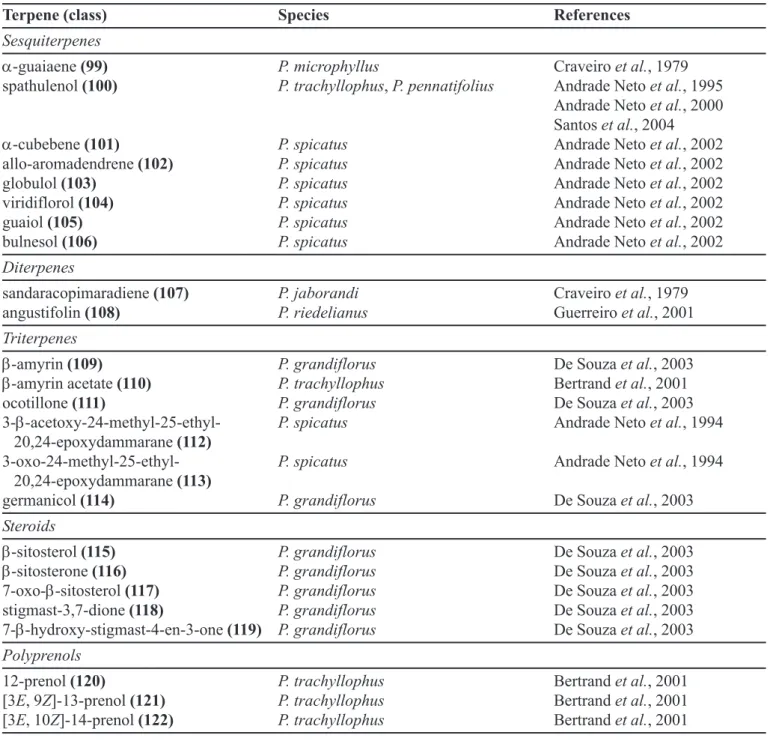
Although the occurrence of triterpenes and steroids in plants is quite common, and these compounds were only reported in three Pilocarpus species (Table VI and Figure 4). For P. grandiflorus the triterpenes b-amyrin (109), occotilone (111) and germanicol (114) were described. The b-amyrin acetate (110) obtained from P. trachyllophus showed a high cytostatic activity against cells of HEp-2 (Gomez et al., 1997).
Additional pharmacological activities, such as angiogenic, antihelminthic, antimicrobial and antitumoral,
were described only for the steroid β-sitosterol (86) (Moon et al., 1999; Villasenor et al., 2002; Singh, Singh, 2003; Awad et al., 2003).
Other secondary metabolites isolated fom Pilocarpus species
Besides alkaloids, coumarins, flavonoids and terpenes there are minor compounds that can occur in some Pilocarpus species. Among these compounds are lignans, hydrocarbons and its alcohols, amides, carboxilic acids, esters and ketones derivatives (Table VII and Figure 5).
Lignans (also L-phenylalanine derivatives) were obtained from two different Pilocarpus species (Table VII). Lignans play an important role in the plant sustentation as cell wall constituents. The lignan lirioresinol B (124), isolated from P. grandiflorus (De Souza et al., 2003), showed antichagasic activity (Sauvain
et al., 1996).
The amide pellitorine (125) was found in P.
trachyllophus (Andrade Neto et al., 1995). This substance is frequently isolated from Piper species and it is widely known as an insecticide (He et al., 2002).
TABLE VI - Terpenoids isolated from Pilocarpus species
Terpene (class) Species References
Monoterpenes
3,7.7-trimethylbicyclo[3.1.1]- P. microphyllus, P. affinis Craveiro et al., 1979
2-heptene (47)
α-pinene (48) P. jaborandi, P. microphyllus, Craveiro et al., 1979
P. affinis, P. spicatus, Santos et al., 1997
P. grandiflorus Andrade Neto et al., 2002
β-pinene (49) P. spicatus, P. grandiflorus Santos et al., 1997
Andrade Neto et al., 2002
canfene (50) P. spicatus Andrade Neto et al., 2002
borneol (51) P. spicatus Andrade Neto et al., 2002
linalool (52) P. spicatus, P. grandiflorus Santos et al., 1997
Andrade Neto et al., 2002
mircene (53) P. jaborandi, P. affinis, P. spicatus, Craveiro et al., 1979
P. grandiflorus Santos et al., 1997
Andrade Neto et al., 2002
E-β-ocimene (54) P. spicatus, P. pennatifolius Andrade Neto et al., 2002
Santos et al., 2004
Z-β-ocimene (55) P. pennatifolius Santos et al., 2004
Limonene (56) P. jaborandi, microphyllus, P. affinis, Craveiro et al., 1979
P. trachyllophus, P. spicatus, Andrade Neto et al., 1995
P. grandiflorus Santos et al., 1997
Andrade Neto et al., 2000, 2002
Sabinene (57) P. spicatus Andrade Neto et al., 2002
δ-3-carene (58) P. spicatus Andrade Neto et al., 2002
α-terpinene (59) P. spicatus Andrade Neto et al., 2002
γ-terpinene (60) P. spicatus Andrade Neto et al., 2002
α-terpineol (61) P. spicatus Andrade Neto et al., 2002
terpinen-4-ol (62) P. spicatus Andrade Neto et al., 2002
p-cimene (63) P. spicatus Andrade Neto et al., 2002
β-felandrene (64) P. spicatus Andrade Neto et al., 2002
1,8-cineole (65) P. spicatus Andrade Neto et al., 2002
Sesquiterpenes
Z,Z-farnesol (66) P. spicatus Andrade Neto et al., 2002
E-nerolidol (67) P. spicatus Andrade Neto et al., 2002
β-bisabolene (68) P. trachyllophus, P. spicatus Andrade Neto et al., 1995
Santos et al., 1997
Andrade Neto et al., 2000, 2002
δ-cadinene (69) P. microphyllus, P. trachyllophus, Craveiro et al., 1979
P. spicatus. P. pennatifolius Andrade Neto et al., 1995 Andrade Neto et al., 2000, 2002 Santos et al., 2004
γ-cadinene (70) P. trachyllophus, P. spicatus Andrade Neto et al., 1995
Santos et al., 1997
Andrade Neto et al., 2000, 2002
germacrene D (71) P. trachyllophus, P. spicatus Andrade Neto et al., 1995
TABLE VI - Terpenoids isolated from Pilocarpus species (continuation)
Terpene (class) Species References
Sesquiterpenes
β-cubebene (72) P. spicatus, P. pennatifolius Andrade Neto et al., 1995
Andrade Neto et al., 2002 Santos et al., 2004
γ-muurolene (73) P. spicatus, P. pennatifolius Andrade Neto et al., 1995
Andrade Neto et al., 2002 Santos et al., 2004
α-muurolene (74) P. spicatus Andrade Neto et al., 2002
germacrene-4-D-ol (75) P. spicatus Andrade Neto et al., 2002
α-cadinol (76) P. spicatus Andrade Neto et al., 2002
cubenol (77) P. spicatus Andrade Neto et al., 2002
T-muurolol (78) P. spicatus Andrade Neto et al., 2002
calacorene (79) P. riedelianus Guerreiro et al., 2001
α-calacorene (80) P. riedelianus Guerreiro eta., 2001
γ-calacorene (81) P. riedelianus Guerreiro et al., 2001
cadalene (82) P. riedelianus Guerreiro et al., 2001
sesquichamaenol (83) P. riedelianus Guerreiro et al., 2001
sesquichamaenol A (84) P. riedelianus Guerreiro et al., 2001
δ-elemene (85) P. spicatus Andrade Neto et al., 2002
germacrene A (86) P. spicatus Andrade Neto et al., 2002
germacrene B (87) P. pennatifolius Santos et al., 2004
selinene (88) P. affinis, P. pennatifolius Craveiro et al., 1979
Santos et al., 2004
β-elemene (89) P. spicatus, P. pennatifolius Andrade Neto et al., 1995
Andrade Neto et al., 2002 Santos et al., 2004
bicyclogermacrene (90) P. spicatus, P. pennatifolius Andrade Neto et al., 2002
Santos et al., 2004
elemol (91) P. spicatus Andrade Neto et al., 2002
β-eudesmol (92) P. spicatus Andrade Neto et al., 2002
cyclosativene (93) P. spicatus Andrade Neto et al., 2002
caryophyllene oxide (94) P. trachyllophus, P. spicatus Andrade Neto et al., 1995
Santos et al., 1997
Andrade Neto et al., 2000, 2002
α-humulene (95) P. microphyllus, P. trachyllophus, Craveiro et al., 1979
P. spicatus, P. grandiflorus, Andrade Neto et al., 1995
P. pennatifolius Santos et al., 1997
Andrade Neto et al., 2000, 2002 Santos et al., 2004
α-copaene (96) P. microphyllus, P. spicatus, Craveiro et al., 1979
P. pennatifolius Andrade Neto et al., 2002
Santos et al., 2004
β-borbonene (97) P. trachyllophus, P. pennatifolius Andrade Neto et al., 1995
Andrade Neto et al., 2002 Santos et al., 2004
β-caryophyllene (98) P. microphyllus, P. trachyllophus, Craveiro et al., 1979
P. spicatus, P. pennatifolius Andrade Neto et al., 1995 Santos et al., 1997
TABLE VI - Terpenoids isolated from Pilocarpus species (continuation)
Terpene (class) Species References
Sesquiterpenes
α-guaiaene (99) P. microphyllus Craveiro et al., 1979
spathulenol (100) P. trachyllophus, P. pennatifolius Andrade Neto et al., 1995
Andrade Neto et al., 2000 Santos et al., 2004
α-cubebene (101) P. spicatus Andrade Neto et al., 2002
allo-aromadendrene (102) P. spicatus Andrade Neto et al., 2002
globulol (103) P. spicatus Andrade Neto et al., 2002
viridiflorol (104) P. spicatus Andrade Neto et al., 2002
guaiol (105) P. spicatus Andrade Neto et al., 2002
bulnesol (106) P. spicatus Andrade Neto et al., 2002
Diterpenes
sandaracopimaradiene (107) P. jaborandi Craveiro et al., 1979
angustifolin (108) P. riedelianus Guerreiro et al., 2001
Triterpenes
β-amyrin (109) P. grandiflorus De Souza et al., 2003
β-amyrin acetate (110) P. trachyllophus Bertrand et al., 2001
ocotillone (111) P. grandiflorus De Souza et al., 2003
3-β-acetoxy-24-methyl-25-ethyl- P. spicatus Andrade Neto et al., 1994
20,24-epoxydammarane (112)
3-oxo-24-methyl-25-ethyl- P. spicatus Andrade Neto et al., 1994
20,24-epoxydammarane (113)
germanicol (114) P. grandiflorus De Souza et al., 2003
Steroids
β-sitosterol (115) P. grandiflorus De Souza et al., 2003
β-sitosterone (116) P. grandiflorus De Souza et al., 2003
7-oxo-β-sitosterol (117) P. grandiflorus De Souza et al., 2003
stigmast-3,7-dione (118) P. grandiflorus De Souza et al., 2003
7-β-hydroxy-stigmast-4-en-3-one (119) P. grandiflorus De Souza et al., 2003
Polyprenols
12-prenol (120) P. trachyllophus Bertrand et al., 2001
[3E, 9Z]-13-prenol (121) P. trachyllophus Bertrand et al., 2001
[3E, 10Z]-14-prenol (122) P. trachyllophus Bertrand et al., 2001
The pattern of n-alkanes is considered an important taxonomic marker in plant classification accordingly to Eglinton et al. (1962). The n-alkanes identified in leaf epicuticular waxes of different Pilocarpus species with a carbon chain ranging from C14 to C33 (Skorupa et al., 1998). An aromatic hydrocarbon (C20)was detected only in P. jaborandi and this substance was considered a marker for the species (Negri et al., 1998).
CONCLUDING REMARKS
Although the medicinal value of pilocarpine is widely recognized, but the importance of other secondary metabolites obtained from Pilocarpus species was not yet well described. The summary of the main bioactive compounds, other than pilocarpine, described for
Pilocarpus species are listed below:
1. From the 16 known Pilocarpus species, alkaloids have only been described in eight species (almost 1 alkaloid/ species) (Table III), and for the majority of them the bioactivity was not yet determined;
2. There are a few reports over the presence of coumarins in Pilocarpus spp., however the pharmacological activities of this class o f compounds are numerous; 3. Flavonoids have been increasingly described as
antioxidant drugs but these compounds were only found in P. trachyllophus (Table V);
4. Only two lignans were isolated from two Pilocarpus
species and one of them has been described as an antichagasic agent (Table VII).
The use of plants in folk medicine has lead scientists
to find a wide variety of active substances of invaluable importance to mankind. Considering the variety of metabolites isolated from Pilocarpus, these species represent a vast research field to be exploited.
RESUMO
Pilocarpus spp.: Revisão sobre sua constituição química e atividades biológicas
Espécies de Pilocarpus têm sido exploradas como única
fonte do alcalóide imidazólico pilocarpina (utilizado no tratamento do glaucoma) desde o isolamento dessa subs-tância até os dias atuais. A maioria das espécies de
Pilocarpus conhecida é nativa do Brasil e, devido à impor-tância medicinal que a pilocarpina possui e ao desmatamento, várias se encontram em risco de extinção. Outros metabólitos secundários entre os quais cumarinas, flavonóides e terpenos foram descritos em espécies desse gênero. Nesta revisão foram relacionados os metabólitos secundários isolados em diversas espécies de Pilocarpus
bem como suas atividades biológicas. Apesar da
varieda-TABLE VII – Miscellaneous secondary metabolites isolated from Pilocarpus species and their respective biological activities
Compound Species Activity References
(-)-episesamin (123) P. trachyllophus - Andrade Neto et al., 1995
lirioresinol B (124) P. grandiflorus Antichagásica De Souza et al., 2003
Sauvain et al., 1996
pellitorine (125) P. trachyllophus Inseticida Andrade Neto et al., 1995
He et al., 2002
eugenol (126) P. pennatifolius Inseticida Santos et al., 2004
Anestésica Park et al.,2000
Antioxidante Ogata et al., 2000
Antifúngica Priyadarsini et al., 1998 Meepagala et al., 2002
N’,N’-dimethyl antranilic acid (127) P. grandiflorus - De Souza et al., 2003
vanilic acid (128) P. grandiflorus - De Souza et al., 2003
siringaldehyde (129) P. grandiflorus - De Souza et al., 2003
2-undecanone (130) P. spicatus - Santos et al., 1997
P.trachyllophus Andrade Neto et al., 1995
P. jaborandi Andrade Neto et al., 2000, 2002
2-tridecanone (131) P. spicatus - Santos et al., 1997
P.trachyllophus Andrade Neto et al., 1995
P. jaborandi Andrade Neto et al., 2000, 2002
1-hydroxy-2-tridecanone (132) P. trachyllophus - Andrade Neto et al., 1996
2-hydroxy-ethyl-glutarate (133) P. racemosus - Compagnone & Rodriguez, 1993
methyl hexadecanoate (134) P. pennatifolius - Santos et al., 2004
hexanol (135) P. pennatifolius - Santos et al., 2004
undecanol (136) P. pennatifolius - Santos et al., 2004
1-phenyl-5-vinyl-5,9-dimethyl- P. jaborandi - Negri et al., 1998
decane (137) Skorupa et al., 1998
tridecane (138) P. pennatifolius - Santos et al., 2004
pentadecane (139) P. pennatifolius - Santos et al., 2004
n-alcanes (140) P. alatus, - Skorupa et al., 1998
P. carajaensis,
P. giganteus,
P. sulcatus, P. pauciflorus,
P. jaborandi,
P. grandiflorus,
P. riedelianus,
de de estruturas e as importantes atividades biológicas já descritas na literatura para as outras classes de metabólitos secundários, ainda há um vasto campo de estudo para as espécies de Pilocarpus.
UNITERMOS: Rutaceae. Pilocarpus spp. Metabólitos secundários. Atividades biológicas.
REFERENCES
ALBUQUERQUE, B.W.P. Rutaceae do Estado da Guanabara. An. Acad. Bras. Ciênc., v. 40, n. 4, p. 500, 1968. Apud: ALBUQUERQUE, B.W.P. Rutaceae. In.: RIZZO J.A.,org. Flora do Estado de Goiás. Goiânia: Editora da UFG, 1985. v. 6. 35 p.
ALBUQUERQUE, B.W.P. Rutaceae. In: RIZZO J.A.,org. Flora do Estado de Goiás. Goiânia: Editora da UFG, 1985. v. 6. 35 p.
AMARO-LUIS, J.M.; MASSANET, G.M.; PANDO, E.; RODRIGUEZ LUIZ, F. New coumarins from
Pilocarpus goudotianus. Planta Med., v. 56, p. 304-306, 1990.
ANDRADE NETO, M.; SILVEIRA, E.R.; BRAZ-FILHO, R.; GAMBARDELA, M.T.P.; SANTOS, R.H.A. 24-methyl-25-ethyldammarane derivatives from Pilocarpus spicatus. Phytochemistry, v. 35, n. 3, p. 739-743, 1994.
ANDRADE NETO, M.; MAFEZOLI, J.; CUNHA, U.A.; SILVEIRA, S.C.; SILVEIRA, E.R. Volatile constituents of Pilocarpus trachyllophus Holmes. J. Essent. Oil Res., v. 7, p. 671-674, 1995.
ANDRADE NETO, M.; MENDES, P.H.; SILVEIRA, E.R. An imidazole alkaloid and other constituents from
Pilocarpus trachyllophus. Phytochemistry, v. 42, n. 3, 885-887, 1996.
ANDRADE NETO, M.; CUNHA, U.A.; MAFEZOLI, J.; SILVEIRA, E.R. Volatile constituents of Pilocarpus trachyllophus Holmes and Pilocarpus jaborandi Holmes (Rutaceae). J. Essent. Oil Res., v. 12, p. 769-774, 2000.
ANDRADE NETO, M.; CUNHA, U.A.; MAFEZOLI, J.; SILVEIRA, E.R. Volatile constituents of different populations of Pilocarpus spicatus Saint Hill. (Rutaceae) from the Northeast of Brazil. J. Essent. Oil Res., v. 14, p. 319-324, 2002.
ARTHUR, H.R.; WUI, W.H.; MA, C.N. An examination of the Rutaceae of Hong Kong (Part I), Flavonoid glycosides from Zanthoxylum species and occurence of optically active hesperidin. J. Chem. Soc., p. 632-635, 1956.
ASHWOOD-SMITH, M.J.; TOWERS, G.H.; ABRAMOWSKI, Z.; POULTON, G.A.; LIU, M. Photobiological studies with dictamnine, a furoquinoline alkaloid. Mutat. Res., v. 102, n. 4, p. 401-412, 1982.
AWAD, A.B.; ROY, R.; FINK, C.S. b-sitosterol, a plant sterol induces apoptosis and activates key caspases in MDA-MB-231 human breast cancer cells. Oncol. Rep., v.10, n. 2, p. 497- 500, 2003.
BALSAM, G.; VOIGTLÄNDER, H.W. A psychotropic alkaloid from Pilocarpus organensis. Archiv. Pharm., v.311, n. 78, p. 1016-1018, 1978.
BATTERSBY, A.R.; OPENSHAW, H.T. The imidazole
alkaloids. In: MANSKE, R.F.H.; HOLMES, H.L., eds.
The alkaloids. San Diego: Academic Press, 1953. v. 20, p. 221-246.
BERTRAND, C.; FABRE, N.; MOULIS, C. Constituents of
Pilocarpus trachylophus. Fitoterapia, v. 72, p. 844-847, 2001.
BROCHMANN-HANSSEN, E.; NUNES, M.A.; OLAH, C.K. On the biosynthesis of pilocarpine. Planta Med., v. 28, p. 1-5, 1975.
CALCAGNO, M.P.; COLL, J.; LLORIA, J.; FAINI, F.; ALONSO-AMELOT, M.E. Evaluation of synergism in feeding deterrence of some furanocoumarins on
Spodoptera littoralis. J. Chem. Ecol., v. 28, n. 1, 175-191, 2002.
CHIOU, W.F.; HUANG, Y.L.; CHEN, C.F.; CHEN, C.C.
Vasorelaxing effect of coumarins from Cnidium
monnieri on rabbit corpus cavernosum. Planta Med., v. 67, n. 3, p. 282-284, 2001.
COMPAGNONE, R.; RODRIGUEZ, M.C. Coumarins from
Pilocarpus racemosus. Fitoterapia, v. 64, n. 6, p. 557, 1993.
CORRÊA, M.P. Dicionário de Plantas úteis do Brasil e das exóticas cultivadas. Rio de Janeiro: Imprensa Nacional, 1969. v. 4. 374 p.
CORRÊA, M.P. Dicionário de Plantas úteis do Brasil e das exóticas cultivadas. Rio de Janeiro: Imprensa Nacional, 1974. v. 5. 256 p.
CRAVEIRO, A.A.; ANDRADE, C.H.S.; MATOS, F.J.A.; ALENCAR, J.W. Essential oils from Brazilian Rutaceae. I Genus Pilocarpus. J. Nat. Prod., v. 42, n. 6, p. 669-671, 1979.
DEWICK, P.M. Medicinal natural products: a biosynthetic approach. New York: John-Willey & Sons, 2000. 466 p.
EGLINTON, G.; HAMILTON, R.J.; RAPHAEL, R.A.; GONZALEZ, A.G. Hydrocarnbon constituents of the wax coatings of plants leaves: a taxonomic survey.
Phytochemistry, v. 1, p. 89-102, 1962.
FIGUEIREDO, A.C.S. Achillea millefolium ssp. millefolium: produção de metebólitos secundários in vivo e in vitro. 1992. 208 p. [Tese de Doutoramento, Universidade de Lisboa].
GARG, A.; GARG, S.; ZANEVELD, L.J.D.; SINGLA, A.K. Chemistry and pharmacology of the Citrus bioflavonoid Hesperidin. Phytother. Res., v. 15, p. 655-669, 2001.
GERRARD, A.W. Alkaloid and active principle of jaborandi.
Pharmaceutical Journal, v. 5, p. 865, 1875. Apud: HOLMSTED, B., WASSEN, S.H.; SCHULTES, R.E.
Jaborandi: An interdisciplinary appraisal. J.
Ethnopharmacol., v. 1, p. 3-21, 1979.
GUERREIRO, G.; FERNANDES, J.B.; VIEIRA, P.C.; DA SILVA, M.F.G.F.; RODRIGUES FILHO, E.; VICTOR, S.R.; MAGALHÃES, C.; BUENO, O.C.; HEBLING, M.J.A.; PAGNOCCA, F.C. Sesquiterpenos e cumarinas bioativos de Pilocarpus riedelianus. In: REUNIÃO ANUAL DA SOCIEDADE BRASILEIRA DE
QUÍMICA, 24., Poços de Caldas, 2001. Livro de
Resumos. São Paulo: SBQ, 2001. PN-008.
GOMEZ, M.A.; SÁENZ, M.T.; GARCIA, M.D.; AHUMADA, M.C.; DE LA PUERTA, R. Cytostatic activity againsty HEp-2 cells of methanolic extracts from
Viscum cruciatum Sieber parasitic on Crataegus monogyna Jacq. and two isolated principles. Phytother. Res., v. 11, p. 240-242, 1997.
HE, W.; van PUYVELDE, L.; de KIMPE, N.; VERBRUGGEN, L.; ANTHONISSEN, K.; van der FLAAS, M.; BOSSLAERS, J.; MATHENGE, S.G.; MUDIDA, F.P. Chemical constituents and biological activities of Zanthoxylum usambarense. Phytother. Res., v. 16, p. 66-70, 2002.
HARDY, M.E., Sur le jaborandi (Pilocarpus pinnatus).
Bulletin Societe Chimi Paris, v. 24, p. 497-500, 1875. Apud: HOLMSTED, B.; WASSEN, S.H.; SCHULTES, R.E. Jaborandi: An interdisciplinary appraisal. J. Ethnopharmacol., v. 1, p. 3-21, 1979.
HOLMSTED, B.; WASSEN, S.H.; SCHULTES, R.E.
Jaborandi: An interdisciplinary appraisal. J.
Ethnopharmacol., v. 1, p. 3-21, 1979.
HOROWITZ, R.M.; GENTILI, B. Flavonoids of Citrus.
Tetrahedron, v. 19, p. 773-782, 1963.
HOULT, J.R.; PAYA, M. Pharmacological and biochemical actions of simple coumarins: natural products with therapeutic potential. Gen. Pharmacol., v. 27, n. 4, 713-722, 1996.
HUANG, L.; KASHIWADA, Y.; COSENTINO, L.M.; FAN, S.; CHEN, C.H.; MCPHAIL, A.T.; FUJIOKA, T.; MIHASHI, K.; LEE, K.H. Anti-Aids agents 15. Synthesis and anti-HIV activity of dihydroseselins and related analogs. J. Med. Chem., v. 37, n. 23, p. 3947- 3955, 1994.
JOWETT, H.A.D. Pilocarpine and the alkaloids of Jaborandi leaves. J. Chem. Soc., v. 77, p. 473-499, 1900.
KAASTRA, R.C. New taxa and combinations in Rutaceae.
Acta Botanica Neerlandica, v. 26, n. 6, p. 471-488, 1977. Apud: SKORUPA, L.A.; SALATINO, M.L.F.; SALATINO, A. Hydrocarbons of leaf epicuticular waxes of Pilocarpus (Rutaceae): Taxonomic meaning.
Biochem. Syst. Ecol., v. 26, p. 655-662, 1998.
KANES, K.; TISSERAT, B.; BERHOW, M.; VANDERCOOK, C. Phenolic composition of various tissues of Rutaceae species. Phytochemistry, v. 324, p. 967-974, 1993.
KOROLKOVAS, A. Dicionário Terapêutico Guanabara. Rio de Janeiro: Guanabara-Koogan, 1995/1996. p. 20.2-20.3.
LOUREIRO, A.A.; SILVA, M.F. Catálogo das madeiras da Amazônia. Belém: SUDAM, 1968. v. 2, p. 261-266.
MACÍAS, F.A.; GALINDO, J.C.C.; MASSANET, G.M.; RODRIGUEZ-LUIZ, F.; ZUBIA, E. Allelochemicals from Pilocarpus goudotianus leaves. J. Chem. Ecol., v. 19, n. 7, p. 1371-1379, 1993.
MAFEZOLI, J.; VIERA, P.C.; FERNANDES, J.B.; da
SILVA, M.F.G.F.; DE ALBUQUERQUE, S. In vitro
activity of Rutaceae species against the trypomastigote form of Trypanosoma cruzy. J. Ethnopharmacol., v. 73, p. 335- 340, 2000.
MANDERFELD, M.M.; SCHAFER, H.W.; DAVIDSON, P.M.; ZOLLOTA, E.A. Isolatio and identification of antimicrobial furocoumarins from parsley. J. Food Prot., v. 60, n. 2, p. 72-77, 1997.
MARDER, M.; PALADINI, A.C. GABAA-receptor ligands of flavonoid structure. Curr. Top. Med. Chem., v. 2, p. 853-863, 2002.
MARDER, M.; VIOLA, H.; WASOWSKI, C.; FERNANDEZ, S.; MEDINA, J.H.; PALADINI, A.C. 6-Methylapigenin and hesperidin: new valeriana flavonoids with activity on the CNS. Pharmacol. Biochem. Behavior, v. 75, n. 3, p. 537-545, 2003.
MAKERSBY, W.R. Oxidative stess hypothesis in Alzheimer’s disease. Free Radical Biol. Med., v. 23, p. 134-147, 1997.
MEEPAGALA, K.M.; STURTZ, G.; WEDGE, D.E. Antifungal constituents of the essential oil fraction of
Artemisia dracunculus L. var dracunculus. J. Agric. Food Chem., v. 50, n. 24, p. 6989-6992, 2002.
MEDINA, J.H.; VIOLA, H.; WOLFMAN, C.; MARDER, M.; WASOWKI, C.; CALVO, D. Flavonoids: a new family of benzodiazepine receptor ligands. Neurochem. Res., v. 22, n. 4, p. 419-425, 1997.
MESTER, I. The occurrence of the alkaloids in Rutaceae.
Fitoterapia, v. 44, p.123-152, 1973.
MIDDLETON, E.J. The flavonoids. Trends Pharmacol. Sci., v. 8, p.335-338, 1984.
MILLER, L.J. Oral pilocarpine for radiation-induced xerostomia. Cancer Bull.(Houston), v. 45, n. 6, p. 549-550, 1993.
MOON, E.J.; LEE, Y.M.; LEE, O.H.; LEE, M.J.; LEE, S.K.; CHUNG, M.H.; PARK, Y.I.; SUNG, C.K.; CHOI, J.S.; KIM, K.W. A novel angiogenic factor derived from Aloe vera gel: b-sitosterol, a plant sterol. Angiogenesis, v.3, n. 2, p. 117- 123, 1999.
MÜLLER, A.H.; DEGASPARI, L.R.O.; VIEIRA, P.C.; da SILVA, M.F.G.; FERNANDES, J.B.; PIRANI, J.R. 3-methoxyfuranocoumarins from Pilocarpus riedelianus.
Phytochemistry, v. 34, n. 2, p. 585-586, 1993.
MURAKAMI, A.; KUKI, W.; TAKAHASHI, Y.; YONEI, H.; NAKAMURA, Y.; OHTO, Y.; OHIGASHI, H.; KOSHIMIZU, K. Auraptene, a citrus coumarin, inhibits 12-O-tetradecanoylphorbol-13-acetate-induced tumor promotion in ICR mouse skin, possibly through suppression of superoxide generation in leukocytes. Jan. J. Cancer Res., v. 88, n. 5, p. 443-452, 1997.
NEGRI, G.; SALATINO, M.L.F.; SALATINO, A.; SKORUPA, L.A. An aromatic hydrocarbon from the foliar epicuticular wax of Pilocarpus jaborandi.
Phytochemistry, v. 49, n. 1, p. 127-129, 1998.
NGWENDSON, J.N.; BEDIR, E.; EFANGE, S.M.; OKUNJI, C.O.; IWU, M.M.; SCHUSTER, B.G.; KHAN, I.A. Constituents of Peucedanum zenkeri seeds and their antimicrobial effects. Pharmazie, v. 58, n. 8, p. 587-589, 2003.
OGATA, M.; HOSHI, M.; URANO, S.; ENDO, T. Antioxidant activity of eugenol and related monomeric and dimeric compounds. Chem. Pharm. Bull., v. 48, n. 10, p.1467-1469, 2000.
PARK, I.K.; LEE, H.S.; LEE, S.G.; PARK, J.D.; AHN, Y.J. Inseticidal and fumigant activities of Connamomun cassia bark-derived materials against Mechoris ursulus
(Coleopetra: attelabidae). J. Agric. Food Chem., v. 48, n. 6, p. 2528-2531, 2000.
PAVÃO F.; CASTILHO M.S.; PUPO M.T.; DIAS R.L.A.; CORREA A.G.; FERNANDES J.B.; SILVA M.F.G.F.; MAFEZOLI J.; VIEIRA P.C.; OLIVA G. Structure of
Trypanosoma cruzi glycossomal glyceraldehyde-3-phosphate dehydrogenase complexed with chalepin, a natural product inhibitor, at 1.95 Å resolution. FEBS Lett., v. 520, p. 13-17, 2002.
PAYO HILL, A.; DOMINICIS, M.E.; OQUENDO, M.; SARDUY, R. Obtención de pilocarpina a partir de
Pilocarpus racemosus Vahl. Rev. Cubana Farm., 1995. Disponível em: www.infomed.sld.cu/revistas/far/ vol29_2_95/far12295.htm.. Acesso em: 22 abr. 2001.
PINHEIRO, C.U.B. Jaborandi (Pilocarpus sp., Rutaceae): a wild species and its rapid transformation into a crop.
Econ. Bot., v. 51, n. 1, p.49-58, 1997.
PIRANI, J.R. Estudos taxonômicos em Rutaceae: Revisão de Helieta e Balfourodendron (Pteleinae). Análise cladística de Pteleinae. Sinópse de Rutaceae do Brasil. São Paulo. 1999. p. irreg. [Tese de Livre docência, Instituto de Biologia, Universidade de São Paulo, São Paulo].
PYMAN, F.L. Pilosine: a new alkaloid from Pilocarpus microphyllus. J. Chem. Soc., v. 101, p. 2206-2271, 1912.
PRIYADARSINI, K.I.; GUHA, S.N.; RAO, M.N. Physico-chemical properties and antioxidant activities of methoxy phenols. Free Radical Biol. Med., v. 24, n. 6, p. 933-941, 1998.
RIBA, J.; RODRIGUEZ-FORNELLS, A.; BARBANOJ, M.J. Effects of ayahuasca on sensory and sensorimotor gating in humans as measured by P50 suppression and prepulse inhibition of the startle reflex, respectively.
Psychopharmacol., v. 165, n. 1, p. 18-28, 2002.
SANTOS, F.A.; CUNHA, G.M.A.; VIANE, G.S.B.; RAO, V.S.N.; MANOEL, A.N.; SILVEIRA, E.R. Antibacterial activity of essential oils from Psidium and Pilocarpus
species of plants. Phytother. Res., v. 11, p. 67-69, 1997.
SANTOS, A.P.; CORNÉLIO, M.L.; LIMBERGER, R.P.; APEL, M.A.; HENRIQUES, A.T.; MORENO, P.R.H.
Analysis of the Volatile Oil from Pilocarpus
pennatifolius Lemmaire (Rutaceae) Leaves by GC/MS.
Flavour Fragrance J., v. 19, n. 4, p. 325-326, 2004.
SAUVAIN, M.; KUNESH, N.; POISSON, J.; GANTIER, J.C.; GAYRAL, P.; DEDET, J.P. Isolation of leishmanicidal triterpenes and lignans from the Amazonian liana Dolicarpus dentatus (Dilleniaceae).
Phythother. Res., v. 10, p. 1-4, 1996.
SINGH, B.; SINGH, S. Antimicrobial activity of terpenoids from Trichodesma amplexicaule Roth. Phytother. Res., v. 17, n. 7, p. 814- 816, 2003.
SHAW, C.Y.; CHEN, C.H.; HSU, C.C.; CHEN, C.C.; TSAI, Y.C. Antioxidant properties of scopoletin isolated from
Sinomonium acutum. Phytother. Res., v. 17, n. 7, p. 823-825, 2003.
SKORUPA, L.A. Revisão taxonômica de Pilocarpus Vahl
(Rutaceae). São Paulo. 1996. 426 p. [Tese de doutoramento, Instituto de Biologia, Universidade de São Paulo].
SKORUPA, L.A.; SALATINO, M.L.F.; SALATINO, A. Hydrocarbons of leaf epicuticular waxes of Pilocarpus
(Rutaceae): Taxonomic meaning. Biochem. Systemat. Ecol., v. 26, p. 655-662, 1998.
De SOUZA, R.C.; FERNANDES, J.B.; VIEIRA, P.C.; da SILVA, M.F.G.F.; RODRIGUES FILHO, E.; PIRANI, J.R. Constituintes químicos de Pilocarpus grandiflorus
(Rutaceae). In: REUNIÃO ANUAL DA SOCIEDADE BRASILEIRA DE QUÍMICA, 26., Poços de Caldas,
2003. Livro de Resumos. São Paulo: SBQ, 2003,
PN-203.
De SOUZA, R.C., FERNANDES, J.B., VIEIRA, P.C., Da SILVA, M.F.G.F., RODRIGUES FILHO, E., BUENO, O.C., HEBLING, M.J.A., ZANCUL, M.S.. Alcalóide furoquinolínico de Pilocarpus grandiflorus e sua ação sobre o fungo simbionte se formigas cortadeiras. In: REUNIÃO ANUAL DA SOCIEDADE BRASILEIRA DE QUÍMICA, 25., Poços de Caldas, 2002. Livro de Resumos. São Paulo: SBQ, 2002, PN-130.
SU, T.L.; LIN, F.W.; TENG, C.M.; CHEN, K.T.; WU, T.S. Antiplatelet aggregation principles from the stem and root bark of Melicope triphylla. Phytother. Res., v. 12, p. S74-S76, 1998.
TEDESCHI, E.; KAMIONSKY, J.; FACKLER, S.; SAREL, S. The isolation of pure pilosine and epi-isopilosine from leaves of Pilocarpus jaborandi. Israel J. Chem., v. 11, n. 5, p. 731-733, 1973.
TENG, C.M.; LI, H.L.; YU, S.M.; WU, T.S.; HUANG, S.C.;
PENG, I.S.; HUANG, T.F.A.S.I.A. Ca+2 channel
blocking effects of 3 coumarin compounds, isolated from
Citrus grandis, in rat thoracic aorta. Pac. J. Pharmacol., v. 7, n. 2, p. 115-120, 1992.
THIRUGNANASAMBANTHAN, P.; VISWANATHAN, S.; MYTHIRAYEE, C.; KRISHNAMURTY, V.; RAMACHANDRAN, S.; KAMESWARAN, L. Analgesic activity of certain flavone derivatives: a structure-activity study. J. Ethnopharmacol., v. 28, p. 207-214, 1990.
VALDEZ, I.H.; WOLFF, A.; ATKINSON, J.C.; MACYNSKY, A.A.; FOX, P.C. Use of pilocarpine during head and neck radiation theraphy to reduce xerostomia and salivary dysfunction. Cancer, v. 71, n. 5, p.1848-1851, 1993.
VILLASENOR, I.M.; ANGELADA, J.; CANLAS, A.P.; ECHEGOYEN, R. Bioactivity studies on b-sitosterol and its glucoside. Phytother. Res., v. 16, n. 5, p. 417- 421, 2002.
VOIGTLÄNDER, H.W.; ROSENBERG, W. Über der isopilosin und pilosin. Arch. Pharm., v. 292, p. 579-585, 1959.
WEBER, U. Ueber die Wikung des Pilocarpium muriaticum.
Central. Med. Wiss., v. 44, p. 409-422, 1876. Apud: HOLMSTED, B.; WASSEN, S.H.; SCHULTES, R.E.
Jaborandi: An interdisciplinary appraisal. J.
Ethnopharmacol., v. 1, p. 3-21, 1979.
YU, S.M.; KO, F.N.; SU, M.J.; WU, T.S.; WANG, M.L.; HUANG, T.F.; TENG, C.M. Vasorelaxing effect in rat thoracic aorta caused by fraxinellone and dictamine isolated from the Chinese herb Dictamnus dasycarpus
Turcz: comparison with cromakalim and Ca2+ channel
blockers. Naunyn Schmiedebergs Arch. Pharmakol., v. 345, n. 3, p. 349-555, 1992.