Printed in Brazil - ©2006 Sociedade Brasileira de Química 0103 - 5053 $6.00+0.00
Article
*e-mail: [email protected]
#Present Address: Instituto de Estudos Avançados, Centro Técnico
Aeroespacial, Rodovia dos Tamoios, km 5,5, 12228-840, São José dos Campos, SP – Brazil
Kinetic Modeling for Chemiluminescent Radicals in Acetylene Combustion
Carla S. T. Marques,*,# Leandro H. Benvenutti and Celso A. Bertran
Instituto de Química, Universidade Estadual de Campinas, CP 6154, 13083-970 Campinas-SP, Brazil
Uma modelagem cinética foi avaliada para reproduzir a quimiluminescência experimental dos radicais excitados OH*, CHO*, CH* e C2* formados na combustão de C2H2/O2 em uma
câmara fechada. Um mecanismo reacional com 37 espécies e 106 reações elementares foi validado para a combustão de C2H2/O2 com Φ=1.00 e Φ=1.62, através das medidas de quimiluminescência. Para isso foram incluídas reações de formação e de decaimento dos radicais excitados. As simulações foram realizadas com o pacote KINAL; o programa DIFF foi utilizado para resolver as equações diferenciais ordinárias e o programa ROPA para realizar a análise das velocidades de produção. Houve uma boa concordância entre os perfis de quimiluminescência experimental e simulado de todos os radicais e para ambas reações. Os resultados mostraram que o CH tem um papel central na formação dos radicais. As reações: H + O2 = OH* + O; CH + O = CHO*; C2H + O2 = CH* + CO2 e CH2 + C = C2* + H2 são as principais rotas reacionais
para reproduzir os perfis experimentais.
Kinetic modeling to reproduce the experimental chemiluminescence of OH*, CHO*, CH* and C2* excited radicals formed in C2H2/O2 combustion in a closed chamber was evaluated. A
reaction mechanism with 37 species and 106 elementary reactions for C2H2/O2 combustion at
Φ=1.00 and Φ=1.62 was validated through chemiluminescence measurements, where formation and decay reactions of excited radicals are included. KINAL package was used for simulations. Ordinary differential equations were solved by the DIFF program and production rate analysis were acquired by the ROPA program. There was good agreement between experimental and simulated chemiluminescence profiles of all radicals for both combustions. The results showed CH has a meaningful role in the production of excited radicals. Reactions: H + O2 = OH* + O; CH + O = CHO*; C2H + O2 = CH* + CO2 and CH2 + C = C2* + H2 were the main reactions paths used to reproduce the experimental profiles.
Keywords: reaction mechanism, chemiluminescence, acetylene, combustion, closed chamber
Introduction
Acetylene is one of the major intermediates in any hydrocarbon flame and its oxidation is relevant to important phenomena and chemical processes occurring in the combustion of hydrocarbon fuels.1-3 Acetylene
plays a role in processes like polycyclic aromatic hydrocarbons (PAH), soot and prompt-NO formation, and chemiionization and chemiluminescence in combustion chemistry, due to its oxidation products, which are highly reactive small radicals, such as CHCO, CH2, CH and C2H.1-3 Consequently, the oxidation
chemistry of acetylene has a significant influence on
mechanisms involved in heavier hydrocarbon flames and, thus, the kinetic modeling of acetylene combustion is of great significance.
However, most computational studies on combustion mechanisms, where acetylene itself is the principal fuel, have focused on laminar flames and benzene formation was the main concern.4-8 Very little attention has been
directed to the chemistry of small hydrocarbon radicals produced in acetylene flames.9-11
Kinetic modeling results usually describe con-centration profiles of stable species and free radicals in the ground electronic states that can be validated by experimental data, which have been generally obtained using molecular-beam mass spectrometry and laser induced fluorescence.5,6,10,12,13
they are intermediate species with short lifetimes that characterize the reaction zones, where the reagents are principally consumed. Thus, they are suitable to use in following the chemistry of small species and other features of the combustion reactions.
In this work, a mechanism is proposed and validated for acetylene combustion in a small closed chamber, where fixed C2H2/O2 premixed amounts at a given initial pressure were ignited, using chemiluminescence data. To validate the proposed mechanism the reactions for excited radical formation and decay are considered and the simulated and experimental chemiluminescence profiles resulting from decay of excited radicals were compared. Based on the analysis of production rates of the kinetic modeling established, the key reaction paths for the production of the excited radicals are also identified.
Experimental
Experimental setup
The combustion system used to obtain the experi-mental chemiluminescence profiles of OH*, CHO*, CH* and C2* excited radicals is the same as that previously reported14 and thus, will be described briefly.
The combustion reactions were carried out in a closed chamber with constant small volume (ca. 200 ml). The gaseous mixtures were prepared using a vacuum manifold to introduce acetylene and oxygen directly into the combustion chamber at a fixed initial composition and pressure. The combustible mixture was ignited by a spark plug at the center of the combustion chamber.
The light emitted from the reaction inside the whole chamber was analyzed by a monochromator (Oriel, 77200), detected simultaneously by a photodiode and a photomultiplier (Burle, 1P28A) and recorded by an oscilloscope (Nicolet, 450). Once the combustion of the fixed mixture amount is initiated, the large number of species produced reacts among themselves and with the original components of the initial mixture, until the reaction rate falls off, while exhibiting a defined chemiluminescence time behavior.
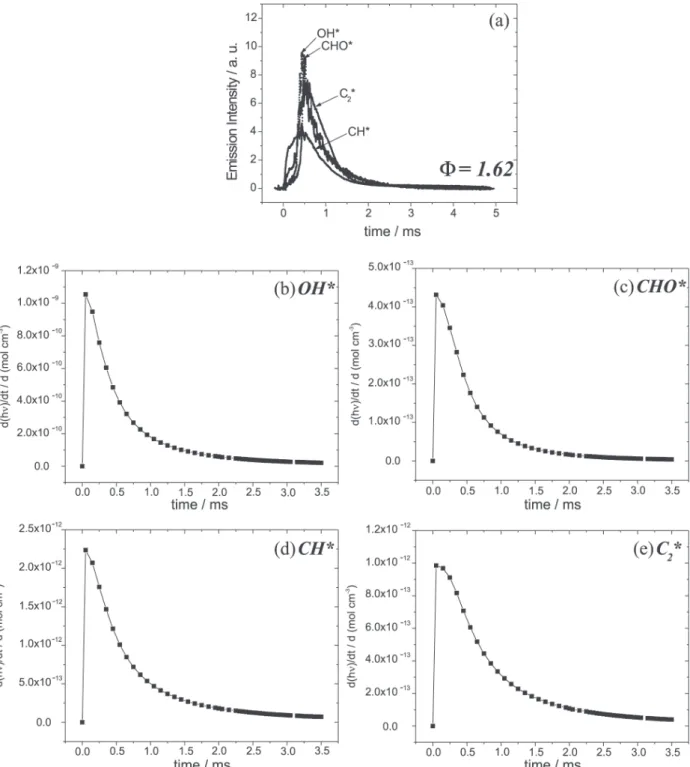
The total chemiluminescences produced in the stoichiometric (Φ=1.00) and fuel-rich (Φ=1.62) C2H2/O2 flames at 140 torr were measured setting the diffraction grating of the monochromator to reflect the light emitted
from these processes ( , where S.R. is the
stoichiometric ratio for C2H2 + O2 = CO2 + H2O reaction). Chemiluminescence profiles as a function of time from our previous work14 for each emitter at the heads of the
emission bands for OH* (A2Σ → X2Π), CHO* (A2Π →
X2A’), CH* (A2∆ → X2Π) and C 2* (A
3Π → X3Π) excited
radical transitions, for both stoichiometric and fuel-rich flames, are also presented.
Calculation methods
Numerical methods for kinetic modeling have been fully discussed in the literature and thus will only be described briefly.15-18 The kinetic model can be expressed
by a set of coupled ordinary differential equations. The equation system is described as: dYi/dt = f(Yi(t),...,Yj(t),t,k), where Yi represents the chemical species i and k represents the vector of the kinetic parameters. In this work, we have used the KINAL program package,19 which is a public
domain program based on the Runge-Kutta-4-semi-implicit method.20 The system of coupled ordinary
differential equations are automatically generated and solved by the DIFF program of the KINAL package.
The classic method for the study of the reaction relevance is the production rate analysis21,22 and this was
carried out by the ROPA program of the KINAL package. The production rate analysis requires calculation of the Pij matrix elements, which show the contribution of reaction j to the rate of production of species i.23,24
Reaction mechanism
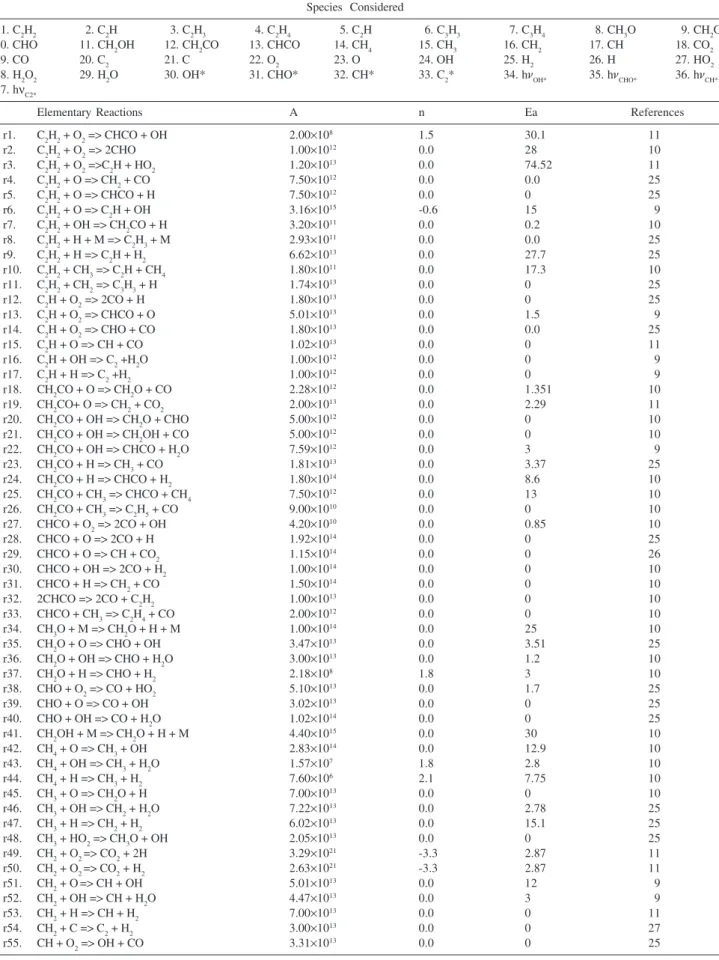
The proposed reaction mechanism for C2H2/O2 homogeneous combustion developed in this study consists of 37 species and 106 elementary reactions, as listed in Table 1. These were proposed in order to reproduce the experimental chemiluminescences of OH*, CHO*, CH* and C2* excited radicals obtained in an earlier study for stoichiometric and fuel-rich C2H2/O2 combustion in a closed chamber at 140 torr.14
The starting mechanism was based on the studies of Eraslan and Brown9 and Hidaka et al.10 with the addition of
Table 1. Optimized reaction mechanism for C2H2/O2 combustions. Reaction rate coefficients are presented in the form k = A Tn exp(-Ea/RT) and units are
in cm3, mol, s, K and kcal mol-1, respectively
Species Considered
01. C2H2 02. C2H 03. C2H3 04. C2H4 05. C2H 06. C3H3 07. C3H4 08. CH3O 09. CH2O
10. CHO 11. CH2OH 12. CH2CO 13. CHCO 14. CH4 15. CH3 16. CH2 17. CH 18. CO2
19. CO 20. C2 21. C 22. O2 23. O 24. OH 25. H2 26. H 27. HO2
28. H2O2 29. H2O 30. OH* 31. CHO* 32. CH* 33. C2* 34. hνOH* 35. hνCHO* 36. hνCH*
37. hν
C2*
Elementary Reactions A n Ea References
r1. C2H2 + O2 => CHCO + OH 2.00×10⁸ 1.5 30.1 11
r2. C2H2 + O2 => 2CHO 1.00×10¹² 0.0 28 10
r3. C2H2 + O2 =>C2H + HO2 1.20×10¹³ 0.0 74.52 11
r4. C2H2 + O => CH2 + CO 7.50×10¹² 0.0 0.0 25
r5. C2H2 + O => CHCO + H 7.50×10¹² 0.0 0 25
r6. C2H2 + O => C2H + OH 3.16×10¹⁵ -0.6 15 9
r7. C2H2 + OH => CH2CO + H 3.20×10¹¹ 0.0 0.2 10
r8. C2H2 + H + M => C2H3 + M 2.93×10¹¹ 0.0 0.0 25
r9. C2H2 + H => C2H + H2 6.62×10¹³ 0.0 27.7 25
r10. C2H2 + CH3 => C2H + CH4 1.80×10¹¹ 0.0 17.3 10
r11. C2H2 + CH2 => C3H3 + H 1.74×10¹³ 0.0 0 25
r12. C2H + O2 => 2CO + H 1.80×10¹³ 0.0 0 25
r13. C2H + O2 => CHCO + O 5.01×10¹³ 0.0 1.5 9
r14. C2H + O2 => CHO + CO 1.80×10¹³ 0.0 0.0 25
r15. C2H + O => CH + CO 1.02×10¹³ 0.0 0 11
r16. C2H + OH => C2 +H2O 1.00×10¹² 0.0 0 9
r17. C2H + H => C2 +H2 1.00×10¹² 0.0 0 9
r18. CH2CO + O => CH2O + CO 2.28×10¹² 0.0 1.351 10
r19. CH2CO+ O => CH2 + CO2 2.00×10¹³ 0.0 2.29 11
r20. CH2CO + OH => CH2O + CHO 5.00×10¹² 0.0 0 10
r21. CH2CO + OH => CH2OH + CO 5.00×10¹² 0.0 0 10
r22. CH2CO + OH => CHCO + H2O 7.59×10¹² 0.0 3 9
r23. CH2CO + H => CH3 + CO 1.81×10¹³ 0.0 3.37 25
r24. CH2CO + H => CHCO + H2 1.80×10¹⁴ 0.0 8.6 10
r25. CH2CO + CH3 => CHCO + CH4 7.50×10¹² 0.0 13 10
r26. CH2CO + CH3 => C2H5 + CO 9.00×10¹⁰ 0.0 0 10
r27. CHCO + O2 => 2CO + OH 4.20×10¹⁰ 0.0 0.85 10
r28. CHCO + O => 2CO + H 1.92×10¹⁴ 0.0 0 25
r29. CHCO + O => CH + CO2 1.15×10¹⁴ 0.0 0 26
r30. CHCO + OH => 2CO + H2 1.00×10¹⁴ 0.0 0 10
r31. CHCO + H => CH2 + CO 1.50×10¹⁴ 0.0 0 10
r32. 2CHCO => 2CO + C2H2 1.00×10¹³ 0.0 0 10
r33. CHCO + CH3 => C2H4 + CO 2.00×10¹² 0.0 0 10
r34. CH3O + M => CH2O + H + M 1.00×10¹⁴ 0.0 25 10
r35. CH2O + O => CHO + OH 3.47×10¹³ 0.0 3.51 25
r36. CH2O + OH => CHO + H2O 3.00×10¹³ 0.0 1.2 10
r37. CH2O + H => CHO + H2 2.18×10⁸ 1.8 3 10
r38. CHO + O2 => CO + HO2 5.10×10¹³ 0.0 1.7 25
r39. CHO + O => CO + OH 3.02×10¹³ 0.0 0 25
r40. CHO + OH => CO + H2O 1.02×10¹⁴ 0.0 0 25
r41. CH2OH + M => CH2O + H + M 4.40×10¹⁵ 0.0 30 10
r42. CH4 + O => CH3 + OH 2.83×10¹⁴ 0.0 12.9 10
r43. CH4 + OH => CH3 + H2O 1.57×10⁷ 1.8 2.8 10
r44. CH4 + H => CH3 + H2 7.60×10⁶ 2.1 7.75 10
r45. CH3 + O => CH2O + H 7.00×10¹³ 0.0 0 10
r46. CH3 + OH => CH2 + H2O 7.22×10¹³ 0.0 2.78 25
r47. CH3 + H => CH2 + H2 6.02×10¹³ 0.0 15.1 25
r48. CH3 + HO2 => CH3O + OH 2.05×10¹³ 0.0 0 25
r49. CH2 + O2 => CO2 + 2H 3.29×10²¹ -3.3 2.87 11
r50. CH2 + O2 => CO2 + H2 2.63×10²¹ -3.3 2.87 11
r51. CH2 + O=> CH + OH 5.01×10¹³ 0.0 12 9
r52. CH2 + OH => CH + H2O 4.47×10¹³ 0.0 3 9
r53. CH2 + H => CH + H2 7.00×10¹³ 0.0 0 11
r54. CH2 + C => C2 + H2 3.00×10¹³ 0.0 0 27
by many researchers.9, 33, 37-40 For OH* chemiluminescence,
only one formation reaction (CH + O2 => OH* + CO) has been considered and tested by simulations.28, 30, 37, 39-41 In
this way, some of the reactions used in our model do not
have established kinetic parameters and it was necessary to estimate them.
The Arrhenius parameters for these formation reactions of excited species were estimated from similar reactions, Table 1. (cont.)
Elementary Reactions A n Ea References
r56. CH + OH => C + H2O 4.00×10⁷ 2.0 3 11
r57. CH + H => C + H2 1.51×10¹⁴ 0.0 0 9
r58. CH + C=> C2 + H 1.00×10¹⁴ 0.0 0 27
r59. 2CH => C2 + H2 3.00×10¹³ 0.0 0 27
r60. CH + O2 => OH* + CO 3.85×10¹³ 0.0 0 28
r61. H + O2 => OH* + O 9.75×10¹³ 0.0 14.851 25a
r62. H + O => OH* 6.20×10¹⁶ -0.6 0 11a
r63. OH* + M => OH + M 9.26×10¹³ 0.0 0 29b
r64. OH* => OH + hνOH* 1.70×10
6 0.0 0 30
r65. CH + O => CHO* 1.26×10¹⁴ 0.0 0 25a
r66. CHO* + M => CHO + M 8.67×10¹³ 0.0 0 31b
r67. CHO* => CHO + hνCHO* 3.30×10
10 0.0 0 32c
r68. C2H + O2 => CH* + CO2 4.47×10¹⁵ 0.0 25 9
r69. C2H + O => CH* + CO 1.44×10¹³ 0.0 0.45 33
r70. C2 + OH => CH* + CO 3.39×10¹² 0.0 0 9
r71. CH* + M => CH + M 2.35×10¹³ 0.0 0 29b
r72. CH* => CH + hνCH* 1.61×10
6 0.0 0 34c
r73. CH2 + C=> C2*+ H2 3.00×10¹³ 0.0 0 27a
r74. CH + C => C2* + H 1.00×10¹⁴ 0.0 0 27a
r75. 2CH => C2* + H2 3.00×10¹³ 0.0 0 27a
r76. C2H + H => C2* + H2 1.00×10¹² 0.0 0 9a
r77. C2* + M => C2 + M 2.05×10¹² 0.0 0 35b
r78. C2* => C2 + hνC2* 5.26×10
6 0.0 0 36c
r79. C2 + H2 => C2H + H 6.00×10¹³ 0.0 2.92 27
r80. C2H3 + O2 => C2H2 + HO2 1.00×10¹² 0.0 0 10
r81. C2H3 + O2 => CH2O+ CO + H 5.40×10¹⁰ 0.0 0 10
r82. C2H3 + O => CH2CO + H 9.60×10¹³ 0.0 0 10
r83. C2H4 + O => CH3 + CHO 1.33×10⁸ 1.55 0.428 10
r84. C2H4 + OH => C2H3 + H20 2.04×10¹³ 0.0 5.941 10
r85. C2H5 => C2H4 + H 1.20×10¹² 0.0 35 10
r86. C3H3 + OH => CH2O + C2H2 5.01×10¹¹ 0.0 0 9
r87. C3H3 + H => C3H4 2.00×10¹³ 0.0 0 9
r88. C3H4 + OH => CH2CO+ CH3 4.50×10¹¹ 0.0 0 10
r89. C3H4 + H => C2H2 + CH3 1.30×10⁵ 2.5 1 10
r90. C3H4 + CH3 => C3H3 + CH4 2.00×10¹² 0.0 7.7 10
r91. H + O2 => OH + O 9.75×10¹³ 0.0 14.851 25
r92. H2 + O => OH + H 1.78×10¹² 0.0 0 25
r93. H2 + OH => H2O + H 1.02×10⁸ 1.6 3.287 25
r94. H + HO2 => 2OH 1.50×10¹⁴ 0.0 1 10
r95. H + HO2 => H2 + O2 1.00×10¹⁴ 0.0 0.7 10
r96. OH + O => H + O2 1.00×10¹³ 0.0 0 25
r97. OH + HO2 => H2O + O2 2.89×10¹³ 0.0 -0.495 25
r98. HO2 + O => OH + O2 1.00×10¹⁴ 0.0 0 25
r99. 2HO2 => H2O2 + O2 2.00×10¹² 0.0 0 9
r100. H2O2 + M => 2OH + M 1.20×10¹⁷ 0.0 45.5 9
r101. H2O2 + O => HO2 + OH 6.62×10¹¹ 0.0 3.97 25
r102. H2O2 + OH => H2O + HO2 7.83×10¹³ 0.0 1.327 11
r103. CO + O2 => CO2 + O 2.53×10¹² 0.0 47.69 25
r104. CO + O + M => CO2 + M 3.24×10¹³ 0.0 -4.2 9
r105. CO + OH => CO2 + H 4.40×10⁶ 1.5 -0.741 10
r106. CO + HO2 => CO2 + OH 5.75×10¹³ 0.0 22.93 9
a The rate constants for these reactions were estimated using the same rate constant parameters of similar reactions, where the species are formed in the
ground electronic state. The references indicate the rate coefficients for the formation reactions of species in the ground state; b The rate coefficients were
which lead to the same species in their ground states, as well as those used for our earlier simulation of ethanol combustion.42 This approach was based on
activated-complex theory16,43 and in the fact that reagent species for
the formation reactions of the excited species are diatomic and/or atomic.
In the simulated combustion processes, soot particle formation is negligible as our previous study of soot temporal evolution by laser extinction measurements reported.44 Hence, elementary reactions for the production
of polycyclic aromatic hydrocarbon (PAH) and soot were not included in the initial reaction mechanism.
The proposed reaction mechanism displayed in Table 1 is very different from the initial one described above. To obtain it, the initial model was optimized through the reduction procedure based on ROPA results and later by applying kinetic parameters from other studies, those that better fitted to the experimental chemiluminescence curves of the excited radicals.
The temperature of the combustion processes, in this study, was a parameter adjusted by running the kinetic modeling at different temperatures until to reproduce the experimental chemiluminescence temporal scales. Simulations with 50 K higher or lower than 1350 K resulted in chemiluminescence temporal scales very different from those experimentally observed.
The proposed reaction mechanism (Table 1) was fitted to 1350 K to reproduce the observed experimental chemiluminescence time of about 2.5 ms in the stoichiometric C2H2/O2 combustion (Φ = 1.00) at 140 torr initial pressure. The same reaction mechanism was applied to fuel-rich C2H2/O2 (Φ = 1.62) combustion at the same initial pressure (140 torr) and the temperature parameter was adjusted to 1375 K to reproduce the observed experimental chemiluminescence time of about 3.5 ms.
It is well known that the principal path of acetylene oxidation is the reaction of acetylene with atomic oxygen, producing CHCO and CH2 radicals as primary products: 1,11,45
(r4)
(r5)
However, there are still polemics about the branching ratio, k5/kC2H2+O and the reported determinations show a wide variation. In this work, the branching ratio k5/kC2H2+O = 50%, used by Miller and Melius,8 was adopted. This
value is within the range of the reported determinations and it is that which best fit our experimental chemi-luminescence profiles. Frank et al.46 cited by Peeters et
al.,26 reported a branching ratio of (64 ± 15)% in favor of
CHCO at 1500 K to 2500 K and Baulch et al.25 deduced
k5/kC2H2+O = (70 ± 20)% for the temperature range of 295-2500 K. There are also some studies1,11,45 suggesting a
CHCO-yield of 80% from the C2H2 + O reaction, and possibly as high as 95% over a wide range of temperatures. One of products of the C2H2 + O reaction is the radical CH2, which is of great importance in acetylene chemistry. This radical can form in both the triplet CH2 (3B
1) and the
singlet CH2 (1A
1) electronic states. CH2 ( 3B
1) is
preferentially produced via C2H2 + O (r5) and the CHCO + H reaction (r31) is the principal channel of CH2 (1A
1)
formation.1,11 Although the reactions for production of both
singlet and triplet CH2 radicals are commonly included in the reaction mechanisms, only CH2 (3B
1) was considered
here, since there is a fast conversion of singlet to triplet CH2 radical (CH2 (1A
1) + M = CH2 ( 3B
1) + M) and, thus, it
is predominantly formed, as reported in the literature.1,46
CH2 radicals are mainly reduced by reaction with C2H2 to produce C3H3 + H in the proposed reaction mechanism. Although this reaction is usually reported for the singlet CH2 radical in kinetic modeling,11,25 there are some studies
that consider the same reaction for the triplet CH2 radical.47-49 The earlier studies applied a rate coefficient
for CH2 (1A
1) and C2H2 reactions around 2x10
14 mol cm3
s-125 and some recent studies have used a rate coefficient
around 1x10¹² mol cm3 s-1 for the reaction with triplet
CH2 (3B
1) in the temperature range of 1350-1375K. 47-49
In this work, only the reaction CH2 (3B
1) + C2H2 =
C3H3 + H with k = 1.74 X 10¹³ mol cm3 s-1 was considered.
This rate coefficient is very similar to those used recently by Frenklach and co-workers.48,49 for production of
propargyl radical via CH2 (1A
1) to simulate polyaromatic
and soot formation.
Results and Discussion
Initial considerations
Figures 1a and 1b show the temporal behavior of the total chemiluminescence (light signal detected by the photomultiplier, setting the monochromator to have total reflection) from the C2H2/O2 combustions with equivalence ratios (Φ) equal to 1.0 and 1.62, respectively. The experimental data show a short time interval to reach maximum chemiluminescence intensity (around 0.55 ms and 0.65 ms after starting the increase, respectively, in Figure 1a and in Figure 1b), followed by an intensity decay to zero during a longer time interval (around 2.0 ms in Figure 1a and ca. 3.0 ms in Figure 1b).
two different events. Flame propagation throughout the chamber is the dominant process in the first part of the chemiluminescence process. This part of the combustion process is strongly affected by dynamic factors that are related to the flame propagation phenomenon. After the chemiluminescence reaches its maximum emission intensity, the reagent consumption is the predominant process in the reaction throughout the chamber.
Theoretical and experimental studies are reported in the literature for C2H2/O2 combustion under different conditions: shock tubes, open burners, etc.5,6,50,51 The
results indicate that the combustion shows an initial step, where the intermediate species are formed and the initial reagents are partially consumed. After the initial step, reagent consumption increases and the reaction goes to completion with the formation of stable species.
Since the chemiluminescence temporal behavior is faster in the first process than in the second, the observed
chemiluminescence in the second process, where turbulence makes the reaction fairly homogeneous, is considered to be emitted from the entire reacting chamber volume. In the second, slow process, the turbulence results in stirring within the reaction zone, which increases heat transfer and radical diffusion. As some studies50,51 have
reported that the reagents are only partially consumed in the initial step and the KINAL is a software package for the analysis of homogeneous gas-phase chemical kinetics (it does not include fluid dynamic factors related to the flame propagation, as most of the software package is for combustion kinetic simulations), a better approach is to use the slower second process to describe the combustion reaction as a guideline to validate the model in simulation studies of acetylene combustion in a closed chamber.
This work proposes a mechanism for acetylene combustion including formation reactions for electro-nically excited species. The simulated temporal behavior of the chemiluminescence originating from the radiative decay of the excited species is compared with the second step of the experimental chemiluminescence, which is used as a criterion for mechanism optimization.
To obtain the simulated chemiluminescence displayed in Figures 2 and 3, the photons emitted, hνOH*, hνCHO*, hνCH*
and hνC2*, from each corresponding excited radical (r64,
r67, r72, r78) were inserted as “species” in the reaction mechanism. The computer simulation results in growth curves of “photon concentration” as a function of time and the differentials of these curves produce the photon production rates as a function of time, which can be associated with the experimental data. The temporal behavior of experimental chemiluminescence can represent the production rate of these excited radicals (number of photons / s) as a function of time, because self-absorption of OH, CHO, CH and C2 is negligible 36,52 and the total
emission time (milliseconds) recorded was a thousand times larger than the lifetimes (microseconds) of excited radicals.14
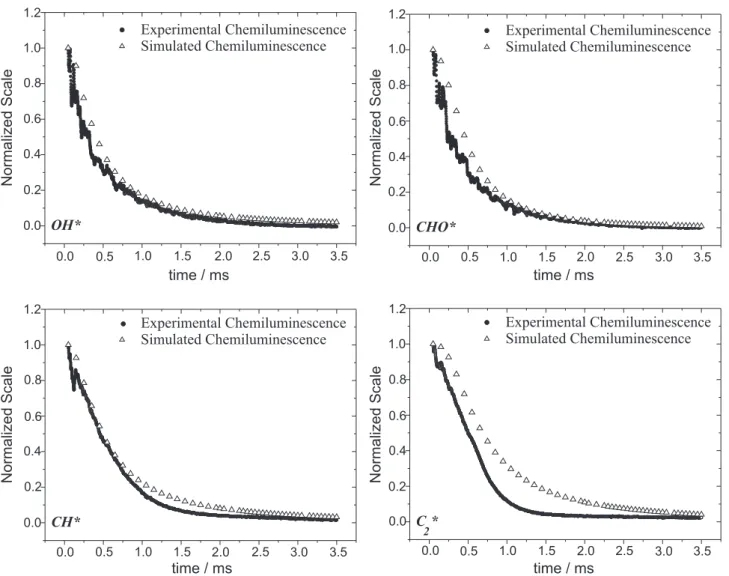
To compare the experimental chemiluminescent profiles with the simulated chemiluminescent profiles, the first part of all curves (which represents the fast flame propagation through the whole chamber) was removed and the curves were normalized to make the first point coincide with zero on the abscissa and with unity on the ordinate. This procedure does not produce any deformation in the curves and allows comparison between the different groups of results. Thus, the simulated and experimental production rates of the excited radicals can be properly compared, since the comparison between the emission intensities (number of photons / s) and the differentials of the “photon concentrations” (generated in the simulation procedure), are not directly possible.
Similar approaches were done to simulate the formation of the chemiluminescent species in ethanol combustion produced in the same combustion system.42
Mechanism for OH* (A2Σ+) radical formation
The temporal decay of the experimental and simulated chemiluminescence of OH*, presented in Figures 4 (a)
and 5 (a) for both stoichiometric and fuel-rich C2H2/O2 combustion, showed good agreement.
The formation reactions used to reproduce experimental data were:
CH + O2 = OH* + CO (r60) H + O2 = OH* + O (r61)
H + O = OH* (r62)
Gaydon36 originally suggested reaction (r60) and
Gaydon and Wolfhard53 proposed reaction (r62) for
hydrogen flames for OH* chemiluminescence. Both reactions (r60) and (r62) are exothermic enough to produce OH* in the excited electronic state, around 159 kcal mol-1 and 101 kcal mol-1, respectively.
Reaction (r61), in spite of being slightly endothermic (16 kcal mol-1),54 was proposed by Shuler55
for hydrogen flames. Shuler55 based on analysis of
potential energy surfaces, showed OH* production through a [HO2] complex intermediate. Two reaction paths are possible, one from excited O2* and another from O2 in the ground state.
H + O2* (3Σ
u-) → [HO2 (
2A”)] → O + OH* (2Σ+)
H + O2 (3Σ
g-) → [HO2 (
2A”)] → O + OH* (2Σ+)
However, none of these authors supplied the reaction kinetic parameters. For both reactions (r61) and (r62), kinetic parameters were obtained from similar reactions that produce OH in the ground electronic state.11,25 Since in the first case,
the activated complex is the same for both reaction paths to production of ground OH (X2Π) and excited OH* (2Σ+), this
approach is valid. In the second, the recombination reaction (r62) would need a third body (M) (to transfer the excess energy) to produce OH in the ground state, so the same rate constant without M in the reaction is suitable.
The reaction (r60) has usually been attributed to OH* chemiluminescence. For this reason the rate constant used by Berman et al.,28 that gives the higher value, was adopted in
this work, to test the other possible reactions for OH* chemiluminescence. In this way, the rate constant for reaction (r60) is about hundred times higher than that for reaction (r61) at the temperatures used. The simulated chemiluminescence profiles without (r61) in the reaction mechanism did not fit the experimental chemiluminescence profiles very well.
In this study, the radiative rate for OH* (A2Σ+) radical
was 1.70x10⁶ s-1, the same value adopted by Berman et
al.,28 and the collisional quenching rate was taken from
Tamura et al.29
ROPA analysis indicated that, in the purposed reaction mechanism, reaction (r61) is the principal route for OH* formation and it contributes to about 90% of the total amount of OH*. The other reactions (r60 and r62) together are responsible for around 10% of OH* production.
Mechanism for CHO* (A2Π) radical formation
There is also a good fit between the simulated and experimental chemiluminescence data for the CHO* radical for both stoichiometric and fuel-rich C2H2/O2 combustion, as shown in Figures 4 (b) and 5 (b).
To reproduce the experimental chemiluminescence of CHO*, only a single formation reaction of this radical was found in the literature, suggested by Gaydon,36 and it
was inserted in the reaction mechanism.
CH + O = CHO* (r65)
According to Sappey and Crosley,32 the CHO* (A2Π)
lifetime is 30 ps and presents a low quantum fluorescence yield. In spite of this, the radical CHO* shows several emission bands in the UV-Visible region from 250 nm to 400 nm that are features of hydrocarbon flames.32,36
Kinetic parameters for reaction (r65) were not found in the literature, the rate coefficient established25 for a
similar reaction, CH + O = H + CO (exothermic, 57-65 kcal mol-1),56 was applied to this reaction.
Mechanism for CH* (A2∆) radical formation
Experimental and simulated chemiluminescences of the CH* radical are shown in Figures 4 (c) and 5 (c). Again the model reproduces the experimental data with good agreement for both stoichiometric and fuel-rich C2H2/ O2 combustion.
Although the mechanism of CH* formation has not yet been definitely established, it is one of the most studied excited radicals. Most of these studies, the reaction between C2H and O was found to be the main source of CH* radical.33,37
To reproduce the experimental chemiluminescent profile of CH* radical, the reactions proposed initially by Hand and Kistiakowsky56 (r68 and r69) and reaction (r70),
suggested by Gaydon,36 were tested.
C2H + O2 = CH* + CO2 (-75 kcal mol-1) (r68)
C2H + O = CH* + CO (-117 kcal mol-1)37 (r69)
C2 + OH = CH* + CO (-91 kcal mol-1) (r70)
C2H radicals could be found in vibrationally excited states37 increasing ca. -12 kcal for reactions (r68) and (r69).
Kinetic parameters for reactions (r68) and (r70) were taken from Eraslan and Brown9 and the kinetic parameters
for the latter reaction are the same as those adopted by Grebe and Homann.37 For reaction (r69), the kinetic
parameters were from Devriendt and Peeters.33 The CH*
(A2Δ) radical lifetime is (0.56±0.06) μs34 and its
non-radiative rate was taken from Tamura et al.29
ROPA analysis indicates that only reaction (r68) is important in this reaction mechanism for CH* production, in order to fit the simulated chemiluminescence of this radical to its experimental chemiluminescence. The other two reactions (r69) and (r70) were discarded by ROPA analysis. Grebe and Homann37 also discard reaction (r70),
due to the low concentration of C2 radical in the ground state and our results support their conclusion.
Mechanism for C2 (A3Π
g) radical formation
The temporal decay of experimental and simulated chemiluminescence of C2*, presented in Figures 4 (d) and 5 (d), showed good agreement for both stoichiometric and fuel-rich C2H2/O2 combustion.
Four formation reactions for C2* radical were inserted in the reaction mechanism to try to reproduce its experimental chemiluminescence. Reactions (r73) and (r76) were originally proposed by Gaydon.36 Miller and
Palmer57 proposed reaction (r74) and Fergunson58
CH2 + C = C2*+ H2 (-63 kcal mol-1)37 (r73)
CH + C = C2* + H (-59 kcal mol-1)37 (r74)
2CH = C2* + H (-82 kcal mol-1)37 (r75)
C2H + H = C2* + H2 (thermoneutral) (r76)
According to Fergunson,58 reaction (r76) does not
contribute very much to C2* formation, because experiments with isotope substitution show that a C2Hn fragment from a C2H2 fuel molecule could not be the main precursor of this excited radical. There is strong evidence in the literature37,59,60 that the reaction between two CH
radicals (r75) does not contribute significantly to C2* production. Grebe and Homann37 also discard reaction
(r74) and proposed reaction (r73) for C2* formation. In this work, the simulation results show that the reaction between CH2 and C (r73) is the main source of the C2* excited radical, contributing to about 98% of the total amount. Reactions (r74) and (r76) have small
contributions, around of 2%, and reaction (r75) does not contribute to C2* production.
Kinetic parameters used to test reactions (r73), (r74) and (r75) were applied by Williams and Pasternack27 for
similar reactions of C2 in the ground electronic state. For reaction (r76) the kinetic parameters employed were also taken from similar reactions of the Eraslan and Brown9
study. The lifetime of C2* (A3Π
g) radical is (0.17±0.02) μs36 and its collisional deactivation rate was taken from
Filseth et al.35
Important reaction paths
of the formation reactions of excited radicals have almost no influence on the simulated chemiluminescence profiles. However, the simulated chemiluminescence profiles are strongly affected by changes in the rate coefficients of reactions that lead to the main precursors (CH2 and CHCO) of most of the excited radicals.
The most important reactions for production and consumption of each species inserted in the reaction mechanism were determined through production rate analysis by ROPA. Figure 6 shows the reaction scheme built from ROPA analysis results at t = 0.05 ms. ROPA analysis was also carried out at t = 0.50 ms to verify the changes in the importance of different reactions with temporal evolution. As there is practically no change in a reaction’s importance as a function of reaction time, the scheme in Figure 6 can properly represent the reaction paths of acetylene oxidation over the whole reaction period.
The proposed reaction mechanism shows three main routes to acetylene oxidation (Figure 6). The first leads to the formation of C2 and C3 species through production of the propargyl radical (C3H3) and contributes about 20% to acetylene oxidation. Another route results in oxygenated species such as formaldehyde, water and hydrogen peroxide, via CH2CO formation; this route also contributes about 20% to acetylene oxidation. The third is the main route that contributes approximately 60% to acetylene consumption and gives the CH2 and CHCO primary radicals, which are the precursors of most of the excited radicals.
molecular and atomic oxygen reactions, respectively, although the reaction between CH and O2 contributes only slightly to OH* production. On the other hand, the CH radical is the principal precursor of atomic carbon, which participates in the most important reaction for C2* production. Only CH* excited radical is directly produced from the acetylene molecule, since this latter is the main source of C2H radicals.
Conclusions
The experimental chemiluminescence profiles obtained in C2H2/O2 combustion were reproduced by kinetic modeling, which includes formation and decay reactions for the excited radicals. The proposed mechanism shows a good agreement between simulated and experimental chemiluminescence data of OH*,
CHO*, CH* and C2* excited radicals for both C2H2/O2 combustions under stoichiometric (Φ = 1.00) and fuel-rich (Φ = 1.62) conditions.
The present paper and our earlier ethanol study42 show
the possibility of using experimental chemiluminescence data as a guideline to validate kinetic modeling and to understand the chemistry of small hydrocarbon radicals in similar combustion systems (closed chamber with small volume), since flame propagation is very fast and the greatest part of the combustion processes can be represented by a fairly homogeneous reaction and, thus, properly simulated by KINAL and other software packages for combustion kinetic simulations.
formation of the chemiluminescent species. The most important reaction paths identified by production rate analysis for formation of excited species that are responsible for the simulated chemiluminescence profiles are: H + O2 = OH* + O; CH + O = CHO*; C2H + O2 = CH* + O2 and CH2 + C = C2* + H2.
Acknowledgments
The authors are grateful to FAPESP (Fundação de Amparo à Pesquisa do Estado de São Paulo) for financial support through projects 96/09627-9 and 97/07938-0.
References
1. Peeters, J.; Bull. Soc. Chim. Belg. 1997, 106, 337. 2. Levy, J. M; Combust. Flame 1982, 46, 7.
3. Koike, T.; Morinaga, K.; Bull. Chem. Soc. Jpn 1987, 60, 4229. 4. Frenklach, M.; Warnatz, J.; Combust. Sci. Technol. 1987, 51,
265.
5. Westmoreland, P. R.; Howard, J. B.; Longwell, J. P.; Proc. Combust. Inst. 1986,21, 773.
6. Westmoreland, P. R.; Dean, A. M.; Howard, J. B.; Longwell, J. P.; J. Phys. Chem. 1989, 93, 8171.
7. Miller, J. A.; Volponi, J. V.; Durant Jr., J. L.; Goldsmith, J. E. M.; Fisk, G. A.; Kee, R. J.; Proc. Combust. Inst. 1990, 23, 187. 8. Miller, J. A.; Melius, C. F.; Combust. Flame 1992, 91, 21. 9. Eraslan, A. N.; Brown, R. C.; Combust. Flame 1988, 74, 19. 10. Hidaka, Y.; Hattori, K.; Okuno, T.; Inami, K.; Abe, T.; Koike,
T.; Combust. Flame 1996, 107, 401.
11. Lindstedt, R. P.; Skevis, G.; Combust. Sci. Technol. 1997, 125, 73.
12. Williams, B.; Fleming, J. W.; Combust. Flame 1995, 100, 571. 13. Hartlieb, A. T.; Atakan, B.; Kohse-HöInghaus, K.; Combust.
Flame 2000, 121, 610.
14. Bertran, C. A.; Marques, C. S. T.; Benvenutti, L. H.; Combust. Sci. Technol. 2001, 167, 113.
15. Turányi, T.; J. Math. Chem. 1990, 5, 203.
16. Steinfeld, J. I.; Francisco, J. S.; Hase, W. L.; Chemical Kinetics and Dynamics, Prentice-Hall: New Jersey, 1989.
17. Pilling, M. J. Modern Gas Kinetics, Blackwell: Oxford, 1987. 18. Hirst, D.M.; A Computational Approach to Chemistry,
Blackwell Scientific Publications: Oxford, 1990. 19. Turányi, T.; Comput. Chem. 1990, 14, 253. 20. Kaps, P.; Rentrop, P.; Numer. Math. 1979, 33, 55.
21. Gelinas, R. J.; Science Applications, Inc., Preprint No. AI/PL/ C279, 1979.
22. Kee, R. J.; Grcar, J. F.; Smooke, M. D.; Miller, J. A.; Report No. SAND85-8240, Sandia National Laboratories, 1985. 23. Gardiner Jr., W. C.; J. Phys. Chem. 1977, 81, 2367.
24. Pimentel, A. S.; Arbilla, G.; J. Braz. Chem. Soc. 1998, 9, 539.
25. Baulch, D. L.; Cobos, C. J.; Cox, R. A.; Frank, P.; Hayman, G.; Just, T.; Kerr, J. A.; Murrells, T.; Pilling, M. J.; Troe, J.; Walker, R. W.; Warnatz, J.; J. Phys. Chem. Ref. Data 1994, 23, 847. 26. Peeters, J.; Boullart, W.; Devriendt, K.; J. Phys. Chem. 1995,
99, 3583.
27. Williams, B. A.; Pasternack, L.; Combust. Flame 1997, 111, 87.
28. Berman, M. R.; Fleming, J. W.; Harvey, A. B.; Lin, M. C.; Proc. Combust. Inst. 1982, 19, 73.
29. Tamura, M.; Berg, P.A.; Harrington, J. E.; Luque, J.; Jeffries, J. B.; Smith, G. P.; Crosley, D. R.; Combust. Flame 1998, 114, 502.
30. Dandy, D. S.; Vosen, S. R.; Combust. Sci. Technol. 1992, 82, 131.
31. Meier, U. E.; Hunziker, L. E.; Crosley, D. R.; J. Phys. Chem. 1991, 95, 5163.
32. Sappey, A. D.; Crosley, D. R.; J. Chem. Phys. 1990, 93, 7601. 33. Devriendt, K.; Peeters, J.; J. Phys. Chem. 1997, 101, 2546. 34. Gaydon, A.G.; Flames - Their Structure, Radiation and
Temperature, 3rd ed, Chapman and Hall: London, 1970.
35. Filseth, S. V.; Hancock, G.; Fournier, J.; Meier, K.; Chem. Phys. Lett. 1979, 61, 288.
36. Gaydon, A. G. The Spectroscopy of Flames, John Wiley, New York, 1974.
37. Grebe, J.; Homann, K. H.; Ber. Der Bunsenges. Phys. Chem. -Chemical Physycs 1982, 86, 587.
38. Devriendt, K.; Van Look, H.; Ceursters, B.; Peeters, J.; Chem. Phys. Lett. 1996, 261, 450.
39. Walsh, K.T.; Long, M.B.; Tanoff, M.A.; Smooke, M.D.; Proc. Combust. Inst. 1998, 27, 615.
40. Smith, G. P.; Luque, J.; Park, C.; Jeffries, J. B.; Crosley, D. R.; Combust. Flame 2002, 131, 59.
41. Marchese, A. J.; Dryer, F. L.; Nayagam, V.; Colantonio, R.O.; Proc. Combust. Inst. 1996, 26, 1219.
42. Benvenutti, L. H.; Marques, C. S. T.; Bertran, C. A.; Combust. Sci. Technol. 2005, 177, 1.
43. Levine, I. Physical Chemistry, McGraw Hill, Inc., 1988. 44. Bertran, C. A.; Marques, C. S. T.; Benvenutti, L. H.; J. Braz.
Chem. Soc. 2002, 13, 47.
45. Michael, J. V.; Wagner, A. F.; J. Phys. Chem. 1990, 94, 2453. 46. Frank, F.; Bhaskarn, K. A.; Just, Th.; Proc. Combust. Inst. 1986,
21, 885.
47. Laskin, A.; Wang, H.; Chem. Phys. Lett. 1999, 303, 43. (http:/ /ignis.me.udel.edu/mech)
48. Frenklach, M.; Wang, H.; Combust. Flame 1997, 110, 173. 49. Frenklach, M.; Appel, J.; Bockhorn, H.; Combust Flame 2000,
121, 122.
50. D’Anna, A.; Violi, A.; D’Alessio, A.; Combust. Flame 2000, 121, 418.
52. Vaidya, D. B.; Horvath, J. J.; Green, A. E. S.; Appl. Opt. 1982, 21, 3357.
53. Gaydon, A. G.; Wolfhard, H. G.; Proc. Roy. Soc. London 1951, A208, 63.
54. Mavrodineanu, R.; Boiteux, H. Flame Spectroscopy, John Wiley & Sons, Inc., New York, 1965.
55. Shuler, K. E.; J. Chem. Phys. 1953, 21, 624.
56. Hand, C. W.; Kistiakowsky, G. B.; J. Chem. Phys. 1962, 37, 1239.
57. Miller, W. J.; Palmer, H. B.; J. Chem. Phys. 1964, 40, 3701.
58. Fergunson, R. E.; J. Chem. Phys. 1955, 23, 2085.
59. Bleekrode, R.; Nieuwpoort, W.C.; J. Chem. Phys. 1965, 43, 3680.
60. Bulewicz, E. M.; Padley, P. J.; Smith, R. E.; Proc. Roy. Soc. London 1970, A315, 129.
Received: July 27, 2005
Published on the web: February 13, 2006