This work was executed in the Graduate Program of Common Health, at the Universidade Federal do Rio Grande do Norte – UFRN – Natal (RN), Brazil, with a scholarship conceived by the Coordenação de Aperfeiçoamento de Pessoal de Nível Superior (CAPES).
(1) Graduate Program in Common Health (Masters Degree), Universidade Federal do Rio Grande do Norte – UFRN – Natal (RN), Brazil. (2) Department of Speech-Language Pathology and Audiology, Universidade Federal do Rio Grande do Norte – UFRN – Natal (RN), Brazil. (3) Department of Speech-Language Pathology and Audiology, Universidade Federal da Paraíba – UFPB – João Pessoa (PB), Brazil. (4) Cochlear Implant Program at Otocentro/Hospital do Coração de Natal, Natal (RN), Brazil.
(5) Department of Odontology, Universidade Federal do Rio Grande do Norte – UFRN – Natal (RN), Brazil.
Conflict of interests: No
Author´s contribution: LFSFPB main researcher, research elaboration, chronogram elaboration, casebook, collecting, analysis of data, writing of the essay, submission and proceedings form the essay; JSB and MAFF advisers, research elaboration, chronogram elaboration, analysis of data, editing the article, final version approval; HGC, LRPLJ and DVSPL assistant researchers, research elaboration, data collection and writing the article.
Correspondence address: Laísa Flávia Soares Fernandes Peixoto Buarque. Av. Senador Salgado Filho, 1787, Lagoa Nova, Natal (RN), Brazil, CEP: 59056-000. Email: [email protected]
Received: 3/18/2013; Accepted: 7/3/2013
Auditory performance, during a period of time in
cochlear implant users with post lingual hearing loss
Desempenho auditivo ao longo do tempo em usuários de
implante coclear com perda auditiva pós-lingual
Laísa Flávia Soares Fernandes Peixoto Buarque1, Joseli Soares Brazorotto2, Hannalice Gottschalck Cavalcanti3,
Luiz Rodolpho Penna Lima Júnior4, Danielle do Vale Silva Penna Lima4, Maria Ângela Fernandes Ferreira5
ABSTRACT
Purpose: Evaluating the hearing accomplishment over time and to in-vestigate the prognostic factors related. Methods: A retrospective cohort study carried out through analysis the medical records of 57 patients with post-lingual hearing loss and cochlear implant for at least 12 months. To sustain our method we applied the Kaplan-Meier method and the logrank test for analysis of speech perception over time and the possible influence of factors such as gender, education, duration of hearing loss, age at implantation, etiology and device’s brand, on the outcome studied.
Results: In only 12 months after implant activation, more than half of the cohort already had satisfactory scores on the test of speech percep-tion. The logrank test had not indicated difference among the covariates tested. There was a significant difference between the hearing results pre and post cochlear implant. Conclusion: The hearing performance after 12 months using the IC exceeds the criterion for the majority of indi-viduals with post-lingual hearing loss, regardless of prognostic factors evaluated, but not all respondents.
Keywords: Cochlear implant; Hearing loss, Sensorineural; Speech perception; Prognosis; Survival analysis
RESUMO
Objetivo: Avaliar o desempenho auditivo ao longo do tempo e investigar os fatores prognósticos relacionados. Métodos: Estudo de coorte retros-pectivo realizado por meio da análise dos prontuários de 57 indivíduos com perda auditiva pós-lingual e usuários de implante coclear há pelo menos 12 meses. Utilizou-se o estimador de Kaplan-Meier e o teste de Logrank para análise da percepção da fala ao longo do tempo e da possível interferência de fatores como gênero, escolaridade, tempo de privação auditiva, idade ao implante, marca do dispositivo e etiologia, sobre o desfecho estudado. Resultados: Em apenas 12 meses após a ativação do implante, mais da metade da coorte já apresentava escores satisfatórios no teste de percepção da fala. O teste de Logrank não indi-cou diferença entre as covariáveis testadas. Houve diferença significativa entre os resultados auditivos pré e pós- implante coclear. Conclusão: O desempenho auditivo, após 12 meses de uso do IC, superou o critério de indicação na maioria dos indivíduos com perda auditiva pós-lingual, independentemente dos fatores prognósticos avaliados, porém não em todos os indivíduos pesquisados.
INTRODUCTION
In patients with post-lingual hearing loss, the use of the Cochlear Implant (CI) seeks the restoration of the auditory perception and the verbal communication(1). The auditory
results obtained by individuals with post-lingual hearing loss has been of great interest, once that the previous auditory experience allows the evaluation of the auditory performance before and after the cochlear implant and, therefore, determine the achieved benefits with the usage of the device(2).
One of the strategies to evaluate this benefit is the applica-tion of speech percepapplica-tion exams. These tests use lists of vowels, syllable, words and sentences in an open presentation and wi-thout contextual hints and closed hints. The scores generated enable to evaluate the evolution of the usage of the CI and they should be executed throughout the post-surgery follow-up.
Within the factors notified in the literature that can interfere in the auditory results, it is highlighted, the period of deafness acquisition, the time of sensorial privation, the integrity of the central auditory paths, the orofacial reading skill, the numbers of electrodes inserted in the cochlea, the etiology of deafness, the quality and the device’s technology and the type and the quality of the training offered to the implanted(3-5).
The prediction the performance of the perception of the speech in candidates to the CI has been, for a long period, the aim of physicians and researchers(6). The time that the benefit
is achieved is without a doubt, an important factor when coun-seling patients candidates to the surgery. However, in literature, there are divergences about the period(7,8).
The presented study aimed to evaluate the auditory perfor-mance throughout the time on adult users of the CI with post--lingual hearing loss, scrutinizing possible prognostic factors.
METHODS
The population studied consisted in 57 adult users (33 men and 24 women) that were accompanied, retrospectively, by collecting in the database of the Cochlear Implant Program from a auditory health center, located in Natal, Rio Grande do Norte. The follow-up with the population covered the period from 2000 to 2011. The criteria of inclusion were: individuals from severe to profound neurossensorial hearing loss acquired in the post-lingual time, CI users for a minimum period of 12 months.
Individuals with the auditory neuropathies spectrum, with other sensorial deficiencies, with cochlear malformation or hypoplasia in the auditory nerve that the handbooks present incomplete information about the data on the audiology pre and/or post cochlear implant, were excluded from the analysis. For the characterization of the population and posterior statistics analysis, the following information was collected in the handbooks: gender, education, time of auditory privation, deafness characteristic, etiology, device’s prototype, implanted
ear, age at the implant and evidence of the rightness in the tests of perception of the speech with sentences in an open set in the period of pre and post cochlear implant with its respective dates of accomplishment.
The retrospective analysis of the cohort was held through the data collected on the handbooks and the results were ob-served at 3, 6 and 12 months after the CI. The Test of Perception of the Speech (TPS) with sentences used in this work was developed by the Center of Audiological Research (CAR) – Rehabilitation of Craniofacial Anomalies Hospital (RCAH) from the Universidade de São Paulo (USP), Bauru(9). This test
was applied in the periodical evaluations pre and post cochlear implant, in a silent environment, live and with the patient po-sitioned one meter away from the evaluator.
In the present work, it was considered satisfactory an index superior to 50% of rightness, for it is admitted that for these individuals, the cochlear implant was beneficial.
The test of sentences in an open set was submitted to analy-sis of supervened (statistic test that evaluates the prognostic of individuals after a clinical intervention) by the estimator of Kaplan-Meier for the benefit of the cochlear implant to be evaluated throughout the time. The dichotomous condition for the evaluation of the denouement was “expected benefit” for the indexes of rightness or superior to 50% (event of interest) and “without benefit” for the indexes of rightness lower than 50% (censored).
After the analysis by the estimator of Kaplan-Meier, the denouement was submitted to univariate analysis through the test of Logrankwith the factors of predictors of auditory perfor-mance, namely, gender, education, time of auditory privation, age at the implant, device’s brand and etiology.
The comparison between the auditory results before and after 12 months of usage of the CI was executed by the test t for paired samples.
The research was approved by the Committee of Ethics in Research at the Universidade Federal do Rio Grande do Norte and obtained a favorable opinion to its realization, by the litigation of number 040/2012. The patients were informed about the procedures to be performed and they signed a Term of Consent, allowing the participation in this study, attending to the Resolution 196/96 from the National Health Counsel.
RESULTS
on the research, once its visual acuity was preserved, noticing that just at the moment of the analysis, with its visual field partially compromised.
The additional characteristics from the sample related to the demographic data, the hearing loss and the prototype of the cochlear implant are presented on Table 1.
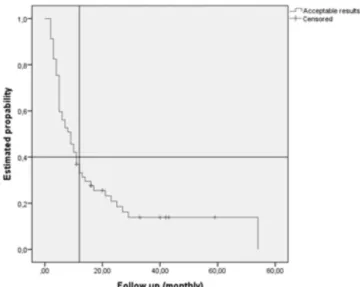
It was evidenced that the benefit achieved by the cochlear implant occurs on the first months of usage, that is, the indivi-duals were able to perceive the sounds of speech, with indexes of rightness of sentences equal or superior to 50% than the presentations. It was observed that with 12 months of usage, about 60% of the population had already achieved satisfactory scores for the TPS with sentences on an open set (Figure 1).
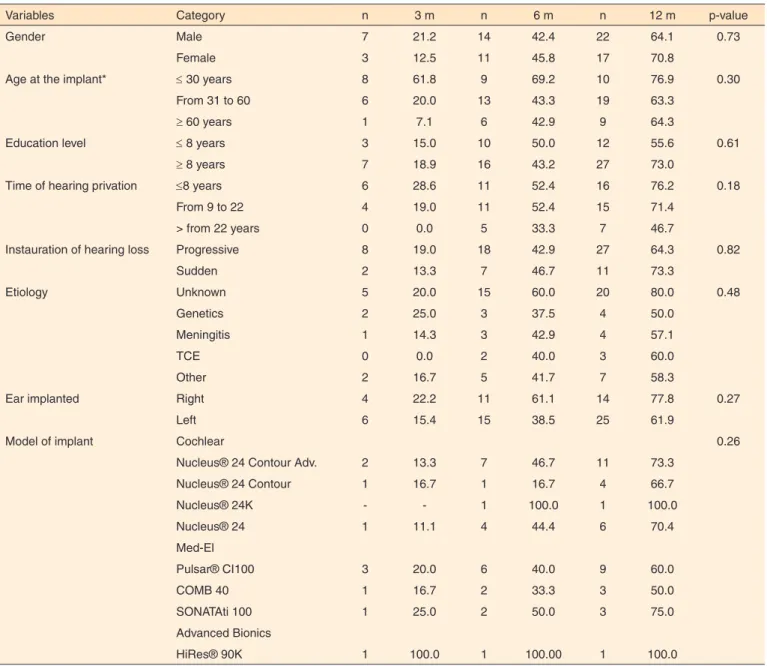
In the satisfactory results for the perception of the speech, 15.8% of the individuals of the sample (9) did not obtain the be-nefit expected (event of interest). The test of Logrank indicated that there was no difference between the time for the perception of the speech and the independent variables (Table 2).
The results pre cochlear implant were compared to the results of the tonal audiometry, represented by the media of the triton frequencies of 500, 1000 and 2000 Hz and of the tests of speech on an open set, for about 12 months after the CI surgery. There was a difference (p<0.001) in both of the analysis (Table 3).
DISCUSSION
The CI is the method currently more adequate to adults with post-lingual deafness in severe-profound degree. The results from the present study show that the cochlear implant is an intervention with benefit effects for the auditory detection and for the perception of the speech in this population. The obtained benefit remained throughout the period studied. Other studies point to the results that agree with ours(1,10).
The same results were observed in a population of elderly. Those benefits remained throughout the time in an average of 44 months of follow up(10).
In the same way, adult individuals with the post-lingual hearing loss, followed at 3, 6 and 12 months post cochlear implant, also presented significant improvement. Those effects were noticed since the first evaluation, at 3 months, raising progressively, until 12 months(1).
It was not observed difference on the performance between men and women users of the CI. Other studies also did not relate this type of difference between genders(2,11).
The etiology and the way of establishment of the hearing loss (sudden appearance or progressive) were not associated to the auditory results of the perception of the speech, the same findings of other authors(2,11,12). The fact that the educated
popu-lation presents, in your majority, an unknown cause, impaired the analysis of data, as there was no information about the true reason for the hearing loss. The etiology can provide data
Table 1. Characterization of the individuals included in the research
Characteristics n (%) Mean Standard
deviation
Age at the implant* 45.31 17.73
Duration of hearing loss* 17.31 14.13
Sex
Male 33 (57.9)
Female 24 (42.1)
Education level
Up to 8 years of education 20 (35.1)
Above 8 years of education 37 (64.9)
Instauration of the hearing loss
Progressive 42 (73.7)
Sudden 15 (26.3)
Model of the implant
Cochlear
Nucleus® 24 Contour Advanced 15 (26.3)
Nucleus® 24 Contour 6 (10.5)
Nucleus® 24K 1 (1.8)
Nucleus® 24 9 (15.8)
Med-El
Pulsar® CI100 15 (26.3)
COMB 40 6 (10.5)
SONATAti 100 4 (7.0)
Advanced Bionics
HiRes® 90K 1 (1.8)
Side Implanted
Right 18 (31.6)
Esquerdo 39 (68,4)
*In years
regarding the level of ossification and bad cochlear formation and about the development of the auditory nerve, therefore being determinant in the post-surgery results(13).
Concerning the way of the hearing loss sprouting, we be-lieve that patients that suffer severe and sudden hearing losses, they seek medical assistance more rapidly than those that suffer
the hearing losses progressively, making it possible, by that, the immediate start of rehabilitation. Thus those who have the progressive hearing loss use auditory prosthesis until the indi-cation of surgery. Due to that we believe that the deterioration of the central auditory ways can be ameliorated.
The age group and the time of auditory privation were
Table 2. Cumulative probability for satisfactory levels of Tests of Perception of the Speech according to prognostic factors at 3, 6 and 12 months of implant use
Variables Category n 3 m n 6 m n 12 m p-value
Gender Male 7 21.2 14 42.4 22 64.1 0.73
Female 3 12.5 11 45.8 17 70.8
Age at the implant* ≤ 30 years 8 61.8 9 69.2 10 76.9 0.30
From 31 to 60 6 20.0 13 43.3 19 63.3
≥ 60 years 1 7.1 6 42.9 9 64.3
Education level ≤ 8 years 3 15.0 10 50.0 12 55.6 0.61
≥ 8 years 7 18.9 16 43.2 27 73.0
Time of hearing privation ≤8 years 6 28.6 11 52.4 16 76.2 0.18
From 9 to 22 4 19.0 11 52.4 15 71.4
> from 22 years 0 0.0 5 33.3 7 46.7
Instauration of hearing loss Progressive 8 19.0 18 42.9 27 64.3 0.82
Sudden 2 13.3 7 46.7 11 73.3
Etiology Unknown 5 20.0 15 60.0 20 80.0 0.48
Genetics 2 25.0 3 37.5 4 50.0
Meningitis 1 14.3 3 42.9 4 57.1
TCE 0 0.0 2 40.0 3 60.0
Other 2 16.7 5 41.7 7 58.3
Ear implanted Right 4 22.2 11 61.1 14 77.8 0.27
Left 6 15.4 15 38.5 25 61.9
Model of implant Cochlear 0.26
Nucleus® 24 Contour Adv. 2 13.3 7 46.7 11 73.3
Nucleus® 24 Contour 1 16.7 1 16.7 4 66.7
Nucleus® 24K - - 1 100.0 1 100.0
Nucleus® 24 1 11.1 4 44.4 6 70.4
Med-El
Pulsar® CI100 3 20.0 6 40.0 9 60.0
COMB 40 1 16.7 2 33.3 3 50.0
SONATAti 100 1 25.0 2 50.0 3 75.0
Advanced Bionics
HiRes® 90K 1 100.0 1 100.00 1 100.0
Logrank’s Test (p≤0,05) * Categorized by age
Table 3. Results of audiometry in free field and scores of TPF with open-set sentences before and after 12 months of cochlear implant
Auditory performance 1st measure (SD) 2nd measure (SD) Test t p-value
Free field audiometry (dB) 105.26 (15.79) 33.42 (9.31) 28.96 <0.001*
Test of perception of the speech (%) 7.02 (0.12) 68.26 (0.31) -15.10 <0.001*
* Significant values (p≤0,05) – Test t for the impaired samples
not associated with the performance. In some studies, it was observed that the most influent factor to the auditory result is not the age at the occasion of the implant but the time that the patient remained with the hearing loss(2,7,11,12,14,15). The success
of the CI requires the functionality of the processing of the enact auditory pathway since the cells of the spiral ganglion until the auditory cortex(16). The deterioration of this pathway
is better related to the time of auditory privation than to the age that the subject was implanted. This fact would explain the importance of a short period of time of auditory privation for a good performance of the CI(14).
Despite the explanation seems quite convincing, many other studies, diversely from ours, did not confirm this pre-mise, by not finding any association with the time of auditory privation(1,4,15,17).
The data related to the asymmetry of the normal auditory function, hemispheric specialization and modifications in the central auditory system as the result of the hearing loss, they should be taken under consideration. Although the human au-ditory cortex receives sensorial stimuli eventually from both ears, it is more strongly activated by the stimulation from the contralateral ear(18). Therefore, considering that the centers of
speech (Broca and Wernicke) are located in the left cerebral cortex in right-handed and they can be presented in one or both sides in left-handed individuals(14), the implantation in the right
ear would imply in best auditory results.
In the presented study, the side implanted did not interfere in the perception of the speech, despite the results of the patients implanted on the right ear have presented answers in the tests of the perception of the speech significantly better than the patients implanted on the left ear(14).
As to the prototypes of the implant devices, it was not verified any influence about the denouements, which is in agre-ement with the other discoveries(4). This is an important factor,
once it evolves expenses for the acquisition and maintenance of the device, although the criteria established by the clinical team in the manufactures are not discarded.
About the results pre and post implant, all of the patients studied present and improvement in the auditory performance after the intervention, when compared to the auditory capabi-lities before the surgery. The findings resemble themselves to the literature, in which the average in the auditory thresholds was of 107 dBSPL and just 18% of hits on the test of the perception of the speech with sentences, before the CI. After the CI, the auditory thresholds became, about, 40 dBSPL and the tests of speech with the sentences reached 60 and 70% of rightness(2).
Some of the limitations in the present study are inherent to the structure of the study itself. By dealing with a retrospective study, involving observation for a long period of time and with the information recovered from clinical handbooks, some of the clinical and individual’s data were not available, thus compro-mising the analysis. Among the limitations are the information
about the residual hearing, the orofacial reading skill, the amount of electrodes inserted in the cochlea, the patient’s motivation and the integrity of the central auditory pathways. These factors are yet little explored in the literature; although there are studies(6) that evidence and sustain its importance as
predictor factors of the auditory performance.
CONCLUSION
It is possible to conclude that the auditory performance after 12 months of usage of the CI it surpasses the criteria of indication in the majority of individuals with post-lingual he-aring loss, independently of the prognostics factors evaluated, however, not in every of the individuals considered.
ACKNOWLEDGMENT
We thank the Otocentro-RN and, specially, the ENT doctor Ana Karla Bigois Capistrano for the honorable collaboration on our research.
REFERENCES
1. Moon JI, Kim EY, Jeong JO, Chung W, Cho Y, Hong SH. The influence of various factors on the performance of repetition tests en adults with cochlear implants. Eur Arch Otorhinolaryngol. 2012Mar;269(3):739-45.
2. Manrique M, Ramos A, Morera C, Cenjor C, Lavilla MJ, Boleas MS, et al. Evaluación del implante coclear como técnica de tratamiento de la hipoacusia profunda en pacientes pre y post locutivos. Acta Otorrinolaringol Esp. 2006Jan;57(1):2-23.
3. Bevilacqua MC, Costa AO, Martinho ACF. Implante Coclear. In: Ferreira LP, Befi-Lopes DM, Limongi SCO (Orgs.). Tratado de Fonoaudiologia. São Paulo: Rocca; 2004. p. 751-61.
4. Costa Filho AO, Bevilacqua MC, Amantini, Lamônica Neto D. Implante coclear em adultos. In: Campos CAH, Costa HOO (Orgs.). Tratado de Otorrinolaringologia. São Paulo: Rocca; 2003. p. 278-89. 5. Costa Filho OA, Bevilacqua MC. Implantes Cocleares. In: Costa SS,
Cruz OLM, Oliveira JAA. Otorrinolaringologia: princípios e prática. 2a. ed. Porto Alegre: Artes Médicas; 2006. p. 447-53.
6. Oh SH, Kim CS, Kang EJ, Lee DS, Lee HJ, Chang SO, et al. Speech perception after cochlear implantation over 4-year time period. Acta Otolaryngol. 2003Jan;123(2):148-53.
7. Bradley J, Bird P, Monteath P, Wells JE. Improved speech discrimination after cochlear implantation in the Southern Cochlear Implant Adult Programme. N Z Med J. 2010Aug;123(1321):34-44. 8. Padilha Romero MJ, Sainz Quevedo M, Roldán Segura C. Cochlear
implant in postlingual adults with progressive hearing loss. Acta Otorrinolaringol Esp. 2004Dec;55(10):457-62.
9. Valente, SLO. Elaboração de listas de sentenças construídas na língua portuguesa [dissertação]. São Paulo (SP): Faculdade de Fonoaudiologia, Pontifícia Universidade Católica; 1998.
performance after cochlear implantation in late septuagenarians and octogenarians. Otol Neurotol. 2009Oct;30(7):916-20.
11. Klop WM, Boermans PP, Ferrier MB, van den Hout WB, Stiggelbout AM, Frijins JH. Clinical relevance of quality of life outcome in cochlear implantation in postlingually deafened adults. Otol Neurotol. 2008 Aug;29(5):615-21.
12. Hiraumi H, Tsuji J, Kanemaru S, Fujino K, Ito J. Cochlear implants in post-lingually deafened patients. Acta Otolaryngol. 2007Feb;127(s557):17-21.
13. Bevilacqua MC, Moret ALM, Costa OA. Conceituação e indicação do implante coclear. In: Bevilacqua MC, Martinez MAN, Balen AS, Pupo AC, Reis ACMB, Frota S (Orgs.). Tratado de Audiologia. São Paulo: Santos; 2012. p. 407-25.
14. Budenz CL, Cosetti MK, Coelho DH, Birenbaum B, Babb James, Waltzman SB, et al. The effects of cochlear implantation on speech
perception in olders adults. J Am Geriatr Soc. 2011Mar;59(3):446-53.
15. Hirschfelder A, Gräbel S, Olze H. The impact of cochlear implantation on quality of life: the role of audiologic performance and variables. Otolaryngol Head Neck Surg. 2008Mar;138(3):357-62.
16. Cosetti MK, Waltzman SB. Outcomes in cochlear implantation: variables affecting performance in adults and children. Otolaryngol Clin North Am. 2012Feb;45(1):155-71.
17. Migirov L, Taitelbaum-Swead R, Drendel M, Hildesheimer M, Kronenberg J. Cochlear implantation in elderly patients: surgical and audiological outcome. Gerontology. 2010;56(2):123-28.