Study of the surface hardness and
modulus of elasticity of conventional and
microwave-cured acrylic resins
Abstract: The aim of this study was to evaluate the following acrylic resins: Clássico®, QC-20® and Lucitone®, recommended specii cally for thermal polymerization, and Acron MC® and VIPI-WAVE®, made for polymerization by microwave energy. The resins were evaluated regard-ing their surface nanohardness and modulus of elasticity, while varyregard-ing the polymerization time recommended by the manufacturer. They were also compared as to the presence of water absorbed by the samples. The technique used was nanoindentation, using the Nano Indenter XP®, MTS. According to an intra-group analysis, when using the polymeriza-tion time recommended by the manufacturer, a variapolymeriza-tion of 0.14 to 0.23 GPa for nanohardness and 2.61 to 3.73 GPa for modulus of elasticity was observed for the thermally polymerized resins. The variation for the resins made for polymerization by microwave energy was 0.15 to 0.22 GPa for nanohardness and 2.94 to 3.73 GPa for modulus of elasticity. The conclusion was that the Classico® resin presented higher nanohard-ness and higher modulus of elasticity values when compared to those of the same group, while Acron MC® presented the highest values for the same characteristics when compared to those of the same group. The water absorption evaluation showed that all the thermal polymerization resins, except for Lucitone®, presented signii cant nanohardness differ-ences when submitted to dehydration or rehydration, while only Acron MC® presented no signii cant differences when submitted to a double po-lymerization time. Regarding the modulus of elasticity, it was observed that all the tested materials and products, except for Lucitone®, showed a signii cant increase in modulus of elasticity when submitted to a lack of hydration.
Descriptors:Denture, complete; Polymethyl methacrylate; Hardness; Elasticity.
Márcio José Fraxino Bindo(a)
Atlas Edson Moleros Nakamae(b)
Lydia de Brito Santos(c)
Karin Hitomi Ishikawa(d)
Tatiana de Carvalho Guarnieri(e)
Regina Tamaki(b)
(a) Professor, Department of Prosthodontics,
School of Dentistry, Federal University of Paraná.
(b) Professor; (d)DDS; (e)PhD – Department
of Prosthodontics, School of Dentistry, University of São Paulo.
(c) Professor, Department of Prosthodontics,
School of Dentistry, State University of Feira de Santana.
Corresponding author:
Atlas Edson Moleros Nakamae Departamento de Prótese Faculdade de Odontologia da USP Av. Prof. Lineu Prestes, 2227 Cidade Universitária São Paulo - SP - Brazil CEP: 05508-000 E-mail: [email protected]
Introduction
For many decades, polymethylmethacrylate has been the i rst choice for making the base of com-plete dentures. Thermally activated acrylic resins have been traditionally processed by immersion in temperature-controlled water, for a specii c period of time.1 Recently, polymerization methods
involv-ing activated light and microwave energy were in-troduced.
In the last years, many studies have been carried out in order to improve the physical and mechanical properties of the acrylic resins activated by micro-wave energy.1-6 The heating by microwave energy is
independent on thermal conductivity. When dielec-tric materials are placed in a microwave energy i eld, some kind of molecular friction takes place and these materials warm up rapidly.3 Some authors
be-lieve that physical proprieties such as hardness and transversal resistance are favored when this process polymerizes the resins,4 others believe that the
po-lymerization by immersion in heated water during a long cycle results in better physical properties.2
Others still consider that the conventional and mi-crowave energy methods are similar, such as Smith et al.5 (1992), who submitted some materials to the
existing polymerization methods: conventional (wa-ter heat diffusion), microwave energy and light, and then compared properties such as hardness, surface smoothness, transversal resistance, modulus of elas-ticity and resistance to impact. The only difference found between the two methods was that the second showed higher values for modulus of elasticity.
When the physical properties of the acrylic resins are highlighted, many are the elements that can vary inside its structure, either cooping or creating ob-stacles that are liable to interfere with the material’s ultimate rate of success. Among these elements we can point out the modulus of elasticity, which is di-rectly related to the material’s resistance to l exion, nanohardness, and also the loss modulus and l uid-ity, which are related to the material’s viscosity and therefore with the probability of it suffering frac-tures or permanent deformations.1
In the present study the surface nanohardness and the modulus of elasticity versus variations on the po-lymerization time recommended by the manufacturer
of i ve acrylic resins broadly used for the base of com-plete dentures were studied. The same characteristics were evaluated when the materials were submitted to a lack of hydration followed by rehydration.
Material and Methods
Manufacture of the samples made of resin polymerized by a thermal procedure
To manufacture the samples, glass slides measuring 10 mm x 10 mm x 2 mm were used. 100 g of Hero-dent® type IV dental stone (Vigodent, Rio de Janeiro, RJ, Brazil) were mixed to 24 ml of distillated water, which was then poured into a copper mufl e used for conventional polymerization of resins, previously iso-lated with vaseline. The glass slides were then embed-ded in the mufl e, and after the time recommenembed-ded by the stone manufacturer for its complete crystallization, the same mufl e was adapted to the counter mufl e, which was completely i lled with a new portion of stone. After its complete crystallization, the mufl e was opened and the glass slides were removed.
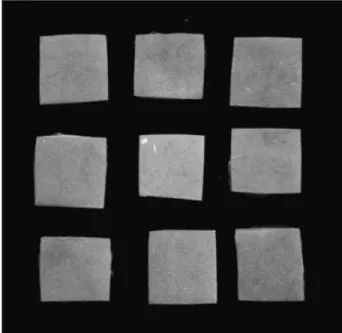
The monomer and the polymer of the Clássico® resin (Clássico Artigos Odontológicos Ltda., São Paulo, SP, Brazil) were then mixed according to the proportion recommended by the manufacturer. When the mix reached the working phase, the mate-rial was embedded in the mufl e. This way, faithful
copies of the samples were produced in resin (Fig-ure 1). The force applied to close the mufl e was 1,250 kgf, maintained by a hydraulic press.
The whole set rested for 4 hours and after that the polymerization cycle started. This was made in-side an electrical polymerizing machine, with tem-perature regulated at 74°C, for 9 hours. After the resin was polymerized and the mufl e cooled off, the sample bars were removed and polished with alu-mina, in order to obtain l at and smooth surfaces.
Identical procedures were performed in order to obtain samples of the resins Lucitone® (Dentsply Indústria e Comércio Ltda., Petrópolis, RJ, Brazil) and QC-20® (Dentsply Indústria e Comércio Ltda., Petrópolis, RJ, Brazil).
Manufacture of the resin samples polymerized by microwave energy
Once more a mufl e was used in order to po-lymerize the resin samples. These mufl es were now made of reinforced glass i ber (Figure 2), especially made for use in microwave ovens. Following the same technique as that used to obtain the samples of the previous resins, glass slides were then included in the mufl es. The same Herodent® type IV dental stone was used.
The i rst resin to be manipulated was Acron MC® (GC Lab Technologies Inc., Alsip, IL, USA), follow-ing the manufacturer’s instructions, and when the
mix reached the working phase it was embedded in the mufl e, which was closed with the aid of screws. The force used for closing was 1,250 kgf.
After waiting 15 minutes the whole set was placed inside a Sharp® microwave oven, on the center of the plate, and was irradiated for 3 minutes, with 500 W of power. A 20 minutes break was taken and the mufl e was washed with cool water on the out-side. After 20 more minutes its complete cooling was checked and only then the samples were removed from its interior. The same procedure for polishing described for the previous group was carried out.
Three different groups of samples were obtained. One of them was polymerized following exactly the time and procedures recommended by the manufac-turer. The other two were polymerized with twice and half of the polymerization time recommended, respectively, for the Acron MC®resin.
These procedures were repeated for the VIPI-WAVE® resin (VIPI Ltda., Pirassununga, SP, Brazil) according to the manufacturer’s recommendations, which state that the mixture should be taken to a microwave oven with 900 W of power, and be ir-radiated with 40% of the power for 2 minutes, and then rest for 15 minutes. After the resting pe-riod, they should be irradiated again with 20% of the power for 8 minutes, and i nally for 3 minutes with 60% of the power. This way, a standard group was obtained, polymerized by following precisely the manufacturer’s directions. Another two groups were irradiated, respectively, with twice as much time and half of the time recommended.
All the samples were always kept immersed in distillated water.
Resin samples analysis and reading
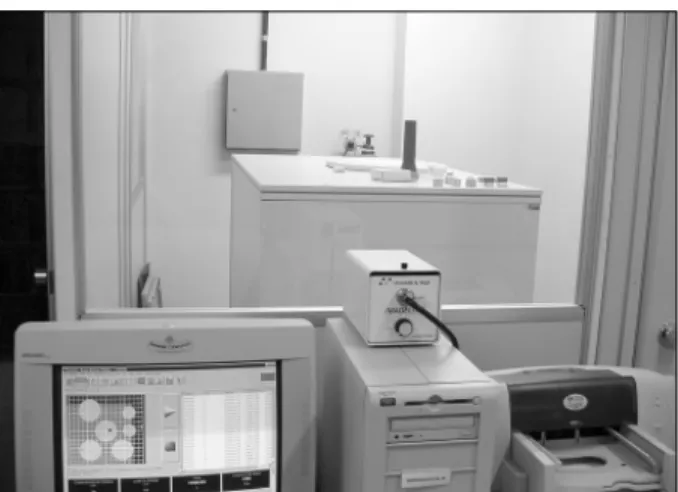
To read the samples a nanoindentation device named Nano Indenter XP (MTS Nano Instruments, Oak-Ridge, TN, USA) was used. This device is made of three different parts: a penetrating cylinder head, an optical microscope and a mobile table (Figure 3). The samples were placed inside the device in or-der to be read, following a time schedule according to the type of resin obtained and the polymerization time used for each polymerization (Figure 4).
Before all the analyses were done, the behavior Figure 2 - Fiberglass muffle (GC brand, Dental Industrial
of the resins was observed after the i rst reading, and after 7 days of dehydration, after which a com-plete set of readings was performed. This was called the 2nd reading. The samples were then rehydrated
for another 7 days, and then the 3rd reading was
per-formed inside the Nano Indenter XP®.
All the readings in this study were accomplished
by 8 loads of indentations, each one of them hav-ing a set of approximately 13 readhav-ings, complethav-ing an average of one hundred reading tests for each sample total, going from zero to 7 thousand nano-meters of depth.
Results
As we analyzed the nanohardness of the conven-tional, thermally polymerized resins, which were polymerized according to the recommendations of the manufacturer, it was observed that the Clássico resin presented a signii cant difference when com-pared to QC-20® and Lucitone®, which were very similar to each other (Table 1).
The same occurred to these materials when con-sidering their modulus of elasticity (Table 2).
The group of resins that were polymerized by mi-crowave energy according to the standard time of po-lymerization presented signii cant differences. Acron MC® presented higher nanohardness and modulus of elasticity values than VIPI-WAVE® (Table 1).
When comparing the two groups submitted to different polymerization methods, it was observed that there was a similarity of results, both regarding nanohardness and modulus of elasticity, especially when comparing Acron MC® and Clássico, and VIPI-WAVE® and QC-20®/Lucitone®.
Regarding the values of modulus of elasticity ver-sus variations in the polymerization time, it was ob-served that, for Acron MC®, as this time decreased, the modulus of elasticity also decreased, and when the time was doubled, the modulus of elasticity also showed an increase, although keeping a level which was similar to that obtained with the standard po-lymerization time.
The VIPI-WAVE® resin presented an increase in modulus of elasticity when compared to that ob-tained when the standard polymerization was per-formed (according to the manufacturer’s recommen-dations), both with half of the polymerization time and with the polymerization time doubled.
Regarding the resins’ behavior when submitted to a lack of hydration (2nd reading), and to an
ensu-ing rehydration (3rd reading), it was observed that in
the conventional thermal polymerization group, the values for nanohardness were very similar when us-Figure 4 - Samples made for the measurements.
ing the standard time of polymerization, except for a few variations, as can be seen in Graph 1.
Yet in the group of resins polymerized by micro-wave energy there was a variation in nanohardness values when they were submitted to dehydration, specially for Acron MC®, when they were polym-erized according to the time recommended by the manufacturer. This variation, however, diminished after rehydration. The same happened to their mod-ulus of elasticity (Graph 2).
Discussion
The resins used for the base of complete dentures are of utmost importance, since the maximum bite strength of a patient using a complete denture is approximately 1/6 of that of a dentate patient. For this reason, it is very important that its adaptability, structure and especially manipulation procedures be reliable.
Currently, the focus of researchers regarding mi-crowave energy has been the analysis of the polym-erization method. Nevertheless, there is some con-Table 1 - Descriptive statistics for type of material / Hardness (GPa).
Data Average Standard
Deviation Minimum Maximum P value(1)
Clássico®
Standard 0.236 0.016 0.222 0.264
< 0.0001 S
Without water 0.234 0.005 0.226 0.240
With water 0.207 0.007 0.196 0.216
Lucitone®
Standard 0.156 0.008 0.147 0.169
0.084 NS
Without water 0.162 0.009 0.152 0.177
With water 0.158 0.007 0.145 0.168
QC-20®
Standard 0.145 0.017 0.123 0.170
0.008 S
Without water 0.155 0.017 0.136 0.178
With water 0.147 0.015 0.136 0.177
VIPI - WAVE®
Standard time
Standard 0.158 0.009 0.149 0.175
< 0.0001 S
Without water 0.193 0.015 0.175 0.216
With water 0.175 0.018 0.157 0.204
Half the Standard time
Standard 0.255 0.013 0.241 0.278
< 0.0001 S
Without water 0.295 0.035 0.259 0.350
With water 0.291 0.028 0.259 0.338
Twice the standard time
Standard 0.243 0.007 0.235 0.254
< 0.0001 S
Without water 0.282 0.029 0.257 0.330
With water 0.268 0.019 0.247 0.298
Acron MC®
Standard time
Standard 0.226 0.007 0.219 0.238
< 0.0001 S
Without water 0.326 0.034 0.285 0.365
With water 0.231 0.031 0.192 0.276
Half the Standard time
Standard 0.191 0.024 0.167 0.238
< 0.0001 S
Without water 0.198 0.020 0.177 0.230
With water 0.169 0.015 0.149 0.190
Twice the standard time
Standard 0.284 0.034 0.247 0.336
0.328 NS
Without water 0.282 0.010 0.265 0.298
With water 0.273 0.014 0.250 0.286
cern about the types of resin being used, as in the study by Kimura et al.3 (1983), who state that the
resin should be carefully chosen in order to avoid fractures, or by Hayden7 (1986), who also links
the type of resin to its inl uence on the resistance to fractures. Both, however, end up comparing the polymerization methods, using microwave energy or a conventional thermal water bath.
When varying the polymerization time, specii -cally when considering microwave resins, it was ob-served that, except for a very small variation with
Table 2 - Descriptive statistics for type of material / Modulus of Elasticity (GPa).
Data Average Standard
Deviation Minimum Maximum P value
(1)
Clássico®
Standard 3.724 0.147 3.591 3.962
< 0.0001 S
Without water 3.709 0.084 3.628 3.841
With water 3.466 0.094 3.350 3.646
Lucitone®
Standard 2.925 0.200 2.757 3.386
0.872 NS
Without water 2.924 0.061 2.862 3.044
With water 2.894 0.072 2.785 2.983
QC-20®
Standard 2.613 0.168 2.415 2.857
0.008 S
Without water 2.716 0.165 2.539 2.941
With water 2.733 0.190 2.594 3.161
VIPI - WAVE®
Standard time
Standard 2.945 0.080 2.870 3.072
< 0.0001 S
Without water 3.282 0.095 3.202 3.467
With water 3.148 0.154 2.990 3.412
Half the Standard time
Standard 3.864 0.108 3.746 3.994
< 0.0001 S
Without water 4.128 0.210 3.883 4.434
With water 4.217 0.230 3.991 4.546
Twice the standard time
Standard 3.808 0.080 3.741 3.945
< 0.0001 S
Without water 4.076 0.151 3.923 4.367
With water 4.079 0.150 3.905 4.299
Acron MC®
Standard time
Standard 3.737 0.074 3.619 3.815
< 0.0001 S
Without water 4.634 0.107 4.506 4.786
With water 3.688 0.187 3.424 3.949
Half the Standard time
Standard 3.135 0.213 2.859 3.502
< 0.0001 S
Without water 3.246 0.095 3.129 3.415
With water 3.030 0.142 2.870 3.254
Twice the standard time
Standard 4.048 0.190 3.838 4.370
0.927 NS
Without water 4.069 0.081 3.958 4.214
With water 4.070 0.190 3.841 4.368
(1) Intra-group analysis, using a parametric test (Repeated Measures ANOVA).
the Acron MC®resin when using half of the polym-erization time, there was no signii cant difference for all the attempts, and no signii cant difference was observed when this time was changed, accord-ing to the depths of the samples.
These data are in accordance with the studies by Sanders et al.8 (1987), De Clerck9 (1987), Levin et
al.10 (1989), Shlosberg et al.11 (1989), Ilbay et al.12
(1994), Arima et al.13 (1995), Monteiro Netto et
al.14 (1999) and their concerns regarding the
masticatory loads. In order to achieve good results, an extra effort should be made to guarantee proper manipulation of the materials.
Conclusion
The results obtained under the described condi-tions allow us to conclude that the Clássico® resin presented higher nanohardness values and a higher modulus of elasticity when compared to its conge-ners, while Acron MC® presented higher values of nanohardness and modulus of elasticity in the mi-crowave energy polymerization group. When vary-ing the polymerization time, only Acron MC® pre-sented no difference when submitted to twice the
0.000 0 .2 3 6 0 .1 5 6 0 .1 4 5 0 .1 5 8 0 .2 2 6 0 .2 3 4 0 .1 6 2 0 .1 5 5 0 .1 9 3 0 .3 2 6 0 .2 0 7 0 .1 5 8 0 .1 4
7 0.1
7 5 0 .2 3 1 0.050 0.100 0.150 0.200 0.250 0.300 0.350 N ano hardnes s (G Pa)
1st reading 2nd reading 3rd reading
Clássico Lucitone QC-20 VIPI-Wave Acron Graph 1 - Nanohardness of the
resins in all groups.
1st reading 2nd reading 3rd reading
0.000 0.500 1.000 1.500 2.000 2.500 3.000 3.500 4.000 4.500 5.000 Mo du lu s o f E las ticity (G Pa)
Clássico Lucitone QC-20 VIPI-Wave Acron
3 .7 2 4 2 .9 2 5 2 .6 1
3 2.94
5 3 .7 3 7 3 .7 0 9 2 .9 2 4 2 .7 1 6 3 .2 8 2 4 .6 3 4 3 .4 6 6 2 .8 9 4 2 .7 3
3 3.1
4
8 3
.6
8
8
Graph 2 - Modulus of elasticity of all resins in all groups.
polymerization time.
Regarding the behavior of the resins when submitted to a lack of humidity (2nd reading) and
subsequent rehydration (3rd reading), the resins
polymerized by microwave energy presented some hardness variations when dehydrated, specially Acron MC®, when following the standard time of polymerization recommended by the manufac-turer. These variations, however, diminished after rehydration.
Acknowledgments
Paraná, Brazil. This study was approved by the Eth-ical Research Committee, Health Science Institute,
Federal University of Paraná (UFPR), Protocol CEP/ SD: 009.SM.009/03-09.
References
1. Bindo MJF. Estudo da dureza e do módulo de elasticidade nas superfícies de resinas acrílicas para bases de prótese total [Tese de Doutorado]. São Paulo: Faculdade de Odontologia da USP; 2003.
2. Blagojevic V, Murphy VM. Microwave polymerization of denture base materials. A comparative study. J Oral Rehabil. 1999;26(10):804-8.
3. Kimura H, Teraoka F, Ohnishi H, Saito T, Yato M. Appli-cations of microwave for dental technique (part 1). Dough-forming and curing of acrylic resins. J Osaka Univ Dent Sch. 1983;23:43-9.
4. Reitz PV, Sanders JL, Levin B. The curing of denture acrylic resins by microwave energy. Physical properties. Quintessence Int. 1985;16(8):547-51.
5. Smith LT, Powers JM, Ladd D. Mechanical properties of new denture resins polymerized by visible-light, heat and micro-wave energy. Int J Prosthodont. 1992;5(4):315-20.
6. Teraoka F, Takahashi J. Controlled polymerization system for fabricating precise dentures. J Prosthet Dent. 2000;83(5):514-20.
7. Hayden WJ. Flexural strength of microwave-cured denture baseplates. Gen Dent. 1986;34(5):367-71.
8. Sanders JL, Levin B, Reitz PV. Porosity in denture acrylic resins cured by microwave energy. Quintessence Int. 1987;18(7):453-6.
9. De Clerck JP. Microwave polymerization of acrylic resins used in dental prostheses. J Prosthet Dent. 1987;57(5):650-8. 10. Levin B, Sanders JL, Reitz PV. The use of microwave energy
for processing acrylic resins. J Prosthet Dent. 1989;61(3):381-3.
11. Shlosberg SR, Goodacre CJ, Munoz CA, Moore BK, Schnell RJ. Microwave energy polymerization of poly (methyl meth-acrylate) denture base resin. Int J Prosthodont. 1989;2(5):453-8.
12. Ilbay SG, Guvener S, Alkumru HN. Processing dentures using a microwave technique. J Oral Rehabil. 1994;21(1):103-9. 13. Arima T, Murata H, Hamada T. Properties of highly
cross-linked autopolymerizing reline acrylic resins. J Prosthet Dent. 1995;73(1):55-9.