Validation of Four Prediction Scores for Cardiac
Surgery-Associated Acute Kidney Injury in
Chinese Patients
Wuhua Jiang
1,2, MD; Jiarui Xu
1,2, MD; Bo Shen
1, MD; Chunsheng Wang
3, MD; Jie Teng
1,2,4, MD; Xiaoqiang Ding
1,2,4, MD
Abstract
Objective: To assess the clinical value of four models for the prediction of cardiac surgery-associated acute kidney injury (CSA-AKI) and severe AKI which renal replacement therapy was needed (RRT-AKI) in Chinese patients.
Methods: 1587 patients who underwent cardiac surgery in the department of cardiac surgery in the Zhongshan Hospital, Fudan University, between January 2013 and December 2013 were enrolled in this research. Evaluating the predicting value for cardiac surgery-associated AKI (AKICS score) and RRT-AKI (Cleveland score, SRI and Mehta score) by Hosmer-Lemeshow goodness-of-it test for the calibration and area under receiver operating characteristic curve (AUROC) for the discrimination.
Results: Based on 2012 KDIGO (Kidney Disease: Improving Global Outcomes) AKI deinition, the incidence of AKI and RRT-AKI was 37.4% (594/1587) and 1.1% (18/1587), respectively.
The mortality of AKI and RRT-AKI was 6.1% (36/594) and 66.7% (12/18), respectively, while the total mortality was 2.8% (44/1587). The discrimination (AUROC=0.610) for the prediction of CSA-AKI of AKICS was low, while the calibration (x2=7.55, P=0.109) was fair. For the prediction of RRT-AKI, the discrimination of Cleveland score (AUROC=0.684), Mehta score (AUROC=0.708) and SRI (AUROC=0.622) were not good; while the calibration of them were fair (Cleveland score x2=1.918, P=0.166; Mehta score x2=9.209, P=0.238; SRI x2=2.976, P=0.271).
Conclusion: In our single-center study, based upon valve surgery dominant and less diabetes mellitus patients, according to KDIGO AKI deinition, the predictive value of the four models, combining discrimination and calibration, for respective primary event, were not convincible.
Keywords: Acute Kidney Injury. Cardiac Surgical Procedures. Risk Assessment. Renal Replacement Therapy. Validation Studies.
DOI: 10.21470/1678-9741-2017-0116
1Department of Nephrology of Zhongshan Hospital of Fudan University Shanghai
Medical College, Shanghai, China.
2Shanghai Kidney and Dialysis Institute of Fudan University Shanghai Medical
College, Shanghai, China.
3Department of Cardiovascular Surgery of Zhongshan Hospital of Fudan University
Shanghai Medical College, Shanghai, China.
4Shanghai Kidney and Blood Puriication Laboratory of Zhongshan Hospital of
Fudan University Shanghai Medical College, Shanghai, China.
This study was carried out at Zhongshan Hospital of Fudan University Shanghai Medical College, Shanghai, China.
Financial Support: Clinical key specialist construction project and Shanghai science and technology committee scientiic research projects 14DZ2260200. No conlict of interest.
Correspondence Address: Xiaoqiang Ding
Department of Nephrology, Zhongshan Hospital Fudan University Shanghai Medical College
180 Fenglin Road, Xuhui District, Shanghai 200032, PR China E-mail: [email protected]
Article received on April 27th, 2017.
Article accepted on July 21st, 2017.
Abbreviations, acronyms & symbols
AKI
AUROC CABG CPB
CSA-AKI KDIGO RRT-AKI
SCr SD
= Acute kidney injury
= Area under receiver operating characteristics curve = Coronary artery bypass grafting
= Cardiopulmonary bypass
= Cardiac surgery-associated acute kidney injury = Kidney Disease: Improving Global Outcomes = Renal replacement therapy-acute kidney injury
= Serum creatinine = Standard deviation
INTRODUCTION
two decades various predictive models have been developed to forecast CSA-AKI or renal replacement therapy (RRT)-AKI required after cardiac surgery. Among them, adequate predictive value has been validated in the Caucasians cohorts[4,5] in four risk scores[6-9]. However, with the new 2012 Kidney Disease: Improving Global Outcomes (KDIGO) AKI deinition being popularized[10], the predictive value for predicting CSA-AKI, RRT-AKI become doubtful due to the updated deinition, with which
some “subclinical AKI” can be deined.
The aim of this study is to validate the predictive value of four predictive scores for their respective outcome in Chinese patients, in which cohort valve surgeries are dominant, and less diabetes[11].
METHODS
Patients
In our retrospective study, we included patients at department of cardiac surgery between January 2013 and December 2013, and extracted data from a computerized cardiac surgical database. Patients (aged > 18 years) who underwent cardiac surgical procedures [coronary artery bypass grafting (CABG) alone, mitral or aortic valve surgery alone, or combination of CABG and aortic or mitral valve surgery] with cardiopulmonary bypass (CPB) were enrolled. In addition, according to common exclusion criteria derived from these four scores, patients who were on RRT preoperatively, those who underwent heart transplant or assist device insertion and patients who denied access to their medical records for the purpose of research were also excluded. In order to evaluate predictive value of diferent models, the prediction scores were calculated and summed as in the original studies[6-9].
Patients who did not meet the original inclusion criteria for a certain model were excluded from the analysis of that speciic model. If there were more than one cardiac surgery procedures performed during the same hospitalization, only the data with the irst surgery were considered. All the patients included were followed until discharge or death. The study was approved by the ethical committee of the Zhongshan Hospital and all participants provided written informed consent before inclusion.
Outcomes
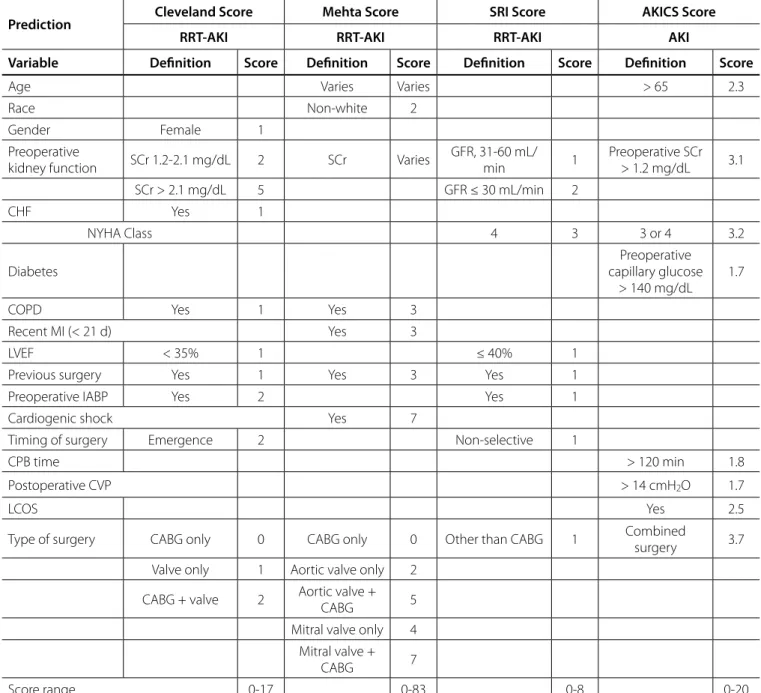
The four prediction scores analyzed in this study were Cleveland score, Mehta score, SRI and AKICS score. The brief description and characteristics of the scores were shown in Table 1.
RRT-AKI, deined with the initiation of dialysis in the postoperative course until the discharge, was the outcome for validation of Cleveland score, Mehta score and SRI. The dialysis was initiated at the consulting nephrologists based on the indication including uremia, acidosis, hyperkalemia or severe luid overload. CSA-AKI deined with KDIGO guideline was the outcome for validation of AKICS score.
KDIGO AKI deinition:
· Increase in serum creatinine (SCr) by ≥ 0.3 mg/dL (≥ 26.5 μmol/L) within 48 hours; or
· Increase in SCr to ≥ 1.5 times baseline, which is known or presumed to have occurred within the prior 7 days; or · Urine volume < 0.5 mL/kg/h for 6 hours.
Statistical Analysis
Statistical analysis was carried out by SPSS statistics for Windows (Version 20.0. Armonk, NY, USA, IBM Corp). Continuous variables were expressed as mean ± standard deviation (SD), and analyzed by unpaired t-tests, with Welch’s adjustment when necessary. Non-parametric variables were expressed as median and 25-75 percentiles and analyzed by Mann-Whitney U test.
Categorical variables were expressed as absolute (n) and relative (%) frequency, and were analyzed by Pearson’s 2-test or Fisher’s exact test, whenever appropriate. Signiicant level was considered with P<0.05. Area under receiver operating characteristic curves (AUROC) and Hosmer-Lemeshow goodness-of-it test were utilized to evaluate discrimination and calibration of every predictive risk score. Statistically, calibration refers to the agreement between observed and predicted risk and Hosmer-Lemeshow P value > 0.05 means good calibration. Discrimination refers to the capacity of separating people with disease from people without disease and the AUROC > 0.80 indicates good discrimination.
RESULTS
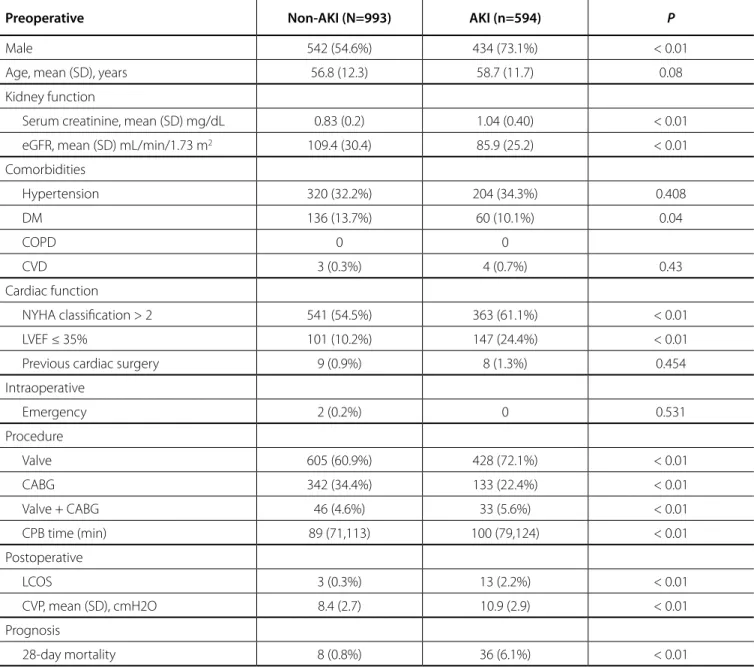
A total of 1609 patients were included in our study. After excluding cases with preoperative RRT (n=4), left ventricular device (n=2), missing data (n=11) and intra-operative and early-post-operative death (< 24h) (n=5), 1587 patients were included to the validation (Table 2). Due to the original exclusion criteria, the cases with emergency surgeries (n=2) were not qualiied into the validation of AKICS score.
The incidence of AKI was 37.4% (594/1587), while the incidence of AKI was 1.1% (18/1587) and the mortality of AKI and RRT-AKI were 6.1% (36/594) and 66.7% (12/18), respectively. The total mortality was 2.8% (44/1587). The discrimination (AUC, 95% CI) for both the prediction of CSA-AKI of AKICS (0.610, 95% CI 0.59 to 0.65) (Figure 1) and the prediction of RRT-AKI of Cleveland score (0.684, 95% CI 0.57 to 0.79) and SRI (0.622, 95% CI 0.49 to 0.75) were low, while Mehta score (0.708, 95% CI 0.60 to 0.81) indicated barely fair discrimination (Figure 2). On the other side, calibration of AKICS score (x2=7.55, P=0.109), Cleveland score (x2=1.918, P=0.166),
Mehta score (x2=9.209, P=0.238) and SRI (x2=2.976, P=0.271) were
fair. Compared to the expected incidence, in our study, AKICS score far underestimated the incidence of AKI, and the other models overestimated the incidence of RRT-AKI slightly (Table 3).
Although the purpose of the study was to evaluate patients according to the KDIGO criteria, we presented a subanalysis using the AKICS criteria for CSA-AKI.
CSA-AKI criteria in AKICS study: an increase of SCr levels above than 2.0 mg/dL in patients with baseline SCr lower than 1.5 mg/dL. In patients with baseline creatinine between 1.5 and 3.0 mg/dL, AKI was deined as a creatinine increase of 50% over the baseline value.
The incidence of CSA-AKI resulted from the AKICS criteria is lower than that from the KDIGO deinition (22.8% vs. 37.4%, P<0.001).
DISCUSSION
decades, the incidence of CSA-AKI varies between 8.9% and 39%, according to diferent deinition[2,3]. Some revealed reasons for the wide range of incidence are the diference between underlying disease, procedure types, comorbidities, ethics and medical care development in global population.
Since early prediction in those patients at high risk of developing CSA-AKI may contribute to prevention of complications, in the last two decades various predictive models have been developed to forecast CSA-AKI or RRT-AKI after cardiac surgery. Among those risk scores, adequate predictive power in the method published by Palomba et al.[7], the Cleveland Clinic score[8], the scoring system published by Mehta et al.[6] and the simpliied renal index score[9] were validated among Caucasians[4,5]. However, with the developing of AKI academic community, especially the publication of KDIGO guideline and recognition of intraoperative and post-operative risk factors, utilizing these risk scores in population other than Caucasians, and cohorts with more valve surgeries and less diabetes become questionable. With the development of medical technology, the cardiac surgery in developing countries like China is booming. Meanwhile, the complication of surgery and economic burden are also increasing due to relatively low medical technology and management. Compared to the existing score derivation cohorts, the incidence of CSA-AKI is much higher in developing countries like Brazil and China[11-14]. Thus, it is important to identify whether or not these existing scores are good enough to predict respective outcome in patients in developing countries.
In 2007, Palomba et al.[7] carried out a single-center study to generate a risk score to predict CSA-AKI with a cohort of 603 patients. In that study, the result of internal validation was good with AUROC 0.84, which meant a good predictive power of AKI
after cardiac surgery. By that time, the authors had recognized the worse prognosis and long-term CKD evolvement could be resulted from even slightly AKI. They also focused on the intraoperative and early postoperative risk factors contributing to CSA-AKI. This has been proven a promising milestone for subsequent authors to build predictive risk scores. However, the validation in our study is not as good as that. Potential reason may include: (1) The deinition of AKI in the primary study was an increase of SCr levels above than 2.0 mg/dL in patients with baseline SCr lower than 1.5 mg/dL. In patients with baseline creatinine between 1.5 and 3.0 mg/dL, AKI was deined as a creatinine increase of 50% over the baseline value. This urine output lacking deinition may result in the missing diagnosis of CSA-AKI compared with the KDIGO deinition. (2) The Asian population in the primary study is 3.8%, while we know the racial discrepancy may afect the validation result[15].
As for the three risk scores predicting RRT-AKI, they were generated upon deliberate design and large sample cohorts, Mehta score[6] and SRI score[9] were established with multicenter studies, and their predictive power have been validated suicient among Caucasian population[4,5]. However, their predictive power in our study were not good enough, and we tried to ind the reason. Maybe the following can explain.
Firstly, the endpoint event of the Cleveland score, Mehta score and SRI is RRT-AKI. Though up till now, whether early RRT is beneicial remains debatable[16], some studies have shown early initiation of RRT can reduce short-term mortality[17]. However, the variability of local practices in when to start RRT may afect the incidence signiicantly. As is known to all, the key problem of risk scores is their derivation, which is strongly dependent on characteristics of the derivation cohort and the statistical
Table 1. Predictors in each score.
Prediction Cleveland Score Mehta Score SRI Score AKICS Score
RRT-AKI RRT-AKI RRT-AKI AKI
Variable Definition Score Definition Score Definition Score Definition Score
Age Varies Varies > 65 2.3
Race Non-white 2
Gender Female 1
Preoperative
kidney function SCr 1.2-2.1 mg/dL 2 SCr Varies
GFR, 31-60 mL/
min 1
Preoperative SCr > 1.2 mg/dL 3.1
SCr > 2.1 mg/dL 5 GFR ≤ 30 mL/min 2
CHF Yes 1
NYHA Class 4 3 3 or 4 3.2
Diabetes
Preoperative capillary glucose
> 140 mg/dL
1.7
COPD Yes 1 Yes 3
Recent MI (< 21 d) Yes 3
LVEF < 35% 1 ≤ 40% 1
Previous surgery Yes 1 Yes 3 Yes 1
Preoperative IABP Yes 2 Yes 1
Cardiogenic shock Yes 7
Timing of surgery Emergence 2 Non-selective 1
CPB time > 120 min 1.8
Postoperative CVP > 14 cmH2O 1.7
LCOS Yes 2.5
Type of surgery CABG only 0 CABG only 0 Other than CABG 1 Combined
surgery 3.7
Valve only 1 Aortic valve only 2
CABG + valve 2 Aortic valve +
CABG 5
Mitral valve only 4
Mitral valve +
CABG 7
Score range 0-17 0-83 0-8 0-20
AKI=acute kidney injury; RRT-AKI=AKI which renal replacement therapy is needed; CABG=coronary artery bypass grafting; CHF=congestive heart failure; COPD=chronic obstructive pulmonary disease; CPB=cardiopulmonary bypass; CVD=cerebral vascular disease; CVP=central venous pressure by ICU admittance; DM=diabetes mellitus; eGFR=estimated glomerular iltration rate, as calculated based on the Cockcroft-Gault formulae for SRI score validation; GFR=glomerular iltration rate; IABP=intra-aortic balloon pump; LCOS=low cardiac output syndrome; LVEF=left ventricular ejection fraction; MI=myocardial infarction; NYHA=New York Heart Association; SCr=serum creatinine; SD=standard deviation
methods[18], especially when the endpoint has a low incidence and is multifactorial. The RRT-AKI incidence in our cohort is 1.1%, slightly lower than that in those three scores (Cleveland 1.7%, Mehta 1.4% and SRI 1.3-2.2%). This may be one of the reasons that result in their insuicient predictive power in our study.
Secondly, despite of strict similar inclusion or exclusion criteria being utilized, there remained much diference among
Table 3. Comparison between predicted and observed outcomes for each score.
AKI RRT-AKI
AKICS (n=1585) Cleveland (n=1587) Mehta (n=1587) SRI (n=1587)
Predicted 14% 1.7% 1.4% 1.3-2.2%
Observed 37.4% 1.1% 1.1% 1.1%
AKI=acute kidney injury
The predicted incidences of each outcome were derived from the origin papers.
Table 2. Characteristics of the patients in the validation cohort.
Preoperative Non-AKI (N=993) AKI (n=594) P
Male 542 (54.6%) 434 (73.1%) < 0.01
Age, mean (SD), years 56.8 (12.3) 58.7 (11.7) 0.08
Kidney function
Serum creatinine, mean (SD) mg/dL 0.83 (0.2) 1.04 (0.40) < 0.01
eGFR, mean (SD) mL/min/1.73 m2 109.4 (30.4) 85.9 (25.2) < 0.01
Comorbidities
Hypertension 320 (32.2%) 204 (34.3%) 0.408
DM 136 (13.7%) 60 (10.1%) 0.04
COPD 0 0
CVD 3 (0.3%) 4 (0.7%) 0.43
Cardiac function
NYHA classiication > 2 541 (54.5%) 363 (61.1%) < 0.01
LVEF ≤ 35% 101 (10.2%) 147 (24.4%) < 0.01
Previous cardiac surgery 9 (0.9%) 8 (1.3%) 0.454
Intraoperative
Emergency 2 (0.2%) 0 0.531
Procedure
Valve 605 (60.9%) 428 (72.1%) < 0.01
CABG 342 (34.4%) 133 (22.4%) < 0.01
Valve + CABG 46 (4.6%) 33 (5.6%) < 0.01
CPB time (min) 89 (71,113) 100 (79,124) < 0.01
Postoperative
LCOS 3 (0.3%) 13 (2.2%) < 0.01
CVP, mean (SD), cmH2O 8.4 (2.7) 10.9 (2.9) < 0.01
Prognosis
28-day mortality 8 (0.8%) 36 (6.1%) < 0.01
REFERENCES
1. Fortes JV, Silva MG, Baldez TE, Costa MA, Silva LN, Pinheiro RS, et al. Mortality risk after cardiac surgery: application of Inscor in a university hospital in Brazil's Northeast. Braz J Cardiovasc Surg. 2016;31(5):396-9.
2. Howell NJ, Freemantle N, Bonser RS, Graham TR, Mascaro J, Rooney SJ, et al. Subtle changes in renal function are associated with diferences in late survival following adult cardiac surgery. Eur J Cardiothorac Surg. 2012;41(4):e38-42.
3. Lassnigg A, Schmidlin D, Mouhieddine M, Bachmann LM, Druml W, Bauer P, et al. Minimal changes of serum creatinine predict prognosis in patients after cardiothoracic surgery: a prospective cohort study. J Am Soc Nephrol. 2004;15(6):1597-605.
4. Candela-Toha A, Elias-Martin E, Abraira V, Tenorio MT, Parise D, Pablo A, et al. Predicting acute renal failure after cardiac surgery: external validation of two new clinical scores. Clin J Am Soc Nephrol. 2008;3(5):1260-5. 5. Englberger L, Suri RM, Li Z, Dearani JA, Park SJ, Sundt TM 3rd, et al.
Validation of clinical scores predicting severe acute kidney injury after cardiac surgery. Am J Kidney Dis. 2010;56(4):623-31.
6. Mehta RH, Grab JD, O'Brien SM, Bridges CR, Gammie JS, Haan CK, et al. Bedside tool for predicting the risk of postoperative dialysis in patients undergoing cardiac surgery. Circulation. 2006;114(21):2208-16. 7. Palomba H, Castro I, Neto AL, Lage S, Yu L. Acute kidney injury
prediction following elective cardiac surgery: AKICS score. Kidney Int. 2007;72(5):624-31.
8. Thakar CV, Arrigain S, Worley S, Yared JP, Paganini EP. A clinical score to predict acute renal failure after cardiac surgery. J Am Soc Nephrol. 2005;16(1):162-8.
9. Wijeysundera DN, Karkouti K, Dupuis JY, Rao V, Chan CT, Granton JT, et al. Derivation and validation of a simpliied predictive index for renal replacement therapy after cardiac surgery. JAMA. 2007;297(16):1801-9. 10. Kidney disease: improving global outcomes (KDIGO) acute kidney
injury work group. KDIGO clinical practice guideline for acute kidney injury. Kidney Inter. 2012;2(suppl):1-138.
11. Fang Y, Teng J, Ding X. Acute kidney injury in China. Hemodial Int. 2015;19(1):2-10.
12. Fang Y, Ding X, Zhong Y, Zou J, Teng J, Tang Y, et al. Acute kidney injury in a Chinese hospitalized population. Blood Purif. 2010;30(2):120-6. 13. Xu J, Jiang W, Fang Y, Teng J, Ding X. Management of cardiac
surgery-associated acute kidney injury. Contrib Nephrol. 2016;187:131-42. 14. Machado MN, Nakazone MA, Maia LN. Acute kidney injury based on
KDIGO (Kidney Disease Improving Global Outcomes) criteria in patients with elevated baseline serum creatinine undergoing cardiac surgery. Rev Bras Cir Cardiovasc. 2014;29(3):299-307.
15. Waikar SS, Curhan GC, Ayanian JZ, Chertow GM. Race and mortality after acute renal failure. J Am Soc Nephrol. 2007;18(10):2740-8. 16. Ricci Z, Ronco C. Timing, dose and mode of dialysis in acute kidney
injury. Curr Opin Crit Care. 2011;17(6):556-61.
17. Zarbock A, Kellum JA, Schmidt C, Van Aken H, Wempe C, Pavenstadt H, et al. Efect of early vs delayed initiation of renal replacement therapy on mortality in critically ill patients with acute kidney injury: the ELAIN randomized clinical trial. JAMA. 2016;315:2190-9.
18. Ranucci M, Castelvecchio S, Menicanti L, Frigiola A, Pelissero G. Risk of assessing mortality risk in elective cardiac operations: age, creatinine, ejection fraction, and the law of parsimony. Circulation. 2009;119(24):3053-61.
19. Santos KA, Berto B, Sousa AG, Costa FA. Prognosis and complications of diabetic patients undergoing isolated coronary artery bypass surgery. Braz J Cardiovasc Surg. 2016;31(1):7-14.
20. Kocogullari CU, Kunt AT, Aksoy R, Duzyol C, Parlar H, Saskin H, et al. Hemoglobin a1c levels predicts acute kidney injury after coronary artery bypass surgery in non-diabetic patients. Braz J Cardiovasc Surg. 2017;32(2):83-9.
21. Birnie K, Verheyden V, Pagano D, Bhabra M, Tilling K, Sterne JA, et al. Predictive models for kidney disease: improving global outcomes (KDIGO) deined acute kidney injury in UK cardiac surgery. Crit Care. 2014;18(6):606.
to injury during cardiac surgery. The comorbidities in developing countries like Chinese patients are also diferent from Western population. In our derivation cohort, the ratio of hypertension and diabetes mellitus is also remarkable, lower than the previous develop population[19].
Nonetheless, our validation did not make the scores useless. The predictors can be further analyzed with other newly found risk factors[20] or biomarkers so as to establish new brand risk scores[21]. Along with the discovery of intraoperative and postoperative predictors, a dynamic predictive model for CSA-AKI/RRT-AKI based on the KDIGO AKI deinition, which might be applied to predict the incidence of CSA-AKI from preoperative to early postoperative periods, shall meet the need. Meanwhile some limitation of our study must be noted, our validation is a single-center study, with relatively lower sample amount.
CONCLUSION
We carried out this study to validate four risk scores predicting CSA-AKI or RRT-AKI. Although all scores presented good calibration in our cohort, their discrimination were barely satisfactory with an underestimated CSA-AKI incidence by AKICS score and overestimated RRT-AKI incidence by Cleveland score, Mehta score and SRI score. However, the risk factors in the scores can be further analyzed to generate reliable new risk scores.
Authors’ roles & responsibilities
WJ
JX
BS
CW JT
XD
Substantial contributions to the conception or design of the work; acquisition, analysis, or interpretation of data for the work; drafting the work or revising it critically for important intellectual content; final approval of the version to be published
Substantial contributions to the conception or design of the work; acquisition, analysis, or interpretation of data for the work; final approval of the version to be published Substantial contributions to the conception or design of the work; acquisition, analysis, or interpretation of data for the work; final approval of the version to be published Final approval of the version to be published
Drafting the work or revising it critically for important intellectual content; final approval of the version to be published