RAC, Curitiba, v. 15, n. 2, art. 6, pp. 261-282, Mar./Abr. 2011
Barriers to the Accomplishment of a Subsidiary’s Strategic Role:
How Location and Corporate Networks Influence Subsidiary
Performance
Omar Salgado *
E-mail: [email protected] EGADE Business School e Instituto Tecnológico y de Estudios Superiores de Monterrey Monterrey, Nuevo León, Mexico.
* Endereço: Omar Salgado
Carretera Lago de Guadalupe, Km 3.5, Atizapán de Zaragoza 52926, Estado de México.
O. Salgado 262
RAC, Curitiba, v. 15, n. 2, art. 6, pp. 261-282, Mar./Abr. 2011 www.anpad.org.br/rac
Resumo
Este trabalho apresenta a evolução da filial de uma multinacional localizada em um país emergente, e tem como objetivo descobrir os obstáculos enfrentados durante evolução da realização da função estratégica. Ao longo de um estudo histórico, voltando 40 anos atrás, o jornal descreve marcos na evolução e destaca os obstáculos enfrentados para o desenvolvimento e aplicação de recursos, sejam eles vindos dos HQ´s ou do processo de incorporação da filial. O resultado da pesquisa aponta os obstáculos encontrados pelas filiais ao cumprir o seu papel e mandatos a fim de alcançar internacionalização e as tipologias de evolução que emergem da interação entre as barreiras locais e empresariais.
Palavras-chave: evolução da filial; funções estratégicas; capacidade da filial; multinacionais.
Abstract
This paper presents the evolution of a multinational’s subsidiary, which is located in an emerging country, and aims to uncover barriers encountered during the evolution of the accomplishment of its intended strategic role. Throughout a historical study that goes back 40 years, the paper depicts milestones in the subsidiary’s evolution and highlights barriers encountered to developing and deploying capabilities, whether they are transferred from HQ’s or emerge from the subsidiary’s embedding process. The results of this research point out the barriers a subsidiary faces while accomplishing its role and duties towards the ends of internationalization and evolution typologies that emerge from the interaction between local and corporate barriers.
Introduction
Traditionally, the study of the internationalization of a firm’s activities finishes once Foreign Direct Investment (FDI) occurs. However, we believe that success or failure in every attempt at internationalization depends not only on activities carried out during the establishment of foreign subsidiaries but also on post-FDI activities; therefore, attention should be paid to the subsidiaries’ evolution rather than merely to the localization process in which strategic intentions and measures are put in place.
In theory, if the localization process is properly planned and concluded, subsidiaries have a greater chance of succeeding in foreign markets. Nonetheless, some subsidiaries face diverse barriers rendering them unable to accomplish their strategic role. What is meant by barriers are all difficulties
in a subsidiary’s business environment that cannot be easily overcome through corporate knowledge, even though the subsidiary in question went through a proper localization process where corporate coordination and control mechanisms were put in place. Coordination and control mechanisms are defined as those processes and procedures to be adhered to by subsidiary managers in order to replicate corporate knowledge.
Some attempts have been made to focus research more on subsidiaries. For example, while discussing multinationals’ (MNE) coordination mechanisms, researchers have highlighted that companies not only allocate resources and transfer technologies but also benefit from the knowledge collected from every node in the network (Casson, Dark, & Gulamhussen, 2009; Jenkins & Tallman, 2010; Nachum, Zaheer, & Gross, 2008). The importance of distinguishing between configuration and coordination activities throughout the internationalization process has also been stated (Beugelsdijk, Pedersen, & Petersen, 2009; Cerrato, 2006; Li & Rugman, 2007). Due to this, international business studies (IB) have concentrated their efforts on discussing what are the most suitable coordination mechanisms that allow a MNC to benefit better from foreign subsidiaries; such as the research of (Criscuolo & Narula, 2007; Maritan, Brush, & Karnani, 2004; Reger, 2004). Meanwhile, international manufacturing studies (IM) tend to concentrate on what configurations enable effective execution, as in the research of (Ferdows, 1997; Luo & Zhao, 2004; Shi & Gregory, 1998; Vereecke & Dierdonck, 2002). Further research about how subsidiaries collect knowledge states that subsidiaries’ linkages and the linkage density are very important in regards to performance and influence within the corporate network (Almeida & Phene, 2004; Luo & Zhao, 2004). This concept has given rise to the term
embeddedness, defined as the number of exchange relationships between the subsidiary and other
entities in and out of the corporate network from which the subsidiary is able to collect potentially commercially exploitable knowledge (Almeida & Phene, 2004; Andersson, Forsgren, & Holm, 2001; Clark & Almond, 2004; Garcia-Pont, Canales, & Noboa, 2009; Holm, Malmberg, & Sölvell, 2003; McDonald, Warhurst, & Allen, 2008).
O. Salgado 264
RAC, Curitiba, v. 15, n. 2, art. 6, pp. 261-282, Mar./Abr. 2011 www.anpad.org.br/rac
Literature about Strategic Roles of Subsidiaries, Research Question, Gaps &
Propositions
Some research (Narula & Dunning, 2000) classifies FDI motives as: resource seeking, market seeking and efficiency/strategy seeking. Hence, forces and motives combined with companies’ strategy and the attractiveness of location constitute a complex mechanism for explaining what it is that MNEs pursue through their subsidiaries. Lall (2002), at his end, define FDI benefits based on proprietary assets (ownership assets) and non-proprietary assets that can be obtained from the market. In consequence, if internationalization explains the resource allocation drivers in foreign countries, then localization should discuss not only the way companies establish and transfer knowledge and technology to their subsidiaries but also how the subsidiary evolves via the development of its capabilities. Once a foreign subsidiary has been set up to play a specific role within a corporate network, coordination between headquarters and the subsidiary is needed to ensure that the corporation gets the best results from that specific node.
It has been stated that the difference in power between foreign business units relies on profit contribution, distance to heartquarters (HQs) and especially the control of critical linkages (Birkinshaw, 1995; Gammelgaard, 2009; Ghoshal & Bartlett, 1990; Kang & Li, 2009; Marin & Verdier, 2009). By controlling these linkages, subsidiaries can influence the assignment of orders
from HQ’s and engage in further functional and geographical responsibilities (Birkinshaw, 1996; Cantwell & Mudambi, 2005; Eckert & Rossmeissl, 2007). However if this were absolutely true, subsidiaries’ success would be limited to only those few targeting growing markets that were managed solely by expatriates and having control of political and financial sources. In contrast, it is possible to see disparities in subsidiaries’ performance even within healthy organizations or those operating in frugal geographical regions; many of these subsidiaries have failed to accomplish their intended strategic roles and currently remain in their locations. In consequence, our research question is: What are the barriers to the accomplishment of subsidiaries’ strategic roles that would keep them from being competitive, not only in their locality, but also across their corporate networks?
Literature about subsidiaries’/plants’ strategic roles shows two research strands: authors concerned about the role subsidiaries play based upon type of interaction and flows within the network, and those interested in the role they play based upon characteristics of their location and available knowledge.
Emphasizing the importance of coordination mechanisms, Jarillo and Martínez (1990) discuss the role that subsidiaries play in terms of the degree of coordination and localization of companies’ activities. Therefore a receptive subsidiary would carry out activities needing a high degree of
integration and a low degree of localization; an autonomous subsidiary would perform activities
with a high degree of localization but a low degree of integration, while an active subsidiary would
need a high degree of both. It has been stated (Tsai, Yu, & Lee, 2006) that cultural distance between HQs and Subsidiaries impacts on subsidiaries' perceived satisfaction of their efforts. Three different roles were established: Respective Subsidiaries (low local responsiveness but highly integrated), Autonomous Subsidiaries (high local responsiveness but low integration) and Active Subsidiaries (highly integrated and high local responsiveness). In a similar sense, (Birkinshaw, 1995) defines subsidiary roles based on the effect coordination mechanisms have on subsidiary responsibility as: a
local implementer if it is adopting HQ’s technology, a specialized contributor if it has significant
expertise in a specific function; and a world mandate if it has extended responsibility, geographically
speaking. While analyzing the sources of funding accessed by the R&D labs of foreign multinationals, Papanastassiou and Pearce (2005) also found a correspondence between coordination mechanisms and strategic roles, and using this information defined four roles R&D labs play: SL1 to support local
production operations by assisting in the adaptation of the products to be produced or processes to be used; LIL to develop a distinctive new product that it will produce for its markets; SL2 to support
coordination mechanisms but based on network flows, Gupta and Govindarajan (1991) conceptualized subsidiaries’ strategic roles in terms of high and low levels of knowledge outflow and inflow: the
Global Innovator serves as the fountainhead of knowledge for other units; the Integrated Player role
implies a responsibility for creating knowledge that can be utilized by other subsidiaries; the Local Innovator role implies that the subsidiary has almost complete local responsibility for the creation of
relevant know-how in all key functional areas; and the Implementor role is one where the subsidiary
engages in little knowledge creation of its own and relies heavily on knowledge inflows from sister subsidiaries. Vereecke and Dierdonck (2002) expand upon the inter-organizational flows described by Ghoshal and Bartlett, (1990) and, based upon the degree of centrality, recorded communication, innovation and people movements in a pool of manufacturing plants, defined a new network plant typology: the isolated plant, the blue-print plant, the host plant, and the glue for the network plant.
The commonality of the literature mentioned above is that they explain subsidiaries’ strategic roles based on MNEs’ coordination mechanisms. However, they do consider these coordination mechanisms equally established and fair across the entire organization, which constitutes our first research gap, and enables us to state our first proposition:
Proposition 1: Corporate coordination mechanisms are a potential source of barriers to
subsidiaries’ accomplishing their strategic roles.
On the other hand, researchers interested in the role subsidiaries play based on characteristics of their locations and knowledge available state the importance of location competence for internationalization drivers: manufacturing cost, access to skills and knowledge, and proximity to market. Ferdows (1997) states six strategic roles of factories: offshore, source, outpost, leader, server and contributor. Location competence is the newly introduced dimension and here subsidiary
roles would depend not only on corporate coordination mechanisms but also on location competence. Subsequent research about inter/intra organizational linkages proposed by Bartlett and Ghoshal (1987) evolved the concept of subsidiary embeddedness, defined as the subsidiary’s sum of total interdependences as a consequence of its position in a business network. Andersson, Forsgren and Holm (2002) argue that the stronger the technical and business embeddedness of a subsidiary, the better the subsidiary’s market performance and its corporate influence (Andersson, Forsgren, & Holm, 2000, 2001; Andersson, Forsgren, & Pedersen, 1999; Andersson et al., 2002).
This is an important finding since it radically changes the concept from the previously accepted belief that corporate knowledge and technology flows from HQ’s to subsidiaries, to the concept that knowledge can be created, codified and packaged for commercial exploitation and deployed corporately from subsidiaries. This is a tremendous upgrading of subsidiaries’ roles by naming them centers of excellence. The literature mentioned above considers subsidiaries’ locations as an important booster for subsidiary performance; however all these studies are based on what MNEs can get from the location and not on what the location can offer to them, which constitutes our second research gap and enables us to state our second proposition:
Proposition 2: Location competence is a potential source of barriers to subsidiaries’
accomplishing their strategic role.
Research Method
Research background
O. Salgado 266
RAC, Curitiba, v. 15, n. 2, art. 6, pp. 261-282, Mar./Abr. 2011 www.anpad.org.br/rac
size, strategic location, the country’s resources, industrial profile, industrial agglomeration and synergy, and industrial policy, among others. Within developing nations, those with rich natural resources, such as Mexico and Saudi Arabia, used to be at the top of the list but a change has been reported in the FDI flow rationale from seeking locations with inherent advantages to locations with created advantages (Ozawa & Castello, 2001; Peneder, 2002) resulting in the emergence of important manufacturing-base countries such as Singapore and Malaysia as well as large markets like China, India and Brazil. In consequence, and since developing countries are increasingly dependent on FDI inflow, mainly from MNE’s, it is important to understand the FDI rationale as well as the potential roles MNE subsidiaries are able to play depending on the geographical extent of their mandates (Birkinshaw, 1995), goals pursued by HQ’s (Ferdows, 1997), how excellent subsidiary capabilities are (Khurana & Talbot, 1998), subsidiary autonomy (Ambos & Birkinshaw, 2010; Cantwell, Dunning, & Lundan, 2010) and subsidiaries’ ability to adopt, pollinate and create knowledge (Andersson, Forsgren, & Holm, 1996, 2001; Andersson et al., 2001, 2002). The ultimate goal pursued in this work
is to discuss the way MNE’s’ subsidiaries can benefit not only their corporations but also from the local environment.
Selection of research sample
This research started with the identification, through exploratory case studies (not reported in this paper), of those factors that have made MNE’s subsidiaries in Mexico shift their production plants to more beneficial locations. There were five cases looked at in all before selecting the main case reported in this paper, at three different levels of analysis: country, sector and firm. These cases focused on two different types of industries: apparel and electronic. Company cases were selected due to the impact their divestments had on macro-economic figures and the attention they received from academics and policy makers in Mexico. Table 1 shows challenges that emerged from the exploratory case studies, from which it was possible to draw out potential research questions to be analyzed further through the literature review process. Different results that could be obtained from this process: 1. Find accurate answers in the literature to the questions emerging from exploratory cases that can
also explain the phenomenon.
2. Find partial or incomplete answers to the questions emerging from exploratory cases that can partially explain the phenomenon. This would identify theoretical gaps and questions could then be modified accordingly until they derive appropriate research questions.
Table 1
Summary of Challenges and Resulting Literature Topics
Case Study Challenges which emerged from exploratory cases Questions which emerged Literature to Review Economic and Industrial evolution in Mexico
1. Understand the dynamics of global competition.
2. Understand the ways technology can be not only adopted from abroad but also created and spread across Mexican manufacturers. 3. Understand the role of industrial policy in reinforcing the internal market and
underpinning indigenous and foreign companies.
1. How can MNE’s be encouraged to stay longer in Mexico? 2. How can indigenous industry be underpinned? 3. How can the technological orientation of products manufactured in Mexico be boosted? 4. How can sustainable FDI inflows be ensured?
1. Firm growth theory
- Definition of growth - Growth mechanism - Role of entrepreneurship - Role of technology 2. Theory of International Production
- Inherent & created competitive
advantages
- Transactional cost 3. International Manufacturing studies - Network configuration - Plant roles 4. International Business studies - Network coordination - Subsidiary management Apparel Industry in Mexico
1. Understand the way indigenous manufacturers can access technology and novel manufacturing practices.
2. Understand the dynamic of international JV’s and the role of systems integrators. Sara Lee
divests operations in Mexico
1. Understand different costs involved in producing in foreign countries.
2. Understand drivers that motive such companies to operate under Maquiladora program.
3. Understand the role of technology in firm/location wealth.
Electronics Industry in Mexico
1. Understand the role of research institutions on the development of technology.
2. Understand the role of industrial policy in reinforcing the infrastructure of the country. 3. Understand the dynamics of global competition and its effects on industrial organization.
4. Understand industrial trends and their effect on regulatory matters.
Phillips transfers production lines to China
1. Understand the way companies get involved in activities upstream of the supply chain, including R&D.
2. Understand ‘manufacturing’ as the complete process from the conception of the idea to placing a product in the client’s hands.
Table 2 takes the questions emerging from exploratory cases, compares them with the literature review and suggests four statements that could have a positive impact on such questions. However, there is still a lack of answers for some specific issues that can potentially become theoretical gaps. There are isolated relationships such as:
1. Long-term generation of profit MNE’s stay longer. 2. Subsidiary embeddedness benefits to location.
O. Salgado 268
RAC, Curitiba, v. 15, n. 2, art. 6, pp. 261-282, Mar./Abr. 2011 www.anpad.org.br/rac
Therefore, it is possible to paraphrase the questions emerging from exploratory cases into one more comprehensive one that includes Greater investment (Plant/subsidiary role) with long term generation of profit (benefit to corporation) and with subsidiary embeddedness (benefit to location)
How can subsidiaries upgrade their roles to support their corporations and the local economy?
Table 2
Linking literature review & exploratory cases
Summary of Literature Review
Firms’ Growth A: Sustainability growth only through the long-term generation of profit.
B: Growth depends on companies’ perception of: risk/uncertainty acceptance, ambition of
founders, managerial style, functional heterogeneity and entrepreneurial attitude.
Theory of International Production
C: Companies embark on international production because of market imperfections. D: Companies transfer a complete package of technology, skills and knowledge.
E: A close cultural distance between companies’ home and host country and the incremental
commitment boosts internationalization.
International Manufacturing Studies
F: Plant roles denote what the corporation aims to get from the new site.
G: Through location decisions companies select a new production site, relocate an existing
facility and reallocate existing ones; the analysis can be done either in snap-shot or dynamic basis taking in account either a single function or a network approach.
H: Geographical dispersion and learning and thriftiness ability are the manufacturing
network’s features that shape its multi-domestic or global-coordinated configuration. Network’s operational performance depends on network/plant capabilities interaction.
International Business Studies
I: Centrifugal/centripetal forces impact on internationalization speed for seeking: resources,
market, and efficiency/strategy.
J: Global coordination and national responsiveness is pursued throughout subsidiary roles, in
which operational freedom depends on subsidiary influence on network.
K: Subsidiary knowledge through adoption, diffusion and creation levels and intensity
depends on its degree of embeddedness.
Linking exploratory cases to literature review Questions from
exploratory cases
1. How can MNE’s be encouraged to stay longer in Mexico? 2. How can indigenous industry be underpinned?
3. How can the technological orientation of products manufactured in Mexico be boosted? 4. How can sustainable FDI inflows be ensured?
Do answers satisfy question?
A: Partially; if profitable, MNE’s will stay in Mexico but this is not directly related either to
the firm’s degree of investment or its creation of wealth.
B: NO; even with a low degree of risk and uncertainty, MNE’s will shift their activities. C: NO; market imperfections appear to be worldwide but MNE’s stay just in certain locations. D: Partially, greater knowledge transferred leads to greater chances to succeed but how can we
make this happen? Is HQ’s knowledge enough?
E: NO; if that is the case then the process of attracting FDI is slow and very limited. F: NO; MNE goals are never committed just to a specific site.
G: Partially; the amount of infrastructure encourages FDI but it is not enough since global
competition is high.
H: Partially; how can subsidiaries influence network configuration decisions?
I: NO; centrifugal/centripetal forces appear to be worldwide but MNE’s stay just in certain
locations.
J: Partially; since it does not explain how subsidiaries can drive investments to their plants to
improve their position.
K: Partially; since it does not explain the process of embeddedness.
Table 2 (continued)
Linking exploratory cases to literature review Paraphrased
Questions
Statements that partially answer the questions which emerged from exploratory case studies: - Long term generation of profit.
- As greater knowledge is transferred, the chances of success become greater. - High level of infrastructure encourages FDI inflows.
- High degree of embeddedness boosts investment.
Remaining lack of answers
- Is firm growth directly related to either the degree of investment or the creation of wealth? - How is it possible to ensure the transference of knowledge?
- How can subsidiaries influence network configuration decisions?
- How can subsidiaries drive investments to their plants to improve their position? - How can subsidiaries embed in their business environment?
- How can subsidiaries upgrade their roles to support their corporations and the local economy?
Summary of Subsidiary Evolution
O. Salgado 270
RAC, Curitiba, v. 15, n. 2, art.6, pp. 261-282, Mar./Abr. 2011 www.anpad.org.br/rac
Table 3
Subsidiary Evolution in Brief
Phase Milestones Period Characteristics Evolution Drivers Manufacturing Practices Business Practices Future Challenges
Phase I: Independent Importer Exposition of German Industry in Mexico 1935 –
1949 .Open market for vehicles such as Beetle was an important initial task.
.The process of engagement between the company and Mexico is an important characteristic of this stage.
.Evolution driver in phase I: exploit Beetle’s characteristics of low cost and stiff construction.
.-Evolution driver within Phase I and Phase II: high taxes on imported vehicles; compulsory production of engines and manufacture of at least 60% of cars’ components in Mexico.
.SKD and CKD mechanisms were adopted before the automotive decree of 1962 in order to reduce transportation costs.
.Sales, distribution and post-sales services in main cities such as Mexico City, Puebla City and Torreon. .Independent importers
establish a formal relationship with VW.
1.Labor issues arise as one of the key barriers for reaching the flexibility needed. Inflexible labour legislation disables managers from reducing working time when market demand decreases, leading to workers being laid-off, with a direct impact on training costs. This is particularly important for the subsidiary since it is immersed in an internal competition with other business units to drive further investment into their locations.
2. The subsidiary is still limited in two main capabilities: participation of local suppliers in forward sourcing and the design of the vehicle’s hats for the North American market.
Phase II: Localization
A new plant is built in Puebla, Mexico
1964 –
1970 .Selection of a location in Mexico to establish a new plant. .Process of localization of VW’s
technology and business practices.
.Emphasis is given to training.
.Evolution driver in Phase II is: subsidiary managers concentrated on quickly and accurately adopting technology and business practices from HQ’s.
.Evolution drivers within Phase II and Phase III are: reduce dependency from HQ’s to run already established business processes.
.SKD and CKD mechanisms were gradually changed by in-house production.
.The Mexican subsidiary adopted existing manufacturing technology in the corporate network. which was flex-mass production.
.A formal relationship between the Mexican plant and VW is established, the subsidiary develops local suppliers to comply with the national content exigency. Phase III: Local Network Development A training center is built 1970 –
1988 .New vehicles were introduced and export to the US and Europe started.
.Technological change took place. .Economic instability during this
period impacted deeply on the national market.
.Evolution drivers in Phase III: the disengagement from HQ’s in operational terms; complying with exporting mandates.
.Evolution drivers within Phase III and IV: exploit location’s advantages such as trade agreements, manufacturing costs and strategic position in North America.
.Technological change pushed the subsidiary’s managers to carry out a supplier development program. .Operational complexity increased. .VW closed down its manufacturing
plant in the US and transferred manufacturing lines to the Mexican plant.
.Subsidiary starts developing activities not related to manufacturing and enlarging its base of suppliers in the location Phase IV: Internal and external embeddedness Closing down of VW plant in the US
1988 –
now .Liberalization of the automotive sector in Mexico. .Faster technological upgrade of
vehicles than is demanded in the Mexican automotive market. .Specialization of the Mexican
subsidiary to manufacture mid-size cars.
.Build interdependence between the Mexican subsidiary and different business entities in and out of the corporate network.
.VWM is appointed as the manufacturing center for North American region.
.VWM put a special emphasis on improving its business practices with local suppliers by reducing logistics complexity and inventory along the value chain.
.VWM increases its interdependency with other business entities
Phase V: Centre of excellence New Beetle is launched from Mexico 1998 –
Now . New Beetle is produced exclusively in Mexico. .The subsidiary exports its
manufacturing knowledge about the A4 production platform.
.Adopt and disseminate corporate knowledge, collect and package commercially exploitable knowledge. .Coordinate solutions regionally with
other subsidiaries.
.Mass customization of subsidiary vehicles via the modularization of parts and components.
.Adaptation of company’s vehicles to specific market needs.
Characteristics and Attrib
In this section, the su depicted similarly to how thi expected in any HQ’s-subsidia strategy rather than isolated d to the evolutionary process.
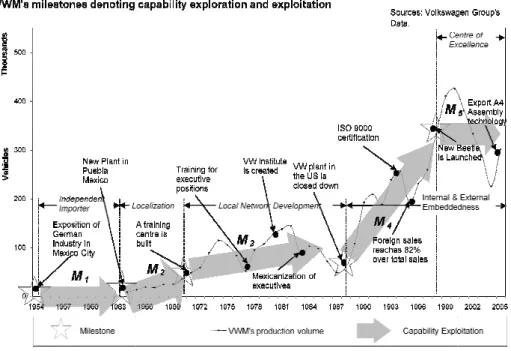
Figure 1 exhibits fiv transformation process: 1. The Beetle exhibition at t
possibility of introducing s exclusive importers and ex 2. Independent importers sold
Puebla City; this was an in seven years after establishi 3. The creation of a training c on the use of expatriates. T executive positions, leading 4. The closing down of a siste
enabled the subsidiary to manufacturing capabilities capability was then exploite
Excellent performance American region turned the subsidiary out of the whole co a worldwide basis. This capab technology on the A4 platform
Figure 1. Milestones Denotin
Process.
ributes of Subsidiary Evolution
subsidiary’s (denoted by VWM acronym) evolu this was done for the parent company (Salgado, diary relationship, most of the subsidiary’s activitie decisions made locally. In consequence, the analy
five main milestones denoting that the subsid
t the 1953 Industrial Fair in Mexico City raised g such vehicles to Mexico. Local investors embrac exploited Beetle’s market for ten years (M1).
old their share to the parent company and the comp
n intense period of training and technology transfe shing the plant (M2).
g center enabled the subsidiary to reduce its depend s. This capability was exploited later on by training
ing to the Mexicanization of the subsidiary (M3).
ister plant in the US and the transference of its prod to become the manufacturing center for North Am es because of the need to comply with different ma
ited further and foreign sales reached 82% of the tot ce by the subsidiary and the promising business en
e subsidiary into a center of excellence; the pare corporate network to launch the new version of the pability was later exploited by specializing the sub rm, which has recently been deployed to other subs
ting Capability Exploration & Exploitation Along S
olution attributes will be o, 2008). However, as is ities respond to a corporate alysis emphasizes barriers
sidiary went through a
ed expectations about the raced the venture, became
mpany built a new plant in sfer which bore fruit only
ndency on HQ control and ing Mexican managers for
oduction lines into Mexico America and extended its market requirements. This total sales (M4).
environment in the North arent company chose the the Beetle from Mexico on ubsidiary’s manufacturing
bsidiaries (M5).
O. Salgado 272
RAC, Curitiba, v. 15, n. 2, art. 6, pp. 261-282, Mar./Abr. 2011 www.anpad.org.br/rac
After explaining the above examples of capability exploration and exploitation, Table 4 exhibits a detailed list of main milestones as well as their characteristics and associated attributes.
Table 4
From Subsidiary's Milestones to Evolution Attributes Table
No. Phase Milestone Characteristic Attribute
1 Phase I: Independent Importer (1954 – 1964) (1954 – 1964)
VW’s cars exhibited in Mexico City Capability
Exploration Corporate Barrier 2 Volkswagen Mexicana is founded as independent
importer
Capability Exploitation
Local Barrier
3 Beetles participate in the Pan-American Capability
Exploitation Local Barrier 4 JV signed with Chrysler Mexico to assemble Beetle Capability
Exploration
Local Barrier
5 First beetles are assembled in Mexico Capability
Exploitation Corporate Barrier 7 2nd agreement to assemble Beetle by British Motor
Company
Capability Exploitation
Local Barrier
8 Independent importer (Volkswagen Mexicana) If so name needs full capitalisation. If not, leave as is and changes “acquires” to “acquire”] acquires British Motor Company
Capability
Exploration Corporate Barrier
9 Investigation into viability of producing Beetles in
Mexico Capability Exploration Corporate Barrier 10 VW buys independent importers’ shares and founds
VWM Capability Exploitation Local Barrier 11 Phase II:
Localization (1964 – 1970)
A new plant is built in Puebla, Mexico Capability
Exploration Local Barrier 12 Stamping process and production line start Capability
Exploitation
Local Barrier
13 Another important supplier builds a press shop in
Puebla Capability Exploration Local Barrier 14 Inauguration of the training center in Puebla Capability
Exploitation
Local Barrier
15 VWM exports its first engines to US and Colombia Capability
Exploration Corporate Barrier 16 VWM exports front seat coverings to Germany Capability
Exploitation Corporate Barrier 17 Credit given to local dealers to acquire vehicles and
spare parts Capability Exploration Local Barrier
Table 4 (continued)
No. Phase Milestone Characteristic Attribute
18 Phase III: Local Network Development (1970 – 1988)
VWM exports cars to Central America Capability
Exploitation Local Barrier
19 Type 2 production starts Capability
Exploitation
Corporate Barrier 20 New training center, unique in Latin America Capability
Exploitation Local Barrier 21 The Thing is exported to the US Capability
Exploration Corporate Barrier 22 VW executives promote Brazil and Mexico trade
exchange Capability Exploration Local Barrier 23 The Brasilia model is launched on Mexican Market Capability
Exploitation
Local Barrier
24 Mexican workers are sent to Germany for technical
training Capability Exploitation Local Barrier 25 Outsourcing of seats and harnesses Capability
Exploration
Local Barrier
26 VWM trains 35 young engineers for executive
positions Capability Exploitation Local Barrier 27 Golf A1 (Rabbit) is introduced to the market Capability
Exploitation Corporate Barrier 28 VW transfers Beetle’s production lines to Mexico Capability
Exploitation Corporate Barrier 29 VWM, VWAG and Banco de Mexico establish a
financing instrument to cover exchange risks
Capability Exploitation
Local Barrier
30 VWM hires 35 young engineers to be trained as
executives Capability Exploitation Local Barrier 31 Project to increase VWM's supplier base to reduce
costs
Capability Exploitation
Local Barrier
32 New manufacturing plant in the US (VWofA) Capability
Exploration Corporate Barrier 33 Investment in VWM to increase capacity to
complement VWofA
Capability Exploitation
Corporate Barrier
34 VW Institute is created Capability
Exploitation Local Barrier 35 VWM starts measuring industrial waste Capability
Exploration
Local Barrier
36 Project for Mexicanizing the executive level of the
company Capability Exploitation Local Barrier 37 Negotiation with VWofA to export A1 vehicles to
the US
Capability Exploration
Corporate Barrier
O. Salgado 274
RAC, Curitiba, v. 15, n. 2, art. 6, pp. 261-282, Mar./Abr. 2011 www.anpad.org.br/rac
Table 4 (continued)
No. Phase Milestone Characteristic Attribute
38 Phase IV: Internal & External Embeddedness (1988 – now)
Several of Beetle's parts are transferred to national
suppliers Capability Exploitation Local Barrier 39 VW executives discuss doing business with US and
Canada with VWM and suppliers Capability Exploitation Local Barrier 40 Press and body parts are outsourced to a national
supplier Capability Exploitation Local Barrier 41 Painting of spare parts, sub-frames and axles is given
to suppliers Capability Exploitation Local Barrier 42 Project to create local suppliers (PICE) with the
sponsorship of the National Chamber of the Transformation Industry and World Bank
Capability
Exploitation Local Barrier
43 VWM, VW of America and VW Canada are merged
to form the North American Region Capability Exploitation Corporate Barrier 44 An industrial park is created beside the VWM plant
to establish automotive suppliers Capability Exploitation Local Barrier 45 Purchasing department plans JIT delivery Capability
Exploration Local Barrier 46 Cost studies of export logistics scenarios Capability
Exploitation Local Barrier 47 VW’s subsidiary in the US stops Mexican imports
due to quality problems, ISO certification needed Capability Exploration Local Barrier
48 VWM is certified by ISO 9000 Capability
Exploitation Local Barrier 49 New working shifts are negotiated between VWM
and workers to improve flexibility Capability Exploration Local Barrier 50 Mexican government gives support to New Beetle’s
project via tax breaks Capability Exploration Corporate Barrier 51 The manufacture of Type 2 is transferred to VW do
Brazil Capability Exploitation Corporate Barrier 52 Suppliers are included in ISO 9000 guidelines Capability
Exploitation Local Barrier 53 VWAG agrees to bring VWM up to date on
technical and logistical production techniques following the example of SKODA
Capability
Exploitation Corporate Barrier
54 VW do Brazil ships the 1st Panel and Microbus to
Mexico Capability Exploitation Corporate Barrier 55 Phase V:
Centre of Excellence (1998 – now)
New Beetle and fourth generation Jetta are launched on the North American Markets
Capability Exploitation
Corporate Barrier 56 VWM is the plant with the highest production
volume and export numbers and the national leader in the passenger car market
Capability
Exploitation Corporate Barrier
57 VWM is given the Excellence award by VW Group
due to the improvements in its processes Capability Exploitation Corporate Barrier 58 VWM starts a new plant for producing buses Capability
Exploration Corporate Barrier 59 VWM exports fourth generation Jetta assembly
technology to other subsidiaries Capability Exploitation Corporate Barrier 60 VWM starts the export of Bora/Jetta (fifth
Two characteristics are associated with every milestone:
1. Capability Exploration, which is concerned with those milestones denoting that the subsidiary (or
Independent Importer in the initial stage) puts effort into gaining new technology or business practices and incorporates them into the subsidiary’s capabilities; therefore, capability exploration would group together all stages of the learning process until the new skill is fully adopted.
2. Capability Exploitation, which is concerned with those milestones denoting that the subsidiary (or
independent importers in the initial stage, which was Volkswagen Mexicana) puts effort into deploying an existing capability in the subsidiary’s operational region.
However, there are two attributes associated with each milestone that denote the type of barrier the subsidiary must overcome in order to reach a better position either in the market or across the corporate network:
I. The Local (Development) Barrier, which is concerned with those milestones denoting that the
business environment constrains the development of the subsidiary’s capabilities because of a lack of proper conditions at the location. Therefore, if extremely adverse conditions are present, the subsidiary will, as a consequence, barely evolve and will not gain better capabilities. Local barriers are also called Development Barriers in this work because six types of development
barriers were identified for the subsidiary:
1. Market constraints concerns the lack of receptiveness to a company’s products/services
because of market issues, such as market decline, market maturation, different market needs, stiff competition, etc.
2. Supply constraints concerns the lack of availability of manufacturing inputs at the location,
such as resources, raw materials, machinery, business services, availability of workers, etc. 3. Knowledge/technology constraints concerns the lack or limitations of, knowledge and
technology at the location, such as skilled workers, skilled suppliers, advanced business practices among industrialists, qualified universities, etc.
4. Infrastructure constraints concerns the lack of the proper infrastructure at the location for
running the business, such as highways, railroads, sea ports, airports, telephones, etc.
5. Legal constraints concerns the lack of a legal framework or the existence of an adverse one at
the location, such as weak intellectual property protection, complex taxation systems and inflexible labor law.
6. Economic constraints concerns the availability of financial resources as well as economic
stability at the location.
II. The Corporate (Optimization) Barrier is concerned with those milestones denoting that
corporate coordination mechanisms constrain the development of a subsidiary’s capability. This can be because it goes against the corporate strategy, it challenges the balance of the network or because it is simply affected by political decisions emerging from the balance of power in the organization. Therefore, if a subsidiary faces high corporate barriers it cannot optimize its operation and performance. Therefore, corporate barriers are also called Optimization Barriers in
this work. In this case six optimization barriers have been identified:
1. Spare capacity is concerned with the allocation of resources and mandates in subsidiaries with
substantially low capacity utilization that endangers its profitability and consequentially its existence.
2. Surplus prices regions for surplus cost regions is concerned with the allocation of resources
O. Salgado 276
RAC, Curitiba, v. 15, n. 2, art. 6, pp. 261-282, Mar./Abr. 2011 www.anpad.org.br/rac
3. Cost efficiency concerns the allocation of resources and mandates in subsidiaries established in
lower cost manufacturing regions.
4. Inherited capabilities concerns the allocation of resources and mandates in subsidiaries
holding a specific capability inherited from a former owner, historically authorized by HQ or as a result of the company’s reward system.
5. Increasing interdependence concerns the allocation of resources and mandates in subsidiaries
in order to increase interdependence among a network’s nodes, with a consequential reduction in a specific node’s influence across the corporate network and an improvement in network responsiveness.
6. Business Opportunities concerns the allocation of resources and mandates into new ventures
emerging from business opportunities that temporarily limit the company’s financial resources.
Theorizing about Subsidiary Evolution Barriers
It has been stated in this work that, during the localization process, a HQ conveys knowledge,
transfers technology, facilitates learning processes and takes the plant/subsidiary to an initial desired role. Therefore, in theory no barriers should be present after a successful localization process. If development barriers are present, four possible issues may be emerging:
1. The location decision was made using inaccurate or incomplete knowledge. 2. The localization process was unsuccessful or incomplete.
3. There is low corporate awareness about changes in local business conditions.
4. The subsidiary is moving into a role not supported by the current location’s advantages.
Even though the localization process should establish the subsidiary into an initial strategic role, HQ and subsidiary coordination is needed to ensure the corporation gets the best from that specific facility, since effective management of foreign subsidiaries will ensure not only the success of the plant or subsidiary but also increase the probability of maintaining business activities at the location (Cerrato, 2006). However, even under the tightest subsidiary control, not every single activity can be regulated and foreseen; an appeal to the entrepreneurship of local managers is needed to procure local opportunities that enhance the subsidiary’s position and the consequential empowerment of the corporation. Hence, it is possible to obtain evidence of the above discussion in the case study: the parent’s corporate strategy had a strong influence on the Mexican subsidiary’s performance, either in developing more capabilities in the subsidiary or in discouraging local attempts to gain them.
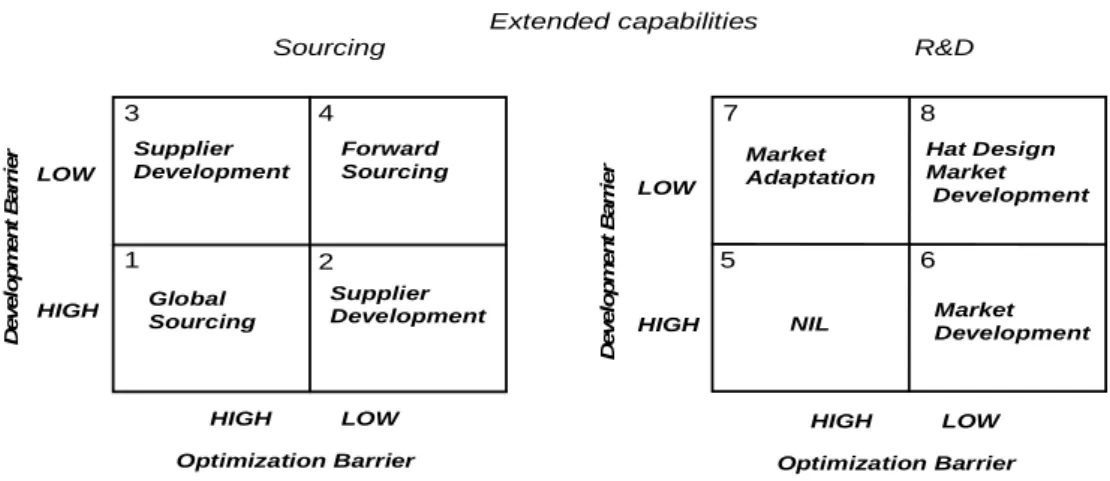
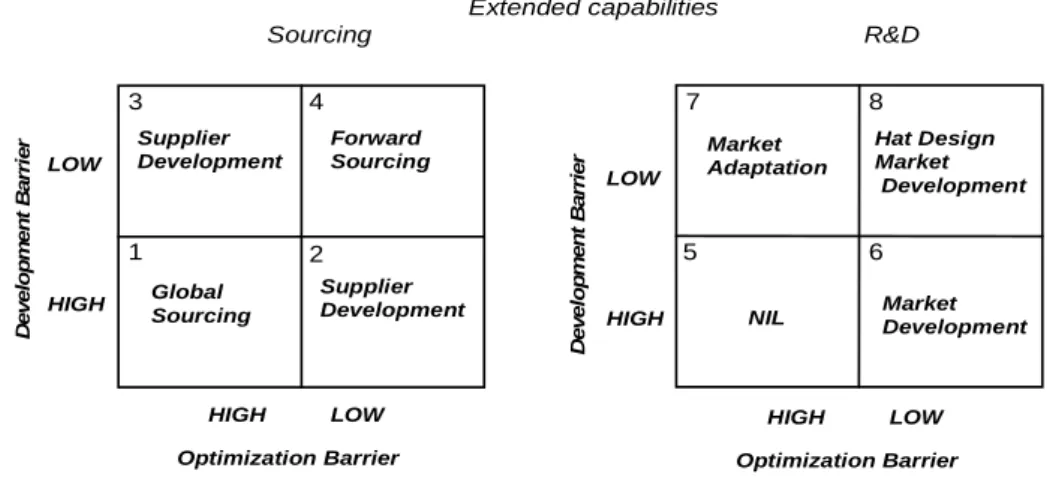
According to the discussion above we can suggest that a subsidiary’s ability to develop capabilities in addition to the ones that were first allocated to develop its initial plant or subsidiary role are constrained in different degrees by Development and Optimization barriers. Figure 2 shows the
effect of the interaction between the Development and Optimization barriers on extended capabilities, which are grouped as Sourcing and R&D and used as examples of more advanced capabilities in
comparison to the ones considered basic to serial production of mature products such as production
and logistics. In the sourcing group, every subsidiary in the corporate network contributes to the company’s pool of suppliers even if Development and Optimization barriers are high; basically because Global Sourcing(1) mechanisms are designed to find the world’s best source, mainly in terms
Figure 2. Effect of the Interaction between Development and Optimization Barriers on Extended
Capabilities.
Consequently, if the subsidiary can overcome certain optimization barriers by getting HQ to support the move to a higher role, the next step in terms of sourcing would be to develop strategies with local manufacturers to achieve lower costs and enhanced services such as responsiveness and inventory reductions (Quadrant 2). It is expected that once a specific knowledge, technology or manufacturing practice has been implemented between the subsidiary and a supplier, it will generate a synergy among the subsidiary’s pool of suppliers to replicate the success. Therefore, suppliers’ development capability is needed to bring weaker suppliers along the value chain up to the necessary standard (Quadrant 3). The subsidiary in question provides an important example of how logistics practices such as Just in Time and Sequenced Delivering were implemented first with main suppliers and subsequently with others. Finally, a subsidiary will reach a mature stage in terms of sourcing once suppliers in its pool participate in the Forward Sourcing(2) mechanism and start influencing the
product development process of the company (Quadrant 4).
A slightly different situation exists in the R&D group: if the Development and Optimization barriers are high, subsidiaries won’t participate in any of the R&D activities. This is mainly the case for young subsidiaries that have not yet mastered basic functions (functions for serial production, such as production and logistics) and concentrate their efforts on accomplishing their initial role (Quadrant 5). However, as soon as the initial role is being accomplished, subsidiaries tend to become less dependent on HQ’s in operational terms and therefore the consequential step is for them to develop their own market (Quadrant 6). It is important to mention that we consider the market development
capability in an expanded way: from market information gathering to foreseeing opportunities and creating market niches from them.
The case study provided an important example of creating new market niches when it re-launched the Beetle for the Mexican market; however, no product development has been carried out by the subsidiary. If Development barriers have been gradually overcome, mainly by supplier development capability, as stated in the Source group, subsidiaries will partner with suppliers in order to adapt products for specific market needs. This is the case where subsidiaries export global products to markets where environmental and safety regulations are different, or to a greater extent, if particular customers’ tastes have to be fulfilled (Quadrant 7). The last position on the chart is when a subsidiary is not only located in a frugal location but also enjoys a special freedom derived from low Optimization barriers. In consequence, subsidiaries will start to design products for their specific market needs, via market development and hat(3)design capability (Quadrant 8). It is important to
mention that due to the cost of product development in the automotive sector, it is very unlikely that a subsidiary would embark on designing a vehicle’s platform since it is very costly; therefore, this activity is concentrated at HQ.
NIL Market Adaptation Hat Design Market Development Market Development D e v e lo p m e n t B a rr ie r LOW HIGH Supplier Development Forward Sourcing Supplier Development Global Sourcing Optimization Barrier HIGH LOW LOW HIGH D e v e lo p m e n t B a rr ie r Optimization Barrier HIGH LOW
Extended capabilities
Sourcing R&D
3
1 2
4
5 7
O. Salgado 278
RAC, Curitiba, v. 15, n. 2, art. 6, pp. 261-282, Mar./Abr. 2011 www.anpad.org.br/rac
In order to conclude the previous discussion, it is useful to derive a typology of the subsidiary’s position and its internationalization driver. Such a typology would summarize not only the position of a subsidiary in terms of its development but also help show the specific position where a parent company would be more likely to drive such a subsidiary, depending on its corporate strategy. Figure 3 shows the subsidiary and its internationalization drivers’ typology, where Quadrant 1a states that the main rationale of a subsidiary in a location with high Development barriers and high Optimization barriers will be to target the local market. However, it is important to mention that the rationale of this type of subsidiary is different from the ones whose main purpose is to benefit from low manufacturing costs, since they will produce for a global reach based on a global product (Quadrant 2a). The difference in the degree of development barriers in the above-explained quadrants relies on the facilitation of mechanisms to export production volumes to other countries such as tax exemptions, flexibility of labor, creation of export processing zones, and the inclusion of the location in a free trade zone, among others. Therefore, recent established subsidiaries that spend time reaching the desired role and fighting against Development and Optimization barriers are called Green Nodes, Quadrant
1b; while subsidiaries exporting the greatest part of their production volumes behave like Hub Nodes
in the network, Quadrant 2b.
Figure 3. The Subsidiary and its Internationalization Driver Typology.
On the other hand, it is expected that a subsidiary would eventually overcome optimization and development barriers, develop further capabilities and move on to higher roles in the corporate network. Without this, the subsidiary will endanger its existence. This is the case for loss-making subsidiaries that, after a trial period, the parent company decides to divest. Sometimes, depending on the extent of the development barrier and the attitude of the company towards risk, subsidiaries are not divested but their activity is kept to the minimum in order to quickly react to potential business opportunities (Quadrant 3a).
The case study offers clear examples of this type of subsidiary since the company put investments on hold in several countries such as Russia and Colombia until better business conditions should appear; subsidiaries under these circumstances behave like Barren Nodes (Quadrant 3b). A
subsidiary that has successfully overcome Development and Optimization barriers will embed itself in internal and external networks in order to empower its products and services (Quadrant 4a). These subsidiaries are recognized as centers of excellence within their networks and behave as Forceful Nodes (Quadrant 4b). Finally, it is important to mention that subsidiary positions among Quadrants
are not fixed since a subsidiary that has become a Hub or Forceful Node could eventually fall into a Barren Node position if new development barriers emerge or they simply lose coherence with current corporate strategy. NIL Market Adaptation Hat Design Market Development Market Development D e v e lo p m e n t B a rr ie r LOW HIGH Supplier Development Forward Sourcing Supplier Development Global Sourcing Optimization Barrier HIGH LOW LOW HIGH D e v e lo p m e n t B a rr ie r Optimization Barrier HIGH LOW Extended capabilities
Sourcing R&D
3
1 2
4
5 7
Conclusions
Evidence from the analysis of subsidiary localization processes suggests that subsidiaries’ potential for success is reinforced if their corporations take them to a mature stage defined as Plant Role. In order to reach the mature stage, corporations need to invest heavily in education and training
until subsidiaries are able to replicate corporate knowledge faithfully; this status is verified once subsidiaries’ managers disengage operationally from HQ and the use of expatriates is kept to minimum.
The parent-subsidiary relationship suggests that subsidiaries’ potential for success is conditioned by the definition of initial plant roles that reflect reliably what subsidiaries can offer to corporations rather than what corporations need from them. Local input is critically important for the definition of coherent plant roles and, rather than being a one-off exercise, these roles need to be monitored by subsidiary managers; feeding back any challenges, threats or trends to their corporate strategy.
The analysis of potential sources of corporate and location barriers would improve not only configuration and coordination mechanism but also increase fair competition across a corporate network, as well as give an opportunity to HQs to monitor host locations and adopt subsidiary strategic role accordingly.
The subsidiary’s evolutionary process suggests that subsidiaries’ potential for success is subject to having an official, committed and active process of subsidiary embeddedness in their corporate network and local/global business environment. This process will increase subsidiaries’ interdependence with their related business framework, increasing the probability not only of keeping their rationale for existence but also pushing forward their plant roles to more advanced capability levels. Data alludes to the idea that that subsidiaries possessing highly mature stages become centers of excellence for their corporations, having the ability not only to faithfully deploy corporate knowledge but also being capable of collecting, codifying and packaging commercially exploitable knowledge that can be conveyed back to their head corporations.
Artigo recebido em 12.10.2009. Aprovado em 15.09.2010.
Notes
1 Global sourcing is a procurement strategy to ensure the best worldwide source is introduced as supplier into the
manufacturing network.
2 Forward sourcing is a procurement strategy to lower the product development cost by partnering with the best suppliers.
3 A passenger car’s system is grouped into two main classifications: the platform composed of the engine, transmission,
exhaust, etc.; and hat, which is composed of body work and all equipment inside it.
References
Almeida, P., & Phene, A. (2004). Subsidiaries and knowledge creation: the influence of the mnc and host country on innovation. Strategic Management Journal, 25(8/9), 847-864. doi:
10.1002/smj.388
Ambos, T., & Birkinshaw, J. (2010). Headquarters' attention and its effect on subsidiary performance.
O. Salgado 280
RAC, Curitiba, v. 15, n. 2, art. 6, pp. 261-282, Mar./Abr. 2011 www.anpad.org.br/rac
Andersson, U., & Forsgren, M. (1996). Subsidiary embeddedness and control in the multinational corporation. International Business Review, 5(5), 487-508. doi: 10.1016/0969-5931(96)00023-6
Andersson, U., & Forsgren, M. (2000). In search of centre of excellence: network embeddedness and subsidiary roles in multinational corporations. Management International Review, 40(4),
329-350. Retrieved from
http://0-search.ebscohost.com.millenium.itesm.mx/login.aspx?direct=true&db=buh&AN=12146143&sit e=bsi-live
Andersson, U., Forsgren, M., & Holm, U. (2001). Subsidiary embeddedness and competence development in MNCs a multi-level analysis. Organization Studies, 22(6), 1013-1034. doi:
10.1177/0170840601226005
Andersson, U., Forsgren, M., & Holm, U. (2002). The strategic impact of external networks: subsidiary performance and competence development in the multinational corporation. Strategic Management Journal, 23(11), 979-996. doi: 10.1002/smj.267
Andersson, U., Forsgren, M., & Pedersen, T. (1999). The MNC as a differentiated network: subsidiary technology embeddedness and performance. Copenhagen Business School, Open Archives.
Retrieved September 9, 2010, from
http://openarchive.cbs.dk/bitstream/handle/10398/6621/wp3.pdf?sequence=1
Bartlett, C., & Ghoshal, S. (1987). Managing across borders: new strategic requirements. Sloan
Management Review, 28(4), 7-17. Retrieved from
http://0-search.ebscohost.com.millenium.itesm.mx/login.aspx?direct=true&db=buh&AN=4021934&site =bsi-live
Beugelsdijk, S., Pedersen, T., & Petersen, B. (2009). Is there a trend towards global value chain specialization? - An examination of cross border sales of US foreign affiliates. Journal of International Management, 15(2), 126-141. doi:10.1016/j.intman.2008.08.002
Birkinshaw, J. (1995). Encouraging entrepreneurial activity in multinational corporations. Business
Horizons, 38(3), 32-38. Retrieved from
http://0-search.ebscohost.com.millenium.itesm.mx/login.aspx?direct=true&db=buh&AN=9506080165 &site=bsi-live
Birkinshaw, J. (1996). How multinational subsidiary mandates are gained and lost. Journal of International Business Studies, 27(3), 467-495.doi:10.1057/palgrave.jibs.8490845
Cantwell, J., Dunning, J., & Lundan, S. (2010). An evolutionary approach to understanding international business activity: the co-evolution of MNEs and the institutional environment.
Journal of International Business Studies, 41(4), 567-586.doi:10.1057/jibs.2009.95
Cantwell, J., & Mudambi, R. (2005). MNE competence-creating subsidiary mandates. Strategic
Management Journal, 26(12), 1109-1128. doi: 10.1002/smj.497
Casson, M., Dark, K., & Gulamhussen, M. (2009). Extending internalisation theory: from the multinational enterprise to the knowledge-based empire. International Business Review, 18(3),
236-256. doi:10.1016/j.ibusrev.2008.12.005
Cerrato, D. (2006). The multinational enterprise as an internal market system. International Business Review, 15(3), 253-277. doi:10.1016/j.ibusrev.2006.02.001
Clark, I., & Almond, P. (2004). Dynamism and embeddedness: towards a lower road? British subsidiaries of American multinationals. Industrial Relations Journal, 35(6), 536-556.
Criscuolo, P., & Narula, R. (2007). Using multi-hub structures for international R&D: organisational inertia and the challenges of implementation. Management International Review, 47(5),
639-660. doi: 10.1007/s11575-007-0038-9
Davis, L., & Meyer, K. (2004). Subsidiary research and development, and the local environment.
International Business Review, 13(3), 359-382. doi:10.1016/j.ibusrev.2003.06.003
Eckert, S., & Rossmeissl, F. (2007). Local heroes, regional champions or global mandates? Empirical evidence on the dynamics of German MNC subsidiary roles in Central Europe. Journal of East-West Business, 13(2/3), 191-218. doi: 10.1300/J097v13n02_05
Falck, O., & Heblich, S. (2008). Modern location factors in dynamic regions. European Planning
Studies, 16(10), 1385-1403.doi: 10.1080/09654310802420094
Ferdows, K. (1997). Making the most of foreign factories. Harvard Business Review, 75(2), 73-88.
doi: 10.1225/97204
Gammelgaard, J. (2009). Issue selling and bargaining power in intrafirm competition: the differentiating impact of the subsidiary management composition. Competition & Change, 13(3), 214-228.doi: 10.1179/102452909X451341
Garcia-Pont, C., Canales, J., & Noboa, F. (2009). Subsidiary strategy: the embeddedness component.
Journal of Management Studies, 46(2), 182-214. doi: 10.1111/j.1467-6486.2008.00797.x
Ghoshal, S., & Bartlett, C. (1990). The multinational corporation as an interorganizational network.
Academy of Management Review, 15(4), 603-625.doi: 10.2307/258684
Gupta, A., & Govindarajan, V. (1991, August). Knowledge flow patterns, subsidiary strategic roles, and strategic control within MNCs. Proceedings of Academy of Management Best Papers,
Chicago, IL, USA.
Holm, U., Malmberg, A., & Sölvell, Ö. (2003). Subsidiary impact on host-country economies - the case of foreign-owned subsidiaries attracting investment into sweden. Journal of Economic Geography, 3(4), 389-408. doi: 10.1093/jeg/lbg014
Jarillo, J., & Martínez, J. (1990). Different roles for subsidiaries: the case of multinational corporations in Spain. Strategic Management Journal, 11(7), 501-512. doi: 10.1002/smj.4250110702
Jenkins, M., & Tallman, S. (2010). The shifting geography of competitive advantage: clusters, networks and firms. Journal of Economic Geography, 10(4), 599-618. doi: 10.1093/jeg/lbq015
Kang, E., & Li, D. (2009). Understanding diverging isomorphic pressures on foreign subsidiary managers: a contingency model. Multinational Business Review, 17(1), 1-21. Retrieved from
http://vlex.com/vid/diverging-isomorphic-pressures-contingency-204277871
Khurana, A., & Talbot, B. (1998). The internationalization process model through the lens of the global color picture tube industry. Journal of Operations Management, 16(2/3), 215-239.
doi:10.1016/S0272-6963(97)00039-9
Lall, S. (2002). FDI and development: research issues in the emerging context. In B. Bora (Ed.),
Foreign Direct Investment: Research Issues (pp. 325-345). Routledge.
Li, J., & Rugman, A. (2007). Real options and the theory of foreign direct investment. International Business Review, 16(6), 687-712. doi: 10.1016/j.ibusrev.2007.08.004
O. Salgado 282
RAC, Curitiba, v. 15, n. 2, art. 6, pp. 261-282, Mar./Abr. 2011 www.anpad.org.br/rac
Marin, D., & Verdier, T. (2009). Power in the multinational corporation in industry equilibrium.
Economic Theory, 38(3), 437-464. doi: 10.1007/s00199-007-0327-3
Maritan, C., Brush, T., & Karnani, A. (2004). Plant roles and decision autonomy in multinational plant networks. Journal of Operations Management, 22(5), 489-503. doi: 10.1016/j.jom.2004.05.007
McDonald, F., Warhurst, S., & Allen, M. (2008). Autonomy, embeddedness, and the performance of foreign owned subsidiaries. Multinational Business Review, 16(3), 73-92.
Nachum, L., Zaheer, S., & Gross, S. (2008). Does it matter where countries are? Proximity to knowledge, markets and resources, and MNE location choices. Management Science, 54(7),
1252-1265. doi: 10.1287/mnsc.1080.0865
Narula, R., & Dunning, J. (2000). Industrial development, globalization and multinational enterprises: new realities for developing countries. Oxford Development Studies, 28(2), 141-167. doi:
10.1080/713688313
Ozawa, T., & Castello, S. (2001). Toward an 'international business' paradigm of endogenous growth: multinationals and governments as co-endogenisers. International Journal of the Economics of Business, 8(2), 211-228. doi: 10.1080/13571510110051450
Papanastassiou, M., & Pearce, R. (2005). Funding sources and the strategic roles of decentralised R&D in multinationals. R&D Management, 35(1), 89-99. doi:
10.1111/j.1467-9310.2005.00374.x
Peneder, M. (2002). Intangible investment and human resources. Journal of Evolutionary Economics, 12(1/2), 107-134. doi: 10.1007/s00191-002-0103-2
Reger, G. (2004). Coordinating globally dispersed research centres of excellence - the case of Philips Electronics. Journal of International Management, 10(1), 51-76. doi:
10.1016/j.intman.2003.12.004
Salgado, O. (2008). Emerging capabilities in manufacturing companies: a new taxonomy of company’s transformations. Saarbrücken: VDM Verlag Dr. Muller Aktiengesellschaft & Co.
KG.
Shi, Y., & Gregory, M. (1998). International manufacturing networks - to develop global competitive capabilities. Journal of Operations Management, 16(2/3), 195-214. doi:
10.1016/S0272-6963(97)00038-7
Talay, M., & Cavusgil, S. (2009). Choice of ownership mode in joint ventures: an event history analysis from the automotive industry. Industrial Marketing Management, 38(1), 71-82. doi:
10.1016/j.indmarman.2007.06.015
Tsai, M.-T., Yu, M.-C., & Lee, K.-W. (2006). Relationships between subsidiary strategic roles and organizational configuration: the case of Taiwanese multinational companies. International Journal of Commerce & Management, 16(1), 3-14. doi: 10.1108/10569210680000203
United Nations Conference on Trade and Development. (2010). Statistical databases online. Retrieved
September 8, 2010, from http://www.unctad.org/Templates/Page.asp?intItemID=1888&lang=1 Vereecke, A., & Dierdonck, R. van (2002). The strategic role of the plant: testing ferdows's model.
International Journal of Operations & Production Management, 22(5), 492-514. doi: