
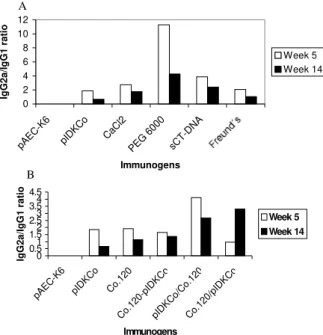
Additives and Protein-DNA Combinations Modulate the Humoral Immune Response Elicited by a Hepatitis C Virus Core-encoding Plasmid in Mice
Texto
Imagem
Documentos relacionados
When comparing the two classroom types with Pearson’s chi-squared test, in the success-oriented classrooms it was more common to maintain the same achievement goal profile over time
The systemic immune response of BALB/c mice infected with larval Taenia crassiceps is a mixed Th1/Th2-type response.. Villa OF,
Despite the mixed type of immune response elicited by GPI-anchored protein vaccination, we observed protection in vaccinated mice with 42% of worm burden reduction.. The involvement
Previous work showed that a C-terminal truncated Hepatitis C Virus core protein variant, different from the protein used in this work, assembles into virus-like particles in vitro
(B and C) HEK-293T cells were transfected with expression vectors encoding GST alone or fused to the C proteins of measles virus (MV-C), hPIV3 (hPIV3-C), or Nipah virus (Nipah-C),
Kinetic expression of plasmid-encoded protein in vivo - Three mice were injected with 50 µg of pGFP intramuscularly with and without the presence of prota- mine sulphate
Female BALB/c mice aged 18 months infected with 100 cercariae, used as controls for the primary infec- tion, mounted a typical acute immune humoral response against domains
In contrast, NO concentrations in the supernatants of spleen cells from mice immunized with the control plasmid pcDNA3 cultured in the presence or absence of the recombinant
Presently, we show that treatment of C57Bl/6 mice with plasmid containing IL-13R α 2-Fc vaccine and/ or plasmid encoding IL-12 significantly prolonged survival of mice challenged
