cent; group C, 26.6 per cent; group A, 13.8 per cent; and groups Y,Z,W-135 and 29¢ for 9 per cent. Those few serológically rough, poly-agglutinating, "non-typable" or untyped strains could not be incorporated for deter-mination of frequency distribution on a national basis.
During the past decade the most notable feature was the decline in group A serogroups from 30 per cent to 7 per cent of the total and the increase in group B distribu-tion from 30 per cent to over 60 per cent of the total isolates.
Laboratory surveillance of meningococcal serogroups and serotypes is becoming increasingly important
because of the introduction of vaccines which are
serogroup specific. A change in the serogroup distribu-tion warrants alteradistribu-tion in the recommendadistribu-tion.
Vaccine preparations for groups A and C have been
licensed in Canada. There is no vaccine presently available for use in prevention of group B disease.
(Source: Canada Diseases Weekly Report, Vol. 6-49, 6 December 1980.)
Histoplasmosis in Mexico, 1979-1980
Primary pulmonary histoplasmosis in Mexico is a health problem that has not been accurately evaluated, both because of a lack of knowledge among medical and paramedical personnel concerning this mycosis and because it affects residents of rural areas, many of whom are not reached by health care services. In addition, it is not a disease for which reporting is compulsory.
The causal agent, Histoplasma capsulatum, grows abundantly in bat droppings that infect mines, tunnels, and caves. It frequently produces massive infection among workers, in whom the disease is usually serious and often fatal.
The problem causes losses of several billion pesos every year, and has become a serious hindrance to development
Table 1. Epidemic outbreaks of primary pulmonary histoplasmosis in Mexico in 1979.a
Case No. of fatality Epidemic outbreaks cases Source of infection Deaths ratio Copalillo, Guerrero 15 Bat droppings 2 13.3%
(tunnel)
Tepic, Nayarit 8 Bat droppings 1 12.5% (abandoned mine)
Ajijic, Jalisco 15 Bat droppings - -(tunnel)
San Luis Potosi, San Luis Potosí 30 Bat droppings -(caves)
Tzitzio, Michoacán 1 Bat droppings -(abandoned mine)
Chiapas 1 Chicken droppings(?) 1 100% Huasteca, Potosina I Bat droppings
-(abandoned mine) Cuernavaca, Morelos 2 Bat droppings
(caves)
Jalisco 2 Bat droppings -(abandoned mine)
Total 75 4 5.3%
aSource: Department of Epidemiology.
12
.
of the nation's mining, metallurgy, and economy. More than 2,000 large mines (most of them gold and silver) have had to be abandoned at the height of production because of H. capsulatum infestation from large chiropteran populations that spread the fungus on the floor of mines, tunnels, and caves.
Because of its geologic structure, Mexico has one of the largest collections of caves in the world, some of which are very beautiful, and attract large numbers of ex-plorers, tourists, speleologists, archaeologists, geologists,
Table 2. Epidemic outbreaks of primary pulmonary histoplasmosis in Mexico in 1980.
Epidemic outbreaks No. of cases Source of infection
Tecalitlián, Jalisco 8 Bat droppings
(tunnel) Etzatlán, Jalisco 4 Bat droppings
(abandoned mine) Guadalajara, Jalisco 4 Bat droppings
(cave) Torreón, Coahuila 4 Bat droppings
(cave) Tijuana, Baja
California Norte 1 ? Guanajuato 4 Bat droppings
(abandoned mine) Juxtlahuaca, Guerrero 3 Bat droppings
(cave) San Joaquin, Querétaro 1 Bat droppings
(abandoned mine) Tzitzio, Michoacán 3 Bat droppings
(abandoned mine) San Luis Potosí 3 Bat droppings
(abandoned mine) Tamaulipas 30 Bat droppings
(cave) Yucatán 3 Bat droppings
(cave) Cases of undetermined
origina 13
Total 81
alnferred from serologic studies done at the Institute of Health and Tropical Diseases.
Source: Department of Epidemiology.
collectors of bat droppings, and students of biology, geology and other subjects. As in the case of the aban-doned mines, caves house large bat populations; cave floors are usually covered with tons of droppings thus ex-posing visitors to the risk of infection by H. capsulatum.
Except for Tlaxcala and Baja California Sur, every state in Mexico has reported epidemic outbreaks or isolated cases. of the disease. But underreporting conceals the true magnitude and full extent of the problem.
Probably because of the peculiar features of its transmission, the primary pulmonary histoplasmosis ob-served in Mexico is much more dangerous than that of other countries: in some outbreaks the case fatality ratio is over 40 per cent. Fatalities have decreased considerably in recent years, however, possibly because of an intensive campaign of hygiene education aimed at the population most frequently attacked.
In 1979, 11 epidemic outbreaks were studied, involving 75 victims and a case fatality of 5.3 per cent. The source of infection in all outbreaks was bat droppings (Table 1). The outbreaks-which occured in Chiapas, Guerrero, Jalisco, Michoacán, Morelos, Nayarit, and San Luis Potosí-involved many employees of the Mexican Telephone Company, the National Electicity Board, and a number of biology students.
Twelve epidemic outbreaks, involving a total of 68 per-sons, were studied in 1980. Another 13 cases were reported whose source could not be determined. Appar-ently none of the 81 patients died (Table 2). In every in-stance where the source of infection could be examined, it was found to be bat droppings.
The states involved were Baja California Norte, Coahuila, Guanajuato, Guerrero, Jalisco (three out-breaks), Michoacán, Querétaro, San Luis Potosí, Tamaulipas, and Yucatán.
(Source: Boletín de Epidemiología, Vol. 1 (4), 1 April, 1981. Department of Epidemiology, Under-Secretariat of Health, Mexico.)
Acute Communicable Diseases in Chile, 1980
The epidemiological characteristics of the com-municable diseases customarily observed in Chile have changed only slightly in the past five years.
Since final statistics on the number of deaths are not o yet available the following comments refer exclusively to
morbidity from the major communicable diseases in 1980 (Table 1). Future corrections as a result of elimina-tion or late reporting of cases may change the totals somewhat, but will have no effect on the study.
Typhoid fever is still the paramount epidemiological
problem, and has become increasingly so over the past
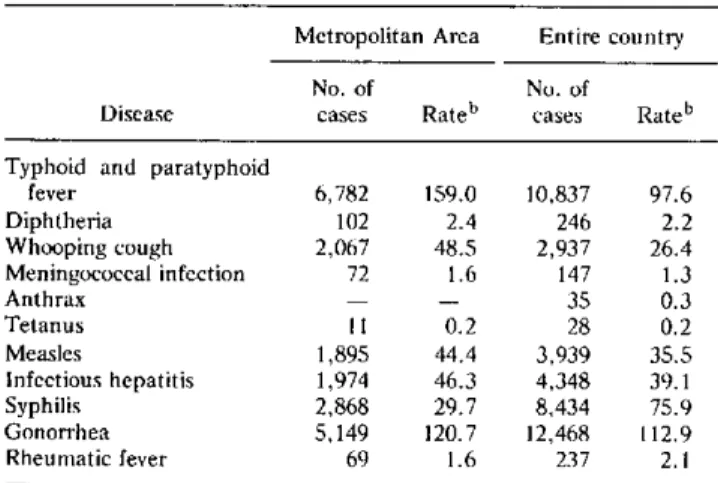
five years. In that time the figures have almost doubled and hold rates close to or over 100 per 100,000 in-habitants, peaking at 13,114 cases at a maximum rate of 120.8 per 100,000. In 1980, for the fourth consecutive year the figures were in the five digits, with a total of 10,837 cases and a rate of 97.6 per 100,000. The estimated figures for January 1981 were even higher than for the same month in 1980, which indicates that the situation shows no signs of returning to normal.
The Ministry of Health is conducting a series of studies to examine the apparent contradictions in the epidemiological behavior of typhoid fever. Its mode of transmission-through the digestive system-is asso-ciated with the cultural and hygienic standards of a population; the disease should therefore be more prevalent in countries of less social, economic, and sanitary development, with higher average annual temperatures and prolonged hot seasons. However, Chile does not fit this description. Indeed, the highest in-cidence of typhoid fever is reported in the capital, San-tiago, which has the best excreta disposal system and the most extensive potable water supply coverage in the country. The morbidity rate for Santiago in 1980 is 159.0 per 100,000, which is much higher than that of the coun-try as a whole.
According to very recent studies by the Ministry of Health in conjunction with the seven largest hospitals in Santiago, 7.3 per cent of the bile cultures made in cholecystectomies disclose the presence of Salmonella typhi or S. paratyphi A or B. If this figure applies to all the cholecystectomies in the country-calculated at more than 1,200,000 (the highest rate in the world, along with Sweden and certain tribes of North American In-dians)-it could mean that there are more than 100,000
Table 1. Morbidity from the major communicable diseases in Chile, 1980.a
Metropolitan Area Entire country No. of No. of
Disease cases Rateb cases Rateb Typhoid and paratyphoid
fever 6,782 159.0 10,837 97.6 Diphtheria 102 2.4 246 2.2 Whooping cough 2,067 48.5 2,937 26.4 Meningococcal infection 72 1.6 147 1.3
Anthrax - - 35 0.3
Tetanus 11 0.2 28 0.2 Measles 1,895 44.4 3,939 35.5 Infectious hepatitis 1,974 46.3 4,348 39.1 Syphilis 2,868 29.7 8,434 75.9 Gonorrhea 5,149 120.7 12,468 112.9 Rheumatic fever 69 1.6 237 2.1
aProvisional data.
bRate per 100,000 population.
carriers in Chile, and about 40,000 in Santiago alone. The situation is further aggravated by the fact that adult women are the most frequent victims of cholelithiasis, which affects almost 50 per cent of those over 35-40 years of age. Also, since women are more involved in handling food, they represent a greater epidemiologic risk if they are carriers of S. typhi.
In response to the foregoing, exhaustive epidemiologi-cal research will be conducted throughout the country with live and attenuated typhoid vaccines such as Ty 21a, which in previous tests have proved safe and have yielded a good immune response; the vaccines have also afforded intestinal protection against local multiplication of the pathogen and its subsequent propagation in the environ-ment.
Diphtheria morbidity declined in 1980 to only two thirds the rate for the preceding year (246 cases com-pared with 337), partly as a result of widespread vaccina-tion campaigns. The morbidity rate is expected to drop even more because recent regulations governing the pur-chase, distribution, and storage of vaccines guarantee that those administered will be of high potency.
The same observations apply to whooping cough. The incidence in 1980 was five times higher than in the preceding year (2,937 against 453), but this is partly a result of periodic epidemic fluctuations; 1980 was an epidemic year, particularly in the nation's capital.
A standing alert is required against meningococcal in-fections because their epidemiological behavior is un-predictable; 147 cases were recorded in 1980 and 203 in 1979. Capsular polysaccharide vaccines from groups A and C have been administered and research is in progress to determine the degree and duration of the protection conferred.
The number of annual cases of diseases transmitted by domesticated herbivores, such as tetanus and anthrax, is very low. Tetanus toxoid is given under national child im-munization programs, as part of the triple vaccine ad-ministered to infants and preschool children. It, along with diphtheria toxoid, is also administered in the vac-cination of school children.
In 1980, 3,939 cases of measles were reported, establishing one of the lowest totals in the country's history. 1979 was an epidemic year that left a large number of naturally immune persons in addition to the many who had been vaccinated; 34,573 cases of measles were recorded. Mass vaccination, instituted in 1964, sharply reduced the magnitude of this problem, which was noted in the increasing number of deaths-over 3,260 in that year, particularly from bronchopulmonary complications in infants under one year of age. It is ex-pected that future use of the vaccine in two doses together with proper storage methods to ensure full potency will soon mark the end of epidemic outbreaks which,
14
.