ii
Supply of cyber insurance in banking sector
operating in Portugal
Ana Rita Batista Martins
Dissertation presented as the partial requirement for
obtaining a Master's degree in Statistics and Information
Management
ii
NOVA Information Management School
Instituto Superior de Estatística e Gestão de Informação
Universidade Nova de LisboaSUPPLY OF CYBER INSURANCE IN BANKING SECTOR OPERATING IN
PORTUGAL
Ana Rita Batista Martins
Dissertation presented as the partial requirement for obtaining a Master's degree in Statistics and Information Management, Specialization in Risk Analysis and Management Advisor / Co‐supervisor: Rui Alexandre Henriques GonçalvesFebruary 2020
2
ACKNOWLEDGEMENTS
I would like to thank and dedicate this master's thesis to the following people:
To my parents, Teresa and José, my sister, Cristina, my boyfriend, Henrique, for supporting me constantly and unconditionally in this stage. They are, without any doubt, the main pillars of fundamental strength and motivation for this work to end. All the hours dedicated to the thesis and abdicated in family time are reflected in this work and that is why I consider it a bit of all of us. To my friends and colleagues who helped me contributing with ideas and solutions in times of doubts and uncertainties. In particular, to those who helped me promptly in the dissemination of my questionnaires.
To all participating insurance companies and, in particular, to their employees who were available to answer the questionnaire. To Dr. Luís Malcato and Dr. Miguel Guimarães, from APS, who helped me in spreading the questionnaire across the sector, thus giving a vote of confidence and recognition in my work.
To Dr. Hugo Borginho, from ASF, who made himself available, together with the collaborators most connected to the topic, to answer the questionnaire.
Finally, to my advisor, Professor Rui Gonçalves, for having accepted to guide my thesis, for given me the opportunity to participate in the 19th Portuguese Association of Information Systems Conference at Nova IMS and for having followed my work.
3
ABSTRACT
The development of technology and the way of doing business exchange sensitive information all over the world through IT resources. In consequence of such reality, cyber events are more likely to occur, being the banking sector one of the major targets. However, in parallel with these new perils from technological growth, awareness of cyber risk is also increasing among institutions, as well as the search for protection and measures to fight them. Cyber insurance is one of the possible protection options.
The main goal of this work is to assess the supply of cyber insurance among the banking sector operating in Portugal. As empirical investigations of cyber insurance applied in the country are rarely reported in the literature, the results are novel.
In order to get the main goal, the research is based on a literature review where will be presented the “state of the art” of cyber insurance market in the world and in the country. In addition, an empirical study will be made through the application of questionnaires to ascertain the specificities of cyber insurance suppliers or potential suppliers in the Portuguese market, their perception of market evolution and knowledge about cyber risk. There is also a specific questionnaire for the supervisor entity in order to know its point of view about the topic in discussion.
The main conclusions of this study relate to the fact that there is still a long way to go in the Portuguese insurance sector for cyber risk. The sector in the country started to be developed by international companies and only after that the national ones started to have more awareness on the subject, as mentioned by the Autoridade de Supervisão de Seguros e Fundos de Pensões (ASF). However, awareness of the issue is not the only point that leads to the underdevelopment of this specific insurance. The difficulties in the product underwriting process, which on the part of those who sell as well as those who buy, the high and variable prices, the lack of historical data and the information asymmetries are examples of obstacles that still have to be overcome.
Although the cyber risk insurance sector is taking its first steps, it is believed to have a large margin of expansion, as has already been the case in several other countries. The creation of information sharing platforms on cyber incidents and the design of insurance and reinsurance products for cyber incidents are considered by the participant insurers as the main measures to be taken to assist this market development. It therefore becomes an inevitable topic to be addressed by the insurance sector in Portugal.
KEYWORDS
4
INDEX
1.
Introduction ... 10
2.
Study Relevance ... 12
2.1.
Background ... 12
2.2.
Main consequences of cyber risk ... 14
2.3.
Real Life examples ... 15
2.4.
Cyber Risk in Portugal ... 16
3.
Study Objectives ... 17
4.
Literature Review ... 18
4.1.
Cyber Risk ... 18
4.1.1.
Overview on Cyber Risk ... 18
4.1.2.
Categories and Subcategories of Cyber Risk ... 19
4.2.
Cyber Insurance ... 20
4.2.1.
Overview on Cyber Insurance ... 20
4.2.2.
Coverages and exclusions ... 21
4.2.3.
Requirements and controls ... 24
4.2.4.
Underdevelopment causes ... 27
4.3.
Cybersecurity in Banking Sector ... 30
4.4.
Legislation in financial sector - Overview ... 31
5.
Methodology ... 33
6.
Results and discussion ... 36
7.
Conclusions ... 45
8.
Limitations and recommendations for future works ... 47
9.
Bibliography ... 48
5
LIST OF FIGURES
Figure 2.1 Risk to broader economy ... 13
Figure 2.2 Cyber risk awareness by sector in the U.S. ... 13
Figure 2.3. Estimated stand-alone cyber-insurance take-up rates by sector ... 14
Figure 2.4. Insider attack discovery time ... 15
Figure 4.1 Loss categories commonly included in stand-alone policies ... 22
Figure 6.1 Banks’ sources of Cyber Risk ... 36
Figure 6.2 Banks’ exposure to types of Cyber Risk ... 37
Figure 6.3 Impacts of cyber-attacks on banks ... 38
Figure 6.4 Loss categories commonly included in stand-alone policies ... 39
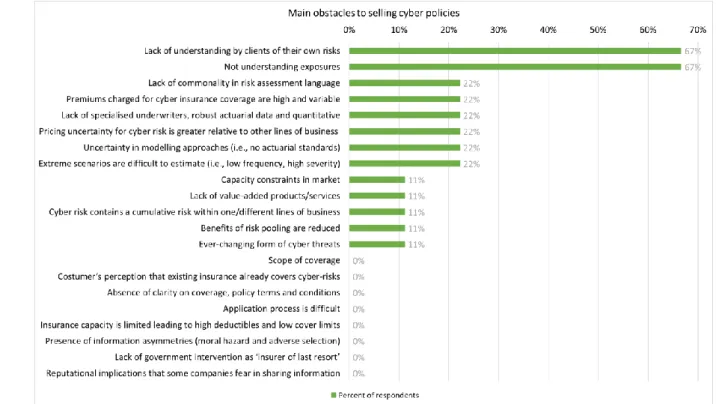
Figure 6.5 Main obstacles to selling cyber policies ... 40
Figure 6.6 Main advantages to have a dedicated cyber insurance policy ... 41
Figure 6.7 Ways of government participation in cyber risk insurance market ... 41
6
LIST OF TABLES
7
LIST OF ANNEXES
Annex 1. Cyber incident potential cost and consequences ... 51
Annex 2. Cyber security incidents along the years in several sectors ... 53
Annex 3. Cyber security incidents along the years in banking sector ... 55
Annex 4. Principles of Integrity, availability and confidentiality of data ... 56
Annex 5. Sources classification of cyber risk ... 57
Annex 6. Categories and subcategories of cyber risk by source classification ... 58
Annex 7. Examples of most common cyber incidents ... 60
Annex 8. Risk transfer options ... 65
Annex 9. Most common first and third-party coverages ... 66
Annex 10. Means of governmental intervention ... 67
Annex 11. Risk associated to cyber security incidents ... 68
Annex 12. Questionnaire to Insurance Companies ... 69
Annex 13. Questionnaire to ASF ... 71
Annex 14. Questionnaire to Banks ... 72
8
LIST OF ABBREVIATIONS AND ACRONYMS
ASF
Autoridade de Supervisão de Seguros e Fundos de Pensões
ATM Automated Teller Machines
CBI Contingent Business Interruption
CEO
Chief Executive Officer
CEPS Centre for European Policy Studies
CFO
Chief Financial Officer
CIO
Chief Information Officer
CISO Chief Information Security Officer
CISP Cyber security Information-Sharing Partnership
DDoS Distributed denial-of-service Attack
D&O Directors and Officer
DNS Domain Name System
DoS Denial-of-Service Attack
EBA European Banking Authority
ECRI European Credit Research Institute Brussels
EIOPA
European Insurance and Occupational Pensions Authority
ENISA European Network and Information Security Agency
ERH Electronic Health Records
ESA European Supervisory Authorities
EU European Union
GDP Gross Domestic Product
GDPR General Data Protection Regulation
GLBA Gramm-Leach–Bliley Act
9
HITECH Health Information Technology for Economic and Clinical Health Act
IAIS International Association of Insurance Supervisors
ICT Information and communications technology
IoT Internet of Things
IP
Internet Protocol
ISO
International Organization for Standardization
IT Information Technology
ITU International Telecommunication Union
OECD Organization for Economic Co-operation and Development
OSP Outside Security Provider
OTP One Time Password
PCI-DSS Payment Card Industry Data Security Standard
PHI Personal Health Information
PII Personally Identifiable Information
POS
Point-of-sale
SOX
Sarbanes Oxley Act
10
1. INTRODUCTION
Cyberspace and the internet have revolutionized the way of communication and do business. They enabled to expand interconnectivity as well provided several benefits for knowledge-based economies, allowing businesses to operate globally with greater speed and efficiency. But where there is a great opportunity, there are also risks associated with it (IRM, 2014). The rapid pace of technological change, increasing connectivity through the Internet of Things1 (IoT) and the growing
sophistication of cyber-attackers introduce new vulnerabilities and increase the potential for systemic and risk aggregation complexities (Camillo, 2017).
Approaches to cyber risk are maturing as organizations recognize it as an enterprise business risk and not just an information technology (IT) problem (Marsh & McLENNAN, 2018). There is also the acknowledgment that cyber risk cannot be completely eradicated from business because of its many correlations and specificities. The best that can be done is to be managed to facilitate the success of a company’s drive forward (RSA, 2016).
Several possibilities to manage this risk have emerged along with the decision-maker awareness and understanding to it. Cyber insurance is one of the possibilities that was created to address risk that cannot be reasonably mitigated by IT security measures and because of the realization that current insurance policies may not adequately cover cyber risks (Biener, Eling, & Wirfs, 2014).
Also, in the area of supervision and regulation cyber risk is a growing concern. The European Union (EU) has made several efforts to harmonize rules and procedures through legislation and recommendations that aim to help organizations to protect themselves and be more aware of this new kind of threat.
Faced with the new perils, financial institutions like banks and insurers see in the need to rethink strategies in order to adapt to the new challenges imposed by technological innovation. Banking institutions (representing the demand side for the purpose of this work) need to find out how to manage these new risks and find the most efficient way to invest in security without losing profitability. This raises questions inside those institutions like are they sufficiently aware for cyber-attacks? Should the organization self-insure their exposure to cyber risk or should they buy insurance? How much they are willing to invest to transfer their exposure? What are the risks they expect to cover with insurance? On the other hand, insurance companies (representing the supply side) need to adjust to the new reality of threats and offer insurance that delivers what their customers need in terms of cyber perils but at the same time not jeopardizing their ability to accept risk. This arises questions like how much the company are willing to accept to take costumer’s risk? What covers they are expecting that costumers will seek for? What cover limits the company impose? What requisites the company demand costumers to have in order to offer a cyber insurance product?
1 There is no common definition for IoT. A definition proposed by The International Telecommunication Union
(ITU) for instance defines it as ‘‘a global infrastructure for the Information Society, enabling advanced services by interconnecting (physical and virtual) things based on, existing and evolving, interoperable information and communication technologies’’ (Fluchter & Wortmann, 2015).
11 The main goal of this work is to assess the supply of cyber insurance among the banking sector operating in Portugal. As empirical investigations of cyber insurance applied in the country are rarely reported in the literature, the results are new.
The research is based on a literature review where will be presented the “state of the art” of cyber insurance market in the world. In addition, an empirical study will be made through the application of online questionnaires to ascertain the specificities of the market’s supply side players constituted by insurance companies working in Portugal. In addition, it will also be explored the Portuguese insurer's supervisor, Autoridade de Supervisão de Seguros e Fundos de Pensões (ASF), view about the offer of an insurance against cyber risk for banking sector in the country.
In order to do that this work is be divided in six main chapters. Chapter 2 presents the study relevance where it is characterized the cyber risk around the world and in Portugal, explained the reason why it is a great concern and the main consequences of a cyber-attack. Chapter 3 describes the main goal of this work and the specific objectives to reach the key objective. The most extensive part of this work is disclosed in chapter 4. It is a literature review talking about cyber risk, cyber insurance, cybersecurity in banking sector and a quick overview about legislation. Chapters 5, 6 and 7 are the most practical ones. They describe the methodology applied, the results, discussion and main conclusions that resulted from the empirical investigation.
12
2. STUDY RELEVANCE
2.1. B
ACKGROUNDElectronic media is replacing the traditional approach of file and paper systems, so having information online for almost all the activities is the new trend emerging in world, which require high level of network availability and consequently high-level of system security (Saini, Azad, Raut, & Hadimani, 2011). Emerging technology such as Fintech2 is an example of that. It is a new way of doing
business that replaces bureaucracy and time-consuming processes by online procedures much faster and easier to get. Although technology innovations allow a wide range of possibilities for human progress, it also increases the vulnerability to cyber incidents once it expands the number of entry points into institutions, which hackers could target (IMF & Bouveret, 2018).
In short, as stated by Deloitte Advisory Cyber Risk Services in the RSA paper (“Cyber Risk Appetite: Defining and Understanding Risk in the Modern Enterprise.”), “the fundamental things that organizations undertake in order to drive performance and execute on their business strategies happen to also be the things that actually create cyber risk. This includes globalization, mergers and acquisitions, extension of third-party networks and relationships, outsourcing, adoption of new technologies, movement to the cloud, or mobility” (RSA, 2016).
According several sources, through their researches and forums, the cyber risk is increasingly considered relevant and a concern. Technological risks, in the form of data fraud, cybersecurity incidents or infrastructure breakdown, were identified as among the top ten risks facing the global economy and the fourth largest risk among surveyed insurers by the International Association of Insurance Supervisors (IAIS, 2016). A year later, in the eighth Emerging Risks Survey by the Society of Actuaries, cyber risk was considered the greatest emerging risk (Xu, Hua, & ASA, 2017). Reaching the same conclusion, in the World Economic Forums3 of 2012, 2014, 2017, 2018 and 2019, cyber-attacks
were considered in the top 5 global risks in terms of likelihood. Additionally, a survey of the major risks to financial stability done by IMF verified that cyber risk was considered, in the past years of 2016 and 201, the greatest peril to stability among other risks like geopolitical, impact of new regulation or Brexit (IMF & Bouveret, 2018), as represented in figure 2.1 of risks to broader economy.
2 FinTech Action plan: For a more competitive and innovative European financial sector.
https://ec.europa.eu/info/sites/info/files/180308-action-plan-fintech_en.pdf
13
Source:IMF, & Bouveret, A. (2018). Cyber Risk for the Financial Sector: A Framework for Quantitative Assessment. DTCC Systemic Risk barometer 2017Q1
Figure 2.1 Risk to broader economy
Cyber risk is transversal to all sectors of activity once all of them depend on IT resources and rely on customer’s data to conduct business. Figure 2.2 shows an example of the awareness of cyber risk across several business sectors in the U.S. being the financial, insurance and real state sectors the most conscious (IMF & Bouveret, 2018).
Source:IMF, & Bouveret, A. (2018). Cyber Risk for the Financial Sector: A Framework for Quantitative Assessment.. SEC form 10-K; and staff calculations
Figure 2.2 Cyber risk awareness by sector in the U.S.
In parallel to the rising awareness of cyber events, the penetration of cyber insurance is also increasing, representing one of the fastest growing sectors of the insurance industry, according to AIR 2017 estimates (AIR, 2017).
More specifically, following the beginning of year 2000, the dotcom crash and the September 11 attacks, interest in cyber insurance grew as there was a growing realization that the virtual world did not necessarily fit within the scope of many traditional covers/classes of insurance (Camillo, 2017). According to European Network and Information Security Agency (ENISA), sectors typically buying cyber insurance include retailers, healthcare providers, hotels and financial services (ENISA, 2012). Noting the same, Organization for Economic Co-operation and Development (OECD) presented in its study of 2017, “Enhancing the Role of Insurance in Cyber Risk Management”, collected data from Marsh reports where they estimated the rates of acquisition of cyber insurance by sector, based on
14 its client’s information (mostly US clients) (OECD, 2017). Figure 2.3 shows these take up rates by sector of activity.
Source: OECD. (2017). Enhancing the Role of Insurance in Cyber Risk Management.
Figure 2.3. Estimated stand-alone cyber-insurance take-up rates by sector
According to OECD, the stand-alone cyber insurance market reached an estimated 3,5 billion dollars in written premiums in 2016, of which approximately 3 billion dollars was written on behalf of US-based companies and 300 million dollars was written on behalf of European companies (OECD, 2017). Additionally, it is expected that the market continues to grow in Europe mostly due to the implementation of the EU General Data Protection Regulation (GDPR) which will create uniform notification and disclosure requirements.
Insurance industry forecasts predict an expected growth in cyber premiums from around 2 billion dollars in 2015 to some 20 billion dollars or more by 2025, as stated in the study of Woods & Simpson, “Policy measures and cyber insurance: a framework. Journal of Cyber Policy” (Woods & Simpson, 2017).
2.2. M
AIN CONSEQUENCES OF CYBER RISKAn interesting approach to interpret the frequency and severity of cyber-attacks is the one developed by Delloite in its research “Beneath the surface of a cyberattack”, in 2016. It allocates the different consequences of cyber-attacks along the length of an iceberg (Deloitte, 2016).
At the top of the iceberg, and thus surfaced, are those direct consequences of a cyber-attack. They are those that are felt immediately or that impact in short term the normal functioning of the institutions and the integrity and confidentiality of the information. Those have the better-known cyber incident costs like technical investigation, customer breach notification, post-breach customer protection, regulatory compliance, public relations, attorney fees and litigation and cybersecurity improvements.
Beneath the surface will be the hidden or less visible consequences of cyber-attacks. Those may only be known several years after the attack. They are insurance premium increases, increased cost to
15 raise debt, impact of operational disruption or destruction, lost value of customer relationships, value of lost contract revenue, devaluation of trade name and loss of intellectual property. These costs/consequences are explained in more detail in annex 1.
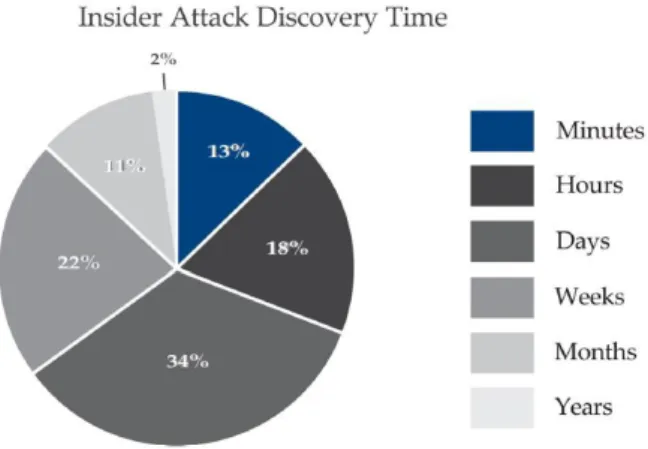
In fact, there are many ways a cyber-attack can affect an organization, and the impacts will vary depending on the nature, severity of the attack and the time of action after identifying it. According to a study of Camillo, “Cyber risk and the changing role of insurance” in 2017, it was found that in 34% of the cases investigated it took days to discover an insider attack, followed by 22% of the cases that took weeks and 18% took hours, as can be shown in figure 2.4.
Source: Camillo, M. (2017). Cyber risk and the changing role of insurance. Journal of Cyber Policy.
Figure 2.4. Insider attack discovery time
There is more awareness that the first 48 hours following detection of a breach are a critical window of opportunity to contain a crisis, according to Camillo, 2017. Additionally, a further 45 days following discovery of a breach is needed on average for recovery and mitigation. Therefore, it can take up to seven months between the initiation of an attack and recovery from it, with some breaches taking a year or more to resolve (Camillo, 2017).
So, there are just a few consequences that stay “at the iceberg’s surface”. Most of them remain submerged, which is why it is so difficult to predict the real impacts of a cyber-attack.
2.3. R
EALL
IFE EXAMPLESIn the past years there was a realization that companies could no longer hope to simply avoid cyber-attacks through IT security. Several cyber incidents demonstrated that even organizations with robust risk mitigation and security measures were not immune.
Historical data prove that no matter the size of the company or the sector that it operates, cyber-attacks are a real threat to everyone.
Annex 2 shows examples of that. Many companies among the most variate sectors, like health, telecommunications, food, energy and business sector suffered from cyber-attacks in the past years.
16 Additionally, annex 3 shows several cyber incidents affecting the banking sector. According to Banco the Portugal, the institutions of financial sector concentrated more than 25% of all the malicious cyber-attacks in 2018 (Banco de Portugal, 2019).
It should be noted that the information collected represent a very small sample of what cyber-attacks have been over the years. The more exhaustive the search, the more historical records will be found in the years before, during and after the dates presented.
Cyber threats are the new risks of the modern world and it is likely that continue to rise along years as cyber-attackers are becoming more sophisticated and innovations are in constantly development.
2.4. C
YBERR
ISK INP
ORTUGALCybercrime threatens Portuguese and global companies. This is a risk in which there is still relatively little experience in Portugal (and even in Europe). However, several studies are being developed. Lloyd's Iberia find out in its investigation that the immediate exposure of Lisbon economy to a catastrophic risk involving natural phenomena, human action (the case of a cyber-attack) or even a humanitarian crisis is in the order of 1040 million dollars. Of this amount, about 840 million dollars will be human responsibility and the rest will be natural risks. Additionally, they revealed that the five biggest risks that Lisbon faces are the market crash that could involve 550 million dollars; floods with an impact on the city's Gross Domestic Product (GDP) of around 100 million dollars; while a cyber-attack will cost the city 80 million dollars’ worth of city's GDP (Bernardo, 2018).
Additionally, the research carried out by Marsh in 2018, "The Portuguese companies' vision of Risk 2016, 2017, 2018", in which 170 Portuguese companies participated, regarding the risks that Portuguese companies considered they could face in 2018, pointed that cyber-attacks were identified as the main risk (with 57%) being at the forefront of risks such as political or social instability and extreme weather events. In 2017 this statistic was only 36%, occupying the second place in the top 5 and in 2016 had only 25% (Marsh, 2018).
According to MDS’s presentation entitled “Cyber Risk. Ameaça virtual versus ameaça real”, of June 2019, Portugal is the sixth country in the world with the highest number of computers infected by viruses and about 25% of the Portuguese companies were affected by cyber-attacks in the last year (MDS, 2019).
17
3. STUDY OBJECTIVES
The main goal of this work is to assess the supply of insurance against cyber risk in the banking sector operating in Portugal.
In order to meet the main goal, there are specific objectives important to be addressed such as characterize the knowledge of insurance sector companies on the cyber risk; characterize the perception of the sector on the main exposures and impacts of cyber risk in banking institutions; check the determining factors for the supply to offer cyber insurance as a mean of protection against the risk; characterize the perception of insurance sector companies on the evolution of the cyber insurance market and finally, characterize the perception of supervisor authority on the cyber insurance market and its evolution.
18
4. LITERATURE REVIEW
4.1. C
YBERR
ISK4.1.1. Overview on Cyber Risk
There is no standardized definition for cyber risk. Regulators of insurance and financial markets follow the operational risk frameworks stated in Basel II and Solvency II to categorize cyber risk. They define it as an "operational risk to information and technology assets that have consequences affecting the confidentiality, availability or integrity of information or information systems” and categorize it into four classes: actions of people, systems and technology failures, failed internal processes and external events (Biener, Eling, & Wirfs, 2014).
The definition adopted by the European Banking sector goes along to that defined by Basel II. They define a security risk as “the risk resulting from inadequate or failed internal processes or external events that have or may have an adverse impact on the availability, integrity, confidentiality of information and communication technology (ICT) systems and/or information used for the provision of payment services. This includes risk from cyber-attacks or inadequate physical security” (EBA, 2017).
Another two possible definitions are summarized in the issuer paper written by International Association of Insurance Supervisors (IAIS), “Issues Paper on Cyber Risk”. One arose during a CRO Forum where it was broadly described as “any risks that emanate from the use of electronic data and its transmission, including technology tools such as the internet and telecommunications networks. It also encompasses physical damage that can be caused by cybersecurity incidents, fraud committed by misuse of data, any liability arising from data storage, and the availability, integrity and confidentiality of electronic information − be it related to individuals, companies, or governments.” The other one arose from the Committee on Payments and Market Infrastructures and the International Organization of Securities Commissions that described it as “the combination of the probability of an event occurring within the realm of an organization’s information assets, computer and communication resources and the consequences of that event for an organization” (IAIS, 2016). Principals like confidentiality, integrity, and availability of companies’ data are therefore an essential part of cyber risk’s definition and prevention. In annex 4 is presented the conceptual definition of those principals, developed by sources like IMF4 and IRM5 in those works created in 2014 and 2018
respectively.
The classification of cyber risk can also depend on the context. There are two possible contexts to consider: the demand side (companies buying cyber insurance) and the supply side (insurance companies selling cyber protection).
For buyers, cyber risk can be interpreted as an operational risk. For insurance companies, however, the allocation of cyber risk depends on which part of the business is considered. If it is considered insurance companies as providers of insurance coverage, then cyber risk is an insurance risk. If,
4 IMF, & Bouveret, A. (2018). Cyber Risk for the Financial Sector: A Framework for Quantitative
Assessment.
19 however, it is considered an insurer as a company that can be hacked and seeking for protection against cyber risk it is interpreted as operational risk (Eling & Wirfs, 2016).
4.1.2. Categories and Subcategories of Cyber Risk
In the study of Biener, Eling, & Wirfs, “Insurability of Cyber Risk: an empirical analysis” in 2015, they refer three criteria that an event must fulfill in order to be categorized as a cyber risk:
1) A critical asset such as a company server or a database needs to be affected;
2) A relevant actor needs to be involved in the cause of the cyber risk incident (e.g., hackers, employees, system, and nature);
3) A relevant consequence needs to be present, such as a loss of data or misuse of confidential data.
Many categories of cyber risk as well as their subcategories have already been identified in several studies. The Cebula and Young approach (“A Taxonomy of Operational Cyber” in 2010) is widely accepted and used in this kind of research work. They divided cyber risk in four main categories. They are actions of people, systems and technology failures, failed internal processes and external events. Those categories fulfill the three criteria stated above. They satisfy criteria (1) once in all of them a company server or a database is affected, criteria (2) once each of them has a source of cyber risk and criteria (3) because all categories have consequences, some more serious than others, for the organizations. So, all the categories and subcategories presented by Cebula and Young are considered as cyber risk according to the Biener, Eling, & Wirfs criterion.
Beyond this categorization, a possible classification can be attributed to the categories and subcategories of cyber risk. This classification is presented by Eling & Wirfs, in their work “Cyber Risk - Too Big to Insure?” in 2016, where they propose a distinction between criminal or non-criminal sources of cyber risk. Annex 5 shows those classification and give examples to each of them.
In annex 6, it is presented an aggregation of the main categories and subcategories of the cyber risk proposed by Cebula and Young with the classification presented by Eling & Wirfs in their study. The research carried out by Biener, Eling, & Wirfs verified that actions of people are considered the main source of cyber risk while the other categories, such as external disasters, are very rare. Mark Camillo, for the Journal of Cyber Policy, also reinforce that “a significant number of successful cyber intrusions have a human element” (Camillo, 2017). In this way, privileged users, that have access to an organization’s network, devices and servers, are often an organizations’ greatest security risk. So, there are several types of cyber incidents that fill in the categories described above. In most of the times it is difficult to detect the source, infer the damages and losses and find out the potential ways to avoid other incidents. Annex 7 present a wide list of cyber incidents. There isn´t a standard and static labeling of cyber risk events since the nature of this risk is very dynamic and it is in increasing sophistication. The intention is not to present a ‘definitive’ overview of all types of incidents, but simply to give an idea of the most common types. It is an aggregation of several cyber incidents stated by numerous authors.
20
4.2. C
YBERI
NSURANCE4.2.1. Overview on Cyber Insurance
Several companies regardless of size and sector collect, store, and share substantial amounts of private and confidential information with various third parties, may they be service providers, intermediaries, costumers or insurers.
The usual approach to managing information security risk is like other business risks. Ideally it is intended to eliminate the sources of risk, then mitigate them, absorb and, if possible, transfer. Since cyber risk cannot be totally eliminated because of its dynamic and ever-changing nature, companies can adopt several options of risk response as: risk avoidance (for example, avoid use of USB flash drives); risk mitigation (control objectives and control measures like protection technologies (firewall, antivirus, encryption) and security procedures (passwords security, access control)); risk transfer (cyber risk insurance) and risk acceptance (self-insurance) (Kosub, 2015). There are several risk transfers options possible to an organization to adopt. They differ from each other by the agent that take the risk. A study developed by Martin Eling and Jan Hendrik Wirfs from University of St. Gallen in 2016, stated several forms of transferring risk. It can be through a risk pool, insurance, reinsurance, capital markets or governments. Annex 8 shows a summary of risk transfer possibilities available.
In the case of buying insurance as a transfer of risk option, an insurance contract (policy) binds an insurance company (supply side) in the occurrence of contractually defined loss events to pay a specified amount (claim) to the insurance holder (demand side). In return, the insurance holder pays a fixed sum (premium) to the insurance company to receive financial compensation in case of certain IT related adverse event occurs (Franke, 2017).
The process of underwriting a cyber insurance is very specific from company to company. Even in the same industry differences may exist in the way that companies use, process or store their information so there are variances related to the selection of the coverage type and to the risk assessment phase of security and cyber protection, where the evaluation of the security systems and tools by IT specialist and insurer is done. That assessment can influence sometimes the amount of the premium that is calculated (ENISA, 2012).
Cyber insurance seems to be a solution each more adopted by companies to transfer their risk exposure. According to a study done by European Insurance and Occupational Pensions Authority (EIOPA) in 2018, “the increasing number of cyber incidents, the continued digital transformation and new regulatory initiatives in the EU are all expected to raise awareness and boost the demand for cyber insurance” and “the growth in the cyber insurance market is a sure sign of firms’ increasing awareness of cyber risk and appetite to transfer exposure”. In fact some markets are already more aware of this new emerging risk than others that is the case of the US market where cyber insurance is frequently regarded as an “hygiene factor” (Franke, 2017) meaning that it is seen as part of a necessary security pack that all businesses should have.
21
4.2.2. Coverages and exclusions
Cyber insurance coverage
As stated above, risks faced by corporations are often unique to its industry or even to the company itself, so most undertakings provide tailor-made solutions. Company size, size of the customer base, web presence, and type of data collected and stored are important determinants of cyber insurance policy terms and pricing (Biener, Eling, & Wirfs, 2015).
The significant property that distinguishes cyber risk from conventional risk is that ICT resources are interconnected in a network, and therefore the analysis of risk and its related potential losses needs to take into account the network topology (Xu, Hua, & ASA, 2017).
Cyber insurance can provide coverage for both first party and third-party liabilities. First party risks are the ones that directly affect the insured. Third party risk are risks that might initially affect someone other than the insured (first party) or insurer (second party, against which an insured like to have coverage (ENISA, 2016).
In annex 9, can be seen the common coverages from first-party and third-party losses, outlined by EIOPA in its study “Understanding cyber insurance” of 2018.
Additionally, cyber insurance can be offered in three different ways: 1) a stand-alone product, 2) a specific endorsement on existing policies (an add-on coverage to traditional lines of business) or 3) as part of traditional coverages without a specific endorsement (often referred to as silent cyber coverage that refers to cases where cyber exposure is neither explicitly included nor excluded within an insurance policy) (EIOPA, 2018) (OECD, 2017).
1) Stand-alone cyber insurance policies
The stand-alone cyber insurance market was developed in response to the introduction of exclusions of cyber-related losses like property, crime, kidnap and ransom. OECD has presented in its study, “Enhancing the Role of Insurance in Cyber Risk Management”, which exclusions may exist: (i) general exclusions of all losses resulting from a cyber-attack or incident; (ii) an exclusion applied in general liability policies to exclude liability related to data breaches; and (iii) exclusion of losses related to data restoration (OECD, 2017).
The coverage provided by stand-alone cyber insurance policies can vary significantly across providers. The abundance of policy forms may be partly due to the common practice of offering a menu of possible coverage options allowing policyholders to tailor their policy terms based on their specific level of exposure (OECD, 2017).
OECD presented also an overview of the possible coverage for different categories of cyber-related losses. This overview was based on responses to the OECD questionnaire as well as on its review of selected publicly available descriptions of policies from major providers (total of 23 providers based in 7 countries). For comparison, it also shown the results of a similar exercise undertaken by Risk Management Solutions, Inc. and Cambridge Centre for Risk Studies in 2016 of 26 stand-alone policies. Figure 4.1 shows the results of most commonly losses covered under a stand-alone policy.
22
Source:OECD. (2017). Enhancing the Role of Insurance in Cyber Risk Management.
Figure 4.1 Loss categories commonly included in stand-alone policies
As the graph suggests the more commonly coverage loss categories, representing more than 50% are the incident response costs, regulatory and legal defense costs, fines and penalties, breach of privacy compensation (that represent the data confidentiality breaches); business interruption losses; network security failure liabilities, data and software loss, cyber ransom and extortion losses and communication and media liability.
In the case of fines and penalties, some policies will not cover it or will only provide such coverage where permissible by law. Another case is of cyber ransom and extortion where there is some variation in the types of losses covered. Some providers only cover costs related to efforts to avoid paying a ransom, not the payment of a ransom itself. Insurance companies may also choose not to provide such coverage in order to be consistent with government policies that are explicitly opposed to making ransom payments in response to kidnapping/extortion.
The other categories are not so commonly covered, according to OECD data. In some cases because it is a challenge for insurers to quantify the possible losses and impacts and, in the case of financial theft and fraud, the low level of coverage may be because many traditional crime policies provide coverage for financial theft without any exclusion of cyber-related incidents (OECD, 2017).
Stand-alone cyber insurance products generally include additional services such as the access to service providers that can assist policyholders in responding to cyber incidents and preparing response plans (Marsh & McLENNAN, 2018). Some insurance companies provide first response incident management as an integrated part of their products. These services not only help companies to improve their security structure but also give insurance companies a degree of control of the quality of incident management, making it easier to predict and manage the costs of incidents. However, in most cases the insurance companies do not provide this service in-house, but rather partner with IT consultancies, law firms or consultants who deliver the actual first response services (Franke, 2017).
23
2) and 3) Cyber risk coverage in traditional insurance policies (endorsed and silent)
Some insurance coverage for losses resulting from cyber incidents may be explicitly (endorsed) or implicitly (silent) covered in traditional policies as is the case of property, general liability, Directors and Officers liability, errors and omissions liability/professional indemnity, crime/fidelity, kidnap and ransom policies.
As organizations assess their cyber insurance coverage options, it is important to understand how cyber incidents may be covered in existing policies. This is a challenge for many organizations as there can be overlaps or “silent coverage” for cyber incidents in existing policies (Marsh & McLENNAN, 2018).
According to OECD, the most common coverages for cyber risk in traditional policies are (OECD, 2017):
• Property policies – data and software loss, business interruption, physical damage; • Liability policies – Incident response costs (compulsory investigations), regulatory and
legal defense costs, fines and penalties, breach of privacy compensation, network security failure, communication and media liability, product liability, directors’ and officers’ liability, professional indemnity;
• Crime/fidelity policies – financial theft and/or fraud; • Kidnap and ransom policies – cyber ransom and extortion.
In insurance companies’ point of view there are some challenges regarding coverage. According to OECD there are significant losses from cyber incidents that are not usually included within the scope of stand-alone or traditional insurance coverage like the impacts on a company's reputation and future business and the loss of value of intellectual property. In both cases, the key impediment to coverage is the difficulty in quantifying the value of the future business that has been lost due to reputational damage or the reduced ability to exploit the commercial value of intellectual property (OECD, 2017).
Besides that, insurers typically impose a maximum loss limit for cyber risk policies in order to protect themselves against unexpected amounts of exposure. This cover limits can vary between insurance companies and whether this amount is acceptable depends on the risk preferences and cyber risk exposure of the individual policyholder. An increase in coverage should be negotiable but will result in higher premiums.
Another severe problem regarding cover limits is policy complexity. According to Biener, Eling, & Wirfs, the dynamic nature of cyber risk and the existence of several exclusions in cyber insurance contracts rises the uncertainty about what the cyber policy covers for the seller and the buyer (Biener, Eling, & Wirfs, 2015).
24
Cyber risk exclusions
Insurance companies make exclusions in their insurance contracts also in a way to protect themselves against unexpected risk that they are not willing to accept from the client (Franke, 2017). Once insurers are increasingly excluding cyber coverage under existing policies it places a growing focus on the need and value of standalone policies (Marsh & McLENNAN, 2018).
EIOPA presented in its study, “Understanding Cyber Insurance: a structured dialogue with insurance companies” in 2018, the main exclusions reported by the participant companies (13 (re)insurance groups based in Switzerland, France, Italy, Germany and UK): war, political risks, nuclear, (cyber) terrorist attacks, property and material damages, bodily injury, unauthorized collection of data by the insured, strike, infrastructure failure, theft of telecommunications services, online gambling, large online consumer auctions, payday loan companies, non-malicious cyber, natural perils, contingent business interruption (CBI), directors and officer (D&O) warranties, claims from internet service providers, regulatory fines, economic value of data, extortion payments, adult entertainment, online and offline dating agents, online sales of firearms, virtual currencies (EIOPA, 2018).
The research of Franke, “The cyber insurance market in Sweden” in 2017, stated also another two possible exclusions that fits to modern concerns. One of them is the offering to cover internal outages and outages at external service providers. Some companies do not make any distinction between internal or external service providers, but others may have restrictions allowing coverage only to a specific list of providers (Franke, 2017). The other one is the coverage offered for subsidiaries and corporate entities in different jurisdictions (Franke, 2017).
Also, legal restrictions might prevent certain coverage for cyber insurance. For example, in many countries, insuring against regulatory fines is prohibited (Biener, Eling, & Wirfs, 2015).
4.2.3. Requirements and controls
Requirements and controls on the insured – Supply Side
In the supply side, some insurers have a basic criterion that need to be fulfilled by costumers in order to get a cyber insurance offer. As stated above, insurance companies are not willing to insure any risks. A study done by Ulrik Franke, “The cyber insurance market in Sweden”, stated that insurers offers can vary from none, partial or total protection, depending on the outcome of a customer’s risk assessment (Franke, 2017).
Nowadays insurance companies not only require knowing but might also validate a customers’ preparation level and assist them by offering consulting, cyber risk assessment or incident response services (ENISA, 2016).
The process of assessing the costumer’s exposure to risk vary from company to company. According to AIR study, “Insuring Cyber risk” in 2017, there are several ways of assessing a costumer or a potential one cyber risk’s exposure. It can be, for example, through self-assessment questionnaires
25 to costumers, additional reports developed in-house by cyber risk engineers, externally resources provided by specialized consultancies such as auditors and IT security consultants (who may perform e.g. penetration tests), letting the procedure depend on the costumer or through interviews with stakeholders such as Chief Information Officer (CIO), Chief Financial Officer (CFO), Chief Executive Officer (CEO) (AIR, 2017). Insurers become a ‘de facto regulator’ by establishing a minimum-security level to gain cyber coverage (Woods & Simpson, 2017). So, cyber risk assessment is a way for insurance companies to control the risk they are taken in but also gives opportunity to customers increase awareness of cyber risk exposure, potentially increasing self-protective efforts and maybe get a lower premium (Franke, 2017).
ENISA stated in its study, “Cyber insurance: recent advances, good practices and challenges” in 2016, that when assessing a clients’ risk, insurers generally focus on the following main categories (ENISA, 2016):
• Dedicated Resources – validate the presence of leadership roles with Information Security focus; the number of employees that are dedicated to Information Security; the time allocation to tasks other than what their role mandates and the reporting lines of a Chief Information Security Officer (CISO);
• Policies and Procedures - validate the existence of an Information Security program (covers technical, administrative and physical measures for data protection);
• Employee Awareness – validate the presence of a formal Security Awareness program, which is a key element for safeguarding the human factor within a company. Top management, brand managers, social media page administrators and all the other employees should have regular and tailored training on how to implement, monitor and enforce the guidelines that the policy has set out;
• Incident Response – validate the existence of an Incident Response program. It defines the processes and resources that an organization engages for addressing any Information Security incidents. Response plans should include preliminary drafts of communications to all stakeholders including customers, suppliers, regulators, employees, the board, shareholders, and even the general public. The plan should also consider legal requirements around timelines to report breaches.
• Security Measures - confirm the proper implementation of Business Continuity Planning, data classification, data retention, access control, log monitoring, intrusion detection, network segmentation, network monitoring, vulnerability management (ENISA, 2016), penetration testing and scanning of systems (EIOPA, 2018).
Additionally, and according to the same source, under the questionnaires applied to several European insurers, they pointed as a good security measure the compliance with some Cyber Security Standards such as: Gramm-Leach-Bliley Act (GLBA), Health Insurance Portability and Accountability Act (HIPAA), Health Information Technology for Economic and Clinical Health Act (HITECH), ISO 27000 family, Payment Card Industry Data Security Standard (PCI-DSS) and Sarbanes-Oxley (SOX) Act.
26
Requirements and controls of the insured – Demand Side
On the demand side, organizations should ask if they are making the appropriate investments in security, vigilance, and resilience, and whether those decisions are based on a realistic understanding of the specific risks their organization faces as well as the magnitude of impact that a cyber-attack could have (RSA, 2016).
Insureds will need to demonstrate that they fulfill certain “cyber hygiene” and pre-loss standards in order to obtain indemnification. To be effective, cybersecurity needs to be addressed at all levels of an institution and with respect to relevant third-party arrangements (IAIS, 2016).
It is very unlikely and most probably impossible to prevent all cyber losses due to the ever-growing frequency and complexity of the criminal efforts to steal data. Indeed, in some areas the cost to mitigate the risk may be many times more than the actual loss of that piece of data. It is however essential to implement controls which can help minimize the potential impact to the organization (IRM, 2014).
If a company can show that it has adopted a set of practices generally considered to be worthwhile things to do with respect to cyber-security, then this will reduce information asymmetries and better demonstrate to the market that the firm takes security seriously. This feeds into premiums once if an insurer can observe that a firm is undertaking various ‘effective’ security measures, then the premium will be reduced on the basis that the firm is less prone to risks (ENISA, 2012).
Advantages to invest cybersecurity:
Deloitte Advisory Cyber Risk Services stated, in RSA study “Cyber risk appetite: Defining and Understanding Risk in the Modern Enterprise”, that “managing cyber risk is not just a cost to the business, but a positive investment to enable the success of strategic growth and performance initiatives” (RSA, 2016). In fact, there are several advantages in choosing to invest in cybersecurity. The points below show the risk mitigation main advantages recognized by several sources:
• Improved business performance;
• Competitive advantage through a stronger customer value proposition;
• Greater organizational awareness of cyber risk and its potential impact on the business. The process of seeking insurance coverage requires policyholders to understand (and quantify) the risk that they face in order to determine the amount of coverage that they require (OECD, 2017);
• Internal transparency on cyber risks and controls in place. Generating an organization-wide approach to ongoing cyber risk management by all aspects of the organization (EIOPA, 2018);
• Assessing the strength of cyber defenses, particularly among a rapidly changing cyber environment (EIOPA, 2018);
27 • Clear compliance with external regulatory controls. The underwriting process will usually involve an assessment of risk management and security practices, including recommendations on further preventative measures that could be taken (OECD, 2017);
• Incentives for firms to increase IT security in order to reduce premiums (ENISA, 2012). • Demonstrate strong business practices to investors (ENISA, 2012);
• Incentives and means to promulgate best practices (ENISA, 2012).
4.2.4. Underdevelopment causes
As stated above, cyber insurance is gaining field as a good measure to manage cyber risk, but some aspects hold it back.
Camillo stated in his study, ”Cyber risk and the changing role of insurance”, that during the late 1990s and early 2000s, companies focused mainly in loss mitigation through network security and, in that time and still nowadays, cyber insurance market remains a niche area, lacking the scope and capacity once a cyber insurance product remains untested and there are a lack of historical loss data. Furthermore, EIOPA in its paper, “Understanding cyber insurance” in 2018, concluded that “there is a clear need for a deeper understanding of cyber risk, both on the supply and demand side, for the European cyber insurance industry to develop further. This relates not only to the assessment and treatment of risks in new cyber insurance propositions, but also to the understanding of clients’ own needs” (EIOPA, 2018).
It will be described below a gathering, collected from different sources, of the main causes for cyber insurance market underdevelopment and the challenges felt by supply and demand:
Insurers – Supply side
• The information asymmetries inherent in cyber risk: moral hazard and adverse selection. They are the most widely spoken causes for the underdevelopment of cyber insurance market. In the adverse selection problem, the insurer cannot discriminate different types of customer before a contract is signed and therefore price the premium accordingly (ENISA, 2012). Besides that, firms that have experienced a cyber-attack are more likely to purchase insurance resulting in adverse selection once a firm may apply for cyber insurance in the knowledge that they are relatively more exposed to cyber risk. In the moral hazard problem, the insured, once a contract is signed, may be incentivized to behave more insecurely in the knowledge that the insurer will bear some of the loss (Biener, Eling, & Wirfs, 2015);
• The perception of effectiveness of various types of cyber-security measures implemented by costumers. It is essential for the process of offering a cyber insurance product that the insurance company knows exactly the extension of risk that the costumer is exposed to in order to accept or refuse to take that risk. Sometimes that process is not so much transparent (ENISA, 2012);
28 • The misevaluation of accumulation risk. Cyber risk is not an isolated threat. There are several potential correlated exposures to this risk that are very difficult to predict and to estimate their probable losses. These correlations can be present through third party, outsourcing exposures or through non-affirmative risks or “silent” risks6. It is a
challenge for insurance companies to be certain about the number of customers that would be affected. Many insurers set relatively low limits and a multitude of exclusions to try to control their potential losses, in addition to high premiums. The potential for accumulation risks may discourage some insurers and reinsurers from entering the cyber insurance market at all (EIOPA, 2018);
• Lack of government intervention as ‘insurer of last resort’ may inhibit cyber insurance supply (ENISA, 2012);
• The ever-changing form of cyber threats. This causes that a control measure that may have been effective a year ago may now prove to be a vulnerability. Technology innovations drives fluctuations in risk and threats that makes it difficult (from an actuarial perspective) to forecast future losses from past events and utilizing predictive analytics for the assessment of potential risks and impacts (IRM, 2014);
• Lack of commonality in risk assessment language - there is not an implemented standardized linguistic among institutions (ENISA, 2017);
• Lack of specialized underwriters, robust actuarial data and quantitative tools (EIOPA, 2018) (OECD, 2018). The absence of relevant data series on past losses, the limited actuarial information available on the frequency and size of actual and potential cyber security incidents and the lack of stochastic models are key obstacles preventing insurers from developing the predictive models they depend on to set accurate premiums, exposure models and the provision of proper coverage;
• Reduced willingness of insurance companies to extend significant amounts of coverage. The topic is the main responsible to this reduction and leads to cyber insurance offers with several exclusions and sub-limits that customers may find unappealing (EIOPA, 2018) (OECD, 2018).
6 Non-affirmative risks or “silent” risks – ““Silent cyber”, also known as “unintended” or
“non-affirmative” cyber, refers to the unknown or unquantified exposures originating from cyber perils that may trigger traditional property and liability insurance policies” (Carpenter, 2018). To see more about that topic:
http://www.guycarp.com/content/dam/guycarp/en/cmp/Affirm%20vs%20Silent%20Cyber%20Briefing%20FIN AL%20(2).pdf
29
Companies – Demand Side
• The absence of clarity on coverage, policy terms and conditions - The lack of similar terminology and different approaches to offering coverage, along with the complexity of the policies themselves, add to the frustration and reduce buyer demand (EIOPA, 2018);
• The lack of understanding by clients of their own risks - Many companies believed that they have nothing a cyber adversary would seek for or they only start to be aware of that threat from the day they are attacked (EIOPA, 2018);
• The perception that existing insurance already covers cyber-risks - Some companies already think that they are insured under existing traditional policies, so they are discouraged from taking out specific cyber-insurance policies on the basis of a fear of being over-insured (EIOPA, 2018);
• The reputational implications of sharing information - some companies fear in sharing information under a full transparency and non-anonymized approach. This would prevent the collection of data, the spread of good practices among companies and consequently the development of the sector (EIOPA, 2018);
• The premiums charged for cyber insurance coverage are high and variable - Given the large tail risks and uncertainties around cyber risk, cyber insurance is currently relatively expensive compared to other types of insurance coverage, with estimations that can be three times more expensive than general liability coverage and six times more expensive than property insurance This became cyber insurance market unattractive for companies. (EIOPA, 2018).
For that main challenges faced by the cyber insurance market are already possible solutions. In the study developed by EIOPA, they stated some of those possibilities such as insurers could introduce explanatory sessions to their customers to provide understanding about their potential exposures to cyber risk and provide customer scenarios and generic examples of policy coverage once could act as a fast method to raise awareness and understanding of cyber insurance; they could also make a review of the wording in contracts in order to clarify the policy language and avoid using generic terminology that can be interpreted in multiple ways; they could also offer a transparent underwriting process, detailing the criteria and criticality that drives pricing and develop a Risk Assessment Guidelines in order to facilitate the analysis of their costumers exposure to risk.
In the costumers side, ENISA stated in its study, “Cyber Insurance: recent advances, good practices and challenges” developed in 2016, that organizations should get informed, prepared, and document their environment, before requesting a cyber insurance policy possibly by attending in explanatory sessions or provide specialized training to employees and nominate a CISO for companies in order to institutionalize the culture of cyber risk management in the organization structure.
Eling&Wirfs stated in their study, “Cyber Risk: Too Big to Insure?”, possible top five measures to improve insurability of cyber risk and hence help to develop the market. They are to incentivize the development of an anonymized data pool; develop minimal standards for risk mitigation; introduce
30 reporting obligations; incentivize the development of “traditional” risk transfer mechanisms and establish a governmental backstop for extreme scenarios (Eling & Wirfs, 2016).
Additionally, general initiatives in terms of legislation and government intervention can also improve significantly the development of the market. A study of Daniel Woods and Andrew Simpson, “Policy measures and cyber insurance: a framework” in 2017, stated that “insurance industry should be more involved in the Cyber Security Information-Sharing Partnership (CISP), which enables government and industry to share information”. They believe that one of the major ways of managing cyber risks is through appropriate sharing of technical information and data.
Government intervention
Governments can potentially play a role in supporting the development of the market and maximizing the contribution it makes to manage this fast-evolving risk. However, this is a field that need to be developed.
The study done by Elling&Wirfs, pointed out in its main conclusions that “cyber risks “of daily life” are not too big to insure” but on the other hand, ““extreme scenarios” (e.g., a breakdown of the critical infrastructure for a period long enough to impact the economy (EIOPA, 2018)) are difficult to insure.” They propose that insurability for those “extreme scenarios” could be improved by “integrating the government in various ways.” In the same study they structured possible means of governmental intervention (Eling & Wirfs, 2016). They are presented in annex 10 of this work.
Sharing the same opinion, EIOPA under their paper “Understanding Cyber Insurance - A Structured Dialogue with Insurance Companies” in 2018, stated that government intervention might be needed in case of extreme events. Once cyber risk has a great potential for significant accumulation of losses and it is difficult to estimate the extent of major cyber incidents, the government is often seen as a potential last resort of the system.
4.3. C
YBERSECURITY INB
ANKINGS
ECTORA bank runs multiple servers that store enormous amount of information and details of various operations such as credit cards, real time gross settlements, ATMs and SWIFT and others. Financial institutions adopt digital channels like online banking and mobile banking to increase access and provide convenience to customers but at the same time it grows the attack surface once it opens the door to online security risks (Reddy & Bhargavi, 2018).
According to Reddy and Bhargavi study, “Cyber security attacks in banking sector: Emerging security challenges and threats” in 2018, cybersecurity attacks increased in the banking industry during 2016 and they have not shown any signs of abating. The risks are prevalent across all areas of the sector affecting large and small banks. Banking institutions are considered a gainful target for cybercrime once they are a source where the money and important information is (Reddy & Bhargavi, 2018). In the European Banking Authority (EBA) semi-annual Risk Assessment Questionnaires (RAQs) among 53 European banks and 15 market analysts, carried out in 2018, it was concluded that more than 50% of banks expected an increase in operational risk in their institution. The main driver identified by