MUSIC PERFORMANCE ANXIETY
AMONG CLASSICAL MUSICIANS:
STRATEGIES FOR IMPROVING PERFORMANCE AND
APPLICATIONS FOR CLASSICAL GUITARISTS
André Rafael Correia Tempera
ORIENTADORES: Prof.ª Doutora Ana Telles Béreau
Prof. Doutor Joaquim Reis
Tese apresentada à Universidade de Évora
para obtenção do Grau de Doutor em Música e Musicologia
Especialidade: Interpretação
ÉVORA, 2018
Versão digital
INSTITUTO DE INVESTIGAÇÃO E FORMAÇÃO AVANÇADA
MUSIC PERFORMANCE ANXIETY
AMONG CLASSICAL MUSICIANS:
STRATEGIES FOR IMPROVING PERFORMANCE AND
APPLICATIONS FOR CLASSICAL GUITARISTS
André Rafael Correia Tempera
INSTITUTO DE INVESTIGAÇÃO E FORMAÇÃO AVANÇADA
iii
Let’s leave our body and hands playing the sounds and our
mind and soul can be somewhere else.
Dare to do that, to enter the other world, the other dimension,
and you will open the door for those who are listening to you
so they can follow.
iv
This dissertation would not have been possible without the collaboration of the following institutions and individuals, whom I wish to thank very warmly:
- Conservatório Regional Silva Marques, Academia de Música de Almada and Conservatório Nacional de Música de Lisboa, for cooperating in the distribution of the questionnaires to the students;
- Universidade de Évora and Universidade de Aveiro, as well as Escola Superior de Música de Lisboa and Escola Superior de Artes Aplicadas de Castelo Branco, for collaborating in the distribution of the online questionnaires;
- All the music students that took the time to answer the questionnaires;
- Jordan Dodson, Pedro Rodrigues, Martha Masters, Anton Baranov, Michalis Kontaxakis, Dejan Ivanovic, Denis Azabagic, Fábio Zanon, Carlo Marchione, Rafael Aguirre, Margarita Escarpa, and Irina Kulikova; all of which great guitarists and were kind enough to take time off from their busy schedules and let me interview them, providing great insight and valuable information for this dissertation;
- My advisors, professor Ana Telles Béreau and professor Joaquim Reis, for all their patience and feedback;
- Professor Alfredo Reis, for his contribution to the statistical analysis portion of this work; - My parents, for the support throughout the years;
- My four-legged furry family, for all the years of companionship, especially to those who are no longer around;
- Lastly, I wish to acknowledge and express my special thanks to my loving wife Paula from the bottom of my heart, for always remaining by my side and being the better half of me.
v
Music performance anxiety among classical musicians: Strategies for
improving performance and applications for classical guitarists
Music performance anxiety (MPA) is experienced in varying degrees of intensity by most, if not all, musicians. It is particularly heightened in a classical music environment and if not addressed properly, it may cause significant harm to the careers and even wellbeing of individuals. Performers and teachers usually develop their own valid coping strategies through years of practical experience, but often lack a theoretical understanding of MPA and its mechanisms, considering it to be an insurmountable and career ending affliction. There are several articles and books addressing different aspects of this subject, and this knowledge can be utilized to develop practice and coping strategies, that incorporate practical and scientific information. This integration should be of special interest to the classical musician community in several aspects of performance and pedagogy, and particularly, for the future generations of musicians who often feel are not being adequately prepared for the reality of a performing career. Differentiating factors such as personality, age and gender are related to the way individuals perceive and experience performance anxiety. Another, somewhat understudied relation, is how the specificities of each instrumentalist affect, and are affected by MPA. By characterizing classical guitarists and their particularities, it is possible to ascertain if this sub-group of musicians has specific needs, and which are the best approaches for them to address music performance anxiety issues. This dissertation attempts to improve classical musicians’ understanding of MPA and will hopefully contribute to a more effective approach to this issue within the community.
vi
Ansiedade na performance musical dos músicos eruditos: Estratégias para
melhorar a performance e aplicações para guitarristas clássicos
A ansiedade na performance musical (APM) é sentida em vários graus de intensidade pela maioria, senão a totalidade, dos músicos. É particularmente elevada no ambiente da música erudita e, quando não é abordada de forma adequada, pode causar danos significativos nas carreiras e até na saúde das pessoas. Intérpretes e professores normalmente desenvolvem as suas próprias estratégias de coping através de anos de experiência prática, mas frequentemente carecem de uma compreensão da APM e dos seus mecanismos, considerando-a como uma condição insuperável que pode ditar o fim de uma carreira. Existem diversos artigos e livros dedicados a uma grande quantidade de aspectos associados a este tema, e este conhecimento facilita o desenvolvimento de estratégias para o estudo da música e para coping, incorporando informação prática e científica. Esta integração deve ser de particular interesse para a comunidade dos músicos eruditos em diversos aspectos da performance e da pedagogia, e particularmente, para as futuras gerações de músicos que frequentemente sentem não estar a ser adequadamente preparados para a realidade de uma carreira como intérpretes. Factores diferenciadores tais como personalidade, idade e sexo estão relacionados com a forma como os indivíduos interpretam e experienciam a ansiedade. Outra relação, algo negligenciada, é a de como as especificidades de cada instrumento afectam e são afectadas pela APM. Ao caracterizar os guitarristas clássicos e as suas particularidades, torna-se possível aferir se este sub-grupo de músicos possui necessidades específicas e quais são as melhores abordagens para resolver problemas relacionados com a ansiedade na performance musical. Esta dissertação tenciona melhorar a compreensão da APM por parte dos músicos eruditos e contribuir para que este assunto seja abordado de uma forma mais eficaz pela comunidade.
vii
Figure Index
. . .
Graph Index
. . .
Table Index
. . .
Preface
. . .
Chapter 1 – Introduction
. . .
1.1 – Motivation
. . .
1.2 – Brief Definition of Performance Anxiety
. . .
1.3 – Methodology
. . .
1.4 – Objectives of the Present Work
. . .
1.5 – Thesis Outline
. . .
Chapter 2 – Music Performance Anxiety
. . .
2.1 – Characterization of MPA
. . .
2.2 – Research Overview. . .
2.3 – MPA in Music Education
. . .
2.4 – Associated Symptoms
. . .
2.5 – Common Practices for Coping and Therapies
. . .
2.5.1 – Practices
. . .
2.5.2 – Therapies
. . .
Chapter 3 – Main Constructs Related With MPA
. . .
3.1 – Self-efficacy
. . .
3.2 – Perfectionism
. . .
3.3 – Deliberate Practice
. . .
3.4 – Flow
. . .
Chapter 4 – Reducing MPA Through Preparation
. . .
4.1 – Self-efficacy Applications
. . .
4.2 – Repertoire and Recital Structure Selection
. . .
4.3 – Structured Learning and Practicing
. . .
4.4 – Understanding Memory
. . .
4.5 – Key Recommendations
. . .
Chapter 5 – Study: Assessment of MPA in Music Students
. . .
5.1 – Context
. . .
5.2 – Questionnaire Construction
. . .
5.2.1 – Questions Common to Both Versions
. . .
5.2.2 – Questions Exclusive to College-level Questionnaire
. . .
x
xii
xii
xiii
1
1
3
7
9
10
11
11
20
27
31
34
35
41
45
45
51
54
56
61
61
65
71
76
80
85
85
85
86
89
viii
5.3.2 – Self-reported Values for Confidence and Anxiety
. . .
5.3.3 – Severity of Self-reported Anxiety
. . .
5.3.4 – Number of Symptoms
. . .
5.3.5 – Symptomatology Before Performance
. . .
5.3.6 – Symptomatology During Performance
. . .
5.3.7 – Focus on Symptoms
. . .
5.3.8 – Symptomatology After Performance
. . .
5.3.9 – Relating Symptoms With Instruments
. . .
5.3.10 – Cognitions
. . .
5.3.11 – Perspectives About Performance and Coping
. . .
5.3.12 – Advices From Teachers
. . .
5.3.13 – Practice Changes When Performance is Near
. . .
5.3.14 – Practice Habits
. . .
5.3.15 – Physical Preparation Habits
. . .
5.3.16 – Mental Preparation Habits
. . .
5.3.17 – Concerns
. . .
5.3.18 – Self-efficacy
. . .
5.3.19 – Flow
. . .
5.3.20 – Deliberate Practice
. . .
5.3.21 – Beliefs About Performance Anxiety
. . .
5.3.22 – Positive Feedback
. . .
5.3.23 – Perspectives on the Reality of MPA in Schools
. . .
5.4 – Discussion
. . .
Chapter 6 – Interviews
. . .
6.1 – Context
. . .
6.2 – Content Overview
. . .
6.2.1 – Early Age
. . .
6.2.2 – First MPA Experiences
. . .
6.2.3 – Symptoms
. . .
6.2.4 – Negative Experiences on Stage
. . .
6.2.5 – Coping
. . .
6.2.6 – Guitarists’ Concerns
. . .
6.2.7 – Practice Strategies
. . .
6.2.8 – Different Moments of Preparation
. . .
6.2.9 – Self-Efficacy
. . .
6.2.10 – Performing Often
. . .
6.2.11 – Competitions
. . .
6.2.12 – Flow
. . .
6.2.13 – Repertoire and Recital Structure
. . .
6.2.14 – Addressing MPA With Students
. . .
91
95
96
98
99
101
101
103
104
110
111
112
113
114
114
115
116
116
117
118
118
119
120
127
127
128
128
128
129
129
130
132
133
134
136
136
137
137
138
138
ix
Conclusions
. . .
References
. . .
Annex I – Questionnaires
Annex II – Interview Transcriptions
143
147
x
2.1 – Summary of MPA assessment results, from Kenny (2011) . . .
2.2 – Summary of studies regarding MPA and its correlations . . .
5.1.1 – Conservatory-level sample population distribution in numbers and percentages . . . .
5.1.2 – College-level sample population distribution in numbers and percentages . . .
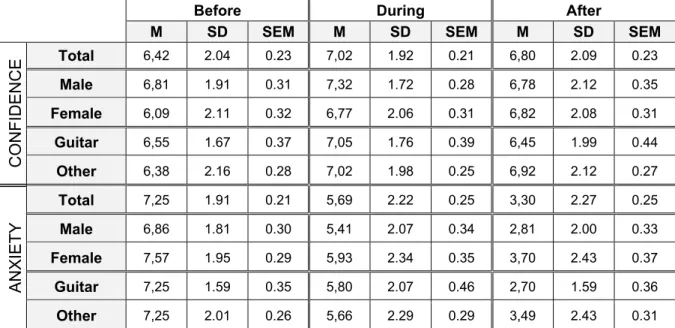
5.2.1 – Conservatory-level mean, standard deviation and standard error of the mean for self-reported confidence and anxiety levels, before, during and after performance . . .
5.2.2 – College-level mean, standard deviation and standard error of the mean for self-reported confidence and anxiety levels, before, during and after performance . . .
5.2.3 – Correlation between confidence and anxiety for conservatory-level students . . .
5.2.4 – Correlation between confidence and anxiety for college-level students . . .
5.2.5 – Analysis of variance in confidence for conservatory-level students . . .
5.2.6 – Analysis of variance in anxiety for conservatory-level students . . .
5.2.7 – Analysis of variance in confidence for college-level students . . .
5.2.8 – Analysis of variance in anxiety for college-level students . . .
5.2.9 – Significance between conservatory-level guitarists and non-guitarists for confidence and anxiety . . .
5.2.10 – Significance between college-level guitarists and non-guitarists for confidence and anxiety . . .
5.3.1 – Conservatory-level severity of self-reported anxiety, in percentages . . .
5.3.2 – College-level severity of self-reported anxiety, in percentages . . .
5.4.1 – Conservatory-level mean number of symptoms, before, during and after performance . . .
5.4.2 – College-level mean number of symptoms, before, during and after performance . . . .
5.4.3 – Correlation between anxiety and number of symptoms for conservatory-level students . . .
5.4.4 – Correlation between anxiety and number of symptoms for college-level students . . .
5.4.5 – Significance between conservatory-level guitarists and non-guitarists for type and number of symptoms . . .
5.4.6 – Significance between college-level guitarists and non-guitarists for type and number of symptoms . . .
5.5.1 – Symptomatology of conservatory-level students, before performance, in percentages . . .
5.5.2 – Symptomatology of college-level students, before performance, in percentages . . . .
5.6.1 – Symptomatology of conservatory-level students, during performance, in percentages . . .
5.6.2 – Symptomatology of college-level students, during performance, in percentages . . . .
5.7.1 – Conservatory-level frequency of being distracted by symptoms during performance, in percentages . . .
5.7.2 – Colleges-level frequency of being distracted by symptoms during performance, in percentages . . .
5.8.1 – Symptomatology of conservatory-level students, after performance, in percentages .
5.8.2 – Symptomatology of college-level students, after performance, in percentages . . .
5.9.1 – Conservatory-level students relation between symptoms and instruments, in percentages . . .
5.9.2 – Significance between four instruments and three symptoms . . .
5.10.1 – Frequency of cognitions for conservatory-level students . . .
5.10.2 – Frequency of cognitions for college-level students . . .
5.10.3 – Significance between conservatory-level guitarists and non-guitarists for cognitions 23 26 91 91 92 93 93 93 94 94 94 94 95 95 95 96 96 96 97 97 97 97 98 99 100 100 101 101 102 103 104 104 104 105 107
xi
5.11.3 – Conservatory-level perspectives on how MPA coping improves, in percentages . . .
5.11.4 – College-level perspectives on how MPA coping improves, in percentages . . .
5.12.1 – Frequency of conservatory-level students receiving MPA coping advices from teacher, in percentages . . .
5.12.2 – Frequency of college-level students receiving MPA coping advices from teacher, in percentages . . .
5.12.3 – Conservatory-level students’ assessment of effectiveness of received advices, in percentages . . .
5.12.4 – College-level students’ assessment of effectiveness of received advices, in percentages . . .
5.13.1 – Conservatory-level students practicing more when performance is near, in percentages. . . 5.13.2 – College-level students practicing more when performance is near, in percentages .
5.13.3 – Conservatory-level students practicing differently when performance is near, in percentages . . .
5.13.4 – College-level students practicing differently when performance is near, in percentages . . .
5.14.1 – Practice habits that conservatory-level students utilize to reduce MPA, in percentages . . .
5.14.2 – Practice habits that college-level students utilize to reduce MPA, in percentages. . . 5.15.1 – Physical preparation habits that conservatory-level students utilize to reduce MPA, in percentages . . .
5.15.2 – Physical preparation habits that college-level students utilize to reduce MPA, in percentages . . .
5.16.1 – Mental preparation habits that conservatory-level students utilize to reduce MPA, in percentages . . .
5.16.2 – Mental preparation habits that college-level students utilize to reduce MPA, in percentages . . .
5.17 – Most anxiety inducing factors for college-level students, in percentages . . .
5.18.1 – College-level students’ deliberate engagement in assessing and raising confidence levels, in percentages . . .
5.18.2 – Relation between assessing and raising confidence during practice and mean confidence levels . . .
5.19.1 – College-level students’ experiences of complete control and lack of anxiety while performing, in percentages . . .
5.19.2 – Relation between frequency of flow experiences and mean confidence levels . . . .
5.19.3 – Relation between frequency of flow experiences and mean anxiety levels . . .
5.20.1 – College-level students’ deliberate engagement in structured practice, in percentages . . .
5.20.2 – Relation between deliberate engagement in structured practice and mean confidence levels . . .
5.21.1 – College-level students’ assessment of whether MPA is natural, in percentages . . . .
5.21.2 – College-level students’ assessment of whether performance anxiety is exclusive to musicians, in percentages . . .
5.22.1 – College-level students’ assessment of how often their teachers provide encouraging feedback, in percentages . . .
5.22.2 – Relation between frequency of encouraging feedback and mean confidence levels .
5.23.1 – College-level students’ assessment of whether music schools address MPA adequately, in percentages . . . 110 111 111 111 112 112 112 112 113 113 113 113 114 114 115 115 115 116 116 116 117 117 117 117 118 118 118 118 119
xii
in percentages . . .
5.23.4 – College-level students’ knowledge of people that gave up performing due to anxiety, in percentages . . .
119 119
Graph Index
5.1 – Frequency of cognitions for conservatory-level students, differences between males and females . . .
5.2 – Frequency of cognitions for conservatory-level students, differences between guitarists and others . . .
5.3 – Frequency of cognitions according to age. . . 5.4 – Frequency of cognitions for college-level students, differences between males and females . . .
5.5 – Frequency of cognitions for college-level students, differences between guitarists and others . . . 105 106 107 108 109
Figure Index
1.1 – Doctoral recital programs . . .
2.1 – Kenny’s (2011) proposed subtypes of MPA . . .
2.2 – Representation of the Yerkes-Dodson curve, in Kenny (2016) . . .
2.3 – Relation between arousal and task complexity, in Kenny (2016) . . .
2.4 – Relation between arousal and mastery, in Kenny (2016) . . .
2.5 – Kenny’s (2011) model for development, maintenance and exit from MPA . . .
3.1 – Gist & Mitchell’s (1992) model of self-efficacy – performance relationship . . .
3.2 – Csikszentmihalyi's (1997) Flow Chart . . .
4.1 – 1st year recital program according to comfort levels
. . .
4.2 – 2nd year recital program according to comfort levels
. . .
4.3 – 3rd year recital program according to comfort levels
. . .
4.4 – Ericsson's (2006) model of skill acquisition . . .
8 12 14 15 15 17 48 57 68 69 70 72
xiii
When embarking on this endeavor, I wondered about what would help me improve the most as a musician, and how could my contribution be meaningful to others. I realized that there was one topic, deeply rooted in the process of interpretation and performance, which could relate to most instrumentalists, in most genres of music. Music performance anxiety was a challenging subject to approach, but also one that was important to tackle.
As a guitarist and performer, I had my share of experiences with performance anxiety, in varying degrees of intensity, ranging from mild and harmless to severely detrimental. I also witnessed several of my friends and colleagues’ struggles on stage, and that experience brought the realization that those experiences were quite common. Unfortunately, the frequency and pervasiveness of such experiences meant that there were no simple solutions to that problem. Having met a few competent musicians that often felt frustrated on stage and decided to not perform anymore, I became aware that the discomfort could be strong enough to remove a great deal of the joy of playing music. Noticing that these individuals felt that no help or improvement was possible, and myself having been dissatisfied with generic suggestions that were less than effective, I sought to research and understand what exactly musical performance anxiety is, and how anxious musicians could learn how to cope with it.
I found that within the classical musicians community, information regarding how to cope with performance anxiety relied mostly on practical experiences. Although useful, that knowledge was incomplete, lacking fundamental notions on the mechanisms through which anxiety operates. Therefore, in the search for answers, it became important to incorporate theoretical and practical knowledge. This broader understanding of music performance anxiety and how to cope with it could be of help not only to musicians, but also to music students and teachers. For coping to be possible, anxiety has to be accepted, understood, and worked upon.
Exploring how and why musicians are affected by anxiety, I understood that it could not be dissociated from performance. The experience of anxiety can inhibit how a musician interprets music, not only during performance, but also by preemptively, influencing the choices one makes during preparation. Proper awareness and information regarding the scope of performance anxiety, as well habits and strategies that are more likely to ameliorate it, are fundamental for interpreting music with a true sense of freedom.
Music interpretation does not originate in a vacuum. It takes musicians and composers, instruments and ideas. But in a broader, more human sense, interpretation is
xiv
on a piece of music, as near to perfection as possible, only to discover that on stage all that hard work, all those ideas, fade away in the presence of anxiety?
Believing that the answer to those questions is “no”, I decided to approach coping with music performance anxiety as another required component of a performer’s collection of interpretative skills. In the end, the contribution of this dissertation will not be how to interpret and play a certain piece, style or composer, but how to get the most out of the activity of interpreting music, especially in a public environment, by attempting to remove the barriers that music performance anxiety places on artistic expression and musical communication.
André Tempera April 2018
1
Introduction
1.1 – Motivation
It is widely accepted that all performers experience anxiety while performing, albeit with different levels of intensity. Musicians are particularly sensitive to such situations and often experience issues related with performance anxiety. Commonly, anxiety negatively influences performance quality, affecting focus, technique, tempo perception, and musical expression. However, in cases of severe performance anxiety, negative experiences and feelings associated with the act of performing will severely affect an individual’s ability to enjoy the activity itself, often leading to dissatisfaction, avoidance and eventually even a career change. As such, these experiences are capable of influencing performers not only professionally but also personally, in their daily lives.
Evidence supports that musicians are particularly susceptible to anxiety related issues, as “in multiple studies, musicians show more psychiatric disorder, interpersonal sensitivity, depression, anxiety, hostility, phobic anxiety, paranoia, and psychoticism” (Arneson, 2010, p.538). Additionally, several examples of personal stories and struggles exist, revealing that even amongst highly trained and experienced professional orchestra musicians, performance anxiety is pervasive (Figueiredo, 2012; Kenny, 2016). Career musicians “demonstrate the highest levels of exhaustion, stomachaches, headaches, and sleep disturbances. They also belong to the top five life-threatening professions and top five occupational groups most at risk for mental illness (Brodsky, 1996)” (in Kenny, 2004a, p.9). Kenny (2004a) also states that these symptoms are attributed to several causes which are an inherent part of a musician’s career, such as: high adrenaline, anxiety, fatigue, social pressure, and financial insecurity. Even in the case of successful careers, factors such as separation from family, irregular work hours, monotony of rehearsals and traveling are reported as stressors. Regarding the case of aspiring students, different factors are reported, namely uncertainty about future employment, professional competition, back-stabbing and irregular work hours.
2
The main motivation behind this dissertation is to raise awareness to the extent to which anxiety related issues affect performers, and acknowledging that musicians in general are not properly informed in about how to counteract it. In addition, personal experiences as a guitarist, performer and teacher also played a significant role in the choice of this complex subject. Considering that performing is an intrinsic part of a musician’s career, it is imperative to address several issues regarding music performance anxiety. Consequently, in the attempt to understand these issues, several other questions were raised, which this work intends to address. For example:
- What is music performance anxiety, exactly? Are classical musicians adequately informed about it? Understanding the existence of several common misconceptions concerning this topic, it should be reasonable to expect that musicians will benefit from a deeper clarification regarding the definition, its symptomatology and implications. Similarly, the knowledge of coping approaches will contribute to the prevention and/or reduction of performance anxiety related problems.
- What does the literature state regarding effectively reducing performance anxiety levels? Can performance anxiety be, in fact, worked upon and ameliorated? The perception espoused by some musicians that no solutions are available to help them in dealing with performing anxiety difficulties can, presumably, be reframed via the presentation of scientific, factual and data based information intended to counter that original biased notion.
- What is the existing knowledge concerning the most effective ways to improve coping? Are theoretical knowledge and practical experience complementary? Reviewing the available literature and exploring the options amongst the therapeutic and self-help approaches, improves awareness of what methods are advisable and which can be more effectively applied in a classroom setting.
- In what manner is performance anxiety experienced and perceived by classical musicians? And specifically by guitarists? Does a defining profile that differentiates guitarists from other musicians exist? Despite having points in common, all individuals experience performance anxiety in their own unique way, but there may be relevant characteristics within groups. The specificities of the instrument someone plays might be a factor of considerable influence in that context.
- Do instrumental teachers approach music performance anxiety issues in the classroom? And do music students feel supported regarding these issues? How are the music schools’ programs preparing future musicians for the reality of anxiety-related aspects of performance? An objective assessment of whether the issue is being approached and if the students feel adequately prepared by means of the
3 training they receive, should provide a valuable insight into a pedagogical direction to approach this subject.
- In addition, what else can be done to improve musicians’ awareness on the fundamentals of performance anxiety? After the analysis of the existing theoretical, empirical and practical information it might be possible to stipulate what could be the most beneficial paths towards improving the comprehension of performance anxiety in the classical music community.
A multidisciplinary approach meant to investigate the aforementioned questions and examples will be conducted. Its results are expected to contribute to a level of knowledge and interdisciplinary understanding that may ultimately provide strategies and tools for musicians and music teachers to better cope with anxiety related issues, as well as contribute to a more positive perspective on addressing them.
1.2 – Brief Definition of Performance Anxiety
In generic terms, performance anxiety is the experience of nervous apprehension in a performance setting. It is found to be present, studied and characterized in several different areas, such as test anxiety (Zeidner, 1998), public speaking (Meritt et al., 2001), and sports (Juuso, 2011).
When addressing this issue, it is important to first distinguish between “trait anxiety”, when referring to an individuals’ tendency of experiencing anxiety as a consistent personality characteristic, and “state anxiety”, when referring to a temporary state of arousal in response to a given situation (Spielberger, 1966). Therefore, performance anxiety in its essence classifies as state anxiety but its severity is often exaggerated when the trait anxiety level (considered to be a determining factor in this context) is high (Randall, 2008; Kototsaki & Davidson, 2003). Performance anxiety is in fact a very complex subject with multiple components, with state/trait anxiety, neuroticism/extraversion, self-efficacy/self-esteem and perfectionism being all correlated in one level or another (Langendörfer et al., 2006). While it may differ in some specific aspects depending on the task in question, reported performance anxiety causes and effects remain similar transversely to most, if not all, performing activities. This is corroborated by general symptoms reported by studies like Steptoe & Fidler (1987), who utilized test-anxiety as a point of reference. The authors highlighted that studies have shown that anxious people report high levels of task-irrelevant thoughts, worrying, and preoccupation with feelings of inadequacy and distraction by perceived somatic arousal, which are common performance anxiety symptoms. Similarly, Meritt et al. (2001) highlighted that anxiety driven negative thoughts often include feelings of lack of control, irrational
4
demands of perfection, exaggerated perception of stakes, fear of failure, impaired focus and/or being distracted by irrelevant thoughts, regarding public speaking.
Recent studies have shown evidence indicating that the presence of psychological stress or negative emotions leads to an activation of the motor system and that this may represent a state of physical readiness that facilitates defensive behaviors under a potential threat to survival, which is usually referred to as the fight or flight response (Yoshie & Kudo, 2009a). Riskind (1997) stated that perceived danger or threat is a cognitive antecedent of anxiety, as it is widely accepted that the cognitive phenomenology of threat is responsible for evoking anxiety and fear. Two types of appraisal processes related to the perception of threat are defined: judging a stimulus as threatening or benign, on one hand; and evaluating possible ways of coping with the threat and the conditions relevant to coping, on the other hand. The lines of coping may include direct actions that remove the threat, originating impulses such as fight, flight and inaction to stave off the threat or indirect actions, such as benign reappraisal, a cognitive defense that implies a distortion of reality, reassessing the situation as less or non-threatening.1 The author adds:
Anxious individuals are cognitively biased to both: (1) perceive excessive threat or danger to their survival (primary appraisal); and (2) underestimate their degree of control or effectiveness in coping with this threat (secondary appraisal). Anxiety is evoked because such individuals form exaggerated expectancies of the imminence, probability, and severity of threat and underestimate their resources for coping (Riskind, 1997, p.687).
Anxious individuals tend to perceive the world through a mental lens of a looming sense of vulnerability, which encompasses previous experiences with threat and reinforces their cognitive bias. Biased processing results in confirmation bias, where expecting to fail originates failure, embedding negative cognitions even further. Tension in performance is akin to other focal anxieties or phobias, however, besides affecting physiology and cognition, stage fright also affects behavior (Steptoe, 1982).
Another important caveat is the existence of facilitating or low grade anxiety, which facilitates performance, and debilitating or high grade anxiety, which impairs performance. While some physiological arousal is good and beneficial to performance (cf. the expression “getting psyched up”), too much leads to the task being perceived as a threat; in that case, the nervous system activates the “fight-or-flight” defense mechanism, adrenaline is pumped up in the bloodstream and the whole body adjusts to deal with that “life-or-death” situation. Not being in real danger, the body’s exaggerated response hinders the ability to perform. Negative obsessions like self-criticism and worrying about the judgment of others contribute
5 to debilitating anxiety. There is also a tendency to interpret all physiological reactions as signs of fear and/or inability (Randall, 2008). Zakaria et al. (2013) also highlighted the duality of positive or negative effects, where no anxiety tends to originate a dull performance, too much anxiety will hinder any sense of control and lastly, the right amount of anxiety actually improves performance. Highlighting this point, Yoshie et al. (2009a) stated that there are few studies directly comparing performance quality under stressful and non-stressful conditions, and results are not consistent, ranging from the performance being considerably impaired to actually being enhanced in the stressful condition. The ability to cope and function in a stressful situation is thought to be ameliorated by age and experience.
Clark & Beck’s (2011) model for social phobia is often considered as a reference, as well as a framework for defining other related disorders. It considers three main features as unique to social phobia: (i) socially driven embarrassment and shame as dominant negative emotions; (ii) fear of negative evaluation from others eliciting automatic inhibitory behaviors and disrupting social performance; and lastly, (iii) interpreting anxiety itself as a threat and as something that must be concealed to avoid negative evaluation by others. In addition, the model also characterizes three moments associated with the experience of social anxiety: (a) anticipatory phase – the anticipation of negative outcomes and discounting positive outcomes, focusing on distress and worry; (b) situational exposure – the automatic activation of negative cognitions and heightened awareness of internal anxiety cues when in a social situation; and (c) postevent processing – a negatively biased recall of the situation, often reinforcing the idea that avoidance would be better that dealing with the discomfort. Understandably, several authors consider performance anxiety to be a form of social phobia (Fehm & Schmidt, 2006; Georges et al., 2007; Osborne & Franklin, 2002; Zakaria et al., 2013), meaning that the psychological triggers of anxiety (like feelings of inadequacy and fear of judgment) are basically the same in both constructs, despite the difference between a social and a performance setting.
Music performance anxiety, or MPA, is a persistent experience of anxiety and/or diminished performing capabilities when in a public context, regardless of musical skill, training and preparation (Salmon, 1990). The term stage fright can also be utilized to describe that experience, although it is not exclusive to musical performance. It can be considered as a form of panic, so the same physiological, behavioral and psychological symptoms can apply (Zakaria et al., 2013). In this sense, referring to MPA, stage fright, or equivalent expressions, always implies a debilitating form of anxiety, which is associated with reactions to several factors, such as: loss of control; presence and perception of significant people (family, teachers and peers); fear of negative evaluation and judgmental attitudes; social situations; fear of crowds and catastrophising (Osborne & Franklin, 2002). Music performance anxiety does not only affect musicians’ careers, it affects musicians’ well
6
being (Georges et al., 2007); is related to health issues as “the altered muscle activity under psychological stress, if continued over a long period of time, can also add to the risk of playing-related musculoskeletal disorders such as tenosynovitis and focal dystonia” (Yoshie et al., 2009a, p.125); and ultimately it is viewed as a serious problem that may lead to a premature career ending (Steptoe, 1982; Steptoe & Fidler, 1987; Topoğlu, 2014).
The tools for the direct assessment of stress and anxiety are: psychophysiological measures (heart rate, blood pressure, respiration, muscle tension), self-report (questionnaires, checklists, interviews) and behavioral observation (observers look for facial expressions, heavy breathing, tremors, perspiration, postural orientation, nail-biting, eye blinks, pacing, hand wringing) (Kenny, 2004a). Several different psychological, physiological and behavioral manifestations of MPA have been identified and they do impact upon the overall life happiness of those who suffer from it (Boucher & Ryan, 2010). It can impair performance by disrupting attention, producing off-task, incompetent or competing behaviors, and also by reducing one’s efforts or choosing less competent behaviors (Kenny, 2004a). More specifically, stressful performance situations can increase heart rate, tempo perception, errors, as well as promote distraction and negative thoughts (Zhukov, 2009).
Anxieties (or phobias) are disorders that may occur due to hereditarity, general psychological vulnerability and specific psychological vulnerability, and can be generated by a single traumatic event or by repeated exposure to stressful events. It can also be developed without direct experience of events, by conditioned fear responses which possible through conditioning and modeling experiences. Being told something is dangerous and/or observing another person reacting anxiously to an event might also trigger anxiety response. This process is called vicarious conditioning and these are the mechanisms responsible for parents transmitting their own anxieties to their children (Kenny, 2004a), which is also applicable to an instrumental teacher and his/her students. MPA can be enhanced in a classical music environment due to several reasons: the need to learn and perform large amounts of music, concert outfits that may hinder natural movement, formal environment in regards to the audience and facing more subjective evaluations due to the formality of the structured tradition (Jimenez, 2015).
Some studies have shown that in other areas, perfectionism is associated with positive characteristics and outcomes such as functional coping, effort and achievement. However, this is not entirely true for musicians as perfectionism is often associated with negative anxiety generating aspects. In broad terms, it can be considered as an overconcern about small mistakes or flaws, accompanied by a tendency to focus on what is wrong and to overlook what is right (Dempsey, 2015). Furthermore, Kobori et al. (2011) posit that classical musicians in particular are more likely to suffer from performance anxiety due to the fact that
7 they cannot depart from the score, cannot improvise and are expected to play without any mistakes, leading to an increase in perfectionism, and consequently, to anxiety.
1.3 – Methodology
The applied methodology consists of several complementing approaches, conducted across all sections of the present dissertation.
An extensive research of published papers, dissertations and books related with music performance anxiety (MPA) was conducted in an early stage of this research, aiming to compile reliable information which would provide an adequate scientific background for the study of the chosen theme. The majority of the aforementioned research documents was available through online libraries and journals and accessed via institutional, public and private websites, while books were purchased. The contents were then carefully compiled in order to effectively integrate and connect the different sources of information, providing the main background presented in Chapter 2.
The research that was undertaken for this dissertation includes an original study. It consists in two different but complementary approaches, which are presented in chapters 5 and 6. The first approach refers to music student’s answers to a questionnaire regarding music performance anxiety and a corresponding statistical analysis, while the second approach refers to a content analysis of individual interviews to professional guitarists where they shared their personal experiences and coping strategies regarding music performance anxiety. In regards to the statistical analysis approach, a questionnaire was specifically elaborated to address music students’ anxiety and confidence levels, beliefs, cognitions and practice habits. For this purpose, two distinct versions were created, according to the students’ educational level: a first version, in paper form, was distributed to younger music students through music conservatories; a second version was distributed to college level students through an online form in “GoogleForms”. In both cases, a sub-population of guitarists was identified within the universe of music students. All data values retrieved from the replies to the questionnaires were initially compiled in Microsoft Excel spread sheets ; later, separate statistical analyses utilizing the SPSS software were conducted for all populations (the younger and older student groups, as well as the guitarist sub-group). Results were then interpreted, providing concrete values and correlations. This numerical approach allowed for a quantitative understanding of the pervasiveness of music performance anxiety in the formative years as well as an opportunity to identify classical guitarists’ specificities. Concerning the content analysis approach, several internationally acclaimed guitarists were contacted and invited to share their personal perspectives and
8
experiences regarding MPA. A general guideline with bullet points for the intended topics was created and a mostly free-form, flowing conversation was the designated procedure for the interview model. This ensured less strictness in both questions and answers, less rationalizing and a more spontaneous, sharing of personal experiences. All relevant information was divided into groups and compiled into indices in an attempt to further characterize classical guitarists and define common ground among them, utilizing proven examples and strategies implemented by professionals.
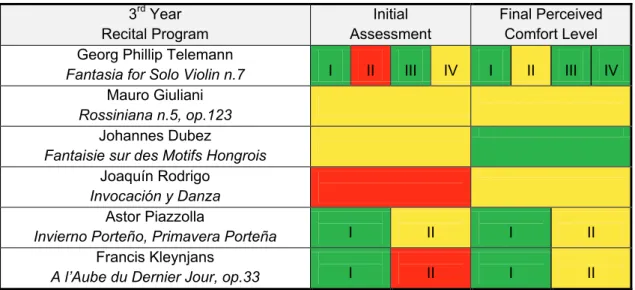
As a part of this doctoral program, three solo recitals programs were selected. The chosen repertoire for the three recitals was the following (Fig.1.1):
1st Year Recital Program 2 nd Year Recital Program 3 rd Year Recital Program Fernando Sor
Fantaisie Élégiaque, op.59
Johann Sebastian Bach
Violin Sonata n.1, BWV1001
Georg Phillip Telemann
Fantasia for Solo Violin n.7
Johann Sebastian Bach
Chaconne, from Partita BWV1004 Rossiniana n.2, op.120 Mauro Giuliani Rossiniana n.5, op.123 Mauro Giuliani
Nuccio D’Angelo
Due Canzoni Lidie
Francisco Tárrega
Gran Jota de Concierto
Johann Dubez
Fantaisie sur des Motifs Hongrois
Konstantin Vassiliev
Three Forest Paintings
Mario Castelnuovo-Tedesco
Tre Preludi Mediterranei
Joaquín Rodrigo Invocación y Danza Dusan Bogdanovic Sonata n.1 Astor Piazzolla Invierno Porteño, Primavera Porteña Francis Kleynjans
A l’Aube du Dernier Jour, op.33
Figure 1.1 – Doctoral recital programs
In order to relate the performances with the main theme of this dissertation and its corresponding issues, the chosen approach was to understand how repertoire choices can be beneficial or detrimental towards anxiety levels. For an anxious musician, it is much more advisable to choose repertoire that is perceived as comfortable, rather than by any other criteria, as in this instance the goal should be to minimize anxiety and maximize coping skills. All musicians, in general, could benefit from this approach in order to gain insight upon themselves and consequently improve their performance. By having chosen challenging repertoire, anxiety was heightened, and the programs were thus utilized as exploratory tools to better understand the implications of assessing all alternatives when choosing a given piece of music. Diversity was also taken into account, and different characteristics such as the musical period, style, composer and tempo, included in the assessment. Beyond deciding which pieces of music to play, it is also important to organize them in a way that
9 promotes comfort while on stage, prioritizing a structure that will minimize anxiety, above other criteria. Formal approaches towards structuring recitals can still be applied as long as they are beneficial to the intended goal. This approach ties in with performance anxiety in general but also fundamental notions of self-efficacy, self-assessment during preparation, awareness of adequate goal setting, and repertoire as a potential trigger for anxiety. My choice of music in the three programs and corresponding recital structure is discussed in sub-chapter 4.2, and deeply connected to the issues addressed in the dissertation. Rather than approaching the choice of repertoire exclusively through musical or historical criteria, I propose reframing this notion, approaching it through a self-analyzed comfort level in order to reduce anxiety and maximize performance quality and fruition.
1.4 – Objectives of the Present Work
The main objective of this work is to attempt to positively demystify music performance anxiety for musicians, teachers and music students, providing knowledge and coping strategies that help change the paradigm of what is perceived to be a career ending affliction. By contributing to the enhancement of the general understanding of this sensitive subject, this work is intended to help promote a positive change in the mindset of struggling performers, as well as endowing future generations of musicians with better tools to overcome anxiety related issues.
This dissertation will also aim to provide unprecedented research and data pertaining to the reality of anxiety related issues of classical music students in Portugal, from conservatory to college level. It will allow for a more reliable representation of what are the feelings and cognitions regarding performance anxiety during formative years. Another important point of focus is the characterization of how classical guitarists are affected by anxiety and what their predominant concerns are, in an attempt to identify and define their specific needs towards coping. The inner workings of the associated psychological, physiological and behavioral symptomatology identified in literature will be addressed, described and discussed, in an attempt to emphasize the idea that although some authors defend that there is an innate component to the experience of performance anxiety, studies also indicate that performance anxiety can be prevented and/or reduced and, as such, can and should be worked upon like any other skill associated with music.
From a pedagogical perspective, it is also relevant to provide adequate information and coping strategies concerning MPA to instrumental teachers. Considering that these teachers can highly influence their students, it is important to ensure they have access to proper theoretical and practical knowledge. Providing such background and highlighting the
10
importance of correctly conveying the information to the students should improve the general level of understanding and anxiety related problem solving.
Finally, this dissertation should contribute to the opening of several adjacent lines of investigation that may be object of further studies, such as characterizing MPA differences according to musical instrument, utilizing cognition profiles to identify specific vulnerabilities, and investigating the effectiveness of coping strategies and practices.
1.5 – Thesis Outline
The structure of this dissertation consists of 7 chapters.
In Chapter 1, the motivation that originated this project is presented, as well as a brief description of the issues pertaining performance anxiety. Furthermore, the methodology is explained, the main objectives of this project are stated and a thesis outline included.
Chapter 2 presents a review of existing literature regarding music performance anxiety, highlighting the associated symptoms and common coping approaches.
In what concerns Chapter 3, ancillary concepts such as self-efficacy, perfectionism and flow, which are directly linked to music performance anxiety, are introduced and explained.
Chapter 4 consists in presenting knowledge on improving learning processes, practice and preparation strategies that may lead to reducing performance anxiety.
As for Chapter 5, part of the original research for this dissertation is presented, including the construction of a questionnaire and subsequent statistical analysis of music students’ responses and their correlations and implications.
In regard to Chapter 6, the content analysis of interviews to several professional guitarists is presented.
11
Music Performance Anxiety
An enhanced understanding of music performance anxiety (MPA) and its specificities by musicians favors an overall awareness that allows and facilitates coping. Thus, it is fundamental to identify it, to understand the concept and its mechanisms, to recognize how it can affect musicians and, according to specific circumstances, implement adequate treatment options.
2.1 – Characterization of MPA
Several terminologies have been used to address MPA throughout the years: “stage fright”, “performance anxiety”, “music performer’s stress syndrome” and “music performance anxiety” (Fehm & Schmidt, 2006). Although, to a certain extent, all of those nomenclatures are valid, nowadays the most consensual terminology amongst authors is in fact music performance anxiety, or MPA, term that will be applied throughout this dissertation.
According to Barbar et al. (2014), MPA is recognized as a social anxiety disorder ranging from normal stress and anxiety intrinsic to being a musician to severely disabling symptoms close to terror or panic. As defined by the American Psychiatric Association in 20021, social anxiety disorder corresponds to the strong and persistent fear of social or
performance situations in which an individual is afraid of doing something or behaving in a humiliating or embarrassing way when faced with possible scrutiny by others. The exposure to such situations can trigger behavioral responses or be tolerated with feelings of dread. Negative cognitions and experiences are considered as predicting factors for performance anxiety proneness and intensity. Personality features like dependence, introversion, sensitivity to judgment, low self-esteem and perfectionism are facilitators to the onset of MPA, as well as trait-anxiety and negative self-expectations. Music performance anxiety is often associated to social anxiety and depression, which can impact not only on isolated performances but also on career and mental health, and therefore it can be regarded as an
12
“occupational health problem”, referring to Taborsky’s (2007) work, and should deserve better attention from the mental health community.
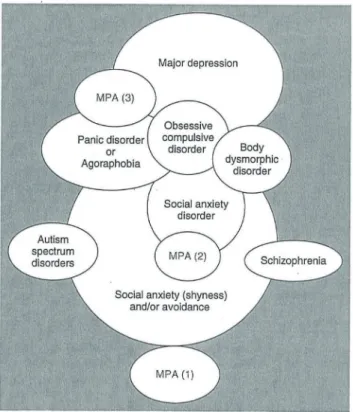
Kenny (2011) suggested a classification of music performance anxiety in three types, which differ in quality and severity, and presented them within a spectrum of other anxiety disorders (Fig.2.1):
Figure 2.1 – Kenny’s (2011) proposed subtypes of MPA
This model allows for a more accurate understanding of the differences in intensity of music performance anxiety as well as the connection with other anxiety disorders. According to this characterization, MPA (1) consists in a focal anxiety disorder resulting of specific conditioning experiences; MPA (2) is a manifestation of (or comorbid with) social anxiety/phobia; and lastly, MPA (3) corresponds to the most severe form of performance anxiety, akin to panic, which may or may not be accompanied with depression and a pervasive problem with the sense of self and self-esteem.
As a construct, music performance anxiety can be divided into state and trait components. The state anxiety component (akin to fear) is a transitory emotional reaction to heightened tension whereas the trait anxiety component (akin to stress) corresponds to the difference between individuals and their anxiety proneness. Logically, high trait anxiety individuals have higher state anxiety levels (Kenny, 2004a). Kokotsaki & Davidson (2003) further described this important distinction, characterizing state anxiety as “subjective, consciously perceived feelings of apprehension and tension, accompanied by or associated
13 with activation or arousal of the autonomic nervous system” (Kokotsaki & Davidson, 2003, p.46). Trait anxiety, on the other hand, was referred to as the “relatively stable individual differences in anxiety proneness, that is, to differences in the disposition to perceive a wide range of stimulus situations as dangerous or threatening, and in the tendency to respond to such threats with A-State reactions”2 (Kokotsaki & Davidson, 2003, p.46). Furthermore, a
proportional relationship between state and trait anxiety has been verified, where the stronger the trait, the more prone the individual is to state anxiety, which also increases in frequency and intensity.
In Cox & Kenardy’s (1993) study, MPA was also associated to social anxiety, commonly conceptualized as anxiety related to performance in front of others. Anxiety can be generated by the performer upon focusing on potential failures and mistakes despite of objective evidence of competence. The authors postulated that there is a correlation between trait anxiety and performance anxiety, and also between social phobia and performance anxiety. Corroborating this notion, Osborne & Franklin (2002) stated that social phobic models provide a valid account of the cognitive processes that occur during music performance anxiety and that performance anxiety is diagnosed as social phobia when it leads to marked impairment or distress. According to these authors, performance anxiety is therefore classified as a performance subtype of social phobia, and the majority of high MPA individuals also correlate to social phobia cognitions. The concern over a negative evaluation in every situation seems to be important for the conceptualization of social phobia; however, this is not entirely true for MPA, where the fear of a negative evaluation from the audience seems to mostly generate anxiety in solo situations, but not in group performances. Therefore, despite sharing common cognitive distortions, social phobia is not synonymous of MPA.
On the same note, Georges et al. (2007) highlighted that music anxiety and social anxiety are in fact strongly related, despite being unique in their own ways. In addition, other personality traits can correlate, such as catastrophizing cognitions3, perfectionism and public
self-focus, corroborating the conceptualization of MPA as a special subtype of social anxiety. Kenny & Osborne (2006) added that “once triggered, the person shifts into a self-evaluative attention state, in which self-evaluation of perceived inadequate capabilities to deal with the threat, in this case, the imminent performance, is prominent. The attention typically narrows to a focus on catastrophic cognitive self-statements that disrupt concentration and performance. In this respect, MPA may share commonalities with social anxiety and in its extreme form appears similar to social phobia” (Kenny & Osborne, 2006, p.104). The
2 On both definitions, authors are quoting Spielberger (1972), Anxiety: Current Trends in Theory and Research,
p.39.
14
transfer of treatment knowledge related to social anxiety to music performance anxiety seems therefore justifiable, even if the approaches need to be adapted. Social anxiety, perfectionism, public self-focus, gender, professional status and the belief that the audience will or won’t like the performance are essential to the extent of MPA.
Regarding schematic organizations of variable elements of performance anxiety, Zhukov (2009) wrote:
LeBlanc (1994) identified 11 factors contributing to performance anxiety: personal characteristics of the performer (age, amount of training and performance experience), difficulty of the music, adequacy of preparation, emotional and physical health, mood, performance environment, self-perceptions, physical and psychological arousal, focus of attention and self-appraisal during playing. Wilson (1994) simplified this theory into three main areas of stress: trait anxiety, task mastery and situational stress. Lehmann et al. (2007) divided factors associated with performance anxiety into four categories: the symptoms, the person, the situation, and the musical task (Zhukov, 2009, p.2).
The Yerkes-Dodson law is an inverted U (or rainbow) shaped function between performance quality and arousal (Steptoe, 1982; Steptoe & Fidler, 1987; Wilson & Roland ,2002; Kenny, 2011; Sinico & Winter, 2013) (Fig.2.2).
Figure 2.2 – Representation of the Yerkes-Dodson curve, in Kenny (2016)
It is a graphical representation of how low levels of arousal usually originate lackluster performances due to being insufficiently motivating, whereas excessive levels of arousal interfere with performance by disrupting concentration and motor coordination.
Naturally, for a simple task the optimal point of arousal (stress) is higher than for a more complex task (Kenny, 2011 & 2016; Sinico & Winter, 2013) (Fig.2.3).
15
Figure 2.3 – Relation between arousal and task complexity, in Kenny (2016)
The level of physiological arousal that produces optimal performance is also related to the extent to which a task has been practiced to mastery (Kenny, 2011 & 2016) (Fig.2.4).
Figure 2.4 – Relation between arousal and mastery, in Kenny (2016)
As observed, a less practiced task will originate a poorer performance at optimal levels of arousal when compared to a well-practiced task.
A catastrophe model is also believed to be realistic, since after reaching a certain level of arousal, performance quality tends to plummet irreversibly as authors agree that cognitive anxiety is mostly responsible for this scenario, rather than somatic anxiety (Wilson, 1997). Wilson & Roland (2002) proposed an extension to this model by grouping the sources of stress in three categories: trait anxiety (personality), situational stress (occasion) and task mastery (preparedness). As the three sources vary independently, their interaction is what dictates whether the anxiety is detrimental or beneficial for performance, in each situation. This notion has practical implications for performers, as high-anxiety individuals perform better in well-prepared and relaxed settings, while low-anxiety individuals perform better in
16
challenging and high-pressure settings. In regards to this topic, Kenny (2004a) stated that the following cognitions are common for performance anxious individuals:
i. stronger negative expectancies before the event
ii. stronger negative bias in their retrospective self-evaluations of performance
iii. stronger expectation that their performance will be judged negatively by their examiners/audience
iv. stronger concerns about the consequences of a poor performance v. heightened responsiveness to changes in reactions of judges or audience
vi. failure to derive comfort from evidence that they have handled the situation skillfully (Kenny, 2004a, p.10).
The referred cognitions mean that anxious performers will overestimate the likelihood and consequences of negative performance, as well as subsequent negative judgment; inversely, they will underestimate or fail to acknowledge their own accomplishments. In addition to this issue, Steptoe (1982) wrote:
People with stage-fright have a tendency to catastrophize, or exaggerate in imagination the consequences of a minor mishap. Thus a small mistake will be seen as ruining a whole performance, alienating the audience and critics, making friends or colleagues ashamed and damaging the individual's entire career prospects. They may also have negative thoughts about the self, seeing themselves as unworthy, technically incapable, not as talented as colleagues, and unable to give genuinely inspired readings (Steptoe, 1982, p.539).
Nevertheless, and despite high levels of MPA, actual performance catastrophes are rare occurrences (Kenny, 2004a). Anxious musicians may also be tempted to give excuses prior to playing, providing excuses for mistakes they have not yet made. This habit, usually referred to as “self-handicaping”, derives from the preoccupation of being evaluated by others. Resulting negative cognitions tend to develop into self-sabotage (Zhukov, 2009). An extreme example of a high performance anxiety individual is that of the “impostor syndrome”, considered to be one of the hardest-to-resolve performance anxiety issues: “These individuals are highly talented, competent, and knowledgeable but regard themselves as inept and as impostors and constantly fear being found out and exposed for their “true” incompetence” (Lazarus & Abramovitz, 2004, p.833).
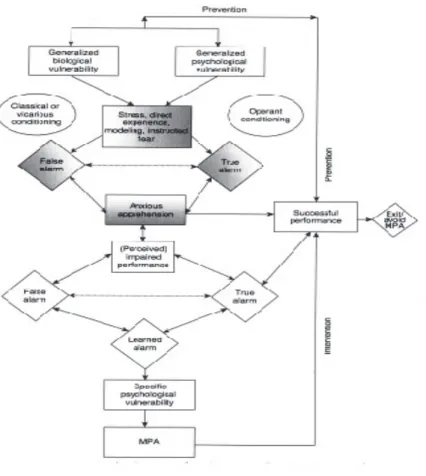
Kenny (2011) elaborated a conceptual model of how a person develops, maintains and exits from music performance anxiety (Fig.2.5). This model consists in the organization of interactions between generalized or specific vulnerabilities, forms of conditioning and responses to a stressful event.
17
Figure 2.5 – Kenny’s (2011) model for development, maintenance and exit from MPA
As illustrated in Fig.5, the shaded boxes represent basic conditioning processes that develop anxious apprehension and some form of social phobia, naturally influenced by biological and/or psychological vulnerabilities and shaped by forms of conditioning. Fear triggers physiological fight-or-flight responses in the presence of real or present danger (true alarms), whereas in anxiety and panic disorders (MPA included) there is usually an absence of real or present danger (false alarms). In a stressful moment, which for a musician is usually a performance situation, the general anxious apprehension becomes focused on the complexity of music performance, originating its impairment, or perceived impairment. The experience of too many alarms in a performance setting will start to condition the anxiety response to performing, establishing music performance anxiety. Therefore, prevention is required (in varying approaches) in order to avoid that conditioning from happening; however, after MPA is materialized, it entails some form of intervention to achieve a successful performance. Early experiences of true or false alarms also define the tendency for anxious apprehension in a performance setting and outcomes will vary according to the perceived success of the performance. The cumulative number of successful performances tend to reduce anxious apprehension to manageable levels, while the experience of
18
unsuccessful performances tends to involve negative emotions and self-evaluation, to aggravate anxious apprehension, and to trigger more alarms, increasing the risk of impaired performance. A vicious circle can then be formed, until the performance itself is increasingly able to trigger conditioned alarms.
The desensitization of exposure, social skills training and cognitive restructuring are mentioned by Cox & Kenardy (1993) as forms of treatment for social phobia, relating well to common coping strategies for MPA. Treatments for MPA have concentrated on characteristic social phobic themes such as fear of failure, fear of social disapproval and irrational and self-defeating thought patterns (Cox & Kenardy, 1993; Osborne & Franklin, 2002). The main obstacle for a musician’s performance is that finer motor skills are greatly impaired by anxiety, which further increases anxiety levels, making it more difficult to cope with. Yoshie & Kudo (2009a) hypothesized that psychological stress leads to a temporary regression of muscle memory patterns to an earlier stage of motor learning, which is characterized by the loss of biomechanical freedom (stiffness) as an attempt to maintain motor functions under control, through the filtering of (anxiety) deteriorated neuromotor signals. This mechanism is thought to prevent performance impairment in simple tasks, but is found to be detrimental in complex manual motor tasks.
Since MPA is found to be relatively common among children, one of the most recurring questions within this subject is whether it is innate or developed. In case of the latter condition, one should ask how it is “learned” (Ryan & Andrews, 2009). Boucher & Ryan (2010) addressed this question and their results indicated that it can stem from either or both situations. In their research, children with prior experience had less anticipatory stress, but higher cortisol4 levels. Familiar location/environment was found to reduce stress and second
performances in a short time frame elicit less stress responses, probably due to being a confidence building experience. The same study did not find any differences between genders in an early age, as they are thought to only become apparent at the onset of puberty. The authors highlighted that, by sixth grade5, children start to develop their own
coping strategies, while advice from teachers regarding this subject is relatively uncommon. Opposing the reality of a generalized lack of studies regarding young children’s performing experiences, several important pedagogical implications can be derived from this work. In fact, Burin & Osório (2016) stated that early diagnosis and intervention for young musicians may prevent future disadvantages in dealing with anxiety. Further supporting this argument, Taborsky (2007) stated that:
4 Cortisol is a steroid-based hormone involved in the regulation of cell metabolism which helps to regulate stress
levels within the body, with higher levels of cortisol equating to higher levels of stress.