USE OF A TEMPERATE REEF-FISH COMMUNITY TO IDENTIFY PRIORITIES IN
THE ESTABLISHMENT OF A MARINE PROTECTED AREA
Emanuel J. Gonçalves
A, Miguel Henriques
A,Band Vítor C. Almada
A AEco-Ethology Research Unit, ISPA, R. Jardim do Tabaco 34, 1149-041 Lisboa, Portugal. BArrábida Nature Park – ICN, Praça da República, 2900 Setúbal, Portugal.Abstract
Few studies have dealt with biodiversity, composition and dynamics of temperate reef fish. The present study area is a 25 km stretch of coastline (53 km2) on the west Portuguese coast that has recently been assigned as a Marine Park (Marine Park of the Arrábida Nature Park), for which basic information on composition of the marine communities is very scarce. From a biogeographical perspective, mainland Portugal is in a transitional zone where many species of cold- and warm-water fish reach their southern and northern limits of distribution respectively. This situation contributes strongly to a high level of biodiversity in the Lusitanian province, and also makes it very sensitive to climatic oscillations such as those predicted as part of global warming.
This study analysed the fish community composition in the marine park and ascribed a hierarchical importance for the coastal sectors and the different habitats present. The results reflect the heterogeneous nature of the substrata present and their significant differences in biodiversity values and in the occurrence of rare species. For each species, dispersion and abundance indexes were calculated and species that require particular attention are noted. Appropriate management measures are suggested. Procedures for the implementation of these measures must be suited to a situation where basic biological information is scarce. This research is included in a broader project aimed at building a long-term database of the fish communities in this area, assessing the main factors influencing their structure and distribution patterns, and monitoring reserve effects in the long term.
Keywords: fish communities; dispersion index; abundance index; marine reserve design; management plan
INTRODUCTION
The advent of SCUBA diving opened a new era in ecological studies of fish communities in hard substrata (Harmelin-Vivien and Harmelin 1975), especially in coral reef ecology where a large number of visual census techniques were developed (e.g. Ehrlich 1975; Colton and Alevizon 1981; Doherty and Williams 1988; Sale 1988, 1991a; Greenfield and Johnson 1990). These techniques contributed decisively to a profound change of perspective in ecological studies of coral-reef fish communities. Basic descriptive research, in which assemblage composition, biomass assessment and food-web characterization had priority, has evolved into a new stage in which a number of important theoretical issues are guiding the scientific research (e.g. Sale 1978, 1988, 1991b; Barlow 1981; Doherty 1991; Ebeling and Hixon 1991; Hixon 1991; Leis 1991; Williams 1991). The development of accurate quantitative census techniques applied to long-term studies opened the door to studies of
stability, resilience and the impact of disturbances in reef fish communities. Regular monitoring of recruitment processes, combined with that of adults, is helping to assess the importance of stochastic and deterministic control mechanisms in different habitats and geographical locations. It is also helping to detect which life stages are most susceptible to the controlling factors limiting the populations of each species (e.g. Williams and Sale 1981; Brothers et al. 1983; Victor 1986; Sale 1988; Thresher 1991; Victor 1991). Quantitative data on fish populations and new forms of habitat characterization, often combined with experimental manipulations, are helping to clarify the relationship between biodiversity and habitat complexity. Finally, these new monitoring methods are allowing the study of the impact of human activities, both fishing and habitat degradation, and are essential in the building of predictive models of drastic environmental changes, such as those likely to be caused by global warming, as well as in the planning, design and management of marine protected areas. Proceedings of the World Congress on Aquatic Protected Areas (pp. 261-272), Cairns, Australia – August 2002.
In comparison with studies on coral reefs, those on temperate rocky shores have progressed at a much slower pace, largely owing to the harsh environment of these habitats (e.g. Stephens and Zerba 1981; Stephens et al. 1984; Jansson et al. 1985; Diamant et al. 1986; Harmelin 1987). Information on subtidal fish communities is available for only a limited number of sites (Harmelin-Vivien and Harmelin 1975; Stephens et
al. 1984; Jansson et al. 1985; Bodkin 1986; Harmelin
1987, 1990; Clavijo et al. 1989; Illich and Kotrschal 1990; Bortone et al. 1991; Falcón et al. 1993; Henriques et al. 1999), despite the fact that almost all important questions raised by coral-reef fish ecology are fully applicable to temperate habitats. On European shores, many of these studies have been carried out in the Mediterranean (Harmelin 1987, 1990; Zander 1992; Ody and Harmelin 1994; Jouvenel 1997) and more studies at higher latitudes are clearly needed (Jansson et al. 1985; Henderson 1989; Minchin 1987). This applies especially to long-term studies with adequately standardized procedures. Such information is fundamental for comparative analysis between geographical locations and to distinguish between inter-annual fluctuations and long-term trends, such as those predicted by global warming. This applies in particular to habitats that are changing rapidly, because of either climatic change (in its broad sense) or habitat degradation.
The role of marine protected areas in preserving intact marine habitats, where these comparative studies can be performed in a meaningful way, is fundamental for evaluation and comparison with other areas where human activities are severely affecting the marine communities (Fishelson 1980; Santos et al. 1995; Rakitin and Kramer 1996; Kramer and Chapman 1999; Roberts and Hawkins 2000; Côté et al. 2001).
From a biogeographical perspective, mainland Portugal is in a transitional zone where many species of cold- and warm-water fish reach their southern and northern limits of distribution, respectively. This situation contributes strongly to a high level of biodiversity in the Lusitanian province (of which mainland Portugal makes a very substantial proportion (Briggs 1974)), and also makes it very sensitive to climatic oscillations such as those predicted as part of global warming. This study was conducted at Arrábida Marine Park (AMP), Portugal, with the aim of characterising the rocky-habitat fish fauna of this region, thereby providing a reference database against which future studies can be compared and a framework to the design and management plan of this MP. One main objective was to characterise the situation before the creation of the MP; this serves as a baseline study against which
implementation of the protective measures; it also suggests a number of management measures for this Area. The results are discussed in terms of the biogeographic importance of the study area and its relevance for conservation.
METHODS
Study area
Our study area is a 25 km stretch of coastline (53 km2) and comprises the rocky shore and adjacent mixed sandy substrata between Cape Espichel (38º27'N, 9º12'W) and Portinho da Arrábida (38º29'N, 8º57'W), on the west coast of Portugal (Fig. 1).
Most of the study area faces south, being protected from the prevailing north and north-west winds by the adjacent mountain chain of Arrábida. The shore is very steep and the intertidal zone includes mainly rocky cliffs, small beaches and several areas covered by boulders. The subtidal zone begins with a narrow stretch of rocky substratum that extends offshore for some tens of metres, and to depths of less than 15 m (except at the Espichel Cape area where it reaches more than 40 m). Many stones and boulders, from a few centimetres to several metres in size, resulting from the erosion of the nearby calcareous cliffs increase habitat complexity. In some places, sandy beaches interrupt this stretch. Beyond the rocky substratum, sandy bottoms that usually present gentle slopes are found. Between Sesimbra and Setúbal there is a terrestrial Nature Park created in 1976 (Arrábida Nature Park) that since 1998 has included a marine area – the AMP. Until a few years ago, the study area harboured extensive eelgrass beds, which are now almost absent as a result of unrestrained clam harvesting. During late spring and summer, dense algal beds are present in many places, ranging from dense tufts of Asparagopsis armata Harvey (a probable invasive species from Australia), to some brown algae such as Cystoseira usneoides (L.) and, in some sites, Saccorhiza polyschides (Lightfoot). Crustose red algae have formed reefs in some areas. The filter-feeding invertebrate fauna is particularly developed and abundant in the MP. A detailed description of the algal and invertebrate communities can be found in Saldanha (1974). This area is near the northern limit of the main north-east Atlantic upwelling events (Wooster et
al. 1976). This means that, during the summer,
water temperature nearshore is frequently lower than that of the offshore waters at the same latitude. Water temperature can vary from around 13ºC in January to 21ºC in September (Almada et
al. 1990, based on data from a nearby
Fig. 1. Location of the study area in the west coast of Portugal.
Data collection
Data were collected from May 1996 to February 2000 during SCUBA surveys. Dives were made every month, with a few exceptions in the winter due to rough seas. Each dive lasted on average one hour and the habitats and microhabitats prospected ranged from the surface down to the limit of the rocky substratum (8 to 30 m). About ten metres of adjacent sandy bottoms were also inspected. In each station (Fig. 2), the sampling procedure started in the adjacent sandy bottom and followed a line perpendicular to the coast as far as the intertidal zone.
In each dive, a cumulative list of the observed species was updated and the new occurrences were added for each habitat. For each species, a qualitative scale of abundance (Harmelin-Vivien and Harmelin 1975) was determined for each station as follows: 1, Single observation (one individual); 2, Rare (2–10); 3, Common (11–100); 4, Abundant (>100). Apart from this qualitative database, the habitats, microhabitats, depths, fish size, patterns of aggregation, and the occurrences of juveniles and their sizes, were also noted. Based on this information, the following indexes were calculated:
Number of stations where the species occurred Dispersion Index = Total number of stations
∑ of abundances in the stations where the species occurred Abundance Index = Total number of stations where the species occurred
9ºW
40m 100m
Lisbon
Arrábida Nature Park Sesimbra Espichel Cape 38º20’N
Setúbal
5 Km Sado Estuary Tejo EstuaryFor the Dispersion Index the occurrence of each species in the sampled stations was rated as follows: 4, Regular (> 50% of stations); 3, Scattered (>25% and ≤50%); 2, Localized (>10% and ≤25%);
and 1, Very Localized (≤10%). For the Abundance Index, the following groups were defined: 4, Abundant (>3 to 4); 3, Common (>2 and ≤3); 2, Rare (>1 and ≤2); 1, Very Rare (≤1).
Fig. 2. Sampling stations (≈ 500m) and sectors, Arrábida Marine Park, Portugal.
RESULTS
The main habitats and microhabitats present in the study area were evaluated and mapped for each station. This method allowed the division of the study area in three main sectors (Fig. 2). Sector 1 is characterised by an extensive vertical coastline with very high (to 400 m) and steep calcareous cliffs. The disintegration of these cliffs forms a very heterogeneous subtidal habitat characterised by the presence of random-sized blocks of rock (from a few centimetres to several metres) and of boulder fields (in shallow water). The rocky habitat occurs in a narrow band and is relatively shallow in this sector (to 20 m depth). Some small and protected bays with intertidal boulder fields are also present. The rocky substratum is bordered by sandy bottoms that can reach 100 m around the limits of the MP. In the eastern part of the sector shallow sandy bottoms and sand banks are present, as well as small and very protected bays with intertidal boulder fields. In Sector 2 the main substratum type is “bedrock”, which constitutes a natural continuation of the rocky formations found inland in this area. They are much less diversified than the random-sized blocks of rock and present fewer microhabitats.
Sector 3 has two sections. In the eastern section,
the rocky vertical substratum reaches medium depths (10—15 m) and the bedrock bottoms can
occur at 30–40 m. In the western (most exposed) section the bedrock habitat is very homogeneous and extends to several hundreds of metres from shore with a gentle slope to around 30 m.
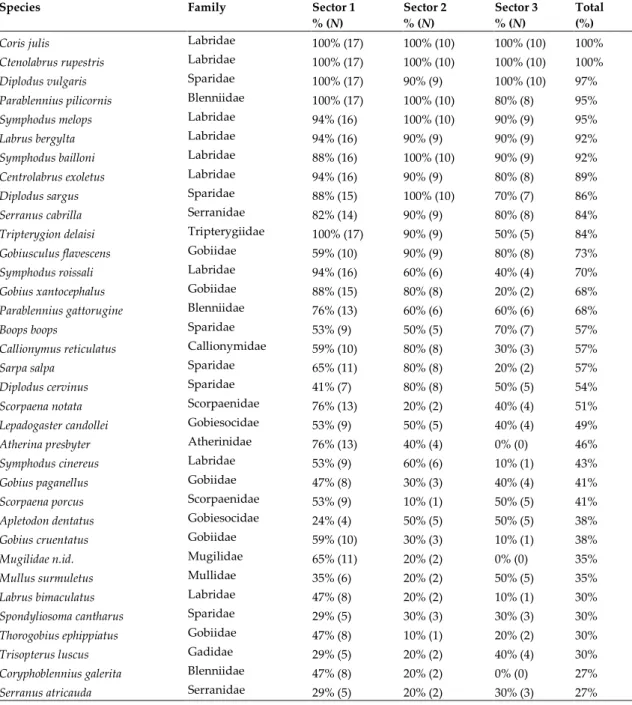
The 96 fish species recorded (Table 1) constitute a high level of fish biodiversity for this biogeographic region (Henriques et al. 1999). At present, we have recorded more than 110 species of coastal fish in the MP (including more recent data from other studies), using visual identification techniques. Some species typical of sandy bottoms adjacent to seagrass beds were not recorded since these beds are now severely reduced.The three identified sectors were compared for the occurrence of each species. Only species that were recorded in more than 25% of the sampled stations were considered, to reduce the error introduced by rare species (Table 2). Species diversity was significantly different between sectors (ANOVA: F = 5.45, d.f. 2, p<0.01) with a significant difference between extremes (Spjotvoll/Stoline test: Sector 1 v. Sector 3 = p<0.05) and with Sector 1 presenting a higher mean number of species (Fig. 3). The percentage occurrence of rare species (in <25% of the sampled stations) is presented in Fig. 4. There is a decrease in the occurrence of rare species from Sector 1 to Sector 3. 1 Km Sector 3 Sector 2 Sector 1 Sesimbra Village Portinho da Arrábida
Table 1. Fish species recorded in the Arrábida Marine Park, Portugal.
Classification follows Whitehead et al. (1984/86) for genus and species and Nelson (1994) for families. Gobius
xantocephalus (Heymer and Zander 1992) replaces G. auratus cited in Whitehead et al. (1984/86). Sphoeroides marmoratus
(Shipp 1990) replaces S. spengleri cited in Whitehead et al. (1984/86).
Family Species Family Species
Carcharhinidae Carcharhinus plumbeus
(Nardo, 1827)
Labridae Centrolabrus exoletus
(Linnaeus, 1758) Muraenidae Muraena helena
Linnaeus, 1758
Coris julis
(Linnaeus, 1758) Congridae Conger conger
(Linnaeus, 1758)
Ctenolabrus rupestris
(Linnaeus, 1758) Clupeidae Sardina pilchardus
(Walbaum, 1792)
LABRUS BERGYLTA
Ascanius, 1767 Phycidae Ciliata mustela
(Linnaeus, 1758) L. bimaculatus Linnaeus, 1758 Gaidropsarus mediterraneus (Linnaeus, 1758) Symphodus bailloni (Valenciennes, 1889) G. vulgaris (Cloquet, 1824) S. cinereus (Bonnaterre, 1788) Phycis phycis (Linnaeus, 1766) .S. melops (Linnaeus, 1758) Gadidae Pollachius pollachius
(Linnaeus, 1758) S. roissali (Risso, 1810) Trisopterus luscus (Linnaeus, 1758) S. rostratus (Bloch, 1797) Batrachoididae Halobatrachus didactylus
(Schneider, 1801)
Ammodytidae Ammodytidae n.id.
Mugilidae Chelon labrosus
(Risso, 1826)
Hyperoplus lanceolatus
(Le Sauvage, 1824)
Liza aurata
(Risso, 1810)
Trachinidae Echiichthys vipera
(Cuvier, 1829)
L. ramada
(Risso, 1826)
Tripterygiidae Tripterygion delaisi
Canedat & Blache, 1971 Atherinidae Atherina presbyter
Cuvier, 1829
Blenniidae Coryphoblennius galerita
(Linnaeus, 1758) Belonidae Belone belone
(Linnaeus, 1761)
Lipophrys canevai
(Vinciguerra, 1880)
Zeidae Zeus faber
Linnaeus, 1758
L. pholis
(Linnaeus, 1758) Syngnathidae Entelurus aequoreus
(Linnaeus, 1758) L. trigloides (Valenciennes, 1836) Hippocampus hippocampus (Linnaeus, 1758) Parablennius gattorugine (Brunnich, 1768) Syngnathus acus Linnaeus, 1758 P. incognitus (Bath, 1968) Macroramphosidae Macroramphosus scolopax
(Linnaeus, 1758)
P. pilicornis
(Cuvier, 1829) Scorpaenidae Scorpaena notata
Rafinesque, 1810 P. rouxi (Cocco,1883) S. porcus Linnaeus, 1758 P. sanguinolentus (Pallas, 1811) Triglidae Trigloporus lastoviza
(Brünnich, 1768)
Gobiesocidae Apletodon dentatus
(Fascciola, 1887) Cottidae Taurulus bubalis
(Euphrasen, 1786)
Diplecogaster bimaculata
(Bonnaterre, 1788) Moronidae Dicentrarchus labrax
(Linnaeus, 1758)
Lepadogaster candollei
Risso, 1810 Serranidae Serranus atricauda
Günther, 1874
L. lepadogaster
(Bonnaterre, 1788)
S. cabrilla
(Linnaeus, 1758)
Callionymidae Callionymus lyra
Linnaeus, 1758
S. hepatus
(Linnaeus, 1758)
C. reticulatus
Valenciennes, 1837 Carangidae Trachurus trachurus
(Linnaeus, 1758)
Gobiidae Gobius cobitis
Sparidae Boops boops (Linnaeus, 1758) G. cruentatus Gmelin, 1789 Diplodus annularis (Linnaeus, 1758) G. gasteveni Miller, 1974 D. bellottii (Steindachner, 1882) G. niger Linnaeus, 1758 D. cervinus (Lowe, 1838) G. paganellus Linnaeus, 1758 D. puntazzo (Cetti, 1777) G. xantocephalus
Heymer & Zander, 1992
D. sargus (Linnaeus, 1758) Gobiusculus flavescens (Fabricius, 1779) D. vulgaris (E.G. Saint-Hilaire, 1817) Pomatoschistus marmoratus (Risso, 1810) Oblada melanura (Linnaeus, 1758) P. pictus (Malm, 1865) Pagellus acarne (Risso, 1826) Thorogobius ephippiatus (Lowe, 1839) Pagrus auriga (Valenciennes, 1843)
Scombridae Scomber japonicus
Houttutyn, 1782
P. pagrus
(Linnaeus, 1758)
Bothidae Arnoglossus thori
Kyle, 1913 Sarpa salpa (Linnaeus, 1758) Bothus podas (Delaroche, 1809) Sparus aurata (Linnaeus, 1758)
Scophthalmidae Phrynorhombus regius
(Bonnaterre, 1788)
Spondyliosoma cantharus
(Linnaeus, 1758)
Zeugopterus punctatus
(Bloch, 1787) Centracanthidae Spicara n.id. Soleidae Solea senegalensis
Kaup, 1858 Mullidae Mullus surmuletus
Linnaeus, 1758
Synaptura lusitanica
(Capello, 1868) Pomacentridae Chromis chromis
(Linnaeus, 1758)
Balistidae Balistes carolinensis
Gmelin, 1789 Tetraodontidae Sphoeroides marmoratus
(Lowe, 1839) Molidae Mola mola
(Linnaeus, 1758)
Eleven species occurred in more than 80% of the sampled stations (Table 2): six wrasses two sea breams, two blennioids and a grouper. These are species that have a consistent presence throughout the MP. The most representative families were the Labridae (wrasses) with 9 species, the Sparidae (sea breams) with 6 species, the Gobiidae (gobies) with 5 species and the Blenniidae (blennies) with 3 species (Table 2). For each species, the abundance and dispersion indexes were determined. These indexes allow the identification of ubiquitous species and also abundant but localised species. For a clearer presentation of this information, the dispersion values of abundant and common species and the abundance values of regular and scattered species were determined (Table 3). Four species were very abundant but localised or very localised in the study area; these species were associated with a specific habitat that occurs in only a few places in the study area, or they appeared at a specific time of the year (e.g. reproductive schools of L.
ramada that migrate from the nearby estuary in
November). On the other hand, 17 species were rare but occurred regularly in the sampled stations (Table 3).
Fig. 3. Number of fish species in each sector of the
Arrábida Marine Park. Mean (squares), standard error (boxes) and standard deviation (whiskers). Sector 1, N = 17, Sector 2, N = 10, Sector 3, N = 10. Nu mb er o f S peci es 10 14 18 22 26 30 34 38
Fig. 4. Occurrence (%) of rare fish species (recorded in <25% of the sampled stations) per Sector, Arrábida Marine Park.
Table 2. Distribution of fish species in the Arrábida Marine Park; percentage and number (in parenthesis) of stations
where each species occurred in each sector and for all stations sampled (for species with >25% of occurrences in the sampled stations).
Species Family Sector 1
% (N) Sector 2 % (N) Sector 3 % (N) Total (%)
Coris julis Labridae 100% (17) 100% (10) 100% (10) 100%
Ctenolabrus rupestris Labridae 100% (17) 100% (10) 100% (10) 100%
Diplodus vulgaris Sparidae 100% (17) 90% (9) 100% (10) 97%
Parablennius pilicornis Blenniidae 100% (17) 100% (10) 80% (8) 95%
Symphodus melops Labridae 94% (16) 100% (10) 90% (9) 95%
Labrus bergylta Labridae 94% (16) 90% (9) 90% (9) 92%
Symphodus bailloni Labridae 88% (16) 100% (10) 90% (9) 92%
Centrolabrus exoletus Labridae 94% (16) 90% (9) 80% (8) 89%
Diplodus sargus Sparidae 88% (15) 100% (10) 70% (7) 86%
Serranus cabrilla Serranidae 82% (14) 90% (9) 80% (8) 84%
Tripterygion delaisi Tripterygiidae 100% (17) 90% (9) 50% (5) 84%
Gobiusculus flavescens Gobiidae 59% (10) 90% (9) 80% (8) 73%
Symphodus roissali Labridae 94% (16) 60% (6) 40% (4) 70%
Gobius xantocephalus Gobiidae 88% (15) 80% (8) 20% (2) 68%
Parablennius gattorugine Blenniidae 76% (13) 60% (6) 60% (6) 68%
Boops boops Sparidae 53% (9) 50% (5) 70% (7) 57%
Callionymus reticulatus Callionymidae 59% (10) 80% (8) 30% (3) 57%
Sarpa salpa Sparidae 65% (11) 80% (8) 20% (2) 57%
Diplodus cervinus Sparidae 41% (7) 80% (8) 50% (5) 54%
Scorpaena notata Scorpaenidae 76% (13) 20% (2) 40% (4) 51%
Lepadogaster candollei Gobiesocidae 53% (9) 50% (5) 40% (4) 49%
Atherina presbyter Atherinidae 76% (13) 40% (4) 0% (0) 46%
Symphodus cinereus Labridae 53% (9) 60% (6) 10% (1) 43%
Gobius paganellus Gobiidae 47% (8) 30% (3) 40% (4) 41%
Scorpaena porcus Scorpaenidae 53% (9) 10% (1) 50% (5) 41%
Apletodon dentatus Gobiesocidae 24% (4) 50% (5) 50% (5) 38%
Gobius cruentatus Gobiidae 59% (10) 30% (3) 10% (1) 38%
Mugilidae n.id. Mugilidae 65% (11) 20% (2) 0% (0) 35%
Mullus surmuletus Mullidae 35% (6) 20% (2) 50% (5) 35%
Labrus bimaculatus Labridae 47% (8) 20% (2) 10% (1) 30%
Spondyliosoma cantharus Sparidae 29% (5) 30% (3) 30% (3) 30%
Thorogobius ephippiatus Gobiidae 47% (8) 10% (1) 20% (2) 30%
Trisopterus luscus Gadidae 29% (5) 20% (2) 40% (4) 30%
Coryphoblennius galerita Blenniidae 47% (8) 20% (2) 0% (0) 27%
Serranus atricauda Serranidae 29% (5) 20% (2) 30% (3) 27%
0 10 20 30 40 50
Sector 1 Sector 2 Sector 3
Table 3. Dispersion values of abundant and common species and abundance values of regular and scattered species in
the Marine Park.
Dispersion Index: 4, Regular (>50% of stations); 3, Scattered (>25% and ≤50%0; 2, Localized (>10% and ≤25%); and 1, Very Localized (≤10%). Abundance Index: 4, Abundant (>3 to 4); 3, Common (>2 and ≤3); 2, Rare (>1 and ≤2); 1, Very Rare (≤1).
Dispersion of Abundant and Common Species Abundance of Regular and Scattered Species
Species Dispersion Species Abundance
Coris julis 4 Coris julis 4
Diplodus vulgaris 4 Diplodus vulgaris 4
Callionymus reticulatus 4 Callionymus reticulatus 3
Centrolabrus exoletus 4 Centrolabrus exoletus 3
Ctenolabrus rupestris 4 Ctenolabrus rupestris 3
Gobius xantocephalus 4 Gobius xantocephalus 3
Gobiusculus flavescens 4 Gobiusculus flavescens 3
Labrus bergylta 4 Labrus bergylta 3
Parablennius pilicornis 4 Parablennius pilicornis 3
Sarpa salpa 4 Sarpa salpa 3
Serranus cabrilla 4 Serranus cabrilla 3
Symphodus bailloni 4 Symphodus bailloni 3
Symphodus melops 4 Symphodus melops 3
Symphodus roissali 4 Symphodus roissali 3
Tripterygion delaisi 4 Tripterygion delaisi 3
Apletodon dentatus 3 Apletodon dentatus 3
Atherina presbyter 3 Atherina presbyter 3
Coryphoblennius galerita 3 Coryphoblennius galerita 3
Lepadogaster lepadogaster 2 Boops boops 2
Pomatoschistus marmoratus 2 Diplodus cervinus 2
Pomatoschistus pictus 2 Diplodus sargus 2
Liza ramada 1 Parablennius gattorugine 2
Locally Abundant Scorpaena notata 2
Gobius cruentatus 2 Gobius paganellus 2 Labrus bimaculatus 2 Lepadogaster candollei 2 Mugilidae n.id. 2 Mullus surmuletus 2 Scorpaena porcus 2 Serranus atricauda 2 Spondyliosoma cantharus 2 Symphodus cinereus 2 Thorogobius ephippiatus 2 Trisopterus luscus 2
DISCUSSION
In the past decade or so, we have recorded an increase in sea-water temperature and the complete disappearance of laminarian beds from the AMP. This is a transitional zone, with many fish species finding their northern or southern limits of distribution within the area (Henriques et
al. 1999). Similar situations have been described
for other regions. Temperature change in the eastern Pacific has caused the disappearance and subsequent reappearance of the kelp beds ‘typical’ of temperate regions in southern California (Eber 1981). This is a transitional zone between the cold and the warm temperate north-eastern Pacific regions, and a gradient of northern and southern faunal elements is present (Stephens et al. 1984). In warm years, there is an increase in warm-water species and a decrease in cold-water species. Major changes in weather trends (e.g. the NAO – North Atlantic Oscillation and the ENSO – El Niño/Southern Oscillation) or sea currents are also potential disturbance factors that must be taken in consideration when trying to explain present-day distribution patterns on the basis of short-term studies. These factors, among many others, are likely to influence the abundance and diversity of reef-fish communities and must be taken into consideration in the design of marine reserves.
The biodiversity of the coastal fish community in our study area is quite high compared with values published for similar latitudes in the north-eastern Atlantic and the Mediterranean (see Henriques et al. 1999), as well as for Californian coastal reef fishes (e.g. Palos Verdes 73 species – Stephens et al 1984; King Harbour 105 species – Stephens and Zerba 1981).
This is also true for the few other taxa that have been investigated in the study area, with more than 1100 species of marine macroorganisms having already been recorded in a few studies (e.g. Palminha 1958; Saldanha 1974; Calado and Urgorri 1999; Henriques et al. 1999). This emphasises the extreme importance of the AMP, since it provides representative habitats for a high proportion of the total shallow-water fish and invertebrate fauna of the Portuguese mainland shores (Henriques et al. 1999).
The management plan for the park is presently under a public discussion process, in which the results of this study allowed the suggestion of several management and design measures. The main objective of this MP is the conservation of coastal biodiversity and rocky-shore habitats. Although one of the objectives is also to contribute to the sustainability of local fisheries (local fishermen from Sesimbra village are greatly
dependent upon the coastal marine resources), there is a great need for reference sites with minimum anthropogenic disturbance in this biogeographic region, and this MP is a key area in this respect.
The present work used the fish communities as a guide so that conservation efforts can be aimed at priority areas while some human activities are permitted in areas that are less important from a conservation point of view. Since the basic ecological information was very scarce, the management and proposed design plan has to be evaluated and continually monitored, and at the same time other key marine taxa must be studied. The main disturbances present in the AMP are the high level of exploitation of natural resources and the uncontrolled proliferation of leisure activities. These leisure activities include sport fishing (angling and spearfishing), nautical sports, SCUBA diving and several beach activities (most intense in the summer months). The main guidelines for the conservation measures to be implemented in the area based on the results of the present study, point to a severe reduction or prohibition of the most destructive human activities. Additionally, the most important area from a conservation point of view (Sector 1) should include a fully protected area with a partially protected area in each side. The fully protected area should constitute a reference site for monitoring the impacts of the protective measures to be adopted, and should also function as a study area for evaluation of changes in the composition of marine communities induced by natural factors. Only scientific research and monitoring procedures should be allowed in this area. In the partially protected areas, only non-extractive human activities that can be unequivocally compatible with the conservation objectives should be considered. In the area of the Cape Espichel, where the greatest depths of the rocky habitat and the conditions of rough seas allow the development of a distinct community of marine organisms, a partially protected area is also proposed. This means that an area of approximately 50% of the Marine Park would be fully protected from extractive activities. The economic dependence of the Sesimbra village fishing community requires the maintenance of some traditional fishery activities in the remaining areas of Sector 2 and Sector 3, and does not allow the extension of the fully protected area to the whole Marine Park. However, the restriction of those activities to more-selective fishing gear (angling and traps) is proposed. These transition zones will also serve to monitor the impact of conservation measures to be adopted in the marine park and to compare the development of
marine communities with those in the other areas where extractive human activities are forbidden. The results and proposals presented in this study are a starting point to the identification of the most relevant areas from a conservation point of view in a situation where the basic biological and ecological information is lacking. This simple approach allowed us to gather sufficient data for inclusion in a management plan proposal for the MP. Political time schedules are incompatible with the time needed to gather enough scientific information to create a more or less “bullet-proof” plan, but an appropriate set of measures can be proposed on the basis of data collected for a few key elements of the community in a short to medium-term study (four years in the present case). There is, however, a need to implement adequate monitoring procedures to evaluate the proposed measures and modify the plan accordingly.
ACKNOWLEDGEMENTS
Part of this study was supported by Fundação para a Ciência e a Tecnologia (FCT) as part of the project (Praxis-XXI/3/3.2/EMG/1957/95) and through the Pluriannual Program (R&D Unit 331/94) and by a project from the Institute for Nature Conservation (ICN). The authors would like to thank Jorge Martins for his assistance in the field.
REFERENCES
Almada, V C, Barata, R N, Gonçalves, E J, and Oliveira, R F (1990). On the breeding season of
Lipophrys pholis (Pisces: Blenniidae) at
Arrábida, Portugal. J.Mar.Biol.Assoc.U.K. 70, 913-916.
Barlow, G W (1981). Patterns of parental investment, dispersal and size among coral-reef fishes. Envir.Biol.Fish. 6, 65-68.
Bodkin, J L (1986). Fish assemblages in Macrocystis and Nereocystis kelp forests off Central California. Fish.Bull. 84, 799-808.
Bortone, S A, Van Tassel, J, Brito, A, Falcón, J M, and Bundrick, C M (1991). A visual assessment of the inshore fishes and fishery resources off El Hierro, Canary Islands: a baseline survey. Sci.Mar. 55, 529-541.
Briggs, J C (1974). Marine Zoogeography. McGraw-Hill Book Co., London.
Brothers, E B, Williams, D M, and Sale, P F (1983). Length of larval life in twelve families of fishes at "One Tree Lagoon", Great Barrier Reef, Australia. Mar.Biol. 76, 319-324.
Calado, G, and Urgorri, V (1999). Additions and new data on Portuguese opisthobranchs.
Boll.Malacol., Roma 34(5-8), 97-102.
Clavijo, I E, Lindquist, D G, Bolden, S K, and Burk, S W (1989). Diver inventory of a midshelf reef fish community in Onslow Bay, N.C.: preliminary results for 1988 and 1989. In: Lang, M A, and Jaap, W C (eds) Diving for Science.1989. American Academy of Underwater Sciences, Costa Mesa, California, pp.59-65.
Colton, D E, and Alevizon, W S (1981). Diurnal variability in a fish assemblage of Bahamian coral reef. Envir.Biol.Fish. 6, 341-345.
Côté, I M, Mosqueira, I, and Reynolds, J D (2001). Effects of marine reserves characteristics on the protection of fish populations: a meta-analysis. J.Fish.Biol. 59, 178-189.
Diamant, A, Ben Tuvia, A, Baranes, A, and Golani, D (1986). An analysis of rocky coastal eastern Mediterranean fish assemblages and a comparison with an adjacent small artificial reef. J.Experim.Mar.Biol.Ecol. 97, 269-285. Doherty, P J (1991). Spatial and temporal patterns
in recruitment. In: Sale, P F (ed) The Ecology of Fishes on Coral Reefs. Academic Press, San Diego, pp.261-293.
Doherty, P J, and Williams, D M (1988). The replenishment of coral reef fish populations.
Oceanogr.Mar.Biol.Ann.Rev. 26, 487-551.
Ebeling, A W, and Hixon, M A (1991). Tropical and temperate reef fishes: comparison of community structures. In: Sale, P F (ed) The Ecology of Fishes on Coral Reefs. Academic Press, San Diego, pp.509-563.
Eber, L E (1981). Large-scale sea-surface temperature anomalies in the Northeast Pacific Ocean. CALCOFI Report 22, 19-33. Ehrlich, P R (1975). The population biology of
coral reef fishes. Ann.Rev.Ecol.Syst. 6, 211-247. Falcón JM, Mena J, Brito A, Rodriguez FM, Mata
M (1993) Ictiofauna de los fondos infralitorales rocosos de las islas Canarias. Observaciones mediante muestreos visuales in situ. Publicaciones Especiales del Instituto Español de Oceanografia 11:205-215
Fishelson, L (1980). Marine reserves along the Sinai Peninsula (northern Red Sea).
Helgo.Meeres. 33, 624-640.
Greenfield, D W, and Johnson, R K (1990). Community structure of western Caribbean blennioid fishes. Copeia 1990, 433-448.
Méditerranée (Parc national de Port-Cros, France). Mar.Ecol.(PSZNI) 8, 263-284.
Harmelin, J-G (1990). Ichtyofaune des fons rocheux de Méditerranée: structure du peuplement du coralligène de l'isle de Port-Cros (Parc National, France). Mesogée 50, 23-30.
Harmelin-Vivien, M, and Harmelin, J-G (1975). Présentation d'une méthode d'evaluation "in situ" de la faune ichtyologique. Travaux
Scientifiques du Parc National de Port-Cros 1,
47-52.
Henderson, P A (1989). On the structure of the inshore fish community of England and Wales. J.Mar.Biol.Assoc.U.K. 69, 145-163. Henriques, M, Gonçalves, E J, and Almada, V C
(1999). The conservation of littoral fish communities: a case study at Arrábida coast (Portugal). In: Almada, V C, Oliveira, R F, and Gonçalves, E J (eds) Behaviour and Conservation of Littoral Fishes. ISPA, Lisboa, pp.473-519.
Heymer, A, and Zander, C D (1992). Le statut de
Gobius auratus Risso, 1810 et description de
Gobius xanthocephalus n. sp. de la Méditerranée (Teleostei, Gobiidae). Zool. Jb. Syst. 119, 291-314.
Hixon, M A (1991). Predation as a process structuring coral reef fish communities. In: Sale, P F (ed) The Ecology of Fishes on Coral Reefs. Academic Press, San Diego, pp.475-508. Illich, I P, and Kotrschal, K (1990). Depth distribution and abundance of northern Adriatic littoral rocky reef blennioid fishes (Blenniidae and Tripterygion).
Mar.Ecol.(PSZNI) 11, 277-289.
Jansson, B-O, Aneer, G, and Nellbring, S (1985). Spatial and temporal distribution of the demersal fish fauna in a Baltic archipelago as estimated by scuba census. Mar.Ecol.Progr.Ser. 23, 31-43.
Kramer, D L, and Chapman, M R (1999). Implications of fish home range size and relocation for marine reserve function.
Envir.Biol.Fish. 55, 65-79.
Leis, J M (1991). The pelagic stage of reef fishes: the larval biology of coral reef fishes. In: Sale, P F (ed) The Ecology of Fishes on Coral Reefs. Academic Press, San Diego, pp.183-230. Minchin, D (1987). Fishes of the Lough Hyne
marine reserve. J.Fish.Biol. 31, 343-352.
Nelson, J S (1994). Fishes of the World, 3rd edn. John Wiley & Sons, Inc., New York.
Ody, D, and Harmelin, J-G (1994). Influence de l'architecture et de l localisation de récifs artificiels sur leurs peuplements de poissons en Méditerranée. Cybium 18, 57-70.
Palminha, F (1958). As algas marinhas da zona costeira da Arrábida e a sua protecção (contribuição para um estudo algológico).
Publicações da " Liga para a Proteção a Natureza",
6-23.
Rakitin, A, and Kramer, D L (1996). Effect of a marine reserve on the distribution of coral reef fishes in Barbados. Mar.Ecol.Progr.Ser. 131, 97-113.
Roberts, C M, and Hawkins, J P (2000). Fully-protected marine reserves: a guide. WWF Endangered Seas Campaign & University of York, Washington.
Saldanha, L (1974). Estudo do povoamento dos horizontes superiores da rocha litoral da costa da Arrábida (Portugal). Arquivos do Museu
Bocage - 2ª Série 5, 1-382.
Sale, P F (1978). Coexistence of coral reef fishes - a lotery for living space. Envir.Biol.Fish. 3, 85-102.
Sale, P F (1988). Perception, pattern, change and the structure of reef fish communities.
Envir.Biol.Fish. 21, 3-15.
Sale, P F (1991a). The Ecology of Fishes on Coral Reefs. Academic Press, San Diego.
Sale, P F (1991b). Reef fish communities: open nonequilibrial systems. In: Sale, P F (ed) The Ecology of Fishes on Coral Reefs. Academic Press, San Diego, pp.564-598.
Santos, R S, Hawkins, S, Monteiro, L R, Alves, M, and Isidro, E J (1995). Marine research, resources and conservation in the Azores.
Aquat.Cons.: Mar.Freshw.Ecos. 5, 311-354.
Shipp, R L (1990). Tetraodontidae. In: Quéro JC, Hurreau JC, Karrer C, Post A, Saldanha L (Eds.) Check-List of Fishes of the Eastern Tropical Atlantic. UNESCO, SEI & JNICT, Lisboa, pp.1069-1072.
Stephens, J S Jr., Morris, P A, Zerba, K, and Love, M (1984). Factors affecting fish diversity on a temperate reef: the fish assemblage of Palos Verdes Point, 1974-1981. Envir.Biol.Fish. 11, 259-275.
Stephens, J S, and Zerba, K E (1981). Factors affecting fish diversity on a temperate reef.
Envir.Biol.Fish. 6, 111-121.
Thresher, R E (1991). Geographic variability in the ecology of coral reef fishes: evidence, evolution, and possile implications. In: Sale, P
F (ed) The Ecology of Fishes on Coral Reefs. Academic Press, San Diego, pp.401-436. Victor, B C (1986). Delayed metamorphosis with
reduced larval growth in a coral reef fish (Thalassoma bifasciatum). Can.J.Fish.Aquat.Sci. 43, 1208-1213.
Victor, B C (1991). Settlement strategies and biogeography of reef fishes. In: Sale, P F (ed) The Ecology of Fishes on Coral Reefs. Academic Press, San Diego, pp.231-260. Whitehead, P J P, Bauchot, M-L, Hureau, J-C,
Nielsen, J, and Tortonese, E E (1984/86) Fishes of the North-Eastern Atlantic and the Mediterranean. UNESCO, Paris.
Williams, D M (1991). Patterns and processes in
the distribution of coral reef fishes. In: Sale, P F (ed) The Ecology of Fishes on Coral Reefs. Academic Press, San Diego, pp.437-474. Williams, D M, and Sale, P F (1981). Spatial and
temporal patterns of recruitment of juvenile coral reef fishes to coral habitats within "One Tree Lagoon", Great Barrier Reef. Mar.Biol. 65, 245-253.
Wooster, W S, Bakun, A, and Mclain, D R (1976). The seasonal upwelling cycle along the eastern boundary of the North Atlantic.
J.Mar.Res. 34, 131-141.
Zander, C D (1992). Underwater census of epilithic fish along a depth gradient in the western Mediterranean Sea. Rapp. Comm. int.