UNIVERSIDADE DE LISBOA FACULDADE DE CI ˆENCIAS
DEPARTAMENTO DE ESTAT´ISTICA E INVESTIGAC¸ ˜AO OPERACIONAL
Optimizing the Master Surgery Schedule in a Private Hospital
Nara Marques Barros
Mestrado em Estat´ıstica e Investiga¸c˜ao Operacional Especializa¸c˜ao em Investiga¸c˜ao Operacional
Disserta¸c˜ao orientada por:
Professora Doutora Inˆes Marques Proen¸ca Professora Doutora Maria Eug´enia Vasconcelos Captivo
I would first like to thank my high school math teacher, Maria Helena Oliveira, for encourage me to apply for an undergraduate program in Applied Mathematics. Without her strong presence during these three years of my life, this thesis could never have existed.
Secondly I would like to thank my advisers, Professor Inˆes Marques Proen¸ca and Professor Maria Eug´enia Vaconcelos Captivo, for all the patient, support and inspiration. During my thesis execution, they share without any doubt a lot more than knowledge in the field of Operation Research.
I would also like to leave a special thank you to the head doctor of the surgical suite of the hospital under study, and to the surgical scheduling department nurse who were always available to explain and clarify me about the hospital processes, the medical practices, and its implications.
Last, but not least, I would like to thank my parents for supporting and prioritizing my education, and my boyfriend for always asking: ”How is it going?”, and for hearken all my frustrations and accomplishments.
Abstract
This dissertation presents an automated method for creating a cyclic master surgery schedule (with a week horizon), and describes the reality and the results of a case study applied in a medium-sized Portuguese private hospital.
Four objectives are taken into account when building the master surgery schedule, which can have OR time allocated to a specific surgeon, or to a surgical specialty. Firstly, the resulting workload at the hospitalization units should be leveled as much as possible. Secondly, the operating rooms are best allocated if shared as little as possible between different surgical specialties (i.e., by being shared by surgeons of the same surgical specialty). Thirdly, the surgical specialties are best allocated when the highest number of surgeons not already assigned that belong to the surgical specialty are available. Lastly, the weekly OR time assigned to surgeons or surgical specialties must be as close as possible to the corresponding OR time used in the last trimester (so the master surgery schedule is renewed based on the recent demand for surgeries). The surgery duration is not assumed to be deterministic. Since the duration of the surgeries are highly dependent on the type of surgery, and dependent on the surgeon and on the surgical specialty of the surgeon performing the surgery, Sturges’ rule is considered in order to incorporate the empirical distribution of the stochastic variable in the model.
Besides the constraints related with the objectives, the developed model incorporates struc-tural constraints which ensure that surgeons and surgical specialties share the OR time properly, such as, capacity constraints that limit the available blocks on each day, and others related with hospital requirements. The number of required OR time blocks per surgical specialty is not given as input as it usually happens on other studies available in the literature.
The method relies on mixed-integer linear programming techniques involving the solution of multiobjective optimization problems. Since the problem’ objective function is formulated as a weighted sum of the multiple criteria presented, the model does not provide an overall solution, and after different algorithm runs, it is up to the decision maker to choose the best solution.
Keywords: Health care, Operating rooms, Master surgery schedule, Mixed-integer linear programming, Multiobjective approach
Resumo
O sistema de sa´ude e os fatores que determinam a sua evolu¸c˜ao s˜ao de grande complexidade. O desenvolvimento cient´ıfico, tecnol´ogico, social e econ´omico a que temos assistido nas ´ultimas d´ecadas possibilitou a resolu¸c˜ao de muitos dos problemas relacionados com os cuidados de sa´ude que enfrent´avamos, mas tamb´em contribuiu para a descoberta de novos problemas mais complexos. Entre outros, as altera¸c˜oes nas necessidades dos cuidados de sa´ude motivadas pelo aumento da esperan¸ca m´edia de vida, o progressivo envelhecimento da popula¸c˜ao, e o aumento da incidˆencia e prevalˆencia de doen¸cas cr´onicas, deu origem aos novos desafios que o sector dos cuidados de sa´ude enfrenta atualmente.
O sector dos cuidados de sa´ude em Portugal sofreu grandes altera¸c˜oes n˜ao s´o devido ao enve-lhecimento da popula¸c˜ao, mas tamb´em devido `a crise financeira portuguesa (que se desenvolveu em consequˆencia da crise da d´ıvida p´ublica da Zona Euro). A crise financeira portuguesa levou ao corte de or¸camentos nos hospitais p´ublicos e tamb´em no setor privado.
A gest˜ao do fornecimento de servi¸cos de sa´ude est´a, pois, a tornar-se cada vez mais importante e exigente. Uma unidade hospitalar que ´e de particular interesse ´e o bloco operat´orio. Dado que uma grande percentagem das admiss˜oes hospitalares ´e devida `a necessidade de interven¸c˜ao cir´urgica (Guerriero & Guido 2011), o bloco operat´orio ´e um recurso hospital que representa um elevado n´ıvel de custo e receita, o que deixa pouco espa¸co para uma gest˜ao ineficiente ou comunica¸c˜ao deficiente.
O planeamento e agendamento do bloco operat´orio pode ser encarado como um processo de otimiza¸c˜ao hierarquizado em trˆes fases: case mix planning (ou n´ıvel de decis˜ao estrat´egica, em que s˜ao tomadas as decis˜oes relacionadas com a oferta cir´urgica do hospital), master surgery planning (ou n´ıvel t´atico, em que ´e definido um hor´ario c´ıclico que divide, entre cirurgi˜oes ou especialidades cir´urgicas, o tempo de funcionamento das salas de opera¸c˜ao), e surgery scheduling (ou n´ıvel operacional, em que os procedimentos cir´urgicos s˜ao marcados para uma sala operat´oria e dia espec´ıfico), tal como referido no trabalho de Marques et al. (2012).
Este trabalho apresenta e estuda a realidade de um hospital privado de dimens˜ao m´edio localizado em Lisboa. O hospital tem oito salas de opera¸c˜ao idˆenticas, estando apenas sete completamente equipadas e operacionais e nenhuma delas dedicada a um servi¸co espec´ıfico, treze valˆencias ou especialidades cir´urgicas, cerca de 224 cirurgi˜oes ativos. Mais de 8400 cirurgias realizadas no ano de 2014. O hospital tem servi¸co de emergˆencia, mas dado que a percentagem destes procedimentos ´e muito reduzida face ao volume global de cirurgias, este servi¸co n˜ao faz parte do estudo realizado. Em termos de cirurgias programadas, o hospital realiza cirurgias de ambulat´orio e convencionais. Pacientes sujeitos a uma cirurgia de ambulat´orio tˆem admiss˜ao e alta em menos de vinte e quatro horas. Em oposi¸c˜ao, pacientes a que seja realizada uma cirurgia
convencional ter˜ao que recuperar pelo menos uma noite numa das unidades de hospitaliza¸c˜ao (internamento ou cuidados intensivos). Segundo a an´alise efetuada aos dados das cirurgias realizadas no hospital ao longo de 2013 e 2014, e segundo a administra¸c˜ao do bloco operat´orio, o volume de trabalho do mesmo tem vindo e continua a aumentar, incrementando a dificuldade de o gerir de forma eficiente. Esta realidade hospitalar difere significativamente da realidade dos hospitais p´ublicos por n˜ao existir lista de espera para cirurgia, e por, em grande maioria, ser o cirurgi˜ao a propor ao paciente, no momento da consulta, a data para o procedimento cir´urgico. Este estudo tem como objetivo criar um master surgery schedule automatizado, de acordo com os requisitos espec´ıficos do hospital, por forma a aumentar a eficiˆencia do bloco operat´orio. Este trabalho insere-se no segundo n´ıvel de otimiza¸c˜ao. No entanto, n˜ao pode ser considerado um problema exclusivamente inserido neste n´ıvel de decis˜ao, pois n˜ao considera o tempo a ser atribu´ıdo a cada cirurgi˜ao ou especialidade cir´urgica como um input do modelo. A decis˜ao inerente a este valor ´e considerada como pertencente ao primeiro n´ıvel de decis˜ao. Calculando este valor no processo de otimiza¸c˜ao do segundo n´ıvel, este trabalho difere significativamente do de Beli¨en et al. (2009), apesar de este ser o trabalho mais pr´oximo de que temos conhecimento em termos de abordagem ao problema e defini¸c˜ao de vari´aveis. As especifica¸c˜oes do problema diferem tamb´em do trabalho mencionado, dado que cada hospital tem uma realidade hospitalar particular, apesar de os desafios di´arios, preocupa¸c˜oes e dificuldades de implementa¸c˜ao serem, genericamente, idˆenticos. `A semelhan¸ca do estudo referido, este trabalho considera que a dura¸c˜ao das cirurgias n˜ao ´e determin´ıstica. ´E usada a regra de Sturges, por forma a incorporar, no modelo, a distribui¸c˜ao emp´ırica da dura¸c˜ao das cirurgias. A dura¸c˜ao das cirurgias ´e conhecida como sendo estritamente dependente do tipo de procedimento cir´urgico, consequentemente dependente da especialidade cir´urgica, e dependente do cirurgi˜ao que executa o procedimento (nomeadamente, por ser mais ou menos experiente na realiza¸c˜ao da cirurgia). Com o uso desta abordagem, espera-se simplificar a tarefa do diretor do bloco operat´orio, reduzir o conflito entre cirurgi˜oes e o respons´avel pelo planeamento (sem perda de confian¸ca por parte dos cirurgi˜oes), e aumentar a eficiˆencia e robustez do bloco operat´orio, reduzindo a variabilidade na sua produ¸c˜ao, e consequentemente reduzindo a variabilidade da procura pelos servi¸cos subsequentes (como as unidades de hospitaliza¸c˜ao). Pretende-se ainda demonstrar, nomeadamente junto do hospital, o potencial das t´ecnicas de programa¸c˜ao linear inteira mista na cria¸c˜ao de boas sugest˜oes de mudan¸ca neste ˆambito de atua¸c˜ao.
De forma mais precisa, este trabalho tem o intuito de alocar cirurgi˜oes e especialidades cir´urgicas ao tempo de bloco de operat´orio dispon´ıvel, considerando restri¸c˜oes estruturais gerais (p. ex. de capacidade) e restri¸c˜oes particulares provenientes dos processos implementados no hospital. Consideram-se quatro objetivos: reduzir a variabilidade da procura pelas unidades de hospitaliza¸c˜ao, nivelando o m´aximo poss´ıvel, ao longo dos dias, a carga de trabalho resultante do
centro cir´urgico; concentrar cirurgi˜oes da mesma especialidade cir´urgica o m´aximo poss´ıvel na mesma sala operat´oria, reduzindo o tempo de intervalo entre cirurgias; alocar tempo de bloco `as especialidades cir´urgicas quando o maior n´umero de cirurgi˜oes n˜ao alocados estejam dispon´ıveis; e renovar o hor´ario c´ıclico, com uma semana de horizonte temporal, tendo por base o hist´orico mais recente de cirurgias. A metodologia criada recai, portanto, num modelo multiobjetivo, formulado como a soma ponderada dos quatro crit´erios descritos. Ao correr o algoritmo para diferentes pesos dos crit´erios, tem-se uma vis˜ao sobre o espa¸co das solu¸c˜oes, n˜ao se obtendo uma solu¸c˜ao ´otima ´unica global. Compete, portanto, ao diretor do bloco decidir sobre qual a pondera¸c˜ao dos crit´erios, e consequentemente a solu¸c˜ao, que aplicada `a sua realidade particular, ´
e considerada a melhor. Nesta fase, s˜ao avaliados v´arios trade-offs (dada a natureza conflituosa dos crit´erios da fun¸c˜ao objetivo ponderada).
Foram recolhidos, junto do hospital, os dados das cirurgias realizadas ao longo dos anos de 2013 e 2014. Depois de analisados os dados, e ter sido poss´ıvel extrair algumas m´etricas como p. ex. a taxa de ocupa¸c˜ao real do bloco e a variabilidade do volume de cirurgias ao longo da semana e do ano, foi poss´ıvel criar trˆes instˆancias de teste. Foram tamb´em recolhidos trˆes master surgery schedules que estiveram em vigor durante o per´ıodo de tempo de janeiro de 2013 a mar¸co de 2015. Foi, por isso, poss´ıvel comparar os resultados obtidos pelo modelo e o plano real em vigor. Concluiu-se que o modelo produz solu¸c˜oes de qualidade, de acordo com as especifica¸c˜oes e necessidades do hospital. Algumas das solu¸c˜oes encontradas obtˆem melhor resultado para as v´arias m´etricas apresentadas (crit´erios da fun¸c˜ao objetivo) do que a solu¸c˜ao implementada no hospital, o que permite estabelecer que o modelo desenvolvido gera master surgery schedules que melhoram o desempenho do bloco operat´orio, tal como proposto inicialmente.
Palavras-chave: Cuidados de sa´ude, Bloco operat´orio, Plano mestre de cirurgias, Programa¸c˜ao linear inteira mista, Abordagem multiobjetivo
Contents
List of Figures ix
List of Tables xi
1 Introduction 1
2 Problem description and case study 9
3 Model formulation 19
3.1 Structural constraints . . . 19 3.2 Optimization criteria . . . 24 3.3 Domain constraints . . . 36
4 Model implementation 39
4.1 Complexity of the model . . . 39 4.2 Model implementation . . . 41 4.3 Instances description . . . 44
5 Solution analysis 47
5.1 First instance results . . . 47 5.2 Second and third instance results . . . 52 5.3 Results comparison . . . 59
6 Conclusions and future work 65
A MILP model formulation 67
A.1 Notation . . . 67 A.2 MILP model formulation . . . 71
References 75
List of Figures
2.1 Evolution of the number of surgeries performed per week (2013 and 2014) . . . . 10 2.2 Number of active surgeons and average number of surgeries performed per week,
per surgical specialty (2013 and 2014) . . . 11 2.3 Number of surgeries performed and of OR hours used per surgeon (2013 and 2014) 12 2.4 Inpatient flow . . . 15 2.5 Outpatient flow . . . 16 2.6 Example of a MSS, for three rooms, which are open on Monday, with overlapping
of surgeons and surgical specialties . . . 18 3.1 Example of a cyclic MSS for a room, which is open from Monday to Wednesday 20 3.2 Histogram of the duration of a surgery performed by surgeon 17 (81 surgeries
performed), after aggregating the values using Sturges’ rule, and its relation with the parameters dursqSRG and pdursqSRG. . . 25 5.1 Solutions obtained for the first instance, after 35 algorithm runs . . . 48 5.2 Solutions obtained for the first instance, after 35 algorithm runs of the normalized
objective function . . . 51 5.3 Solutions obtained for the second instance, after 35 algorithm runs . . . 53 5.4 Solutions obtained for the third instance, after 35 algorithm runs . . . 54 5.5 Solutions obtained for the second instance, after 35 algorithm runs of the
normal-ized objective function . . . 57 5.6 Solutions obtained for the third instance, after 35 algorithm runs of the normalized
objective function . . . 58 5.7 MSS used, in the operating theatre under study, in the first trimester of 2015 . . 60 5.8 Solution for algorithm run 23, which improves the implemented MSS . . . 63
List of Tables
3.1 Parameters’ values of the midpoint of each class q of the stochastic variable DU RSRG
17 , durSRG17,q , and the corresponding probability, pdur17,qSRG . . . 30
4.1 Number of variables . . . 40
4.2 Number of constraints . . . 45
4.3 Characteristics of the three instances . . . 46
5.1 Legend of the first column of Figures 5.1 to 5.6 . . . 49
5.2 Glossary of surgical specialty’s IDs . . . 61
5.3 Value of each term of the objective function for the MSS used . . . 61
Chapter 1
Introduction
The healthcare sector and the factors that determine its evolution are highly complex. The scientific, technological, social and economic development that has been witnessed in recent decades allowed to solve many of the past health problems, but it has also contributed to discover newer and more complex problems. Among others, the changes in the needs of healthcare motivated by the increase of the life expectancy, progressive aging of the population, and higher incidence and prevalence of chronic diseases, gave rise to the new challenges that healthcare sector is facing today.
It is known that the Portuguese healthcare sector has suffered major changes not only due to population aging, but also due to the Portuguese financial crisis (from 2010 to 2013), which developed in the context of the Eurozone public debt crisis. The Portuguese financial crisis led to budget reduction not only in Portuguese public hospitals, but also in the private sector.
Given that, the management of healthcare services is becoming more and more challenging, and one unit of special interest is the surgical suite (Cardoen et al. 2010). Since a high percentage of hospital admissions is due to surgical interventions, surgical suites drive a high level of cost and revenue as a hospital resource (Guerriero & Guido 2011), leaving little room for inefficient management or poor communications and visibility.
Operating room (OR) planning and scheduling is known as being a three-stage hierarchical optimization process, as seen in the work of Mannino et al. (2012), Marques et al. (2012), Marchesi & Pacheco (2016), and in the literature reviews of Cardoen et al. (2010), and Guerriero & Guido (2011), among others.
In the first stage, usually called case mix planning or strategic decision level, decisions concerning the hospital’s supply for surgery are made. Since planning the case mix is a long term decision, it is usually conducted on an annual basis along with the construction of hospital budget (which includes the number and types of surgical procedures to be performed, the medical staff
2
available, and relevant costs and targets) (Marques et al. 2012). At this stage, and taking into account the expected demand for each treatment type and the resources available, an operational research problem arises. Following the administration perspective, it aims to maximize the revenue or minimize the costs, while optimizing the distribution of service between available resources (e.g. ORs, surgical specialties, specialized staff, and equipment) (Guerriero & Guido 2011). Blake & Carter (2002) presented a linear goal programming approach for allocating resources in hospitals. The two developed models permit to investigate the trade-offs between financial return (as funding) and resource allocation. This problem is also tackled by Kuo et al. (2003) who created a linear programming routine to determine the optimal mix of surgical OR time allocation in order to maximize the income. Testi et al. (2007) have studied this problem in a three-stage hierarchical approach for OR planning and scheduling. For this stage, the authors used a bin packing-like model in order to determine the number of sessions to be weekly scheduled for each ward.
Master surgery planning or tactical decision level is the second stage of OR planning and scheduling. It involves defining a cyclic timetable in which is established the ORs available, their opening hours, and how both (rooms and time periods) are divided among surgeons (also called surgical teams) or surgical specialties. In a master surgery schedule (MSS) the allocation of surgeons or surgical specialties to an OR time period (also called block), give the priority of usage of the corresponding room. Whenever the OR opening hours or the number of available rooms change, a new MSS must be defined in order to achieve a good usage of the resources inside and outside the OR. This changes can occur as a result of the changes on the previous stage (e.g. annual variations in funding), or as a response to the demand seasonal fluctuations (e.g. summer and Christmas holidays). Therefore, operational researchers may produce various MSS per year (Blake et al. 2002, Beli¨en & Demeulemeester 2007, Marques et al. 2012).
Some hospitals choose to completely allocate each room to a surgical specialty, where others choose to share the allocation of a room with different surgical specialties, or even specific surgeons. The former occurs mainly because of the highly setup costs and time consuming activities for preparing the rooms for some surgical specialties. This type of relevant information must be taken into account in the construction of a MSS. Other relevant information is resources availability, such as surgeons, specialized staff, and medical equipment (extra to the room basic equipment), since their unavailability can cause delays, or other performance issues (Gomes 2014).
This stage of OR planning and scheduling has a greater range of approaches. Blake et al. (2002), Vissers et al. (2005), Testi et al. (2007), and Mannino et al. (2012) used exact methods, while others used heuristic approaches (Blake & Donald 2002, Beli¨en & Demeulemeester 2007, Beli¨en et al. 2009, van Essen et al. 2014, Hosseini & Taaffe 2015, Marchesi & Pacheco 2016), or
3
even simulation models (Cappanera et al. 2014).
Blake et al. (2002) described an automated methodology to create a MSS, and presented a hospital’s experience of developing a consistent schedule that minimizes the shortfall between each surgical group’s target and the corresponding actual assigned OR time, using integer programming techniques. The authors made clear that their model is appropriate for hospitals with limited OR budgets, in opposition to hospitals at which OR time is always provided in order to generate additional revenue using surgical resources. The authors concluded that their methodology simplified the OR manager’s task, and believed that the conflict among surgeons and between surgeons and the OR manager was reduced due to the schedule being produced in a consistent, and unbiased manner. Vissers et al. (2005) solved a mixed-integer linear programming model, which is used to evaluate scenarios for the second as well as the third stages of OR planning and scheduling. The authors also demonstrated the potential of integer programming for providing recommendations for change. Testi et al. (2007) solved the problem of maximizing surgeon preference on their three-stage hierarchical approach. Mannino et al. (2012) created two major variants: the first asks for leveling patient queue lengths among different specialties, while the second aims to minimize the overtime. Firstly, the authors created a mixed-integer linear formulation, and then, since the estimation of demand levels is affected by uncertainty, they developed a light robustness approach to the latter variant.
Blake & Donald (2002) presented an integer linear programming approach for the prob-lem of equitably allocating OR time to surgical departments, and a post-solution heuristic, which has also greatly reduced the conflict between surgeons and the OR planning manager. Beli¨en & Demeulemeester (2007) established models for building MSS with leveled resulting bed occupancy, and developed mixed-integer programming based heuristics and a metaheuristic (simulated annealing) to solve the models. It was the first published work that specifically presented optimization models which aim to level the resulting bed occupancy, and enabled to predict performance measures as the daily expected bed occupancy, the corresponding variance, the expected bed shortage, and the corresponding daily bed shortage probability. The authors considered both the number of operated patients per block, and the length of stay of each operated patient to be dependent on the type of surgery, therefore being considered stochastic variables. Note that, being an exclusively second stage problem, it receives as input the number of required OR time blocks per surgeon. Beli¨en et al. (2009) presented a decision support system for creating a cyclic MSS, based on the previous described paper. The authors considered three objectives when building the MSS: the resulting bed occupancy at the hospitalization units should be leveled as much as possible, operating rooms should be shared as little as possible between different surgeon groups, and the MSS is preferred to be as simple and repetitive (from week to week) as possible. The authors formulated a multiobjective mixed-integer linear
pro-4
gramming model, a multiobjective quadratic optimization problem, and developed a simulated annealing metaheuristic. The developed software does not provide an overall best solution, since different algorithm runs lead to different solutions, and it is up to the decision maker, after visualizing different schedules, to choose the one he prefers. While Beli¨en & Demeulemeester (2007) focused on minimizing the total expected bed shortage, van Essen et al. (2014) developed two approaches to reduce the number of required beds: a heuristic approach based on local search, and a simplified approach that reduces the complexity of the problem, and makes it possible to solve the resulting problem as an integer linear programming model. The authors’ approach considers the expected number of emergency patients, despite not considering the stochastic nature of the arrival process of emergency patients. Hosseini & Taaffe (2015) proposed an algorithm that allocates OR time blocks based on demand variability, considering for both over-utilized and under-utilized time, not in a capacity-constraint situation. The authors also studied the effect of turnover time on the number of ORs that need to be assigned. This study enhances that block adjustments can be even harder than assigning OR time to new surgeons, since there is always competition between surgeons for the OR time, and its reduction can cause loss of trust, when there is no quantifiable data to justify the decision. Marchesi & Pacheco (2016) developed a model for creating a MSS, when the hospital’s goal is to minimize the difference between the OR time assigned to each surgical specialty and its demand, and the unmet demand. The authors also successfully tested the efficiency of a genetic algorithm in this context.
More studies were found in the literature considering and trying to overcome the uncertainty in surgeries’ duration (van Oostrum et al. 2008), and in patients’ length of stay on recovery units (Vanberkel et al. 2011). van Oostrum et al. (2008) proposed a mathematical program containing probabilistic constraints to deal with stochastic nature of the duration of surgical procedures, and the unbalanced scheduling of the surgical theatre, which often causes demand fluctuations in other departments of the hospital, such as recovery units. Planned slacks are used in order to overcome the uncertain duration of surgical procedures. The authors solved the problem using a column generation approach, in a two-phase decomposition method, maximizing the OR utilization, and leveling the demand for wards and intensive care units. Vanberkel et al. (2011) stated that post-surgical activities are quite sensitive to the activities in the OR, and so find it important to define the workload of downstream departments as a function of the MSS. The authors developed a model that computes the ward occupancy distribution, the patient admission and discharge distributions, and the distributions for ongoing interventions, and then supports the development of a MSS. This way department managers can determine their workload by aggregating tasks associated with recovering patients after being operated. Cappanera et al. (2014) were focused on both sources of variability. The authors considered that
5
their study help hospital managers to understand the advantages and disadvantages associated with three scheduling policies in different operational circumstances. They developed a mixed-integer programming model that considers three performance criteria: the efficiency related to scheduling a large number of surgeries, the fair balancing of the workload between the surgical resources, and the robustness to surgical time and length of stay variability. All the policies maximize the first criterion, but each scheduling policy corresponds to a different balancing criterion. The authors used a discrete event simulation model to assess the robustness of the schedules produced by the MILP model. The simulation model samples surgical times and length of stay from both empirical distributions and theoretical (lognormal) distributions. F¨ugener et al. (2014) were also interested on the downstream costs resulting from the MSS. The authors stated a stochastic analytical approach, that calculates for a given cyclical MSS the exact demand distribution of patients both in the ICU and the wards, and presented measures (as fixed capacities and staffing levels) to estimate the downstream costs resulting from the MSS. They proposed exact and heuristic algorithms (branch-and-bound and simulated annealing) to minimize these costs.
A different approach comes from Beli¨en et al. (2006), who developed a software system that instantaneously visualizes the impact of the MSS on the consumption patterns for multiple resources throughout the hospital. Since the authors agreed that the MSS can be seen as the engine that drives the hospital, they considered that decision makers must have a clear vision on how the demand for resources is related to the MSS. The system is considered to be very promising for helping the development of the MSS, and for improving the efficiency of resource utilization. However, the authors claimed their system to be deterministic and simple, which can be seen as a flaw: it can predict accurately the load of resources with deterministic utilization (e.g. use of equipment), in opposition to resources where the utilization is subject to high uncertainty (e.g. bed occupancy). Van Oostrum et al. (2010) also summarized the advantages of using a MSS approach: it provides the required medical autonomy of surgeons, while it obtains an OR high efficiency and robustness due to the previously alignment of resources inside and outside the OR. A MSS approach aims to minimize the week-to-week variation in OR production, and consequently the resulting demand for other hospital resources (due to its cyclic nature), which improves clarity and predictability of work processes, levels workflow, and optimizes patient flows. Besides several implementation issues from an advanced planning approach (such as MSS), as the availability of reliable data and weak cooperation between different actors in the hospital organization, the authors recommended all hospitals to consider the implementation of a MSS approach. The authors addressed the typical implementation issues, and offer guidelines for dealing with them.
6
when and where surgeries can be performed. It is an important stage of operating theater optimization, since it establishes the mix of surgical procedures taking place in the near future. Yet some hospitals use an open scheduling strategy (also called first-come, first-served strategy), in opposition to a block scheduling strategy (used when considering a MSS). An OR planning and scheduling problem using an open scheduling strategy is presented e.g. in the work of Fei et al. (2010).
Surgery scheduling or operational decision level is the last stage of the three-stage process being defined, and it can be divided into advance scheduling and allocation scheduling. Advance scheduling consists of scheduling each elective surgery for a specific room and day. The surgical team must also be defined at this stage. Each surgery can be assigned to a specific period of the day, or a set of surgeries can simply be assigned to a day and then, ordered, which is called allocation scheduling. Since the short-term nature of this decision level, and since it involves each specific patient, this stage must be performed in a daily or weekly basis. The work of Hans et al. (2008) is only focused on advance scheduling, while the work of Cardoen et al. (2009) is only focused on allocation scheduling. Some authors considered elective case scheduling in a single problem (Marques et al. 2014), while others studied both advance and allocation scheduling in two separate problems (Fei et al. 2010). A different approach is presented by Testi et al. (2007), who, after determining the optimal MSS, scheduled patients are selected based on the developed discrete-event simulation model.
The present case study entails a private hospital in Lisbon, and intends to create an auto-mated MSS according to the specific requirements of the hospital. The main aim of this study is to propose ways to enhance the efficiency of the hospital’s surgical suite. Despite of the great range of approaches that are available in the literature, concerning our knowledge, no study has been carried out that fully considers the reality of the hospital under study. Although the general reality of hospitals, its daily challenges, concerns and implementation difficulties are similar, each hospital appear to have their particularity, which in most cases induces the department manager or operational researcher to start his own formulation, based on the most related work published. Notwithstanding, it is expected that this work findings are in accordance with the authors above: the usage of a MSS approach simplifies the OR manager’s task, reduces the conflict between surgeons and the planning manager (without surgeons’ loss of trust), increases the OR efficiency and robustness, reduces the intra-week and week-to-week variability in OR production, and consequently reduces the variability on the resulting demand for downstream units (e.g. recovery units), and in the end demonstrates the potential of mixed-integer programming techniques for providing great recommendations for change.
Bearing in mind the definition of the OR planning and scheduling as a three-stage hierarchical optimizing process, this work falls within the second stage, master surgery planning. However,
7
and unlikely Beli¨en & Demeulemeester (2007), the number of required OR time per surgeon or surgical specialty is not given as input, and so it must be calculated, not being considered an exclusively second stage problem. The presented problem differs significantly from the above since it implicitly has behind a huge question of the case mix planning stage.
Bearing in mind the approach to the problem plus the use of the same type of variables in the developed model, the closest work is that of Beli¨en et al. (2009). Notwithstanding, and as remarked before, the specifications of this problem are different from those observed in the case study mentioned above. More precisely, this study aims to: (1) assign surgeons and surgical specialties to the available OR time, while reducing the variability at the care units, in order to level the workload as much as possible, (2) concentrate surgeons from the same surgical specialty as much as possible in the same room, in order to reduce surgeries’ turnover time, (3) allocate an OR time with the highest number of available and not individually assigned surgeons to the corresponding surgical specialty, and (4) renew the MSS based on the recent historical data. A multiobjective mixed-integer linear programing model is developed. Since the problem’ objective function is formulated as a weighted sum of the multiple presented criterion, the model does not provide an overall solution, and after different algorithm runs, it is up to the head doctor of the surgical suite to choose the best solution.
This work proceeds in Chapter 2 with a description of the problem, and some hospital specifications. Chapter 3 presents a mixed-integer linear programming model for the MSS approach, followed by a discussion of the complexity of the problem, the description of the model implementation process and of the real instances in Chapter 4. Chapter 5 presents the results of the computational experiments performed using the hospital data, and the analysis of the solutions. Finally, conclusions are reported in Chapter 6.
Chapter 2
Problem description and case study
The case study entails a private hospital located in Lisbon, which is part of a reference group in the health care sector in Portugal. The group is known for the high quality clinical services in the medical and surgical area. The group has five hospitals and four clinics spread from north to south of Portugal and relies on the work of more than 4500 professionals.
The hospital under study offers a wide range of health care services as specialty consulta-tions, complementary diagnosis exams, emergency care, surgery, maternity, medically assisted procreation and inpatient units. The maternity has two inpatient units, obstetrics-gynecology inpatient unit and neonatal intensive care unit, to take good care of mothers and babies. The hospital had its services all concentrated in one building. In 2015, due to huge operational growth, the hospital moved some services to a new building (namely, specialty consultations and complementary diagnosis exams). The remaining services had the opportunity to expand in the old building. This study focus on the surgical suite and the surgical recovery units (including wards), which are separated from the above-mentioned units and the center for medically assisted procreation.
The hospital performed nearly 7800 surgeries in 2013 and more than 8400 in 2014. It is expected that the number of surgeries per year continues to increase. In Figure 2.1 is shown the evolution of the number of surgeries performed per week from the first week of 2013 – week 1 – to the last week of 2014 – week 105. Note that the low peaks occur at the beginning and end of the year - weeks 1, 52, 53, 104 and 105. These weeks coincide with the Christmas and New Year holidays.
The hospital has emergency service, but the problem is exclusively dedicated to elective surgeries, since non-elective surgeries represent only two percent of all surgical procedures. An elective surgery is a non-emergency surgical procedure that can be either conventional or ambulatory. These two types of surgeries are alternatively called inpatient and outpatient
10
Figure 2.1: Evolution of the number of surgeries performed per week (2013 and 2014)
surgeries, respectively. Inpatient surgeries, as opposed to outpatient surgeries, require at least one overnight hospital stay, namely hospitalization. For outpatient surgical procedures the entry and departure of the patient in the hospital occur in less than twenty-four hours. The inpatient and outpatient flows will be described later. Figure 2.1 also shows the evolution of the number of emergency surgeries performed per week from the first week of 2013 to the last week of 2014, and helps to realize the irrelevance of the number of emergency surgeries in the number of surgeries performed.
The hospital has one central surgical suite with eight identical operating rooms (ORs), but one of these ORs is still closed. The unused OR is ready to be open, although it is not equipped, since until now the workload does not justify the initial cost concerning the equipment and the fixed costs of keeping it open. There is no dedicated ORs, so all the seven available ORs can be used to perform all types of surgery. Additional or specialized equipment has to be required when needed, so it can be prepared and moved in time. The surgical suite is open between 8am and 11pm, from Monday to Friday. Each day is divided in two shifts: Morning (from 8am to 4pm) and Afternoon (from 4pm and 11pm). The surgery schedule has to respect this opening hours and so no surgery should be planned using extra time, despite nearly four percent of surgeries have been performed outside this opening hours in the period under study (2013 and 2014).
Thirteen surgical specialties and more than 200 active surgeons compete for the OR time (in each trimester). Figure 2.2 shows the total number of active surgeons and the average number of
11
Figure 2.2: Number of active surgeons and average number of surgeries performed per week, per surgical specialty (2013 and 2014)
surgeries performed per week, per surgical specialty (in 2013 and 2014). As shown in this figure, a surgical specialty with a larger number of surgeons has not necessarily performed a higher number of surgeries, which leads us to believe that some specialties have greater interchange of active surgeons on the OR per week. In Figure 2.3 is shown the number of surgeries performed and of OR hours used by each surgeon in the period under study. This figure helps to understand that the number of patients operated in a shift (with the same capacity) varies considerably with the assigned surgeon. Some surgeons, unlike the majority, do not need much time to perform many surgeries, and so can perform a larger number of surgeries and send a greater number of patients to the hospitalization units.
In Portugal, it is usual for surgeons to operate at any time of the day within the opening hours of the surgical suite, if the allocated specialty of an available room matches the surgery’s specialty (Marques et al. 2014). Although it is considered a block-scheduling system, it has the simplicity and flexibility of an open scheduling strategy. This hospital also operates in a block-scheduling system, which is the most widely used (Guerriero & Guido 2011). In fact, the practice of this hospital is to assign rooms, days and shifts to surgeons or surgical specialties, creating a more elaborated master surgery schedule (MSS) than the commonly used in Portugal. The head doctor of the surgical suite meets with the most important doctors (the ones with more surgical workflow) in his office when needed (usually, every three months). The head doctor tries to discuss the availability of the surgeons and to negotiate the amount of weekly hours requested
12 Figure 2.3: Num b er of surgeries p erformed and of OR h ours used p er surgeon (2013 and 2014)
13
by each surgeon. Then, without any optimization procedure, he creates a new MSS that is sent to the surgical scheduling department and displayed at the entrance of the surgical suite. The task of building a cyclic MSS, with a weekly horizon, is becoming even harder, since the demand for surgeries has been increasing, as well as the number of active surgeons to manage, and the fact that surgeons’ estimations for their weekly required time are in most cases inaccurate.
During the patient consultation with the doctor, the surgical procedures are discussed and they try to arrange a date that best fits both of them, considering the MSS, personal preferences, availability, and common practices. Patient’s travel time and patient’s age are other examples of aspects taken into account. An attempt is made not to schedule patients with considerable travel distance between his residence and the hospital in the begging of the day. Children up to five years old, opposing to adults, cannot easily stay sober when the surgery is performed and the absence of food can cause exasperation on the hospital’s staff, other patients and companions, so it is preferable to schedule these surgeries as early as possible in the morning. The nurses or the administrative assistant in the surgical scheduling department receive the surgical proposal from the doctors and confirm or reschedule the surgery based on ORs’ availability, also using the MSS as a guideline. It is possible that some type of “negotiation” between administrative assistants and doctors, and also between doctors and patients, exists. The administrative assistants also perform some changes, after confirming all the surgeries of a certain day, in order to make the schedule more consistent. For example, if a room only has allocated surgeries from 8am to 11am in the morning and from 4pm to 10pm in the afternoon, while another room just has allocated surgeries from 11am to 3pm, if possible the administrative assistant will consolidate all the surgeries in the same room. This consolidation leads to a reduction of costs, since the costs of the unallocated room decrease. Sometimes, this consolidation is not possible given the nature of the surgeries of the surgical specialties. For example, “dirty” surgeries can only be consolidated with surgeries from the same type, as well as “clean” surgeries can only be consolidated with “clean” surgeries. The administrative assistants also try to consolidate surgeries of the same surgical specialty in the same room. For example, the surgical specialty gynecology performs surgeries that require the surgical imaging equipment. If the surgeons of this surgical specialty are concentrated in the same room, the surgical imaging equipment will not have to be moved, which is considered a good practice. Notice that these tasks consume a mass portion of the administrative assistant’s time, since doctors deliver the surgical proposal on a paper and the administrative assistants have to copy it to the information technology (IT) platform, although surgeons can directly introduce the information of the surgical proposal on the system. Also notice that each patient is previously assigned to a surgeon (at the specialty consultation) and thus, when planning, patients and surgeons are already paired.
14
cleaning and disinfecting protocols average duration is fifteen minutes. A “clean” surgery (e.g. a cataract surgery - phacoemulsification) requires a cleaning time of about ten minutes, while a “dirty” surgery (e.g. a resection of the colon - hemicolectomy) requires a cleaning time of about twenty minutes. In exceptional cases, the surgery is highly contagious (as, for instance, when the patient has HIV infection), and requires a cleaning time of about thirty minutes. However, this type of surgeries is allocated lastly (i.e. they are usually scheduled to the end of the day, when no other surgery is expected to take place afterwards). The department staff is partly composed of nurses, who help in the training of administrative assistants, which end up getting sensibility for these situations, and thus taking them into account when managing the allocation of surgeries.
Usually each room has an allocated anesthetist. The shift’s duration of the ORs was defined taking into account the exchange time of the operational anesthesia care team. There is a team that operates in the first shift of the day, and another one that operates in the second shift of the day. These teams are not fixed throughout the week. Sometimes due to the low expected flow, it is used a volant anesthetist. An anesthetist is called volant when he is allocated to more than one room in the same shift. However, the allocation of an anesthetist to more than one room in the same shift can only occur in specific circumstances. The surgeries of the two rooms cannot be carried out simultaneously. For example, if a room only has allocated surgeries from 8am to 9:30am in the morning and from 2pm to 4pm in the afternoon, while another room just has allocated surgeries from 10am to 1pm, and it was not possible to consolidate all the surgeries in the same room given the nature of the surgeries of the surgical specialties, then a volant anesthetist can be allocated to both rooms.
In the hospital under study, it is known from practical experience that the occupation rate of other units (namely beds in the recovery units such as the wards) and the shortage of resources (such as staff - nurses and nursing aides - specialized equipment and clinical materials) do not limit the activity of the surgical suite. However, this was not always true, and that’s why the hospital was expanded in 2015. Now it has a new building for consultations and exams. The wards were increased in the older building, and consequently the number of beds available. It is important to level as much as possible the workload in the OR and consequently in care units, in order to better manage and allocate the staff in rotating shifts. Thus, we intend to avoid last minute changes in the operational schedules as unplanned extra-hours, and too exhausting shifts due to the workload being too high for the number of nurses and nursing aids assigned.
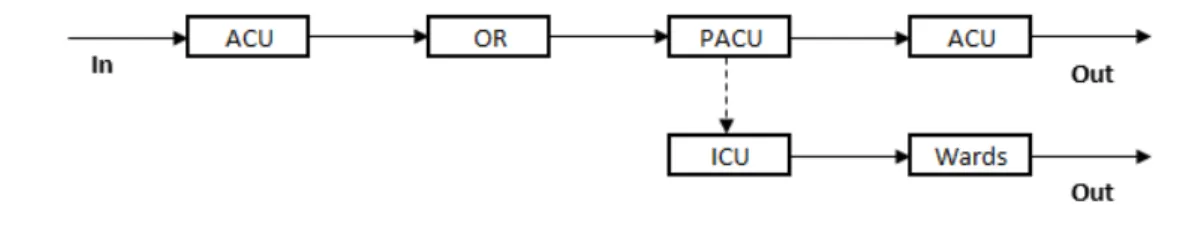
As shown in Figure 2.4 (in schematic form), inpatient surgeries scheduled to the first OR time block usually require the patient to enter in the hospital, at least on the eve of the surgery’s day, directly to the wards to be prepared to the surgical intervention. The inpatient surgeries scheduled to the other OR time blocks in the first shift usually require the patient to enter in
15
Figure 2.4: Inpatient flow
the hospital at least at 7:30am of the surgery’s day, and the inpatient surgeries scheduled to the second shift usually require the patient to enter the hospital at least at 12am of the surgery’s day. All the inpatient surgeries that require bowel preparation imply that the patient enters in the hospital at least on the eve of the surgery’s day. Only emergency surgical procedures have the patient at the wards at an unexpected time. From the wards, the patient proceeds to the OR, he is moved from the ward type bed to the OR type bed, and prepared with the help of the anesthetist in a small room next to the main room – each room at the OR has a “support room” at its entrance. The patient then crosses to the main room and is exposed to the agreed surgical procedures. When the surgery ends, the patient is usually moved to the post-anesthesia care unit (PACU) to recover from the anesthesia. In special cases, when the health of the patient is considered fragile, he goes to the intensive care unit (ICU). When this is the case, the time spent in this unit is known to be longer than the time spent in the PACU. Even though unusual, it can happen that a patient, after being sent to the PACU, does not recover from the anesthesia as expected and has to be transferred to the ICU. In all the cases, when the patient recovers from the anesthesia, he is sent to the wards to be monitored until he is “fully” recovered from the surgery and thus is able to leave the hospital.
In Figure 2.5 is shown the outpatient flow. Usually the patient enters the hospital a couple of hours before surgery and is sent to the ambulatory care unit (ACU), where the patient is prepared for the surgery: he it asked about the compliance with the preoperative recommendations, the unit’s staff verify his exams and the validity of the anesthetic consultation (since it expires every six months). The patient is also asked to change to scrubs – operating room clothes. As it happens in the inpatient flow, the outpatient is moved to the OR, where he is submitted to anesthesia. After leaving the OR, he is moved to the PACU. When something goes as unexpected, the patient is sent to the ICU, but in the great majority of the cases the patient is sent back to the ACU, after recovering from the anesthesia and become awake. The patient that enters in the ICU only leaves to the wards becoming an inpatient. In both cases, when the patient is “fully” recovered from the surgery, he has medical release and is allowed to go with a companion to his residence. As said before, an outpatient goes through the multiple stages in less than a day.
16
Figure 2.5: Outpatient flow
This hospital adopted weekly surgical planning, that is discussed and finalized on a meet-ing with the head doctor of the surgical suite and the head nurse of the surgical schedulmeet-ing department, each Friday at 4pm, for the following week. At this stage, the staff of the surgical scheduling department has confirmed, in the IT platform, the validity of the anesthesia consulta-tion and the preoperative recommendaconsulta-tions of all the patients with surgery in the following week. The staff also contact by phone every scheduled patient and confirm with them the realization of the anesthetic consultation in the previous six months, the preoperative recommendations, the realization of the necessary exams, and ask the patients to bring the exams in the day of the surgery. If the patient does not have a valid anesthesia consultation, a consultation is scheduled according to the availability of the patient and the anesthesiologist, and the surgery’s date. From the anesthesia consultation, the patient is sent to the several clinical and exam units in order to perform an accurate preoperative evaluation.
The planning can suffer some changes during the course of the week until late afternoon of the surgery’s previous day. Emergency surgeries may arise during the course of the day and must take place as soon as there is an available room. This can lead to a delay in the planned surgeries. For this reason, it is important to consider some slacks in the planning. By placing the slacks in an appropriate pattern, it is possible to reduce the impact of the emergency patients in the planned surgeries. Thus, emergency patients are operated as soon as needed, and elective patients are operated when expected, leading to a good service level. The surgical schedule is real-time displayed at the surgeon’s sitting room, which is inside the surgical suite. In alternative, OR’s staff - surgeons, nurses or administrative assistants - can access online the entire plan in their personal area on the IT platform.
The construction of the weekly surgical plan is a manual procedure that relies on the MSS and requires the contribution of several human resources. This decision level, like the tactical level, requires too much staff time and it is suspected that its outcome is far from being an efficient use of the surgical suite. Nevertheless, the scope of this work is only focused in the tactical level. As a result, this work aims to create a methodology and a model to generate an appropriate MSS to the hospital’s surgical workload. Note that it is not guaranteed that the OR time available is sufficient to assign all the surgeons or surgical specialties. Though,
17
based on the data collected from the hospital’s historical records, it is possible to show that such requirement is not sufficient to create an unfeasible problem, since the real OR time allocation rate never exceeds 69%.
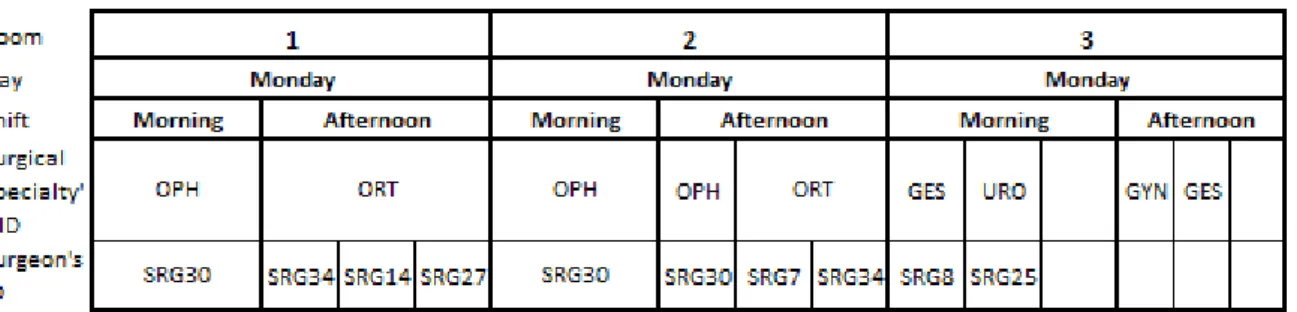
The MSS problem allocates surgeons or surgical specialties for a specific OR time block, a day and a room, for a weekly planning horizon. In this case study, the OR time block is a portion of a shift. The problem must also take into account structural constraints such as non-overlapping of different surgeons or surgical specialties on the same OR time block, day and room, and non-overlapping of the same surgeon in different rooms on the same OR time block and day (or more generally, at the same shift and day). Figure 2.6 shows examples of both types of overlap. At Monday’s morning in room 1 and 2 occurs overlapping of the same surgeon in different rooms on the same shift and day, and at Monday’s afternoon in room 3 occurs overlapping of different surgical specialties on the shift, day and room. At Monday’s afternoon in room 1 and 2, and at Monday’s morning in room 3 there is no overlap of different surgeons on the same OR time block, day and room, since the surgeons are sharing the shift in OR time blocks. This topic will be addressed in the next chapter. The model determines which surgeons have sufficient workflow to be individually allocated to an OR time block. Those surgeons with less workflow must be allocated to an OR time block in a group of surgeons of the same surgical specialty. In this latter case, surgeons do not have an individual OR time block and share OR time with other surgeons from the same surgical specialty. The induction and waking up time is included in the surgery duration, since it is also performed in the OR. The cleaning and disinfecting protocols (fifteen minutes on average) are incorporated in the surgery duration in order to better estimate the weekly time required for each surgeon in terms of OR occupation. Surgery durations are not assumed deterministic, and this is the reason why the model must receive as input a stochastic variable representing the duration of a surgery. The MSS problem also considers daily and weekly operating time limits for each surgeon. The problem has to reflect some hospital’s rules, as for example, on each shift, day and room, we can assign up to three surgeons or one surgical specialty. Time is discretized in periods of thirty minutes, generating sixteen time periods in the first shift and fourteen time periods in the second shift. The choice of the time period duration was not difficult, since the increasing of the time periods accuracy would produce a greater complexity in the model and it is not known that it would generate a better practical result at this decision level.
Furthermore, the aim of this work induces four main optimization criteria to the MSS problem:
1. to minimize the workload variability at the care units, in which there are major fluctua-tions, in order to level the workload as much as possible,
18
Figure 2.6: Example of a MSS, for three rooms, which are open on Monday, with overlapping of surgeons and surgical specialties
2. to minimize the number of assigned rooms per surgical specialty (i.e. to concentrate surgeons that belong to the same surgical specialty as much as possible in the same room), 3. to minimize the deviation of the assignment of each surgical specialty to the difference between the maximum number of available and not individually assigned surgeons that belong to the surgical specialty and the number of the available and not individually assigned surgeons that belong to the specific surgical specialty on the OR time of block under study (i.e. to allocate shifts to surgical specialties when the highest number of available and not individually assigned surgeons that belong to the surgical specialty occur), and
4. to minimize the positive and negative deviations of the weekly duration assigned to surgeons or surgical specialty to the median value of the weekly time used by the surgeon or the surgical specialty in the last trimester (i.e. to renew the MSS based on recent historical data).
These objectives clearly have a conflicting nature. In fact, for instance, when the objective is to minimize the first criterion, it is preferable to assign surgeons with different operating time in a specific shift and day, in order to level the number of patients sent to the recovery units during the week (cycle time). But when the objective is to minimize the second criterion, it is preferable to schedule surgeons from the same specialty in a specific day and room, in order to reduce the number of rooms per surgical specialty. Since the operating time of a surgeon is highly related to his surgical specialty, these objectives in particular are conflictuous.
The mathematical model designed for this MSS problem is detailed in the next chapter, as well as the underlying methodology.
Chapter 3
Model formulation
This chapter introduces the modelling approach and methodology. Some problem requirements that will be formulated as structural constraints, in order to be incorporated in the Mixed-Integer Linear Programming (MILP) model, will be discussed first. Then, the four optimization criteria will be enunciated one at a time, and the restrictions for its mathematical formulation will be established in order to present the criterion’s expression. The chapter ends with the setting of the variables’ domain. Appendix A presents the notation used and the full model formulation.
3.1
Structural constraints
In this case study, the MSS problem must allocate surgeons or surgical specialties for a specific OR time block, a day and a room, for a weekly planning horizon. Each OR time block is a portion of a specific shift. The model must determine which surgeons have sufficient workflow to be individually allocated to an OR time block, or, in the opposite case, must be allocated to an OR time block in a group of surgeons of the same surgical specialty. The model must incorporate the hospital’s rule stating that, on each shift, day and room, up to three surgeons or one surgical specialty can be assigned. Therefore, in Figure 3.1, it can be found an example of a cyclic MSS for a single room, which is open from Monday to Wednesday (in both shifts). In this figure, it is possible to find an example of each type of conceivable allocation. Each shift, day and room can be assigned to one surgeon, and thus the surgeon is individually assigned to an OR time block, a day and a room, with a duration equal to the shift duration (as shown at Monday’s morning). Each shift, day and room, can also be assigned to two or three surgeons, and thus each of the surgeons are individually assigned to an OR time block, a day and a room, and the sum of the durations is equal to the shift duration. Thus, the two or three surgeons have to share
20
Figure 3.1: Example of a cyclic MSS for a room, which is open from Monday to Wednesday (not necessarily equitably) the shift, day and room. The duration of each of the OR time blocks reflects the portion in which the assigned surgeons should share the shift. The surgeons can be, or not, from the same surgical specialty. An example of surgeons, from the same surgical specialty, individually assigned and sharing a shift in OR time blocks is shown at Monday’s afternoon. An example of surgeons, from different surgical specialties, individually assigned and sharing a shift in OR time blocks is shown at Tuesday’s afternoon and at Wednesday’s morning. Note that the order of the surgeons’ ID does not necessarily reflect the order in which they must operate. Surgeons can be individually assigned to more than one OR time block, either sharing or not the shift (as shown at Monday’s and Wednesday morning). Alternatively, each shift, day and room can be allocated to a surgical specialty, and thus the surgeons with less workflow are allocated to the OR time block in a group of surgeons of the same surgical specialty. In this case, the duration assigned to the surgical specialty equals the shift capacity (as shown at Tuesday’s morning). A shift, day and room can also not be assigned, and then is called a slack. Blank OR time blocks can be used for any surgeon or surgical specialty if needed (namely, each blank OR time block is assigned on a first-come, first-serve basis) as shown at Wednesday’s afternoon. In particular, it can be used for emergency surgeries that may arrive.
Concerning the surgeons’ individual allocation, the problem must take into account that each surgeon cannot be assigned to two different rooms at same day and OR time block (or, more generally, shift). The mathematical formulation of this requirement is stated in constraint set (3.1). Constraint set (3.1) also prevents a surgeon to be scheduled for a day and shift when he is not available.
X
r∈R
21
where the decision variable
xsrdk=
(
1, if surgeon s obtains an OR time block in room r on day d and shift k 0, otherwise
and parameter
asdk :
(
1, if surgeon s is available on day d and shift k 0, otherwise
The indices s, r, d, and k concern surgeons, rooms, days, and shifts, respectively, whereas S, R, A, and K are the sets of surgeons, rooms, active days during a week, and shifts, respectively.
Constraint set (3.2) prevents the assignment of more than three surgeons in the same room, day and shift.
X
s∈S
xsrdk ≤ 3 · zrdk, ∀r ∈ R, d ∈ A, k ∈ K, (3.2)
where the auxiliary variable
zrdk=
(
1, if an OR time block in room r on day d and shift k is assigned to at least one surgeon 0, otherwise
Constraint set (3.3) sets the sum of the durations of the OR time blocks assigned to surgeons in each shift, day and room, equal to the shift capacity. When no surgeon is assigned, the sum of the durations of the allocated OR time blocks must be equal to zero.
X
s∈S
durbsrdk = capacityrdk· zrdk, ∀r ∈ R, d ∈ A, k ∈ K, (3.3)
where the decision variable durbsrdk equals the duration (in minutes) of the OR time block
allocated to surgeon s in room r on day d and shift k, and parameter capacityrdk provide the
total capacity (in minutes) of room r on day d and shift k, which is defined as a multiple of thirty-minute time blocks.
Constraint set (3.4) establishes that, each shift, day and room, can be assigned either to at least one surgeon or one surgical specialty, or not be assigned.
zrdk+
X
p∈P
22
where the decision variable
yprdk=
(
1, if surgical specialty p is assigned to room r on day d and shift k 0, otherwise
The index p concerns surgical specialties, whereas P is the set of surgical specialties.
Constraint set (3.5) assures that each surgeon only has an allocated OR time block with positive duration when he is assigned for the correspondent shift, room and day.
durbsrdk ≤ capacityrdk· xsrdk, ∀s ∈ S, r ∈ R, d ∈ A, k ∈ K (3.5)
Time is discretized in periods of thirty minutes. Constraint set (3.6) states that the duration of each allocated OR time block is a multiple of thirty-minute time blocks.
durbsrdk = 30 · usrdk, ∀s ∈ S, r ∈ R, d ∈ A, k ∈ K, (3.6)
where the auxiliary variable usrdk equals the (integer) number of thirty-minute time blocks of
the OR time block allocated to surgeon s in room r on day d and shift k.
The model considers daily and weekly operating time limits for each surgeon individually assigned, and so the next two sets of constraints define the lower and upper bounds for the daily and weekly working hours (for each surgeon individually assigned), which are also related to surgeon’s experience or background. Constraint set (3.7) limits the sum of the duration of the daily allocated OR time blocks, for each surgeon individually assigned, between the minimum and maximum duration (in minutes) that the surgeon can operate each day.
mindays · zdaysd ≤X
r∈R
X
k∈K
durbsrdk ≤ maxdays · z day
sd , ∀s ∈ S, d ∈ A, (3.7)
where the auxiliary variable
zsdday= (
1, if surgeon s obtains at least one OR time block on day d 0, otherwise
and parameters mindays and maxdays provide the minimum and maximum duration (as a multiple
of a thirty-minute time blocks) that can be daily assigned to surgeon s, respectively.
Likewise, constraint set (3.8) restrains the sum of the duration of the weekly allocated OR time blocks, for each surgeon individually assigned, between the minimum and maximum
23
duration (in minutes) that the surgeon can operate each week. minweeks · zsweek ≤X
r∈R
X
d∈A
X
k∈K
durbsrdk ≤ maxweeks · zsweek, ∀s ∈ S, (3.8)
where the auxiliary variable
zsweek= (
1, if surgeon s obtains at least one OR time block during the week 0, otherwise
and parameters minweeks and maxweeks provide the minimum and maximum duration (as a multiple of a thirty-minute time blocks) that can be weekly assigned to surgeon s, respectively. The decision variable that describe if a surgeon obtains an OR time block at a specific room, day and shift, xsrdk, gives the information needed to define the auxiliary variables zsdday and
zweeks . Constraint set (3.9) ensures that the variable zsdday takes the right value. X
r∈R
X
k∈K
xsrdk≤ |K| · zsdday, ∀s ∈ S, d ∈ A, (3.9)
where |K| is the number of elements in set K (namely, the number of shifts considered). Likewise, constraint set (3.10) ensures that the variable zweeks is well-defined.
X r∈R X d∈A X k∈K xsrdk ≤ |A| · |K| · zweeks , ∀s ∈ S, (3.10)
where |A| is the number of elements in set A (namely, the number of active days considered during the week).
In past MSSs1 of the hospital under study, which were created by the head doctor of the surgical theatre, the assignment rate was at least 80%. The assignment of surgical specialties never exceeds 3% of the total OR time. In the literature, it was found evidence that most industry sources believe that an OR utilization between 75% and 80% is acceptable. Johnson and Johnson desires to have an OR utilization of 75% for individually assigned surgeons, and an OR utilization of 80% in total, including surgical specialties allocation (Hosseini & Taaffe 2015). An OR utilization over 80% requires extremely good supporting systems (particularly with respect to bed occupancy, pre-admissions testing and the PACU access) (Company 2001). Thus, it was decided to consider at least an OR utilization of 75% for surgeons individually
1
MSSs used, in the operating theatre under study, in a trimester of 2013, in the last trimester of 2014, and in the first trimester of 2015.
24 assigned. X s∈S X r∈R X d∈A X k∈K durbsrdk ≥ 0.75 · X r∈R X d∈A X k∈K capacityrdk (3.11)
Constraint (3.12) demands an OR utilization of at least 80% for surgeons individually assigned and surgical specialties’ allocation.
X r∈R X d∈A X k∈K (X s∈S durbsrdk+ capacityrdk· X p∈P yprdk) ≥ 0.8 · X r∈R X d∈A X k∈K capacityrdk (3.12)
3.2
Optimization criteria
First optimization criterion
The first optimization criterion aims to minimize the workload variability at the care units in which there are major fluctuations, in order to level the workload as much as possible. This is done by minimizing the weighted peaks in the expected number of surgical patients sent to those hospitalization units, and in the associated absolute deviation.
To state the mathematical formulation of the first criterion, the number of patients that an individual surgeon or a group of surgeons from the same surgical specialty can operate on each day must be defined. Since the surgeries’ duration is not assumed deterministic, the number of operated patients on each day varies with the duration of the surgeries performed by the assigned surgeon or by the group of surgeons from the allocated surgical specialty.
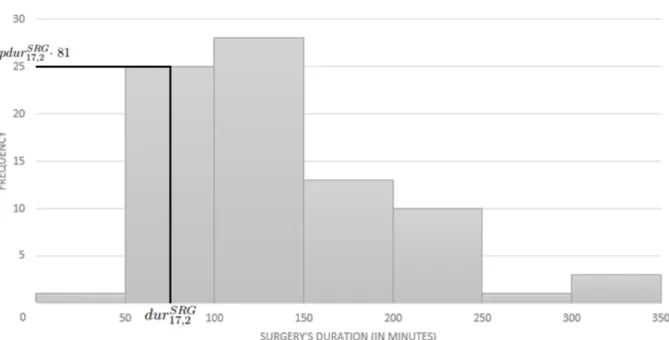
The stochastic variables (considered as inputs) DU RSRGs and DU RSP Cp provide, respectively, the duration of a surgery (in minutes) performed by surgeon s or by a surgeon from the surgical specialty p, including the induction and waking time, and the cleaning procedures. The empirical distribution of the stochastic variables was fitted from the collected data. The variable values were aggregated into classes using Sturges’ rule, and then the corresponding values were incorporated in the model as inputs. By aggregating the variable values using Sturges’ rule, the types of procedure that the surgeon performs are being grouped by duration, and at best, all the occurrences of a procedure are being isolated in each class. Figure 3.2 shows an example of an empirical distribution of the stochastic variable DU RSRGs , after their values were aggregated into classes by Sturges’ rule, and how parameters durSRGsq and pdursqSRG were extracted in order to be incorporated in the model. Parameter durSRG
sq represents the
midpoint of class q, with q ∈ QSRGs , of the stochastic variable DU RSRGs , while parameter pdursqSRG represents the corresponding probability (pdurSRGsq = P (DU RsSRG = dursqSRG)). So, q is the index for the classes, and QSRGs are the sets of classes of the stochastic variables
25
Figure 3.2: Histogram of the duration of a surgery performed by surgeon 17 (81 surgeries performed), after aggregating the values using Sturges’ rule, and its relation with the parameters dursqSRG and pdursqSRG.
DU RsSRG. The total number of surgeries performed by the surgeon analyzed in Figure 3.2 is 81, and the number of surgeries with duration between 50 and 100 minutes is 25. The relation is stated as pdur17,2SRG = P (DU RSRG17 = 75) ≈ 25 / 81, since pdur17,2SRG is approximated by the relative frequency of a surgery’s duration, performed by surgeon 17, belonging to class 2 of the stochastic variable DU RSRG17 . It was used the same reasoning for parameters durSP Cpq and pdurSP Cpq . Parameter durpqSP C represents the midpoint of class q, with q ∈ QSP Cp , of the stochastic variable DU RpSP C, while parameter pdurSP Cpq represents the corresponding probability (pdurSP Cpq = P (DU RSP Cp = durSP Cpq )). So, QSP Cp are the sets of classes of the stochastic variables DU RpSP C.
At first, a fitting attempt was made in order to find a named probability distribution (e.g. exponential distribution) that suits the collected historical data (concerning the duration of the surgeries), but unfortunately it was impossible to find one. In the best fitting attempt not even 50% of the surgeons had their surgery’s duration accurately estimated, and so it was decided to use the empirical distribution with the variable values aggregated into classes. We suspect that the attempt to find a good fitting based on a named probability distribution failed, because the duration of the surgeries varies significantly with the surgeon’s surgical specialty, type of surgeries that the surgeon performs, and surgical procedures or techniques in which he feels comfortable. Unknown factors such us as surgeon’s inexperience may also contribute to the