A Work Project presented as part of the requirements for the Award of a master’s degree in management from the NOVA – School of Business and Economics.
A PROBLEM OF EFFECTIVENESS: SELECTING THE IDEAL
PRODUCTION MODEL
AFONSO FERREIRA PALMA GUARDA DE SOUSA & 5340
A Project carried out on the Master’s in Management Program, under the supervision of: Paulo Faroleiro
Abstract:
In the face of new market and consumer challenges, sustaining a leadership position in the animal feed industry has never been so challenging. As such, in an attempt to remain competitive, the following paper provides an exhaustive examination of how the Raporal’s business model could be restructured to enhance operative effectiveness. Grounded on the idea that an accurate selection of production models can convey a distinctive value proposition to customers, in the following pages, a portrait of different manufacturing options is created, and attractiveness further tested to assess which option best suits Raporal current needs. Aligned with managers’ judgments and the company’s intrinsic needs, a final recommendation for improvement will be made.
Keywords:
Optimization; Quality; Animal Nutrition; Production strategies
This work used infrastructure and resources funded by Fundação para a Ciência e a Tecnologia (UID/ECO/00124/2013, UID/ECO/00124/2019 and Social Sciences DataLab, Project 22209), POR Lisboa (LISBOA-01-0145-FEDER-007722 and Social Sciences DataLab, Project 22209) and POR Norte (Social Sciences DataLab, Project 22209)
INTRODUCTION
Lately, feed production industry has been witnessing a widespread growth in the search for animal protein, a direct consequence of the relentless increase in population that is demanding more and more food. As a matter of fact, according to the Food and Agriculture Organization (FAO), animal protein is expected to grow massively until 2050. “There will be more than 9 billion people in the world… and the need for food will be 60% higher than today” (IFIF, 2017). Presently, compounded feed production surpasses 1 billion tons per year (IFIF, s.d.) and some difficulties to satisfy all the demand start to emerge, with companies struggling to redesign their operations to encompass such growth. Thereby, developing the feed production industry and all the agriculture chain is vital to ensure future demand is met in a sustainable, efficient and nutritious way.
Moreover, latest events show that the feed production industry is volatile and heavily influenced by external forces. For instance, the economic war being fought between Washington and Beijing is significantly impacting the global agriculture market. President Trump continues to raise tariffs on Chinese goods and, as a retaliation, the largest soybean buyer - China - has put the purchase of American supplies on hold (Koeleman, 2019). Such conflicts, coupled with the appearance of the African Swine Fever in some region of China, will generate an excessive offer, affecting the prices of raw materials - soybean and corn - on the Mercolleida stock exchange (Pound, Thoenes, & Coslet, 2019).
All in all, given the constantly increasing population, the variability on the price of raw materials and the desire to source high quality compounded feed at lower prices, firms must optimize operations to successfully embrace the daily challenges proposed by the industry. As one might conclude, optimization is intrinsically linked with improvements in production strategy and, when accurately done, it boosts efficiency and production capacity of
organizations. Yet, numerous companies have found it challenging to select the perfect manufacturing process as it entails mathematical models, data analytics and a full understanding of business requirements. Taking all of this into consideration, the purpose of the subsequent dissertation is to provide the necessary support to one specific company,
Raporal S.A, in selecting a manufacturing process that resembles its needs.
Company Overview
Raporal S.A was founded in 1971 by 18 pig farmers who join forces to revolutionize the
animal feed production sector. Their goal was to make use of the most advanced technology to produce the best feed for their animals. By meticulously selecting each ingredient, ensuring the highest quality and safety at the production level, and diversifying their products to keep up with the improvements in animal nutrition and genetics, executives not only achieved their goal but made Raporal a benchmark of excellence in the Portuguese market. Time has passed and its activity has grown exponentially in the agri-food market. Nowadays, Raporal operates in 4 intrinsically related markets (Livestock, Feed, Meat and Forest) that, together, allow the company to vertical integrate and develop its unique business model: produces its animals, feeds them with its foodstuffs and slaughters them in its slaughtering plant. The advantages were countless. Production costs reduced remarkably, efficiency standards improved hugely, full traceability of products became possible and, most importantly, became less dependent on suppliers.
Thanks to its unique approach to business, Raporal remains a national reference in agri-food industry. As a matter of fact, “if we consider the global business, that is, the turnover expressed in the income statement, plus the internal movements between the various activities” (Raporal, 2018) it reached 128 million euros in the fiscal year of 2018.
Nature of the Problem
“Daily we receive numerous orders in which customers demand a specific nutrient tuning, forcing us to produce in small batches. Given the low storage capacity and the existence of a single production
line, waiting times inevitably increase.”
(Sousa, 2019) Raporal has been operating under a pull production system: characterized as a
manufacturing process that only starts after orders being placed. But, given today’s industry specifications, such methodology is preventing the company from thriving. More and more, the intricacy of farmers’ individual needs and the prevailing capacity constraints oblige the firm to produce in small customized batches which increases set-up and response time. Intuitively, for a Make to order approach to be viable, it should be coupled with strong improvements in the production plant, more specifically, enlargement of the storage facilities and assembly of an additional production line. However, financial constraints do not conceive massive capital expenditures. Consequently, the most prominent solution, that would allow to better serve clients and achieve higher standards of effectiveness, is to reformulate company’s production model: But how can it be done? Which mechanism is most suitable for it?
LITERATURE REVIEW
Production strategies
First and foremost, companies must realize how hard it is to find the perfect structure for their business. According to a study conducted by the Harvard Business School, it is often more effective to choose an organizational structure that meets most business requirements and then design a custom strategic system that aligns such structure with the vision (Kaplan & P. Norton, 2006). As one might conclude, market features constitute an important criterion to take into consideration when picking which production strategy to implement (LaMarco, 2018).
Fundamentally, if customization is not a crucial part of the model, Make to Stock approaches become widely preferred. Conversely, high level customization companies tend to put in practice a Make to Order or even a combination of both, the so-called Hybrid approach. With regard to the latter methodology, a subcategory should also be emphasised: Kanban. By “allowing team members to see the state of every piece of work at any time” (Radigan, s.d.), it not only gained much adherence among agile software teams but proved to be very successful in optimizing company’s operations.
Having identified the 4 candidates, in the following pages, the author will thoroughly examine the purpose of the identified methods and try to understand which production strategies would better serve the interests of the company.
Make to Stock
Worthwhile strategy when company’s customization level is low. It is all about predicting how much demand could be generated, and then supply enough stock to meet those orders - using data tools to accurately measure/estimate the demand level (Segal, 2019). In other words, it is a traditional production strategy commonly used by corporations to match the inventory with anticipated consumer demand. Once MTS allows products to be ready before customer demand, companies will be able to properly organize resources and schedule production in a way that maximizes efficiency and ensures a smooth workflow of activities. Additionally, as soon as an order is placed, products can be immediately shipped to customers, greatly reducing lead times (Make to Order Vs Make to Stock, s.d.).
Yet, such an approach has its downfalls. If information is wrongly collected, huge operational and financial problems might arise within the company (Segal, 2019). As a matter of fact, if excessive demand is forecasted, spare inventory will be created and holding cost will escalate, leading to less liquidity or lost revenues as some goods become obsolete very quickly.
Make to Order
Business strategy intrinsically linked with a pull production process (MTO, s.d.). The making of an item only starts after having received an order confirmation – the customer’s demand drives the process. Fundamentally, such technique is associated with long lead times and excessive costs. Being setup times and opportunity costs unavoidable, to accommodate different customer needs, companies must spend additional time and money preparing and adapting machines to each production round, loosing “potential sales and slowing cash flow” (Bender, s.d.). Yet, depending on the business characteristics, it can be very successful. Enables higher levels of customization, reduced inventory, accurate customer satisfaction and prevention of inventory obsolescence.
Hybrid approach
Often, when supplying products with different demand patterns and customization levels, adopting a pure Make to Stock or Make to Order approach might not be ideal. On one hand, MTO will certainly affect companies’ response time for standard and regular products, while, on the other hand, a pure MTS production strategy may result in overstocking. To overcome such imperfections, companies have combined insights from each policy and crafted a hybrid and dynamic approach (Rafiei, Rabbani, & Kokabi, 2014) favoring their business. Although there is no specific consensus on the definition of “hybrid processes”, such technologies have been widely used for academic and business purposes, as it augments efficiency and productivity. (Zhu, Dhokia, Nassehi, & Newman, 2013). Fundamentally, a manufacturing resource planning, MRP-II, should be initially applied. As it integrates all the important departments of the business - planning, purchasing, inventory, sales, marketing, finance, and Human Resources - scheduling raw materials deliveries and production quantities becomes possible. Basically, “MRP II is a computer-based system that can create detailed production schedules using real-time data to coordinate the arrival of component materials with machine and labor availability” (Hayes, 2019).
Along these lines, it is vital to comprehend which orders have comparable requirements so that the capacity utilization of the machines can be maximized by producing them together. One software that allows achieving high standards of effectiveness is Biarri (Transforming your business through better decisions, s.d.). Built on the idea that commercial mathematics simplifies decision making, it predicts when a client might want to place an order. A record of previous interactions with clients is created and operations are coordinated to certify that similar orders are produced under the same set. Per se, companies can scale up productivity, reduce set-up costs and waiting times.
Kanban Control Method
When implemented, the Kanban Control Method mitigates the negative effects of the fruitless production strategies that managers persist to adopt. By definition, Kanban is a non-disruptive evolutionary change management system (What is Kanban, 2019) in which the outcome and success of your business depend on the implementation of small and minor steps, rather than big and complex ones. By continuously monitoring the process, a widespread control of the value chain is achieved, and the search for possible bottlenecks that could compromise, and slow production becomes simpler. In essence, corporations gain a just-in-time production control system powerful enough to boost throughput, diminish delivery just-in-times, risk, and cost of delay.
Additionally, when it comes to reform the company’s management culture, Kanban provides a set of initiatives that should be implemented to easily visualize work, continuously deliver products and get customer feedback more often and with greater speed. At an early stage of restructuration, change is not recommended (What is Kanban, 2019). One should initially stick to what is being currently done - roles and responsibilities - as some of them might be performing well. Subsequently, an effort should be made to avoid multitasking and a spirit of “Start- Finish” must be instilled (What is Kanban, 2019). Recurrently, teams and
knowledge workers deal with multiple issues at a time, lacking the ability to perform all tasks successfully. To increase the effectiveness of operations, limits to work in progress (WIP) should be imposed. Likewise, to ensure everyone shares the same information, Kaizen should be part of teams’ daily routine. It consists of periodical “stand up meetings to decide the direction of the business in strategic terms, where all team members are constantly encouraged to work together and give their opinion on how to improve current processes” (Siderova, 2018). All in all, if these minor steps are followed, companies will incrementally change the underlying processes without major changes to the business structure.
Multi-Criteria Decision Analysis
When selecting one of the production methods identified above, a certain level of complexity can be expected due to the need of incorporating risk preferences and balance different criteria. Under such situations, conclusions are normally sustained on a Multi-Criteria Decision Analysis (MCDA). At its core, MCDA provides a unique ability to easily solve complex trade-offs between alternatives (Multi-criteria Decision Analysis, s.d.). By pinpointing the pros and cons of each, the tool makes it simpler for executives to decide which approach constitutes a meaningful solution to the company’s problem.
Nevertheless, as expected, the intricacy of the problem at hand largely depends on the array of solutions available. If they are explicitly known right from the beginning – multiple criteria evaluation problem - , the idyllic alternative can be found by “placing alternatives in a set of preference-ordered classes” (Triantaphyllou, 2000). Conversely, when such condition is not verified - multiple criteria design problem -, analysts are forced to rely on “mathematical programming models to reveal the implicitly defined solutions” (Karasakal & Köksalan, s.d.). Regardless of the availability of information, an effort must always be done to collect as much data as possible about decision maker’s preferences, as it will provide the necessary know-how to decode criteria and shrink decision making complexity.
Recently, decision-supporting tools have been widely used and, as new areas of applicability started to arise, new schools of thought were developed and others were improved (Velasquez & Hester, 2013). Consequently, when applying MCDA methods to real-world problems, it must be acknowledged that some methodologies are better suited than others. To ensure consistency and intuitiveness throughout this paper, the author found it appropriate to complement the analysis with a specific MCDA technique: M-MACBETH (Measuring Attractiveness through a Categorical-Based Evaluation Technique).
M-MACBETH: Method Overview
Macbeth is an approach to Multi-criteria Decision Analysis whose development was set in motion in the early 1990s by CA. Bana e Costa, J.-C Vansnick and J.-M de Corte. Partly similar to other MCDA methods, this model uses its intuitiveness to assist managers in decision-making processes that blend conflicting viewpoints. It is an extremely efficient and user-friendly decision supporting system (Costa, Corte, & Vansnick, MACBETH) that only requires qualitative findings to quantify the relative attractiveness of options. “It employs an initial, interactive, questioning procedure that compares two elements at a time, requesting only a qualitative preference judgment” (Costa, Corte, & Vansnick, Macbeth, s.d.). As soon as judgments start to be inputted into the software, consistency is automatically tested and a numerical scale, congruent with all the decision maker’s preferences, is created. Through a similar process, criteria will be balanced, weighted and hierarchically plotted in a value tree (Figure 4 Phases comprising the construction of the Macbeth model1. Such graphical representation is grounded on two different nodes (non-criteria” and “criteria nodes”) and, what distinguishes one from the other, is the ability to evaluate options attractiveness (Macbeth User Guide).
M-MACBETH: Evaluating Options and Analysing Results
To ease the process of comparing options and testing performance, the authors of the model have defined a seven semantic scoring system (“no”; “very weak”; “weak”; “moderate”; “strong”; “very strong” and “extreme” difference) that standardizes qualitative and quantitative judgements, making it easier to derive conclusions about attractiveness. In essence, to run the model, a two-step procedure must be followed. First of all, each option attractiveness has to be tested against each of the criteria formerly defined, always considering the judgements and preference of executives. This provides a preliminary understanding of how each option will outperform in overall terms: options are ranked hierarchically, and their intrinsic attractiveness is assessed using a value score table. Subsequently, it is time to ponder the references and define how “powerful” each criterion will be in making the final decision. Based on the attributed weight, “value scores” will be aggregated to calculate the overall score that reflects options intrinsic attractiveness.
Having derived options’ attractiveness, results must be displayed and analysed. Such interpretation can be illustrated using the thermometer window: it plots the score of all options in a vertical line, making it easier to identify the better-balanced alternative among all aspects being considered. To make such analysis even more credible and accurate, creating a two-dimensional cost-benefit graph might be appropriate as it contrasts an option overall score – benefit - with its respective cost. Ultimately, this methodology allows performing sensitivity and robustness analyses. Such functionalities “are liable to assist the emergence of convictions that enable to move forward the decision-making process” (Costa, Corte, & Vansnick, MACBETH). By testing errors and modifying criteria weight - sensitivity analysis -, decision makers are better able to gauge the propensity of making the wrong decision, and how impactful such decision might be (Mabin & Beattie). Similarly, as the underpinnings of our hypothesis might be inaccurate, incomplete or uncertain testing the robustness of the results is crucial to ensure our line of thought is correct.
PROBLEM: IS THE CURRENT PRODUCTION MODEL SUITABLE?
With a production capacity of 10.000 tons per month, Raporal Rações holds a prominent position in the Portuguese feed market. Nevertheless, as executives acknowledged, keeping up with the market growth has never been so challenging. The capacity utilization has reached the optimal rate (85%) and, boosting production, might compromise the sustainability of operations. Malfunction of equipment or unequal distribution of resources can arise and should be avoided.
Faced with a growth constraint in such a competitive market, the company's goal is to serve the customer in the best possible way while ensuring short lead times. Yet, the complexity of the business, associated with some manufacturing inefficiency, prevent the company from achieving the desired objective: “it produces 22 tons of feed per hour, which is insufficient to ensure outstanding customer satisfaction” (Mota, 2019). At the core of the problem the following constraints were pointed out:
⁃ The individuality of customer needs, each requiring a specific nutrient adjustment, makes it impossible to standardize production. As such, the company is required to operate in small batches, which inevitably creates long setup times as cleaning and sterilizing machines is required between production sets.
⁃ The company owns a single production line, meaning that only a production set can be manufactured at a time. If we ally that with the absence of a careful order planning - orders are frequently placed with short notice -, the timetable might be disturbed, deteriorating the quality of the service provided.
Taking all of this into consideration, the authors ambition throughout this paper is to enhance the quality of the service provided to the client, more specifically reduce the waiting times after placing an order. As a path to achieve such objective, the authors analysis will be grounded on the M-Macbeth, a Multicriteria Decision Analysis Model. Through its implementation the
author will be able to gauge which production method best suits the needs of the company and contribute to solve the previously mentioned constraints.
BUILDING M-MACBETH
The author believes the M-Macbeth, because it is intuitive and easy to use, will allow to get quicker and more accurate answers to the Raporal´s problem of effectiveness. As such, it will be applied to the above identified production models (MTS, MTO, Hybrid or Kanban) to understand which one best suit the current needs of the company. Once the options have been defined, a subsequent step is to build the value tree and describe the criteria used to assess options’ attractiveness.
RANKING WITHINA CRITERION1
Fundamentally, after deliberating on the company's concerns and priorities, the author derived 5 criteria that prove essential to outperforming the feed production sector. To rank the attractiveness of options within a criterion, three different comparison bases can be used: the options plus two references, qualitative or quantitative performance levels.
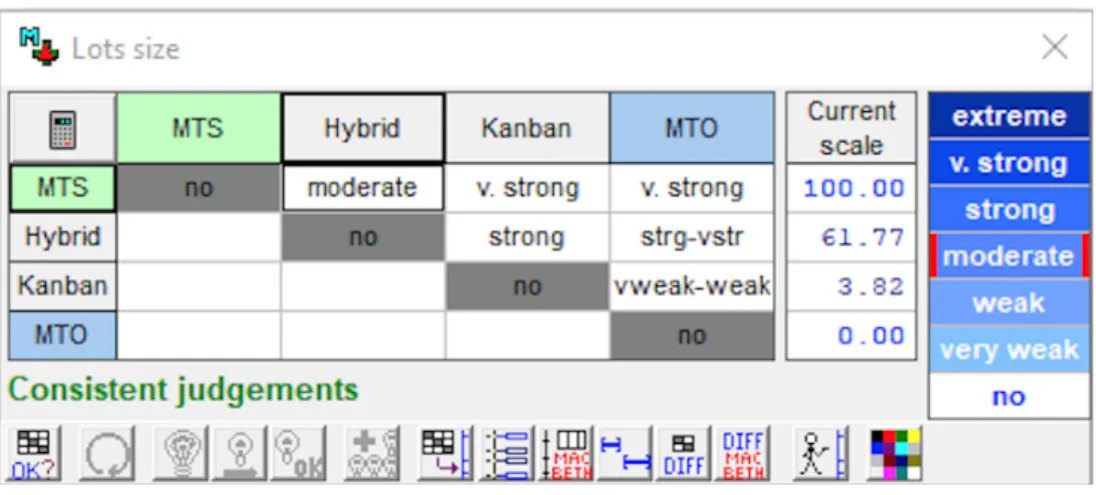
Lots size: (Figure 5: Lots Size matrix of Macbeth judgements) In consonance with what was
tested by ICCF2, feed homogeneity is possible and might be a reality soon. According to a study developed, “the active substance(s) contained in the feed ingredient can be homogeneously distributed under conditions of the proposed use in the intended matrices” (Homogenity testing of feed ingredients, 2019). Essentially, converging towards large batches/lots in the feed industry is not only feasible, but beneficial as it allows companies to cut setup costs, become more effective and consequently increase productivity. Sustained on theory, let’s compare options’ appeal based on their intrinsic advantages plus two references.
1 The options are hierarchically displayed as they appear in the table of result
- MTS: If we get to the point in which a Make to Stock strategy is implemented, Raporal
will no longer be dependent on the wills of customers to operate. Instead, will centre its operation in the manufacture of standard, predetermined types of feed. Thus, and with the help of forecasting systems, the company will be better able to schedule the workflow throughout the day/week, attribute specific production slots to each product category and, consequently, increase batch size.
⁃ Hybrid: Intuitively, combining identical orders under the same production run allows to enlarge lots size. Yet, since the customization cannot be neglected, the array of nutrient tuning from which clients might choose is immense. Therefore, massive satisfaction of needs is not conceivable. Lots’ breadth will most likely be smaller than the one achieved when using MTS.
⁃ Kanban: It is commonly agreed that Kanban’ roots derive from the core elements of lean and just in time productions strategies (MTO). Therefore, as expected, achieving large production lots is not feasible since the pace of production depends on the individual needs of customers.
⁃ MTO: In line with the above, large production lots do not label MTO. Once the methodology is intrinsically associated with high levels of customization and does not grant the possibility of predicting when an order might be placed (for the production process to start an order needs to be submitted), producing under large batches is completely out of option.
Pinpointing Mistakes: (Figure 6:Pinpointing Mistakes matrix of Macbeth judgements)
Becoming more efficient will only add advantage if coupled with improved quality of products. Customers demand specific “formulas” (nutrient tuning) to satisfy the needs of their animals. “Special formulation should be followed faithfully as any variation will alter nutrient content of the final feed and may compromise animal performance” (Good practices for the
feed industry, 2010). Only supplements and additives that have been formulated specifically for each animal species or category should be used, otherwise hazards might arise and compromise the sustainability of the business. To prevent it, having the aptitude to anticipate and detect unconformities in products is key. By “monitoring feed and feed ingredients, (…) with recurrent inspections, sampling, and analyses, unacceptable levels of undesirable substances could be detected” (Good practices for the feed industry, 2010; IFIF, 2017) and the quality of the product could be assured. Inherently, let’s test the attractiveness of options based on their intrinsic advantages.
- Kanban: It promotes an environment of quality improvement. Once it uses small lots
sizes throughout production, any quality issue that might arise can be easily pinpointed at the source. In line with that, this control system allows to continuously improve and swiftly respond to issues, meaning that products have fewer errors and require less rework. Moreover, through the implementation of Kaizen, it promotes knowledge sharing across different departments which allows to come up with improved solutions to everyday glitches.
- MTO: Limited size production lots constitutes, in most situations, a drawback. However,
when identifying errors, small batches are desirable. Intrinsically, low volume production sets allow detailed control of the units being manufactured, which in turn reduces the risk of defects and the number of units requiring rework.
- Hybrid: The model combines insights from all departments involved in the production
process (marketing, sales, operations, and finance) which, to a certain extent, ensures careful order planning and a smooth production process. Nevertheless, it operates lots of considerable dimensions which does not ease the process of pinpointing mistakes in raw materials tuning.
- MTS: Under Make to Stock, production tends to be smooth and free of choppy scenes.
But, on the other hand, as we operate large batches, detecting/predicting any defective unit can be tricky and, when possible, it can be too late to reverse the situation, and redoing all work might be required.
Production costs3: (Figure 7:Production costs matrix of Macbeth judgements) A key pillar
underlying IFIF is to work “with its members to meet the sustainability challenge: produce more, using less, at an affordable cost” (IFIF). However, such vision is not evident in the current feed cost structure. If an in-depth analysis is performed, it gets clear how defective units, excessive setup time, deviation on price of raw materials, and lack of productivity can impact production costs. As expected, the frequency with which these hitches appear makes it indispensable to reassess and improve feed efficiency (Connolly, 2015). Inherently, a great start towards cost leadership would be to select a cost-effective production model. Based on the theory and data collected, it was possible to compare the options’ attractiveness using a quantitative comparison method: (Figure 8: Variation on Production costs).
- Kanban: Overproduction, wasted time, defects and unnecessary motion are the main
driver of increased production costs. As so, in an attempt to minimize adverse effects, Kanban looks at waste’s reduction as a mean to boost productivity. Through work prioritization – fulfilling most valuable tasks first -, better schedule of production and strong investment in quality assessment, efficiency is strengthened, and costs reduced.
- Hybrid: As expected, producing similar orders concurrently ensures greater operational
efficiency as the opportunity cost of preparing the manufacturing processes for subsequent production runs is minimized. That said, the extra spare time allows to boost
3TC = “Formula” (raw materials + additives + medication) + cost/h machines + cost/h labor + general manufacturing costs (electricity
productivity, making the Hybrid approach an excellent option in terms of cost effectiveness.
- MTS: While it may be true that forecasting production enables to source raw materials at
a cheaper price, the case in which expectation do not match reality - demand decreases sharply or boosts exponentially - must also be contemplated. The nature of the market can cause you to end up with too much or too less stock which could kill the business. Even so, the model's predictive skills, coupled with sizable batches, allows for more efficient production planning and consequently lower setup costs.
- MTO: Once production is not previously scheduled, an effort must be done to keep
inventories as low as possible. As raw materials provisions vary with demand, sourcing large quantities at a time is not advisable. Instead, a routine task to acquire small volumes must be implemented. Intuitively, exposure to risk decreases, but the price per ton will most likely increase. Likewise, the negative effects of operating small lots - costs to prepare and adapt the machines to each specific production round - must not be disregarded. All things considered, MTO is the less cost-effective option.
Service provided: (Figure 9: Service provided matrix of Macbeth judgements) When
sourcing feed, farmers value the company’s aptitude to satisfy not only its intrinsic need but also to provide a quality service. Hence, ensuring satisfaction, reduced waiting times and flexibility is key to capture buyers. Yet, Raporal faces a tradeoff. Currently, it receives countless orders daily, each demanding a particular customization level - specific additives dosages and combination of nutrients - but, due to production constraints, it cannot accurately meet those needs. Ensuring simultaneous delivery of complex customer orders and reduced lead times is not possible. Eventually, based on a qualitative estimate of service provided we can infer whether changing the production model helps Raporal leverage on this matter4.
- Hybrid: It is the production model that better deals, simultaneously, with complex orders
and reduced waiting times. Being capable of predicting when customers might place an order, through a detailed analysis of past purchases, allows for similar orders to be produced at once. Additionally, because the Hybrid approach is essentially based on a pull production strategy, satisfying customers complex orders becomes viable. Everything considered, it scores positively in both parameters. Efficiency is maximized, favorable waiting times are guaranteed, and customers satisfaction is assured.
- Kanban: Improving the company’s leadership culture enhances customer satisfaction
and contributes towards higher standards of productivity and efficiency. With the Kanban control system, we can view all tasks that have been and still need to be performed. Thus, identifying/monitoring bottlenecks and scheduling production, considering equipment idle time, becomes possible. Moreover, shifting the focus from “starting” to “finishing”, setting boundaries to work in progress, and creating a “To Do’s” board enables companies to, step by step, start to outperform in terms of throughput and cycle time.
- MTS: When building ahead production, customers place an order and see it being
immediately fulfilled as feed will always be available in-stock. However, most of the time, given the order specifications, the in-stock feed does not match customers’ intrinsic needs. As it is poorly tailored - so that general needs could be satisfied -, complex and unique requests are unlikely to be met. In sum, such approach scores positively in terms of waiting time, but negatively in satisfaction of the intrinsic need.
- MTO: Under this approach, and considering a unique production line, obtaining short
lead times will be difficult, which can compromise customer satisfaction and cause the company to lose potential sales as individuals might end up purchasing from other brands. Even so, the MTO enables feed customization allowing to satisfy their specific need.
Precedency with which orders are placed: (Figure 10: Precedency of orders matrix of Macbeth judgements) Very often orders arrive at the factory with short notice, making it a
challenge to put in practice a careful order planning. On a daily basis, Raporal “makes huge
efforts, through overtime and production intensification, to ensure customers are pleased and maintain strong interactions with the company” (Sousa, 2019)5 but, such effort may not always be sufficient. “Animals have to eat, and it is our duty to guarantee that happens” (Sousa, 2019), but it may get to the point in which the company is not able to handle all orders received. Following this reasoning, a viable solution that guarantees greater elasticity of production is the reform of current methods. As such, to understand how different approaches can nurture company’s response skills, an intrinsic comparison between their advantages was conducted.
⁃ Hybrid: As mentioned earlier, the hybrid approach is grounded on analytical tools that help to establish consumption patterns for each customer. Thus, tackling “surprise orders” becomes simpler: it understands when customers might submit an order and starts planning the assemble accordingly, avoiding hectic situations.
⁃ MTS: The success of an approach focused on mass production of feed depends on the company’s intrinsic priorities. From an operational point, once upholding production schedule is urgent than meeting customers' unique needs5, implementing such a strategy might be beneficial: in-stock feed will be abundant enough to accommodate last minute orders and so, operational constraints will be avoided.
⁃ Kanban: By empowering “front line” employees – those that have all the knowledge of the daily operations – Kanban is better able of communicating the company’s vision, align efforts, and build commitment from people at all levels. In addition, and based on the
5Note: From companies’ point of view, in extreme situations, it is better to satisfy a general customer need than
historical record of customer purchases, it provides all the tools to create a predictive system that supports managers in decision-making (Siderova, 2018). Everything considered, Kanban improves responsiveness to changes in demand, specially by increasing production when consumption reaches an established floor.
⁃ MTO: In a pull production strategy, by definition, companies only operate when orders are placed. Therefore, intuitively, if too many orders with tight deadlines arrive simultaneously, the ability to accurately respond to them all will be affected.
M-MACBETH: OBTAINING AND ANALYZING RESULTS
To ensure consistency with managers’ vision and beliefs, it is indispensable to balance all criteria. Therefore, a subsequent step in building an M-Macbeth model is the process of weighting references, which development was grounded on Raporal’s CEO and COO judgments. Based on a set of face-to-face interviews it was possible to infer, as shown in the Overall Weighting Table (Figure 11: Weighting matrix of judgements), that providing quality service and ensuring reduced production costs is critical to maintain a leadership position throughout time. However, for a clearer understanding of the model’s results, it is recommended to combine the insights on criteria weights and options’ attractiveness in a concise table of results. Basically, as shown in the appendixes (Error! Reference source not
found.), the Hybrid production approach – a combination of Manufacturing Resources
Planning and data predicting tools - is the one that better suits Raporal’s current needs. Driven by a vast contribution towards client’s satisfaction - simultaneously achieves low waiting times and meets customers’ expectations - and unique ability to fight “surprise orders”, the Hybrid approach outperforms with an overall score of 92.23 points. Notwithstanding, Kanban also exhibits superior results. With an overall score of 65.74, it attests that carrying out an efficient leadership culture management can to a certain extent yield similar or prevailing results than a
“traditional” restructuration of production models. Based on intelligent task distribution, employee empowerment, and alignment of efforts toward a common goal, Kanban makes it evident that small changes in mindsets and procedures can be very impactful.
Figure 1: Overall table of scores
Ultimately, after having interpreted M-Macbeth’s recommendations, is imperative to conduct sensitivity and robustness analysis to understand how volatile these findings can be. As one might conclude, restructuring production strategies can be particularly demanding and risky. Decisions are often underpinned by ambiguous and incomplete information that may mask the outcome and adversely affect business. Along with this, the lack of evidence validation may compel managers to incur in unnecessary massive investments: redesign the plant’s layout, acquire new equipment/software and promote their human capital.
Sensitivity Analysis
To test results’ accuracy, the author will try to understand how fluctuations in criterion weights can impact and alter the model outcome. Particularly, it will be assessed how likely it is for options to swap their rank in overall attractiveness based on a new combination of weights. At first sight, by looking at the overall table of scores, we can infer major divergences between options results. The outperforming score of the Hybrid approach shows how unlikely it is for the model to deviate from the pre-determined result. Still, to eliminate risk, the writer will perform a sensitivity analysis on those criteria that are powerful enough to alter the end
results: Service provided, Production costs and Size of lots (weighting respectively 35.35; 27.76; 17.83 percentual points).
Starting with Size of Lots, it is commonly agreed that for rankings to change, the weight placed upon Lots Size must exceed 32%. MTS would receive a score similar to Kanban which, according to managers’ judgments, is unrealistic: lots’ breadth is not as valued (Error!
Reference source not found.). Similarly, modifying weights to the extent that different ranks
are obtained is merely utopic. For this to occur, the relevance of Production costs must double - from 27.7% to 60.3%. In this case, and depending on the interception point considered, Kanban may become the preferred option (Figure 2: Sensitivity analysis on Lots and Costs). Ultimately, changing the substance placed in Service Provided would not crash the results of the model, as there are no points of intersection between options. Eventually, it could only narrow the gap between scores. In short, the insights collected show that M-Macbeth results are irrefutable.
Figure 2: Sensitivity analysis on Lots and Costs
Robustness Analysis
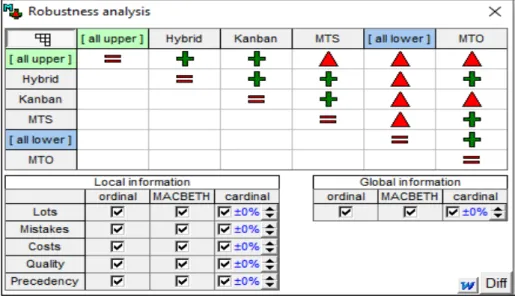
When exploring the extent to which conclusions can be drawn given varying amounts of information and differing degrees of inaccuracy, intuitiveness and practicality are key. Thus, M-Macbeth provides three types of information (“Ordinal”,” Macbeth”,” Cardinal”) and two
sections (“Local information” and “Global information”) that simulate access to different levels of information and ambiguity. Fundamentally, by "playing" with the levels of information, it can be illustrated that M-Macbeth's local information is sufficient to delineate the Hybrid approach as the best production method (Figure 3: Robustness Analysis: Testing
Ordinal - Local information and varying precision). Nevertheless, adding extra layers of
information (Figure 13: Robustness Analysis – Full information) shows that this option additively dominates all the others: “it is always found to be more attractive than the others” (Macbeth User Guide).
Besides, as criteria weights strongly depend on managers judgements, relying on dubious statements can and will reduce the consistency of the analysis. Thereby, it is important to test the inaccuracy margin associated with the weights. Inherently, consecutively changing the degree of imprecision associated with global information (until 15%) makes it clear that the Hybrid approach will not be detached as model’s best choice (Figure 3: Robustness
Analysis: Testing Ordinal - Local information and varying precision). Conversely, the model
will lack information to deduce if Kanban is globally more attractive than Make to Stock (MTS). All things considered; it is clear that the integrity of model’s final outcome is maintained even with varying degrees of information.
CONCLUSION
The leading role animal nutrition has been playing in the global food industry and the intensifying competition have forced manufacturers to compete in the global marketplace, both responsively and in a sustainable manner. Intuitively, being feed “the largest and most important component to ensuring safe, abundant and affordable animal proteins” (IFIF, s.d.), the burden posed to those operating in the business is enormous. Hence, to survive in such a cut-throat industry, where quality service is privileged, being responsive to the customers’ sophisticated needs and achieving cost-effectiveness is required.
Following such reasoning, this paper makes it clear that changing and redesigning production methods can strengthen Raporal’s responsiveness, increase client’s satisfaction and productivity levels. By conducting an in-depth analysis of different production models, and a set face-to-face interviews with the management team - to understand their preferences and gather relevant data about the company and market -, it was concluded that switching from a Pull to a Hybrid production strategy strongly contributes to increased performance (Figure 14:
Comparing Hybrid and MTO scores). Thanks to its predictive and customization skills, Raporal will be endowed with the tools needed to stand out from the competition and provide
faster, consistent and affordable service to customers.
In short, this comprehensive study, designed to achieve greater operational efficiency, is of no use if not coupled with a detailed procedure on how to incorporate this vision into
Raporal’s daily routine. Intuitively, to unlock corporate value through business restructuration,
a set of factors must be contemplated to prevent the organization from disrupting. On one hand, it must be understood that organizational change is complex. For instance, redesigning the plant’s layout to maximize efficiency, aligning intangible assets such as knowledge workers and data-driven models to customer’s demand, and improving supply chain is likely to be required. On the other, an effort must be done to avoid being caught up in expensive and
frustrating cycles of organizations change. Very often, restructuration’s create new problems as bad as the ones they solve so, to avoid additional costs and hectic situations, a well-thought-out framework needs to be implemented.
Limitations
This research allowed to draw enriching conclusions about improvements that could be made to Raporal’s production process. In essence, it was grasped that maintaining the current production level – 10.000 tons per month - and operating at a lower production cost - 215,2€/ton compared to the 218€ attained with MTO - immediately generates an added monthly return of 28.000€ (Figure 15: Cost-Benefit analysis). Yet, however enriching this number might be, it does not contemplate the full benefit of the opportunity. To be consistent in those calculations, an equally important component must be considered: the customer demand. Intuitively, boosting the quality of the service provided and reducing operating costs attracts more customers. Yet, such growth in demand is not easy to quantify. The volatility and complexity of the market hinder access to demand-related information, making it hard to accurately gauge the full benefit. In spite of that, with the data available, we can guarantee that the company would profit from this restructuration.
Direction for further research
Following the situation above described, a subsequent research step would be to develop a scheme to calculate/forecast customers’ patterns of consumption. Understanding how feed consumption varies throughout the year and from farmer to farmer, would allow to accurately estimate the total benefit of switching from a pull to a Hybrid production process.
REFERENCES
⁃ Bender, J. F. (n.d.). Advantages and Disadvantages of a Build to Order Strategy. Retrieved from Chron: https://smallbusiness.chron.com/advantages-disadvantages-build-order-strategy-18276.html
⁃ Connolly, A. (2015, December 2). The future of feed: An industry in transition. Retrieved from Feed Strategy: https://www.feedstrategy.com/feed-mill-management/the-future-of-feed-an-industry-in-transition/
⁃ Costa, C. A., Corte, J.-M. d., & Vansnick, J.-C. (n.d.). Retrieved from MACBETH: http://eprints.lse.ac.uk/22761/1/MACBETH_LSE_working_paper_0356_30set.pdf
⁃ Costa, C. A., Corte, J.-M. d., & Vansnick, J.-C. (n.d.). Retrieved from Macbeth: http://m-macbeth.com
⁃ Good practices for the feed industry. (2010). Retrieved from IFIF: https://ifif.org/wp-content/uploads/2018/06/IFIF-FAO-Feed-Manual-English.pdf
⁃ Hayes, A. (2019, April 29). Manufacturing Resource Planning. Retrieved from Investopedia: https://www.investopedia.com/terms/m/manufacturing-resource-planning.asp
⁃ Homogenity testing of feed ingredients. (2019, October). Retrieved from IFIF:
https://ifif.org/wp-content/uploads/2019/10/ICCF-Guidance-Homogeneity-Testing-Step4.pdf
⁃ IFIF. (2017). Annual Report. IFIF. Retrieved from IFIF: http://annualreport.ifif.org/#start ⁃ IFIF. (n.d.). Sustainability. Retrieved from IFIF: https://ifif.org/our-work/sustainability/ ⁃ IFIF. (n.d.). The Global Feed Industry. Retrieved from IFIF:
https://ifif.org/global-feed/industry/
⁃ Kaplan, R. S., & P. Norton, D. (2006, March). How to Implement a New Strategy Without Disrupting Your Organization. Retrieved from Harvard Business School:
https://hbr.org/2006/03/how-to-implement-a-new-strategy-without-disrupting-your-organization
⁃ Karasakal, & Köksalan. (n.d.). Multi-criteria Decision Analysis. Retrieved from Wikipedia: https://en.wikipedia.org/wiki/Multiple-criteria_decision_analysis
⁃ Koeleman, E. (2019, May 15). US-China dispute and effects of ASF on feed. Retrieved from All about feed: https://www.allaboutfeed.net/Raw-Materials/Articles/2019/5/US-China-dispute-and-ASF-effects-on-feed-427703E/
⁃ LaMarco, N. (2018, October 23). Why Is Industry Analysis Important? Retrieved from Chron: https://smallbusiness.chron.com/industry-analysis-important-3292.html
⁃ Mabin, V., & Beattie, M. (n.d.). A Practical Guide to Multi-Criteria Decision Analysis. ⁃ Macbeth User Guide. (n.d.). Retrieved from MACBETH:
http://m-macbeth.com/wp-content/uploads/2017/10/M-MACBETH-Users-Guide.pdf
⁃ Make to Order Vs Make to Stock. (n.d.). Retrieved from Katana: https://katanamrp.com/blog/make-to-order-vs-make-to-stock
⁃ Mota, N. (2019, October). Production capacity. (A. Sousa, Interviewer)
⁃ MTO. (n.d.). Retrieved from Lean-Manufacturing: http://www.lean-manufacturing-japan.com/scm-terminology/mto-make-to-order.html
⁃ Multi-criteria Decision Analysis. (n.d.). Retrieved from Natural Resources Leadership Institute: https://projects.ncsu.edu/nrli/decision-making/MCDA.php
⁃ Pound, J., Thoenes, P., & Coslet, C. (2019, May). Biannual Report on Global Food Markets. Retrieved from Food Agriculture Organization: http://www.fao.org/3/ca4526en/ca4526en.pdf
⁃ Rafiei, H., Rabbani, M., & Kokabi, R. (2014). Multi-site production planning in hybrid make-to-stock/make-to-order production environment. Journal of Industrial Engineering International.
⁃ Raporal. (2018). Annual Report.
⁃ Segal, T. (2019, May 13). Make to Stock . Retrieved from Investopedia: https://www.investopedia.com/terms/m/make-to-stock.asp
⁃ Siderova, S. (2018). The Top 10 Benefits of Kanban. Retrieved from Nave: https://getnave.com/blog/kanban-benefits/
⁃ Sousa, C. (2019, October). Production efforts. (A. Sousa, Interviewer)
⁃ Transforming your business through better decisions. (n.d.). Retrieved from Biarri: https://biarri.com/solutions/
⁃ Triantaphyllou. (2000). Multi-criteria decision anlysis. Retrieved from Wikipedia: https://en.wikipedia.org/wiki/Multiple-criteria_decision_analysis
⁃ Velasquez, M., & Hester, P. T. (2013). An Analysis of Multi-Criteria Decision Making Methods. International Journal of Operations Research, 56.
⁃ What is Kanban. (2019). Retrieved from Digite: https://www.digite.com/kanban/what-is-kanban/
⁃ Zhu, Z., Dhokia, V., Nassehi, A., & Newman, S. T. (2013, July). A review of hybrid manufacturing processes - State of the art and future perspectives. International Journal of Computer Integrated Manufacturing. Retrieved from International Journal of Computer Integrated Manufacturing.
GLOSSARY
⁃ Feed: Any single or multiple materials, whether processed, semi-processed or raw, which is intended to be fed directly to food-producing animals;
⁃ Feed additives: Intentionally added ingredient, whether it has nutritional value, affecting the characteristics of feed or animal products. Micro-organisms, enzymes, acidity regulators, trace elements, vitamins, and other products fall within the scope of this definition depending on the purpose of use and method of administration;
⁃ Formula feed: A combination of two or more ingredients with or without additives proportioned, mixed, and processed according to specifications.
⁃ Hazard: A biological, chemical or physical agent in, or condition of, feed or food with the potential to cause an adverse health effect.
⁃ Capacity utilization: Measures the potential economic output that is realized. The capacity utilization rate cannot exceed 100% as no machine or human can be expected to work at a full capacity of 100%. It provides a rate that can help you find the general output that can be generated. Producing at maximum capacity is not efficient since companies must account for any constraints or problems that might arise throughout production;
⁃ Lead time: Time between the initiation and completion of a production process;
⁃ Traceability: The ability to follow the movement of feed or food through specified stage(s) of production, processing and distribution;
⁃ Ordinary information: information refers only to rank, thereby excluding any information pertaining to differences of attractiveness;
⁃ MACBETH information: includes the semantic judgments entered into the model; ⁃ Cardinal information: denotes the specific scale validated by the decision-maker; ⁃ Local information is all information specific to a criterion, whereas global information
pertains to the model’s weights;
⁃ Throughput: number of units produced during a certain period;
⁃ Cycle time: Time it takes for a unit to go all along the production process; ⁃ Value score: reflects an option attractiveness taking all criteria in consideration;
⁃ Upper limit: for a given criterion it defines the limit beyond which the option exhibits an excellent performance; lower limit delimits the opposite;
APPENDIXES
Figure 5: Lots Size matrix of Macbeth judgements
Figure 6:Pinpointing Mistakes matrix of Macbeth judgements
Figure 7:Production costs matrix of Macbeth judgements
Figure 8: Variation on Production costs
Figure 10: Precedency of orders matrix of Macbeth judgements
Figure 11: Weighting matrix of judgements
Figure 13: Robustness Analysis – Full information
Figure 14: Comparing Hybrid and MTO scores