A Work Project presented as part of the requirements for the Award of a Master Degree in Management from the NOVA - School of Business and Economics.
Self-Guided Vehicles Impacts in Supply Chain
Field Lab of Digital Trends in Supply ChainJoão Pedro Soares Machado, 30138
A project carried out on the Master in Management Program, under the supervision of: Professor José Crespo de Carvalho
Acknowledgement
This master’s thesis culminates my academic journey at Nova School of Business and Economics. I am very grateful for the moments I lived during my trajectory as a student. The path I did defines who I am today, and I could not be more satisfied for having met numerous friends, professors, colleagues, and school’s staff, that somehow contributed to my education and personal development.
In addition, I would like to give a special thank you to my thesis advisor, Professor José Crespo de Carvalho, for helping and advising me throughout this project, always with a friendly attitude. Also, I would like to thank the experts interviewed for their important contribution to this thesis by sharing their valuable insights and vision on several topics hereby discussed. Finally, I would like to express my profound gratitude to my parents, sister, and friends, who have always supported me during my academic journey, and especially during this master’s thesis. Without them, this would not have been possible - you know how important you are!
Lisbon, 4th January 2019
Abstract
As the world moves towards a place immerse of technology, self-driving capabilities are becoming a reality for many industries, so does for supply chains. The opportunities are wide and self-guided vehicles are showing up in many forms, shapes, and sizes. This paper explores several applications of this technology and their potential impacts in our society, particularly focused on economic, social and environmental levels, and ultimately in supply chain management. The future of this technology strongly relies on the ability to flawlessly overcome several roadblocks, as uncovered in the experts’ interviews.
Keywords
List of Figures
Figure 1 - Value of the Car: Today vs. Tomorrow. ... 7
Figure 2 - Potential Savings per year to the Autonomous Freight Vehicles in the US. ... 17
Figure 3 - Delivery Costs by Part of Journey. ... 20
Figure 4 - Biggest barriers to wide adoption of SGVs in supply chain. ... 22
Figure 5 - Relevance of self-driving applications. ... 23
List of Tables Table 1 - Basic interdependent functions for self-driving systems. ... 4
Table 2 - Description of main Sensing Technologies of Autonomous Vehicles. ... 6
Table 3 - Potential benefits and drawbacks of self-driving technology. ... 11
Table 4 - Fundamental principles of Supply Chain Management. ... 14
Table 5 - In-depth Interview Results. ... 24
Table 6 - Expert's Quotes. ... 24
Table 7 - Comparison of main Technologies for environment perception. ... 33
Table 8 - Levels of Vehicle Automation according to SAE International ... 34
Table 9 - Examples of Applications of Self-Guided Vehicle in the General Context. ... 35
List of Abbreviations
AGV – Automated Guided Vehicle AV – Autonomous Vehicle
SC – Supply Chain
SCM – Supply Chain Management SGV – Self-Guided Vehicle UGV - Unmanned Ground Vehicle US – United States
Table of Contents ACKNOWLEDGEMENT ... II ABSTRACT ... III KEYWORDS ... III LIST OF FIGURES ... IV LIST OF TABLES ... IV LIST OF ABBREVIATIONS ... IV 1 – INTRODUCTION ... 1
2 – RESEARCH QUESTIONS AND METHODOLOGY ... 2
3 – GENERAL CONTEXT AND APPLICATIONS OF SELF-GUIDED VEHICLES ... 4
3.1LITERATURE REVIEW OF THE TECHNOLOGY ... 4
3.2GENERAL CASES/APPLICATIONS ... 8
3.3PROS AND CONS OF THE TECHNOLOGY ... 10
3.4GENERAL FUTURE OF THE TECHNOLOGY ... 12
4 – SUPPLY CHAIN CONTEXT AND APPLICATIONS OF SELF-GUIDED VEHICLES ... 14
4.1SUPPLY CHAIN MANAGEMENT ... 14
4.2SELF-GUIDED VEHICLES IMPACTS IN SUPPLY CHAIN ... 15
4.3CASES/APPLICATIONS OF SELF-GUIDED VEHICLES IN SUPPLY CHAIN ... 18
4.3.1 Moving Goods Inside Warehouses and Factories ... 18
4.3.2 Long-Haul Transportation (Exit-to-Exit and Platooning) ... 19
4.3.3 Last-Mile Delivery Services ... 20
5. IN-DEPTH INTERVIEW RESULTS ... 22
6. CONCLUSION ... 25
1 – Introduction
In this work project, the concept of self-guided vehicles (SGV) and its impacts on the supply chain will be broadly developed, supported by a literature review of the technology and in-depth interviews. The main applications, impacts, and the future of the technology will be assessed both in general terms and applied to the supply chain.
Before proceeding to the analysis of the impacts of this technology, it is fundamental to establish its definition: a self-guided vehicle (SGV) or an autonomous vehicle (AV) is any kind of vehicle that operates on its fullness without the direct input of a driver. It does not require any kind of pre-configured scripts to control the steering, acceleration, and braking of the vehicle (Otto Motors, 2017). Moreover, it operates under sensor devices and navigation algorithms combined with advanced Artificial Intelligence technology that enables to interpret the outside environment and make the right decisions in the right moment (Tabatabaei, Dascalescu, & Bizon, 2014), allowing to smoothly navigate from point A to point C, passing through point B or any other desired location (Otto Motors, 2017). Additionally, the use of Machine Learning in this technology enables the vehicle to become more efficient and make the right decisions as it encounters obstacles or faces new situations (Wilkins, 2017).
Automated guided vehicles (AGV) and self-guided vehicles concepts are often misemployed and interchanged, but they have significantly different characteristics that are important to clarify (Otto Motors, 2017).
The first AGV was launched in the 1950s by Barrett Electronics in Illinois, United States. At that time, it was a simple tow truck following a wire in the floor (Trebilcock, 2010). This initial technology was the base for further developments with the use of UV markers on the ground instead of hauling wires, until reaching a more sophisticated AGV technology. An AGV is an electric vehicle that runs by pre-programmed software to operate in a controlled space moving within fixed paths and known locations with the use of guidance (Otto Motors, 2017). These vehicles are guided by magnetic tape, beacons, barcodes, or predefined laser paths and equipped
with sensors and lasers that detect unexpected obstacles on the way and stop immediately, avoiding accidents (Otto Motors, 2017).
Over the years, there were important technological advances, namely in sensors and big data capabilities that gave way to the development of the SGV technology (Otto Motors, 2017). The most significant differences between SGV and AGV is that the former has onboard intelligence boosted by Machine Learning, which allows to easily adapt to constantly changing environments and does not require any infrastructure to navigate in, making it easily scalable. Thus, SGV technology can be seen as an evolution of the AGV (Otto Motors, 2017).
As like many other technologies, SGVs have the ability to greatly impact the economy, people’s lives, and the environment as a whole. It grants several benefits but also entails rather negative consequences (See 3.3 Pros and Cons of the Technology).
This emerging technology can be applied in a wide range of industries, such as, aerospace, automotive, mail delivery, storage, manufacturing to pharmaceutical, hospitality, university research, or even military use cases (IQSdirectory, s.d.). As an example, some of its applications can be self-driving cars, autonomous boats, welcoming robots in hospitality environments, public transports, short and long-haul delivery services, autonomous vehicles to move goods inside facilities, or even vehicles for military purposes (See 3.2 General Cases/Applications). However, autonomous driving technology will be adopted far faster in logistics than in passenger markets due to regulatory and safety reasons. In fact, liability issues are less pressing when transporting goods (Morgan Stanley, 2013).
2 – Research Questions and Methodology
The research methodology adopted in the development of this chapter combines both primary and secondary research in different stages of the work.
Initially, secondary research was used by assessing the existing technology in the market and acquiring the required knowledge to get a significant landscape of the technology both in
collected from multiple sources like independent researchers, academia, books, articles, TEDx Talks, Web Summit conferences, and reports from industry stakeholders.
After having a glance at the technology as well as its impacts in multiple areas, the need to properly define the research questions was recognized, being the starting point of this project as it worked as the conductive line of the whole thesis. Additionally, and since these questions represent what the author wants to have answered throughout the chapter, the research questions are the ultimate purpose of this study.
Research Questions:
Question 1: What is the self-guided vehicle technology and where to apply it in general terms? Question 2: What are the most relevant applications of the self-guided vehicle technology in
supply chains and major pros and cons?
Question 3: What do you foresee for the future of this technology and what are the biggest
barriers to a wide adoption?
In order to answer these questions and support them appropriately, the author collected primary data by conducting four in-depth interviews with experts from multiple areas that are somehow being affected by this technology. Moreover, this practical approach was instrumental in gathering insights on what “direction” this technology is taking and to understand their major concerns regarding this topic. By collecting experts’ opinions, it significantly enriched this study with empirical inputs that help to support the ideas hereby presented.
The in-depth interviews were held by the author. Three of them were done in the context of the technology conference of Web Summit in Lisbon in November 2018 to engineers in the automotive, robotics, and manufacturing industries. Another interview was done at the University of Madeira to a Professor of Artificial Intelligence.
The methodology applied in the in-depth interviews consists of three parts. The interview started with an introductory discussion about the topic, where the purposes of this study were explained, and an assessment of the level and nature of the expertise of the interview partner
was conducted. Then, the author followed a questionnaire which was elaborated based on the research questions. This questionnaire was used as a guideline for the whole interview and it was important to ensure that the same questions were asked to all interviewees to guarantee that the results provide comparable aspects to be further on analyzed. Finally, the future of the technology was discussed, and experts shared their prospects of future adoption in the various areas, including their major concerns. The questionnaire can be found in Appendix 1.
The following step was to incorporate the experts’ insights (primary data) with the initial research done by the author (secondary data). After all, the conclusion is derived by combining both approaches. Even though the research questions are answered throughout the chapter, the conclusion gives a direct answer to each of the previously presented questions.
3 – General Context and Applications of Self-Guided Vehicles 3.1 Literature Review of the Technology
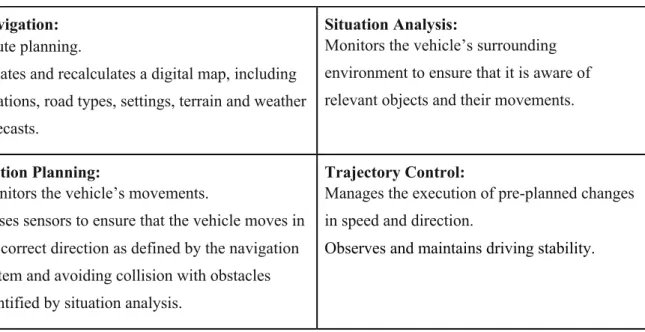
The broad definition of a self-guided vehicle is, according to Otto Motors, “any kind of vehicle in which operation occurs without direct driver input or pre-configured scripts to control the steering, acceleration, and braking” (Otto Motors, 2017). As stated by DHL Trend Research in a report, a vehicle capable of self-driving requires four basic interdependent functions:
Navigation:
Route planning.
Creates and recalculates a digital map, including locations, road types, settings, terrain and weather forecasts.
Situation Analysis:
Monitors the vehicle’s surrounding environment to ensure that it is aware of relevant objects and their movements.
Motion Planning:
Monitors the vehicle’s movements.
It uses sensors to ensure that the vehicle moves in the correct direction as defined by the navigation system and avoiding collision with obstacles identified by situation analysis.
Trajectory Control:
Manages the execution of pre-planned changes in speed and direction.
Observes and maintains driving stability.
In fact, an SGV does not require a fixed external infrastructure for navigation due to onboard intelligence that interprets the external environment and allows to make decisions in every situation (Otto Motors, 2017). However, these vehicles are designed to operate under specific circumstances, which vary from space, undersea, land to air environments (Wilfong, 1990). Still, according to the book Autonomous Robot Vehicles by I.J. Cox and G.T Wilfong, regardless of the environment, there are general principles that autonomous vehicles must follow:
1. Sensing its environment;
2. Interpreting this sensor information to refine its knowledge of its position and the environment’s structure;
3. Planning a route from an initial to a goal position in the presence of a known or perhaps unknown obstacle.
For this reason, SGVs are equipped with multiple environmental sensing technologies, depending on the application and the complexity of the environment in which they will be
deployed. According to the book Autonomous Vehicles: Intelligent Transport Systems and
Smart Technologies, sensing technologies for environment perception are devices that provide information about the vehicle’s surroundings. Then, the data gathered is processed by perception algorithms in order to extract useful information that will be used for navigation decision-making. Furthermore, sensing and perception technologies play a critical role in the overall performance of autonomous vehicles. Thus, these are areas of sustained research activity (Tabatabaei, Dascalescu, & Bizon, 2014).
Initially, automated vehicles used for handling materials inside warehouses were guided by laser targets on the walls, wires buried in the floor, in-floor magnets or tape on the floor (Forger, 2017). Other robots used odometry, ultrasonic, infrared, laser range sensing, monocular, binocular and trinocular sensing technologies (Wilfong, 1990). But new versions of autonomous vehicles have now implemented improved onboard sensors, including cameras,
lidar-based systems, two-dimensional lasers, and three-dimensional lasers (Forger, 2017). As a result, they became more flexible, accurate, and effective when facing increasingly challenging and unexpected situations (Mcconney, 2016). Indeed, in self-driving cars, which are considered the most challenging automation project ever undertaken due to its hardly-predictable
environment (Oliver, Potočnik, & Calvard, 2018), the main groups of sensing technologies are
radars, cameras, LIDAR-based systems (Light Detection and Ranging), and GPS (Global
Positioning System) (Tabatabaei, Dascalescu, & Bizon, 2014) (See Appendix 2). Components Description
LIDAR It is an active sensor that transmits a collection of laser pulses to measure the range between objects and the vehicle (Mcconney, 2016).
Pulses of laser light reflect on objects back to a detector and the distance is calculated according to the time-of-flight. This compiled data creates an accurate real-time 360º and 3D representations of the surrounding environment of the system (Marshall, 2018) (See Appendix 3).
Video Cameras
Provide digital images of the vehicle surroundings, which are processed by image algorithms to detect objects (Tabatabaei, Dascalescu, & Bizon, 2014).
Despite the advances regarding image algorithms, video cameras still underperform when weather conditions are not appropriate, namely the existence of fog, snow, rain or in poor lighting conditions (Mcconney, 2016).
Radars Uses electromagnetic radiation for object detection from short (10m) to long (100m) range.
It provides the advantage of being less affected by weather conditions (Tabatabaei, Dascalescu, & Bizon, 2014).
GPS Satellite navigation system used to identify the vehicle position and velocity (TechTerms, s.d.).
Table 2 - Description of main Sensing Technologies of Autonomous Vehicles. With this in mind and depending on the vehicle application, these technologies are usually neither ideal nor enough when employed by itself. In order to obtain the best results, they are often complemented with one another (Tabatabaei, Dascalescu, & Bizon, 2014). Appendix 4 shows a comparison table of the main environmental perception technologies according to
especially for autonomous cars. They are mostly known as V2V (Vehicle-to-Vehicle) and V2I (Vehicle-to-Infrastructure) wireless technologies (Slowik & Sharpe, 2018), collectively referred to as V2X (Vehicle-to-Everything) (C2CCC, 2017).
Nevertheless, the vehicle requires onboard computers, known as "the brain" to make the sensor fusion (Marshall, 2018), meaning the combination of the data gathered by the sensor systems in order to get a full understanding of the environment around the car (Cohen, 2018). Appendix 5 shows a comparison between an AV System Architecture and a current one. These computers are powered by Artificial Intelligence, combined with navigation and object detection algorithms, being an essential component of automated driving technology (Gadam, 2018). Machine Learning plays an essential role in learning from past situations, which provides the capability to become more efficient and accurate when facing new situations (Wilkins, 2017).
Nowadays, the challenges in the development of autonomous vehicles are on the software side, as the needed hardware already exists (Morgan Stanley, 2013). The following graph illustrates the increasing value of software when compared to traditional vehicles.
10% Software 20% Content
90% Hardware
40% Software
40% Hardware
Today Tomorrow
Source: Morgan Stanley Research, 2013 Figure 1 - Value of the Car: Today vs. Tomorrow.
In particular, regarding self-driving cars, five levels of automation can be defined and serve as categories (see Appendix 6), according to the Society of Automotive Engineers (SAE International), an international entity in charge of standards developments for engineering professionals. This scale ranges from level 0, with all driving aspects manually controlled, to level 5, in which vehicles are fully autonomous and can drive without any human intervention.
3.2 General Cases/Applications
Self-guided vehicles have been frequently used for reconnaissance, remote maintenance (Wilfong, 1990), sorting, delivering, transporting, and assembling operations in numerous industries (IQSdirectory, s.d.), ranging from aerospace, automotive, mail delivery, storage, manufacturing to pharmaceutical, hospitality, university research, or even military use cases. One of the most common applications is self-driving cars. As previously explained, it can be categorized into five levels of automation (see Appendix 6). To give an example of the extent to which this technology is being exploited, Tesla’s autopilot system from 2018 is considered to be only level 2 in the mentioned scale (Tabora, 2018).
In the last decade, recent advancements in self-driving cars have been revolutionizing not exclusively traditional automakers but also leading innovators from the tech field. As a matter of fact, Google has been at the forefront of this technology by investing in a self-driving car project, mostly known for Waymo, which has recently achieved important milestones in the industry. Waymo performed 16 million kilometers of self-driving on public roads (Hawkins, 2018) and received a remarkable authorization in the US issued by the California Department of Motor Vehicles, allowing to test autonomous vehicles in the state of California (DMV, 2018), without the requirement to have a human in the driver’s seat. Until then, it was only possible to test vehicles with a human inside the car to take over in case of an emergency (Herger, 2017). In the automotive industry, Tesla is the most innovative and disruptive player. The company started its business by selling high-end electric cars and quickly moved towards self-driving technology, being a well-established player in that market nowadays. Moreover, Tesla’s CEO has announced the intention to achieve full self-driving technology by 2019 (Baptiste, 2018). Every time a software developer creates a model or changes anything in the source code, the car has to be tested. As a result, NVIDIA has developed a virtual simulator platform to train self-driving systems, as it is cheaper and safer than testing it on the streets (Nvidia, s.d.).
Most experts state that self-driving cars will boost the ride-sharing industries (Brown, 2018). Since today’s cars are parked 95% of the time (Morris, 2016), and through the implementation of autonomous vehicles in this industry, the ownership of a car will no longer be beneficial cost-wise. As shown by research, the cost of ride-sharing services will drop to a level that makes it more effective to join such services. Like RethinkX demonstrated, by the year 2031, using an autonomous ride-sharing service will cost around $3,400 per year compared to $9,000 per year for car ownership (Brown, 2018). Indeed, big players like General Motors and Uber are planning to launch commercial self-driving taxi services in 2019 (Davies, 2018) (Neiger, 2018). Another relevant application is public transportation. A good example is the Sohjoa project in Helsinki, Finland, where small autonomous buses perform short routes and transport up to a dozen passengers at a time (Sisson, 2017).
Freight transportation appears to be one of the most promising applications, where long-haul autonomous delivery trucks will have a significant impact on the logistics industry (See 4.3.2 Long-Haul Transportation (Exit-to-Exit and Platooning)).
Nonetheless, in the transport of goods, it could be used for short distance deliveries of small items, such as food and post mail, either by a drone or any kind of autonomous vehicle. Domino's performed the world's first pizza delivery by drone, in November 2016 (CNBC, 2016). Another example is the Stanford's University Jackrobbot, a self-driving electric delivery cart which is able to carry small cargos. While self-driving cars operate in streets and highways, this robot is designed to operate in pedestrian sites. The goal of this project is to understand the pedestrian's behavior. Jackrobbot is now able to move with social awareness, respect human social norms, and predict human trajectories in crowded spaces (Stanford University, 2016). Additionally, manufacturers and logistics companies have been devoting special attention to the application of this technology to more easily move goods inside warehouses and factories. Last year, the world largest retailer, Alibaba, developed the so-called "Smart Warehouse", a distribution center where over 100 autonomous vehicles do 70% of the work (Pickering, 2017).
In the hospitality industry, Alibaba A.I. Labs have announced the launch of an artificially-intelligent wheeled robot that delivers items to hotel guests (Coxworth, 2018). Additionally, a brand-new Sheraton Hotel in Los Angeles has a fleet of robots, developed by the company Aethon, taking over guest luggage duties autonomously (Aethon, 2018).
Another form of SGV is a floating drone developed by the Dutch company RanMarine Technology, that sucks up trash from the water (Hunt, 2018). Regarding other applications in water environments, researchers from Massachusetts Institute of Technology and Amsterdam’s AMS are working on “The Roboat Project”, aiming to design and deploy a fleet of autonomous boats to reduce inner-city traffic (Charlton, 2018).
The company Husarion has vehicles devoted to research and education, which can be built from scratch to best suit the needed application. As an illustration, Panther is an autonomous vehicle dedicated to outdoor research in agriculture, rescue, or inspection tasks (Husarion, 2018). Additionally, the military sector was an early adopter of SGVs. They used the so-called Unmanned Ground Vehicles (UGV) for minesweeping. In fact, it saved numerous human lives by deploying autonomous vehicles to detect and detonate mines (DHL Trend Research, 2014). The U.S. Army has used TerraMax, a self-driving vehicle for those purposes (Golson, 2014). After briefly grasping some general applications of this technology, it is clear that self-guided vehicles will be a trigger for emerging new business models, as well as the establishments of new partnerships to profit from new business opportunities that are constantly arising. With this in mind, a synthesized table of the several technology applications and their respective industries here presented can be found in Appendix 7.
3.3 Pros and Cons of the Technology
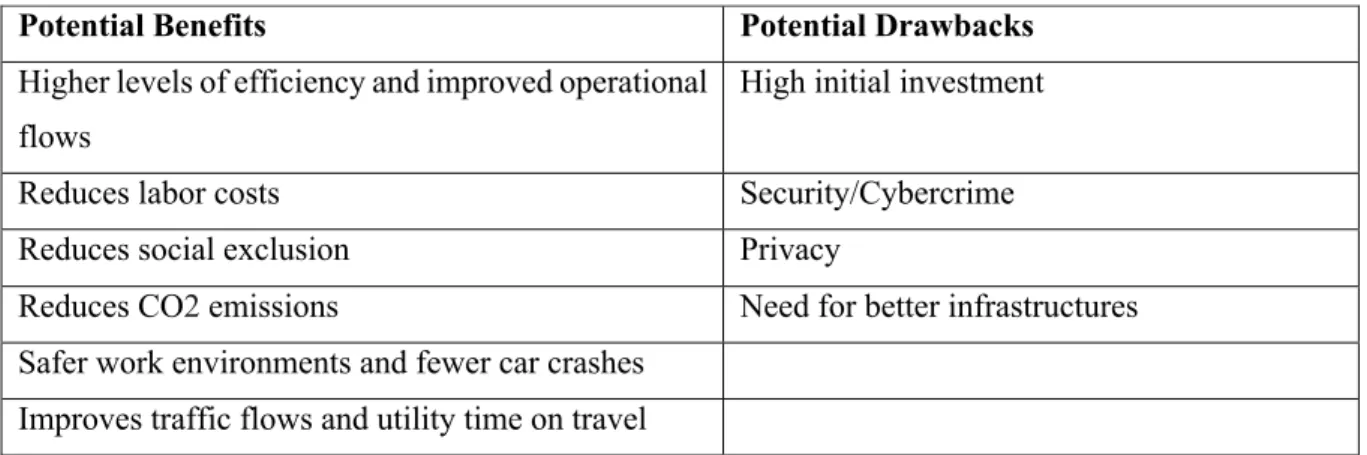
As like many other technologies, self-guided vehicles have the ability to greatly impact the economy, people’s lives, and the environment as a whole. However, it also entails negative consequences. The following table summarizes the main potential benefits and drawbacks.
To start with, it grants several benefits in an organizational context. Since these vehicles do not require any sort of human direction or control (IQSdirectory, s.d.), they are able to work around the clock, which provides higher levels of efficiency and improves operational flows. In addition, it reduces labor costs associated with the driver (Automaticguidedvehicles.com, s.d.). People will deal with significant changes in their daily lives. Through the implementation of self-driving cars, users will improve the utility time on travel by re-allocating their commuting time to more useful tasks, therefore improving the quality of life and having greater comfort (DHL Trend Research, 2014). Plus, autonomous cars improve traffic flows (Stern, et al., 2018). There will be a substantial reduction in CO2 emissions as these vehicles are intrinsically
associated with electric engines, contributing to a better environment (General Motors, 2018). Driverless technology might be a changing paradigm for people with disabilities (Brown, 2018). Since it does not require a driving license, they will be able to use it and consequently reduce social exclusion (Adnan, Nordin, Bahruddin, & Ali, 2018).
Improved safety is another relevant advantage of this technology (Slowik & Sharpe, 2018). With lower error rates and thanks to collision avoidance systems, it provides safer working environments and substantially reduces car crashes which are in over 90% of all cases caused by human errors, as it regards the United States (NHTSA, 2015).
On the other hand, SGV also entails rather negative consequences. Against the improved safety, there are serious concerns among experts due to the difficulties to guarantee the maximum
Potential Benefits Potential Drawbacks
Higher levels of efficiency and improved operational flows
High initial investment
Reduces labor costs Security/Cybercrime
Reduces social exclusion Privacy
Reduces CO2 emissions Need for better infrastructures Safer work environments and fewer car crashes
Improves traffic flows and utility time on travel
security when it comes to cybercrime (See 6. In-depth Interview Results). Since most of these vehicles have multiple connection points, such as between the car and other vehicles on the road, or the car and any wired public infrastructure, they are vulnerable to threats that did not exist in traditional vehicles. In fact, these multiple connections increase the risk of hacking simply because there are more entry points for hackers to exploit (Thomson Reuters, 2018). Privacy appears to be a critical concern as well. Due to connections to multiple sources, data about the owner, passenger, location, and sensors will be collected and shared by these vehicles (Norton Rose Fulbright, 2017). Additionally, drones, which most of the times are equipped with cameras, also present a constant concern for people as their privacy is exposed to those vehicles (Antunes, 2018). Indeed, some statistics show that 54% of the US population thinks drones should not be allowed to fly near people's homes (Hiltin, 2017).
Furthermore, as it is an innovative product for most industries, the overall initial investment required is very high. However, future prospects indicate that these costs end up decreasing as the technology enters in mass production phases (Oliver, Potočnik, & Calvard, 2018).
Besides all, the existent infrastructures are poor and need to be properly adapted. The implementation of technologies like "smart pavement" would contribute to smoother navigation on public roads, by providing extra data for self-driving cars and trucks (Sylvester, 2018). These “smart roads” are equipped with radio transmitters replacing traffic lights and roadside units providing real-time data on weather, traffic, and other relevant conditions (Oliver, Potočnik, & Calvard, 2018).
3.4 General Future of the Technology
There are several projects ongoing to take the fullest advantages of this technology, as presented in chapter 3.2 - General cases and applications, which shows that this technology has strong potential in many areas of modern society. However, laws, regulations, and ultimately cultural acceptance of this technology in society in the upcoming times will definitely play an important
Cultural acceptance is a key issue in the process of the technology adoption in society. In fact, it works as a strong barrier when there are negative perceptions of self-driving vehicles (DHL Trend Research, 2014). A change of thinking is required, and people must get used to computers fully controlling their vehicles. For this reason, some adjustments might facilitate this process. For instance, implementing slow adoption plans to foster cultural acceptance (See 6. In-depth Interview Results). Additionally, not only self-driving cars suffer from public acceptance, but also other types of SGVs depend a lot on those concerns. To illustrate, robots also seek people’s acceptance in society and it substantially differs from country to country (Nomura, 2017). A research study shows that trust and ethical implications are key points for user acceptance of autonomous vehicles (Adnan, Nordin, Bahruddin, & Ali, 2018). In particular, the ethical side of this technology still has some gaps that need to be addressed. The following dilemma presented by DHL Trend Research explains this issue. “You are driving downhill on a narrow mountain road between two big trucks. Suddenly the brakes on the truck behind you fail, and it rapidly gains speed. If you stay in your lane, you will be crushed between the trucks. If you veer to the right, you will go off a cliff. If you veer to the left, you will strike a motorcyclist.”. What would you do and what should the autonomous system do?
Furthermore, liability is another important factor that has been discussed for several years and for which a satisfying solution has not been found yet. Therefore, stakeholders must provide greater clarity on issues of liability. For instance, in case of an autonomous vehicle crash, who is responsible for the damages provoked? The person inside the vehicle, the vehicle owner or the manufacturer? Even though it might be hard to figure out, the most logical answer is that it depends on the case and who caused the accident in the first place. (DHL Trend Research, 2014) Above all, although some support that the technology itself is not the hurdle for the process of adoption, regulation works as a strong barrier (Morgan Stanley, 2013)
The experts interviewed see positive future-prospects, since most of them believe that the technology is going to be widely adopted in coming years (See 6. In-Depth Interviews Results).
4 – Supply Chain Context and Applications of Self-Guided Vehicles 4.1 Supply Chain Management
According to Council of Supply Chain Management Professionals (CSCMP), Supply Chain Management (SCM) is the management of products and services flows from the point of origin to the point of consumption, including a two-way flow of information and data between supply chain participants. These participants include producers, distributors, retailers, and customers. In order to have a successful SCM strategy, all the participants must collaborate, developing winning strategies for all stakeholders. The two-way flow of information and data is fundamental as it provides information of product demand to the right players and helps to promptly detect problems within the process.
The SCM includes the processes of Planning, Procurement, Production, Distribution, and Customer Interface. SCM follows seven fundamental principles, according to a research study published in Supply Chain Management Review and supported by CSCMP:
Principle 1 Segmentation of customers based on the service needs and consequent adaptation of the supply chain to serve those segments.
Principle 2 Customization of the logistics network according to the service requirements and the profitability of customer segments.
Principle 3 Listen to market signals and align demand planning accordingly across the supply chain, ensuring consistent forecasts and optimal resource allocation.
Principle 4 Differentiate product closer to the customer and speed conversation across the supply chain.
Principle 5 Manage sources of supply strategically to reduce the total cost of owning materials and services.
Principle 6 Develop a supply chain-wide technology strategy that supports multiple levels of decision making and gives a clear view of the flow of products, services, and information.
Principle 7 Adopt channel-spanning performance measures to gauge collective success in reaching the end-user effectively and efficiently.
Source: Supply Chain Management Review Table 4 - Fundamental principles of Supply Chain Management.
4.2 Self-Guided Vehicles Impacts in Supply Chain
The previous chapters explored the self-guided technology in general terms, assessing its impacts and applications in various industries. This chapter is dedicated to supply chains. As stated by Morgan Stanley Researchers, self-driving technology is expected to be adopted faster in logistics than in passenger markets, because humans feel more comfortable with such technology when there are no human lives at risk. Indeed, liability issues are less pressing for freight markets (Morgan Stanley, 2013).
Autonomous vehicles have been around in supply chains for many years. Usually deployed for sorting, transporting, and assembling operations in closed environments, such as warehouses and factories. Initially, these vehicles were inflexible and required well-structured environments. But, thanks to technological advances, the next generation of self-guided vehicles are showing up. Equipped with cameras and other sensing technologies, (see 3.1 Literature Review of the Technology), they are able to scan the environment and easily adapt, being able to operate in the outdoor environment and public streets. Therefore, they are revolutionizing the industry and opening opportunities in other areas of the supply chain. In particular, the outdoor logistics operations (DHL Trend Research, 2014).
Accordingly, SGV is mainly applied in three areas of the supply chain: manufacturing, warehousing, and transportation. Within a manufacturing context, companies benefit from this technology by using it for assembling operations and transporting goods inside factories. For instance, SGVs of many forms and sizes can deliver components to workers in the production line when they need them, making manufacturing floor less chaotic and cluttered (Pierson, 2016) (See Appendix 8). Also warehousing operations have been strongly hit by SGVs, not just to move goods inside facilities but also to load and unload orders (DHL Trend Research, 2014), accelerating warehouse processes (See Appendix 9).
In fact, the impacts in manufacturing and warehousing contexts are identical. It increases efficiency and significantly reduces labor costs. SGVs provide safer work environment thanks
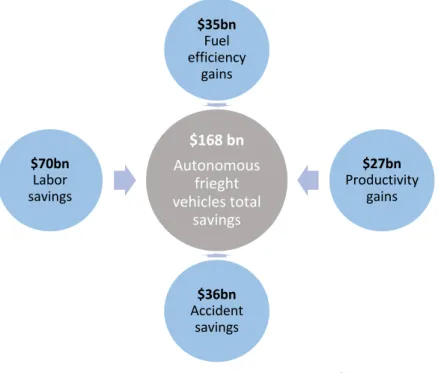
to sensing technologies that monitor the surroundings, eliminating the risk of bumping, crashing and colliding. Also, the vehicle does not need to take breaks or shifts like humans do, which significantly improves the operational flow and increases production rates (automaticguidedvehicles.com, s.d.). For most cases, when the battery is low, the vehicle recognizes and drives to a battery station where it will swap or charge it (Pickering, 2017). There are big waves of innovation going towards the transportation sector. Numerous companies are developing projects with autonomous vehicles to handle transportation, including autonomous trucks, drones, and robots. These can be deployed for last-mile delivery services or line-haul transportation, which will be explained in the next section. In addition, it is becoming a common practice to implement driverless vehicles in container terminals, where heavy goods vehicles transport containers to and from ship and yard (PortHamburg, 2016) (See Appendix 10). Also, at airports, self-guided dollies are used to transport cargos from the airport terminal to the airplane, and vice-versa (DHL Trend Research, 2014) (See Appendix 11). Through broad adoption of this technology in logistics, there will be substantial improvements in delivery performances along with reduced delays. These vehicles are able to work around the clock, contributing to higher productivity. The more vehicles are deployed on the roads, the lower the congestion, due to reduced error rates and improved efficiency (Baton Global, 2018). At the moment, a large stem of transportation costs is associated with the need of a driver to transport goods from one place to the other. Besides that, this technology will generate significant cost savings related to improved productivity, gains in fuel consumption, as well as improved safety leading to fewer accidents relative to today (Morgan Stanley, 2013). As estimated by Morgan Stanley, the potential savings per year to the US freight transportation industry thanks to autonomous freight vehicles are the following:
This estimation opportunely illustrates the economic benefits of autonomous vehicles in the transportation sector, although it reflects the utopian scenario by assuming 100% market penetration and not taking into account the implementation costs, offsetting losses, and investment implications (Morgan Stanley, 2013).
On the other hand, some drawbacks must be considered. First of all, and as referred in previous chapters, the need of better infrastructure to communicate with the vehicle and allow an ease navigation, as well as security and privacy issues. (See 3.3 Pros and Cons of the Technology). Additionally, autonomous driving will probably eliminate millions of jobs, for instance, of truck drivers, leading to significant negative macroeconomic impacts, if there are not sufficient policies and programs in place to support those displacements (Slowik & Sharpe, 2018). Above all, it requires very high initial investments, which for small to medium logistics companies might not be accessible, giving the big players significant advantages and increasing the barriers to entry in the business (Morgan Stanley, 2013). However, despite the high initial expenditures, big players of the industry envision SGV technology as an attractive return on investment (ROI), which provides large economic benefits (Slowik & Sharpe, 2018).
$168 bn Autonomous frieght vehicles total savings $35bn Fuel efficiency gains $27bn Productivity gains $36bn Accident savings $70bn Labor savings
Figure 2 - Potential Savings per year to the Autonomous Freight Vehicles in the US. Source: Morgan Stanley, 2016
It is clear that SGV technology will impact not exclusively the areas where it is applicable, but the supply chain management as a whole. There will be the need for re-structuration of supply chain networks as well as re-assessment of cost structures. For instance, given the very high turn-over rates faced by the long-haul truck industry (exceeding 100% annually in some cases) (Josephs, 2016), companies will face significant reductions in recruitment costs (Morgan Stanley, 2013). Additionally, the fact of having autonomous vehicles operating the final mile of delivery might be a trigger for changes in distribution center locations. Fulfillment centers will tend to be smaller in size and be located closer to the cities, due to operating limits of these vehicles (Gibbs, 2017).
4.3 Cases/Applications of Self-Guided Vehicles in Supply Chain 4.3.1 Moving Goods Inside Warehouses and Factories
In the context of warehouses, factories, and distribution centers, SGV technology is a reality but still worthwhile mentioning. SGVs applications are specially tailored for specific tasks; thus, they can vary in forms and sizes. Some examples are automated stackers, forklifts, pallet trucks, and small rack carrying robots.
As an illustration, the world largest retailer, Alibaba, has developed a “smart warehouse”, where self-driving robots perform 70% of the work (Pickering, 2017). The newest one dates November 2018, and it is the biggest automated warehouse in the world, with over 700 robots deployed in a facility of 3.000 m2 (See Appendix 12). The robots are responsible for moving goods to designated areas where employees will pick up and post (Twentyman, 2017).
The robots can carry up to 500 kilos at one time and are extremely fast and accurate. They are agile and can rotate 360º. Moreover, each robot is equipped with wi-fi and self-charging. The vehicle knows when and where it should go to charge itself (Pickering, 2017).
According to Ben Wang, the vice-president of Cainiao, a logistics company of the Alibaba Group, the “smart warehouse” can fulfill 50% more orders than a traditional one, within the
The giant Chinese retailer achieved a remarkable record in November 2018 by selling $30.8 billion on a single day – the so-called "Singles' Day", a festive day in China (AlibabaCloud, 2018). The company stated that at the peak, 256.000 payments were being processed per second. Plus, the company offers same-day and next-day deliveries for over 1.000 regions in China (Twentyman, 2017), showing how big and efficient warehousing operations must be to respond to these endless orders. Hence, SGV is a valuable tool to accelerate warehousing processes and improve efficiency in an era of increasing number of online orders.
4.3.2 Long-Haul Transportation (Exit-to-Exit and Platooning)
It is clear that driverless technology is disrupting the transportation sector around the world (Lee, 2018). The long-haul transportation and autonomous trucks have been in the aim of many stakeholders due to their expected high levels of return on investment (Slowik & Sharpe, 2018). Some experts sustain that fully autonomous trucks will be a reality only by 2035 (Frisoni, et al., 2016). Therefore, some alternative techniques are being broadly developed.
Firstly, the exit-to-exit or assisted highway trucking is the concept of manually driving a truck until the entrance of the highway and from that point activating the autonomous “highway pilot” until the exit to urban areas. While navigating in highway, the driver is not required to manually control the vehicle as the acceleration, steering, and braking is done autonomously. The truck is equipped with radar, proximity sensors and various cameras that allow navigating in highways with ease (DHL Trend Research, 2014). The driver is then free to backseat and rest or even work on different tasks during the trip. In fact, the driver’s resting time does not count for hours of work, which would substantially increase efficiency of that operation as the truck would be navigating while the driver is resting. Additionally, it would decrease the number of accidents and optimize fuel consumption by 5-10% (Pickering, 2017). Once the vehicle reaches the end of the highway, the driver would take over the vehicle again and manually drive it until the final destination. The Mercedes-Benz future truck 2025 is a successful case and is expected to start its production in 2021 (Johnson & Wissenbach, 2018) (See Appendix 13 and 14).
Secondly, the platooning or conveying system consists of a fleet of vehicles traveling in highways close to each other, minimizing aerodynamic drag. Only the first truck is manually operated by the driver, while the remaining trucks autonomously follow the first one, as they are paired together using sensor and communication technologies (Slowik & Sharpe, 2018). Similarly to exit-to-exit, drivers can rest during the journey and that time counts as rest time; thus it significantly increases the productivity of each driver. In addition, it reduces fuel consumption by up to 15% (Slowik & Sharpe, 2018). The ENSEMBLE consortium (composed by European automakers) have been testing this technology, and the multi-brand platooning truck is planned to be on the roads by 2021 (EUTruckPlatooning, 2018).
4.3.3 Last-Mile Delivery Services
In a product distribution process, the last-mile of delivery is the final step the journey - the moment that the package finally arrives at the customer's doorstep. It is the move of the good from the warehouse to the final consumer (Dolan, 2018). That final path is usually short in distance but high in costs. As shown in
Figure 3, it represents 53% of the total shipping costs (Honeywell, 2016). In addition to the costs, it is the bottleneck of the process, being the step that causes most delays in delivering’s (Gibbs, 2017). As a result, a growing number of companies are aiming to implement robots, self-driving cars, or even drones to their last-mile deliveries.
McKinsey predicts that 85% of last-mile deliveries will be held by autonomous vehicles by 2025 (McKinsey, 2016). Although it seems an optimistic figure, it shows the potential of SGVs. Being the least predictable part of the journey due to its complex and dynamic environment, it
53% 37% 6% 4% Last-mile delivery Line haul Sorting Collection Source: Honeywell, 2016 Figure 3 - Delivery Costs by Part of Journey.
Besides that, several companies are testing their vehicles on the streets. In detail, the company Starship Technologies is one of the most promising players and one of the earliest movers in the autonomous last-mile deliveries. With a fleet of delivery robots that can carry items within a 3km radius, it only takes from 5 to 30 minutes for the delivery to be completed (Starship, s.d.). The vehicle is equipped with several cameras that allow navigating with ease in sidewalks (See Appendix 15). Starship's robots can deliver all manner of items. However, it has been tested for food and groceries deliveries. The company has achieved impressive milestones. Their self-driving robots have covered over 100.000 miles in 100 cities and encountered 12 million people so far (Starship, s.d.).
4.4 The Future of Self-Guided Vehicles in Supply Chain
Pieces of evidence support that the future of supply chains relies very much on self-guided vehicles, as previously shown in the prior chapters by assessing several applications as well as societal, environmental, and economic benefits of this emerging technology. Even though the extent of these benefits is generally unknown today (Slowik & Sharpe, 2018), there is no doubt that they actually exist and that it will change the way supply chains operate.
At the moment, SGVs are being fairly used within in-door facilities. Evidently, the next step is to start deploying it to outdoor environments, although these are considerably more challenging due to their complex and hardly-predictable characteristics (DHL Trend Research, 2014). Furthermore, the biggest drawback – the high initial investment - is not a hurdle for the adoption of driverless technology as experts associate it to very appealing return on investment rates (ROI) (Slowik & Sharpe, 2018). However, and as stated previously, it might not be affordable for small to medium-sized logistics companies, which will give big players significant advantages and ultimately increase the barriers to entry in the business (Morgan Stanley, 2013). Moreover, and in order to allow autonomous vehicles to become a reality, several roadblocks must be overcome (Mueller, 2018), as it can be seen below:
Note: Public acceptance was added to the graph as it fosters the creation of laws and regulations. The technology maturity is a roadblock because the systems still underperform in certain circumstances, for instance when weather conditions are not favorable.
The move to a fully automated industry will not happen at once- it will be gradually. First, through automated assistance systems, and then, after overcoming the existent roadblocks, it will most likely become widely deployed for operational tasks in supply chains.
5. In-depth Interview Results
Given the complexity and uncertainty associated with any emerging technology and its future impacts, some interviews were conducted to experts in related areas. They worked on different domains (See 2. Research Questions and Methodology), thus their concerns and opinions vary accordingly. With the purpose of enriching this study with their insights, the primary research was particularly relevant to a better understanding of SGV technology. The diversity of experts’ backgrounds unveiled different visions of the topic that were explored throughout this thesis. The goal was to understand their expectations and concerns, essentially covering six topics:
• Areas of application in general terms; • Most relevant applications in supply chains;
• Pros and cons of self-guided vehicles in supply chains; • Biggest barriers to a wide adoption of self-guided vehicles; • Major concerns about this technology;
• Future of self-guided vehicles.
Wide Adoption of SGV in Supply Chain Laws and Regulations Technology
Maturity AcceptancePublic
Cyber Security
Source: Author based on Sabine Mueller, CEO of DHL Consulting Figure 4 - Biggest barriers to wide adoption of SGVs in supply chain.
The interviewees were asked to order from 1 to 6 several applications in terms of relevance. Given the relative scale approach, they had to prioritize their answers, meaning that even when they classified an application as the least relevant it does not mean that it is not relevant. Each circle matches one response and the colored the average - green is higher rate than yellow.
Source: In-depth interviews conducted by the author
From the graph, one can conclude that long-haul transportation, last-mile delivery services, and self-driving cars are among the most relevant application according to the experts’ opinions. Both experts in manufacturing and robotics, who classified self-driving cars as the 5th relevant, sustained that it is not the most relevant because it is still a long way until its wide adoption. Although when it reaches a big market segment, will be the one impacting our society the most. The following table presents the relevance given by experts to each of the topics in discussion:
Questions Int1 Int2 Int3 Int4 Avg.
Trigger for a substantial shift from personal use cars to ride-sharing/ride-hailing?
Impacts of SGV in supply chain: • Warehousing • Transportation/Logistics Main benefits: • Improved security • Higher efficiency • Environmental aspects • Costs Saving o o oo oo o o o o oo oo o o o o oo o oo o Last-mile delivery services Long-haul
transportation Military uses
Moving goods inside warehouses Public transports Self-driving cars
Figure 5 - Relevance of self-driving applications. 1- Most
Relevant
6- Least Relevant
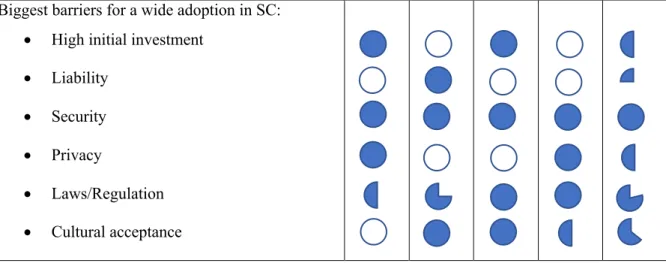
Biggest barriers for a wide adoption in SC: • High initial investment
• Liability • Security • Privacy
• Laws/Regulation • Cultural acceptance
Source: In-depth interviews conducted by the author Table 5 - In-depth Interview Results.
From the interview results, one can conclude that security is seen as both a benefit and a concern. In fact, this technology improves safety for its users and people co-existing with these machines, but it also presents a big threat as these vehicles can be hacked and cause tremendous damages. Therefore, a big challenge for the future is that stakeholders can guarantee the maximum security for the users and the community in general.
The 4th interviewee – Artificial Intelligence Expert- mentioned that the impacts of SGV are more significant in warehousing than in outdoor transportation because it is already being used for indoor applications and those applications exclusively depend on the company, while applications in outdoor environments strongly rely on regulations and legal issues.
Theme Expert’s Quote
Importance of Regulation
“It is not only a technical issue that needs developments. Also, governments and companies need to work together to allow this technology to become a reality in everyday life.” - Expert of software engineer in the Automotive industry.
Cultural Acceptance
“Self-guided vehicles will not become a reality if people do not accept it. If somehow it appears to be dangerous, it will definitely delay the formation of laws - Technology needs to be safe enough before trying to implement it in any field. In my perspective, slowly adoption would be the best and easier way to foster public acceptance.” – Expert of software engineer in the Automotive industry.
Main Barriers “The barriers are not anymore on the technology but on the ethical side and regulations.” – Expert of Artificial Intelligence Table 6 - Expert's Quotes.
Regarding the future, all interviewees showed favorable prospects and believed in a wide adoption in the coming years. Some emphasized the importance of regulation, cultural acceptance, and security on shaping the future of this technology, as well as the timing on which each step is done towards its implementation. Any considered the technology itself as a barrier.
6. Conclusion
The self-guided vehicle technology is any kind of vehicle in which navigation occurs without direct driver input. It is mostly used to transport goods and people, but it can also be deployed for other activities, such as research and education, cleaning, or even military purposes. After briefly grasping some general applications, it is clear that SGVs will be a trigger for emerging new business models, as well as the establishments of new partnerships to profit from new opportunities that are constantly arising.
In supply chains, the most relevant applications are in warehousing and transportation, but also manufacturing contexts. Within manufacturing and warehousing, these vehicles are mostly used to move goods around in-door facilities. In fact, it reduces labor costs, improves efficiency, makes facilities less chaotic, as well as provides safer work environments. Thanks to its closed environments, there are fewer barriers to its implementation, which depends exclusively on the company. Contrarily, the outdoor operations strongly rely on public laws and regulations, making its adoption a slower process but inevitably for most. At the moment, there are three main relevant applications in the transportation sector: last-mile delivery services, exit-to-exit, and platooning. Indeed, they improved efficiency and safety, reduce labor costs, and grant better environmental aspects. By contrast, it also entails negative consequences including, vulnerability to hacking interventions, privacy issues, and high initial investments, which is compensated by attractive return on investment (ROI) associated with autonomous trucks. Ultimately, the future of this technology towards wide adoption in supply chains strongly relies on the ability to flawlessly overcome four main roadblocks: technology maturity, cultural/public acceptance, cybersecurity, and laws/regulations.
7. Bibliography
Adnan, N., Nordin, S., Bahruddin, M., & Ali, M. (2018). How trust can drive forward the user acceptance to the technology? In-vehicle technology for autonomous vehicle. Elsevier Ltd.
Aethon. (2018). Aethon. Retrieved November 2018, from https://aethon.com/sheraton-hotel-to-use-tug-robots/
AlibabaCloud. (2018, November 12). Alibaba Cloud. Retrieved December 2018, from https://www.alibabacloud.com/blog/unveiling-the-networks-behind-the-2018-double-11-global-shopping-festival_594167
Antunes, J. (2018, February 21). Expo Uav. Retrieved November 2018, from https://www.expouav.com/news/latest/addressing-privacy-safety-concerns-drones-percepto/
Automaticguidedvehicles.com. (n.d.). Retrieved November 2018, from https://www.automaticguidedvehicles.com/self-guided-vehicles/
automaticguidedvehicles.com. (n.d.). Automatic Guided Vehicles. Retrieved from https://www.automaticguidedvehicles.com/self-guided-vehicles/
Bailey. (2018, October 30). Technode. Retrieved December 2018, from https://technode.com/2018/10/30/alibaba-new-robotic-warehouse/
Baptiste, J. (2018, November 7). Forbes. Retrieved November 2018, from https://www.forbes.com/sites/jeanbaptiste/2018/11/07/tesla-could-have-full-self-driving-cars-on-the-road-by-2019-elon-musk-says/#14ca081c62ac
Baton Global. (2018, June 13). Baton Global. Retrieved December 2018, from https://www.batonglobal.com/post/impact-of-autonomous-vehicles-in-your-supply-chain
Brown, M. (2018, June 9). Inverse. Retrieved November 2018, from https://www.inverse.com/article/44173-benefits-of-self-driving-cars
C2CCC. (2017). Position Paper Frequency Bands for V2X. CAR 2 CAR Communication Consortium.
Charlton, E. (2018, November 7). World Economic Forum. Retrieved December 2018, from
https://www.weforum.org/agenda/2018/11/amsterdam-is-developing-a-fleet-of-
autonomous-boats-to-reduce-city-traffic?utm_source=Facebook%20Videos&utm_medium=Facebook%20Videos&utm_ campaign=Facebook%20Video%20Blogs
CNBC. (2016, November 16). CNBC. Retrieved November 2018, from https://www.cnbc.com/2016/11/16/dominos-has-delivered-the-worlds-first-ever-pizza-by-drone-to-a-new-zealand-couple.html
Cohen, J. (2018, May 22). Towards Data Science. Retrieved November 2018, from https://towardsdatascience.com/sensor-fusion-90135614fde6
Coxworth, B. (2018, September 27). New Atlas. Retrieved November 2018, from https://newatlas.com/alibaba-room-service-robot/56546/
Davies, A. (2018, November 30). Wired. Retrieved December 2018, from https://www.wired.com/story/gm-dan-ammann-cruise-self-driving-cars-ceo/
DHL Trend Research. (2014). Self-Driving Vehicles in Logistics.
DMV. (2018, October 30). State of California - Department of Motor Vehicles. Retrieved
November 2018, from
https://www.dmv.ca.gov/portal/dmv/detail/pubs/newsrel/2018/2018_81
Dolan, S. (2018, May 10). Business Insider. Retrieved December 2018, from https://www.businessinsider.com/last-mile-delivery-shipping-explained
Dyble, J. (2018, April 23). Gigabit Magazine. Retrieved from https://www.gigabitmagazine.com/ai/understanding-sae-automated-driving-levels-0-5-explained
EUTruckPlatooning. (2018, February 2). EU Truck Platooning. Retrieved December 2018, from https://eutruckplatooning.com/news/967655.aspx
Forger, G. (2017, December 15). Modern Materials Handling. Retrieved November 2018, from https://www.mmh.com/article/the_big_picture_navigation_gets_a_reboot_for_automa tic_vehicles
Frisoni, R., Dall'Olgio, A., Nelson, C., Long, J., Vollath, C., Ranghetti, D., & McMinimy, S. (2016). Research for TRAN Committee - Self-piloted cars: the future of road transport? Directorate-General for Internal Policies- European Parliament.
Gadam, S. (2018, April 19). Medium. Retrieved November 2018, from
https://medium.com/datadriveninvestor/artificial-intelligence-and-autonomous-vehicles-ae877feb6cd2
General Motors. (2018). Self-Driving Safety Report. General Motors.
Gibbs, P. (2017). How autonomous vehicles will impact on the supply chain. Automotive logistics.
Golson, J. (2014, 6 30). Wired. Retrieved November 2018, from https://www.wired.com/2014/06/oshkosh-autonomous-minesweeping/
Groshen, E. (2018). Preparing U.S. Workers and Employers for an Autonomous Vehicle Future. Securing America’s Future Energy (SAFE).
Hawkins, A. (2018, October 10). The Verge. Retrieved November 2018, from
https://www.theverge.com/2018/10/10/17958276/waymo-self-driving-cars-10-million-miles-challenges
Herger, M. (2017, November 7). The Last Driver License Holder. Retrieved November 2018, from https://thelastdriverlicenseholder.com/2017/11/07/historic-milestone-waymo-to-become-first-company-to-deploy-autonomous-car-fleet-without-driver-on-board/ Hiltin, P. (2017, December 19). Pew Research Center. Retrieved November 2018, from
http://www.pewresearch.org/fact-tank/2017/12/19/8-of-americans-say-they-own-a-drone-while-more-than-half-have-seen-one-in-operation/
Hunt, K. (2018, August 29). World Economic Forum. Retrieved November 2018, from https://www.weforum.org/agenda/2018/08/this-drone-sucks-up-trash-from-the-water-like-a-roomba
Husarion. (2018). Husarion. Retrieved November 2018, from https://husarion.com/#products-robots
IQSdirectory. (n.d.). IQS Directory. Retrieved November 2018, from https://www.iqsdirectory.com/self-guided-vehicles/
Johnson, E., & Wissenbach, I. (2018, June 6). Reuters. Retrieved December 2018, from https://www.reuters.com/article/us-daimler-trucks/daimler-fights-tesla-vw-with-new-electric-big-rig-truck-idUSKCN1J22A5
Josephs, M. (2016, January 6). Forbes. Retrieved December 2018, from https://www.forbes.com/sites/maryjosephs/2016/01/06/100-driver-turnover-hurts-trucking-industry-correct-ma-approach-can-fix-it/#3f49fecf50f2
Lee, T. (2018, May 29). Ars Technica. Retrieved December 2018, from https://arstechnica.com/cars/2018/05/self-driving-technology-is-going-to-change-a-lot-more-than-cars/
Marshall, B. (2018, February 21). Rs Online. Retrieved November 2018, from https://www.rs-online.com/designspark/lidar-radar-digital-cameras-the-eyes-of-autonomous-vehicles Mcconney, L. (2016, December 5). Conveyco. Retrieved November 2018, from
https://www.conveyco.com/future-agvs-new-technology-keep-eye/
McKinsey. (2016, September). McKinsey&Company. Retrieved from https://www.mckinsey.com/~/media/mckinsey/industries/travel%20transport%20and %20logistics/our%20insights/how%20customer%20demands%20are%20reshaping%2 0last%20mile%20delivery/parcel_delivery_the_future_of_last_mile.ashx
Morgan Stanley. (2013). Autonomous Cars: Self-Driving the New Auto Industry Paradigm. Morgan Stanley Blue Papers.
Morris, D. (2016, March 13). Fortune. Retrieved November 2018, from http://fortune.com/2016/03/13/cars-parked-95-percent-of-time/
Mueller, S. (2018, June 17). Sabinext. Retrieved December 2018, from https://sabinext.com/self-driving-vehicles-new-reality-logistics
Neiger, C. (2018, November 9). Fool. Retrieved November 2018, from https://www.fool.com/investing/2018/11/09/2019-is-shaping-up-to-be-the-year-of-the-self-driv.aspx
NHTSA. (2015). Critical Reasons for Crashes Investigated in the National Motor Vehicle Crash Causation Survey. U.S. Department Transportation.
Nomura, T. (2017). Cultural Differences in Social Acceptance of Robots. IEEE International Symposium.
Norton Rose Fulbright. (2017). The Privacy Implications of Autonomous Vehicles.
Nvidia. (n.d.). Retrieved November 2018, from https://www.nvidia.com/en-us/self-driving-cars/drive-constellation/
Oliver, N., Potočnik, K., & Calvard, T. (2018, August 14). Harvard Business Review. Retrieved November 2018, from https://hbr.org/2018/08/to-make-self-driving-cars-safe-we-also-need-better-roads-and-infrastructure
Otto Motors. (2017). AGV vs SDV - A Comparison of Automated Material Transport. Supply Chain 247.
Pickering, J. (2017, September 19). Business Insider. Retrieved November 2018, from https://www.businessinsider.com/inside-alibaba-smart-warehouse-robots-70-per-cent-work-technology-logistics-2017-9
Pierson, R. (2016, October 9). Read Write. Retrieved from https://readwrite.com/2016/10/09/autonomous-vehicles-in-factories-il4/
PortHamburg. (2016, December 19). Hafen Hamburg. Retrieved December 2018, from https://www.hafen-hamburg.de/en/news/besic-energy-transition-project-successfully-concluded---35007
Sisson, P. (2017, June 15). Curbed. Retrieved November 2018, from https://www.curbed.com/2017/6/15/15810912/driverless-self-driving-bus-finland-helsinki-transportation
Slowik, P., & Sharpe, B. (2018). Automation in the long haul: Challenges and opportunities of autonomous heavyduty trucking in the United States. ICCT (The International Council on Clean Transportation.
Stanford University. (2016). Stanford’s social robot ‘Jackrabbot’ seeks to understand pedestrian behavior. Stanford University.
Starship. (n.d.). Starship. Retrieved December 2018, from https://www.starship.xyz/business/ Stern, R. E., Cui, S., Monache, M. L., Bhadani, R., Bunting, M., Churchill, M., . . . Work, D.
B. (2018). Dissipation of stop-and-go waves via control of autonomous vehicles: Field experiments. Transportation Research Part C: Emerging Technologies, Pages 205-221. Retrieved from https://phys.org/news/2018-02-autonomous-vehicles-traffic.html Sylvester, T. (2018, February 13). Medium. Retrieved November 2018, from
https://medium.com/self-driving-cars/a-smart-plan-for-american-infrastructure-d76bd6e64b92
Synced Review. (2018, March 15). Medium. Retrieved from https://medium.com/syncedreview/global-survey-of-autonomous-vehicle-regulations-6b8608f205f9
Tabatabaei, N., Dascalescu, L., & Bizon, N. (2014). Autonomous Vehicles : Intelligent Transport Systems and Smart Technologies. New York: Nova Science Publishers, Inc. Tabora, V. (2018, February 24). Medium. Retrieved November 2018, from
https://medium.com/self-driving-cars/tesla-enhanced-autopilot-overview-l2-self-driving-hw2-54f09fed11f1
TechTerms. (n.d.). Retrieved from https://techterms.com/definition/gps
Thomson Reuters. (2018, February 13). Thomson Reuters. Retrieved November 2018, from https://blogs.thomsonreuters.com/answerson/privacy-concerns-self-driving-cars-ready-autonomous-vehicles/
Trebilcock, B. (2010, August 23). Logistics Management. Retrieved October 2018, from https://www.logisticsmgmt.com/article/lets_remember_mac_barrett_father_of_the_ag v
Twentyman, J. (2017, August 25). Internet of Business. Retrieved December 2018, from
https://internetofbusiness.com/ecommerce-giant-alibaba-opens-chinas-smartest-warehouse/
Wilfong, I. J. (1990). Autonomous Robot Vehicles. Springer Science & Business Media. Wilkins, J. (2017, August 21). Manufacturing Global. Retrieved October 2018, from
8. Appendices
Appendix 1 - Questionnaire used for the in-depth interviews
Self-Guided Vehicles impacts in Supply Chain
Question 1: How are you aware with Self-Guided Vehicles technology?
[Beginner; Intermediate; Expert]
Question 2: In what areas do you think it will be more useful to apply such technology? Question 3: Order the following applications of SGV from 1 to 6 (1- Most relevant and 6-
Least relevant):
[Public transports (e.g. autonomous buses)] [Military uses (e.g. mines detonation)] [Long-haul transportation]
[Self-driving cars]
[Last-mile delivery services]
[Moving goods inside warehouses (e.g. autonomous forklifts)]
Question 4: Concerning self-driving cars, do you think it will be an important trigger for a
substantial shift from personal use cars to ride-sharing? Why?
Question 5: In Supply Chain, where do you think SGV will be more impactful?
Question 6: What barriers/difficulties do you see in the adoption of SGVs in supply chain?
[High initial investment] [Expertise] [Liability] [Security] [Privacy] [Laws/Regulations] [Other:____]
Question 7: What are the major pros and cons of SGV in supply chain? Question 8: What do you foresee for the future of this technology?
Appendix 2 – The use of different sensors in an autonomous vehicle.
Source: Sensors Online
Appendix 3 – Representation of a scanned environment from a LIDAR system.
Appendix 4 – Comparison of main Technologies for environment perception.
Source: Book - Autonomous Vehicles: Intelligent Transport Systems and Smart Technologies (Tabatabaei, Dascalescu, & Bizon, 2014) Table 7 - Comparison of main Technologies for environment perception.
Appendix 5 – Current System Architecture vs Autonomous Vehicle System Architecture.