http://www.uem.br/acta ISSN printed: 1679-9275 ISSN on-line: 1807-8621
Doi: 10.4025/actasciagron.v35i2.15967
Acta Scientiarum. Agronomy Maringá, v. 35, n. 2, p. 209-219, Apr.-June, 2013
Induction of water deficit tolerance by cold shock and salicylic acid
during germination in the common bean
Edna Antônia Torquato de Agostini, Nelson Barbosa Machado-Neto and Ceci Castilho Custódio*
Universidade do Oeste Paulista, Rod. Raposo Tavares, Km 572, 19067175, Presidente Prudente, São Paulo, Brazil. *Author for correspondence. E-mail: [email protected]
ABSTRACT. The application of short-term stresses or elicitors in seedlings or embryos with high
metabolic activity might increase multi-adversity tolerance. Beans seeds cv. IAC-Carioca were exposed to
cold shock temperatures (S - 7°C 24h-1) and salicylic acid (SA - 0.01 mM 48h-1) during imbibition to study
physiological responses to osmotic stress physiological responses. The seeds were soaked in paper towel imbibed in water or salicylic acid at 25°C for 24h. The seed were subsequently submitted to temperatures of 7ºC and 25ºC for another 24h in water or salicylic acid. Following each treatment, the seeds were transferred to mannitol solutions (0, -0.3, -0.6, and -1.2 MPa) and evaluated after seven days for germination, vigour, shoot and root length, dry mass, proline accumulation and protein electrophoretic
profile. Treatments with salicylic acid and cold shock did not affect germination, but germination was
reduced through the mannitol-induced progression of water deficit. However, both salicylic acid and cold shock treatments affected seed vigour. The application of salicylic acid increased root and total seedling length and dry weight, especially at intermediate water stress levels. Both salicylic acid and cold shock treatments changed the protein pattern of the treated seeds, but only SA showed promise as a technology for seed treatment.
Keywords:Phaseolus vulgaris, thermic shock, elicitor, vigour, protein.
Indução da tolerância ao estresse hídrico por choque frio e ácido salicílico durante a
germinação em feijoeiro
RESUMO. Estresses curtos ou aplicação de elicitores em mudas ou embriões com atividade metabólica
pode aumentar a resistência à adversidade. Aplicações de choque térmico (S - 7°C 24h-1) e ácido salicílico
(SA - 0,01mM 48h-1) durante a embebição foram avaliados em sementes de feijão para estudar as respostas
ao estresse hídrico. As sementes foram embebidas em papel toalha com água ou ácido salicílico a 25°C durante 24h, e submetidas por outras 24h à 7 ou 25ºC em água ou ácido salicílico. As sementes foram transferidas para soluções de manitol (0; -0,3; -0,6; -1,2 MPa) e após sete dias foram avaliadas a germinação, vigor, comprimento e massa seca de parte aérea e raízes, acúmulo de prolina e perfil protéico. A germinação não foi afetada pelo tratamento com ácido salicílico e choque frio, mas diminuiu com a progressão do déficit hídrico induzido por manitol. O vigor foi afetado por ambos, ácido salicílico e choque frio. O ácido salicílico incrementou o comprimento e peso total seco de raiz e total de plântula, especialmente em níveis de estresse intermediários. Tanto o ácido salicílico e choque frio mudaram o padrão protéico das sementes tratadas, mas SA mostrou ser uma tecnologia promissora para o tratamento de sementes.
Palavras-chave:Phaseolus vulgaris, choque térmico, elicitor, vigor, proteína.
Introduction
Common beans are cultivated under a wide range of environmental conditions. All bean cultivars, to some degree, are sensitive to abiotic stresses, and during germination, the seeds are particularly sensitive to water deficit and exposure to low or high temperatures (COELHO et al., 2010; CUSTÓDIO et al., 2009a; MACHADO-NETO et al., 2006a and b). Bean seeds subjected to water deficit induced by mannitol, calcium or magnesium chloride show a
decline in the first germination count, seedling dry matter, and root and shoot length and an increase in abnormalities in water potentials of over –0.6 MPa (CUSTÓDIO et al., 2009a). However, the fast water uptake by the seeds could damage the seed cells and tissues and thus lead to a lack of germination (CUSTÓDIO et al., 2009b).
13°C, and the maximum temperature is between 35 and 39°C. A strong germination inhibition was observed over these ranges (MACHADO-NETO et al., 2006b).
There are common responses to abiotic stresses in plants, but unique responses to a specific stress in different species or even different cultivars have been observed (CUSTÓDIO et al., 2002; MACHADO-NETO et al., 2004a; TEXEIRA et al., 2008). For example, the expression of several classes of proteins, such as transcription factors (SNYMAN; CRONJÉ, 2008), BiPs (Binding Protein) (VALENTE et al., 2009), antioxidant enzymes (LEI et al., 2005; MEI; SONG, 2010), late embryogenesis abundant proteins (LEAs) and proline-rich proteins (PRP) (VERDOY et al., 2004) and heat shock proteins (HSP) (AL-WHAIBI, 2011; GUPTA et al., 2010), may be up-regulated (VERDOY et al., 2004) or suppressed (NEPOMUCENO et al., 2000). In addition, during dry conditions, plants actively accumulate amino acids, sugars and ions in the cytoplasm to reduce osmotic potential and, consequently, to maintain water potential and cell turgor. The accumulation of the amino acid proline in plants might occur under water, heat or salt stress conditions (MAIA et al., 2007), through the glutamic acid pathway (KISHOR et al., 2005) and the bifunctional enzyme Δ 1-pyrroline-5-carboxylate synthetase (P5CS), which plays a key role in proline biosynthesis (KIYOSUE et al., 1996).
In many plants, gradual changes in the environmental conditions induce tolerance to extreme situations. This acclimatising response is defined as cross-tolerance (SABEHAT et al., 1998). Often, exposure to one particular stress at moderate levels enhances resistance to multiple stresses. For example, pre-treatment at 33oC can increase salt stress in wheat,
and pre-treatment with NaCl at -0.8 MPa enhances heat tolerance (SONG et al., 2005). Mei and Song (2008) reported that barley seeds pre-treated at 30oC or
in a salt solution during germination improved tolerance to subsequent heat stress (35oC). Moreover,
the poor germination of barley seeds at 35oC could be
overcome through pre-treatment at a 0oC (MEI;
SONG, 2010). In the common bean, Custódio et al. (2009c) showed that a 7oC pre-treatment during early
germination improved drought tolerance.
Biological elicitors are macromolecules, either from plants or pathogens that mediate defence reactions. According to McCue et al. (2000), many stresses may be mitigated by the application of exogenous or endogenous elicitors, such as organic acids (salicylic, ascorbic, and citric). Salicylic acid
(SA) is a compound belonging to the phenolic group and is present in most plants (SHI et al., 2005). SA has numerous functions, particularly the inhibition of germination and growth, interference with root absorption, reduced transpiration and leaf abscission (ASHRAF et al., 2010). Carvalho et al. (2007) showed that salicylic acid promoted an increase in the germination percentage in marigold seeds, especially under heat and drought stresses.
SA also showed an important role in suberin and lignin biosynthesis by activating peroxidases that are involved in strengthening the barrier properties of cell walls (SAKHABUTDINOVA et al., 2004). In addition, salicylic acid modulates the binding of some transcriptional factors to enhance HSP70 synthesis in tomato seedlings (SNYMAN; CRONJÉ, 2008).
There are few studies concerning the pre-treatment of bean seed during the critical seedling emergence stages to increase tolerance to water deficiency. More information and knowledge are still required to select treatments that can be used to stimulate the formation of elicitor compounds and create better combinations between specific elicitors and pre-treatments in order to improve osmotic stress tolerance. This work aimed to study the effect of salicylic acid, cold shock and their combination to induce water deficit tolerance in the common bean during the germination and initial growth of the seedlings.
Material and methods
Plant material and osmotic stress experiment
Acta Scientiarum. Agronomy Maringá, v. 35, n. 2, p. 209-219, Apr.-June, 2013 On the seventh day of seed imbibition, the
seedlings were classified as strong (morphologically perfect) and normal (BRASIL, 2009), abnormal and weak (with minor defects) or dead. Germination was measured as the percentage of normal, strong and weak seedlings, relative to the number of seeds tested. For vigour classification, only the percentage of strong normal seedlings was considered (NAKAGAWA, 1999).
Four replications consisting of 10 seeds each were allowed to germinate as in the germination test in order to assess shoot, root, total seedling length and dry masses. After seven days, the seedlings were measured, dried at 60°C for 72h, and divided into roots and shoots (without cotyledons) for the dry mass analysis (NAKAGAWA, 1999).
Proline content
The proline content was analysed according to Machado-Neto et al. (2004b). Four replications with five normal seedlings per replication were used for the determination of proline. Three hundred mg of seedling axes was macerated in 3 mL of 3% sulphosalicylic acid. The extract was reacted with acid ninhydrin at 100°C for 1h and quickly cooled on ice. The resultant mixture was analysed in a spectrophotometer at 520 nm, and the results were plotted against a calibration curve and expressed in μg g-1 of dried tissue.
Protein electrophoresis
The root and shoot total proteins were extracted from two replicates with five normal seedlings per replication. Every tissue fraction was macerated in liquid nitrogen and transferred to a tube containing 2.0 mL of extraction buffer (0.625 M Tris-HCl, pH 6.8; 2% SDS; 5% 2-mercaptoethanol; 20% glycerol). The tubes were shaken, incubated for 1h at room temperature and then boiled for 3 min. Subsequently, the solution was centrifuged at 9500 rpm for 10 min. The pellet was re-extracted once as above, and the resulting supernatants were mixed and stored in a freezer until further analysis. The protein concentration was quantified according to Bradford (1976).
Electrophoresis was carried out according to Laemli (1970) with a 10% acrylamide-bisacrylamide (30:0.8), pH 8.8 running gel, and a 2.5% acrylamide-bisacrylamide, pH 6.8 stacking gel at 50 V for 30 min. and 20 mA for 4h. Samples of 30 μg of protein were loaded per well. The running buffer was composed of Tris (25 mM), glycine (38 mM) and SDS (0.7 mM), pH 8.8. The gels were fixed in a isopropanol:acetic acid:water (4:1:5) solution for 30 min. and stained in the same solution containing
2% Coomassie Blue R250 until the bands appeared. The gel was destained in 10% acetic acid, examined under a white fluorescent light in a transilluminator, and the image was analysed using an image analysis system (Quantum-ST4-1000).
Statistical analysis
The experiment was conducted in a completely randomised statistical design with four replicates per treatment. The treatments were arranged in a 4 x 4 factorial, with four combinations of salicylic acid and cold shock and four osmotic potentials produced by different mannitol concentrations. The data were analysed (ANOVA F test - p < 0.05), and the means were compared using Tukey’s test (p < 0.05). A polynomial regression analysis was used to evaluate the osmotic potential levels. The equations were considered significant (p < 0.05) using the F test, and the highest coefficients of determination (R2) were chosen as the best predictors. The data
percentage was transformed into arcsine (X.100-1)1/2.
The SISVAR program was used for the statistical analysis (FERREIRA, 2008).
Results and discussion
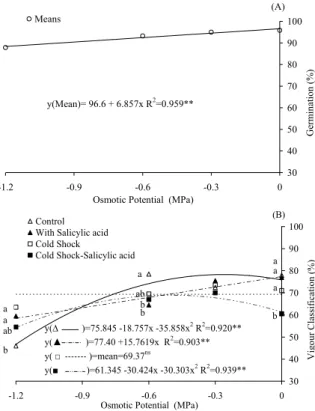
Cold shock and salicylic acid treatments did not affect seed germination at any of the osmotic potentials studied (Figure 1A). However, the germination rate was slightly reduced with increasing osmotic stress. The initial zero potential was 96.6% reduced at a rate of 0.68% per -0.1 MPa decrease in osmotic potential. Machado-Neto et al. (2006a) and Custódio et al. (2009a) observed different responses in germination and vigour in Phaesolus vulgaris for the same osmotic potentials and levels of stress; mannitol was a less harmful osmotic agent with high seed germinating until -0.6 MPa. However, Moraes et al. (2005) reported that treatments with NaCl or PEG 6000 at -0.2 MPa did not reduce germination below 90%, and lower osmotic potentials (-0.30 MPa) caused a drastic reduction in the germination percentage. These effects could be attributed to a reduction in water availability during cell development leading to a cascade of events, such as an increase in ROS forms, which culminates with cell death (KRANNER et al., 2010).
previous reports (CUSTÓDIO et al., 2009a; MORAES; MENEZES, 2003) showing that water stress imposed by osmotic solutions had a larger effect in vigour than in germination, because germination is less sensitive than vigour.
The CS treatment did not improve germination and vigour in bean seeds subjected to water restriction (Figure 1B). However, quadratic adjustment was the mathematical model that better fit the results (R2 = 0.939**) for seed germination
when cold shock and with salicylic acid (CS-SA) were applied to the seeds, with the higher value at -0.50 MPa.
While a zero potential CS-SA treatment had the lowest average, differing significantly from the other treatments, the vigour was potentially less restrictive, (Figure 1B), i.e., the untreated seeds presented higher means compared with the CS and SA treatments. Regarding the intermediate water restriction levels, the differences between the treatments were less pronounced. At -0.3 MPa, there was no difference, and at -0.6 MPa, the control treatment was higher but did not differ from the CS treatment. Applying salicylic acid to marigold seeds resulted in an inhibitory effect on the germination percentage (CARVALHO et al., 2007).
30 40 50 60 70 80 90 100
-1.2 -0.9 -0.6 -0.3 0
Osmotic Potential (MPa)
Ge
rm
inat
ion (%
)
xx
Means
y(Mean)= 96.6 + 6.857x R2=0.959**
(A)
30 40 50 60 70 80 90 100
-1.2 -0.9 -0.6 -0.3 0
Osmotic Potential (MPa)
V
ig
o
u
r C
la
ss
ifi
ca
ti
o
n
(%
)
xx
Control With Salicylic acid Cold Shock
Cold Shock-Salicylic acid
y(∆ )=75.845 -18.757x -35.858x2 R2=0.920** y(▲ )=77.40 +15.7619x R2=0.903** y( □ )=mean=69.37ns
y(■ )=61.345 -30.424x -30.303x2 R2=0.939** b a a a a
ab b b a
a ab
b
(B)
Figure 1. Germination (A) and vigour (B) of bean seeds treated with cold shock (7oC 24h-1) and salicylic acid (0.01 mM 48h-1),
submitted to different osmotic potentials with mannitol. At each osmotic potential, the same letters represent no significant differences by Tukey’s test (p < 0.05).
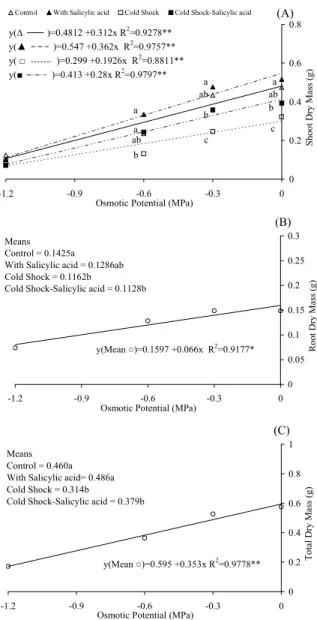
There was no significant interaction between the treatments and water deficiency for shoot length (Figure 2A), exhibiting a strong decrease at -1.2 MPa, a descending linear adjustment with the zero potential, 10.7 cm of shoot length and a decrease of 0.705 cm for each -0.1 MPa increase in water restriction. Machado-Neto et al. (2006a) concluded that there was a decrease in the size of the bean seedlings as the osmotic potential remained negative (-0.6 to -1.8 MPa) that could be attributed to less water availability, which negatively affects enzyme activities and, consequently, cell growth. Nevertheless, in the treatments used here, significant differences for shoot length were observed, indicating a higher growth in the control plants, followed by those treated with salicylic acid (SA), cold shock (CS) and finally the combination of shock and salicylic acid (CS-SA). Salicylic acid or cold shock could not prevent a lower shoot growth, but in these cases, there was a reserve mobilisation to root growth (Figure 2B), resulting in an increase in total seedling growth (Figure 2C).
For root length (Figure 2B), a significant linear fit was observed in the control group. Increasing the water restriction resulted in a decrease in root length, which Custódio et al. (2009a) also observed in beans exposed to four different potentials induced by three osmotic stressors. With CS, a quadratic adjustment in the reduced root growth was observed at an estimated -0.89 MPa, demonstrating that only the cold shock was not sufficient to mitigate the effects of reduced water on root growth. The SA and CS-SA treatments showed quadratic adjustments with maximum points for root growth estimated at -0.35 and -0.39 MPa, respectively.
With increased water availability, the root growth under the SA treatment was increased, followed by intermediate growth with under the combined CS-SA treatment and reduced growth under the other two treatments. At the largest water restriction, -1.2 MPa, growth under the SA treatment remained high and did not differ from growth under the cold shock with salicylic acid (CS-SA) treatment.
Acta Scientiarum. Agronomy Maringá, v. 35, n. 2, p. 209-219, Apr.-June, 2013 0 3 6 9 12 15
-1.2 -0.9 -0.6 -0.3 0
Osmotic Potential (MPa)
Sh oo t le ngt h (cm ) xx
y(Means ○)=10.736 +7.0526x R2=0.987** Means
Control = 10.653a With Salicylic acid = 8.012b Cold Shock = 5.575c
Cold Shock-Salicylic acid = 3.893d
(A) 0 5 10 15 20 25 30
-1.2 -0.9 -0.6 -0.3 0
Osmotic Potential (MPa)
R oot len g th ( cm ) xx
Control With Salicylic acid Cold Shock Cold Shock-Salicylic acid
y(∆ )=6.802 +4.914x R2=0.9065** y(▲ )=13.642 -10.35x -14.46x2 R2=0.999** y( □ )=6.01 -12.016x -6.712x2 R2=0.978** y(■ )=10.377 -9.922x -12.642x2 R2=0.939**
c c b a a b c c b a ab b a a b c (B) 0 5 10 15 20 25 30 35
-1.2 -0.9 -0.6 -0.3 0
Osmotic Potential (MPa)
To tal leng th ( cm ) xx
Control With Salicylic acid Cold Shock Cold Shock-Salicylic acid
y(∆ )=22.38 +14.29x R2=0.976** y(▲ )=25.59 -14.81x R2=0.918** y( □ )=16.39 +10.498x R2=0.957** y(■ )=16.81 -5.05x -12.597x2 R2=0.933**
b b ab a a b b b a a a b (C)
Figure 2. Shoot (A), root (B) and total length (C) of bean seeds treated with cold shock (7o
C 24h-1
) and salicylic acid (0.01 mM 48h-1), subjected to different osmotic potentials with mannitol. At
each osmotic potential, the same letters represent no significant differences by Tukey’s test (p < 0.05).
Salicylic acid was the determinant for the total length because when SA was used alone, the seedlings had higher total length; in combination with cold shock, there was no difference in growth as compared with the control at -0.6 MPa. At zero potential, salicylic acid (SA) was the superior treatment, although the effect was not different from the control. However, this result was in contrast with a previous study (ASHRAF et al., 2010), which demonstrated that salicylic acid tended to inhibit plant growth through the down regulation of lignin biosynthesis, resulting in the hardening of the secondary cell wall (GALLEGO-GIRALDO et al., 2011) or IAA synthesis (IGLESIAS et al., 2011), which inhibits plant growth. However, Khodary
(2004) and El-Tayeb (2005) showed that SA treatment improves plant growth. In this case, treatment with salicylic acid alone stimulated root growth in all conditions.
At the more drastic water potential, there were no differences between the treatments, while at a potential of -0.6 MPa, there was an increased emphasis with salicylic acid use (SA). Sakhabutdinova et al. (2003) concluded that salicylic acid use in wheat seedlings reduced the water deficiency and salinity injury and accelerated restoration of the growth processes.
For shoot dry matter (Figure 3A), we observed a mass reduction with an increase with the osmotic potential for all treatments, indicating that free water reduction reduced shoot development, with the allocation of lower cotyledon reserves to the shoot. All treatments showed linear adjustments, and an increased shoot mass in total water availability (0.0547 g) was observed under the SA treatment, with a 0.0362 g mass reduction rate for each -0.1 MPa reduction in osmotic potential, which was not different from the control. The CS treatment had the lowest initial mass calculated (0.299 g), with a decrease of 0.0192 g for each -0.1 MPa reduction in the potential.
Significant differences were observed between treatments at 0, -0.3 and -0.6 MPa, while the maximum water restriction showed no differences between treatments. Custódio et al. (2009c) also found that upon thermal shock treatment at 7°C or 33ºC for 24 hours, IAPAR 81 bean seeds demonstrated a better performance to water restriction in early development, as a clear cross tolerance response (temperature x water deficit) in that cultivar was observed. In this paper, tolerance was achieved by exposition to SA only and not to temperature. This result could be explained by the allocation of cotyledon reserves to root elongation instead of shoot elongation, which increases the length (Figure 2B and C) and dry mass (Figure 3B and C) of the root and consequently the whole seedling.
There was no significant interaction between the treatment and the osmotic potential for root dry mass (Figure 3B); therefore, these results were evaluated separately. In relation to water restriction, all treatments resulted in a reduced root mass (Figure 3B). Coelho et al. (2010) studied bean seeds cv. ‘Pérola’ under water stress with osmotic treatments simulated with mannitol, CaCl2, NaCl
and MgCl2 and observed a reduction in the shoot
0 0.2 0.4 0.6 0.8
-1.2 -0.9 -0.6 -0.3 0
Osmotic Potential (MPa)
Shoo
t
Dry M
ass (g)
xx
Control With Salicylic acid Cold Shock Cold Shock-Salicylic acid
y(∆ )=0.4812 +0.312x R2=0.9278** y(▲ )=0.547 +0.362x R2=0.9757** y( □ )=0.299 +0.1926x R2=0.8811** y(■ )=0.413 +0.28x R2=0.9797**
c b ab
a
a
a ab b
a ab
b
c
(A)
0 0.05 0.1 0.15 0.2 0.25 0.3
-1.2 -0.9 -0.6 -0.3 0
Osmotic Potential (MPa)
R
o
ot
Dry Mass (g)
xx
y(Mean ○)=0.1597 +0.066x R2=0.9177* Means
Control = 0.1425a With Salicylic acid = 0.1286ab Cold Shock = 0.1162b
Cold Shock-Salicylic acid = 0.1128b
(B)
0 0.2 0.4 0.6 0.8 1
-1.2 -0.9 -0.6 -0.3 0
Osmotic Potential (MPa)
To
ta
l
Dry
M
ass
(g
)
xx
y(Mean ○)=0.595 +0.353x R2=0.9778** Means
Control = 0.460a With Salicylic acid= 0.486a Cold Shock = 0.314b
Cold Shock-Salicylic acid = 0.379b
(C)
Figure 3. Shoot (A), root (B) and total dry masses (C) of bean seeds treated with cold shock (7o
C 24h-1
) and salicylic acid (0.01 mM 48h-1), submitted to different osmotic potentials with
mannitol. At each osmotic potential, the same letters represent no significant differences by Tukey’s test (p < 0.05).
The adjustment, considering the mean, was linear with a decrease in the initial mass of 0.159 g and reduced root mass of 0.0066 g decrease for each -0.1 MPa reduction in osmotic potential. Considering only the treatments used on the seeds in this study, the highest mass was observed for the control, with an average of 0.1425 g, which differed from the shock treatments with and without salicylic acid. However, treatment with SA treatment was not different, which remained at an intermediate position.
There was no significant interaction for total dry mass (Figure 3C) between the osmotic potential and treatments. Concerning the reduction of water availability, the total dry mass reduced was represented by a linear fit, showing 0.595 g of dry
mass at zero potential with a 0.353 g decrease for each MPa reduction in osmotic potential. As compared with the control treatment, treatment with SA was superior to the thermal shock treatments with and without salicylic acid. When salicylic acid was used alone, an increase in dry mass accumulation occurred. Singh and Usha (2003) and El-Tayeb and Ahmed (2010) showed a significant dry matter increase upon salicylic acid treatment in wheat. The removalof the adverse effects causedby the lack of water, mediated by salicylic acid,could be explained by the repression of IAA genes in the shoot, promoting its expression in roots (IGLESIAS et al 2011), increasing nitrogen uptake (SINGH et al., 2010), and increasing germination, length and dry matter (GHARIB; HEGAZI, 2010) in six bean cultivars.
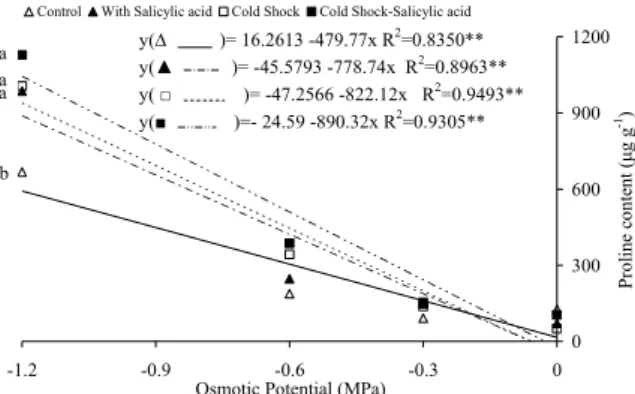
In all the treatments, there was proline accumulation (Figure 4) in relation to water restriction that increased with rising linear adjustments, suggesting that proline is an element of metabolism that favours the seedlings adjustment to water deficit. The use of salicylic acid, cold shock or both led to increased proline accumulation at higher osmotic potentials, demonstrating the possibility that the applied treatments to attenuate the water stress effects. In treatments without stress and under moderate water stress (-0.3 and -0.6 MPa), there was no difference in proline accumulation in the seedlings. Machado-Neto et al. (2004b) found that proline accumulation was not linear and was not temperature dependent. Hussein et al. (2007) observed that in maize plants, all amino acid concentrations were reduced by salt stress but not proline and glycine. Praxedes et al. (2009) found that in turgid cowpea leaves, the proline content remained constant. However, those subjected to water stress, accumulated proline suggesting an osmotic adjustment defence against dehydration. Proline has osmotic adjustment properties without causing any tissue damage compared with the adjustments made through ions (LIMA et al., 2004). Sakhabutdinova et al. (2003) reported that pre-treatment with salicylic acid could contribute to proline accumulation in wheat under stress.
Acta Scientiarum. Agronomy Maringá, v. 35, n. 2, p. 209-219, Apr.-June, 2013 during thermal stress, allowing normal function
when favourable temperatures are re-established. Protein dysfunction can be due to abiotic stresses. Maintaining proteins in their functional conformation is important for cell survival under stress. The heat shock proteins (HSPs) are responsible for winding, assembly, translocation, and degradation and may also assist in the refolding of proteins and membranes under stress conditions (WANG et al., 2004).
0 300 600 900 1200
-1.2 -0.9 -0.6 -0.3 0
Osmotic Potential (MPa)
Pr
oline c
o
ntent (
μ
g g
-1)
xx
Control With Salicylic acid Cold Shock Cold Shock-Salicylic acid
y(∆ )= 16.2613 -479.77x R2=0.8350** y(▲ )= -45.5793 -778.74x R2=0.8963** y( □ )= -47.2566 -822.12x R2=0.9493** y(■ )=- 24.59 -890.32x R2=0.9305**
b a a a
Figure 4. Proline determination in seedlings of bean seeds treated with cold shock (7oC 24h-1) and salicylic acid (0.01 mM
48h-1), submitted to different osmotic potentials with mannitol.
At each osmotic potential, the same letters represent no significant differences by Tukey’s test (p < 0.05).
Protein expression in the untreated shoots bean seedlings (Control), not subjected to water restriction, is shown in column 7B (Figure 5A), with bands at 106, 102, 67, 55, 40, 30, 22, 19 and 17 kDa representing the normal protein pattern. The electrophoretic pattern from water stress application in untreated seeds (Control) is presented in columns 8, 9 and 10B (Figure 6A) where additional bands at 76 and 45 kDa (column 9B, -0.6 MPa) and 90 and 85 kDa bands (column 10B, -1.2 MPa) can be observed, indicating a metabolic response to applied water restriction. The lowest hydric restriction (-0.3 MPa, column 8B) was not different from the control (column 7B).
The seeds treated only with cold shock (CS) showed a distinctive band, as compared with the control (column 7B), of 45 kDa at zero and -0.3 MPa potential (Figure 5A - columns 2 and 3B). In the lower potentials, a complete loss of the protein pattern was observed (Figure 5A - columns 4 and 6B).
Under CS-SA or SA treatment, we observed the additional expression of bands at 94, 88, 85, 81, 65, 45 and 37 kDa and the absence of a 67 kDa band at all levels of osmotic potential in columns 2, 3, 4, 5, 7, 8, 9 and 10A (Figure 5A). The data shown here are consistent with the observations of Snyman and Cronjé (2008) where salicylic acid had an inhibitory
effect on the HSP70 family. The expression of these proteins expression might have greater effects on physiological response, such as dry mass, with the best performance under treatment with salicylic acid, as shown by Singh and Usha (2003), where the dry mass of wheat plants under water stress and salicylic acid treatment was significantly higher than without the salicylic acid treatment.
The protein expression in the roots of untreated bean seedlings (Control) is shown in column 7B (Figure 5B) with bands at 63, 50, 45, 43, 40, 30, 26, 22, 19 and 17 kDa representing the normal protein profile. The electrophoretic pattern from water stress application in the untreated seeds (Control) is presented in columns 8, 9 and 10B (Figure 5B) and the expression of a 102 and 72 kDa band in columns 9 and 10B (-0.6 and -1.2 MPa) can be observed, suggesting a metabolic response to applied water restriction. The lowest hydric restriction (-0.3 MPa, column 8B) showed a profile similar to that of the control (column 7B). The seeds treated only with cold shock (CS) had four differential bands at 116, 106, 102 and 90 kDa in all potentials (columns 2, 3, 4 and 5B, Figure 5B) as compared with the control (column 7B).
Under treatments with salicylic acid, CS-SA or SA, the expression of additional protein bands at 106 and 102 kDa relative to the column 7B, and the reduced expression of the 50 and 26 kDa bands in all levels of osmotic potential (columns 2, 3, 5, 6, 7, 8, 9 and 10A, Figure 5B) was observed. Salicylic acid also reduced the expression of a 72 kDa band, which is consistent with the data of Snyman and Cronjé (2008).
CS-SA WSA CS Control 2A 3A 4A 5A 7A 8A 9A 10A 2B 3B 4B 6B 7B 8B 9B 10B MW
(KDa) MM
0 -0.3 -0.6 -1.2 0 -0.3 -0.6 -1.2 0 -0.3 -0.6 -1.2 0 -0.3 -0.6 -1.2 118
106
102
94 90
88
85
81 76
67
65
55 50
45
40
37 34
30 26
22
19
17
CS-SA WSA CS Control MW
(KDa) MM
2A 3A 4A 6A 7A 8A 9A 10A 2B 3B 4B 5B 7B 8B 9B 10B 0 -0.3 -0.6 -1.2 0 -0.3 -0.6 -1.2 0 -0.3 -0.6 -1.2 0 -0.3 -0.6 -1.2 118
116
106
102 90
72
63
50
45
43
40 34
30
26
22
19
17
Figure5. Soluble protein draft pattern of the shoot (A) and root (B) of bean seedlings treated with cold shock (7oC 24h-1) and salicylic
acid (0.01 mM 48h-1), subjected to different osmotic potentials using mannitol. Columns 1A and 1B are missing in both Figures; 6A and
5B in Figure A and 5A and 6B in Figure B are the lanes of molecular markers. Treatments are named after the interaction between osmotic potential and the application or not of shock and salicylic acid.
These two factors, proline accumulation and HSP expression, could improve plant quality under treatments with salicylic acid by enhancing the
results for all variables based on plant development and seedlings that are less sensitive to water stress. The literature shows that there are two mechanisms A
Acta Scientiarum. Agronomy Maringá, v. 35, n. 2, p. 209-219, Apr.-June, 2013 to alleviate stress effects: i) pre-treatment without
elicitor application (CUSTÓDIO et al., 2009c; MEI; SONG, 2008, 2010; SABEHAT et al., 1998; SONG et al., 2005) and ii) pre-treatment with elicitor application, such as salicylic acid (CARVALHO et al., 2007; McCUE et al., 2000; SAKHABUTDINOVA et al., 2004). However, the results obtained in this project showed better results in seedling development with salicylic acid use, even though both treatments (salicylic acid and cold shock) promoted biochemical routes of stress tolerance, such as proline accumulation and protein expression or suppression.
Conclusion
Seed treatment with salicylic acid at 0.01 mM for 48h showed promise for partially mitigating water deficit during the early growth of bean seedlings.
References
AL-WHAIBI, M. H. Plant heat-shock proteins: a mini
review. Journal of King Saud University – Science,
v. 23, n. 2, p. 139-150, 2011.
ASHRAF, M.; AKRAM, N. A.; ARTECA, R. N.; FOOLAD, M. R. The physiological, biochemical and molecular roles of brassinosteroids and salicylic acid in
plant processes and salt tolerance. Critical Reviews in
Plant Sciences, v. 29, n. 3, p. 162-190, 2010.
BRADFORD, M. M. A rapid and sensitive method for
the quantitation of microgram quantities of protein
utilising the principle of protein-dye binding. Analytical
Biochemistry, v. 72, n. 1-2, p. 248-254, 1976.
BRASIL. Ministério da Agricultura e Reforma Agrária.
Regras para análises de sementes. Brasília:
SNDA/DNDV/CLAV, 2009.
CARVALHO, P. R.; MACHADO-NETO, N. B.; CUSTÓDIO, C. C. Ácido salicílico em sementes de
calêndula (Calendula officinalis L.) sob diferentes estresses.
Revista Brasileira Sementes, v. 29, n. 1, p. 114-124, 2007.
COELHO, D. L. M.; AGOSTINI, E. A. T.; GUABERTO, L. M.; MACHADO-NETO, N. B.; CUSTÓDIO, C. C. Estresse hídrico com diferentes osmóticos em sementes de feijão e expressão diferencial de
proteínas durante a germinação. Acta Scientiarum.
Agronomy, v. 32, n. 3, p. 491-499, 2010.
CUSTÓDIO, C. C.; SALOMÃO, G. R.; MACHADO-NETO, N. B. Estresse hídrico na germinação e vigor de sementes de feijão submetidas a diferentes soluções
osmóticas. Revista Ciência Agronômica, v. 40, n. 4,
p. 617-623, 2009a.
CUSTÓDIO, C. C.; BOMFIM, D. C.; SATURNINO, S. M.; MACHADO-NETO, N. B. Estresse por alumínio
e por acidez em cultivares de soja. Scientia Agricola,
v. 59, n. 1, p. 145-153, 2002.
CUSTÓDIO, C. C.; MACHADO-NETO, N. B.; MORENO, E. L. C.; VUOLO, B. G. Water submersion
of bean seeds in the vigour evaluation. Revista Brasileira
de Ciências Agrárias, v. 4, n. 3, p. 261-266, 2009b.
CUSTÓDIO, C. C.; VIVAN, M. R.; NUNES, R. C. A.; AGOSTINI, E. A. T. Tolerância cruzada induzida por choque térmico na germinação de sementes de feijão.
Revista Brasileira de Sementes, v. 31, n. 1, p. 131-143,
2009c.
EL-TAYEB, M. A. Response of barley grains to the
interactive effect of salinity and salicylic acid. Plant
Growth Regulation, v. 45, n. 3, p. 212-224, 2005.
EL-TAYEB, M. A.; AHMED, N. L. Response of wheat
cultivars to drought and salicylic acid.
American-Eurasian Journal of Agronomy, v. 3, n. 1, p. 1-7, 2010.
FERREIRA, D. F. SISVAR: programa para análises e
ensino de estatística. Revista Symposium, v. 6, n. 2,
p. 36-41, 2008.
GALLEGO-GIRALDO, L.; ESCAMILLA-TREVINO, L.; JACKSON, L. A.; DIXON, R. A. Salicylic acid mediates the reduced growth of lignin down-regulated
plants. Proceedings of the National Academy of
Science, v. 108, n. 51, p. 20814-20819, 2011.
GHARIB, F. A.; HEGAZI, A. Z. Salicylic acid ameliorates germination, seedling growth, phytohormone and enzymes
activity in bean (Phaseolus vulgaris L.) under cold stress.
Journal of American Science, v. 6, n. 10, p. 675-683, 2010.
GUPTA, S. C.; SHARMA, A.; MISHRA, M.; MISHRA, R.; CHOWDHURI, D. K. Heat shock proteins in
toxicology: how close and how far? Life Science, v. 86,
n. 11-12, p. 377-384, 2010.
HUSSEIN, M. M.; BALBAA, L. K.; GABALLAH, M. S. Salicylic acid and salinity effects on growth of maize
plants. Research Journal of Agriculture and
Biological Sciences, v. 3, n. 4, p. 321-328, 2007.
IGLESIAS, M. J.; TERRILE, M. C.; CASALONGUÉ, C. A. Auxin and salicylic acid signalling counteract during the
adaptive response to stress. Plant Signalling and
Behavior, v. 6, n. 3, p. 452-454, 2011.
KHODARY, S. E. A. Effect of salicylic acid on the growth, photosynthesis and carbohydrate metabolism in
salt-stressed maize plants. International Journal of
Agriculture and Biology, v. 6, n. 1, p. 5-8, 2004.
KISHOR, P. B. K.; SANGAM, S.; AMRUTHA, R. N.; SRI LAXMI, P.; NAIDU, K. R.; RAO, K. R. S. S.; RAO, S.; REDDY, K. J.; THERIAPPAN, P.; SREENIVASULU, N. Regulation of proline biosynthesis, degradation, uptake and transport in higher plants: its implications in plant
growth and abiotic stress tolerance. Current Science,
v. 88, n. 3, p. 424-438, 2005.
KIYOSUE, T.; YOSHIBA, Y.; YAMAGUCHI-SHINOZAKI, K.; YAMAGUCHI-SHINOZAKI, K. A nuclear encoding mitochondrial proline dehydrogenase: an enzyme involved in proline metabolism, is upregulated by proline
but down regulated by dehydration in Arabidopsis. Plant
Cell, v. 8, n. 8, p. 1323-1335, 1996.
KRANNER, I.; MINIBAYEVA, F.; BECKETT, R.; SEAL, C. E. What is stress? Concepts, definitions and
applications in seed science. New Phytologist, v. 188,
LAEMLI, U. K. Cleavage of structural proteins during
assembly of the head of bacteriophage T4. Nature, v. 227,
n. 5259, p. 680-685, 1970.
LEI, Y.-B.; SONG, S.-Q.; FU, J.-R. Possible involvement of anti oxidant enzymes in the cross tolerance of the germination/growth of wheat seeds to salinity and heat
stress. Journal of Integrative Plant Biology, v. 47,
n. 10, p. 1211-1219, 2005.
LIMA, M. D. S.; LOPES, N. F.; BACARIN, M. A.; MENDES, C. R. Efeito do estresse salino sobre a concentração de pigmentos e prolina em folhas de arroz.
Bragantia, v. 63, n. 3, p. 335-340, 2004.
LIN, C.-Y.; ROBERTS, J. E.; KEY, J. L. Acquisition of
Thermotolerance in Soybean Seedlings. Plant
Physiology, v. 74, n. 1, p. 152-160, 1984.
MACHADO-NETO, N. B.; CUSTÓDIO, C. C.; COSTA, P. C.; DONÁ, F. L. Deficiência hídrica induzida por diferentes agentes osmóticos na germinação e vigor de
sementes de feijão. Revista Brasileira de Sementes,
v. 28, n. 1, p. 142-148, 2006a.
MACHADO-NETO, N. B.; GATTI, A. B.; PRIOLLI, M. R.; CARDOSO, V. J. M. Temperature effects on seed
germination in races of common beans (Phaseolus vulgaris L.).
Acta Scientiarum. Agronomy, v. 28, n. 2, p. 155-164,
2006b.
MACHADO-NETO, N. B.; SATURNINO, S. M.; BOMFIM, D. C.; CUSTÓDIO, C. C. Hydric stress induced by mannitol and sodium chloride in soybean
cultivars. Brazilian Archives of Biology and
Technology, v. 47, n. 4, p. 521-529, 2004a.
MACHADO-NETO, N. B.; CUSTÓDIO, C. C.; GATTI, A. B.; PRIOLLI, M. R.; CARDOSO, V. J. M. Proline: use as an indicator of temperature stress in bean
seeds. Crop Breeding and Applied Biotechnology,
v. 4, n. 3, p. 330-337, 2004b.
MAIA, P. S. P.; OLIVEIRA NETO, C. F.; CASTRO, D. S.; LOBATO, A. K. S.; SANTOS, P. C. M.; COSTA, R. C. L. Conteúdo relativo de água, teor de prolina e carboidratos solúveis totais em folhas de duas cultivares de milho submetidas a estresse hídrico.
Revista Brasileira de Biociências, v. 5, supl. 2, 918-920,
2007.
McCUE, P.; ZHENG, Z.; PINKHAM, J.; SHETTY, K. A model for enhanced pea seedling vigour following low
pH and salicylic acid treatments. Processes
Biochemistry, v. 35, n. 6, p. 603-613, 2000.
MEI, Y. Q.; SONG, S. Q. Cross-tolerance associated with temperature and salinity stress during germination of
barley seeds. Seed Science and Technology, v. 36, n. 3,
p. 689-698, 2008.
MEI, Y. Q.; SONG, S. Q. Response to temperature stress of reactive oxygen species scavenging enzymes in
cross-tolerance of barley seed germination. Journal of
Zhejiang University – Science B (Biomedicine and
Biotechnology), v. 11, n. 12, p. 965-972, 2010.
MORAES, G. A. F.; MENEZES, N. L. Desempenho de sementes de soja sob condições diferentes de potencial
osmótico. Ciência Rural, v. 33, n. 2, p. 219-226, 2003.
MORAES, G. A. F.; MENEZES, N. L.; PASQUALLI, L. L. Comportamento de sementes de feijão sob diferentes
potenciais osmóticos. Ciência Rural, v. 35, n. 4, p. 776-780,
2005.
NAKAGAWA, J. Testes de vigor baseados nos desempenhos das plântulas. In: KRZYZANOWSKI, F. C.;
VIEIRA, R. D.; FRANÇA-NETO, J. B. (Ed.). Vigor de
sementes: conceitos e testes. Londrina: Abrates, 1999.
p. 21-24.
NEPOMUCENO, A. L.; STEWART, J. M.; OOSTEHUIS, D. M.; TURKEY, R.; NEUMAIER, N.; FARIAS, J. R. B. Isolation of a cotton NADP(H) oxidase
homologue induced by drought stress. Pesquisa
Agropecuária Brasileira, v. 35, n. 7, p. 1407-1416, 2000.
PARCELLIER, A.; GURBUXANI, S.; SCHMITT, E.; SOLARY, E.; GARRIDO, C. Heat shock proteins, cellular chaperones that modulate mitochondrial cell death
pathways. Biochemical and Biophysical Research
Communications, v. 304, n. 3, p. 505-512, 2003.
PRAXEDES, S. C.; FERREIRA, T. M.; GOMES FILHO, E. Acúmulo de prolina e aminoácidos em cultivares de feijão caupi com tolerância diferencial à salinidade.
Caatinga, v. 22, n. 3, p. 211-214, 2009.
SABEHAT, A.; WEISS, D.; LURIE, S. Heat shock
proteins and cross-tolerance in plants. Physiologia
Plantarum, v. 103, n. 3, p. 437-441, 1998.
SAKHABUTDINOVA, A. R.; FATKHUTDINOVA, D. R.; SHAKIROVA, F. M. Effect of salicylic acid on the activity of antioxidant enzymes in wheat under conditions
of salination. Applied Biochimistry Microbiology,
v. 40, n. 5, p. 501-505, 2004.
SAKHABUTDINOVA, A. R.; FATKHUTDINOVA, D. R.; BEZRUKOVA, M. V.; SHAKIROVA, F. M. Salicylic acid prevents the damaging action of stress factors on
wheat plants. Bulgarian Journal of Plant Physiology,
v. 21, Special Issue, p. 314-319, 2003.
SHI, Q.; BAO, Z.; ZHU, Z.; YING, Q.; QIAN, Q. Effects of different treatments of salicylic acid on heat tolerance, chlorophyll fluorescence, and antioxidant enzyme activity in
seedlings of Cucumis sativa L. Russian Journal of Plant
Physiology, v. 52, n. 2 , p. 793-800, 2005.
SINGH, B.; USHA, K. Salicylic acid induced physiological
and biochemical in wheat seedlings under water stress. Plant
Growth Regulation, v. 39, n. 2, p. 137-141, 2003.
SINGH, P. K.; CHATURVEDI, V. K.; BOSE, B. Effects of salicylic acid on seedling growth and nitrogen metabolism in
cucumber (Cucumis sativus L.). Journal of Stress
Physiology and Biochemistry, v. 6, n. 3, p. 102-113, 2010.
SNYMAN, M.; CRONJÉ, M. J. Modulation of heat shock factors accompanies salicylic acid-mediated
potentiation of Hsp70 in tomato seedlings. Journal of
Experimental Botany, v. 59, n. 8, p. 2125-2132, 2008.
SONG, S. Q.; LEI, Y. B.; TIAN, X. R. Proline metabolism and cross-tolerance to salinity and heat stress
in germinating wheat seeds. Russian Journal of Plant
Physiology, v. 52, n. 6, p. 793-800, 2005.
Acta Scientiarum. Agronomy Maringá, v. 35, n. 2, p. 209-219, Apr.-June, 2013
de cultivares de soja quanto à tolerância ao estresse em
substrato contendo polietileno glicol. Acta Scientiarum.
Agronomy, v. 30, n. 2, p. 217-223, 2008.
VALENTE, M. A. S.; FARIA, J. A. Q. A.; SOARES-RAMOS, J. L. R.; REIS, P. A. B.; PINHEIRO, G. L.; PIOVESAN, N. D.; MORAIS, A. T.; MENEZES, C. C.; CANO, M. A. O.; FIETTO, L. G.; LOUREIRO, M. E.; ARAGÃO, F. J. L.; FONTES, E. P. B. The ER luminal binding protein (BiP) mediates an increase in drought tolerance in soybean and delays drought-induced leaf
senescence in soybean and tobacco. Journal of
Experimental Botany, v. 60, n. 2, p. 533-546, 2009.
VERDOY, D.; LUCAS, M. M.; MANRIQUE, E.; COVARRUBIAS, A. A.; FELIPE, M. R.; PUEYO, J. J. Differential organ-specific response to salt stress and water
deficit in nodulated bean (Phaseolus vulgaris L.). Plant,
Cell and Environment, v. 27, n. 6, p. 757-767, 2004.
WANG, W.; VINOCUR, B.; SHOSEYOV, O.; ALTMAN, A. Role of plant heat-shock proteins and molecular chaperones in the abiotic stress response.
Trends in Plant Science, v. 9, n. 5, p. 244-252, 2004.
Received on February 6, 2012. Accepted on March 26, 2012.