Nitrogen fertilization in consecutive cycles and
its impact on high-density peach crops
Letícia Vanni Ferreira(1), Luciano Picolotto(2), Ivan dos Santos Pereira(3), Juliano Dutra Schmitz(4) and Luis Eduardo Corrêa Antunes(1)
(1)Embrapa Clima Temperado, Rodovia BR-392, Km 78, Caixa Postal 403, CEP 96001-971 Pelotas, RS, Brazil. E-mail: [email protected],
[email protected] (2)Universidade Federal de Santa Catarina, Caixa Postal 101, CEP 89520-000 Curitibanos, SC, Brazil. E-mail:
[email protected] (3)Universidade Federal de Pelotas, Caixa Postal 354, CEP 96010-900 Pelotas, RS, Brazil. E-mail: [email protected] (4)Instituto Federal Catarinense, Campus Concórdia, Rodovia SC-283, Km 08, Caixa Postal 58, CEP 89703-720 Concórdia, SC, Brazil.
E-mail: [email protected]
Abstract – The objective of this work was to evaluate the effect of nitrogen fertilization on the mineral composition of leaves, initial growth, and yield of peach (Prunus persica) tree advanced selections grown at a high-planting density. The experiment was carried out between 2012 and 2015 in a randomized complete block design, with a combination of advanced selections of the 'Cascata 1513' and 'Cascata 1067' peach trees and of N fertilization doses (0, 30, 60, and 120 kg ha-1 N). Green weight after pruning, diameter, and increase of trunk diameter, canopy volume, plant height, branch length, number of buds per centimeter of shoot, chlorophyll index, leaf area, rust incidence, average production, number of fruit, and mass of fruit were evaluated. Genotype affects the vegetative growth and productive performance of peach trees. The application of N to dense peach orchards promotes a greater vegetative growth of the plants and increases the content of the nutrient in leaves. The initial production is affected by N fertilization. The recommendation of N fertilization made to date is insufficient for peach trees at high-density management systems of production. Index terms: Prunus persica, growth, nitrogen, nutrition, planting density.
Adubação nitrogenada em ciclos consecutivos e seu
impacto no manejo adensado de pessegueiro
Resumo – O objetivo deste trabalho foi avaliar o efeito da adubação nitrogenada na composição mineral das folhas, no crescimento inicial e na produção inicial de seleções avançadas de pessegueiro (Prunus persica) cultivadas em alta densidade de plantio. O experimento foi conduzido entre 2012 e 2015 em delineamento em blocos ao acaso, com a combinação de seleções avançadas de pessegueiro 'Cascata 1513' e 'Cascata 1067' e de doses de adubação nitrogenada (0, 30, 60 e 120 kg ha-1 de N). A massa de poda, diâmetro e incremento do diâmetro de tronco, volume de copa, altura de plantas, comprimento de ramos, número de gemas por centímetro de ramo, índice de clorofila, área foliar, incidência de ferrugem, produção média e o número e a massa de frutos foram avaliados. O genótipo influencia o crescimento vegetativo e o desempenho produtivo do pessegueiro. A aplicação de N em pomares adensados promove maior crescimento vegetativo das plantas e aumenta o teor do nutriente nas folhas. A produção inicial é influenciada pela adubação nitrogenada. A recomendação de adubação nitrogenada feita até o presente é insuficiente para pessegueiros conduzidos em sistemas de produção adensada.
Termos para indexação: Prunus persica, crescimento, nitrogênio, nutrição, densidade de plantio.
Introduction
Orchard nutrition is a major factor affecting productivity and requires a balanced nutrient supply that should be achieved by fertilizer supplementation (Amorim et al., 2015). However, the addition of fertilization products should only be considered when it is economically feasible (Freire & Magnani, 2014).
Peach growers in the state of Rio Grande do Sul have adopted higher-planting density systems, aiming at the
increase of crop yield starting in the first year (Mayer &
Although low and medium densities of peach tree planting are still predominant worldwide, higher-planting density is a trend in countries such as Slovenia, Italy, South Africa, and United States, with more than 1,300 plants per hectare (Loreti & Massai, 2002, 2006; Marini & Reighard, 2008). One of the effects of high-density planting is a greater competition for nutrients among plants, which affects fertilizer requirements and application recommendations.
The current fertilizer recommendations for peach tree crops do not yet take into consideration the increased planting density of this crop, and consider only soil organic matter content in relation to the orchard age. The amount of fertilizer recommended by the fertilizer and liming guidelines for the states of Rio Grande do Sul and Santa Catarina (Manual…, 2016) is
20 to 80 kg ha-1 N per year. These guidelines provide
recommendations on fertilization for populations of up to 400 plants per hectare. There is no guidance regarding N dose that should be applied in an orchard with a higher density of plants. According to Sete et al. (2015), the N accumulated in the plants throughout crop seasons contributes to increase peach tree yield.
Given the low-mean yield of peach trees in the state of Rio Grande do Sul, the scarcity of adequate guidance, and the rationale for different fertilizer recommendations in high-density orchards, it is presumed that high-density planting requires the use of higher doses of N than those recommended in the Manual… (2016).
The objective of this work was to evaluate the effect of nitrogen fertilization on the mineral composition of leaves, initial growth, and yield of peach tree advanced selections grown at a high-planting density.
Materials and Methods
The experiment was conducted in field conditions,
from August 2012 to 2016 in the experimental area of Embrapa Clima Temperado, in the municipality of Pelotas, in the state of Rio Grande do Sul, at 31º40'41"S, 52º26'22"W, and 70 m altitude. According
to the Köppen-Geiger’s classification, the climate
of the region is of Cfa type, that is, humid with hot summers. Rainfall and air temperature data during the experimental period are shown in Figure 1. The soil is moderately deep, with an intermediate texture in the A-horizon, and clayey texture in the B-horizon,
classified as a Latossolo Vermelho-Amarelo (Santos et
al., 2006), i.e., a Typic Haplustox.
The spacing adopted between plants was 1.5x5.0 m, with a planting density of 1,333 plants per ha. The 'Capdeboscq' rootstock was used for grafting the scions 'Cascata 1513' and 'Cascata 1067' – which are advanced selections of the genetic improvement program of Embrapa Clima Temperado, both of which have the potential to be marketed because of their intense red color that is appealing to consumers. 'Cascata 1067' is very productive and bears large-sized fruit. 'Cascata 1513' bears smaller fruit, but has a typical crunchiness, which is preferred by the consumers, and is grown in a y-shaped training system.
Soil samples from the 0–20 cm depth layer of the experimental area were collected in 2012 and analyzed according to Manual…, (2016), indicating: 4.6 pH in
H2O (considered very low); 3.4 cmolc dm-3 H+Al (low);
13 g kg-1 organic matter; 1.4 cmol
c dm-3 Ca (low);
1.4 cmolc dm-3 Mg (high); 17.9 mg dm-3P (intermediate);
and 75.0 mg dm-3 K (high).
Pre-planting liming and fertilization with P and K were performed according to the fertilizer and liming guidelines. Liming was performed three months before planting the seedlings, in May 2012, and pre-planting fertilization was performed one month before planting, in July 2012. The soil received 130
kg ha-1 P
2O5 and 30 kg ha-1 K2O (Manual…, 2016),
and orchard management was performed according to the standards for integrated peach tree production (Fachinello et al., 2003). Nitrogen fertilization for
the growth period was provided during the first three
years of the orchard establishment (2012, 2013, and
2014). Increasing doses of N (0, 30, 60, and 120 kg ha-1
N) were applied at three different times (August, November, and February) each year. Urea containing 45% N was used as the fertilizer source.
The following plant variables were analyzed during the years 2013, 2014, and 2015: green weight after pruning, that is the weight of the material removed from the two central plants of the plots, during two separate pruning times (summer and winter pruning), expressed as grams per plant; trunk diameter, which was obtained from two measurements, taken with a digital pachymeter at 20 cm height above the soil, in the two central plants of the plot; trunk diameter increase,
which is the difference in diameter between the first
first and the last year; canopy volume, which was
measured in three central plants of the plots and calculated according to the method described by Rossi
(2004), using the equation V = [(L/2) × (E/2) × A × π]/3, in which V is the volume of the canopy, L is the distance
between the main branches, E is the mean thickness of the main branches, and A is the height of the canopy; plant height, which was measured from soil level to the tip of the plant (cm); branch length, obtained by calculating the mean length (cm) of two productive branches per plant, which were randomly selected from the middle part of the canopy of two central plants of the plots; number of buds per centimenter, obtained by calculating the ratio between the branch length (cm)
and the number of buds (vegetative and flowering);
total chlorophyll index, which was measured using
a chlorophyll meter ClorofiLOG (Falker Automação Agrícola Ltda., Porto Alegre, RS, Brazil); and specific
leaf area and rust incidence caused by Tranzschelia
discolor (Fuckel) Tranzschel and Litv.,obtained from a sample comprising 20 leaves matured by treatment and removed from the middle third of the canopy.
Yield variables were assessed in 2013, 2014, and 2015, after the establishment of the orchard. They were obtained by collecting and weighing the fruit produced by the two central plants of each plot; mean fruit mass
(estimated by dividing the total mass of the fruit in each plant by the number of fruit collected per plant), and number of fruit per plant (obtained by counting the fruit collected per plant).
The experiment used a randomized block design (RBD) with subdivided plots according to a 2x4 factorial arrangement, that is, two genotypes ('Cascata 1067' and 'Cascata 1513') and four N doses (0, 30, 60,
and 120 kg ha-1 N), with four replicates of four plants.
The results were subjected to the analysis of variance, and the Tukey’s test was performed, at 5% probability. The statistical analyses were performed using the Sisvar software, version 5.1 (Ferreira, 2014).
Results and Discussion
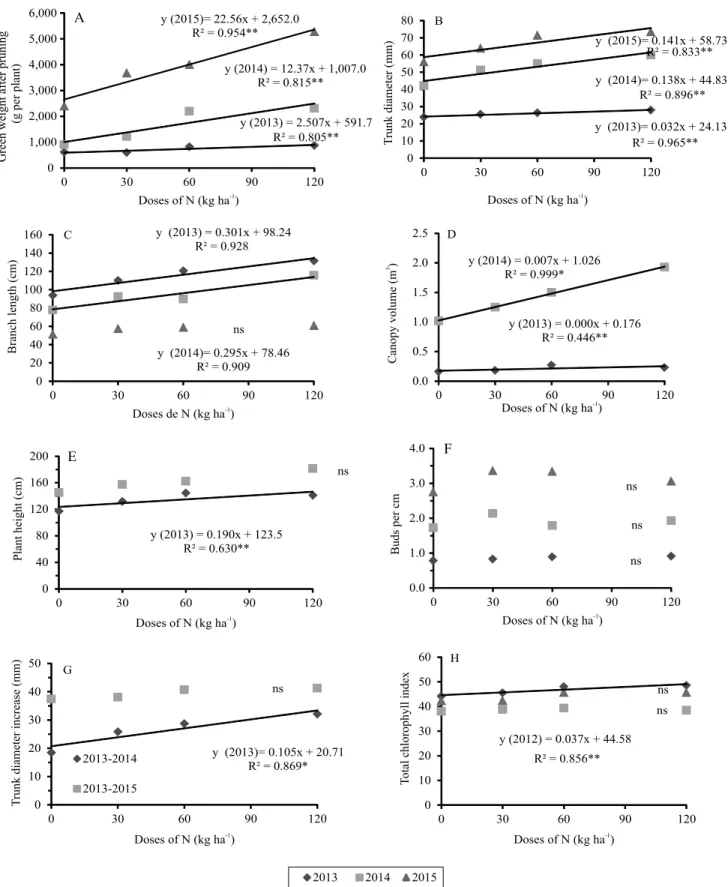
Nitrogen doses promoted a linear increase of green weight after pruning, trunk diameter, branch length, canopy volume, and plant height of the assessed peach genotypes (Figures 2 A, B, C, D, and E). These results were similar to those observed by Dias et al. (2012) and Della Bruna & Back (2014), who reported that increasing doses of N led to an increase of vegetative development.
According to Nunes et al. (2008), maximal N in plant contributes to the increase of plant height, trunk diameter, and fresh biomass of the aerial parts. Nitrogen
0 50 100 150 200 250 300 350
Jan. Feb. Mar. Apr. May June July Aug. Sept. Oct. Nov. Dec. Month
2012 2013 2014 2015 Historical climate normal
Rainfall (mm)
is considered the most important nutrient for peach tree (Ferreira et al., 2016) and it is required in large amounts (Pereira et al., 2015). According to Rombolà et al. (2012), assimilation of mineral nutrients by young plants is essential during the early establishment of the orchard, particularly, for the growth of the trees.
Additionally, the recommended N dose for a specific
region should take into account the density of plants in the orchard, among other aspects (Ferreira et al., 2016).
The number of vegetative buds per centimeter of branch was not affected by any of the studied factors (Figure 2 F), which is in agreement with the observations reported by Della Bruna & Back (2014). These authors
also did not find differences in the number of vegetative
buds between the treatments involving different doses of N to Aurora and Chimarrita cultivars in southern Santa Catarina.
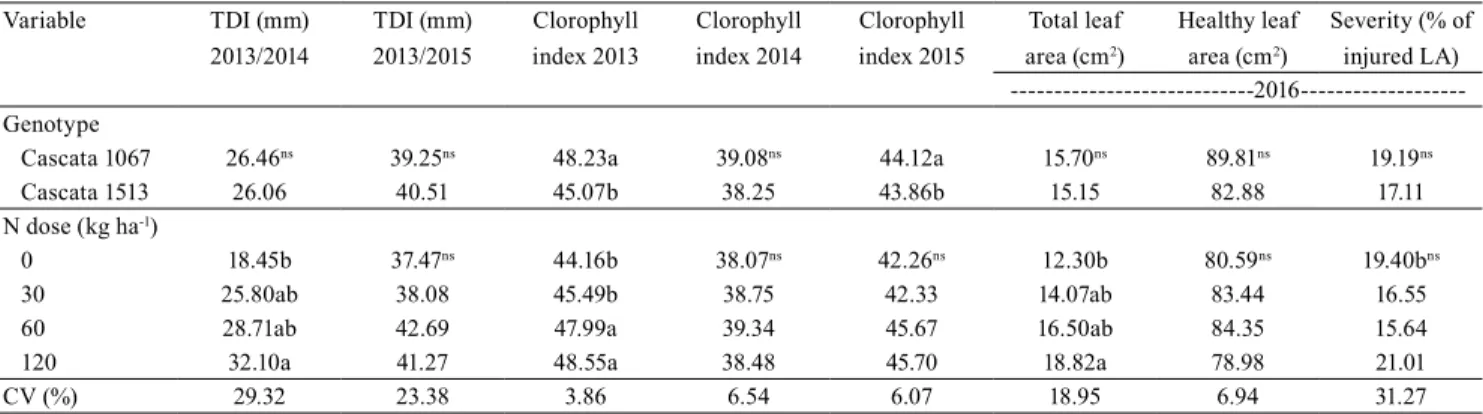
The scion Cascata 1067 cultivar had a higher chlorophyll index than Cascata 1513 during the study period (Table 1). This fact indicates that one of the studied genotypes has a greater photosynthetic capacity; it may also explain the increase of its vegetative growth, which was evident from a higher-green weight after pruning, canopy volume, trunk diameter, plant height, branch length, and buds per centimeter of branch (Table 2). When N dose was increased only in 2013, the chlorophyll index was positively impacted, and a direct linear relationship was observed (Figure 2 H). These results are in agreement with that reported by Leal et al. (2007). Furthermore, the chlorophyll content also positively correlates with N doses (Pereira et al., 2015). This is partly because N is a component of the chlorophyll molecule (Leonardo et al., 2013; Taiz & Zeiger, 2013). Leaf area between the assessed genotypes were comparable, however, it increased in both cultivars with increasing N application (Table 1).
Similar results were obtained by Guarçoni & Ventura
(2011), who reported that the increase of the N amount led to an increase of leaf length. According to Medeiros et al. (2004), the addition of N promotes cell division, and it is involved in growth and development (Oliveira et al., 2015).
During the study period in 2014 and 2015, no changes in the chlorophyll index was observed across all N treatments. The absence of any effect may be attributed to a higher consumption of N which resulted in a higher yield in 2014, or to drainage of nutrients, or even to an increased output of N in the fruit. Therefore,
the chlorophyll index remained unchanged even at the highest doses of N. According to Leal et al. (2007), N is a component of chlorophyll molecule and is required for photosynthesis. These authors state that, in the absence of N, the chlorophyll photosynthesis is affected. The lack of energy production impacts some vital functions, such as the absorption of nutrients and the production of carbohydrates that are necessary for the reproductive development.
There were no differences between the genotypes for change in trunk diameter, during the years 2014 and 2015 (Table 2); however, a proportionate increase in this parameter was observed when N application was increased (Figure 2 B). This result is similar to those obtained by Nunes et al. (2008), who observed that the increase of N content in the tissues of grafted plants onto the 'Aldrighi' rootstock led to a increase of trunk diameter. Rocha et al. (2007) suggested that this variable is related to the capacity of the rootstock to impact plant vigor, which in turn may be related to the capacity of the rootstock to absorb available N in the soil.
Both studied cultivars did not have any effect on the severity of peach rust at all doses of N tested (Table 1).
Interestingly, this finding contradicts Dolinski et al.
(2012), who reported that the severity of rust reduced due to N fertilization, that is, peach plants treated
with the highest doses of N (183 and 240 kg ha-1) had
the lowest levels of peach rust severity, during the 2009/2010 and 2010/2011 crop seasons.
In the first two years (2013 and 2014) of yield
assessment, 'Cascata 1513' had the highest yield potential initially – the highest means for yield per plant (MYP), number of fruit per plant (NFP), and mean fruit mass (MFM) (Table 2). Yield variation between cultivars is common in orchards (Alves et al., 2012; Souza et al., 2013).
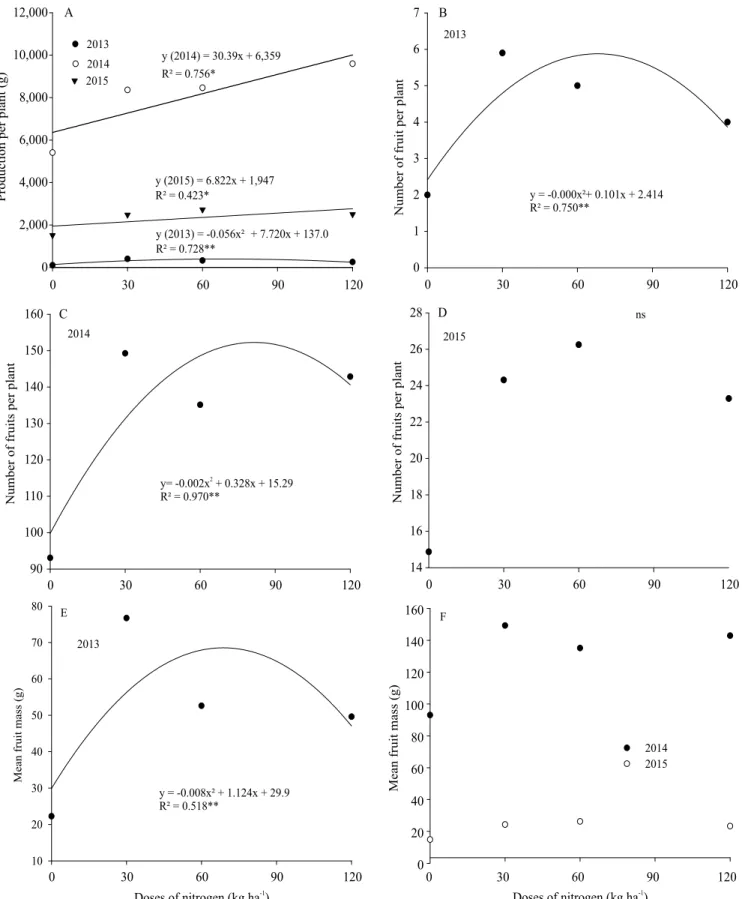
In 2013, the crop yield exhibited a quadratic response to the applied doses of N, with an estimated
maximum, effective dose of 69 kg ha-1 N (Figure 3 A),
which is 19 kg more than the recommended dose (of
50 kg ha-1 N) required for the growth phase during
the first year after planting peach. This result is in
agreement with that of Dolinski et al. (2012), who also reported that the increasing amounts of N application resulted in a proportionate increase of yield. According to Leal et al. (2007), N affects photosynthesis and,
y (2013) = 2.507x + 591.7 R² = 0.805** y (2014) = 12.37x + 1,007.0
R² = 0.815** y (2015)= 22.56x + 2,652.0
R² = 0.954**
0 1,000 2,000 3,000 4,000 5,000 6,000
0 30 60 90 120
Doses of N (kg ha )-1
A
2013 2014 2015
y (2013)= 0.032x + 24.13 R² = 0.965** y (2014)= 0.138x + 44.83
R² = 0.896** y (2015)= 0.141x + 58.73
R² = 0.833**
0 10 20 30 40 50 60 70 80
0 30 60 90 120
Doses of N (kg ha )-1
B
y (2013) = 0.301x + 98.24 R² = 0.928
y (2014)= 0.295x + 78.46 R² = 0.909 0 20 40 60 80 100 120 140 160
0 30 60 90 120
Doses de N (kg ha )-1
C
ns y (2013) = 0.000x + 0.176
R² = 0.446** y (2014) = 0.007x + 1.026
R² = 0.999*
0.0 0.5 1.0 1.5 2.0 2.5
0 30 60 90 120
Doses of N (kg ha )-1
D
y (2013) = 0.190x + 123.5 R² = 0.630**
0 40 80 120 160 200
0 30 60 90 120
Doses of N (kg ha )-1
E ns 0.0 1.0 2.0 3.0 4.0
0 30 60 90 120
Doses of N (kg ha )-1
F
ns
ns
ns
y (2013)= 0.105x + 20.71 R² = 0.869*
0 10 20 30 40 50
0 30 60 90 120
Doses of N (kg ha )-1
G
2013-2014
2013-2015
ns
y (2012) = 0.037x + 44.58
R² = 0.856**
0 10 20 30 40 50 60
0 30 60 90 120
Doses of N (kg ha )-1
H
ns
ns
G
reen weight after pruning
(g per plant)
T
runk diameter (mm)
Branch length (cm)
Canopy volume (m )
3
Plant height (cm) Buds per cm
T
runk diameter increase (mm)
T
otal chlorophyll index
Figure 2. Green weight after pruning (A), trunk diameter (B), branch length (C), canopy volume (D), plant height (E),
other physiological events in plants. Any reduction of the photosynthesis translates as a reduced growth,
delayed or no flowering, and this facts reduce yield.
Therefore, N is one of the nutrients that promotes
significant morphophysiological changes in plants.
Furthermore, crop yield depends on other factors, such as precipitation at the time of fertilization, as emphasized in the study conducted by Fidalski & Auler (2007). During the years 2014 and 2015, a direct relationship between N increase and yield increase
was observed (Figure 3 A). This result highlights the
need to apply at least 120 kg ha-1 N, that is, twice as
high as the currently recommended dose (60 kg ha-1) in
the second year after plantation (2014), and 40 kg ha-1
as high as what is currently recommended (80 kg ha-1
N) in the third year after plantation (2015), for plants to achieve their yield potential. According to Leal et al.
(2007), there is a window of nutritional deficiency in
which the plant yield tends to increase as a consequence of N supply.
Table 1. Trunk diameter increase (TDI), total clorophyll index, total leaf area, severity of rust incidence by Tranzschelia discolor,area and healthy leaf area (LA) of 'Cascata 1513' and 'Cascata 1067' peach (Prunus persica) tree genotypes subjected to different doses of N fertilization growth(1).
Variable TDI (mm)
2013/2014
TDI (mm) 2013/2015
Clorophyll index 2013
Clorophyll index 2014
Clorophyll index 2015
Total leaf area (cm2)
Healthy leaf area (cm2)
Severity (% of injured LA) ---2016---Genotype
Cascata 1067 26.46ns 39.25ns 48.23a 39.08ns 44.12a 15.70ns 89.81ns 19.19ns
Cascata 1513 26.06 40.51 45.07b 38.25 43.86b 15.15 82.88 17.11
N dose (kg ha-1)
0 18.45b 37.47ns 44.16b 38.07ns 42.26ns 12.30b 80.59ns 19.40bns
30 25.80ab 38.08 45.49b 38.75 42.33 14.07ab 83.44 16.55
60 28.71ab 42.69 47.99a 39.34 45.67 16.50ab 84.35 15.64
120 32.10a 41.27 48.55a 38.48 45.70 18.82a 78.98 21.01
CV (%) 29.32 23.38 3.86 6.54 6.07 18.95 6.94 31.27
(1)Means followed by equal letters, uppercase in the lines and lowercase in the columns, do not differ by Tukey’s test, at 5% probability. nsNonsignificant.
CV, coefficient of variation.
Table 2. Green weight after pruning (GWP), canopy volume (CV), trunk diameter (TD), plant height (PH), branch length
(BL), buds per cm, average production per plant (AVP), average number of fruit per plant (NMP), and mean fruit mass (MMF) of peach trees (Prunus persica) genotypes subjected to different doses of nitrogen fertilization in the years of 2013, 2014, and 2015(1).
Genotype GWP
(g per plant)
CV
(m3)
TD
(mm)
PH
(cm)
BL
(cm)
Buds per
centimeter
AVP
(g per plant)
ANP AMP
(g per fruit) 2013
Cascata 1067 822.78a 0.25a 26.67a 145.87a 125.82a 0.87ns 80.72b 0.97b 40.51b
Cascata 1513 635.18b 0.17b 25.03b 121.17b 103.84b 0.83 468.24a 7.47a 60.05a
CV (%) 27.98 32.26 8.57 9.27 16.04 13.86 49.05 48.35 48.45
2014
Cascata 1067 1656.89ns 1.64a 53.14ns 170.72a 91.25ns 1.88ns 7152.87ns 72.31b 100.60a
Cascata 1513 1449.76 1.21b 51.09 152.72b 96.70 1.92 8758.84 187.84a 44.91b
CV (%) 29.07 28.24 17.12 13.39 12.25 24.59 37.05 39.52 16.27
2015
Cascata 1067 4760.56a - 65.72ns - 57.76ns 2.77ns 3656.63a 31.51a 116.91a
Cascata 1513 2912.90b - 66.57 - 56.64 3.48 919.54b 12.84b 69.66b
CV (%) 43.83 - 14.92 - 17.47 35.61 31.72 32.04 14.61
(1)Means followed by equal letters, uppercase in the lines and lowercase in the columns, do not differ by Tukey’s test, at 5% probability. nsNonsignificant.
Figure 3. Average production per plant (A), number of fruit per plant (B, C, and D), and mean fruit mass of 'Cascata 1513' and 'Cascata 1067' peach (Prunus persica) trees in 2013 (E), and 2014 and 2015 (F), subjected to different doses of N fertilization. ** and *Significant by the F-test, at 1 and 5% probability, respectively.
0 30 60 90 120
Number of fruit per plant
0 1 2 3 4 5 6 7
2013
0 30 60 90 120
Number of fruits per plant
14 16 18 20 22 24 26 28
2015
ns y = -0.000x²+ 0.101x + 2.414 R² = 0.750**
0 30 60 90 120
Production per plant (g)
0 2,000 4,000 6,000 8,000 10,000 12,000
2013
2014 2015
y (2015) = 6.822x + 1,947 R² = 0.423*
y (2014) = 30.39x + 6,359 R² = 0.756*
y (2013) = -0.056x² + 7.720x + 137.0 R² = 0.728**
Doses of nitrogen (kg ha )-1
0 30 60 90 120
Mean fruit mass (g
)
10 20 30 40 50 60 70 80
2013
y = -0.008x² + 1.124x + 29.9 R² = 0.518**
Doses of nitrogen (kg ha )-1
0 30 60 90 120
Mean fruit mass (g)
0 20 40 60 80 100 120 140 160
2014 2015
0 30 60 90 120
Number of fruits per plant
90 100 110 120 130 140 150 160
2014
y= -0.002x + 0.328x + 15.292
R² = 0.970**
A B
C D
Considering the production volume obtained in the second and third crop years, maintenance fertilization should have been already implemented, but according to the current recommendation (Manual…, 2016), it is still the growth period fertilization. This may limit the yield potential because the recommended amounts of nutrients do not take into consideration the nutrient requirements and transfer to fruit, and therefore it may be underestimated.
Compared to the year 2014, yield reduction was observed in 2015. This was probably due to adverse weather conditions, such as excessive rainfall during the N application period (August to February). During this period, rainfall was 70% higher (1,329 mm) than the historical mean (750 mm) (Figure 1). Excessive rainfall favors N leaching and loss of available N fertilizer. The loamy sand soil with less than 20% of clay in the orchard also facilitates leaching (Manual…, 2016). Nitrogen loss through leaching in the soil occurs
mostly in the form of nitrate (N-NO3-) and ammonium
(N-NH4+), which are commonly used in fruit tree
orchards; however, N loss also depends on the quantity of applied N, soil type, and rainfall volume (Nielsen et al., 1982; Barlow et al., 2009; Lorensini et al., 2012).
As to fruit mass, in 2013 there was a quadratic effect of increasing N doses, with an estimated maximum,
effective dose of 70 kg ha-1 N (Figure 3 C), which was
similar to that observed for fruit yield in the same year. During the third and fourth years, there was no effect of increasing N doses on fruit mass. The amount of
applied N was probably insufficient because the plants
were larger and had a higher-fruit yield. Therefore, there was an effect of “dilution” of the applied N.
Fruit mass was higher in the first year than in the
subsequent years in 'Cascata 1513' (Table 2). Fruit size
is defined by genetic characteristics of the plant and
by the orchard management system (Giovanaz et al., 2014). In addition, it depends on the load of fruit in the plants, but a relationship between increased yield and reduced fruit size, and vice-versa, is not always observed (Almeida et al., 2014), especially before yield stabilization. Moreover, Mayer et al. (2016) showed that high-density planting did not affect the physical characteristics of fruit, such as mass and diameter, and therefore, did not affect the yield potential of the plants.
The number of fruit in the initial stage of plant development was low in the assessed cycles; however, the effect of the genotypes was already evident at this
stage. The number of fruit in 'Cascata 1513' decreased
from the first and second years to the third year
(Table 2). In 2013 and 2015, there was a quadratic response in the number of fruit to increasing doses of N, and the estimated technical maximum, effective
doses were 50 and 82 kg ha-1 N, respectively. This
result is in agreement with the response reported by Amorim et al. (2015). Nava et al. (2007) note that previous studies had shown that increasing the dose of N led to an increase of fruit ripening and, therefore, of the number of fruit. However, in the present study, there was no response to increasing doses of N in 2014, probably because most plants were still in the early vegetative phase, and they
were not yet flowering, requiring future assessments.
According to Oliveira et al. (2015), only a part of the N provided by the fertilizer is absorbed by the plants and used to produce fruit because of the dynamics of
N in the soil-plant-atmosphere system. The efficiency
of conversion of the applied nutrients into biomass depends on numerous complex processes that, in turn, depend on the plant, the environment, and soil fertility management.
Conclusions
1. The advanced selections of peach (Prunus
persica) trees grown in high-density orchards require a higher dose of N to show an adequate mineral nutrition
and to fulfill their vegetative growth potential and, consequently, the productive efficiency of the crop.
2. The current recommended amount of N
fertilization for peach orchards is suboptimal for a high-density planting system.
Acknowledgments
To Coordenação de Aperfeiçoamento de Pessoal de Nível Superior (Capes) and to Empresa Brasileira
de Pesquisa Agropecuária (Embrapa), for financial
support; and to Conselho Nacional de Desenvolvimento
Científico e Tecnológico (CNPq), for award for
excellence in research.
References
ALMEIDA, G.K. de; MAGRIN, F.P.; SOLDATELLI, P.;
pessegueiro. Revista de Ciências Agroveterinárias, v.13, p.255-265, 2014.
ALVES, G.; SILVA, J. da; MAY DE MIO, L.L.; BIASI,
L.A. Comportamento fenológico e produtivo de cultivares
de pessegueiro no município da Lapa, Paraná. Pesquisa
Agropecuária Brasileira, v.47, p.1596-1604, 2012. DOI: 10.1590/ S0100-204X2012001100006.
AMORIM, D.A. de; ROZANE, D.E.; SOUZA, H.A. de.;
MODESTO, V.C.; NATALE, W. Adubação nitrogenada e potássica em goiabeiras 'Paluma': I. Efeito na produtividade e na
qualidade dos frutos para industrialização. Revista Brasileira de Fruticultura, v.37, p.201-209, 2015. DOI: 10.1590/0100-2945-051/14.
BARLOW, K.; BOND, W.; HOLZAPFEL, B.; SMITH, J.; HUTTON, R. Nitrogen concentrations in soil solution and surface run-off on irrigated vineyards in Australia. Australian Journal of Grape and Wine Research, v.15, p.131-143, 2009. DOI: 10.1111/j.1755-0238.2008.00042.x.
DELLA BRUNA, E.; BACK, A.J. Adubação nitrogenada em pessegueiros 'Aurora' e 'Chimarrita'. Revista Tecnologia e Ambiente, v.20, p.71-80, 2014. DOI: 10.18616/ta.v20i0.1561. DIAS, M.J.T.; SOUZA, H.A. de; NATALE, W.; MODESTO,
V.C.; ROZANE, D.E. Adubação com nitrogênio e potássio em
mudas de goiabeira em viveiro comercial. Semina: Ciências Agrárias, v.33, p.2837-2848, 2012. Suplemento 1. DOI: 10.5433/1679-0359.2012v33Supl1p2837.
DOLINSKI, M.A. Produtividade, crescimento vegetativo, doenças e qualidade pós-colheita de pessegueiro adensado com manejos de adubação nitrogenada e de poda verde. 2012. 126p.
Tese (Doutorado) – Universidade Federal do Paraná, Curitiba. FACHINELLO, J.C.; TIBOLA, C.S.; VICENZI, M.; PARISOTTO,
E.; PICOLOTTO, L.; MATTOS, M.L.T. Produção integrada
de pêssegos: três anos de experiência na região de Pelotas-RS.
Revista Brasileira de Fruticultura, v.25, p.256-258, 2003. DOI: 10.1590/S0100-29452003000200018.
FERREIRA, D.F. Sisvar: a guide for its bootstrap procedures in multiple comparisons. Ciência e Agrotecnolgia, v.38, p.109-112, 2014. DOI: 10.1590/S1413-70542014000200001.
FERREIRA, L.V.; CORRÊA, A.P.A.; PICOLOTTO, L.;
CANTILLANO, R.F.F.; ANTUNES, L.E.C. Qualidade
de pêssegos submetidos à adubação nitrogenada. Revista
Iberoamericana de Tecnología Postcosecha, v.17, p.108-115, 2016.
FIDALSKI, J.; AULER, P.A.M. Adubação nitrogenada e
precipitação sobre a nutrição e produção de laranjeira 'Valência'.
Pesquisa Agropecuária Brasileira, v.42, p.141-146, 2007. DOI: 10.1590/S0100-204X2007000200001.
FREIRE, C.J. da; MAGNANI, M. Adubação e correção do solo.
In: RASEIRA, M. do C.B.; PEREIRA, J.F.M.; CARVALHO,
F.L.C. Pessegueiro. Brasília: Embrapa, 2014. p.259-281.
GIOVANAZ, M.A.; FACHINELLO, J.C.; GOULART, C.;
RADÜNZ, A.L.; AMARAL, P.A.; WEBER, D. Produção e
qualidade de pêssegos, cv. Jubileu, com uso de fitorreguladores.
Revista Ceres, v.61, p.552-557, 2014. DOI: 10.1590/0034-737X201461040015.
GUARÇONI, A.M.; VENTURA, J.A. Adubação N-P-K e o
desenvolvimento, produtividade e qualidade dos frutos do abacaxi 'Gold' (MD-2). Revista Brasileira de Ciência do Solo, v.35, p.1367-1376, 2011. DOI: 10.1590/S0100-06832011000400031. LEAL, R.M.; NATALE, W.; PRADO, R. de M.; ZACCARO, R.P. Adubação nitrogenada na implantação e na formação de pomares de caramboleira. Pesquisa Agropecuária Brasileira, v.42, p.1111-1119, 2007. DOI: 10.1590/S0100-204X2007000800007.
LEONARDO, F. de A.P.; PEREIRA, W.E.; SILVA, S. de M.; COSTA, J.P. da. Teor de clorofila e índice SPAD no abacaxizeiro
cv. Vitória em função da adubação nitrogenada. Revista
Brasileira de Fruticultura, v.35, p.377-383, 2013. DOI: 10.1590/ S0100-29452013000200006.
LORENSINI, F.; CERETTA, C.A.; GIROTTO, E.; CERINI, J.B.; LOURENZI, C.R.; DE CONTI, L.; TRINDADE, M.M.; MELO, G.W. de; BRUNETTO, G. Lixiviação e volatilização de
nitrogênio em um Argissolo cultivado com videira submetida à
adubação nitrogenada. Ciência Rural, v.42, p.1173-1179, 2012. DOI: 10.1590/S0103-84782012005000038.
LORETI, F.; MASSAI, R. State of the art on peach rootstocks and orchard systems. Acta Horticulturae, n.713, p.253-268, 2006. DOI: 10.17660/ActaHortic.2006.713.37.
LORETI, F.; MASSAI, R. The high density peach planting system: present status and perspectives. Acta Horticulturae, n.592, p.377-390, 2002. DOI: 10.17660/ActaHortic.2002.592.52. MANUAL de calagem e adubação para os Estados do Rio Grande do Sul e de Santa Catarina. 11.ed. Porto Alegre: Sociedade
Brasileira de Ciência do Solo, Núcleo Regional Sul, Comissão de
Química e Fertilidade do Solo, 2016. 375p.
MARINI, R.P.; REIGHARD, G.L. Crop load management. In: LAYNE, D.R.; BASSI, D. (Ed.). The peach: botany, production and uses. Wallingford: CAB International, 2008. p.289-302. DOI: 10.1079/9781845933869.0289.
MAYER, N.A.; NEVES, T.R. das; ROCHA, C.T.; SILVA, V.A.L.
da. Adensamento de plantio em pessegueiros 'Chimarrita'. Revista de Ciências Agroveterinárias, v.15, p.50-59, 2016. DOI: 10.5965/223811711512016050.
MAYER, N.A.; PEREIRA, F.M. Produtividade de pessegueiros
‘Aurora-1’ em diferentes espaçamentos e métodos de propagação
do porta-enxerto 'Okinawa'. Bragantia, v.71, p.372-376, 2012. DOI: 10.1590/S0006-87052012005000026.
MEDEIROS, B.G. de S.; GOUVEIA, J.P.G. de; ALMEIDA, F. de
A.C.; RIBEIRO, C. de F.A.; DUARTE, S.M.A. Características físicas da goiaba (Psidium guajava L.): efeito da adubação nitrogenada. Revista Brasileira de Produtos Agroindustriais, v.6, p.47-53, 2004. DOI: 10.15871/1517-8595/rbpa.v6n1p47-53.
NAVA, G.; NUERNBERG, N.J.; PEREIRA, A.J.; DECHEN, A.R.
NIELSEN, D.R.; BIGGAR, J.W.; WIERENGA, P.J. Nitrogen
transport process in soil. In: STEVENSON, P.J. (Ed.). Nitrogen
in agriculture soils. Madison: American Society of Agronomy, 1982. p.423-448.
NUNES, J.L. da S.; SOUZA, P.V.D. de; MARODIN, G.A.B.;
FACHINELLO, J.C. Incremento no desenvolvimento do porta-enxerto de pessegueiro 'Aldrighi' por fungos micorrízicos arbusculares autóctones. Ciência e Agrotecnologia, v.32, p.1787-1793, 2008. DOI: 10.1590/S1413-70542008000600017.
OLIVEIRA, P.N. de; DOVIS, V.L.; MATTOS JUNIOR, D. de.
Nitrogênio na cultura dos citros. Informações Agronômicas,
n.151, p.6-14, 2015.
PEREIRA, I. dos S.; NAVA, G.; PICOLOTTO, L.; VIGNOLO, G.K.; GONÇALVES, M.A; ANTUNES, L.E.C. Exigência
nutricional e adubação da amoreira-preta. Revista de Ciências Agrárias, v.58, p.96-104, 2015. DOI: 10.4322/rca.1755.
ROCHA, M. da S.; BIANCHI, V.J.; FACHINELLO, J.C.; SCHMITZ, J.D.; PASA, M. da S.; SILVA, J.B. da. Comportamento
agronômico inicial da cv. Chimarrita enxertada em cinco porta-enxertos de pessegueiro. Revista Brasileira Fruticultura, v.29, p.583-588, 2007. DOI: 10.1590/S0100-29452007000300032. ROMBOLÀ, A.D.; SORRENTI, G.; MARODIN, G.A.B.; DE PIERI, A.Z.; BARCA, E. Nutrição e manejo do solo em fruteiras de caroço em regiões de clima temperado. Semina: Ciências
Agrárias, v.33, p.639-654, 2012.DOI: 10.5433/1679-0359.2012v3 3n2p639.
ROSSI, A. de; FACHINELLO, J.C.; RUFATO, L.; PARISOTTO, E.; PICOLOTTO, L.; KRUGER, L.R. Comportamento do pessegueiro 'Granada' sobre diferentes porta-enxertos. Revista Brasileira de Fruticultura, v.26, p.446-449, 2004. DOI: 10.1590/ S0100-29452004000300018.
SANTOS, H.G. dos; JACOMINE, P.K.T.; ANJOS, L.H.C. dos;
OLIVEIRA, V.A. de; OLIVEIRA, J.B. de; COELHO, M.R.;
LUMBRERAS, J.F.; CUNHA, T.J.F. (Ed.). Sistema brasileiro
de classificação de solos. 2.ed. Rio de Janeiro: Embrapa Solos,
2006. 306p.
SETE, P.B.; MELO, G.W.B. de; OLIVEIRA, B.S.; FREITAS, R.F.; DAL MAGRO, R.; AMBROSINI, V.G.; TRAPP, T.; COMIN, J.J.; GATIBONI, L.C.; BRUNETTO, G. Perdas de nitrogênio do solo
e resposta do pessegueiro à adição de composto orgânico. Ciência Rural, v.45, p.651-657, 2015. DOI: 10.1590/0103-8478cr20131232.
SOUZA, F.B.M. de; ALVARENGA, Â.A.; PIO, R.; GONÇALVES,
E.D.; PATTO, L.S. Produção e qualidade dos frutos de cultivares e seleções de pessegueiro na Serra da Mantiqueira. Bragantia, v.72, p.133-139, 2013. DOI: 10.1590/S0006-87052013005000024. TAIZ, L.; ZEIGER, E. Fisiologia vegetal. 5.ed. Porto Alegre: Artmed, 2013. 820p.