
Rev. Caatinga
PHYTOREGULATORS ON BUD FERTILITY AND CLUSTER QUALITY OF
‘THOMPSON SEEDLESS’ GRAPES GRAFTED ONTO ‘RAMSEY’ ROOTSTOCK
1PATRÍCIA FERNANDA INÁCIO VILAR2*, EDER IGNÁCIO DE SOUZA3, LAISE DE SOUSA SANTOS3, EMANUEL
ALMEIDA MARTINEZ3, VALTEMIR GONÇALVES RIBEIRO2
ABSTRACT – The objective of this work was to evaluate the influence of Trinexapaque-ethyl (TrixE) and
benzyladenine (BA) on the fertility of buds and the quality of bunches of „Thompson Seedless‟ grapes grafted onto „Ramsey‟ rootstock, in the Vale São do Francisco. The experimental design consisted of randomized blocks with 16 treatments (doses and number of applications of the plant regulators TrixE and BA), with four replications, each composed of three plants, with one plant per plot. The variables analyzed were: overall potential bud fertility, potential of the basal, median and apical branches of the plant; fertility of potential buds from the basal region of the basal and median branches; fertility of overall real buds, and of the median and
apical branches; diameter of the basal, median and apical branches; Falker chlorophyll index a, b and total;
sprouting buds, number of clusters per branch, clusters per plant, branches per plant; berry diameter, length, volume; fresh material mass; soluble solids content (SS), titratable acidity (AT) and SS/AT relationship; diameter, length, mass of fresh material from the clusters; shatter, fresh material mass of the rachis and rachis
diameter . It was shown that the TrixE applied in isolation , one, two or three times in doses of 20 mg L-1, or
associated with BA in a single application of 120 or 240 mg L-1, increased the rate of real fertility, but did
notaffect the length of the clusters or the vegetative vigor of the plants.
Keywords: Vitis vinífera L.. Plant regulator . Trinexapaque-etil. Benzyladenine.
FITORREGULADORES NA FERTILIDADE DE GEMAS E QUALIDADE DE CACHOS DA ‘THOMPSON SEEDLESS’ ENXERTADA SOBRE ‘RAMSEY’
RESUMO – Objetivou-se avaliar a influência do Trinexapaque-etílico (TrixE) e benziladenina (BA) na
fertilidade de gemas e na qualidade de cachos da „Thompson Seedless‟ enxertada sobre o porta-enxerto
‘Hamsey‟, no Vale São do Francisco. O delineamento experimental adotado foi o de blocos ao acaso, com 16
tratamentos (doses e número de aplicações dos reguladores vegetais TrixE e BA), com quatro repetições, constituídas por três plantas, com uma planta útil por parcela. As variáveis analisadas foram: fertilidade de gemas potencial geral, potencial dos ramos basais, medianos e apicais da planta; fertilidade de gemas potencial da região basal dos ramos basais e medianos; fertilidade de gemas real geral, e dos ramos medianos e apicais;
diâmetro dos ramos basais, medianos e apicais; índice de clorofila Falker a, b e total; brotação de gemas,
número de cachos por ramo e por planta e de ramos por planta; diâmetro, comprimento e massa da matéria fresca e volume de bagas; e teor de sólidos solúveis (SS), acidez titulável (AT) e relação SS/AT; diâmetro, comprimento, massa da matéria fresca dos cachos; degrana, massa da matéria fresca do engaço e diâmetro do
engaço. Verificou-se que o TrixE aplicado isoladamente, em uma, duas ou três vezes nas dosagens de
20 mg L-1, ou associado à BA em aplicação única de 120 ou 240 mg L-1 aumentou a taxa de fertilidade real, no
entanto, sem afetar o comprimento dos cachos ou o vigor vegetativo das plantas.
Palavras-chave: Vitis vinífera L.. Regulador vegetal. Trinexapaque-etil. Benziladenina.
___________________ *Corresponding author
1Received for publication in 05/21/2015; accepted in 05/16/2016. Paper extracted from the masters dissertation of the primary.
2Department of Science and Technology, Universidade do Estado da Bahia, Juazeiro, BA, Brazil; [email protected], [email protected].
Rev. Caatinga
INTRODUCTION
Viticulture is an activity of great importance for the sustainability of small farms in Brazil and is a great source of jobs, both for the production of fresh grapes as well as processing grapes to create juices and wines (ANUÁRIO BRASILEIRO DE
FRUTICULTURA, 2012). The Sub-Middle of the
São Francisco River Basin is the principal region exporting fine grapes from Brazil (REGINA, 2006).
‘Thompson Seedless‟ is a seedless grape that
is important for global commercialization in natura,
however, it presents limited climatic adaptation to few areas of the world because of its necessity for special conditions of temperature, sunlight, photoperiod and mineral nutrition for the vegetative buds to differentiate into mixed buds with branch primordia and floral panicle (ALBUQUERQUE;
MOUCO; ALBUQUERQUE NETO , 2008).
Therefore, low bud fertility and consequent low productivity has limited this crop from expanding into new areas of production.
Among the development stages of the grapevine's reproductive organs, the formation of the inflorescence primordia is the most sensitive. Sometimes, a partially differentiated inflorescence primordia may revert to tendril primordia, a
phenomenon known as “curd stretching”. Various
factors may influence grapevine bud fertility, includin hormonal balance, varietal characteristics, branch vigor, ambient temperature, sunlight, photoperiod, water availability, mineral nutrition, cultural practices and the application of plant regulators(MULLINS et al., 2007).
In a study of viniculture, Srinivasan and
Mullins (1980) showed the relationship between
cytokinin applications and flowering, even when climatic conditions are not inductive, thus determining the tendency of a meristem to become floral or remain vegetative. It was shown that treatments with cytokinin may substitute for the climatic factors essential for flowering, but plant response is dependent on the concentration.
Along with the cytokinins gibberellins also play a role in the formation of the inflorescence primordia on the grapevine. At the initial stage, the gibberellins promote flowering because they induce the formation of undifferentiated primordia. Afterward, they act to inhibit flowering, since they direct the undifferentiated primordia to form tendrils (MULLINS et al., 2007). This causes the radicular system of the rootstock to interfere in this relationship, because the radicular system is the principal site of cytokinin synthesis in plants, as
observed by Melo and Ribeiro (2012) in the
„Superior Seedless‟ crop, which did not have its fertility altered by the use of phytoregulators or growth retardants, but presented higher fertility when
grafted onto the „Harmony‟ rootstock of the IAC-766
„Campinas‟.
The action of the gibberellins may undergo interference in the substances known as plant retardants, which block the final reactions of the metabolism of this hormone. Examples of these substances are acilciclohexanodionas such as
trinexapaque-ethyl (TrixE,) prohexadione-Ca
(ProCa), paclobutrazol (PBZ), among others (MOUCO et al., 2013; SILVA et al., 2013; OLIVEIRA et al, 2015; SILVA et al., 2014;).
Given the above, the objective of this work
was to evaluate trinexapaque-ethyl (TrixE) and
benzyladenine (BA) on the fertility of the buds and
the quality of clusters of ‘Thompson Seedless‟
grapes grafted onto the „Ramsey‟ rootstock, in the Submédio do Vale São Francisco region.
MATERIAL AND METHODS
The experiment was conducted at a commercial vineyard in the Projeto Irrigado Senador
Nilo Coelho (Sasaki Farm), located at 09º23'17.08"S
and 40º38'24.08"W in the municipality of Petrolina, Pernambuco State, Brazil, using the „Thompson
Seedless’ crop sustained with the pergola system,
with spacing of 2.5 m x 4 m, grafted onto the
‘Ramsey‟ rootstock and irrigated with a
microsprinkler system.
According to the Köppen classification, the climate of the region is Bswh, which corresponds to semiarid very hot, with an annual pluvial index of
549.2 mm, mean annual temperature of 26.3 ºC, with
minimum averages of 21.6 ºC and maximum
averages of 32.9 ºC.
The experiment was conducted in two cycles,
one during formation (pruning on 26/11/2012) and
the other during production (pruning on 27/05/2013).
After the prunings, the branches were twisted and
Dormex® at 5% (hydrogen cyanamide) was applied
locally, with the aid of rollers.
The trinexapaque-ethyl used was the
commercial product Moddus®, compound deethyl
4-cyclopropyl (hydroxy) methylene-3,5
dioxocyclohexanecarboxylate (trinexapaque-ethyl,
250 g L-1) and for Benzyladenine the product used
was Maxcel®, composed of Benzyladenine
(Benzyladenine 20.0 g L-1).
The treatments were represented by different combinations of doses and numbers of TrixE
(commercial product Moddus®, 250 g L-1) and BA
(commercial product Maxcel®, 20g L-1 )
applications, totaling 16 treatments: T1- Control;
T2- TrixE (1x 20 mg L-1) + BA (60 mg L-1);
T3- TrixE (1x 20 mg L-1) + BA (120 mg L-1);
T4- TrixE (1x 20 mg L-1) + BA (240 mg L-1);
T5- TrixE (2x 20 mg L-1);
T6- TrixE (2x 20 mg L-1) + BA (60 mg L-1);
T7- TrixE (2x 20 mg L-1) + BA (120 mg L-1);
T8- TrixE (2x 20 mg L-1) + BA (240 mg L-1);
Rev. Caatinga
T10- TrixE (3x 20 mg L-1) + BA (60 mg L-1);
T11- TrixE (3x 20 mg L-1) + BA (120 mg L-1);
T12- TrixE (3x 20 mg L-1) + BA (240 mg L-1);
T13- TrixE (1x 20 mg L-1); T14- BA (60 mg L-1);
T15- BA (120 mg L-1); T16- BA (240 mg L-1).
The Control treatment Control (T1), received
no application of the products used. However, the 16
treatments, as well as the control, were done using the cultural , nutritional and phytosanitary management practices adopted at the farm.
The experimental design used randomized blocks. Each treatment was composed of plots containing three plants, with one plant per plot, totaling 48 plants per block. The treatments were repeated in four blocks obtaining a total of 192 plants. For the evaluations, only four plants were used from each treatment.
Trinexapaque-ethyl was applied only during
the formation cycle, in three distinct phases, with the
first application being done on December 14 2012
(18 days after the pruning formation - DAPF), in the
phase of the fifth to sixth expanded leaf; the second,
20 days after the first, was done on January 3 2013
(38 DAPF), in the full bloom pellet phase; and third,
20 days after the second application, on January 23
2013 (58 DAPF), in the pellet phase. The benzyladenine applications were done on January 7
2013 (42 DAPF) in the pellet phase.
Evaluations were done during both cycles
(formation and production). In the formation cycle,
branch diameters and potential fertility were evaluated.
Branch diameters were measured on all branches of the plants used in each treatment, separating the measurements by plant region (basal, median and apical). In this way, the diameter of the branches was obtained from the basal region of the plant (DbaB), from the median region of the plant
(DmeB) and from the apical region of the plant (DapB). The measurements were done with the help
of a digital caliper, measuring the diameter between
the 3rd and 4th buds of each branch. These
evaluations were done at 130 DAPF (05/04/2013), in
the dormant bud phase, when the branches were
between 160 and 180 cm in length, i.e., with foliar
mass totally established.
Potential fertility was evaluated from May
23-26 2013, 178 DAPF in the dormant bud phase.
For this evaluation, three grapevine were harvested, each with 20 buds, one in each region (basal, median and apical) of the plant used from each plot, with a
total of 12 grapevine per treatment (4 canes from
each plant region).
To analyze the buds of the grapevine, a stereomicroscope was used (binocular loupe) with
30x zoom, following Ribeiro et al. (2008). Each grapevine cane was evaluated individually, separating the readings of potential fertility (PF) by region of the plant to obtain the potential fertility of the basal branches of the plant (PFbaBpl), the
median branches (PFmeBpl) and the apical branches
(PFapBpl). The readings were also separated by
branch regions, to obtain the potential fertility of the basal region of the branches (PFbaRegB, the median region of the branches (PFmeRegB) and of the apical region of the branches (PFapRegB).
The pruning production, done on May 27
2013, left the branches with an average of 12 buds
(ranging from 10-14 buds). During production the
variables of real fertility, sprouting rate, chlorophyll indexes and variables relating to cluster production and quality of clusters were analyzed.
At 14 days after pruning production (DAPP),
the start of the budding breakphase, real fertility was evaluated. The bud sprouting rate (bSR) was evaluated by means of the relationship between the number of shoots and the total number of buds. The real bud fertility rate (RbFR) was evaluated by the relationship of the number of shoots with one or more inflorescences and the total number of shoots. For potential fertility, separate readings were done to obtain the real fertility from the basal region of the plant (RFbaReg), the median region of the plant
(RFmeReg) and the apical region of the plant (RFapReg). Thus the potential fertility of the basal
region of the branches (PFbaRegB), the median region of the branches (PFmeRegB) and the apical region of the branches (PFapRegB) were also obtained.
At 55 DAPP, in the pellet phase, the indexes
of chlorophyll a (Cl a), chlorophyll b (Cl b) and total
chlorophyll (Cl a + Cl b) were evaluated. The
readings were done on completely expanded leaves and with good plant health. The measurements were done on the plants used in each treatment/replication, with measurements being done on 2 leaves, with 3 readings per leaf, with the final value referring to the plant from the average of the measurements, with the help of the chlorophyll meter of the commercial
brand ClorofiLOG® model CFL 1030, produced by
Falker Automação Agrícola. This apparatus has light emitting diodes, and it passes the leaf sample through, reaching a receptor (silicon photodiode) that converts the transmitted light into analog electrical signals. From these data, the apparatus provides read
values proportional to absorbance of chlorophyll a, b
and total (a + b). The ClorofiLOG® uses emitters at
three wavelengths: two emit within the red band,
close to the peaks of each type of chlorophyll (λ=635
and 660nm) and the other in the infrared band near
(λ = 880nm). The ClorofiLOG® provides results in
adimensional units, FCI values (Falker Chlorophyll Index) (FALKER, 2008).
The criteria adopted for collecting the clusters from the plots was from the soluble solids
content finding of at least 16 °Brix and titratable
acidity of 0.65 g of tartaric acid/100 ml of grape
juice.
The grapes were harvested at 123 DAPP, in
Rev. Caatinga
being evaluated: fruit production (kg plant-1);
average cluster mass (g); fresh rachis mass (g);
average rachis diameter (mm); berry volume (cm³);
berry length (mm); average cluster width (cm);
average cluster length (cm); total fresh mass of 100
berries; free berries (%); soluble solids contents (°Brix); titratable acidity (in g tartaric acid/100g of
pulp); and ratio.
To determine yield per plant, all the clusters from each plant in the plot were collected and weighed on a Toledo analytical balance, with
maximum capacity of 15 kg and variation of 5 g.
For biometric and chemical analyses, 5
clusters of similar lengths and representative of the plant used were collected, with all berries removed
and separated into a random sample of 100 berries
that were used for the evaluations described below. To determine the average mass of the cluster and the rachis (g) a precision balance (0.1 g) was used. While the average cluster length (cm) was determined with the help of a graduated ruler, measuring the length from the beginning of the first secondary branch (cluster) and the cluster width (cm), measuring from one end to the other of the first branching. The average diameter of the rachis was measured with the aid of a digital caliper, just below the first secondary branching.
The total fresh mass of 100 berries was
determined with a precision balance and the diameter and length of berries, were determined with a graduated ruler (cm) by dividing the measurement obtained with the ruler after placing the 100 berries in vertical position (to determine berry diameter) and horizontal (for berry length): measured on the ruler /100, results in millimeters; and the average berry volume (measured in the cylinder, by dividing the volume of water displaced after the introduction
of 100 berries: displaced volume /100, in milliliters).
To determine the soluble solids contents (SS,
in °Brix) a portable refractometer RT-30ATC was
used, with a sample of grape juice (wine) removed
from 20 berries per replication and the titratable
acidity (AT, in g tartaric acid/100g of pulp) was determined by the titulometric method in a solution
of NaOH at 0.1 N.
The results were subjected to the test of normality and then analysis of variance (F test) and
the means were compared by the Scott-Knott test at
5% probability of error, with the data being the rates
of bud fertility and of sprouting, transformed by the arc sign quadratic root of X/100. For those that did not meet the normal criteria, their averages and standard deviation were calculated.
RESULTS AND DISCUSSION
The treatments had no effect on the variables related to potential fertility of buds on branches in
different regions of the plant (basal, median and apical) and in different regions of the branches (basal, median and apical). Treatment T4 however, which refers to the real bud fertility rate (RbFR), was statistically higher than the control treatment, with
the values being 52.82% and 44.59% (Table 1). No
significant difference was observed among treatments T4 and T3, T7, T9, T12, T13, however. The T4 treatment corresponds to the highest
benzyladenine dose (240 mg L-1) and according to
Botelho et al. (2006a), the cytokinins are necessary to differentiate the undifferentiated inflorescence primordia. Any imbalance among the factors responsible for the formation of inflorescence
primordiamay cause the “anlage” to differentiate into
a tendril or vegetative bud (VIEIRA et al., 2006). It is noteworthy that the real fertility rate of the buds (RFRb) presented a higher average compared the potential fertility rate (PFRb) in the majority of the treatments, with the exception of T2, T8, T10, T11, T15 and T16. Thus, it may be said that the expression of real bud fertility is generally higher than potential bud fertility. These data are repeated to analyze the real fertility of the median (RFmeB) and apical branches (RFapB).
When the potential fertility per region of the branches was analyzed, it was observed that in the basal region relative to the apical region, there was variation in fertility, since in the basal region, fertility was always lower than in the apical region of the same branches, presenting an overall average of 33.08% and 50.47%. Thus, it was observed that in general, there was an approximately 17% increase of fertility in the apical region compared to the basal region. Similar results were found by Vieira et al. (2006) in their work with „Niagara Rosada‟, in two conduction systems (espalier and pergola), which had higher bud fertility averages and fewer necrotic buds in the terminal portion of the vines in both conduction systems.
Rev. Caatinga
Table 1. Bud fertility (%) overall potential (OP), fertility of potential buds from the basal (FPBBaB), median (FPBMeB) and apical branches (FPBApB) of the plant; fertility of potential buds on the basal region of the basal (FPBBaRBaB) and median branches (FPBBaRMeB); fertility of real geneal buds (FRg), fertility of real buds on the median (FRBMeB) and
Means followed by the same letter in the column did not differ by the Scott-Knott test (p < 0.05).
T1- Control; T2- TrixE (1x 20 mg L-1) + BA (60 mg L-1); T3- TrixE (1x 20 mg L-1) + BA (120 mg L-1);
T4- TrixE (1x 20 mg L-1) + BA (240 mg L-1); T5- TrixE (2x 20 mg L-1); T6- TrixE (2x 20 mg L-1) + BA (60 mg L-1);
T7- TrixE (2x 20 mg L-1) + BA (120 mg L-1); T8- TrixE (2x 20 mg L-1) + BA (240 mg L-1);T9- TrixE (3x 20 mg L-1);
T10- TrixE (3x 20 mg L-1) + BA (60 mg L-1); T11- TrixE (3x 20 mg L-1) + BA (120 mg L-1);
T12- TrixE (3x 20 mg L-1) + BA (240 mg L-1); T13- TrixE (1x 20 mg L-1); T14- BA (60 mg L-1); T15- BA (120 mg L-1);
T16- BA (240 mg L-1).
Cultural practices such as cutting of branches and defoliation, which were done in the orchard from
the 45th day after pruning, may have caused greater
exposure of the apical buds on the branches to the increased direct and diffuse light, which would result in the higher fertility of the apical buds compared to the basal buds. Botelho et al. (2006 b) found that the differentiation of inflorescence primordia in vines cv. Itália in the regions of Jundiaí (SP) and Jales (SP) occurred principally between 45 and 75 days after sprouting, corresponding to the phenological stages of flowering and “pea pod” respectively. These stages also coincide with the start of the cited cultural practices.
The high auxin levels in the apical meristem may inhibit the formation of vascular connections and restrict nutrients. Cytokinins stimulate the growth of the lateral buds and mobilize the assimilates, but cytokinin synthesis in the lateral buds may be inhibited by the auxins of the apex and the bud. Thus, to remove the apical buds, the levels of cytokinins, nutrients, or both are elevated in the
lateral buds, promoting higher bud fertility (TAIZ; ZEIGER, 2009).
Data from the dead bud variable from the basal, median, apical branches and dead buds from the basal region of the branches, were not statistically significant, presenting means and standard deviation of 16.63 ± 10.97%, 18.08%± 14.76%, 23.06% ± 15.54%, 14.19% ± 13.09%, 19.70 ± 12.80%, 28.09 ± 11.38%.
For the real fertility variable (RFRb) it was observed that treatments with isolated BA (T14, T15 and T16) had results similar to the Control; unlike treatments T13, T5 and T9, corresponding to
applications isolated with TrixE at 20 mg L-1, applied
once, twice and three times. On the other hand, with the application of TrixE being applied once (T3 and T4), twice (T7) and three times (T13), in association
with different concentrations of BA (120 and
240 mg L-1), established the positive interaction
between these two compounds for maximizing the bud fertility rate of the „Thompson Seedless‟, grafted onto the „Ramsey‟ rootstock (Table 1).
Treatments OP FPBBaB FPBMeB FPBApB FPBBaRBaB FPBBaRMeB FRg FRBMeB FRBApB
T 1 41.77 40.17 47.07 45.97 36.37 47.95 44.59 b 51.95 55.05 T 2 42.67 52.37 40.52 45.00 38.81 41.12 41.18 b 53.07 56.77 T 3 47.17 50.20 62.22 48.20 36.03 55.62 50.09 a 67.87 69.27 T 4 47.62 58.12 49.20 54.70 41.36 59.75 52.82 a 72.70 71.07 T 5 45.68 62.17 42.27 49.12 36.42 56.00 47.23 a 64.60 48.60 T 6 40.02 49.20 38.47 36.57 27.06 42.35 43.27 b 48.70 66.65 T 7 45.82 56.22 53.47 44.55 23.74 63.00 46.03 a 58.75 55.40 T 8 46.36 46.60 59.72 50.77 35.24 60.32 43.37 b 49.55 63.60 T 9 43.87 58.75 48.55 36.87 33.86 53.22 52.18 a 64.82 64.75 T 10 42.91 52.50 53.70 33.05 29.84 41.50 42.42 b 55.25 76.07 T 11 44.38 55.65 52.02 39.17 36.14 49.3 39.98 b 48.85 64.62 T 12 42.53 45.57 52.95 38.62 31.79 46.57 47.51 a 63.22 55.52 T 13 43.99 52.00 44.75 47.92 37.68 48.50 47.34 a 49.15 66.65 T 14 39.79 33.75 40.45 48.75 27.77 41.97 41.77 b 37.77 53.32 T 15 40.80 51.52 31.42 45.27 25.59 46.70 40.13 b 46.12 52.95 T 16 43.36 46.35 47.25 48.02 31.60 53.67 40.22 b 50.25 53.52 F Test 0.68 ns 0.94ns 0.984ns 0.539ns 1.631ns 1.044ns 1.962* 1.205ns 0.592ns
Rev. Caatinga
This fact shows that the interference of
growth retardants on gibberellin biosynthesis - with
the TrixE being a blocker of the final metabolism reactions of the gibberellins (RADEMACHER, 2004), which should have favored the higher fertility rate of real buds, having been applied at a more advanced stage, possibly at the start of the differentiation of the undifferentiated primordia in inflorescence primordial (secondary induction). In this phase, the gibberellins inhibit inflorescence formation, while the cytokinins promote it (SRINIVASAN; MULLINS, 1980). On the other hand, this may explain the higher bud fertility rates (potential and real) under the effect of treatment with
TrixE applied only once (20 mg L-1), associated with
BA at 240 mg L-1).
Treatments 2, 6, 8, 10, 11, 14, 15 and 16 were those that presented the lowest averages among the treatments, ranging from 39.98% to 43.37% of overall real bud . Srinivasan and Mullins (1980) observed that the floral formation process involves three steps: anlage formation, their differentiation into flower primordial tendrils and then the formation of flowers. The inflorescence primordia and tendrils developed in inflorescence during the bud sprouting in the next season, and the two first steps occurred during branch development.
The growth inhibitor applications associated
to low and medium doses of BA (T3 and T7,
120 mg L-1) presented results similar to T4 (52.18%).
On the other hand, since the highest dose of BA (T8) associated with TrixE had results similar to the control, it may be inferred that it was not satisfactory to use this dosage of BA. Mullins et al. (2007) concluded that the cytokinins exert strong influence on the mobilization of assimilates at the application site, beyond promoting inflorescence development.
Another factor to consider is the rootstock, since this may change the vegetative vigor of the crop canopies on which they are grafted and influence the bud fertility rate, directly affecting productivity (TECCHIO et al., 2006; FELDBERG et al., 2008). According to Giovannini (2008), the excess vigor reduces the accumulation of carbohydrates in the branches, which must be considered since this is a characteristic of the „Ramsey‟ rootstock. Excess vegetative vigor may be considered one of the principal causes of low fertility in grapevines.
To obtain satisfactory bud fertility, it is necessary that there is an adequate cytokinins/ gibberellins relationship endogenous during the different stages (CHADHA; SHIKHAMANY, 1999). Mullins et al. (2007) reported on the importance of this hormonal balance in the induction and formation of the floral buds and reported the activity of the chlormequat on the inhibition of gibberellin synthesis and increase cytokinins production, causing the plants to flower. This means that the TrixE doses were not sufficient to change the
visual aspects of vigor but were sufficient to inhibit the synthesis of gibberellins at an appropriate level, since the TrixE applied once, twice or three times (at different stages of development) caused overall higher bud fertility, compared to the control.
Thus, it is possible that the cytokinin activity in the sap of the phloem may have increased in the presence of the TrixE, since, when used in isolated form, once twice or three times during the cycle (T13, T5 and T9), or with an application of BA at the
concentrations of 12 and 240 mg L-1 (T3, T4, T7 and
T12), may have functioned as an indicator of cytokinin biosynthesis by the roots of this rootstock crop („Ramsey‟), in favor of the fertility of buds of the crop canopy („Thompson Seedless‟).
In an experiment with different cyocel doses associated with benzyladenine, Ribeiro and Scarpare Filho (2003) found an increase of 28.22% in bud fertility of cv. Flame Seedless, highlighting the need for the joint application of the growth retardant and the benzyladenine. In the present work, with the „Thompson Seedless‟ grafted onto the „Ramsey‟ rootstock, there was also an interaction of the gibberellin synthesis inhibitor (TrixE) with cytokinins, such as T4: 52.82% bud fertility buds
(Table 1).
Under tropical crop conditions, fruit bud
formation occurs 45-60 days after pruning, which
was observed by Shikhamany (1999). Mullins et al. (2007) points out that the bud differentiation process starts in the first weeks after the nde separates from
the apex and continues for 56-84 days. , the BA
doses may cause better effectsdone in two or three applications, as was done with the TrixE, which started at 18 DAPF, followed by applications at 38 and 58 DAPF. Since, according to Carmona et al. (2008), the period of differentiation of the vegetative buds to flowering buds is a crucial time for the plant, because it is in this period that inflorescence primoridia begin to form.
With this information, it may be inferred that there may have been endogenous imbalances in the critical phase and these imbalances may affect the bud fertility rate, with the possibility of “filagen”
occurring, i.e., the reversion of partially differentiated inflorescence primordia to tendrils,
especially during the final stage of differentiation: bud sprouting (VASCONCELOS et al., 2009).
The real fertility rate (RFRb) was higher than the potential fertility rate (PFRb) for treatments T1, T3, T4, T5, T6 T7, T9, T10, T12, T13, T14 and T15 (Table 1), but this was not observed by Ribeiro et al.
(2008) with cv. Superior Seedless under geographically similar conditions, reporting that for
the hypothesis of the physiology of „Thompson
Seedless‟ flowering in the Sub-Middle of the São
Francisco region, its peculiarities, are due to geographic location.
Rev. Caatinga
there is an intrinsic relationship between the quantity of leaves left on the plant so that it reaches suitable cluster quality; thus, it is possible that the structures that were not identified in the potential fertility analysis have pronounced bud sprouting, or even, that the three phases or the last two started at the same time as the bud sprouting (SOUZA; RIBEIRO; PIONÓRIO, 2011). Thus, there is a clear need for further research on the physiology of the flowering grapevines established in the northeastern semiarid region. For the variables branch diameter and
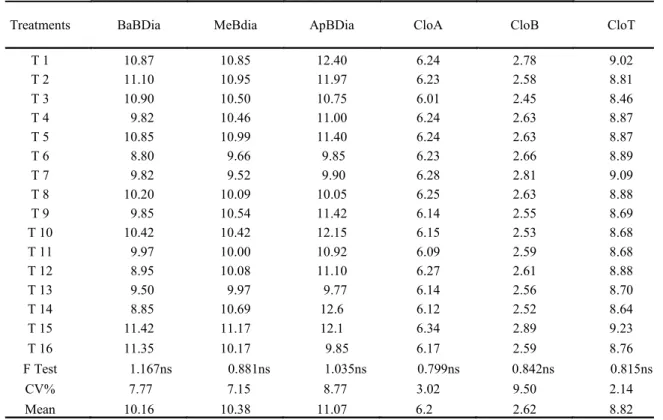
chlorophyll a b and total there was no effect on the
treatments (Table 2).
In relation to branch diameter, independent of their position in relation to the regions of the plant (basal, median and apical), the treatments did not differ among them, indicating that a single
application of TrixE at 20 mg L-1 (T13), or two (T5)
or three (T9) may increase the rate of real bud fertility without modifying the diameter of the branches, which according to Shikhamany (1999), may be a factor appropriate for determining plant vigor, linked to other parameters, for example of the length of its internodes and of the leaf area index.
Table 2. Basal branch diameter (BaBDia, cm), median branch diameter (MeBDia, cm), apical branch diameter (ApBDia, cm), Falker index for chlorophyll a (CloA), b (CloB) and total (CloT) (in FCI values) of the „Thompson Seedless‟ grapevine.
Means followed by the same letter in the column did not differ by the Scott-Knott test (p < 0.05).
T1- Control; T2- TrixE (1x 20 mg L-1) + BA (60 mg L-1); T3- TrixE (1x 20 mg L-1) + BA (120 mg L-1);
T4- TrixE (1x 20 mg L-1) + BA (240 mg L-1); T5- TrixE (2x 20 mg L-1); T6- TrixE (2x 20 mg L-1) + BA (60 mg L-1);
T7- TrixE (2x 20 mg L-1) + BA (120 mg L-1); T8- TrixE (2x 20 mg L-1) + BA (240 mg L-1);
T9- TrixE (3x 20 mg L-1); T10- TrixE (3x 20 mg L-1) + BA (60 mg L-1); T11- TrixE (3x 20 mg L-1) + BA (120 mg L-1);
T12- TrixE (3x 20 mg L-1) + BA (240 mg L-1); T13- TrixE (1x 20 mg L-1); T14- BA (60 mg L-1); T15- BA (120 mg L-1);
T16- BA (240 mg L-1).
As the relative Falker chlorophyll index is a way to evaluate the N content in the leaves, it may be affirmed that there was no difference in the nitrogen contents among the treatments. When a plant goes
into active growth, carbohydrate metabolism becomes more intense and the increase in sucrose
comes at the expense of producing carbohydrates through photosynthesis (BORBA; SCARPARE
FILHO; KLUGE, 2005). The increased
photosynthetic activity and consequent accumulation of sugars in the expanded leaves occurs due to the increase in the chlorophyll content per leaf unit area,
increased carboxylactive enzyme activity and decreased stomatal resistance (KLIEWER, 1981).
Thus, it is possible to infer that the vegetative vigor of the plants was not affected by the treatments and that the TrixE doses could have been higher.
In tropical climate conditions the Thompson Seedless crop presents excessive vigor, with very dense vegetation. The insufficient differentiation of the latent buds, which resulted in their low fertility and was even more pronounced when grafted onto vigorous rootstock grafts, lead to excessively vigorous plants (ALBUQUERQUE; MOUCO;
Treatments BaBDia MeBdia ApBDia CloA CloB CloT
T 1 10.87 10.85 12.40 6.24 2.78 9.02
T 2 11.10 10.95 11.97 6.23 2.58 8.81
T 3 10.90 10.50 10.75 6.01 2.45 8.46
T 4 9.82 10.46 11.00 6.24 2.63 8.87
T 5 10.85 10.99 11.40 6.24 2.63 8.87
T 6 8.80 9.66 9.85 6.23 2.66 8.89
T 7 9.82 9.52 9.90 6.28 2.81 9.09
T 8 10.20 10.09 10.05 6.25 2.63 8.88
T 9 9.85 10.54 11.42 6.14 2.55 8.69
T 10 10.42 10.42 12.15 6.15 2.53 8.68
T 11 9.97 10.00 10.92 6.09 2.59 8.68
T 12 8.95 10.08 11.10 6.27 2.61 8.88
T 13 9.50 9.97 9.77 6.14 2.56 8.70
T 14 8.85 10.69 12.6 6.12 2.52 8.64
T 15 11.42 11.17 12.1 6.34 2.89 9.23
T 16 11.35 10.17 9.85 6.17 2.59 8.76
F Test 1.167ns 0.881ns 1.035ns 0.799ns 0.842ns 0.815ns
CV% 7.77 7.15 8.77 3.02 9.50 2.14
Rev. Caatinga
ALBUQUERQUE NETO, 2008). Thus, another factor to be considered is the fact that Thompson was on the Ramsey rootstock, which is highly vigorous and may confer great strength to the grafts (CHRISTENSEN, 2003), which may be the reason
why the treatments with TrixE did not affect the vegetative vigor of the plants.
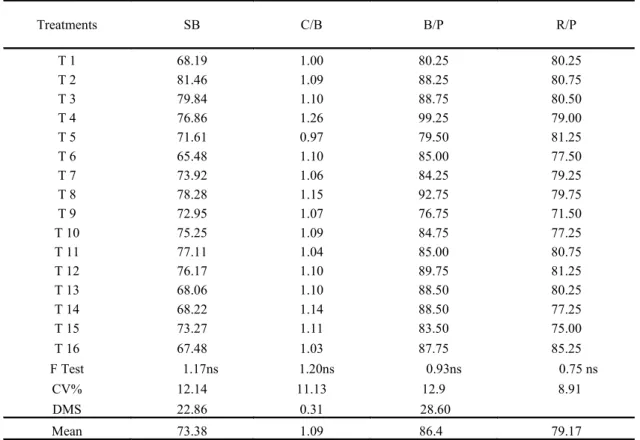
There was no effect of the treatments on the variable rates of sprouting of buds, number of clusters per branch, number of clusters per plant and number of branches per plant (Table 3).
Table 3. Sprouting of buds (SB%), number of clusters per branch (C/B), per plant (B/P) and branches per plant (R/P) and of ‘Thompson Seedless‟.
Means followed by the same letter in the column did not differ by the Scott-Knott test (p < 0.05).
T1- Control; T2- TrixE (1x 20 mg L-1) + BA (60 mg L-1); T3- TrixE (1x 20 mg L-1) + BA (120 mg L-1); T4- TrixE (1x 20 mg L-1) + BA (240 mg L-1); T5- TrixE (2x 20 mg L-1); T6- TrixE (2x 20 mg L-1) + BA (60 mg L-1); T7
-TrixE (2x 20 mg L-1) + BA (120 mg L-1); T8- TrixE (2x 20 mg L-1) + BA (240 mg L-1);T9- TrixE (3x 20 mg L-1);
T10- TrixE (3x 20 mg L-1) + BA (60 mg L-1); T11- TrixE (3x 20 mg L-1) + BA (120 mg L-1); T12- TrixE (3x 20 mg L-1) + BA (240 mg L-1); T13- TrixE (1x 20 mg L-1); T14- BA (60 mg L-1); T15- BA (120 mg L-1); T16- BA (240 mg L-1).
In evaluating the effect of the treatments on the sprouting of the buds, it was observed that there were no significant differences for the results of percentage of buds sprouted in relation to the use of the growth retardant and cytokinins, whether applied in isolation or together. In a different way, Melo and Ribeiro (2012), using the phytoregulator paclobutrazol (PBZ) associated with uracil, obtained significant values in the rate of sprouting of the buds of the „Thompson Seedless‟. Ribeiro and Scarpare Filho (2003) however, using chlorocholine chloride (CCC), obtained in the absence of the product rates of sprouting of the crops approximately 69%; and
with applications of 50000 mg L-1 and
100000 mg L-1 of CCC, the rates exceeded 68.68%
to 54.03% in „Thompson Seedless‟, and ranged from 45.29% to 16.24% in „Flame Seedless‟. These results suggest that the TrixE, with or without BA, same
that applied in the dosage of 20 mg L-1 at 18, 38 and
58 DAPF did not lower the levels of gibberelin in the plants to the point of negatively affecting the bud sprouting rate.
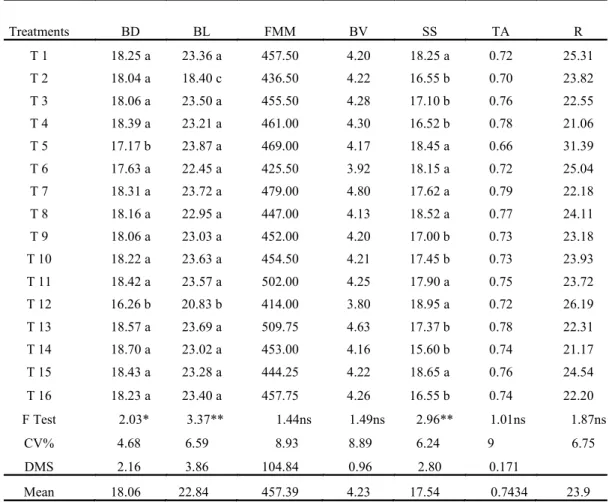
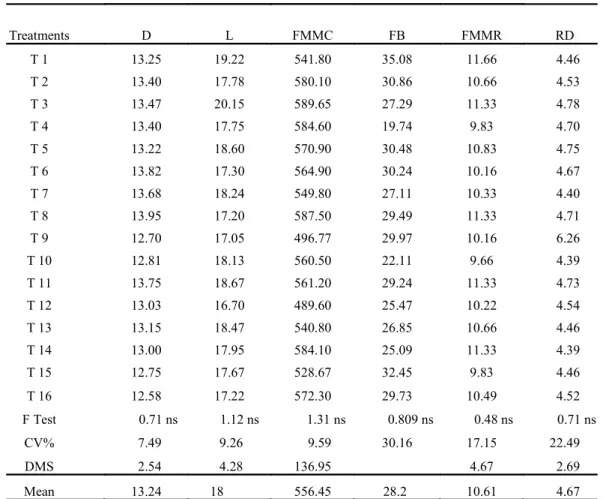
For the variables fresh material mass, berry volume, titratable acidity and ratio, as well as for diameter, length and mass of fresh material of the clusters, free berries, fresh material mass of the rachis and diameter of the rachis, there was no significant difference among the treatments (Tables 4 and 5). It is noteworthy that only for berry
length and diameter and for the soluble solids content were there residual effects from the TrixE
treatments, with or without the BA, which were applied during the branch development phase. However, none of the associations or even applications of these products in isolated form have
provided better results than those obtained by the Control treatment.
Treatments SB C/B B/P R/P
T 1 68.19 1.00 80.25 80.25
T 2 81.46 1.09 88.25 80.75
T 3 79.84 1.10 88.75 80.50
T 4 76.86 1.26 99.25 79.00
T 5 71.61 0.97 79.50 81.25
T 6 65.48 1.10 85.00 77.50
T 7 73.92 1.06 84.25 79.25
T 8 78.28 1.15 92.75 79.75
T 9 72.95 1.07 76.75 71.50
T 10 75.25 1.09 84.75 77.25
T 11 77.11 1.04 85.00 80.75
T 12 76.17 1.10 89.75 81.25
T 13 68.06 1.10 88.50 80.25
T 14 68.22 1.14 88.50 77.25
T 15 73.27 1.11 83.50 75.00
T 16 67.48 1.03 87.75 85.25
F Test 1.17ns 1.20ns 0.93ns 0.75 ns
CV% 12.14 11.13 12.9 8.91
DMS 22.86 0.31 28.60
Mean 73.38 1.09 86.4 79.17
Rev. Caatinga
Table 4. Berry diameter (BD, mm), berry length (BL, mm), fresh material mass (FMM, g) and berry volume (BV, cm³), and soluble solids content (SS, ºBrix), titratable acidity (TA, g. tartaric acid/100 g of wine) and ratio (R, SS/AT relationship) of the ‘Thompson Seedless‟ treated with TrixE with or without BA; F test, coefficient of variation and mean values of the variables.
Means followed by the same letter in the column did not differ by the Scott-Knott test (p < 0.05).
T1- Control; T2- TrixE (1x 20 mg L-1) + BA (60 mg L-1); T3- TrixE (1x 20 mg L-1) + BA (120 mg L-1);
T4- TrixE (1x 20 mg L-1) + BA (240 mg L-1); T5- TrixE (2x 20 mg L-1); T6- TrixE (2x 20 mg L-1) + BA (60 mg L-1); T7- TrixE (2x 20 mg L-1) + BA (120 mg L-1);
T8- TrixE (2x 20 mg L-1) + BA (240 mg L-1);T9- TrixE (3x 20 mg L-1); T10- TrixE (3x 20 mg L-1) + BA (60 mg L-1); T11- TrixE (3x 20 mg L-1) + BA (120 mg L-1);
T12- TrixE (3x 20 mg L-1) + BA (240 mg L-1); T13- TrixE (1x 20 mg L-1); T14- BA (60 mg L-1); T15- BA (120 mg L-1); T16- BA (240 mg L-1).
For the berry diameter variable the treatments
T5 (TrixE 2x 20 mg L-1) and T12 (TrixE
3x 20 mg L-1 + BA 240 mg L-1), were those that
presented the lowest means (17.17 and 16.26 mm ). Soluble solids contents tended to increase sharply with berry growth until reaching a point of equilibrium, with values that depended on the crop,
berry size, production per plant and climatic conditions during berry maturation (MARINHO et
al., 2009).
As noted above, the treatment with TrixE (1x
20 mg L-1) + BA (240 mg L-1) promoted the highest
bud fertility rate in absolute values: 52.82%. It may be observed that for the variables berry diameter and length, under this treatment, a result similar to the Control treatment was reached but with a small
reduction in soluble solids, reaching 16.52 ºBrix, while the Control reached 18.25 ºBrix (Table 4). This result however is within the minimum required by the majority of the importers and well above the minimum required by the technical regulations of identity and of quality for the classifications of fine grapes, which is of at least 14 ºBrix (BRASIL, 2002).
It is worth noting that for the soluble solids variable (Table 4), the products TrixE and BA applied alone: T5 and T15, respectively, or with these two products in combination (T6, T7, T8, T11 and T12) obtained results similar to the control, or in other words, it may be affirmed that at the doses used, the TrixE and BA did not hinder the growth of this characteristic in the berries.
Treatments BD BL FMM BV SS TA R
T 1 18.25 a 23.36 a 457.50 4.20 18.25 a 0.72 25.31
T 2 18.04 a 18.40 c 436.50 4.22 16.55 b 0.70 23.82
T 3 18.06 a 23.50 a 455.50 4.28 17.10 b 0.76 22.55
T 4 18.39 a 23.21 a 461.00 4.30 16.52 b 0.78 21.06
T 5 17.17 b 23.87 a 469.00 4.17 18.45 a 0.66 31.39
T 6 17.63 a 22.45 a 425.50 3.92 18.15 a 0.72 25.04
T 7 18.31 a 23.72 a 479.00 4.80 17.62 a 0.79 22.18
T 8 18.16 a 22.95 a 447.00 4.13 18.52 a 0.77 24.11
T 9 18.06 a 23.03 a 452.00 4.20 17.00 b 0.73 23.18
T 10 18.22 a 23.63 a 454.50 4.21 17.45 b 0.73 23.93
T 11 18.42 a 23.57 a 502.00 4.25 17.90 a 0.75 23.72
T 12 16.26 b 20.83 b 414.00 3.80 18.95 a 0.72 26.19
T 13 18.57 a 23.69 a 509.75 4.63 17.37 b 0.78 22.31
T 14 18.70 a 23.02 a 453.00 4.16 15.60 b 0.74 21.17
T 15 18.43 a 23.28 a 444.25 4.22 18.65 a 0.76 24.54
T 16 18.23 a 23.40 a 457.75 4.26 16.55 b 0.74 22.20
F Test 2.03* 3.37** 1.44ns 1.49ns 2.96** 1.01ns 1.87ns
CV% 4.68 6.59 8.93 8.89 6.24 9 6.75
DMS 2.16 3.86 104.84 0.96 2.80 0.171
Rev. Caatinga
Table 5. Diameter (D, cm), length (L, cm), fresh material mass of the clusters (FMMC, in g), free berries (FB, %), fresh material mass of the rachis (FMMR, in g) and rachis diameter (RD, in mm) of the ‘Thompson Seedless‟.
Means followed by the same letter in the column did not differ by the Scott-Knott test (p < 0.05).
T1- Control; T2- TrixE (1x 20 mg L-1) + BA (60 mg L-1); T3- TrixE (1x 20 mg L-1) + BA (120 mg L-1);
T4- TrixE (1x 20 mg L-1) + BA (240 mg L-1); T5- TrixE (2x 20 mg L-1); T6- TrixE (2x 20 mg L-1) + BA (60 mg L-1); T7- TrixE (2x 20 mg L-1) + BA (120 mg L-1);
T8- TrixE (2x 20 mg L-1) + BA (240 mg L-1); T9- TrixE (3x 20 mg L-1); T10- TrixE (3x 20 mg L-1) + BA (60 mg L-1); T11- TrixE (3x 20 mg L-1) + BA (120 mg L-1);
T12- TrixE (3x 20 mg L-1) + BA (240 mg L-1); T13- TrixE (1x 20 mg L-1); T14- BA (60 mg L-1); T15- BA (120 mg L-1); T16- BA (240 mg L-1).
CONCLUSIONS
TrixE applied in isolation, once, twice or
three times at the dosages of 20 mg L-1, or TrixE
applied once or twice associated with BA at the
dosage of 120 mg L-1 and TrixE applied three times
associated with BA at the dosage of 240 mg L-1,
increased the real fertility rate and did not affect cluster length or plant vegetative vigor of the plants
of the ‘Thompson Seedless‟ grapevine grafted onto
‘Ramsey‟ rootstock.
REFERENCES
ALBUQUERQUE, T. C. S.; MOUCO, M. A. C.; ALBUQUERQUE NETO, A. A. R. Reguladores de
crescimento vegetal na concentração de
macronutrientes em videira Itália. Bragantia, São
Paulo, v. 67, n. 3, p. 553-561, 2008.
ANUÁRIO BRASILEIRO DE FRUTICULTURA.
Uvas – Caminho com obstáculos. Santa Cruz do
Sul, RS: Editora Gazeta, 2012. 128 p.
BORBA, M. R. C.; SCARPARE FILHO J. A.; KLUGE R. A. Teores de carboidratos em pessegueiros submetidos a diferentes intensidades de
poda verde em clima tropical. Revista Brasileira de
Fruticultura, Jaboticabal, v. 27, n. 1, p. 68-72, 2005.
BOTELHO, R. V.; PIRES E. J. P.; TERRA M. M. Desenvolvimento de gemas férteis em videiras cv.
Itália no estado de São Paulo. Bragantia, Campinas,
v. 65, n. 2, p. 297-302, 2006b.
BOTELHO, R. V.; PIRES E. J. P.; TERRA M. M. Fertilidade de gemas em videiras: fisiologia e fatores
envolvidos. Ambiência, Guarapuava, v. 2, n. 1, p.
129-144, 2006a.
Treatments D L FMMC FB FMMR RD
T 1 13.25 19.22 541.80 35.08 11.66 4.46
T 2 13.40 17.78 580.10 30.86 10.66 4.53
T 3 13.47 20.15 589.65 27.29 11.33 4.78
T 4 13.40 17.75 584.60 19.74 9.83 4.70
T 5 13.22 18.60 570.90 30.48 10.83 4.75
T 6 13.82 17.30 564.90 30.24 10.16 4.67
T 7 13.68 18.24 549.80 27.11 10.33 4.40
T 8 13.95 17.20 587.50 29.49 11.33 4.71
T 9 12.70 17.05 496.77 29.97 10.16 6.26
T 10 12.81 18.13 560.50 22.11 9.66 4.39
T 11 13.75 18.67 561.20 29.24 11.33 4.73
T 12 13.03 16.70 489.60 25.47 10.22 4.54
T 13 13.15 18.47 540.80 26.85 10.66 4.46
T 14 13.00 17.95 584.10 25.09 11.33 4.39
T 15 12.75 17.67 528.67 32.45 9.83 4.46
T 16 12.58 17.22 572.30 29.73 10.49 4.52
F Test 0.71 ns 1.12 ns 1.31 ns 0.809 ns 0.48 ns 0.71 ns
CV% 7.49 9.26 9.59 30.16 17.15 22.49
DMS 2.54 4.28 136.95 4.67 2.69
Rev. Caatinga
BRASIL. Ministério da Agricultura e do
Abastecimento. Regulamentos técnicos de
identidade e de qualidade para a classificação de abacaxi e uva. Instrução Normativa nº 1. 2002.
Disponível em: <http://
sistemasweb.agricultura.gov.br/sislegis/action/ detalhaAto.do?method=consultarLegislacconsultar>. Acesso em: 19 mai. 2015.
CARMONA, M. J. et al. A molecular genetic perspective of reproductive development in
grapevine. Journal of Experimental Botany,
Oxford, v. 59, n. 10, p. 2579-2596, 2008.
CHADHA, K. L.; SHIKHAMANY S. D. The grape:
Improvement, production and post-harvest
management. New Delhi: Malhotra Publishing House. 1999. 579 p.
CHRISTENSEN, L. P. Rootstock selection. In:
Wine grape varieties in california. Oakland: University of California Agricultural and Natural
Resources. 2003. p.12-15. Disponível em: <//
iv.ucdavis.edu/Viticultural_Information/? uid=185&ds=351>. Acesso em: 28 nov. 2013.
FALKER AUTOMAÇÃO AGRÍCOLA Ltda.
Manual do medidor eletrônico de teor de clorofila
(ClorofiLOG/ CFL 1030). Porto Alegre, RS:
Falker, 2008. 33 p.
FELDBERG, N. P. et al. Avaliação agronômica de cultivares de videiras apirenas na região de Jaíba,
Minas Gerais. Revista Brasileira de Fruticultura,
Jaboticabal, v. 30, n. 3, p. 644-648, 2008.
GIOVANNINI, E. Produção de uvas para vinho,
suco e mesa. 3. ed. Porto Alegre, RS: Renascença, 2008. 362 p.
KLIEWER, W. M. Grapevine physiology: how
does a grapevine make sugar? Berkeley: University of California. 1981. 13 p.
MARINHO, L. B. et al. Produção e qualidade da videira 'Superior Seedless' sob restrição hídrica na
fase de maturação. Pesquisa Agropecuária
Brasileira, Brasília, v. 44, n. 12, p. 1682-1691,
2009.
MELO, P. S. F.; RIBEIRO, V. G. Porta-enxertos,
citocininas, retardantes de crescimento e uracil na
fertilidade de gemas de videiras apirênicas. Revista
Caatinga, Mossoró, v. 25, n. 1, p. 80-85, 2012.
MOUCO, M. A. C. et al. Plant regulators on vegetative growth of „Tommy Atkins' mangoes.
Acta Horticulturae, Sanya, v. 992, n. 1, p. 187-192,
2013.
MULLINS, M. G.; BOUQUET, A.; WILLIAMS, L. E. Biology of the grapevine. 8. ed. Cambridge: University Press. 2007. 239 p.
OLIVEIRA, M. B. et al. Paclobutrazol and tip pruning in the management of 'Palmer' mango trees
in the Semi-Arid region of Brazil. Acta
Horticulturae, Punta Cana, v. 1075, n. 1, p. 149
-156, 2015.
RADEMACHER, W. Chemical regulation of shoot
growth in fruit trees. Acta Horticulturae, Seoul, v.
653, n. 1, p. 29-32, 2004.
REGINA, M. A. Viticultura. Revista Brasileira de
Fruticultura, Jaboticabal, v. 28, n. 2, p. 160-338,
2006.
RIBEIRO, V. G. et al. Expressão da Fertilidade de gemas da “Superior Seedless” no município de
Petrolina (PE). Revista Caatinga, Mossoró, v. 21, n.
3, p. 231-235, 2008.
RIBEIRO, V. G.; SCARPARE FILHO, J. A. Fertilidade de gemas em cultivares de uvas apirênicas tratadas com benziladenina e cycocel.
Ciência e Agrotecnologia, Lavras, Sup., p. 1516
-1521, 2003.
SILVA, G. J. N. et al. Floral induction os mango
'Tommy Atkins' at Submédio São Francisco region. Acta Horticulturae, Hainan Island, v. 992, n. 1, p. 149-153, 2013.
SILVA, K. K. A. et al. Uniconazole no florescimento e produção da mangueira (Mangifera indica L) cv.
Palmer. Revista Magistra, Cruz das Almas, v. 26, n.
4, p. 507-517, 2014.
SHIKHAMANY, S. D. Physiology and cultural practices to produce seedless grapes in tropical environments. In: CONGRESSO BRASILEIRO DE
VITICULTURA E ENOLOGIA, 9. Anais... Bento
Gonçalves: Embrapa Uva e Vinho, 1999. p. 43-48.
SOUZA, E. R.; RIBEIRO, V. G.; PIONÓRIO, J. A. A. Percentagem de fertilidade gemas e teores carboidratos contidos em raízes, sarmentos e folhas
da videira cultivar Itália. Revista Brasileira de
Tecnologia Aplicada nas Ciências Agrárias,
Guarapuava, v. 4, n. 1, p. 83–95, 2011.
SRINIVASAN, C.; MULLINS, M. G. Efeitos da temperatura e reguladores de crescimento na formação de anlagen, gavinhas e inflorescências em Vitis vinífera L. Annals of Botany Company,
Sydney, v. 45, n. 4, p. 439-446, jul.1980.
TAIZ, L; ZEIGER, E. 2009. Fisiologia vegetal. trad.
Rev. Caatinga
Artmed, 2009. 848 p.
TECCHIO, M. A. et al. Efeitos do CPPU e do ácido giberélico nas características morfológicas dos
cachos e bagos da uva 'Vênus'. Acta Scientiarum
Agronomy. Maringá, v. 28, n. 4, p. 507-511, 2006.
VIEIRA, C. R. Y. I. et al. Fertilidade de gemas de videiras „Niagara Rosada‟ de acordo com o sistema
de condução. Revista Brasileira de Fruticultura,
Jaboticabal, v. 28, n. 1, p. 136-138, 2006.
VASCONCELOS, M. C. et al. The flowering
process of Vitis vinifera: A review. American
Journal of Enology and Viticulture, Davis, v. 60,

![Selection Indices in Indian Mustard [Brassica juncea (L.) Czern & Coss]](data:image/gif;base64,R0lGODlhAQABAIAAAP///wAAACH5BAEAAAAALAAAAAABAAEAAAICRAEAOw==)