(Annals of the Brazilian Academy of Sciences)
Printed version ISSN 0001-3765 / Online version ISSN 1678-2690 www.scielo.br/aabc
New spatial central configurations in the 5-body problem
LUIS F. MELLO and ANTONIO C. FERNANDES
Instituto de Ciências Exatas, Universidade Federal de Itajubá, Avenida BPS 1303, Pinheirinho, 37500-903 Itajubá, MG, Brasil
Manuscript received on January 4, 2010; accepted for publication on August 9, 2010
ABSTRACT
In this paper we show the existence of new families of convex and concave spatial central configurations for the 5-body problem. The bodies studied here are arranged as follows: three bodies are at the vertices of an equilateral triangleT, and the other two bodies are on the line passing through the barycenter ofT that is perpendicular to the plane that containsT.
Key words:central configurations, spatial configurations, 5-body problem, convex configuration, concave
configuration.
INTRODUCTION
Consider n punctual positive masses m1, . . . ,mn with position vectors r1, . . . ,rn. Usually ri ∈ Rd,
d =2,3. TheNewtonian n-body problemin celestial mechanics consists in studying the motion of theses masses interacting amongst themselves through no other forces than their mutual gravitational attraction according to Newton’s gravitational law (Newton 1687).
In this paper we denote the Euclidean distance between the bodies of masses mi andmj by ri j =
|ri−rj|. We take theinertial barycentricsystem, that is the origin of the inertial system is located at the
center of mass of the system, which is given byPn
j=1mjrj/M, where M = m1+. . .+mn is the total
mass. The configuration space is defined by{(r1,r2, . . . ,rn)∈Rdn :ri 6=rj,i 6= j}.
At a given instant t = t0 the n bodies make acentral configuration if there exists λ 6= 0 such that ¨
ri = λri, for alli =1, . . . ,n. Two central configurations (r1,r2, . . . ,rn),(rˉ1,rˉ2, . . . ,rˉn)of then bodies
are said to berelatedif we can pass from one to the other through a dilation and a rotation (centered at the center of mass). So we can study the classes of central configurations defined by the above equivalence relation.
In the 3-body problem the collinear solutions of Euler (Euler 1767) and the triangular equilateral solutions of Lagrange (Lagrange 1873) are the first examples in which the bodies are in central config-uration at any instant of time. The Euler collinear central configconfig-urations were generalized by Moulton
AMS Classification: Primary 70F10, 70F15, 37N05. Correspondence to: Luis Fernando Mello
in (Moulton 1910) who showed that, to givenn masses, the number of collinear central configurations is exactly n!/2. It is know that planar regular n-gons with n equal masses at the vertices are in a central configuration. This is a generalization of Lagrange’s result.
The knowledge of central configurations allows us to compute homographic solutions (see Moeckel 1990); there is a relation between central configurations and the bifurcations of the hypersurfaces of con-stant energy and angular momentum (see Smale 1970); if thenbodies are going to a simultaneous collision, then the bodies tend to a central configuration (see Saari 1980). See also the following references (Hagihara 1970, Moulton 1910, Wintner 1941).
Some examples of spatial central configurations are a regular tetrahedron with arbitrary positive masses at the vertices (Lehmann-Filhés 1891) and a regular octahedron with six equal masses at the vertices (Wintner 1941).
There are also thestacked spatial central configurations, that is central configurations for then-body problem in which a proper subset of the n bodies is already on a central configuration. Double nested spatial central configurations for 2nbodies were studied for two nested regular polyhedra in (Corbera and Llibre 2008). More recently, the same authors studied central configurations of three regular polyhedra for the spatial 3n-body problem in (Corbera and Llibre 2009). See also (Zhu 2005) in which nested regular tetrahedrons are studied.
Recently Hampton and Santoprete (Hampton and Santoprete 2007) provided new examples of stacked spatial central configurations for the 7-body problem in which the bodies are arranged as concentric three and two dimensional simplexes. New classes of stacked spatial central configurations for the 6-body problem that have four bodies at the vertices of a regular tetrahedron and the other two bodies on a line connecting one vertex of the tetrahedron with the center of the opposite face are studied in (Mello et al. 2009a).
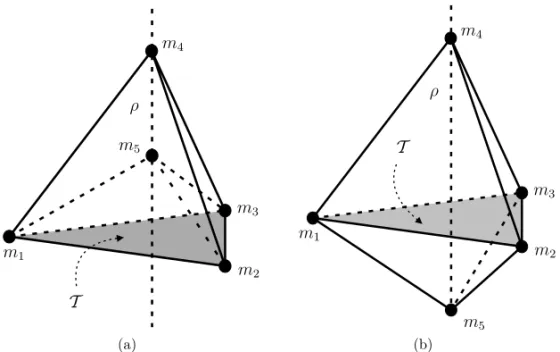
In this paper we study spatial central configurations for the 5-body problem that satisfy (see Fig. 1(a) and 1(b)):
1. The position vectorsr1,r2andr3are at the vertices of an equilateral triangleT;
2. Letρbe the line passing through the barycenter ofT that is perpendicular to the plane that contains T. The position vectorr4∈ρis fixed and does not belong to the plane that containsT;
3. The position vectorr5∈ρ,r56=r4.
This type of configuration is calledconcaveif one body is located in the interior of the convex hull of the other four bodies (see Fig. 1(a)), otherwise the configuration is called convex(see Fig. 1(b)). We say that the configuration isconcave of type 1if the body 5 is in the interior of the convex hull of the bodies 1, 2, 3 and 4. On the other hand, if the body 4 is in the interior of the convex hull of the bodies 1, 2, 3 and 5, we say that the configuration isconcave of type 2.
Fig. 1 – Spatial central configurations for the 5-body problem. Concave configuration (a). Convex configuration (b).
T. There is no special reason to taker4at(0,0,√6/3). With this choice, the length of the edge of the regular tetrahedron is 1. Note that the body 5 is at the barycenter ofT if and only if y =0. Therefore, the configuration is convex if and only if y ≤ 0, and the configuration is concave of type 1 (type 2, respectively) if and only if 0< y <√6/3 (y >√6/3, respectively).
Fig. 2 – Coordinates for the five bodies.
The main results of this paper are the following ones.
THEOREM1. Consider the position vectors r1=(x,0,0) , r2=
−x/2,−√3x/2,0, r3=
−x/2,√3x/2,0
at the vertices of an equilateral triangleT, and the position vectors r4=
0,0,√6/3, r5 =(0,0,y)on
ρ, whereρis the line passing through the barycenter ofT and perpendicular to the plane that containsT, according to Fig. 2. In this way, the following statements hold.
1. There exists a minimum positive value x = xmin =(3√2−2√3)/3such that if0 < x ≤ xminthere are no positions r1, . . . ,r5 and positive masses m1, . . . ,m5 such that these bodies are in a central configuration according to Fig. 2;
2. There are two open intervals I1 =
(3√2−2√3)/3,√3/3
and I2 =
√
3/3,√6/3
such that for each x ∈ I1∪ I2 there is one non-empty segment of possible positions for r5 and positive masses m1, . . . ,m5 such that these bodies form a 1-parameter family of concave central configurations of type 1;
3. There exists one distinguished and well-determined value x = ˉx for which there is just one position for r5such that these five bodies form a 2-parameter family of concave central configurations of type 1. Indeed this concave central configuration is exactly the well-known central configuration whose four equal masses are at the vertices of a regular tetrahedron and the fifth mass is at the center of the tetrahedron;
4. There exists one open interval I3 =
√
3/3, (2√3+3√2)/3such that for each x ∈ I3there is one non-empty segment of possible positions for r5and positive masses m1, . . . ,m5such that these bodies form a 1-parameter family of convex central configurations;
5. There exists one open and unbounded interval I4 =
4√3/3,+∞
such that for each x ∈ I4there is one non-empty segment of possible positions for r5and positive masses m1, . . . ,m5such that these bodies form a 1-parameter family of concave central configurations of type 2;
6. There exists one distinguished and well-determined value x = ˉˉx for which there is just one position for r5such that these five bodies form a 2-parameter family of concave central configurations of type 2. As in the above item 3, this concave central configuration is exactly the one whose four equal masses are at the vertices of a regular tetrahedron and the fifth mass is at the center of the tetrahedron.
REMARK 2. Items 2, 3 and 4 of Theorem 1 are closely related with some results obtained by Leandro in
(Leandro 2003). However, the assumptions, statements and proofs presented here are different and much simpler than those that appear in (Leandro 2003). Items 3 and 6 of Theorem 1 are not new. We have included them here for completeness.
PROOF OF THEOREM 1 The equations of motion of then-body problem are given by
¨ ri = −
n X
j=1 j6=i
mj
ri −rj
ri j3 , (1)
fori=1,2, . . . ,n. In (1) the gravitational constant is taken equal to one.
From the definition of central configuration, equation (1) can be written as
λri = − n X
j =1 j 6=i
mj
ri −rj
ri j3 , (2)
fori =1,2, . . . ,n. For the planar case, that isd =2, simple computations allow us to write equation (2) in the following form
fi j = n X
k =1 k 6=i, j
mk(Ri k −Rj k) 1i j k =0, (3)
for 1≤i < j ≤n, where Ri j =1/ri j3 and1i j k =(ri −rj)∧(ri −rk). In fact,1i j k is twice the oriented
area of the triangle formed by the bodies of massesmi,mj andmk. See the references (Hagihara 1970,
Mello et al. 2009b). Thesen(n−1)/2 equations are called Dziobek or Laura-Andoyer equations.
The computation of spatial central configuration is very difficult if we begin with equation (2). Instead of working with equation (2) we shall use another equivalent system of equations (see equation (6), p. 295 of (Hampton and Santoprete 2007) and the references therein)
fi j h = n X
k =1 k 6=i,j,h
mk(Ri k−Rj k) 1i j hk =0, (4)
for 1≤i < j ≤n,h =1, . . . ,n,h 6= i, j. Here, again, Ri j =1/ri j3 and1i j hk =(ri−rj)∧(rj −rh)∙ (rh−rk). Thus,1i j hkgives six times the signed volume of the tetrahedron formed by the bodies of masses
mi,mj,mhandmk. Thesen(n−1)(n−2)/2 equations are also called here Dziobek equations.
For the proof of Theorem 1 we use Dziobek equations (4). For five bodies, system (4) is a set of 30 equations. From the distances between the bodies it follows that R12 = R13 = R23, R14 = R24 = R34and R15 =R25= R35. Taking into account the symmetries, we have the following equalities among others:
11425= −11435= −12415=12435=13415= −13425,
11524= −11534= −12514=12534=13514= −13524.
Taking these symmetries into the Dziobek equations, the following 9 equations of (4) are trivially satisfied f123=0, f124=0, f125=0, f132 =0, f134 =0, f135 =0, f231 =0, f234=0 and f235=0.
Again looking for symmetries, we have the following equivalence between the equations:
f145=0⇔(R12−R24) 11452(m2−m3)=0, (5)
f245=0⇔(R12−R14) 12451(m1−m3)=0, (6)
f345 =0⇔(R13−R14) 13451(m1−m2)=0. (7)
As our classes of central configurations satisfyr4 6= r5, we have11452 6= 0, 12451 6= 0 and13451 6= 0. From equations (5), (6) and (7), we have two cases to analyze: the massesm1 = m2 = m3andr1,r2,r3 andr4are at the vertices of a regular tetrahedron.
CASE1. Considerr1,r2,r3andr4at the vertices of a regular tetrahedron. We have the following lemma. LEMMA3. Consider r1, r2, r3and r4at the vertices of a regular tetrahedron. Then, there exists just one position for r5at the center of the tetrahedron and positive masses m1=m2=m3=m4=m and m5such that these bodies form a2-parameter family of concave central configurations of type 1.
PROOF. Due to symmetries, we have the following equivalences between equations of (4):
f142=0⇔ f241=0, f143 =0⇔ f341=0, f243 =0⇔ f342=0,
f152=0⇔ f251 =0, f153=0⇔ f351 =0, f253=0⇔ f352=0.
Hence the remaining 21 equations are reduced to 15 equations. From f142=0, f143=0 and f243=0 we have m5(R15−R45) 11425 = 0, m5(R15−R45) 11435 = 0 andm5(R25−R45) 12435 = 0, respectively. As11425 6= 0,11435 6=0 and12435 6= 0, it follows thatR15 = R45 = R25. This implies thatr5 must be at the center of the tetrahedron. Adding this information into f152 = 0, f153 = 0 and f253 = 0, we have
(m3−m4) (R13−R35) 11523=0,(m2−m4) (R12−R25) 11532=0 and(m1−m4) (R12−R15) 12531=0, respectively. These last three equations are verified just when m1 = m2 = m3 = m4. By another side m5 can assume any positive value. The remaining equations of (4) are trivially satisfied. The lemma
is proved.
Define xˉ = √3/3. Thus, r1 = (√3/3,0,0), r2 = (−√3/6,−1/2,0), r3 = (−√3/6,1/2,0), r4 = (0,0,√6/3) and r5 = (0,0,√6/12). From Lemma 3, item 3 of Theorem 1 is proved. In the remainder of the statements we omit this type of concave central configuration.
CASE 2. Considerm1 = m2 = m3 = m. It follows that equations (5), (6), (7), f154 = 0, f451 = 0, f254=0, f452=0, f354=0 and f453 =0 are satisfied, and
f142 =0⇔ f143 =0⇔ f241 =0⇔ f243=0⇔ f341=0⇔ f342=0,
In other words, the initial 30 equations were reduced to 2 equations, which are the following:
f142 =m(R13−R34) 11423+m5(R15−R45) 11425=0, (8)
f152=m(R13−R35) 11523+m4(R14−R45) 11524=0. (9)
Equations (8) and (9) can be explicitly solved in the formm4 =m4(x,y,m)andm5 =m5(x,y,m), respectively. In these equations,mcan be understood as a parameter for the central configurations.
From equations (8) and (9) we have
m4 m =
(R35−R13) 11523
(R14−R45) 11524
, (10)
m5 m =
(R34−R13) 11423
(R15−R45) 11425
. (11)
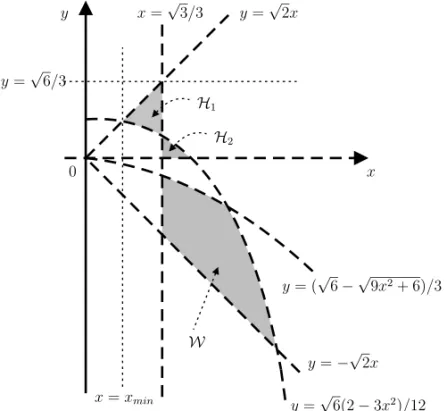
We wish to find subsets of D = {x > 0,y ∈ R,y 6= √6/3} whose ratios of the masses m4/m andm5/m are positive. For the study of the signs of the terms that appear in equations (10) and (11), we have R35 − R13 = 0 if and only if (x,y) ∈ {x > 0,y = −√2x} ∪ {x > 0,y = √2x} (straight lines), R14 − R45 = 0 if and only if (x,y) ∈ {x > 0,y = √6/3 −√9x2+6/3} ∪ {x > 0,y = √
6/3+√9x2+6/3}(hyperbolas), R34− R13 = 0 if and only if(x,y) ∈ {x =√3/3}, R15−R45 =0 if and only if (x,y) ∈ {x > 0,y = √6(2−3x2)/12} (parabola), 11523 = 0 if and only if (x,y) ∈ {x > 0,y = 0}, 11524 = 0 if and only if (x,y) ∈ {x > 0,y = √6/3}, 11425 = 0 if and only if
(x,y)∈ {x >0,y =√6/3}. See Figs. 3 and 4.
Fig. 3 – The open regionsH1,H2andW.
LEMMA4. Consider r5 =(0,0,0), that is y =0. Then, there is no value x >0such that 5 bodies with positive masses form a central configuration according to Fig. 2.
PROOF. From equation (9) we have
m(R13−R35) 11523+m4(R14−R45) 11524=0.
By assumption,11523=0. As(R14−R45)6=0 and115246=0; then,m4=0. This is a contradiction.
CASE2.2. Consider 0<x ≤(3√2−2√3)/3 andy6=√6/3. We have the following lemma.
LEMMA5. Consider 0 < x ≤ (3√2−2√3)/3. Then, there is no position for the body 5 on the line ρ and positive masses mi, i = 1, . . . ,5 such that these bodies form a central configuration according
to Fig. 2.
PROOF. There are three cases to analyze: y<0, 0<y <√6/3 andy >√6/3.
Consider y<0. From equation (8) we have
m(R13−R34) 11423+m5(R15−R45) 11425=0.
By assumption R13−R34 <0, R15 −R45 < 0,11423 >0 and11425 >0. Therefore, the coefficients of the above equation have the same sign. This implies thatmandm5must have opposite signs.
Consider 0 < y < √6/3. By assumption R13−R34 < 0, R13−R35 > 0, R14− R45 < 0,11423 > 0,
11425 > 0,11523 >0, 11524 < 0, R15−R45 <0, if 0 < y < √6(2−3x2)/12 and R15−R45 > 0, if √
6(2−3x2)/12< y<√6/3.
From equation (8) we have
m(R13−R34) 11423+m5(R15−R45) 11425=0.
If 0 < y < √6(2−3x2)/12, then the coefficients of the above equation have the same sign. Therefore,
the massesmandm5have opposite signs. Now, from equation (9), we have
m(R13−R35) 11523+m4(R14−R45) 11524=0.
If√6(2−3x2)/12 < y <√6/3, then the coefficients of the above equation have the same sign.
There-fore, the masses m andm4 have opposite signs. If y = √6(2−3x2)/12, then R15− R45 = 0 and this implies that the massmmust be zero in equation (8).
Consider y>√6/3. From equation (8) we have
m(R13−R34) 11423+m5(R15−R45) 11425=0.
From Lemma 5 item 1 of Theorem 1 is proved. The valuexmin = (3√2−2√3)/3 is defined as the x-coordinate of an intersection of the curves R35−R13=0 andR15−R45=0 (see Fig. 3).
CASE2.3. Considerx >0 and 0< y<√6/3.
DefineH=H1∪H2(see Fig. 3) where
H1= (
3√2−2√3 3 <x <
√ 3 3 ,
√
6(2−3x2)
12 <y < √
2x
) ,
H2= (√
3 3 <x <
√ 6
3 ,0<y < √
6(2−3x2)
12
) .
For (x,y) ∈ H1 we have x > 0, 0 < y < √6/3, R35 −R13 > 0, R34 − R13 < 0, R15 − R45 < 0, R14 −R45 < 0, 11523 > 0, 11524 < 0, 11423 > 0 and 11425 > 0. For (x,y) ∈ H2 we have x > 0, 0< y <√6/3, R35−R13 >0, R34−R13 >0, R15−R45 >0, R14−R45 <0,11523 >0,11524 <0,
11423>0 and11425>0.
It is simple to see that for(x,y)∈Hthe right-hand sides of equations (10) and (11) are positive and, therefore, we have concave central configurations of type 1.
The orthogonal projections of the open sets H1 andH2 onto the x-axis give two open intervals by I1 =
(3√2−2√3)/3,√3/3
andI2=
√
3/3,√6/3
, respectively. For eachx∗ ∈ I1∪I2the straight linex =x∗intersectsH1∪H2in a non-empty segment. This proves item 2 of Theorem 1.
CASE2.4. Considerx >0 andy<0.
In order to have convex central configurations, it is necessary that y < 0. Define the open set
W =W1∪W2(see Fig. 3), where
W1= (√
3 3 <x ≤
√
2,−√2x <y <
√ 6 3 − √ 9x2 +6 3 ) ,
W2= (
√
2≤x < 2
√
3+3√2
3 ,−
√
2x < y<
√
6(2−3x2)
12
) .
For(x,y) ∈W we havex >0, y <0, R35−R13 >0, R34−R13 >0, R15−R45 >0, R14−R45 >0,
11523<0,11524<0,11423>0 and11425>0.
It is simple to see that, for(x,y) ∈ W, the right-hand sides of equations (10) and (11) are positive and, therefore, we have convex central configurations.
The orthogonal projection of the open setW onto thex-axis gives one open interval
I3=
√
3/3, (2√3+3√2)/3
.
For eachx∗ ∈ I3the straight line x = x∗ intersectsW in a non-empty segment. This proves item 4 of Theorem 1.
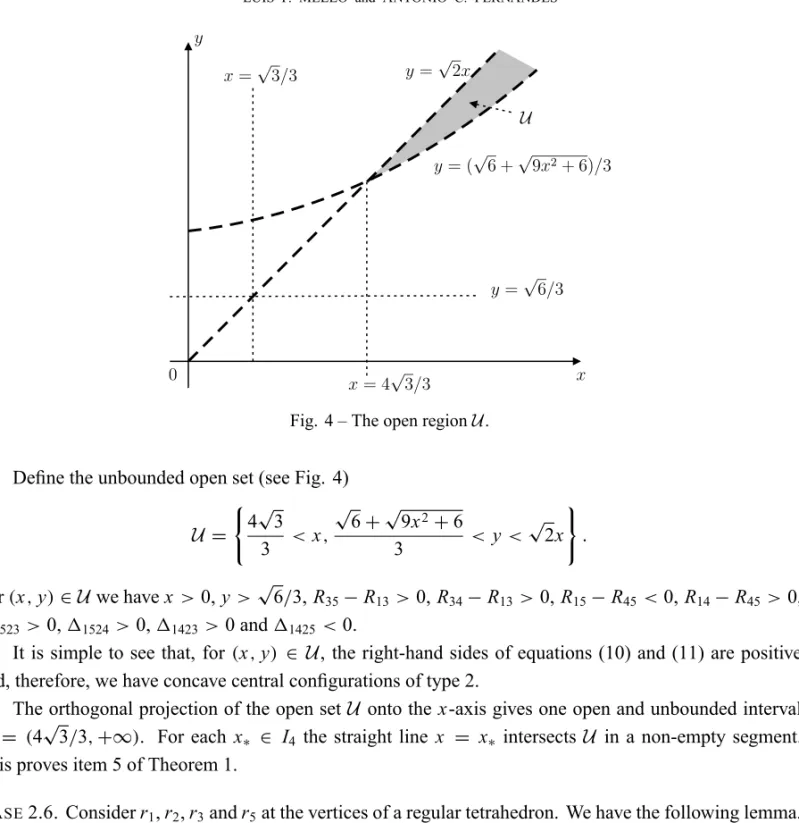
Fig. 4 – The open regionU.
Define the unbounded open set (see Fig. 4)
U = (
4√3 3 <x,
√
6+√9x2+6
3 <y < √
2x
) .
For(x,y)∈Uwe havex >0, y>√6/3, R35−R13 >0, R34−R13 >0, R15−R45 <0, R14−R45 >0,
11523>0,11524>0,11423>0 and11425<0.
It is simple to see that, for (x,y) ∈ U, the right-hand sides of equations (10) and (11) are positive and, therefore, we have concave central configurations of type 2.
The orthogonal projection of the open setU onto the x-axis gives one open and unbounded interval I4 = (4√3/3,+∞). For each x∗ ∈ I4 the straight line x = x∗ intersects U in a non-empty segment. This proves item 5 of Theorem 1.
CASE2.6. Considerr1,r2,r3andr5at the vertices of a regular tetrahedron. We have the following lemma. LEMMA6. If m1 = m2 = m3 = m5 =m and m4 are at r1 =
4√3/3,0,0
, r2 =
−2√3/3,−2,0
,
r3=
−2√3/3,2,0
, r4=
0,0,√6/3
and r5=
0,0,4√6/3
, then these bodies form a2-parameter family of concave central configurations of type 2.
PROOF. By assumption, x = 4√3/3 and y = 4√6/3. For these values, we have R13 −R35 = 0 and R14 − R45 = 0. Therefore, equation (9) is satisfied for all m4 > 0. As m5 = m, equation (8) can be written as
m(R13−R34)11423+(R15−R45)11425=0.
The proof of item 6 of Theorem 1 follows Lemma 6 in which xˉˉ =4√3/3. In short we have proved
Theorem 1.
CONCLUDING COMMENTS
In this paper it was shown the existence (and the nonexistence) of concave/convex spatial central config-urations in the 5-body problem. The spatial central configconfig-urations studied here are generalizations of the kite planar central configurations.
Some of the results presented here (see Remark 2) are closely related with the results presented by Leandro in (Leandro 2003). However, the methods used in the two articles are different. The tech-niques used here are very simple, and the use of the computer is not necessary in the proofs of the results presented (see Theorem 1 and its proof). In this sense, the two articles are complementary.
ACKNOWLEDGMENTS
The first author is partially supported by Conselho Nacional de Desenvolvimento Científico e Tecnológico (CNPq), grants 476672/2009-0 and 304926/2009-4. The second author is partially supported by Coorde-nação de Aperfeiçoamento de Pessoal de Nível Superior (CAPES).
RESUMO
Neste artigo estudamos a existência de novas famílias de configurações centrais espaciais dos tipos côncavas ou convexas para o problema de 5 corpos. Os corpos estudados aqui estão dispostos da seguinte maneira: três corpos estão sobre os vértices de um triângulo equiláteroT e os outros dois corpos estão sobre a reta que passa pelo baricentro deT e é perpendicular ao plano que contémT.
Palavras-chave: configurações centrais, configurações espaciais, problema de 5 corpos, configuração convexa,
configuração côncava.
REFERENCES
BERNATJ, LLIBREJANDPÉREZ-CHAVELAE. 2009. On the planar central configurations of the 4-body problem
with three equal masses. Dynam Contin Discrete Impuls Systems 16: 1–13.
CORBERA M AND LLIBRE J. 2008. Central configurations of nested regular polyhedra for the spatial 2n-body
problem. J Geom Phys 58: 1241–1252.
CORBERA M AND LLIBRE J. 2009. Central configurations of three regular polyhedra for the spatial 3n-body
problem. J Geom Phys 59: 321–339.
EULERL. 1767. De moto rectilineo trium corporum se mutuo attahentium. Novi Comm Acad Sci Imp Petrop 11: 144–151.
HAGIHARAY. 1970. Celestial Mechanics, vol. 1, Massachusetts: MIT Press, 720 p.
HAMPTONMANDSANTOPRETEM. 2007. Seven-body central configurations: a family of central configurations
in the spatial seven-body problem. Celestial Mech Dyn Astr 99: 293–305.
LEANDRO ESG. 2003. Finiteness and bifurcations of some symmetrical classes of central configurations. Arch Rational Mech Anal 167: 147–177.
LEHMANN-FILHÉSR. 1891. Ueber zwei Fälle des Vielkörperproblems. Astr Naschr 127: 137–144.
MELLOLF, CHAVESFEAND FERNANDES AC. 2009b. Configurações centrais planares do tipo pipa. Rev Bras Ens Fis 31: 1–7, (in Portuguese).
MELLO LF, CHAVES FE, FERNANDES AC AND GARCIA BA. 2009a. Stacked central configurations for the
spatial 6-body problem. J Geom Phys 59: 1216–1226.
MOECKELR. 1990. On central configurations. Math Z 205: 499–517.
MOULTONFR. 1910. The straight line solutions ofnbodies. Ann of Math 12: 1–17.
NEWTONI. 1687. Philosophi Naturalis Principia Mathematica. London: Royal Society, 512 p.
SAARID. 1980. On the role and properties of central configurations. Celestial Mech 21: 9–20.
SMALES. 1970. Topology and mechanics II: The planarn-body problem. Invent Math 11: 45–64.
WINTNER A. 1941. The Analytical Foundations of Celestial Mechanics. Princeton: Princeton University Press,
448 p.
YIMINGLAND SHANZHONGS. 2002. Four-body central configurations with some equal masses. Arch Rational
Mech Anal 162: 25–44.