(Annals of the Brazilian Academy of Sciences)
Printed version ISSN 0001-3765 / Online version ISSN 1678-2690 www.scielo.br/aabc
Developmental pathway from leaves to galls induced by a sap-feeding insect
on
Schinus polygamus
(Cav.) Cabrera (Anacardiaceae)
GRACIELA G. DIAS1, BRUNO G. FERREIRA1, GILSON R.P. MOREIRA2 and ROSY M.S. ISAIAS1 1Universidade Federal de Minas Gerais, Instituto de Ciências Biológicas, Departamento de Botânica,
Av. Antônio Carlos, 6627, Campus Pampulha, 31270-901 Belo Horizonte, MG, Brasil
2
Programas de Pós-Graduação em Biologia Animal e Ecologia, Universidade Federal do Rio Grande do Sul, Instituto de Biociências, Departamentos de Zoologia e Ecologia,
Av. Bento Gonçalves, 9500, Campus do Vale, 91501-970 Porto Alegre, RS, Brasil
Manuscript received on June 9, 2011; accepted for publication on September 19, 2011
ABSTRACT
Galling sap-feeding insects are presumed to cause only minor changes in host plant tissues, because they usually do not require development of nutritive tissues for their own use. This premise was examined through comparison of the histometry, cytometry and anatomical development of non-galled leaves and galls of Calophya duvauae (Scott) (Hemiptera: Calophyidae) on Schinus polygamus (Cav.) Cabrera (Anacardiaceae). Cell fates changed from non-galled leaves to galls during the course of tissue differentiation.
C. duvauae caused changes in dermal, ground, and vascular systems of the leaves of S. polygamus. Its feeding activity induced the homogenization of the parenchyma, and the neoformation of vascular bundles and trichomes. The histometric and cytometric data revealed compensatory effects of hyperplasia and cell hypertrophy in the epidermis, with hyperplasia predominating in the adaxial epidermis. There was a balance between these processes in the other tissues. Thus, we found major differences between the developmental pathways of non-galled leaves and galls. These changes were associated with phenotypic alterations related to shelter and appropriate microenvironmental conditions for the gall inducer. The non-differentiation of a typical nutritive tissue in this case was compared to other non-phylogenetically related arthropod gall systems, and is suggested to result from convergence associated with the piercing feeding apparatus of the corresponding gall-inducer.
Key words: hemipteran gall, histometry, developmental patterns, cell fates.
Correspondence to: Gilson R.P. Moreira E-mail: [email protected]
INTRODUCTION
Closely related lineages of gall-inducing insects
tend to influence their host plant tissues equally
(Rohfritsch 1992), because of the similarities in
their feeding habits. Conversely, differences in
the feeding habits of gall inducers may explain,
broadly, the morphological differences found
However, these contentions are still under debate.
In fact, some authors have demonstrated the
induction of a nutritive reserve in galls induced by
sap-feeders (e.g., Meyer 1987, Oliveira et al. 2006,
Moura et al. 2008). Herein, we measured tissue
developmental changes between non-galled leaves
and galls throughout ontogeny to establish possible
convergences between gall systems involving
gall-inducers with similar mouth apparatus.
Independently of whether a nutritive tissue is
formed, gall induction occurs in response either to
oviposition or to the feeding activity of the first-instar
nymph. In some cases, it may also be due to the
feeding activity of the mother insect during oviposition
(Rohfritsch 1992). The corresponding cell responses
are induced by the combined effects of tissue injury
and the injection of substances present in the saliva
of the insect, which causes metabolic and hormonal
imbalances in adjacent tissues (Hori 1992, Raman
2011). After gall induction, a number of cell divisions
and hypertrophy occur (Mani 1964, Rohfritsch 1992,
Oliveira et al. 2006), and increase as the insect’s
feeding activity continues (Rohfritsch 1992). Even
for a typical gall-inducing phloem-feeding insect that
causes localized impacts on plant cells, substantial
changes in the plant to provide shelter and an
appropriate environment during the gall inducer’s
life cycle are expected (Stone and Schönrogge 2003).
Assuming that the peculiarities of the galls are related to
the gall-inducer’s feeding behavior, it is expected that
the processes of differentiation and redifferentiation
(
sensu
Lev-Yadun 2003) that occur from hosts to galls
induced by sap-feeding insects are similar to those
induced by other sucking arthropods.
We examined this question further by
comparing through histometry, cytometry and
anatomy the development of non-galled leaves of
Schinus polygamus
(Cav.) Cabrera (Anacardiaceae)
with the leaf galls induced by a parenchyma
sap-feeder,
Calophya duvauae
(Scott) (Hemiptera:
Calophyidae). We searched for the existence
of significant differences in the corresponding
cell and tissue developmental pathways from
both qualitative and quantitative perspectives.
As described in detail by Fleig (1987, 1989),
S.
polygamus
is a small, relatively common tree
found more or less interspersed with fragments
of semideciduous forests, herbaceous and shrub
vegetation of southern Brazilian
Campos
(sensu
Overbeck et al. 2007). Although galls induced
by calophyids on species of
Schinus
have been
reported by several investigators (Núñez and Sáiz
1994, Sáiz and Núñez 1997, 2000, Burckhardt and
Basset 2000, Caballero and Lorini 2000, Burckhardt
2005), aspects of the anatomical development
of these galls remain unknown. Thus, additional
goals of the current study were: (1) to describe the
developmental pattern of the host leaf tissues that
are not influenced by the attack of
C. duvauae
;
(2) to describe the anatomical development of
the gall during the life cycle of
C. duvauae
; and
(3) to quantify the reactions of cell hypertrophy
or hyperplasia from non-galled tissues to mature
galls, and their relationship to the alterations in
S.
polygamus
cell fates.
MATERIALS AND METHODS
collection of the Laboratório de Morfologia e
Com-portamento de Insetos, Departamento de Zoologia,
UFRGS, under accession number LMCI 202.
For the structural analyses, apical buds, young
(from first to fourth nodes), and expanded (fifth and
sixth nodes) non-galled leaves, galls and fragments
with evidence of gall induction (n = 10, for each
type) were fixed in either 4% Karnovsky in 0.1 mM
phosphate buffer for 24h (O’Brien and McCully
1981, modified to pH = 7.2) or in FAA (37%
formaldehyde, glacial acetic acid, and 50% ethanol,
1:1:18, v/v) (Johansen 1940), and subsequently
stored in 70% ethanol.
Semi-permanent slides were prepared with
freehand cross-sections, stained with 0.5%
safranin-astra blue (9:1) (Kraus and Arduin 1997).
In the preparation of permanent slides, fragments
were dehydrated in an n-butyl series, and embedded
in Paraplast
®(Kraus and Arduin 1997). Serial
sections (12-14 μm) were obtained in a rotary
microtome and stained in 0.5% safranin-astra blue
(9:1) (Kraus and Arduin 1997). The presence of
crystals was verified by polarized light, and their
chemical nature was tested with 5-10% sulfuric acid
(Chamberlain 1932). Presence of silica crystals was
further tested with phenol (Johansen 1940, Kraus
and Arduin 1997). Phenolic compounds were
evidenced by the histochemical reaction with ferric
chloride (Johansen 1940).
For the studies in scanning electron microscopy
(SEM), the fragments with evidence of gall
induction, and galls were separated according to
the life stage of the insect, fixed in 4% Karnovsky
in 0.1 mM phosphate buffer for 24 h (O’Brien and
McCully 1981, modified to pH = 7.2), post-fixed in
1% osmium tetroxide in 0.1 mM phosphate buffer
(pH 7.2), and then dehydrated in an ethanol series
(Johansen 1940), followed by critical point drying
with carbon dioxide (Bal-Tec CPD
®030). The
material was sputter-coated with 30 nm of gold
(Bal-Tec SCD
®050). Images were observed and captured
in a scanning electron microscope (LEO EVO
®40).
To obtain isolated epidermis, 10 non-galled
leaves and 10 galls (with insect inducers in the fourth
or fifth instars) were used. Fragments were immersed
in 50% sodium hypochlorite at room temperature.
After detachment, the epidermis was washed and
stained with 0.5% safranin in 95% ethanol, and
mounted with Kaiser's jelly glycerin (Johansen 1940).
The diagrams were based on photomicrographs, and
created using Adobe Photoshop
®CS (Adobe Systems
Inc. 1990-2003) and a tablet (Trust
®TB-6300).
In parallel to structural observations, histometry
can provide statistically reliable comparisons
(Thiébaut 2000), and was used here to confirm and
supplement the observations of contrasts between
normal and altered morphogenesis. Histometric
and cytometric data were obtained from
photo-micrographs of cross sections of the middle region
of five fully expanded non-galled leaves and five
mature galls, in the adaxial region opposite to the
opening. The number of cells was counted from a
transect. The thickness of the mesophyll of
non-galled leaves, adaxial gall wall, vascular bundles
in the middle portion, adaxial epidermis, and
epidermis lining the chamber were evaluated (n = 40
fields). The area of the spongy parenchyma cells in
non-galled leaves, the cells of the inner cortex of
the galls, the adaxial epidermis, and the epidermis
lining the chamber (n = 50 fields) were also
evaluated. The measurements were performed with
Axion Vision Zeiss
®software, and subjected to
statistical analyses in JMP (SAS Institute, U.S.A.,
1989-2002). The data did not pass normality tests
(Shapiro-Wilk tests) and therefore were compared
by a nonparametric Kruskal-Wallis test, followed
by Dunn's multiple comparison tests (α= 0.05).
RESULTS
LEAF DEVELOPMENT
At the shoot apex, the promeristem initiates
its differentiation by anticlinal divisions of L1.
During leaf development, the protoderm is the
first meristem to differentiate, followed by the
ground meristem, where the procambium arises.
The palisade parenchyma is the last tissue to
differentiate, when the leaves get to the sixth node,
and are completely differentiated.
The protoderm and the ground meristem are
already differentiated at the first leaf primordium
(Fig. 1B). In the protoderm, only anticlinal divisions
take place, while in the submarginal layers, anticlinal
and periclinal divisions occur. At the second node, the
cells of the ground meristem divide anticlinally and
periclinally, resulting in an increase of isodiametric cell
layers (Fig. 1C). In the middle meristem, the procambial
cells differentiate and divide in several planes, giving
rise to grouped small cells. Phenolic idioblasts start
to differentiate. At the third node, the protoderm of
the leaf primordium divides anticlinally. The ground
Fig. 1 - Development of the leaves of Schinus polygamus: A) Shoot apex with spiral alternate phyllotaxy; B-D) Diagrams of a leaf primordium intransverse section at the first, second and fourth nodes, respectively; in C, the red circle indicates the procambium, and the arrows, the marginal
meristem has three distinct layers: adaxial, abaxial
and middle meristem. Schizogenous secretory ducts
are associated with the phloem. At the fourth node,
the adaxial meristem divides both anticlinally and
periclinally (Fig. 1D). The procambium divides
periclinally. The middle meristem, in addition to the
vascular system, gives rise to the inner layers of the
spongy parenchyma. The abaxial meristem has two
layers. In this stage of development, the second-order
veins begin to differentiate in the middle layers of the
ground meristem, without secretory ducts. At the
fifth node, the palisade parenchyma is 2-3 layered
and anticlinally elongated, and more cells in the
spongy parenchyma and the stomata differentiate.
The midrib is almost completely differentiated,
with 2-4 secretory ducts associated with the
phloem (Fig. 1E). The frequency of idioblasts with
phenolic compounds gradually increases during the
leaf development.
The leaf lamina is completely differentiated at
the sixth node, and the midrib is biconvex (Fig. 1E).
The vascular system is constituted of 3-5 units with
collateral arrangement and secondary growth. The
epithelial cells and the vascular parenchyma cells are
filled with phenolic compounds, as are the cells of
the endodermis and the pericycle. Some individual
druses of calcium oxalate were observed in the
endodermis. At the cortex of the midrib, there are
2-3 layers of annular collenchyma and isodiametric
parenchyma cells. The second-order veins are
collateral, and also have secretory ducts, unlike the
smaller veins which have few vascular cells.
In the mature leaf lamina, the mesophyll is
dorsiventral, with biseriate palisade parenchyma
(Fig. 1F) facing the adaxial surface, and spongy
parenchyma with a variable number of cell layers,
and interspersed vascular bundles. Most of the cells
of the mesophyll are filled with phenolic compounds.
The leaf is amphistomatic, with periclinally
elongated epidermal cells in cross section, and
slightly sinuous anticlinal walls in frontal view (Fig.
1G). The stomata are anomocytic (Fig. 1H).
GALL DEVELOPMENT
General aspects
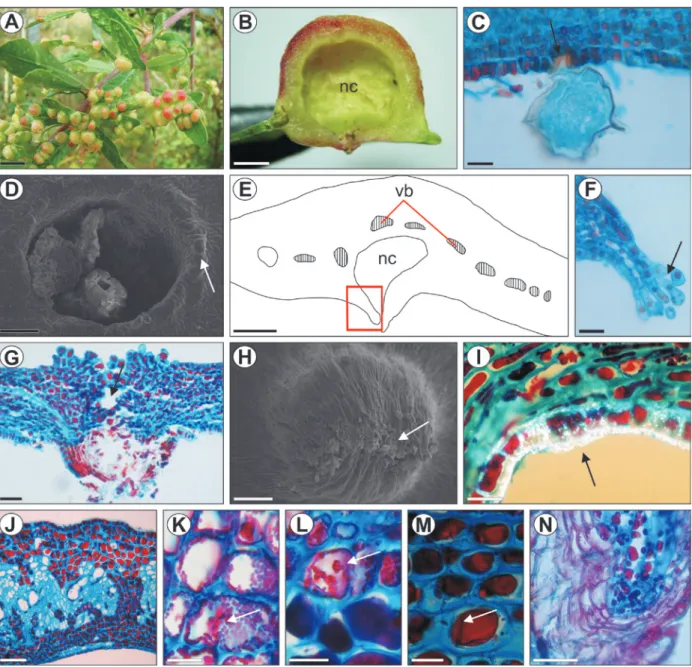
. Galls induced by
C. duvauae
are isolated or grouped (Fig. 2A), and form a
large chamber (Fig. 2B), which shelters one
gall inducer. The induction occurs at the abaxial
surface and causes a depression in the leaf lamina,
followed by the formation of emergences with
trichomes that close the opening of the gall in the
growth and developmental phase. The maturation
phase is characterized by an increase in gall
size. Suberization of the epidermis covering the
nymphal chamber and the opening region occurs in
the senescent phase.
Anatomical features
. The insertion of a
pedun-culated egg between two epidermal cells causes a
local increase in phenolics accumulation (Fig. 2C).
After hatching, the first-instar nymph inserts its
stylets into epidermal cells, and continues inducing
the cell alterations started by the egg’s presence. The
mesophyll tissues develop, involving the nymph (Fig.
2D). The gall is closed by trichome differentiation, and
by divisions of the cells of the abaxial epidermis and
of the adjacent parenchyma (Fig. 2E, F). There is no
welding, but only overlapping of the trichomes. The
epidermis of the nymphal chamber is continuous
with the abaxial surface, and its cells successively
divide anticlinally. The adaxial epidermis also
divides anticlinally, following the growth of the
gall, which is projected to this surface. Emergences
consisting of parenchyma and epidermal cells
differentiate and give rise to the region of the gall
opening, where the adult will emerge.
In the maturation phase, the gall contains
several layers of parenchyma, large vascular
bundles in the adaxial portion, and secretory ducts
with large lumens. The trichomes of the ostiole
lignify and project inward and outward to the
nymphal chamber (Fig. 2G-H). A large amount
of calcium oxalate crystals accumulates in the
epidermal cell walls immediately outside the
opening (Fig. 2I). These inclusions are absent from
the cells surrounding the nymphal chamber.
Fig. 2 - Development of the galls of Calophya duvauae on the leaves of Schinus polygamus: A) Shoot with several galls; B) Cross section of a mature gall, showing the large nymphal chamber (nc); C) Egg inserted (arrow) in the abaxial epidermis; D) Evagination of leaf tissues around insect body, under scanning electron microscopy (arrow); E) Diagram of a cross section of the gall during the growth and developmental phases, showing the nymphal chamber and position of the vascular bundles; F) Detail (red rectangle in E) of the trichomes at the opening of the gall (arrow); G) Detail of
The vascularization develops only in the
adaxial portion of the gall, where several cells of
the parenchyma, vascular parenchyma and secretory
epithelium are filled with phenolic compounds
(Fig. 2J). Druses abound in the adaxial mesophyll.
The adaxial surface of the epidermis has isodiametric
cells with a thick cuticle. The phenolic content of the
parenchyma and epidermal cells is variable, and is
higher in the adaxial cortex (Fig. 2K-M).
In the senescent phase, the gall inducer emerges
through the gall opening, which enlarges. The major
anatomical alterations in this phase are the absence
of trichomes, and the suberization of the opening
region (Fig. 2N) and the nymphal chamber epidermis
adjacent to it. Some epidermal and parenchyma cells
exhibit altered forms and contents.
The gall induction causes alterations and
redifferentiation of the leaf tissues. In this process,
palisade parenchyma originates the outer adaxial
cortex. The spongy parenchyma redifferentiates
into the inner adaxial cortex, the abaxial cortex and
vascular bundles. The epidermis redifferentiates into
the dermal system of the nymphal chamber (Fig. 3).
Cytometry and Histometry
. Every measured
cytometric and histometric parameter was altered
during gall development, except the thickness of
the adaxial epidermis (Fig. 4). The number of cell
layers and vascular bundles, and the mesophyll
thickness in the mature galls (MG) are almost
twice those of non-galled leaves (NGL) (Fig.
4A-C). The thickness of the epidermis covering
the nymphal chamber is greatly reduced (Fig.
4E). The area of the parenchyma cells increases
(Fig. 4F), and the areas of the adaxial epidermal
cells and of the nymphal chamber epidermis
decrease (Fig. 4G-H).
DISCUSSION
Our data clearly showed that there are pronounced
anatomical changes caused by the presence and
feeding habit of the gall inducer. Compared to two
other similar systems induced by galling
fluid-feeders that were studied in detail in this regard,
the galls of
S. polygamus
–
C. duvauae
are more
similar to those of
Lantana camara
(Verbenaceae)
–
A. lantanae
(Acari: Eriophyidae) than to those of
Copaifera langsdorffii
(Fabaceae) – Cecidomyiidae
Fig. 4 - Cytological and histometrical analyses of cross sections of non-galled leaves (NGL) of Schinus polygamus and mature galls (MG) of Calophya duvauae. Bars followed by the same letters are not significantly different (Kruskal-Wallis test, followed by Dunn’s(Diptera). The latter develop a specialized nutritive
tissue in response to the feeding habit of the
gall-inducer (Oliveira and Isaias 2010). Although
considered fluid feeders, cecidomyiid larvae have a
complex feeding apparatus that is not homologous
to that of the psylloids (Bronner 1992).
A. lantanae
,
on the other hand, induces galls with a homogeneous
parenchyma that does not lignify and suberize
during senescence, characteristics associated with
their sucking habit (Moura et al. 2009). Thus, our
results indicate the existence of a convergence in
the tissue composition of
C. duvauae
galls with
those of
A. lantanae
, presumably associated with
their similar feeding apparatus (both have piercing
stylets; see Roberts et al. 1994, and Buckhardt
2005), given that are distantly phylogenetically
related (belong to different arthropod classes). Two
additional peculiarities distinguish these systems,
but apparently play no major role in the existence
of such a convergence: first, their galls have a
different number of inducers per chamber; i.e.,
L.
camara
houses a colony of
A. lantanae
in each
gall, whereas
S. polygamus
houses one
C. duvauae
per chamber; and second, their galls have different
shapes; i.e.
A. lantanae
induces crinkle-leaf galls
with an irregular, hairy surface (Moura et al. 2008),
and
C. duvauae
induces pouch galls with regular,
non-hairy surfaces, as described herein.
In two other Neotropical, fluid-feeder gall
inducers,
Bacharopelma dracunculifolia
(Arduin
et al. 2005) and
Euphalerus ostreoides
(Oliveira et
al. 2006, Isaias et al. in press), similar patterns were
observed, such as in relation to the homogenization
of the parenchyma and hyperplasia of the vascular
bundles. However, regarding the epidermis and
secretory cells, each of these gall systems showed
some peculiarities, indicating the different role of
each insect species in determining the gall phenotype.
As rounded galls, those induced by
C. duvauae
have cells whose pattern of elongation drastically
changed. The mass of homogeneous cells are in the
majority isodiametric, not elongated or braciform
as in the palisade and spongy parenchyma, and
seem to be the cause of the gall shape. In the
case of the bivalve-shaped galls of
Lonchocarpus
muehlbergianus
, for instance, the cells elongate
anticlinally to generate the gall morphotype (Isaias
et al. in press). This gives further support for the
specific role of the inducers in causing subtle
differences in gall morphologies, independently of
their similar feeding behaviors.
LEAF DEVELOPMENT
The leaf development of
S. polygamus
follows the
pattern described by Foster (1936) for
Pelargonium
zonale
(Geraniaceae), and of some other simple
leaves (Fahn 1990). The adaxial meristem initiates
the palisade parenchyma, and the middle meristem
originates the procambial cells and half of the
spongy parenchyma. The other half differentiates
from the abaxial meristem. A similar pattern was
described by Oliveira and Isaias (2010) for the
development of the leaflets of C. langsdorffii
.
The leaf epidermis originates exclusively from the
protoderm, and is one-layered from the first to the
sixth node, when the leaves are totally expanded.
The adaxial surface of the epidermis originates from
the adaxial protoderm, and the abaxial epidermis
from the abaxial protoderm (Fahn 1990, Moura et
al. 2009, Oliveira and Isaias 2010). In the plants
of
S. polygamus
studied here, trichomes are rare,
similarly to the observations of Fleig (1985). The
stomata are numerous and associated with the veins,
as described by Alvarez et al. (2008) for another
Anacardiaceae,
Pistacia terebinthus
.
The procambium cells originate from the
middle meristem layers, as observed for
P. zonale
,
(Solereder 1908, Metcalfe and Chalk 1983,
Carmello-Guerreiro and Paoli 2005, Simpson
2006, Lacchia and Carmello-Guerreiro 2009).
These gum resin secretory ducts (Fahn 1979)
begin to differentiate at the third node, and their
presence may function in the early protection of
the expanding leaves, similarly to the phenolic
compounds detected in the mesophyll cells since
the second node.
GALL DEVELOPMENT
During oviposition, the egg stalk of
C. duvauae
is inserted precisely between two epidermal cells.
According to Burckhardt (2005), most galls of
Psylloidea are induced by the feeding activity of
the nymph. However, in the case of
C. duvauae
,
phenolics accumulation and cell divisions were
observed in response to the presence of the egg,
resulting in the onset of a depression in the leaf.
Then, the nymph is responsible for continuing the
stimuli that began at the time of oviposition. Plant
responses to insect oviposition, such as the secretion
of ovicidal and volatile attractive substances,
and hypersensitivity reactions are known, and
they can also be found in galls (Rohfritsch 1992,
Hilker and Meiners 2006). The depression around
the oviposition site seems to follow the patterns
previously observed in galls of some Psylloidea
(Bouyjou and Nguyen 1974, Taylor 1992). The
cells underlying the egg and later the nymph divide
anticlinally and form the epidermis of the nymphal
chamber. This tissue does not have differentiated
stomata, and has small cells covered with a thin
cuticle, as observed in the galls of
P. terebinthus
(Alvarez et al. 2009).
At the edges of the emergences, the epidermal
cells redifferentiate into trichoblasts that increase
in size and eventually obliterate the opening. The
trichomes are related to mechanical protection
against invaders, such as predators, parasitoids and
cecidophages, and help to stabilize the temperature
and humidity within the gall chamber (Johnson
1975, Arduin et al. 2005, Oliveira et al. 2006,
Alvarez et al. 2009). In galls induced by
Forda
formicaria
in
P. terebinthus
, the trichomes are
reminiscent of the young stage of the leaflets; in
S.
polygamus
, however, these epidermal appendages
are neoformed, similarly to what was observed on
the valves of galls induced by
Euphalerus ostreoides
(Hemiptera: Psyllidae) on
L. muehlbergianus
Hassl.
(Fabaceae) (Oliveira et al. 2006).
In galls induced in mature tissues, cell
redifferentiation is necessary, generating specialized
tissues (Oliveira and Isaias 2009). In galls of
C.
duvauae
on
S. polygamus
, either the vascular or the
ground systems are derived secondarily from cells
of the ground meristem. Because of their relative
position on the leaf surface, it is possible to trace
the origin of the gall tissues redifferentiated from
palisade and spongy parenchyma.
In response to the stimuli of gall induction, the
parenchyma cells recover their ability to divide and
hypertrophy. Cell divisions occur in several planes,
increasing the number of cell layers and the thickness
of the mesophyll, and originating the homogeneous
parenchyma cortex. Both the homogenization of
the parenchyma and cell hypertrophy are common
phenomena in the formation of galls, and have
been observed in other Neotropical systems (Souza
et al. 2000, Moura et al. 2008, Moura et al. 2009,
Oliveira and Isaias 2010). These phenomena are
linked to reduced photosynthetic capacity in some
galls (Moura et al. 2008), and are related to the new
functions of the mesophyll, such as a feeding site
for the insect and a protective barrier (Mani 1964,
Rohfritsch 1992, Moura et al. 2008). Hence, some
plants infested with galls have shown less growth
and productivity (Gonzáles et al. 2005).
opening. Crystal accumulation is a product of the
activity of the gall inducer, which usually does not
cause the appearance of novel features in the host
plant. Moreover, it is a product of the redirection
of substances and patterns of development that are
already present in the host organ (Rohfritsch and
Shorthouse 1982, Schönrogge et al. 2000).
The neoformation of vascular bundles is
observed throughout the adaxial portion of the
gall, similarly to the midrib gall of
C. langsdorffii
(Oliveira and Isaias 2010). These bundles are
essential for the nourishment of the cells of the gall
and of the gall inducer, which feeds by inserting its
stylets into phloem cells. In galls of
S. polygamus
,
these bundles originate from the middle layer of
the spongy parenchyma, indicating a return of the
meristematic potentialities of these cells, as is often
reported for galls (Mani 1992, Isaias et al. 2000,
Oliveira and Isaias 2010). There is also a considerable
increase in the thickness of these bundles, resulting
from the increased number of vascular cells. This
hyperplasia of vascular bundles was also observed in
galls of
E. ostreoides
, a galling phloem feeder, on
L.
muehlbergianus
(Oliveira et al. 2006). The absence
of abaxial vascular bundles in the cortex of the gall
is explained by the origin of this region, a product
of the redifferentiation of the outer layers of spongy
parenchyma, which were not vascularized.
In the galls, the secretory ducts associated
with the phloem only complete their differentiation
in the early stages of the maturation phase. This
confirms the return to the meristematic activity of
the middle layers of spongy parenchyma, since the
pattern observed in the gall repeats the development
of the non-galled leaf: first the procambial strands
differentiate, and from these, the secretory ducts.
The cytometric and histometric results confirm
the cell changes during maturation of the gall
of
C. duvauae
on
S. polygamus
. The cells lining
the nymphal chamber, in direct contact with the
insect, showed reduced thickness and cell area. The
thickness of the adaxial epidermis remained similar
to that of the leaves, but with a reduction in cell area.
These changes in the epidermis reflect the great
hyperplasia of this tissue, resulting in the growth of
the gall. The increase in cell number and thickness
of the mesophyll and vascular bundles, as well as
the considerable increase in the area of parenchyma
cells, reflect the hyperplasia and hypertrophy typical
of gall formation (Mani 1964, Oliveira and Isaias
2010, Moura et al. 2009).
When the insect completes its development,
it escapes through the gall ostiole obliterated by
trichomes. Later on, during the senescence stage,
no trichomes are observed in the gall opening, and
they may have been mechanically detached when
the insect emerged from the gall. This region has a
phellem covering similar to that observed in galls of
L. camara
, possibly as an indication of the end of the
gall-inducer feeding stimulus, as proposed by Moura
et al. (2009). The abaxial portion of the gall degrades
rapidly, and its tissues are disorganized.
Oliveira and Isaias (2010) suggested that
differences in histometric data denoted the
relationship between the development of tissues
and the final morphology in a gall morphotype
of
C. langsdorfii
. In the gall studied herein, this
relationship was confirmed, as the round shape
could be a consequence of the homogenization of
the mesophyll cells. This represents an additional
step in understanding the gall phenotype as a
product of the alteration in cell fates and the
corresponding pattern of growth and elongation.
FINAL COMMENTS
The most affected tissues were those derived from
the submarginal initials, which differentiated the
palisade and the spongy parenchyma. Hypertrophy
and hyperplasic phenomena also occurred in the
cells of these mesophyll layers, leading to the
homogenization and the new functional design of
the gall structure.
Galls have been recently seen as extended
phenotypes of gall-inducer genes (
sensu
Dawkins
1982), and most gall-inducers, as parasites that
might in some way control gall development (Crespi
and Worobey 1998, Stone and Schönrogge 2003).
Contrary to other taxa, however, in which a control
can be inferred from phylogenetic patterns in gall
evolution, in aphids, gall midges and thrips, the gall
form may be occasionally associated with differences
in the gall-inducer feeding behaviors (Stone and
Schönrogge 2003). This seems to be also the case
for the calophyid studied herein studied that is also
a sap-feeder. In summary, our data showed that
major anatomical changes occur in galls induced by
C. duvauae
on
S. polygamus
leaves, which may be
linked to the piercing feeding apparatus of the inducer.
However, no typical nutritive tissue differentiates.
This is a strong indication that this pattern results
from convergent evolution, as it has been similarly
observed not only in galls induced by other insects,
but also by distantly related arthropod lineages
(e.g., Acari) that belong to the same feeding guild.
Thus, these changes are not related to the formation
of a nutritive tissue, but presumably provide an
adequate shelter and microenvironment for growth
and development of the gall-inducer, for which the
corresponding adaptive value remains to be tested.
ACKNOWLEDGMENTS
The authors thank the Electron Microscopy
Laboratory of the Universidade Federal de Lavras
for the use of SEM facilities, and Thiago Magalhães
(UFMG) for helping in the SEM analyses. Thanks
are also due to Denis Santos Silva (UFRGS) for
editing the plates, and to Janet Reid for editing the
text. G.G. Dias and B.G. Ferreira were financially
supported by Capes and CNPq master’s and
undergraduate fellowships, respectively. R.M.S.
Isaias and G.R.P. Moreira benefited from CNPq
grants (process numbers 307488/2009-8 and
304458/2008-2, respectively).
RESUMO
Supõe-se que insetos galhadores de hábito sugador causam menos alterações nos tecidos vegetais, já que
eles usualmente não necessitam de um tecido nutritivo diferenciado para sua alimentação. Essa premissa foi examinada pelo uso da histometria, citometria e comparação do desenvolvimento de folhas não galhadas e galhas de Calophya duvauae (Scott) (Hemiptera: Calophyidae) em Schinus polygamus (Cav.) Cabrera
(Anacardiaceae). As galhas demonstraram alterações
nos tipos celulares durante a diferenciação tecidual. C. duvauae causou mudanças nos sistemas de revestimento, fundamental e vascular das folhas de S. polygamus. A atividade alimentar induziu a homogeneização do parênquima, a neoformação dos tecidos vasculares e tricomas. Os dados histométricos revelaram efeitos
compensatórios de hiperplasia e hipertrofia celular na
epiderme, predominando a hiperplasia na epiderme adaxial. Houve um balanço entre esses processos nos demais tecidos. Assim, obtivemos diferenças expressivas entre as trajetórias de desenvolvimento das folhas
com e sem galhas. Essas alterações foram associadas a alterações fenotípicas relacionadas à provisão de abrigo e
microambiente adequado ao galhador. A não diferenciação de um tecido nutritivo típico neste caso foi comparada com sistemas de galhas induzidas por outros artrópodes, sendo sugerido como uma convergência associada ao aparato alimentar perfurador do agente indutor.
Palavras-chave: galha de hemíptero, histometria, padrão de desenvolvimento, destinos celulares.
REFERENCES
ALVAREZ R, ENCINA A AND PéREZ HN. 2008. Pistacia terebinthus L. leaflets: an anatomical study. Plant Syst
ALVAREZ R, ENCINA A AND PéREZ HN. 2009. Histological aspects of three Pistacia terebinthus galls induced by three different aphids: Paracletus cimiciformis, Forda marginata
and Forda formicaria. Plant Sci 176: 303-314.
ARDUIN M, FERNANDES GW AND KRAUS JE. 2005. Morpho-genesis of galls induced by Baccharopelma dracunculifoliae
(Hemiptera: Psyllidae) on Baccharis dracunculifolia
(Asteraceae) leaves. Braz J Biol 65: 559-571.
ARDUIN M AND KRAUS JE. 1995. Anatomia e ontogenia de galhas foliares de Piptadenia gonoacantha (Fabales, Mimosaceae). Bol Bot Univ São Paulo 14: 109-130. BOUYJOU B AND NGUYEN TX. 1974. Observations sur la
morphogènese et la structure de la galle de Trioza alacris
Flor. (Homoptera-Psyllidae) sur Laurus nobilis L. Marcellia 38: 49-55.
BRONNER R. 1992. The role of nutritive cells in nutrition of cynipids and cecidomyiids. In: SHORTHOUSE JD AND ROHFRITSCH O (Eds), Biology of Insect-Induced Galls. New York: Oxford University Press, p. 118-140.
BURCKHARDT D. 2005. Biology, ecology and evolution of pall-inducing psyllids (Hemiptera: Psylloidea). In: RAMAN A, SHAEFER CW AND WITHERS TM (Eds), Biology, Ecology, and Evolution of Gall-Inducing Arthropods. Plymouth: Science Publishers, p. 143-157. BURCKHARDT D AND BASSET Y. 2000. The jumping plant-lice
(Hemiptera, Psylloidea) associated with Schinus (Anacar-diaceae): systematics, biogeography and host plant relationships. J Nat Hist 34: 57-155.
CABALLERO PP AND LORINI H. 2000. Does resource concen-tration affect attack by galling and folivorous insects on
Schinus polygamus (Cav.) Cabr. (Anacardiaceae)? Rev Chil Entomol 26: 89-92.
CARMELLO-GUERREIRO SM AND PAOLLI AAS. 2005. Anatomy of the pericarp and seed-coat of Lithraea molleoides
(Vell.) Engl. (Anacardiaceae) with taxonomic notes. Braz Arch Biol Technol 48: 599-610.
CHAMBERLAIN CJ. 1932. Methods in Plant Histology. 5th ed., Chicago: University Press, 416 p.
CRESPI B AND WOROBEY M. 1998. Comparative analysis of gall morphology in Australian gall thrips: the evolution of extended phenotypes. Evolution 52: 1686-1696.
DAWKINS R. 1982. The Extended Phenotype: The Gene as a Unit of Selection. Oxford: Oxford University Press, 313 p. FAHN A. 1979. Secretory Tissues in Plants. London: Academic
Press, 302 p.
FAHN A. 1990. Plant Anatomy. Oxford: Pergamon Press, 600 p. FERNANDES GW, PRESZLER RW AND GRIM JN. 1989. The occur-rence of crystals in a cynipid leaf gall on Quercus turbinella. Beiträge zur Biologie der Pflanzen 65: 377-383.
FLEIG M. 1985. Análise da variação foliar de Schinus polygamus
(Cav.) Cabrera (Anacardiaceae). Iheringia 33: 3-16. FLEIG M. 1987. Anacardiaceae. (Flora Ilustrada do Rio Grande
do Sul, 18) Bol Inst Biociênc 42: 1-72.
FLEIG M. 1989. Anacardiáceas. In: REITZ R (Ed), Flora Ilus-trada Catarinense. Itajaí: Herbário Barbosa Rodrigues, 64 p.
FOSTER AS. 1936. Leaf differentiation in angiosperms. Bot Rev 2: 349-372.
GONZáLES WL, CABALLERO PP AND MEDEL R. 2005. Galler-induced reduction of shoot growth and fruit production in the shrub Colliguaja integerrima (Euphorbiaceae). Rev Chil Hist Nat 78: 393-399.
HILKER M AND MEINERS T. 2006. Early herbivore alert: Insect eggs induce plant defense. J Chem Ecol 32: 1379-1397. HORI K. 1992. Insect secretions and their effect on plant
growth, with special reference to hemipterans. In: SHORTHOUSE JD AND ROHFRITSCH O (Eds), Biology of Insect-Induced Galls. New York: Oxford University Press, p. 157-170.
ISAIAS RMS, OLIVEIRA DC AND CARNEIRO RGS. 2011. Role of Euphalerus ostreoides (Hemiptera: Psylloidea) in manipulating leaflet ontogenesis of Lonchocarpus muehlbergianus (Fabaceae). Botany 89: 581-592. ISAIAS RMS, SOARES GLG, CHRISTIANO JCS AND GONÇALVES
SJMR. 2000. Análise comparativa entre as defesas mecânicas e químicas de Aspidosperma australe Müell. Arg. e Aspidosperma cylindrocarpon Müell. Arg. (Apocynaceae) contra herbivoria. Floresta Ambient 7: 19-30.
JOHANSEN DA. 1940. Plant Microtechnique. New York: McGraw-Hill Book Co. Inc., 523 p.
JOHNSON HB. 1975. Plant pubescence: An ecological pers-pective. Bot Rev 41: 233-258.
KRAUS JE AND ARDUIN M. 1997. Manual Básico de Métodos em Morfologia Vegetal. Seropédica: EDUR, 198 p. LACCHIA APS AND CARMELLO-GUERREIRO SM. 2009. Aspectos
ultra-estruturais dos canais secretores em órgãos vegetativos e reprodutivos de Anacardiaceae. Acta Bot Bras 23: 376-388. LEV-YADUN S. 2003. Stem cells in plants are differentiated too.
Curr Opin Plant Biol 4: 93-100.
MANI MS. 1964. Ecology of Plant Galls. The Hague: Dr. W. Junk Publishers, 434 p.
MANI MS. 1992. Introduction to Cecidology. In: SHORTHOUSE JD AND ROHFRITSCH O (Eds), Biology of Insect-Induced Galls. New York: Oxford University Press, p. 3-7. METCALFE CR AND CHALK L. 1983. Anatomy of the
Dicotyledons, 2nd ed., Oxford: Clarendon Press, 297 p. MEYER J. 1987. Plant Galls and Gall Inducers. Berlin: Gebrüder
Bornträger, 291 p.
MOURA MZD, SOARES GLG AND ISAIAS RMS. 2008. Species-specific changes in tissue morphogenesis induced by two arthropod leaf gallers in Lantana camara (Verbenaceae). Aust J Bot 56: 153-160.
MOURA MZD, SOARES GLG AND ISAIAS RMS. 2009. Onto-gênese da folha e das galhas induzidas por Aceria lantanae
Cook (Acarina:Eriophyidae) em Lantana camara L. (Verbenaceae). Rev Bras Bot 32: 271-282.
NÚÑEZ C AND SáIZ F. 1994. Cecidios en vegetación autóctona de Chile de clima mediterráneo. An Mus Hist Nat Valpso 22: 57-80.
OLIVEIRA DC, CHRISTIANO JCS, SOARES GLG AND ISAIAS RMS. 2006. Reações de defesas químicas e estruturais de Lonchocarpus mulherbergianus (Fabaceae) à ação do galhador Euphalerus ostreoides (Hemiptera: Psyllidae). Rev Bras Bot 29: 657-667.
OLIVEIRA DC AND ISAIAS RMS. 2009. Influence of leaflet age in anatomy and possible adaptive values of the midrib gall of Copaifera langsdorffii (Fabaceae: Caesalpinioideae). Rev Biol Trop 57: 293-302.
OLIVEIRA DC AND ISAIAS RMS. 2010. Redifferentiation of leaflet tissues during midrib gall development in Copaifera langsdorffii (Fabaceae). S Afr J Bot 76: 239-248. OVERBECK GE, MULLER SC, FIDELISA A, FADENHAUER JP,
PILLAR VP, BLANCO CC, BOLDRINI II, BOTH R AND FORNECEK ED. 2007. Brazil’s neglected biome: The South Brazilian Campos. Perspect Plant Ecol Evol Syst 9: 101-116. RAMAN A. 1987. On the cecidogenesis and nutritive tissues of the leaf galls of Garuga pinnata Roxburgh (Burseraceae) induced by Phacopteron lentiginosum Buckton (Pauro-psyllinae: Psyllidae: Homoptera). Phytophaga 1: 141-159. RAMAN A. 2011. Morphogenesis of insect-induced plant galls:
facts and questions. Flora 206: 517-533.
ROBERTS IM, JONES AT AND AMRINE JrJW. 1994. Ultrastructure of the black currant gall mite, Cecidophyopsis ribis (Acari; Eriophyidae), the vector of the agent of reversion disease. Ann Appl Biol 125: 447-455.
ROHFRITSCH O. 1992. Patterns in gall development. In: SHORTHOUSE JD AND ROHFRITSCH O (Eds), Biology of Insect-Induced Galls. New York: Oxford University Press, p. 60-86.
ROHFRITSCH O AND SHORTHOUSE JD. 1982. Insect galls. In: KAHL G AND SCHELL N (Eds), Molecular Biology of Plant Tumors. New York: Academic Press, p. 131-151.
SáIZ F AND NÚÑEZ C. 1997. Estudio ecológico de las cecidias del género Schinus, especialmente lãs de hoja y de rama de S. polygamus y Schinus latifolius (Anacardiaceae), em Chile Central. Acta Entomol Chil 21: 39-59.
SáIZ F AND NÚÑEZ C. 2000. Cecidias de hoja y de rama de
Schinus polygamus (Cav.) Cabr. (Anacardiaceae): doble agente formador o secuencia temporal de cecidias forma-das por huespedes diferentes? Rev Chil Entomol 27: 57-63. SCHÖNROGGE K, HARPER LJ AND LICHTENSTEIN CP. 2000.
The protein content of tissues in cynipid galls (Hymenoptera: Cynipidae): Similarities between cynipid galls and seeds. Plant Cell Environ 23: 215-222.
SIMPSON MG. 2006. Plant Systematics. Oxford, Elsevier Academic Press, 590 p.
SOLEREDER H. 1908. Systematic Anatomy of the Dicotyledons. Oxford: Clarendon Press, 1182 p.
SOUZA SCPM, KRAUS JE, ISAIAS RMS AND NEVES LJ. 2000. Anatomical and ultrastructural aspects of leaf galls in Ficus microcarpa L.F. (Moraceae) induced by Gynaikothrips ficorum Marchal (Thysanoptera). Acta Bot Bras 14: 57-69. STONE GN AND SCHÖNROGGE K. 2003. The adaptive
signifi-cance of insect gall morphology. Trends Ecol Evol 18: 512-522.
TAYLOR GS. 1992. The structure of the eggs of some Australian Psylloidea (Hemiptera). J Aust Entomol Soc 31: 109-117. THIéBAUT M. 2000. A foliar morphometric approach to the