Fitting of decomposition of sewage sludge and oat
straw by nonlinear models
Edilson Marcelino Silva1 Sílvio de Castro Silveira2 Thais Destefani Ribeiro Furtado3 Joel Augusto Muniz4
Abstract
An economic and environmentally feasible way to recycle sewage sludge is its use in agriculture. Information on carbon mineralization curves allows us to seek improvements in soil quality and crop productivity. The objective of this work was to evaluate the nonlinear models that describe carbon mineralization in the soil. The experiment was conducted in laboratory and the design was completely randomized, with four replicates and three treatments. The following treatments were evaluated: sewage sludge, black oat straw and sewage sludge + oat straw, incorporated into the soil. Pots with soil and the applied treatment were incubated for 110 days. The Stanford and Smith and Cabrera models were used, considering structure of autoregressive errors AR (1) when necessary. The fittings were compared using the Akaike Information Criterion (AIC). The evaluated nonlinear models described the carbon decomposition dynamics of the treatments satisfactorily. The Stanford and Smith model is suitable for describing the carbon decomposition in the soil + sludge and soil + oat straw treatments. The Cabrera model is suitable to describe the carbon decomposition of the soil + sludge + straw treatment.
Keywords: Mineralization. Stanford and Smith model. Cabrera model. Half-life.
Introduction
Sewage sludge is an organic waste generated at the end of the process of treatment of water in the treatment plants, at home or industrial, and its ecologically correct and economically feasible final disposal has been a concern for the sanitation companies. Sewage sludge is a product rich in organic matter (OM) and nutrients and it can be used as soil conditioner and fertilizer in agriculture (CARVALHO et al. 2015; SILVA; ANDRADE PINTO, 2010). Agricultural recycling of sewage sludge is interesting from an economic and environmental point of view, being a beneficial alternative to its use as OM, releasing nutrients to the soil (PAREDES FILHO, 2011).
Studies have shown (SILVA; ANDRADE PINTO, 2010) that the use of sewage sludge in agriculture has a positive effect on the development of vegetation and recovery of degraded soils, since the decomposition of this residue generates an organic fertilizer, improving soil physical and
1 Universidade Federal de Lavras (UFLA), doutorando em Estatística e Experimentação Agropecuária. [email protected]. Departa-mento de Estatística, Caixa Postal 37, Campus Universitário da UFLA, Lavras, Minas Gerais, 37200-000.
chemical properties and providing macro and micronutrients. Silva and Andrade Pinto (2010) found that sewage sludge was a feasible alternative to the environment with lower fertilization expense and provided satisfactory development of native forest species.
Although it is rich in macro and micronutrients, it is necessary to know the decomposition of the sewage sludge in the soil so that it can be properly disposed in the environment; if the final disposal of the sludge is not a safe alternative, it can reduce the benefits of sanitation. It is known that at the beginning of the process of decomposition of the organic residue in the soil, the amount of mineralized carbon (C) is higher, since fractions of easily degradable substances are present, then this amount decreases by the mineralization of more resistant carbon fractions (PULROLNIK, 2009). This dynamic of decomposition is described by nonlinear models.
Stanford and Smith (1972) proposed a nonlinear model that describes the organic residue composition as only of a fraction of carbon that is mineralized exponentially. The Stanford and Smith model has been the most used to model the accumulated CO2 and to estimate decomposition rate (k) and amount of potentially mineralizable carbon (C0).
Moretti et al. (2015) evaluated two trials with sewage sludge; in trial I, they evaluated three rates equivalent to 0, 21.2, and 42.4 mg ha-1 and sewage sludge compost rates; in trial II, five rates between 0 and 480 mg ha-1 simulating successive applications of the residue into the soil. The authors concluded that the fractions of decomposition of the sludge compost were greater than those found for sewage sludge. Paula et al. (2013) analyzed different methods of estimating mineralized fractions of several manure, sewage sludge and urban waste compost in the field and observed that after 120 days, more than 89% of the organic carbon fractions added had been mineralized. Andrade et al. (2013) evaluated the carbon mineralization dynamics in the soil after successive applications of sewage sludge and observed that there was an increase of potentially mineralizable carbon in the soil. All these authors used the Stanford and Smith model to model data of accumulated CO2 released from the soil.
Cabrera (1993) proposed a nonlinear model to describe the mineralization of chemical elements into two phases; the first corresponds to easily mineralizable substances that have exponential behavior, and the other to more resistant substances with constant mineralization.
Sleutel et al. (2005) evaluated the fit of five nonlinear models, including the Cabrera (1993) model, to C mineralization data of four organic residues and observed that the models satisfactorily described soil C dynamics. Martines et al. (2006) evaluated C mineralization of tannery sludge and found that at the beginning of the incubation there was a phase of rapid mineralization, followed by a slower phase of C mineralization.
Prado et al. (2013) report that, in studies involving fitting of nonlinear models for data with measures taken over time, experimental errors can be correlated, which also occurs for data accumulated in studies of soil respiration (HESS; SCHMIDT, 1995). Fernandes et al. (2014), Muianga et al. (2016) and Muniz et al. (2017) emphasize that the estimation of this correlation should be considered in modeling studies, since they lead to adequate fittings and confidence intervals for the most accurate parameters.
The decomposition dynamics of organic residues in the soil depends on chemical composition of the residue, besides other factors; they can be described by models that consider one or two mineralization phases. This aspect needs to be evaluated in the decomposition process for a better management of agricultural soils.
The objective of this work was to evaluate the fitting of Stanford and Smith and Cabrera nonlinear models in the decomposition of sewage sludge, black oat straw, and sludge + oat straw, incorporated
into the soil, based on the amount of mineralized CO2, to indicate the most appropriate model, and estimate the half-life of the easily and potentially mineralizable carbons.
Material and methods
The data used for the model fittings were extracted from Giacomini et al. (2015) and correspond to the results of an experiment that evaluated carbon mineralization of sewage sludge, black oat straw, and sludge + straw, incorporated into the soil.
The experiment was conducted at the Soil Science Laboratory of the Federal University of Santa Maria, RS, Brazil. An arenic dystrophic Red Argissolo (Ultisol) from the 0-10 cm layer of a no-till area under a soybean-oat rotation was evaluated. The soil presented 17 g kg-1 of organic matter, 150 g kg-1 of clay, and pH in water of 5.3. After sampling, the soil was sieved (<4.75mm), ground and stored at room temperature in a dark plastic bag for four days before incubation.
Sewage sludge (SS) was collected at the Santa Maria Sewage Treatment Station of the Sanitation Company of Rio Grande do Sul. The sludge was processed in a system of activation of prolonged aerobic sewage and continuous flow. The SS was then placed in drying containers, from which a sample of approximately 10 kg of SS was collected; it was placed in a plastic container with a lid and taken to the laboratory. After homogenization, three subsamples of SS were taken from the bucket for chemical and physical characterization. Dry matter was determined by drying approximately 50g of SS in an oven at 65 °C to constant weight. The sample pH was measured directly in an aliquot of approximately 12 g of fresh SS. After determining dry matter, three subsamples were ground to determine total C, total N, ammoniacal N, and nitric N.
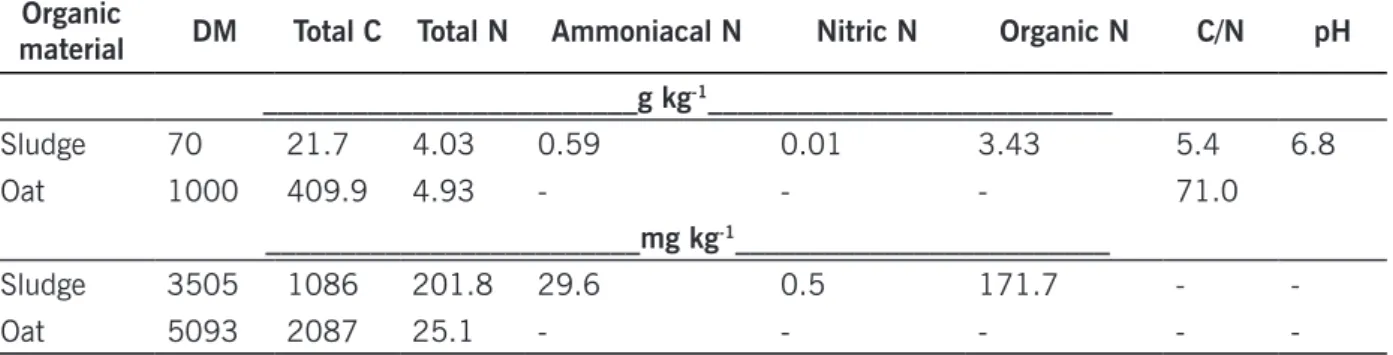
Black oat straw was collected at physiological maturity. After collection, the straw was air dried and stored until incubation. Before starting incubation, straw samples were dried in an oven at 65°C until constant weight. Total C and N levels in the dry and ground materials were determined. The characteristics of the SS and straw are shown in Table 1.
Table 1. Amounts of dry matter (DM), total carbon (C), and nitrogen (N) added to soil by sewage sludge and
black oat straw (GIACOMINI et al., 2015).
Organic
material DM Total C Total N Ammoniacal N Nitric N Organic N C/N pH
_________________________g kg-1___________________________ Sludge 70 21.7 4.03 0.59 0.01 3.43 5.4 6.8 Oat 1000 409.9 4.93 - - - 71.0 _________________________mg kg-1_________________________ Sludge 3505 1086 201.8 29.6 0.5 171.7 - -Oat 5093 2087 25.1 - - - -
C mineralization of sludge, straw, and sludge + straw incorporated into the soil were evaluated. The experiment was conducted in a completely randomized design with four replications, in which the following treatments were evaluated: soil + incorporated sludge, soil + incorporated black oat straw, and soil + incorporated sludge + incorporated black oat straw. The treatments applied were incubated for 110 days in the dark at 25 °C. Soil moisture was adjusted to approximately 80% of field capacity and maintained at this level throughout the incubation period by adding water periodically. Acrylic containers (diameter 5 cm, volume 110 mL) were used in the experiment.
Each container received 133.1 g of soil with 13% water content compacted to a height of 5 cm to reach an apparent density of 1.2 mg m-3. The dried straw was cut manually (length 10-20 mm) and added (600 mg per container, corresponding to 3 mg ha-1 of dry straw) to the soil. Fresh SS was added to soil at a rate of 30 mg ha-1. Straw and SS were incorporated into the soil before filling the containers. The acrylic containers were individually placed in 800-mL glass containers with lid. All glass containers were aerated periodically for 10 minutes to avoid O2 deficit. Soil moisture was controlled by weighing each experimental unit and adding water when necessary using a pipette. C mineralization was evaluated by the amount of CO2 released at 2, 4, 6, 10, 14, 21, 28, 35, 45, 60, 75, 86 and 110 days after the beginning of the incubation in the same containers.
The Stanford and Smith model was evaluated, which is given by Ct = C0(1 - exp(-kt)) + εt, and the Cabrera model, given by Ct = C1(1-exp(-k1t)) + k0t + εt. The authors Zeviani et al. (2012) proposed a reparametrization of the model in which k1 = ln 2/v, so the model is given by Ct = C1(1 - exp(-ln 2.t/v)) + k0t + εt. In the models, Ct is the mineralized carbon (mg of CO2 kg-1) up to the time t (days); C0 is the potentially mineralizable carbon; k and k0 are mineralization rates; C1 is the easily mineralizable carbon; v is the half-life of the easily mineralizable carbon; and εt is the experimental error assuming a normal distribution with mean zero and variance σ2. The half-life of the potentially mineralizable carbon for the Stanford and Smith model was estimated by the expression v = ln(2)/k. According to Fernandes et al. (2015), reparametrization does not change the values estimated by the model nor the estimated values of fit quality. If the parameter k0 of the Cabrera model is zero, the Cabrera model is reduced to the Stanford and Smith model.
The adequacy of the models was made based on the analysis of the estimated errors, being applied the tests: Shapiro-Wilk, to verify the assumption of normality of the errors; Breusch-Pagan, to verify the hypothesis that the experimental errors are homoscedastic; Durbin-Watson, to verify the assumption of independence of the errors. When the Durbin-Watson test indicated that the errors were dependent, the structure εt = ϕεt-1 + λt was considered, wherein ϕ is the is first-order autoregressive parameter AR(1), and λt is the white noise (MORETTIN; TOLOI, 2006). If the assumption of normality is met, a confidence interval of 95% of probability can be estimated for the parameters of the model.
The quality of the fitting was evaluated by the adjusted coefficient of determination:
, at which values closer to 1 indicate better fittings. The selection of the best
model was based on Akaike Information Criterion: AIC = -2lnL(θ�) + 2p, which is proportional to
the mean square of the residue, being more appropriate the model that presents the lowest value. In the expressions, n is the number of observations used to fit the model, i is related to the model intercept, which is equal to 1 if there is an intercept and 0 otherwise, p is the number of parameters;
R2=1- SSE/TSS is the coefficient of determination, wherein SSE is t he sum of squares of the errors,
TSS i s the total sum of the squares, and lnL(θ�) i s the value of the natural logarithm of the likelihood
function, considering the estimates of the parameters.
R
2= 1–
(n – 1) (1–R
2)
n – p
ajIn studies with nonlinear models, there is no closed form to solve the system of normal equations, so the estimation of the parameters is done with approximations by iterative numerical methods (DRAPER; SMITH, 2014). Among the iterative methods, the Gauss-Newton is the most used (CARNEIRO et al., 2014; FERNANDES et al., 2014; GUEDES et al., 2004; SILVEIRA et al., 2018). The parameters were estimated using the generalized least squares method, implemented in the gnls function of the nlme package (PINHEIRO et al., 2015) of the R program (R DEVELOPMENT CORE TEAM, 2017).
Results and discussion
The results of the analysis of errors estimated by the models, based on the carbon mineralization in the soil, for the Shapiro-Wilk (SW), Breusch-Pagan (BP), and Durbin-Watson (DW) tests are presented in Table 2. The SW test was not significant (p-value>0.05) for the three treatments and both models, and the assumption of normality of the errors was corroborated by the test. The BP test showed the hypothesis of homogeneity of variances were not rejected (p-value>0.05) for the three treatments and both models, indicating the variances were homogeneous. The DW test showed a dependence on the errors (p-value<0.05) for the soil + sludge + oat straw and soil + oat straw treatments for both models, i.e. the hypothesis of independence of the errors was rejected, and this correlation was considered in the study. Thus, a fitting with a first-order autoregressive error AR(1) was presented to explain the dependence of the errors of these treatments with both models. This correlation of errors was also observed by Hess and Schmidt (1995) in the fitting of a nonlinear model to accumulated data of CO2 releases from the soil. Pereira et al. (2005) compared eight nonlinear models to predict the amount of mineralized nitrogen in the soil and found residual dependence for two models, they considered autoregressive errors of order AR(p) in the fitted models.
Table 2. P-values of the Shapiro-Wilk (SW), Durbin-Watson (DW), and Breusch-Pagan (BP) tests applied to
the errors of the models and fit quality evaluators, adjusted coefficient of determination (R2
aj) and Akaike
Information Criterion (AIC) for mineralized carbon (mg CO2 kg-1) of the evaluated treatments.
Treatment Model p-valueSW p-valueBP p-valueDW R2
aj AIC
Sludge + straw Stanford and Smith 0.4881 0.5067 0.0020 0.9939 128.99 Sludge + straw Cabrera 0.7745 0.3023 0.0120 0.9976 125.56 Straw Stanford and Smith 0.8777 0.2086 0.0000 0.9686 133.81 Straw Cabrera 0.2866 0.2519 0.0040 0.9861 134.63 Sludge Stanford and Smith 0.4782 0.0884 0.4220 0.9984 93.79 Sludge Cabrera 0.4412 0.1783 0.2740 0.9983 95.78
Source: Elaborated by the authors (2018).
According to Table 2, by fitting the models to the C decomposition data, R2
aj values were higher than 0.96, indicating the model adequately describes the data (FIGURE 1). Sleutel et al. (2005) evaluated the fit of five nonlinear models in the C mineralization of four types of organic residues, they found R2
Figure 1. Stanford and Smith model and Cabrera model fitted to carbon mineralization (mg of CO2 kg-1) of
organic residues in soils as a function of incubation time.
Source: Elaborated by the authors (2018)
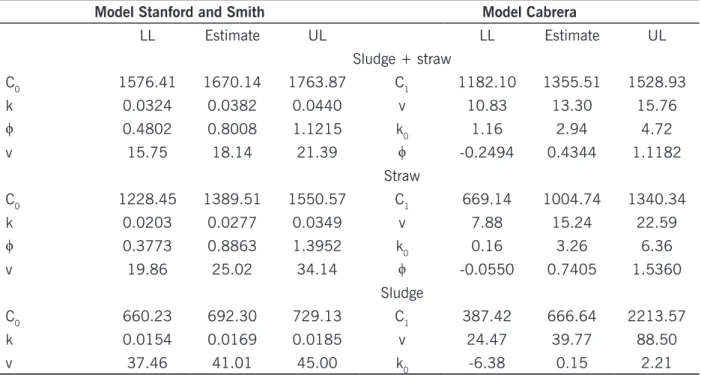
The estimates of the parameters of the models and their respective confidence intervals of 95% probability are presented in Table 3. The estimation of the confidence interval of the parameter k0of the Cabrera model, considering the treatment soil + sludge, included the value zero. According to Zeviani et al. (2012), this result indicates a zero parametric value, i.e., the Cabrera model did not fit to this treatment, therefore disregarding parameter k0, the model is reduced to the Stanford and Smith with only a fraction of potentially mineralizable carbon. Similar results were found by Sleutel et al. (2005) by fitting the Cabrera model and obtaining k0 equal to zero to decomposition data of C of urban waste compost. Considering the Cabrera model and the estimates of the confidence intervals for the soil + sludge + straw and soil + straw treatments, any parameter of the model included the value zero, showing that the model describes the treatments. The Stanford and Smith model was fitted to the data of the three treatments, since the estimates of confidence intervals show that any parameters of the model included value zero.
The soil + sludge + straw treatment showed a lower AIC value (TABLE 2) for the Cabrera model, therefore, this model is the most adequate to describe the treatment. Thus, this treatment had two fractions of C, one that is easily mineralized with exponential behavior and another more resistant fraction with a constant mineralization. The soil + straw treatment presented the lowest AIC value (TABLE 2) for the Stanford and Smith model, which was the most adequate model to describe this treatment. Thus, this treatment had only a potentially mineralizable C fraction that is mineralized exponentially.
Table 3. Estimates for the parameters of the models and their respective asymptotic confidence intervals of
95% (LL = lower limit and UL = upper limit) in the fitting of the mineralized C (mg of CO2 kg-1) in the evaluated
treatments.
Model Stanford and Smith Model Cabrera
LL Estimate UL LL Estimate UL Sludge + straw C0 1576.41 1670.14 1763.87 C1 1182.10 1355.51 1528.93 k 0.0324 0.0382 0.0440 v 10.83 13.30 15.76 ϕ 0.4802 0.8008 1.1215 k0 1.16 2.94 4.72 v 15.75 18.14 21.39 ϕ -0.2494 0.4344 1.1182 Straw C0 1228.45 1389.51 1550.57 C1 669.14 1004.74 1340.34 k 0.0203 0.0277 0.0349 v 7.88 15.24 22.59 ϕ 0.3773 0.8863 1.3952 k0 0.16 3.26 6.36 v 19.86 25.02 34.14 ϕ -0.0550 0.7405 1.5360 Sludge C0 660.23 692.30 729.13 C1 387.42 666.64 2213.57 k 0.0154 0.0169 0.0185 v 24.47 39.77 88.50 v 37.46 41.01 45.00 k0 -6.38 0.15 2.21
Source: Elaborated by the authors (2018)
Considering the Stanford and Smith model, there was a significant difference between the potentially mineralizable carbon (C0) of the treatments (TABLE 3), since there was no overlap in the estimates of the confidence intervals. The soil + sludge + straw treatment presented the highest amount of potentially mineralizable carbon, followed by the soil + straw treatment and soil + sludge treatment. This result corroborates the conclusions of Giacomini et al. (2015), who found similar results after 110 days from the beginning of incubation. These authors attributed this difference to the amounts of C added to each treatment and to the different chemical compositions of the organic materials that facilitated the use of C by microorganisms. The amount of C added by the oat straw is approximately twice as high as that added by the sewage sludge (TABLE 1).
The estimation of the confidence interval for mineralization rate (k) showed that the soil + sludge treatment was significantly smaller (there was no overlap in the confidence interval estimates) than the other treatments. Consequently, the half-life (v) for this treatment was significantly higher, with an estimate of approximately 41 days. Although the potentially mineralizable carbon of the soil + sludge + straw treatment was higher than soil + straw, they presented no difference in mineralization rate (k), as there was an overlap in the estimates of the confidence intervals for this parameter, consequently, no difference between their half-life (v), which were approximately 18 and 25 days, respectively.
Considering the Cabrera model, the value of easily mineralizable carbon (C1) of the soil + sludge + straw treatment was lower than that of the soil + straw treatment (TABLE 3), since there was an overlap in the estimates of the confidence intervals. Thus, the adding of sludge and straw did not increase the activity of microorganisms in the decomposition of the easily degradable fractions.
Estimates for half-life of easily mineralized carbon (v), considering the Cabrera model, were approximately 13 and 15 days (TABLE 3) for the soil + sludge + straw treatment and soil + straw treatment, respectively, not differing statistically, since there was an overlap in the confidence interval estimates. This result agrees with those of Moretti et al. (2015), who found no significant difference in potentially mineralizable carbon half-life for five rates between 0 and 480 mg ha-1, and half-life of 15 days for two rates, within the confidence intervals. These results were higher than those of Martines et al. (2006), who found an average of 6 days for potentially mineralizable carbon half-life with application of tannery sludge rates to soils with different textural class; this difference is probably due to the difference in chemical composition of sewage sludge and tannery sludge. Paula et al. (2013) compared the mineralization rate (k) of the Stanford and Smith model of several residues on the soil surface in the field and found higher value of this parameter for the sewage sludge, denoting greater decomposition of this waste in the first days.
Conclusion
The Stanford and Smith model is suitable for describing the carbon decomposition of soil + incorporated sewage sludge treatment and soil + incorporated black oat straw treatment.
The Cabrera model is suitable for describing the carbon decomposition of the soil + sludge + incorporated oat straw treatment.
The half-life (v) of the potentially mineralizable carbon is approximately 41 days for the soil + sludge treatment and is higher than that of the soil + straw treatment and soil + straw + sludge treatment, which is approximately 25 and 18 days, respectively.
The half-life (v) of the easily mineralizable carbon is approximately 13 and 15 days for the soil + sludge + straw and soil + straw treatments, respectively, which presented no significant difference between them.
Acknowledgements
The authors thank the Brazilian Coordination for the Improvement of Higher Education Personnel (CAPES) for granting doctoral scholarship to the first author.
Ajuste da decomposição do lodo de esgoto e palha
de aveia por modelos não lineares
Resumo
Uma forma viável econômica e ambientalmente da reciclagem do lodo de esgoto é o manejo agrícola. O conhecimento das curvas de mineralização do carbono permite buscar melhorias na qualidade do solo e maior produtividade das culturas. O objetivo deste trabalho foi avaliar o ajuste de modelos não lineares que descrevem a mineralização do carbono no solo. O experimento foi conduzido em laboratório e o delineamento foi inteiramente ao acaso, com quatro repetições e três tratamentos. Foram avaliados os seguintes tratamentos: Solo + Lodo de esgoto, Solo + Palha de aveia preta e Solo + Lodo + Palha, incorporados ao solo. Recipientes com solo e tratamento aplicado foram incubados
por 110 dias. Foram utilizados os modelos Stanford & Smith e Cabrera, considerando estrutura de erros autorregressivos AR(1), quando necessário. Os ajustes foram comparados utilizando o critério de informação de Akaike (AIC). Os modelos não lineares avaliados descrevem de forma satisfatória a dinâmica de decomposição do carbono dos tratamentos. O modelo Stanford & Smith é adequado para descrever a decomposição do carbono dos tratamentos Solo + Lodo e Solo + Palha de aveia, incorporados. O modelo Cabrera é adequado para descrever a decomposição do carbono do tratamento Solo + Lodo + Palha incorporada.
Palavras-chave: Mineralização. Modelo Stanford & Smith. Modelo Cabrera. Tempo de meia-vida.
References
ANDRADE, C. A.; SILVA, L. F. M.; PIRES, A. M. M.; COSCIONE, A. R. Mineralization of carbon and nitrogen in soil after successive applications of sewage sludge. Pesquisa Agropecuária Brasileira, Brasília, v. 48, n. 5, p. 536-544, maio 2013. Disponível em: <http://www.scielo.br/scielo.php?s-cript=sci_arttext&pid=S0100-204X2013000500010&lng=pt&nrm=iso>. Acesso em: 11 fev. 2017.
CABRERA, M. L. Modeling the flush of nitrogen mineralization caused by drying and rewetting soils.
Soil Science Society of America Journal, Fayetteville, v. 57, p. 63-66, 1993.
CARNEIRO, A. P. S.; MUNIZ, J. A.; CARNEIRO, P. L. S.; MALHADO, C. H. M. M.; MARTINS FILHO, R.; SILVA, F. F. Identity of nonlinear models to compare growth curves of the cattle breed Tabapuã.
Pesquisa Agropecuária Brasileira, Brasília, v. 49, n. 1, p. 57-62, jan. 2014. Disponível em:
<ht-tps://seer.sct.embrapa.br/index.php/pab/article/view/18183>. Acesso em: 04 ago. 2017.
CARVALHO, C. S.; RIBEIRINHO, V. S.; ANDRADE, C. A.; GRUTZMACHER, P.; PIRES, A. M. M. Chemical composition of sewage sludge organic matter. Revista Brasileira de Ciências Agrárias, v. 10, n. 3, p. 413-419, 2015. Disponível em: <http://dx.doi.org/10.5039/agraria.v10i3a5174>. Acesso em: 11 dez. 2016.
DRAPER, N. R.; SMITH, H. Aplied regression analisys. 3 ed., reprint. New York: J. Wiley, p. 505-565, 2014.
FERNANDES, T. J.; MUNIZ, J. A.; PEREIRA, A. A.; MUNIZ, F. R.; MUIANGA, C. A. Parameteriza-tion effects in nonlinear models to describe growth curves. Acta Scientiarum, Maringá, v. 37, n. 4, p. 397-402, 2015. Disponível em: <http://periodicos.uem.br/ojs/index.php/ActaSciTechnol/article/ view/27855/pdf_119 >. Acesso em: 5 mar. 2017.
FERNANDES, T. J.; PEREIRA, A. A.; MUNIZ, J. A.; SAVIAN, T. V. Selection of nonlinear models for the description of the growth curves of coffee fruit. Coffee Science, Lavras, v. 9, n. 2, p. 207-215, 2014. Disponível em: <http://dx.doi.org/10.25186/cs.v9i2.618>. Acesso em: 5 mar. 2017.
GIACOMINI, S. J.; SIMON, V. L. G.; AITA, C.; BASTOS, L. M.; WEILER, D. A.; REDIN, M. Carbon and nitrogen mineralization in soil combining sewage sludge and straw. Revista Brasileira de Ciência do
Solo, v. 39, p. 1428-1435, 2015. Disponível em:
<http://www.scielo.br/scielo.php?script=sci_art-text&pid=S0100-06832015000501428&lng=en&nrm=iso>. Acesso em: 29 jan. 2017.
GUEDES, M. H. P.; MUNIZ, J. A.; PEREZ, J. R. O.; SILVA, F. F.; AQUINO, L. H.; SANTOS, C. L. Growth functions of Santa Inês and Bergamacy lambs considering heteroscedastic variance.
Ciên-cia e Agrotecnologia, v. 28, n. 2, p. 381-388, 2004. Disponível em: <http://www.scielo.br/scielo.
php?script=sci_arttext&pid=S1413-70542004000200019&lng=en&nrm=iso>. Acesso em: 06 mar. 2017.
HESS, T. F.; SCHMIDT, S. K. Improved procedure for obtaining statistically valid parameter estimates from soil respiration data. Soil Biology and Biochemistry, v. 27, p. 1-7, 1995. Diponível em: <https:// www.sciencedirect.com/science/article/pii/003807179400166X>. Acesso em: 28 nov. 2016. MARTINES, A. M.; ANDRADE, C. A.; CARDOSO, E. J. B. N. Mineralization of the organic car-bon in soils treated with tannery sludges. Pesquisa Agropecuária Brasileira, Brasília, v. 41, n. 7, p. 1149-1155, 2006. Disponível em: <http://www.scielo.br/scielo.php?script=sci_arttext&pi-d=S0100-204X2006000700011&lng=en&nrm=iso>. Acesso em: 28 nov. 2016.
MORETTI, S. M. L.; BERTONCINI, E. I.; ABREU JUNIOR, C. H. Decomposition of sewage sludge and sewage sludge compost in a hapludox soil. Revista Brasileira de Ciência do Solo, Viçosa, v. 39, p. 1796-1805, 2015. Disponível em: <http://www.scielo.br/scielo.php?script=sci_arttext&pi-d=S0100-06832015000601796&lng=en&nrm=iso>. Acesso em: 12 jan. 2017.
MORETTIN, P. T.; TOLOI, C. M. C. Análise de séries temporais. 2. ed. São Paulo: Edgard Blucher, p. 110-119, 2006.
MUIANGA, C. A.; MUNIZ, J. A.; NASCIMENTO, M. S. FERNANDES, T. J.; SAVIAN, T. V. Descrip-tion of the growth curve of cashew fruits in nonlinear models. Revista Brasileira de Fruticultura, v. 38, n. 1, p. 22-32, 2016. Disponível em: <http://www.scielo.br/scielo.php?script=sci_arttext&pi-d=S0100-29452016000100022&lng=en&nrm=iso>. Acesso em: 7 ago. 2017.
MUNIZ, J. A.; NASCIMENTO, M. S.; FERNANDES, T. J. Nonlinear models for description of cacao fruit growth with assumption violations. Revista Caatinga, v. 30, n. 1, p. 250-257, 2017. Disponível em: <http:// www.scielo.br/scielo.php?script=sci_arttext&pid=S1983-21252017000100250&lng=en&nrm=i-so>. Acesso em: 05 set. 2017.
PAULA, J. R.; MATOS, A. T.; MATOS, M. P.; PEREIRA, M. S.; ANDRADE, C. A. Carbon and nitrogen mineralization of wastes applied to soil under field conditions. Revista Brasileria de Ciência do Solo, Viçosa, v. 37, p. 1729-1741, 2013. Disponível em: <http://www.scielo.br/scielo.php?script=sci_ar-ttext&pid=S0100-06832013000600029&lng=en&nrm=iso>. Acesso em: 12 nov. 2017.
PAREDES FILHO, M. V. Composting of sewage sludge for agricultural use. Revista
Agrogeoambien-tal, Pouso Alegre, v. 3, p. 73-80, dezembro, 2011. Disponível em: <https://doi.org/10.18406/
PEREIRA, J. M.; MUNIZ, J. A.; SILVA, C. A. Nonlinear models to predict nitrogen mineralization in an oxisol. Scientia Agricola, Piracicaba, v. 62, n. 4, p. 395-400, 2005. Disponível em: <http://www. scielo.br/scielo.php?script=sci_arttext&pid=S0103-90162005000400014&lng=en&nrm=iso>. Acesso em: 14 mar. 2018.
PINHEIRO, J.; BATES, D.; DEBROY, S.; SARKAR, D. nlme: linear and nonlinear mixed effects
mo-dels. R package version 3, p. 1-122, 2015.
PRADO, T. K. L.; SAVIAN, T. V.; MUNIZ, J. A. The fit Gompertz and Logistic models to the growth data of green dwarf coconut fruits. Ciência Rural, v. 43, n. 5, p. 803-809, 2013. Disponível em: <http:// www.scielo.br/scielo.php?script=sci_arttext&pid=S0103-84782013000500008&lng=en&nrm=i-so>. Acesso em: 12 set. 2017.
PULROLNIK, K. Transformações do carbono no solo. Planaltina, DF: Embrapa Cerrados, p. 1-36, 2009. R Core team. R: a language and environment for statistical computing. R Foundation for Statistical Computing Viena: 2017.
SILVA, B. V. N.; ANDRADE PINTO, L. V.; Potential use of the sewage sludge as organic manur-ing in covermanur-ing forestation native arboreal species planted in area degraded by intensive pasturmanur-ing.
Revista Agrogeoambiental, Pouso Alegre, p. 50-56, abril, 2010. Disponível em:
<http://dx.doi.or-g/10.18406/2316-1817v2n12010251>. Acesso em: 18 mar. 2017.
SILVEIRA, S. C.; MUNIZ, J. A.; SOUSA, F. A.; CAMPOS, A. T. Non-linear models adjusted to the accumulated production of biogas originating from swine deep bedding. Revista Agrogeoambiental, v. 10, n. 3, p. 91-103, 2018. Disponível em: <https://agrogeoambiental.ifsuldeminas.edu.br/index. php/Agrogeoambiental/article/view/1168/pdf>. Acesso em: 26 nov. 2018.
SLEUTEL, S.; NEVE, S.; ROIBÁS, M. R. P.; HOFMAN, G. The influence of model type and incubation time on the estimation of stable organic carbon in organic materials. European Journal of Soil
Sci-ence, v. 56, p. 505-514, 2005. Disponível em: <https://onlinelibrary.wiley.com/doi/epdf/10.1111
/j.1365-2389.2004.00685.x>. Acesso em: 23 nov. 2016.
STANFORD, G.; SMITH, S. J. Nitrogen mineralization potentials of soil. Soil Science Society of
Amer-ica Journal, Madison, v. 36, n. 3, p. 465-471, 1972.
ZEVIANI, W. M.; SILVA, C. A.; OLIVEIRA, W. J.; MUNIZ, J. A. Non-linear models to potas-sium release from animals manure in Latosols. Ciência Rural, Santa Maria, v. 42, n. 10, p. 1789-1796, 2012. Disponível em: <http://www.scielo.br/scielo.php?script=sci_arttext&pi-d=S0103-84782012001000012&lng=en&nrm=iso>. Acesso em: 23 nov. 2016.