PEANUT RESPONSE TO LIME AND MOLYBDENUM
APPLICATION IN LOW pH SOILS
(1)J. A. QUAGGIO(2), P. B. GALLO(2), C. OWINO-GERROH(3), M. F. ABREU(2) & H. CANTARELLA(2)
SUMMARY
Liming acid soils is considered to assure the availability of Mo in crops. Additionally, in peanuts (Arachis hypogaea L.) the positive response to liming is associated to a better supply of Ca+2, Mo for the nitrogenase-complex activity,
and other non-nitrogen fixing activities of the crop. This study was thus undertaken to assess the effect of lime, Mo, and the lime-Mo interaction on peanut crop, on an acid Ultisol at the Mococa Experimental Station, Instituto Agronômico, São Paulo State, Brazil, from 1987 to 1990. A randomized complete block design with four replications, in a 4 x 4 factorial arrangement, was used in the study. The factors included four lime rates (0, 2, 4, and 6 t ha-1) broadcast
and incorporated into the soil, and Mo (0, 100, 200, and 300 g ha-1) as (NH
4)2MoO4
applied as seed dressing. Lime was applied once at the beginning of the study while Mo was applied at every planting. Peanut seed cv ‘tatu’ was used. Significant increase in peanut kernel yield with liming was only evident in the absence of Mo, whereas the peanut response to Mo was observed in two out of the three harvests. A higher yield response (28 % increase) was found when Mo was applied without liming. Soil molybdenum availability, as indicated by plant leaf analysis, increased significantly when lime was applied. Molybdenum fertilization led to higher leaf N content, which in turn increased peanut yield in treatments with smaller lime doses.
Index terms: Arachis hypogaea, liming, molybdenum, nitrogen fixation
(1) Recebido para publicação em junho de 2002 e aprovado em junho de 2004.
RESUMO: RESPOSTA DO AMENDOIM À CALAGEM E AO MOLIBDÊNIO EM SOLO ÁCIDO
A calagem em solos ácidos tem sido considerada prática suficiente para garantir a disponibilidade de molibdênio para as culturas. Adicionalmente, seu efeito positivo na cultura do amendoim tem sido associado ao melhor fornecimento de cálcio, maior disponibilidade de molibdênio para o complexo nitrogenase, e outros processos na planta não relacionados com a fixação biológica de N. Esse trabalho foi realizado, com vistas em estudar os efeitos de doses de calcário e de molibdênio e suas interações na cultura do amendoim, num Argissolo ácido da Estação Experimental de Mococa do IAC durante três safras (1987 a 1990). Foi empregado o delineamento em blocos, com quatro repetições, num esquema fatorial 4 x 4. Os tratamentos constituíram das doses de 0, 2, 4 e 6 t ha-1 de calcário
calcinado e de 0, 100, 200 e 300 g ha-1 de Mo, aplicadas como tratamento de sementes, na
forma de molibdato de amônio. O calcário foi aplicado uma única vez no início do ensaio, enquanto o Mo foi aplicado anualmente por ocasião do plantio. Foi utilizado o amendoim cv. Tatu. Houve resposta significativa da produção de grãos à calagem apenas na ausência de Mo, enquanto a resposta do amendoim ao Mo foi observada em duas das três safras estudadas. Foi encontrado um maior ganho de produção (28 %) quando o Mo foi aplicado na ausência de calagem. A disponibilidade de Mo no solo, avaliada por meio da análise de folhas, aumentou significativamente com a calagem. A aplicação de Mo proporcionou maior concentração de nitrogênio nas folhas, o que aumentou a produtividade do amendoim nos tratamentos com doses mais baixas de calcário.
Termos de indexação: Arachis hypogaea, calagem, molibdênio, fixação de nitrogênio.
INTRODUCTION
Peanuts (Arachis hypogaea L.), a legume, is an
important crop for oil production and also a protein source (Krishna, 1997). It is grown on many soil types including those that are highly weathered and acidic (Gascho et al., 1993). Studies in such soils suggest a deficiency of available molybdenum (Mo) (Adams et al., 1990). Molybdate is sorbed by the soil (Goldberg & Forster, 1998); however, molybdate sorption is highly sensitive to the soil pH and decreases with increases in soil pH (Adams et al., 1990; Goldberg & Forster, 1998). Therefore, liming is an effective means of increasing the available molybdenum in such soils (Rosolem & Caires, 1998; Quaggio et al., 1998; Hodges et al., 1994).
Molybdenum is one of the micronutrients required for plant growth and development. It is essential for the reduction of nitrate in plants
(Sedbeeryet al., 1993). Symptoms of Mo deficiency
have been characterized in many crops including
peanuts (Sedbeeryet al., 1993). More pronounced
deficiencies have been observed under acid soil conditions (Adams et al., 1990).
Molybdenum, which constitutes part of the enzyme nitrogenase, is also essential for symbiotic nitrogen fixation; Mo deficiencies are therefore much more pronounced in legumes (Bailey & Laidlaw, 1999). Since peanut is a legume, it is highly susceptible to Mo deficiency when grown in acidic soils. This affects its ability to nodulate and
symbiotically fix atmospheric nitrogen (Simbajon & Duque, 1987; Bailey & Laidlaw, 1999). This study, therefore, investigated the effect of lime and molybdenum and their interaction on peanut yields on a low pH soil.
MATERIAL AND METHODS
The study was conducted over three consecutive years (1987/88, 1988/89, and 1989/90) on an acidic Ultisol of the Mococa Experimental Station, Instituto Agronômico, Mococa, São Paulo State, Brazil. The following analysis results described the original soil
characteristics: pH(CaCl2) 4.2; exchangeable Ca, Mg,
and K, in mmolc dm-3, 10, 4, and 2.1 respectively,
and 21 % soil base saturation. A randomized complete block design with four replications in a 4 x 4 factorial arrangement was used in the study. The factors consisted of four lime rates (0, 2, 4, and 6 t ha-1) and
molybdenum (0, 100, 200, and 300 g ha-1). Burnt
dolomitic limestone (127 % CaCO3 equivalent) and
ammonium molybdate ((NH4)2MoO4) were used as
were maintained on the same plots throughout the study period. Basic fertilization (0-20-15 NPK
formula at a rate of 400 kg ha-1)was applied each
year at planting to all plots.
One year after liming, 15 soil samples from the plough layer were randomly collected with auger, mixed, dried, ground, sieved (2 mm), and used to evaluate the soil pH, phosphorus and organic carbon contents, exchangeable bases, and exchangeable acidity as described by Raij & Quaggio (1983).
Leaf samples, composed by 100 leaves per plot, were taken every year at flowering by collecting the third leaf from the top. The samples were washed,
dried at 35 oC, and ground prior to total nutrient
content analyses according to methods described by
Batagliaet al. (1983).
Certified peanut (Arachis hypogaea L.) cv. ‘tatu’
seeds were dressed with 0, 2.8, 5.6, and 8.4 g (NH4)2MoO4, respectively, per 1.200 g of seeds. The
seeds were then inoculated with Bradyrhizobium
sp in each study year. No nitrogen fertilizer was
applied throughout the study period. Other agricultural practices recommended for growing peanuts in Brazil were observed.
The statistical analysis of evaluated variables were based on variance and regression analyses using the Minitab Statistics Program (Minitab, 2000).
RESULTS AND DISCUSSIONS
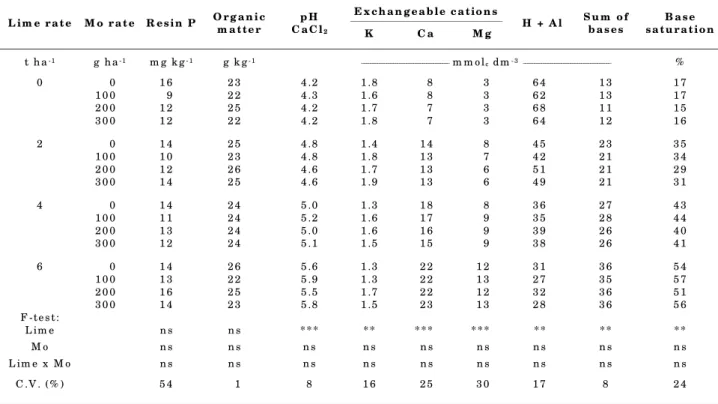
Soil chemical analyses one year after the application of lime and molybdenum showed that liming increased exchangeable Ca and Mg and the soil base saturation linearly, while the soil pH increased from 4.2 in control plots to 5.7 in the plot under the highest liming rate (Table 1).
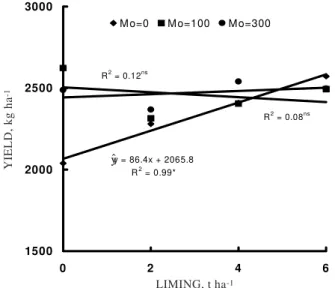
The peanut yield increase due to liming was not statistically significant, but the lime-Mo interaction was significant in all studied harvests (Table 2). The response of peanut to lime was quite linear in absence of Mo. This could be more related to the increase of Mo availability than to soil acidity neutralization, because no response to liming was observed where the smallest rate of Mo was applied (Figure 1).
Molybdenum application without lime in 1988/ 89 and with lime in 1987/88 and 1989/90 significantly increased the yields. However, the applied Mo with or without lime increased the average yields significantly in any case. In absence of liming, the calculated maximum yield was obtained with
186 g ha-1 Mo, corresponding to a 28 % increase in
relation to the plots without Mo. Peanut response
to Mo was closely related (R2 = 0.90**) to the
increase in nitrogen fixation, evaluated by the concentration of this nutrient in the leaves (Figure 2). Molybdenum deficiency symptoms were
Table 1. The effect of lime and Mo and their interactions on the soil chemical characteristics one year after liming
E x c h a n g e a b l e c a t io n s
L i m e r a t e M o r a t e R e s i n P O r g a n i c
m a t t e r
p H
C a C l2 K C a M g H + A l
S u m o f b a s e s
B a s e s a t u r a t i o n
t h a- 1 g h a- 1 m g k g- 1 g k g- 1 _______________________________________ m m o lc d m- 3_______________________________________ %
0 0 1 6 2 3 4 .2 1 .8 8 3 6 4 1 3 1 7
1 0 0 9 2 2 4 .3 1 .6 8 3 6 2 1 3 1 7
2 0 0 1 2 2 5 4 .2 1 .7 7 3 6 8 1 1 1 5
3 0 0 1 2 2 2 4 .2 1 .8 7 3 6 4 1 2 1 6
2 0 1 4 2 5 4 .8 1 .4 1 4 8 4 5 2 3 3 5
1 0 0 1 0 2 3 4 .8 1 .8 1 3 7 4 2 2 1 3 4
2 0 0 1 2 2 6 4 .6 1 .7 1 3 6 5 1 2 1 2 9
3 0 0 1 4 2 5 4 .6 1 .9 1 3 6 4 9 2 1 3 1
4 0 1 4 2 4 5 .0 1 .3 1 8 8 3 6 2 7 4 3
1 0 0 1 1 2 4 5 .2 1 .6 1 7 9 3 5 2 8 4 4
2 0 0 1 3 2 4 5 .0 1 .6 1 6 9 3 9 2 6 4 0
3 0 0 1 2 2 4 5 .1 1 .5 1 5 9 3 8 2 6 4 1
6 0 1 4 2 6 5 .6 1 .3 2 2 1 2 3 1 3 6 5 4
1 0 0 1 3 2 2 5 .9 1 .3 2 2 1 3 2 7 3 5 5 7
2 0 0 1 6 2 5 5 .5 1 .7 2 2 1 2 3 2 3 6 5 1
3 0 0 1 4 2 3 5 .8 1 .5 2 3 1 3 2 8 3 6 5 6
F -te s t:
L im e n s n s * * * * * * * * * * * * * * * * *
M o n s n s n s n s n s n s n s n s n s
L im e x M o n s n s n s n s n s n s n s n s n s
only observed in control plots with a leaf Mo
concentration around 2.0 mg kg-1. These symptoms
were characterized by a general yellowing of the foliage and tip necrosis of the young leaves (Figure 4). These symptoms were earlier described as symptoms of Mn toxicity (Nakagawa et al, 1987), but they were not observed in plots with a leaf Mo
higher than 3.0 mg kg-1, which was attained by both
lime and molybdenum application.
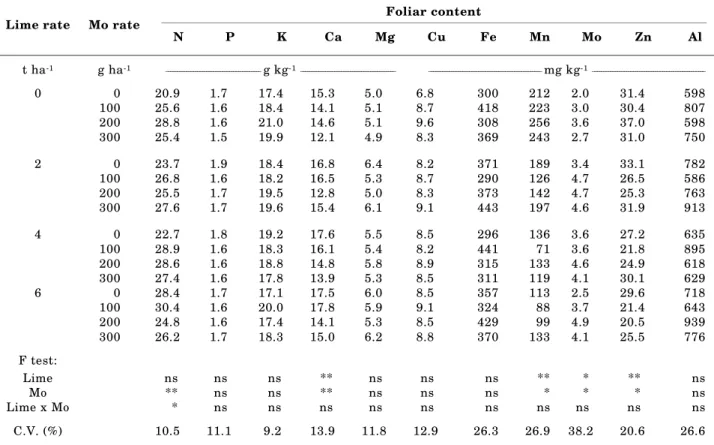
Liming increased Ca and Mo significantly but decreased Mn and Zn contents in peanut leaves. Molybdenum applied with lime caused an increase in N and, without lime, an increase in N and in leaf Mo concentration (Table 3). A significant positive correlation was only found between the applied Mo
and leaf N content. Leaf-N contents above 26 g kg-1
were associated with leaf Mo around 4.0 mg kg-1.
However, at the highest leaf N contents leaf Mo tended to decrease due to dilution effects (Figure 3). The effect of lime on peanut yield depends on many factors including the initial Ca and Mo status of the soil, the time of lime application, and the peanut cultivar in use (Caires et al., 1991; Gascho et al., 1993; Hodges et al., 1994). Peanut cultivars with large seeds, as for example the Virginia and Valencia types, require considerably higher lime inputs to manifest any significant improvement in yields or grain quality. The results found in this study with soil liming are consistent with those of Rosolem & Caires (1998) on a similar soil type in Brazil. The yield increase when Mo was applied without lime could be attributed to the increase in available Mo concentration in the soil. This enabled the plant to fix atmospheric nitrogen and also incorporate the nitrate taken up from the soil. This led to an increase of vegetative growth and consequently to higher kernel per pod yield. Figure 1. Lime and molybdenum interaction on
peanut yield in low pH soil. Results of treatments with no lime application (averaged of three successive harvests). * and ns significant at 0.05 probability and non significant respectively.
R2 = 0.08ns R2
= 0.12ns
y = 86.4x + 2065.8 R2 = 0.99*
1500 2000 2500 3000
0 2 4 6
M o=0 M o=100 M o=300
LIMING, t ha-1
YIELD, kg ha
-1
yˆ
y = -0.000017x2 + 0.0063x + 2.1 R2 = 0.91*
y = -0.0002x2 + 0.077x + 20.6 R2 = 0.96*
1,8 2,0 2,2 2,4 2,6 2,8
0 100 200 300
18 22 26 30 34 Yield Leaf-N
Mo APPLIED, g ha-1
YIELD, kg ha
-1
Figure 2. Effects of molybdenum rates on yield and nitrogen concentration in peanut leaves. Data of treatment without lime application. (Averaged results of three successive harvests) *significant at 0.05 probability.
LEAF-N,gkg
-1
yˆ
yˆ Table 2. Effect of lime and Mo and their interaction
on peanuts yields
Period
Lime rate Mo rate
87/88 88/89 89/90
Mean yie
t ha-1 g ha-1 ______________________________ kg ha-1______________________________
0 0 1855 2075 2188 2039
100 2163 2633 3073 2623
200 2113 2660 2990 2588
300 1723 2948 2820 2497
Mean 1963 2579 2768 2437
2 0 2107 2218 2515 2280
100 1770 2453 2723 2315
200 2435 2393 2676 2501
300 1635 2665 2800 2367
Mean 1987 2432 2678 2366
4 0 1733 2605 2888 2409
100 2143 2535 2538 2405
200 2323 2688 2853 2621
300 2308 2632 2678 2540
Mean 2126 2615 2739 2494
6 0 2453 2310 2953 2572
100 1895 2753 2830 2493
200 1770 2633 2828 2410
300 2018 2598 2873 2496
Mean 2034 2573 2871 2492
F-test:
Lime ns ns ns ns
Mo ns ** * *
Lime x Mo ** * ** **
C.V. (%) 15 11 9 7
In absence of liming, a significant quadratic relationship was found between leaf nitrogen content and the amount of Mo applied to the soil
(Figure 2). Gascho et al. (1993), Sahuet al. (1998),
and Rosolem & Caires (1998) also found consistent results and attributed the increase in peanut yields to increased growth and development to Mo application. The yield increase when lime and Mo were applied could be explained by several reasons including that the increasing soil reaction increased available Mo, as a result of liming. The increase in soil Mo concentration due to liming is well documented (Goldberg & Forster, 1998).
Figure 3. Relationship between leaf N and Leaf Mo in peanut crop established in four lime rates, averaged in three successive harvests. (Data for Mo rates were averaged) *significant at 0.05 probability.
Y = -0.84 x2 + 44.4x - 584.2 R2 = 0.85*
2.0 3.0 4.0 5.0
25.0 26.0 27.0 28.0
LEAF N, g kg-1
LEAF Mo, mg kg
-1
yˆ
Figure 4. Molybdenum deficiency symptoms in peanut crop.
Table 3. Effect of lime, Mo and their interaction on peanut leaf nutrient content (Averaged results of three harvests)
Foliar content
Lime rate Mo rate
N P K Ca Mg Cu Fe Mn Mo Zn Al
t ha-1 g ha-1 __________________________________________ g kg-1__________________________________________ __________________________________________________ mg kg-1__________________________________________________
0 0 20.9 1.7 17.4 15.3 5.0 6.8 300 212 2.0 31.4 598
100 25.6 1.6 18.4 14.1 5.1 8.7 418 223 3.0 30.4 807
200 28.8 1.6 21.0 14.6 5.1 9.6 308 256 3.6 37.0 598
300 25.4 1.5 19.9 12.1 4.9 8.3 369 243 2.7 31.0 750
2 0 23.7 1.9 18.4 16.8 6.4 8.2 371 189 3.4 33.1 782
100 26.8 1.6 18.2 16.5 5.3 8.7 290 126 4.7 26.5 586
200 25.5 1.7 19.5 12.8 5.0 8.3 373 142 4.7 25.3 763
300 27.6 1.7 19.6 15.4 6.1 9.1 443 197 4.6 31.9 913
4 0 22.7 1.8 19.2 17.6 5.5 8.5 296 136 3.6 27.2 635
100 28.9 1.6 18.3 16.1 5.4 8.2 441 71 3.6 21.8 895
200 28.6 1.6 18.8 14.8 5.8 8.9 315 133 4.6 24.9 618
300 27.4 1.6 17.8 13.9 5.3 8.5 311 119 4.1 30.1 629
6 0 28.4 1.7 17.1 17.5 6.0 8.5 357 113 2.5 29.6 718
100 30.4 1.6 20.0 17.8 5.9 9.1 324 88 3.7 21.4 643
200 24.8 1.6 17.4 14.1 5.3 8.5 429 99 4.9 20.5 939
300 26.2 1.7 18.3 15.0 6.2 8.8 370 133 4.1 25.5 776
F test:
Lime ns ns ns ** ns ns ns ** * ** ns
Mo ** ns ns ** ns ns ns * * * ns
Lime x Mo * ns ns ns ns ns ns ns ns ns ns
The yield increase could also be related to an increased concentration of basic cations in the soil solution (Table 1), particularly Ca, that could have complemented the effect of Mo on the nutrition of the peanut plant. Calcium plays a fundamental role in the peanut nutrition, especially at the pod development; Ca deficiency at this stage would have a negative effect on yields (Hodges et al., 1994;
Fernandezet al., 2000). The ameliorating effect of
lime on Al and Mn toxicity and the increase in available N, P, and Mo could also have contributed to the yield increase. These effects could have improved the soil conditions for plant growth (Table 1), and reduced the adsorption of the applied Mo to the soil. Sahu et al. (1995; 1998) studied peanut response to lime and Mo on acidic soil environment and furthermore observed that the yield increase was due to the increased efficiency of Mo associated to the lime application.
CONCLUSIONS
1. Although liming significantly reduced the soil acidity, its effect on peanut yields was only significant in absence of Mo.
2. The peanut yield was more limited by molybdenum deficiency than by soil acidity in this low pH soil.
3. In absence of lime, a seed-dressed Mo rate of
186 g ha-1 produced maximum peanut yields.
4. The molybdenum rate for a maximum peanut yield decreased as the lime rate increased.
ACKNOWLEDGMENTS
The authors thank the CNPq (Conselho Nacional de Desenvolvimento Científico e Tecnológico) and the Third World Academy of Science for research fellowship and support.
LITERATURE CITED
ADAMS, J.F.; BURMESTER, C.H., & MITCHELL, C.C. Long-term fertility treatments and molybdenum availability. Fert. Res., 21:167-170, 1990.
BAILEY, R. & LAIDLAW, L.R. The interactive effects of P, K, lime and molybdenum on the growth and morphology of white clover (Trifolium repens L.) at establishment. Grass Fol., 16:69-76, 1999.
BATAGLIA, O.C.; FURLANI A., M.C.; TEIXEIRA, J.P.F.; FURLANI, P.R. & GALLO, J.R. Methods for leaf analyses. Campinas, Instituto Agronômico de Campinas, 1983. 48p. (Technical Bulletin, 78) (In Portuguese)
CAIRES, E.F.; ROSOLEM, C.A.; WRIGHT, R.J.; BALINGER, V.C. & MURMANN, R.J. The root growth of peanut cultivars and soil acidity. In: PLANT AND SOIL INTERACTIONS AT LOW pH. INTERNATIONAL. SYMPOSIUM, 2., Beckley, 1991. Proceedings. Beckley, US. Development in Plant and Soil Science, 1991. p.239-243 FERNANDEZ, E.M.; ROSOLEM, C.A. & OLIVEIRA, D.M.T.
Peanut seed tegument affected by liming and drying method. Seed Sci. Technol., 28:185-192, 2000.
GASCHO, G.J.; HODGES, S.C.; ALVA, A.K.; CSINOS, A.S. & MULLINEX Jr., B.G. Calcium and time of application for Runner and Virginia peanut. Peanut Sci., 20:31-35, 1993. GOLDBERG, S. & FORSTER, H.S. Factors affecting molybdenum adsorption by soils and minerals. Soil Sci., 163:109-114, 1998.
HODGES, S.C.; GASCHO, G.S. & KIDDER, G. Calcium and magnesium. In Research based on soil testing information and fertilizer recommendations for peanuts on Coastal Plain soils. Alabama, Auburn University, 1994. (Series Bull., 380)
KRISHNA, P.K. Phosphorus uptake and utilization efficiency in peanut. Peanut Sci., 24:1-6, 1997.
MINITAB Inc. User’s guide 2: Data analysis and quality tools. Release 13 for Windows, 2000.
NAKAGAWA, J.; VILAS BOAS, R.L. & HELIODORO, B. Toxidez de manganês em amendoim cv. Tatu (identificação do problema). R. Agric., 62:157-162, 1987.
QUAGGIO, J.A.; GALLO, P.B.; FURLANI, A.M.C. & MASCARENHAS, H.A.A. Soybean and sorghum grain yields isopleths for liming and molybdenum rates. R. Bras. Ci. Solo, 22:337-344, 1998.
RAIJ, B. Van & QUAGGIO, J.A. Métodos de analise química e de solo para fins de fertilidade. Campinas, Instituto Agronômico, 1983. 31p. (Boletim Técnico, 31)
ROSOLEM, C.A. & CAIRES, E.E. The yield and nitrogen uptake of peanuts as affected by Lime, cobalt and molybdenum. J. Plant Nutr., 21:827-835, 1998.
SAHU, S.K.; DHAL, J.K.; DAS, B.B. & DAS, P.K. Response of groundnuts to boron with and without molybdenum and lime in a laterite soil. Inter. Arachis Newsl., 15:19-30, 1995. SAHU, S.K.; KABAT, B. & NAYAK, S.K. Available B, Mo, status on alluvial soil of Orissa growing groundnuts and its response Mo on laterite soils. Environ. Ecology. 16:772-775, 1998.
SEDBEERY, J.R.; DHARMAPUTRA, R.H.; BRUPBACHER, R.H.; PHILLIPS, S.A.; MARSHALL, J.G.; SLOANE, I.W.; MELVILLE, D.R.; ROBB, J.I. & DAVIS, J.H. Molybdenum investigations with soybean in Louisiana. Louisiana, Louisiana State University, 1973. 39p. (Bulletin, 630) SIMBAJON, E.C. & DUQUE, C.M. Nodulation, N-fixation and