RESUMO.- [Isolamento, cultura, caracterização e crio-preservação de células tronco derivadas de camada amniótica mesenquimal e de tecido do cordão
umbili-cal de fetuses bovinos.] As células tronco mesenquimais (CTMs) estão presentes na maioria dos tecidos adultos e possuem grande capacidade de multiplicação. Quando cul-tivadas in vitro são capazes de se auto renovar e dar origem a novos tipos celulares. As células tronco mais utilizadas, tanto na medicina humana como na medicina veterinária são as células tronco mesenquimais derivadas da medula óssea e do tecido adiposo. Atualmente, uma grande ten-dência para a utilização de CTMs obtidas de tecidos fetais,
Isolation, culture, characterization and cryopreservation of
stem cells derived from amniotic mesenchymal layer and
umbilical cord tissue of bovine fetuses
1Loreta L. Campos2*, Fernanda C. Landim-Alvarenga2, Tatícia L. Ikeda2, Bianca A. Monteiro2, Leandro Maia2, Camila P. Freitas-Dell’Aqua2 and Bruna De Vita2
ABSTRACT.- Campos L.L., Landim-Alvarenga F.C., Ikeda T.L., Monteiro B.A., Maia L., Freitas--Dell’Aqua C.P. & De Vita B. 2017. Isolation, culture, characterization and cryopreser-vation of stem cells derived from amniotic mesenchymal layer and umbilical cord tissue of bovine fetuses. Pesquisa Veterinária Brasileira 36(3):278-286. Departamento de Reprodução Animal e Radiologia, Faculdade de Medicina Veterinária e Zootecnia, Univer-sidade Estadual Paulista, Distrito de Rubião Júnior s/n, Botucatu, SP 18618-970, Brazil. E-mail: [email protected]
Stem cells are undifferentiated cells with a high proliferation potential. These cells can be characterized by their in vivo ability to self-renew and to differentiate into specialized
cell lines. The most used stem cell types, in both human and veterinary fields, are the mesen -chymal stem cells (MSC) derived from bone marrow and adipose tissue. Nowadays, there is a great interest in using stem cells derived from fetal tissues, such as amniotic membrane (AM) and umbilical cord tissue (UCT), which can be obtained non-invasively at delivery time. Due to the scarcity of studies in bovine species, the aim of this study was to isolate, characterize, differentiate and cryopreserve MSC derived from the mesenchymal layer of
amniotic membrane (AM), for the first time, and umbilical cord tissue (UCT) of dairy cow
neonates after assisted delivery (AD) and from fetus at initial third of pregnancy (IT) obtai-ned in slaughterhouse. Cells were isolated by enzymatic digestion of the tissue fragments with 0.1% collagenase solution. Six samples of AM and UCT at delivery time and six
sam-ples of AM and UCT at first trimester of pregnancy were subjected to morphology evalua -tion, imunophenotype characteriza-tion, in vitro osteogenic, adipogenic and chondrogenic differentiation and viability analysis after cryopreservation. All samples showed adherence
to plastic and fibroblast-like morphology. Immunocytochemistry revealed expression of CD
44, NANOG and OCT-4 and lack of expression of MHC II in MSC from all samples. Flow cyto-metry demonstrated that cells from all samples expressed CD 44, did not or low expressed CD 34 (AM: IT-0.3%a, AD-3.4%b; UCT: 0.4%, 1.4%) and MHC II (AM: IT-1.05%a, AD-9.7%b;
UCT: IT-0.7%a, AD-5.7%b). They were also capable of trilineage mesenchymal
differentia-tion and showed 80% viability after cryopreservadifferentia-tion. According to the results, bovine AM and UCT-derived cells, either obtained at delivery time or from slaughterhouse, are a pain-less and non-invasive source of MSC and can be used for stem cell banking.
INDEX TERMS: Holstein cow, cell banking, MHC class II, fetal annexes, immunophetotype.
1 Received on June 10, 2015.
Accepted for publication on February 22, 2016.
2 Departamento de Reprodução Animal e Radiologia Veterinária,
como a membrana amniótica (MA), matriz extravascular do cordão umbilical (TCU) e sangue do cordão umbilical
(SCU) pode ser observada, já que estas fontes podem ser
colhidas no momento do parto por uma técnica não
inva-siva. Dessa forma, o objetivo deste estudo foi isolar, carac -terizar, diferenciar e criopreservar CTMs obtidas de MA e TCU de fetos bovinos colhidos no momento do parto e de
fetos do terço inicial da gestação em abatedouro-frigorífico.
As células foram recuperadas por meio de digestão enzi-mática tecidual, realizada com solução de colagenase 0,1%. Foram colhidas amostras de MA e TCU no momento do par-to (n=6) e de MA e TCU no terço inicial de gestação (n=6), as quais foram submetidas às análises morfológicas,
imu-nofenotípica por imunocitoquímica e citometria de fluxo,
diferenciações in vitro nas linhagens osteogênica, adipogê-nica e condrogêadipogê-nica e ainda, avaliação da viabilidade após a
criopreservação por citometria de fluxo. Todas as amostras
dos diferentes grupos demonstraram adesão ao plástico
e morfologia fibroblastóide. No ensaio imunocitoquímico
todas as amostras foram imunomarcadas para CD44, NA-NOG e Oct-4, com ausência de marcação para MHC II. Na
análise imunofenotipica por citometria de fluxo, todas as
amostras apresentaram marcação para CD44, ausência de marcação para ou baixíssima expressão de CD34 (MA: TI--0,3%a, PA-3.4%b; TCU: TI-0,4%, PA-1.4%) e nula ou baixa
expressão de MHC II (MA: TI-1.5%a, PA-9.7%b; UCT:
TI--0.7%a, PA-5.7%b. Apresentaram também capacidade de
diferenciação in vitro nas três linhagens mesodermais e quando analisadas pós criopreservação por citometria de
fluxo, todas as amostras apresentaram viabilidade de 80%.
Estes resultados indicam que MA e TCU, obtidos tanto no momento de parto como em abatedouro, de fetos bovinos podem ser utilizados como fonte não invasiva e indolor de CTMs e possibilitam a formação de bancos de armazena-mento de células.
TERMOS DE INDEXAÇÃO: Vaca holandesa, células tronco mesen-quimais, MHC classe II,anexos fetais, imunofenótipo.
INTRODUCTION
MSC are multipotent cells with high self-renewing capa-bility that can be obtained from a variety of adult tissues and possess immunomodulatory and immunosupressive properties, which increase their use as therapeutic tools.
These cells secrete a variety of anti-inflammatory cytoki -nes and growth factors by bioactive molecules, modulating
the inflammatory response and the appropriate tissue re -pair (Nauta & Fibbe 2007).
The search for new sources of MSC as alternative to bone marrow, which requires an invasive harvesting procedure and exhibits decreased proliferative and differentiation po-tential associated with donor aging (Pittenger et al. 1999), has increased in the last decades. In this context, fetal anne-xes emerge as a convenient source for being easily obtained by a non-invasive technique as they are usually discarded after delivery. Besides, they may represent an important re-source for the creation of MSC banks in both human (Fauza
2004) and veterinary fields (Cremonesi et al. 2011). AM has anti-inflammatory, antibiotic and wound pro -tection properties, which combined with the absence or
low immunogenicity, led to the clinical use of this tissue as wound dressing for skin burns, lower limb ulcerations and
various ophthalmic injuries in humans (Parolini & Sonci -ni 2011). In veterinary medicine, the AM properties of
re--epithelization, fibrosis reduction and angiogenesis modu
-lation have been known at the ophthalmic field for at least
a decade (Dua et al. 2004, Solomon et al. 2005) and it is ap-plied mainly in the reconstruction of ocular surface of dogs and horses (Ollivier et al. 2006, Arcelli et al. 2009, Plummer et al. 2009). These characteristics attracted research atten-tion to the use of amnion-derived cells for cell therapy and regenerative medicine in allogeneic and xenogeneic trans-plantation (Parolini & Soncini 2011).
In humans, UCT and AM have been proved as sources of MSC with high proliferative rate, in vitro differentiation capacity into at least three mesodermal lineages (osteoge-nic, adipogenic and chondrogenic), expression of surface markers, such as CD13, CD44, CD90 and CD105, and low expression of MHC II. They also maintain the expression of pluripotency markers like Nanog and OCT-4 without indu-cing the formation of tumors when applied (Van Pham et al. 2015).
Domestic species, such as swine and company animals, like dogs and cats, provide uncountable opportunities to the development of protocols for veterinary regenerative medi-cine, which can be implemented as experimental models for humans. Nowadays, there is an extensive number of resear-ch and review articles addressing MSC, including fetal anne-xes-derived MSC, from a variety of domestic animal species (Gonçalves et al. 2014). However, studies using ruminant species are still rare when compared to other species.
Fadel et al. (2011) suggested isolation protocols for ob-taining MSC from adipose tissue and umbilical cord blood
of sheep and reported difficulties in isolating umbilical
cord cells from ovines.
Despite few reports, bovine fetal annexes are remarka-ble sources of stem cells as they have developmental pe-culiarities, such as the presence of yolk sac, an important organ for the formation of primordial cells and visible ma-croscopically until the 55th day of pregnancy. Besides, the
high cost to use them as experimental model, especially in studies of assisted reproduction techniques, can be overco-me by the existence of pregnant animals, in different gesta-tional ages, at slaughterhouses (Neto et al. 2010).
Recently, Mançanares et al. (2015) demonstrated the presence of MSC in bovine yolk sac obtained from slau-ghterhouse. These cells expressed the surface markers CD90, CD44 and CD105, were capable to differentiate in vitro toward the mesodermal lineages (osteogenic, chon-drogenic and adipogenic) and exhibited expression of plu-ripotency genes Oct-4, Nanog and Sox-2.
Isolation and differentiation of MSC derived from
um-bilical cord blood were first reported in 2011 (Raoufi et al.
2011). In the following year, Cardoso et al. (2012) isolated
Corradetti et al. (2013) described, for the first time, the
isolation of bovine MSC derived from AM, using its
epithe-lial layer though, and from amniotic fluid. They reported
that MSC from both sources were capable to differentiate in vitro toward ectodermal and mesodermal lineages when properly induced.
With the exception of the study from Mançanares et al. (2015), all reports with bovine fetal annexes mentioned above used samples obtained during eutocic births. In our laboratory, we successfully obtained equine MSC derived
from amniotic fluid (De Vita et al. 2013), AM and UCT (De
Vita 2011) harvested at slaughterhouses, using fetuses at
initial, middle and final term of pregnancy. This had encou -raged us to apply the same harvesting procedure to bovine species, considering there is a large number of commercial bovine slaughterhouses.
Adding this fact to the lack of studies with fetal anne-xes-derived MSC in the bovine species, this study aimed to isolate, characterize, differentiate and cryopreserve MSC derived from the mesenchymal portion of the AM and UCT, obtained from term fetuses during assisted delivery of
Holstein cows as well as from fetuses at first trimester of
pregnancy harvested in slaughterhouse, in order to provide an economic and easily obtained harvesting technique.
MATERIALS AND METHODS
All procedures were approved by the Ethics Committee of the Colle-ge of Veterinary Medicine and Animal Sciences from São Paulo Sta-te University “Júlio de Mesquita Filho” (n 30/2013 Botucatu, SP).
Amniotic membrane and umbilical cord harvesting. Sam-ples were isolated from neonates during assisted delivery (AD) of Holstein cows at Fazenda Colorado (Araras, SP) and from fetuses at initial third of pregnancy (IT) obtained at Mondelli slaughterhou-se (Bauru, SP). Six samples of each structure, measuring about 10 cm2, were collected for both AD and IT groups. They were
main-tained in Hank’s Balanced Salt Solution (HBSS, Invitrogen, USA) supplemented with 1% penicillin/streptomycin (Gibco, USA) until later laboratory processing. Transportation was performed at 5C
using the semen cooling system Botuflex® (Botupharma, Brazil).
Isolation and cell culture. All laboratory procedures were performed at the Animal Advanced Assisted Reproduction and Cell Therapy Laboratory (LANÇA) of the School of Veterinary Me-dicine and Animal Sciences (Unesp-Botucatu, SP). Samples were washed with HBSS (Invitrogen, USA) supplemented with 1% pe-nicillin/streptomycin (Gibco, USA) and minced to facilitate the en-zymatic digestion using 0.1% collagenase type I solution (Gibco, USA) for 2 hours in water bath at 37C. During this period, samples were agitated by vortex every 15 minutes.
After digestion, samples were filtered through 70µm cell strai -ner (BD, USA) and centrifuged at 600G for 10 minutes with culture medium consisting of DMEM low glucose/F12 (1:1, Gibco, USA), supplemented with 20% fetal bovine serum (SFB, Gibco, USA), 1% penicillin/streptomycin (Gibco, USA) and 1.1% amphotericin B (Gibco, USA). Pellet was resuspended in culture medium and incu-bated in 25cm2 plastic flasks (Sarstedt, USA) at 37.5o C in a
humidi-fied atmosphere containing 5% CO2. Culture medium was changed
every 48 hours until 80% confluence was reached, when adherent
cells were detached with trypsin and passaged to subcultures.
Immunocytochemistry. Cells from third passage (P3) were transferred to 24-wells plates (Sarstedt, USA). After reaching 80%
confluence, cells were fixed and permeabilized with Cytofix/Cyto -perm™ (BD, USA), followed by blocking of endogenous peroxidase for
20 minutes. Then, samples were incubated for one hour in 3% milk
powder solution to block nonspecific proteins. Primary antibodies
mouse anti-horse MHC class II monomorphic (clone CVS20, ABD Se-rotec, United Kingdom), Rb pAb to NANOG (ABCAM, USA), polyclonal goat anti Oct-4 (1:100, SCR002, MILIPORE, USA) and negative con-trol IgG anti mouse (Dako Cytomation, Denmark) were incubated for 18 hours at 4oC, protected from light. Staining was carried out by
using chromogenic substrate DAB solution (Dako Cytomation, Den-mark) for 5 minutes, followed by Harris Hematoxylin (Merck, Brazil) counter-coloration for 1 minute. The reaction was examined under an inverted light microscope (Leica Microsystems, Germany).
Flow cytometry. MSC at P3 from the distinct groups were
analyzed by flow cytometer FACS Calibur (BD, USA). Cells were
incubated with primary antibodies mouse anti CD44 (clone BA-G40A, 1:100, VMRD, USA) mouse anti MHCII FITC (clone CVS20, 1:100, ABD Serotec, United Kingdom) e mouse anti CD34 (clone 581, 1:50, BD, USA). For CD44 marker, the secondary marker goat anti-mouse IgG- FITC (clone STAR117F, 1:200, ABD Serotec, Uni-ted Kingdom) was used. Reactions were performed in accordan-ce with the manufacturer’s protocol of each antibody. Expression was based in cross-reaction.
Osteogenic and Adipogenic differentiation. For the diffe-rentiation assays, MSC at P3 were cultured in 6-wells plates
(Sars-tedt, USA) until 60% confluence was reached. At this point, cultu -re medium was -replaced by the -respective diffe-rentiation media (StemPro, Gibco, USA). Culture was maintain for 10 days with the medium being changed every 48 hours. After this period, the cell
monolayer were fixed with paraformaldehyde 4% for 30 minutes
and submitted to histological staining. Osteogenic differentiation
was confirmed by the visualization of calcium matrix deposits
stained with Alizarin Red S (2% solution e pH 4.2, Sigma-Aldrich, USA). For the evaluation of adipogenic differentiation, monolayers were stained with Oil red (Sigma-Aldrich, USA) and assessed to the presence of intracytoplasmic lipid droplets.
Chondrogenic differentiation. Chondrogenic differentiation was performed in a 3D system for 21 days. Cells were trypsinised and centrifuged to pellet formation, which was incubated in 15ml falcon tubes (Corning, USA), containing culture medium, for 24-48 hours. Then, culture medium was replaced by chondrogenic diffe-rentiation medium (StemPro Chondrogenesis Kit, Gibco, USA).
Af-ter 21 days, pellets were fixed in 10% buffered formalin followed by paraffin embedding and section cutting. Samples were stained
with Hematoxylin-Eosin (HE), Alcian Blue (pH=2.5) and Toluidine Blue (pH=1) for the visualization of proteoglycan deposits.
Cryopreservation. After P3, MSC from AD and IT groups from both sources were trypsinised and the pellet was resuspended into 1.5ml cryotubes containing freezing medium (90% FBS sup-plemented with 10% DMSO). Cryotubes were stored in a control-led cooling container (Mr. Frosty, Nalgene, USA) in -80oC freezer
for 24 hours and then transferred to liquid nitrogen container at -196oC. After 3 to 6 months, samples were thawed and cell
viabi-lity was analyzed by trypan blue staining method and annexine V
expression by flow cytometry.
Statistical analysis. Data from CD44, CD34 and MHC II ma-rkers were expressed as mean and standard error and were sub-mitted to T student test, using PROC GLM from SAS (SAS, Inst. Inc.,
Cary, NC, USA), to verify if there was significant difference betwe
-en means and if the factors influ-enced any dep-end-ent variable. All analysis adopted significance level of P<0.05.
RESULTS Morphology
After isolation and initial culture, cells derived from am-niotic membrane and umbilical cord tissue were attached
-blastic morphology within 24 hours and, in 48-72 hours,
these cells reached 80-90% confluence. There were no differences in terms of time to adhesion and fibroblastoid
morphology between Ad and IT groups from both sources (AM and UCT, Figure 1 and 2 respectively).
Immunophenotype characterization
Immunocytochemistry for CD44, Oct-4, NANOG and MHC II markers. Qualitative evaluation by immunocyto-chemistry showed positive staining for CD44 (which is frequently expressed in mesenchymal cells) and Oct-4 and NANOG (which are expressed in embryonic cells and are associated to pluripotent differentiation capacity) in sam-ples from amniotic membrane as well as umbilical cord
from both AD and IT groups. Furthermore, both groups of the different sources lacked MHC II staining, which can be observed in Figure 3 and 4.
Flow cytometry for CD34, CD44 and MHCII. Samples from bovine AM and UCT obtained in slaughterhouse and during assisted delivery were evaluated after P3. Lack of
expression was set when results were ≤ 2%.
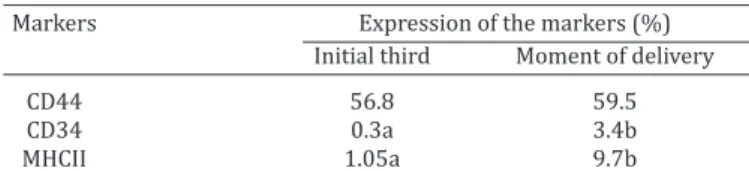
Cell samples from AM obtained in IT and AD expressed
CD44 with no significant difference between the studied
groups (P>0,05). Samples from IT showed lacked expres-sion of CD34 and MHC II markers. On the other hand, the expression of CD34 and MHC II markers from cells
obtai-ned during AD, although low, was significantly higher in
comparison with the values obtained in the IT group
sam-Fig.4. Immunocytochemistry of UCT-derived cells from bovine gestational uterus at early pregnancy harvested at slaughterhouse (A) MHC II (negative staining); (B) Oct-4 (positive staining); (C) NANOG (positive staining); (D) CD44 (positive staining). Magnification 10x.
Fig.3. Immunocytochemistry of AM-derived cells from bovine gestational uterus at early pregnancy harvested at slaughterhouse (A) MHC II (negative staining); (B) Oct-4 (positive staining); (C) NANOG (positive staining); (D) CD44 (positive staining). Magnification 10x.
Fig.2. (A) UCT samples harvested at initial third of pregnancy showing fibroblastoid morphology at 24h; (B) AM-derived cells from IT
group showing 90% confluence in 48h; (C) AM samples harvested during assisted delivery showing fibroblastoid morphology in
48h; (D) AM-derived cells obtained during assisted delivery showing 90% confluence at 4 days. Magnification 10x.
Fig.1. (A) AM samples harvested at initial third of pregnancy showing fibroblastoid morphology at 24h; (B) AM-derived cells from IT
group showing 90% confluence in 48h; (C) AM samples harvested during assisted delivery showing fibroblastoid morphology in
ples (P<0.05). Nonetheless, the expression level did not ex -ceed 10% in any sample (Table 1).
UCT-derived cells of the different groups showed ex-pression for CD44 and non exex-pression for CD34. There was no difference in the expression of CD44 and CD34 between
the studied groups. However, MHC II expression was signifi
-cantly higher in AD group than IT group (P<0.05) (Table 2).
Table 2. Mean values and standard error of the expression of CD44, CD 34 and MHC class II markers of MSC derived from bovine UCT, harvested from gestational uterus at initial third of pregnancy and from fetuses during assisted delivery
of Holstein cows
Markers Expression of the markers (%)
Initial third Moment of delivrery
CD44 7.6 63.4
CD34 0.4 1.4
MHCII 0.7a 5.2b
Table 1. Mean values and standard error of the expression of CD44, CD 34 and MHC class II markers of MSC derived from bovine AM, harvested from gestational uterus at initial third
of pregnancy and from fetuses during assisted delivery of Holstein cows
Markers Expression of the markers (%)
Initial third Moment of delivery
CD44 56.8 59.5
CD34 0.3a 3.4b
MHCII 1.05a 9.7b
Fig.6. Adipogenic differentiation of AM-derived MSC harvested from bovine gestational uterus at early pregnancy obtained in slau-ghterhouse and from fetuses during assisted delivery of Holstein cows. (A) Negative control for adipogenic differentiation; (B)
adi-pogenic differentiation displaying lipid droplets stained with Oil Red and morphological changes. Magnification 20x.
Fig.5. Osteogenic differentiation of AM-derived MSC harvested from bovine gestational uterus at early pregnancy obtained in slau-ghterhouse and from fetuses during assisted delivery of Holstein cows. (A) Negative control for osteogenic differentiation; (B)
oste-ogenic differentiation displaying extra cellular calcium deposits stained with Alizarin Red. Magnification 10x.
Tri-lineage differentiation: osteogenic, adipogenic and condrogenic
AM osteogenic differentiation. All samples from AM of both studied groups showed morphological changes and presence of calcium-rich extracellular matrix (Fig.5).
showed morphological changes and presence of lipid dro-plets in the cytoplasm (Fig.6).
AM chondrogenic differentiation. Evaluation of the chondrogenic differentiation of MA samples from both
groups was made by histological analysis of the 3D cultu-res. Samples showed morphological changes and presence of proteoglycans deposits (Fig.7).
UC osteogenic differentiation. In the evaluation of
os-Fig.8. Osteogenic differentiation of UCT-derived MSC harvested from bovine gestational uterus at early pregnancy obtained in slau-ghterhouse and from fetuses during assisted delivery of Holstein cows. (A) Negative control for osteogenic differentiation; (B)
oste-ogenic differentiation displaying extra cellular calcium deposits stained with Alizarin Red. Magnification 10x.
Fig.7. Chondrogenic differentiation of AM-derived MSC harvested from bovine gestational uterus at early pregnancy obtained in slaughterhou-se and from fetuslaughterhou-ses during assisted delivery of Holstein cows. (A) Morphological changes observed by the red HE staining; (B) presence of glycosaminoglycan stained in blue by Alcian blue dye; (C) metacromasia visualized by toluidine blue staining. Magnification 10x.
Fig.9. Adipogenic differentiation of UCT-derived MSC harvested from bovine gestational uterus at early pregnancy obtained in slau-ghterhouse and from fetuses during assisted delivery of Holstein cows. (A) Negative control for adipogenic differentiation; (B)
teogenic differentiation of UCT samples from the distinct groups, we observed morphological changes and presence of calcium-rich extracellular matrix (Fig.8).
UC adipogenic differentiation. When evaluated to adipogenic differentiation, all UCT samples from AD and IT groups showed morphological changes and presence of lipid droplets in the cytoplasm (Fig.9).
UC chondrogenic differentiation. Evaluation of the chondrogenic differentiation of UCT samples from both groups was made by histological analysis of the 3D cultu-res. All samples showed morphological changes and pre-sence of proteoglycans deposits (Fig.10).
Viability, apoptosis and necrosis assays
MSC from all samples of both groups were cryopreser-ved after P3 and thawed subsequently for viability, apopto-sis and necroapopto-sis assays. All AM samples (IT and AD) showed 80% of viability (Fig.11). We observed the same results for UCT samples obtained at IT and during AD (Fig.12).
DISCUSSION
The search of new sources of MSC as alternative to bone marrow and adipose tissue has increased in the last
deca-de, especially in human field. In this respect, fetal annexes
have arisen in the last 10 years as a convenient source for being easily and non-invasively obtained from tissues that are usually discarded and for being an important candidate to be used as resource for the creation of cell banks for both human (Fauza 2004, Gucciardo 2009, Parolini & Soncini
2011) and veterinary fields (Cremonesi et al. 2011). These
cells also stand out for their secretion of a variety of
anti--inflammatory cytokines and growth factors through bioac
-tive molecules, which modulate the inflammatory response
and the appropriate tissue repair (Parolini et al. 2008). Studies with bovine MSC obtained from fetal annexes,
until now, are little described in literature (Raoufi et al.
2011, Cardoso et al. 2012, Corradetti et al. 2013, Mançana-res et al. 2015). Therefore, the aim of the pMançana-resent study was to isolate, characterize, differentiate and cryopreserve bo-vine MSC obtained from the amniotic mesenchymal layer,
for the first time, and the extravascular matrix of umbilical
cord, which were harvested from neonates during assisted
Fig.12. UCT samples harvested from bovine gestational uterus at early pregnancy obtained in slaughterhouse and from fetuses during assisted delivery of Holstein cows showing 80% cell viability after being cryopreserved.
Fig.10. Chondrogenic differentiation of UCT-derived MSC harvested from bovine gestational uterus at early pregnancy obtained in slau-ghterhouse and from fetuses during assisted delivery of Holstein cows. (A) Morphological changes observed by the red HE staining; (B) presence of glycosaminoglycan stained in blue by Alcian blue dye; (C) metacromasia visualized by toluidine blue staining.
Mag-nification 10x.
Fig.11. AM samples harvested from bovine gestational uterus at early pregnancy obtained in slaughterhouse and from fetuses during assisted delivery of Holstein cows showing 80% cell viability after being cryopreserved.
delivery of Holstein cows and from fetuses at initial third of pregnancy obtained in slaughterhouse.
All cultured samples showed plastic adherence and fi -broblastoid morphology within 24 hours and reached 80%
confluence in 48-72 hours of culture, which is in agreement
with results from studies with human (Zhang & Fan, 2010), canine (Lee et al. 2012), equine (Koch et al. 2007,
Lange--Consiglio et al. 2012, De Vita et al. 2013) and bovine (Raoufi
presence of these epithelial cells decreased through passa-ges until P3 when it could not be observed.
Cells submitted to immunocytochemistry stained for
CD44, which confirms their mesenchymal origin, and for
Oct-4 and NANOG, which are pluripotency markers that can also be expressed in adult stem cells with multipotent characteristics, including MSC; and lacked MHC II staining.
This data supports the findings already reported in several
studies with MSC derived from fetal annexes in different species (Uranio et al. 2011, Lee et al. 2012, Calloni et al. 2014, Gonçalves et al. 2014).
The lack of MHC II expression results in lower risks of immune response to allogeneic therapy. Several studies reported no expression of MHC II in MSC by the
techni-ques of flow cytometry (Hoynowski et al. 2007, Carrade
et al. 2012) and RT-PCR (Lovati et al. 2011, Corradetti et al. 2013). In the present study, however, we have observed lack of MHC II expression only when analyzing by immu-nocytochemistry.
In the immunophenotypical analysis by flow cytometry,
all samples highly expressed CD44 marker and did not or minimally expressed CD34 marker (AM from AD group, 3.4%). CD34 is a common marker for hematopoietic cells. Gonçalves et al. (2014) described MSC as a highly hetero-geneous cell population that includes, in some cases, CD34 positive cells.
As described before, AM and UCT-derived cells showed negative immunocytochemistry staining for MHC II;
howe-ver, when evaluated quantitatively by flow cytometry, the
cells obtained during AD low expressed MHC II (AM: 9.7%
and UCT: 5.2%, respectively) and significantly differed from
AM and UCT samples of IT group (1.05% and 0.7% respec-tively). Similar results were obtained in study with equine umbilical cord blood-derived MSC, which also observed a low expression, but not absent, of MHC II (De Schauwer et al. 2014); and in a study with equine UCT-derived MSC that reported 5.6% expression of MHC-II (Barberini et al. 2014).
The hypo-immunogenic profile of MSC is associated to
the absence of MHC II expression, making it an important factor to the application of MSC as immunomodulators and allowing the allogeneic transplantation of these cells (Koppula et al. 2009). In this study, the results obtained
suggest that the first trimester of pregnancy is the eligible
moment to harvest MSC that possess a more appropriate and safe immunological phenotype for clinical use. Still, it
is important to highlight that this classification (negative or
positive) vary between authors (Dominici et al. 2006, Seo et al. 2012, Yuan et al. 2013). Besides, the harvest at slau-ghterhouse showed more accessible and free from
environ-mental contamination in comparison to the harvest at field.
At delivery moment, if the fetal membranes are in contact with the stall bedding before they are harvested; this mate-rial must not be used due to high microbial contamination.
For the in vitro differentiation, one of the most important properties in MSC characterization is the ability of these cells to differentiate into at least three tissues from the mesoder-mal lineage. All samples showed osteogenic, adipogenic and chondrogenic differentiation capacity when exposed to the respective inductor media. This data is in accordance with
results obtained in other studies with cells derived from
bo-vine fetal annexes (Raoufi et al. 2011, Cardoso et al. 2012,
Corradetti et al. 2013, Gonçalves et al. 2014).
An important aspect of cell therapy is the formation of cell banks that allows greater resource availability for the treatment of diseases. Therefore, it is necessary to utilize safe protocols that allow cells to maintain their viability for a long period. In pioneer study, Liu et al. (2011) obtained positive results for in vitro expansion and differentiation after submitting umbilical cord blood-derived MSC to long--term cryopreservation. In the present study, after thawing, MSC from both assessed tissues showed cell viability hi-gher than 80% when stained with propidium iodate and
annexine V and analyzed by flow citometry.
Furthermore, the transportation at 5C for 48 hours did not interfere on the isolation and following MSC develop-ment, which allows even more the use of these cells at the clinical application.
CONCLUSIONS
Based on the proposed aims, we can conclude that MSC may be easily isolated from the AM as well as the UCT from bovine fetuses obtained in slaughterhouse or during assis-ted delivery. The transport at 5 C for 48 hours also showed viable to send samples to the laboratory.
Immunocytochemistry analysis demonstrated that MSC from the evaluated tissues show typical characteristics of stromal cells, but also signs of pluripotency, which suggests a high therapeutic potential.
The low expression of MHC II indicates a low immuno-genic characteristic that is desirable in cells intended to cell therapy. Cells from both the amniotic mesenchymal layer and the UCT showed a satisfactory differentiation potential
into mesodermal tissues, which confirms their characteri -zation as MSC.
Cell viability was preserved with the use of DMSO as cryoprotector and the employment of controlled freezing and thawing curves, which indicates the possibility of sto-ring these cells in cell banks.
Our results suggest that the amniotic mesenchymal layer and the UCT harvested in fetuses at initial third of pregnancy and during assisted delivery are excellent sour-ces of MSC for veterinary medicine of bovine species, with potential use of them as an experimental model, that main-tain their morphological characteristics after
cryopreser-vation. However, more studies related to the identification
of mechanisms and molecules that participate in the bio-logical functions and that control the survival and prolife-ration of these cells after in vivo application are required.
Acknowledgment.- The authors would like to acknowledge CAPES and
FUNVET for the financial support.
REFERENCES
Arcelli R., Tibaldini P., Angeli G. & Bellezza E. 2009. Equine amniotic mem-brane transplantation in some ocular surface diseases in the dog and cat: a preliminary study. Vet. Res. Commun. 33(1):169-171.
differentia-tion potential. Stem Cell Res. Ther. 5:25. < http://stemcellres.com/con-tent/5/1/25>
Calloni R., Viegas G.S., Turck P., Bonatto D. & Henriques J.A.P. 2014. Mesen-chymal stromal cells from unconventional model organisms. Cytothe-rapy 16:3-16.
Cardoso T.C., Ferrari H.F., Garcia A.F., Novais J.B., Frade C.S., Ferrarezi M.C., Andrade A.L. & Gameiro R. 2012. Isolation and characterization
of Wharton’s jelly-derived multipotent mesenchymal stromal cells ob
-tained from bovine umbilical cord and main-tained in a defined
serum-free three-dimensional system. BMC Biotechnol. 12:18.
Carrade D.D. & Borjesson D.L. 2013. Immunomodulation by mesenchymal stem cells in veterinary species. Comp. Med. 63(3):207-217.
Corradetti B., Meucci A., Bizzaro D., Cremonesi F. & Lange-Consiglio A.
2013. Mesenchymal stem cells from amnion and amniotic fluid in the
bovine. Reproduction 145:391-400.
Cremonesi F., Corradetti B. & Lange C.A. 2011. Fetal adnexa derived stem cells from domestic animals: progress and perpectives. Theriogenology 75:1400-1415.
De Schauwer C., Goossens K., Piepers S., Hoogewijs M.K., Govaere J.L.J.,
Smits K., Meyer E., Van Soom A. & Van de Walle G.R. 2014.
Characteriza-tion and profiling of immunomodulatory genes of equine mesenchymal
stromal cells from non-invasive sources. Stem Cell Res. Ther. 5(1):6. De Vita B. 2011. Isolamento e caracterização de células-tronco
mesenqui-mais derivadas de anexos fetais equinos. Tese de Doutorado em Medici-na Veterinária, Faculdade de MediciMedici-na Veterinária e Zootecnia, Univer-sidade Estadual Paulista, Botucatu, SP. 74p.
De Vita B., Campos L.L., Listoni A.J., Maia L., Sudano M.J., Curcio B.R., Lan-dim-Alvarenga F.C. & Prestes N.C. 2013. Isolation, culture and
differen-tiation of mesenchymal stem cells derived from equine amniotic fluid
obtained from different gestational ages. Pesq. Vet. Bras. 33(4):535-542. Dominici M., Le Blanc K., Mueller I., Slaper-Cortenbach L., Marini F.C., Krause D.S., Deans R.J., Keating A., Porkcop D.J. & Howitz E.M. 2006. Minimal
crite-ria for defining multipotent mesenchymal stroma cells. The International
Society for Cellular Therapy Position Statement. Cytotherapy 8:315-317.
Dua H.S., Gomes J.A., King A.J. & Maharajan V.S. 2004 The amniotic mem -brane in ophthalmology. Surv. Ophthalmol. 49:51-77.
Fadel L., Viana B.R., Feitosa M.L., Ercolin A.C., Roballo K.C., Casals J.B., Pieri N.C., Meirelles F.V., Martins D.S., Miglino M.A. & Ambrósio C.E. 2011. Protocols for obtainment and isolation of two mesenchymal stem cell sources in sheep. Acta Cir. Bras. 26(4):267-273.
Fauza D. 2008. Amniotic fluid stem cells. Best Pratc. Res. Clin. Obstet. Gy -naecol. 18:877-891.
Gonçalves N.N., Ambrósio C.E. & Piedrahita J.A. 2014. Stem cells and regen-erative medicine in domestic and companion animals: a multispecies perspective. Reprod. Domest. Anim. 49(2):10. (Review)
Gucciardo L., Lories R., Ochsenbein-Kolble N., Done E., Zwijsen A. & Deprest
J. 2009. Fetal mesenchymal stem cells: isolation, properties and potential use in perinatology and regenerative medicine. BJOG 116:166-172. Hoynowski S.M.. Fry M.M., Gardner B.M., Leming M.T., Tucker J.R., Black
L., Sand T. & Mitchell K.E. 2007. Characterization and differentiation of equine umbilical cord-derived matrix cells. Biochem. Biophys. Res. Com-mun. 362:347353.
Koch T.G., Heerkens T., Thomsen P.D. & Betts D.H. Isolation of mesenchym-al stem cells from equine umbilicmesenchym-al cord blood. BMC Biotechnol. 7:26. Koppula P.R., Chelluri L.K., Polisetti N. & Vemuganti G.K. 2009.
Histocom-patibility testing of cultivated human bone marrow stromal cells: a promising step towards pre-clinical screening for allogeneic stem cell therapy. Cellular Immunol. 259:61-65.
Lange-Consiglio A., Corradetti B., Bizzaro D., Magatti M., Ressel L., Tassan S., Parolini O. & Cremonesi F. 2012. Characterization and potential appli-cations of progenitor-like cells isolated from horse amniotic membrane. J. Tissue Eng. Reg. Med. 6:622-635.
Lee K.S., Nah J.J., Lee B.C., Lee H.T., So B.J. & Cha S.H. 2013. Maintenance and characterization of multipotent mesechymal stem cells from the amniotic membrane. Res. Vet. Sci. 94:144-151.
Liu G., Ye X., Zhu Y., LiI Y., Sun J., Cui L. & Ca Y. 2011. Osteogenic differentiation of
GFP-labeled human umbilical cord blood derived mesenchymal stem cells
after cryopreservation. Cryobiology, doi: 10.1016/j.cryobiol.2011.05.005
Lovati A.B., Corradetti B., Lange Consiglio A., Recordati C., Bonacina E., Bizzaro D. & Cremonesi F. 2011 Comparison of equine bone marrow-,
umbilical cord matrix and amniotic fluid-derived progenitor cells. Vet.
Res. Comm. 35:103-121.
Mançanares C.A., Oliveira V.C., Oliveira L.J., Carvalho A.F., Sampaio R.V., Man-çanares A.C., Souza A.F., Perecin F., Meirelles F.V., Miglino M.A. & Ambró-sio C.E. 2015. Isolation and characterization of mesenchymal stem cells from the yolk sacs of bovine embryos. Theriogenology 84(6):887-898. Miki T., Lehmann T., Cai H., Stolz D.B. & Strom S.C. 2005. Stem cell
characte-ristics of amniotic epithelial cells. Stem Cells 23:1549-1559.
Nauta A.J. & Fibbe W.E. 2007. Immunomodulatory properties of mes-enchymal of bone marrow. Analysis of precursor cells for osteogenic and hematopoietic tissues. Transplantation 6:230-247.
Neto A.C.A., Pereira F.T.V., Santos T.C., Ambrosio C.E., Leiser R. & Miglino M.A. 2010. Morphophysical recording of bovine conceptus (Bos indicus) and placenta from day 20 to 70 of pregnancy. Reprod. Dom. Anim. 45:760-772. Ollivier F.J., Kallberg M.E., Plummer C.E., Barrie K.P., O’Reilly S., Taylor D.P., Gelatt K.N. & Brooks D.E. 2006. Amniotic membrane transplantation for corneal surface reconstruction after excision of corneolimbal squamous cell carcinomas in nine horses. Vet. Ophthalmol. 9:404-413.
Parolini O., Alviano F., Bagnara G.P., Bilic G., Bühring H.J., Evangelista M., Hennerbichler S., Liu B., Magatti M., Mao N., Miki T., Marongiu F.,
Naka-jima H., Nikaido T., Portmann-Lanz C.B., Sankar V., Soncini M., Stadler G., Surbek D., Takahashi T.A., Redl H., Sakuragawa N., Wolbank S., Zeisberger S., Zisch A. & Strom S.C. 2008. Concise review: isolation and
characteriza-tion of cells from human term placenta: outcome of the first internacharacteriza-tional
Workshop on Placenta Derived Stem Cells. Stem Cells 26:300-311. Parolini O. & Soncini M. 2011. Placenta as a Source of Stem Cells and as a Key
Organ for Fetomaternal Tolerance, p.11-23. In: Bhattacharya N. &
Stubble-field P. (Eds), Regenerative Medicine Using Pregnancy-Specific Biological
Substances. Springer-Verlag, London. DOI: 10.1007/978-1-84882-718-9_2 Pittenger M.F., Mackay A.M., Beck S.C., Jaiswal R.K., Douglas R., Mosca J.D., Moorman M.A., Simonetti D.W., Craig S. & Marshak D.R. 1999. Multi-lineage potential of adult human mesenchymal stem cells. Science 284:143-147.
Plummer C.E., Ollivier F., Kallberg M., Brooks D., Barrie K., Utter M. & Gel-att K. 2009. The use of amniotic membrane transplantation for ocular surface reconstruction: a review and series of 58 equine clinical cases (2002-2008). Vet. Ophthalmol. 12(1):17-24.
Raoufi M.F., Tajik P., Dehghan M.M., Eini F. & Barin A. 2011. Isolation and
differentiation of mesenchymal stem cells from bovine umbilical cord blood. Reprod. Dom. Anim. 46:95-99.
Seo M.S., Park S.B. & Kang K.S. 2012. Isolation and characterization of
canine Wharton’s jelly-derived mesenchymal stem cells. Cell Transpl.
21:1493-1502.
Solomon A., Wajngarten M., Alviano F., Anteby I., Elchalal U., Pe’er J. & Le
-vi-Schaffer F. 2005. Suppression of inflammatory and fibrotic responses in allergic inflammation by the amniotic membrane stromal matrix.
Clin. Exp. Allergy 35:941-948.
Uranio F.M., Valentini L., Lange-Consiglio A., Caira M., Guaricci A.C., L’Abbate A., Catacchio C.R., Ventura M., Cremonesi F. & Dell’Aquila M.E. 2011. Isolation, proliferation, cytogenetic, and molecular characteriza-tion and in vitro differentiacharacteriza-tion potency of canine stem cells from foetal
adnexa: a comparative study of amniotic fluid, amnion, and umbilical
cord matrix. Mol. Reprod. Dev. 78:361-373.
Van Pham P., Truong N.C., Le P.T., Tran T.D., Vu N.B., Bui K.H. & Phan N.K. 2015. Isolation and proliferation of umbilical cord tissue derived mes-enchymal stem cells for clinical applications: cell tissue bank. DOI 10.1007/s10561-015-9541-6
Yuan H., Zhuang Y., Xiong J., Zhi W., Liu L., Wei Q. & Han P. 2013. Human um-bilical mesenchymal stem cells-seeded bladder acellular matrix grafts for reconstruction of bladder defects in a canine model. Plos One 8(11).
Doi:10.1371/journal.pone.0080959
Zhang H.T. & Fan J. 2010. Human Wharton’s jelly cells can be induced to