EFFECTS OF ISOFLAVONES ON BEANY FLAVOR AND ASTRINGENCY
OF SOYMILK AND COOKED WHOLE SOYBEAN GRAINS
1MERCEDES CONCÓRDIA CARRÃO-PANIZZI2, ADELAIDE DEL PINO BELÉIA3,
SANDRA HELENA PRUDÊNCIO-FERREIRA4, MARIA CRISTINA NEVES OLIVEIRA5, and KEISUKE KITAMURA6
ABSTRACT - Flavor is the main limiting factor affecting soybean acceptability in the Occidental countries. The purpose of this study was to determine the effetcs of isoflavones on soybean flavor. Differences in beany flavor and astringency of soymilk and cooked whole soybean grains, prepared with cultivars IAS 5 and BR-36 (136 and 54 mg of total isoflavones /100 g of sample, respectively) with pre-soaking and pre-heating of grains, were sensorially analised, by an unstructured category scale of ascending intensity. Differences in isoflavone contents for both soybean cultivars were maintained in the two products, despite the pre-treatments in the processing. Pre-soaking of grains intensified beany flavor in the soymilk, reducing the perception of astringency, which is caused by the aglucones that were developed in reduced amounts.The whole soybeans grains cooked under pressure (1.5 kgf/cm2 at 127°C) presented reduced levels of isoflavones malonyl-glucosides. Due to thermal
instability, these compounds were converted to conjugated glucosides, genistin and daidzin. In the cooked whole soybean grains, no aglucones were formed and consequently it was not possible to detect differences in astringency. Results suggest that pre-heating of grains promote better flavor in soybean products.
Index terms: Glycine max, cultivars.
EFEITOS DOS ISOFLAVONÓIDES NO SABOR DE FEIJÃO CRU E NA ADSTRINGÊNCIA DO EXTRATO HIDROSSOLÚVEL DE SOJA E DOS GRÃOS INTEIROS COZIDOS
RESUMO - O sabor é o principal fator que limita a aceitabilidade da soja nos países ocidentais. O propósito deste estudo foi determinar os efeitos dos isoflavonóides sobre o sabor da soja. Diferenças no sabor de feijão cru e na adstringência do extrato hidrossolúvel de soja e dos grãos inteiros de soja cozidos, preparados com as cultivares IAS 5 e BR-36 (136 e 54 mg isoflavonóides totais /100 g de amostras, respectivamente), com pré-maceração e pré-aquecimento dos grãos, foram analisadas sensorialmente, conforme uma escala não estruturada de categoria de intensidade ascendente. As diferenças no teor dos isoflavonóides das duas cultivares foram mantidas nos dois produtos, apesar dos pré-tratamentos nos processamentos. Pré-maceração dos grãos intensificou o sabor de feijão cru nos extratos de soja, reduzindo a percepção de adstringência, que é causada por agliconas, que desenvolveram-se em quantidades reduzidas. Os grãos inteiros de soja cozidos sob pressão (1,5 kgf/cm2 a 127°C) apresentaram teores muito reduzidos dos isoflavonóides malonil glicosídeos.
Devido à alta temperatura, esses compostos foram convertidos nos glicosídeos conjugados daidzina e genistina. Nos grãos cozidos inteiros não houve formação de agliconas, e, conseqüentemente, não se percebeu diferença na adstringência. Os resultados sugerem que tratamentos que envolvem pré-aquecimento dos grãos favorecem a obtenção de produtos de soja com melhor sabor.
Termos para indexação: Glycine max, cultivares.
1 Accepted for publication on September 25, 1998.
2 Agronomist, Drª, Embrapa-Centro Nacional de Pesquisa de
Soja, (CNPSo), Caixa Postal 231, CEP 86001-970 Londrina, PR, Brasil. E-mail: [email protected]
3Agronomist, Ph.D., Dep. de Tecnologia de Alimentos e
Medicamentos, Universidade Estadual de Londrina, CEP 86051-970 Londrina, PR, Brasil.
4 Pharmaceutist, Drª, Dep. de Tecnologia de Alimentos e
Medicamentos, Universidade Estadual de Londrina.
5 Mathematical, M.Sc., Embrapa-CNPSo.
6 Biochemical, Ph.D., Agriculture, Forestry and Fisheries
INTRODUCTION
Isoflavones have been related to anticancer
properties of soybean. This fact increased the
inter-est in soybean as a component of the human diet
(Adlercreutz et al., 1991; Coward et al., 1993; Persky
& Horn, 1995). The amount of isoflavones (two
glu-cosides, genistin and daidzin, and their respective
aglucones, genistein and daidzein) is variable among
soybean cultivars, due to genetic and
environmen-tal factors (Eldridge & Kwolek, 1983; Wang
& Murphy, 1994). Variability on the amount of
isoflavones was also observed among different
Brazilian soybean cultivars (Carrão-Panizzi
& Kitamura, 1995).
Processing techniques affect the type and level
of isoflavones remaining in the final product.
Traditional fermented products (miso, tempeh)
contain high levels of daidzein and genistein
(aglucones), while non fermented products, like dry
grains, soymilk, soyflour, and tofu retain high
con-centrations of the unhydrolysed daidzin and genistin
(Coward et al., 1993; Wang & Murphy, 1994).
Bitterness and astringency of soybean are caused by
saponins and isoflavones, respectively (Huang et al.,
1981; Okubo et al., 1992). The intensity of
off-flavor in soymilk increases as the concentration
of genistein and daidzein increases due to
hydro-lytic action of
β
-glucosidase on glucosidic isoflavone
precursors (Matsuura et al.,1989). Boiling whole
soybeans in a 0.25% NaHCO
3solution effectively
inhibit the hydrolysis of daidzin and genistin in
soymilk, due to the inactivation of
β
-glucosidase
(Ha et al., 1992). It should also be considered,
however, that genistein is effective in preventing and
inhibiting cancer processes (Peterson & Barnes,
1991, 1993; Fotsis et al., 1993; Steele et al., 1995).
Flavor is the main limiting factor affecting
soybean acceptability in the Occidental countries.
Since isoflavones are one of the compounds involved
with soybean flavor, and because a variability in
isoflavone concentrations among soybean cultivars,
was observed, this study was carried out to
determine the effects of isoflavone on flavor of
soymilk and whole cooked soybean grains.
MATERIAL AND METHODS
Raw material
Soybean cultivars IAS 5 and BR-36 sowed in Londrina, Paraná State, Brazil (latitude 23°11' S), in 1993/94 with high and low isoflavone content (136 and 54 mg of total isoflavones /100 g of sample, respectively), were processed by pre-soaking and pre-heating treatments of grains in soymilk and whole cooked soybean grains.
Soymilk preparation
Soymilk with pre-heating treatment of grains was prepared according to Nelson et al. (1976), with the modi-fications introduced by Embrapa (1988). Clean and dry soybean (162 g) were placed directly into boiling water (500 mL) containing 0.25% NaHCO3, for three minutes. After boiling, the water was discarded and the whole soybean grains were cooled with cold tap water. The grains were reblanched in boiling water (1000 mL) containing 0.05% NaHCO3, for three minutes. The grains were then ground in a blender, for three minutes, and the slurry was cooked for ten minutes. Soymilk was extracted by filtra-tion through a cotton cloth and boiled again.
Soymilk with pre-soaking treatment of grains was prepared according to the traditional oriental method. Soybean grains (162 g) were soaked in cold water for 16 hours at room temperature (20ºC). After soaking, water was discarded and the grains were then ground in a blender, for three minutes, in 1000 mL of cold water. The slurry was cooked for ten minutes, filtered and boiled.
Cooked whole soybean grains preparation
Cooked whole soybean grains with pre-soaking treat-ment, were prepared by soaking 100 g of grains in water, for 16 hours, at room temperature (20ºC). Soaked grains were cooked in 500 mL water for five minutes, under pressure (1.5 kgf/cm2 at 127°C).
Cooked whole soybean grains without pre-soaking, were prepared by cooking dry grains (100 g) in 500 mL water, for 15 minutes, under pressure. Water was discarded and grains were prepared for sensorial analysis.
Sensory evaluation
according to sequential analysis defined as: α = 0.01;
β = 0.05; ρ0 = 0.35; and ρ1 = 0.65 as suggested by Della-Modesta (1989). To test this bitterness in the soymilk, 5 mg of genistein (Sigma, 4',5-7 trihydroxyisoflavone G6776) was added to 250 mL of soymilk prepared with the soybean cultivar BR-36, with pre-heating of grains. Tasters observed that soymilk with genistein was more astringent than bitter, and did not detect differences in bitterness. Because of that, just beany and astringency flavors, which were easier to detect were considered in the evaluation.
After training for perception of beany flavor and astringency, trainees were selected according to their ability to discriminate samples, reliability and agreement with the team, which were analysed statistically by ANOVA with two factors (samples and sessions), as suggested by Silva & Damásio (1994). Trainees with greater F-sample values (P≤0.25) were selected for their ability to discriminate samples, while for reliability, train-ees with lower F-sessions values (P≥0.05) were selected. To evaluate agreement of each trainee with the team, sample means of each trainee were compared with sample average of the team. After these analyses nine trainees were selected for the sensory analysis experiment.
An unstructured 9.0 cm intensity scale (Silva & Damásio, 1994), was used to evaluated the sensory attributes, beany flavor and astringency. Coded samples of 25 mL of soymilk, at room temperature (20ºC), placed in small plastic cups were offered at random, individually and sequentially. Samples of four different treatments (two cultivars and two processing methods), were tasted in the each replicate session. Samples were presented one at a time because the flavor attributes, beany and astringency, were analysed in the same sample. Interstimulus rinsing protocol was observed during the evaluations.
Coded samples of 20 g of cooked grains, placed in small plastic cups, were offered to the tasters by using the same procedures observed with soymilk. Tests for soymilk and cooked whole grains were conducted in separate.
High performance liquid chromatographic (HPLC) analysis
Isoflavone content in the raw soybean grain, soymilk and in the cooked whole soybeans were determined by HPLC, according to Kudou et al. (1991) and Kitamura et al. (1991). Isoflavones were extracted from 100 mg samples of freeze dried soymilk, ground raw and cooked whole soybeans, with 4.0 mL of 70% aqueous ethanol containing 0.1% acetic acid for one hour, at room temperature (20ºC). After centrifugation, 40 µL of the
supernatant was used directly for the HPLC analysis. Analysis of isoflavones were performed on ODS commercially packed columns [Tosoh Corp., Tokyo; TKS gel ODS-80TM (4.6 x 250 mm)]. A 0.1% acidic acid solvent system was used with a linear gradient of acetoni-trile, developed from 20% to 45% for 30 minutes. The solvent flow rate was 1.0 mL/minute, and UV absorption was measured at 260 nm. Purified soybean genistin and daidzin (Kudou et al., 1991), were used as standards. Isoflavone content was calculated as milligrams per 100 g of dry matter.
Statistical analysis
Treatments were evaluated in a factorial experiment in a randomized complete design, according to Watts et al. (1992). Two soybean cultivars and two processing methods, were analysed by nine subjects, totalizing 36 treatment combinations replicated in five sessions for soymilk and three sessions for cooked whole soybean grains. According to the experiment design the following model was used: Yijk = m + Ti + Sj + T*Sij + Eijk where: Yijk is the observations; m is the effect of means; Ti is the effect of treatments; Sj is the effect of subjects; T*Sij is the effect of interaction Treatmenti and Subjectsj; and Eijk is the residual effect.
Before testing by ANOVA, the data were tested for normal distribution (Shapiro & Wilk, 1965), homogene-ity of variance (Hartley, 1940; Burr & Foster, 1972), and model additivity (Tukey, 1949). A transformation of the data was applied to stabilize treatment variances and linear structure of the model (Hoaglin et al., 1992). Differences among treatment mean values were determined using Tukey’s test at P≤0.05 (Cochran & Cox, 1957). Statistical Analysis System (SAS, 1995) and Sistema de Análise Estatística - SANEST (Zonta et al., 1982) were used to analyse the data.
RESULTS AND DISCUSSION
β
-glycosidic conjugate isoflavones are the main
forms found in the soybean grains. In soybean
products, isoflavone composition and concentrations
change according to the processing methods (Barnes
et al., 1994). During soaking,
β
-glucosidase
hydrolyses isoflavone glucosides (daidzin and
genistin) to aglucones (daidzein and genistein)
(Matsuura et al., 1989). Fermentation is another
processing technique that hydrolyses the isoflavone
glucosides. Non fermented soybean products showed
lower levels of aglucones than fermented soybean
foods (Coward et al., 1993; Wang & Murphy, 1994).
Isoflavones were present in the soymilk almost
entirely as their
β
-glucosidic conjugates (daidzin and
genistin), while the average contents of the
aglucones, daidzein and genistein, were very small,
3.2
µ
g/g and 3.6
µ
g/g in one sample and, 1.1
µ
g/g
and 1.3 mg/g in another sample, (Barnes et al., 1994).
When soybean is processed at high temperatures
(>80°C), manolylated isoflavone glucosides which
are thermally unstable are converted to the
corresponding daidzin and genistin.
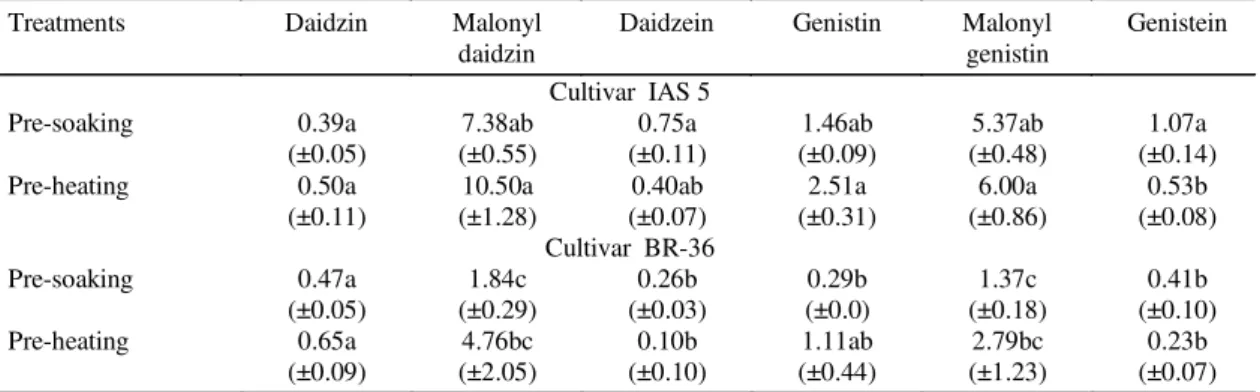
In this experiment, isoflavone
β
-glucoside
conjugates were the major isoflavone compounds
in soymilk and in cooked whole soybeans, as
expected for non fermented soybean foods
(Tables 2 and 3). Differences in total isoflavone
contents observed in soybean cultivars IAS 5 and
BR-36, were mantained despite the treatments
(pre-soaking and pre-heating), in samples of freeze
dried soymilk (Table 2). Soymilk prepared with the
cultivar IAS 5, by pre-heating treatment had
20.4 mg/100 g of total isoflavones, while by
pre-soaking treatment had 16.5 mg/100 g. Soymilk
prepared with the cultivar BR-36 had 9.6 mg/100 g,
when prepared by pre-heating treatment; and
4.7 mg/100 g, when prepared by pre-soaking
treatment (Table 2). In spite of the low
concentra-Cultivars Daidzin Malonyl
daidzin
Genistin Malonyl
genistin
Total
IAS 5 9.5 30.8 19.9 75.7 135.9
BR-36 3.7 12.4 7.3 30.2 53.6
TABLE 1. Mean isoflavone contents (mg/100 g as is) in seeds samples of soybean cultivars IAS 5 e BR-361.
1 Mean values of two replicate analysis.
tions of aglucones found in all treatments, the level
of aglucones (daidzein and genistein) increased
twofold in the pre-soaked grain treatments, for both
cultivars (Table 2).
Pre-soaking grains in water before soymilk
extraction process intensified the beany flavor of
soymilk, independently of the high or low isoflavone
contents of soybean cultivars IAS 5 and BR-36
(Table 3). For the beany flavor data, because there
was a dependence between logarithm of mean and
logarithm of variance, it was applied a potency
transformation (y
0.70), for higher efficiency on the
treatment effects (Hoaglin et al., 1992). In this test,
two subjects (tasters) were not able to accurately
define the beany flavor, resulting in a significant
interaction between subjects and treatments. In this
case, according to Stone & Sidel (1993), for
statistical analyses, these two subjects were
eliminated and the ANOVA was applied again with
seven tasters.
The difference in astringency in the soymilk was
not significant among treatments. Less intense
astringency, however, was observed when grains of
cultivar IAS 5 were not soaked (Table 3). The
reduced amount of aglucones (daidzein and
genistein) observed in the soymilk (Table 2) could
be the probable explanation of the results of non
significant differences in astringency among
treatments.
Treatments Daidzin Malonyl
daidzin Daidzein Genistin Malonylgenistin Genistein
Cultivar IAS 5
Pre-soaking 0.39a 7.38ab 0.75a 1.46ab 5.37ab 1.07a
(±0.05) (±0.55) (±0.11) (±0.09) (±0.48) (±0.14)
Pre-heating 0.50a 10.50a 0.40ab 2.51a 6.00a 0.53b
(±0.11) (±1.28) (±0.07) (±0.31) (±0.86) (±0.08)
Cultivar BR-36
Pre-soaking 0.47a 1.84c 0.26b 0.29b 1.37c 0.41b
(±0.05) (±0.29) (±0.03) (±0.0) (±0.18) (±0.10)
Pre-heating 0.65a 4.76bc 0.10b 1.11ab 2.79bc 0.23b
(±0.09) (±2.05) (±0.10) (±0.44) (±1.23) (±0.07)
TABLE 2. Mean values (± E) of isoflavone content (mg/100 mL dry weight) in soymilk extracted by two differ-ent processing methods (pre-soaking and pre-heating treatmdiffer-ents of grains), from soybean cultivars IAS 5 and BR-361.
1Means with different letters in the same column are significantly different (Tukey P≤0.05).
Treatments Beany flavor 2 Astringency3
BR-36 - Pre-soaking 6.02a 4.50a
(±0.32) (±0.36)
IAS 5 - Pre-soaking 6.05a 4.61a
(±0.38) (±0.34)
BR-36 - Pre-heating 4.11b 4.00a
(±0.43) (±0.37)
IAS 5 - Pre-heating 2.91b 2.87b
(±0.31) (±0.28)
TABLE 3. Mean values (±SE) in sensory analysis of soymilk extracted by two different processing methods (pre-soaking and pre-heating treatments of grains), from soybean cultivars IAS 5 and BR-36, according to an unstructured 9.0 cm intensity scale1.
1Means followed by the same letters in the columns are not significantly
different (Tukey P≤0.05).
2 Mean values from seven tasters; for statistical analysis means were
transformed by potency (y0.7); the original data is presented. 3 Mean values from nine tasters.
Results from this experiment suggested that the
compounds daidzein and genistein in the soymilk
were not present in sufficient amount (Table 2), to
yield bitterness and astringency, and in this case, it
was easier to perceive the beany flavor. Tango et al.
(1984) observed that different soymilks obtained
with different soybean cultivars were similar in
astringency and bitter taste.
During soaking, lipoxygenase enzimes catalyze
lipid oxidation developing undesirable carbonyl
compounds which are responsible for the beany
flavor (Rackis et al., 1972). The n-hexanal
compound, formed during hydroperoxidase of
linoleic acid (Matoba et al., 1985), remained as a
major headspace organic compound in boiling
NaHCO
3soaked soybeans (Ha et al., 1992). Beany
flavor could also be present in the soybean grain
before processing, as it was already observed by
Rackis et al. (1970). Heat treatment is an effective
method to inhibit objectionable flavor of soymilk,
since it inactivates the enzymes lipoxygenase and
β
-glucosidase (Ha et al., 1992).
In the test of cooked whole soybean grains,
malonyl isoflavones, which are heat-labile and
unstable (Kudou et al., 1991; Coward et al., 1993;
Cole & Cousin Junior, 1994), were significantly
reduced and converted to glucoside conjugates,
daidzin and genistin (Table 4), as compared to the
amounts of malonyl isoflavones in the raw soybean
grains (Table 1). Barnes et al. (1994), also observed
a significant reduction of malonyl conjugates, in
soybean products prepared under pressure.
Differences in isoflavone contents of cultivars
IAS 5 and BR-36, were also maintained when
grains were cooked under pressure, despite the
pre-treatments.
According to Hoaglin et al. (1992), because there
was a dependence between logarithm of mean and
of variance, a potency transformation (y
- 0.26) was
applied on astringency data (Table 5), for higher
efficiency on the treatment effects.
Whole cooked soybean grains were not broken
before soaking, and probably, lipoxygenase enzyme
did not interact with the substrate to develop beany
flavor as observed by Nelson et al. (1976). The
cultivar BR-36, with pre-soaking treatment had the
lowest beany flavor. Astringency of cooked whole
Treatments Daidzin Malonyl
Daidzin
Total Genistin Malonyl
Genistin
Total
Cultivar IAS 5
Pre-soaking 58.9a 0.9a 59.8a 130.9a 1.3a 133.5a
(±3.90) (±0.21) (±4.08) (±6.00) (±0.09) (±6.59)
Pre-heating 65.6a 1.9a 67.5a 139.1a 1.2a 142.2a
(±2.14) (±1.04) (±3.17) (±10.13) (±0.08) (±10.26)
Cultivar BR-36
Pre-soaking 17.4b 0.8a 18.2b 32.2b 0.9b 34.3b
(±2.36) (±0.77) (±1.64) (±3.76) (±0.09) (±2.94)
Pre-heating 26.4b 1.9a 28.3b 52.8b 0.9b 53.5b
(±6.26) (±1.05) (±5.67) (±7.18) (±0.10) (±7.18)
TABLE 4. Means (±SE) of isoflavone contents (mg/100 g dry weight)1, in whole soybean grains of cultivars
IAS 5 and BR-36, cooked under pressure (1.5 kgf/cm2 at 127°C)2.
1 HPLC analysis were made with an ODS-80 TS column.
2 Means followed by the same letters in the column are not significantly different (Tukey P≤0.05).
Treatments Beany flavor2 Astringency3
BR-36 - Pre-soaking 2.74b 1.97a
(±0.38) (±0.31)
IAS 5 - Pre-soaking 3.58ab 2.87a
(±0.44) (±0.41)
BR-36 - Pre-heating 3.91ab 2.82a
(±0.49) (±0.40)
IAS 5 - Pre-heating 4.63a 3.06a
(±0.53) (±0.45)
TABLE 5. Mean values (±SE) of sensorial analysis of whole soybean grains of cultivars IAS 5 and BR-36, cooked under pressure (1.5 kfg/cm2
at 127°C) according to an unstructured 9.0 cm intensity scale1.
1Means followed by the same letters in the columns, are not significantly
different (Tukey P≤0.05).
2Mean values obtained with nine tasters.
3For statistical analysis mean values were transformed by potency
(y-0.26); the original data is presented.
soybean grains was the same for all treatments
(pre-heating and pre-soaking) (Table 5). This result
suggests that at high temperature b-glucosidase was
inactivated and did not form aglucones, which are
related to astringency (Okubo et al., 1992). Absence
of aglucones could not cause differences among
treatments for astringency, suggesting that aglucones
are the compounds related to that sensorial attribute.
CONCLUSIONS
1. Differences in isoflavone contents between
IAS 5 and BR-36 are maintained in soymilk
and whole cooked soybean grains, despite the
processing treatments.
2. The aglucone genistein is formed in the soymilk
in reduced amounts and does not affect flavor.
Pre-soaking treatment of grains intensifies beany
flavor in the soymilk reducing the perception of
astringency, which is caused by genistein.
3. When whole soybeans grains are cooked
under pressure, malonyl glucosides is converted to
the correspondent conjugated glucosides (daidzin
and genistin). In this case, the aglucones (daidzein
and genistein) is not formed and no differences on
astringency is observed.
ACKNOWLEDGEMENT
To Mr. Celso Fratias and Mr. Adriano A. do P.
Lima for the field work and sample preparation; to
J.L.T. da Silva, A.C.F. Mendes, N.M.S. Scarpelin,
T. Fagundes, E.M. Nakamura, M. de Aquino, Z.
Miranda, L.M. Chueire, M. da S. Pires, I. Soldório,
J.J. da Silva, O. Ferreira, A. Carneiro, F. E. Paro, C.
S. Aligleri and I. C. Silva for the sensorial analysis.
We are also grateful to A. R. Panizzi and N.
Neumaier for their critical reading of this manuscript;
to the National Agriculture Research Center for
allowing to use Legume Breeding Laboratory
facilities; to Conselho Nacional de Desenvolvimento
Científico e Tecnológico (CNPq) for providing
finantial support to the trip to Japan and to Embrapa
for allowing to realize this work.
REFERENCES
ADLERCREUTZ, H.; HONJO, H.; HIGASHI, A.; FOTSIS, T.; HAMALAINEN, E.; HASEGAWA, T.; OGAWA, H. Urinary excretion of lignans and isoflavonoid phytoestrogens in Japanese men and women consuming a traditional Japanese diet. American Journal of Clinical Nutrition, v.54, p.1093-1110, 1991.
BARNES, S.; KIRK, M.; COWARD, L. Isoflavones and their conjugates in soy foods: Extraction conditions and analysis by HPLC-mass spectrometry. Journal of Agricultural and Food Chemistry, v.42, p.2466-2474, 1994.
BURR, I.W.; FOSTER, L.A. A test for equality of variances. West Lafayette: University of Purdue, 1972. 26p. (Mimeo Series, 282).
CARRÃO-PANIZZI, M.C.; KITAMURA, K. Isoflavone content in Brazilian soybean cultivars. Breeding Science, v.45, p.295-300, 1995.
COCHRAN, W.G.; COX, G.M. Experimental designs. New York: Willy, 1957. 601p.
COLE, K.; COUSIN JUNIOR, S.L. Size exclusion chromatography of soybean proteins and isoflavones. Journal of Agricultural and Food Chemistry, v.42, p.2713-2720, 1994.
COWARD, L.; BARNES, N.C.; SETCHELL, K.D.R.; BARNES, S. Genistein, daidzein, and their
β-glycoside conjugates: Antitumor isoflavones in soybean foods from American and Asian diets. Journal of Agricultural and Food Chemistry, v.41, p.1961-1967, 1993.
DELLA-MODESTA, R.C. Análise sensorial de alimentos e bebidas. Rio de Janeiro: Embrapa-CTAA, 1989. 72p.
ELDRIDGE, A.; KWOLEK, W. Soybean isoflavones: Effect of environment and variety on composition. Journal of Agricultural and Food Chemistry, v.31, p.394-396, 1983.
EMBRAPA-Centro Nacional de Pesquisa de Soja (Londrina, PR). Delícias da soja: um cardápio nutritivo. Rio de Janeiro: Globo, 1988. 86p.
FOTSIS, T.; PEPPER, M.; ADLERCREUTZ, H.; FLEISCHMANN, G.; HASE, T.; MONTESANO, R.; SCHWEIGERER, L. Genistein, a dietary-derived inhibitor of in vitro angiogenesis. Proceedings of
the National Academy of Sciences of the United States of America, Serie Medical Sciences, v.90, p.2690-2694, 1993.
HA, E.Y.W.; MORR, C.V.; SEO, A. Isoflavone aglucones and volatile organic compounds in soybeans: Effects of soaking treatments. Journal of Food Science, v.57, p.414-417, 1992.
HARTLEY, H.O. Testing the homogeneity of a set of variances. Biometrika, v.31, p.249-255, 1940.
HOAGLIN, D.C.; MOSTELLER, F.; TUKEY, J.W. Análise exploratória de dados: técnicas robustas. Lisboa: Salamandra, 1992. 446p.
HUANG, A.; HSIEH, O.A.L.; CHANG, S.S. Character-ization of the non volatile minor constituents respon-sible for the objectionable taste of deffated soybean flour. Journal of Food Science, v.47, p.19-23, 1981.
KITAMURA, K.; IGITA, K.; KIKUCHI, A.; KUDOU, S.; OKUBO, K. Low isoflavone content in early maturing cultivars, so called summer-type soybeans (Glycine max (L.) Merrill). Japanese Journal of
Breeding, v.41, p.651-654, 1991.
MATOBA, T.; HIDAKA, H.; NARITA, H.; KITAMURA, K.; KAIZUMA, N.; KITO, M. Lipoxygenase-2 isoenzyme is responsible for generation of n-hexanal in soybean homogenate. Journal of Agricultural and Food Chemistry, v.33, p.852-855, 1985.
MATSUURA, M.; OBATA, A.; FUKUSHIMA, D. Objectionable flavor of soymilk developed during the soaking of soybeans and its control. Journal of Food Science, v.54, p.602-605, 1989.
NELSON, A.I.; STEINBERG, M.P.; WEI, L.W. Illinois process for preparation of soymilk. Journal of Food Science, v.41, p.57-51, 1976.
OKUBO, K.; IJIMA, M.; KOBAYASHI, Y.; YOSHIKOSHI, M.; UCHIDA, T.; KUDOU, S. Components responsible for the undesirable taste of soybean seeds. Bioscience Biotechnology Biochemistry, v.56, p.99-103, 1992.
PERSKY, V.; HORN, L.V. Epidemiology of soy and cancer: perpectives and directions. Journal of Nutrition, v.125, p.709S-712S, 1995.
PETERSON, G.; BARNES, S. Genistein and Biochanin A inhibit the growth of human prostate cancer-cells but not epidermal growth factor receptor tyrosine autophosphorylation. The Prostate, v.22, p.335-345, 1993.
PETERSON, G.; BARNES, S. Genistein inhibition of the growth of human breast cancer-cells: independence from estrogen receptors and the multi-drug resistance gene. Biochemical and Biophysical Research Communications, v.179, p.661-667, 1991.
RACKIS, J.J.; HONIG, D.H.; SESSA, D.J.; MOSER, H.A. Lipoxygenase and peroxidase activities of soybeans as related to flavor profile during matura-tion. Cereal Chemistry, v.49, p.586-597, 1972.
RACKIS, J.J.; HONIG, D.H.; SESSA, D.J.; STEGGERDA, F.R. Flavor and flatulence factors in protein products. Journal of Agricultural and Food Chemistry, v.18, p.977-982, 1970.
SAS INSTITUTE. SAS proprietary software release 6.09. Cary, NC, 1995.
SHAPIRO, S.S.; WILK, M.B. An analysis of variance test for normality. Biometrika, v.52, p.591-611, 1965.
SILVA, M.A.A.P. da; DAMÁSIO, M.H. Curso de análise sensorial descritiva. Campinas: Fund. Tropical de Pesquisas e Tecnologia “André Tosello”, 1994. 58p.
STEELE, V.E.; PEREIRA, M.A.; SIGMAN, C.C.; KELLOFF, G.J. Cancer chemoprevention agent development strategies for genistein. Journal of Nutrition, v.125, p.713S-716S, 1995.
STONE, J.L.; SIDEL, H. Sensory evaluation practices. San Diego: Academic Press, 1993. 338p. (Food Science and Technology, A Series of Monographs).
TANGO, J.S.; SANTOS, L.C.; TURATTI, J.M.; MORI, E.E.M.; SHIROSE, I; YOTSUYANAGI, K. Caracterização de algumas cultivares de soja para produção de extrato protéico. Boletim do Instituto Tecnologia de Alimentos, Campinas, v.21, p.157-182, 1984.
TSUKAMOTO, C.; SHIMADA, S.; IGITA, K.; KUDOU, S.; KOKUBUN, M.; OKUBO, K. Factors affecting isoflavone content in soybean seeds: changes in isoflavones, saponins, and composition of fatty acids at different temperatures during seed development. Journal of Agricultural and Food Chemistry, v.43, p.1184-1192, 1995.
TUKEY, J.W. One degree of freedom for non-additivity. Biometrics, v.5, p.232-242, 1949.
WANG, H.; MURPHY, P. Isoflavone content in commer-cial soybean foods. Journal of Agricultural and Food Chemistry, v.42, p.1666-1673, 1994.
WATTS, B.M.; YLIMAKI,G.L.; JEFFERY, L.E.; ELIAS, L.G. Métodos sensoriales básicos para la evaluación de alimentos. Ottawa,Canada: CIID, 1992. 170p.