Bioavailability and poultry fecal excretion of phosphorus from
soybean-based diets supplemented with phytase
1Bianca Almeida Brandão Martins2, Laura Maria de Oliveira Borgatti2, Luiz Waldemar de Oliveira
Souza3, Simi Luiza Durante Aflalo Robassini2, Ricardo de Albuquerque4
1 Research supported by FAPESP, Brazil.
2 Universidade de São Paulo, Pirassununga, São Paulo, Brazil. 3 University of Minnesota, Saint Paul, Minnesota, USA.
4 Departamento de Nutrição e Produção Animal - FMVZ - USP, Caixa Postal 23, Rua Duque de Caxias Norte, 225, Pirassununga, São Paulo, 13630-000, Brazil.
ABSTRACT - Five hundred and four 1-day-old Cobb broiler chickens were randomly allotted to 18 treatments and fed a semi-purified basal diet (4 g/kg total phosphorus) supplemented with 2 levels of supplemental P (0.5 or 1 g/kg) during 21 days to evaluate performance and bone mineralization; to assess the relative bioavailability of P (RBP) in wheat meal (WM) and roasted (RS) or extruded soybean meal (ES), with or without phytase (0 or 750 ftu/kg diet), using dicalcium phosphate (DC) as standard; and to estimate phosphorus excretion. Weight gain (WG), feed intake (FI), feed to gain ratio (FG), and tibia ash weigh (AW) were assessed. For each source, the RBP was calculated by the slope ratio method, when tibia ash weight was regressed on P ingested. Ingested and fecal P was determined to calculate P intake, and P excretion and excretion rate. Phytase addition increased overall FI, WG, and FG ratio by 3.3, 2.6 and 0.8%, respectively, but differences were not significant. Overall AW was increased by 10.8% after the enzyme inclusion in the diets. The relative bioavailability of phosphorus values of tested WM, RS, and ES were increased by 6.32, 64.32, 76.99%, respectively, in response to supplementation of phytase in diets containing WM, RS, and ES, respectively. Phytase reduced P excretion by 12.7% and the excretion rate by 15.0%, regardless of the phosphorus source or level.
Key Words: available phosphorus, bone ash, broiler, phosphorus excretion, phytate, wheat meal
Introduction
The main characteristics of the modern poultry production are total confinement and high density, resulting in great reject output containing nitrogen, phosphorus and others. Such contaminants, originated from supplemented diets based on cereal grains and oil seeds, represent both environmental pollution and waste of nutrients added to the ration, raising production costs. About two-thirds of P in the main ingredients of poultry diets are in the phytic form unavailable for non-ruminants, requiring the addition of an inorganic P to the diets (Denbow et al., 1995). Phytate has the ability to bind mono and divalent cations forming quelate complexes with minerals like Ca, Zn, Fe and Mn and proteins, lipids and starch (Cosgrove, 1966; Thompson & Yoon, 1984). It is also an inhibitor of enzymatic actions of alpha-amylase, proteases and lipases (Deshpande & Cheryan, 1984; Knuckles, 1988).
Solutions for low availability of nutrients include feed processing, such as extrusion and roasting, in attempt to reduce anti-nutritional factors and increase nutrient digestibility (Marsman et al., 1997; Alonso et al., 1998, 2000).
Recently, research studies have been focused on the evaluation of the efficacy of exogenous enzymes upon nutrient availability. After its discovery by Suzuki et al. (1970), the natural phytase has been detected in cereals like rice, wheat, corn, soybean, triticale and sorghum (Vohra & Satyanarayana, 2003), but low or no enzymatic activity was found in corn and soybean (Selle, 1997). The commercial phytase industrially produced through recombinant technology increases P availability in vegetal ingredients for non-ruminants, improving intestinal absorption, bone mineral deposition and performance (Qian et al., 1996). Several reports have shown the efficacy of phytase in improving nutrient digestibility (Tejedor et al., 2001), increasing bone Ca and P (Teichmann et al., 1998) and reducing P excretion (Denbow et al., 1998; Vohra & Satyanarayana, 2003).
Modern poultry production requires the reduction of costs and waste output, and the increment of animal performance. Therefore, the objectives of this study were to evaluate the improvement in growth performance and bone ash content in response to enzyme addition; to assess the relative bioavailability of phosphorus in wheat meal, ISSN 1806-9290
www.sbz.org.br R. Bras. Zootec., v.42, n.3, p.174-182, 2013
and roasted or extruded soybean with or without phytase addition; and to determine the phosphorus excretion of broilers fed phytase-supplemented and non-supplemented diets.
Material and Methods
The study was conducted at Universidade de São Paulo, southwest of Brazil, with mean temperature of 26.4 ºC (maximum of 36.5 ºC; minimum of 22.0 ºC). All experimental procedures were in agreement with Ethical Principles in Animal Research adopted by the Bioethics Commission of FMVZ/USP.
Five hundred and four one-day-old male Cobb 500 poultry chicks, vaccinated for Marek disease at birth, were allotted to 18 treatments with four replications (7 birds/pen; experimental unit). Initial weight was recorded (65±1 g) and birds were randomly housed in 3 batteries with 24 cages each (2.0 × 1.70 × 0.73 m) with electric heating (60 W incandescent lamps), one linear feeder (0.64 × 0.06 × 0.06 m) and 2 nipple drinkers. Birds were under a 24-hour light/one hour dark lighting program.
A semi-purified basal diet (BD) based on corn starch and soybean meal was produced to meet the requirements
of poultry according to the NRC (1994), except for total P, which was kept at 0.40%. From the basal diet, 8 experimental diets were created through addition of 0.05 or 0.10% of P from dicalcium phosphate (DC), roasted or extruded soybean (RS and ES, respectively), or wheat meal (WM). Phosphorus sources were added to the diet in substitution to corn starch. Another 9 diets were produced through addition of phytase produced by Aspergillus oryzae
(Ronozyme®, MSD Nutritional Products, 750 ftu/ kg diet),
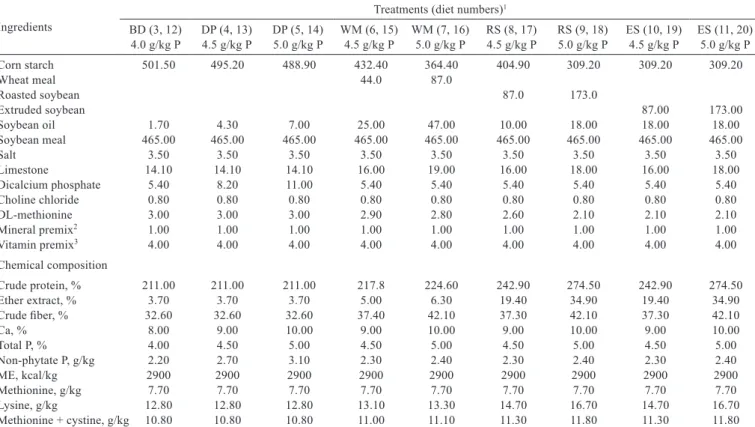
thus totaling 18 experimental diets (Table 1).
Chromic oxide (0.20%) was added to diets as digestibility marker. Water and the isocaloric diets were provided ad libitum during 21 days. The calcium:phosphorus ratio was maintained constant at 2:1 by varying limestone and corn starch levels in the different diets. Soybean oil and DL-methionine inclusion were also variable in the different treatments. Experimental diets were analyzed according to the AOAC (1995). Phytase activity of test-ingredients, phytase premix and experimental diets were evaluated by Roche Vitamins using the Vanadate Manual method (Engelen et al., 1994).
Broiler weight and feed intake were weekly recorded to calculate daily weight gain (WG), daily feed intake (FI),
Table 1 - Composition of experimental diets (g/kg fed basis)
Ingredients
Treatments (diet numbers)1
BD (3, 12)
4.0 g/kg P DP (4, 13)4.5 g/kg P DP (5, 14)5.0 g/kg P WM (6, 15)4.5 g/kg P WM (7, 16)5.0 g/kg P RS (8, 17)4.5 g/kg P RS (9, 18)5.0 g/kg P ES (10, 19)4.5 g/kg P ES (11, 20)5.0 g/kg P Corn starch 501.50 495.20 488.90 432.40 364.40 404.90 309.20 309.20 309.20
Wheat meal 44.0 87.0
Roasted soybean 87.0 173.0
Extruded soybean 87.00 173.00
Soybean oil 1.70 4.30 7.00 25.00 47.00 10.00 18.00 18.00 18.00 Soybean meal 465.00 465.00 465.00 465.00 465.00 465.00 465.00 465.00 465.00
Salt 3.50 3.50 3.50 3.50 3.50 3.50 3.50 3.50 3.50
Limestone 14.10 14.10 14.10 16.00 19.00 16.00 18.00 16.00 18.00 Dicalcium phosphate 5.40 8.20 11.00 5.40 5.40 5.40 5.40 5.40 5.40 Choline chloride 0.80 0.80 0.80 0.80 0.80 0.80 0.80 0.80 0.80 DL-methionine 3.00 3.00 3.00 2.90 2.80 2.60 2.10 2.10 2.10 Mineral premix2 1.00 1.00 1.00 1.00 1.00 1.00 1.00 1.00 1.00
Vitamin premix3 4.00 4.00 4.00 4.00 4.00 4.00 4.00 4.00 4.00
Chemical composition
Crude protein, % 211.00 211.00 211.00 217.8 224.60 242.90 274.50 242.90 274.50 Ether extract, % 3.70 3.70 3.70 5.00 6.30 19.40 34.90 19.40 34.90 Crude fiber, % 32.60 32.60 32.60 37.40 42.10 37.30 42.10 37.30 42.10
Ca, % 8.00 9.00 10.00 9.00 10.00 9.00 10.00 9.00 10.00
Total P, % 4.00 4.50 5.00 4.50 5.00 4.50 5.00 4.50 5.00
Non-phytate P, g/kg 2.20 2.70 3.10 2.30 2.40 2.30 2.40 2.30 2.40 ME, kcal/kg 2900 2900 2900 2900 2900 2900 2900 2900 2900 Methionine, g/kg 7.70 7.70 7.70 7.70 7.70 7.70 7.70 7.70 7.70 Lysine, g/kg 12.80 12.80 12.80 13.10 13.30 14.70 16.70 14.70 16.70 Methionine + cystine, g/kg 10.80 10.80 10.80 11.00 11.10 11.30 11.80 11.30 11.80 BD - basal diet; DC - dicalcium phosphate; WM - wheat meal; RS - roasted soybean; ES - extruded soybean; ME - metabolizable energy; Met + cys - methionine + cystine.
1 Phytase supplementation: 0 ftu/kg (diets number 3 to 11) or 750 ftu/kg (diets number 12 to 20).
2 Mineral premix supplies (per kg of diet): iron - 40 mg; copper - 12 mg; zinc - 120 mg; manganese - 100 mg; iodine - 2.5 mg; cobalt - 0.75 mg.
3 Vitamin premix supplies (per of diet): vitamin A - 10000 IU; vitamin D3 - 2000 IU; vitamin E - 10 mg; vitamin K3 - 2 mg; thiamine - 1 mg; riboflavin - 5 mg; piridoxin - 2 mg;
and feed to gain ratio (FG). At the end of the experimental period, 3 broilers per cage were slaughtered and legs were removed for bone sampling. Left tibias (3 samples/experimental unit) were immediately cleaned after removing, and frozen (-20 ºC). After thawing, tibia samples were dried (105 ºC; 48 hours) and subjected to ether extraction for 12 hours and weighted, which was followed by calcination (600 ºC; 8 hours) and weighting after cooling. Tibia ash weight (WA) was determined (g). Broiler excretion was collected one day before each bird slaughtering, making a pool of 3 samples per repetition and immediately frozen (-20 ºC). After thawing, samples were dried (65 ºC), processed to 1 mm in a mash grinder and weighted for determination of dry matter (105 ºC). Phosphorus content was determined using calcinated samples (550 ºC; 4 hours) solubilized in hydrochloric acid. Ammonium molybdate and ascorbic acid were added to 0.2 mL of the mineral solution and reading was performed at 670 mm by colorimetric method. Results were given in percentage of P excretion.
Analysis of variance was performed according to a completely randomized block design by initial weight (0.065±0.0015 kg) (Snedecor & Cochran, 1967) and a 4 × 2 × 2 + 2 factorial arrangement of treatments (4 P sources, 2 levels of P, 2 levels of phytase + basal diets with 0 or 750 ftu/kg) using the GLM procedures of software SAS (Statistical Analysis System). Duncan test was used to perform contrasts for sources means, and analysis of variance for P and phytase levels. Basal diet results were used only to calculate P availability. Tibia ash weight at 21 days of experiment was regressed on supplemental P levels (SAS, 1990) to assess P bioavailability by the slope ratio technique (Combs Jr., 1955 cited by Waldroup et al., 1965; Ammerman et al., 1995).
Results and Discussion
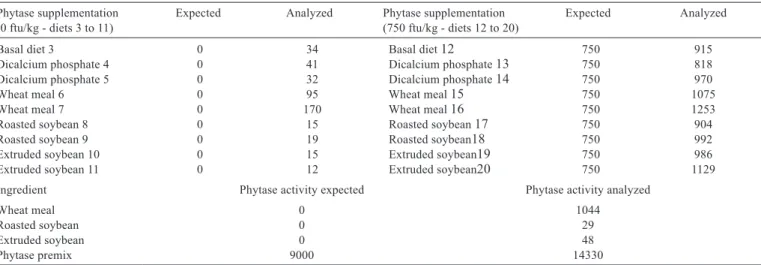
Diets not supplemented with phytase showed some light enzymatic activity (Table 2) probably due to the natural enzyme contained in vegetal ingredients, especially the wheat meal diets (diets number 6 and 7), which presented higher endogenous phytase activity.
This fact can be confirmed by the same pattern of enzymatic activity observed after inclusion of 750 ftu/kg (diets 11 to 20). When analyses were individually performed on test-ingredients, wheat meal showed phytase activity 36 times higher than roasted soybean meal, and 22 times higher than extruded soybean meal (1044, 29 and 48 ftu/kg, respectively). Those findings are in agreement with literature reports (Selle, 1997; Vohra & Satyanarayana, 2003).
Additionally, the phytase premix showed about 1.6 times the expected enzyme activity (14330 vs 9000 ftu/kg). Phytase was reported by Augspurger et al. (2003) with 2875 ftu/g of analyzed activity when the level guaranteed by the manufacturer was 2500 ftu/g premix, confirming that it is not uncommon to find commercial products with activity higher than the displayed in labels.
On the other hand, the standard assay procedures for determination of phytase activity include one step where the release of inorganic P is measured at pH 5.5 (Figueiredo et al., 2000). However, the optimal pH for the enzyme activity is bimodal (4.0 and 4.5). Therefore, the enzymatic activity observed at bench top assays does not necessarily reflect thein vivo activity.
Broilers fed non-supplemented diets ingested 40.32 g/ day (±2.84) regardless of the P level (Table 3), while the overall feed intake for the phytase-supplemented diets was 41.68 g/day (±3.83).
Table 2 - Phytase activity (ftu/kg) expected and analyzed in the experimental diets, test-ingredients, and phytase premix
Phytase supplementation
(0 ftu/kg - diets 3 to 11) Expected Analyzed Phytase supplementation (750 ftu/kg - diets 12 to 20) Expected Analyzed
Basal diet 3 0 34 Basal diet 12 750 915
Dicalcium phosphate 4 0 41 Dicalcium phosphate 13 750 818 Dicalcium phosphate 5 0 32 Dicalcium phosphate 14 750 970
Wheat meal 6 0 95 Wheat meal 15 750 1075
Wheat meal 7 0 170 Wheat meal 16 750 1253
Roasted soybean 8 0 15 Roasted soybean 17 750 904
Roasted soybean 9 0 19 Roasted soybean18 750 992
Extruded soybean 10 0 15 Extruded soybean19 750 986
Extruded soybean 11 0 12 Extruded soybean20 750 1129
Ingredient Phytase activity expected Phytase activity analyzed
Wheat meal 0 1044
Roasted soybean 0 29
Extruded soybean 0 48
Overall, broilers fed 0 or 750 ftu/kg of diet ingested similar amount of ration regardless of the P source or level, indicating that phytase did not influence feed intake (P>0.01), as reported in the literature. Costa et al. (2007) and Assuena et al. (2009) reported no differences in the feed intake of broilers fed diets with phytase levels varying from 250 to 1,000 ftu/kg.
Feed intake was reduced by the use of roasted soybean meal for non-supplemented diets (P<0.05), but such difference was not observed for the phytase-supplemented diet. Considering the 750 ftu/kg level, there was a lower feed intake (P<0.05) regardless of the P source. The overall feed intake was only different (P<0.05) between the dicalcium phosphate and the roasted soybean meal diets.
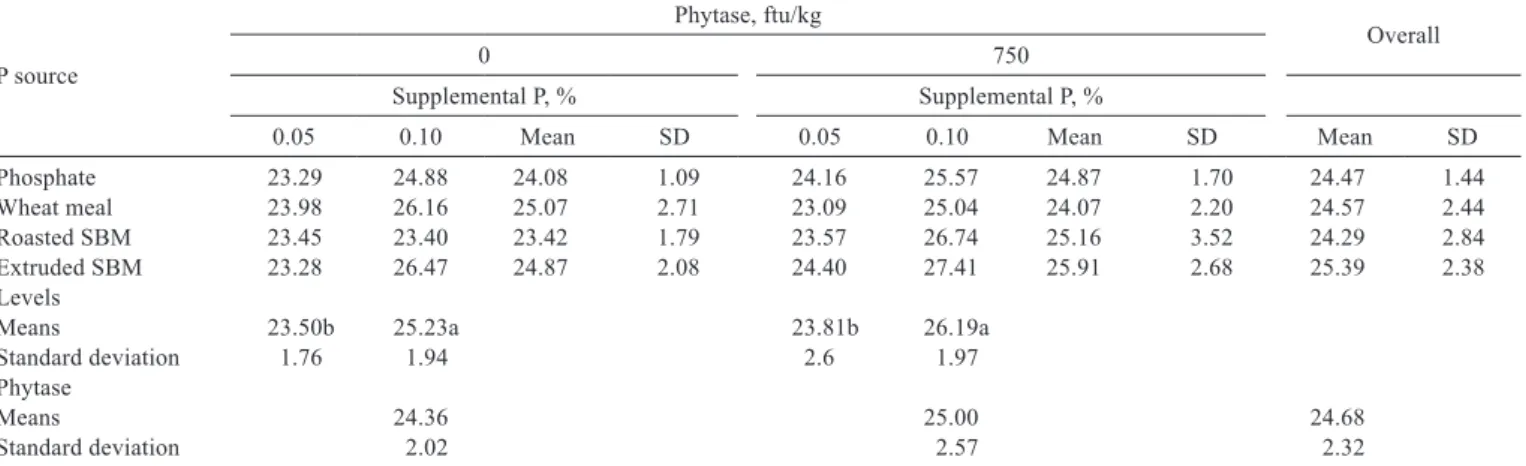
Birds fed diets supplemented with 0 or 750 ftu/kg gained 24.36 g/day (±2.02) or 25.00 g/day (±2.57) of body weight, respectively (Table 4).
As observed for feed intake, weight gain was not affected by supplementation of the enzyme in experimental diets, regardless of P source or level. However, Tejedor et al. (2001) verified that both 500 and 750 ftu/kg can improve weight gain of broilers by 3.4% and 2.8%, respectively. On the other hand, Costa et al. (2007) observed that different enzymes, at the same level (500 ftu/kg), can result in differences in weight gain, when compared with non-supplemented diets. Assuena et al. (2009)reported a linear reduction in weight gain of 21 and 42 day-old broilers as a result of supplementation with levels higher than 500 ftu/kg, with marked impairment of this variable at 1,000 ftu/kg.
In this study, weight gain was only affected (P<0.05) by the P level at both phytase levels.
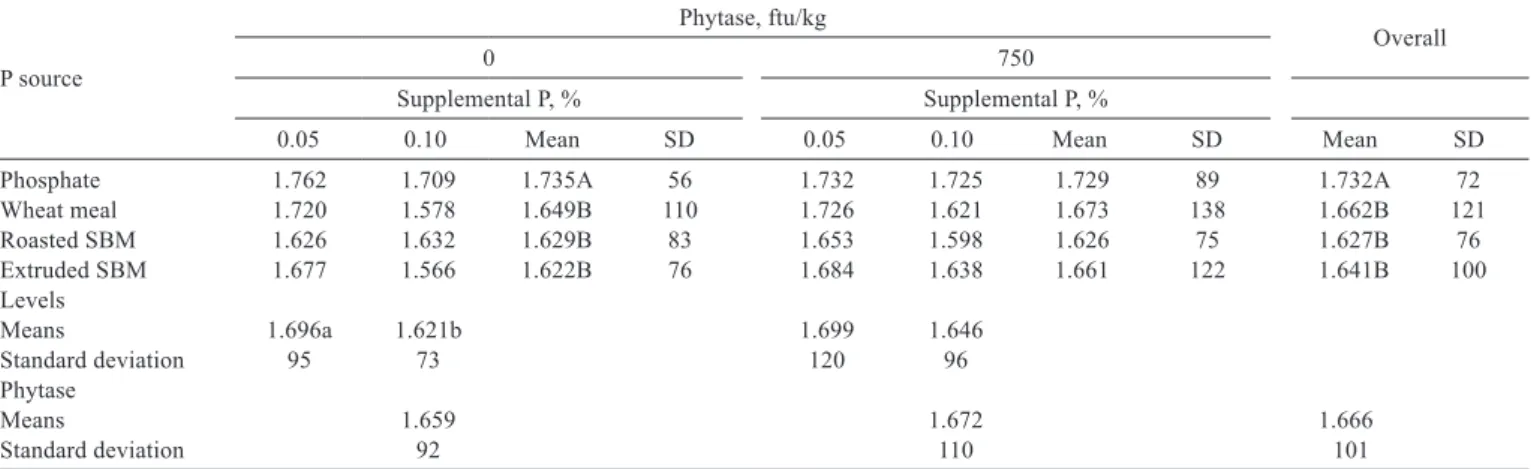
Feed to gain ratio was 1.659 g/kg (±92) and 1.672 g/kg (±110) for broilers fed diets containing 0 or 750 ftu/kg, respectively (Table 5).
Table 3 - Feed intake (g/day) of 22-day-old broilers fed diets with different supplemental P sources containing 0 or 750 phytase units1
P source
Phytase, ftu/kg
Overall
0 750
Supplemental P, % Supplemental P, %
0.05 0.10 Mean SD 0.05 0.10 Mean SD Mean SD
Phosphate 41.06 42.49 41.78A 1.62 41.83 44.09 42.96 3.15 42.37A 2.50 Wheat meal 41.00 41.33 41.16A 3.33 39.96 40.55 40.26 4.69 40.71AB 3.96 Roasted SBM 38.11 38.11 38.11B 2.78 38.76 42.62 40.69 4.24 39.40B 3.72 Extruded SBM 39.00 41.48 40.24AB 2.29 40.88 44.74 42.81 2.84 41.53AB 2.83 Levels
Means 39.79 40.85 40.36b 43.00a
Standard deviation 2.67 2.98 4.41 2.67
Phytase
Means 40.32 41.68 41.00
Standard deviation 2.84 3.83 3.41
Means with different capital letters in the same column are different (P<0.05) by the Duncan test. Means followed by different lowercase letters in the same row are different (P<0.05) by analysis of variance. SBM - soybean meal; SD - standard deviation.
1 Birds fed basal diet (P = 0.40 %), with 0 or 750 ftu/kg of diet showed average feed intake of 36.92 or 39.11 g/day, respectively.
Table 4 - Weight gain (g/day) of 22-day-old broilers fed diets with different supplemental P sources containing 0 or 750 phytase units1
P source
Phytase, ftu/kg
Overall
0 750
Supplemental P, % Supplemental P, %
0.05 0.10 Mean SD 0.05 0.10 Mean SD Mean SD
Phosphate 23.29 24.88 24.08 1.09 24.16 25.57 24.87 1.70 24.47 1.44 Wheat meal 23.98 26.16 25.07 2.71 23.09 25.04 24.07 2.20 24.57 2.44 Roasted SBM 23.45 23.40 23.42 1.79 23.57 26.74 25.16 3.52 24.29 2.84 Extruded SBM 23.28 26.47 24.87 2.08 24.40 27.41 25.91 2.68 25.39 2.38 Levels
Means 23.50b 25.23a 23.81b 26.19a
Standard deviation 1.76 1.94 2.6 1.97
Phytase
Means 24.36 25.00 24.68
Standard deviation 2.02 2.57 2.32
Means followed by different capital letters in the same column are different (P<0.05) by the Duncan test. Means followed by different lowercase letters in the same row are different (P<0.05) by analysis of variance. SBM - soybean meal; SD - standard deviation.
Broilers fed non-supplemented or supplemented diets did not differ (P<0.05) in feed to gain ratio, confirming the assumption that overall performance was not influenced by dietary level of phytase. Significant difference (P<0.05) in feed to gain ratio was only observed between non-supplemented diets containing different P levels.
Data on feed to gain ratio is available, but still not consistent. Phytase improved feed to gain ratio by 3% at 500 and 750 ftu/kg (Tejedor et al., 2001) in broilers from 10 to 24 days of age, and 1.3% at 500 ftu/kg (Costa et al., 2007) in 21-day-old broilers.
However, Assuena et al. (2009) showed that diets containing 750 or 1,000 ftu/kg of diet resulted in increase of feed to gain ratio in broilers from 1 to 21 or 22-42 days of age. Those authors concluded that those phytase levels impaired performance, but at 500 ftu/kg, feed to gain ratio was better than the control diet. Alvarenga et al. (2011) verified that diets with lower ME (2,850 kcal/kg) and crude protein content (17.0%) increased feed to gain ratio as a result of phytase supplementation.
The overall (±standard deviation) tibia ash weight was 1.799 mg and (±222) and 2.016 mg (±247) for non-supplemented and non-supplemented diets, respectively (Table 6). It is clear that the P level affected (P<0.05) ash weight in presence or absence of the enzyme. Broilers fed diets with 750 ftu/kg showed higher tibia ash content (P<0.05) than birds fed non-supplemented diets. On the other hand, differences (P<0.05) due to P source were reduced after phytase supplementation, except for the wheat meal diet, which resulted in the lower, different (P<0.05) tibia ash weight. This observation suggests that phytase supplementation does not increase bone mineralization for diets containing ingredients with natural phytase.
Previous research studies have described the improvement in bone mineralization of broilers in response to phytase supplementation (Powell et al., 2011). Powell et al. (2011) concluded that 500 ftu/kg results in increased bone breaking strength, bone weight, bone ash weight and percentage of tibia ash.
However, Assuena et al. (2009)observed that 21-day-old broilers fed a control diet (3,050 kcal/kg ME; 21.14% CP; 0.48% aP) or control diet plus 250 ftu/kg resulted in higher bone density as compared with diets containing higher levels of phytase. For broilers from 22 to 42 days of age, phytase supplementation reduced bone density up to the level of 785 ftu/kg and then density started to increase, showing a quadratic effect of phytase.
Oliveira et al. (2008) observed impairment of bone mineralization in broilers fed diets containing 250 ftu/kg and 100, 85, and 70% of available P (aP) requirement. According to the authors, it is possible that the release of bound Ca from ingredients, besides the organic P, may interfere with P deposition in the bone matrix. Augspurger et al. (2003) reported that diets containing phytase from
Escherichia coli at 500 ftu/kg resulted in similar tibia ash
content of broiler chicks compared with diets supplemented with inorganic P. However, a product from Aspergillus
niger resulted in lower bone ash content. Bone breaking
strength, fresh and dry bone weight, and bone ash weight of growing-finishing pigs increased linearly in response to increasing phytase levels (Veum et al., 2008).
Obviously, when phytase is added to the DC diet, there is no substrate in the ingredient but the enzyme has effect on the fixed amount of soybean meal present in all diets (Table 1). This soybean meal is not under investigation, but it was verified that the enzyme promoted an average
Table 5 - Feed to gain ratio (g/kg) of 22-day-old broilers fed diets with different supplemental P sources containing 0 or 750 phytase units1
P source
Phytase, ftu/kg
Overall
0 750
Supplemental P, % Supplemental P, %
0.05 0.10 Mean SD 0.05 0.10 Mean SD Mean SD
Phosphate 1.762 1.709 1.735A 56 1.732 1.725 1.729 89 1.732A 72 Wheat meal 1.720 1.578 1.649B 110 1.726 1.621 1.673 138 1.662B 121 Roasted SBM 1.626 1.632 1.629B 83 1.653 1.598 1.626 75 1.627B 76 Extruded SBM 1.677 1.566 1.622B 76 1.684 1.638 1.661 122 1.641B 100 Levels
Means 1.696a 1.621b 1.699 1.646
Standard deviation 95 73 120 96
Phytase
Means 1.659 1.672 1.666
Standard deviation 92 110 101
Means followed by different capital letters in the same column are different (P<0.05) by the Duncan test. Means followed by different lowercase letters in the same row are different (P<0.05) by analysis of variance.
SBM - soybean meal; SD - standard deviation.
increase of 14% in RBP as result of hydrolysis of the phytate content in the soybean (Table 7).
After supplementation of phytase to wheat meal diets, RBP was poorly increased from 74.4% to 79.4%. Since wheat meal contains 0.85% total P, the aP content is calculated as 0.63%, which can be increased to 0.67% after phytase addition. Based on findings from this research and previous reports (Fireman & Fireman, 1998; Vohra & Satyanarayana, 2003; van Krimpen & Esmaeilipour, 2012), it is assumed that the endogenous phytase in wheat meal was able to release most of phytic P, leaving no significant substrate for enzymatic action of microbial phytase added to experimental diets.
The RBP in roasted soybean meal and extruded soybean meal increased by 64.3% and 77.0%, respectively, as a result of inclusion of phytase in non-supplemented diets. In both diets, the enzyme effect was more evident because of the lack of natural enzyme in the soybean. Furthermore, the improvement seen in the aP from the dicalcium phosphate diet compared with those verified in the roasted soybean meal and extruded soybean meal diets lead us to the conclusion that the extraction process performed in the soybean meal may extinguish some of the anti-nutritional factors like trypsin inhibitors and phytic
acid, which affect protein digestibility and P availability, respectively (Cromwell, 2012).
Previous research from the authors of the present study has pointed out that this criterion is the best for determination of phosphorus bioavailability, as confirmed by other studies (Augspurger et al., 2003; Brum et al., 2006, Oliveira et al., 2008). The overall increase in RBP resulting from phytase supplementation was 22%, regardless of the P source. Surek et al. (2008) also observed that the bioavailability of P was calculated as 78.1 g/100 g and 79.0 g/100 g for non-supplemented and supplemented (500 ftu/kg) diets, respectively, for 21-day-old broilers. Interestingly, this effect was significant in diets with 430 µm granulometry (increase of 3.1% of RBP), but not in diets with 680 µm, but the authors concluded that phytase improved the efficiency of dietary nutrient utilization. Teichmann et al. (1998) reported that increasing levels of dietary phytase (300, 600, and 900 ftu/kg) linearly increased tibia ash content of broilers, improving P availability from corn-soybean meal diets containing rice bran. Figueiredo et al. (2000) observed 69.2% increase in the availability of P from rice bran for pigs fed diets supplemented with phytase. Aboosadi et al. (1995) and Denbow et al. (1995) also reported improvements in P
Table 6 - Tibia ash weight (mg) of 22-day-old broilers fed diets with different supplemental P sources containing 0 or 750 phytase units1
P source
Phytase, ftu/kg
Overall
0 750
Supplemental P, % Supplemental P, %
0.05 0.10 Mean SD 0.05 0.10 Mean SD Mean SD
Phosphate 1.781 2.152 1.967A 213 1.931 2.324 2.128A 259 2047A 244 Wheat meal 1.787 1.924 1.855AB 137 1.664 1.948 1.806B 204 1830B 170 Roasted SBM 1.457 1.777 1.617C 256 1.979 2.122 2.051A 199 1834B 315 Extruded SBM 1.709 1.802 1.755BC 117 1.964 2.193 2.079A 226 1917B 241 P levels
Means 1.683b 1.914a 1.884b 2.147a
Standard deviation 167 214 210 213
Phytase
Means 1.799b 2.016a 1907
Standard deviation 222 247 257
Means followed by different capital letters in the same column are different (P<0.05) by the Duncan test. Means followed by different lowercase letters in the same row are different (P<0.05) by analysis of variance.
SBM - soybean meal; SD - standard deviation.
1 Birds fed basal diet (P = 0.40 %), with 0 or 750 ftu/kg of diet showed average tibia ash weight of 1.347 or 1.572 g/kg, respectively.
Table 7 - Coefficient of determination (r2) and regression equation (Y=a+bx) for P sources using tibia ash content as criterion for relative bioavailability of P (RBP, %)
P sources
Phytase, ftu/kg
0 750
r2 Y=a+bx RBP r2 Y=a+bx RBP
availability and higher bone mineralization as result of phytase supplementation.
Overall (±standard deviation), the P intake (mg/day) was 1.93 (±0.32) and 1.99 (±0.38) for 0 and 750 ftu/kg, respectively (Table 8).
Daily P excretion (mg/day) was 0.71 (±0.11) and 0.63 (±0.11), and P excretion rate was 0.69 (±0.07) and 0.60 (±0.08) for diets with and without phytase, respectively. There is a difference in P intake because of the P source at 0 ftu/kg only between dicalcium phosphate and roasted soybean meal (P<0.05), but not at 750 ftu/kg (Table 8).
On the other hand, data show that broilers consuming diets with different P sources, regardless of the phytase or P level, did not have different P ingestion (P<0.05).
Considering both pieces of information, it was assumed that P intake (mg/day) was not influenced by the different sources of supplemental P. Phosphorus excretion (mg/day) showed similar pattern to intake. At 0 ftu/kg, the source with the highest intake was different from the source with the lowest intake (P<0.05). However, that was the only difference between the 4 studied sources of supplemental P, and data suggest that the source of supplemental P did not influence P intake in mg/day. The rate of excreted P (%) was different at both enzyme levels. At 0 ftu/kg, the highest excretion was for dicalcium phosphate, differing from wheat meal (P<0.05), and then, differing from the roasted soybean meal and extruded soybean meal, following the same sequence of P availability (Table 6). At 750 ftu/kg, those differences are reduced, but the dicalcium phosphate and wheat meal are still the sources with highest P excretion
rate (P<0.05). Regardless of the P level or phytase addition, dicalcium phosphate showed the highest P excretion (%), differing from wheat meal. Roasted soybean meal and extruded soybean meal resulted in significantly lower excretion compared with the first two sources (P<0.05). It is clear that at both levels of phytase, P intake (mg/day) was higher (P<0.05) for broilers fed 0.50% total P compared with 0.45% total P, regardless of the P source.
The amount of P excreted (mg/day) was also different (P<0.05) for the different levels of supplemental P, following the same pattern observed for ingested P (mg/ day). Nonetheless, the difference in excretion rate was observed only when diets did not contain phytase (P<0.05), suggesting that the enzyme reduced the differences in excretion between the two levels of dietary P. Most of the differences observed at 0 ftu/kg were not seen at 750 ftu/kg (Table 8). The P intake was similar for chicks consuming both levels of phytase in the diet.
However, the amount of fecal P (mg/day) was higher (P<0.05) for diets without the enzyme. Indeed, the rate of excreted P was higher (P<0.05) for non-supplemented diets, compared with diets containing the enzyme. It is well documented that dietary P level has a major influence on the total P intake (Yi et al., 1996). Previous reports have indicated that phytase can increase P ingestion when dietary levels do not meet the poultry requirements (Ahmad et al., 2000), which may not be the case of the present research. Denbow et al. (1998) reported that levels of supplemental P increased this nutrient excretion, but feeding corn-soybean diets with 400, 800, and 1200 ftu/kg result in decrease of
Table 8 - Phosphorus intake and excretion of 22-day-old broilers fed diets (4 g/kg total P) with supplemental P from inorganic or organic sources, with or without phytase addition
0 ftu/kg 750 ftu/kg
Supplemental P level, g/kg Supplemental P level, g/kg
0.05 0.10 Mean SD 0.05 0.10 Mean SD
P intake, mg/day1
Phosphate 1.94 2.25 2.09a 0.22 1.83 2.30 2.06 0.32
Wheat meal 1.83 2.06 1.94ab 0.35 1.89 1.91 1.90 0.50
Roasted soybean 1.73 1.75 1.74b 0.22 1.84 2.04 1.94 0.26
Extruded soybean 1.70 2.22 1.96ab 0.41 1.69 2.44 2.06 0.45 P excretion, mg/day1
Phosphate 0.66 0.75 0.71ab 0.06 0.60 0.72 0.66 0.09
Wheat meal 0.68 0.84 0.76a 0.11 0.52 0.68 0.60 0.15
Roasted soybean 0.61 0.70 0.66b 0.12 0.57 0.65 0.61 0.11
Extruded soybean 0.59 0.82 0.71ab 0.14 0.60 0.68 0.64 0.07 P excretion, %1
Phosphate 0.74 0.78 0.76a 0.03 0.65 0.72 0.69a 0.04
Wheat meal 0.69 0.77 0.73b 0.06 0.62 0.66 0.64a 0.06
Roasted soybean 0.64 0.65 0.64c 0.04 0.51 0.55 0.53b 0.04 Extruded soybean 0.62 0.65 0.63c 0.03 0.55 0.52 0.54b 0.04 Means followed by different letters in the same column are significantly different by Duncan test (P<0.05).
SD - standard deviation.
1 Birds fed basal diets (4.0 g/kg total P) with 0 or 750 ftu/kg showed P intake of 1.52 and 1.53 mg/day, P excretion of 0.50 and 0.46 mg/day, and P excretion of 6.6 and 5.7%,
excretion up to 18.0% for broilers. Applegate et al. (2003) reported 33% reduction of P excreted to the environment when aP was reduced in phytase-supplemented diets. The same effect was observed by Laurentiz et al. (2007), who observed up to 55% reduction in P excretion when this nutrient was reduced and phytase was added to poultry diets from starter to finishing phases.According to Zyla et al. (2000), diets based on wheat and soybean with 0.17% of available P also can decrease P excretion (19.6%) when supplemented with 750 ftu/kg, and improvements in the reduction of P in poultry feces can be obtained by the combination of phytase and acidic phosphatase (Zyla et al., 2001). Among the procedures used to reduce P excretion (e.g., lowering dietary P or increasing P availability), phytase addition is a desirable procedure which can increase P availability and reduce up to 50.0% of total P in the feces (Cromwell & Coffey, 1991; Kersey et al., 1998; Vohra & Satyanarayana, 2003). Furthermore, better results are observed whit use of 300-500 ftu/kg in lower rather than higher total P diets (Boling et al., 2000; Yan et al., 2001).
Conclusions
The level of 750 ftu/kg of diet does not affect performance of 22-days-old broilers, but is effective in improving bone mineralization and P bioavailability in soy ingredients, reducing phosphorus output to the environment.
Acknowledgements
This paper is dedicated to the life, accomplishments and memories of our respected counselor, teacher, researcher and friend, Professor, Doctor Felix Ribeiro de Lima. Authors are also grateful to graduate and undergraduate students of the Department of Animal Nutrition and Production (FMVZ, Universidade de São Paulo) and to Dr. Virgill W. Hays (University of Kentucky, USA) and his encouragement to the students of FMVZ-USP.
References
ABOOSADI, M.A.; SCAIFE, J.R.; MURRAY, I. et al. Effect of phytase supplementation of diets containing rice bran on growth performance and bone characteristics in broiler chickens. Journal of Animal Science, v.60, p.557-558, 1995.
AHMAD, T.; RASOOL, S.; SARWAR, M. et al. Effect of microbial phytase produced from fungus Aspergillus niger on bioavailability of phosphorus and calcium in broiler chickens. Animal Feed Science and Technology, v.83, p.103-114, 2000.
ALONSO, R.; ORÚE, E.; MARZO, F. Effects of extrusion and conventional processing methods on protein and antinutritional factor contents in pea seeds. Food Chemistry, v.63, p.505-512, 1998.
ALONSO, R., ORÚE, E.; ZABALZA, M. et al. Effect of extrusion cooking on structure and functional properties of pea and kidney beanproteins. Journal of Food Science and Agriculture, v.80, p.397-403, 2000.
ALVARENGA, R.R.; NAGATA, A.K.; RODRIGUES, P.B. et al.
Ciência Animal Brasileira, v.12, p.602-609, 2011.
AMMERMAN, C.B.; BAKER, D.H.; LEWIS, A.J. Bioavailability of nutrients for animal: amino acids, mineral and vitamins. San Diego: Academic Press, 1995. 441p.
APPLEGATE, T.J.; ANGEL, R.; CLASSEN, H.L. Effect of dietary calcium, 25-dihydroxycholecalciferol, or bird strain on small intestinal phytase activity in broiler chickens. Poultry Science, v.82, p.1140-1148, 2003.
ASSOCIATION OF OFFICIAL ANALYTICAL CHEMISTRY - AOAC. Official methods of analysis. 16.ed. Arlington: AOAC International, 1995.
ASSUENA, V.; JUNQUEIRA, O.M.; DUARTE, K.F. et al. Effect of dietary phytase supplementation on the performance, bone densitometry, and phosphorus and nitrogen excretion of broilers.
Revista Brasileira de Ciência Avícola, v.11, p.25-30, 2009. AUGSPURGER, N.R.; WEBEL, D.M.; LEI, S.G. et al. Efficacy of
an E. coli phytase expressed in yeast for releasing phytate-bound phosphorus in young chicks and pigs. Journal of Animal Science, v.81, p.474-483, 2003.
BOLING, S.D.; WEBEL, D.M.; MAVROMICHALIS, I. et al. The effects of citric acid on phytate-phosphorus utilization in young chicks and pigs. Journal of Animal Science, v.78, p.682-689, 2000.
BRUM, P.A.R.; COLDEBELLA, A.; PIRACÉS, F. et al. Efeito da fitase e dos níveis de energia metabolizável das dietas sobre o desempenho, no balanço de fósforo de frangos de corte e na digestibilidade da energia das rações. Concórdia: EMBRAPA, 2006. p.1-3. (Comunicado Técnico 450). Available at: <www. cnpsa.embrapa.br/sgc/sgc_publicacoes/publicacao_q9h6c9i.pdf.> Accessed on: Oct. 10, 2012.
COSGROVE, D.J. The chemistry and biochemistry of inositol polyphosphates. Reviews in Pure & Applied Chemistry, v.16, p.209-224, 1966.
COSTA, F.G.P.; BRANDÃO, P.A.; BRANDÃO, J.S. et al. Efeito da enzima fitase nas rações de frangos de corte, durante as fases pré-inicial e pré-inicial. Ciência Agrotecnológica, v.31, n.3, p.865-870, 2007.
CROMWELL, G.L.; COFFEY, R.D. Phosphorus – a key essential nutrient, yet a possible major pollutant – its central role in animal nutrition. In: Biotechnology in the feed industry. Nicholasville: Alltech Tech Publishers, 1991. p.133-145.
CROMWELL, G.L. Soybean meal – The “Gold Standard”. Available at: <http://www.uky.edu/ Ag / AnimalSciences/pubs/soybeanmeal-thegolfstandard.PDF> Accessed on: Sept. 20, 2012.
DENBOW, D.M.; GRABAU, E.A.; LACY, G.H. et al. Soybeans transformed with a fungal phytase gene improve phosphorus availability for broilers. Poultry Science, v.77, p.878-881, 1998. DENBOW, D.M.; RAVINDRAN, V.; KONERGAY, E.T. et al.
Improving phosphorus availability in soybean meal for broilers by supplemental phytase. Poultry Science, v.74, p.1831-1842, 1995.
DESHPANDE, S.S.; CHERYAN, M. Effects of phytate, divalent cátions and their implications on alpha-amylase activity. Journal of Food Science, v.49, p.516-519, 1984.
ENGELEN, A.T.; VAN DER HEEFT, F.C.; RANDSDORP, P.H.G. et al. Simple and rapid determination of phytase activity. Journal AOAC International, v.77, p.760-764, 1994.
FIGUEIRÊDO, A.V.; FIALHO, E.T.; VITTI, D.M.S.S. et al. Ação da fitase sobre a disponibilidade biológica do fósforo, por intermédio da técnica de diluição isotópica, em dietas com farelo de arroz integral para suínos. Revista Brasileira de Zootecnica, v.29, p.177-182, 2000.
KERSEY, J.H.; SALEH, E.A.; STILBORN, H.I. Effect of dietary phosphorus level, high available phosphorus corn, and microbial phytase on performance and fecal phosphorus content. Poultry Science,v.77, n.71, p.82, 1998. (Suppl.1).
KNUCKLES, B.L. Effect of phytate and other myoinositol phosphate esters on lipase activity. Journal of Food Science, v.50, p.250-252, 1988.
LAURENTIZ, A.C.; JUNQUEIRA, O.M.; FILARDI, R.S. et al. Efeito da adição da enzima fitase em rações para frangos de corte com redução dos níveis de fósforo nas diferentes fases da criação.
Ciência Animal Brasileira, v.8, p.207-216, 2007.
MARSMAN, G.; GRUPPEN, H.; VAN DER POELA, A. et al. The effect of thermal processing and enzyme treatments of soybean meal on growth performance, ileal nutrient digestibilities, and chyme characteristics in broiler chicks. Poultry Science, v.76, p.864-872, 1997.
NATIONAL RESEARCH COUNCIL - NRC. Nutrient requirement of poultry. 9.ed. Washington: National Academy of Sciences, 1994. 156p.
OLIVEIRA, M.A.; MARQUES, R.H.; GRAVENA, R.A. et al. Qualidade óssea de frangos alimentados com dietas com fitase e níveis reduzidos de fósforo disponível. Acta Scientia Animal Science, v.30, p.263-268, 2008.
POWELL, S.; BIDNER, T.D.; SOUTHERN, L.L. Phytase supplementation improved growth performance and bone characteristics in broilers fed varying levels of dietary calcium.
Poultry Science, v.90, p.604-608, 2011.
QIAN, H.; VEIT, H.P.; KONERGAY, E.T. et al. Effects of supplemental phytase and phosphorus on histological and other tibial bone characteristics and performances of broilers fed semi-purified diets.Poultry Science, v.75, p.618-626, 1996.
SELLE, P.H. The potential of microbial phytase the sustainable production of pigs and poultry. In: SHORT COURSE AND FEED TECHNOLOGY, 7., 1997, Ansung. Proceedings… Ansung: Korean Society of Animal Nutrition and Feedstuffs, 1997. p.124. SNEDECOR, G.W.; COCHRAN, W.G. Statistical methods. 2.ed.
Ames: Iowa State University, 1967. 593p.
SUZUKI, U.; YOSHIMURA, K.; TAKAISHI, M. Ueber ein enzym phytase das anhydro-oxy-methilen diphosphorusäure spaltet.
Bulletin of the College of Agriculture, v.7, p.503-512, 1970. SUREK, D.; MAIORKA, A.; DAHLKE, F. et al. Uso de fitase em
dietas de diferentes granulometrias para frangos de corte na fase inicial. Ciência Rural, v.38, p.1725-1729, 2008.
TEICHMANN, H.F.; LÓPEZ, J.; LÓPEZ, S.E. Efeito da fitase na biodisponibilidade do fósforo em dietas com farelo de arroz integral para frangos de corte. Revista Brasileira de Zootecnia, v.27, p.338-344, 1998.
TEJEDOR, A.A.; ALBINO, L.F.T.; ROSTAGNO, H.S. et al. Efeito da adição da enzima fitase sobre o desempenho e a digestibilidade ileal de nutrientes. Revista Brasileira de Zootecnia, v.30, p.802-808, 2001.
THOMPSON, L.U.; YOON, J.H. Starch digestibility as affected by polyphenols and phytic acid. Journal of Food Science, v.49, p.1228-1229, 1984.
VAN KRIMPEN, M.; ESMAEILIPOUR, O. The role of intrinsec phytase in diet formulation. Available at: <http://www.livestock research.wur.nl/NR/rdonlyres/720D8E9D-B5D6-49BE-8E69-CCA73979A943/166745/Krimpen.pdf.>Accessed on: Sept. 20, 2012. VEUM, T.L.; ELLERSIECK, M.R. Effect of low doses of
Aspergillus niger phytase on growth performance, bone strength, and nutrient absorption and excretion by growing and finishing swine fed corn-soybean meal diets deficient in available phosphorus and calcium. Journal of Animal Science, v.86, p.858-870, 2008.
VOHRA, A.; SATYANARAYANA, T. Phytases: microbial sources, production, purification, and potential biotechnological applications.
Critical Reviews in Biotechnology, v.23, p.29-60, 2003.
WALDROUP, P.W.; AMMERMAN, C.B.; HARMAS, R.H. A comparison of phosphorus asssay techniques with chicks. Poultry Science, v.44, p.1086-1089, 1965.
YAN, F.; KERSEY, J.H.; WALDROUP, P.W. Phosphorus requirements of broiler chicks three to six weeks of age as influenced by phytase supplementation. Poultry Science, v.80, p.455-459, 2001. YI, Z.; KONERGAY, E.T.; RAVINDRAN, V. et al. Improving phytase
phosphorus availability in corn and soybean meal for broiler using microbial phytase and calculating of phosphorus equivalency values for phytase. Poultry Science, v.75, p.240-249, 1996. ZYLA, K.; WIKIERA, A.; KORELESKI, J. et al. Comparision of
efficacies of a novelAspergillus niger mycelium with separate and combined effectiveness of phytase, acid phosphatase, and pectinase in dephosphorylation of wheat-based feeds fed to growing broilers.
Poultry Science, v.79, p.1434-1443, 2000.
ZYLA. K.; KORELESKI, J.; SWIATKIEWICZ, S. et al. Influence of supplemental enzymes on the performance and phosphorus excreation of broilers fed wheat-based diets to 6 weeks of age.