S m
>
Reading Bernsteín,
Researching Bernstein
Johan Muller, Brian Davies ând
Ana Morais
ff RoutIedgeFalmer
Taylor & Francis Croup11 New Fene
Lonáon EC4
29 We-^T
ISBN 0-415-33982-0
9"780415"339827l
l
J
i
The what and the how of teaching
and learning
Going deeper into sociological
analysis and intervention
Ana Morais, Isabel Neves and
Delmina Pires
Introduction
This chapter focuses on primary school scienc^learning contexts and
addresses^one of the major research áreas of the ESSA Group: the
charac-tenstics of pedagogic practices most favourable to the acquisition <
knowledgeand"competences by students of different soci,albackgrounds\J
is"based" Bernstein's theory of pedagogic discourse and Vygotsky's ;
constmctivism and asks which modalities of pedagogic practice are more
favourabïeto the acquisition of scientific knowledge and competences
d/íchildren. Our studies have shown that the effect ofpedagogic practice can
overcome the effect of children's social background and suggest a
: for successful scientific, social and affective learning (Morais
Ne"veos~'2'Óoï)-and
indicated howteachers' conceptual demand1 withrespectto scientific
knowïedge
and investigative competences isinflye
ncedby^
sociafc
ontext of the s"chool (Domingos 1989a; Miranda and Morais 1994).'Thestudy starts from these results and goes deeper into classroom analy^s
m order'to search for a more comprehensive and detailed picture otthe
relat^importance of each characteristic of pedagogic pracüce and thei
ínterDÏav-for effective learning. We attempt to distinguish the charactenstics
of'a-practice both as a wholeand separately. With this objective in mmd we
have considered the:
l sociological characteristics of pedagogic practices that lead to the success
of ali children; ...
2 mteraction between children's social background, pedagogic practice;
scientific learning;
3 interactions between the distinct characteristics of a pedagogic practice
that make for better scientific learning.
The first and second questions require consideration not only of the how oí
tïachmg and Íearning (classroom'social contexts) but also thewfcf (sclen;
76 Ana Morais, Isabel Neves and Delmina Pires
conceptual demand and status. For that reason the what of learning was taken as a sociological characteristic. Teachers can variously recontextualize
the same scientific subjects not only on the basis of epistemological and
psy-chological but also sociological assumptions. They can implement pedagogic
practices with low leveis of conceptual demand, promoting fundamentally
terminological and factual learning and appealing to low-level investigative competences, limiting children to acquisition of simple cognitive competences that privilege memorizing and low-level understanding and observation.
Teachers can also seek to implement pedagogic practices involving high
leveis of conceptual demand when they promote learning processes based on conceptualizing and applying knowledge and developing competences with investigative potential, such as in problem solving. Such practices pro-mote the development of complex cognitive competences and access of ali
children to texts more highly valued by the scientific community and society.
The what considered in our studies is therefore not related to the scientific
themes to be learned but to the conceptual levei at which they are intended
to be learned.
In our third research question, we wanted to achieve deeper understanding
of the extent to which some characteristics of the social classroom context, highlighted in earlier studies, constitute limiting factors to others and the relative importance of each. In particular, we sought to understand how conceptual demand, in terms of scientific knowledge and investigative com-petences, the what of learning, may be a limiting factor for characteristics of the classroom social context, the how of learning. A complete description ofthe research is available in Pires (2001).
Theoretical framework
The study is based on Vygotsky's ideas (1978, 1992) about the child as an
active learner and of the role of the teacher as creator of social contexts that
enhance learning. It is focused particularly on Bernstein's theory of pedagogic discourse (Bernstein 1990, 2000) in defining those contexts, the interactions which occur in them and in analysing the influence they may have on children's scientific learning.
For Vygotsky, learning involves the social construction of knowledge for which the nature of the social interaction the teacher promotes in the class-room context is fundamental. For that learning to be meaningful and to allow the development of the total cognitive potential of children, teachers must promote learning processes which go beyond children's actual to exploring their potential development through the creation of the zone of proximal development. 2 This requires teaching-learning processes that are not based on low-level conceptual demand and implies that children learn in contexts
which allow dialogue and interaction with others.
According to Bernstein, the nature of social interaction that characterizes
given teaching-learning contexts at the micro-level of the classroom is a
Sociological analysis and intervention 77
consequence of power and contrai relations between subjects, discourses and
spaces. Classification (power) and framing (control) are conceptual
instru-ments used to characterize the how of pedagogic practice, both instructionally
and regulatively. In instructional contexts, discursive rules of selection,
sequence, pacing and evaluation define teacher-child relations using distinct
values of framing. Stronger values characterize theories of instruction more
centred on the transmitter and weaker values those more centred on the
acquirer. Intra-disciplinary, inter-disciplinary and academic/non-academic
relations between discourses are characterized by distinct values of
classifi-cation. Strong classification of intra-disciplinary relations entails clear
boundaries between various scientific contents to be learned within disciplines and weak classification entails blurred boundaries. These lead to smaller or
greater conceptual articulation between the various contents of a discipline.
Strong classification of inter-disciplinary relations and between academic
and non-academic knowledges indicates higher status given to knowledge
of a discipline, relative to that of others in the curriculum and to academic
knowledge, relative to the non-academic knowledge, respectively. Whenever
knowledge from other disciplines and non-academic knowledge is allowed
to enter subject classrooms, classifícation between them becomes more
blurred. In the regulative context of pedagogic practice, hierarchical rules
that define communicative relations between teachers and children and
children themselves may be characterized according to distinct framing
values. Strong framing shows communication with heightened contrai by
teachers and children of higher social status, respectively, and weak framing
of communication where ali children, including those of lower social status, have some form of contrai. Relations between spaces also have distinct classification values. Teachers' and children's spaces and those of children of
distinct socio-cultural backgrounds, gender and achievement may be strongly
classifica and bounded or have weak or blurred boundaries.
Methodology
The study took two years and followed a rather unusual action research
methodoÍogy, rejecting both analysis ofthe empirical without an underlying
theoretical basis and uses of theory which do not allow for its transformation
on the basis of the empirical. Rather, we have used an externai language
of description, as advocated by Bernstein (2000), whereby the theoretical
and empirical are viewed dialectically. Researchers and teachers were always
strongly classified, with the possibility ofvarying control relations (see Afonso
2002; Neves, Morais and Afonso Chapter 12, this volume).
Sample
78 A.na Morais, Isabel Neves and Delmina Pires
taught ninety-one children (thirty-nine boys and fifty-two girls) from families
differing by socio-economic levei in terms of fathers' and mothers' academic
qualifications and occupations. 3 They were grouped into three categories:
working class (WC), lower-middle class (MC-) and higher-middle class (MC+)
(seeTable6. 1).4
Table 6. 1 Social composition of the four school classes
Family socio-economic levei
Teachers wc MC - MC
-A B c D 7 4 10 3 9 3 10 12 10 7 Notes
WC~= Working class; MC- = Lower-middle class; MC+ = Higher-middle class.
Methodological procedures
The first year of the research was dedicated to intensive teacher training
involving learning about scientific content and processes and pedagogical
content, particularly Bernstein's theory and related research. Itwas also
dedicated to the piloting of one teaching unit by each teacher and the
con-struction of instruments to characterize teachers' pedagogic practice in terms
of Bernstein's concepts of classification and framing. Two teaching units
and relevant materiais were constructed and delivered during the second year
of the study.
Instruments were devised to analyse teachers' practices during the first and
second stages ofthe study in terms ofthe relations between subjects (teachers,
children), discourses (intra-disciplinary, inter-disciplinary,
academic/non-academic) and spaces (teacher's space, children's spaces) present in the
classroom context. They guided teachers' actions in their classrooms and
were used to characterize the pedagogic practices that took place. Each
relation analysed had several indicators measured on a four-point scale
of classification and framing, from very strong to very weak (C++, C+, C-,
C-; F++, F+, F-, F--). The number and type of indicators for each relation
varied according to the instructional and regulative context under analysis.
The results obtained made it possible to characterize the pedagogic practice
of each teacher in relation to the characteristics of the theoretical profile of
the practice that they were intended to implement These characteristics had
been suggested by former studies as having the potential to promote
favourable learning by ali children (Morais and Neves 2001).
Sociological analysis and intervention 79
Our methodology was based on a dialectical relation between the
theo-retical and the empirical. We developed an externai language of description
só that the notion of Bernstein's internai language of description could
guide observation and the empirical data obtained provideda basis to define
mdicators more adequate to the relations under analysis. Thus the
instru-ments contain textual indicators of the specific characteristics of the contexts
under study.
Table 6.2 exemplifies an extract from the instrument used to characterize
the instructional context of the pedagogic practice with respect of the
discursive rule sequence and one of the indicators used in the analysis of this
rale. This is followed by transcripts obtained from classroom observation
which show two values of framing on a four-point scale.
Table 6.2 Extract of the instrument for analysis of the discursive rule sequence and
respective examples of transcripts
Example o f indicator
Indicator
P++
F+ .F-
F"
Exploriag/ discussing themes under study The teacher explores contents
according to a rigid arder
which is never altered even when children mtervene The teacher explores contents
according to a
given order
but accepts
children's interventions
at the levei of
the micro-sequence The teacher explores contents altering the micro-sequence, and occasionally the macro-sequence, as a
result of children's
interventions
The teacher explores the
contents, even
changing the macro-sequence, as
a result of
children s interventions
Examples of transcripts:
F+t Ronaldo reads aloud the material needed for the realization of an experiment planned by his group.
David, who is part of another group, wants to ask a question. 'No, sorry, we are leaving doubts to the end. ' (Teacher)
F- - Children made a variety of experiments about several state changes of various substanres.
fhe"de'scnptro
'n-of~the experiences and the presentation of the results are done ac to an order chosen by children. ^ ,,,,.,Teacher-squestïons intend to clarify some aspects referred to by children, but do not suggest
any sequence to work presentaüon.Having characterized each teacher's actual pedagogic practice over two
teachingunits, we determined its degree of approximation to the theoretical
profile previously planned, on a four-point scale, for both instructional and
?
r§. rs ii ^
5
l?ls:lt!
o- y 5'
n ?üy>
^ ^ ê
ig g Ã
^ " 5 &
~^.l
Eul
CR n5 3
i l^^ ^§
^ 5' (T> ?" ^^ "<hg ^p ÜJ S ^
^1
n>
s
l
3. 3^s5-^^ro
"Uilli
O K- 5" KTQ 0?r§ Í
1-ts ^si
wB'^ 2
w s
P CL° s ^
£.
t<"! (/1
o n^ y w
^í G
S 9 ^
§-s i
II tsl l. J
Ia. |§f;|.3
illïlil
^s Íl:m
g--l l ^s
: IÍ ri
II.
2. o'>ü
i l II II
n>
ï-!- ? ^
^ ? i l
n n õ 2
'^^-a.
?^p-? Q. 5
(Tl iü M
1^ ^
n> ë0-i
11?IÏII
ílis-i-Ï
ë R^
o- o
s- o S ^ °:3
e ^3~'fi>S S. SS- §5'
^
8
i3
?? 8 S. ï-8 S-S. B. , 1'
II If-l lll^ç
52^ ^ Hí ë. <^oy, ^ss&. ^^^:
sl $ g s S-n'K' ?f
ë!fii!i&8Si
c ^ S~->aM n u ?i
n su
N
lill-ltlllslllll^ltilillllill.
liltíl l Íl iHÍIIJílllli fítíi 11'
^s:i-g-sg!» ">5 ?11^1-si. aes:^sJ":RHs
in c/i vi
Si S^
Si ui
ÏUílí^
tltllH^
si Ss li ^
e ^i 11^
o rt(N ? 5'
r'(N, o
niiïï
s's-!. ^ !'>
w 3 g o.
~^S ç'n §-g ^
j i l i
GR1-1
w P-. 2 P 3 OT
tu
lsi l li-1
i ï-(N. ii-^ -êli(s
Õ 3 Ï^ - u. ^ §' S
iilliyi
3 S SS^ ë-S-3
Ç? P " G.
5 t" O.
" F. "' 2. ?f EJ' "
1111
" ?' &-3-S
S o
^
s â-i
P rts-s
5-^ g
sn ^ë 5
?üw § s
iÍ III
?í^ ^? 3.^ 2- !Ï.
Ill i l
li-^rl
Q-^.
S. l
s-j'^1
Ill
S s.
00 o
l
&l
l
f^l
0Íl^l
ha ^. *; g- "°^
Ílrt?
a y P;' o. ^H- '^ ï' s '^
Er 3- % -"
s- s ^ r
p "ü(T>
l
li ?l
tlll
IÍIE
11111
n> n re w,"
Table 6. 3 Teachers' pedagogic practices when teaching the first and second units
Pedagogic
prachce
Teacker A
Ist 2nd Teacher BIst 2nd Teacher CIst 2nd Teacher DIst 2nd
Thehow 28/48 32/48 42/48 38.5/48 40/48 43/48 29. 5/48 35/48
Thewhat 2/8 2/8 6/8 8/8 8/8 8/8 8/8 8/8
Total 30/56 34/56 48/56 46.5/56 48/56 51/56 37.5/56 43/56
53. 6% 60. 7% 85. 7% 83% 85. 7% 91. 1% 67% 76. 7%
Modalityof Ppl Pp2 Pp4 Pp4 Pp4 Pp5 Pp2 Pp3
practice
Notes
82 Ana ÏAorais, Isabel Neves and Delmina Pires
attained by children in complex cognitive competences as a measure of
achievement. Studies by Domingos (1989a, b) and Morais et al. (1992b)had
shown that differences in scientific achievement related to a family's
socio-economic background were particularly marked when the levei of conceptual
demand was higher.
Interaction between pedagogic practice, family socio-economic background and achievement in sciences
Analysis of variance was carried out, where the dependent variable was
chil-dren s achievement in complex cognitive competences (CC), the independent
variable was pedagogic practice (Pp) and the mediating variable was a
family's socio-economic levei (FSEL). Achievement was measured on a 1-4
scale, where levei l indicates very low achievement and levei 4 very high
achievement in CC. Teachers' pedagogic practice was measured on a 1-5
scale, where l indicates the practice most distanced and 5 the nearest to the
pedagogic practice which previous studies had shown to be favourable to the
scientific learning of ali children (see Table 6. 3). Family socio-economic levei
was measured on a 1-3 scale: l working class; 2 lower-middle class; and 3 higher-middle class.
The analysis was carried out for ali children in the sample at the same two
points when their teachers' pedagogic practice was characterized. However,
the analysis presented here concerns only results from two teachers and their
children after delivery of the second teaching unit when not only teachers
changed practices but children's progress should ha vê been most evident. To
highlight the relation between pedagogic practice and achievement, as
mediated by family socio-economic levei, we selected the two teachers (A and
C) who showed greatest contrast in their pedagogic practice and whose
children's science results were significantly different at the point of delivery
of both teaching units. At the same time, their pupils were the most evenly
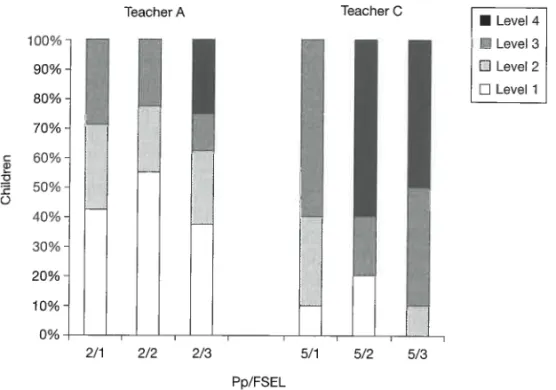
distributed in terms of social class leveis. Figure 6. 1 shows the results of the
analysis. The percentages on the vertical dimension refer to the distribution
of children, by social group and achievement levei.
The data show that teacher C, with pedagogic practice nearer to the
characteristics shown to be favourable to children's achievement, achieves
the best results: the percentage of children with low achievement (2 or less)
is lower than 50 per cent for any social group. Teacher A, whose pedagogic
practice is furthest away from the characteristics favourable to children's
achievement, hás more than 50 per cent of children in ali social groups
showing low achievement. Indeed, a high percentage of teacher A's children
in ali social groups show very low achievement (levei l) and levei 4 is achieved
only by socially advantaged children (FSEL 3). In contrast, the percentage of
teacher C's children with very low achievement is very small and the highest
achievement is not restricted to socially advantaged children. These results
support the conclusions of our earlier studies which show that pedagogic
s
100%-i 90% -| 80% -| 70% -i 60%-l 50% -| 40% -| 30% -| 20% -| 10%-|
0%-Teacher A
Sociological analysis and intervention 83
Teacher C
. Levei 4
_ Levei 3
D Levei 2
d Levei 1
2/1 2/2 2/3 5/1 5/2 5/3
Pp/FSEL
Figure 6. 1 Interaction between pedagogic practice, family socio-economic levei and
achievement in sciences - second stage of research
practice can overcome the effect of children's social background (e.g.
Pontinhas et al. 1995; Morais and Miranda 1996; Morais et al. 1992a, 1993,
2000).
The influence ofdifferent characteristics ofpedagogic practice on scientific development
To provide a more comprehensive and detailed picture of the relative impor-tance of each of the various characteristics of pedagogic practice and their
interplay for effective learning, we undertook a stepwise regression analysis
to estimate the contribution of each characteristic of pedagogic practice for
children's success in complex cognitive competences. The results showed that differences in scientific achievement were explained mainly by the what of the pedagogic practice, explaining 25. 8 per cent of the variation of children's results after delivery of the first unit and 24 per cent after the second. When only the how oí pedagogic practice was considered, by analysing each of the sociological characteristics which defined its instructional context,
intra-disciplinary relations and evaluation criteria emerged as those with higher
explanation value of children's results after the first unit, together explaining
84 Ana M.orais, Isabel Neves and Delmina Pires
When we analysed the relation between the sociological characteristics
whïch define the regulative context of pedagogic practice and children's
rcsuÍts in complex cognitive competences, regression analysis mdicated the
reÏatïon"between teacííers' and children's space and child-child hierarchical
rales as those with highest influence on achievement after the first unit,
together explaining 2374 per cent of the variance (20. 1 per cent and 3 3 per
ce^,~respectively). "After the second unit, teachers'-children's space relation
emergedr
again as the characteristic of the regulative context with greatestinÏuïnce on children's achievement, explaining 24 per cent of the variance.
These results support the idea that an important condition of children's
success in complex cognitive competences is the scientific competence of
teachers: their knowledge proficiency and command of the investigative
competences to be developed. However, this what is a necessary but not a
sufficient condition. The explicating of evaluation criteria (strong framing
oTthis'discursive rule) and the blurrmg of boundaries between teachers' and
chiïdren's spaces (weak classification) are further crucial conditions for
chil-dren:s~success. Statistically, the blurring of boundaries between knowledges
of a discipline (weak classification^ofintra-disciplmaryrelations) and the
existence of open and intense communication between various children (weak
framing of child-child hierarchical rales) were also important.
-This"statistical analysis complements the results of the earlier ones,
revealing which practices contributed most to differential scientific
achieve-mentamong children. When there is a poor pedagogic practice at the levei
oïthe~wha7&náit is characterized, at the levei of the fcow, by weak framing
of evaluation criteria, strong classification of teacher and child spaces and of
intra-dïsciplinary relations and strong framing of child^-child hierarchical
rules, thereisa low levei of scientific learning and high differential
achieve-ment among children. In contrast, when there is good pedagogic practice
atthe levei of the what and it is characterized at the levei of the how by strong
framing of evaluation criteria, weak classification between teacher andchild
space and intra-disciplinary relations and a weak framing of child-child
hier-archicaÏruÍes, there is a high levei of scientific learning and low differential
achievement among children.
The characteristics of the pedagogic practice highlighted by this analysis
must be seen in the context of the results obtained by the whole group
of teachers who were part of the study. Some of the characteristics showed
teachers to be similar or having little difference between them, as in the case
ofpacing, só that it is understandable why they did not come out as
explain-ing differential results. However, it must be borne in mind that simi arity
between some teachers in the present study was engendered partly, at least,
by the training they received in the course of the action-research process. This
suggests the importance of developing further research involving teachers
whose pedagogic practices are more markedly distinct in terms of those
characteristics(see Afonso 2002; Neves, Morais and Afonso, Chapter 12,
this volume).
Sociological analysis ana intervention 85
Interplay between various characteristícs ofpedagogic practice and the relation between children's achievement and practíce
The statistical results of previous analyses indicate that there is a relation between pedagogia practice and children's differential achievement and that some characteristics are more important in that relation. But what is the
extent to which the interplay of the various characteristics of the practice explains the relations suggested by the results? We must look at the interplay
between the characteristics which emerged as fundamental factors for
children's differentiated achievement in order to understand the reason why
they perform a crucial role in the pedagogic practice as a whole. We should also look at the interplay between those characteristics and other charac-teristics of the pedagogic practice in order to obtain a more comprehensive
picture about the relation between practice and achievement.
If explicating the evaluation criteria (strong framing) is a crucial condition for efficient scientific learning, that explicating will be more successful when
communication relations between subjects in interaction are more open.
In order for the text that children are expected to produce to be explicit, it should be constructed (with the teacher's support) by children in interaction with other children. This requires a weak framing of hierarchical rales só
that children can intervene in discussions and só that ali children feel their
opinions are valued. Moreover, the classification between teacher's and
children's spaces should be weak só that there are open teacher-children communication relations. Furthermore, making the text explicit to children represents a high levei of scientific conceptualization. A condition for success
at the levei of cognitive competences, it requires a blurring of boundaries
between the various subjects of the discipline. This requires a weak
classi-fication at the levei of intra-disciplinary relations, an aspect that previous
analyses showed to be an important condition for that success. On the other
hand, if a crucial condition for efficient learning is high scientific competence
on the part of teachers, the explicating of evaluation criteria will lead to efficient learning only when that competence exists.
We are encouraged to believe that effecting ali these aspects of peda-gogic practice requires weak framing of pacing if time restrictions are not
to preveni the whole process. For text to be acquired by children to be made
explicit, in detail and with rigour, and articulation of distinct knowledges of a discipline to be systematically achieved, and frequent open
commu-nication between teacher and children and among children themselves
to occur, time is needed. However, contrary to what is believed, it is pos-sible to weaken the framing of pacing without significantly increasing the amount of time school hás to offer to children. If efficient intra-disciplinary relations require time, they may, in turn, increase time for learning. When returning systematically to scientific knowledge already explored in order to relate it to new content to be learned, teachers increase learning time for the
86 Ana Morais, Isabel Neves and Delmina Pires
Detailed analysis of the pedagogic practice of teachers A and C shows that they differed in terms of evaluation criteria (teacher A with weak and teacher
C with strong framing), child-child hierarchical rules (framed more weakly for teacher C than for teacher A) and the relation between teacher and
child spaces (teacher A with strong and teacher C with weak classifica-tion). Teacher A also had very strong classi£cation at the levei of children's power relations, stronger classification of academic-non-academic relations
and strong framing of the teacher-children hierarchical rules. Teacher C had very weak classification at the levei of children's power relations, rela-tively weaker classification at the levei of academic-non-academic relations and very weak framing of teacher-children hierarchical rules. Pacing
and children's space were framed and classified more weakly for teacher C
than for teacher A. These differences could also account for differences
in their children's achievement. They also lead us to contend that learning time cannot itself be a sufficient reason to explain children's differential achievement. For example, the lesser attention given by teacher A than by teacher C to the relation between academic and non-academic knowledge
and to teacher-children communication may be seen in terms of differences
in learning time. However, since framing of pacing for teacher A is also weak,
it is not the most relevant difference between their practices: it is possible to think that teacher A did not use the time to put into practice that which ostensibly distinguished her from teacher C. This illustrates the complexity
of the relations between the various characteristics which define a pedagogic practice and help us to understand how these relations may explain its
influence as a whole on school achievement.
Conclusion
The current and earlier studies reveal that the pedagogic practice which promotes a high levei of scientific development in primary schoolchildren is mixed, with: (l) weak boundaries between teachers' and children's spaces; (2) open communication relations between teacher-children and child-child; (3) explicit evaluation criteria; (4) weak pacing of learning; (5) strong intra-disciplinary relations; (6) high levei of conceptual demand; and (7) high
levei of investigative proficiency. Primary schoolchildren are able to develop scientific knowledge and investigative competences provided their teachers possess sound scientific and pedagogic competences. As in Morais et al.
(1993), Morais et al. (2000), and Morais and Neves (2001), we show that pedagogia practice can overcome students' social background, even in
developing complex cognitive competences, where the disadvantaged tend to show greater difficulty. This implies that there is no need to lower the levei
of conceptual demand in arder for ali children to succeed at school. Raising the levei of conceptual demand is, indeed, a crucial step in order that ali may have access to a higher levei of scientific literacy valued both by the scientific community and society at large.
Sociological analysis and intervention 87
A pedagogic practice which makes possible attainment of a good levei of
school science success, even when the levei of conceptual demand is raised,
creates conditions for working in the zone of proximal development of given
groups of children, exploring ali their potential leveis of development, as
suggested by Vygotsky when he said that 'pedagogy should be directed not
to the yesterday but to the tomorrow of child's development' (Davydov 1995:
18). Vygotsky contends that learning precedes development, 'that an
ade-quately organised instruction leads to mental development' (Wertsch 1991:
72) só that good learning goes beyond actual development; if it does not it
is not learning. The levei of conceptual demand we provide for children
should be somewhat higher than what their actual development suggests they
are able to achieve. Learning is a complex social process in which knowledge
is socially constructed in interaction with others; that social,
inter-psychological processes precede subject, intra-inter-psychological processes will
be of extreme relevance to the characteristics of the social context which define a given pedagogic practice.
The primary condition for children's success in complex cognitive
competences is the scientific competence of teachers. Making evaluation
criteria explicit and arranging weakly classified teacher-child space are also
crucial, while the blurring of boundaries between distinct scientific content,
with open and intense communicatíon between children, ali of whose
opinions are equally valued, is important. Marked weakening of pacing,
blurring of boundaries between children's spaces, an open relation of
communication between teacher and children and between academic and
non-academic knowledge also characterized the arrangements ofthe teacher
whose pedagogic practice was closest to our theoretical profile and whose
children were relatively the most successful. Bernstein's and Vygotsky's ideas
clearly give meaning to these linkages, synthesized in Figure 6.2.
Once more we underline that although teachers' scientific competence is
a necessary condition for learning, it is not sufficient. The other characteristics
presented in the diagram are also fundamental to the success of ali children;
their interplay in the creation of a learning context favourable to ali children
permits understanding of the extent to which their mutual interdependence
explains children's school performances.
This study is able to explain with greater rigour why pedagogic practice
plays só important a role in children's levei of scientific development and
the meaning of the interdependence of its various characteristics.
Ana Morais, Isabel Neves and Delmina Pires High
Scientific knowledge
Explicit
evaluation
criteria
Open
communication
relations
Scientific development Knowledge and
competences
Weak
boundaries between
classroom
spaces
Strong
academia/
non-academic
relations
Strong intra-disciplinary
relations
High
Investigative competencies
Interrelations between the characteristics of the pedagogic practice and
scientific development
Acknowledgements
We acknowledge the financiai support of the Gulbenkian Foundation and the Institute for Educational Innovation for the project of which this study is part.
Notes
l Teachers' levei of conceptual demand is related to the nature of the cognitive
competences to be developed by children. When there is a low levei of conceptual demand, these competences involve a low levei of abstraction (memorization aad understanding at a simple levei); when there is a high levei of conceptual demand, the competences involve a high levei of abstraction (understanding at a high levei,
application, synthesis and evaluation).
2 Áccording to Vygotsky (1978: 86), the zone of proximal development 'is the distance between the actual development levei as determined by independent
problem solving and the levei of potential development as determined through
Sociological analysis and intervention 89
problem solving under adult guidance or in collaboration with more capable
peers'.
3 The FSEL was obtained from a composite index based on fathers' and mothers'
occupations and academic qualifications, each scoring 1-6. Their sum was then
converted to a percentage and this percentage was scaled (l: ^ 58 per cent; 2: 59-83 per cent; 3: 84-100 per cent).
4 Social class should be understood here as a nominal concept.
5 Instructional context: selection, sequence, pacing, evaluation criteria, intra-disciplinary relatioas, inter-disdplinary relations, relarions between academic and non-academic knowledges. Regulative context: hierarchical rules
children, power relations child-child, hierarchical rales child-child,
teacher-children spaces, teacher-children's spaces.
6 For example, according to the theoretical profile, pacing would be characterized by very weak framing (F--) and the evaluation criteria by a very strong framing
(F++). In the case of pacing, the value 4 was given to pedagogic practice F--, 3 to
practice F-, 2 to practice F+ and l to practice F++. On the contrary, ia the case of the evaluation criteria, the value 4 was given to pedagogic practice F++, 3 to practice F+, 2 to practice F~ and l to practice F--.
7 Children's scientific learning was also measured (Pires 2001) in relation to their possession of recognition and realization rules regarding knowledge and competence. This analysis will be the object of a further study.
8 An example of a question to measure the development of complex cognitive competences and of two answers given by children was:
Questíon: You have probably seen that when we stir the wood in a fireplace we rekindle the embers. Explain this.
ChildA: This happens because when the embers are stirred the ashes are taken
away lettiag oxygen in, which is the air component responsible for making the materiais burn, light up.
Child B: Because the embers which were beneath went up when we stirred them, and they could again consume the oxygen which is in the room. 9 Morais et al. (2000) also contains studies carried out by Afonso, Câmara, Morais,
Neves and Pires focusing on family contexts.
References
Afonso, M. (2002) 'Os professores e a educação científica no primeiro ciclo do
ensino básico: Desenvolvimento de processos de formação', Doctoral thesis, School of Science, University of Lisbon (unpublished).
Bernstein, B. (1990) Class, Codes and Contrai, Vol. IV: The Structuring of Pedagogic Discourse, London: Routledge.
Bernstein, B. (2000) Pedagogy, Symbolic Control and Identity: Theory, Research, Critique (rev. edn), London: Rowman & Littlefield.
Davydov, V. (1995)'The influence of L.S. Vygotsky on education, theory, research and practice', Educational Researcher, 24(3): 12-21.
Domingos, A. M. (now Morais) (1989a) 'Influence of the social context of the
school on the teacher's pedagogic practice', British Journal of Sociology of
Education, 10(3): 351-66.
Domingos, A. M. (now Morais) (1989b) 'Conceptual demand of science courses and social class', in P. Adey (ed. ) Adolescent Development and Social Science, London:
90 Ana Morais, Isabel Neves and Delmina Pires
Pontinhas, F., Morais, A.M. and Neves, I.P. (1995) 'Students' coding orientation
and school socialising context in their relation with students' scientific
achieve-ment', Journal of Research in Science Teaching, 32(5): 445-62.
Miranda, C. and Morais, A. M. (1994) 'O contexto social na relação entre a exigência
conceptual dos professores e o desenvolvimento científico dos alunos', Aprender,
17:55-70.
Morais, A.M. and Miranda, C. (1996) 'Understanding teachers' evaluation criteria: a condition for success in science classes', Journal of Research in Science
Teaching, 33(6): 601-24.
Morais, A.M., Neves, I.P. et al. (2000) Estudos para uma sociologia da
aprendiza-gem, Lisbon: Insdtute for Educational Innovation and Centre for Educadonal
Research of FCUL.
Morais, A.M. and Neves, I.P. (2001) 'Pedagogic social contexts: studies for a
soci-ology of learning', in A. Morais, I.P. Neves, B. Davies and H. Daniels (eds)
Towards a Sociology of Pedagogy: The Contribution of Basil Bernstein to Research, New York: Peter Lang.
Morais, A.M., Pontinhas, F. and Neves, I.P. (1992a) 'Recognition and realization rules in acquiring school science: the contribution of pedagogy aad social back-ground of students', British Journal of Sociology of Education, 13(2): 247-70. Morais, A. M., Peneda, D., Neves, I.P. and Cardoso, L. (1992b) Socialização
primária e prática pedagógica: ~Vol. l, Lisbon: Gulbenkian Foundation.
Morais, A.M., Neves, I.P., Medeiros, A., Peneda, D., Fontinhas, F. and Antunes, H. (1993) Socialização primária e prática pedagógica: Vo/. 2, Análise de
apren-dizagens na família e na escola, Lisbon: Gulbenkian Foundation.
Neves, I.P. and Morais, A.M. (2004) 'Pedagogic practices in the family socialising
context and children's school achievement', British Journal of Sociology of Education (submitted for publication).
Neves, I.P., Morais, A. M. and Afonso, M. (2004) Teacher training contexts: study of specific sociological characteristics', in J. Muller, B. Davies and A.M. Morais (eds) Thinking with Bernstein, Working with Bernstein, London: Routledge. Pires, D. (2001) 'Práticas pedagógicas inovadoras em educação científica: Estudo no
primeiro ciclo do ensino básico', Doctoral thesis, School of Science, University of
Lisbon (unpublished).
Vygotsky, L. (1978) Aíwá m Society: The Development o f Higher Psychological Processes, edited by M. Cole, V. John-Steiner, S. Scribner and E. Souberman,
Cambridge, MA: Harvard University Press.
Vygotsky, L. (1992) Educational Psychology, Winter Park, FL: PMD Publications. Wertsch, J.V. (1991) \oices o f th e Mind: A Socio-cultural Approach to M.ediated