2018
UNIVERSIDADE DE LISBOA
FACULDADE DE CIÊNCIAS
Evaluation of thermal stress in tropical marine organisms in the
context of climate warming
Doutoramento em Biologia
Especialidade em Biologia Marinha e Aquacultura
Sara Carolina Gusmão Coito Madeira
Tese orientada por:
Doutora Catarina Vinagre
Professor Doutor Mário Diniz
Professor Doutor Henrique Cabral
2018
UNIVERSIDADE DE LISBOA
FACULDADE DE CIÊNCIAS
Evaluation of thermal stress in tropical marine organisms in the
context of climate warming
Doutoramento em Biologia
Especialidade em Biologia Marinha e Aquacultura
Sara Carolina Gusmão Coito Madeira
Tese orientada por:
Doutora Catarina Vinagre
Professor Doutor Mário Diniz
Professor Doutor Henrique Cabral
2018
UNIVERSIDADE DE LISBOA
FACULDADE DE CIÊNCIAS
Evaluation of thermal stress in tropical marine organisms in the
context of climate warming
Doutoramento em Biologia
Especialidade em Biologia Marinha e Aquacultura
Sara Carolina Gusmão Coito Madeira
Tese orientada por:
Doutora Catarina Vinagre
Professor Doutor Mário Diniz
Professor Doutor Henrique Cabral
Júri:Presidente:
● Doutora Maria Manuela Gomes Coelho de Noronha Trancoso, Professora Catedrática e Membro do Conselho Científico, Faculdade de Ciências da Universidade de Lisboa
Vogais:
● Doutor Luís Miguel dos Santos Russo Vieira, Investigador Auxiliar, Centro Interdisciplinar de Investigação Marinha e Ambiental (CIIMAR) da Universidade do Porto
● Doutora Maria Helena Ferrão Ribeiro da Costa, Professora Catedrática, Faculdade de Ciências e Tecnologia da Universidade Nova de Lisboa
● Doutora Ana Margarida da Silva Faria, Investigadora, Centro de Ciências do Mar e do Ambiente (MARE) no ISPA – Instituto Universitário de Ciências Psicológicas, Sociais e da Vida
● Doutor José Pavão Mendes de Paula, Professor Associado com Agregação, Faculdade de Ciências da Universidade de Lisboa
● Doutora Catarina Maria Batista Vinagre, Investigadora FCT “nível inicial”, equiparação a Investigador Auxiliar da carreira de investigação científica, Faculdade de Ciências da Universidade de Lisboa
Documento especialmente elaborado para a obtenção do grau de doutor Fundação para a Ciência e Tecnologia (FCT)
i This study was funded by Fundação para a Ciência e Tecnologia, through a PhD scholarship SFRH/BD/92975/2013 and the research project WarmingWebs (PTDC/MAR-EST/2141/2012). Additional funding was provided by the strategic projects UID/MAR/04292/2013 granted to MARE and UID/Multi/04378/2013 granted to UCIBIO.
iii Nota prévia
A presente tese apresenta artigos científicos já publicados ou submetidos para publicação (capítulos 2 a 8), de acordo com o previsto no n˚2 do artigo 25˚ do Regulamento de Estudos de Pós Graduação da Universidade de Lisboa, publicado em Diário da República 2ª série – N˚57 – 23 de Março de 2015. Uma vez que estes trabalhos foram realizados em colaboração, a candidata esclarece que participou integralmente na concepção dos trabalhos, obtenção de dados, análise e discussão dos resultados, bem como na redacção dos manuscritos.
Lisboa, Março de 2018 Carolina Madeira
v
“I like the scientific spirit — the holding off, the being sure but not too sure, the willingness to surrender ideas when the evidence is against them: this is ultimately fine — it always keeps the way beyond open — always gives life, thought, affection, the whole man, a chance to try over again after a mistake — after a wrong guess.”
Walt Whitman Walt Whitman's Camden Conversations
vii
Acknowledgements
Someone once said “many times a day I realize how much my own outer and inner life is built
upon the labors of my fellow people, both living and dead, both known and unknown and how I earnestly must exert myself in order to give in return as much as I have received”. I believe
these words fully express the extent of my gratitude towards all the people that walked with me through the PhD journey, guiding, advising and supporting me in the ups and downs. If nothing else, this PhD pursuit has taught me that we are here for the sake of each other, human beings connected with the purpose of helping each other grow, and, in that way – helping us all evolve as a species. I will try - hoping words will not fail me, to express how thankful I am to each and everyone that made this work possible.
Firstly, I thank Fundação para a Ciência e Tecnologia for giving me a PhD grant that made my dream of pursuing a career in Science come true.
Then, I would like to thank my wonderful supervisors: Catarina Vinagre, Mário Diniz and
Henrique Cabral. Your vision, hard work and ethics in science have been an inspiration to me
and I’ll always admire you. You have given me all the tools I needed to accomplish this academic achievement, but, in fact, you have given me more: your time, your patience, your knowledge and life experience and your friendship. You have given me a piece of yourselves, of your lives, and for that, I cherish you. You helped me to be confident and believe in myself, knowing I had “all it takes” to get the job done. With the trust and freedom you gave me, I grew to be an autonomous researcher, yet unafraid to ask for help and guidance when I need it. That is something I will always be thankful for.
Catarina, I am so grateful you proposed me this PhD, allowing me to follow my passion for
tropical marine ecology. This PhD brought me amazing opportunities, not only to work with charismatic species, but also to travel to some incredible places during fieldwork and just feel amazed every day I stepped outside and into some beautiful tropical beach! You made me reach my life goal of living in shorts and flip-flops (and we both know I am a warm-adapted organism)!! Check √ You were tireless in your efforts to provide me with everything I needed. I am proud to have been your apprentice, and your perseverance in the difficult academia world has taught me immensely.
Mário, you were a solid pillar during my lab work. Your guidance allowed me to refine my
viii
scientific discussions. You taught me almost everything I know about biochemistry and metabolism. You are one of the most understanding and patient scientists I’ve ever met, and I knew I could always count on your wise words when the lack of motivation sometimes kicked in. I am also very thankful that you always encouraged me to go to scientific meetings and presentations, providing me with financial resources to do it. I can’t thank you enough for everything you did for me, since whenever something went wrong during work you were the first one to come up with all kinds of solutions to help me. You were always available and present during these 4 years.
Prof. Henrique, we first met probably a decade ago (already?!) when I was doing my bachelor
in Marine Biology at FCUL. Since then I’ve always considered you one of my main and most impressive references in the marine scientific community. I’ve always looked up to you and I’ve always felt inspired not only by your academic and professional achievements, but also because you always had a kind word of encouragement to your students. So, having you as my supervisor is more than what I could’ve asked for! Your care and interest in helping me to get through the different stages of my PhD (from the doctoral program to practical work, to article writing and thesis writing) have been essential to smooth the path. Your advice during statistical analyses was essential for the progress of this work. I am deeply grateful for always making yourself available for meetings and scientific discussions. I cannot emphasize enough how much I have learned from you during my entire professional life. Thank you.
I also thank Guca Flores for the collaboration with Cebimar. You provided everything that was needed for fieldwork and experiments in Brazil and I can’t thank you enough for that, it absolutely saved my work at a time when things were going wrong. It was amazing to meet you and everyone at Cebimar! Thank you for a wonderful experience and for your valuable inputs and suggestions to my work.
My colleague Miguel Costa Leal, who always challenged, helped and encouraged me even at a distance. I thank you for always thinking of me when you have new ideas – I always know something productive will come out of our chats and meetings (usually one or several scientific papers in pretty good IF peer-reviewed journals)!! You gave me the incredible opportunity of having an internship at Eawag, where I learned new methods and lab techniques, which very much enriched my PhD work. I thank you for everything you taught me about statistical analyses and scientific writing, and just general biology and ecology from our scientific discussions!
ix
I thank Alexandra Elbakyan and the Sci-Hub team for their revolutionary project of making all scientific articles available to the public. Your project is serving the best interests of society and it should be recognized as such. You saved me on so many occasions. I don’t even know you in person, but I can honestly say you made an incredible contribution to the work of this thesis.
I would now like to thank my awesome colleagues from ECCOWEBS research group (MARE – FCUL): Vanessa Mendonça, Rui Cereja, Marta Dias, Sheila Alexandre and Pedro
Fernandes. You were amazing friends and we had so many joyful moments together! I keep
you all very close to my heart! Oh the fun and laughter during field trips, the same sense of wonder for nature and ecology, all the snorkeling and swimming together, the running away from crazy octopuses and jellyfish, the whining about how tiring it is to write half a dozen scientific articles in a row, all the lunches and dinners shared…it doesn’t matter what the occasion was, you guys were always there for me! You keep challenging me intellectually with all our scientific discussions, and I know I can always count on you, professionally or otherwise!! Thank you for being incredible people, I am so lucky you crossed my path!
My dear and cherished colleagues from FCT-UNL: Pedro Costa, Ana Patrícia, Carla
Martins, Marta Martins, Cátia Gonçalves, Nagore Cuevas, Joana Antunes, Ana Luísa Maulvault, Eduardo Araújo and Susana Jorge. You absolutely made my days at FCT! Your
companionship, understanding, friendship and scientific knowledge have helped me grow immensely. Our shared moments in the lab, at the office or during lunch times were absolutely essential to keep my mental sanity during the 4 years of PhD. Without you, this journey would have been so much poorer. You made me laugh and supported me throughout the loneliest moments! You brought me in and made me feel like family. Besides, your enthusiasm in doing outdoor activities together really gave me a sense of team building and bonding!! I thank you all so much for everything, I will never forget all these moments!!
My beloved college friends Catarina Casadinho, Lia Laporta, Tiago Veríssimo, Diogo
Stilwell and Rita Borba. You always make me laugh! I love that we all trust each other to share
our craziest and most creative scientific/professional ideas! You remind me of who I am and why I became a biologist in the first place! Thanks for all the insightful scientific discussions and for the incredible companions you have been along the past decade.
My friends David Avelar and Pedro Garrett from FCUL, with whom I shared so many lunch picnics at the faculty’s gardens, talking about science, family, life, research, work, human relations and everything in between! You have taught me so much about finding balance in life,
x
about personal growth and development and about being present and just enjoying the here and now. You have my admiration and gratitude.
My friends Yara Gutkin, Vanessa Leal, Sónia Sarmento and my cousin Vera Carmo, you girls were my solid rocks during these years! My conversations with you gave me such peace of mind and serenity! I am deeply thankful to you sisters!
My life-long friends from 9B - João Abreu, Rui Araújo, João Coelho, Rui Teixeira, Rita
Prata and Catarina Martinho, for all the support and friendship, and for giving my brain a rest
from science! You were essential to help me get through these years of hard work.
I thank Miguel Santos and Luis Dias for challenging me intellectually, by asking difficult scientific and spiritual questions. You helped me improve my cognitive competence by testing my argumentative skills! I am grateful that you opened my mind to new horizons. You also opened my heart and taught me so much about love, emotions, relationships and myself. You made me stronger and more confident in the person I am. You encouraged me to trust in myself and take better care of every aspect of my being. I will be eternally grateful for that.
I thank all of my family: grandparents, parents, sister, cousins, uncles and aunts! You raised me up to become a better person each and every day of my life. You showed me by example what the important things are in life. You were tireless in your understanding, love and support. It’s impossible to say in a few sentences how much you mean to me. Mom and Dad thank you for all the sacrifices you made to make me happy. You always believed in me and encouraged me to follow my dreams, motivating me in my endeavors. You listened to me in all moments: happy, boring, complaining, excited, annoyed, etc! Thank you for your love, patience and words of advice. Finally, my twin sister – I have absolutely no idea what I would do with my life or who I’d be without you. You are my twin sister and my twin soul. You are my all: my inspiration, my dearest friend, my teacher, my strength, my higher love. You and I discovered Nature together, we explored the outdoors together, we shared our love for Science and the Ocean together and we travelled through the wonders of marine biology together. You alone have probably taught me more about everything than anyone else I’ve know. Thank you for always showing me there is a way. Thank you for this lifetime of sharing together.
xiii
TABLE OF CONTENTS
Acknowledgements………... vii ABSTRACT………... xxi RESUMO………... xxiiiList of symbols and abbreviations... xxvii
Chapter 1. General Introduction………. 1
1.1. Global change and human impacts in the world’s oceans... 3
1.2. Warming in tropical oceans: today and tomorrow………..………...….….. 5
1.3. Impacts and mechanisms of tolerance and adaptation to temperature change in marine organisms……...………..………… 8
1.4. General evaluation of stress and performance in tropical marine organisms under ocean warming………….……… 14
1.5. Main aims of the thesis………..……… 22
1.6. Thesis outline……….………... 23
References……… 25
Chapter 2. Thermal acclimation in clownfish: an integrated biomarker response and multi-tissue experimental approach……… 37
Abstract……….………... 39
Graphical abstract………..…... 40
Highlights………….……… 40
2.1. Introduction……….……….. 41
2.2. Materials and methods……….………. 43
2.2.1. Test organism and acclimation procedure…...……… 43
2.2.2. Experimental design and sampling……..………. 43
2.2.3. Biochemical biomarkers and IBR………...………... 44
2.2.4. Data analysis……...……….. 45
2.3. Results………….……….. 45
2.3.1. Stress biomarkers activity……… 45
2.3.2. Integrated biomarkers response index (IBR)………...……… 47
2.3.3. Body condition and stress biomarker levels………. 54
2.4. Discussion……….……… 56
2.4.1. Patterns of biomarker levels under elevated temperature………...……. 56
2.4.2. Assessment of thermal stress in different organs………...………. 57
2.4.3. Influence of time of exposure in biomarker responses……...……… 58
2.4.4. Relation between body condition and stress responses……...……….. 60
xiv
Acknowledgements………. 62
References……… 63
Chapter 3. Comparing biomarker responses during thermal acclimation: a lethal vs non-lethal approach in a tropical reef clownfish………... 69
Abstract………….………... 71
Graphical abstract………..………... 72
Highlights……….……… 72
3.1. Introduction…….……….. 73
3.2. Materials and methods………….………. 75
3.2.1. Ethical statement…………...……… 75
3.2.2. Housing and husbandry of fish………...……… 75
3.2.3. Experimental design………...……….. 75
3.2.4. Biomarker analyses………...……... 77
3.2.5. Survival and mortality……….………. 78
3.2.6. Data analysis………...……….. 78
3.3. Results…….……….. 79
3.4. Discussion….……… 83
3.4.1. Stress levels under and ocean warming scenario………...……… 83
3.4.2. Lethal vs non-lethal approach………….…...……… 85
3.4.3. Survival under increased temperature………..………... 86
3.4.4. Study considerations and justification………...………... 87
3.5. Conclusions……….……….. 88
Acknowledgements……….………. 89
References……….………... 89
Chapter 4. Thermal stress and energy metabolism in two circumtropical decapods crustaceans: responses to acute temperature events………. 95
Abstract……….………... 97
Graphical abstract………..………... 98
Highlights……….……… 98
4.1. Introduction……….……….. 99
4.2. Materials and methods……….………. 100
4.2.1. Test organisms and acclimation procedure………. 101
4.2.2. Experimental design and sampling………..…………. 101
4.2.3. Biochemical markers……….... 102
4.2.4. Data analysis………... 105
xv
4.3.1. Thermal, oxidative and neurotoxic stress biomarkers………... 106
4.3.2. Integrated biomarker responses (IBR) index………... 109
4.3.3. Energy metabolism and performance……… 112
4.4. Discussion……….… 112
4.5. Conclusions……….……….. 115
Acknowledgements……….………. 115
References……….………... 116
Chapter 5. Thermal stress, thermal safety margins and acclimation capacity in tropical shallow waters – an experimental approach testing multiple end-points in two common fish………... 123
Abstract………….………... 125
Graphical abstract…………..………... 126
Highlights……….……… 126
5.1. Introduction………... 127
5.2. Materials and methods……….. 129
5.2.1. Ethical statement………... 129
5.2.2. Test species and assessment of their thermal environments………. 129
5.2.3. Specimen collection and acclimation procedure……… 130
5.2.4. Experimental design and rationale……… 120
5.2.5. Experimental outcomes……… 132
5.3. Data analysis………. 134
5.4. Results………... 135
5.4.1. Assessment of the species’ thermal environments during the juvenile phase…… 135
5.4.2. Thermal and oxidative stress biomarker analyses……….. 136
5.4.3. Thermal tolerance………. 141
5.4.4. Whole body analyses……… 142
5.5. Discussion………. 145
5.5.1. Stress biomarkers: combined influence of temperature and time of exposure….. 145
5.5.2. Species upper thermal limits, intraspecific variation and acclimation capacity.. 147
5.5.3. Whole organisms stress indicators……… 149
5.6. Conclusions………... 152
Acknowledgements……….. 152
References……… 153
Chapter 6. High thermal tolerance does not protect from chronic warming – a multiple end-point approach with a tropical gastropod 161 Abstract……… 163
xvi Graphical abstract………. 164 Highlights………. 164 6.1. Introduction………... 165
6.2. Materials and methods……….. 166
6.2.1. Ethical statement………... 166 6.2.2. Test species, specimen collection and acclimation procedure………. 167 6.2.3. Experimental design………. 167 6.2.4. Molecular biomarkers……….. 168 6.2.5. Thermal tolerance………. 169 6.2.6. Data analyses………. 170
6.3. Results………... 171
6.3.1. Environmental temperature variation………... 171 6.3.2. Sub-cellular stress assessment……… 172 6.3.3. Whole animal stress assessment………. 173
6.4. Discussion………. 174
Acknowledgements……….. 179 References……… 180 Chapter 7. Present and future invasion perspectives of an alien shrimp in South Atlantic coastal waters – an experimental assessment of functional biomarkers and
thermal tolerance……….. 187
Abstract……… 189
Graphical abstract………. 190 Highlights………. 190 7.1. Introduction………... 191
7.2. Materials and methods……….. 192
7.2.1. Ethical guidelines……….. 192 7.2.2. Animal collection and field temperature measurements……… 193 7.2.3. Experimental layout……….. 195 7.2.4. Laboratory analyses………. 198
7.3. Results………... 201
7.3.1. Characterization of rocky reefs’ thermal environments in original and newly colonized areas………. 201 7.3.2. Temperature effects on Lysmata lipkei………. 203
7.4. Discussion………. 207
7.5. Conclusions………... 210 Acknowledgements……….. 210
xvii References……… 211 Chapter 8. Environmental health assessment of warming coastal ecosystems in the tropics – application of an integrated biomarker response index……… 219
Abstract……… 221 Graphical abstract………. 222 Highlights………. 222 8.1. Introduction………... 223
8.2. Materials and methods……….. 225
8.2.1. Selected coastal environment and test species……… 225
8.2.2. Experimental design………. 227
8.2.3. Sampling scheme………... 228 8.2.4. Biomarker measurements……… 229
8.2.5. Data treatment and statistical analysis………. 233
8.3. Results………... 234
8.3.1. Multi-stress response categories IBR approach………. 234
8.3.2. Overall stress response IBR approach……….. 238 8.3.3. Biomarker scores as a fitness index……….. 240
8.4. Discussion………. 242
8.5. Conclusions………... 244 Acknowledgements……….. 246 References……… 246 Chapter 9. Final remarks and future perspectives……… 255 9.1. Final remarks………. 257 9.2. Future perspectives……… 262
ANNEXES………. 267
Annex 1: PhD outputs……….. 269
Annex 2: Supplementary material on biochemical methods used in chapters 2-8………... 275 Annex 3: Supplementary material for chapter 2……….. 281 Annex 4: Supplementary material for chapter 5……….. 291 Annex 5: Supplementry material for chapter 6……… 309 Annex 6: Supplementary material for chapter 7……… 315
xxi
ABSTRACT
The marine environment is already registering the impacts of climate change. The current increase in global temperature since pre-industrial times is disrupting life in the oceans, from the tropics to the poles. The key impacts for marine species as warming continues include shifting home ranges and altered life histories due to the direct effects of temperature on metabolism, life cycles and behaviour of organisms. These pervasive effects on species will also have a significant impact in the goods and services provided by the ocean to human society. However, the vulnerability of tropical marine species (e.g. reef fish and non-coral invertebrates) towards ocean warming is still far from clear, not only due to the gap of knowledge on general ecology and biology of most tropical species, but also because there is a lack of integrative approaches addressing physiological and molecular thermal compensation mechanisms, as well as a lack of adequate or optimized assessment tools for tropical habitats. Therefore, the aim of this thesis was to assess the vulnerability of marine species (fish, crustaceans and gastropods) from tropical reef environments to ocean warming (gradual temperature increase and heat waves), using molecular- (proteins and antioxidant enzymes), cellular (lipid peroxidation), tissue- (energy reserves), organism- (condition, critical thermal maxima) and sample population (acclimation rate, thermal safety margins, mortality) parameters to measure stress and performance.
General methodologies included collecting animals from tropical shallow waters with hand nets, experimental assays testing acute and chronic thermal stress and thermal tolerance in the lab (following control and warming scenarios), periodic samplings of several tissue types and biomarker quantification (sample homogenization and posterior immunoassays, kinetic colorimetric assays and elemental analyses by isotope ratio mass spectrometry). Mathematical calculations were used for several performance parameters as well as stress indices. Multivariate (as well as multifactorial) statistical analyses were then performed for all datasets.
Results revealed that chronically increased water temperatures (30˚C – 32˚C) elicited a time-dependent cellular stress response in all species tested, where chaperones and antioxidant enzymes showed the greatest fold-changes. The latter molecular responses were highly inducible in vital organs such as gills, liver and muscle, suggesting a relation to tissue function, metabolic- and oxygen diffusion rate which determine the flux of reactive oxygen species and damage potential in cells. Additionally, animals subjected to increased temperatures also showed poorer health status and decreased body condition with lower energy reserves when compared to control temperatures, although mortality levels remained unchanged. An acute exposure to increased thermal load revealed plastic upper thermal limits. However, thermal safety margins were generally low for shallow water species in reef environments, indicating a
xxii low ability to tolerate further future warming. This means that organisms will have to rely on subtidal habitats for thermal refugia as shallow water habitats (e.g. tide pools) become ecological traps where animals cannot escape heat. Overall, the results point to the importance of monitoring thermal change in the wild to provide decision makers with appropriate and detailed information to sustain conservation efforts in fragile tropical marine ecosystems.
Keywords: climate change, temperature, tropical marine organisms, physiology, environmental bio-monitoring
xxiii
RESUMO
O ambiente marinho está actualmente a sofrer transformações devido às alterações climáticas. O aumento da temperatura global que se tem verificado no último século está a alterar a vida nos oceanos, desde os trópicos até aos polos. Os impactos mais relevantes deste fenómeno vão desde alterações nos ecossistemas e biótopos, até alterações na composição e distribuição geográfica das espécies, com consequências para a biodiversidade local e regional. Tem-se observado ainda a alteração dos padrões de história vital dos organismos, devido aos efeitos directos da temperatura na sua biologia e ecologia. Tudo isto tem tido um efeito significativo a nível dos bens e serviços que o oceano providencia à sociedade humana, com perdas consideráveis a nível económico e socio-cultural. Desta forma, a protecção da biodiversidade irá deparar-se com grandes desafios nas próximas décadas, especialmente em zonas tropicais onde a susceptibilidade a fenómenos climáticos é maior, e as medidas de protecção são muitas vezes mais permissivas. Neste processo, é essencial que as medidas de protecção e adaptação climáticas incluam as reorientações ou correcções necessárias aos conceitos de conservação da Natureza e gestão das zonas costeiras já existentes.
Neste contexto, é necessária investigação fundamental para compreender a vulnerabilidade de espécies marinhas tropicais (e.g. peixes de recife e invertebrados não-coralíneos) ao aquecimento do oceano. Para além de haver uma lacuna de conhecimento relativa à biologia e ecologia da maioria das espécies tropicais, não existe uma abordagem integradora que inclua a análise dos mecanismos fisiológicos e moleculares de compensação térmica, assim como não foram testadas ou optimizadas as ferramentas para fazer este tipo de avaliação em ambientes tropicais. Esta tese de doutoramento teve como ponto de partida a necessidade de responder às seguintes questões: “Em que medida é que o aquecimento dos oceanos afecta os organismos marinhos tropicais ectotérmicos?”, e, “De que forma é que se poderá monitorizar estes efeitos da temperatura?”. Para estudar a vulnerabilidade/resiliência destes organismos ao aumento de temperatura, optou-se por fazer uma avaliação holística da biologia térmica de várias espécies (de vários grupos distintos, i.e. peixes, crustáceos e gastrópodes) de ambientes de recife tropical sujeitos ao aquecimento da água do mar (crónico e agudo), medindo o nível de stress e desempenho fisiológico dos animais sujeitos à variação deste factor ambiental. Em particular, esta tese focou-se nos efeitos da temperatura a nível molecular (proteínas e enzimas antioxidantes), celular (peroxidação lipídica das membranas celulares), tecidular (reservas energéticas), organísmico (condição corporal, limites térmicos máximos), e populacional da amostra (taxa de aclimatação, margens térmicas de segurança e mortalidade) revelando os mecanismos e a capacidade dos animais para resistir aos cenários de aquecimento global actuais e previstos para o final deste século. Foi utilizada uma abordagem multidisciplinar para atingir
xxiv os seguintes objectivos: (i) seleccionar, optimizar e validar uma série de biomarcadores para gerar uma perspectiva completa da fisiologia do stress em espécies marinhas tropicais; (ii) providenciar uma base de dados de parâmetros fisiológicos em condições óptimas para os grupos animais em estudo, para que, a partir daí se possa medir/quantificar os níveis de stress; (iii) avaliar a utilidade destes parâmetros fisiológicos na bio-monitorização da variação térmica em sistemas de recife tropical susceptíveis, como uma forma de diagnosticar a saúde do ecossistema, identificar eventos stressantes e desenhar planos preventivos para o futuro.
As metodologias gerais para atingir estes objetivos incluíram a colheita no campo de animais tropicais de águas pouco profundas com redes de mão, ensaios experimentais para testar stress agudo, crónico e valor térmico crítico (após exposição a cenários de controlo e de aquecimento da água do mar), amostragens periódicas de vários tipos de tecido, e quantificação de biomarcadores (homogeneização de amostras seguida de imunoensaios, ensaios cinéticos colorimétricos e análises de elementos através de espectometria de massa de rácio de isótopos). Foram também realizados vários cálculos matemáticos para analisar os indicadores de desempenho assim como para os índices de stress. Todos os conjuntos de dados gerados foram depois analisados estatisticamente, recorrendo a técnicas multivariadas e multifactoriais. Os trabalhos realizados foram desenvolvidos ao longo de vários capítulos, como é descrito em seguida.
A presente tese é então composta por nove capítulos: no primeiro capítulo é descrito o estado da arte sobre temas relacionados com as alterações climáticas em ecossistemas marinhos tropicais e conceitos de biologia térmica, assim como é referida a estrutura e os objetivos da presente tese. Nos capítulos 2-4 é analisada a biologia térmica de várias espécies criadas em cativeiro (com história térmica conhecida) sob condições de aumento de temperatura crónico e agudo (onda de calor), numa perspectiva fisiológica e metodológica. Nos capítulos 5-8, faz-se uma abordagem a animais do meio natural, que co-existem no mesmo tipo de habitat (recife rochoso tropical intertidal), e são analisados os efeitos de stress térmico crónico e agudo, agora num contexto ecológico. No capítulo 9 são apresentadas as conclusões da tese e perspectivas futuras.
Mais especificamente, no capítulo 2 - Aclimatação térmica em peixes palhaço: resposta integrada de biomarcadores através de uma abordagem experimental em vários órgãos - foi estudada a forma como as temperaturas previstas para o oceano futuro afectam a fisiologia (marcadores proteicos e enzimáticos medidos em vários tipos de tecido, e medição da condição corporal) de um peixe tropical com história térmica conhecida e variação genética mínima (devido à criação em aquacultura ornamental), para depois se conjugar as respostas num índice que permite a avaliação global da saúde dos organismos.
No capítulo 3 - Comparação da resposta de biomarcadores durante o processo de aclimatação térmica: uma abordagem letal vs não-letal em Amphiprion ocellaris (peixe palhaço)
xxv – efectuou-se um estudo de fisiologia comparativa na mesma espécie de peixe palhaço para testar a possibilidade de utilizar um método de amostragem não letal com resultados fiáveis na medição de parâmetros bioquímicos e moleculares de avaliação do stress.
No capítulo 4 - Stress térmico e metabolismo energético em crustáceos decápodes com distribuição tropical: efeitos de eventos agudos de aumento de temperatura - foram investigados os efeitos de uma simulação experimental de uma onda de calor na fisiologia (biomarcadores moleculares e metabolismo energético) de duas espécies de crustáceos com histórias térmicas conhecidas, utilizando um índice integrado de resposta ao stress e fazendo uma avaliação do estado geral de saúde dos organismos.
No capítulo 5 - Stress térmico, margem térmica de segurança e capacidade de aclimatação em águas tropicais pouco profundas – uma abordagem experimental multi-parâmetro em peixes comuns - foram analisados os efeitos de cenários de aumento de temperatura do oceano em duas espécies de peixes intertidais de um recife rochoso (testam-se biomarcadores moleculares, metabolismo energético, tolerância térmica, condição corporal, capacidade de aclimatação, mortalidade e margem de segurança térmica), e relacionam-se as diferenças interespecíficas com as suas histórias vitais e preferências de micro-habitat.
No capítulo 6 - Tolerância térmica elevada não garante protecção contra o aquecimento crónico da água do mar: uma abordagem multi-paramétrica com uma espécie de gastrópode tropical - foi investigada a biologia térmica (efeitos subletais, tolerância térmica e margem térmica de segurança) de uma espécie de gastrópode cosmopolita que habita em zonas de intertidal rochoso sujeitas a temperaturas elevadas, e testou-se um cenário experimental de aquecimento.
No capítulo 7 - Perspectiva presente e futura de expansão de uma espécie de camarão invasora na zona costeira do Atlântico Sul – uma avaliação experimental de biomarcadores funcionais e tolerância térmica - foram estudados vários cenários climáticos e as suas consequências na expansão geográfica de uma espécie de crustáceo invasor no oceano Atlântico tropical. Foi avaliada a influência que a fisiologia tem no sucesso da invasão, através da análise de parâmetros moleculares, celulares e corporais, assim como a taxa de resposta de aclimatação e a margem térmica de segurança), comparando os regimes de temperatura presentes vs previstos entre a sua distribuição geográfica original e os locais em que houve introdução da espécie.
Finalmente, no capítulo 8 – Avaliação do estado de saúde de ecossistemas costeiros tropicais em aquecimento – aplicação de um índice integrado de biomarcadores - foram explorados os padrões gerais fisiológicos que emergem entre diferentes grupos animais e espécies que vivem no mesmo tipo de habitat. Fez-se a integração das características fisiológicas de diferentes níveis de complexidade biológica para diagnosticar a saúde dos recifes
xxvi tropicais rochosos, e avaliou-se o risco ecológico do aumento de temperatura em espécies de águas pouco profundas.
No geral, os resultados dos vários tipos de análises complementares (moleculares, celulares, tecidulares e organísmicas) revelaram que o aumento gradual e crónico da temperatura (30˚C – 32˚C) induziu uma resposta celular de stress dependente do tempo de exposição, em todas as espécies animais testadas. A nível molecular observou-se que as proteínas da família das chaperonas e as enzimas antioxidantes foram as que demonstraram maiores alterações, especialmente em órgãos vitais como as brânquias, o fígado e o músculo. Isto sugere uma relação com a função de cada tipo de tecido, nomeadamente com a sua taxa metabólica e taxa de difusão de oxigénio – o que, por sua vez, determina o fluxo de espécies reactivas de oxigénio nas células e a dimensão dos danos às estruturas celulares. Adicionalmente, os animais que foram sujeitos a temperaturas elevadas demonstraram um estado geral menos saudável e com menor condição corporal e menos reservas energéticas, quando comparados com os animais do controlo. Ainda assim, os níveis de mortalidade mantiveram-se iguais em ambos os casos. Uma exposição aguda a uma maior carga térmica revelou que as espécies testadas possuem plasticidade nos seus limites térmicos máximos. Contudo, as margens térmicas de segurança (ou seja, a tolerância ao aquecimento) revelaram-se baixas para espécies de águas pouco profundas em ambientes de recife, o que indica uma baixa capacidade para suportar a continuação da elevação da temperatura da água. Nestas circunstâncias, os habitats de águas pouco profundas (e.g. intertidal e poças de maré) podem tornar-se armadilhas ecológicas, onde os animais não serão capazes de escapar ao calor. Isto permite prever que estes organismos irão migrar para habitats subtidais, onde as águas são mais frias, em busca de refúgio térmico. Numa visão global dos resultados, estes apontam para a importância da bio-monitorização da carga térmica no meio natural. A recolha de dados e informação detalhada será essencial para que os decisores dêem os passos necessários para aumentar os esforços de conservação da Natureza nos frágeis ecossistemas marinhos tropicais. Ao compreendermos os mecanismos por detrás das respostas dos organismos aos desafios térmicos, a nossa capacidade de previsão e gestão, assim como de avaliação de risco ambiental tornar-se-ão mais precisas face aos cenários de alterações climáticas para o final do século.
Palavras-chave: alterações climáticas, temperatura, organismos marinhos tropicais, fisiologia, bio-monitorização ambiental
xxvii List of symbols and abbreviations
Abs, absorbance
AChE, acetylcholinesterase ACTI, acetilthiocholine iodide
AMPK, adenosine monophosphate kinase ANOVA, analysis of variance
AOX, antioxidant
ARR, Acclimation Response Ratio
ARRIVE, Animal Research: Reporting in Vivo Experiments ATP, adenosine triphosphate
AVG, Aquário Vasco da Gama Avg, average
BSA, bovine serum albumin C:N, carbon:nitrogen CAT, catalase
CDNB, chloro-2,4-dinitrobenzene CEBIMar, Centro de Biologia Marinha
CEUA, Comissão de Ética na Utilização de Animais CI, confidence interval
CMIP, Coupled Intercomparison Project Phase CO2, carbon dioxide
CSR, cellular stress response CTMax, Critical Thermal Maximum CV, coefficient of variation
Da, Dalton
DCM, dichlorometane
DGAV, Direcção Geral de Veterinária DNA, deoxyribonucleic acid
DTNB, 5,5’-dithiobis-(2-nitrobenzoic acid) E, east
e.g., for example EC, enzyme commission
EDA, Experimental Design Assistant EDTA, ethylenediaminetetraacetic acid EFSA, European Food Safety Authority ELISA, Enzyme-linked immunosorbent assay ENSO, El-Niño Souther Oscillation
Eq, equation EU, European Union
xxviii
EWCE, extreme weather and climatic events ɛ, extinction coefficient
FCT, Fundação para a Ciência e Tecnologia
FELASA, Federation of European Laboratory Animal Science Associations Fig., figure
g, grams
GHG, greenhouse gas GLM, General Linear Models GSH, reduced glutathione GST, gultathione-S-transferase H+, hydrogen ion H2O, water H2O2, hydrogen peroxide HCl, hydrochloridric acid HO*, hydroxyl radical hr, hour HRP, Horseradish peroxidase HSC, Heat shock conjugate
Hsc70, Heat shock protein cognate 70 kDa HSD, Honest significant difference Hsp70, Heat shock protein 70 kDa Hsps, Heat shock proteins
IBR, integrated biomarker response IgG, immunoglobulin G
ind, individual
IPCC, Intergovernmental Panel on Climate Change
IUCN, International Union for Conservation of Nature and Natural Resources IWPWP, Indo-West Pacific Warm Pool
KCl, Potassium Chloride kDa, kilodalton Kg, kilograms KH2PO4, monopotassium phosphate Km, kilometre L, litre L:D, light:dark LC, lipid content LPO, lipid peroxidation Lt, total length
M, molar concentration
xxix
MARE, Marine and Environmental Sciences Centre MAX, maximum
MDA, malondialdehyde bis(dimethylacetal) MeOH, methanol
mg, milligrams
MHT, Maximum Habitat Temperature MIN, minimum
Min, minutes mL, mililitre mm, milimetres mM, milimolar Mt, total wet mass M-W, Mann-Whitney N, north
NA, not available or not-applicable Na2HPO4, disodium phosphate NaCl, sodium chloride
NADH, Nicotinamide adenine dinucleotide
NADPH, Nicotinamide adenine dinucleotide phosphate NaOH, sodium hydroxide
NASA, National Aeronautics and Space Administration NBT, nitroblue tetrazolium
NE, northeast
NMI, National Meteorology Institute nmol, nanomoles
NOAA, National Oceanic and Atmospheric Administration of USA NW, northwest
O2•, superoxide radical ˚C, degree Celsius
OCLTT, oxygen and capacity limited thermal tolerance
OECD, Organization for Economic Co-Operation & Development OH, hydroxide
OOH, oxide hydroxide p, p-value
PBS, phosphate buffered saline PC, principal component
PCA, principal component analysis PQC, protein quality control PUFAs, polyunsaturated fatty acids PVC, polyvinyl chloride
xxx
RCP, Representative Concentration Pathways RNA, ribonucleic acid
ROS, reactive oxygen species S, south
SD, standard deviation SDS, sodium dodecyl sulphate SE, southeast
SOD, superoxide dismutase
SRES, Special Report on Emission Scenarios SST, sea surface temperature
T0, 0 days of exposure T14, 14 days of exposure T21, 21 days of exposure T28, 28 days of exposure T7, 7 days of exposure TBA, thiobarbituric acid
TBARS, thiobarbituric acid reactive substances TCA, trichloroacetic acid
Tdays, timepoint in days Temp, Temperature TLE, total lipid extracts
TMB/E, 3,3’,5,5’-Tetramethylbenzidine for ELISA Tprotein, total protein
TSM, Thermal Safety Margin Ub, total ubiquitin
UCIBIO, Research Unit on Applied Molecular Biosciences USA, United States of America
USP, Universidade São Paulo UV, ultraviolet
W, Watt W, west
WHO, World Health Organization XOD, xanthine oxidase
χ2 , Chi-square %C, percentage of carbon ~, approximately ∆, variation ↑ increase or up-regulation ↓ decrease or down-regulation µg, micrograms
xxxi
µg, micrograms µL, microlitres µmol, micromoles
1
CHAPTER 1
General Introduction
3 1.1. Global change and human impacts in the world’s oceans
Global change is firmly established as a scientific reality, with a variety of challenges for humankind emerging today and in the coming decades. As the human population increases, so does our global footprint and most of the projected threats to biodiversity arising from human growth and consumption are expected to be severe (Rocha, 2017). Presently, there is no area in the world’s oceans unaffected by human influence and a significant fraction (41%) is affected by multiple pressures (Gattuso et al., 2015; Halpern et al., 2008), ranging from agriculture and industry, to fishing, aquaculture and tourism. Human activities (either land-based or ocean-based) have strongly impacted the oceans mainly by (i) altering runoff of pollutants and nutrients into coastal waters (Syvitski, 2005), (ii) removing, changing or destroying natural habitats (Jackson, 2008) and/or (iii) imposing the climate change ‘deadly trio’ – warming, ocean acidification and deoxygenation (Bijma et al., 2013; Nowicki et al., 2012). All of these anthropogenic drivers of ecological change can be observed both locally and regionally (Fig. 1.1), with strong spatial heterogeneity (Halpern et al., 2008; Ottersen et al., 2010).
Figure 1.1 Global map (A) of cumulative human impact across 20 ocean ecosystem types. (Insets) Highly
impacted regions in the Eastern Caribbean (B), the North Sea (C), and the Japanese waters (D) and one of the least impacted regions, in northern Australia and the Torres Strait (E). Ecosystem types include: hard and soft bottom shallow, shelf, slope and deep; coral reefs; mangroves; surface water; deep water;
4
seamounts; nearshore ecosystems with assumed distributions (rocky intertidal, beach, intertidal mud, suspension-feeding reefs, salt marshes, kelp forests). Human impacts include: direct human, benthic structures, commercial shipping, ocean-based pollution, species invasion, climate change (acidification, UV, warming), fishing (artisanal, pelagic and demersal), and pollution (inorganic, organic and nutrient input). Source: Halpern et al. 2008.
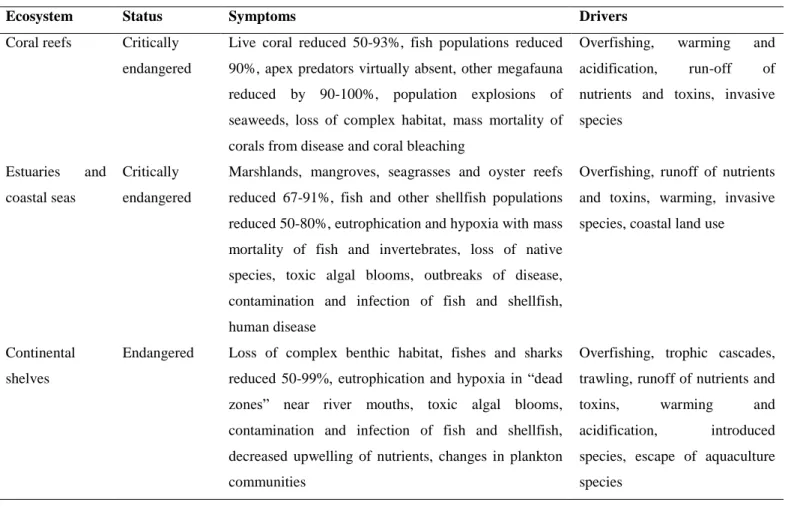
As expected, coastal areas, which have been focal points for human settlements and marine resource use in the past centuries, are the most impacted by the above mentioned anthropogenic drivers of environmental change. As coastal habitats are progressively altered, fragmented or loss, the likelihood of the occurrence of abrupt ecological shifts in these areas increases (Lotze et al., 2006; Montefalcone et al., 2011). Table 1.1 presents a summary of the magnitude of degradation and biodiversity loss in coastal ecosystems already occurring in the present.
Table 1.1 Status and trends of major coastal-associated ecosystems defined by principal symptoms and
drivers of degradation in the >99% of the global ocean that is unprotected from exploitation. Adapted from Jackson (2008).
Ecosystem Status Symptoms Drivers
Coral reefs Critically endangered
Live coral reduced 50-93%, fish populations reduced 90%, apex predators virtually absent, other megafauna reduced by 90-100%, population explosions of seaweeds, loss of complex habitat, mass mortality of corals from disease and coral bleaching
Overfishing, warming and acidification, run-off of nutrients and toxins, invasive species
Estuaries and coastal seas
Critically endangered
Marshlands, mangroves, seagrasses and oyster reefs reduced 67-91%, fish and other shellfish populations reduced 50-80%, eutrophication and hypoxia with mass mortality of fish and invertebrates, loss of native species, toxic algal blooms, outbreaks of disease, contamination and infection of fish and shellfish, human disease
Overfishing, runoff of nutrients and toxins, warming, invasive species, coastal land use
Continental shelves
Endangered Loss of complex benthic habitat, fishes and sharks reduced 50-99%, eutrophication and hypoxia in “dead zones” near river mouths, toxic algal blooms, contamination and infection of fish and shellfish, decreased upwelling of nutrients, changes in plankton communities
Overfishing, trophic cascades, trawling, runoff of nutrients and toxins, warming and acidification, introduced species, escape of aquaculture species
The combination of drivers depicted in Table 1.1 has, over time undermined these ecosystems’ ecological resilience (Hernández-Delgado, 2015; Jackson, 2008; Pandolfi, 2003),
5 as demonstrated by numerous fisheries collapses (Blaber, 2013, 2002; Perry, 2005) and historical losses of coral reefs, mangroves and wetlands (Gable et al., 1991; Loarie et al., 2009; Munday et al., 2009; Pandolfi, 2003). Predictions for the near and long-term health of marine ecosystems are therefore concerning, if the course of human action observed until today is to remain. Even in the best scenarios, with the creation of marine protected areas and strict regulations on pollution and fishing, along with significant reduction in greenhouse gas emissions, scientists have highlighted that the effects of yesterday’s and today’s actions will continue to be felt in the future. In particular, climate change stressors (warming, acidification and deoxygenation) and their nonlinear interactions will significantly shape ecological processes in the marine realm in the decades to come (Ottersen et al., 2010).
1.2. Warming in tropical oceans: today and tomorrow
Climate monitoring over the past century has shown that the Earth is warming (Hughes, 2000). The appearance of this risk factor is a consequence of the perturbation of the carbon cycle due to the anthropogenic release of carbon dioxide and/or methane in industrialization processes and consequent burning of fossil fuels, and is major cause of concern (Beaugrand et al., 2008; Ottersen et al., 2010; Todgham and Stillman, 2013). Recorded 20th century trends have shown that global mean surface air temperatures have increased 0.6˚C since the late 19th century and by 0.2˚C to 0.3˚C over the past 50 years (Hughes, 2000). This means that the average global temperature on Earth has increased by about 0.85˚C since 1880 (Hartmann et al., 2013; IPCC, 2014; NASA, 2017). This additional heat has been mostly absorbed by the oceans: estimates are that from the surface down to 700 m, ocean temperature has increased by 0.2˚C over the last decades (Noone et al., 2013). Moreover, climate models predict that the mean annual global surface temperature will further increase between 0.3˚C to 4.8˚C by 2100 (temperature range including all Intergovernmental Panel on Climate Change, IPCC, emission scenarios, Fig. 1.2) (Collins et al., 2013; IPCC, 2014).
6
Figure 1.2 Global mean temperature change averaged across all Coupled Intercomparison Project Phase
5 (CMIP5) IPCC models (relative to 1986-2005) for the four Representative Concentration Pathway (RCP) scenarios: low emissions (dark blue), intermediate emissions (light blue and orange) and high emissions (red). Likely ranges for global temperature change by the end of the 21st century are indicated by vertical bars. For the highest (red) and lowest (dark blue) greenhouse gas emission scenarios, illustrative maps of surface temperature change at the end of the 21st century (2081–2100 relative to 1986–2005) are shown. Source: Collins et al. 2013.
Tropical oceans in particular provide the major storage of heat for the global climate system and are also the source of most of the atmospheric water vapor, the single most important greenhouse gas (GHG) (Herbert et al., 2010). Due to these characteristics, tropical oceans can lead to large feedbacks that enhance the global expression of climate cycles both at seasonal, interannual, interdecadal, and long-term scales (Lin et al., 2011). Numerous studies have documented the importance of several modes of sea surface temperature (SST) variability in the Pacific, such as the El Niño-Southern Oscillation (ENSO) cycle and its relationship to convection both locally and extratropically (e.g. Glynn 1988; McPhaden et al. 1998; Chiang and Sobel 2002; Abram et al. 2009). Also, interannual SST variability in the Atlantic, associated with ENSO, the Atlantic dipole and equatorial warm events are all coupled with changes in the location of the intertropical convergence zone (Clayson and Weitlich, 2007). At all of these timescales, SSTs can affect rainfall and convection in the Indian Ocean (Clayson and Weitlich, 2007).
7 Tropical climate trends for the past century (Fig. 1.3) suggest that the largest warming trend has occurred in the eastern tropical Atlantic (1.2˚C - 1.6˚C), whereas the eastern tropical Pacific warmed approximately by 0.8˚C to 1.0˚C, similar in magnitude to the tropical Indian Ocean and the central tropical Atlantic (Deser et al., 2010). Therefore, regional and local variability need to be accounted for when estimating impacts for marine biota and ecosystems.
Figure 1.3 Twentieth century tropical and subtropical (20˚N to 20˚S) SST anomaly trend. Note: white
pixels denote insufficient data. Source: Deser et al. 2010.
Additionally, ocean isotherms in tropical areas have been fluctuating significantly, with areas of lower temperatures contracting and areas of higher temperature expanding (Arora et al., 2016). It has been observed that tropical ocean areas with SST below 25˚C change little, whereas in isotherms between 26˚C and 28˚C, the area change rate decreases with the increase in SST (Lin et al., 2011). On the contrary, the ocean areas between 29˚C and 30˚C in the global Pacific and Indian oceans have the largest increase rate and the global tropical oceans have a maximum area increase rate of 2.29 × 10⁶ km2.decade-1 (Lin et al., 2011). This means that not only ocean temperatures are gradually rising but also that the naturally warmest ocean areas are expanding rapidly, leading to a narrower range of tropical temperatures, which are being skewed further to the warmer edge of their range. Finally, predicted future temperature anomalies for tropical regions range from 0.9˚C - 3.3˚C across scenarios for late 21st century (2081-2100) (IPCC, 2013; IPCC, 2014), which means that thermal pressure over ecosystems will continue.
Changes in ocean heat content have direct physical and biogeochemical consequences, including thermal expansion, sea level rise, increased melt water, washed nutrients and sediments, and reduced salinity (Kharin et al., 2007; Knutson et al., 2010). Rising temperatures will also increase surface ocean stratification, which in turn will affect the surface-water light regime and nutrient input from deeper layers, and thus ocean productivity (Ackerman, 2013). Extreme events (Fig. 1.4) will significantly escalate in frequency and intensity: heat waves, cold spells, storms, La Niña and El Niño, droughts and heavy rain (Ceccherini et al., 2017; Chiang and Sobel, 2002; Di Lorenzo and Mantua, 2016; Kharin et al., 2007; Sura, 2011).
8
Figure 1.4 Predicted shifts in extreme events. Shifts in extreme events due to changes in
temperature distribution can occur in three ways a) shift of the entire distribution towards a warmer climate; b) increase in temperature variability with no shift in the mean and c) asymmetric distribution towards hot weather. Source: IPCC 2012.
All these changes in ocean temperatures and consequently in chemistry and currents mean that many organisms will find themselves in unsuitable environments, potentially testing their ability to survive.
1.3. Impacts and mechanisms of tolerance and adaptation to temperature change in marine organisms
As observed by many scientists, climate warming affects, through many different mechanisms and processes, the structure and function of marine ecosystems, setting ecological
9 patterns in the marine environment (Bijma et al., 2013; Crabbe, 2008; Graham et al., 2008). Observations from the field show that the ongoing ecosystem changes in response to climate warming include poleward or depth shifts in species geographical distribution (Brander et al., 2003; Grebmeier et al., 2006; Perry, 2005), population collapses or local extinctions (Pörtner and Knust, 2007), failure of large scale animal migrations (Pörtner and Farrell, 2008), changes in the seasonal timing of recurring biological events (Kerr and Dobrowski, 2013; Wiltshire and Manly, 2004) and changes in food availability and food web structure (Durant et al., 2007; Taucher and Oschlies, 2011).
For tropical marine regions in particular, the impacts of climate warming — the cradle of biodiversity — are often predicted to be small relative to those in temperate regions (Hernández-Delgado, 2015; Roberts, 2002) because the rate of climate warming in the tropics is lower than at higher latitudes (Hartmann et al., 2013). Yet, predictions based only on the magnitude of climate change may be misleading. Coral and rocky reefs for instance, are a very important component of tropical shores which harbor rich communities that are already naturally subjected to temperature regimes that fluctuate with a high frequency and magnitude (Ammar et al., 2000; Craig et al., 2001; Kennedy et al., 2013). This temperature regime coupled with a gradual temperature rise and the increase in extreme climatic events is leading to one of the most worrisome ecological phenomena: community reassembly in time and space (Groom et al., 2012). Consequently, reef fish, corals, sea urchins and coralline algae are declining (Kroeker et al., 2014) whereas algal turfs, non-calcifying macrophytes and non-calcifying zooxanthellate cnidarians are benefiting from elevated SSTs in such tropical reef systems (Johnson et al., 2012; Koch et al., 2013) (see Fig. 1.5 for detailed impacts of increasing SST in tropical marine ecosystems).
10
Figure 1.5 Impact chain of ocean warming for tropical coastal areas in: A) coral reefs, B) fish stocks, C)
biodiversity. Adapted from Ci-Grasp 2.0 (http://www.pik-potsdam.de/cigrasp-2/index.html).
All of these observed changes are directly or indirectly derived from the core assumptions of thermal biology (i) temperature is one of the most pervasive state variables affecting biological processes, and (ii) the laws of thermodynamics define the direction and rate of biochemical processes that ultimately determine the performance of whole organisms and species fitness (Brown et al., 2004; Haynie, 2001). In fact, temperature exerts its effects at different levels of biological organization, and literature suggests a hierarchical series of tolerance (Fig. 1.6), from molecular to communities and ecosystems, with wider tolerance windows at lower levels and highest sensitivity at higher levels of biological complexity (Barry et al., 1995; Bozinovic and Pörtner, 2015; Chen and Stillman, 2012; Hofmann and Todgham, 2010; Mora and Ospína, 2001; Somero, 2010; Warren et al., 2011).
11
Figure 1.6 Up-scaling of temperature effects from the molecular level to communities and ecosystems
(adapted from Madeira 2016).
With regard to organisms, they tend to have thermal tolerances that reflect the environment in which they are found, and the study of their thermal biology can help to identify individual and ecological characteristics of “winners” and “losers” in a climate warming context (Logan and Somero, 2010). When exposed to stressful temperature variations, and depending on the magnitude and duration of the thermal challenge, organisms must divert variable amounts of available energy away from foraging, growth and reproduction to cellular defense and maintenance of physiological homeostasis (Perry, 2005; Todgham and Stillman, 2013). Consequently, there are cascading impacts in reproductive rate, recruitment, mortality and population size and distribution, which are all dependent on temperature (e.g., Kröncke et al. 1998; Perry 2005; Pörtner and Farrell 2008).
In fact, all organisms specialize on a limited range of ambient temperatures. Usually, thermal specialists occur both at low and high latitudes, and thermal generalists appear most common at mid-latitudes (Pörtner and Knust, 2007). This pattern tracks the seasonality of ocean surface temperatures - tropical oceans are warm but show little temperature variation throughout the year and the largest seasonality in ocean surface temperatures are seen at mid-latitudes (Tewksbury et al., 2008). Thermal specialization phenomenon has traditionally been linked to tradeoffs (Table 1.2) in structural properties of molecules (e.g. enzyme, proteins, cell membrane components) and associated functional adjustments to a range of temperatures (Bijma et al., 2013). It reflects the integration of molecular functions into organisms as high-complexity systems (Huey and Berrigan, 2001).
Table 1.2 Proximate mechanisms by which thermal reaction norms differ between genotypes and the
12
Change in reaction norm Proximate mechanism Tradeoff
Greater performance over a broad range of temperatures ↑ concentration of all isozymes ↑ density of organelles
↑ number of cells
Allocation or acquisition Allocation or acquisition Allocation or acquisition Greater performance over a narrow range of temperatures ↑ enzyme flexibility
↑ concentration of a specific isozyme
Specialist – Generalist Allocation or acquisition Greater performance at extreme temperatures ↑ concentration of a specific isozyme
↑ stability of enzymes ↑ intracellular stabilizers
Allocation or acquisition Specialist – Generalist Allocation or acquisition
Overall, the specialization on limited temperature ranges implies functional disturbances setting in at temperatures beyond these ranges. Therefore, thermal acclimatization between seasons or adaptation to a climate regime involves shifting thermal windows and adjusting window widths (Fig. 1.7), in accordance with ambient temperature variability (Angilletta, 2009; Angilletta et al., 2006, 2004; Pörtner and Farrell, 2008). Usually, when temperature of the environment varies spatially and temporally, one of four conditions must occur (Angilleta et al., 2006): (i) body temperature is regulated by behavior and physiology; (ii) body temperature fluctuates, but performance is not impaired; (iii) body temperature fluctuates, and performance is initially impaired but is restored later by acclimation; or (iv) body temperature fluctuates, and performance is impaired and is not restored by acclimation. However, acclimation capacity is limited to a more or less dynamic thermal niche which covers the temperature regime and determines the biogeography of a species. Overall, the relationships between energy turnover, the capacity for aerobic and anaerobic activity, and the width of thermal windows lead to an integrative understanding of specialization on climate and, of sensitivity to climate change (Previati et al., 2010).
Figure 1.7 Concept of thermal windows. A) The thermal windows of aerobic performance display optima
and limitations by pejus (pejus means “turning worse”), critical, and denaturation temperatures, when