1 | P a g e
Departamento de Economia Política
Nudge Practices: A Smart and Cheap Way to Manage Human Resources
Roberto Musarra
Dissertação submetida como requisito parcial para obtenção do grau de
Mestre em Politicas de Desenvolvimento dos Recursos Humanos
Orientadora:
Professora Helena Maria de Sousa Lopes, Professora Associada (com Agregação) Department of Political Economy (ECSH)
2 | P a g e
Table of Contents
Introduction ... 4
Chapter 1 Applying Behavioral Economics to Organizations ... 6
1.1. Bounded Self-Interest ... 6
1.1.1. Preferences for Fairness (Ultimatum and Dictator Game) ... 7
1.1.1. Fairness as a wage determinant (Gift Exchange) ... 9
1.1.2. Fairness and reference dependence ... 11
1.2. Bounded Rationality ... 12
1.2.1. Incentives and the case of the bicycle messengers... 13
1.2.2. Mental accounting problems ... 14
1.3. Bounded Willpower ... 15
Chapter 2 Nudge Management ... 17
2.1. Every piece of information matter ... 19
2.2. Nudge employees to save money ... 21
2.3. More nudges... 23
Chapter 3 Defining the Boundaries of a Nudge Practice – A case study ... 26
3.1. The characteristics of a nudge practice ... 27
3.2. The pension plan ... 27
3.3. Predictable behaviors and hypothesis ... 30
3.4. The Results ... 32
Conclusion ... 38
3 | P a g e ABSTRACT
There is a new strand of literature that argues about the possibility to construct some HR practices using insights from behavioral science. These practices are manly inspired by the nudge theory formulated by Thaler and Sunstein (2008). A nudge is something that aims to alter people predictable behavior in order to protect their interests, but without restricting people’s freedom of choice. As we will see in this paper, HR practices built with this setting can lead to remarkable results at minimum or even no costs. This dissertation aims to answer to the following questions: When can we talk of nudge practices? What are the roots of these practices? What are the characteristics that define them? To identify the characteristics that a nudge practice should possess in order to be considered as such, I will first trace the literature behind these kinds of practices. Once this work is done, I extract the relevant variables. To give some empirical evidence to my argument, I picked up a practice that I consider to be a nudge practice and I examine whether this practice possesses all the identified characteristics.
Keywords: Nudge Theory, HR Practices, Behavioral Economy, Organization Science.
RESUMO
Há uma nova vertente da literatura que discute sobre a possibilidade de construir algumas práticas de RH, usando ideias da ciência do comportamento. Essas práticas são maiormente inspiradas na teoria do nudge formulada por Thaler e Sunstein (2008). Um nudge é algo que visa alterar o comportamento previsível das pessoas para proteger seus interesses, mas sem restringir a liberdade de escolha das pessoas. Como veremos neste artigo, as práticas de RH construídas com essa configuração podem levar a resultados notáveis a custos mínimos ou mesmo sem custos. Esta dissertação tem como objetivo responder às seguintes perguntas: quando podemos falar de práticas de nudge? Quais são as raízes dessas práticas? Quais são as características que os definem? Para identificar as características que uma prática de nudge deve possuir para ser considerada como tal, primeiro vou traçar a literatura por trás desses tipos de práticas. Uma vez concluído este trabalho, vou extrair as variáveis relevantes. Para dar alguma evidência empírica ao meu trabalho, vou pegar uma prática que considero uma prática de nudge e vou examinar essa prática para ver se possui todas as características identificadas.
Palavras Chave: Teoria do Nudge, Práticas de RH, Economia Comportamental, Ciência da Organização.
4 | P a g e
Introduction
The current global market situation is characterized by a high level of instability and uncertainty. In this context, organizations that do not want to lose their competitiveness must recognize the need for an efficient human resources management. There is already a vast literature on this topic but there is still an unexplored path related to the latest studies in behavioral economics. The application of insights from behavioral economics to organizations environments leads to the understanding of many workers’ behavior that could have not been understood with the only help of neoclassical economics. It is good to clarify at this point, that behavioral economics does not aim to replace the basic assumptions of neoclassical economics, but to enrich its contents. This new strand of literature argues about the possibility to construct some HR practices using insights from behavioral science. These practices are manly inspired by the nudge theory formulated by Thaler and Sunstein (2008). A nudge is something that aims to alter people predictable behavior in order to protect their interests, but without restricting people’s freedom of choice. As we will see in this paper, HR practices built with this setting can lead to remarkable results at minimum or even no costs.
This dissertation aims to answer to the following questions: When can we talk of nudge practices? What are the roots of these practices? What are the characteristics that define them? To identify the characteristics that a nudge practice should possess in order to be considered as such, I will first trace the literature behind these kinds of practices. Once this work is done, I extract the relevant variables. To give some empirical evidence to my argument, I picked up a practice that I consider to be a nudge practice and I examine whether this practice possesses all the identified characteristics. The practice in question is related to the pension plan offered by my company. The practice implemented to lead workers to enroll in the plan has, hypothetically speaking, all the
5 | P a g e necessary characteristics to be considered a nudge practice. By analyzing the plan and the answers to a survey, I will test this hypothesis. The survey is directed to the employees who are eligible to the plan. During the analysis I also assess the efficiency of this practice and give some improvement suggestions, based on the answers to the survey.
This work is divided into three chapters: the first chapter explains how behavioral economics applies to organizations’ environment; the second chapter focuses on how these findings can be useful in the construction of HR practices based on nudge theory; in the third chapter I conduct an empirical study following the method explained above.
6 | P a g e
Chapter 1 Applying Behavioral Economics to Organizations
Over the last three decades, we observed a substantial increment of researches in the economic field related to other disciplines such as psychology, sociology and neurology. These studies led to the raising of a new economic approach, behavioral economics (BE). The aim of this approach is not to replace the basics assumptions of the neoclassical economics (NE) but to enrich them. In fact, neoclassical economists conceived solid economic models, able to describe efficiently many issues and markets. However, these models are obtained through a simplification of reality that does not take into account human emotions and other external factors. The core of NE is given by assumptions that focus on rational agents, seeking to maximize their utility. For instance, BE shows that, in some circumstances, agents do not act rationally and do not care only about their own payoffs.
This chapter aims to presents the insights of BE that may be relevantly applied to the organizational environment, in order to understand when and how the neoclassic assumptions on the labor market and behavior at work are violated. To do so, I will focus on some essential elements from behavioral economics that Richard Thaler (2015) call “the three bounds”: bounded rationality, bounded willpower, and bounded self-interest.
1.1. Bounded Self-Interest
According to the standard economic analysis, individuals’ preferences are determined only by their self-interest. Despite the explanatory relevance of this assumption, recent empirical findings in the field of BE suggest a reexamination. Bounded self-interest is the assumption that people’s preferences are influenced also by norms of fairness and reciprocity. These norms are trigged by the fact that people do not care only about their own payoffs, as NE suggests, but also about the
7 | P a g e payoffs relative to the others. Therefore, they tend to respond positively to fair allocations and negatively to unfair allocations, even when the allocator is a stranger. Secondly, while the standard model assumes that only the level of payoffs matters, the evidence suggests that the levels are valued relative to a reference point (Fehr, Goette, & Zehnder, 2008). The assumptions on bounded self-interest apply also to the standard labor economics model. According to this model, workers’ effort depends on their wages: people do not like to work but they like leisure, so they decide how much labor to supply at a specific wage and spend the remaining hours as leisure. Furthermore, it assumes that wages are determined only by the bargaining power of the parties and that wage fluctuations do not depend on any reference point. This paragraph aims to question the basics assumptions of this model by showing that workers’ effort and wage determination and fluctuations are influenced also by fairness and reciprocity norms (cf. (Camerer & Malmendier, 2007; Fehr, Goette, & Zehnder, 2008; Della Vigna, 2009; Houdek & Koblovský, 2017).
1.1.1. Preferences for Fairness (Ultimatum and Dictator Game)
A first attempt to stress the importance of fairness in economic agency theory was the so-called “Ultimatum Game” proposed by Güth et al. (1982). In the simplest version of this game, subjects are divided in groups of two Players. Player 1 has to allocate a given amount of money between him and Player 2 (in most of the cases the amount was $10). Then, Player 2 has to decide whether to accept or decline the allocation proposal. If Player 2 does not accept the offer, both players do not receive anything; otherwise they split the money as Player 1 proposed. It is called Ultimatum Game, because Player 1 restricts the set of possible bargaining to one single proposal, which the other party can either accept or reject. According to rational agency theory, Player 2 should accept any amount greater than zero because choosing conflict in any other case would correspond to a cost. Surprisingly, in this context, Players 2 tend to accept offers close to 50/50 and decline offers
8 | P a g e close to zero. In other words, they tend to refuse offers that are considered unfair. In real life situations, independent from the game form, subjects often rely on what they consider a fair or justified result, so the consequences would not be so extreme. Furthermore, this experiment failed in exhaustively explaining this behavior because most offers in the experiments were obviously fair and occasions for resistance correspondingly rare.
In order to go deeper into the study of this phenomenon, Kahneman et al (1986) introduced a punishment element in the game. For this reason, the new version of the game was called “The Dictator Game”. They run different experiments with this logic. In the most relevant experiment, participants were asked to divide $20 between them and an anonymous participant that could not reject the offer. The possible allocations in this game were restricted to just two possible outcomes: $18 to self and $2 to the other, or $10 each. Participants were informed that just 8 pairs would have been paid accordingly to the response. Many participants chose the second option. Then, in the second part of the experiment, directed just to participants who were not selected to be paid in the first part, subjects were divided in groups of three. One of the members of the group was designed as the allocator. The other two members of the group could have been: a) subjects that in the first part of the experiment allocated $10 each (Subject X) or b) subjects that in the first part of the experiment chose the other allocation option (Subject Y). Hence, the possible groupings could have been: a) a group made up of an allocator and two Subjects X, b) a group made of an allocator and two Subjects Y or c) a group made of an allocator, a Subject X and a Subject Y. In case of Group A and B, the allocator had no chose if not to receive $6 and give $3 to both remaining members of the group. In case of Group C instead, the Allocator had to choose between giving $5 to himself, $5 dollars to Subject X and $0 to Subject Y or, giving $6 to himself, $0 to Subject X and $6 to Subject Y. This second part of the experiment was designed to see if subjects were
9 | P a g e willing to renounce to $1 dollar to punish an unfair allocator. In fact, 74% of the subjects made this choice. This prove that there is a tendency to punish unfair behaviors. Furthermore, their results showed that fair allocations are observed even under conditions of complete anonymity.
1.1.1. Fairness as a wage determinant (Gift Exchange)
According to standard economic theory, wages are determined only by the bargaining power of the parties. This theory does not leave room for the concept of fairness. In contrast, Akerlof (1982) compare contracts between employees and employers to a gift exchange. In his paper, he argues that workers are willing to exceed effort expectations if they are treated fairly. With the objective of exploring the mechanisms behind this reciprocity effect, some years later Fehr et al (1993) proposed an experiment called the “Gift-Exchange” game whose aim was to reproduce the scenario of an incomplete employment contract. The authors refer to labor contracts as incomplete because many interactions that occur between the parties are not specified on the paper. In this game, subjects are divided into workers and employers. An employer has to offer a wage to a worker and request a certain level of effort. The worker can either accept or reject the proposal. If he accepts, then he has to indicate the effort that he is willing to provide at that wage, without any restriction imposed by the effort previously indicated by the employer. Otherwise, he receives an unemployment benefit. In every session of the experiment, workers were always more numerous than employers. If all the subjects of the experiment were utility maximizers, independently of the wage offer, workers should always opt for choosing the minimum effort. The results of the experiment suggest differently. The average effort chosen by the workers exceeded four times the prediction of the standard theory. The more generous the wage the more effort employees were willing to provide.
10 | P a g e The studies cited so far are laboratory experiments, but some field experiments have been recently conducted in order to provide more robust empirical evidences. A first field experiment to test this theory was conducted by Gneezy and List (2006). They advertised a one-time work of 6h for which the pay was $12 per hour. The announcement was directed to undergraduate students of a large university. The work consisted in maintaining the data regarding the holding of a small university library into a computerized system. Participants did not get to know each other since they performed the work alone. In addition, they were informed about the experiment before. The selected applicants, were divided into two groups which received different treatments: the first group received a no Gift treatment, meaning that after acceptation of the work they were promised the wage previously advertised; while the second group received a Gift treatment, meaning that after acceptation of the work they were promised $20 per hour, higher than the wage previously advertised. The results of the experiments showed a positive correlation between the increase in wage and the effort provided. Anyway, this positive correlation tended to vanish over time. In fact, subjects of the second group demonstrated a 25% more effort provision during the first 90 min but in the followings 90 min this difference slowly disappeared. Due to this quick boost, paying gifts in the form of higher wages can result ineffective (Fehr, Goette, & Zehnder, 2008). This experiment considered only positive reciprocity, but as I mentioned before there is also a negative reciprocity that influences workers’ effort. An experiment that puts the focus on negative reciprocity was organized by Kube et al. (2013). Similarly to the case cited before, they hired people to maintain the cataloging informatic system of a library. The advertisement reported a salary of €15 per hour. But this time participants were divided into three groups. The first group received a “Baseline” treatment, like the first group of the previous experiment. Group 2 and 3 received respectively a “Pay Cut” treatment and a “Pay Rise” treatment. The Pay Cut groups just
11 | P a g e before the work started were told about a reduction of the promised wage by €5 while the Pay Rise group was told about an increase of €5. In this case, subjects were recruited through e-mail and they were not informed about the experiment. Nobody from the Pay Cut group left but their productivity was on average 20% less than the Baseline group. Furthermore, they maintained this level of productivity for the whole experiment. Crossing the results of the last experiment with the results of the previous one, the authors concluded that positive reciprocity tends to vanish through time while negative reciprocity lasts for the whole period (Houdek & Koblovský, 2017). These findings are in line with the assumptions on loss aversion: “…changes that make things worse (losses) loom larger than improvements or gains.” (Kahneman, Knetsch, & Thaler, 1991).
1.1.2. Fairness and reference dependence
According to neoclassical theory, wage fluctuations do not depend on any specific reference point. Behavioral economics instead introduce this aspect as a determinant. For example, employers are always reluctant to cut wages because past income works as a reference point for employees. Generally, even if a company is registering a wide loss of profits, cuts are valued as a loss and, consequently, considered unfair. Employers know this, so they prefer to employ less workers instead of cutting wages. We just saw how past incomes determine a reference point; however, this can be determined also by other variables such as social comparison or future expectations. Kahneman et al (1986) asked three questions to groups of subjects to provide evidence about reference dependence:
- Question A: “A small photocopying shop has one employee who has worked in the shop for six months and earns $9 per hour. Business continues to be satisfactory, but a factory in the area has closed and unemployment has increased. Other small shops have now hired
12 | P a g e reliable workers at $7 an hour to perform jobs similar to those done by the photocopy shop employee. The owner of the photocopying shop reduces the employee’s wage to $7.” - Question B: “A small photocopying shop has one employee [as in Question A] … The
current employee leaves, and the owner decides to pay a replacement $7 an hour.”
- Question C: “A house painter employs two assistants and pays them $9 per hour. The painter decides to quit house painting and go into the business of providing landscape services, where the going wage is lower. He reduces the workers’ wages to $7 per hour for the landscaping work.”
Subjects were asked to mark the situations just described as acceptable or unfair. In the first question, 17% of the subjects considered the choice of the photocopying shop owner is acceptable while 83% considered it unfair. In the second question, 73% of the respondents considered the choice acceptable while 27% considered it unfair. Data shows that the current wage of the employee works as a reference point for future transactions due to past income reference point but in case of new employees, this reference point has little influence on fairness. In the third question, 63% of the respondents valued the action as acceptable while 37% considered it unfair. The results of the last question are quite surprising. Notice that the situation described in the first question is similar to the one described in the third question except for the change of task. Due to this evidence, we can assume that the reference wage has less influence on the negative wage fluctuation due to the change of task. Due to social comparison, the true reference point in this case becomes the average of wages of workers performing the same task in the same area.
1.2. Bounded Rationality
Bounded rationality is the assumption that individual’s rationality in the decision-making process is influenced by some factors such as the amount and quality of information they have access to,
13 | P a g e the cognitive limitations of their minds, and the time they have to take a decision. In this paragraph we will examine the effect of incentives on effort. Although the standard model considers incentives to be a crucial determinant of workers’ effort, BE argues that in some cases this determinant can be inefficient. This happen mainly for two reasons. First, individuals tend to evaluate outcomes as gains and losses relative to a reference point (Goette, Huffman, & Fehr, 2004). Second, the mental accounting process of individuals influences the reference point.
1.2.1. Incentives and the case of the bicycle messengers
The most ideal context to prove this thesis is given by an environment in which workers are free to choose (at least in part) how much labor to supply in a given day, and in which their effort is correlated to their pay outcomes. Fehr and Goette (2002) studied the case of bicycle messengers in Zurich. They have all the ideal characteristics needed for this study. In fact, bicycle messengers are paid on commission, and they have only some few fixed days in which they are obliged to work while they can choose how much work to supply and when for the rest of the week. They divided the participants into two groups: A treatment group that received an increase in the commission rate of 25% for one month and a control group. The objective of the experiment is to show that an increase of the commission rate corresponds to an increase of participation rate. The results showed that messengers of the treatment group were much more likely to participate than the messengers from the control group during the whole month.
Goette and Huffman (2003) continued the study on the bicycle messengers. They analyzed data of three bicycle messenger firms. They based the study on the following prediction: individuals with a daily target tend to exert more effort when they have almost but not yet reached the target; on the contrary the effort diminishes after they have reached the target. This prediction is consistent with the loss aversion bias: workers seem to be willing to provide more effort when they need to
14 | P a g e reach a goal than they are willing to provide more effort to surpass it (Heath, Larrick, & Wu, 1999). To verify the first prediction, they studied the effort provided by messengers at different time during one daily shift. They found out that a wage increase has zero effect on the daily effort provided but it has a strong influence on the allocation of the effort during the day. Workers of the treatment group worked remarkably harder during the early hours of work, and then they sensibly diminish the intensity of the effort during the last hours.
1.2.2. Mental accounting problems
An interesting study about reference dependence has as its protagonists New York cabdrivers (Camerer, Babcock, Loewenstein, & Thaler , 1997). These subjects are very useful for the study’s aim because their wages face significant fluctuations depending on the day of the week, holidays, the weather etc. Furthermore, this category of workers can autonomously decide how much labor they supply in a working day taking into consideration that a daily shift can last maximum twelve hours. Given the premises, it is reasonable to expect cabdrivers to work more on high wage days and less on low wage days. This study shows that these expectations do not always match reality. In fact, many cabdrivers were organizing their expecting incomes on a daily base. For instance, imagine that cabdrivers had a daily target of $150. No matter if they were working on a high or low wage day, once they had reached the target they stopped working. Changes from daily target to two or more days target would significantly optimize the relationship between hours spent on work and earnings. So why do they not just use a different measure to define their income target? To explain this behavior, I must first introduce the concept of mental accounting. Mental accounting is the description of the way people and organizations record, summarize, analyze and report the results of their transactions. The importance of studying mental accounting lies in the assumption that this violates the economic notion of fungibility (Thaler R. H., Mental Accounting
15 | P a g e Matters, 1999). Fungibility is the ability of a good or asset to be interchanged with other individual goods or assets of the same type. But money in one mental account is not perfectly interchangeable with money in another mental account. One of the ways in which mental accounting violates this notion is related to narrow framing bias. People affected by this bias tend to focus their attention on specific, seemingly attractive investment options while they tend to overlook the full range of options available to them. Cabdrivers of the study above show to be affected by this bias. The fact of accounting their earnings on a daily base limits their range of options.
1.3. Bounded Willpower
Bounded willpower refers to the fact that people often take action that they know to be in conflict with their interests. For example, most smokers say they would like to quit, because they know smoking is an unhealthy habit, but they keep on postponing the decision. In neoclassical economics, problems related to bounded will-power are not taken into consideration. We could say that neoclassical economics implicitly assumes that humans do not have self-control problems. The first economist to notice this problem was Thaler (Thaler R. H., Willpower? No Problem, 2015). He came up with this idea by analyzing a simple situation. Imagine you organize a dinner in your place inviting some friends. Before dinner starts you put some cashews on the table. You and your friends keep on eating the cashews without caring about the fact that eating too many of them could ruin your appetite. At a certain point, you understand the situation and decide to put the cashews away to not ruin your dinner. In other words, you are cutting an option and according to neoclassical economics, this is an unproductive choice. But still it is smart because it helps to prevent people from eating all the cashews and ruin their appetite. So why for NE this choice is unproductive? Because the subject of NE are econs not humans. But most of the people are not econs; they are just humans and they have self-control problems.
16 | P a g e Motivated by these findings, Thaler decided to hire an assistant to help him to create a model that could help to understand the role of self-control in economics. He called this model “The Planner and the Doer” (Thaler & Shefrin, 1981). He assumes that self-control is mainly about conflict. But it takes at least two people for a conflict, so he decides to base the model on a metaphor. At any point in time an individual consists in two selves: a “planner” who is always caring about the future and has always good intention and a “doer” who lives day by day. To explain the interaction between the two selves they use the principal-agent model related to the world of organizations. In this model the principal is the owner of a firm and the agent is someone delegated with the owner’s authority. The agent aims to make as much money as possible with the minimum effort while the firm adopts some measures to prevent a conflict of interests between the principal and the agents. For example, the firm could ask for receipts to document travel expenses to an employee who travels. According to Thaler’s model, the agents are a series of short-lived doers: in this specific case, he assumes that there is a new doer each new day. The doer is completely selfish and acts as if he does not care about the future doers. In contrast, the planner cares about the utility of the whole series of doers but she has limited control over their actions. She has two alternatives: she can try to influence doers’ behavior with rewards or penalties, or she can impose rules that limit doers’ action.
In the organizational environment, self-control problems lead workers to take action that have a negative impact on their productivity, wealth and health. In the next paragraph, we will see how these self-control problems work and what to do in order to prevent a negative impact on workers.
17 | P a g e
Chapter 2 Nudge Management
All these new findings in BE that we analyzed in the previous chapter, leaded to the construction of a new management approach that has been called nudge management. “Roughly speaking, nudge management is a management approach that applies insights from behavioral science to design organizational context so to optimize fast thinking and unconscious behavior of employees in line with the objectives of the organization” (Ebert & Freibichler, 2017). Nudge management is mainly inspired by two important theories related to behavioral science: the dual process system and the nudge theory. The dual process system, turned famous by Daniel Kahneman (Thinking, Fast and Slow, 2011), refers to the existence of two systems that have a huge impact on the way in which human beings think. These two systems have been named in different ways, but here we will refer to them as System 1 and System 2. System 1 needs little or no effort at all to be activated and is fast, automatic and uncontrolled. System 2 instead, needs effort and concentration to be activated resulting in a slower and more elaborate way of thinking. The potentiality of System 1 includes some innate skills that we share with other animals such as understanding the world around us, fear hurricanes and rest when we feel tired. Some other activities become fast and involuntary after some practice. When we born, we are not able to speak and read but by practicing we acquire enough experience to turn this operation extremely easy. In addition, also some complex operation can be fast and involuntary for specialized people. A good mathematician can easily and immediately find the solution of a medium complex calculation that for others would require the access to System 2. On the other hand, System 2 takes action when we need to do something that usually does not come naturally. For instance, solving crossword puzzles, looking for a friend in a crowded square or writing this thesis, are all tasks that require the activation of system 2 to be successfully performed.18 | P a g e The main problem with the dual process system is the tendency of people to rely too often on system 1. In some cases, this tendency leads to bad choices that can generate troubles. So how can we avoid this problem? One possible solution would be to try to rationalize all human beings in order to be always in full control of their actions, but this is more than a utopia. An Econ would always activate system 2 when the time comes to take an important decision, but humans are not always that rational; it is in their nature to act by instinct sometimes instead of pausing and thinking. Another solution would be to use paternalism to prevent certain behavior. The problem is that people do not really like to be said what to do and they really care about their freedom of choice. Some constriction could be seen as unfair and lead to unproductive results. So how can we leave to people the freedom of choice but still avoid them getting into trouble? Thaler and Sustein (2008) propose a soft weak and nonintrusive kind of paternalism that they call “Libertarian Paternalism”. The aim of this philosophy is to establish policies that aim to influence people choices in order to take better decisions without blocking all their possible alternatives. The person or entity that build these policies is called “choice architecture”. The main instrument of choice architectures is the nudge. A nudge is something that aims to alter people behavior in a predictable way without restricting people’s freedom of choice. For instance, smokers would surely know that during the last decades the EU government started to put writings and images on tobacco boxes to inform them about the risks of smoking. The government did not force people to quit smoking, but statistics demonstrate that this policy leaded to good results. Few people quit smoking but many of them, when seeing the images or reading the writes, hesitate to light a cigarette and less people start smoking. Nudge is not always the best solution but, in many cases, it can be the smartest, cheaper and more efficient solution.
19 | P a g e Therefore, in nudge management, people working in the HR department are usually the choices architectures who have the heavy responsibility to establish efficient policies with the intent of optimizing worker’s system 1. From now on, I will use the term “Nudge Practice” to describe this kind of policies. In the following paragraphs, we will see some applications of nudge practices in real organizational contexts.
2.1. Every piece of information matter
Managers have many decisions to take and they tend to neglect some duties because they have too much work to do. In this paragraph we will see some nudge practices which aim to make their life easier and their work more efficient.
Grunewald et al (2017) tried to make aware some HR managers on the efficiency of goal setting performance-based pay by nudging. In doing so, they first randomly selected a consistent number of companies (around 1500) then sent, to the HR managers of these companies, a survey. The questions contained in the survey had the intent of understanding the actual situation regarding goal setting performance-based pay in the companies. At the end of the survey was included a nudge: a piece of information regarding the diffusion of performance-based pay in German companies. Before the experiment started, they divided the subjects into three group: one control group and two treatments group. Group A had been told that most of the companies in Germany are using a goal performance-based system. Group B, had been told the same but they received also an additional piece of information. They had also been told that 9/10 companies consider this system to be very efficient in increasing both employees’ motivation and productivity. Before moving to the results of the experiment, let us see which behavioral economics assumptions lay behind this nudge: herding behavior and frame effect. Herding behavior is the behavior we observe when one person follows the decision of a group of other people. This happens because people
20 | P a g e tend to believe that the decision taken by the herd is the most optimal. By telling HR managers that most of the companies had already implemented this system you are exploiting the effects of this behavior. The framing effect describes the fact that depending on how we present an information, different decisions can follow. In this case, the information was presented in a positive framing in order to make it more attractive. The goal of the experiment is to analyze to what extent a small piece of information can convince HR Managers to adopt a goal performance-based pay system. The results show that after the experiment, one fourth of the surveyed HR managers did not consider implementing this system in their companies among all three groups. On the other hand, 21% of the surveyed HR managers belonging to the control group see a need to act. The percentage increase in Group A and B, respectively 27% and 28%, confirming the efficiency of the nudge.
In Google, HR managers have developed many nudge practices. Some of them are described in the New York Time best seller “Work Rules!: Insights from Inside Google That Will Transform How You Live and Lead” (Bock, 2015). One in particular is related to the topic of this paragraph. Nowadays, an issue commonly faced by companies concerning human resources management is related to new hiring. They represent a big cost in terms of training, and they are not productive until they become fully effective. Book, ex HR manager at Google Inc. as well as author of the book cited above, decided with his team to build a nudge practice to improve Nooglers (this is how they call new hiring at Google) integration. The practice consists in sending an e-mail to managers the Sunday before a new hire started. The time is very important for this practice: probably on Sunday the manager is wondering what to do with the new hiring. The e–mail is a checklist containing the more relevant tasks to do. To make it more credible, every step of the checklist is followed by academic citations. As a result, managers were very happy to have one less thing to
21 | P a g e think about and the integration process improved by 25%! Furthermore, they added a 15 min speech to Noogler orientation for some people about the benefits of being proactive and how by following five simple steps. They also sent a follow up e-mail containing the five steps to follow a couple of weeks later. The results of this experiment showed that people who received this speech are more likely to ask for feedback and become productive faster.
Even if these practices look very easy, they are incredibly efficient. They just have to be timing relevant, meaningful and easy to act on.
2.2. Nudge employees to save money
Economics models based on rational agents predict that people will start to save for retirement when young but evidence from the field say the contrary. Many individuals save very little when young. Nowadays many companies implement some tricks in order to nudge people to roll in pension plans. Thanks to these small tricks, it is possible to significantly increase the enrollment rate of workers. A famous American pension plan, that has been object of many studies, is the 401(K). One of these studies has been conducted by Madrian and Shea (The Power of Sugeestion: Inertia in 401(K) Partecipation and Savings Behavior, 2000), who analyzed in details the situation before and after the implementation of some changes. They analyzed data of a large USA company to track the enrollment behavior of participants to the plan before and after the changes.
The eligibility to the plan was limited to the workers with one or more years of employment at the firm. They could contribute with up to 15% of their salary, with an additional contribution from the firm corresponding to the 3% of their salary, for those who contributed with at least 6% of their salary. In order to participate to the saving plan you had to select a contribution rate, fill out an enrollment form to authorize the payroll to deduct the contribution rate you chose directly from
22 | P a g e your salary each month and choose how to allocate the investments of the money you decided to save with the pension plan. In 1998 two changes were implemented. The first change turned all workers eligible for the plan, even those with less than one year of employment at the firm. However, they maintained the one-year service requirement to establish who was eligible for the matching contribution of the firm. The second change was in the fact that new hiring was automatically enrolled in the saving plan with a 3% contribution unless they expressly declare their unwillingness to participate.
In order to analyze the data collected, the authors divided the sample into three groups. The first group is made by those employees who were hired before the implementation of the changes and who had between 1 and 2 years of tenure so as to be eligible for the match compensation. The employees who were hired in the year before the changes make the second group. When the changes were implemented, these workers were already employed at the company but were not eligible to participate to the plan because of less than one year of employment. After the changes, they become immediately eligible for the plan but were not entitled to the automatic enrollment. The third group are all the employees hired in the year following the changes. These people are automatically enrolled in the plan
The changes had a huge impact on both the participation rate and the contribution rate. After the changes, the overall participation rate was 72% but the participation rate of those hired under automatic enrollment was 86%. A comparison between the first and the second group shows that immediate eligibility has just little impact on the participation rate. The participation rate was respectively 48,7% for the first group and 49,4% for the second. Regarding the contribution rate, the most relevant discovery is the tendency of employees of the third group to stick with 3% contribution rate of the automatic enrollment along time.
23 | P a g e There are many explanations for these results. One is regarding the complexity of the choices to make in order to apply to the 401 (k) plan. Decide the allocation of your investments require a lot of knowledge that can be master just trough a specific path of study or a lot of experience in the field. People tend to procrastinate when the decision-making process is complex. Proposing some prefabricated pension plan package could really limit the choice to the simple action of putting a cross to a box. Another explanation is that people prefer to consume instead of saving due to bounded self-control, so they do not apply to the plan, but when they are automatically enrolled, the endowment effect takes action. People are more likely to retain an object they own than acquire that same object when they do not own it (Thaler R. , Toward a Positive Theory of Consumer Choice, 1980). The inertia problem is due to the bounded willpower. Participants to the 401 (k) plan interviewed say that their contribution rate is too low but still they procrastinate the action of increasing it. Thaler and Benartzi (2004) propose a smart way to overcome this problem. In their “Saving More for Tomorrow” pension plan, they introduce an automatic increase of the contribution rate for every time an employee receives a salary adjustment.
2.3. More nudges
One of the biggest challenges of the 21st century for organizations regard the productivity of
knowledge workers. They are essential for the acquisition of an advantage on competitors but there are many biases that have a negative impact on their productivity (Ebert & Freibichler, 2017). For instance, it has been noticed that knowledge workers spend too much time in meetings, time that they could spend working. In a nudge perspective, a possible solution would be to change the default time of meetings. Usually, company tools for scheduling meetings have a default time set on 60 min, if we change the default time to 30 min the perceptions on time passing change. A meeting of 45 min would be considered too long while before 60 min was considered the
24 | P a g e normality. Another way to improve knowledge workers productivity is to bust innovation. In Google, they designed the work environment in order to have more moments of talk between workers. They created these micro kitchens where workers, also from different departments, can have a coffee, eat a snack, relax and have small chats about their work (Bock, 2015). Micro kitchens improve creativity by nudging people to share their knowledge.
Reducing costs is another sensible topic for organizations since it often generates protests among workers. By using nudges, we can contain this problem. For instance, a study conducted by Brown at al. (2012) with the objective to reduce electricity consumption in winter in a company building, shows encouraging results. They decreased the default temperature of the thermostats by one degree, leaving the possibility to employees of regulating the temperature any time they wanted. The nudge resulted in a decrease of 0,38 degrees during the winter period and a consequent reduction in electricity consumption.
Recently organizations are starting also to care about the environment. Changes in this direction have a double advantage. They increase the organization credibility by contributing to social improvement and they can also lead to costs reductions in many cases. For example, me and some colleagues proposed to adopt a plastic free mindset in our office. The main source of plastic came from plastic glasses and water dispensers. We proposed to eliminate both, but by doing so we were cutting the access to free water for the entire building. This could have generated a sense of unfairness, so we had to provide access to water in some other way. So, the company decided to install a depurator in substitution of the water dispenser and to give a reusable bottle of water to every employee of the building. As a result, the company substantially reduced the consumption of plastic and the costs related to it. In France, the ecological ministry set up a nudge in their own
25 | P a g e offices by activating the double side print mode in their printers saving a lot of paper wasting (Dianoux, Heitz-Spahn, Siadou-Martin, Thevenot, & Yildiz, 2019).
At Google also the health of employees matter! (Bock, 2015) Since they provide most of their daily food and beverage, they tried to nudge them to eat and drink healthy. For example, they decided to make unhealthy food and drinks less accessible than the healthy ones by putting the healthier snacks on open counters and at eye and hand level and by moving the more indulgent snacks lower on their shelves and placed them in opaque containers. With this simple trick, the consumption of unhealthy food dropped by 40%. They also got to reduce the quantity of food consumed. First they substitute in plates in the cafeteria with smaller ones but without success because employees were complaining about the new size of the plates. So they reintroduced the bigger plates together with the smaller ones. They also attached posters around the cafeteria referencing a research that shows that people eating in smaller plates consume less calories but feel equally satiated. As a result, the total consumption reduced by 5% and waste by 18%.
26 | P a g e
Chapter 3 Defining the Boundaries of a Nudge Practice – A case study
In the previous chapter we have seen that is possible to build HR practices by taking advantage of insights from Behavioral Economics. We called these practices “Nudge Practices” because of the nudge theory that inspired them, and we have seen some applications in real contexts. In this chapter, I will try to move a step forward in the literature. When can we talk about nudge practices? What are the characteristics that define these practices? To what extent can we talk about nudge practices? These are the questions that I will try to answer in this chapter. Moving in this direction, I will first trace down the characteristics that define these kinds of practices, in order to distinguish them from other HR practices. These characteristics will be extracted from the literature surveyed in the previous chapters following a deductive path.Subsequently, I will analyze an HR practice that, hypothetically speaking, can be considered as a nudge practice and I will examine its efficiency. This practice is related to the pension plan offered by a company located in Lisbon. For reasons of data privacy, I will not refer to the company by its real name but as “Company X”. Similarly to the 401 (k) pension plan presented in the previous chapter, this practice aims to make sure that most of the employees eligible for the plan take fully advantage of this benefit by using some nudges. As we have seen in the previous chapter, in many cases people fail to save enough money for retirement on their own due to bounded willpower. The mechanisms behind the practice we study help the employee to overcome this problem. Through the analysis, I will show that this practice possesses all the identified characteristics. Furthermore, I will try to measure the efficiency of this practice by analyzing the results of a survey directed to the employees of Company X that benefit from it. These results will also be used to show that the practice does match the characteristics that identify a nudge practice. The analysis carried out allow us to provide improvement suggestions in the conclusions.
27 | P a g e
3.1. The characteristics of a nudge practice
Following the literature presented in the previous chapters, I identified four characteristics that a nudge practice should possess in order to be considered as such:
- Influential: As we saw, a nudge practice must aim to influence employees’ predictable behavior. If the practice is well constructed, most of the employees will go towards the choices suggested by the choice architecture;
- Non-invasive: The employee must conserve the freedom to choose whatever he wants despite the influence exercised by the practice;
- Cheap: The implementation of the practice must be low cost or not have costs at all; - Easy: The practice must be easy to implement.
If an HR practice possesses these characteristics, we can assume that we are facing a nudge practice. Furthermore, thanks to these traits we can measure the efficiency of a nudge practice. This can be useful for a choice architecture to understand the weaknesses of the practice and consequently make some adjustments. In the following pages, I will analyze an HR practice that posses these characteristics and I will try to measure its efficiency.
3.2. The pension plan
Company X has different retirement plans depending on the department to whom the employee belongs. We will focus on just one of them, since it is the only one I was able to get all the information necessary for the analysis. Only employees with an unlimited contract are eligible for the plan. At the moment of writing this thesis, in the department where the practice is implemented, about 110 people are working but just 30 of them have an unlimited contract. During the month of December, employees eligible for the plan receive an e-mail from the HRBP (Human Resources
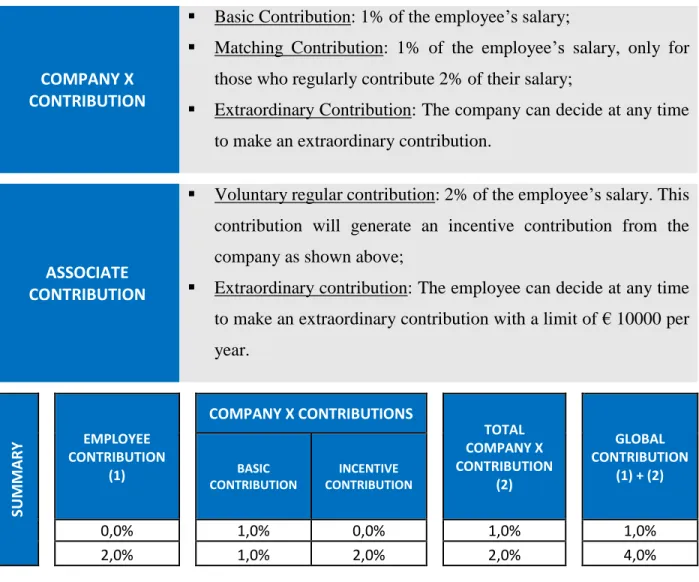
28 | P a g e Business Partner) containing all the information about the plan and a module to fill, sign and send back. This e-mail is sent either if the employee has to enroll in the plan for the first time or just to ask him if he wants to make some alterations. In order to correctly fill the module, the employee must choose how much to contribute, how to allocate the investments of his contributions between four available funds and authorize the payroll to deduct the contributions directly from his salary by signing the corresponding section. The employee can only choose to contribute 2% of his salary or not contribute at all. If he chooses to not contribute, he receives, in any case,
Table 1 The Main Characteristics of the Pension Plan
COMPANY X CONTRIBUTION
Basic Contribution: 1% of the employee’s salary;
Matching Contribution: 1% of the employee’s salary, only for those who regularly contribute 2% of their salary;
Extraordinary Contribution: The company can decide at any time to make an extraordinary contribution.
ASSOCIATE CONTRIBUTION
Voluntary regular contribution: 2% of the employee’s salary. This contribution will generate an incentive contribution from the company as shown above;
Extraordinary contribution: The employee can decide at any time to make an extraordinary contribution with a limit of € 10000 per year. SUM M AR Y EMPLOYEE CONTRIBUTION (1) COMPANY X CONTRIBUTIONS TOTAL COMPANY X CONTRIBUTION (2) GLOBAL CONTRIBUTION (1) + (2) BASIC CONTRIBUTION INCENTIVE CONTRIBUTION 0,0% 1,0% 0,0% 1,0% 1,0% 2,0% 1,0% 2,0% 2,0% 4,0%
29 | P a g e a contribution from the company corresponding to 1% of his salary. Otherwise, if he chooses to contribute 2% of his salary, the company’s contribution adds another 1% so as to get to 2%, leading to a total contribution of 4%. Table 1 sums up the main characteristics of the plan described so far. When it comes to deciding the allocation investment of the contributions, the employee can choose between two options:
- Option A: the employee can decide on his own how to allocate the investments between the four available funds;
- Option B: the investments are automatically allocated according to a life cycle principle. Following this principle, the funds are all invested in one plan at a time in accordance with the age of the employee. If the employee is less than forty years old, the contributions are entirely invested in the fund which invests more in stocks. As the employee gets older the investments are entirely moved to funds which invest progressively less in stock and more in bounds till the employee turns 61 and the investments are entirely moved to the fund which invests all the employee’s contributions in bounds.
The characteristics of the available funds are as follow:
- Multireforma Ações: Aggressive profile fund that invests exclusively in stocks; - Multireforma Plus: Balanced profile fund with top investment limit in stocks of 40%; - Multireforma: Conservative profile fund with top investment limit in stocks of 15% - Multireforma Capital Garantido: Guaranteed capital fund at a twelve month time horizon,
with no investments in stocks.
If the employee does not fill the enrollment module, he is automatically enrolled in the plan with a 0% contribution from him and a 1% contribution from the company. The investments of the
30 | P a g e contributions are allocated following the life cycle option. The enrollment and the successive possible alterations are effective starting from the first of January of the following year. During the year it is not possible to enroll in the plan or modify the contribution rate nor the investments allocation. Once the employee is effectively enrolled in the plan, he can decide at any time to make an extraordinary contribution up to € 10˙000,00 considering the whole year. The extraordinary contribution will be directly deducted from the salary. Also the company can decide at any time to do an extraordinary contribution in favor of the employee.
Besides the e-mail sent by the HRBP the information about the plan is accessible on the company internal network. Furthermore, two years ago the HR department organized a workshop to explain how the offer works. They also promised to organize an annual workshop on this topic, but they failed to do that until now.
3.3. Predictable behaviors and hypothesis
Unlike the 401(k) plan, the default contribution rate, namely the contribution rate if you don’t spontaneously enroll in the plan, is 0%. However, the employee is automatically enrolled with a contribution rate of 1% provided by the company. Despite the automatic enrollment, the company nudges employees to spontaneously enroll in the plan. The e-mail sent by the HRBP in the beginning of December has similar characteristics to the e-mail we have seen in the previous chapter sent to managers in order to help them with new hired integration process. It is timing relevant, since it is sent one month before the enrollment phase and it is meaningful since it contains most of the necessary information about the plan. Furthermore, the module to fill is quite simple. In order to contribute 2% of your salary you just have to check the corresponding box. By checking this box, the employee gets a matching contribution from the company that doubles. These facts lead to my first hypothesis:
31 | P a g e H1: Most of the employees choose to contribute 2% of their salaries in order to generate the 2 % company contribution.
Option A leaves the possibility to the employee to autonomously choose in which percentage to invest his contribution in each of the available funds. But most employees lack the required financial market knowledge to know how to make this choice. Two years ago, the HR department organized a workshop to get the employees to know better about the pension plan offer. At the beginning of the workshop there was a little introduction where an HRBP tried to explain why people should start to save money for the pension when young but there was no explanation on how the financial market and stocks and bonds work. Probably a training on these topics should be organized in order to make people more conscious and secure about their decisions. Even if there are just four funds available, the allocation decision looks quite difficult for a person who doesn’t have at least a basic knowledge on this topic, and as we’ve seen in the previous chapter, complexity translates into procrastination. Furthermore, many studies show that most of the people do not change their allocation assets after the enrollment in the plan. On the other hand, Option B seems to solve all these problems by deciding in which funds to invest and by changing the investments asset automatically during the working life of the employee. It seems like the company tries to nudge his employees to choose this plan but is this life cycle fund the best solution for them? Many studies show that investments in stocks never go down after a 20 years period, so investing in an aggressive fund which invests entirely in stocks when young seems to be a good solution. Also reducing the investments in stocks trough time is a good strategy since the period for the investments to go up reduces the more we get close to the retirement time. However, the timing for switching from a fund to another cannot be considered perfect since it depends also on how many years the person started investing in the plan. Anyway this solution can be considered
32 | P a g e the best since the alternative for most people would be to stick with the initial investment asset till the retirement day.
H2: Most of the employees allocate their contribution investments following the life cycle option.
The maximum contribution rate is 2%. Anyway, as we have seen previously, if the employee feels the necessity to save more money, he can make an extraordinary contribution any time he wants. But would they make it? I have some doubts. Even if they feel they should do it they probably will not for the same reason that they do not change the allocation of their investments after the enrollment process or they do not fill in the enrollment form: procrastination. Furthermore, people could even have missed this information or forgot about it after some time. The practice could be improved in this respect.
H3: Few employees or no one make an extraordinary contribution.
These hypotheses correspond to the behaviors predicted by the behavioral literature surveyed in previous chapters. In the next paragraph I will confirm or reject them using the data extracted from the results of the survey.
3.4. The Results
The survey (Annex 1) was sent out on the 7/10/2019 with objective of comparing the data collected to the characteristics I listed before, so to reinforce their credibility and to measure the efficiency of the practice studied. After one week, 27 people responded. Despite the small dimension of the sample, some interesting results came out. Before starting to test my hypotheses, I would like to confirm the cheapness characteristic of the practice. In order to do so, I asked the survey’s participants information about their gross salary. Although the answer to this question was not mandatory, since some people may have felt bothered to talk about their salary, 17 out of 27
33 | P a g e employees answered. With this piece of information we can do some easy math. The average salary in the studied department is about € 1200 gross. Knowing that the maximum contribution rate from the company corresponds to 2% of the employee’s salary, it means that the maximum cost is €24 per month for each employee.
Max Cost per Employee = €1200 x 2% = €24 per month
Considering also that Company X does not offer the most competitive salary in the market and tries to fill this gap by offering several benefits to its employees, these costs do not represent a big effort for the company.
In fact, when asked if the pension plan offered by the company is one of the reasons that keep them from leaving the company, most of them answered “yes” (Figure 1). The cost represented by this practice would not be that expensive even if all the employees of the department would have adhered to the plan and contribute 2% of their salary. Anyway, realistically speaking, this will never happen. At the moment of writing this thesis, employees eligible for the pension plan are about 30. As we can see from Figure 2, out of these 30 only 55% of them contribute. Although
34 | P a g e more than half of the employees chose to contribute with the maximum rate, this result sounds a bit surprising to me. I would have expected much more of them to do so, and I think that this percentage will grow in the next years due to the annual e-mail sent by the HRBP which works as
a reminder for those employees that do not contribute yet.
Regarding the second hypothesis, the predictable behavior would have seen most of the employees allocate the investments of their contributions following the life cycle principle represented by
Figure 2
35 | P a g e option B. Although Figure 3 shows that only about 30% of the employees of the survey opted for Option B, 60% of them do not know how their investments are allocated. I remind that all the employees eligible for the plan, even the ones who did not spontaneously enroll, have a 1% contribution rate to invest in the funds. This data probably depends on the fact that most of them did not choose how to allocate the investments of their contributions as shown in Figure 4.
In what concerns the third hypothesis, as I was expecting no one has ever made an extraordinary contribution. This could imply that all the employees of the survey believe that they are saving
Figure 4
36 | P a g e enough money for the pension plan but this is not the case. In fact, almost 50% of them is not satisfied with the amount of money they are saving while only 15% of them think they are saving enough (Figure 5). So why do they not make an extraordinary contribution? The first explanation that came to my mind, following the studies made on the 401 (k) pension plan, was that they are procrastinating. But when employees were asked if they were planning to do an extraordinary contribution, 60% of them answered “no” (Figure 6). Even if procrastination is probably one of
the reasons, the contradiction between the answers suggests that there are also other reasons related to bounded willpower.
Regarding the complexity of the practice, I asked the employees to value, by picking a number from 1 to 5, the complexity of the choices to make in order to spontaneously enroll in the plan (Figure 7). Almost 50% of them valued the complexity at level 3 out of 5, which corresponds to a medium level of complexity. Although it is a good result, the complexity of the practice can be reduced by reinforcing the knowledge of the employees about the actions to take in order to fully
37 | P a g e take advantage of the practice. In fact, most of the employees who participated to the survey think that the information provided by the company is not enough (Figure 8).
Figure 7
38 | P a g e
Conclusion
The main objective of the study was to introduce the concept of nudge practice in the HR literature. A nudge practice is an HR practice that applies insights from behavioral economics to design practices so to optimize fast thinking and unconscious behavior of employees, in order to align the objectives of the employee with the objectives of the organization.
To understand why these practices should be used, we have first seen how some elements from behavioral economics apply also to organizational environments. These elements are the so called three bounds: bounded interest, bounded rationality and bounded willpower. Bounded self-interest is the assumption that people’s preferences are not influenced only by their self-self-interest as neoclassical economics suggests, but also by norms of fairness and reciprocity. For example, we have seen that a pay cut substantially reduces the effort that an employee is willing to exert, while a pay rise, despite having a positive relation with the effort the worker is willing to provide, is not as strong as the relation between pay cut and workers’ effort. Bounded rationality is the assumption that individuals’ rationality in the decision-making process is influenced by some factors such as the amount and quality of information they have access to, the cognitive limitations of their minds, and the time they have to take a decision. Studied that applied this assumption to the organizational environment showed for instance that in an environment in which workers are free to choose how much labor to supply in a given day, and in which their effort is correlated to their pay outcomes, an increase of the commission rate corresponds to an increase of participation rate. Bounded willpower refers to the fact that people often take actions that they know to be in conflict with their interests. Thanks to this assumption, we have seen that, in an organizational environment, self-control problems bring workers to take actions that have a negative impact on their productivity, wealth and health.
39 | P a g e To understand the origins of the concept of nudge practice, we went through the literature that inspired them. Basically, there are two main theories behind the nudge practices: The dual process system and the nudge theory. The dual process system, turned famous by Kahneman (2011), refers to the existence of two systems that influence the way in which human beings think. System 1 needs little or no effort at all to be activated and is fast, automatic and uncontrolled. System 2 instead, needs effort and concentration to be activated resulting in a slower and more elaborate way of thinking. A nudge is something that aims to alter people behavior in a predictable way without restricting people’s freedom of choice.
To understand how these practices work, we have analyzed some examples from the field. Thanks to the practice used in Google to maximize the efficient integration of new hiring process, we have seen how a simple piece of information can lead to incredible results if it is timing relevant, meaningful and easy to act on. The study conducted by Madrian and Shea (2000) on the 401 (k) pension plan showed how by turning all workers eligible for the plan and by changing the default option to automatically enroll in the saving plan with a 3% contribution unless they expressly declare their unwillingness to participate, companies that were offering this plan got a remarkably increase of the quantity of workers enrolled in the plan.
In the last chapter, following a deductive methodology, I have extracted from the literature the characteristics that a nudge practice should possess in order to be considered as such. The result of this investigation is that a nudge practice must be influential, non-invasive, cheap and easy. These characteristics can be useful to assess the efficiency of a nudge practice. To show that, I studied an HR practice used in Company X relative to a pension plan offer. Similarly to the 401 (k) pension plan, this practice aims to make sure that most of the employees eligible for the plan
40 | P a g e take full advantage of this benefit by using some nudges. To collect some data, I sent out a survey directed to the workers eligible for the plan.
In order to understand if the practice was cheap to implement, I asked the employees about their monthly salary. This data allowed me to calculate the maximum monthly cost per person which is €24. Considering that the number of workers eligible for the plan is about 30 and that the company offers a lower salary comparing to the competitors and tries to fill this gap by offering more benefits, this practice can be considered cheap. There are for sure also other costs relative to this practice agreed with the company that take care of the pension plan, but I don’t have access to this information.
Regarding the influence that this practice exerts on the employees, I first devised their predictable behaviors. According to my predictions, most of the employees choose a contribution rate of 2%, allocate their contribution investments following the life cycle option and few of them, or no one at all, have ever done an extraordinary contribution. The data collected from the survey seems to confirm all the hypothesis. While the first two hypothesis confirm the influential characteristic of the practice, the third does the opposite. In order to improve the efficiency under this aspect, I suggest to increase the maximum contribution rate that an employee can provide. Furthermore, also changing the default option into automatic enrollment with a 2% contribution rate would improve this characteristic.
Regarding the complexity of the practice, I asked the employees to value, by picking a number from 1 to 5, the complexity of the choices to make in order to spontaneously enroll in the plan. Almost 50% of them valued the complexity at level 3 out of 5, which corresponds to a medium level of complexity. To make choices easier, I suggest to provide some training regarding savings