FRAMEWORK FOR SUCCESSFULLY IMPLEMENTING AN
INAUGURAL GRI REPORTING PROCESS
Anna Dudik
Project submitted as partial requirement for the conferral of Master in International Management
Supervisor:
Prof. Carmen Lages, ISCTE Business School, Marketing Department 9TH Master in International Management 2010/2011
June 2012
II
-‐ Spine -‐
FR
AM
E
W
O
R
K
FO
R
S
U
CC
E
SS
FU
LL
Y
IM
PL
EM
EN
T
IN
G
AN
IN
A
U
G
U
R
AL
G
R
I R
E
PO
R
T
IN
G
P
R
O
CE
SS
An
n
a
D
u
d
ik
A
CKNOWLEDGEMENTSAbove all, I would like to express my profound gratitude and a heartfelt thank you to my boyfriend, Jorge Machado for always being there for me while I worked on this Master Thesis. Jorge, I don’t think I would’ve been able to complete this project without your ongoing support as we traveled between three continents - while your career took you to Europe and Africa, and we took breaks to see my family in the United States during this past year.
Additionally, I’d like to give a warm thanks to my supervisor, Carmen Lages. Thank you for your guidance in my thesis topic choice, and your invaluable inputs and feedback throughout the entire thesis-writing process. You have been a wonderful supervisor and role model.
I also want to express my gratitude to the two interviewees for their input and sharing information about the companies where they work and their thoughts about the GRI reporting process.
And finally, I’d like to thank my parents and brother for their support in my decision to study abroad and my friends in understanding my decision.
A
BSTRACTThis thesis is a corporate project analyzing the Global Reporting Initiative (GRI) reporting process. Its main objective is to propose a practical framework to guide
organizations that plan to engage in first-time voluntary sustainability reporting using GRI’s Sustainability Reporting Guidelines. The thesis provides insight into the exact tasks involved in each stage of the GRI reporting process, as well as the specific resources and capabilities that are necessary in order for organizations to succeed in reporting, regardless of size, location, sector, or organization type. Two international case companies, one in the Service sector and the other in the Forest and Paper Products sector became objects of study and specific recommendations were provided to each one. As a conclusion, the thesis presents general recommendations that are thought to be universal for any first-time GRI reporter, assisting organizations to successfully implement an inaugural GRI reporting process.
Key words: corporate sustainability reporting, global reporting initiative (GRI), resource-based view (RBV), and resources and capabilities
S
UMÁRIOEsta tese é um projeto empresarial que analisa o processo de reporte da Global Reporting Initiative (GRI). O seu principal objectivo é a definição de um guia prático para apoiar as empresas que pretendem iniciar voluntariamente a publicação de relatórios de sustentabilidade segundo as directrizes da GRI. Esta tese descreve as actividades concretas a executar em cada etapa do processo de reporte da GRI, assim como os recursos e
competências que as organizações necessitam para serem bem-sucedidas no reporte, independentemente da sua dimensão, localização, sector, ou tipo de organização. Duas empresas multinacionais foram objecto de estudo, uma do sector de serviços e outra do sector florestal, tendo sido elaboradas recomendações específicas para cada uma. Como conclusão, a tese apresenta recomendações gerais, aplicáveis a qualquer organização que elabore o GRI pela primeira vez, para apoiar a sua implementação com sucesso.
Palavras chave: reporte da sustentabilidade corporativa, Global Reporting Initiative (GRI), visão baseada em recursos (VBR), e recursos e competências
R
ESUMOE
XECUTIVOEsta tese é um projeto empresarial que analisa o processo de reporte da Global Reporting Initiative (GRI). O seu principal objectivo é a definição de um guia prático para apoiar as empresas que pretendem iniciar voluntariamente a publicação de relatórios de sustentabilidade corporativa segundo as diretrizes da GRI. Esta tese descreve os recursos e competências que as organizações necessitam para serem bem-sucedidas no reporte da GRI, e descreve em detalhe cada fase do processo de reporte. Também apresenta recomendações gerais para organizações que executam o reporte da GRI pela primeira vez.
Foram identificadas duas empresas multinacionais que iniciaram a implementação do processo de reporte da GRI, uma no sector de serviços e outra no sector florestal, e foram selecionadas como objecto de estudo. Este projeto empresarial fornece recomendações específicas para cada uma das empresas em estudo, assim como recomendações gerais para qualquer empresa que inicie o processo de reporte GRI, uma vez que se verificou que as recomendações são universais, independentemente das características da empresa, tais como tamanho, localização, sector e tipo de organização.
O guia prático desenvolvido apoia-se em literatura sobre reporte de sustentabilidade corporativa e sobre a visão baseada em recursos (VBR). O método de pesquisa é o de um projeto empresarial com uma abordagem exploratória. Obtiveram-se dados primários através de duas entrevistas detalhadas com a gestão de topo durante Fevereiro de 2012.
Adicionalmente, foram obtidos dados secundários através de artigos académicos, livros, relatórios, jornais, publicações, relatórios de sustentabilidade corporativa, e websites.
O projeto empresarial sustenta que o processo de reporte de sustentabilidade corporativa é intensivo e exige um esforço organizacional significativo. Como resultado deste estudo, foram identificados recursos e competências que são instrumentais para implementar com sucesso o processo de reporte da GRI. Os recursos essenciais são tempo, dinheiro, pessoas e tecnologia. O estudo documenta em detalhe cada recurso específico e até que grau cada um é necessário (ver secção 2.4). As competências essenciais são liderança, constituição de equipas, formação, e disseminação de conhecimento. O estudo detalha cada competência e a forma como é necessária (ver secção 2.5).
As recomendações genéricas para as organizações que pretendem implementar o processo de reporte de sustentabilidade corporativa segundo as diretrizes da GRI foram categorizadas de acordo com as cinco fases do processo do reporte da GRI: Preparar, Conectar, Definir, Monitorizar e Reportar (ver secção 2.3.1). Cada recomendação está explicada no documento e inclui uma referência à secção onde o material é apresentado em detalhe (ver secção 5.1).
As recomendações da fase “Preparar” incluem:
o Obter apoio da gestão de topo de forma antecipada no processo de reporte. o Iniciar o reporte utilizando o nível de aplicação C.
o Comparar os indicadores de desempenho com empresas concorrentes para definir o conteúdo do relatório.
As recomendações da fase “Conectar” incluem:
o Envolver os intervenientes numa avaliação de materialidade. As recomendações da fase “Definir” incluem:
o Definir o conteúdo do relatório com base no resultado da avaliação de materialidade, e concentrar aí os esforços.
o Avaliar as necessidades de tecnologia da empresa para recolha de dados. As recomendações da fase “Monitorizar” incluem:
o Aumentar a credibilidade do relatório suportando-o em dados relevantes. o Recolher dados que ajudarão a produzir o relatório final de forma clara. As recomendações da fase “Reportar” incluem:
o Demonstrar como os intervenientes participaram no processo de preparação do relatório.
o Compilar um relatório balanceado, comunicando as boas e as más notícias.
o Utilizar gráficos para apresentar os dados e comunicar tanto os objectivos como progresso.
o Considerar executar uma auditoria em períodos posteriores de reporte.
o Personalizar o relatório de sustentabilidade corporativa a cada interveniente. o Caso se utilize a taxonomia da GRI para publicação na internet, participar no
Programa de Preenchimento Voluntário da GRI.
o Garantir que o relatório é facilmente acessível.
o Registar o relatório de sustentabilidade corporativa na base de dados da GRI. As recomendações específicas para as empresas do sector de Serviços e do sector Florestal estão apresentadas nas secções 5.2 e 5.3 respectivamente. Os detalhes das empresas de estudo e as recomendações específicas para estas não estão publicadas na versão da Biblioteca do ISCTE devido a um acordo de confidencialidade estabelecido em troca do acesso à informação.
L
IST OFF
IGURESFIGURE 1: VOLUNTARY SUSTAINABILITY REPORTING AMONG G250 COMPANIES ... 6
FIGURE 2: MAIN DRIVERS FOR CORPORATE SUSTAINABILITY REPORTING ... 7
FIGURE 3: COMPANIES ISSUING CORPORATE SUSTAINABILITY REPORTS USING GRI'S GUIDELINES ... 9
FIGURE 4: THE GRI REPORTING PROCESS ... 12
FIGURE 5: STEPS IN THE GRI REPORTING PROCESS ... 13
FIGURE 6: GRI APPLICATION LEVELS ... 19
FIGURE 7: RESOURCES NECESSARY FOR A SUSTAINABILITY REPORTING PROCESS ... 22
FIGURE 8: CAPABILITIES THAT FACILITATE WITH IMPLEMENTING A SUSTAINABILITY REPORTING PROCESS ... 27
FIGURE 9: CONCEPTUAL FRAMEWORK ... 32
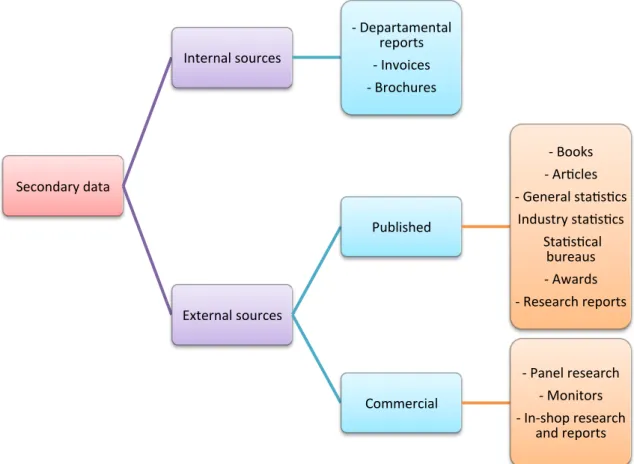
FIGURE 10: TYPES OF SECONDARY DATA ... 35
FIGURE 11: TYPES OF INTERVIEWS ... 36
FIGURE 12: CORPORATE PROJECT SCHEDULE ... 38
A
CRONYML
ISTA4S The Prince’s Accounting for Sustainability Framework
“Big 4” A reference to the four largest accounting firms: PricewaterhouseCoopers, Deloitte Touche Tohmatsu, Ernst & Young, and KPMG
CDP Carbon Disclosure Project
CERES Coalition for Environmentally Responsible Economies CSR Corporate Social Responsibility
DJSI Dow Jones Sustainability Indexes
GRI Global Reporting Initiative
EMS Environmental Management System
ERP Enterprise Resource Planning
ESG Environmental, Social, and Corporate Governance
IFC International Finance Corporation
ISO International Standards Organization
OECD Organization for Economic Co-operation and Development PMO Project Management Office
RBV Resource Based View
SAP Systems Applications and Products
SEC Securities & Exchange Commission
SMEs Small and Medium-sized Enterprises
TBL Triple Bottom Line
T
ABLE OFC
ONTENTSAcknowledgements ... III Abstract ... IV Sumário ... V Resumo Executivo ... VI List of Figures ... IX Acronym List ... X
1. Introduction ... 1
1.1. Background to the Study ... 1
1.2. Problem Definition ... 1
1.3. Structure of the Thesis ... 2
2. Literature Review ... 4
2.1. Corporate Sustainability ... 4
2.2. Corporate Sustainability Reporting ... 5
2.2.1. Motivators For and Against Organizations Publishing Sustainability Reports ... 7
2.3. The Global Reporting Initiative (GRI) ... 9
2.3.1. The GRI Reporting Process ... 11
2.3.2. Report Content ... 14
2.3.3. GRI Report Application Levels ... 18
2.3.4. External Assurance of Corporate Sustainability Reports ... 19
2.4. The Resource Based View (RBV) of the Firm ... 20
2.5. Role of Resources and Capabilities in Corporate Sustainability Reporting ... 21
2.5.1. Resources Necessary for the Inaugural GRI Reporting Process ... 22
2.5.2. Capabilities Necessary for the Inaugural GRI Reporting Process ... 27
3. Conceptual Framework ... 32
4. Methodology ... 34
4.1. Data Collection ... 34
4.2. Data Analysis ... 38
5. Main Findings and Recommendations ... 40
5.1. Recommendations for First-‐time GRI Reporters ... 40
5.1.1. “Prepare” Stage Recommendations ... 41
5.1.2. “Connect” Stage Recommendations ... 42
5.1.3. “Define” Stage Recommendations ... 43
5.1.4. “Monitor” Stage Recommendations ... 43
5.1.5. “Report” Stage Recommendations ... 44
6. Project Conclusions, Contributions, and Limitations ... 46
6.1. Conclusions ... 46
6.2. Managerial Contributions ... 46
6.3. Limitations ... 47
List of References ... 48
1. I
NTRODUCTIONThe objective of this chapter is to present the reader with a background to this thesis and what it aspires to accomplish. It explains the motivation, problem context, and the structure of the corporate project.
1.1. Background to the Study
Perception regarding the role of businesses in our society has been going through a transformation. We no longer identify a company’s sole purpose as being that of maximizing shareholder return but we increasingly expect companies to do good for society. There is growing recognition that corporate sustainability is essential in today’s business and
companies are voluntarily disclosing their effects on the people and communities where they operate. In fact, sustainability reporting is becoming standard practice; with 95 percent of global Fortune 250 (G250) companies now publishing sustainability reports (KPMG, 2011). Smaller companies (it is important to note that the term “smaller” utilized here is not equal to the definition of small and medium-sized enterprises [SMEs] but references all those
companies that are smaller than the G250) are recognizing this paradigm shift and are attempting to follow-suit. However, implementation factors of corporate sustainability reporting have been recognized as major deterrents in “smaller” companies engaging in the reporting process and publishing corporate sustainability reports (Martin & Hadley, 2008).
1.2. Problem Definition
Since there are no formal requirements regarding what information should be included in a corporate sustainability report, many companies often search for support and advice on how to go about reporting (Kolk, 2004). Indeed, the reporting process requires much collaboration, time, effort, as well as other resources and capabilities to implement it; however, many companies are unaware of precisely which resources and capabilities are necessary to embark on the reporting effort, thus requiring support in reporting for the first time. Sustainability professionals may find themselves asking questions such as: What should a corporate sustainability report include? How should the reporting effort be planned, staffed, and budgeted? How long will it take to complete it? What does the GRI
sustainability reporting process involve? These are all valid concerns and questions that have not been answered in literature. Even GRI notes that those companies who have gone
through the GRI reporting process report that it is “not easy for an organization reporting for the first time to understand what the GRI sustainability reporting process involves” (GRI Learning Series, 2008: 2). This corporate project aims to provide a practical framework answering those questions that sustainability professionals may find themselves asking upon embarking on an inaugural corporate sustainability reporting process.
The objective is to map out the reporting process in such a way that makes it applicable to a company of any size or sector and provide insight into the resources and capabilities that will be necessary to successfully implement a sustainability reporting process. This approach was supported by a preliminary review of relevant academic
literature, as well as a review of sustainability reports and discussions with senior leadership of two case companies who intend to compile an inaugural sustainability report.
1.3. Structure of the Thesis
This corporate project is structured as follows:
Chapter 1: Introduction. This chapter introduces the subject of the corporate project, as well as the motivation for its undertaking. Lastly, it presents the problem context of this corporate study.
Chapter 2: Literature Review. This chapter provides a review of the literature on the main concepts underlying this research, namely corporate sustainability reporting and the resource-based view of the firm, as well as the resources and capabilities necessary for corporate sustainability reporting.
Chapter 3: Conceptual Framework. This section introduces the conceptual framework of reference stemming from the literature review.
Chapter 4: Methodology. This section presents a discussion of the data collection and data analysis employed for the corporate project. The interviewees of the corporate project are introduced, as well as the general structure of the interviews. The collection of data has been divided into primary and secondary data, which both will be explained.
Chapter 5: Main Findings and Recommendations. This section presents findings based on the literature review that may be relevant for inaugural corporate sustainability reporters. It includes general recommendations that are applicable to organizations of any size or sector
information on the two companies who became the objects of study. The results from the interviews with each company’s corporate sustainability professionals are reflected against the conceptual framework developed in Chapter 3. Finally, this chapter provides
recommendations specific to the two companies based on the information analysis introduced in the Methodology chapter. The company-specific content of this chapter, which is
considered to be confidential, is not published in ISCTE’s library version.
Chapter 6: Project Conclusions, Contributions, and Limitations. This chapter provides concluding remarks, an explanation of the managerial contributions this corporate project intends to build, and accounts for limitations of the corporate project.
2. L
ITERATURER
EVIEWThe objective of this chapter is to present the most relevant literature related to the concepts in this research - namely, corporate sustainability reporting and the resource-based view to explain firm performance. The first section provides an overview of corporate sustainability. The second section explains the trend in corporate sustainability reporting. The third section introduces the concept of a resource-based view of the firm and links the corporate sustainability reporting function of an organization with resources and capabilities.
2.1. Corporate Sustainability
Sustainability is one of the hottest topics of the 21st century, with much coverage in academia, in management practice, on the political scene, and in media. Sustainability issues such as climate change and human rights are gaining widespread attention and are moving to the forefront of people’s minds. The most recognized and quoted definition of sustainability is, “development that meets the needs of the present without compromising the ability of future generations to meet their needs”, as was devised by the Brundtlandt Commission (WCED, 1987: 43). In other words, the international community is acknowledging that the current approach to development is inadequate and a sustainable one is required.
“Sustainability is the most critical issue of our time”, says Coca-Cola CEO Muhtar Kent (Coloradoan, 2011).
Sustainability and corporate social responsibility (CSR) have become closely connected terms and are being used interchangeably (Emerson, 2003). Sustainability originally referred to the long-term positive environmental impact of human activities, whereas CSR had to do with organizations’ positive social impact on society. Now a new term has been coined, corporate sustainability, which is essentially sustainability at the business level, entailing both environmental and social dimensions, as well as a third – economic.
Corporate sustainability can be defined as “meeting the needs of firms’ direct and indirect stakeholders without compromising its ability to meet the needs of future
stakeholders as well” (Dyllick & Hockerts, 2002: 131). This definition is in line with that of the Brundtlandt Commission’s definition of sustainability (WCED, 1987). Other terms used to capture the concept of corporate sustainability include corporate social responsibility
(CSR), corporate responsibility, corporate citizenship, simply sustainability, and
environmental, social, and governance (ESG). Within the business sphere, the corporate sustainability movement is increasingly gaining prominence and is widely viewed as one of the major developments for global organizations (Stanny & Ely, 2008).
The three components of corporate sustainability – economic, environmental, and social, are also known as the three pillars of sustainability, the bottom line framework, and are sometimes referred to as people, planet, and profit. The triple bottom line framework, coined by Elkington (1997), is the idea that businesses should measure their success not only by the traditional bottom line (the last line of the income statement indicating net income), referring to a company’s financial performance but also by their impact on the environment and society where they operate, as well as the broader economy.
A 2010 global survey conducted by MIT Sloan Management Review and The Boston Consulting Group of more than 2,800 companies found that over two-thirds of companies have placed corporate sustainability permanently on their management agenda. Two-thirds of the companies see sustainability as necessary to being competitive in today’s marketplace, up from 55% a year earlier. In addition, two-thirds of respondents said management attention to, and investment in sustainability have increased in the last year (MIT Sloan Management Review and The Boston Consulting Group, 2011). Another recent survey conducted by GreenBiz discovered that 85 percent of companies now have sustainability permanently on their agenda (GreenBiz.com, 2012).
2.2. Corporate Sustainability Reporting
Corporate sustainability reporting refers to the practice of companies voluntarily measuring, tracking, and communicating information regarding their commitment and progress towards reducing their social, economic and environmental impacts on society in a written report tailored toward stakeholders – including employees, investors, consumers, suppliers and the community. The practice has been growing remarkably since its first introduction in the 1970s. In just the last five years, the number of sustainability reports has increased by 125 percent (GreenBiz.com, 2012). Stakeholders are increasingly interested in the impact companies have on society, the environment, and the economy, leading to a demand for greater transparency, accountability, and consistency in reporting.
During the 1970s, the first wave of corporate sustainability reports emerged in the form of “social reports” that were published by companies in the U.S. and in Western Europe. Since the practice wasn’t institutionalized, it faded in the 1980s, only to reemerge during the late 1980s focusing more on environmental issues. Since then, it expanded to encompass social and economic aspects (Kolk, 2010). Reporting has been done in the form of stand-alone reports or as sections in financial reports, and has been going by names such as non-financial reporting, sustainable development reporting, corporate social responsibility reporting, corporate citizenship reporting or integrated reporting (Kolk, 2006; KPMG, 2011).
Corporate sustainability reporting has been growing substantially amongst the largest global companies in the past two decades (see Figure 1). Reporting on corporate
sustainability efforts rose from 12% in 1992, to 17% in 1993, to 24% in 1996, and to 28% in 1999 (Kolk, 2006). In 2002, 45% of the Fortune Global 250 (G250) companies reported their corporate responsibility efforts (KPMG, 2002). In 2005, the number rose to 52%. In 2008, the percentage rose to 79% (KPMG, 2008). In 2011, the percentage of G250 companies reporting on their corporate sustainability efforts was at a whopping 95% (KPMG, 2011).
Figure 1: Voluntary Sustainability Reporting Among G250 Companies
Source: Personally developed by author, adapted from Kolk, 2006 and KPMG
Nearly half of the G250 companies have noted financial gains from their
sustainability activities (The Wall Street Journal, 2011). Corporate sustainability reports are playing an increasingly important role in the business environment and in our society. Stakeholders are using sustainability reports in decision-making; businesses are reading them to better assess potential partners; consumers are reading them to better understand the
12% 17% 24%
28%
45% 52% 79%
95%
1992 1997 2002 2007 2012
companies from which they buy products; and job seekers are reading them to evaluate perspective employers.
2.2.1. Motivators For and Against Organizations Publishing Sustainability Reports
Overall, the decision of whether to publish a sustainability report is seen as a strategic decision by companies (Kolk, 2004). There are numerous reasons why organizations choose to voluntarily publish sustainability reports however to provide a holistic view, it must be mentioned that there are also several reason for not publishing a sustainability report.
2.2.1.1. Benefits of Publishing Sustainability Reports
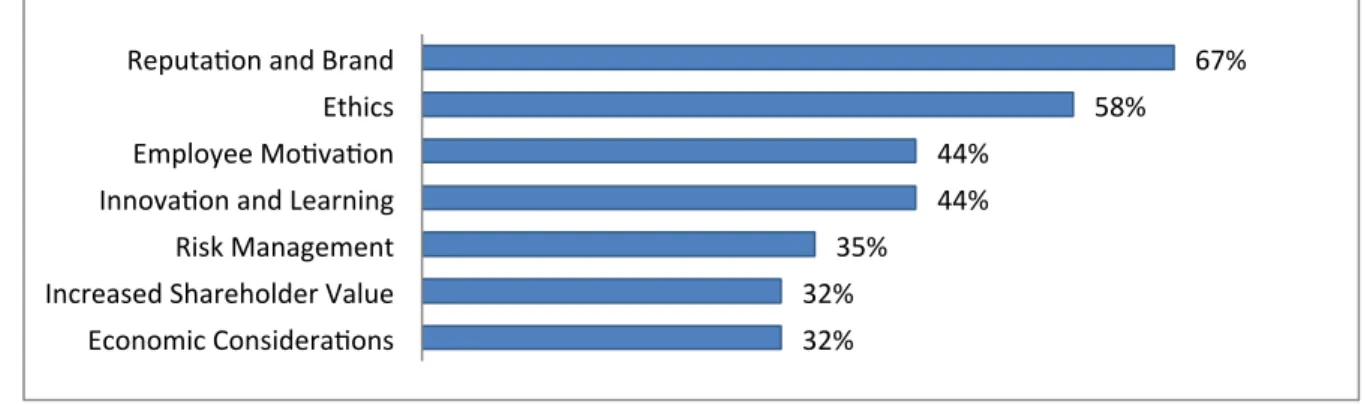
Organizations choose to publish sustainability reports because they believe that reporting will provide some type of benefit. A 2011 KPMG survey identified the driver of corporate sustainability reporting to be: reputation and brand (67 percent), followed by ethics (58 percent), employee motivation (44 percent), innovation and learning (44 percent), risk management (35 percent), access to capital or increased shareholder value (32 percent), economic considerations (32 percent), strengthened supplier relationships (22 percent), market position improvement (22 percent), improved relationship with governmental
authorities (18 percent), and cost savings (10 percent) (KPMG, 2011). Reputation and brand considerations as a top driver is reinforced in an academic study of 600 global companies which cited competitive and media pressure, media visibility and publicity efforts as
important motivators for reporting (Nikolaeva & Bicho, 2010). Additionally, sustainability is seen as a potential source of competitive advantage and a way to innovate a company’s product offerings - whether it is in the products the company sells, services it provides, or in its internal processes.
Figure 2: Main Drivers for Corporate Sustainability Reporting
Source: Developed by author, derived from KPMG, 2011
32% 32% 35% 44% 44% 58% 67% Economic Considera_ons Increased Shareholder Value Risk Management Innova_on and Learning Employee Mo_va_on Ethics Reputa_on and Brand
It has also been recognized that publishing a sustainability report enhances employee morale and has a strong positive impact on readers’ perception of the reporting company – with 85 percent of readers reporting a more positive perception (KPMG International and SustainAbility Ltd., 2008). Furthermore, advantages of engaging in corporate sustainability are evident from the ‘people’ perspective, in terms of employee engagement, recruitment, and retention. Studies indicate that employees are concerned about the impact that the companies where they work have on their communities (Do Well Do Good, 2010) and findings show that:
• 83% of employees would seriously consider leaving their job if their employer used
child labor in sweatshop factories.
• 65% would seriously consider leaving their job if the company where they work
harmed the environment.
• 32% would seriously consider leaving their job if their employer gave no or little
money to charity.
One could expect that the employees who identify with their organization would increase their motivation to give their best to it and be proud of being part of it. Furthermore, a corporate sustainability report can be used for communication purposes in marketing. It can be used as a tool to demonstrate a company’s transparency, its commitment toward sustainable development, showcase the actions the company has taken and plans to take, and demonstrate its performance from year to year (Kolk, 2004). Evidently, there are many motivations to publishing sustainability reports.
2.2.1.2. Reasons Not to Publish Sustainability Reports
It has been noted in literature that there are a number of factors to consider before choosing to publish a sustainability report. Major reasons for not publishing a sustainability report include (Kolk, 2010):
• If a company decides for some reason to stop reporting in the future, it risks getting negative media coverage for doing so.
• The publication of a sustainability report demands vast amounts of data to be collected. Some information that needs to be reported may be perceived to be sensitive to public disclosure, namely to competitors.
• When stakeholders lack interest in sustainability reporting, the effort might be reconsidered.
Furthermore, it has been documented that corporate responsibility efforts can actually harm a company’s competitiveness if stakeholders get the impression that such activities are being given higher priority than core business activities (Bhattacharya, Korschun, & Sankar, 2012). To prevent this backfire, companies must be clear about the motives behind
sustainability activities, the activities should serve stakeholders’ needs, and a company must routinely test the progress being made with such activities.
2.3. The Global Reporting Initiative (GRI)
GRI is a network-based non-profit organization whose global reporting guidelines are the most highly regarded, globally applicable and easily comparable (KPMG International and SustainAbility Ltd., 2008). GRI is the leading global authority on corporate
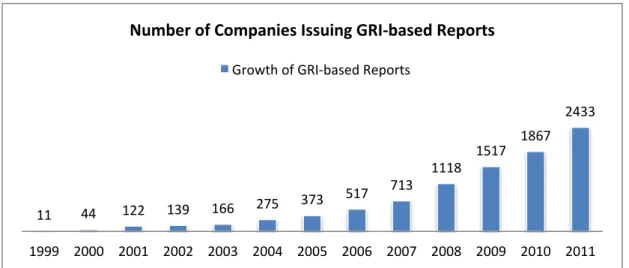
sustainability reporting. Since 1999, GRI has been providing a comprehensive framework that includes reporting guidelines and sets out principles and indicators companies can use to measure and report their economic, environmental, and social impact, as well as achieve greater organizational transparency. GRI’s framework standardizes voluntary sustainability reporting, allowing for easy comparability, with the aim of making sustainability reporting as routine and comparable as financial reporting (GRI, 2011). As of October 26th, 2011, 3,002 organizations have published sustainability reports using GRI’s Reporting Framework.
Source: Personally developed by autor, adapted from GRI
11 44 122 139 166 275 373 517 713 1118 1517 1867 2433 1999 2000 2001 2002 2003 2004 2005 2006 2007 2008 2009 2010 2011
Number of Companies Issuing GRI-‐based Reports
Growth of GRI-‐based Reports
GRI launched the first ‘generation’ of guidelines, called G1, in draft form in 1999, with a full version launched in 2000, followed by consultations and testing. The second guidelines, G2, were launched in 2002, and the latest, G3, were published in 2006 and were subsequently updated in March 2011, called G3.1. These include reporting principles and guidance, and standard disclosures that include: organizational profile, management
approach, and performance indicators. Companies using G3 guidelines must self-declare an application level of C, C+, B, B+, A, or A+, corresponding to the degree of thoroughness and whether third-party assurance achieved. GRI is currently developing the next generation of sustainability reporting guidelines, called G4, with the help of world-known international companies including Alcoa, Enel, GE, Goldman Sachs, Natura and Shell, as well as consulting firms Deloitte, Ernst & Young, KPMG and PwC. This updated version, which GRI hopes “will help more companies to report their sustainability performance”, is expected to be released in 2013 (MIT Sloan Management Review, 2011).
In its current form, GRI is an alliance formed on May 28th, 2010 between GRI and the UN Global Compact. The intent of this alliance is to “build a universal framework for corporate sustainability performance and disclosure, aiming to transform business practices on a global scale”. GRI will integrate the Global Compact’s ten principles that include human rights, labor, the environment and anti-corruption (UN Global Compact, 2011). The Global Compact will adopt the GRI Guidelines as the recommended reporting framework for companies to communicate progress made. This alliance is expected to serve as a crucial step in ensuring convergence in the area of corporate sustainability (GRI and UN Global Compact Forge New Alliance, 2010).
On November 7, 2011, GRI launched the Sustainability Disclosure Database (http://database.globalreporting.org), a free database that as of May 18th, 2012, includes repository of 10,004 sustainability and integrated reports (both GRI-based and non-GRI-based) that are searchable and offer possibilities for interesting benchmarking options. This is a major step forward in sustainability transparency, allowing for comparison and
benchmarking of interesting facts and figures.
Sustainability performance data is increasingly important worldwide. In 1975, on average, 80 percent of a company’s value came from tangible capital, namely finances and assets. Today, on average, 80 percent of a company’s value is intangible i.e. customer trust, brand value and stakeholder relations (Sustainable Plant, 2011). “Financial figures are no
longer enough to get the full picture of a company’s performance. Stakeholders of all sorts want to take a company’s sustainability performance into account too, to have an idea of the long-term viability of the organization”, says Ernst Ligteringen, chief executive of the Global Reporting Initiative (GRI). “We may be witnessing the most important transformation in corporate transparency and disclosure in recent decades,” says José Luis Blasco Vázquez, partner in charge of Climate Change and Sustainability Services at KPMG for EMA.
Sustainability reporting guidelines besides GRI’s include: the Carbon Disclosure Project (CDP), Coalition for Environmentally Responsible Economies (CERES), Dow Jones Sustainability Indexes (DJSI), the Prince’s Accounting for Sustainability Framework (A4S), International Standards Organization (ISO) 26000, the Organization for Economic Co-operation and Development (OECD) Guidelines for Multinational Enterprises, the United Nations Global Compact (UNGC) and the International Finance Corporation (IFC)
Performance Standards but GRI is the best known and most-widely adapted framework. GRI has been synchronizing its reporting format to correspond with the abovementioned
organizations’ frameworks such as those of ISO 26000’s and the UNGC’s. “Global
Reporting Initiative is arguably the best known set of guidelines for producing such reports worldwide”, note Brown, Lessidrenska, & de Jong (2009).
2.3.1. The GRI Reporting Process
In order to produce a GRI-based corporate sustainability report, an organization must go through a reporting process. Going through the reporting process can be a very valuable tool to reporting organizations, helping them to become more focused, more efficient, and more sustainable. The actual report that an organization produces should be a transparent assessment of the company’s activities that provides support for continuous improvement in performance over time. The report is also a tool for engaging with stakeholders, measuring and managing sustainability and can provide useful input to organizational processes.
Any organization that plans to engage in corporate sustainability reporting using GRI’s framework for the first time needs to understand the stages involved in the reporting process. The first report should serve as a baseline for future sustainability reports and can be the determining factor as to where the opportunities are greatest for an organization. It can also provide means to measure future successes. The first report will serve the purpose of benchmarking for future sustainability initiatives and will further document progress in reaching sustainability goals.
The sustainability reporting process should be a comprehensive review of all of the company’s impacts, both good and bad on society, the environment and the economy. It is essential to have support from the company’s top executives, as well as engagement from stakeholders in order for it to be effective. The reporting process itself should be seen as a cycle.
A GRI-based corporate sustainability report will help companies measure, monitor and improve their performance. According to research conducted by GRI, “a key benefit of reporting for companies is that it allows them to track progress and sheds light on areas needing improvement, helping them to manage what they measure. When organizations decide to start a reporting process they do not expect to create this value” (GRI Learning Series, 2008: 28).
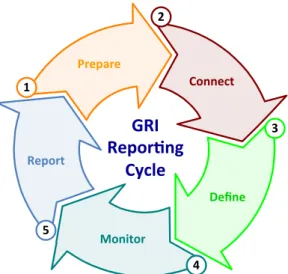
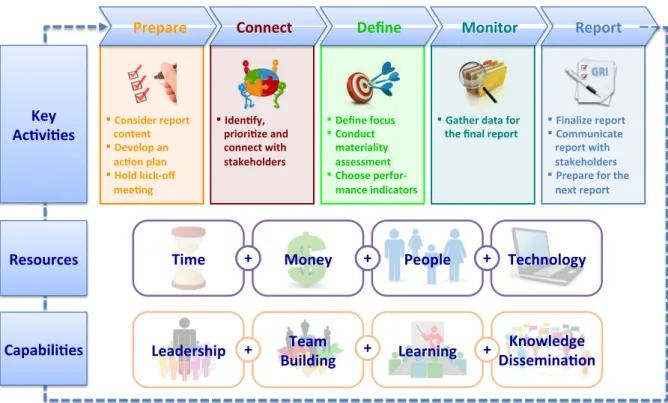
GRI found that the GRI reporting process could be presented in five stages. The stages are:
1. Prepare, in which management prepares to begin the reporting process by considering possible items to include in the report;
2. Connect, in which an organization communicates with stakeholders regarding topics to include in the report;
3. Define, in which an organization defines the focus of the report, based on results from the previous two stages;
4. Monitor, in which an organization actually monitors and collects information needed for inclusion in the final report; and
5. Report, in which an organization compiles the final report with data gathered from the previous stage and communicates it to
stakeholders. The next reporting cycle begins where this one leaves off. 5" 4" 2" 1" Report" Prepare" Connect" Monitor" Define" GRI"" Repor7ng" Cycle"! 3"
Figure 4: The GRI Reporting Process
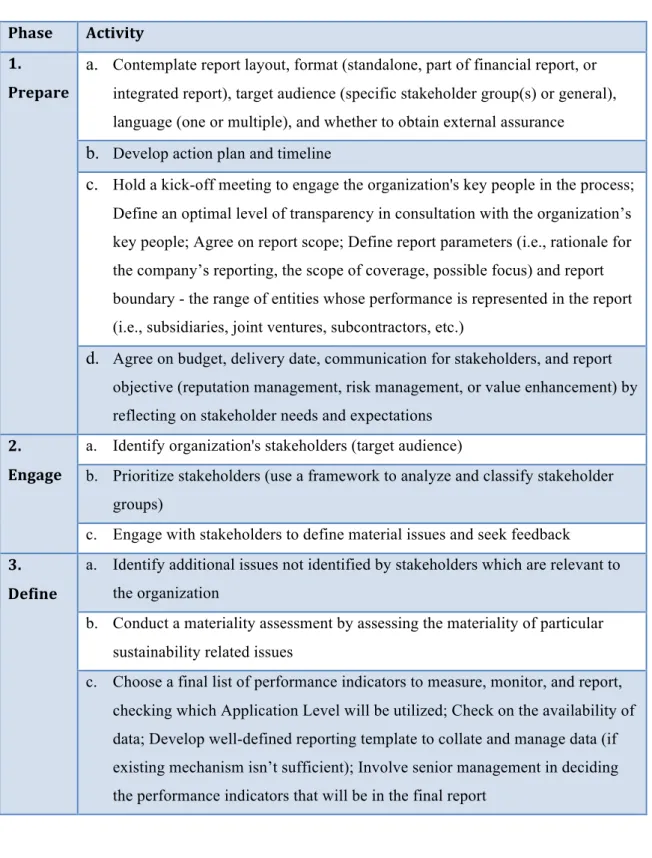
The figure below provides a drilldown of each stage of the GRI reporting process and the possible tasks included:
Figure 5: Steps in the GRI Reporting Process
Phase Activity 1.
Prepare
a. Contemplate report layout, format (standalone, part of financial report, or integrated report), target audience (specific stakeholder group(s) or general), language (one or multiple), and whether to obtain external assurance
b. Develop action plan and timeline
c. Hold a kick-off meeting to engage the organization's key people in the process; Define an optimal level of transparency in consultation with the organization’s key people; Agree on report scope; Define report parameters (i.e., rationale for the company’s reporting, the scope of coverage, possible focus) and report boundary - the range of entities whose performance is represented in the report (i.e., subsidiaries, joint ventures, subcontractors, etc.)
d. Agree on budget, delivery date, communication for stakeholders, and report objective (reputation management, risk management, or value enhancement) by reflecting on stakeholder needs and expectations
2. Engage
a. Identify organization's stakeholders (target audience)
b. Prioritize stakeholders (use a framework to analyze and classify stakeholder groups)
c. Engage with stakeholders to define material issues and seek feedback
3. Define
a. Identify additional issues not identified by stakeholders which are relevant to the organization
b. Conduct a materiality assessment by assessing the materiality of particular sustainability related issues
c. Choose a final list of performance indicators to measure, monitor, and report, checking which Application Level will be utilized; Check on the availability of data; Develop well-defined reporting template to collate and manage data (if existing mechanism isn’t sufficient); Involve senior management in deciding the performance indicators that will be in the final report
Source: Developed by author, adapted from GRI
It’s important to note that the reporting process and steps defined above are iterative and dynamic, rather than linear and static. Additionally, the reporting organization repeats the process during each reporting period, thereby refining the process.
There are a few elements that are essential when setting out in the process of
sustainability reporting. It’s important to make the business case for the effort, to plan for it, to create a shared vision, to transfer knowledge, to have leadership, to gain support, to communicate the sustainability message, to identify and address any resistance to the effort, to have a learning culture, to have training and to have continuous learning within the organization.
2.3.2. Report Content
Report content refers to the identification of topics or issues that are to be covered in a corporate sustainability report. It is important to perform a materiality assessment (refer to Section 2.3.2.1) in order to identify what is important to an organization’s corporate
4. Monitor
a. Monitor and begin recording information needed to report on the chosen performance indicators; Begin recording other sections of the report, which includes: Strategy and Profile (to include: Strategy and Analysis; Organization Profile; Report Parameters; Governance) and Disclosure on Management Approach (not applicable for Level C Application Level)
b. Check and change internal procedures to meet reporting requirements c. Ensure the quality of the information (comparability, reliability, accuracy,
clarity, timeliness, and balance) being measured and monitored
5. Report
a. Write the final report
b. Obtain approval from top executives; Make changes if necessary
c. Publish the report (downloadable PDF, interactive online version, a hard-copy, just a poster or a combination of either)
d. Launch the final report
e. Send report and the GRI Content Index to GRI; Register report with GRI f. Communicate report with stakeholders
g. Prepare for the next reporting cycle
h. Continuous improvement and development, including stakeholder feedback of report; Use current report for the next reporting cycle
sustainability report include? In a study of which elements make a good corporate
sustainability report, it was found that the most important ones to readers of sustainability reports include showing (KPMG International and SustainAbility Ltd., 2008):
1. How the company’s sustainability strategy is linked with the overall business strategy;
2. Commitment to sustainability by explaining what sustainability means to the organization;
3. How the organization impacts the economy, society, and the environment both directly and indirectly;
4. How the organization addresses sustainability issues;
5. Innovative thinking about the future of the organization’s products and services; and 6. How the organization’s sustainability strategy translates into local business.
Additional elements that contribute to successful corporate sustainability reports include communication of: organizational goals, corporate vision and progress on different corporate sustainability initiatives.
2.3.2.1. Significance of Materiality in GRI Reporting
Materiality is a term used in sustainability reporting to refer to items that are most important for organizations to address in their GRI report and is meant to assist them in focusing on the right topics by prioritizing them. Materiality is a central reporting principle set forth in the G3 Guidelines as the basis of defining report content. Essentially, a GRI report should not overwhelm the reader, and for that reason, it should only include information that is relevant and can affect stakeholders’ decisions and behaviors. By compiling a concise report focusing on priority “material” issues, an organization increases the value of its GRI report.
In a study, GRI found that identifying “material” issues is one of the major challenges that companies face in the GRI reporting process (GRI Learning Series, 2008). In the study, José Mª Méndez Álvarez-Cedrón, Deputy General Manager and Secretary General of Confederacion Española de Cajas de Ahorros, S.A. (CECA), an association of over 40 savings banks in Spain noted that, “The main challenge of reporting relates to the need to
focus on material issues (few but relevant) for a wide range of stakeholders” (GRI Learning Series, 2008: 21).
The process of identifying which topics are most important to address and which topics are of little concern for the organizations and its stakeholders is called a materiality assessment or materiality analysis and varies substantially from company to company. For the inaugural GRI report, the process requires a thorough issues review, coupled with a structured stakeholder engagement process (GRI Learning Series, 2008). Furthermore, the materiality assessment conducted for the inaugural GRI report can serve as a starting point for future GRI reports, assuming no major internal or external changes to the organization. This will save the company both time and money in subsequent reporting years.
To employ a materiality assessment, the sustainability professional in charge of the GRI report first needs to create an initial list of potential issues to discuss at the kick-off meeting. Then, stakeholders should ideally get involved in prioritizing which issues are most material. The sustainability professional should then prepare a summary of the discussions with stakeholders to include a record of them and to include in the final GRI-based corporate sustainability report. Finally, the material indicators to focus on should be selected and the gathering of data for their reporting should commence. For further guidance, please refer to GRI’s website at:
https://www.globalreporting.org/reporting/latest-guidelines/g3-guidelines/Pages/default.aspx.
2.3.2.2. Stakeholder Engagement
According to the GRI Learning Series (2008), organizations usually consider engaging stakeholders (i.e. employees, investors, clients, suppliers, media and the
community) only after the report is finished in order to glean feedback. However, by doing this so late in the reporting process, organizations omit a crucial value of doing the report. Ideally, an organization should engage in dialogue with stakeholders in the beginning of the reporting process - during the time when it’s self-assessing its performance and choosing the “material” issues to monitor and report on. Furthermore, organizations should consider having their stakeholders engage in the entire reporting process. By getting input from stakeholders throughout the process, an organization gains meaningful insight into internal and external viewpoint of what is important. The GRI reporting process is a potential vehicle to build relationships with key stakeholders. After all, the report is geared toward
In compiling the sustainability report, organizations should describe how stakeholders were identified, who they are, how they were involved in the process of selecting issues to report on, as well as the results of stakeholder engagements. Once a sustainability report has been completed, stakeholders should be invited to provide feedback on it.
2.3.2.3. Benchmarking of Performance Indicators
Benchmarking refers to making comparisons with business peers and competitors. It is an excellent tool for assessing the content organizations in a sector or similar sectors are reporting on and for developing an inaugural report’s content. This is important as it allows for continuity and consistency in reporting within the respective sector. The internet operates as a “reporting facilitator” (Isenmann, Bey, & Welter, 2007) for comparing reports, which is further facilitated with GRI’s launch of the Sustainability Disclosure Database in 2011. With the publication of sustainability reports online, it has become extremely easy to benchmark.
Performance indicators serve the important purpose of providing means of measuring and controlling a concept (Meadows, 1998). GRI provides three sets of performance
indicators organizations can choose to report on - economic, environmental, and social. These are used to present comparable information on an organization’s performance.
Economic indicators refer to the ways organizations impact their stakeholders’ economic and indirect economic conditions. There are a total of nine economic performance indicators. Environmental indicators refer to the way an organization impacts living and non-living natural systems. There are 30 different environmental performance indicators and they cover areas such as biodiversity, environmental compliance, environmental protection expenditures, and impacts of products and services on the environment. Lastly, social indicators refer to organizations’ impacts on the communities where they operate. Social indicators are split into four categories - labor practices, human rights, society, and product responsibility. There are fourteen labor practices indicators, nine human rights indicators, eight social ones, and nine product responsibility indicators.
When compiling an inaugural corporate sustainability report based on GRI’s
guidelines, an excellent starting point is to identify the performance indicators that peers and competitors are reporting on in order to help select which indicators are key in that industry. In fact, the GRI Reporting Framework was created in order to be able to compare
performance internally, as well as between other organizations over time. GRI provides a “common language” and “common metrics” for companies to report on. The use of
consistent industry benchmarks and indicators allows for comparison with competitors. Over time, results can be tracked and progress can be shown.
Benchmarking to other sustainability reports can act as a guide to the content of an inaugural report. Collecting information needed to report on the chosen performance indicators is part of the “Monitor” phase, which is the longest phase and is continuous. One concern with benchmarking is that it can lead to a follower strategy.
Benchmarking can be initiated by accessing GRI’s Sustainability Disclosure Database (http://database.globalreporting.org) and filtering based on region, sector, and/or report type. Once the report is finalized, have it added to the Sustainability Disclosure Database by filling in the Report Registration Form, located on GRI’s website, and submitting it to GRI.
2.3.3. GRI Report Application Levels
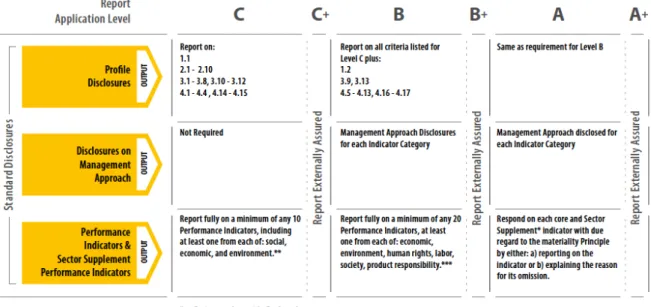
GRI requires companies to declare their GRI Application Level. The different levels are: A+, A, B+, B, C+, and C, reflecting the degree of transparency against GRI’s guidelines addressed in the report. The “+” indicates that external assurance was obtained (refer to section 2.3.4 for further details on external assurance).
When compiling an inaugural GRI-based corporate sustainability report, an
organization should consider using a Level C Report Application Level. A Level C report is simpler than other levels, requiring reporting on just a minimum of 10 performance indicators and a limited number of profile disclosures. As an organization continues reporting year-after-year, gaining experience and accumulating resources, it may choose to report on further levels. A Level A Report Application Level is the most thorough level and requires
addressing all profile disclosures, to disclose the management approach that was used, and to report on all core performance indicators. A Level C report is an excellent starting point to move on to subsequent reporting periods and to track performance over time.
Figure 6: GRI Application Levels
Source: GRI
As of October 31, 2011, 31% of US reporters have not declared their GRI Application Level, whereas globally, just 18% haven’t declared their level. The reason that companies may be hesitant to declare their Application Level is due to questions regarding the value versus the risk of declaring a level when reporting for the first time (Prizma, 2011).
2.3.4. External Assurance of Corporate Sustainability Reports
Similar to financial reporting, external assurance (commonly known as auditing) is also available for sustainability reports but the practice of obtaining this type of assurance is just beginning. Assurance is not mandatory for sustainability reporting like it is for financial reporting. Nonetheless, third party assurance significantly increases the value of a
sustainability report in terms of quality and credibility of the report to stakeholders. KPMG points out that the use of assurance maintains high standards in sustainability reporting and not getting assurance sends the message that sustainability information is not held in as high regard as financial information (KPMG, 2011). In 2011, 55% of Asian companies, 55% of African companies, 52% of European, 47% of companies in Oceania, 34% of companies in Latin America, and 21% of North American companies obtained external assurance (GRI, 2012).
There are three main types of assurance providers: accounting firms (Big 4),
have an internal auditing department. According to KPMG (2008: 78), “current trends indicate that organizations use formal assurance, third party commentary (often called expert or stakeholder commentary), or some combination of the two to build trust with
stakeholders”.
Once an organization has collected data for the sustainability report, a formal external validation should be considered. When choosing an assurance provider, it is important to choose one with a reliable reputation (KPMG International and SustainAbility Ltd., 2008). An organization can obtain sustainability assurance of a report, assurance of performance data, or both. Factors should be considered such as the cost of assurance and/or verification, as well as whether internal quality assurance processes are already in place – in which case a company may choose to forego external verification. Assurance is represented with a “+” in GRI’s Application Level system. There are various methodologies and levels of assurance however there is no distinction based on the extent that the data has been assured.
The cost of sustainability reporting assurance depends on a number of factors such as the level of assurance engagement to be provided, report format, the organization’s sector, and the number of countries the organization operates in. If an organization is interested in obtaining assurance, it must request a quote directly from the assurance provider who will assess the organization’s needs.
In addition to external assurance, there are consulting companies that provide guidance for various stages of corporate sustainability reporting such as for content
development and design. If an organization that intends to compile an inaugural GRI-based report lacks internal resources to put together a report or is looking for assistance, the company should consider hiring extra support.
2.4. The Resource Based View (RBV) of the Firm
The resource-based view (RBV) of the firm is a leading theory that links organizational resources and capabilities with performance. It is based on the work of
scholars such as Penrose (1959) and Wenerfelt (1984) who defined a coherent resource-based view theory by characterizing the firm as a collection of resources. While subsequent
scholars such as Rumelt (1984) and Dierickx & Cool (1989) went on to expand on
Wenderfelt’s basis for the resource-based view theory, it was Barney (1991) who popularized the theory with his proposition that firm resources which are rare, valuable, inimitable, and
non-substitutable are the ones that create competitive advantages and thus superior
performance. Barney (1996) explained that firm resources include physical assets such as equipment and location, organizational processes, firm attributes, as well as human capital such as capabilities, information and knowledge that are linked to each organization and are key to performance.
Academic literature on the resource-based view makes a distinction between
organizational resources, splitting them into resources and capabilities (Amit & Schoemaker, 1993). Resources refer to fixed assets of a firm such as equipment, land, and stocks
(Wenerfelt, 1989) – essentially all assets whose value can be easily measured (Hall, 1989), as well as intangible assets such as intellectual property and including trademarks, company reputation, and company networks and databases (Hall, 1992). Capabilities, sometimes referred to as invisible assets (Itami, 1987) or intermediate goods (Amit & Schoemaker, 1993), are essentially “the skills of individuals or groups, as well as the organizational routines and interactions through which all the firm’s resources are coordinated” (Grant, 1991). Capabilities are “a special type of resource, specifically an organizationally embedded non-transferable firm-specific resource whose purpose is to improve the
productivity of the other resources possessed by the firm” (Makadok, 2001). Employees hold a critical role by converting a firm’s resource base into something of value by using
capabilities (Williams, 1992).
The resource-based view is influential in recognizing that companies are comprised of various resources and capabilities that are necessary to succeed. This approach should also be applied to various efforts that companies engage in, such as corporate sustainability reporting. It is important to recognize the need of different organizational resources and the capabilities of staff to turn them into something of value – in this case, a corporate
sustainability report.
2.5. Role of Resources and Capabilities in Corporate Sustainability Reporting Studies show that some organizations are put off by the extent of the GRI reporting process. In a study on non-reporting, Martin & Hadley (2008) found implementation factors, including difficulties in collecting data, choice of performance indicators, costs and effort as major deterrents to reporting amongst the “smaller” firms in the UK FTSE 350. Another study that analyzed corporate sustainability reporting found deterrents to reporting to be: the
potentially burdensome process of assessing criteria and methods for inclusion of some topics and not others (materiality), the requirement of stakeholder involvement, considerable
amount of choices to be made for reporting (i.e. type of report, format, means, and external assurance), concern about the disclosure of information that may be sensitive due to its competitive nature, as well as its potential legal implications (Kolk, 2010).
In order to address deterrents to embarking on corporate sustainability reporting, which are identified in the problem statement, and successfully engage in the reporting process, organizations need to allocate specific resources and possess certain capabilities for the effort to be successful.
Based on the stages involved in the corporate sustainability reporting process, a comprehensive analysis of the resources and capabilities that are essential for successfully implementing an inaugural GRI reporting process has been conducted.
2.5.1. Resources Necessary for the Inaugural GRI Reporting Process
Sustainability reporting requires a great deal of organizational effort in order to gather and monitor data, especially in multinational organizations. This can make it a challenging, time consuming and a costly effort. In order to carry out a corporate sustainability reporting process, an organization will need to allocate time, money, people and technology for the effort.
2.5.1.1. Time for the Inaugural Corporate Sustainability Reporting Process
Corporate sustainability reporting is an intensive and time-consuming process. The entire process, which includes activities such as gathering data to report on, meeting with stakeholders, getting an official letter from the CEO, and actually compiling the report can take anywhere from six weeks and up to one year, depending on factors such as the size of
Source: Developed by author
Figure 7: Resources Necessary for a Sustainability Reporting Process
reporting process can be a continuous, year-long process for companies who take the effort seriously (KPMG International and SustainAbility Ltd., 2008).
A sufficient time commitment is necessary in order to obtain accurate and useful data. It will be necessary to leverage internal talent to implement all the steps necessary for the reporting process, as well as to compensate them for their time. The staff time necessary will depend on the size of the organization, as well as the GRI Application Level. How
frequently should a sustainability report be published? Most companies report on an annual basis (KPMG International and SustainAbility Ltd., 2008).
2.5.1.2. Money for the Inaugural Corporate Sustainability Reporting Process
A budget is necessary as a number of costs are associated with producing a GRI-based corporate sustainability report. An organization will incur internal staffing costs and varying costs depending on the chosen approach to report production, format, design, PR, marketing, possible printing and whether the organization chooses to obtain external
assurance and/or verification of data. An organization will have the option of producing the report internally or outsourcing the task and will also need to plan for costs associated with the format of the final published report– whether to print it on glossy paper, have it available online, or both.
As we can see from above, costs will vary based on numerous factors. Furthermore, if a company already has systems in place to gather data, even if the system isn’t yet
gathering all the data required for the sustainability reporting process, the costs should not be very high although, adaptions will most likely be required. Otherwise, costs for systems to gather information may be expensive.
GRI points out that particularly in the case of small companies, there will most likely be extra staffing costs. Companies that have a small number of staff will need to plan well and may require extra help when undertaking the reporting process for the first time (GRI Learning Series, 2008). Furthermore, companies should consider external support for the production of the inaugural corporate sustainability report if established timelines aren’t being met or if there are insufficient staff to compile the report.
2.5.1.3. People for the Inaugural Corporate Sustainability Reporting Process
The sustainability reporting implementation process requires involvement and coordination of multiple staff with various levels of engagement. For successful
implementation, it is necessary to have involvement of the CEO, CFO, Board of Directors, and other senior management. Functional support is necessary, as well as collaboration between various departments in order to gather the necessary data.
Some large global firms who have compiled sustainability reports note that they get such a large number of questionnaires relating to sustainability to respond to that it can be a full-time job for staff just to respond. Data needs to be tailored for each particular survey or the firm risks ending up with a lower ranking. Therefore, it may be necessary to establish new roles in order to successfully engage in corporate sustainability reporting.
In 2010, the U.S. Securities & Exchange Commission (SEC) issued guidance to companies regarding their responsibility to disclose material risks related to climate change. The guidance notes that a company's CEO and CFO must certify that the company has installed controls and procedures enabling it to do so. The guidance places sustainability high up in the management agenda.
Eighty-six percent of large companies have at least one employee working full-time on sustainability. Interestingly, there is no consistency as to which department sustainability professionals report to directly – it varies between public affairs, operations, marketing, HR, or general counsel. This inconsistency is not necessarily negative since sustainability professionals need to work across functions (GreenBiz.com, 2012).
If the internal resources to put together a report are unavailable, some companies hire external support for the areas that are lacking. Consulting services are available for various stages of corporate sustainability reporting such as content development, design, and verification.
2.5.1.3.1. Roles in the Inaugural Corporate Sustainability Reporting Process
Prior to undertaking a sustainability reporting process in an organization, senior management needs to get everyone on the same page to ensure a smooth process and so that each department involved is able to see the big picture. Upon the corporate sustainability reporting process commencing, an organization needs to designate a senior-level professional