Erica Lima Costa de Menezes
Universidade Federal de Santa Catarina. Florianópolis, SC, Brasil. E-mail: [email protected]
Magda Duarte dos Anjos Scherer Universidade de Brasília. Brasília, DF, Brasil. E-mail: [email protected]
Marta Inez Verdi
Universidade Federal de Santa Catarina. Florianópolis, SC, Brasil. E-mail: [email protected]
Denise Pires de Pires
Universidade Federal de Santa Catarina. Florianópolis, SC, Brasil. E-mail: [email protected]
Manners of producing care and universality of
access in primary health care
Modos de produzir cuidado e a universalidade do acesso na
atenção primária à saúde
Correspondence
Magda Duarte dos Anjos Scherer
Universidade de Brasília. Colina Bloco G, ap. 101, Asa Norte. Brasília, DF, Brasil. CEP 70904-107.
Abstract
This study is a literature review in the SciELO, Lilacs, BVS, and Medline databases, aiming to analyze how the work of professionals in primary health care in Brazil contributes to the universal access to health services. Of 901 articles, 52 were included, published between January 2005 and
October 2015. The findings evidence elements of the work that influence its ability to ensure access,
related to manners of producing care that extend access to health actions. The following elements are highlighted: labor standards; spaces that promote encounters (hosting, home visits, matrix support, and collective activities); training/experience of the worker; relationship with the user and with the territory; bond and accountability; respect for autonomy and different types of knowledge and culture; knowledge of local reality; workload; and professional valuation/satisfaction. The manners of producing care described contribute to extend the access, both for the existence of trust, bond, and ability to respond to the demands presented by users, as for the organization of services so they
become more flexible and attentive to the health
needs of individual and collective subjects.
Resumo
Este artigo faz uma revisão da literatura nas bases SciELO, Lilacs, BVS e Medline, e analisa como o
trabalho dos profissionais na atenção primária
no Brasil contribui para o acesso universal aos
serviços de saúde. De uma seleção inicial de 901
artigos, foram incluídos 52, publicados entre janeiro de 2005 e outubro de 2015. Os achados
evidenciam elementos do trabalho que influenciam a capacidade do serviço em assegurar o acesso,
relacionados a modos de produzir cuidado
que ampliam o acesso às ações de saúde. São
destacados os seguintes elementos: normativas
prescritoras do trabalho; espaços que favorecem
o encontro (acolhimento, visitas domiciliares,
apoio matricial e atividades coletivas); formação/ experiência do trabalhador; relação com o usuário e com o território; vínculo e responsabilização;
respeito à autonomia e aos diferentes saberes e culturas; conhecimento da realidade local; carga de
trabalho; e valorização/satisfação profissional. Os
modos de produzir cuidado descritos contribuem
para a ampliação do acesso, tanto pela existência de confiança, vínculo e capacidade de dar resposta às demandas apresentadas pelos usuários, como pela organização de serviços mais flexíveis e atentos às necessidades de saúde dos sujeitos
individuais e coletivos.
Palavras-chave: Atenção Primária à Saúde; Acesso
aos Serviços de Saúde; Assistência à Saúde.
1 BRASIL. MINISTÉRIO DA SAÚDE. Portal do Departamento de Atenção Básica. Available in: <https://goo.gl/GRdLa5>. Access on: Feb 8, 2017.
Introduction
The universality of access to health services at all levels of assistance is one of the organizational
and doctrinal principles of the Brazilian Unified
Health System (SUS) with strong ethical grounding. To enable the universal right to health, it is necessary to carry out a set of actions ensured
through the legal framework. The definition of this
right in the Brazilian Constitution of 1988 results from an important dispute between segments of the Brazilian population to address the unequal
access, identified as one of the serious problems in
to health services is a reason for international concern. It has been used as analytical category in researches on the organization of health systems and services, so that it can contribute to effective changes in the model of care focused on the singularities of individuals and collectivities, and must be considered at the time of construction of public policies (Assis; Jesus, 2012).
Access is related to the multidimensional capacity of health services and systems for
responding to the health needs of users, configuring
itself as one of the essential pre-requirement for the good quality of health care that relates to cultural, geographical, social, and economic aspects, such as the living conditions of the population, nutrition, housing, income, and education, in addition to aspects concerning the organization of services (Assis; Jesus, 2012). Also, the way the work of professionals is performed, and in what conditions, as well as how the standards and values that guide
them influence the capacity of services and systems
to ensure universal access.
The different Brazilian realities, whether social, economic, or forms of service organization, promote different manners of producing care which, in turn, will interfere in different ways on the universality of access. This reality indicates a dimension of analysis of universality of access related to how employees manage what is prescribed by labor standards, in a dialectical relationship with the context that is always singular, to respond to the demands that arise in the daily work in the
health field. This study analyzes how the work of
professionals in Primary Health Care in Brazil contributes to universal access.
Method
This is a literature review performed on the bases SciELO, Lilacs, BVS, and Medline that included articles about access to health services in primary care, published between January 2005 and October 2015. The question that guided this research was:
how the manner of producing care influences access
to PHC services?
Different combinations of descriptors were tested, being finally used the following: Access to health services AND Primary Health Care OR Family
Health Strategy. 26 articles were found in Medline (via PubMed), 637 in Lilacs, 112 in SciELO, and 126 in the Virtual Health Library (VHL-PHC), totaling 901 articles.
Were included scientific articles about how workers produce care in primary health care and their relationship with the universality of access on PHC in Brazil, written in Portuguese language. Were excluded literature reviews, studies on access to medicines and tests, expansion of coverage, use of services, and those whose data were collected in health information system.
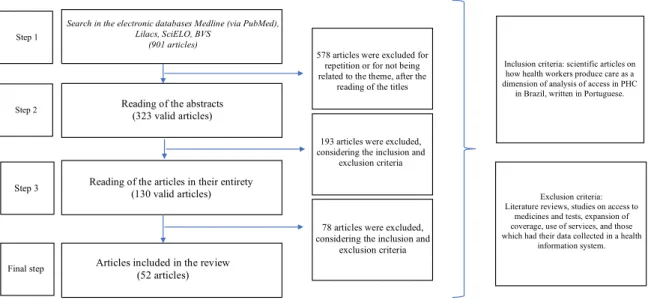
When reading the titles, of the 901 articles found in databases, 578 were excluded by repetition, 193 did not meet the criteria for inclusion after reading of the summaries, and 130 were read in
their entirety. The selection and final inclusion
was paired by two researchers, resulting in 52 articles analyzed in this study. Figure 1 presents
the flow chart of the search, selection, inclusion,
and exclusion of articles.
The data were categorized and organized according to the general aspects of the publication (title, authors, journal, year of publication), methodological characteristics (type of study, study location, and research participants), as showed in Chart 1, in which the articles are presented in numerical order seeking response to the objective of the review. The information was validated at a meeting of consensus with two researchers, coauthors of the article. After systematization of the results, the discussion was structured in: elements
of the work that influence the ability of the service
Figure 1 – Flow chart of the steps of the literature review
Step1
Search in the electronic databases Medline (via PubMed), Lilacs, SciELO, BVS
(901 articles)
578 articles were excluded for repetition or for not being related to the theme, after the
reading of the titles
Step 2
Step3
Finalstep
Reading of the abstracts (323 valid articles)
g
Readin of the articles in their entirety (130 valid articles)
Articles included in the review (52 articles)
193 articles were excluded, considering the inclusion and
exclusion criteria
78articles were excluded,
considering the inclusion and exclusion criteria
Inclusion criteria: scientific articles on how health workers produce care as a dimension of analysis of access in PHC
in Brazil, written in Portuguese.
Exclusion criteria: Literature reviews, studies on access to
medicines and tests, expansion of coverage, use of services, and those which had their data collected in a health
information system.
Results
Of the 52 articles that compose this study (Chart 1), 44 are qualitative, 4 quantitative, 2 theoretical studies, 1 is a single case study, and 1 is a quali-quantitative study. All studies were produced on the PHC in Brazil, and the most of them was held in the Northeast (21), followed by the Southeast (16), South (9), Central-West (1), and North (1). One study was held nationwide, 2 in places not informed, and in 2 the category is not applied. Only one article was published in an international journal. As for the participants of the survey, users are present in 36 of the 52 studies, workers in 21, and managers in 11. The searches were carried out in Family Health Basic Units (FHBU) (19), in traditional Health Basic Units (HBU) (7), in PHC services with or without family health (19) and in Local Health Systems (LHS) (5) (Chart 1).
The articles show elements on organization and completion of work on primary health care
that influence the ability of the service to ensure
access, as well as points manners to produce care with potential to expand access to services. Of the 52 studies included, 15 addressed the organization of the services with ascription of customers, both expanding as reducing access. The proximity of the unit facilitates the access to the actions in the PHC (Burille; Gerhardt, 2014; Lima et al., 2015;
Quinderé et al., 2013; Santos et al., 2012; Schwartz et al., 2010; Silva; Andrade; Bosi, 2014; Souza; Garnelo, 2008), being considered “legitimate
organizational criterion to define the access to
local services” (Trad.; Castellanos; Guimarães, 2012), and contributes to the achievement of activities such as home visits (Quinderé et al., 2013). However, the register on the unit can be an obstacle to the access (Carneiro Junior; Jesus; Crevelim, 2010) and criterion capable of generating situations of discrimination (Martes; Faleiros, 2013), non-assistance (Lima et al., 2015; Viegas; Carmo; Luz, 2015), and disapproval by users (Souza et al., 2008). Living close to the unit by itself does not guarantee that the user will be attended when necessary (Chagas et al., 2014; Quinderé et al., 2013; Silva; Andrade; Bosi, 2014), since for those who spend the day working in distant locations from where they reside, this rule becomes a hindrance (Silva; Benito, 2013) and the possibility to be attended next to the work place would be a facilitator (Lopes et al., 2013).
A study considered important the flexibilization
The organization of the offer of services by spontaneous and/or organized demand also
appears in the review as factor capable to influence
access to health actions. When organized by programmatic actions, it hinders the access in the extent that prioritizes groups and, thus, despises the health needs of the rest of the population or do not organizes the unit to receive other
groups, such as adolescents and men (Araújo et
al., 2013; Barbosa; Elizeu; Penna, 2013; Burille;
Gerhardt, 2014; Cunha; Vieira-Da-Silva, 2010;
Lima; Assis, 2010; Souza; Souzas, 2012; Souza et al., 2008; Souza; Garnelo, 2008; Trad; Castellanos; Guimarães, 2012; Vanderlei; Navarrete, 2013). This
form of organization guarantees access to priority groups (Lanza; Lana, 2011; Silva; Viera, 2014), while its absence makes the user look for the unit by
herself/himself, just when it identifies any need
(Oliveira et al., 2013).
Studies indicate the importance of balance between programmatic actions and attendance to spontaneous demand (Tesser; Norman, 2014),
through strategies such as risk classification (Silva;
Viera, 2014), and draw attention that even users belonging to priority groups may have, at some point in life, acute clinical conditions that require attendance out of schedule (Albuquerque et al., 2014; Vanderlei; Navarrete, 2013).
Chart 1 – Systematization of the results according to general aspects of publication
Order Year Authors Participants Region Type of study
Study Location
1 2015 LIMA, S. A. V. et al. Users, workers, and
managers NE Qualitative LHS
2 2015 ESPOSTI, C. D. D. et al. Users SE Qualitative LHS
3 2015 VIEGAS, A. P. B.; CARMO, R.
F.; LUZ, Z. M. P. Users and workers SE Qualitative PHC
4 2014 SILVA, R. M. M.; VIERA, C. S. Users S Qualitative PHC
5 2014 FINKLER, A. L. et al. Workers NI Qualitative PHC
6 2014 MARIN, M. J. S.; MORACVICK,
M. Y. A. D.; MARCHIOLI, M. Users and workers SE Qualitative PHC
7 2014 CHAGAS, M. I. O. et al. Workers NE Qualitative BHU
8 2014 SILVA, M. Z. N.; ANDRADE, A.
B.; BOSI, M. L. M. Users NE Qualitative PHC
9 2014 AZEVEDO, A. L. M.; GURGEL, I. G. D.; TAVARES, M. A.
Users, workers, and
managers NE Qualitative PHC
10 2014 CAMPOS, R. T. O. et al. Users SE Qualitative BHU
11 2014 BURILLE, A.; GERHARDT, T. E. Users S Qualitative LHS
12 2014 SARTI, T. D. Users and workers SE Qualitative FHBU
Chart 1 – Continuation
Order Year Authors Participants Region Type of study Study Location
13 2014 SOUSA F. O. S. et al. Workers NE Quali-quantitative FHBU
14 2014 ALBUQUERQUE, M. S. V.
et al. Users and workers NE Quantitative PHC
15 2014 TESSER, C. D.; NORMAN,
A. H. NA NA Theoretical study NA
16 2013 SILVA, B. F. S.; BENITO,
G. A. V. Managers SE Qualitative LHS
17 2013 LOPES, L. C. O. et al. Users NE Qualitative BHU
18 2013 ENGEL, R. H. et al. Users S Quantitative PHC
19 2013 ARAÚJO, M. G. et al. Workers NE Qualitative FHBU
20 2013 MARTES, A. C. B.;
FALEIROS, S. M. F. Users SE Qualitative FHBU
21 2013 VANDERLEI, L. C. M.; NAVARRETE, M. L. V.
Users, workers,
and managers NE Qualitative PHC
22 2013 BARBOSA, S. P.; ELIZEU, T.
S.; PENNA, C. M. M. Workers SE Qualitative FHBU
23 2013 QUINDERÉ, P. H. D. et al. Users and
managers NE Qualitative PHC
24 2013 OLIVEIRA, A. A. V. et al. Users NE Quantitative FHBU
25 2012 ASSIS, M. M. A.; JESUS,
W. L. A. NA NA Theoretical study NA
26 2012 OLIVEIRA, L. S. et al. Users NE Qualitative FHBU
27 2012 TADDEO, P. S. et al. Users NE Qualitative FHBU
28 2012 SOUZA, C. L.; SOUZAS R. Users NE Qualitative FHBU
29 2012 NASCIMENTO, P. T. A.;
PEKELMAN R. Users and workers S Qualitative FHBU
30 2012
TRAD, L. A. B.; CASTELLANOS, M. E. P.; GUIMARÃES, M. C. S.
Users NE Qualitative PHC
31 2012 SANTOS, T. M. M. G. et al. Users NE Qualitative FHBU
Chart 1 – Continuation
Order Year Authors Participants Region Type of study Study Location
32 2011 LANZA, F.; LANA, F. C. F. Workers SE Qualitative PHC
33 2011 VARGAS, A. M. D. et al. Users and managers SE Qualitative PHC
34 2011 HINO, P. et al. Users SE Qualitative FHBU
35 2011 CORREA, Á. C. P. et al. Users CE Qualitative FHBU
36 2010 CUNHA, A. B. O.;
VIEIRA-DA-SILVA, L. M.
Users, workers, and managers
NE Single case
study
PHC
37 2010 LIMA, W. C. M. B.; ASSIS,
M. M. A.
Users, workers, and managers
NE Qualitative FHBU
38 2010 SCHWARTZ, T. D. et al. Users SE Qualitative FHBU
39 2010 CARREIRA, L; RODRIGUES, R. A. P.
Users S Qualitative FHBU
40 2010 MEDEIROS, F. A. et al. Users NI Qualitative BHU
41 2010 VIEGAS, S. M. F. et al. Workers and managers
SE Qualitative LHS
42 2010 COIMBRA, V. C. C. et al. Users, workers, and managers
S Qualitative FHBU
43 2010 CARNEIRO JUNIOR, N.; JESUS, C. H.; CREVELIM, M. A.
NA SE Qualitative PHC
44 2009 CERQUEIRA, M. B.; PUPO, L. R.
Users SE Qualitative PHC
45 2009 COELHO, M. O.; JORGE, M. S. B.; ARAÚJO, M. E.
Users NE Qualitative FHBU
46 2009 DALL’AGNOL, C. M.; LIMA, M. A. D. S.; RAMOS, D. D.
Users S Quantitative BHU
47 2008 SOUZA, E. C. F. et al. Users and workers NE Qualitative PHC
48 2008 NASCIMENTO, P. T. A.; TESSER, C. D.; POLI NETO, P.
Workers S Qualitative FHBU
49 2008 SOUZA, M. L. P.; GARNELO, L.
Users and workers N Qualitative PHC
50 2008 SOUSA, M. F. Managers National Qualitative SUS
51 2007 LIMA, M. A. D. S. et al. Users S Qualitative BHU
52 2007 TAKEMOTO, M. L. S.; SILVA, E. M.
Workers and managers
The studies describe the waiting time from the appointment until the medical attendance, and even the own day of medical attendance, as something bureaucratic and time consuming (Burille; Gerhardt, 2014; Campos et al., 2014; Carreira; Rodrigues, 2010; Chagas et al., 2014; Coimbra et al., 2010; Correa et al., 2011; Cunha;
Vieira-Da-Silva, 2010; Esposti et al., 2015; Lima
et al., 2007; Lima et al., 2015; Lopes et al., 2013; Marin; Moracvick; Marchioli, 2014; Oliveira et al., 2012; Schwartz et al., 2010; Silva; Andrade; Bosi, 2014; Silva; Viera, 2014; Souza et al., 2008; Trad; Castellanos; Guimarães, 2012; Viegas; Carmo; Luz, 2015). The system of medical appointments by queues and passwords, resulting in long waiting time and requiring that users arrive very early in the unit to get attendance, was the main factor to limit access regarding the provision of services (Barbosa; Elizeu; Penna, 2013; Coimbra et al.,
2010; Dall’agnol; Lima; Ramos, 2009; Finkler et
al., 2014; Lima; Assis, 2010; Lopes et al., 2013; Sarti, 2014; Silva; Viera, 2014; Sousa et al., 2014; Vargas et al., 2011).
The hours of operation of the unit is one
more element to influence access, having been mentioned in 8 of the 52 review articles (Araújo
et al., 2013; Burille; Gerhardt, 2014; Campos et al., 2014; Correa et al., 2011; Esposti et al., 2015; Lima et al., 2015; Oliveira et al., 2013; Silva; Viera, 2014). The breach of the schedule reduces the access to
health services (Cunha; Vieira-Da-Silva, 2010; Dall’agnol; Lima; Ramos, 2009; Lima et al., 2015;
Silva; Benito, 2013; Silva; Andrade; Bosi, 2014; Trad; Castellanos; Guimarães, 2012), but the existence of the third shift and the attendance on weekends
(Araújo et al., 2013; Lopes et al., 2013; Silva; Benito,
2013)are strategies for broadening [access] for those who work during the day and on weekends.
The ambience is pointed, in three articles, as
the element to influence the access: by promoting
professional satisfaction, improving care, and
expanding access (Coelho; Jorge; Araújo, 2009); as
expectation and attractive so that users feel more comfortable and welcomed in the unit (Esposti et al., 2015); but also as an obstacle, because to transform the environment of the services in a
more “feminine” place limits the access of men
(Araújo et al., 2013).
The presence of Health Community Agents (HCA) in the teams generate enlargement of the bond between health team and users, in addition to facilitate the access (Coimbra et al., 2010; Lanza; Lana, 2011; Lima et al., 2015; Martes; Faleiros, 2013; Oliveira et al., 2012; Sousa, 2008), both for the appointment of medical attendance by this professional in the households (Lima et al., 2015), as for the articulation promoted by HCA between health team and community (Sousa, 2008), or for this professional be part of the community and understand its culture and manners of care (Martes; Faleiros, 2013).
Capacity, training, and qualification of health professionals to act on PHC directly influence the
population’s access to health actions, according to studies that compose this review (Barbosa; Elizeu; Penna, 2013; Carneiro Junior; Jesus; Crevelim, 2010; Hino et al., 2011; Lanza; Lana, 2011; Oliveira et al., 2013; Souza; Garnelo, 2008; Taddeo et al., 2012; Vanderlei; Navarrete, 2013; Viegas et al., 2010).
The professional profile (Araújo et al., 2013) and
the commitment of professionals regarding the attention to certain priority aggravations or to
issues related to the cycles of life also influence
access (Lanza; Lana, 2011; Oliveira et al., 2013). The focus on disease, biological aspects, and curative actions that keep the complaint-oriented attendance, greater attention to acute situations, the centrality in medical appointments (Campos et al., 2014; Coimbra et al., 2010; Esposti et al., 2015; Lima et al., 2015; Souza; Garnelo, 2008; Taddeo et al., 2012), the predominance of requests of specialized procedures, exams, prescription of
drugs and actions held in the medical office (Lima
The perception, by users, that the absence of professionals would be related to the model centered in the appointment and the presence of the medical professional, not recognizing the care produced by other professional categories, is highlighted in four studies (Esposti et al., 2015; Nascimento; Pekelman, 2012; Vanderlei; Navarrete, 2013; Vargas et al., 2011).
Professional experience may facilitate the access when it counts on experienced professionals to act as recommended by the policies (Nascimento; Tesser; Poli Neto, 2008), while ignorance of the regulations can limit it (Souza; Garnelo, 2008).
The disproportion between supply and demand of services is an obstacle to the access, result of the excessive number of families under the
responsibility of the team, the insufficient number
and turnover of doctors and other professionals (Campos et al., 2014; Lima et al., 2015; Marin; Moracvick; Marchioli, 2014; Nascimento; Tesser; Poli Neto, 2008; Schwartz et al., 2010; Silva; Andrade; Bosi, 2014; Silva; Viera, 2014; Trad; Castellanos; Guimarães, 2012), and the breach of
workload (Cunha; Vieira-Da-Silva, 2010; Lima et
al., 2015; Lima; Assis, 2010; Silva; Benito, 2013; Silva; Andrade; Bosi, 2014; Trad; Castellanos; Guimarães, 2012).
Of the 52 studies, 16 consider the reception as transversal strategy to health actions, that must happen in all spaces to guarantee the access with quality (Albuquerque et al., 2014; Assis; Jesus, 2012; Campos et al., 2014; Chagas et al., 2014;
Coelho; Jorge; Araújo, 2009; Coimbra et al., 2010; Correa et al., 2011; Cunha; Vieira-Da-Silva, 2010;
Nascimento; Pekelman, 2012; Nascimento; Tesser; Poli Neto, 2008; Silva; Andrade; Bosi, 2014; Silva; Viera, 2014; Souza et al.; 2008; Takemoto; Silva, 2007; Vanderlei; Navarrete, 2013; Viegas; Carmo; Luz, 2015). However, it is also pointed as capable to restrict access when configured in simple screening of spontaneous demand, when creates obstacles to get the doctor’s appointment or as a kind way to deny answers to the users’ health needs (Campos et al., 2014; Nascimento; Pekelman, 2012; Souza et al., 2008; Takemoto; Silva, 2007; Tesser; Norman, 2014).
In addition to clinical care, an important space of meeting between team and user, home visits (Carreira; Rodrigues, 2010; Coimbra et al., 2010; Correa et al., 2011; Lanza; Lana, 2011; Martes; Faleiros, 2013; Oliveira et al., 2013; Quinderé et al., 2013; Santos et al., 2012), group activities (Carreira; Rodrigues, 2010; Chagas et al., 2014; Lima et al., 2007), educational activities (Silva; Benito, 2013), matrix support (Souza et al., 2008), and the collective attendances in and out of the unit (Barbosa; Elizeu; Penna, 2013) stimulate the expansion of access.
Respect for knowledge, inclusion of singularities – cultural issues, values, beliefs of users (Assis; Jesus, 2012; Azevedo; Gurgel; Tavares, 2014; Carneiro Junior; Jesus; Crevelim, 2010; Carreira; Rodrigues, 2010; Silva; Andrade; Bosi, 2014;
Taddeo et al., 2012), – to the needs (Araújo et al.,
2013; Burille; Gerhardt, 2014; Campos et al., 2014; Carneiro Junior; Jesus; Crevelim, 2010; Chagas et
al., 2014; Coelho; Jorge; Araújo, 2009; Esposti et
al., 2015; Lima et al., 2007; Medeiros et al., 2010; Souza et al., 2008; Souza; Garnelo, 2008; Takemoto; Silva, 2007), and the knowledge of local reality (Carneiro Junior; Jesus; Crevelim, 2010; Chagas
et al., 2014; Coelho; Jorge; Araújo, 2009; Santos
et al., 2012; Souza; Garnelo, 2008; Vanderlei; Navarrete, 2013) were identified as important elements to guarantee access. The listening, the
bond, the confidence, the sympathy (Assis; Jesus,
2012; Burille; Gerhardt, 2014; Campos et al., 2014; Carneiro Junior; Jesus; Crevelim, 2010; Carreira; Rodrigues, 2010; Cerqueira; Pupo, 2009; Chagas et
al., 2014; Coelho; Jorge; Araújo, 2009; Dall’agnol;
Lima; Ramos, 2009; Esposti et al., 2015; Hino et al., 2011; Lima et al., 2007; Medeiros et al., 2010; Nascimento; Pekelman, 2012; Nascimento; Tesser; Poli Neto, 2008; Oliveira et al., 2012; Silva; Andrade; Bosi, 2014; Souza et al., 2008; Souza; Garnelo, 2008; Taddeo et al., 2012; Takemoto; Silva, 2007; Viegas et al., 2010), the dialogue, and the communication (Barbosa; Elizeu; Penna, 2013; Esposti et al., 2015; Schwartz et al., 2010; Silva; Andrade; Bosi, 2014; Souza et al., 2008) between users and professionals must be present in the various meetings to qualify
the access. These elements influence the choice of
Discrimination by race and socioeconomic
condition (Trad; Castellanos; Guimarães, 2012), by being a foreigner in the country (Martes; Faleiros, 2013), and the prejudice of health professionals against a few aggravations (Lanza; Lana, 2011) were pointed as obstacles for obtaining care in health units.
The studies showed that the limitation of access was also caused because by the need of workers to reduce the suffering and the work overload. The overwork due to incomplete team, lack of professionals (Silva; Viera, 2014), and pent-up demand (Chagas et al., 2014; Lima et al., 2015; Marin; Moracvick; Marchioli, 2014; Medeiros et al., 2010; Nascimento; Pekelman, 2012; Nascimento; Tesser; Poli Neto, 2008; Sarti, 2014; Schwartz et al., 2010; Silva; Andrade; Bosi, 2014; Sousa et al., 2014; Souza et al., 2008; Viegas et al., 2010), the conditions and structure of the unit (Coelho; Jorge;
Araújo, 2009; Medeiros et al., 2010; Sarti, 2014)),
low wages, and the lack of professional valuation mechanisms (Sarti, 2014) were indicated as factors that generate stress and reduce the quality of the actions.
Other important points that emerged in the studies and interfered in the access by increasing the workload of health professionals were the need to work in teams (Correa et al., 2011; Takemoto; Silva, 2007), increased responsibility in giving answers to users when extends the listening and the access, and the inability to respond to all requirements of the population (Barbosa; Elizeu; Penna, 2013; Nascimento; Pekelman, 2012; Souza et al., 2008; Takemoto; Silva, 2007).
These situations make workers to not give continuity to the practice of hosting, to reduce working time in the units, and even to leave the service by overload, stress, and desire for time off (Sarti, 2014), reducing the number of attendances, restricting team actions to the activities within the unit (Lima et al., 2015; Souza et al., 2008; Souza; Garnelo, 2008), with priority for medical-healing attendances (Souza; Garnelo, 2008),and the development of activities in a mechanical
and superficial way (Takemoto; Silva, 2007), less
welcoming and humanized (Finkler et al., 2014).
In addition, more and more new responsibilities (“programs”, “policies”, “lines of care”, “functions”)
dedicated to diseases, groups, problems, or specific
situations are created or devolved to the PHC/FHS (Tesser; Norman, 2014). Urban violence (Viegas et al., 2010), professional dissatisfaction with daily practices, low wages (Trad; Castellanos; Guimarães, 2012), the little autonomy to decide the actions deployed (Barbosa; Elizeu; Penna, 2013; Nascimento; Pekelman, 2012),and the social imaginary of the low quality of public services (Sarti, 2014) also emerged as factors that decrease the supply of services and limit access. However, some workers, when taking greater responsibility, feel valued and recognized (Takemoto; Silva, 2007). Associated to the elements described here, manners of producing care to guarantee the access are revealed in the studies analyzed, highlighting values such as solidarity (Assis; Jesus, 2012; Medeiros et al., 2010; Sarti, 2014; Tesser; Norman, 2014), justice (Lima; Assis, 2010), health as a right (Schwartz et al., 2010; Silva; Andrade; Bosi, 2014; Takemoto; Silva, 2007), humanization of assistance
(Dall’agnol; Lima; Ramos, 2009; Finkler et al., 2014; Takemoto; Silva, 2007), responsibility (Araújo et
al., 2013; Barbosa; Elizeu; Penna, 2013; Finkler et al., 2014; Lima et al., 2007; Takemoto; Silva, 2007), and equality (Trad; Castellanos; Guimarães, 2012) as key elements to expand and ensure access and quality of health actions.
Discussion
Of the 52 studies, 38 addressed care produced in Family Health Units in an isolated way or in comparison with the Traditional Basic Units, which shows greater interest of the authors in discussing the work of family health teams, probably for being a priority strategy in SUS for expanding and qualifying PHC services in Brazil. The predominance of qualitative studies can be explained by the fact that it is a theme that requires listening to the protagonists of the work.
The findings of the review show elements
of the work which influence the ability of the
actions resulting from dialectic relationship between the environment, the worker, and the user of the services.
The results highlight the following elements: labor standards; spaces that promote meeting (hosting, home visits, matrix support, and collective activities); training/experience of the worker; relationship with the user and with the territory; bond and accountability; respect for autonomy and different types of knowledge and culture; knowledge of local reality; workload; and professional valuation/satisfaction.
The standards related to modes of organization of services in the units, such as ascription of customers, teamwork, hours of operation of the BHU/FHU, the supply of actions by spontaneous or scheduled demand, sometimes facilitate, sometimes limit the access. Users prefer services whose previous experience was positive, those closest to their home or work; which dedicate time to listen to their demands, and to explain the procedures that will be carried out, and are
dissatisfied with the time remaining in the waiting
room, the hours of operation of the unit, the agility to solve the problems, and the lack of freedom
to choose the professionals, like the findings of
the study of Ferreira, Raposo and Pisco (2017) that indicate that these aspects were the worst evaluated by users.
The standards set the limits of what is lawful and what is prohibited, expression of what one
instance evaluates as “must be” (Durrive, 2011).
This instance can be exterior to the workers or include them. In the context of the PHC, standards are fundamental to guide practices associated with the autonomy of teams, to adjust actions according to the singularities of the cases, individuals, and
communities (Carrapiço; Ramires; Ramos, 2017).
However, this adjustment must not dispense the consideration for the needs of the users.
From the point of view of the attention model, the review corroborates the study of Franco and Merhy (2007) that indicates the coexistence of structural changes proposed to the PHC and the FHS with the maintenance of medical-centered practices, focused on disease, procedures, and the request of examinations that increase the demand
and reduce access to health services. Training and
qualification of workers are determining factors
to change the way health teams work through “new technical knowledge, new technological settings of the health work, as well as other micro politics for this job” (Franco; Merhy, 2007, p. 115-116). Health units must strengthen themselves as learning institutions whose knowledge is a collective production that results in protection
and satisfaction for workers (Carrapiço; Ramires;
Ramos, 2017).
We must act, thus, based on two distinct types of knowledge. On one hand, in the academic,
scientific knowledge, from protocols that promote
changes in the training of health professionals. And, on the other hand, in not written and not formalized knowledge, resulting from the experience of the work activity (Trinquet, 2010), from the organization, for example, of training actions on the unit itself, and the use of digital technologies to exchanges and survey of training needs (Biscaia; Heleno, 2017) contributing to the construction of agile, responsive, and technically
qualified health acts.
For Schwartz (2000, p. 485) “each work activity is always, to some degree, on one hand, describable as experimental protocol and, on the other hand, experience and meeting.” Meetings that produce bond, co-responsibility, listening, hosting, which dialogues with the knowledge of users, which knows the local reality, and that are attentive to the needs of users and health professionals appear in the studies as being capable of extending the access, both for promote the expansion of the clinic (Cunha, 2005), as for comprise the symbolic dimension of “perceptions, ideas, and action of the subject; social representations of health-disease process; social representations of how the health system is organized to meet the needs” (Jesus; Assis, 2010, p. 164).
caution must be produced from different types of knowledge.
Home visits, group work, and collective actions appear as spaces capable to broaden access, being hosting the most used device among health teams. However, the practice of hosting, while recognizes the right to health, also disregards this constitutional guarantee (Brehmer; Verdi,
2010) when, for example, is configured as a “nice
way” to deny access to medical consultations or as simple triage of cases to be attended in the units
at specific times to happen.
The organization of demand that limits access and reduces the number of daily attendances, the high number of referrals to specialists, the delay to reach the unit, to not follow the actions, and focus
on activities within the office may be reflections
of the overload and the workers’ search for greater job satisfaction, either by fear of violence, by low wages and precarious bonds, by dissatisfaction with the function they perform or the desire for some time off, as cited in articles of this review. Research conducted in three regions of Brazil pointed out that work overload associated with the excessive demand and overrated territory
were the most significant elements to increase the
workloads of nursing professionals, affecting the effectiveness, the quality of care, and the access to services (Pires et al., 2016).
Health acts, when promoting exchange and team production, satisfaction, and professional appreciation, qualify the care and extend access, according to selected articles. These results
corroborate the study of Carrapiço, Ramires
and Ramos (2017), which adds that teamwork, in addition to optimize the actions and help to prevent or reduce the incidence of burnout, promotes exchange and scientific update among professionals. In “teams with human and professional dimension and diversity, with personality and name of their own, where there is sense of belonging [...], perception of the results achieved [...] and external recognition,
health outcomes are better evaluated” (Carrapiço;
Ramires; Ramos, 2017, p. 697).
To evaluate the work and estimate how much it contributes to expand access to health services
is not simple. Health work is facing complex and variable needs, being impossible to be standardized in its entirety; it is performed by a heterogeneous group of workers, depending on the socio-political conditions and requiring constant negotiation in the context of disputes of various interests (Scherer et al., 2013). In addition, professionals need always to confront labor standards with the requirements of the concrete situations of life for users who require care, which puts them in a discussion of standards and values that will generate choices, that is, certain manners of producing care.
To prioritize the users that need it the most; to act in a planned way; to execute actions beyond the walls of the unit; to provide information, and to contribute to expanding people’s autonomy were also reported as manners of producing care, crossed by certain set of values capable to expand access. The values are permanently present in human activity. The prioritization of values, such as the protection of life, health as a right, valuation of knowledge, experience, and autonomy of the users, understanding the other as a similar, they all tend to guide the manners of producing care that contribute to more creative actions and that qualify the PHC, according to Scherer and Menezes (2016), in addition to being in line with the values highlighted in this review. Common values are necessary for performing actions that extend access by contributing to the production of health acts with equity, focusing attention on the user and prioritizing those who are most in need.
References
ALBUQUERQUE, M. S. V. et al. Acessibilidade aos
serviços de saúde: uma análise a partir da atenção básica em Pernambuco. Saúde em Debate, Rio de
Janeiro, v. 38, p. 182-194, 2014. Número especial. ARAÚJO, M. G. et al. Acesso da população
masculina aos serviços de saúde: perspectiva dos profissionais da Estratégia Saúde da Família. Revista de Pesquisa, Rio de Janeiro, v. 5, n. 4, p. 475-484, 2013.
ASSIS, M. M. A.; JESUS, W. L. A. Acesso aos
Coletiva, Rio de Janeiro, v. 17, n. 11, p. 2865-2875, 2012.
AZEVEDO, A. L. M.; GURGEL, I. G. D.; TAVARES, M. A. O poder de acessar a saúde: uma análise do acesso à saúde na etnia indígena Xukuru do Ororubá, Pesqueira (PE).
Cadernos de Saúde Coletiva, Rio de Janeiro, v.
22, n. 3, p. 275-280, 2014.
BARBOSA, S. P.; ELIZEU, T. S.; PENNA, C. M. M.
Ótica dos profissionais de saúde sobre o acesso à atenção primária à saúde. Ciência & Saúde Coletiva, Rio de Janeiro, v. 18, n. 8, p. 2347-2357, 2013.
BISCAIA, A. R.; HELENO, L. C. V. A reforma
dos cuidados de saúde primários em Portugal:
portuguesa, moderna e inovadora. Ciência & Saúde Coletiva, Rio de Janeiro, v. 22, n. 3, p. 701-712, 2017.
BREHMER, L. C. F.; VERDI, M. Acolhimento na atenção básica: reflexões éticas sobre a atenção à saúde dos usuários. Ciência & Saúde Coletiva, Rio de Janeiro, v. 15, p. 3569-3578, 2010. Suplemento 3.
BURILLE, A.; GERHARDT, T. E. Doenças crônicas, problemas crônicos: encontros e desencontros com os serviços de saúde em itinerários
terapêuticos de homens rurais. Saúde e Sociedade, São Paulo, v. 23, n. 2, p. 664-676, 2014.
CAMPOS, R. T. O. et al. Avaliação da qualidade do acesso na atenção primária de uma grande cidade brasileira na perspectiva dos usuários. Saúde em Debate, Rio de Janeiro, v. 38, p. 252-264, 2014.
Número especial.
CARNEIRO JUNIOR, N.; JESUS, C. H.; CREVELIM,
M. A. A Estratégia Saúde da Família para a equidade de acesso dirigida à população em situação de rua em grandes centros urbanos. Saúde e Sociedade, São Paulo, v. 19, n. 3, p. 709-716, 2010.
CARRAPIÇO, E. I. N.; RAMIRES, J. H. V.; RAMOS,
V. M. B. Unidades de Saúde Familiar e Clínicas da Família: essência e semelhanças. Ciência & Saúde Coletiva, Rio de Janeiro, v. 22, n. 3, p. 691-700, 2017.
CARREIRA, L.; RODRIGUES, R. A. P. Dificuldades dos familiares de idosos portadores de doenças crônicas no acesso à unidade básica de saúde.
Revista Brasileira de Enfermagem, Brasília, DF, v.
63, n. 6, p. 933-999, 2010.
CERQUEIRA, M. B.; PUPO, L. R. Condições e modos
de vida em duas favelas da Baixada Santista
e suas interfaces com o acesso aos serviços de saúde. Revista Baiana de Saúde Pública, Salvador, v. 33, n. 2, p. 214-230, 2009.
CHAGAS, M. I. O. et al. Acesso dos usuários aos serviços de saúde na Estratégia Saúde da Família: percepção dos enfermeiros. Revista de APS, Juiz de Fora, v. 17, n. 3, p. 280-290, 2014.
COELHO, M. O.; JORGE, M. S. B.; ARAÚJO, M. E. O acesso por meio do acolhimento na atenção básica à saúde. Revista Baiana de Saúde Pública, Salvador, v. 33, n. 3, p. 440-452, 2009.
COIMBRA, V. C. C. et al. Avaliação da estrutura: processo de acesso de usuários a uma unidade de saúde da família. Revista de Pesquisa, Rio de Janeiro, v. 2, n. 3, p. 1095-1107, 2010.
CORREA, À. C. P. et al. Acesso a serviços de saúde: olhar de usuários de uma unidade de saúde da
família. Revista Gaúcha de Enfermagem, Porto Alegre, v. 32, n. 3, p. 451-457, 2011.
CUNHA, A. B. O.; VIEIRA-DA-SILVA, L. M. Acessibilidade aos serviços de saúde em um
município do estado da Bahia, Brasil, em gestão plena do sistema. Cadernos de Saúde Pública, Rio de Janeiro, v. 26, n. 4, p. 725-737, 2010.
CUNHA, G. T. A construção da clínica ampliada na
atenção básica. São Paulo: Hucitec, 2005.
DALL’AGNOL, C. M.; LIMA, M. A. D. S.; RAMOS, D. D. Fatores que interferem no acesso de usuários a um ambulatório básico de saúde. Revista Eletrônica de Enfermagem, Goiânia, v. 11, n. 3, p. 647-680, 2009.
DURRIVE, L. A atividade humana,
simultaneamente intelectual e vital:
ENGEL, R. H. et al. Acessibilidade geográfica e organizacional: obstáculos entre usuários com tuberculose e os serviços de saúde. Revista de
Enfermagem da UFSM, Santa Maria, v. 3, n. 2, p.
307-314, 2013.
ESPOSTI, C. D. D. et al. Representações sociais
sobre o acesso e o cuidado pré-natal no sistema
único de saúde da região metropolitana da Grande
Vitória, Espírito Santo. Saúde e Sociedade, São Paulo, v. 24, n. 3, p. 765-779, 2015.
FERREIRA, P. L.; RAPOSO, V. M.; PISCO, L. A voz
dos utilizadores dos cuidados de saúde primários
da região de Lisboa e Vale do Tejo, Portugal.
Ciência & Saúde Coletiva, Rio de Janeiro, v. 22, n. 3, p. 747-758, 2017.
FINKLER, A. L. et al. O acesso e a dificuldade na resolutividade do cuidado da criança na atenção primária à saúde. Acta Paulista de Enfermagem, São Paulo, v. 27, n. 6, p. 548-553, 2014.
FRANCO, T. B.; MERHY, E. E. Programa de
Saúde da Família (PSF): contradições de um programa destinado à mudança do modelo
tecnoassistencial. In: MERHY, E. E. et al. O
trabalho em saúde: olhando e experienciando o
SUS no cotidiano. 4. ed. São Paulo: Hucitec, 2007. p. 55-124.
GIOVANELLA, L.; FLEURY, S. Universalidade
da atenção à saúde: acesso como categoria de análise. In: EIBENSCHUTZ, C. (Org.). Política de saúde: o público e o privado. Rio de Janeiro:
Fiocruz, 1995. p. 177-198.
HINO, P. et al. As necessidades de saúde e
vulnerabilidade de pessoas com tuberculose
segundo as dimensões acesso, vínculo e adesão.
Revista da Escola de Enfermagem da USP,
São Paulo, v. 45, p. 1656-1660, 2011. Número
especial 2.
JESUS, W. L. A.; ASSIS, M. M. A. Revisão
sistemática sobre o conceito de acesso nos serviços de saúde: contribuições do planejamento. Ciência & Saúde Coletiva, Rio de Janeiro, v. 15, n. 1, p. 161-170, 2010.
LANZA, F.; LANA, F. C. F. Acesso às ações de controle da hanseníase na atenção primária à
saúde em uma microrregião endêmica de Minas
Gerais. Revista de APS, Juiz de Fora, v. 14, n. 3, p. 343-353, 2011.
LIMA, M. A. D. S. et al. Acesso e acolhimento em unidades de saúde na visão dos usuários. Acta Paulista de Enfermagem, São Paulo, v. 20, n. 1, p. 12-17, 2007.
LIMA, S. A. V. et al. Elementos que influenciam o acesso à atenção primária na perspectiva dos profissionais e dos usuários de uma rede de serviços de saúde do Recife. Physis: Revista de Saúde Coletiva, Rio de Janeiro, v. 25, n. 2, p. 635-656, 2015.
LIMA, W. C. M. B.; ASSIS, M. M. A. Acesso restrito
e focalizado ao programa saúde da família em
Alagoinhas, Bahia, Brasil: demanda organizada
para grupos populacionais específicos × demanda espontânea. Revista Baiana de Saúde Pública, Salvador, v. 34, n. 3, p. 439-449, 2010.
LOPES, L. C. O. et al. A acessibilidade do homem
ao serviço de saúde após a implantação do Programa Nacional de Saúde do Homem: uma
realidade presente? Revista de APS, Juiz de Fora, v. 16, n. 3, p. 226-233, 2013.
MARIN, M. J. S.; MORACVICK, M. Y. A. D.; MARCHIOLI, M. Acesso aos serviços de saúde: comparação da visão de profissionais e usuários da atenção básica. Revista Enfermagem UERJ, Rio de Janeiro, v. 22, n. 5, p. 629-636, 2014.
MARTES, A. C. B.; FALEIROS, S. M. Acesso dos
imigrantes bolivianos aos serviços públicos de saúde na cidade de São Paulo. Saúde e Sociedade, São Paulo, v. 22, n. 2, p. 351-364, 2013.
MEDEIROS, F. A. et al. Acolhimento em uma unidade básica de saúde: a satisfação do usuário
em foco. Revista de Salud Pública, Bogotá, DC, v.
12, n. 3, p. 402-413, 2010.
NASCIMENTO, P. T. A.; PEKELMAN, R. Acesso e acolhimento: “ruídos” e escutas nos encontros
NASCIMENTO, P. T. A.; TESSER, C. D.; POLI NETO, P. Implantação do acolhimento em uma unidade local de saúde de Florianópolis. Arquivos Catarinenses de Medicina, Florianópolis, v. 37, n. 4, p. 32-34, 2008.
OLIVEIRA, A. A. V. et al. Diagnóstico de
tuberculose em pessoas idosas: barreiras de
acesso relacionadas aos serviços de saúde.
Revista da Escola de Enfermagem da USP, São
Paulo, v. 47, n. 1, p. 145-151, 2013.
OLIVEIRA, L. S. et al. Acessibilidade a atenção básica em um distrito sanitário de Salvador. Ciência & Saúde Coletiva, Rio de Janeiro, v. 17, n. 11, p. 3047-3056, 2012.
PIRES, D. E. P. et al. Cargas de trabalho da
enfermagem na saúde da família: implicações
no acesso universal. Revista Latino-Americana de Enfermagem, Ribeirão Preto, v. 24, 2016.
Não paginado. Disponível em: <https://goo.gl/
XM3SQZ>. Acesso em: 21 nov. 2017.
QUINDERÉ, P. H. D. et al. Acessibilidade e resolubilidade da assistência em saúde mental: a
experiência do apoio matricial. Ciência & Saúde, Rio de Janeiro, v. 18, n. 7, p. 2157-2166, 2013.
SANTOS, T. M. G. et al. O acesso ao diagnóstico e ao tratamento de tuberculose em uma capital do nordeste brasileiro. Revista Enfermagem UERJ, Rio de Janeiro, v. 20, n. 3, p. 300-305, 2012.
SARTI, T. D. A marcação de consulta médica em uma unidade de saúde da família: uma etnografia a respeito dos conflitos entre usuários e profissionais de saúde. Revista de APS, Juiz de Fora, v. 17, n. 3, p. 362-372, 2014.
SCHERER, M. D. A.; MENEZES, E. L. C.
Atenção primária à saúde: espaço potencial de
criatividade. Revista Tempus: Actas de Saúde Coletiva, Brasília, DF, v. 10, n. 3, p. 137-146, 2016.
SCHERER, M. D. A. et al. A construção da
interdisciplinaridade no trabalho da Equipe de
Saúde da Família. Ciência & Saúde Coletiva, Rio de Janeiro, v. 18, n. 11, p. 3203-3212, 2013.
SCHWARTZ, T. D. et al. Estratégia Saúde da
Família: avaliando o acesso ao SUS a partir da
percepção dos usuários da unidade de saúde de
resistência, na região de São Pedro, no município de Vitória (ES). Ciência e Saúde Coletiva, Rio de Janeiro, v. 15, n. 4, p. 2145-2154, 2010.
SCHWARTZ, Y. Os ingredientes da
competência: um exercício necessário para
uma questão insoluvel. Educação e Sociedade, Campinas, v. 19, n. 65, 1998. Não paginado.
Disponível em: <https://goo.gl/VyqSCr>. Acesso
em: 1º dez 2017.
SILVA, B. F. S.; BENITO, G. A. V. A voz de gestores
municipais sobre o acesso à saúde nas práticas de
gestão. Ciência & Saúde Coletiva, Rio de Janeiro, v. 18, n. 8, p. 2189-2200, 2013.
SILVA, M. Z. N.; ANDRADE, A. B.; BOSI, M. L. M.
Acesso e acolhimento no cuidado pré-natal à luz
de experiências de gestantes na atenção básica. Saúde em Debate, Rio de Janeiro, v. 38, n. 103, p. 805-816, 2014.
SILVA, R. M. M.; VIERA, C. S. Acesso ao cuidado à
saúde da criança em serviços de atenção primária.
Revista Brasileira de Enfermagem, Brasília, DF, v.
65, n. 5, p. 794-802, 2014.
SOUSA, F. O. S. et al. Do normativo à realidade do sistema único de saúde: revelando barreiras de
acesso na rede de cuidados assistenciais. Ciência & Saúde Coletiva, Rio de Janeiro, v. 19, n. 4, p. 1283-1293, 2014.
SOUSA, M. F. O programa saúde da família no Brasil: análise do acesso à atenção básica. Revista Brasileira de Enfermagem, Brasília, DF, v. 61, n. 2,
p. 153-158, 2008.
SOUZA, C. L.; SOUZAS, R. Juventude e saúde: análise
do discurso sobre oferta e acesso aos equipamentos
e serviços. Revista Brasileira de Enfermagem,
Brasília, DF, v. 65, n. 6, p. 922-928, 2012.
SOUZA, E. C. F. et al. Acesso e acolhimento na
atenção básica: uma análise da percepção dos usuários e profissionais de saúde. Cadernos de Saúde Pública, Rio de Janeiro, v. 24, p. S100-S110, 2008. Suplemento 1.
SOUZA, M. L. P.; GARNELO, L. “É muito
dificultoso!”: etnografia dos cuidados a pacientes com hipertensão e/ou diabetes na atenção básica,
Pública, Rio de Janeiro, v. 24, p. S91-S99, 2008. Suplemento 1.
TADDEO, P. S. et al. Acesso, prática educativa e empoderamento de pacientes com doenças crônicas. Ciência & Saúde Coletiva, Rio de Janeiro, v. 17, n. 11, p. 2923-2930, 2012.
TAKEMOTO, M. L. S.; SILVA, E. M. Acolhimento
e transformações no processo de trabalho de enfermagem em unidades básicas de saúde de
Campinas, São Paulo, Brasil. Cadernos de Saúde Pública, Rio de Janeiro, v. 23, n. 2, p. 331-340, 2007.
TESSER, C. D.; NORMAN, A. H. Repensando o acesso ao cuidado na Estratégia Saúde da Família. Saúde e Sociedade, São Paulo, v. 23, n. 3, p. 869-883, 2014.
TRAD, L. A. B.; CASTELLANOS, M. E. P.; GUIMARÃES, M. C. S. Acessibilidade à atenção básica a famílias negras em bairro popular de
Salvador, Brasil. Revista de Saúde Pública, São Paulo, v. 46, n. 6, p. 1007-1013, 2012.
TRAVASSOS, C.; MARTINS, M. Uma revisão sobre
os conceitos de acesso e utilização de serviços de saúde. Cadernos de Saúde Pública, Rio de Janeiro, v. 20, p. 190-198, 2004. Suplemento 2.
TRINQUET, P. Trabalho e educação: o método
ergológico. Revista HISTEDBR On-line, Campinas,
v. 10, n. 38, p. 93-113, 2010. Número especial. UNGLERT, C. V. S. Territorialização em sistemas de saúde. In: MENDES, E. V. (Org.). Distrito sanitário. São Paulo: Hucitec; Rio de Janeiro: Abrasco, 1995. p. 221-235.
VANDERLEI, L. C. M.; NAVARRETE, M. L. V. Mortalidade infantil evitável e barreiras de acesso à atenção básica no Recife, Brasil. Revista de Saúde Pública, São Paulo, v. 47, n. 2, p. 379-389, 2013.
VARGAS, A. M. D. et al. O acesso aos serviços públicos de saúde em área limítrofe entre
municípios. Saúde e Sociedade, São Paulo, v. 20, n. 3, p. 821-828, 2011.
VIEGAS, A. P. B.; CARMO, R. F.; LUZ, Z. M. P.
Fatores que influenciam o acesso aos serviços de saúde na visão de profissionais e usuários de uma unidade básica de referência. Saúde e Sociedade, São Paulo, v. 24, n. 1, p. 100-112, 2015.
VIEGAS, S. M. F. et al. O cotidiano da assistência
ao cidadão na rede de saúde de Belo Horizonte. Physis: Revista de Saúde Coletiva, Rio de Janeiro, v. 20, n. 3, p. 769-784, 2010
Authors’ contribution
Menezes and Scherer were responsible for this study’s conception, data analysis, writing and critical review. Verdi and Pires provided the critical review of this research.