
Original
research
n
Cardia
1 From the Medical Research Council Clinical Sciences
Centre, Faculty of Medicine, Imperial College London, Ham-mersmith Hospital Campus, Du Cane Road, London, W12 0HS, England (T.J.W.D., A.d.M., R.B., P.T., M.Q., G.D., T.D., L.M.G., S.A.C., D.P.O’R.); Department of Cardiology, Imperial College NHS Healthcare Trust, London, England (A.G.); and Sorbonne Universités, UPMC Univ Paris 06, INSERM UMR_S 1146, CNRS UMR 7371, Lib, Paris, France (A.d.C.); Received July 16, 2015; revision requested September 3; revision received October 26; accepted November 17; final version accepted November 24. Supported by the Medical Research Council, UK; National Institute for Health Research (NIHR) Biomedical Research Centre based at Imperial College Healthcare NHS Trust and Imperial College London, UK; NIHR Cardiovascular Biomedical Research Unit at Royal Brompton & Harefield NHS Foundation Trust and Imperial College London, UK; British Heart Foundation project grant (PG/12/27/29489). Address correspondence to D.P.O’R. (e-mail: [email protected] ).
2 Current address: Department of Biomedical Sciences
and Medicine, University of Algarve, Faro, Portugal.
3 Current address: National Heart Centre Singapore,
Singa-pore and Duke-NUS Graduate Medical School, SingaSinga-pore. This research was supported by by a Wellcome Trust-GSK fellowship grant.
q RSNA, 2016
Purpose: To determine the relationship between pulmonary artery (PA) stiffness and both right ventricular (RV) mass and function with cardiac magnetic resonance (MR) imaging. Materials and
Methods: The study was approved by the local research ethics com-mittee, and all participants gave written informed con-sent. Cardiac MR imaging was performed at 1.5 T in 156 healthy volunteers (63% women; age range, 19–61 years; mean age, 36.1 years). High-temporal-resolution phase-contrast imaging was performed in the main and right PAs. Pulmonary pulse wave velocity (PWV) was deter-mined by the interval between arterial systolic upslopes. RV function was assessed with feature tracking to derive peak systolic strain and strain rate, as well as peak early-diastolic strain rate. RV volumes, ejection fraction (RVEF), and mass were measured from the cine images. The asso-ciation of pulmonary PWV with RV function and mass was quantified with univariate linear regression. Interstudy re-peatability was assessed with intraclass correlation. Results: The repeatability coefficient for pulmonary PWV was
0.96. Increases in pulmonary PWV and RVEF were asso-ciated with increases in age (r = 0.32, P , .001 and r = 0.18, P = .025, respectively). After adjusting for age (P = .090), body surface area (P = .073), and sex (P = .005), pulmonary PWV demonstrated an independent positive association with RVEF (r = 0.34, P = .026). Significant associations were also seen with RV mass (r = 0.41, P = .004), RV radial strain (r = 0.38, P = .022), and strain rate (r = 0.35, P = .002), and independent negative as-sociations were seen with radial (r = 0.27, P = .003), longitudinal (r = 0.40, P = .007), and circumferential (r = 0.31, P = .005) peak early-diastolic strain rate with the same covariates.
Conclusion: Pulmonary PWV is reliably assessed with cardiac MR im-aging. In subjects with no known cardiovascular disease, increasing PA stiffness is associated with increasing age and is also moderately associated with both RV mass and function after controlling for age, body surface area, and sex.
q RSNA, 2016
Online supplemental material is available for this article.
Timothy J. W. Dawes, FRCA, PhD Ajay Gandhi, MRCP Antonio de Marvao, MRCP, PhD Rui Buzaco, MD2 Paweł Tokarczuk, PhD Marina Quinlan, BSc Giuliana Durighel, MSc Tamara Diamond, RN, BSc Laura Monje Garcia, RN, MSc Alain de Cesare, PhD Stuart A. Cook, MRCP, PhD3
Declan P. O’Regan, FRCR, PhD
independently associated with
right Ventricular Mass and
Function:
A Cardiac MR Imaging
(G.D., M.Q.) with at least 5 years of experience. The maximum gradient strength was 31 mT/m, and the max-imum slew rate was 200 mT/m/msec. A 32-element cardiac phased-array coil was used for signal reception.
Ventricular function was assessed with standard balanced steady-state free precession cine images acquired in conventional cardiac short- and long-axis planes with the following typ-ical parameters: repetition time msec/ echo time msec, 3.2/1.6; voxel size, 1.5 3 1.5 3 8 mm; flip angle, 60°; sensi-tivity encoding factor, 2.0; bandwidth, 962 Hz/pixel; and temporal resolution, 29 msec (15). An additional RV long-axis image was acquired through the tricuspid annulus and the RV apex to assess longitudinal motion. Breath-holding pulmonary phase-contrast im-ages were acquired perpendicular to the direction of flow in the main PA, 1 cm above the valve annulus, and in the right PA with the following sequence parameters: 3.9/2.3; voxel size, 1.4 3 1.4 3 10 mm; flip angle, 15°; sensi-tivity encoding factor, 2.0; bandwidth, 722 Hz/pixel; velocity encoding ad-justed to avoid aliasing; and temporal in tissue-tracking technology now offer
a powerful tool for assessing contrac-tile function and diastolic relaxation in populations without RV hypertro-phy (10–12). Our hypothesis was that, similar to the systemic circulation, age-related changes in PA stiffness are associated with prognostically adverse structural and functional adaptations in the RV. In this study, we set out to determine the relationship between PA stiffness and both RV mass and func-tion by using cardiac MR imaging.
Materials and Methods
Study Population
All subjects provided written informed consent for participation in the study, which was approved by the local re-search ethics committee. Our prospec-tive observational study included 156 healthy adult volunteers who were re-cruited by advertisement for a substudy of the United Kingdom Digital Heart Project. This cohort has no overlap with previously published data from this study (13,14). Healthy volunteers with no known cardiovascular disease were invited to participate by adver-tisement. In pre-enrolment screening, we excluded participants who were un-dergoing treatment for hypertension, diabetes, or hypercholesterolemia; with known occupational lung disease or pulmonary embolism; who were breast-feeding or pregnant; and who were tak-ing prescription medication, with the exception of simple analgesics, antihis-tamines, and oral contraceptives. Stan-dard safety contraindications to MR im-aging were applied, including a weight limit of 120 kg.
MR Imaging Protocol
All images were acquired with a Phil-ips 1.5-T MR Achieva system (PhilPhil-ips, Best, the Netherlands) by technologists
Published online before print
10.1148/radiol.2016151527 Content codes: Radiology 2016; 280:398–404
Abbreviations: CI = confidence interval LV = left ventricle PA = pulmonary artery PWV = pulse wave velocity RV = right ventricle RVEF = RV ejection fraction Author contributions:
Guarantors of integrity of entire study, T.J.W.D., A.G., M.Q., D.P.O’R.; study concepts/study design or data acquisition or data analysis/interpretation, all authors; manuscript drafting or manuscript revision for important intellectual content, all authors; approval of final version of submitted manuscript, all authors; agrees to ensure any questions related to the work are appropriately resolved, all authors; literature research, T.J.W.D., A.G., A.d.M., R.B., D.P.O’R.; clinical studies, T.J.W.D., A.G., A.d.M., R.B., M.Q., T.D., L.M.G., S.A.C., D.P.O’R.; experimental studies, A.G., R.B., M.Q., A.d.C., S.A.C.; statistical analysis, T.J.W.D., A.G., A.d.M., R.B., D.P.O’R.; and manuscript editing, T.J.W.D., A.G., A.d.M., R.B., M.Q., G..D., D.P.O’R.
Conflicts of interest are listed at the end of this article. Advances in Knowledge
n Assessing pulmonary pulse wave
velocity with cardiac MR imaging is a reliable (intraclass correla-tion coefficient, 0.96) way to noninvasively assess adaptations to aging in the cardiopulmonary system.
n Pulmonary artery stiffness
in-creases with age (r = 0.32, P , .001) and is independently asso-ciated with both right ventricular mass (r = 0.41, P = .004) and diastolic relaxation (r = 0.27– 0.40, all P , .01).
Implication for Patient Care
n Pulmonary artery stiffness should
be evaluated as a potential con-tributory risk factor for cardiac dysfunction.
O
ne of the earliest manifestationsof vascular aging in humans is im-pairment of central arterial func-tion (1,2). Increased arterial stiffness in the systemic circulation is a strong pre-dictor of cardiovascular events and all-cause mortality, which is related to both structural and functional differences of the left ventricle (LV) (3). While there is evidence that pulmonary arterial (PA) and aortic stiffness increase with age, it is not known whether the right ventricle (RV) adapts to aging in the same way as the LV does (1,2,4). This is clinically important because even mild RV hyper-trophy is an independent predictor of heart failure and death in populations with no clinical cardiovascular disease at baseline (5).
Cardiac magnetic resonance (MR) imaging techniques for assessing the relationship between LV mass, con-tractile function, and aortic stiffness are well established, but applying them to the right side of the heart and pulmonary circulation is challenging because of the complex geometry of the RV and proximal branching of the PAs (6,7). High-temporal-resolution phase-contrast imaging has shown promise as a technique to overcome these limitations, allowing pulse wave velocity (PWV) to be measured in the pulmonary circulation; however, these methods have not been prospectively applied to cohort studies (8,9). As-sessment of RV mass with cardiac MR imaging is a reproducible technique in healthy subjects, and recent advances
twice on the same day. Interobserver agreement was assessed by two inde-pendent readers (T.J.W.D., A.d.M.), each with 3 years of cardiac MR imag-ing experience.
RV Function Analysis
Cine image analysis was performed on a Philips ViewForum (Best, the Netherlands), and data were indexed to body surface area. Endocardial and epicardial borders of the RV were manually traced on short-axis cine im-ages at end systole and end diastole by two reviewers (T.J.W.D., A.d.M.). The position of the pulmonary and tricuspid valves was referenced on long-axis images to ensure correct placement of the contours. Papillary muscles and trabeculae were included in the RV volumes but excluded from RV mass.
cardiac cycle by two readers (A.G., with 2 years of MR imaging expe-rience, and R.B., with 1 year of MR imaging experience). The path length was defined on anatomic images to create a three-dimensional Bezier curve through the center of the vessel that intersected the planes at which flow measurements were obtained. To minimize the variability of foot-to-foot measurement in the pulmonary system, the transit time was calculated as the average time difference between data points at 10%–90% of the nor-malized arterial systolic upslope with integration by parts between the flow curves. Pulmonary PWV was then cal-culated with the formula D/Dt. Reliability
Repeatability was assessed in 20 con-secutive subjects who were each imaged resolution, 15 msec. To calculate path
length, a balanced steady-state free precession single shot sequence was performed by using a three-point plan along the main and right PAs intersect-ing the planes at which phase encod-ing was performed with the followencod-ing parameters: 3.4/1.7; voxel size, 0.63 3 0.63 3 10 mm; flip angle, 60°; band-width, 722 Hz/pixel.
Pulmonary PWV Analysis
In each phase-encoded sequence, pul-monary PWV was calculated from the three-dimensional vessel length (D) and transit time (Dt) between the flow wave-forms with validated software (ART-FUN; Inserm, Paris, France) (Fig 1) (6,16). On the magnitude phase-con-trast images, regions of interest were drawn around the vessel lumen and automatically propagated through the
Figure 1
Figure 1: A, Phase-contrast MR images obtained in a 45-year-old woman show normalized flow waveforms in the main (MPA) and right (RPA)
PAs. B, Pulmonary angiographic image shows the relationship of scanning planes and the path length (green line). C, Graph shows the transit time between the normalized flow waveforms, which was measured on the upslope of the curve between the points shown.
vs 12.4% and P = .328; Wilcoxon rank sum test). When pooling strain and strain rate, mean absolute errors were similar for longitudinal, radial, and cir-cumferential measures (intraobserver agreement, 8.1%, 14.6%, and 9.7%, respectively, and P = .353; interob-server agreement, 12.9%, 10%, and 19%, respectively, and P = .608; Krus-kal-Wallis rank sum test).
Pulmonary PWV
There was no significant difference in pulmonary PWV between the sexes (women: mean, 2.19 m/sec; standard error, 0.05; men: mean, 2.21 m/sec; standard error, 0.07; mean difference, 0.019 m/sec; 95% CI: 0.162, 0.199; P = .837), races (mean difference, 0.009 m/sec; 95% CI: 0.129, 0.111; P = .839), and it was not associated with cardiac output (r = 0.10, P = .224). Pulmonary Significance was assessed with
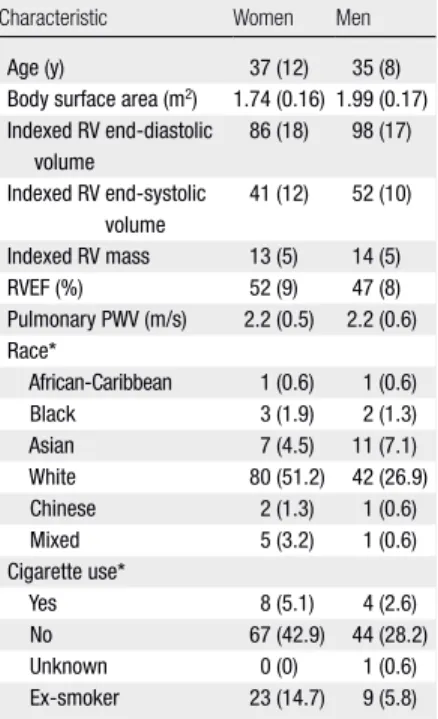
two-tailed testing, with P , .05 indicating a significant difference.
Results
All 156 subjects completed the imag-ing protocol. All data sets were ana-lyzed and included in the final analysis. Subjects’ anthropometric data are de-scribed in the Table. The mean age of the cohort was 36.1 years (range, 19–61 years), and 63% were women. The difference in age between men and women was not significant (men: mean age, 34.6 years; standard error 1.1; age range, 22–55 years; women: mean age, 37.0 years; standard error 1.2; age range, 19–61 years; estimated difference between men and women, 2.4 years; 95% confidence interval [CI]: 0.7, 5.6 years, P = .133).
Reliability
Test-retest reproducibility and interob-server agreement are shown in Table E1 (online) for volumetry, PWV, and functional assessment. When pooling components of function, median abso-lute errors were higher for strain rate than they were for strain (intraobserv-er agreement, 13.9% vs 9.9% and P = .027; interobserver agreement, 14.9% Systolic and diastolic function were
quantified with feature-tracking soft-ware (TomTec Imaging Systems, Mu-nich, Germany) and validated in both the RVs and LVs (11,12). Briefly, man-ual definition of an endocardial con-tour at end diastole by an observer (T.J.W.D.) served as an initialization from which software is used to track the displacement of spatial features in the time series of images (17). Systolic strain and strain rate, its temporal de-rivative, were measured in the RV from two- and four-chamber cine images (ie, longitudinal) and from short-axis cine images at the midpapillary level (ie, cir-cumferential and radial) (Fig 2). For all measurements, the mean value across ventricular segments was calculated at each time point, and the peak value was recorded. For measurements that were recorded in more than one plane, peak values were averaged. Systolic and dia-stolic function were quantified by peak systolic strain and strain rate and by peak early diastolic strain rate, respec-tively. End diastole was identified as the frame with the largest end-diastolic area at the midpapillary level in the LV. Statistical Analysis
Data were analyzed with R software, version 3.1.1 (http://www.R-project.
org). Preliminary associations were
assessed with correlation analysis and simple linear regression. Multiple lin-ear regression was used to assess for independent relationships after con-trolling for age, body surface area, and sex. Data were log-transformed to satisfy the assumptions of linear re-gression and tested by the normality of residuals (Shapiro-Wilk test), ho-moscedasticity (inspection of residual plots), and absence of multicollinearity (variance inflation factor) and outlier effects (Cook distance). All fields were centered and scaled before analysis to allow comparison of effect sizes. Con-tinuous variables were compared be-tween groups with the unpaired t test (two groups) or one-way analysis of variance (more than two groups) af-ter logarithmic transformation, where necessary. Reliability was assessed with intraclass correlation coefficients.
Figure 2
Figure 2: Graph shows examples of radial (red line), longitudinal (blue line), and circumferential (green line) strain obtained during the cardiac cycle in a 33-year-old woman with feature-tracking motion analysis.
Subject Characteristics and Cardiac MR Imaging–derived Measurements
Characteristic Women Men Age (y) 37 (12) 35 (8) Body surface area (m2) 1.74 (0.16) 1.99 (0.17)
Indexed RV end-diastolic volume 86 (18) 98 (17) Indexed RV end-systolic volume 41 (12) 52 (10) Indexed RV mass 13 (5) 14 (5) RVEF (%) 52 (9) 47 (8) Pulmonary PWV (m/s) 2.2 (0.5) 2.2 (0.6) Race* African-Caribbean 1 (0.6) 1 (0.6) Black 3 (1.9) 2 (1.3) Asian 7 (4.5) 11 (7.1) White 80 (51.2) 42 (26.9) Chinese 2 (1.3) 1 (0.6) Mixed 5 (3.2) 1 (0.6) Cigarette use* Yes 8 (5.1) 4 (2.6) No 67 (42.9) 44 (28.2) Unknown 0 (0) 1 (0.6) Ex-smoker 23 (14.7) 9 (5.8)
Note.—Unless otherwise indicated, data are the mean, and data in parentheses are standard deviation. There were a total of 156 subjects, with 98 women and 58 men.
* Data are numbers of subjects, and data in parentheses are percentages.
important pathophysiologic mediators of the powerful contribution that arte-rial blood pressure has on cardiovascu-lar risk (18). An association between LV hypertrophy and arterial stiffness is well documented in both adults and adolescents independent of blood pres-sure and is an established risk factor for cardiovascular events (19–21). Less is known about the effect of vascular aging on RV function and its impact on health outcomes, although echocardio-graphic estimates of PA pressure in-crease with age in the general popula-tion and are an indicator of all-cause mortality (4). Hemodynamic studies show that PA stiffness influences RV function, an effect that is mediated through changes in ventriculoarterial coupling (22–25). It is now recognized that, in adults without clinical cardio-vascular disease at baseline, RV mass (measured with cardiac MR imaging) is an independent predictor of heart failure and cardiovascular death, even when accounting for variation in LV mass (5). It is not known what factors drive an increase in RV mass with age. Therefore, the aim of our study was to determine whether the relationship be-tween vascular stiffness and myocardial hypertrophy seen in the systemic circu-lation is also present in the right side of the heart and PAs.
We showed that cardiac MR im-aging offers reliable assessment of pulmonary PWV, RV mass, and RV strain in healthy volunteers by using measurements taken from phase-con-trast images and feature tracking of balanced steady-state free precession cine images. In contrast to aortic PWV, there is a shorter path length in the pulmonary circulation over which to measure transit time, and there are distinct wave propagation and reflec-tion effects (26). While free-breathing interleaved phase-contrast imaging has achieved a very high temporal resolu-tion for measurement of PWV in the proximal PAs, a disadvantage is the long acquisition time and the poten-tial for physiologic variation (8,9). We found that pulmonary PWV can be re-liably assessed in healthy adults with the use of breath-hold phase-contrast (r = 0.02, P = .802), longitudinal strain
rate (r = 0.03, P = .688), or circumfer-ential strain (r = 0.08, P = .334). Cir-cumferential strain rate showed a sig-nificant but weak negative association with pulmonary PWV (r = 0.16, P = .043). Pulmonary PWV was associated with significant and similarly sized re-ductions in radial, longitudinal, and circumferential peak early diastolic strain rate (Fig 4). All significant as-sociations persisted after adjusting for age, body surface area, and sex (Table E2 [online]).
Discussion
In a large cohort of healthy adults, we found that PA stiffness increases with age and is independently associated with an increase in RV mass and di-astolic stiffness after controlling for age, sex, and body surface area. These findings indicate that, similar to the systemic circulation, prognostically ad-verse changes in the RV are associated with vascular aging. Combined assess-ment of RV performance and PA stiff-ness with cardiac MR imaging provides a reliable means to evaluate physiologic adaptations of the cardiopulmonary unit.
Systemic arterial stiffness and wave reflection phenomena are recognized as PWV was significantly and positively
as-sociated with age (r = 0.32, P , .001). RV Function
RV ejection fraction (RVEF) was signif-icantly higher in women than in men (t test; mean RVEF, 52% vs 47%; P , .001), with no effect of race (analysis of variance, P = .352). Age was posi-tively associated with RVEF (r = 0.18,
P = .025) and negatively related to both
RV end-systolic (r = 0.27, P , .001) and end-diastolic (r = 0.22, P = .005) volume. These associations persisted after adjustment for the effects of body surface area and sex (RVEF: r = 0.31 and P = .022; RV end-systolic volume:
r = 0.70 and P , .001; RV end-diastolic
volume: r = 0.72 and P , .001). RVEF was positively associated with LV ejec-tion fracejec-tion (r = 0.28 and P , .001). Pulmonary PWV and RV Function
Pulmonary PWV was positively asso-ciated with RVEF (r = 0.34, P = .026) after adjusting for age (P = .090), body surface area (P = .073), and sex (P = .005) and with RV mass (r = 0.41, P = .004) after adjusting for age (P , .001), body surface area (P = .008), and sex (P = .086) (Fig 3). PWV was associated with radial strain (r = 0.17,
P = .030) and strain rate (r = 0.25, P =
.002), but not with longitudinal strain
Figure 4
Figure 4: Scatterplot shows corrected peak end-diastolic longitudinal strain rate (adjusted to mean age [36 years], body surface area [1.83 m2], and
female sex) versus pulmonary PWV, with regression line and 95% CI.
Figure 3
Figure 3: Scatterplot shows corrected RV mass (adjusted to mean age [36 years], body surface area [1.83 m2], and female sex) versus pulmonary PWV,
(38,39). A “foot-to-foot” comparison of the flow curves would be appealing, as the effect of wave reflection would be minimal; however, as others have reported, this inflection point is indis-tinct in the pulmonary arteries (9). We used automated vessel tracking during the cardiac cycle but were not able to compensate for through-plane motion.
In conclusion, aging is related to increased PA stiffness in healthy adults and moderately associated with both RV mass and diastolic function. These findings suggest that prognostically ad-verse changes in RV function and mor-phologic features are associated with an age-related increase in PA stiffness.
Disclosures of Conflicts of Interest: T.J.W.D. disclosed no relevant relationships. A.G. closed no relevant relationships. A.d.M. dis-closed no relevant relationships. R.B. disdis-closed no relevant relationships. P.T. disclosed no relevant relationships. M.Q. disclosed no rele-vant relationships. G.D. disclosed no relerele-vant relationships. T.D. disclosed no relevant tionships. L.M.G. disclosed no relevant rela-tionships. A.d.C. disclosed no relevant relation-ships. S.A.C. disclosed no relevant relationrelation-ships. D.P.O’R. disclosed no relevant relationships.
References
1. Redheuil A, Yu WC, Mousseaux E, et al. Age-related changes in aortic arch geometry: re-lationship with proximal aortic function and left ventricular mass and remodeling. J Am Coll Cardiol 2011;58(12):1262–1270. 2. Cavalcante JL, Lima JA, Redheuil A,
Al-Mallah MH. Aortic stiffness: current under-standing and future directions. J Am Coll Cardiol 2011;57(14):1511–1522.
3. Vlachopoulos C, Aznaouridis K, Stefanadis C. Prediction of cardiovascular events and all-cause mortality with arterial stiffness: a systematic review and meta-analysis. J Am Coll Cardiol 2010;55(13):1318–1327. 4. Lam CS, Borlaug BA, Kane GC, Enders FT,
Rodeheffer RJ, Redfield MM. Age-associat-ed increases in pulmonary artery systolic pressure in the general population. Circula-tion 2009;119(20):2663–2670.
5. Kawut SM, Barr RG, Lima JA, et al. Right ventricular structure is associated with the risk of heart failure and cardiovascular death: the Multi-Ethnic Study of Atheroscle-rosis (MESA)--right ventricle study. Circula-tion 2012;126(14):1681–1688.
6. Dogui A, Redheuil A, Lefort M, et al. Mea-surement of aortic arch pulse wave velocity in cardiovascular MR: comparison of transit pathophysiologic adaptations that
oc-cur in the cardiopulmonary unit of healthy subjects. There are alterna-tives to the use of cardiac MR imaging, since PA pressure can be estimated with echocardiography to measure tricuspid regurgitation velocity in the general population, but tricuspid re-gurgitation velocity is not assessable in 30% of subjects, and the range of PA pressure in the general population is relatively narrow (4,35). If the inde-pendent prognostic risk attributable to RV mass is mediated by a measurable change in pulmonary vascular func-tion, it could prove to be a latent car-diovascular risk factor assessable only with cardiac MR imaging. If validated by longitudinal studies, pulmonary vas-cular function may be used to guide lifestyle modification or more intensive treatment of modifiable risk factors for heart failure.
Our study has limitations. A cross-sectional study cannot deter-mine the causal relationship between increased PA stiffness and RV mass. We adjusted for age, sex, and body surface area, but other unmeasured factors, including LV end-diastolic pressure, may influence hemodynamics of the right side of the heart. For eth-ical reasons, we did not confirm nor-mal PA pressure with catheterization of the right side of the heart, and we had no reference standard with which to compare cardiac MR imaging as-sessment of PWV. Transaxial imaging of the RV may provide easier identi-fication of valve planes than the short axis, but volumetry is comparable in both axes in subjects without complex heart disease (36,37). Free-breathing interleaved phase-contrast sequences have achieved greater temporal reso-lution but require several minutes for acquisition, making them vulnerable to physiologic variations (9). The tem-poral resolution of our phase-contrast sequence was relatively low compared with the transit time being measured, but it achieved good repeatability in healthy adult subjects. Several au-thors have commented on the influ-ence of reflection waves from short path lengths and frequent bifurcations sequences performed with parallel
im-aging; however, greater improvements in spatial and temporal resolution may be achievable with techniques such as compressed sensing (27). Our data show that PA stiffness is positively as-sociated with age, a finding consistent with experimental evidence that pulmo-nary vascular elastic properties decline over time, with an increase in medial thickness (28–30). We also observed that rising PA stiffness was moderately associated with both an increase in RV mass and a decline in diastolic func-tion among apparently healthy adults. Age-related increases in RVEF were ob-served in other cohorts; because of the association with radial but not longitu-dinal or circumferential function, we suggest that this is principally related to an increase in radial contractility (31). Although a low pressure system makes distinctive demands on the right ventricle, our findings of an association between pulmonary vascular aging and increased RV mass and myocardial stiff-ness draw parallels with the physiologic characteristics of the systemic circula-tion (32). A tandem rise in vascular and ventricular stiffness occurs with aging in the aorta and LV associated with in-creasing afterload; our PWV and strain data show that a similar response may also occur in the PA and RV (33,34). How RV mass mediates cardiovascular risk in the general population is not known, but it was proposed that the RV serves as a more sensitive “barometer” of cumulative exposure to elevated LV end-diastolic pressure over time than a single measurement of LV mass or ejec-tion fracejec-tion. Our data, supported by prognostic studies on PA pressure, and RV mass suggest that subclinical vascu-lar aging may contribute to increasing afterload, RV hypertrophy, and dia-stolic dysfunction in the general popula-tion (4, 5).
The role of RV structure and func-tion in both health and disease has his-torically been neglected compared with the epidemiologic characteristics of LV hypertrophy, systemic hypertension, and aortic aging, as is evidenced by the extensive literature on these topics. Our data shed light on the underlying
time estimators and description of a new ap-proach. J Magn Reson Imaging 2011;33(6): 1321–1329.
7. Bell V, Sigurdsson S, Westenberg JJ, et al. Relations between aortic stiffness and left ventricular structure and function in older participants in the Age, Gene/Environment Susceptibility--Reykjavik Study. Circ Cardio-vasc Imaging 2015;8(4):e003039.
8. Ibrahim SH, Shaffer JM, White RD. Assess-ment of pulmonary artery stiffness using velocity-encoding magnetic resonance imag-ing: evaluation of techniques. Magn Reson Imaging 2011;29(7):966–974.
9. Bradlow WM, Gatehouse PD, Hughes RL, et al. Assessing normal pulse wave velocity in the proximal pulmonary arteries using transit time: a feasibility, repeatability, and observer reproducibility study by cardiovas-cular magnetic resonance. J Magn Reson Imaging 2007;25(5):974–981.
10. Grothues F, Moon JC, Bellenger NG, Smith GS, Klein HU, Pennell DJ. Interstudy repro-ducibility of right ventricular volumes, func-tion, and mass with cardiovascular magnetic resonance. Am Heart J 2004;147(2):218–223. 11. Hor KN, Gottliebson WM, Carson C, et al.
Comparison of magnetic resonance feature tracking for strain calculation with har-monic phase imaging analysis. JACC Cardio-vasc Imaging 2010;3(2):144–151.
12. Heermann P, Hedderich DM, Paul M, et al. Biventricular myocardial strain analysis in patients with arrhythmogenic right ventricu-lar cardiomyopathy (ARVC) using cardiovas-cular magnetic resonance feature tracking. J Cardiovasc Magn Reson 2014;16:75. 13. Corden B, Keenan NG, de Marvao AS, et al.
Body fat is associated with reduced aortic stiffness until middle age. Hypertension 2013; 61(6):1322–1327.
14. de Marvao A, Dawes TJ, Shi W, et al. Popu-lation-based studies of myocardial hypertro-phy: high resolution cardiovascular magnetic resonance atlases improve statistical power. J Cardiovasc Magn Reson 2014;16(1):16. 15. Kramer CM, Barkhausen J, Flamm SD,
Kim RJ, Nagel E; Society for Cardiovascu-lar Magnetic Resonance Board of Trustees Task Force on Standardized Protocols. Stan-dardized cardiovascular magnetic resonance (CMR) protocols 2013 update. J Cardiovasc Magn Reson 2013;15:91.
16. Herment A, Mousseaux E, Jolivet O, et al. Improved estimation of velocity and flow rate using regularized three-point phase-contrast velocimetry. Magn Reson Med 2000;44(1): 122–128.
17. Hor KN, Baumann R, Pedrizzetti G, et al. Magnetic resonance derived myocardial strain assessment using feature tracking. J Vis Exp 2011;(48):2356.
18. Safar ME, Levy BI, Struijker-Boudier H. Current perspectives on arterial stiffness and pulse pressure in hypertension and car-diovascular diseases. Circulation 2003;107 (22):2864–2869.
19. Urbina EM, Dolan LM, McCoy CE, Khoury PR, Daniels SR, Kimball TR. Relationship be-tween elevated arterial stiffness and increased left ventricular mass in adolescents and young adults. J Pediatr 2011;158(5):715–721. 20. Bluemke DA, Kronmal RA, Lima JA, et al.
The relationship of left ventricular mass and geometry to incident cardiovascular events: the MESA (Multi-Ethnic Study of Athero-sclerosis) study. J Am Coll Cardiol 2008; 52(25):2148–2155.
21. Willum-Hansen T, Staessen JA, Torp-Ped-ersen C, et al. Prognostic value of aortic pulse wave velocity as index of arterial stiff-ness in the general population. Circulation 2006;113(5):664–670.
22. Milnor WR, Bergel DH, Bargainer JD. Hy-draulic power associated with pulmonary blood flow and its relation to heart rate. Circ Res 1966;19(3):467–480.
23. Piene H, Sund T. Flow and power output of right ventricle facing load with vari-able input impedance. Am J Physiol 1979; 237(2):H125–H130.
24. O’Rourke MF. Vascular impedance in stud-ies of arterial and cardiac function. Physiol Rev 1982;62(2):570–623.
25. Piene H. Pulmonary arterial impedance and right ventricular function. Physiol Rev 1986;66(3):606–652.
26. Bouwmeester JC, Belenkie I, Shrive NG, Tyberg JV. Wave reflections in the pulmo-nary arteries analysed with the reservoir-wave model. J Physiol 2014;592(Pt 14): 3053–3062.
27. Kwak Y, Nam S, Akçakaya M, et al. Accel-erated aortic flow assessment with com-pressed sensing with and without use of the sparsity of the complex difference image. Magn Reson Med 2013;70(3):851–858. 28. Lankhaar JW, Westerhof N, Faes TJ, et al.
Quantification of right ventricular afterload in patients with and without pulmonary hy-pertension. Am J Physiol Heart Circ Physiol 2006;291(4):H1731–H1737.
29. Ha B, Lucas CL, Henry GW, Frantz EG, Fer-reiro JI, Wilcox BR. Effects of chronically el-evated pulmonary arterial pressure and flow
on right ventricular afterload. Am J Physiol 1994;267(1 Pt 2):H155–H165.
30. Pace JB. Sympathetic control of pulmonary vascular impedance in anesthetized dogs. Circ Res 1971;29(5):555–568.
31. Kawut SM, Lima JA, Barr RG, et al. Sex and race differences in right ventricular struc-ture and function: the multi-ethnic study of atherosclerosis-right ventricle study. Circu-lation 2011;123(22):2542–2551.
32. Roman MJ, Ganau A, Saba PS, Pini R, Pick-ering TG, Devereux RB. Impact of arterial stiffening on left ventricular structure. Hy-pertension 2000;36(4):489–494.
33. Chen CH, Nakayama M, Nevo E, Fetics BJ, Maughan WL, Kass DA. Coupled systolic-ventricular and vascular stiffening with age: implications for pressure regulation and car-diac reserve in the elderly. J Am Coll Car-diol 1998;32(5):1221–1227.
34. Kang S, Fan HM, Li J, et al. Relationship of arterial stiffness and early mild diastolic heart failure in general middle and aged population. Eur Heart J 2010;31(22):2799– 2807.
35. Gomberg-Maitland M. Something subtle about death: isolated systolic pulmonary pressure. Circulation 2009;119(20):2647– 2649.
36. Schelhorn J, Neudorf U, Schemuth H, Nensa F, Nassenstein K, Schlosser TW. Volumetric measurements in patients with corrected tetralogy of Fallot: comparison of short-axis versus axial cardiac MRI and echocardiog-raphy [PubMed]. Acta Radiol 2015;56(11): 1315–1322.
37. James SH, Wald R, Wintersperger BJ, et al. Accuracy of right and left ventricular functional assessment by short-axis vs ax-ial cine steady-state free-precession mag-netic resonance imaging: intrapatient cor-relation with main pulmonary artery and ascending aorta phase-contrast flow mea-surements. Can Assoc Radiol J 2013;64(3): 213–219.
38. Hollander EH, Wang JJ, Dobson GM, Par-ker KH, Tyberg JV. Negative wave reflec-tions in pulmonary arteries. Am J Physiol Heart Circ Physiol 2001;281(2):H895–H902. 39. Castelain V, Hervé P, Lecarpentier Y,
Dur-oux P, Simonneau G, Chemla D. Pulmonary artery pulse pressure and wave reflection in chronic pulmonary thromboembolism and primary pulmonary hypertension. J Am Coll Cardiol 2001;37(4):1085–1092.
![Figure 4: Scatterplot shows corrected peak end- end-diastolic longitudinal strain rate (adjusted to mean age [36 years], body surface area [1.83 m 2 ], and female sex) versus pulmonary PWV, with regression line and 95% CI.](https://thumb-eu.123doks.com/thumbv2/123dok_br/18872961.931546/5.891.310.563.191.441/figure-scatterplot-corrected-diastolic-longitudinal-adjusted-pulmonary-regression.webp)
