Acta Cirurgica Brasileira
This is an Open Access artcle distributed under the terms of the Creatie Commons
Attributon NonCCommercial iicense, hhich permits unrestricted nonCcommercial use, distributon,
and reproducton in any medium, proiided the original hork is properly cited. Fonte:
http://hhh.scielo.br/scielo.phpsscriptssci_aarttext&pidsS0102C
86502014000300151&lngsen&tlngsen
. Acesso em: 26 noi. 2019.
REFERÊNCIA
SOUSA, Dircilei Nascimento de et al. Behaiioural and cognitie efects of simiastatn dose used in
stmulaton of bone regeneraton in rats. Acta Cirurgica Brasileira, São Paulo, i. 29, n. 3, p. 151C
157, mar. 2014. DOI:
http://dx.doi.org/10.1590/S0102C86502014000300002
. Disponíiel em:
http://hhh.scielo.br/scielo.phpsscriptssci_aarttext&pidsS0102C
Behavioural and cognitive effects of simvastatin dose used in stimulation of bone
regeneration in rats
1Dircilei Nascimento de SousaI, Washington Macedo de SantanaII, Vania Moraes FerreiraIII, Wagner Rodrigues DuarteIV
IFellow Master degree, Postgraduate Program in Health Sciences, Health Sciences Faculty, Brasília University (UNB), Brasília-DF, Brazil. Surgical
procedures, acquisition and interpretation of data, manuscript writing.
IIFellow PhD degree, Postgraduate Program in Health Sciences, Health Sciences Faculty, UNB, Brasília-DF, Brazil. Surgical procedures, acquisition
and interpretation of data, manuscript writing.
IIIPhD, Full Professor, Health Sciences Faculty, UNB, Brasília-DF, Brazil. Statistical analysis, English language, critical revision.
IVPhD, Full Professor, Health Sciences Faculty, UNB, Brasília-DF, Brazil. Conception and design of the study, manuscript writing.
ABSTRACT
PURPOSE: To analyze the effects of simvastatin (SVT) in the locomotion, anxiety and memory of rats, as a reflection of the administration of a minimum dose capable of stimulating bone regeneration in defects in the calvariae.
METHODS: Surgical procedures were performed in 15 female Wistar rats, 2-month old, to insert the grafting material regenerator
(Bone-ceramic®) and/or SVT, followed by behavioural and cognitive assessments in the 7th, 30th and 60th days post surgery.
RESULTS: The SVT locally applied with the goal of bone regeneration in defects created in rat calvariae does not interfere with locomotion, anxiety levels and/or memories of rats, except for the first week following surgery, when an anxiolytic effect was observed, as a result of a possible central action.
CONCLUSION: Failure to provoke any response within 30 and 60 days post surgical procedures suggests that SVT may constitute a good choice in stimulating bone regeneration without affecting the long term neural functions.
Sousa DN et al.
Introduction
For many years the gold standard applied to bone grafting has been of the autogenous type. The bone graft is obtained from the same patient from different intra- or extra-oral
donor regions, such as parts of the mandible, skullcap or tibia1.
The search for a bone substitute has increased over the years due to the limited volume of bone removed from the donor area and
mainly because of surgical morbidity2. The search for a material
that eliminates the need to intervene in the donor area could lead to further advances in biomaterials research and the production of different bone substitutes.
There are some factors that are valuable in bone regeneration, e.g., hormones, cytokines and growth factors, such as
bone morphogenetic protein3, drugs such as calcitonin4 and statins5.
The latter, in turn, are widely used to lower blood cholesterol level and can stimulate bone formation, as observed by the increasing activity of the alkaline phosphatase, osteocalcin expression levels and mineral deposits, suggesting an anabolic effect on bone tissue
by increasing osteoblast differentiation6. Some studies suggest
that simvastatin (SVT) enhances differentiation of osteoblasts in humans, measured by increased alkaline phosphatase activity and
the expression of osteoblast-related genes7.
Although there is a great deal of information indicating the beneficial effect of SVT in bone regeneration, results of preclinical and clinical studies have shown conflicting results with its use. Studies indicate that the effects of SVT may be influenced by factors such as method and route of administration and duration of exposure. In addition, there are also many questions about the optimal concentration and the best carrier for the drug. The materials available for bone regeneration are still expensive and unaffordable to many patients, and therefore, there is a tireless search by the scientific community for a biomaterial that is efficient and, at the same
time, accessible to the majority of the population6,8.
Attention should also be given to the fact that the SVT influence another aspect that cannot be ruled out in this present context, which concerns to their interference on aspects of neurobehaviour. In recent years, attention has been given
to this statin in the treatment of anxiety and depression9,10, for
In order to investigate this, the aim of this study was to assess the behavioural and cognitive effects of the SVT dose seeking to stimulate bone regeneration in defects created in the calvariae of rats.
Methods
Research approved by the Ethics Committee on Animal Use, Faculty of Medicine, University of Brasília (protocol UnB doc 44299-2012).
Fifteen female 2-month old Wistar rats were used at the beginning of the experiments, each weighing 300 g, originating from the Animal Facilities of the Faculty Sena Aires (Valparaiso de Goias, GO, Brazil). The animals were housed in groups of five per cage, kept under standard conditions with food and water ad
libitum, room temperature, light/dark cycle of 12 hours (06:00
to 18:00 h), After the surgical procedures and the behavioural assessments, the animals were sacrificed by decapitation eight weeks after the onset of the experiments, which is the time required for bone healing in rats. The brains were dissected and stored in 10% formalin for further studies.
Preparation of simvastatin
The ideal amount of BoneCeramic® (BC) and SVT
solution to fill a bone defect 5 mm in diameter was standardized, using a condensation silicone template created to mimic the bone defect. We determined that collagen sponge (CS) or 15 mg of BC and 15μL of a SVT (BC+SVT) solution in ethanol were sufficient to fill the designed defect. The SVT solution
(Farmogral®, Brasilia, Brazil) was prepared to contain 0.1 mg of
SVT in 15μL of SOLUTION23.
Anaesthesia and surgery procedures
The rats were anesthetized with ketamine (80 mg/kg) and xylazine (10 mg/kg) by intramuscular route before the induction of bilateral defects in the calvariae. The rat’s skulls were desinfected with povidone-iodine solution, a linear incision was made on the region, and a full thickness flap elevated exposing the bone. A 5mm
5.0Etchon® thread, as demonstrated in Figure 1. During surgery
procedures special care was taken not to damage the duramater. All surgical instruments had been sterilized in an autoclave. For pain management after surgery recovery and on the next day, 150 mg/kg of acetylsalicylic acid was administered, by the gavage route every four hours.
Open field test: The animals were individually placed in
the centre of a wooden arena (60 x 60 x 35 cm3) divided into nine
quadrants, to evaluate the number of sections crossed by the animal during 5 min. Immediately after the animal was placed in the centre of the arena, its movements began to be scored. Locomotor activity was considered only when the animal placed all four paws onto one square.
Elevated plus maze test: This apparatus was used on the basis of its documented validity to detect both anxiolytic- and
anxiogenic-like drug effects in rats13. Made of wood and covered
with impermeable Formica, it was placed 50 cm above the floor. The four arms were 50 cm long and 10 cm wide. Two opposite arms were surrounded by walls (40 cm high, enclosed arms), while the other two were devoid of enclosing walls (open arms) surrounded by a 1 cm high Plexiglas edge. The four arms were connected by a central
platform (10 x 10 cm2). Each rat was placed in the centre of the maze
facing an enclosed arm. The animals were observed for a 5-min test period and the anxiogenic-like effects were defined as a decrease in the proportion of open arm entries divided by the total number of arm entries, and a decrease in the time spent on open arms relative to the total time spent on both arms. Whenever a rat placed all four paws onto one arm, one entry was recorded. The total number of enclosed arm entries was also used as a measure of locomotor activity.
Inhibitory avoidance task: The equipment was an acrylic box (50 cm x 25 cm x 25 cm), the floor of which consisted of parallel stainless steel bars (1 mm diameter) spaced 1 cm apart. A platform (7-cm wide x 2.5-(7-cm high) was placed on the floor against the left wall. The animals were placed on the platform, and the time from latency to step-down on the grid with four paws was measured with an automatic device. The experimental subjects were submitted to the inhibitory
avoidance task using a protocol similar to that previously described14.
During training sessions, immediately after stepping down on the
FIGURE 1 – Illustrations of the sequence of surgical procedures for the
induction of bilateral defects in the calvariae of rats. A) Demarcation of the area where the bone defect is to be performed; B) Removal of the bone layer that characterizes the bone defect; C) Administration of a substance corresponding to what was chosen for each investigated group, D) area procedure finalized and ready to be sutured.
Experimental design
The animals were behaviourally assessed on the 7th, 30th
and 60th days after surgical procedures in order to verify the level
of stress/anxiety and any cognition impairment. For the purposes of the experiments and control, the animals were divided into three groups of five animals each:
Group 1 (G1): In this control group the bone defects was made on the left side to receive no treatment, being filled only with the blot clot. On the right side the bone defects received different types of fillers: BC, BC+SVT, CS, or CS+SVT.
Group 2 (G2): (100% synthetic bone substitute, osteoconductive, made up of biphasic calcium phosphate particles) – on the left side the bone defects received treatment only with BC, while the right side received BC+SVT.
Group 3 (G3): On the left side the bone defects received CS, and on the right side the animals received CS+ SVT.
Behavioural tests
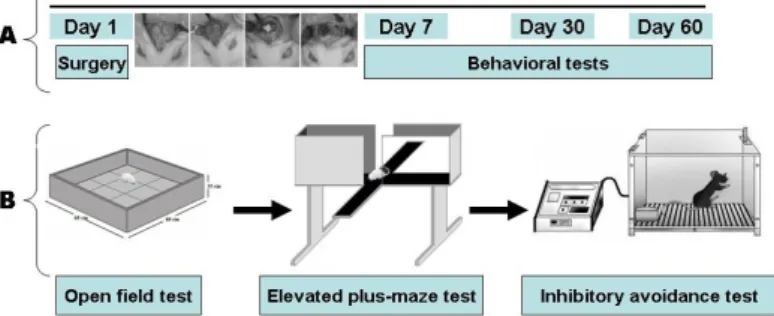
Animals were acclimated to the experimental room for at least 1 h before beginning the experimental procedures, which were carried out between 8 a.m. and 12 p.m. in order to avoid circadian influence and or any kind of noise or interference from external factors in the experimental environment. The behavioural tests were conducted with each separate group of animals (n=5 animals in each group), as demonstrated in Figure 2.
FIGURE 2 - Schematic representation of the steps of the experimental
procedures adopted in the research. A) The surgeries took place on day 1 of the beginning of the experiments, and behavioural evaluations occurred on
the 7th, 30th and 60th days after anaesthesia and surgery procedures in order
to verify the level of stress/anxiety and some cognition impairment; B) The tests used in the research were open field (locomotion); elevated plus-maze (anxiety); and “step down” inhibitory avoidance (memory) tests.
Sousa DN et al.
grid, the animals received a 0.4-mA, 1.0-s scrambled foot shock. During test sessions, no foot shock was administered, and the step-down latency (maximum 180 sec) was used as measure of memory retention. Animals were submitted to a single training session. In order to evaluate short-(STM) and long-term (LTM) memories, test sessions were performed 1h and 24h after training, respectively.
Statistical analysis
The results were expressed as the mean ± SEM (standard error of the mean) of 15 animals (five animals/group). Data were analyzed using a GraphPad Prism v5 statistical program. Locomotion and anxiety-related behaviour were analyzed using the one way Analysis of variance (ANOVA) followed post hoc by the Newman-Keuls test. Data on the inhibitory avoidance task are shown as the medians (interquartile range) of step-down latencies. Comparisons of the step-down test session latencies among groups were performed with using the Kruskal–Wallis test followed by Dunn’s multiple comparison test. Statistical significance was considered when p≤0.05.
Results
The evaluation of SVT administration in the calvariae of
rats for locomotor activity on the 7th, 30th and 60th post-surgical
days is demonstrated in Figure 3. Statistical analysis performed by the one-way ANOVA did not detect any statistical difference among the groups and/or in the recovery time of the animals [F(2,14)=2.022, p=0.1750].
To evaluate the anxiety levels, the animals were tested in the EPM (Figure 4), which the percentage of entries into the open arms of the maze and the time spent in these arms were considered. The one-way ANOVA followed by a post hoc Newman Keuls test detected an increase in the percentage of open arm time of the
EPM on the 7th day post surgery [F
(2,14)= 8.209, p=0.0057], but not
in any other of the assessments. This behaviour response seemed to be specific to an anxiolytic effect of SVT expected early after treatment, although the frequency of enclosed arms entries of the
EPM [F(2,14)= 0.5566, p= 0.5873] was not affected.
0 20 40 60 80
7 30 60
G 2 G 3 G 1L
o
co
m
o
tio
n
0 10 20 30 40 G 2 G 3 G 1%
O
p
en
a
rm
e
n
tr
ie
s
0 5 10 15 20*
%
O
p
en
a
rm
ti
m
e
0 5 10 157 30 60
Days
E
n
cl
o
se
d
a
rm
e
n
tr
ie
s
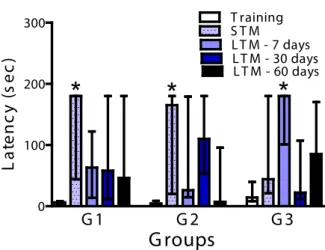
The STM and LTM were investigated in the step down inhibitory avoidance test, by which the animals had to recognize the aversive stimulus when they were evaluated 1 hour (STM) or
24 hours (LTM) after training on the 7th day post surgery, and then
again on the 30th and 60th days (Figure 5). The animals recognized
the stimulus and increased their latency time on the platform of
the apparatus, for STM on the 7th day [11.62, p=0.02] and the 30th
day [13.02, p=0.01]. LTM also made a difference compared to
the control group on the 60th day [11.41, p=0.02]. No statistical
difference was observed between STM and LTM or LTM over time in each group.
It is well known that the natural behaviour of rodents (rats and mice) can be measured by the number of enclosed arm entries into a maze and by locomotor activity in an open field test. Researchers have noted that rodents are motivated to investigate new objects and places, but the novelty also induces fear, which may tend to suppress exploration or encourage them to flee from the new
situation15. Drugs (or other manipulations) that reduce the presumed
inhibitory mechanism can increase the levels of exploitation, without
affecting the responses to novelty16. The results obtained in the
present study showed that SVT did not interfere with locomotion, since the locomotion of the animals remained independent of the treatment and the period of time investigated
Regarding anxiety, this behaviour, very common in everyday life, is also present in the dentist’s chair, independent of the clinical manifestations presented by patients. There is a good reason to believe that the same neural systems are involved in the generation of the phenomena of acute physiological states of fear and anxiety, even though the situations and conditions that lead
to physiological and pathological anxiety are different17. Anxiety
disorders that are more directly related to phobic situations or originating from phobic stimuli are classified as exogenous anxiety. Furthermore, there are multiple types of anxiety disorders, each one with a characteristic pattern of response. Major advances have been
made towards understanding the neurobiology of fear responses18.
Several studies have suggested the influence of SVT as a probable therapy for treating anxiety and other changes related
to this disorder9,10,19. Based on this information, our interest was to
know how far a low dose intended for use in bone regeneration could
also interfere with behaviour. It was observed on the 7th day post
surgery that the animals showed a significant anxiolytic response, depending on the osteoconductive material used. An adaptation of the response to the latter was demonstrated, whereas no similar behaviour or other kind of behaviour alteration was observed during the recovery of the animals in the process of bone regeneration.
With respect to the correlation between locomotor activity and anxiety-related behaviour, our results were the opposite of those produced by the previous reports on SVT hyperactivity in the animals; this was a reflection of the high amount of exploration time of the animals in the open arm of EPM, suggestive of
anxiolytic effect19. Locomotion of the animals used in our research
did not alter during the tests. These conflicting results may be are due to the dose used. Authors used a very high dose of 10 mg/kg/ day, whereas in our studies the dosage was 0.1 mg/kg, which was enough to produce bone regeneration (data not shown) without significant interference in behaviours investigated after the first week of surgical recovery.
FIGURE 5 - Effects of simvastatin (0.1 mg/kg) on short- and long-term
memories of rats evaluated in the “step-down” inhibitory avoidance test on
the 7th, 30th and 60th days post surgery. The results are expressed as mean
± SEM of 5 animals per group. STM was evaluated 1h after the training.
LTM was evaluated 24h after STM on the 7th day post surgery, and again
on the 30th and 60th days. *p≤0.05 compared to the control group (G1) on
7th day post surgery (Kruskal-Wallis test, followed by Dunn’s multiple
comparison). G1= control group; G2= left side: BoneCeramic® (BC)/ right
side: BoneCeramic® + simvastatin (BC+SVT); G3= left side: Collagen
sponge (CS)/ right side: Collagen sponge + simvastatin (CS+SVT). 0 100 200 300 S T M LT M - 7 days LT M - 30 days LT M - 60 days
G 1 G 2 G 3
G roups
T raining*
*
*
L
at
en
cy
(s
ec
)
DiscussionIn a general context, the results showed that the SVT dose-seeking bone regeneration in defects created in rat calvariae, does not interfere with behavioural and/or cognitive responses, except after the first week after application, which showed an anxiolytic effect, reflecting a possible action arising from the first specific effects of the SVT on the central nervous system. On the other
hand, the lack of response on the 30th and 60th days corresponding
to the period of surgical recovery suggests that SVT may be a good choice in stimulating bone regeneration without affecting long-term locomotion, anxiety levels and aspects of memory.
Sousa DN et al.
Attention is drawn here to the fact that in the first week of surgery recovery, the animals showed anxiolytic effect that was osteoconductive- dependent. There are no reports in the
literature emphasizing the anxiolytic property of BoneCeramic®
and any mechanism by which it might induce such behaviour. However, it is well known that pre-clinical studies have shown that the major receptor involved in the observed responses is the N-methyl-D-aspartate (NMDA) receptor. In some of the research previously reported, SVT behaved as an antagonist of
these receptors19. Considering this hypothesis, it is possible to
justify the fact that the anxiolytic response observed in animals undergoing surgical procedures may perhaps have involved the NMDA receptors.
In addition, emphasis also has been given to the fact that statins have shown neuroprotective effects in some neurological diseases. In a comparative study on the effect of commercially available statins on the neural damage and memory impairment in mice produced by Kainate, which is a glutamate agonist, SVT was more effective in reducing the harmful effects, including the severity of seizures, excitotoxicity, oxidative damage, neuritic
and apoptosis dystrophy11. With the SVT dose used in the present
experiment, the animals showed no significant changing in STM and LTM, regardless of the time of bone regeneration.
The mechanism by which SVT promotes bone regeneration has long been investigated, showing that the influence of lipid-lowering therapies generates many positive results. On the other hand, there are many contradictory results with regard to the role of cholesterol in cognitive functions. However, it is clear that the conflicting data are mainly due to changes in dosage and duration of treatment in subjects investigated. For example, the effect of local application of SVT on bone growth is more favourable with lower doses (2.2 mg to 0.5 mg), reducing
inflammation to clinically acceptable levels8. The optimal dose
to stimulate maximum bone regeneration without inducing inflammation in rat calvariae is 0.1 mg, especially if associated with an osteoconductive biomaterial able to release the drug
gradually20. Our results support this information. SVT in a dose
of 0.1 mg is effective in regenerating bone in rat calvariae with no considerable effect at central nervous system.
In overall, the results here obtained with the SVT dose
Conclusion
Failure to provoke any response within 30 and 60 days post surgical procedures suggests that SVT may constitute a good choice in stimulating bone regeneration without affecting the long term neural functions
References
1. Veis A, Tsirlis T, Parisis NA. Effect of autogenous harvest site location on the outcome of ridge augmentation for implant dehiscences. Int J Periodontics Restorative Dent. 2004;24:155-63. 2. Jensen SS, Broggini N, Hjrting-Hansen E,Schenk R, Buser D. Bone
Healing and graft resorption of autograft, anorganic bovine bone and β-tricalcium phosphate. A histologic and histomorphometric study in mandibles of minipigs. Clin Oral Implants Res 2006;17:237-43. 3. Nyan M, Hao J, Miyahara T, Noritake K, Rodriguez R, Kasugai S.
Accelerated and enhanced bone formation on novel simvastatin-loaded porous titanium oxide surfaces. Clin Implant Dent Relat Res. 2013 [Epub ahead of print].
4. Ma L, Xiang L, Yao Y, Yuan Q, Li L, Gong P. CGRP-alpha application: a potential treatment to improve osseoperception of endosseous dental implants. Med Hypotheses. 2013;81:297-9. 5. Liu X, Li X, Zhou L, Li S, Sun J, Wang Z, Gao Y, Jiang Y, Lu H,
Wang Q, Dai J. Effects of simvastatin-loaded polymeric micelles on human osteoblast-like MG-63 cells. Colloids Surf B Biointerfaces. 2013;102:420-7.
6. Baek KH, Young Lee W, Oh KW, Tae HJ, Lee JM, Lee EJ, Han JH, Kang MI, Cha BY, Lee KW, Young Son H, Kang SK. The effect of simvastatin on the proliferation and differentiation of human bone marrow stromal cells. J Korean Med Sci. 2005;20:438-44.
7. Maeda T, Matsunuma A, Kawane T, Horiuchi N. Simvastatin promotes osteoblast differentiation and mineralization in MC3T3-E1 cells. Biochem Biophys Res Commun. 2001;280:874-7.
8. Stein D, Lee Y, Schmidt MJ, Killpack B, Genrich MA, Narayana N, Marx DB, Cullen DM, Reinhardt RA. Local simvastatin effects on mandibular bone growth and inflammation. J Periodontol. 2005;76:1861-70.
9. Kilic FS, Ozatik Y, Kaygisiz B, Baydemir C, Erol K. Acute antidepressant and anxiolytic effects of simvastatin and its mechanisms in rats. Neurosciences (Riyadh). 2012;17:39-43. 10. Santos T, Baungratz MM, Haskel SP, de Lima DD, da Cruz JN,
Magro DD, da Cruz JG. Behavioral interactions of simvastatin and fluoxetine in tests of anxiety and depression. Neuropsychiatr Dis Treat. 2012;8:413-22.
11. Ramirez C, Tercero I, Pineda A, Burgos JS. Simvastatin is the statin that most efficiently protects against kainate-induced excitotoxicity and memory impairment. J Alzheimers Dis. 2011;24:161-74. 12. Chauhan NB, Gatto R. Restoration of cognitive deficits after statin
feeding in TBI. Restor Neurol Neurosci. 2011;29:23-34.
13. Pellow S, Chopin P, File SE, Briley M. Validation of open: closed arm entries in an elevated plus-maze as a measure of anxiety in the rat. J Neurosci Methods 1985;14:149-67.
16. Gray JA. Drug effects on fear and frustration: possible limbic site of action of minor tranquilizers. Handbook of psychopharmacology 8 (1977): 433-529.
17. Haefely W. Benzodiazepine receptor and ligands: structural and functional differences. Bezodiazepines: current concepts: biological, clinical and social perspectives. Wiley, Chicester; 1990. p.1-18. 18. Carlsson SG, Wide Boman U, Lundgren J, Hakeberg M. Dental
anxiety - a joint interest for dentists and psychologists. Eur J Oral Sci. 2013;121:221-4.
19. Wang Q, Zengin A, Deng C, Li Y, Newell KA, Yang GY, Lu Y, Wilder-Smith EP, Zhao H, Huang XF. High dose of simvastatin induces hyperlocomotive and anxiolytic-like activities: the association with the up-regulation of NMDA receptor binding in the rat brain. Exp Neurol. 2009;216:132-8.
20. Nyan M, Sato D, Kihara H, Machida T, Ohya K, Kasugai S. Effects of the combination with alpha-tricalcium phosphate and simvastatin on bone regeneration. Clin Oral Implants Res. 2009;20:280-7.
Correspondence:
Dircilei Nascimento de Sousa Universidade de Brasília Faculdade de Ciências da Saúde
Programa de Pós-Graduação de Ciências da Saúde Campus Universitário Darcy Ribeiro, s/n 70.910-900 Brasília-DF Brasil Tel.: (55 61)9984-0106 [email protected] Received: Nov 14, 2013 Review: Jan 15, 2014 Accepted: Feb 18, 2014 Conflict of interest: none Financial source: none
1Research performed at Pathology Laboratory, School of Medicine,
Bra-silia University (UNB), BraBra-silia-DF, Brazil. Part of Master degree thesis, Postgraduate Program in Health Sciences, Health Sciences Faculty, UnB. Tutor: Dr. Wagner Rodrigues Duarte.