Germination of Physalis peruviana L. seeds under varying conditions
of temperature, light, and substrate
1Germinação de sementes de Physalis peruviana L. em diferentes condições de
temperatura, luz e substrato
Fábio Oliveira Diniz2*, Larissa Chamma3 and Ana Dionisia da Luz Coelho Novembre4
ABSTRACT - Optimum seed germination conditions are crucial for the complete utilization of the potential of a crop.
Hence, the objective of this study was to evaluate the effects of light, temperature, and substrate on the germination of
Physalis peruviana L. seeds. Three seed lots were used, which were first assessed over a temperature gradient of nine
intervals (from 15 °C to 35 °C) and alternating temperatures of 20-30 °C and 15-35 °C under a photoperiod of 8h light. Subsequently, germination was studied according to the substrate used, i.e., paper (on paper), sand (between sand), and vermiculite (between vermiculite), under 8h light per day at a constant temperature of 25 °C or alternating temperatures (20-30 °C). Evaluations were conducted daily until germination stabilized, and normal seedlings were counted. The results are expressed in percentage, germination speed index, and mean germination time. The germination of P. peruviana seeds occurred within a wide temperature range (15 °C to 30 °C). A constant temperature of 25 °C and alternating temperatures of 20-30 °C were found to be optimum under 8h light per day. Sand was the most suitable substrate, but paper and vermiculite can also be used as alternatives. Germination test can be evaluated on the 7th day (first count) and 14th day (last count) after test initiation.
Key words: Cape gooseberry. Seedlings. Thermo-gradient table. Seed analyze.
RESUMO - O conhecimento das condições ideais para o teste de germinação das sementes é essencial em função do potencial
de crescimento da cultura no País. Portanto, o objetivo neste trabalho foi avaliar as influências da luz, da temperatura e do substrato para o teste de germinação de sementes Physalis peruviana L. Foram utilizadas sementes de três lotes, inicialmente avaliadas, em mesa termogradiente, em nove temperaturas constantes (variação de 15 a 35 °C) e duas alternadas 20-30 °C e 15-35 °C, com oito horas de fotoperíodo na presença e ausência de luz. Em seguida, a germinação das sementes foi estudada em função dos substratos, papel mata-borrão (sobre papel), areia (entre areia) e vermiculita (entre vermiculita), com oito horas de luz, nas temperaturas de 25 °C e 20-30 °C. As avaliações foram realizadas diariamente até a estabilização da germinação, sendo registradas as sementes que originaram plântulas normais. Os resultados foram expressos em porcentagem, índice de velocidade e tempo médio de germinação. A germinação de sementes de P. peruviana L. ocorreu em intervalo amplo de temperatura (15 a 30,2 °C), sendo ideais as temperaturas de 25 °C e alternada de 20-30 °C, com oito horas de luz. O substrato areia (entre areia) foi mais adequado e, como alternativa, podem ser utilizados o papel (sobre papel) e a vermiculita (entre vermiculita). As avaliações do teste de germinação podem ser realizadas no 7o dia (primeira contagem) e no 14o dia (contagem
final) após a instalação do teste.
Palavras-chave: Fisális. Plântulas. Mesa termogradiente. Análise de sementes.
DOI: 10.5935/1806-6690.20200003 *Author for correspondence
Received for publication 19/12/2016; approved on 05/08/2019
1Parte da Tese de Doutorado do primeiro autor apresentada ao Programa de Pós-Graduação em Fitotecnia, Universidade de São Paulo/USP, Escola
Superior de Agricultura “Luiz de Queiroz”/ESALQ
2Instituto Federal de Educação, Ciência e Tecnologia do Piauí/IFPI, Campus Uruçuí, Rod. PI 247, Km-07, Portal dos Cerrados, Uruçuí-PI,
Brasil, 64.860-000, [email protected] (ORCID ID 0000-0002-1890-5559)
3Programa de Pós-Graduação em Agronomia-Agricultura, Faculdade de Ciências Agronômicas, Universidade Estadual Paulista “Júlio de Mesquita
Filho”, Botucatu-SP, Brasil, [email protected] (ORCID ID 0000-0003-3350-462X)
4Departamento de Produção Vegetal, Universidade de São Paulo/USP, Escola Superior de Agricultura “Luiz de Queiroz”/ESALQ, Piracicaba-SP, Brasil,
INTRODUCTION
Physalis peruviana L. is an exotic shrub belonging to the Solanaceae family, which includes small fruits. Most studies refer to the Andes as its region of origin (MORENO; FISCHER; SÁNCHEZ, 2012).
The crop became economically viable because of the organoleptic and nutraceutical properties of its fruit. As a result, in recent years, there has been an increase in its cultivation in South America, including Brazil (FISCHER; ALMANZA-MERCHÁN; MIRANDA, 2014).
The seed is the major form of propagation of the species (MUNIZ et al., 2014). However, the cultivation of P. peruviana is recent in Brazil, and there have been only few studies on its seeds. When sexual propagation is the main propagation form of a crop, it is essential to master the techniques that allow obtaining seeds of varying quality.
Germination tests are conducted to evaluate seed physiology, and they must be conducted under optimum conditions of water supply, oxygen concentration, temperature, and light (BRASIL, 2009). Germination involves several metabolic events starting with seeds being soaked in water and water absorption, followed by oxygen uptake and, consequently, enzyme synthesis and activation. As a result, the seeds’ organic reserves are mobilized, leading to the elongation of the embryonic axis (BEWLEY; BLACK, 1994). Therefore, germination is the outcome of an ordered sequence of metabolic events affected by abiotic factors such as water, temperature, and light. Nevertheless, the seeds of different species respond differently to exogenous stimuli (BARAKAT et al., 2013; MOTSA et al., 2015; OLIVEIRA et al., 2016; PAIVA et al, 2016).
In germination, substrates are fundamental for the supply of water and oxygen because dehydration hinders the sequence of biochemical, physical, and physiological processes, whereas overhydration may restrict the availability of oxygen, which is involved in oxidative reactions that provide energy for the development of the embryonic axis (POPINIGIS, 1985).
Temperature controls all biological processes; in germination, it affects not only the rate of water absorption but also the number of seeds that germinate and the overall rate of seed germination (BEWLEY; BLACK, 1994). Notably, there is a specific temperature range for germination for all species (CARVALHO; NAKAGAWA, 2012).
Regarding the effect of light on germination, seeds are classified as positively or negatively photoblastic depending on whether they are favored or inhibited by light, respectively. Some seeds are not sensitive to light (VIDAVER, 1980).
In Brazil, the growth potential of crops requires knowledge of the optimum conditions for the germination evaluation of P. peruviana seeds, indicating that professional seed producers and the standardization of germination tests are required. The results of these tests are used to compare seed lots and serve as a seed marketing parameter (BRASIL, 2009).
However, the recommendations for the seed germination test of Physalis included in the International Rules for Seed Testing (BRASIL, 2009) refer to P. alkekengi and P. pubescens. Hence, the basic knowledge of P. peruviana is not yet established, and studies that assist in the development of such tests are required.
Therefore, the aim of the present study was to assess the germination of P. peruviana seeds under varying conditions of light, temperature, and substrate.
MATERIAL AND METHODS
The present study was conducted at the Seed Testing Laboratory and Image Analysis Laboratory of the Department of Plant Production, Luiz de Queiroz Agriculture College, University of São Paulo (USP, ESALQ), Piracicaba, São Paulo. P. peruviana seeds were purchased from the farmers of Maria da Fé and Camanducaia Municipalities, Minas Gerais. The seed lots were defined according to their place of origin and production year (A: Maria Fé, 2013; B: Camanducaia, 2012; and C: Camanducaia, 2013).
Initially, the water content of the seeds was determined based on the wet weight using an oven at 105 °C± 3 °C for 24 h and 1000-seed weight (BRASIL, 2009). Subsequently, the seeds were physically characterized based on color, size, and shape using 4 replicates of 25 seeds each with the seeds placed on double-sided transparent adhesive tape positioned on a transparent acrylic sheet (210 × 297 mm). They were subsequently photographed with a digital camera placed at a distance of 37.9 cm (60 mm f/2.8 D, Nikon D1; AF Micro-NIKKOR lens). The pictures in .tiff format were copied onto a computer using the Nikon Capture Camera Control program (exposure model: manual; shutter speed: 1/15 s; aperture: f/20; exposure comp.: +1/3 EV) and analyzed with the ImageJ 1.5 software in the following sequence: image opening, keeping the RGB format (red, green, and blue, respectively), scale selection using the Set Scale command; selection of parameters to be measured using the Set Measurements command (area, shape descriptor, and mean gray value), and selection of individual seeds for analysis. Color is expressed as RGB values; seed area is expressed as mm2; and circularity, which determines how round the
seed is, was scored as 0 or 1 (FERREIRA; RASBAND, 2012).
Two trials were set up to evaluate germination behavior. In the first trial, different temperature regimes were tested in the presence and absence of light. The thermogradient table of van den Berg Klimaattechniek (model R134) was set to 9 temperature intervals ranging from 15 °C to 35 °C with 7 fixed temperatures and 2 alternating temperatures (20-30 °C and 15-35 °C) under a photoperiod of 8 h. Then, 4 replicates of 25 seeds were placed on 3 sheets of blotting paper moistened with distilled water at a proportion of 2.3-times dry paper weight, which were placed on Petri dishes (8 cm diameter). In the absence of light, the Petri dishes were stacked in black polyethylene containers to prevent exposure to light. In this case, the placement of seeds on substrates and further evaluations were performed under green light (BRANCALION et al., 2008).
In the second trial, after the light and temperature requirements were established using the thermogradient table, seed germination was evaluated according to the substrate used: blotting paper, between sand, and between vermiculite. Substrates were sterilized and placed inside transparent plastic boxes (11 × 11 × 3 cm). Four replicates of 25 seeds were placed on 2 sheets of blotting paper, between sand, or between vermiculite at a depth of 0.5 cm. Paper was moistened with distilled water at a proportion of 2.3-times dry paper weight; sand and vermiculite were moistened with a volume of water equivalent to 50% of the retention capacity of these substrates. Then, the seeds were kept in germination chambers and received 8h light per day at a constant temperature of 25 °C or alternating temperatures of 20 °C/30 °C.
In both trials, assessments were performed daily until the stabilization of germination was achieved. The number of normal seedlings with well-developed essential parts was recorded. The results are expressed as percentages (first and last counts) as prescribed by the International Rules for Seed Testing (BRAZIL, 2009), germination speed index (MAGUIRE, 1962), and mean germination time (LABOURIAU, 1983).
The experimental design was completely randomized with 4 replicates of 25 seeds. There were 22
combinations of temperature and light. In the substrate trial, treatments were arranged in a 2 × 3 factorial for temperature and substrate. The data collected were analyzed using analysis of variance, and mean values were compared using Tukey’s test (p<0.05).
RESULTS AND DISCUSSION
There were virtually no differences in physical characterization among P. peruviana seeds (Table 1), which indicates uniformity among the seeds of the three analyzed lots. The low water content of the seeds (average: 7.6%) was suitable to maintain their physiological potential during storage (CARVALHO; NAKAGAWA, 2012). Regarding the RGB values, there were no differences according to seed origin because no evident changes were found in color, although this parameter may be used to classify seeds with different qualities.
The weight of 1000 seeds was approximately 1 g. The size of the seeds, which is given by their area (Table 1), demonstrated how small the seeds were and the number of seeds (150-300) in a fruit with weight ranging from 4 to 10 g (FISCHER; ALMANZA-MERCHÁN; MIRANDA, 2014). Regarding circularity, the results showed that all seeds had a round shape.
The germination of P. peruviana seeds was favored by the presence of light when associated with constant temperatures ranging from 15.0 °C to 30.2 °C and alternating temperatures of 20-30 °C and 15-35 °C (Table 2). The seeds from lot A were an exception, for which temperatures between 15 °C and 19.3 °C caused a reduction in germination percentage.
In the absence of light, germination was compromised regardless of temperature, despite the occurrence of primary radicle protrusion (Figure 1B). Under this condition, most seeds with protruding radicles produced abnormal seedlings with the integument attached to the cotyledons; they were etiolated and necrotic as well as had tissue constriction in the hypocotyl region (Figure 1E–I). Therefore, light exposure was beneficial for germination because it favored the normal development of all essential seedling structures (Figure 1D).
Table 1 - Mean and standard deviation values of water content (WC), color values (Red, Green, and Blue, RGB), 1000-seed weight
(WOTS), seed area (SA), and circularity of Physalis peruviana L. seeds of lots A, B, and C
Lote WC (%) RGB WOTS (g) AS (mm2) Circularity
A 7.4 ± 0.4 125.42 ± 2.01 1.0 ± 0,0005 2.16 ± 0.03 0.64 ± 0.02
B 7.6 ± 0.3 123.70 ± 2.39 1.1 ± 0,0011 2.21 ± 0.06 0.67 ± 0.01
Primary root protrusion is used as a parameter to evaluate seed germination as reported by Ataíde, Borges and Flores (2016). However, the results obtained with P. peruviana seeds under the study conditions showed that this germination criterion was not adequate because the seeds with primary radicles produced abnormal seedlings.
A similar behavior was observed by Brancalion et al. (2008) in seeds of Heliocarpus popayanensis L. They reported that seeds that developed a radicle under dark conditions produced abnormal seedlings characterized by cotyledons restricted within the integument and etiolated hypocotyls. In contrast, light favored the development of normal seedlings. Light also favored the growth of P. angulata seeds because germination was stimulated at a higher light intensity (564 lux) but delayed at a lower light intensity (385 lux) (FREITAS; OSUÑA, 2006).
Light availability has been considered important in the germination of small seeds, which are usually produced by plants growing in the open and exposed to light (OLIVEIRA; GARCIA, 2011; VIEIRA; RODRIGUES; GARCIA, 2018). Seed size is related to the amount of stored reserves; therefore, in general, the seeds considered small germinate on or near the soil surface where they are exposed to sunlight, which stimulates seed germination, growth, and establishment (AUD; FERRAZ, 2012).
The germination percentages obtained for the three lots of P. peruviana seeds (Table 2) showed that the germination test perfumed at any constant temperature between 19.4 °C and 30.2 °C and alternating temperatures of 20-30 °C and 15-35 °C under 8h light per day produced the highest emergence percentage. Remarkably, the results obtained for P. peruviana seeds at the alternating temperatures (20-30 °C) and light availability were identical to the recommendations for
Treatments Lot A Lot B Lot C
G (%) GSI MGT (day) G (%) GSI MGT (day) G (%) GSI MGT (day)
15,0 a 17,1 °C (L) 13 def 0.19 f 17.3 abcd 62 ab 0.87 cd 17.9 de 78 ab 0.99 de 20.2 d
17,2 a 19,3 °C (L) 29 cdef 0.46 def 16.1 abcd 77 a 1.34 bc 15.1 bcde 79 ab 1.24 cd 16.2 abcd
19,4 a 21,5 °C (L) 53 abc 0.96 bcd 14.1 abcd 78 a 1.52 b 13.6 abcd 89 a 1.62 abc 14.1 abcd
21,6 a 23,7 °C (L) 60 ab 1.20 abc 12.8 abc 85 a 1.89 ab 12.1 abc 95 a 1.88 ab 13.1 abcd
23,8 a 25,8 °C (L) 53 abc 1.29 ab 10.7 a 82 a 1.87 ab 12.1 abc 92 a 1.90 ab 12.9 abc
25,9 a 28,0 °C (L) 54 abc 1.41 ab 10.2 a 79 a 2.1 3a 10.3 ab 88 a 1.90 ab 12.4 abc
28,1 a 30,2 °C (L) 71 a 1.79 a 10.6 a 71 a 1.64 ab 11.8 abc 78 ab 1.79 ab 12.1 ab
30,3 a 32,4 °C (L) 39 bcd 0.90 bcde 11.3 ab 39 bc 0.88 cd 12.1 abc 65 bc 1.42 bcd 12.9 abcd 32,5 a 35,0 °C (L) 34 bcde 0.60 cdef 14.7 abcd 37 bcd 0.77 cd 12.8 abcd 46 cd 0.95 de 13.4 abcd
20,0-30,0 °C (L) 71 a 1.60 a 11.5 ab 76 a 1.84 ab 11.1 abc 89 a 1.95 a 12.1 ab
15,0-35,0 °C (L) 60 ab 1.26 ab 12.3 ab 78 a 1.59 ab 12.9 abcd 90 a 1.80 ab 12.7 abc
15,0 a 17,1 °C (A) 1 f 0.01 f 23.0 d 5 e 0.08 e 20.0 e 7 f 0.12 f 17.4 bcd
17,2 a 19,3 °C (A) 3 f 0.05 f 20.1 bcd 23 cde 0.38 de 16.3 cde 11 ef 0.20 f 14.0 abcd
19,4 a 21,5 °C (A) 5 f 0.08 f 17.8 abcd 21 cde 0.40 de 13.8 abcd 9 f 0.17 f 13.3 abcd
21,6 a 23,7 °C (A) 8 ef 0.15 f 14.9 abcd 20 cde 0.42 de 13.6 abcd 3 f 0.06 f 19.5 cd
23,8 a 25,8 °C (A) 7 ef 0.16 f 15.1 abcd 12 de 0.33 de 12.4 abcd 5 f 0.12 f 15.0 abcd
25,9 a 28,0 °C (A) 11 def 0.29 ef 10.9 ab 16 cde 0.47 de 8.7 a 19 ef 0.53 ef 10.8 ab
28,1 a 30,2 °C (A) 6 ef 0.16 f 9.4 a 18 cde 0.47 de 10.8 abc 10 f 0.31 f 9.8 a
30,3 a 32,4 °C (A) 11 def 0.25 f 15.5 abcd 22 cde 0.58 de 9.8 ab 32 de 0.92 de 9.6 a
32,5 a 35,0 °C (A) 6 ef 0.16 f 17.1 abcd 21 cde 0.54 de 10.0 ab 48 cd 1.05 d 11.5 ab
20,0-30,0 °C (A) 28 cdef 0.33 ef 22.1 cd 27 cde 0.50 de 15.0 bcde 11 ef 0.20 f 14.9 abcd
15,0-35,0 °C (A) 19 def 0.23 f 23.3 d 26 cde 0.50 de 13.9 abcd 12 ef 0.18 f 17.8 bcd
Table 2 - Germination (G), germination speed index (GSI), and mean germination time (MGT) of Physalis peruviana seeds at different
temperatures in the presence (L) and absence (A) of light for seed lots A, B, and C
Figure 1 - Physalis peruviana L. seeds: intact (A), with early radicle protrusion (B), and dead (C); normal (D); and abnormal (E,
F, G, H, and I) seedlings. The arrows in E and F indicate seedlings with the integument attached to the cotyledons and etiolated, respectively; in I, necrosis and tissue constriction in the hypocotyl region are observed. The bars in A and D correspond to 1 and 25 mm, respectively
the germination of P. alkekengi and P. pubescens seeds described in the International Rules for Seed Testing (BRASIL, 2009).
The findings of the present study are consistent with those reported by Pellizzaro et al. (2019), i.e., the P. peruviana seed germination test should be performed in the presence of light and at a constant temperature of 25 °C or alternating temperatures of 20-30 °C. Nosratti et al. (2016) also emphasized the benefit of alternating temperature and the stimulating effect of light on the germination of P. divaricata seeds. Mondo et al. (2010) studied seed germination in four species of Digitaria and reported that alternating temperatures led to optimum seed germination results, with the seeds of D. bicornis and D. horizontalis requiring light to complete germination.
The highest values of germination speed index (Table 2) were obtained when the test was conducted under light and at a constant temperature between 21.6 °C and 30.2 °C and at alternating temperatures of 20-30 °C and 15-35 °C. The highest germination percentage was also obtained under these conditions with the difference achieved starting from 19.4 °C, whereas an increase in germination speed was attained at temperatures starting from 21.5 °C and up to 30.2 °C.
The present results are consistent with those reported by Carvalho and Nakagawa (2012), who reported that germination speed increases with increasing temperature up to a certain limit. The optimum temperature for complete germination is not the same as that at which the germination speed is the highest. Pereira, Santos and Martins Filho (2011) found that the highest germination
Substrate Temperature (°C) Mean 25 20-30 Germination (%) ---Sand 76 68 72 Paper 75 72 73 Vermiculite 76 74 75 Mean 76 71 - GSI - ---Sand 2.00 1.66 1.82 a Paper 1.63 1.36 1.50 b Vermiculite 1.67 1.62 1.64 ab Mean 1.76 A 1.54 B -- MGT (day) ---Sand 10.4 bA 10.8 bA 10.6 Paper 11.9 aB 14.0 aA 13.0 Vermiculite 11.9 aA 12.0 bA 12.0 Mean 11.4 12.3 -CVG = 10.6 %; -CVGSI = 12.2%; CVMGT = 6.2% percentage for Solanum sessiliflorum (Dunal) seeds was
obtained at 30 °C and 35 °C, but the highest germination speed occurred at 35 °C.
Unlike the speed germination index and germination percentage, which were negatively affected by the absence of light, there was no significant difference in the mean germination time according to light exposure at most tested temperatures (Table 2). This is probably because a large proportion of seeds germinated in the initial days of the test and, consequently, there was a reduction in the mean germination time even if this value is a weighted mean.
Examination of only the temperature and photoperiod conditions that led to the optimum germination percentages and highest germination speeds revealed that the mean germination time varied between 10 and 14 days and radicle protrusion was noticeable 3 days after test initiation. Souza et al. (2010) conducted a germination test on P. angulata seeds at 35 °C with 12h light and found that radicle protrusion and tegument detachment started 40 and 100 h after test initiation, respectively. P. peruviana seeds completed germination in a relatively short time considering the 28-day duration of P. alkekengi and
P. pubescens seeds, the germination test for which is conducted at alternating temperatures (20-30 °C) and under an 8h photoperiod (BRAZIL, 2009).
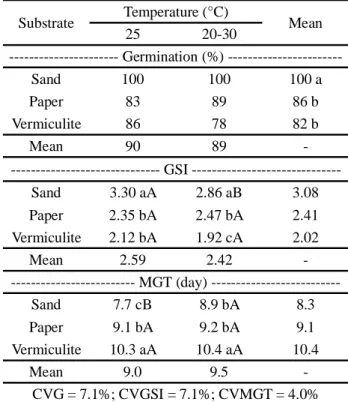
The mean germination values summarized in Tables 3-5 indicate the absence of a temperature effect and a significant effect of the substrate used only for lots B and C. The highest germination percentage for the seeds of these lots was obtained with sand as a substrate regardless of the temperature used.
The absence of a significant effect of constant and alternating temperatures on germination percentage is due to the fact that these temperatures provided similar germination percentages during evaluations performed using the thermogradient table and were, therefore, selected for substrate evaluation.
The highest germination speeds of seeds from lot A were obtained at 25 °C when sand and vermiculite were used as substrates (Table 3). On the other hand, only the use of sand as a substrate at a temperature of 25 °C increased the germination speed of seeds from lots B and C (Tables 4 and 5). As substrates, paper and vermiculite yielded similar results at a constant temperature, but the results differed when alternating temperatures were used.
Table 3 - Mean germination percentage (%), germination speed index (GSI), and mean germination time (MGT) of Physalis peruviana
L. seeds from lot A using different substrates and different temperatures
Means followed by the same lowercase letter in the column and uppercase in the row do not differ from each other based on Tukey’s test ( p < 0.05). CV: coefficient of variation
The greater contact of seeds with moistened sand possibly favored water absorption and, consequently, increased germination speed.
There was a significant factor interaction effect on mean germination time among the seeds from lots A and C (Tables 3 and 5). For paper, the germination time was the longest at alternating temperatures of 20-30 °C (lot A); for substrate, it was the longest at both tested temperatures (lot C). Only seeds from lot B were significantly affected by the substrate, particularly sand, which led to the lowest mean germination time (Table 4).
The germination of P. peruviana seeds is epigeal, and the seedlings are of the phanerocotiledonar– epigeal–foliaceous type. The mechanical resistance of substrates may contribute to the detachment of the integument from the cotyledons, thereby completing germination. Among the evaluated substrates, sand has this physical property perhaps explaining the higher percentage of germination and germination speed it allowed compared with the other substrates regardless of the temperature used.
Similar to P. peruviana seeds, Cucumis metuliferus seeds showed optimum performance at temperatures of 25 °C and 20-30 °C, but they differed with regard to the optimum substrate, which was paper (ALVES et al., 2014). In Parkia multijuga, the optimum conditions for the seed germination test were obtained using sand as a substrate, temperatures of 25 °C or 30 °C, and continuous light exposure (ROCHA et al., 2014).
Ferreira and Novembre (2015) studied the germination of Bixa orellana L. and stated that paper is the optimum substrate for these seeds. More than one substrate may be indicated for some seeds, including those of Simira gardneriana, for which paper and sand have been recommended as substrates (OLIVEIRA et al., 2016).
Although sand led to good results in P. peruviana seeds, there were difficulties in the setting up of the germination test because of the size and, in particular, the color of the seeds resembling those of the substrate, thereby hindering seed placement. Therefore, although this substrate meets the ecophysiological requirements of
Means followed by the same lowercase letter in the column and uppercase in the row do not differ from each other based on Tukey’s test (p<0.05). CV: coefficient of variation
Table 4 - Mean germination percentage (%), germination speed
index (GSI), and mean germination time (MGT) of Physalis
peruviana L. seeds from lot B using different substrates and
different temperatures
Table 5 - Mean germination percentage (%), germination speed
index (GSI), and mean germination time (MGT) of Physalis
peruviana L. seeds from lot C using different substrates and
different temperatures
Means followed by the same lowercase letter in the column and uppercase in the row do not differ from each other based on Tukey’s test (p<0.05). CV: coefficient of variation
Substrate Temperature (°C) Mean
25 20-30 --- Germination (%) ---Sand 100 100 100 a Paper 83 89 86 b Vermiculite 86 78 82 b Mean 90 89 - GSI - ---Sand 3.30 aA 2.86 aB 3.08 Paper 2.35 bA 2.47 bA 2.41 Vermiculite 2.12 bA 1.92 cA 2.02 Mean 2.59 2.42 MGT (day) - ---Sand 7.7 cB 8.9 bA 8.3 Paper 9.1 bA 9.2 bA 9.1 Vermiculite 10.3 aA 10.4 aA 10.4 Mean 9.0 9.5 -CVG = 7.1%; -CVGSI = 7.1%; CVMGT = 4.0%
Substrate Temperature (°C) Mean
25 20-30 --- Germination (%) ---Sand 84 80 82 a Paper 65 74 70 b Vermiculite 68 77 73 b Mean 72 77 - GSI - ---Sand 2.37 aA 2.15 aB 2.26 Paper 1.50 bA 1.60 cA 1.55 Vermiculite 1.54 bB 1.85 bA 1.70 Mean 1.80 1.87 1.84 --- MGT (day) ---Sand 9.5 10.0 9.7 b Paper 11.8 12.4 12.1 a Vermiculite 11.6 10.8 11.2 a Mean 11.0 11.1 -CVG = 8.4 %; -CVGSI = 7.0%; CVMGT = 7.1%
the seeds, this inconvenience should be considered during the setting up of the test. Not surprisingly, paper and sand are recommended as substrates for seeds of P. alkekengi and P. pubescens, which belong to the same genus as P. peruviana (BRASIL, 2009). Therefore, paper and vermiculite are alternative substrates for the P. peruviana seed germination test because the germination results of the seeds from lot A in paper and vermiculite were similar to those obtained in sand.
Studies on the germination of P. peruviana seeds have used various methods for conducting germination tests, which may compromise the interpretation of the present results. For example, Sbrussi et al. (2014) used paper moistened at 2.5-times dry paper weight, alternating temperatures of 20-30 °C, and 16-h light exposure. Melo et al. (2015) also used paper as the substrate and the same amount of water (2.5-times dry paper weight), but they applied a constant temperature of 25 °C and 12-h photoperiod, similar to that used by Souza et al. (2016). In contrast, Oro et al. (2012) moistened the substrate at a ratio of 3-times dry paper weight.
As such, the requirement of light for the germination of P. peruviana seeds is obvious (8 h per day); although they germinate at a wide temperature range (between 15.0 °C and 30.2 °C), a constant temperature of 25 °C and alternating temperature of 20°C/30°C were found to be optimum because they led to the highest germination percentage and germination speed index. In addition, temperatures below 21.6 °C reduced the seed germination speed and those above 30.2 °C reduced seed germination speed and total number of germinated seeds. Considering that, at optimum temperatures, radicle protrusion occurred starting from the 3rd day after setting
up of the test and that the mean germination time ranged from 10 to 14 days, it is possible to conduct evaluations on the 7th and 14th days, corresponding to the first and last
counts. In the test, normal seedlings, those with green cotyledons detached from the integument, and those with hypocotyl and primary radicle developed in a balanced way possibly with a secondary root should be observed (Figure 1D).
Thus, the results obtained herein may be useful to standardize or implement a method for the germination test of P. peruviana seeds with the aim of providing seeds with near-optimum conditions for germination and of obtaining test results that are reproducible and comparable.
CONCLUSIONS
1. The germination of P. peruviana seeds occurred over a wide temperature range from 15.0 °C to 30.2 °C, but a constant temperature of 25 °C and alternating
temperatures of 20-30 °C appeared to be optimum under 8h light per day;
2. Sand was found to be the most suitable substrate (between sand); alternatively, blotting paper (on paper) and vermiculite (between vermiculite) may be used as substrates;
3. Germination tests can be evaluated 7 (first count) and 14 days (final count) after test initiation.
REFERENCES
ALVES, C. Z. et al. Teste de germinação em sementes de
Cucumis metuliferus E. Mey. Ciência Rural, v. 44, n. 2, p.
228-234, 2014.
ATAÍDE, G. M.; BORGES, E. E. L.; FLORES, A. V. Enzymatic activity in braúna seeds subjected to thermal stress. Ciência
Rural, v. 46, n. 6, p. 1044-1049, 2016.
AUD, F. F.; FERRAZ, I. D. K. Seed size influence on germination responses to light and temperature of seven pioneer tree species from the Central Amazon. Anais da Academia Brasileira de
Ciências, v. 84, n. 3, p. 759-766, 2012.
BARAKAT, N. A. M. et al. Synergetic action of light and temperature on seed germination of some solanaceae members. Journal of Stress Physiology & Biochemistry, v. 9, n. 4, p. 85-100, 2013.
BEWLEY, J. D.; BLACK, M. Seeds: physiology of
development and germination. New York: Plenum Press, 1994. 445 p.
BRANCALION, P. H. S. et al. Efeito da luz e de diferentes temperaturas na germinação de sementes de Heliocarpus
popayanensis L. Revista Árvore, v. 32, n. 2, p. 225-232, 2008.
BRASIL. Ministério da Agricultura, Pecuária e Abastecimento.
Regras para análise de sementes. Brasília, DF, 2009. 395 p.
CARVALHO, N. M.; NAKAGAWA, J. Sementes: ciência, tecnologia e produção. 5. ed. Jaboticabal: Funep, 2012. 590 p. FERREIRA, R. L.; NOVEMBRE, A. D. L. C. Teste de germinação de sementes de urucum (Bixa Orellana L.).
Multi-Science Journal, v. 1, n. 3, p. 46-52. 2015.
FERREIRA, T.; RASBAND, W. ImageJ use guide: IJ 1.46r. 2012. Disponível em: https://imagej.nih.gov/ij/docs/guide/user-guide.pdf. Acesso em: 14 nov. 2016.
FISCHER, G.; ALMANZA-MERCHÁN, P. J.; MIRANDA, D. Importancia y cultivo de la uchuva (Physalis peruviana). Revista
Brasileira de Fruticultura, v. 36, n. 1, p. 1-15, 2014.
FREITAS, T. A.; OSUÑA, J. T. A. Efeito do substrato e da luminosidade na germinação de sementes de Physalis angulata L. (Solanaceae). Sitientibus Série Ciências Biologicas, v. 6, n. 2, p. 101-104, 2006.
LABOURIAU, L. G. A germinação das sementes. Washington: Secretaria Geral da Organização dos Estados Americanos, 1983. 174 p.
MAGUIRE, J. D. Speed of germination-aid in selection and evaluation for seedling emergence and vigor. Crop Science, v. 2, n. 2, p. 176-177, 1962.
MELO, A. P. C. et al. Does fruit cooling and seed film coating affect the germination potential of physalis? Scientia
Agropecuaria, v. 6, n. 4, p. 325-328, 2015.
MONDO, V. H. V. et al. Efeitos da luz e temperatura na germinação de sementes de quatro espécies de plantas daninhas do gênero
Digitaria. Revista Brasileira de Sementes, v. 32, n. 1, p.
131-137, 2010.
MORENO, A. M. H.; FISCHER, G.; SÁNCHEZ, M. I. C. Agronomical evaluation of cape gooseberries (Physalis peruviana L.) from central and north-eastern Colombia. Agronomia
Colombiana, v. 30, n. 1, p. 15-24, 2012.
MOTSA, M. M. et al. Effect of the light and temperature on seed germination of selected African leafy vegetables. South African
Journal of Botany, v. 99, n. 4, p. 29-35, 2015.
MUNIZ, J. et al. General aspects of physalis cultivation.
Ciência Rural, v. 44, n. 6, p. 964-970, 2014.
NOSRATTI, I. et al. Germination and emergence characteristics of annual ground cherry (Physalis divaricata). Jordan Journal
of Biological Sciences, v. 9, n. 2, p. 131-138, 2016.
OLIVEIRA, F. N. et al. Temperaturas e substratos na germinação de sementes de pereiro vermelho (Simira gardneriana M.R. Barbosa & Peixoto). Revista Ciência Agronômica, v. 47, n. 4, p. 658-666, 2016.
OLIVEIRA, P. G.; GARCIA, Q. S. Germination characteristics os Syngonanthus seeds (Euriocaulaceae) in campos rupestres vegetation in South-eastern Brazil. Seed Science Research, v. 21, n. 1, p. 39-45, 2011.
ORO, P. et al. Metodologia para teste de envelhecimento acelerado em sementes de fisális (Physalis peruviana). Cultivando o
Saber, v. 5, n. 3, p. 167-175, 2012.
PAIVA, E. P. et al. Light regime and temperature on seed germination in Salvia hispanica L. Acta Scientiarum Agronomy, v. 38, n. 4, p. 513-519, 2016.
PELLIZZARO, V. et al. Physiological potential of Physalis
peruviana L. seeds under different temperatures and light
wavelengths. Semina: Ciências Agrárias, v. 40, n. 5, p. 1737-1746, 2019.
PEREIRA, M. D.; SANTOS, C. E. M; MARTINS FILHO, S. Germinação de sementes de cubiu (Solanum sessiliflorum Dunal).
Revista Brasileira de Ciências Agrárias, v. 6, n. 1, p. 79-84,
2011.
POPINIGIS, F. Fisiologia da semente. Brasília, DF: AGIPLAN, 1985. 285 p.
ROCHA, C. R. M. et al. Morfobiometria e germinação de sementes de Parkia multijuga benth. Nativa, v. 2, n. 1, p. 42-47, 2014.
SBRUSSI, C. A. G. et al. Maturation stages of fruit development and physiological seed quality in Physalis peruviana. Revista
Ciência Agronômica, v. 45, n. 3, p. 543-549, 2014.
SOUZA, C. L. M. et al. Morfologia de sementes e desenvolvimento pós-seminal de Physalis angulata L. Acta Botanica Brasilica, v. 24, n. 4, p. 1082-1085, 2010.
SOUZA, C. L. M. et al. Physalis peruviana seed storage. Revista
Brasileira de Engenharia Agrícola e Ambiental, v. 20, n. 3, p.
263-268, 2016.
VIDAVER, W. Light and seed germination. In: KHAN A. A.
The physiology and biochemistry of seed dormancy and germination. New York: North-Holland Publishing Company,
1980. p. 181-192.
VIEIRA, B. C.; RODRIGUES, B. M. A.; GARCIA, Q. S. Light exposure time and light quality on seed germination of Vellozia species (Velloziaceae) from Brazilian campo rupestre.
Flora, v. 238, p. 94-101, jan. 2018.