From Anchieta to Guerrero: The Salve Regina in
Portuguese Sources and an Unknown Early
Spanish Alternatim Setting
Bernadette Nelson
CESEM Faculdade de Ciências Sociais e Humanas Universidade NOVA de Lisboa [email protected]
Resumo
As cerca de doze Salve Regina polifónicas, algumas fragmentárias, copiadas em manuscritos do século XVI preservados na Biblioteca Geral da Universidade de Coimbra não mereceram até hoje investigação pormenorizada. Com excepção de apenas duas obras atribuídas a compositores do Mosteiro de Santa Cruz de Coimbra, todas são anónimas. No entanto, a análise dos estilos e das variantes textuais deste pequeno grupo de obras revelou, além de concordâncias das Salve Regina de Anchieta e Guerrero, que uma ou duas outras foram claramente importadas de Espanha e que as restantes parecem ser de origem portuguesa, ou local. As obras espanholas terão sido originalmente destinadas principalmente para a execução nos Ofícios especiais da Salve, uma particularidade da devoção mariana em importantes instituições como as catedrais de Sevilha e Palencia e a capela real de Castela a partir das duas últimas décadas do século XV. Este estudo centra-se especialmente em uma Salve Regina anónima concebida para ser executada em alternância com o cantochão, copiada junto com um fragmento da Salve de Anchieta no manuscrito P-Cug MM 7, que revela estreitas relações com algumas das Salve
Regina espanholas mais antigas, incluindo as de Anchieta, Rivaflecha e Escobar. Trata-se de uma obra
com cantus firmus aparentemente baseado, em grande parte, na versão sevilhana do cantochão, como aparece na Breve instrucción (1565), única fonte conhecida para a melodia da Salve Regina em uso na catedral de Sevilha no século XVI.
Palavras-chave
Salve Regina; Anchieta; Catedral de Sevilha; Coimbra, Mosteiro de Santa Cruz; Coimbra, manuscrito
MM 7; Polifonia.
Abstract
The series of about a dozen Salve Regina settings (some fragmentary) copied in sixteenth-century polyphonic manuscripts preserved in Coimbra University Library has thus far not received detailed investigation. With the exception of just two settings attributed to composers at the royal Augustinian monastery of Santa Cruz in Coimbra, all are anonymous. However, analysis of the styles and textual variants found in a small handful of settings has not only revealed concordances of Salve Regina settings by Anchieta and Guerrero but also one or two more that were likewise clearly imported from Spain, whilst the remainder would appear to be of (local) Portuguese origin. It is likely that these Spanish settings would originally have been intended for performance at the special Salve services, which were a
nova série | new series 6/1 (2019), pp. 113-156 ISSN 2183-8410 http://rpm-ns.pt
distinctive feature of Marian devotion at such major institutions as Seville and Palencia Cathedrals as well as the Castilian royal chapel from around the last two decades of the fifteenth century onwards. This study focuses especially on an anonymous alternatim setting copied with a fragment of Anchieta’s Salve into the manuscript P-Cug MM 7, which demonstrates close connections with some of the very earliest Spanish settings, including those of Anchieta, Rivaflecha and Escobar. It is a cantus firmus setting seemingly based largely on the Sevillian version of the chant as recorded in the later (1565) Breve
instrucción (the only known source for the Salve Regina chant used at Seville cathedral in the sixteenth
century).
Keywords
Salve Regina; Anchieta; Seville Cathedral; Coimbra, Monastery of Santa Cruz; Coimbra Manuscript
MM 7; Polyphony.
Introduction
HE SALVE REGINA WAS ONE OF THE MOST WIDESPREAD and popular polyphonic genres to have developed in Renaissance Europe, with hundreds of different settings recorded in musical sources dating from about the mid-fifteenth century onwards. Whilst it had a very long tradition of liturgical integration at the close of Compline, normally during the season between Trinity Sunday and Advent, it also formed an integral part of important paraliturgical and devotional contexts—in particular, in Spain, as part of the Salve service, a counterpart of the Marian
Lof in the Low Countries.1 Likewise in Spain, it was often sung at Compline during the Lenten
This essay is based on a paper first presented at the Open Symposium ‘Late 15th- and Early 16th-Century Iberian Polyphonic Music’ held in Lisbon (NOVA FCSH) in January 2017 as part of the FCT-funded project PTDC/CPC-MMU/0314/2014. I especially wish to thank João Pedro d’Alvarenga, Tess Knighton and Kenneth Kreitner for reading a preliminary draft of this essay and for their most helpful comments and suggestions, and João Pedro d’Alvarenga again for very kindly providing me with copies of invaluable documentation necessary in its preparation. Photographic reproductions from the Portuguese Early Music Database with permission of the Biblioteca Geral da Universidade de Coimbra.
1 For the history and development of the Spanish Salve Service, see Robert SNOW, A New-World Collection of Polyphony
for Holy Week and the Salve Service: Guatemala City, Cathedral Archive, Music Ms 4 (Chicago, University of Chicago Press, 1996), especially at IV: ‘Music for the Salve Service and Compline’, pp. 65-78. See also Grayson WAGSTAFF, ‘Mary’s Own: Josquin’s Five-Part Salve Regina and Marian Devotions in Spain’, TVNM, 52/1 (2002), pp. 3-34; and Juan María SUÁREZ MARTOS, El rito de la Salve en la catedral de Sevilla durante el siglo XVI: Estudio del repertorio musical contenido en los manuscritos 5-5-20 de la Biblioteca Columbina y el libro de polifonía de la Catedral de Sevilla (Seville, Consejería de Cultura, 2010). For the Lof, and practices in Antwerp especially, see Kristine FORNEY, ‘Music, Ritual and Patronage at the Church of Our Lady, Antwerp’, Early Music History, 7 (1987), pp. 1-58. The precise starting point of the Spanish Salve service is not precisely known, but it is possible that it was influenced by traditions in northern Europe. For possible connections between practices established in the cathedral at Palencia and the Low Countries, see Tess KNIGHTON, ‘Marian Devotions in Early Sixteenth-Century Spain: The Case of the Bishop of Palencia, Juan Rodríguez de Fonseca (1451-1524)’, in Uno gentile et subtile ingenio. Studies in Renaissance Music in Honour of Bonnie J. Blackburn, edited by M. J. Bloxam, G. Filocamo and L. Holford-Strevens (Leiden, Brepols, 2009), pp. 137-46; and Tess KNIGHTON, ‘“Motetes de la Salve”: Some Thoughts on the Provenance, Compilation, and Use of Seville, Biblioteca Colombina, 5-5-20’, in Treasures of the Golden Age: Essays in Honor of Robert M. Stevenson, edited by M. O’Connor and W.A. Clark (Hillsdale, Pendragon Press, 2012), pp. 29-58. See also, Juan RUIZ JIMÉNEZ, La Librería de Canto de Órgano. Creación y pervivencia del repertorio del Renacimiento en la actividad musical de la catedral de Sevilla (Granada, Consejería de Cultura - Centro de Documentación Musical de Andalucía, 2007), pp. 149-55.
season, besides at Vespers and other times.2 From the later fourteenth century, and following
ecclesiastical prescription, Salve Regina was sung on Saturdays after the Marian Mass,3 which was
then to become the usual time for the Salve service to take place. The Salve service itself was a distinctive feature of Marian devotion at such major ecclesiastical institutions as Seville and Palencia Cathedrals, as well as the Castilian royal chapel, by at least the last quarter of the fifteenth century onwards, with documented traditions extending back to at least the early 1480s and, in Seville, in perpetuity from 1499.4 As notably in the Antigua chapel in Seville Cathedral, for
example, Salve services often took place in special chapels in front of a painting or statue of the Virgin, and many were endowed by private, often ecclesiastical patrons, or—as at the Church of Our Lady (now the cathedral) in Antwerp—by lay (‘Salve’) confraternities.5 The early Salve service
predominantly followed a set pattern in which, especially before the early 1530s, the Salve Regina was often performed alternatim in chant and polyphony, and in conjunction with Marian motets, prayers and responses, organ music, and also sometimes bells.6 Although it is likely that most
polyphonic settings of the Salve Regina in Spanish sources were intended for the Saturday Salve service, slightly different traditions could well have evolved in such important monasteries with choral foundations as Our Lady of Montserrat and Our Lady of Guadalupe, both of which are associated with pilgrimages and special devotional practices focused on a (black) statue of the Virgin and child. In 1500 in Montserrat, for example, the antiphon was said (or indeed sung) after
2 See SUÁREZ MARTOS, ‘Estructura del rito de la Salve y el canto de la antífona en otras ceremonias’, El rito de la Salve
(see note 1), chap. V, pp. 149-63. A chapter concerning the Salve and its performance after Vespers and Compline was included in the 1498 printed constitutions of the archdiocese of Toledo: ‘Del tañer de la Salue y doctrina de los niños’, in Constituciones del Arzobispado de Toledo ordenados por Fr. Francsico Jiménez de Cisneros (Toledo, 1498), chap. 4, ff. 4v-5v. See also Robert STEVENSON, Spanish Music in the Age of Columbus (Los Angeles, University of California, 1960), p. 181.
3 This Mass was then to be followed by the seven penitential psalms: ‘En 1362 […] instituyó […] que en las sábados,
despues de la misa de la Virgen se cantase in jubilo la antífona Salve Regina, y luego se digesen los VII salmos penitenciales.’ Jaime VILLANEUVA, Viage literário á las iglesias de España (Madrid, 1850), vol. 13, p. 17. See also STEVENSON, Spanish Music (see note 2), p. 181.
4 The earliest Spanish foundations of a special Marian devotion that included singing Salve Regina in Spain that are
known are connected with Seville Cathedral—in particular, the foundation of a service with polyphonic integration by Pedro de Toledo, Archbishop of Malaga in c. 1484. See Todd BORGERDING, ‘The Motet and Spanish Religiosity, ca. 1550-1610’ (PhD. Diss., University of Michigan, 1997), pp. 92 and 290-1, SUÁREZ MARTOS, El rito (see note 1), pp. 116-23, WAGSTAFF, ‘Mary’s Own’ (see note 1), pp. 18-19, RUIZ JIMÉNEZ, La Librería de Canto de Órgano (see note 1), p. 14; and Juan RUIZ JIMÉNEZ, ‘“The Sounds of the Hollow Mountain”: Music Tradition and Innovation in Seville Cathedral in the Early Renaissance’, Early Music History, 29 (2010), pp. 189-239 (pp. 209-10). For the origins of the Salve service at Palencia Cathedral, see KNIGHTON, ‘Marian Devotions’ (see note 1); and KNIGHTON, ‘“Motetes de la Salve”’ (see note 1).
5 For details of foundations with endowments of the Salve services in Spain, see preceding note; for Antwerp traditions,
see Forney, ‘Music, Ritual, and Patronage’ (see note 1).
6 See BORGERDING, ‘The Motet and Spanish Religiosity’ (see note 4), pp. 92-3; SUÁREZ MARTOS, El rito (see note 1),
pp. 116-23; WAGSTAFF, ‘Mary’s Own’ (see note 1), pp. 18-19, and KNIGHTON, ‘Marian Devotions’ (see note 1), pp. 137 and 143-4.
Mass daily.7 Besides being sung in chant and polyphony, there was also an important tradition in
many institutions of performing the Salve Regina alternatim with organ music.8
Two major Spanish polyphonic sources preserved in Seville that most clearly demonstrate their origin in or association with the Salve service may be highlighted—not only because of their intention but also because they contain paradigms and varieties of Salve Regina composition that help situate early Salve settings found in other Iberian manuscripts, including those in Portuguese holdings. The first of these two sources, E-Sco 5-5-20, whose precise origins have not yet been definitely established,9 features a small group of four Salve Regina settings with alternatim
structures by composers associated with the reign of the Catholic Monarchs during the late fifteenth and early sixteenth centuries—Anchieta, Medina, Ponce and Rivaflecha10—besides ‘motetes de la
Salve’.11 A setting by Pedro de Escobar also intended for inclusion in this manuscript survives only
in E-TZ 2/3 where it is paired with a further copy of Anchieta’s Salve. (There are no other Salve settings in this source.) Indeed, Anchieta’s four-five voice Salve is the only such setting known to have circulated widely: as many as four complete or nearly complete copies, in addition to fragments, survive in Spanish sources, whilst there is now important evidence testifying to its transmission to Portugal (see below).12 The second source, E-Sc 1, copied at Seville Cathedral in
c. 1555,13 has seven Salve Regina settings: four with alternatim structures, and three
through-composed.These are predominantly by the succeeding generation of Spanish composers—Morales, Guerrero (with two settings, one of each type) and Ceballos, besides Pedro Fernández de Castilleja, whose long fifty-year career at Seville Cathedral in succession to Escobar extended from 1514 to
7 Montserrat constitutions dating from c. 1500 state that it should be recited [daily] by the clergy after Mass, a tradition
that is still upheld today, and sung by the choir and choristers. (No mention is made of a particular ‘Salve service’ as such here.) See Bernadette NELSON, ‘The integration of Spanish and Portuguese organ music within the liturgy from the latter half of the sixteenth to the eighteenth century’ (D.Phil. diss., University of Oxford, 1987), vol. I, p. 190.
8 A very early reference to performing the Salve alternatim with the organ at the close of Compline is found in the same
set of constitutions at Montserrat. See NELSON, ‘The integration’ (see note 7), vol. I, p. 191. For traditions of singing the Salve alternatim with the organ, especially in a slightly later period, see NELSON, ‘The integration’ (see note 7), vol. I, pp. 189-93 and 203-7.
9 For the most recent study of this manuscript and discussion of its possible origins and compilation history, which
include the role of Juan Rodríguez de Fonseca, Bishop of Palencia Cathedral, and for literature on possible connections between this manuscript and Seville, see KNIGHTON, ‘“Motetes de la Salve”’ (see note 1).
10 For information about the possibly identities of Medina and Ponce, Rivaflecha’s associations with Palencia, and other
connections between this group of composers and Bishop Fonseca, see KNIGHTON, ‘“Motetes de la Salve”’ (see note 1), pp. 40-9.
11 With the exception of the music by Rivaflecha that was added in the second part of E-Sco 5-5-20, judging by other
extant sources of Spanish polyphonic music of the period, the motets in this manuscript were among the most widely circulated in Spain in the sixteenth century.
12 For the most recent discussion of Anchieta’s Salve Regina and its sources, see Kenneth KREITNER, ‘The late sacred
music’, in Tess KNIGHTON and Kenneth KREITNER, The Music of Juan de Anchieta (Abingdon - New York, Routledge, 2019), chap. 6, at pp. 150-7.
13 Documentation recording the activity of this choirbook’s scribe, Francisco de Torres, witnesses his copying of ‘un libro
the time of his death in 1574. The compositional date of his setting is therefore not entirely certain.14 In addition, there are two non-Iberian settings: Josquin’s famous five-voice Salve Regina
in three partes, and an alternatim setting by Gombert.15
Certain idiosyncracies of early Spanish Salve settings associated with the Salve service tradition, in particular those with alternatim structures, distinguish them from the genre that developed around the middle of the sixteenth century in Spain and Portugal, which was predominantly through-composed. This transition or change can be appreciated especially in E-Sc 1, in which both types are included. The newer ‘motet’ or through-composed type in three partes, which characterizes the structure of Morales’s five-voice setting, has often been credited to the influence of Josquin’s setting.16 This overall distinction of compositional approach is significant
when considering the settings of the Salve Regina in Iberian sources more generally.
Portuguese Sources of the Salve Regina
In contrast to the well-documented practices and traditions in Spain, there appears to be none in Portugal of special Marian devotions centred on singing Salve Regina beyond the normal liturgical (Compline) context. But the fact that at least a dozen or more polyphonic Salve settings are recorded or partially recorded in Portuguese manuscripts is a clear indication that this genre occupied an important and integral part of the liturgy and devotion in a number of choral institutions. As with the majority of polyphonic music in Portugal, however, any appreciation of early Salve settings is almost entirely focused on the series of manuscripts dating from the sixteenth century preserved in the University library in Coimbra (BGUC) of which a significant proportion were likely to have been composed at the Augustinian monastery of Santa Cruz in Coimbra from about the middle decades of the sixteenth century onwards.17
14 Further on Fernández and his Salve Regina, see WAGSTAFF, ‘Mary’s Own’ (see note 1), WAGSTAFF, ‘A re-Evaluation of
Music Attributed to Pedro Fernández de Castilleja’, Revista de Musicología, 16/5 (1993), pp. 2722-33, and Grayson WAGSTAFF, ‘Re-examining Pedro Fernández de Castilleja Again: Was He a more Important Contemporary of Peñalosa than We Assumed?’, Portuguese Journal of Musicology, new series, 6/1 (2019), pp. 63-90. See also below.
15 Josquin’s Salve was printed in Rome in 1521 (RISM 15215). It has been suggested that it could have been personally
brought to Spain from Italy by Morales; see WAGSTAFF, ‘Mary’s Own’ (see note 1), p. 13; see also Bernadette NELSON, ‘Josquin in the Music of Morales: Musico-Rhetorical Devices in Salve Regina and Other Works’, in Treasures of the Golden Age. Essays in Honor of Robert Stevenson, edited by M. O’Connor and W. Clark (Hillsdale, New York, Pendragon Press, 2012), pp. 295-320, at p. 213, n. 51. Contextually, it is interesting to note that Josquin endowed a Salve service to be sung on Saturdays and Marian feasts. See Herbert KELLMAN, ‘Josquin and the Courts of the Netherlands and France: The Evidence of the Sources’, in Josquin des Prez, edited by E. Lowinsky and B. Blackburn (London, OUP, 1976), pp. 217-46, at p. 208. (This is also cited in WAGSTAFF, ‘Mary’s Own’ (see note 1), p. 27, and NELSON, ‘Josquin in the Music of Morales’ (see note 15), p. 312).
16 See WAGSTAFF, ‘Mary’s Own’ (see note 1), and below.
17 For the Coimbra polyphonic sources, see Owen REES, Polyphony in Portugal, c.1530 – c.1620: Sources from the
Monastery of Santa Cruz, Coimbra (New York, Garland, 1995). The majority of these sources are available for consultation online on the Portuguese Early Music Database (PEM).
The BGUC is in fact one of the largest single repositories of the polyphonic Salve Regina in the Iberian Peninsula: there are about nine complete settings—either with alternatim structures (the majority) or through-composed in three partes—besides fragments of three more. These settings are to be found in seven manuscript choirbooks, sometimes copied together in twos or threes, or in close proximity to other Marian antiphons. With the exception of those by Dom Heliodoro de Paiva (d. 1552) and a Dom Bento (fl. mid 1500s), both of whom were professed canons at the monastery, none of these settings receive composer attributions, although a number of others would also surely have originated there. Nonetheless, as with other polyphony recorded in the Santa Cruz manuscripts, this does not preclude that these sources do not also incorporate Salve settings transmitted from outside a purely monastic context or, indeed, Portugal. In fact a preliminary examination of basic structural, textual and compositional elements of this array of Salve Regina settings, including the fragments, enables a broad classification of these works according to their probable origins or provenance, importantly identifying not only those that were likely to have been composed locally but also a small number that were clearly imported—notably, further but rare concordances (albeit incomplete or fragmentary) of two important Salve settings by the Spanish composers Juan de Anchieta (1462-1523) and Francisco Guerrero (1528-99) in P-Cug MM 7 and MM 6 respectively: see Table 1a.
The concordance of Anchieta’s Salve Regina setting in MM 7 is just a very small fragment, consisting merely of the cantus part of the first two verses, but untexted. This is the sixth source for his Salve to have been identified to date, further demonstrating its wider circulation in the Iberian Peninsula from the date of its first composition through to the mid sixteenth century.18 The
four-voice Salve by Francisco Guerrero (partially texted in MM 6), on the other hand, was only previously known in a very small handful of Spanish sources: the aforementioned Sevillian Salve choirbook (E-Sc 1), Guerrero’s Sacrae cantiones, published in Seville in 1555,19 and a later
sixteenth-century Spanish manuscript preserved in Tarazona, E-TZ 4. It is in fact extremely unusual to find his music in the Coimbra manuscripts, and no other compositions from the 1555 print have been identified in Portuguese sources. However, it is interesting to note that both the Anchieta and Guerrero settings are included in the two Salve service polyphonic sources (E-Sco 5-5-20 and
18 For a list of sources of Anchieta’s Salve Regina, see Appendix 1. His music was generally circulated quite widely, and
two more of his compositions are included in the corpus of early ‘Spanish Court Repertory’ works identified in the Coimbra sources. See REES, Polyphony in Portugal (see note 17), especially chap. 2, ‘Dissemination of a ‘Spanish Court Repertory’ in Portugal’, pp. 49-85 and passim. See also João Pedro D’ALVARENGA, ‘On the Transmission of Iberian Polyphonic Music in the Early Decades of the Sixteenth Century: Some Philological Issues Revisited’, Portuguese Journal of Musicology, new series, 6/1 (2019), pp. 5-28.
19 The Sacrae cantiones (Seville, D. Pisador, 1555; RISM G4967) consists of a set of five small partbooks which was
dedicated to the Duke of Arcos, Don Luis Cristóbal Ponce de León. However, only one complete set is known to survive (Hispanic Society, New York). Guerrero composed this Salve at Seville Cathedral.
E-Sc 1) described above, and it is indeed possible that they could have had a Sevillian route of
transmission to Coimbra, perhaps in line with other early Spanish polyphonic music encountered in these manuscripts by composers of the early generation up to and including Morales.20 To these two
concordances of Spanish Salve Regina settings in Coimbra can be added that of Morales’s four-part setting in the late sixteenth-century Portuguese choirbook in Oporto, P-Pm MM 40.21
No. Source ff. Structure Text: first line of setting
Text: final phrase Composer Provenance/ Concordances
1 P-Cug
MM 6
56r [frag.]
[Alternatim] (missing) [O] dulcis Virgo Maria.
Anon. [Coimbra, Santa Cruz?] 2 82v-86r Motet (3 partes) Vs. 1 Salve Regina mater misericordiae. [O dulcis Virgo semper Maria.] [Francisco Guerrero] (1528-99) Spanish/ E-Sc 1; E-TZ 4; 1555 (RISM G4867) 3 P-Cug MM 7 25v-26r 27B-30r Motet (3 partes) Vs. 1 Salve Regina misericordiae. O dulcis Virgo semper Maria. Anon. [Spanish?]/MM 9 4 30v-31r Alternatim Vs. 2 Vita dulcedo et
spes nostra salve
O dulcis Virgo semper Maria.
Anon. [Spanish]
5 31v
[frag.]
Alternatim Vs. 2 [Vita dulcedo et spes nostra salve]
(missing) [Juan de Anchieta] (c.1462-1523) Spanish/ see Appendix 1 6 P-Cug MM 9 151v-154r
Alternatim Vs. 1 Salve Regina misericordiae.
O dulcis Virgo Maria.
Anon. [Coimbra, Santa Cruz] (3) 154v-158r Motet (3 partes) Vs. 1 Salve Regina misericordiae. O dulcis Virgo [semper] Maria. Anon. [Spanish?]/ MM 7 7 P-Cug MM 12 35v-37r [incompl.]
Alternatim Vs. 1-2 Salve Regina mis.../Vita dulcedo. O dulcis Virgo Maria. Dom Bento (fl. mid 16thc.) Coimbra, Santa Cruz 8 198v-200r
Alternatim Vs. 1 Salve Regina misericordiae.
O dulcis Virgo Maria.
Anon. [Coimbra, Santa Cruz] 9 P-Cug MM 33 90v + 100r-101r
Alternatim Vs. 2 Vita dulcedo et spes nostra salve.
O dulcis Virgo Maria.
Anon. [Coimbra, Santa Cruz?]/ MM 53
10 P-Cug
MM 44
98v-100r
Alternatim Vs. 1 [Salve] Regina mater misericordiae. O pia [O dulcis Virgo Maria.] Anon. [Coimbra] 11 100v-101r Motet (3 partes) Vs. 1 Salve Regina mater misericordiae. O dulcis Virgo Maria. Anon. [Coimbra] 12 101v-104r
Alternatim Vs. 1 Salve Regina mater misericordiae. O dulcis Virgo Maria. Dom Heliodorus de Paiva (d. 1552) Coimbra, Santa Cruz (9) P-Cug MM 53
33v-35r Alternatim Vs. 2 Vita dulcedo et spes nostra salve.
O dulcis Virgo Maria.
Anon. [Coimbra, Santa Cruz?]/ MM 33 Table 1a. Salve settings in Coimbra manuscripts
20 See also Tess KNIGHTON, ‘Gonçalo de Baena’s Arte para tanger (Lisboa, 1540): Local and International Repertories’,
in Musical Exchanges, 1100-1650: Iberian Connections, edited by Manuel Pedro Ferreira (Kassel, Reichenberger, 2016), pp. 209-39, at p. 221.
21 For an inventory and description of this manuscript, see João Pedro D’ALVARENGA, ‘Manuscripts Oporto, Biblioteca
Pública Municipal, MM 40 and MM 76-79: Their Origin, Date, Repertories and Context’, in Pure Gold: Golden Age Sacred Music in the Iberian World. A Homage to Bruno Turner, edited by Tess Knighton and Bernadette Nelson (Kassel, Reichberger, 2011), pp. 27-58. In this version of his Salve in P-Pm MM 40, there is a newly composed final verse setting all three of the last phrases of the antiphon, ‘O clemens, o pia, o dulcis…’ It is likely that this verse was recomposed for performance in a particular Portuguese institution. See NELSON, ‘Josquin in the Music of Morales’ (see note 15), pp. 305-6, n. 37.
Finally, the Coimbra sources include a transcription in the score manuscript P-Cug MM 48 of Josquin’s famous five-voice Salve Regina which, like Guerrero’s Salve in P-Cug MM 6, is also included in the Sevillian Salve service choirbook, E-Sc 1.22 MM 48 records a large corpus of
polyphony in score by northern European and Iberian composers, but this is the only Franco-Flemish Salve Regina in the Coimbra manuscripts. As evinced by the sources situation, Josquin’s
Salve was widely disseminated in the Iberian Peninsula in the sixteenth century, and is generally
considered to have had some influence on Spanish Salve composition—not least because of its presentation as a through-composed ‘motet’ setting with a tripartite structure, as opposed to the more traditional alternatim arrangement. (As indicated, an example is Morales’s ‘Roman’ five-voice setting, which has thematic relationships with the Josquin.)23 Most Spanish and Portuguese
settings dating from before the mid sixteenth century reflect a performing pattern that involved the alternation of plainchant and polyphony, with the first polyphonic verse usually beginning after the intonation (in chant) of at least part or the whole of the opening line of the antiphon.
The Coimbra Settings: Structural Patterns and Texts
A consideration of structural and compositional procedures, and indeed textual details or variations of the polyphonic Salve Regina, importantly reveals that it is one of the few liturgical genres to evince a number of different performative traditions, many of which would presumably have reflected local traditions, or perhaps even specific ecclesiastical prescriptions for particular places.24
In this, the Salve differs from other polyphonic genres associated with the liturgical Offices, such as the psalms, canticles and hymns, in which alternation between, for example, two opposing vocal groups singing chant and polyphony would usually result in a prescribed pattern of either the odd- or the even-numbered verses being performed polyphonically. There are even small structural variations to be found within the alternatim settings by the Anchieta-Escobar generation of Spanish composers, which in terms of their contextualization or original intended performing contexts is extremely significant.
The group of Salve Regina settings in the Coimbra manuscripts set out on Table 1a is an eclectic collection of compositions (some fragmentary) dating from between the Anchieta fragment and the late sixteenth century of both Portuguese (mostly local) and Spanish origin. Structurally
22 There are four vocal polyphonic sources of Josquin’s Salve in sixteenth-century Spanish sources: E-Bbc 681, E-Boc 7,
E-Zac 17, and E-Sc 1. It was also intabulated for vihuela in Pisador’s Libro de musica de vihuela (RISM 155235/
P2448).
23 See WAGSTAFF, ‘Mary’s Own’ (see note 1), and NELSON, ‘Josquin in the Music of Morales’ (see note 15). In fact both
of Morales’s Salve Regina settings show a debt to Josquin’s.
24 There are various prescriptions for alternatim performing patterns of the Salve on the organ, for example (see NELSON,
‘The integration’ (see note 7), pp. 189-93), besides isolated documentation testifying to different traditions that must have prevailed in vocal performances. For an example of specific prescriptions for the alternatim performance of the Salve Regina in Palencia in 1601, see SUÁREZ MARTOS, El rito de la Salve (see note 1), p. 144. (See also below, n. 43.)
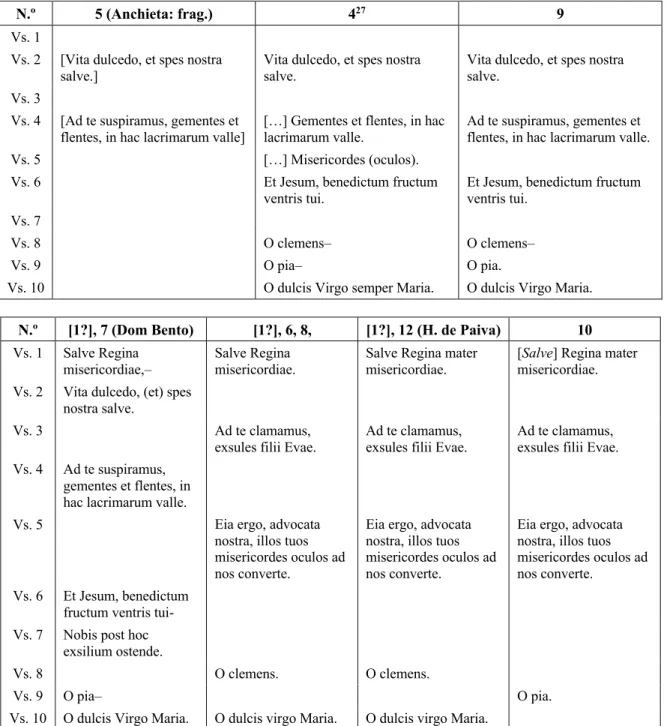
speaking, just three (including Guerrero’s setting) have through-composed ‘motet’ structures. The remainder is comprised of alternatim settings among which as many as four-five different performing patterns can be distinguished, which in itself is probably indicative of mixed (institutional) origins or traditions. Three, for example, including the setting by Heliodoro de Paiva, are settings of the odd-numbered verses, beginning at the first verse (‘Salve regina’)—a pattern that was likely to have been the norm at the Santa Cruz monastery before the mid sixteenth century. Conversely, two settings (nos. 4 and 9) are even-numbered settings that begin with the second verse, ‘Vita dulcedo’, a pattern more commonly found in Spanish settings; it is interesting to observe that in these two Salve settings the last three phrases of the antiphon, beginning at ‘O clemens’, are combined for the final polyphonic verse: this is relatively unusual (see Table 1b and discussion below).
There are also varying textual differentiations between the various settings: the main differences occur in the very first as well as in the very last line of the antiphon with which most settings conclude, regardless of compositional structure. For instance, the Coimbra Salve settings that include a first verse either begin ‘Salve regina misericordiae’ (nos. 6-8 on Table 1a) or ‘Salve regina mater misericordiae’ (nos. 2 and 10-2), the version most familiar today. Secondly, most end with the phrase ‘O dulcis Virgo Maria’, whereas two settings (nos. 3 and 4), introduce the word ‘semper’: ‘O dulcis Virgo semper Maria’.25 As described in further detail below, the first difference
(the presence or absence of the word ‘mater’) would in fact appear to reflect a gradual change and development of traditions in the antiphon’s text in at least the Coimbra Monastery of Santa Cruz during the sixteenth century. It is an important feature of the Salve text that distinguishes many of the later settings in Portuguese sources from those in Spanish sources. For instance, this word not only appears in all surviving Spanish musical sources of the sixteenth century but also in the earliest known Spanish liturgical source dating from the early 1460s, the Breviarium Hispalensis, which is important in any consideration of the very earliest Salve settings.26 The second difference (the
addition of the word ‘semper’ in the last line), on the other hand, is a clear indication of the peculiarly Spanish Salve tradition, as is amply testified in both chant and polyphonic sources, and indeed liturgical.
25 The last line of Guerrero’s Salve (no. 2) would also include the word ‘semper’, but this verse was not texted in MM 6. 26 The Breviarium Hispalensis, which was copied in c. 1462, is now preserved in the Bibliothèque Nationale in Paris:
N.º 5 (Anchieta: frag.) 427 9
Vs. 1
Vs. 2 [Vita dulcedo, et spes nostra salve.]
Vita dulcedo, et spes nostra salve.
Vita dulcedo, et spes nostra salve.
Vs. 3
Vs. 4 [Ad te suspiramus, gementes et flentes, in hac lacrimarum valle]
[…] Gementes et flentes, in hac lacrimarum valle.
Ad te suspiramus, gementes et flentes, in hac lacrimarum valle. Vs. 5 […] Misericordes (oculos).
Vs. 6 Et Jesum, benedictum fructum ventris tui.
Et Jesum, benedictum fructum ventris tui.
Vs. 7
Vs. 8 O clemens– O clemens– Vs. 9 O pia– O pia.
Vs. 10 O dulcis Virgo semper Maria. O dulcis Virgo Maria.
N.º [1?], 7 (Dom Bento) [1?], 6, 8, [1?], 12 (H. de Paiva) 10
Vs. 1 Salve Regina misericordiae,–
Salve Regina misericordiae.
Salve Regina mater misericordiae.
[Salve] Regina mater misericordiae. Vs. 2 Vita dulcedo, (et) spes
nostra salve.
Vs. 3 Ad te clamamus, exsules filii Evae.
Ad te clamamus, exsules filii Evae.
Ad te clamamus, exsules filii Evae. Vs. 4 Ad te suspiramus,
gementes et flentes, in hac lacrimarum valle.
Vs. 5 Eia ergo, advocata nostra, illos tuos misericordes oculos ad nos converte.
Eia ergo, advocata nostra, illos tuos misericordes oculos ad nos converte.
Eia ergo, advocata nostra, illos tuos misericordes oculos ad nos converte.
Vs. 6 Et Jesum, benedictum fructum ventris tui- Vs. 7 Nobis post hoc
exsilium ostende.
Vs. 8 O clemens. O clemens.
Vs. 9 O pia– O pia. Vs. 10 O dulcis Virgo Maria. O dulcis virgo Maria. O dulcis virgo Maria.
Table 1b. Structures of alternatim Salve settings in the Coimbra manuscripts (numbers correspond to the
numbers on Table 1a above)
A historically informed study of sources relevant to the evolution of the Salve Regina and its text in their geographical distributions from the medieval period onwards falls outside the scope of this study.28 However, it is important to make a few observations relevant to the polyphonic settings
27 See also below, Table 2.
28 For the first appearances of the Salve Regina in Cistercian chant sources in southwestern France (Aquitaine) dating
from the twelfth century, see Marie-Noël COLETTE, ‘Le Salve Regina en Aquitaine au XIIème siècle: L’auteur du Salve’, in Cantus Planus: Papers Read at the Fourth Meeting, Pécs, Hungary, 3-8 September 1990, edited by L.
in Coimbra here. For instance, and although it has not yet been possible to locate any actual Portuguese medieval chant or liturgical sources with this antiphon, it would seem that the original medieval (northern European) version of the text of antiphon beginning ‘Salve regina misericordiae’, rather than ‘Salve regina mater misericordiae’, was retained for a considerable period in a number of southern Portuguese monastic institutions up to even as late as the (early) seventeenth century.29 A different tradition evolved in the monastery of Santa Cruz, however: here,
this opening line was evidently altered to include ‘mater’ sometime around the middle of the sixteenth century. This may be witnessed in both liturgical and musical sources at Coimbra: in the Santa Cruz Breviarium printed in 1531, for example, the word is absent from the antiphon,30 and
this version of the text was originally entered into the chant manuscript P-Cug MM 37, which was copied before 1550; sometime after, however, the word ‘mater’ (and extra chant notes) was added to this manuscript.31 Owen Rees estimates that MM 37 was copied around the same time as some of
the earliest surviving Santa Cruz polyphonic sources (including a number of those in this survey). Further evidence for this change is demonstrated in the polyphonic manuscripts themselves. For example, in the Salve Regina by Dom Bento, which was probably composed (like some of the other settings) sometime before the mid sixteenth century, the first line is underlaid with the standard medieval ‘Salve regina misericordiae’, whereas the group of three settings recorded in the late manuscript MM 44, which include the Salve by Heliodoro de Paiva, incorporate the word ‘mater’ in this line (see Table 1a).32
Regarding the second most important textual difference in these settings in the Coimbra manuscripts—the presence of the word ‘semper’ in the last line of the antiphon—a connection with
Dobszay (Budapest, Hungarian Academy of Sciences, 1992), pp. 521-47. Early sources of the antiphon’s text are otherwise surprisingly difficult to find. However, it is clear that textual revisions took place over a long period, and that these were not necessarily uniform—either between different monastic uses or in secular establishments more linked to central Roman reforms. In early versions of the text in Dominican sources, for example, the text reads: ‘Salve regina misericordiae’; it also ends ‘O dulcis Maria’, rather than ‘O dulcis Virgo Maria’. These sources include the so-called Poissy Antiphonal (see <http://www.newliturgicalmovement.org/2010/05/medieval-version-of-salve-regina.html#.XXP SkbGZPR3> (accessed on 30 June 2018), and in another fourteenth-century antiphonal from Dominikanerinnen-konvent Paradies: D-DÜl Ms D 9, f. 279r-279v available at <http://musmed.eu/source/9721> (accessed on 30 June 2018). I wish to thank Océane Boudeau for alerting me to the latter manuscript and to later chant sources in Portugal (see following note).
29 These are found in two monastic antiphonals preserved in Évora: P-EVad Ms. Mus. Lit. 23 (of unknown origin, but
used in a Franciscan convent); and P-EVpc (Évora) Palácio Duques do Cadaval, Évora (Carthusian). The latter source introduces another textual variant at the end of the seventh line.
30 Breviarium secundum usum insignis monasterii sancte crucis colibriensis ordinis divi augustini (Coimbra, G. Galharde,
1531).
31 The Salve Regina in MM 37 is notated on pp. 191-93 (modern pagination). For information on MM 37, see REES,
Polyphony in Portugal (see note 17), pp. 29 and 255-8.
32 See REES, Polyphony in Portugal (see note 17), p. 29.The identity of Dom Bento, composer of the Salve Regina in MM
12, is not firmly established. Further on this question, see REES, Polyphony in Portugal (see note 17), p. 221, who indicates that a composer called D. Bento or D. Benedictus in MM 32 and MM 53, may have been the same Dom Bento who died only in 1602.
Spanish traditions can almost certainly be inferred. There are two anonymous settings copied into
P-Cug MM 7 that have this word: first, a through-composed setting (no. 3),33 and second, an
alternatim setting (no. 4). The latter, which transpires to be the earliest polyphonic setting in the Coimbra group apart from the Anchieta, immediately precedes the Anchieta fragment, and was copied by the same hand. This in itself immediately suggests that these two settings at least originated in the same (now lost) exemplar, and would therefore probably have shared an identical provenance.34 As discussed in the next part of this essay, this anonymous Salve in fact shows
overall structural and stylistic characteristics that link it closely with the earliest Spanish alternatim
Salve Regina settings, including demonstrably that by Anchieta.
A Word about Anchieta’s Salve
The current source situation of Anchieta’s Salve Regina indicates that it was one of his most widely circulated works. The question of its place in the chronology of his existing canon is not yet entirely settled, although it has been considered to date from towards the end of first decade of the sixteenth century. However, the old fragments recently discovered in the Segovia Cathedral archives might eventually support an earlier estimation.35 For the now six known complete or fragmentary sources
of Anchieta’s Salve, see Appendix 1. This fragment in P-Cug MM 7 of Anchieta’s Salve consists of just the first two verses of the cantus part (untexted). However, even within this small fragment, there is a tiny but intriguing melodic variant—or indeed error—at the very start. While in all concordant copies of this setting the cantus begins (after two breves rest) with a citation in breves of the characteristic opening of the chant with its drop of a fifth at ‘Vita’, followed by a descent of four notes starting on f’,36 in the fragment there is a skip between the third and fourth notes of this
descending line (e’ to c’):37 see Figure 1.
33 The concordance of the through-composed setting (no. 3) in MM 9, however, is copied without the word ‘semper’,
although stylistically, it may be linked with Spanish practices. It falls outside the scope of the present article to discuss this particular setting and the two concordances (see also, REES, Polyphony in Portugal (see note 17), p. 165). A separate study of this setting and its relationship with Spanish settings is in preparation.
34 The three Salve settings in P-Cug MM 7 were copied together between folios 25v and 31v: see foliation provided in
REES, Polyphony in Portugal (see note 17), p. 163. However, the manuscript has been rebound in recent years and the foliation sequence disrupted. (The folios are however clearly numbered in pencil.)
35 For a discussion and analysis of Anchieta’s Salve and the newly found Segovia fragments, see KREITNER, ‘The late
sacred music’ (see note 12), pp. 150-7. See also Kenneth KREITNER, The Church Music of Fifteenth-Century Spain (Woodbridge, Boydell Press, 2004), pp. 123-4, and KREITNER, ‘Juan Anchieta and the Rest of the World’, in Queen Isabel I of Castile: Power, Patronage, Persona, edited by B. F. Weissberger (Woodbridge, Tamesis, 2008), pp. 169-85.
36 Note: references to pitches in this essay are made according to the Helmholtz system.
37 Although this was likely to have been an error, it is interesting to speculate whether this occurred in the exemplar or
during the copying process (in MM 7), and whether indeed the counterpoint in the lower three voices would have been altered to allow for this. It would mean sacrificing the passing cadential articulation (bar 8) to the dominant, though omitting this would be entirely feasible, resulting, for example, in a cambiata figure in the bass, which is consistent with his style. In the context of this manuscript, it is also of some curiosity to find that the opening of the bass part in the anonymous alternatim setting opens with this exact contour. See also analysis below.
Figure 1. Anchieta, Salve Regina, fragment in P-Cug MM 7, f. 31v
This normally four-note descent in Anchieta’s setting in fact interrupts or elaborates upon the chant contour outlined in the cantus at ‘Vita’, which then only resumes with ‘dulcedo’ at bar 12: see Example 1.
Example 1. Anchieta, Salve Regina: opening (bb. 1-14), E-TZ 2/3
But seen from a different perspective, it is intriguing to find that the eight-note opening phrase of the cantus in Anchieta’s Salve (bb. 3-9) exactly corresponds with the first eight notes of the final
phrase of the antiphon at ‘O dulcis’ as it appears in the Franciscan version of the Salve, which also begins with the distinctive four-note ‘Salve call’: see Example 2.
Example 2. Salve Regina chant at ‘O dulcis’ (Franciscan version, after SNOW, A New-World Collection (see
note 1), ex. 4.1)
(This also partly relates the Sevillian contour at ‘O dulcis’, as notated in the version of the chant included in the 1565 Breve instrucción, but it is not a characteristic of other Spanish sources of the
Salve.)38 This is an intriguing aspect about the opening of Anchieta’s Salve, which may not have
been commented on before. Most early Spanish alternatim Salve settings assiduously follow the distinctive opening phrase of the chant, especially when citing it as a cantus firmus. But there again, whilst the chant is used as a constructing cantus firmus in many parts of Anchieta’s setting, it is neither necessarily consistently present nor cited verbatim.39
Judging from available sources, it is extremely probable that Anchieta’s Salve was sung at the
Salve services at Seville and Palencia cathedrals in addition to the Castilian royal chapel, where it is
likely to have been composed. Tess Knighton presents a convincing hypothesis that E-Sco 5-5-20, which is in fact the only surviving source of Salve service music that includes his setting, could well have been compiled in connection with practices established at Palencia cathedral.40 However, the
copy of Anchieta’s Salve in this manuscript uniquely includes a significant variant in the first verse that distinguishes it from the version transmitted in the main line of sources that include E-Bbc 454 and E-TZ 2/3. It is very likely that this latter version of Anchieta’s setting, which I shall call version A, was the one traditionally sung at Seville: quite apart from the likely Sevillian provenance of a large proportion of music eventually entered into E-TZ 2/3,41 this may also be corroborated by
38 For the Franciscan version in sixteenth-century sources, see SNOW, A New-World Collection (see note 1), ex. 4.1, p. 69.
The Sevillian source is included in ex. 4.2 (no. 3): in this version, the ‘O dulcis’ phrase lacks the AGA turn at the start of the phrase. (It also resembles the contour of this phrase in the Liber Usualis, p. 276.)
39 Further on the setting, see KREITNER, ‘The late sacred music’ (see note 12), pp. 150-7. 40 See KNIGHTON, ‘“Motetes de la Salve”’ (see note 1).
41 The precise origins and copying date of E-TZ 2/3 is still unsettled. For recent literature concerning this source, see
especially, Juan RUIZ JIMÉNEZ, ‘Infunde amorem cordibus: An Early 16th-Century Polyphonic Hymn Cycle from Spain,’ Early Music, 33/4 (2005), pp. 619-38, and La librería de canto de órgano (see note 1), pp. 82-4; Eva T. ESTEVE ROLDÁN, ‘Manuscrito musical 2/3 de la Catedral de Tarazona: Estudio historiográfico’, Nassarre, 22 (2006), pp. 131-72; Emilio ROS-FÁBREGAS, ‘Manuscripts of Polyphony from the Time of Isabel and Ferdinand’, in Companion to Music in the Age of the Catholic Monarchs, edited by Tess Knighton (Leiden, BRILL, 2017), pp. 404-68 (at pp. 446-52); and KREITNER, ‘The late sacred music’ (see note 12), at pp. 157-8, and n. 16. New arguments and theories regarding its origins and copying history are presented in Esperanza RODRÍGUEZ-GARCÍA, ‘What the Credo of a mass Rex virginum “dis-attributed” from Francisco de Peñalosa tells us about the manuscript Tarazona 2/3 and the Iberian mass around 1500’ (forthcoming), and in my essay ‘Tarazona 2/3 and the Early Iberian Polyphonic Hymn’, in The Anatomy
evidence in the alternatim Salve Regina setting (no. 4) in P-Cug MM 7 accompanying the Anchieta fragment. As discussed in more detail below, elements of the structure and a specific contrapuntal detail in this anonymous Salve indicate that the composer knew version A of Anchieta’s setting. Furthermore, it would seem that the chant underlying most of this anonymous setting corresponds with the Sevillian version, supporting my hypothesis that it was likely to have been composed at Seville.
In the following part of this essay, I shall focus on the anonymous alternatim Salve in P-Cug MM 7 because of its clear relationship not only with the Anchieta setting but also with a number of the other early Spanish Salve settings dating from around the early sixteenth century found in important Spanish manuscript sources of the early sixteenth century. Moreover, it has a number of key structural and stylistic features that help link some of these earlier Spanish Salve settings with the slightly later settings by Pedro Fernández and Morales, and provides additional evidence for the earliest style of polyphonic setting of likely origins in Seville Cathedral before those of the generation as represented especially in the Salve service choirbook, E-Sc 1.
The Anonymous Alternatim Salve Setting in Coimbra MM 7
The anonymous alternatim setting (henceforth Anon.) preceding Anchieta’s Salve fragment in MM 742 is formally copied, and fully texted (the first letters of the verses are included, despite the
indentations allowing for larger initials): see Figure 2. From the overall structural point of view, this
Salve broadly conforms to the structure of the majority of early Spanish alternatim settings in which
the even verses of the antiphon are set polyphonically beginning with the second line, ‘Vita dulcedo’.43 However, there appear to be one or two omissions in the copy of this setting in this
manuscript, besides some variations to the normal verse structure. First of all, the beginning of what would normally be the second polyphonic verse, ‘Ad te suspiramus’ (verse 4 of the antiphon), is evidently missing; second, there is an unexpected setting of ‘Misericordes (oculos)’, which is part of the middle phrase of the antiphon beginning ‘Eia ergo’ (usually left in chant); and further, the whole setting ends with a verse texted to all three of the final phrases of the antiphon beginning at ‘O clemens’, rather than allowing for the middle phrase, ‘O pia’, to be sung in chant.
of Iberian Polyphony around 1500 edited by João Pedro d’Alvarenga and Esperanza Rodríguez-García (Kassel, Reichenberger, forthcoming).
42 A transcription of this setting is included in Appendix 3.
43 These verses are ‘Vita dulcedo’, ‘Ad te suspiramus’, ‘Et Jesum’, ‘O clemens’, and ‘O dulcis’. The first and subsequent
odd-numbered verses would have been sung in chant. Medina’s setting in E-Sco 5-5-20, however, also includes a setting of the last word of the first line, ‘Misericordiae’. This variation almost certainly reflects practices at a particular institution, and very probably ecclesiastical prescription at that place. It is intriguing to find that this precise procedure in relationship to the Salve sung alternatim with the organ is stipulated in the constitutions issued in Palencia Cathedral in 1601 (see above, n. 24).
Figure 2. Anon., Salve Regina, P-Cug MM 7, ff. 30v-31r
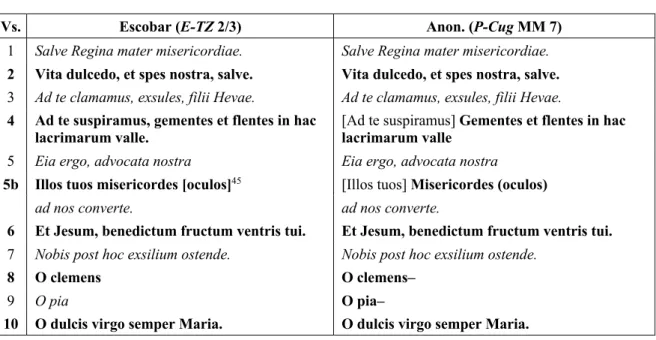
The presence of the setting of ‘Misericordes (oculos)’ in Anon. is especially significant because there is a close parallel to be found in Escobar’s Salve Regina. Unlike other early Spanish alternatim settings, in which the entire verse ‘Eia ergo, advocata nostra illos tuos misericordes oculos ad nos converte’ (‘Turn, then, most gracious advocate, thine eyes of mercy toward us’) was left in chant, Escobar privileges the central phrase, ‘illos tuos misericordes [oculos]’, by setting it in polyphony, thus making a six-verse polyphonic structure. In fact, and as discussed below, there is evidence in the copy of the Anon. setting indicating that it too was originally comprised of the whole of this phrase. The inclusion of this verse or phrase in the settings by Escobar and Anon. presumably reflects particular customs at the place for which they were originally intended (see also discussion below). As already stated, the chant used in Anon. almost entirely corresponds with the Sevillian version printed in the later Breve instrucción (Seville, 1565) in important details, which could well be an indication that it had been composed for performance at the cathedral where, indeed, Escobar was chapelmaster from 1507 to 1514.44 The alternatim structures of these two
settings are set out in parallel on Table 2.
44 This chant version is reproduced in SNOW, A New-World Collection (see note 1), table 4.2 (no. 3), pp. 70-2. It is sourced
Vs. Escobar (E-TZ 2/3) Anon. (P-Cug MM 7)
1 Salve Regina mater misericordiae. Salve Regina mater misericordiae.
2 Vita dulcedo, et spes nostra, salve. Vita dulcedo, et spes nostra, salve.
3 Ad te clamamus, exsules, filii Hevae. Ad te clamamus, exsules, filii Hevae.
4 Ad te suspiramus, gementes et flentes in hac
lacrimarum valle. [Ad te suspiramus] Gementes et flentes in hac lacrimarum valle
5 Eia ergo, advocata nostra Eia ergo, advocata nostra
5b Illos tuos misericordes [oculos]45 [Illos tuos] Misericordes (oculos)
ad nos converte. ad nos converte.
6 Et Jesum, benedictum fructum ventris tui. Et Jesum, benedictum fructum ventris tui.
7 Nobis post hoc exsilium ostende. Nobis post hoc exsilium ostende.
8 O clemens O clemens–
9 O pia O pia–
10 O dulcis virgo semper Maria. O dulcis virgo semper Maria. Table 2. Escobar and Anon. Salve structures46
Apart from its overall alternatim structure, the general compositional approach in Anon. can be compared with many of the very earliest Spanish settings, notably Anchieta’s, by which it was clearly inspired. It is predominantly a cantus firmus setting with some paraphrase, and Anon.’s treatment of the cantus firmus is indeed similar to Anchieta’s: in the first polyphonic verse (‘Vita dulcedo’), for example, the cantus firmus is placed throughout in the top (cantus) voice part; similarly in the last verse (‘O clemens’), it is placed in the tenor. In the remaining verses the cantus firmus is placed variously in the altus and tenor, and again in the cantus, and sometimes migrates between voice parts, including mid phrase, which again occurs in the Anchieta.47 From the point of
view of compositional procedure in the individual verses, like Anchieta’s and many of the other settings, each is subdivided into very short phrases that are usually comprised of just two words or sometimes just one (like ‘gementes’, for example). In Anon.’s setting especially, these are usually very clearly punctuated by some kind of cadential articulation. Even though the chant is prominent mostly as a cantus firmus in this setting, these often short phrases may be contrasting in their
45 Escobar’s setting survives only in E-TZ 2/3, where it is fully texted. Although this verse texted in the manuscript to
‘Illos tuos misericordes’ is entirely based on the plainchant, which appears as a cantus firmus in the altus, judging from the behaviour of the individual voice parts, in particular the tenor, it is feasible that the word ‘oculos’ was also intended in the contrapuntal setting. Supporting this hypothesis is the fact that the word ‘oculos’ is entered into the cantus part (only) of the Anon. setting, and that setting the entire phrase, ‘Illos tuos misericordes oculos’ would, of course, make more grammatical sense, in that the subject of the phrase (‘oculos’) is present rather than absent from the polyphonic verse. The word ‘oculos’ has been inserted in Examples 6a and 6b below.
46 Key: extant polyphonic verses in bold type; chant in italics.
47 Examples in the Anchieta setting are at Vs. 2, ‘Ad te suspiramus’, where the chant migrates from the cantus to tenor and
back again. It also occurs at the start of the succeeding verse, ‘Et Jesum’ in the Anchieta, where the chant passes from the altus to the cantus in two sets of identical trios at the interval of a fifth. It is interesting that the same idea is used in Pedro Fernández’s setting of this verse, again with the repeat of the chant entering a fifth above (from altus to cantus).
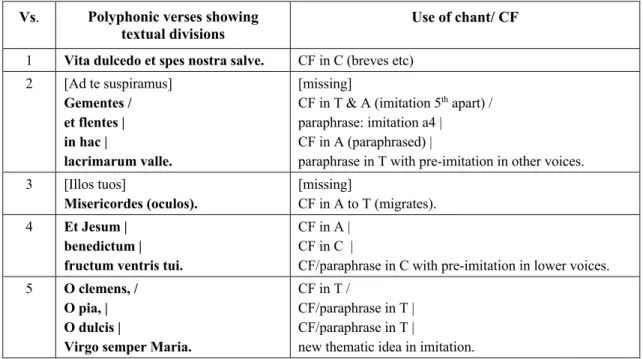
contrapuntal treatment—sometimes homophonic, sometimes imitative, or at other times more freely contrapuntal. For example, the second polyphonic verse, which begins at ‘Gementes’, opens with a four-chord homophonic phrase leading to four-part imitation at ‘et flentes’. The next two words ‘in hac’ are likewise chordal, and this is followed initially by a strict imitative phrase for the word ‘lacrimarum’ (see discussion and analysis below). The structure, phrase divisions and use of chant of the Anon. Salve are shown on Table 3.
Anon.’s clear divisional approach to the text, with its regular cadential articulations and musical contrasts, is perhaps a little more marked than in most early Spanish alternatim settings in which mid-verse cadential articulations are more usually elided by a continuation of contrapuntal activity in one or more of the voice parts, although this is by no means a general rule.48 In Escobar’s
setting, for example, the contrapuntal subsections often overlap, excepting in a few places in the middle verses where there are clearly articulated breaks. This general sectional approach is an important characteristic of other sacred polyphonic music of the era, including in the motets and masses.49
Vs. Polyphonic verses showing
textual divisions Use of chant/ CF
1 Vita dulcedo et spes nostra salve. CF in C (breves etc) 2 [Ad te suspiramus] Gementes / et flentes | in hac | lacrimarum valle. [missing]
CF in T & A (imitation 5th apart) /
paraphrase: imitation a4 | CF in A (paraphrased) |
paraphrase in T with pre-imitation in other voices. 3 [Illos tuos] Misericordes (oculos). [missing] CF in A to T (migrates). 4 Et Jesum | benedictum | fructum ventris tui.
CF in A | CF in C |
CF/paraphrase in C with pre-imitation in lower voices. 5 O clemens, /
O pia, | O dulcis |
Virgo semper Maria.
CF in T /
CF/paraphrase in T | CF/paraphrase in T |
new thematic idea in imitation.
Table 3. Anon. Salve Regina: phrase divisions50
48 A notable exception is the homophonic section in Medina’s setting of the words ‘gementes et flentes’ (second
polyphonic verse), in which each chord is highlighted by a corona. Anchieta’s verses are also quite clearly divided.
49 See also João Pedro D’ALVARENGA, ‘Juan Anchieta and the Iberian Motet around 1500’, Acta Musicologia, 91/1 (2019),
pp. 1-27.
50 Key: vertical lines denote clear breaks; oblique lines denote contrapuntal continuation or overlapping. CF: cantus
Composition and Style
The very opening of the ‘Vita dulcedo’ verse in Anon.’s setting is one of the few amongst early Iberian Salve settings that is entirely structured at the outset from the imitation of the opening four-note ‘Salve call’ in breves, in all four voices: first, the tenor-bassus pair for a period of four bars, or breves, then the altus-cantus pair. Only the settings by Escobar and Ponce open with the imitation of this figure, and Escobar’s enters with the same order of voices, but at regular distances of two breves. Anchieta’s setting, on the other hand, opens with a voice pair (altus-cantus) initially using this motif over freely composed lower voice parts moving predominantly in breves and semibreves. In the Anon., this is followed by the close stretto imitation of a descending theme in the lower voices below the cantus firmus in the cantus (bb. 8-11) pre-echoing the chant’s descent at ‘dulcedo’.51 This technique of overlapping imitative entries in stretto in more than two voices is to
be found from time to time in the music of the period, including also in Anchieta’s Salve setting. Thereafter, the cantus voice in the Anon. leads the composition with its continuous cantus firmus presentation (largely in breves) to the very end of the verse. The clear presentation of the chant melody in the cantus in this verse provides the first indication that it is probably based on the Sevillian version at the last word, ‘salve’, where (but also like in the Franciscan version) the chant has an arch-shaped phrase beginning on D (this is not particularly a characteristic of other Hispanic chants.)52 In this verse, there are important (perfect) cadences at the end of the first phrase
(‘dulcedo’) and at the close of the entire verse: respectively an octave leap cadence and a V-I cadence, both on the final, corresponding with the chant melody: see Examples 3a and 4a below. There is also a number of interim cadential articulations, which importantly include two (at bb. 13 and 17) with double leading note suspensions (played out in the two middle parts) in which the note of resolution is already present in the cantus voice. This type of cadence, which is also found in the following two verses, clearly places the music to near the time of Anchieta’s own composition.
There are two more features in particular in this first verse, including the two principal cadence points, that link it closely not only with Anchieta’s but in addition intriguingly with Rivaflecha’s
Salve.53 What is striking first of all is that at the ‘dulcedo’ cadence, Anon. joins the two phrases of
the chant cantus firmus (in the cantus), ‘Vita dulcedo’ and ‘et spes nostra’, together: here, the notes at the inflection of the chant at the close of the first phrase, DCD, become the starting notes of
51 These occur in various places in this verse of Anchieta’s Salve, which in turn were possibly also the inspiration of
imitation in Pedro Fernández’s Salve at bars 15-19. See WAGSTAFF, ‘A re-Evaluation’ (see note 14).
52 For comparison of the chant melodies, see SNOW, A New-World Collection (see note 1), exx. 4.1 and 4.2 (pp. 69-70). 53 For the compilation history of E-Sco 5-5-20, and the possible activity of Rivaflecha in consolidating Bishop Fonseca’s
foundation of a polyphonic Salve service at Palencia when he was chapelmaster there (1503-28), see KNIGHTON, ‘“Motetes de la Salve”’ (see note 1).
the next phrase of the chant (‘et spes’) beginning on C (CDF: bb. 20-1) without a break: see transcription in Appendix 3. This is most unusual; yet there is an exact parallel in Rivaflecha’s short setting (at bb. 11-5): see Examples 3a-3b. Textually, however, this verse in Rivaflecha’s setting, which is uniquely recorded in E-Sco 5-5-20, reflects the version of the antiphon in which the word ‘et’ is omitted: ‘Vita dulcedo, spes nostra, salve’ (this is a feature of all four Salve settings in this manuscript).54
Example 3a. Anon., Salve, Vs. 1: cadence at ‘dulcedo, et spes nostra’55
Example 3b. Rivaflecha, Salve, Vs. 1: cadence at ‘dulcedo, et spes nostra’
Further, there is also a very clear relationship to be found with the same cadence in Anchieta’s
Salve with respect to the contrapuntal activity in the lower voices at bar 21. In the Anon., the altus,
having dropped a third to the third of the chord (from a to f) at bars 20-1, which is a very typical
54 The question of the presence of the word ‘et’ in this line of the antiphon is important when considering polyphonic
sources of the Salve, as there is little apparent consistency in the settings. Patterns can however be seen in the different sources. Taking Anchieta’s settings as an example: while this setting in E-Sco 5-5-20 (like the other Salve settings in this source) omits this word in all voice parts, the concordance in E-Bbc 454 (like the other Salve in this manuscript) includes the word in all voice parts, whilst the concordance in E-TZ 2/3 has it in the cantus part only, which is the chant carrying cantus firmus voice. Choices were made by the scribes, presumably in accordance with traditions known to him or, indeed, with the composer’s original intentions.