ReÐ. lnst. Med.. trop. Sqo Paulo 2gl5J: 295 X04, setenbro-outubro, 1987
THERAPEUTICAL EVALUATION OF DIFFERENT DOSE REGIMENS OF PRAZIOUANTEL IN SCHISTOSOMIASIS MANSONI. BASED ON THE OUANTITATIVE OOGRAM TECHNIOUE.III
Aloísio Sales ¿la CUNHA (2), J. Rom€u CANçADO (2) & cetúlio Leonel at€ REZENDE (3)
A clinical
trial
involving 80 pâtients of both sexes, from âges 15 to 5b, with chronic intestinal or hepatointestinal schistosomiasis mansoni, was carried out to evaluate the therapeuticâÌ efncacy of different dose regimens ofpraziquantel.. The patients were randomly âllocated into four groups with an equal number
of cases and were then treated with one of the following dosâges: 60 mg/kg for
1 day; 60 mg/kg dâily for 2 days; 60 mg/kg daily for 3 days; and 30 mg/kg daily for 6 days.
The assessment of pansitological cu¡e wâs based on the quantitative oogram technique through rectal mucosa biopsies v¿hich were undertaken plior to, âs vt ell as, 1,2,4 and 6 months post-treatment. Concuûently, stool examinations according
to the qualitative Hofünai, Pons & Janer (HPJ) and the quantitative Kato-Katz (K K) methods were also performed.
The best tolerability was observed with 30 mg/kg daily for 6 days whereas the highest inÊidence of side-effects (mainly dizziness and nausea) was found with 60 mg/kg daily for 3 days. No serious âdverse d.rug reâction has occurred_
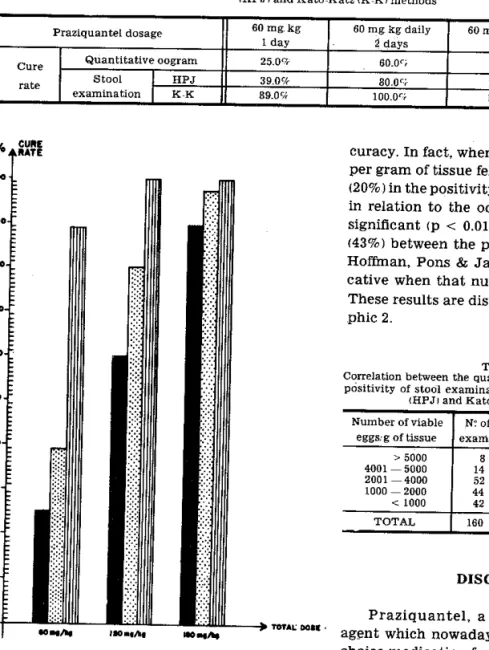
The achieved cure rates were: 25Eo wit}] 60 mg/kg for 1 dayi 60q. with 60 mg/kg daily fo¡ 2 dàysi 89.5Eo with 60 mg/kg daily for 3 days; and gOEa wil}J 30 mg/kg daily for 6 days. At the same time there has been a downfall of 64Ea,73Eo. BlEø and, 84% respectively, in the median number ofviable S. mansoni ova pe¡ gram oftissue. Thus, a very clear direct correlation between dose and effect could be seen.
The corresponding cure rates âccording to stool examinations by HpJ were 399a,809a, l0Ù9a and 95%; by K-K 89Eo, 100Eo, 1007o and I00Z¿. This discrepahcy
in results âmongst the three parasitological methods is certainlidue to theùunequal âccuracy.
In
fact, when the number of viâble eggs per gram of tissire feU below 5,000 the difference in the percentage of fâlse negative hndings between HpJ (28%) and K-K (80%) became significative. When this number dropped to less thân 2,000 the percentage of false negative results obtâined with HpJ (492¿) turned signifrcant in relation to the oogram as well.In conclusion, it has been proven thât praziquantel is a highly efncacious agent against S, mansoni infections, If âdministered at a total dose of 180 mg/kg divided
into either 3 or 6 days,
it
yields a 907o cure tate. possibly, one Could reac¡' IOO% by increâsing the totâl dose to 240 mg/kg. Furthermore,it
wâs conhrmed that the quântitative oogram technique is the most reliable parâsitologicâl method when evaluating the efficacy of new dn¡gs in schistosomiasis mansoni.KEY WORDS: Schistosomiasis; Praziquantel; Oogrâm.
SUMMARY
(1) This work was supported by grants ftom "Fundåçáo Ca¡los Chågas ate Pesquisa Médica", Belo Hodzonte. MG.. Blezit. {2) Full Professo¡, Internâl Medicine Department, "naculdade de Medicinâ da Universidade Federal de Minas c¡erâi6',, Beto
Horizonte. Mc.. BraziÌ.
CUN¡IA, A. s. dâ, CAÌ{çADo, J. R. & REZENDE, @. L. de - Tbempeuticâl evalùåtion of aliffe¡ent alose ¡esimens ofpraziquanüe¡ in schistosomiasis mansoni, based on the quântitåtive oogrâm technrque- Rev- Insa. Meit. r¡op. sáo p¿ùlo, 29:295 304. 198?.
Praziquantel, an isoquinoline-pyrazino
deri-vative,
is
a broâd spectrum antiheìminthicagent36 which has Þroven in experimentâl
stu-dies
to
be a remarkable active compoundagainst all schistosome species pathogenic to man13 34 as {6, including Scbistosoma mansoni strains resistânt to oxamniquiner3 ¡{. It has also
shown to bear a quite sâfe toxicological
p¡ofitel?-In
humån schistosomiasis mansoni, using single oral doses ftom 40 to 60 mg/kg BWT, cure rates higher than 807¿ have been reportedinBra-zil
in
accordance with parasitological assess-ments by Kato-Katz stool exãni¡âtionsro 26 40 43, fnclusively, double-blindtrials
applying the same parasitological methodology to compare the efñcacy of praziquantel and oxamniquine failed to disclose significânt difrerences between the two drugs8 15 25 3e.In â recent double-blind trial bâsed on the
quartitative oogram technique, rÃre also found no signilicant difference in the efncacy of both drugs administêred in a single dose, praziquån-tel65 mg/kg ând oxamniquine 18 mg/kg12. Howe-ver, contrary to thepreviously reported ñndings, the achieved cure rates, 29Eø and 23Eo
tesþec-tively, were rather low. These divetgent results can be explained by the unequal accu¡acy of the methods apf,lied for parasitological evalua-tion since, in the same t¡iâI, the coFespondent cure rat€s according to stool examinations by Kato-Katz were 92Eo and 86Ea, and by Hofüna¡, Pons E¡ Janer 5070 for either drug.
fn
addition,it
has been demonstrat€d that â single dose of praziquantel induces in practically alt patientsa complete interruption of the egg-laying
capa-city of the parasites during the ñrst four weeks
following the treatment. Thereafter, in
non-cu-red cases a sharp fau (83%) in the mean number ofliving ova per gram of tissue is maintained.
Nevertheless, an explanation for the diver-gence between the remarkable antischistosomal
activity observed experimentally and the f¡e-quènt recurence rât€ we have found clinically
with a single dose administrâtion by means of the oogram, requircs further considerations.
296
INTRODUCTION
When schistosomes are exposed to prazi-quantel they exibit an almost instanta¡eous te-tanic contraction ofthe musculature3, ând rapid structural damage to the syncytial tegument sucb as vacuolization and surface blebbing6. 3r. Tegumental injury (basal vacuolization) can be
induced by oxamniquine as well, but t,le lesion becomes appârent only after hours or days2?
whilst n'ith praziquantel its onset is extremely rapidæ 33. As early as 15 minutes after treating mice, schistosomes were found contracted,
para-lysed and hanslocated from mesent€ric veins to
the liver and their tegument had developed typi-cal lesions'e. In vitro exposure
to
30 r¿glml for60 minutes resulted in severe injurya. Evidence
fo¡ the râpidity ofpraziquantel action was equa-Uy denoted by tlle reduction of 63% in the titer
of circulating v!'orm antigen ?2 hours following tlle treatmentof mice infectedwith S. mansoni{.
Nonetheless, using sub-curative doses in
mi-ce theworms recovered and seemed to be almost normal within three days, although the iDitial appealence of the tegumental lesion was indis-tinghishable f¡om that câused by a cu¡ative
do-se23.3?. This indicarcs that complete recovery from the drug effect may take more than 24 hou¡s. Actually, observations in mice revealled tñat on the 4th day subsequent to a si¡gle
sub-curative dose, S: mansoni have either recovered or were dying
in
the liverr 30. Thus, a ce¡tain degree ofinjury or of drug exposure can be tole-rated by the pårasites and can be repaired, butif the limit ofsuch repairing capacity is exceeded
then irreversible fatal damage
occurss-In fact, tegumental vacuolization itselfis not lethal to schistosomes since parasites in mice have recovered completely within 3 days after
a su¡-curative dose. Deâth of worms occurred
as soon âs t,he injury became severe enoughz.
In
this circumstance, neutrophils aDdeosino-Þhils were seen attached to the schistosome sur-face alreådy 4 hours aft€r the drug administration.
Soon afterwards the worms became flxed to the wâlls of blood vessels by ñbroblasts. Invasion of schistosome's body by phagocyte cells was
in frtll progress 14 hours post-tteatment leading to the lysis of the f,arasite tissues with¡n ? days.
ra-CUNHA, A. S. dâiCANçADO, J- I¿. & REZENDE, G- L- de TheÉpeutical evaluatron of d iflerent dosercgimens ofpraziqua¡tel
in schistosomiasis mansoni, based on the quântitative oogram ¿echnique. Bev. Inst. Med. trop. Sáo PâuÌo, 29:295'304,
1987-pidly, enclosed in a granulomatous reaction
v/i-tllin two weeks after therapy2e. The ¡apid aggre
gation of granulocytes around drug-affected pa-rasites insinuates that immunological processes may be involvedr. Indeed, exposure of previously disguised S. mansoni antigens as a result ofcon-tact with praziquantel has happened in vitrore. The drugengenders membrane i¡stability which
exposes antigenic determinants leading
granu-locytes to congregate onto the worm. The partial
deshuction of the tegument opens doors for en
try ofphagocytic cells that then lyse the schisto-some tissuesr. In addition, the release of antige-nic component from injuried parasite tegument
may not only sensitize the host butpossibly con-fer some degree ofresistance to subsequentlein-fection{.
Consequently, the main question rests in the deñnition of the optimal praziquantel
concen-tration
andduration of
exposurein
vivo,v¿hich is necessary to inflict treversible fatal da-mage to the worms.
In
vitro, experiments have revealed that n'ith concentrations of 3.2 x 10⁻⁶M to 3.2 x t0-4M of praziquantel the observed iniury to the para-sites was â timefunction ofexposure to the drug, râther than ofits concentration4 s 6. Apparently, the antischistosomal efrect of prazÍquantel is notso entirely ¡elated to the absolute height of its
mâximal plasma level as to the length of expo-sure to the drug'. Praziquantel at a
concentra-tion of 0.6 ,¡M produces a good chemothera-peutical effect, provided that the total period ofexposure ranges from 6 to l0 hours'z.
In animals and man alike, following a¡ oral intake,thedrugreaching theliverviaportâlvein
is extensively metâbolized at a fâst rate so that
within t houronly 5 to 7% are stiU unmetabolized
praziquantel (the biologically active principle) and its half-life is just 90 minutesæ. This
first-pass effect, which varies from individual to indi-vidual, is more effective
in
smaller doses thanin lâ¡ger onesæ. Peak serum concentration ofun-changed praziquantel, 4.1 t¿M, is reached in about 2 hours and may prevail for approximately 4 hours after an oml dose of 50 mg/]Kq.,2oEo (0 8 ,,M) being the active protein unbound fractionæ.
Therefore. the effectively available drug is
only a small percentage ofthe total administered
Actuâlly, the same dose has been more
effec-tive
in killing
laterâther
than early develop-mentâl stâges ofS, mansoni in vivo, but no suchdifference in susceptibility was observed in vitrc.
This apparent resistance might result from these
immature forms found in the peripheral
syste-mic circulation being exposed to lower
concen-trations of prâziquantel thân the mature
para-sites located in the liyer and mesenteric veins". The drug bioavailability, however, can be im-proved by changing its dosage schedule.In mice the total amount of praziquantel required per os to produce a reduction of957¿ in the number of parasites could be decreased by more than
70% by administering multiple doses (10
x
18.5 mg/kg) instead of only one (1 x 685 mg/kg)r8. Asingle oral dose of 50 mg/kg diminished tl1e
num-ber of S. mansoni id mice by 127o whilst 5 doses given at dâilyintervâts killed 827, ofthe wormsrs.
Based upon: (a) our previous therapeutical trialuin which ithâs been proven, through se¡ial rectal mucosâ biopsies, thât a single dose
ofpra-ziquantel leads
to
a marked decrease of the worm burden in human S, mansoni infection; (b) the experimental evidence that, dependingon the concentration and time ofexposurc, this drug is able to cause the deâth of this pansite; we have designed the present clinical tria.l to investigate whether dose regimens other than
a single day treatment would yield htgher cure
rates.
PATIENTS AND METHODS
Children, etderly patients, pregnant or lacfa-ting women, and those cases having
concomi-tant acute or serious chronic diseases, severe
ânemiâ or nutritional deficiency, cardiac, pul-monar, hepât¡c or renal insufficiency, were ex-cluded from the trial.
A. total of80 patients ftee from previous
speci-fic tlrerapy, 4lEø male and 597¿ female, ftom 15
to 55 yea¡s old with â mean age of 2?, weighing 57.8 kg in the average, qrith chronic intestinal (64%) or hepatointesti¡af (367o) schistosomiasis mansoni hâd voluntarity been enrolled in t¡e trial.
oUNHA A. S. dâicANçADo, J R & REZENDE, G. L. de -Therâpeuticâl evaluation ofdiffe¡eni dose rcgimens ofprâziquântel in schisüosomiasis mansoni, based on tlìe quânt¡¿ative oogrsm technique. Rev.Irst. Med. troD. sâo pauto, 29:295,304. 1987.
The worm burden âs measured by the num-ber of viâble eggs per grâm of tissue taken by rectal mucosa biopsy rânged from 1,1?3 up
til
12,8?5 with a meân of3,410 and â median of3,025.
Nine percent had more than 5,000, 45Eo lrom 3,001 to 5,000, 32Eo from 2,001 to 3,000 and 1470 from 1,001 to 2,000. These figures shape a skewed distribution curve with most of the pâtients, as
it
tr'ould be expected, lodging a u¡orm burden lower than the mean. Consequently, non-para-metric tests (chi-square and Fisher exact proba bility iests, were applied for the statisticat analy-sis ofthe results.the
patients were treated ât an out-patient clinic and instructed not to getin
touch withTABLE I
Distrlbution of patlents wiih schistosomiasis mânsonl in accordance with the alose regimen ofpraziquâniel, sex, age, body any focus of schistosoma infection at least
du-ring the six-month period subsequent to the the-rapy. Following a randomized distribution they v/ere allocated into four groups having ân equal number ofcases and were then treated \Ã'ith
difre-rent dose regimens: 60 mg/kg fo¡ 1 day; 60 mg/kg dâily for 2 days; 60 mg/kg daily for 3 days; and 30 mg/kg dâily for 6 days. As shown in Tabte
I
the four groups were homogeneous in regard to the relevant fâctors that could influence the therapeutical response, particularly the age ran-ge ofthe patients and the intensity oftheir worm burden.Treeted
v'eight, cltnical form ofthe diseâse and worm buden bâsed on the quantitâttv€ oogrâm.
Prazlqì.rântel dosage
Sex
(Yeâß) . Weight , (kg)
Male ¡'emale Cllnicâl fo¡m Mean Range Meân
NumÞer of eggs/g of ti$ue
Range Int€sti¡aì
Hepatointeßtinal
60 mgl]{q
I day
20
Meân Median
R,ânge
> 5000 3001- 5000 2001- 3000 1001 - 2000
Praziquântel was presented
in
tablet folm containing 300 mg. The total daity dose wasâd-ministered per os, in the morning, divided into two intakes 4 hours âpart, under nurses' close
supervision. During the dâys of treatment the
pa¿ients remained under clinical observation for
a few hours after the drug administ¡ation in or-der to look for any occurrence of adverse
reac-tions.
PrioÌ to the therapy all patients underwent
a thorough physical examination and were
sub-mitted to rectal mucosa biopsy in order to have a quântitâtive oogram perfo¡mede rr, âs well as,
to stool examinations by both the qualitative Ilofftnan, Pons
&
Janer2o and the quantitative298
45qo 551o
30
60 mg/kgdaily
2 days
59_8 42-79 20 6íEa 35q' 3340 3025 1823 - 68?9
rÙqa íOEÔ 30E" r0s. 20% aoEo 24
15 -45
60 mslkg daily 3 day8
55.8 38 -?9
20
'tova 301¡ 3640
2{63
1653 - 12875
tSEo 15V. 50c. 20sa 50so 50Ea 21 l8-44
30 mg/kg dâily 6 dâys
56.0
4l-66
20
65S0 3ESê
Kato-Katz2a methods. A
kit
(vermi-fec') from Boehringer Mannheim vras used for the latterexamination and for each !,atient the result was expressed by the ârithmeticmean ofthree slides. All these parasitological examinations were
re-peated on the same day, at the end of the lst., 2nd.,4th. and 6th. month post-treatment.
&ESULTS
The occurrence of untoward effects is
de-monstrated in Table II. The best tolerated dose regimen wâs 30 mg/kg daily for 6 days whereas the higher incidence of complaints was
assocta-ted with tlte administratior of 60 mglkg daily for 3 days. Actually, the respective frequencies
3382
3I95
1910 - 5657
,íEr 50v¡ 35Sr LOSo 50% 50v. 26 18-40 59.6 42-84 55qõ 455ô 3278 3315 tl?3 - 5333
íVc 65C.
CUNIiA. A. S- dei CANÇADO. J. R.. & R'EZENDE, G. L. de - Therapeutrcâl evaìuaüion ofdifferent dose regimens ofprâziquânÙel in schistosomiasis mârisoni, bâsed on Lhe quânbiLàtive oogram t€chnique. Rev. Inst. M€d. troD. São Påulo, 29:295-304. 198?.
refering to: total incidence of side effecÙs (40% vs. 807¿); dizziness (157¿ vs. 657o): ând nausea (15% vs.55Eo). wete significantly (p < 0.05) ìower
with tbeformer dosage. The inverse holding true
for light severity oi symptoms (67% vs.32Ea). On the other hând, there was neither any signifrcant difference
in
regardto
overâll tolerability
Evalì.rated pâtients Prâzlquantel dosåge
Intensity
Occurrence 19.¡ ofside-effecüs v,/ith diffelent dose rcgimens ofpraziquantel
Totaì incidence
Dizáness Nausea Geneml malaise HeâÍ-bum
Ileadache Abdomlnal pain Vomitl¡ìg Skln râsh I.evet
amongst the four groups nor any occurrence of
serious adverse drug reaction. With the m4jority of the patients the side-effects aÞpeared within the
first
four hours (987a) subsequentto
the drug intake, did not last longer than 12 hours (?5%), and their intensity was light to moderate ß4qa).Light
Moderate
20 60 mg/kg
1 dây
TABLE II
OvelalI toleråbility 40.0 37.O 52.0 11_0
The assessment of therapeutical efücacy in
accordance with the quantitative oogram tech-nique, as shov/n in Table
III,
reveâled the follo-\Ã'ing cure rates, i. e., no single viable S. mansoni eggin all
rectal mucosa biopsies performed during the 6-month parasitological follow up; 25Ea wit}r60 1'rg,l]r.g, for I day; 6070 with 60 mg/kg daily ior 2 days;89.5Eo with 60 mg/kg daily for 3 days; ând 90% ysith 30 mg/kg dâily for 6 days.The lâst two regimens did not differ one ftom
the other, but there had þeen a highly significaÌt difference between either one and 60 mg/kg daiìy
60 ms/ks daily 2 days
15_0 20.0 20.0 15.0 5.0 20 Good Recular 65.0 350 62.O 3.0
60 mg/kg dåily
3 days
45.0 20.0 20.0 15.0 250
;
20 65.0 30.0 5-0 75.0 32.0 63.5 4.5TABI-E III
Therapeutical emcacy of direlent dose regimens of prâziquantel accordlng to the quântiiative oogrâm Þe¡formed l, 2, 4 and
6 r¡¡onths afte¡ tleatment
30 mg/kg daily 6 days
65.0 55.0 10.0 15.0 25.0 35_0 10.0 5.0 50 20 55.0 40_0 5.0 35.0 63.0 31.0 6.0
for 2 days (p
<
0.01) or 60 mg/kg forI
day (p< 0.001). Inôlusively these two last dosages also
differed
significantly
(p
<
0.01) one fromthe other. Furthermore, a marked reduction in the median number of viable eggs per gram of tissue in non-cured patients was observed in all four groups. However, this reduction was more noticeable with eitlìer 60 mg/kg dâily for 3 days (minus 8?%) or 30 mg/kg daily for 6 days (minus 84Eø) and, less with 60 mg/kg for
I
day (minus 64Ea).PEziquantel dosâge
Median number of vlâble egggg of tissue
it non cuted câses
15-0 15.0 5.0 20.0 5.0 10.0
;
Controlled patients Culed Þatients
40.0 50.0 10.0
Bèfo¡e treet¡nent After treahnent Requction
75.0 20.0 5-0
60 r¡g/kg
1 day
20 5 t25E t
3023 1099
63.65.
60 mglkg daily 2 days
20
12líOVrt
2662 715
73.1%
60 mg/kg daily
3 dâys
19
L7 tag,5.ht 4l9t
562 46.6%
30 mglkg dâily 6 days
20
ta 190%l 3348
542
cuNHAASdalcANcADo-J.R.&REzENDE-cL.de-Therâpeut¡catevâluationofclifferÊntdoseregÌmensofprâziquantel
in schistosom¡âsis mansoni. based on the quântita¿ive oog¡am rechDìque. Rev. Insr. :vle.t. rrop. sáo paulo,
291295 304. 198?
Considering the cure râtes in relation to the stool examinations by Hofünan, pons
&
Janerand Kato-Katz methods, the corresponding figu-res were: 397. and 89% with 60 mg/kg for 1 day; SOqa and lOÙVa with 60 mg/ke daily for 2 days;
t00% and I00% with 60 mg/kg daily for 3 days:
TABLE IV
compÙison of curc rates âttainecl accordi¡g to the quântitahve oogram and stool exâmrnârrons by Hotfmar¡. I,ons & Jâner rHPJJ and Kato KaLz (K K) methods
Cur€
PEziquantel dosage QuantiLâtive oogrâm
Stool
95% and 100./. with 30 mg/kg dâity for 6 days. When confronted with the oogram fìndings these percentages aÌe quite dive¡gent particulùly the
data pertaining to Kâto-Katz as seen in Table IV and c¡af,bic
t-HPJ KK
60 mekg
L day
25 0+ 39.0./.
89.09¿
60 mg kg daily
2 days
60.0.,
80.0.i
100 0.,
curacy. In fact, when the number of viable eggs per gram of tissue fell below 2,000 the difference (207o)in the positivity by Hoffrnân, pons & Janer
in relation
to
the oogram became statistÍcally signiñcânt (p<
0.01). Moreover, the difference (437¿) betv/een the positivity of Kato-Kåtz and Hofünan, Pons & Janer already tu¡ned signifi_cative when that number was inferior to 5,000. These results are displayed in Table V and cra_ phic 2.
TABLE V
Colre¡åtrcn bctween rhe positivity quâniiLative ooelam 6¡dhgs â¡d rhe of sl.ool examinâtions by Hoffman. pons & Jâner
rHPJr and Kato-Katz rK.Kr methods
60 mg kg daity
3 dâys
89 5.i-100.0.¡
r00.0.,
30 ms kg dâily
6 dãvs
Graphic I - Correlârion between ihe cure rãt€s of var¡able
doses ofprâziqÌ¡ånteÌ and diffeæn¿ pùas¡tological methods (¡ oogmrn, EHoffman, Pons & Jã¡e¡, lllKato-Kaiz).
r ne orscrepancy amongst the three parasi tological methods de¡ives from thei.r variable ac_ 300
90.0.¿
I00_0.i
I
l4 52 42
P.raziquantel, a novel schistosomicÍdal agent which nowadays is regarded as the first
choice medication for human schistosomiasis22.
21 33, has proven acco¡ding to the quantitative
oogram technique, to be highly etï¡catious in S. mânsoni infection
if
usedin
an adeouate dose ¡egrmen.In
this trial, n'hen administering 60 mglkg for 1 day the cure rate was just 252ú, howeverDISCUSSION
47.5 57.1
38_5
CUNHA, A. S. da; CANÇADO, J. R. & EEZENDE, G. L. de - Therapeutical evå-lìrat¡on ofdiffereni dose ¡eg¡mens ofpmziquantel
in schistosomìasis mânsoni, based on the quântitative ooCfâm technique. Rev.Inst. M€d. arop. Sáo PâuIo, 29:295-304, 1987.
it rose up to 9070 when the same daily dose was
taken for 3 consecuüve days. ParâUelly, t¡ere had been a corresponding downfâ-ll of 64% and 877o in the mediân nr¡mber of S. mansoni ova per gram of feces in non cured patients, conñr-ming both the superiorefncacy ofthe latter dosa-ge ând the sensitivity of the aþplied parasito-logical methodology.
lung fluke, 75 mg/kg daily tahen during 1,2 or 3 days ensued cure rates of nEo,86Eo and 1007¿, resPectively.
The reason for attâining pârasitological cure in somepâtients withjust asingle day treatment
urhereas
in
others, solelyif
the drug adminis-t¡âtion is prolonged for two or more days, most probably relies on the distinct patterns ofindivi,duâl pharmacokinetics. Those who convert pra-ziquantel quickly and extensively into hydroxy-lated and conjugated metabolites, that are inac-tive or considerably less potent, will lequire
hi-gher doses and/or lengthned therapeutical
cout-ses than those who do not eliminate the drug ftom plasmâ so efficiently. In this context, with
a single dose of 30 mg/kg a relatively high cure rate (76.770) has been ob¿ained in hepatosplenic schistosomiasis mansonir0 in comparison to the quite lov/ figurc (33.37a) attained in i¡testinâl or hepatointestinâl cases35, using the sâme pârâsi-tological control ofcure (Kato-Katz stool exami-nation). Perhaf,s, patients presenting hepatos-plenic forms metabolize p¡aziqua¡tel at a slower pace or the drug by passes the liver via
pottosys-temic shunts allosring higher plâsma concentra-tions of the active flrinciple for longer periods
of time.
Certainly, as
it
v¡as demonstratedin
vivo,the antiparasitic efñcacy of praziquantel against S. mansoni is due to r'ts âbility to produce tegu-mental damage, an effect thât depends on the drug concentration a¡d on the duration of the parasite exposure to it{{. Both are a function of
the peak level and time course ofunmetabolized praáquantel in the serum which arc known to vary greatly ftom patient to patient'8 42. There-fore, ideally an individual dose regimen should be established for eve¡y pâtient based on the monitoring of the drug serum concentÌàt¡on, þut
in practice this is unfeasible. Possibly, a simple way to secure a cure rate very close to 1007¿ in all cåse would have to consist of augmenting the total dose up to 240 mg/kg (either 40 mgkg daily for 6 days or80 mg/kg daily for S days). Actually, total doses of 1,000 mg/kg or even higher (100 mg/kg daily during l0 days7, 50 mg/kg daily du-ring 3 week$r, ?5 mg/kg daily during 15 days?) have been v¡ell tolerated by patients with neurc-cysticercosis.
6i¡?H¡C â- COnnEL^lrOr{ aElrEEr{ THE AUÁilrrTArrvE O06iA¡ Fr¡o|¡Ot ¡lio rtiE
m3ÍNrfr oF rxf lfool Er^xr¡arror{s tY åoFr¡¡rl, tor{! Ã ,l^rlEi {ol ¡¡¡ x^ro-f
^12 la} rllHoDl
Graphic 2 - Corelâtion between ihe quantibative oog¡âm Í¡ dings ånd the positivity of the stool exùblnations by Ëoffr¡an, Pons & Jarer (@) âÀd Kato-Katz (a) methods.
In
tl¡e treatment of other humantremato-diases with praziquantel, analogous therapeu-ticâl responses s¡ere reported'r: in Opisthorchis viver¡in¡ infections cu¡e rates of447¿ or 887o we-re achieved with 1 or 2 days administration of
25 mg/kg daily and with 30 mg/kg daily for 3
days 91qa was reached: with infections caused
by Clonorchis sinensis, anoths liver fluke, 50
mg/kg dàily yielded, 47qo cure rat€
if
given forI
day but 807¿ if given for 2 days, yet more ?5mg/kg for
I
dây resulted in 817¿ cure rate andCUNHA'A S- dâ; cANÇADo' J- R &REZENDE,G.L.de Therar,euticsl evaluabion ofdifferen! close regimens
ofprâ;iquantel
in schistosomiasls mansoni' based on ihe quântitâtive oogmm technique. Rev. Inst. Med. t¡op. sáo pauro, 29:29¿i-304, i98?.
Another relevant aspect to be considered is
the disparity amongst the ¡esults accomplished wÍth the different procedures emptoyed for as-sessment of parasitologicâl cute. In fact, the ac_ curacy of the stool examination methods have varied in direct correlation with the number of viable ova per gram of tissue in the oogram: be low 5,000 the Kato-Kâtz alreadyshowed a signifi_
c
tt lower sensitivity in comparison to the lloff_man, Pons & Janer, which for its turn was signifî_
cantly ir¡ferior to the oogrâm when that number was less than 2,000.
In
connection to this, wehâve already commented on similar findings achieved in a previous clinicaì trialrr. Likewise,
other investigâtors have demonstrated the supe riority of the rectaÌ mucosa biopsy
in
proving the presence of schistosoma ova in respect tostool ñltration and MIF concentlation methods. which stitl yield more reliâble results than a di. rect fecal smeatl8. Furthermore, they also hâve
pointed out that the positivity offecal examinâ-tions diminishes
in
direct conelation with the decrease in the number ofyiâble eggs per 20 mm2 of tissue in the biopsyrs.In conclusion, it has been proven that a 902¿ cure rate can be attained
in
schistosomiasis mansoni with praziquântel when administerins either 60 mg/kg daily during 3 days or 30 mg/k;daily duúng 6 days. The former dosage is more convenient but the latter has been associated
with mildet and lower incidence ofuntoward ef_ fects. The ideal dose regimen should be hxed
individualy by vi¡tue of the va¡iable intestinal absorption rate, extent of hepatic metaboliza_
tion and plasma protei¡-binding capacity, main factors that influence .the setum concentration of the unchanged prâziquantel ând its hâlf_life. However, since it is unfeasible to establish a spe_ cific dosage foÌ€yery pâtient, perhâps the admi_
nist¡ation of a total dose of 240 mg/kg clivided into 3 or 6 days would lead to tOOEo ctjre rate.
Finally, ithas been confirmed that the quan_
titative oog¡am technique is the most accurate method for assessing the therapeutical efñcâcy
of antischistosomal agents in mansoni schisto_ somlasis so that
it
should be apptied at the ear_ liest phases of the clhicâlstudy ofâlt new d¡uss.302
Âvaliaçáo têrapêutica de diferen¿es esquemas
posológicos do ptaziquantel na esquistossomo.
se mansônica, baseada na técnica do oograma quantitativo,
Uma pesquisa clinica compreendendo g0 pa_ cientes de ambos os sexos, de t5 a 55 anos de idade, portadores de esquistossomose mansôni_
ca crônica, formas intestinal ou
hepatintesti-nal, foi efetivadâ para avaliâr a ef,icáciâ do prazi_
quântel em diferentes esquemas posológicos.
Os pacientes foram distribuÍdos aleatoria_
mente em quatro grupos, com igual número d.e casos, sendo tratados com uma das seguintes
dosagens: 60 mg/kg em um dia, 60 mg/kg diários por dois diâs, 60 mg/kg diários por três dias e
30 mg/kg diários por seis dias.
A âvaliaçáo dâ curâ parâsitológica baseou_ se nâ técnica do oograma quan¿itativo mediante biópsias da mucosa retal, realizadas antes, bem como um, dois, quatro e seis meses após o trâta mento. Concomitantemente, efetuaram_se exâ
mes de fezes segundo os metódos qualitativo de Hoffrnan, Pons & Janer e quantitativo de Kato-Kaïã.
A melhor tolerabilidade foi verifÌcadâ com 30 mg/kg diários durante seis diâs, enquanto a
maior incidéncia de efeitos colaterais. em espe_ cial tonturâ e náusea, ocor.reu com 60 mg/kg cliá_ rios durante três dias. Nenhuma reaçáo âdversa grave foi observada com o medicamento.
Alcançaram-se os seguintes Índices de curâ: 25% comíOmg/kgem um dia;60% com 60mg/kg diáriospordois dias;89,570 com 60 mg/kg diários por três dias e 90Ea com 30 mg/ke diárìos por
seis dias. Pâralelamente houve uma queda de, respec tivamente, 6 4Ea , 73Ea , A7 Eo e 84% no núm e_
ro mediano de ovos viáveis de S. mansoni por
grama de tecido. Assim, constatou_se uma corre_ laçáo dheta entre dose e efeito_
Os coffespondentes Índices de cura, segun_
do os exames de fezes, foram ZgEô, AOEÒ, IOOEa e 957o com o método de lloffman, pons & Janer e com o de Kato-K atz qgEø , tOOEo , IOO%. e t\OEo
.
cUNHA, A. S daì CANÇADo, J. R. &REzENDE, G. L. de -TheÞpeui¡cal evâluation ofdifferen¿ ctose ægimens ofp¡az¡quÂntel in schistosomiasis månsoni, based on the quantitative oocrâm techn¡que. Rev. ¡ns¿. Med- !.op. sáo påulo, zgj295 304. 198?.
A discrepância encontrada nos resultados -'ntre os três métodos parâsitológicos decorre dâ desigualdade nâ precisão dos mesmos. euando
o número de ovos viáveis por grama de tecido caiu abaixo de 5000, a diferença no percentual
de achados falso negativos entre Hoftnann, pons & J anet (28Ea) eKalo-Katz(80Eal tornou-se signi-ñcativa. Quando esse número baixou parâ me nos de 2000, a percentagem de resultâdos faìso
negativos encontrâda com Hoffman, pons & Ja
ner (49%) tâmbém pâssou a ser significâtiva em relâçáo ao oograma.
Em conclusáo, ficou provâdo que o prazi-quantel é altamente ef\caz na infecçáo pelo S. mansoni, Administrado nâ dose total de 180 mg/.
kg, dividida em três ou seis dias, o praziquântel
proporcionou 907¿ de cura. Provavelmente, po-deria atingir 1007o se a dose total fosse
aumen-tadapara 240 mg/kg. Ademais, confirmou-se que
o oogramâ quanfitativo consiste no método mâis fidedigno para âyaliar a eficácia terâpéu-tica de novas drogas na esquistossomose
man-sônica.
EEFE&ENCES
L BRANCHINI, M. L. M.; PEDRO, J. R_j DIAS. L. C. da
S. & DEBERALDINI, E. R. - Double blind ctinicât triat
compâÌing praziquântel with oxåmniquine in the tleat
rDen L of patients wirh schistosomiasis m ansonl Rev. Ins¿.
Med. troÞ. S. Paulo.24: 315-321. 1982.
L CANÇADO, J. R.i CUNHA, A. S.i CARVALHO, D. O. &
CAMBRAIS, J. N. S. - Evâluation of the heâtment of
hùman Schistosomâ mansoni ùìfecùion by the quantita-t¡ve oogrâm technique. Bult. wld, Htth. Ors., g3:55?-566,
r.965.
10. COUTINIIO,4.. A.J DOMINGUES, A. L. C.i FLORÉNCIO, J. N. & ALMEIDA, S_ T. - Tmtarrento da esquistosso-mose hepâtesplénica com praziquantet. Rev. I¡st. M€d. trop. S. Paulo,26: 38-50, 1984.
It. CUNHA, A S. da & CARVALHO, D. G. de - Estudo do
ANDIèE\{S, P. - A summary of t¡e efñcacy ofprâziquan-tel agâinst schistosome i¡ anilnâl expetiments ând notes
on ltË mode ofaction. Drug B€s.,3l:538-541, 1981.
ANDRE\rVS, P. -P¡aziquantel: mechânisms of antiscbis-tosomål activity- Phårmâcol. Th€r.,29: 129-156, 1985.
ANDREItrS, P-l TIIOMAS, H.; POHLKE, R. & EUBERT,
J. - Pråziq{rântel. Mealicinâl B€s. Rev.,3: 14? 200,
1983-BECKER, B.; MEHLI{ORN, H.; ANDREWS, P. & THO-MAS, H. - Scannlrrg ând tlansmission electron
miclos-cope studies on the efrect ofpraziqua¡tel on Hym€nolepis nâ¡a in vltlo. Z. Pâ!¡sitenk..6l: 121 133. 1980.
BECKER., B.i MEHLHORN, H.; ANDREWS, p. & THO-MAS, H. - Ult¡astructurâl investigations or the effect
of pråziquantel on the tÊgumentof ñve speciesof cestodes, Z. ParLìitenk., 3l: 544-554. 1981.
BECKER, ;.; MEHLHORN, H.; ANDREWS, p.: THO-MAS, H- & ECKERT, J. - Light anal elechon mic¡oscopic studies on the effect of p¡aziqu antel on Schisôosom¡m¡n-soDi, Dicrocoellun detrdriticum ând rÂsciola hepsticâ (ürematoda) in viho. Z. Pârasiterk.,63: 113,128, 1980. BIITENCOURT, P. R.; GORZ, A. M.; OLIVEIRA, T, V.
& MAZER, S. - Neurociatlcetcosis: conceptos báslcos de clÍnicÊ, diâgnóstico y tntarniento. Ac¿a N€urol.,2{3): 1l-14, 1986.
método do oog¡amâ quantitâtivo na esquistossomose mânsoni. Rev.I¡st. M€d. úrop. S. Pauto, 6: 113-121, I966. CUNHA, A. S. dâ ,& PEDROSA, R. C. _ Doubte-btinct
therapeutical evaluation based on the quåntitative oo, gram technique, compa.ring ptaziquå¡tel and oxâmniqui
ne ¡n human schistosomlâsis mÂnÂoni_ Rev. Inst. M€d
lrop. S. Paìrlo,28: 33?, 351. 1986.
DIAS, L- C. de S. & OLMER, C. E. Stability of 6chisüo, soma mânson¡ progeny to antlschistosomal drugs. R€v.
Irst. Med, ù!op. S. Påülo,27: 186189, 1985_
r3.
14. DIAS,l,. C. de S.; PEDRO, n. de J. & DEBERALDINI.
. 7.
E. R. - Use of p$ziquantel in pâtients with schtstoso, miasis mansonipleviousty treâted with oxamniqulbe ând/ or ¡ycanthone. Resistânce oI Scbistosoma mansoni to schtto8omicidal agents. Tråns. ¡oy. Soc. trop.Mcd.Hyg., ?6:652-659, 1982.
EMANUEL, A. & PRÁTA, A. - Comparâçáo ent¡e prazi, quantel e oxamniquinefio tlatamento da
esquistossomo-se mansoni. Rev. Soc. bras. Me.t. trop.,16:90-98, lgAA_
FELÐMEIER, H-; ZWINGENBERGER, K.; STEINER,A,
& DIETRICII, M.-Dlâgnostic vâlue oflectâl biopsy and concenhation methods in schistosomiasis htercatatum:
quanüitative compalison of the thlee techniques, Tro¡r€D. med. PaEsit., 32: 243-246. 1981.
F'ROHBERG, H. - Results of toxicologicât studies on plâziqua¡tel. Drug Res., 34: I l3?.t 144, 1984.
GONNERT, R.. & ANDREIITS, p.
- ptaziquantet, a lleq¡ broad-spectrum antischistosomaì agênt. Z. parasite¡k, 52: r29-I50, 19??.
IIARNETT, W. & KUSEL, J. R. - The influence of plszt quaDtel on antigen exposule at the surface otadutt lnâlê Schls¿osomå måtrsoni. PÂråsifologt, t9: 1011, 1984.
HO¡'FMAN, W. A.; PONA, J. A. & JANER, J. L. _ Sedi-mentatlon concentlâtion method in schlstosomiasis man.
soni. Pucrlo RicoJ. pubI.fllth. trop. M€d,, 9: 283,298, l93rt. INTERNATIONAL Symposium on Human Infectio¡rs in Souùheast and EâstAsia. Drug R€s.,34: t115,t242, 1984.
CUNHA, A. S. daiCANçADO, J R &REZENDE,G.L.de Therapeu Lic al ev aluation of difierent dose ¡egim ens of prâzìquan tel
in schistosomia8is mansom, bâsed on the quântitâtive oogrâm techniqLre. Rev. Inst. Med. trop. Såo Påulo, 29:295 304, 198?.
I<AMMERER, W. S. - Iniestinal parasibes. In: RAKEL, R.. E., ed. Conn's Cu¡rent The¡apt. Philadelphia, Sâun ders, 1984. p- 406-410.
KATZ,M Antbelminticsi cu¡rentconcepts in the ¿reab
ment ofhelminthic i¡fecbions. Drugs,32: 358'3?1,
1986-KATZ, N.i CHAVES, A. & PELLEGRINO, J. - A simple device Ior quanbitabive sbool thrck smeår bechnique in
schistosohiasis mansoni. R,ev,Inst. Med, trop. S. Pâuro,
14: 39? 400, 19'12
KATZ, N. & ROCHA, R S. Double bli¡d clinicaì ¿rial compâring praziquantel with oxâmniqu¡ne in schistoso, miasis mânsoni. Rev.Inst. Med. t¡op. S. Paulo,24:310-314,
1982. 25
KATZ, N.; ROCHA, R,. S. & CHAVES, A. -Clúicat ûials with praziquantel in humân infections due to Schistoso-ma Dånsoni, Bull. wtd. Hltù. Ors.,5?: ?81 ?86, 19?9
KOHN,A.;LOPEZ ALV,A,REZ,M L.&KATZ,N--T¡ans mission ând Scânnùìg elecÞon mlcroscopial studieE iD tùe tegum ent of m sle Schis tosomå manso¡i after oxâmni quine tleatment. Ann, Paråsit. (Paris),5?: 285 291, 1982. LEOPOLD, G.i UNGETEÛM, W,i GROLL, E,i DIEK. MANN, H. W.iNOWAK, H. & WEGNER, D.IL G. - Clini-çal phalmacology i¡ nolmâl volunteers oi praziqusntel,
a new drus asai¡st sc¡istosome and cestodes. Europ. J.
clin, Phårmacol.. 14: 281'291. 19?8.
MEHLHORN, J. K. - In vivo and in vitro expenments on the effects of praziquanbeÌ on Schistosoma mânsoni. Drug Res.,3l: 544-554, 198L
MEHI,HORN, ¡L; FR,ENKEI,, J. K.; ANDREWS, P. &
THOMAS, H. Light ând electlon microscopic studies on Schis¿osoma EaDsoni glanulomas ofmouse liveß fo-llowing beatment with prâziquântel Tropc¡m¿¿t. Pa¡a-sit.. 33: 229-239. 1982.
MEHLHORN, H.; KOJIMA, S.; RIM, H. J.i RUENWONG-SA, P.; ANDR.EWS, P.; TIIOMAS, H. & BUNNAG, B. -Ultlastluctu.râl invesüigations on ühe effects ofpmziquån
tel on humân tlematodes tomAsia. Clonorchis sin€nsis, Mèt¡soDiEus yokosawai, OÞisthorchis viverrini, Pa¡a-goDihùs r{,êstcrmani and Schistosona japonicum. D¡ug R€s..33: 91 98.1983.
2't.
PRATA, A.i CASTR.O, C. N.; SILVA, -4. E.t P.q.M, M.j
MAcÊDo, v. & JUNQUETRA JR., L. F'. - Pmziquântel ¡o tratamento da esquistossomose mansoni. R¿v. I¡st. Med. trop. S. Paulo,24: 95'103, 1982.
R.EZENDE, G. L. de - PrâzÍquantel: exr'eriéncia clinica
mundiâI. Bol- cbil. Parasit.,38: 52 63. 1983.
SHAW, M. K. & ERASMUS. D. A - Schistosoma må¡.
soni: the effects ofâ subcüraüive dose of prâziquântel on the ultrastructue of wolms in vivo. Z. Pa¡ãsiteDk., 69: ?3 90, 1983.
SHAW, M- K. & ERASMUS, D. A- Schistosoma mân-sori: doserelated begumental sudace change afberin vivo tleatmenL with prâziquantel- Z. Paiâsitenk., 69: 643-653, r983.
30.
38.
31.
SILVA, L. C. dâ; ZEIT'UNE, J. M. R.; ROSA-EIÐ, L. M. F.i LIMA, D. M. C.; ANTONELLI, R. Il.i CÈR.ISTO, C.
H.; SAÉZ.ALQUEZAR, A, & C,A.RBoNI, A. de c- TÌeat
ment of patients v,ith schistosomiasis mansoni: double bÌind clinicâl b¡iâl comparing praziqua¡tel with oxamni quine. Rev.Inst. Med. trcp. S. Paulo,28: 14? 180, 1986.
SILVA, L. C. dâ; SETTE JR., H.; CHRISTO, C. H.i SAÈZ ALQUEZAR,, A.; CARNEIRO, C. R. W.i LACEI, C M,i OHTSUKI, N. & RAIA, S. - Praz iquan Lel ¡n thetreaLment of hepatosplenic form of schisrosomiasis mansoni. Drus Res.. 31: 601-603. 1981.
SPINA F'RANçA, A.i NÓBREGA, J. P. S.; L1VRAMEN TO, J. A. & MACIIADO, J. R. -Administ¡ation ofprazi quanbel in neurocysticercosis. Troperm€d. Pårasit., 33: 1-6, r982.
SPINA F'R,ANqA, A.; MACHADO, I,- R.; NÓBR,EGA, J.
P. S. j LMAMENTO, J. A-; DIEKMANN, H. W.; cROLL, E. & REZENDE, G. L. de -Praziquantet in the cerebros pinaÌ nuid in neurocysticercosis. Arch. Neu¡o-Þsiquiat.
(S. Paùlo),43: 243 259. 1985.
VILELA, M. P.; c.qMMAL, S.I¡-i COSTA. L. C. dâ S. ó¿
CURTI JR.-, O. - Avellâçáo terapêutica do !,raziquânbel na esqu¡stossomose mansônica. Fotba ^êd,, S1 423 426, 1986.
XI.AO, S. H.; CATTO, B. A. & WEBSTER, JR-, L. T.
-Effects of praziquântel on different development stages of Schistosomâ ñaDso¡i in viüro and in vivo- J. irfect. Dis.,151: ll30 113?. 1985.
40.
PAX, R.i BENNETT, J. L. & ¡'ETTERER, R. ¿. benzo diazepine and praziquântel: effedts o¡ musculature of Schistosoma ma¡soni and S. jãpoDicùm. Naunyn-Schmiedebe¡s's Arch. ¿xp. Pâth. Pbarmåk., 304: 309 315, t9?8.
PEARSON, R. D. & GUERRANT, R. L. Praz¡quantel:
a m4or advÊnce in anthelmillthic therapy. Ann. inte¡n. M€'t,. 99: 195 198. 1983.
PELLEGRINO, J.; I,IMA COSTA, F. F.; CARLOS, M. A. 47
3¿ MELLO, R. T. - Experimenraì chemotherapy ofschis-tosomiâsis mansoni. XIU Activity ofpmziquantel, an iso quinoline-pyrazino dedvate, on mice, hâmsters ând C€bus
honkeys. Z. Pa¡asitenk.,5P: 151-168, 19??.
43.
304
'WEBBE, G. & JAMES, C. A comparison of bhe susceÞ
,ibi.lity to prâziquantel of Schistosoma haem¿toþium, S.
japonicuD, S. bånsoni, S. int€rcarâtum and s. m¿ttheei in hamsters. Z. Påråsitcnk,.52: 169 177. l9?7.
WEBBE, G.; JAMES, C., NELSON, G. S. & STURROCK,
R.. f.. - The erect ofpmziquantel on Schistosoma hâemâ-tob¡um, S. japoDicum ând S. mânsoni in primâres. D.ug Res..31: 542 544. 1981.
rüELTMAN, J. I<. Emect ofpraziquântel or ahülgenemlå
i¡ mudne schisbosomiasis. Ame¡. J. trop, M€d. Hyg., 31: 1294-1296,1982.