October 1 - 5 , 2017, Barcelona, Spain © 2017 Elsevier B.V. All rights reserved.
Designing Integrated Biorefineries Supply Chain:
Combining Stochastic Programming Models with
Scenario Reduction Methods
Helena Paulo
a,b*, Teresa Cardoso-Grilo
c,b,Susana Relvas
b
, Ana Paula
Barbosa-Póvoa
ba
ISEL, IPL, Rua Conselheiro Emídio Navarro, 1959-007 Lisboa, Portugal
b
CEG-IST, Universidade de Lisboa, Av. Rovisco Pais, 1049-001 Lisboa, Portugal
c
Instituto Universitário de Lisboa (ISCTE-IUL), Av. das Forças Armadas, 1649-026 Lisboa, Portugal
Abstract
This paper addresses the design and planning of integrated biorefineries supply chain under uncertainty. A two-stage stochastic mixed integer linear programming (MILP) model is proposed considering the presence of uncertainty in the residual lignocellulosic biomass availability and technology conversion factors. Nevertheless, when the scenario tree approach is applied to a large real world case study, it generates a computationally complex problem to solve. To address this challenge the present paper proposes the improvement of the scenario tree approach through the use of two scenario reduction methods. The results illustrate the impact of the uncertain parameters over the network configuration of a real case when compared with the deterministic solution. Both scenario reduction methods appear promising and should be further explored when solving large scenario trees problems.
Keywords: Supply Chain Design; MILP model; Integrated Biorefinery; Stochastic
Programming; Scenario Reduction Methods
1. Introduction
The European Union has set an ambitious target to reduce de greenhouse gas emissions and oil dependency. Establishing a bio-based economy, through the use of biomass at integrated biorefineries is the key to accomplish this goal (European Commission, 2015). Integrated biorefineries represent industrial plants where high value low volume bioproducts are produced simultaneously with bioenergy enhancing the economic feasibility of the bioenergy production. Furthermore, in this case considering the residual lignocellulosic biomass as feedstock to the process a circular economy goal is achieved. However, there is a clear research need to support the development of the bio-based industry and respective supply chain. At this stage of progress, a large number of decisions require large capital investments that cannot be reversed in the short term. It is thus recognized that an appropriate supply chain design and adequate methods to obtain it are required. Additionally integrated biorefinery supply chain consists of a network of integrated facilities, i.e., nodes that are mutually connected and interact with each other and can assume different capacity, location or type alternatives and does making strategic decisions in the integrated biorefinery supply chain can be quite difficult. The
biomass availability and prices, products prices and demand, and also non-mature technologies used at integrated biorefineries are typically uncertain and presenting a strong influence in supply chain design decisions.
In order to address this problem, a two stage stochastic MILP model for the strategic supply chain design of integrated biorefineries is here developed. A scenario tree approach is selected to handle uncertainty in the context of the proposed model, and two critical parameters, within this chain, are taken as uncertain: the availability of biomass; and the process conversion factor. The selection of these two sources of uncertainty is justified by: (1) the availability of residual lignocellulosic biomass is not easy to predict since it represents the by-product of other activities upon which the members of this supply chain have no influence, and (2) the process conversion factor is also uncertain because the technologies to be used at integrated biorefineries are still under development, in a transition phase to industrial implementation. The resulting problem appears as quite complex, involving prohibitively computational times to be solved, even when a small number of scenarios are considered for each uncertain parameter. Based on this, the present study also studies the improvement of the scenario tree approach using scenario reduction methods. Two alternative methods are applied and compared: the reduction method proposed by Heitsch et al. (2003); and the reduction method proposed by Karuppiah et al. (2010).
The paper includes a brief literature review in section 2. Sections 3 and 4 are devoted to the methodology used. Section 5 presents the results obtained by the implementation of the methodology in a selected real case study. We summarize our conclusions in section 6.
2. Literature review
In what concerns the modelling approaches to deal with uncertainty within mathematical programming models, the most popular in this field is the two stage stochastic programming based on scenario planning. This approach has been applied in a few works when the biomass to bioenergy supply chain design and planning is the goal. However, for problems with a large number of scenarios it is typically required to implement solution strategies that overcome the computational complexity. Several solution strategies are proposed in the literature. Particularly, You (2013) studied the effect of supply and demand uncertainties using a Multi-cut L-shaped decomposition approach and comparing it with the L-shaped method. To capture the impact of biomass supply and technology uncertainty Marufuzzaman et al. (2014) combine Lagrangian relaxation and L-shaped solution methods. The study proposed by Osmani et al. (2017) jointly considers three major sources of uncertainties: switchgrass yield due to unpredictable weather conditions; demand for bioethanol; and bioenergy sale price. To solve the proposed stochastic optimization model efficiently and effectively, the work proposes a solution approach involving sequential application of a modified Sample Average Approximation method and Benders decomposition. Nevertheless, to the best of our knowledge, there is no published work that applies scenario reduction methods, such as the ones proposed by Heitsch et al. (2003) and by Karuppiah et al. (2010). In fact, these scenario reduction methods are useful when a high number of scenarios is at hand allowing to reduce it to a smaller set of scenarios that still represent a good approximation of the original set of scenarios. These methods have potential to overcome the computational complexity associated with the design of integrated
biorefineries supply chain when using scenario-based two stage stochastic programing models with several sources of uncertainty.
3. Problem statement and model formulation
The problem addressed in this work studies the integrated biorefinery supply chain design and planning under multiple uncertainty sources. The supply chain under consideration has four layers: (1) biomass sources; (2) biomass storage and/or intermediate processing facilities; (3) integrated biorefineries facilities; and (4) demand markets. The links between all nodes are also taken in account. A more detailed description of the supply chain in study can be found in a previous paper by the authors Paulo et al. (2013) where a deterministic problem is formulated as a MILP model. Given are a set of locations to biomass collection, intermediate processing units, biorefineries and markets denoted by the indices i, j, k, v, respectively. A set of biomass types, b, p products, c capacities and n preprocessing technologies at storage, q capacities and m processing technologies at biorefineries, r and s transportation modes for biomass and products transportation, respectively, and t time periods. The objective is the minimization of the total cost that includes according to the presented order in the objective function: the biomass cost, the preprocessing/storage capital cost, the fixed, variable and holding cost on the preprocessing/storage facility, the capital cost, fixed and variable cost at integrated biorefineries and finally the biomass and the products transportation costs. KV v , k K m p v z PT t , z , p t 2 t , z , v , p , m , k bi i k r t IK k , i BT t , r , bi 3 t , r , k , i , bi JK k , j TBT t , r , b j n k b r t 2 t , r , b , k , n , j IJ j , i BT t , r , bi bi i n j r t 1 t , r , j , n , i , bi VB t , m , b b m k t B t , k , m , b FB t , q , m k m q t B t , q , m , k IB q , m k m q t BO t , q , m , k HS t , n , b n b j t t , j , b , n VS t , n , bi bi i n j r t 1 t , r , j , n , i , bi j n c1 c2 t FS t , 2 c , 1 c , n S t , 2 c , 1 c , n , j bi i t j n c1 c2 t IS 2 c , 1 c , n SO t , 2 c , 1 c , n , j B t , i , bi t , i , b D C pr D C bf D C bf D C bf C bf C y C y C sl C bf C y C y C bc TC Min
∑∑∑∑∑∑
∑∑∑∑∑
∑∑∑∑∑∑
∑∑∑∑∑∑
∑∑∑∑
∑∑∑∑
∑∑∑∑
∑∑∑∑
∑∑∑∑∑∑
∑∑∑∑∑
∑∑∑
∑∑∑∑∑
+ + + + + + + + + + + + + + + =Several constraints are accounted for in the model: biomass availability constraints, mass balance constraints, capacity constraints, and demand constraints.
The deterministic model is converted into a stochastic MILP to capture the uncertainty on the biomass availability and the conversion factors from biomass into products at biorefineries. This is modelled using a scenario tree approach. For each scenario (denoted by s) is known the value for each of the parameters and respective probability of occurrence. The stochastic model objective function is as follows:
s s s*TC prob Cost Min =
∑
As a two-stage decision model, the optimal strategic configuration for the network is achieved determining the first-stage decisions, in this case the location, capacities and technologies for the intermediate processing facilities and for the biorefineries. The second-stage decisions determine the planning decisions that are biomass flows, product flows and respective transportation modes.
4. Reduction methods
Stochastic models used for most practical situations, typically need to account for a high number of scenarios. The reduction of the number of scenarios considered to solve the problem can improve the efficiency in the resolution of these problems. The reduction algorithms determine a subset of the initial scenario set and assign new probabilities to the preserved scenarios. One of the methods applied in the literature is proposed by Heitsch et al. (2003). The algorithm scans the probability distance of the original and the reduced scenario tree. The probability distance trades off scenario probabilities and distances of scenario values, and deletion occur if scenarios are close or have small probabilities. This algorithm is implemented in the GAMS model library under the designation of SCENRED/SCENRED2. Karuppiah et al. (2010) presented an alternative approach based on a heuristic strategy that selects the subset of scenarios as follows: it considers that the overall probability of occurrence of a particular realization of any uncertain parameter in the final set of scenarios should be equal to the probability of the uncertain parameter taking on that particular value. Being based on different reduction metrics, both scenario reduction methods are explored in this study.
5. Case study and results
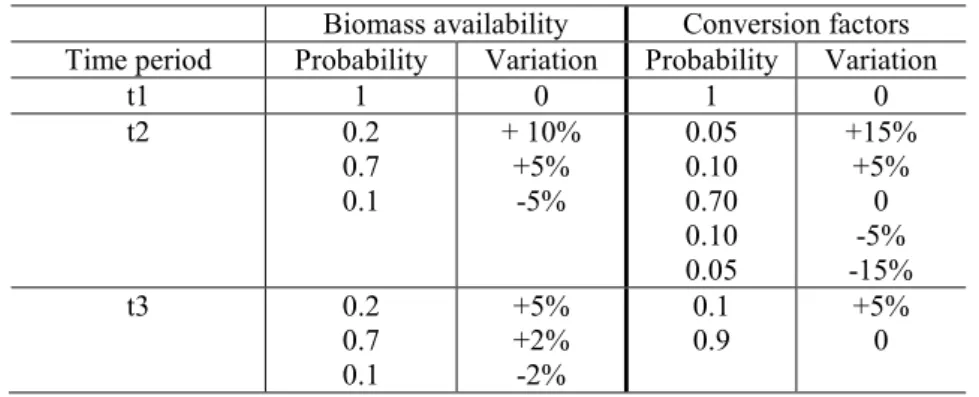
To evaluate the effectiveness of the proposed model and methods to handle the uncertainty, the design of a Portuguese biomass to chemicals and energy supply chain is considered. Each of the 278 Portuguese municipalities is a candidate as harvesting site. 28 cities are potential intermediate storage and/or preprocessing facility locations, and also represent potential locations for integrated biorefinery installation. The 18 capital of the Portuguese districts are demand points. Forestry residual lignocellulosic biomass is considered as a biomass source and an estimate of its availability is known. Intermediate processing facilities can be defined using no technology at all and work just as a depot to biomass storage, or a technology can be selected for biomass chipping and drying conferring more adequate characteristics to the biomass storage, transport and processing. Two technologies are available to biomass conversion: (m1) process defined by hydrolysis/fermentation/pyrolysis to produce bioethanol, phenols, electricity and heat; and (m2) steam gasification/hydroprocessing/combustion operations to produce biofuels and waxes. Three processing capacities are available for the biorefinery capacities. The uncertain parameters are modelled according to literature data considering expected changes in biomass availability and conversion factors, see Table 1.
Table 1. Data information to scenario definition
Biomass availability Conversion factors Time period Probability Variation Probability Variation
t1 1 0 1 0 t2 0.2 0.7 0.1 + 10% +5% -5% 0.05 0.10 0.70 0.10 0.05 +15% +5% 0 -5% -15% t3 0.2 0.7 0.1 +5% +2% -2% 0.1 0.9 +5% 0
The resulting tree obtained after combining simultaneously the two uncertain parameters has 90 scenarios (106 nodes). By applying the scenario reduction method proposed by Heitsch et al. (2003), a reduced tree with 13 scenarios (23 nodes) was created. As the scenario reduction by Karuppiah et al. (2010) requires as input the number of scenarios to attain the reduced tree and given that there is no other criterion to define the reduced tree size, this input to the model is the number of scenarios generated by the previous method, i.e, 13. The reduced tree resulted in this case in 13 scenarios (25 nodes). In summary, 4 cases are studied and compared: (CASE A) the deterministic problem; (CASE B) the stochastic problem with Heitsch et al. (2003) methodology to scenario reduction; (CASE C) the stochastic problem with Karuppiah et al. (2010) methodology to scenario reduction; (CASE D) the stochastic problem using all scenario tree nodes, i.e., 106 nodes.
In order to compare the efficiency of the proposed methodologies in the reduction of the scenario tree, the computational statistics are presented in Table 2. The execution time of CASE D the stochastic model with the 90 scenarios, illustrate the problem complexity and consequent difficulty in attaining a solution in a reasonable time. To tackle this problem the scenario reduction methods are applied and as can be seen in table 2 a solution with a lower GAP, for both scenario reduction methods, CASE B and CASE C compared with CASE D, is attained in approximately one quarter of the time. When comparing both reduction methods CASE C presents a SLIGHT better solution with an objective function value approximately 1% lower than CASE B. For both cases the global structure of the supply chain is identical in terms of number of facilities and installed capacity (see Table 3 and Figure 1). Also comparing the deterministic and the stochastic solutions is clear that the influence of uncertainty needs to be accounted for as the deterministic case results in a very optimistic solution.
Table 2. Computational statistics Case study Objective
function (€) Variables Integer variables Executing time (seg) GAP CASE A 486 402 276 95 419 2 352 15 296 0.05 CASE B 875 560 324 2 076 631 2 352 26 535 0.11 CASE C 869 697 831 2 257 003 2 352 28 781 0.11 CASE D 878 721 599 9 562 069 2 352 97 609 0.13
The model was implemented in GAMS, using CPLEX 12.3 and solved in a Two Intel Xeon X5680, 3.33 Gigahertz computer with 12 Gigabyte RAM.
Table 3. Biorefinery technologies and capacities installed (kton)
CASE A CASE C Braga Chaves Fundão Leiria Pombal Santarém
Vila Velha de Rodão Viseu m2, 250 m1, 250 m1, 250 m2, 250 m1, 250 m2, 250 m1, 250 m2, 250 Chaves Coimbra Fundão Porto Santarém Sines m1, 500 m2, 500 m1, 500 m2, 250 m2, 500 m1, 250
CASE A CASE C Figure 1. Map of the biorefineries locations
6. Conclusions
This paper studies the integrated biorefinery supply chain design and management under uncertainty in biomass availability and conversion factors. A stochastic model is proposed to minimize the total cost supply chain. With the application of the stochastic model to a real case study results illustrate that the uncertain parameters have a large impact on the supply chain design, resulting in very different network structures either in terms of locations for biorefinery installation either in technologies and capacities selected. The computational complexity of the stochastic model for a large number of scenarios in real life problems is minimized using scenario reduction methods. The efficiency of the proposed methods is illustrated by the computational performance results and as main conclusion it can be said that such methods are promising and should be further explored and tested.
References
European Commission, 2015, Communication from the Commission to the European Parliament, the Council, the European Economic and Social Committee and the Committee of the Regions. Closing the loop - An EU action plan for the Circular Economy, COM(2015) 614 final. H. Heitsch, W. Römisch, 2003, Scenario Reduction Algorithms in Stochastic Programming,
Computational Optimization and Applications, 24, 187-206.
R. Karuppiah, M. Martín, I. E. Grossmann, 2010, A simple heuristic for reducing the number of scenarios in two-stage stochastic programming, Computers & Chemical Engineering, 34, 1246-1255.
M. Marufuzzaman, S. D. Eksioglu, Y. Huang, 2014, Two-stage stochastic programming supply chain model for biodiesel production via wastewater treatment, Computers & Operations Research, 49, 1-17.
A. Osmani, J. Zhang, 2017, Multi-period stochastic optimization of a sustainable multi-feedstock second generation bioethanol supply chain − A logistic case study in Midwestern United States, Land Use Policy, 61, 420-450.
H. Paulo, A. P. F. D. Barbosa-Póvoa, S. Relvas. (2013). Modeling Integrated Biorefinery Supply Chains. In K. Andrzej & T. Ilkka (Eds.), Computer Aided Chemical Engineering, Volume 32, 79-84: Elsevier.
F. You. (2013). Design of Biofuel Supply Chains under Uncertainty with Multiobjective Stochastic Programming Models and Decomposition Algorithm. In K. Andrzej & T. Ilkka (Eds.), Computer Aided Chemical Engineering, 32, 493-498: Elsevier.