CROWDFUNDING: WHAT FACTORS INFLUENCE YOUR
SUCCESS?
Joana Sofia Batista dos Reis
Dissertation presented in partial fulfillment of the requirements for the
Degree of Master of Science in Finance
Supervisor:
Prof. Dr. José Paulo Esperança, Full Professor, ISCTE Business School Finance Department
III I would like to thank Prof. José Paulo Esperança for all his kindness and availability throughout this academic journey; to all professors from ISCTE-IUL that enriched my path with all their knowledge; and most important I want thank to my family and close friends for all their patience, support and never letting me give up from my dreams.
IV
Abstract
Financing got a new dimension with the emergence of Crowdfunding platforms, start-ups and small projects were able to be financed and new ideas got the chance to be developed. Throughout this dissertation it will be displayed several characteristics of both Crowdfunding as an alternative mean of financing and the platform in study, Indiegogo. In addition, the crucial topic that is discussed in the following chapters is what can influence positively and negatively the success of a Crowdfunding campaign and what can contribute to a higher funding percentage. Although Crowdfunding is still an upcoming topic since the financial crisis in 2008, and have already helped thousands of start-ups, small projects and non-for-profit ideas to be funded, the benefits Crowdfunding can provide to the society and the economic development are far away to be known.
This dissertation is most relevant to future project creators and entrepreneurs that aim to obtain financing through alternative sources, as it provides advices that can be used in future Crowdfunding campaigns.
Keywords: Entrepreneurship; Crowdfunding Success; Start-ups; Financing JEL Classification: G21; L260; M13; O31.
V
Sumário
O financiamento ganhou uma nova dimensão com o aparecimento das plataformas de Crowdfunding, agora é possível que novas empresas e pequenos projetos sejam financiados e que novas ideias tenham a possibilidade de serem desenvolvidas. Ao longo desta dissertação serão disponibilizadas as diversas características tanto do Crowdfunding como um método alternativo de financiamento como também da plataforma que será estudada, a Indiegogo. Além disso, o tema crucial que será discutido durante os próximos capítulos refere-se a que fatores podem influenciar positiva ou negativamente o sucesso de um projeto de Crowdfunding e também os que podem contribuir para um aumento da taxa de financiamento desses mesmos projetos. Contudo e apesar do tema Crowdfunding ser um assunto bastante recente e principalmente notório após a crise financeira iniciada em 2008, e apesar de já ter permitido o financiamento a milhares de novas empresas, pequenos projetos e ideias para fins não lucrativos, os benefícios que este novo método de financiamento pode trazer à sociedade e ao desenvolvimento económico estão longe de serem conhecidos.
Esta dissertação é orientada para futuros empreendedores que pretendam obter financiamento através de métodos alternativos e também para futuros fundadores de projetos em plataformas de Crowdfunding, uma vez que dá conselhos que podem ser utilizados na criação de futuras campanhas de Crowdfunding.
Palavras-Chave: Empreendedorismo; Sucesso com Crowdfunding; Startups; Financiamento
VI
List of Graphs
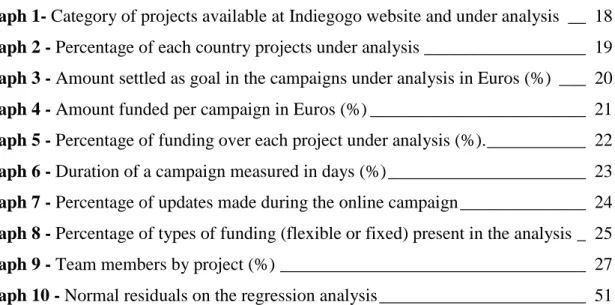
Graph 1- Category of projects available at Indiegogo website and under analysis __ 18 Graph 2 - Percentage of each country projects under analysis __________________ 19 Graph 3 - Amount settled as goal in the campaigns under analysis in Euros (%) ___ 20 Graph 4 - Amount funded per campaign in Euros (%) ________________________ 21 Graph 5 - Percentage of funding over each project under analysis (%). ___________ 22 Graph 6 - Duration of a campaign measured in days (%) ______________________ 23 Graph 7 - Percentage of updates made during the online campaign ______________ 24 Graph 8 - Percentage of types of funding (flexible or fixed) present in the analysis _ 25 Graph 9 - Team members by project (%) __________________________________ 27 Graph 10 - Normal residuals on the regression analysis _______________________ 51
List of Figures
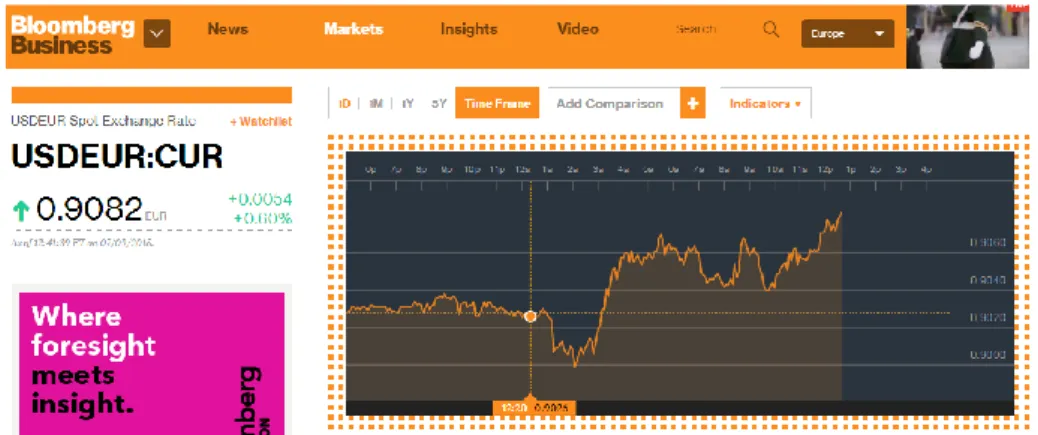
Figure 1 - Exchange rate USD – EUR _____________________________________ 45 Figure 2 - Exchange rate AUD – EUR ____________________________________ 45 Figure 3 - Exchange rate GBP - EUR _____________________________________ 45
VII
List of tables
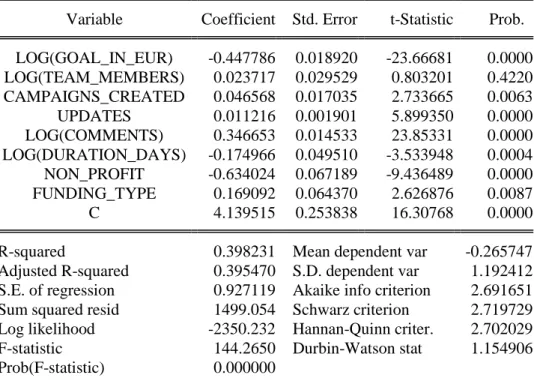
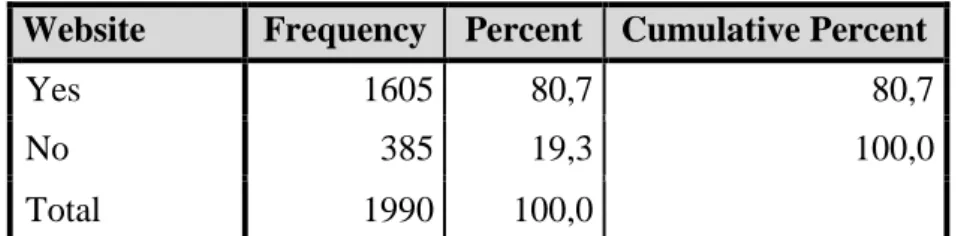
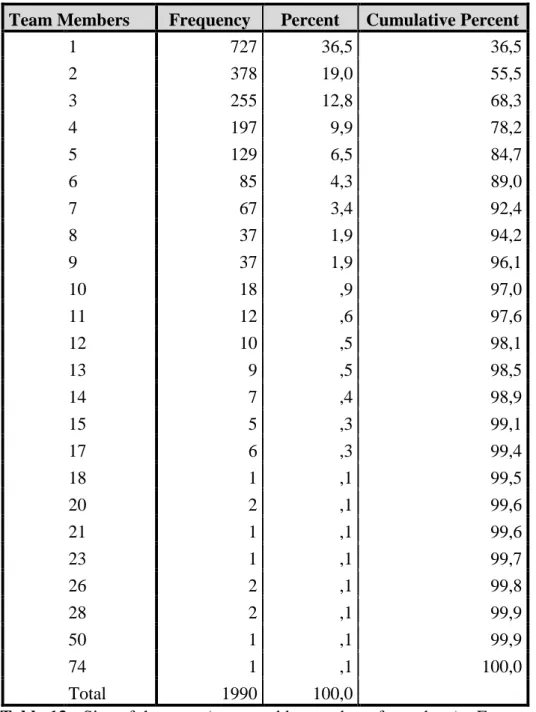
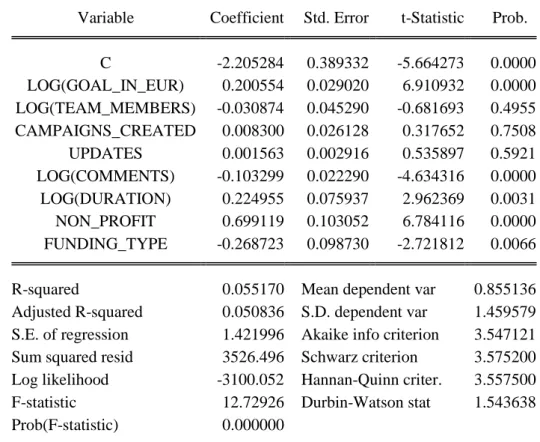
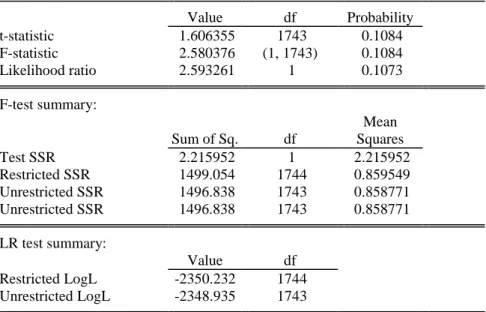
Table 1- SWOT Analysis of Crowdfunding ________________________________ 11 Table 2 - SWOT Analysis of Indiegogo Platform ____________________________ 16 Table 3 - Econometric model under analysis (Source: Eviews) _________________ 33 Table 4 - Frequency and percentage of categories available at Indiegogo website and under analysis ________________________________________________________ 46 Table 5 - Frequency and percentage of projects per country under analysis ________ 46 Table 6 - Amount settled as goal in Euros from projects under analysis - Percentage and Frequency ___________________________________________________________ 47 Table 7 - Amount funded in Euros from projects under analysis - Frequency and percentage ___________________________________________________________ 47 Table 8- Percentage of Funding’s Success by Intervals - Frequency and Percentage _ 47 Table 9 - Funding type (Flexible VS Fixed) Frequency and Percentage ___________ 48 Table 10 - Presence of video on the campaigns - Frequency and Percentage _______ 48 Table 11 - Projects' funding for non-profit institutions - Frequency and Percentage _ 48 Table 12 - Presence of website in the campaigns - Frequency and Percentage ______ 48 Table 13 - Size of the team (measured by number of members) - Frequency and Percentage ___________________________________________________________ 49 Table 14 - Summary table with variables' information regarding description, significance, impact and hypothesis analyzed _______________________________ 50 Table 15 - Breusch-Pagan-Godfrey Test - Heteroskedasticity Test ______________ 51 Table 16- Ramsey Reset Test – Test to specification errors ____________________ 52
VIII
Index
1. Introduction ______________________________________________________ 1 2. Literature Review _________________________________________________ 2 2.1 Crowdfunding – Concept and Origin __________________________________ 2 2.2 Types of Crowdfunding ____________________________________________ 3 2.2.1 Reward-Based ________________________________________________ 3 2.2.2 Donation-based Crowdfunding ___________________________________ 4 2.2.3 Lending-based Crowdfunding ____________________________________ 5 2.2.4 Equity-based Crowdfunding _____________________________________ 5 2.3 Reasons to Crowdfund _____________________________________________ 6 2.3.1 Motivations for funders _________________________________________ 6 2.3.2 Motivations for creators _________________________________________ 7 2.4 Factors influencing Crowdfunding Success _____________________________ 7 3. Crowdfunding & Indiegogo behind the spotlights ___________________________ 8 3.1 SWOT Analysis of Crowdfunding ____________________________________ 8 3.1.1 Strengths _____________________________________________________ 8 3.1.2 Weaknesses __________________________________________________ 9 3.1.3 Opportunities ________________________________________________ 10 3.1.4 Threats _____________________________________________________ 10 3.2 Platform in Study: Indiegogo _______________________________________ 12 3.2.1 Platform Characteristics ________________________________________ 12 3.2.2 Pricing and Fees ______________________________________________ 12 3.2.3 Nonprofit campaigns __________________________________________ 13 3.3 SWOT analysis of Indiegogo _______________________________________ 13 3.3.1 Strengths ____________________________________________________ 14 3.3.2 Weaknesses _________________________________________________ 14 3.3.3 Opportunities ________________________________________________ 14 3.3.4 Threats _____________________________________________________ 15 4. Data Analysis ______________________________________________________ 17 4.1 Methodology & Variables in study ___________________________________ 17 4.2 Descriptive Statistics ______________________________________________ 17 4.2.1 Category ____________________________________________________ 18 4.2.2 Country _____________________________________________________ 19
IX 4.2.3 Amount stated as goal – Euro Currency____________________________ 19 4.2.4 Amount funded per campaign – Euro Currency _____________________ 20 4.2.5 Funding percentage per campaign ________________________________ 21 4.2.6 Backers per campaign _________________________________________ 23 4.2.7 Duration of each campaign measured in days _______________________ 23 4.2.8 Number of updates per campaign_________________________________ 24 4.2.9 Comments done per campaign ___________________________________ 24 4.2.10 Type of funding: Flexible vs Fixed ______________________________ 25 4.2.11 Availability of Video per campaign ______________________________ 26 4.2.12 Charity campaigns: Profit vs Non-profit __________________________ 26 4.2.13 Number of team members per campaign __________________________ 26 4.2.14 Number of previous campaigns created by team members ____________ 28 4.2.15 Availability of a website per campaign ___________________________ 28 4.3 Hypothesis to be tested ____________________________________________ 29 4.4 Results _________________________________________________________ 32 5. Conclusion ________________________________________________________ 38 5.1 Discussion of results ______________________________________________ 38 5.2 Advices to future project creators ____________________________________ 41 5.3 Future researches ________________________________________________ 42 5.4 Main findings ___________________________________________________ 42 Bibliography _________________________________________________________ 43 Appendix ___________________________________________________________ 45 Appendix A – Exchange Rates _________________________________________ 45 Appendix B – Support to statistical analysis of independent variables – SPSS ____ 46 Appendix C – Support to econometric model analysis _______________________ 50
1
1. Introduction
As a result of the financial crisis that started to be felt in 2008, there comes the need for alternative sources of financing and with that the emergence of Crowdfunding platforms. Crowdfunding is the crucial topic over this dissertation and it consists mainly in individuals or start-ups advertising their projects online in order to get funding from the crowd to proceed with their ideas, development of products or other type of goal. The main goal is to answer the question: What factors influence the success of a Crowdfunding project? Is it the amount settled as a goal or the number of updates made during the campaign? Does the size of your team matter or you can succeed on your own? Is there any chance that prior experiences (whether good or bad) can influence the success of the current project? Is the success of your project related to the type of funding it is approaching or to the number of days it stays online?
Essentially the aim of this dissertation is to provide the reader a better understanding of the concept of Crowdfunding, what types are available in the market, what are the characteristics, advantages, opportunities and risks associated to it and briefly explain what motivates both creators and backers of projects which will be discussed in Chapter 2 - Literature Review, while in Chapter 4. Data Analysis, the key variables will be analyzed individually both statistically and within the regression created, as for the Chapter 5. Conclusion it will be provided final remarks and a possible answer to the main question in study. Also this dissertation will provide useful information that can be used in future investments in Crowdfunding projects and platforms, as backers or as project creators. Beyond that the reader will get further knowledge in Indiegogo Crowdfunding platform which will be used as the basis for the study of relevant factors and also it will be analyzed in the Chapter 3.2 Platform in Study: Indiegogo.
Last but not least, the purpose of the study is to explore several characteristics shared by Crowdfunding campaigns that may be factors contributing to a successful final result. Whereas the main goal is to find a linear relation between the expected success and the factors and characteristics contributing to it, being some also suggested in the platforms’ website. Such an upcoming topic is quite challenging as there is not many information available over Crowdfunding and this is also one of the reasons why it is so interesting and relevant to analyze these success factors which can change the future of many entrepreneurs and start-ups and enhance success rates.
2
2. Literature Review
2.1 Crowdfunding – Concept and Origin
Crowdfunding is defined by several authors as a type of fundraising for small simple projects and also for some startups that are usually funded by venture capitalists or business angels (Belleflamme et al, 2010). This emergent concept comes from the combination between crowdsourcing and microfinance (Mollick, 2013) and is defined as when a firm, which is oriented to profit, outsources from the crowd several activities that are very specific in the production and marketing sale of a product, project or idea (Kleemann et al., 2008). However, one big problem that start-ups face when starting its business is the accessibility to capital and there is where the need for Crowdfunding is born.
Crowdfunding is defined by (Larralde & Schwienbacher, 2010) as “an open call, essentially through the Internet, for the provision of financial resources either in form of donation or in exchange for some form of reward and/or voting rights in order to support initiatives for specific purposes”. In fact they also say that through Crowdfunding projects there may be an increase in the innovation and development support given by those who also finance it, information which would also be typically obtained through crowdsourcing.
The first idea of Crowdfunding was also found in crowdsourcing, this means that the consumer stopped being only a good taker and began to collaborate in the production process. Consumers are now seen as co-workers as they can actually contribute to several processes of the product they want to purchase, even if it is still the enterprise that takes control, (Kleemann et al., 2008)
In fact, Crowdfunding was only possible due to the “Web 2.0” emergence, as we grew from static pages to virtual communities where we interact with each other in a social media dialogue, (Peyankov, 2013).This term was popularized in 2004 by Tim O’Reilly, and brought us to the first Crowdfunding platforms. The first known Crowdfunding platform was ArtistShare based in U.S. in 2001, afterwards there was Sellaband in 2006, and in a blink of an eye appeared Indiegogo and Kickstarter in 2008 and 2009 respectively, being the final two the major Crowdfunding platforms known nowadays, (Zouhali, 2011).Crowdfunding works as a mean of generating ideas and solutions to the
3 problems affecting the production and development process, companies use consumers and crowd in general to provide them ideas and feedback to increase the efficiency of the business (Belleflamme et al., 2010).
In order to have a better understanding of what is said throughout this research; it will be provided a definition of project creator and funder, as follows. Being the person, group or start-up that actually create the project and update the campaigns called creators, whereas the individual that participates in the campaign by giving contributions to the projects they want to support are called funders or backers.
2.2 Types of Crowdfunding
There are several types of Crowdfunding, in this section it will be clarified the concept and the differences between them. The four types of Crowdfunding are donation-based, reward-based, loan-based and equity-based, and they will be explained in the following pages.
2.2.1 Reward-Based
Starting reward-based Crowdfunding, this one consists in the people that contribute to the campaign getting rewards or even the product itself in return for the funding, but they do not receive money in return. As the project creator defines different compensations for the different amounts of money in the contribution, people who contribute with more money will get better prizes. It is similarly common to use the preselling of the product or also giving away compensations, as for example when financing a band album, the funder will get the CD in presale and can also get a t-shirt or a free-entrance in a specific concert, in form of compensation. The most well-known platform for this type of funding is Kickstarter, (Giudici et al., 2012)
The funding here works with the all-or-nothing type meaning that the fundraiser will get the money if the goal is reached or exceeded in the period set, otherwise the money goes back to the funders and the project campaign fails. There is also another type which is the keep-it-all, where the fundraiser gets the money despite they did not reach the monetary goal set at the beginning of the campaign.
4 A good example of a platform that uses reward-based Crowdfunding as stated previously, is Kickstarter however the campaign’s creator currently needs to have a social security number or to be a permanent resident of some specific countries, (Kickstarter - Creator Questions - FAQ, 2015). This great platform was born in 2009 and by 14th of January 2015 it had over than 7.7 billion backers and approximately 78 million funded projects. In the year of 2014 there were 22.252 projects successfully funded on Kickstarter, and over $529 million was pledged.
Apart from Kickstarter there is also another big platform in the field of Crowdfunding which is Indiegogo, the platform chosen to build the research over this dissertation. However, contrary to Kickstarter, this platform allows charity projects and does not present a list of specific countries which can take part in the funding of Crowdfunding projects. Additional and more detailed information over Indiegogo platform will be presented in the Section 3.2 Platform in Study: Indiegogo of this study.
2.2.2 Donation-based Crowdfunding
This type consists as the name suggests in the crowd supporting a specific cause or campaign without receiving any kind of reward, an example of this type of platforms is GoFundMe. This platform is considered one of the best and funding has the possibility to be collected for different purposes through three different methods, (Härkönen, 2014). A personal campaign is the most popular one, where the person can get funds without a specific timeframe and those funds can be used immediately, however there is also the charity campaign method where the funds are given to a specific non-profit organization on a monthly basis. Last but not least there are the campaigns focused on a particular idea, product or project, where it is set a goal for money and time and only after these specifications are being met it occurs the transfer of money. GoFundMe is mainly known for its charity and donation projects, however it can also give support to some business projects.
Some Crowdfunding projects follow what is called a Patronage model, mainly humanitarian or art projects, where funders do not expect any return for their investments. There are several reasons for people to invest in patronage models, most of them do it to support a cause, as a political statement or in order to personally support the project founder’s, (Mollick, 2013).
5 2.2.3 Lending-based Crowdfunding
When it comes to this type of Crowdfunding, crowdmembers receive interest on the principal, as the example of Lainaaja in Finland. The first microloan service was Zidisha where there was just the lender and the borrower, enabling the cost structure to be lower and the interest rates to be half of the ones in the traditional microloans, being an example of it Kiva. Kiva is considered the biggest player of this new internet era when it comes to micro-funding, (Härkönen, 2014). According to JIRKA the biggest microloans platforms are designed for entrepreneurs in developing countries or only as a personal need. As Crowdfunding loans are getting known in the field, some might think that they will become a threat to big banks as its popularity is increasing while banks’ requirements are being tightened. In short, lower interest rates may be obtained by borrowers and higher returns by investors when comparing it to the traditional methods. According to Mollick (2013), this model when applied to micro-financed loans may be due to any social good that is promoted by the venture rather than the return itself.
2.2.4 Equity-based Crowdfunding
Last but not less important, there is also this type of Crowdfunding where the investor has the chance to get returns in form of company stake if the company they invested in became successful. Only in 2012 in the Jumpstart Our Business Startups Act, from now on denominated JOBS Act, it was possible to legalize equity Crowdfunding in the US, when reading Mollick (2013) it is stated that President Obama refers to this as “a potential game changer” for small companies however he also refers that it is still very unclear how can this fresh type of Crowdfunding can help developing new ventures. When relating to market inefficiency it is easy to find lack of investors’ protection, besides this might happen due to adverse selection, risk of fraud, moral hazard and also information asymmetry. When one side of the market cannot observe the actions of the other side then we are in the presence of a called hidden action problem, or commonly known moral hazard, on the other side when it comes to adverse selection it happens in situations where the quality or type of the good or service is unknown, so we are in the presence of a hidden information problem, (Varian, 2010).
6 The JOBS Act is seen as a mean of giving emphasis to the lack of backers’ protection, making the problems such as moral hazard or information asymmetry getting worse. This act will give an opportunity to unexperienced people to invest in businesses which they have no ability to understand or evaluate, (Griffin & Johnson, 2012 in Härkönen, 2014). On the other hand there are some people, such as Hazen (2012) that still see this legislation as a necessity to incentivize entrepreneurs in the beginning of their business funding. This act treats funders as investors as in return for their funding it gives them equity stakes or similar returns. Beyond equity Crowdfunding, it is possible for backers to get shares of future profits, portions of returns for public offerings or acquisitions, or also shares of real estate investments, (Mollick, 2013)
2.3 Reasons to Crowdfund
There is still a lot to be done when it comes to studies over Crowdfunding either from reasons for preferring this alternative method on the creators’ side or from the funders’. However, regarding the motivations that bring backers to contribute to Crowdfunding projects and also motivations that influence funders to create Crowdfunding projects follows two sections regarding summary information on the topic.
2.3.1 Motivations for funders
Firstly funders seek mainly rewards that might be in form of services or tangible products, in addition they want to get the product first or to be given a limited edition. However when rewards are not related to the project backed, funders get frustrated and say they want to see their money well spent, (Gerber et al., 2012).
Another reason that motivates backers to contribute to these projects is if the creator is a friend, family or an institution (as in supporting causes). Backers say they feel they are creating value and social impact within their social network or institutions they identify themselves to. In addition and coming back to section 2.2.2 Donation-based Crowdfunding, there are numerous reasons for people to make investments in this type of patronage models, and it is mainly due to political issues or because they feel the personal will to help a particular cause, (Mollick, 2013).
7 2.3.2 Motivations for creators
When analyzing the creators’ motivations to engage in a Crowdfunding project according to Gerber et al., (2012) there are some specific characteristics that would motivate a person to start a Crowdfunding campaign. The first and most common is the need for raising funds, people that would not collect the money if it was not through Crowdfunding. Also, creators prefer the feeling of getting several small contributions rather than applying to a financial institution. Another great motivation is to connect with the crowd, to establish relationships with other creators and backers and to extend the communication beyond funding issues, as in a way to spread the product or to get advice over business. Last but not least, creators focus in successful experiences and projects, as they are inspired by other successful people they also want to obtain online validation of their ability and inspire and motivate others. (Agrawal et al., 2013)
2.4 Factors influencing Crowdfunding Success
When referring to distance as factor influencing Crowdfunding success, Agrawal et al. (2011) made a study where they showed that if the project creator uses Crowdfunding platforms to finance his project then there is not a significant influence related to its location. Even when changing distances, they show that the use of online platforms eliminates barriers related to distance in financing early stage start-ups. In addition, Mollick (2013) says that geography has some influence in the type of the project. Also, he measured different determinants of success and he found out that there is a strong correlation between the projects’ success and personal networks. Other findings are possible to be recognized in Mollick (2013) where for example the size of the project creator social network, it is said that its impact is quite revealing as only 10 Facebook friends can push the funding rate up by 9%. Besides this in the chances of being a successful funding increases if the project is supported by the crowdfunding platform where it is allocated, which in the case of Mollick (2013) is Kickstarter and not Indiegogo as in the present analysis.
Given this, there are several other factors that have been clarified even by Mollick (2013) and others than those that might have an influence over the projects success. Some of the chosen factors will be discussed in hypothesis in the following sections of this dissertation, being this the main concern of the study.
8
3. Crowdfunding & Indiegogo behind the spotlights
3.1 SWOT Analysis of Crowdfunding
There are several threats that Crowdfunding can face as a funding mean, but there are also some opportunities it can reach out in the market. In order to clarify this information and to give some insight to entrepreneurs, it will be performed a SWOT (strengths, weaknesses, opportunities and threats) analysis of Crowdfunding.
In order to clarify this analysis it is essential to understand the clear meaning of each dimension (Valanciene & Jegeleviciute, 2013, in Härkönen, 2014). Strengths might be seen as advantages of Crowdfunding when comparing to other means of raising capital; weaknesses are concerning negative features also when comparing to other ways to raise capital and they both are originated internally. Opportunities can give an idea of what can be exploited in the field of Crowdfunding and threats the negative factors that can be harmful to the method or that might decrease its performance.
There are several advantages and disadvantages in using the Crowdfunding model instead of other traditional funding or investment means, (Valanciene & Jegeleviciute, 2013 in Härkönen, 2014). Further follows Table 1 as a summary table with information concerning the SWOT analysis, also based on Zeco & Propfe, (2014).
3.1.1 Strengths
When talking about the strengths of this technique one can observe that the main advantage is that the capital is raised from several people instead of one single funder, so the risk of bearing a project is spread all over and then mitigated. Another important advantage is the ability to test the popularity of the product, as when presenting the product in the campaign the enterprise can get the feeling if the product will be well accepted by the target consumer or if it needs to be changed. Also, the product is freely advertised by funders and backers themselves.
As the Crowdfunding campaigns are directed to the crowd, possible consumers will provide their ideas about the product and that interaction will also contribute to the development and production process of the product itself. As well as this, it is possible in some cases for the funder to purchase the product before it is launched in a pre-sale
9 way, and to expand the campaign himself to friends and family and to other possible funders Another major strength of Crowdfunding when comparing to other traditional funding means is that the project owner keeps his equity and total control over company decisions contrary to what happens for example in bank loans where they require some guarantee or venture capitalists and business angels where there is a control over the management decisions. Another plus in Crowdfunding is that it contributes to a better economic environment, as there is a creation of projects by local communities where the funds come not only locally but also globally.
Last but not least, in Crowdfunding the crowd can actually contribute to the efficiency of the business activity or the development of the production process. It is very important for entrepreneurs as it is extremely efficient in giving consumers’ feedback over the product, given that approximately half of the new products that are launched fail to meet and understood consumer needs, (Härkönen, 2014).
3.1.2 Weaknesses
One of the major problems of Crowdfunding is its uncertainty. A company that is funding its project is never sure if the funding campaign will be successful and if it will be funded. However, there is also uncertainty for the funders themselves as there is the possibility of scam and fraud and they are not sure if they will receive the reward they were promised to. Also, when a company is sharing its product’s campaign it is showing all the competitors what product they are developing.
Given the case the campaign is not successful they are not able to get the fund, apart from the bad reputation the company goes through, competitors can see a chance to be a step ahead of them. Another problem is that a Crowdfunding campaign requires a lot of time, work, skills and effort and there might not be worth it due to the uncertainty it represents.
10 3.1.3 Opportunities
When referring to the opportunities still available to this alternative funding way there are lots of new things to be explored, there are several new start-ups and business activities that can get its chance out through Crowdfunding, which would not exist otherwise. A big opportunity that can be taken from this is the efficiency in allocating new resources and in the development or production processes. As the crowd gives you capital it also gets interested in helping out the product they want to purchase, by giving new ideas that companies will use to fill in some gaps in the process and to improve them efficiently.
3.1.4 Threats
There might be a change in the legislation or a surplus of projects in the future that could lead to a decrease in the number of successfully funded projects. The lack of funders or other competitive sources of financing are some of the main threats to this technique. Another great threat is the riskiness of startups’ success brought to life by Crowdfunding when comparing to when they follow the benefits of venture capitalists and business angels bring to the business, mainly mentorship, advice, contacts and so on.
11
Strengths Weaknesses
Mitigation of risks
Ability to test product popularity and demand
Free marketing provided by funders and backers
Feedback of the crowd, interaction, development of ideas
Keeping its equity
Possibility to pre-sell the product or service
Keep control over company decisions – different from Venture Capital and Business Angels.
Opportunity of funding to small businesses – traditional sources do not give out funds easily
Uncertainty of project’s funding
Requires skills, time and work in order to be successful
Once you go public you can’t go back
Possibility of scam and fraud
Opportunities Threats
Financing new start-ups & grown enterprises
Spread the business to other markets
Efficient resources’ allocation
New ideas & gap-fillers in the production process
Other sources of financing
Surplus of projects, lack of investors
Change in legislation
May lose reputation if the funding or project fails
Riskiness of startup’s success
12 3.2 Platform in Study: Indiegogo
3.2.1 Platform Characteristics
Indiegogo is an international platform where its main focus is rewarded-based Crowdfunding and was funded by Danae Ringelmann, Slava Rubin and Eric Schell in 2008 in San Francisco with the aim to “revolutionize the flow of funding, so it can reach and grow the ideas that matter” (Indiegogo, Our Story, 2015). Also, there has been a huge growth in the Crowdfunding industry since 2008, as there were many entrances in the market of platforms and niche platforms that nowadays have a variety of services regarding all types of Crowdfunding, (Stern, 2013).
Indiegogo sees itself as a mean to empower people and to make ideas happen, while it also refers the support given to the community in spreading their campaigns throughout the world, (Indiegogo, Indiegogo Help Center - Contributing, 2015).
Project owners can have the possibility to create either a flexible funding or a fixed funding campaign. In the case they decide to go for the flexible funding campaign then even though the goal is not met, funds are raised and the owner still gets the money. On the other way, if the project owner decides to choose the fixed funding campaign then he only keeps the funds raised if he meets the goal settled initially. (Indiegogo, Learn how to raise money for a campaign, 2015)
3.2.2 Pricing and Fees
When it comes to signing up in the platform, creating a campaign or backing one, there are no fees from Indiegogo platform. Even though funders have no charges from Indiegogo, it might be the case where they pay additional charges that are determined by their credit card which can also depend on the currency of the campaign they are contributing for.
However when a campaign is created and it raises funds, Indiegogo charges fees depending on whether the main goal is reached or not and if it is a fixed or a flexible funding. In the case the goal is reached Indiegogo charges a 4% fee on the funds raised, although if the goal is actually not reached and you have a flexible funding then Indiegogo charges you a 9% fee. This fee works also as a mean to empower the
13 promotion of campaigns and the setting of reasonable goals. In the case the goal is not reached and we are in the presence of a fixed funding, then Indiegogo charges nothing and backers get refunded. (Indiegogo, Pricing Fees, 2015).
3.2.3 Nonprofit campaigns
There is a possibility for campaigns to be classified as non-profit and if this is the case, then Indiegogo offers a reduction on the charged fees of 25%. For this to happen, the nonprofit institution must be registered in the United States Contributions and will have a specific sign on the campaign’s page referring to it as “Verified Nonprofit Campaign”. This tax exemption and deduction is only available in the United States and refers to non-for-profit organizations being them scientific, charitable, educational, religious or other. Regarding Indiegogo platform, all contributions made to nonprofits will be processed by FirstGiving and have the right to be tax deductible.
The campaign will be automatically set in the flexible funding category, meaning that funds received will have a 25% discount, meaning a 6.75% fee, plus a 4% fee charged by FirstGiving as a payment processing fee. If the goal is met then Indiegogo charges only a fee of 3% as a bonus for achieving the desired goal. All the information above regarding Nonprofit Campaigns will be find in Indiegogo’s website, (Indiegogo, Learn how to raise money for a campaign, 2015).
3.3 SWOT analysis of Indiegogo
When performing a deeper analysis of Indiegogo platform it is possible to obtain its strengths, weaknesses, opportunities and threats. In order to get a clearer idea of the opportunities Indiegogo has in the Crowdfunding market and also which threats they go through, it will be performed a SWOT analysis to the platform in study. In this specific section information was by majority taken from Indiegogo, Seedrs and Kickstarter websites in order to have a possible relation between them, the specific pages where the information was taken was either the blog’s or the guides to launch a campaign.
14 3.3.1 Strengths
Regarding Strengths, Indiegogo has a competitive advantage to Kickstarter’s platform, as there is no need to be a US citizen to create a campaign. Also contrary to Kickstarter, Indiegogo offers donation Crowdfunding type meaning it accepts non for profit campaigns. This is a plus when comparing to Kickstarter as it gives the possibility to diversify the type of campaigns and to help other communities and institutions. Another competitive advantage is the 75% discount offered over the charging fees regarding the non-profit campaigns. Concerning the type of funding there is the possibility to choose if the owner of the campaign wants a flexible funding or a fixed funding. This is a huge advantage when comparing to other platforms such as Kickstarter, meaning the funder can choose at the beginning of the campaign to keep the funds regardless of having or not reached its target (having as consequence higher fees in a case than in another).
3.3.2 Weaknesses
Although there are several strengths when it comes to weaknesses there are great disadvantages for Indiegogo for not offering Equity Crowdfunding nor Lending Crowdfunding. When observing Seedrs platform it is possible to see that it offers other types of Crowdfunding rather than the regular ones (donation and reward-based types), (Seedrs, 2015). Another disadvantage is that the only non-profit institutions which can be offered funds with donation Crowdfunding have to be registered in the United States Contributions, meaning European non-profit institutions cannot be offered funds through Indiegogo platform.
3.3.3 Opportunities
An opportunity available to the platform in study in the Crowdfunding field is the offer of the remaining types available in the market such as Lending Crowdfunding and Equity Crowdfunding. Since the JOBS Act in 2012 there was a boom in the Crowdfunding platforms and after the JOBS Act, funders also begin to be seen as investors as they were given the opportunity to get equity in return for the funding they made, (Stern, 2013). Last but not least, it would be a good way to diversify the market if
15 Indiegogo would extend the non-profit campaigns to European institutions and not just limit that opportunity to the United States citizens.
3.3.4 Threats
Regarding threats in the market, there exist several other sources of financing that any funder can use to obtain its needed funds, there might be a chance they have different costs and fees to the funder and might also give more certainty when it comes to assure the amount needed. Apart from other sources of financing there are also other platforms in the market, mainly after 2008 there was a boom in the Crowdfunding platforms and niche platforms. These platforms can charge different and better fees to the funder, might also offer different types of Crowdfunding preferred by funders, mainly equity Crowdfunding after the JOBS Act in 2012. As a huge consequence there is the possibility that Indiegogo may loose market and funders to other well-known platforms in the field. Further it follows Table 2 - SWOT Analysis of Indiegogo Platform with a summary of the SWOT analysis specified above:
16
Strengths Weaknesses
Non-profit Campaigns
Not needed to be a US citizen. Anyone can create a campaign
Possibility to choose if Flexible funding or if Fixed funding (when comparing to Kickstarter)
Bonus fee for non-profit campaigns (75% discount over the fees charged)
Fee’s of fixed and flexible funding lower (4%) when comparing to other well-known platform in the case the goal is reached
(Seedrs – 7.5%; Kickstarter – 5%)
Fee’s of flexible funding higher when comparing to other platforms 9% in the case there is a flexible funding and the main goal is not reached
Does not offer Equity Crowdfunding nor Lending; (bad when comparing to Seedrs that has Equity Crowdfunding
Non-profit institutions have to be registered in US. (If you want to make a nonprofit campaign to a European institution it has to be registered in the US law)
Opportunities Threats
Offer Equity Crowdfunding & Lending Crowdfunding
Extend the non-profit campaigns to European institutions.
Other sources of financing
Other platforms (boom after 2008)
Loose market as they do not offer all types of Crowdfunding (not even equity, after the JOBS Act 2012) Table 2 - SWOT Analysis of Indiegogo Platform
17
4. Data Analysis
4.1 Methodology & Variables in study
The methodology used for addressing the research questions was based on a statistical analysis concerning ended Crowdfunding campaigns from Indiegogo website until 31st of December 2014, only referent to five chosen countries and limited to a maximum of fifty projects per category per country available. Taking into account the fifth countries were chosen by the highest GBP with information relative to 2013 in the World Bank website as per February 2015. Bearing in mind the characteristics available for this study, the countries under research are United States, China, Japan, Germany and also France, being considered as referred only a maximum of fifty projects per each of the twenty-four available categories at Indiegogo website. Last but not least, using the same data described previously, there will be an econometric analysis of a model that observes the influence of different variables in the campaigns' success, being them called factors of success.
Those variables in study presented in the data basis are as follows: category, country, goal in local currency, amount funded in local currency, percentage of funding, number of backers, duration, type of funding (flexible VS fixed), number of updates, number of comments, number of members in a team, number of campaigns created before the current one, presence or not of website, presence or not of video and being or not a non-for-profit project. Variables containing amounts at local currency where exchanged to Euros at the exchange rate available on the 9th of July of 2015.1
4.2 Descriptive Statistics
In order to better observe and understand the statistical picture of each variable, it was decided to build several graphs and tables based on the information collected in Indiegogo website and presented in the Data Basis used for the following econometric model. Given this, graphs and tables presented in Section 4.2 and Appendix B were constructed by the author of this dissertation on purpose during the development of the analysis.
1
18 4.2.1 Category
Considering the categories available at Indiegogo website, and having a maximum of 50 projects per category per country, it is possible to observe that Film, Technology and Music are the categories with higher percentage of projects in the countries considered to perform this analysis, representing around 9% each of the whole categories. On the other hand, the ones that are less represented in this group are Comic representing less than 1% and Religion and Politics with less than 3% of the whole projects under this analysis. In Graph 1 presented below it is possible to observe the distribution in percentage obtained in this analysis when it comes to the categories of projects available and being analyzed. 2
Graph 1- Category of projects available at Indiegogo website and under analysis
2 See Appendix B – Support to statistical analysis of independent variables – SPSS, Table 4 - Frequency
and percentage of categories available at Indiegogo website and under analysis and Table 5 - Frequency and percentage of projects per country under analysis, for specific values over categories and country.
0% 1% 2% 3% 4% 5% 6% 7% 8% 9% 10% C o m ic R elig io n Po lit ics An im als Dan ce E n v ir o n m en t Fo o d T h ea ter T ran sm ed ia Hea lt h Sp o rt s C o m m u n it y Fas h io n Sm all B u sin ess Vid eo /W eb W ri tin g Des ig n Ph o to g rap h y E d u ca ti o n Gam in g Ar t Mu sic T ec h n o lo g y Fi lm
Category of Projects
Category19 4.2.2 Country
When referring to the countries under analysis, with the respective projects of all categories, it is possible to observe in Graph 2 below, that the majority of our observation belongs to United States with 53% of all projects, 22% to Germany, 16% to France and only a few to China and Japan, representing 3% and 5% respectively.2
Graph 2 - Percentage of each country projects under analysis
4.2.3 Amount stated as goal – Euro Currency
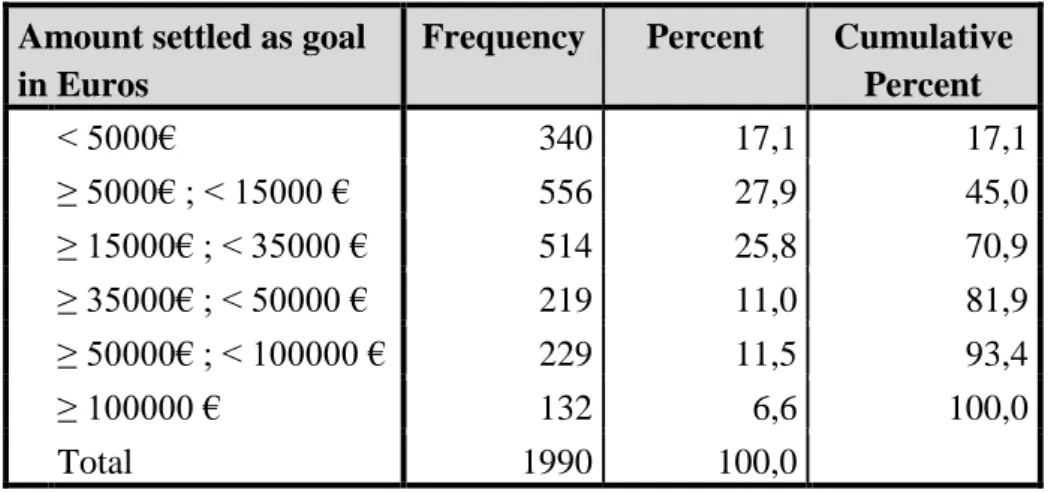
Considering now one of the most crucial variables of this study, it is possible to observe that the goal of the amount asked for by project creators can vary from less than 500 Euros to almost 6 million Euros. The values represented in this variable and in the amount funded per campaign were converted from local currency to Euros at the real conversion rate on the 9th of July 2015 and the medium value considered as goal by project creators is about 350.000 Euros. When analyzing these values by ranges, approximately 28% of the whole projects have a goal between 5.000 and 15.000 Euros, while the second most common range is between 15.000 and 35.000 Euros being around 26% of the totality. On the other side, being less common but still considering 132 projects requiring amounts superior or equal to 100.000 Euros. Given this, it is possible to perceive the percentage of the amount of funding set as goal for each range of amounts in Graph 3, this split into different ranges was performed exclusively for a
53% 3% 5% 22% 16%
Country
US China Japan Germany France20 better and more efficient observation of the statistical results, however it will not be considered in the econometric model where the variable considering the goal will be tested in Hypothesis 1 of the section 4.4 Results.3
Graph 3 – Amount settled as goal in the campaigns under analysis in Euros (%).
4.2.4 Amount funded per campaign – Euro Currency
When focusing on the amounts funded by backers the minimum amount available was less than 500 Euros while the maximum was of over 2 million Euros. Although the medium value obtained by backers on a project was around 42.000 Euros, the range with the higher percentage of funding is for values lower than 5.000 Euros being 30% of the projects. After with around 23% and 25% values from 5.000 and equal to 15.000 Euros and from 15.000 and equal to 35.000 Euros, respectively. On the other side projects that got higher funding values represent only 8% of the totality, being around 150 projects from the 1990.
The two projects with higher funding amount were held in Texas in the Film category and in California in the Technology category with the respective amounts of 2.252.639 Euros and 2.222.206 Euros. In this specific case both projects got a huge rate of success being 382% and 979% respectively. In Graph 4 it is possible to observe the percentages
3 See Appendix B – Support to statistical analysis of independent variables – SPSS, Table 6 to see
specific values and percentages. 0% 5% 10% 15% 20% 25% 30% < 5000€ ≥ 5000€ ; < 15000 € ≥ 15000€ ; < 35000 € ≥ 35000€ ; < 50000 € ≥ 50000€ ; < 100000 € ≥ 100000 €
Amount considered as Goal
21 of the amount actually funded considering the ranges used in the previous variable, the amount of goal in Euros settled initially.4
Graph 4 - Amount funded per campaign in Euros (%).
4.2.5 Funding percentage per campaign
Although the medium rate of success is positive for funding (almost 160% corresponds to the medium percentage funded) and that there are extremely high rates of success in this study, there are also some projects that were not that lucky and didn’t achieve the 100%, representing in sum almost 45% of the totality of the campaigns provided in this study. This rate of success is given by Indiegogo website and is the most important variable in this research as the aim of it is to find factors that may influence this rate of success, further analysis and results can be observed in section 4.4 Results.
The highest rate of success in this study is of 14.282%, representing a project from California in the Fashion category. The most amazing part of this campaign is that project creators set as a funding goal less than 500 Euros and after 21 days, this project got almost 65.000 Euros. There are some similar campaigns when it comes to the rate of success, one of them is in Tokyo a technological project that got during 60 days, over
4 See Appendix B – Support to statistical analysis of independent variables – SPSS, Table 7 - Amount
funded in Euros from projects under analysis - Frequency and percentage to see specific values and percentages. 0% 5% 10% 15% 20% 25% 30% 35% < 5000€ ≥ 5000€ ; < 15000 € ≥ 15000€ ; < 35000 € ≥ 35000€ ; < 50000 € ≥ 50000€ ; < 100000 € ≥ 100000 €
Amount Funded
22 than 12.000% of the amount initially set. On the other side there are some examples where the funding is less than 1% of the goal set and this may be due to several reasons being one of them the initial amount set as goal is too high when comparing to other campaigns of the same category.
When analysing the success of the funding by intervals it is possible to observe that 45% of the 1990 projects got the amount set initially as a goal or even doubled it. Also, there are around 12% of the whole campaigns that got more than the double of their funding goal which is an extremely good result for the project creator and the project itself. On the other side, considering the ranges where the project fails to meet its funding goal, around 20% of the projects get less than 30% of their goal, while only 5% get between 70% and the totality of their funding goal. This gives the idea that when the campaign fails it fails by big amounts as for example less than 30% of the goal, however only a few campaigns fail to reach its goal when they are only 30% or less away from it. These findings over the statistical analysis come to confirm the theory exposed by Mollick (2013) where he says that “Crowdfunding projects mostly succeed by narrow margins, or else fail by large amounts”. For a better observation of the statistical analysis split within ranges, in Graph 5 presented below it is possible to observe the funding percentage split in ranges where the majority of projects get between 100% and 200% of the goal settled initially.5
Graph 5 - Percentage of funding over each project under analysis (%).
5
See Appendix B – Support to statistical analysis of independent variables – SPSS, Table 8 to see specific values and percentages.
0% 5% 10% 15% 20% 25% 30% 35% 40% 45% 50% < 30% ≥ 30% ; < 50% ≥ 50% ; < 70% ≥ 70% ; < 100% ≥ 100% ; < 200% ≥ 200% ; < 300% ≥ 300%
Funding Percentage
Funding Percentage (%)23 4.2.6 Backers per campaign
The project with less backers had only 6 people supporting it, was created in Paris and belonged to Transmedia category however it was not totally funded and its funding percentage is of 91%. On the other hand, the project that had the higher number of people supporting was 382% funded, it belonged to the Film category with 37.493 backers and was created in Texas. Also, taking into account these projects the average number of backers per project is 510, way lower than the maximum available in this analysis.
4.2.7 Duration of each campaign measured in days
The majority of the projects, around 60%, have campaigns with duration of 30 days, the second-most common is 60 days with 25% and finally 90 days with 3%. However the maximum of campaign days reached was 210, concerning to a project about the environment in the State of California, getting almost 110% funded. On the other hand, the minimum duration for a campaign in this analysis was 1 day concerning a Project in New York City about animals and the amount funded was around 30.000 Euros being 460% of the amount settled as goal. Given this the variable duration will be tested in Hypothesis 6 and the results can be observed in section 4.4 Results.
Graph 6- Duration of a campaign measured in days (%) 0% 10% 20% 30% 40% 50% 60% 70% 1 4 6 8 10 12 14 16 18 20 22 24 26 28 30 60 120
Duration of a campaign (Days)
24 4.2.8 Number of updates per campaign
When analyzing the updates made during the online campaign it is possible to see that the average number of updates is 10, however having 20 updates in the campaign and beyond starts to be rather occasional as the percentage decreases to less than 1%. There are project creators that prefer not to update their campaign and still some of them can get 100% of their funding goal. The maximum number of updates made in a project in this research is 142 updates, this project was held in California, in the gaming category and got 553% of the funding goal, however when observing Graph 6 it is possible to see that the majority of the project creators still prefer not to update their campaigns while they are online. The impact of this variable is tested in the Hypothesis 5 and results can be observed in the section 4.4 Results.
Graph 7 - Percentage of updates made during the online campaign
4.2.9 Comments done per campaign
On the other side when observing the comments variable it is possible to see that the medium value for the amount of comments in this study is way below the maximum reached in this study, being the average around 90 comments and the maximum of 7.064 comments. Giving the example of the project with maximum number of comments, it was held in the United States in the animals category, the success rate is about 1.100% and it only took the project creator 15 days to reach this amazing result. On the other side there are also several projects with no comments from backers in their
0% 2% 4% 6% 8% 10% 12% 14% 16% 18% 20% 0 3 6 9 12 15 18 21 24 27 30 33 36 39 42 45 49 55 58 61 67 73 81 85 138
Updates
Updates (%)25 campaigns but still having funding percentages beyond 200% of the goal. Given this and in order to measure the impact of having comments on the campaign, this variable will be analyzed in the Hypothesis 4 where the results can be observed in the section 4.4 Results.
4.2.10 Type of funding: Flexible vs Fixed
The majority of the campaigns present in this analysis are flexible, just a small part around 15%, is represented by the fixed type of funding as it can be observed in Graph 8 as follows. This may be due to the fact that fixed campaigns have higher fees and commissions in Indiegogo platform if they do not reach their funding goal when comparing to the flexible type. This assumption cannot be expanded to other platforms once there are several differences in the way each Crowdfunding platform works and applies its fees6. The relation between the type of funding and the funding percentage is analyzed in the Hypothesis 8 and results can be observed in the section 4.4 Results.
Graph 8 - Percentage of types of funding (flexible or fixed) present in the analysis.
6 For additional information on types of funding please come back to the section 3.2.1 Platform
Characteristics. To see specific values and percentages go to Appendix B – Support to statistical analysis of independent variables – SPSS in Table 9.
85% 15%
Type of Funding
Flexible Fixed
26 4.2.11 Availability of Video per campaign
The majority of the campaigns present in this study had videos available while they were online and only 16% of them did not upload any video during the campaign. One of the reasons this happens may be due to the fact that is one of the characteristics that Indiegogo finds most important to have in order to obtain a successful campaign and Mollick, (2013) refers that containing a video is one of the characteristics of being a higher quality project. Given this, variable Video will not be tested under Hypothesis on this research. 7
4.2.12 Charity campaigns: Profit vs Non-profit
There are several constraints into completing a campaign for a non-profit organization in Indiegogo Platform. One of the most important and restrictive constraint is that the non-profit organization must belong to a specific U.S. non-profit organizations list, which makes it impossible for someone with an idea or project for a non-profit organization based somewhere which is not United States to get the funding. In this specific analysis, from the whole projects only 14% belong to non-profit campaigns and of this 99% are from campaigns in the United States, of which only 60% obtained over 100% of their goal. There are also three other projects that belong to non-profit campaigns, one project from Japan and two other projects in France. On these specific cases the project creator must be contributing with the campaign’s funding to a U.S. based non-profit organization, even though they are not located in the U.S. The comparison between a profitable and a non-for-profit campaign will be analyzed in the Hypothesis 7 in the 4.4 Results. 7
4.2.13 Number of team members per campaign
One of the most important variables in this study is the team members in order to have a successful campaign, one must be sure to have the right team on the side, as this may differ between an excellent and a poor rate of success. The medium number7 of
7 See Appendix B – Support to statistical analysis of independent variables – SPSS, Table 10, Table 11
and Table 13 for specific values and percentages on Video, Non-Profit projects and size of the team respectively.
27 members per team in this study is 3 people, while the maximum number is 74 members and the minimum and most common is 1 person, as can be observed in the Graph 9. Having a huge number of members in a team doesn’t necessarily mean that the project will get 100% of the funding goal and this study shows some examples of that such as one project with 74 members that in 60 days could only reach 5% of the funding goal. On the other side there is an example of a big team and a successful project, this one is based in New York with 50 members and in 60 days it was able to reach 130% of its goal. When observing this variable it is not totally accurate to take out a conclusion based only on some examples, as there may be different faiths for projects with the same number of members in the team. There are some examples on distinct projects, one located in the United States and the other one located in Germany, both with 28 members in their teams, where the duration of the first project is 30 days and of the second one is 60 days. These two projects had different faiths despite their equality in the number of team members, the first one succeed with a rate of 115% of the goal and the second one failed reaching only 20%; this may be due to several reasons being one of them the quality of the members in the team, as they may have previous experiences or may know other people that can help them to reach their goal. In order to know the impact of the size of team independently of the quality of the team, in the funding percentage, this variable is analyzed in Hypothesis 2 and the corresponding notes can be verified in the section 4.4 Results.
Graph 9 - Team members by project (%) 0% 5% 10% 15% 20% 25% 30% 35% 40% 1 2 3 4 5 6 7 8 9 10 11 12 13 14 15 17 18 20 21 23 26 28 50 74
Team members
Team members28 4.2.14 Number of previous campaigns created by team members
One of the crucial variables in this study is the experience prior to the settlement of this campaign and that information may be given through the number of campaigns created previously. In this study the maximum number is 31 campaigns created prior to the one settled in the study, in this case the project was based in the Fashion category and hosted in Los Angeles, as with such experience in the background of this group of 6 members, the rate of success of this project is around 900% percent of the funding goal. Contrary to what may be thought initially having a big number of campaigns created before doesn’t necessarily mean the following one will be successful, as this variable is measuring the number of times a member or a group tried to create a campaign independently of being successful or not, and it is not measuring the influence of prior success in future campaigns. Although this is still just a statistical analysis based on 1.990 projects, and teams with higher number of campaigns created before don’t always have successful results, this does not mean that this is always the rule and that is why this variable is tested in the econometric model in the Hypothesis 3 and the corresponding results are displayed in the section 4.4 Results.
4.2.15 Availability of a website per campaign
When analyzing the statistic related to the existence of a webpage during the Crowdfunding campaign, it was possible to observe that the great majority of the projects have a website available on the campaign’s page, however there are still 20% of them that did not updated their campaign with a link to their website, information on the frequency of this variable can be observed in the Appendix B – Support to statistical analysis of independent variables – SPSS in Table 12 . Given that the majority of the population under analysis has a website available, there is no significant reason to be testing this variable in the econometric model and so its impact will not be included in this analysis. 8
8
See Appendix B – Support to statistical analysis of independent variables – SPSS, Table 12 - Presence of website in the campaigns - Frequency and Percentage Table 12 for specific values and percentages.
29 4.3 Hypothesis to be tested
In order to have guidelines for the econometric study and based on the theory researched over Crowdfunding and which factors influence its success, there have been created some hypothesis that will be tested in the Data analysis section of this study. The key question of this research is which factors actually influence the success of an online Crowdfunding’s campaign, in this specific case, which factors available at Indiegogo Crowdfunding platform can help explain the rate of success each project had and predict what else can have an influence. As a complement of the description of the variables and hypothesis described below, it is possible to see a summary table in Appendix C – Support to econometric model analysis, more specifically in Table 14 - Summary table with variables' information regarding description, significance, impact and hypothesis analyzed Also, it is important to refer that the dependent variable refers to the success of funding measured by the multiple between the amount obtained and the amount desired, and that it varies between 0 and positive infinite, this concrete idea will help in the comprehension of the hypothesis that follows.
First of all it is interesting to cover the topic of the relation between the amount settled as goal and the rate of success. A campaign’s funding will be able to achieve its goal by a small amount and will fail to achieve it by a large one (Mollick, 2013); one of the hypotheses to be tested in the research is related to the amount settled as goal. The hypothesis is testing the impact that a bigger (or minor) amount has in the success of the project in achieving its goal and so if they tend to fail by big amounts and succeed by small ones.
H1: The larger the amount of money pledged, the lower is the expected success.
In order to know the influence that the size of a team can have in its funding success, this is also an hypothesis to be tested. Although it is not possible to measure the quality of the team, this is, if the team is composed by for example a teenager or a manager or director of a company, it is possible to know the influence of having another person in the team. This variable is quite ambiguous and that is one of the motivations for having it tested in a hypothesis, as the team might be big, have low quality human capital and so might fail to succeed, or the team might be big but have the majority of its elements experiencing extremely high quality, and the same case if the team is small. The result