EQUITY RESEARCH: GROUP INDITEX
Rita Tiago Rebelo
Master´s Thesis
in Finance
Coordinator:
Prof. Doutora Clara Costa Raposo, Prof. Catedrática, ISEG Universidade de Lisboa, Department of Management Studies
I. ABSTRACT
A company valuation is a complex process that requires a rich set of assumptions from the analyst – understanding the mechanisms behind valuation is crucial to make value-added decisions. The aim of this thesis is to value Inditex, one of the world´s largest fashion retailers. For this end, different valuation methodologies are described, used and compared, (the reasons concerning them will be explained), combining the academic approach with the most used practices in the valuation market. The equivalence between different discounted cash flow methods (such as the weighted average cost of capital, the adjusted present value, and the flow to equity) is an element of pedagogical interest in this master’s final work. Finally, the valuation result obtained will be subject to sensitivity analysis, to comparison with the traded market value, and comparison with the results obtained from a well-known Portuguese investment bank (Banco Português de Investimento), evidencing the main differences between both analysis.
Key words: Valuation, Cash-flow, Firm value, Equity value
JEL Classification System: G30 (Corporate Finance and Governance: General), O22 (Project
II. RESUMO
A avaliação de empresas é um processo complexo que requer a definição de um vasto conjunto de pressupostos pelo analista. A compreensão dos mecanismos de suporte de uma avaliação é fundamental para que possam ser tomadas decisões de valor acrescentado. O objectivo desta tese é avaliar o Grupo Inditex, um dos maiores retalhistas de moda do mundo. Para este fim foram descritas, analisadas, aplicadas e comparadas diferentes metodologias de avaliação (as razões subjacentes a cada uma serão apresentadas), combinando a abordagem académica com as práticas mais utilizadas no mercado de avaliações. A equivalência existente entre os diversos métodos de discounted cash flow (tais como o weighted average cost of capital, o adjusted present value, e o flow to equity) é um elemento de interesse pedagógico neste trabalho final de mestrado. Por último, o resultado obtido da avaliação será sujeito a análises de sensibilidade, a comparações com o valor de mercado e com os resultados obtidos por um conhecido banco de investimento Português (Banco Português de Investimento), evidenciando as principais diferenças entre ambas as análises.
III. ACKNOWLEDGMENTS
With the completion of this master thesis, I reach the top of my academic path until now. The master is a long and hard process and to achieve this goal I had the happiness to count with the support of many people, without them would have been almost impossible and for that I want to express my gratitude: Professor Clara Raposo, my coordinator in this thesis, which gave me the right mentorship and support, being always available; my family, simply and for the most important, never let me given up; Togu, for always inspire me to learn more; Belchior and Margarida, for the technical help and being always available, above all for the friendship; Inês, for the friendship of sharing the ups and downs of writing a thesis, and finally João, for all.
I. ABSTRACT ... II II. RESUMO ... III III. ACKNOWLEDGMENTS ... IV
1. INTRODUCTION ... 7
2. LITERATURE REVIEW: VALUATION METHODOLOGIES ... 8
2.1 Introduction ... 8
2.2 Valuation methodologies ... 8
2.2.1 Discounted cash-flow valuation ... 9
2.2.1.1 Firm value ... 10
2.2.1.1.1 WACC - Weighted Average Cost of Capital ... 10
2.2.1.1.2 APV - Adjusted Present Value ... 13
2.2.1.2 Equity value ... 14
2.2.1.2.1 FTE - Flow to Equity ... 14
2.2.1.2.2 Cost of capital in the DCF valuations ... 16
2.2.1.2.3 Cost of debt ... 17
2.2.2 Liquidation and accounting valuation ... 17
2.2.3 Relative valuation ... 18
2.2.4 Contingent claim valuation... 19
3. APPAREL INDUSTRY ... 21
3.1 Apparel industry overview ... 21
3.2 Key players and trends ... 22
4. INDITEX ... 25
4.1 History ... 25
4.2 Inditex nowadays ... 27
4.3 Market share evolution ... 30
4.4 Strategy ... 31
5. VALUATION ... 34
5.1 Macro-economic assumptions ... 35
5.2 Financial and operational analysis... 36
5.3 Key drivers for projections ... 37
5.3.1 Stores expansion ... 37
5.3.3 Cost of sales ... 41
5.3.4 Operating costs ... 41
5.3.5 Working capital ... 43
5.3.6 Investment in fixed assets: CAPEX ... 44
5.4 WACC valuation ... 45 5.5 APV valuation ... 50 5.6 FTE valuation ... 52 5.7 Relative valuation ... 53 5.8 Sensitivity analysis ... 55 6. VALUATION COMPARISON... 56 7. CONCLUSION ... 59 8. APPENDIXES ... 60 8.1 Time line ... 60
8.2 Revenues build up... 61
8.3 Cost of sales ... 62
8.4 Operating expenses build up ... 62
8.5 Income and cash flow statement ... 63
8.6 Cash flows... 63
8.7 Consolidated balance sheet ... 64
8.8 Working capital ... 64
8.9 Equity value adjustments... 65
8.10 Synthetic rating calculation ... 66
1. INTRODUCTION
The objective of this project is to determine the market value of Inditex, as of 31-12-2012 and the implicit value per share. By so doing, I apply different valuation methods studied during the Master in Finance, which are founded in the academic contributions in the field of Finance.
The starting point of my work is to identify the methodologies used for Inditex valuation by performing a literature review, where the main valuation methodologies are presented, considering the different perspectives of the related academics.
After an industry analysis is done, presenting the evolution of the apparel market, as well as its main players and key trends. Subsequently, a company analysis is also performed, by presenting the performance, strategy and culture of Inditex, one of the world’s largest retailers.
Afterwards the valuation of Inditex is performed, presenting the macroeconomic assumptions, the valuation of the company through the Weighted Average Cost of Capital (WACC), Adjusted Present Value (APV), Flow to Equity (FTE) and relative valuation and the comparison with an equity research from BPI, highlighting the methodology discrepancies and final value differences.
Based on a set of clearly justified assumptions for valuation, I find a price target of around €47,43 by applying the three different versions of the Discounted Cash Flow method (WACC, APV and FTE), and showing their equivalence. I also contrast this result to “true” market price, and valuation performed by an investment bank’s equity research group.
2. LITERATURE REVIEW: VALUATION METHODOLOGIES
2.1 Introduction
Valuation plays a key role in many areas of finance, understanding the mechanism of a company valuation is an indispensable requirement. This is not only because of the importance of valuation in mergers and acquisitions, but also, because the process of valuing the company and its business units helps to identify sources of economic value and destruction within the company.
As Damodaran (2002) claims every asset has a value. The key to successfully investing in and managing these assets lies in understanding not only what the value is, but the sources of the value. If the objective in corporate finance is the maximization of the firm value, the relationship between financial decisions, corporate strategy, and firm value has to be delineated.
The value of a firm can be directly related to decisions that it makes. Understanding this relationship is key to making value-increasing decisions and sensible financial restructuring.
As stated by Copeland (2000), making good decisions depends on having good information, and value is the performance metric that uses the best, and most complete, information.
2.2 Valuation methodologies
There are many valuation Methodologies. In order to choose the right one, the final purpose of the valuation, the company environment and the available information must be considered. Although, Young, M., Sullivan, P., Nokhasteh, A., and Holt, W. (1999) defends that “most approaches are, in truth, different expressions of the same underlying model”, meaning that all valuation methods will have the same output if applied with the same information and evolution expectations. Damodaran (2002) claims that “the problem in valuation is not that there are not enough models to value an asset, is that there are too many”, shown as follows:
Picture 1 - Valuation methodologies (Damodaran, 2002)
Damodaran brings structure to the vast world of Valuation, by presenting four main Methodologies: the most used Discounted Cash Flow valuation (DCF), which is the present value of the estimated cash flows in the future; Liquidation and accounting valuation, is the valuation of a company assets based on the accounting value; Relative Valuation, estimates the value of an asset by comparing a company with similar ones by their common variables (sales, cash flow, costs); and Contingent claim valuation that uses option prices models to calculate the assets value with characteristics similar to an option.
All these methods of valuation are solidly founded in the theory of corporate finance, from the seminal paper of Modigliani and Miller (1958) to many other influential articles.
It will now be more detailed the valuation methods used for Inditex valuation.
2.2.1 Discounted cash-flow valuation
The DCF considers that the value of an asset corresponds to the present value of the expected cash flows on the asset, discounted back, at a rate that reflects the risk of the asset.
The cash flow changes from asset to asset, depending on the variables under each company activity and the discount rate used to discount the cash flows, and that change depending on the risk that each asset represents. Assets with higher risks have higher discount rates and
Valuation Models Asset Based
Valuation Discounted CashflowModels Relative Valuation Contingent Claim Models
Liquidation Value
Replacement Cost
Equity Valuation
Models Firm ValuationModels
Cost of capital
approach APVapproach Excess ReturnModels Stable Two-stage Three-stage or n-stage Current Normalized Equity Firm Earnings Book
Value Revenues Sectorspecific Sector
Market
Option to
delay Option toexpand Option toliquidate
Patent Undeveloped Reserves Young firms Undeveloped land Equity in troubled firm Dividends Free Cashflow to Firm
assets with lower risk have lower discount rates. The general formula for the DCF methodology is the following (see for example, Fernández 2007):
( ) ( ) ( ) ( ) ( ) ( ) Where:
CFi = Cash flow generated by the company in the period i
RVn = Residual value of the firm in the year n
R = Appropriate discount rate for the cash flows risk, that is, the cost of capital g = Expected growth rate of the cash flows after the explicit period.
The DCF has two different valuation perspectives, the equity and the firm valuation. Damodaran (2006) explains that the equity valuation, values directly the equity stake in the business while the firm valuation values the entire business (enterprise value) and then subtracts the net debt to obtain the equity.
2.2.1.1 Firm value
2.2.1.1.1 WACC - Weighted Average Cost of Capital
The firm value is calculated by discounting the free cash flows to the firm at the weighted cost of capital (WACC). The WACC is a rate of return that tries to reflect the opportunity costs of the capital invested by the different types of investors in the firm (equity holders and debt holders), weighted by their relative positions in the firm’s capital. Additionally, this rate takes into account the corporate tax savings associated with the service of debt.
It is this rate that is used to discount the estimated future free cash flows to the firm, defined as:
Free cash flow to firm = After-tax operating income – (Capital expenditures – Depreciation) – Changes in non-cash Working Capital
( ) ( ) ( ) ( ) ( ) Where:
FCFFi = Cash flow generated by the company in the period i
TVn = Terminal value of the company in the year n
WACC = Appropriate discount rate for the cash flows risk, that is, the cost of capital g = Expected growth rate of the cash flows after the explicit period.
The WACC is the weighted average cost of capital, calculated based on the Capital Asset Pricing Model (CAPM), and the cost debt, estimated based on the rating or risk of default of the company or listed debts yields.
( ) ( )
Where:
RD = Cost of debt
E = Market value of the firm’s equity D = Market value of the firm’s debt V = E + D
E/V = Percentage of financing that is equity D/V = Percentage of financing that is debt Tc = Corporate tax rate
According to Vernimmen (2005) the WACC reflects the overall risk of the firm for providers of funds, representing the average cost of equity and debt financing. It is also seen as the minimum rate of return required by the sources of funding of the firm, shareholders and lenders. This perspective assumes that the risk of the tax shield is the same as the debt.
It is important to be aware of the fact that Free Cash Flow to the Firm (FCFF) is an indirect valuation method and therefore net debt shall be deducted to the enterprise value in order to obtain the equity value. Damodaran (2006) defends that even though there is a strong theoretical basis supporting WACC discounting; it undervalues the importance of the financing structure since the FCFF are the same in spite of the financing structure, but the discount rate changes according to the debt to equity ratio. The author also defends that the model is highly sensitive to changes in growth assumptions which is reinforced by the fact that the WACC rate is lower than the required rate of the return on equity.
Despite all different points of view, Graham and Harvey (2001) defend that this is one of the most common valuation methods since it works quite easily in a situation of a target debt to equity ratio, the reality of most companies.
2.2.1.1.2 APV - Adjusted Present Value
The APV approach values the company in separate parts by establishing a separation between the value of the assets and the value created by a favorable financial structure, regarding this the APV brings relevant information, once it not only realizes how much an asset is worth but also where the value is coming from.
APV is based more directly on the work of Modigliani and Miller (1958 to 1963) who studied the effects of leverage on the firm´s value. The first proposition of Modigliani and Miller defends that in perfect markets without taxes, the firm value is independent from its capital structure, although in the presence of taxes, an incentive exists to take on debt due to the interest´s tax shields.
(6)
For a constant perpetuity the value of the levered firm equals the sum of the unlevered firm
(VU ) and the value of tax shields (VTS). Later, Myers develops the APV model (1974) and
Damodaran (2006) presents the following model:
Value on the unlevered firm (VU ) + Present value of expected interest tax shields – Present
value of expected bankruptcy costs = Enterprise Value (EV)
( ) ( ) ( ) ( ) ( ) Where:
RU = Unlevered cost of capital
g = Expected growth rate of the cash flows after the explicit period.
The present value of the interest tax shield is, then, discounted at the unlevered cost of capital itself (rate Ru). This is the appropriate rate to use if the firm chooses a target capital structure
ratio of D/E, as will be the case in this study(see e.g., Berk and DeMarzo (2011)).
( ) ∑ ( ) ( ) Where:
RU = Unlevered cost of capital
When the firm maintains a target leverage ratio, its futures interest tax shields have similar risk to the project´s cash flow, so they should be discounted at the project´s unlevered cost
of capital.
2.2.1.2 Equity value
2.2.1.2.1 FTE - Flow to Equity
The free cash flow to equity valuation is a methodology that discounts directly the cash flows that are expected to shareholders (already after having remunerated the debt holders) at a rate of return that is appropriate for the equity risk in the company, according to Damodaran (2006).
The definition of free cash flow to equity is:
FCFE = Net income + Depreciation and amortization – Capital expenditures – Changes in working capital – (Debt repayments – New debt issued).
In which case the total equity value is:
( ) ( ) ( ) ( ) ( ) Where:
FCFEi = Cash flow generated by the company in the period i
RVn = Residual value of the company in the year n
RE = Appropriate discount rate for the cash flows risk, which is the cost of the equity
g = Expected growth rate of the cash flows after the explicit period.
According to Damodaran (2006) in the FCFE we assume that the cash flow will be paid to stockholders with more than one consequence: there will be no cash build up since after debt payments and reinvestments needs, the money available in the firm will be paid to stockholders and the expected growth in FCFE will be from operating assets and not from increase in market securities.
2.2.1.2.2 Cost of capital in the DCF valuations
The cost of capital is the minimum rate of return on the company’s investment that simultaneously satisfy the shareholders (cost of equity ) and the debt holders (cost of debt) by reflecting the company’s total cost of financing. The cost of capital depends on the company financing structure, it can be unlevered cost of equity (100% equity) or a weighted cost of capital (WACC) by having in it financing structure both debt and equity. The Capital Asset Pricing Model (CAPM) is the most used risk and return model to calculate the cost of equity. According to Damodaran (2002) the model works under the assumption that investors are well diversified and concerned with systematic risk requiring a compensation for the risk
added to his “market portfolio” and which is calculate through the company´s beta1
. ( ) (12) Where: RE = Cost of equity RF = Risk free βL = Levered beta
RM - RF = market risk premium
An asset is risk free if we know exactly its expected return and by filling the follow conditions: it can be associated to default risk and there can´t be no reinvestment risk, usually the risk free rate is a government default free security. It should have more or less the duration of the cash flows under analysis, being normally the yield on the country´s 10-year Treasury bonds.
1 The beta is a statistical measure of sensitivity of the returns of an asset to overall Market returns, according to
The market risk premium is the return for investors regarding the average risk stock investment as an alternative of investing in risk free. For Damodaran (2008) the expected return of an investment is the sum of the risk free rate with an extra compensation for risk.
2.2.1.2.3 Cost of debt
The cost of debt measures the current cost of debt to the firm, meaning the cost of debt financing a certain project according with Damodaran (2006). The cost of debt equals the sum of the risk-free rate and the company default spread, taking in consideration the tax advantaged associated with debt, separating the before and after tax cost of debt and the book and market value of debt (see e.g., Berk and DeMarzo (2011)).
To estimate the default spread we can look to the implicit yield-to-maturity (YTM) of the outstanding long-term bonds if they exist, provided, there is sufficient market liquidity.
2.2.2 Liquidation and accounting valuation
The value of an asset corresponds to the present value of the estimated future cash flow generated by the asset. And in valuation of a company, its value should correspond to the sum of its assets. According to Fernández (2007) in this method the value of the company lies essentially in its balance sheet. The question within this method is that it values the company from a static point of view, since it does not consider either the company evolution in the future or the value of money.
In a valuation it is necessary to define assumptions, not only for the existent assets but also for the future investments and return on the investments. In this regard, the main value of a company comes from the growth perspective of its assets. Although the asset based valuation focuses on existent assets valued separately, and for companies with growth perspectives this is a conservative methodology.
There are several methodologies that use this approach (Book value, Adjusted book value, Substantial value) but one of the most known is the Liquidation.
The liquidation value is the value of a company if it is going to be liquidated, its assets are sold and debts are paid off. The value is calculated by deducting the business liquidation expenses (tax expenses, redundancy payments to employees and other) from the adjusted net worth, Fernández (2007).
2.2.3 Relative valuation
In relative valuation, an asset is valued based on how other similar assets are priced in the market; it is also called peer comparison. Damodaran claims (2006) that in this methodology the value of an asset is what the market is paying for similar assets.
The model works when a set of comparable assets is found and an average market price to common variables is defined, being a key point the correction of any differences regarding specific features of the asset.
The company is valued at a multiple of its profit generating capacity; the enterprise value must be compared with operating data (EBITDA) and equity with a figure after interest expenses for example net profit or cash flow.
There are two types of multiples, the enterprise multiples that represent the total value of the company or equity multiples that represent the value to the shareholders.
Main multiples used, Fernández (2002):
1. P/E Price earnings ratio 8. P/output Price to output 2. P/CE Price to cash earnings 9. P/units Price to units
3. P/S Price to sales 10. EV/EBITDA Enterprise value do EBITDA 4. P/LFCF Price to levered free cash flow 11. EV/S Enterprise value to sales 5. P/BV Price to book value 12. EV/BV Enterprise value to book value
6. P/AV Price to asset value 13. PEG PER/growth of earnings per share in the next few years
7. P/Customer Price to customer 14. EV/EG EV/EBITDA/growth of EBITDA in the next few years
Koller, T., Goedhart, M., Wessels, D., McKinsey & Company (2005) suggests that enterprise value multiples, represent a better alternative than equity multiples, since these can be easily manipulated by earnings through changes in capital structure.
A comparable company is a company with similar cash-flows, potential growth and risk. It would be ideal if a company could be valued by observing how an identic company in terms of risk, growth and cash flows is valued. A comparable company does not have necessarily the same industry. This methodology can be difficult to implement when there are few listed companies in a country for the same business sector. As an alternative the analyst will look for companies with similar assumptions or consider all companies in the market as comparable ones and control the differences through statistics techniques, as stated by Damodaran (2006).
Fernández (2001) claims, that the valuations performed based on multiples should be useful in a second phase of valuation, by checking the valuation already performed and by identifying differences between the company valued and the comparable ones.
2.2.4 Contingent claim valuation
This methodology uses option pricing models to measure the value of assets that have the same option characteristics such as patents or oil reserves not developed. Real options are a valuable valuation method whenever investment flexibility is important for the company, Vernimmen (2005).
Damodaran (2002) states that this valuation can be used for assets with two specific characteristics: they derive their value from other assets value and the cash flows on the assets are contingent on the occurrence of specific events. These assets are called options and can be of two types, American or European, depending on the moment when they can be excised. The binomial and Black-Scholes models are the most common for options valuation.
This methodology gives companies a bigger flexibility to analyze investment decisions or operations (postpone an investment, expand production, or change technology among others). Although there are some boundaries to the method since variance assumptions (constant) and
dividend yields are not contested in the short-term, but only when the asset has a long life. On other side when the assets are not listed, the assumptions cannot be extracted from the capital markets and must be estimated; regarding this the error margin can be higher than the
financial options.2
2 Given that this is still not the most common approach for company valuations, this will be left out of our
3. APPAREL INDUSTRY
3.1 Apparel industry overview
Inditex is the key player in the apparel industry. In accordance with Datamonitor this industry consists on selling all men’s wear, women’s wear and children’s wear. The global apparel retail industry had total revenues of $1.175,4 billion in 2011, representing a Compound Annual Growth Rate (CAGR) of 2,7% between 2007 and 2011. The performance of the industry is forecast to accelerate, with an anticipated CAGR of 2,8% for the five-year period from 2011 to 2016, which is expected to drive the industry to a value of $1.348,1 billion by
the end of 2016.3
Chart 1 - Market performance
The Women’s wear segment was the industry’s most lucrative, with a total revenue of $600,5 billion, equivalent to 51,1% of the industry's overall value.
Chart 2 - Market by gender
3.2 Key players and trends
In the last decade China has dominated the apparel manufacturing operations and developed nations producers such as the United States and Canada have suffered with this Chinese domination. To European and North American consumers, the Chinese expansion has represented low retail prices for goods with reasonable quality. Most recently because of the Chinese currency appreciation and also because of the rising labor costs, China is becoming less competitive. There are several other nations competing in the low labor costs categories, such as African countries, as well as Vietnam, Sri Lanka, Mauritius, Malaysia, Cambodia, Bangladesh, Pakistan and the Philippines.
There are several Chinese firms massive in size, with closely integrated units able to provide fast design, manufacturing and logistics. Among these companies there is one particularly interesting, the Esquel Group of Companies, one of the world’s biggest cotton shirts producers. Esquel is responsible for manufacturing clothes on behalf of brands such as Banana Republic, Tommy Hilfiger, Hugo Boss, Brooks Brothers, Abercrombie & Fitch and Nike, among others, as well as private-label items for retailers such as Marks & Spencer. The companies’ fabrics are transformed into premium men’s and women’s wear at plants in China, Hong Kong, Malaysia, Mauritius, Sri Lanka and Vietnam. The group also has its own
brand, PYE and offices in several locations around the world, including New York City and regional locations convenient to key accounts.
Most manufacturers outside Asia have a different way of approaching business. These companies have become specialists in reacting to consumer trends and Inditex is definitely the reference in this category. Inditex is well known for its lean inventory and fast-fashion strategy, being able to obtain a new item of clothing in two weeks, making it through its design teams, manufacturing plants and into more than 4.600 stores.
Recent developments in the industry are showing the return of some of the business to a model where plants are located in the country where significant sales are made. These companies are finding that their orders do not have sufficient size to attract major offshore plants and also they need to ensure fast delivery making it impossible to use overseas manufacturers. While wages continue to rise in emerging nations, and shipping costs continue to be affected by high fuel prices, some part of clothing manufacturing will continue to re-shore.
Apparel stores sales are recovering around the world and simultaneously the luxury apparel, shoes and accessories market is thriving in fast growing economies such as Brazil and China. The world top luxury brands are opening big numbers of new stores in these markets. At this point we are able to say that the apparel market players can be divided into four different categories, as follows:
Picture 3 - Type of players in the market Multilabel retailers
and department stores
Vertically integrated
retailers Hybrid wholesalers Mass merchandisers
El corte Ingles Inditex Espirit Walmart
Macy´s H&M Adidas Kohl’s
Harrod´s GAP Nike Target
Uniqlo Hugo Boss
Big multilabel department stores with
growing private label business Small to midsize local/regional multilabel apparel retailers Apparel retailers controlling the complete value chain
from design to shelf
Pure-play apparel wholesalers that are increasing their control
of the retail space via own stores and
franchising Hypermarkets, hard discounters and apparel discounters mainly focusing on private-label products
Through the analysis of apparel market and company’s annual reports it is easily understood that the hybrid wholesalers and vertically integrated retailers are the ones with higher growths in the past years.
This is an industry known for being a tough, highly competitive business, where many chains rise dramatically and then fail just-in-time inventory, supported by highly computerized supply chain management systems represents an enormous asset to major retailers. Main discounters like Walmart, Target and Kohl’s are responsible for a huge price pressure and consequently for keeping profit margins thin at stores that sell reasonably priced apparel. The “fast fashion” stores selling the latest designs at very low prices have been growing in the world’s biggest markets, such as Zara, H&M and Uniqlo.
Department stores historically known as sellers of every type of product, arranged by category in well-defined spaces within giant buildings, have changed their business models radically. Nowadays the majority department stores in America are above all apparel and accessories stores. This change has created several issues within the industry, as managers developed the routine of incessantly discounting apparel in sale events in order to face competition and consequently reducing margins. At the same time consumers have developed the ability to wait for items to go on sale before they make purchases and therefore stores profit margins are lower. In spite of these facts these stores are still top players in apparel retailing today. Another aspect to consider as a trend for this business is the increasing success of e-commerce. Major players are creating synergies between very active web sites and their retail stores. There are also some players, such as Bluefly.com, that sell only through the Internet and often at discount prices.
4. INDITEX
4.1 History
Amancio Ortega Gaona (Busdongo of Arbas, Leon, 28, March 1936) is a Spanish entrepreneur dedicated to the textile sector whose career began at the age of fourteen in La Coruña as an employee of two clothing stores.
In 1963 Amancio Ortega set up his first workshop making dressing gowns, along with his first wife, Rosalía Mera. The business grew steadily over the decade and in 1972, Confecciones GOA (his initials in reverse), began producing on a large scale. Ortega and his wife distributed their textile goods in Spain and abroad, with dressing gowns still, the stock-in trade.
In 1975 he opened his first store, a local retail store in a central street of La Coruña, that would grow into the enormously popular chain of fashion stores called Zara. This store was initially conceived to be an outlet for canceled orders.
From 1975 to 1980 Confecciones GOA continued to open stores around La Coruña but shortly afterwards the company began to establish a nationwide presence, opening Zara stores all over Spain.
In 1985 Inditex was born, as the holding company for the shops and factories under the control of Amancio Ortega.
Internationalization began in 1988 when Inditex had already more than 60 shops throughout Spain and opened the first shop abroad, in Oporto, Portugal. By 1989 Inditex had already opened stores in New York, and a year later, in Paris.
In 1991 Inditex buys 65% of men's fashion retailer Massimo Dutti, and creates Pull & Bear, targeted to a youth market. In 1998, Ortega sets up Bershka, targeted to young women. A year later he buys Stradivarius, and in 2000 launches the lingerie chain Oysho. In 2003 he set up Zara Home and in 2008 starts Uterqüe.
By 2001 with 997 shops in 30 countries around the world, Inditex goes public and enters the stock market with capital of €92 million. Shares go on sale at €14,70. A few days after launch, shares have risen to €18. They have continued to rise since.
Almost two decades after the opening of the first Zara store, Hong Kong hosted the company store number 2.000 it was the year of 2004. By that time Inditex had already expanded its global footprint to 56 countries and 4 continents.
In the next four years Inditex doubled the number of stores and by 2008 reached de number of 4.000 stores, granting its presence in 73 countries. The extension of stores continued and by the year 2010 there were already 5.000 stores.
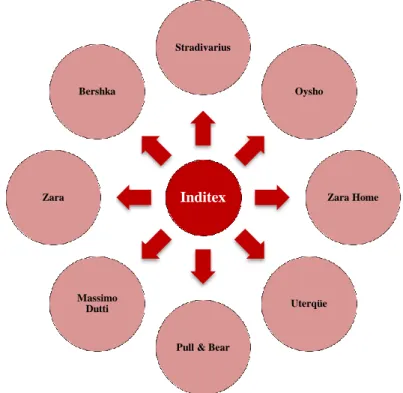
Today, despite the crisis, the group continues to grow, opening new stores that should take Inditex to 6.000 in 85 nations, working eight different formats, from lingerie to home-ware going through several clothing concepts; each of them has a defined offer and operates independently from the others.
Figure 1 - Inditex commercial formats in 2011 Inditex
Stradivarius
Oysho
Zara Home
Uterqüe
Pull & Bear Massimo
Dutti Zara
Bershka
4.2 Inditex nowadays
The group headquarters remains in La Coruña, Spain, the city where the Group first began doing business. Its stores can now be found in prime locations in more than 400 cities on five continents. Inditex has now more than 100 companies operating in textile design, manufacturing and distribution.
During 2011 the group was able to consolidate Inditex strategy of global expansion, by opening 200 new stores in Europe and 165 in Asia. At the moment (2011) Inditex has commercial activities in all five continents, and is increasing the commitment with the electronic retail business.
Europe and Asia remain the main focus of the group for expansion. By the end of 2011 they represented 45% and 18% of the company sales, respectively.
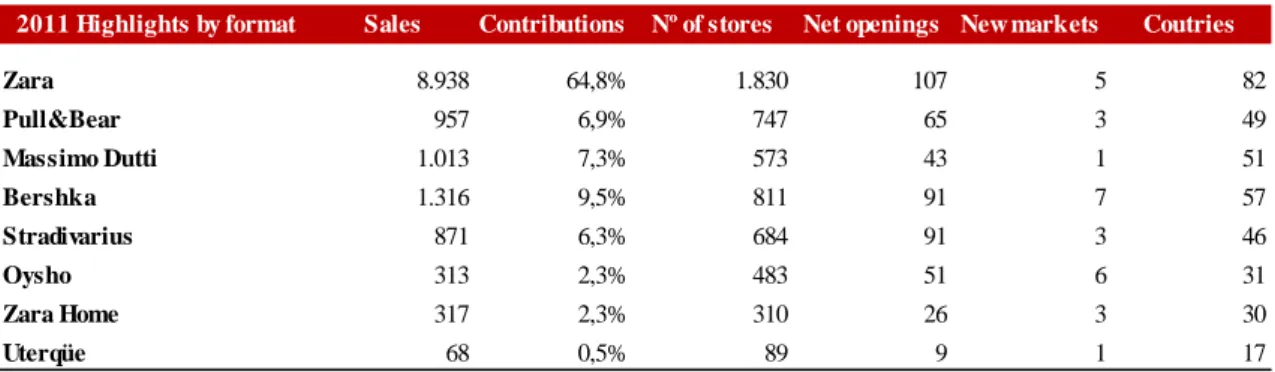
According to the last annual report Inditex net sales reached €13.793 million, being Zara the main contributor, with around 65% of the total sales.
Table 1 - 2011 Highlights
During 2011 Inditex created 9.374 new jobs, bringing its workforce to 109.512 employees. Also this year Inditex opened 483 stores in 49 markets, bringing the Group's total number of stores to 5.527 and expanding its footprint in all geographic areas.
Table 2 - Inditex general information
Chart 4 - Sales and EBITDA breakdown Chart 5 - EBIT breakdown per concept 2011 Highlights by format Sales Contributions Nº of stores Net openings New markets Coutries
Zara 8.938 64,8% 1.830 107 5 82 Pull&Bear 957 6,9% 747 65 3 49 Massimo Dutti 1.013 7,3% 573 43 1 51 Bershka 1.316 9,5% 811 91 7 57 Stradivarius 871 6,3% 684 91 3 46 Oysho 313 2,3% 483 51 6 31 Zara Home 317 2,3% 310 26 3 30 Uterqüe 68 0,5% 89 9 1 17
Source: Inditex annual report
General information 2007 2008 2009 2010 2011
Number of stores 3.691 4.264 4.607 5.044 5.527
Net openings 560 573 343 437 483
S quare meters 1.657.300 1.914.494 2.180.889 2.587.647 2.838.980
Nº of markets with commercial presence 68 73 74 77 82
Number of employees 79.517 89.112 92.301 100.138 109.512
The gross profit of Inditex rose to €8.180 million, reaching a gross margin of 59,3% at financial year (FY) 2011 a growth of 11%. FY 2011 EBITDA was €3.258 million, and EBIT €2.522 million both with a growth of 10% from last year. EBITDA margin reached 24% of sales.
In the FY 2011 the Group’s net income totaled €1.9 billion, an increase of 12% from the previous year. During the press release it was announced that “The Board of Directors will submit a proposal to the Annual General Meeting of Shareholders for 12,5% increase in the company’s dividend, to a total of €1,80 euros per share”.
4.3 Market share evolution
Chart 6 - Share price evolution vs. Ibex 35
By May 2001 the Ortega family advanced with an Initial Public Offer (IPO) of 26% of the company with a price of €14,70 per share, the group was valuing €9.000 million. Ortega family reduced their shares to 70% being the remaining 4% held by the management and employees.
Even though the IPO did not bring cash into the company, with its strong financial structure and its constant increasing negative Working Capital, result of a self-sustainable model, Inditex was able to maintain its financing of capital expenditures and continued growing.
Inditex - Industria de Diseño Textil, S.A. is now a public company listed on the stock exchanges of Madrid, Barcelona, Bilbao and Valencia, and on the Automated Quotation System, since 23, May 2001 under the ISIN code: ES0148396015; incorporating, with its shares being traded by the end of 2011 at €63,28.
Inditex has the following shareholders structure:
Table 3 - Inditex Shareholders
4.4 Strategy
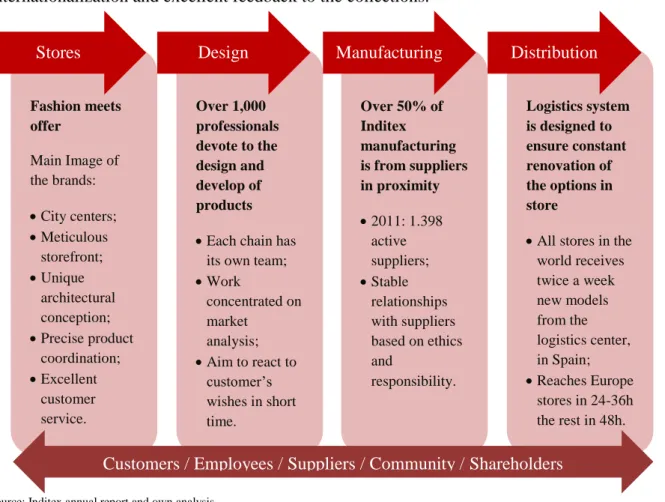
The unique business model, based on innovation and flexibility, made of Inditex a group with a unique success. Its approach to fashion is based on creativity, quality design and rapid turnaround by adjusting its performance, to everyday market demands, allowing a fast internationalization and excellent feedback to the collections.
Source: Inditex annual report and own analysis
Figure 2 - Inditex business plan
Logistics system is designed to ensure constant renovation of the options in store
All stores in the world receives twice a week new models from the logistics center, in Spain; Reaches Europe stores in 24-36h the rest in 48h. Over 50% of Inditex manufacturing is from suppliers in proximity 2011: 1.398 active suppliers; Stable relationships with suppliers based on ethics and responsibility. Over 1,000 professionals devote to the design and develop of products Each chain has
its own team; Work concentrated on market analysis; Aim to react to customer’s wishes in short time. Fashion meets offer Main Image of the brands: City centers; Meticulous storefront; Unique architectural conception; Precise product coordination; Excellent customer service. Manufacturing Distribution Design Stores
According to Inditex press release, nowadays, the Group strategy is related with Emblematic locations by siting stores in prime shopping areas, often in well-known buildings. During 2011 there were several openings, including new Zara stores on the most popular shopping streets in Sydney and Melbourne and in Taiwan's capital.
Bershka landed in Japan with a four-store establishment in the Shibuya district. It also opened in expensive locations in Lausanne and Istanbul. Meanwhile, Bershka in downtown Berlin revealed its most sophisticated eco-efficient store.
Inditex also controls sales by product per store and every store can offer different products trying to reach consumers desires and therefore avoiding inventory risk. Along with the product management per store Inditex also limits its production not allowing restocks of a best seller. As a result store managers have to work in order to define why a product was a best seller so that this reason can also assist the creation of other products.
In Inditex there is a very close relation between product teams, merchandisers and stores staff since the designers create in reaction to customers’ behavior. Regarding this the season collection begins with a small number of products allowing to understand trends, and be the trigger for the creation of the remaining collection.
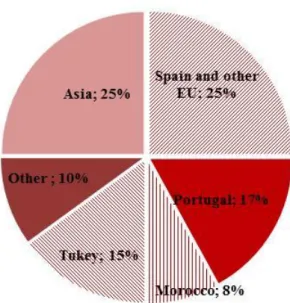
Inditex strategy is to source half of its products from Spain, Portugal and north Morocco, costing more but creating a proximity sourcing, shortening its supply chain, by contrast the majority of apparel retailers source most of their products from Asia. Additionally factory wages in Europe are much higher than in Asia making products more expensive to source, being the bought-in margins lower than the ones achieved when sourcing in Asia.
However, Inditex can quickly react to new trends and is able to beat tomorrow's new look, since their concepts (mainly Zara) can wait to see what customers are buying and produce only those products selling at full prices, while others get stuck with unwanted stock.
Chart 7- Location of Inditex suppliers in 2011
Inditex products distribution to stores is ensured by its own distribution network (using third-party logistic suppliers) their distribution centers are located in Spain, employing over 4.000 people in logistic platforms with more than 1.2 million square meters. All Inditex stores around the world are supplied by this distribution centers.
Table 4 - Location of the logistics platforms
Logistics platforms Location Concept served Space ( 000 Sqm)
Arteixo Zara 500
Naron Pull & Bear 52
Leon Onzonilla Zara 40
Madrid M eco Zara / Zara Home / Uterque 160
Tordera M assimo Dutti / Oysho / Uterque 175
Palafolls Bershka 65
Sallent de Llobregat Stradivarius 75
Zaragosa Zaragosa Zara 175
Elche Elche All chains (footware) 45
Source: Morgan Stanley Research - Inditex
Galicia
As explained the highly differentiated Inditex business model results of the staff involvement in the entire value chain, going from design to production through merchandising to retail stores.
5. VALUATION
Taking in consideration the main types of valuation already referred in my literature review, I performe Inditex valuation based on the following discounted cash flow financial models: WACC (Weighted Average Cost of Capital), APV (Adjusted Present Value) and FTE (Flow to Equity).
For a more detailed analysis, Inditex valuation should be performed considering an assessment by segment and geographical region (mainly Spain, Rest of Europe, Asia and America) to better evidence the different kind of Cash-flows and their impact in the company value. However considering the available public information it was not possible to obtain more detailed (P&L, Balance sheet or Cash flow statements) financial information since only detailed consolidated accounts and reports were available.
Since Inditex is an unlevered company (100% of equity) I decided to support my valuation considering a still conservative target rate of 10% of debt in the company structure in order to create a richer valuation as well as allowing a Corporate Tax impact analysis. For this I performed a Synthetic Rating Estimation from which Inditex resulted in an AAA rating company.
For the relative valuation I defined a peer group per region and used the EV/EBITDA and P/E multiples.
5.1 Macro-economic assumptions
In this section the most relevant macro-economic assumptions for the valuation analysis of Inditex were identified.
Regarding Inditex strategy of global expansion the Gross Domestic Product (GDP) and Inflation rate were weighted considering the company expansion by region. The sales percentage of each of the global regions in which Inditex operates were for 2011: 70% in Europe, 18% in Asia and 12% in America and the main counties were Spain, China and Brazil, respectively.
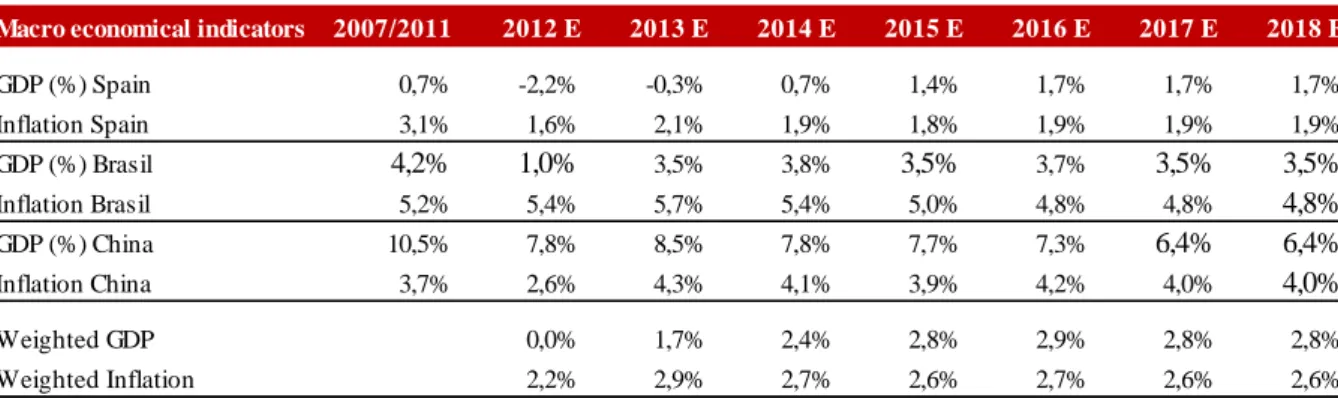
Considering this, the weighted GDP and Inflation were based on the percentages of the sales per region and the GDP and Inflation of the respective countries:
Table 5 - Macroeconomic indicators
Macro economical indicators 2007/2011 2012 E 2013 E 2014 E 2015 E 2016 E 2017 E 2018 E
GDP (%) Spain 0,7% -2,2% -0,3% 0,7% 1,4% 1,7% 1,7% 1,7% Inflation Spain 3,1% 1,6% 2,1% 1,9% 1,8% 1,9% 1,9% 1,9% GDP (%) Brasil 4,2% 1,0% 3,5% 3,8% 3,5% 3,7% 3,5% 3,5% Inflation Brasil 5,2% 5,4% 5,7% 5,4% 5,0% 4,8% 4,8% 4,8% GDP (%) China 10,5% 7,8% 8,5% 7,8% 7,7% 7,3% 6,4% 6,4% Inflation China 3,7% 2,6% 4,3% 4,1% 3,9% 4,2% 4,0% 4,0% Weighted GDP 0,0% 1,7% 2,4% 2,8% 2,9% 2,8% 2,8% Weighted Inflation 2,2% 2,9% 2,7% 2,6% 2,7% 2,6% 2,6%
5.2 Financial and operational analysis
Table 6 - Inditex main Key Performance Indicators
The previous table shows the key indicators of Inditex. In the last five years Inditex was able to have slight improvements in EBITDA and EBIT margins, with sales presenting an annual average growth rate around 10%. The net cash position had a continuous increase, in a practically debt free company, thus auto financing its capital expenditures needs through the years.
Table 7 - Inditex net debt
KPI's 2007 2008 2009 2010 2011
S ales (€M) 9.434 10.406 11.084 12.526 13.793
YoY Growth n.a. 10,3% 6,5% 13,0% 10,1%
EBITDA (€M) 2.148 2.186 2.375 2.966 3.258
Margin (% of sales) 22,8% 21,0% 21,4% 23,7% 23,6%
EBIT (€M) 1.652 1.608 1.729 2.290 2.522
Margin (% of sales) 17,5% 15,4% 15,6% 18,3% 18,3%
Net debt (€M) 1.052 1.219 2.380 3.427 3.465
Net debt / EBITDA 49,0% 55,8% 100,2% 115,5% 106,3%
Working Capital (€M) -542 -330 -698 -835 -713
Margin (% of sales) -5,7% -3,2% -6,3% -6,7% -5,2%
ROIC 52,1% 43,8% 55,0% 73,0% 63,3%
NOPLAT (€M) 1.652 1.608 1.729 2.290 2.522
Net financial position 2007 2008 2009 2010 2011
Cash & cash equivalents 1.466 1.466 2.420 3.433 3.467
Current financial debt 371 234 35 3 1
Non - current financial debt 42 13 5 4 2
Net debt 1.052 1.219 2.380 3.427 3.465
Inditex increasing ROICs are mainly due to the stated above profitability and strong financial structure, due to the continuous negative growth of the net debt and slow increase of its equity, in line with the ambitious dividend pay-out policy.
Table 8 - Inditex dividend pay ratio
5.3 Key drivers for projections
5.3.1 Stores expansion
The evolution of the total number of stores (company managed and franchising) per year (from 2012 to 2018) was based on the average calculation of the historical information (from 2007 to 2011). Inditex total number of stores per year shows that the company is more or less stable with year on year (YoY) growths from 6% to 10% with exception for 2008 that was a significant expansion year for Inditex.
Table 9 - Inditex stores per year
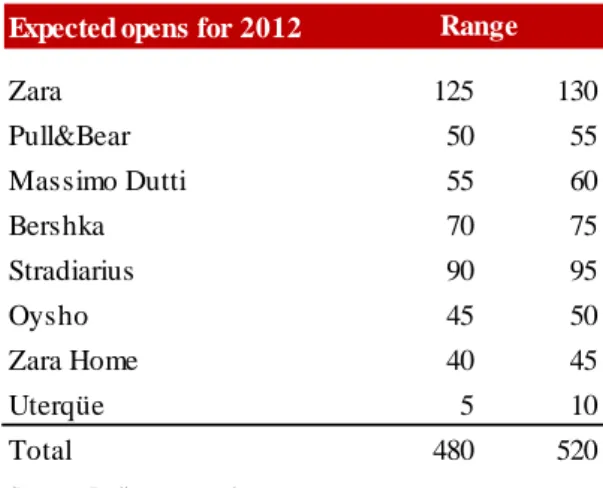
In the 2011 Inditex annual report, the company foresees for 2012 a range of net openings from 480 to 520, stating that the openings are mainly associated with Inditex strategy of global expansion.
Year 2007 2008 2009 2010 2011
Dividend pay-out ratio 42% 52% 50% 43% 52%
Stores per year 2007 2008 2009 2010 2011 2012E 2013E 2014E 2015E 2016E 2017E 2018E
Number of stores 3.691 4.264 4.607 5.044 5.527 6.006 6.485 6.965 7.444 7.923 8.402 8.642
YoY growth n.a. 16% 8% 9% 10% 9% 8% 7% 7% 6% 6% 3%
Net openings 560 573 343 437 483 479 479 479 479 479 479 240
Table 10 - Inditex expected opening for 2012
Inditex in accordance with the international expansion referred during the last press release that “Going into China is like beginning again in Europe for us”. During 2011 Inditex opened 179 new stores in Asia, 156 of them in China. Although, the expansion in China will not be as smooth as in Europe as China as specific tastes and behaviours according to their cultural difference. At the moment Zara has already Chinese designers to assess this question. During last year some difficulties where found when trying to enter into that market:
Zara's clothes were far pricier than local rivals and because of the distance from La
Coruña, Zara must charge more in absolute terms as well;
It has to convince Chinese shoppers that it is luxurious enough to justify the price tag;
Must watch the quality of its products since consumers already attacked Zara for poor
quality.4
A new business model may need to be considered to Asia if sales grow, considering both logistics and design in China in order to address the previous situations.
4Fashion Forward; The Economist, 24th March, 2012
Expected opens for 2012 Range
Zara 125 130 Pull&Bear 50 55 Massimo Dutti 55 60 Bershka 70 75 Stradiarius 90 95 Oysho 45 50 Zara Home 40 45 Uterqüe 5 10 Total 480 520
Considering the economic situation in the Euro zone I choose to estimate net openings based on an average calculation of the historical net openings (from 2007 to 2011) that resulted in the opening of 479 stores, resulting on a YoY growth between 6% to 10% of the total stores per year.
For the last year estimation I decided to stabilize the number of stores for half of the net openings average in the previous years, since is expected that the company will continue the opening of stores mainly in the emergent markets, but with a different YoY growth due to the cultural differences of the markets.
5.3.2 Sales
By the end of 2011 Inditex was operating in 82 countries reaching total revenues of €13.793 million, 30% obtained outside Europe.
To calculate the sales I started by analysing historical information and forecasted several inputs, as follows:
Table 11 - Sales forecast
I projected the number of stores per year as explained (consider point 5.3.1) by defining the net opening in each year, maintaining a sustainable YoY growth.
With the number of stores per year (including the net openings) I was able to define the square meters (sqm) per store for the historical data. With the average of sqm per store of the historical data and the net openings for 2012 (projected) I was able to calculate the new sqm
Sales estimation 2007 2008 2009 2010 2011 2012E 2013E 2014E 2015E 2016E 2017E 2018E
Number of stores 3.691 4.264 4.607 5.044 5.527 6.006 6.485 6.965 7.444 7.923 8.402 8.642
Net openings 560 573 343 437 483 479 479 479 479 479 479 240
Square meters 1.657.300 1.914.494 2.180.889 2.587.647 2.838.980 3.040.310 3.244.944 3.449.578 3.657.906 3.867.332 4.077.585 4.077.585 Square meters/stores 2.094 2.176 2.403 2.693 2.726 2.695 2.675 2.659 2.648 2.640 2.634 2.562 Sales per square meter (€M) 0,04 0,04 0,05 0,04 0,04 0,04 0,04 0,04 0,04 0,04 0,05 0,05 Sales (€M) 9.434 10.406 11.084 12.526 13.793 15.096 16.577 18.096 19.674 21.348 23.094 23.701
for 2012. By adding the total of sqm of the previous year I was able to calculate the total sqm for 2012, the same was performed for the rest of the projected years.
To calculate the sales for 2012 I used the sales per sqm of the previous year and with the total sqm of 2012 I reached the total sales for that year, considering also the 2,6% impact of inflation ( consider point 5.1). The same was performed for following years.
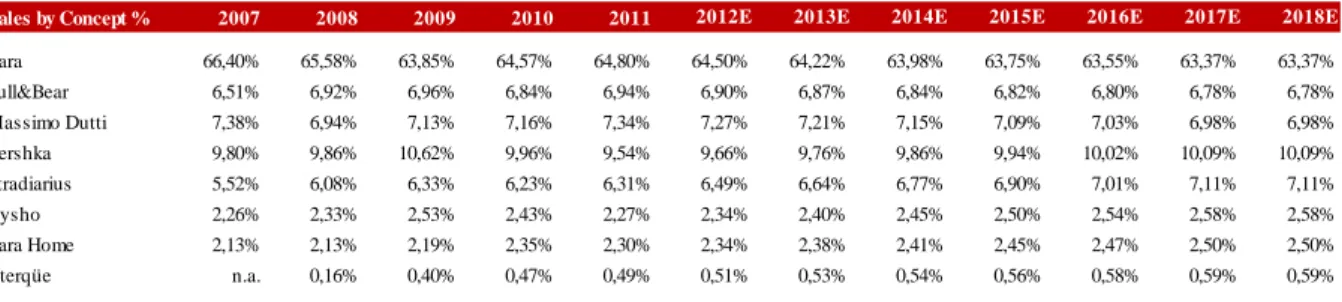
The total stores and net openings as well as all the calculations for the sales projections were performed by concept:
Table 12 - Forecasted sales by concept
Since the currency impact is very difficult to foresee and Inditex has the ability to charge different prices per location, I assumed that the impact of currency would have no expression on the sales projections.
Sales by Concept % 2007 2008 2009 2010 2011 2012E 2013E 2014E 2015E 2016E 2017E 2018E
Zara 66,40% 65,58% 63,85% 64,57% 64,80% 64,50% 64,22% 63,98% 63,75% 63,55% 63,37% 63,37% Pull&Bear 6,51% 6,92% 6,96% 6,84% 6,94% 6,90% 6,87% 6,84% 6,82% 6,80% 6,78% 6,78% Massimo Dutti 7,38% 6,94% 7,13% 7,16% 7,34% 7,27% 7,21% 7,15% 7,09% 7,03% 6,98% 6,98% Bershka 9,80% 9,86% 10,62% 9,96% 9,54% 9,66% 9,76% 9,86% 9,94% 10,02% 10,09% 10,09% Stradiarius 5,52% 6,08% 6,33% 6,23% 6,31% 6,49% 6,64% 6,77% 6,90% 7,01% 7,11% 7,11% Oysho 2,26% 2,33% 2,53% 2,43% 2,27% 2,34% 2,40% 2,45% 2,50% 2,54% 2,58% 2,58% Zara Home 2,13% 2,13% 2,19% 2,35% 2,30% 2,34% 2,38% 2,41% 2,45% 2,47% 2,50% 2,50% Uterqüe n.a. 0,16% 0,40% 0,47% 0,49% 0,51% 0,53% 0,54% 0,56% 0,58% 0,59% 0,59%
5.3.3 Cost of sales
It was estimated for the cost of sales that its evolution would be similar to the sales evolution, as follows:
Chart 8 - Forecasted sales vs. cost of sales
5.3.4 Operating costs
Regarding the operating costs the best proxy to calculate its growth is the space growth since Inditex main operating costs are staff and rent.
Personal Expenses were calculated and forecasted taking into consideration the historical number of employees per square meter for 2011 and an average cost per employee considering this, the number of employees increased in accordance with the number of square meters growth per year (based on the net openings) the total of personal cost was obtained by multiplying the total number of employees per year by the average cost, considering also the 2,6% impact of inflation (consider point 5.1).The same was performed for the following years.
The operating lease charges were estimated based on the historical percentage of sales that they represent in the previous years. Since the sales were already calculated by considering the sqm per year in accordance with the new openings, this is implicitly included.
The other operating expenses include expenses related with store operations, logistics, electricity, commissions on credit and debit card payments, travel, decoration, communications and all kinds of professional services, their evolution was considered in accordance with the sales evolution.
5.3.5 Working capital
Inditex presents a successive and increasingly negative working capital, once the available resources are significantly higher, comparing with the requirements. This is a consequence of the business model and is mainly related to Inditex supply chain and store management along with the short receivable periods.
The working capital is mainly composed in detail as follows:
Receivables: trade receivables, sales for franchising, receivables from public entities
and other current receivables;
Requirements: trade payables, payables to personnel, payables from public entities and
other current payables. Additionally an adjustment was performed in the cash and equivalents amount to consider an extra value for working capital in stores, the value was calculated in order to have an amount around €12.500 per store;
Inventories: Raw materials and consumables, working progress and finished goods for
sale.
The following evolution of the working capital is expected:
5.3.6 Investment in fixed assets: CAPEX
The Capital Expenditures (CAPEX) for Inditex are related to the company expansion and investment policy, as detailed:
Tangible assets: Land and buildings, machinery and furniture plant and equipment, leasehold improvements and other property. This is mainly related to new store and stores update including the logistics platforms, which are also set to receive facility expansions and upgrades, including pioneering textile industry technology.
Intangible assets: Rights over leased premises that include amounts paid in respect of lease transfer rights, access premiums or tenancy right waivers and indemnities in order to lease commercial premises.
Other intangible assets: include amounts paid for the registration and use of group brand names, industrial designs of items of clothing, footwear, accessories, household goods and external costs of software applications.
During 2011 the main additions were in land and buildings with the acquisition of premises in Milan’s Corso Vittorio Emanuele shopping district, which housed the flagship Zara store and additions in assets under construction including the investment for the acquisition of premises on Fifth Avenue in New York for a world flagship Zara store.
It is expected that the investment in CAPEX will be in line with the forecasted depreciations, and considering that in perpetuity they will be similar.
5.4 WACC valuation
Inditex is practically a debt free company, meaning that the WACC should be practically equal to the cost of equity (RE).
However, in my valuation, in order to perform a morecomplete analysis and in order to better
compare the valuation models chosen (WACC, APV, and FTE) it was considered that the company should contemplate a 10% of debt in the capital structure (Debt / Equity = 10%). Since Inditex has no debt in its capital structure, as well as all the main competitors in the apparel market (result of the business model) it was not possible to obtain a rating from a comparable company. Considering this, Inditex rating was calculated based on a synthetic rating estimation model created by Damodaran, using comparable ratings for large manufacturing companies.
Table 13 – Interest coverage ratio for large manufacturers Interest coverage ratio for large manufacturing firms is
> ≤ to Rating is Spread is -100000 0,199999 D 12,00% 0,2 0,649999 C 10,50% 0,65 0,799999 CC 9,50% 0,8 1,249999 CCC 8,75% 1,25 1,499999 B- 6,75% 1,5 1,749999 B 6,00% 1,75 1,999999 B+ 5,50% 2 2,2499999 BB 4,75% 2,25 2,49999 BB+ 3,75% 2,5 2,999999 BBB 2,50% 3 4,249999 A- 1,65% 4,25 5,499999 A 1,40% 5,5 6,499999 A+ 1,30% 6,5 8,499999 AA 1,15% 8,50 100000 AAA 0,65% Source: http://www.bondsonline.com
For the rating calculation the following information was considered (for a detailed calculation of the synthetic rating please consider appendix 8.10):
Table 14 - Synthetic rating calculation obtained from Damodaran model
After calculating the rating, for the WACC the following values were used:
( ) (13)
RF = Risk free rate - yield on the Germany´s 10 - year government bonds plus the
estimated default spread as showed in table 13.
Synthetic rating calculation
Operating leases Current year 2011 1.286,00 1 1.399,00 2 1.524,00 3 1.651,00 4 1.781,00 5 1.918,00 6 and beyond 2.061,00 Reported debt 2011 92,97 EBIT 2011 2.552,00 Interest expenses 2011 17,7
Long term government bond rates* 1,50%
Output
Interest coverage ratio 12,36
Estimated Bond Rating AAA
Estimated Default S pread 0,65% Estimated Cost of Debt ** 2,15%
Unit: values in €M
* Germany government-bonds - Bloomberg ** Long term government bond rates+ spread
β L = Beta Levered calculated throught the unlevered β of the Apparel industry considered by Damodaran.
RM RF - total risk premium - Country default spreads and risk premiums calculated by
Damodaran, although the Euro zone is under a sovereign crisis, they should be outdated.
Table 15 - WACC calculation WACC
Risk free M T10 2,15%
Total risk premium 7,28%
Unlevered beta 1,22 Levered beta 1,31 Cost of equity 11,71% Risk Free M T10 2,15% Spread 0,65% Cost of debt 2,80%
Debt risk free of taxes 2,13%
D/E 10%
D/(D+E) 9%
Tax rate 24%
As previously mentioned in the literature review the value of the firm was obtained by discounting the free cash flows to the firm at the weighted average cost of capital (WACC) as follows (for detailed income statement, cash flow and balance sheet, please consider from appendix 8.2 to 8.7):
Table 16 - Valuation through WACC
Since Inditex is a mature company, with most of its sales coming from Europe (70%) Asia (18%) and Americas (12%) I assumed that from 2018 onwards the perpetuity will grow at the weighted Inflation rate of 2,6% from the three mentioned geographical areas, as previously mentioned (consider point 5.1). Additionally it was assumed an operational efficiency maintenance that would converge the CAPEX to the amortizations value.
The Enterprise Value (EV) obtained is the EV without the FCF0 (2011), if this cash flow was
included we would obtained an EV0 of €34.797 million, finding the same EV0 as the one
obtained in the APV and FTE valuation methods (please consider point 5.5 and 5.6).
After computing the Enterprise Value I made the necessary adjustments to obtain the Equity Value. For this an adjustment of €2.957 million, related to the net debt of the time “zero” was performed, reaching an Equity Value of €29.567 million. The Equity value obtained is the same as the one obtained for APV and FTE (please consider point 5.5 and 5.6), considering in
both that the Equity Value does not include the FCF0.
Valuation 2012E 2013E 2014E 2015E 2016E 2017E 2018E Perp.
€M
EBIT 2.759 3.029 3.305 3.593 3.897 4.215 4.326 4.440
(-) Taxes @ (662) (727) (793) (862) (935) (1.012) (1.038) (1.065)
Tax rate 24,0% 24,0% 24,0% 24,0% 24,0% 24,0% 24,0% 24,0%
NOPLAT 2.097 2.302 2.512 2.730 2.962 3.204 3.288 3.374
(+) Depreciation and Provision 805 884 965 1.049 1.139 1.232 1.264 1.297
Operating Cash Flow 2.902 3.186 3.477 3.780 4.101 4.435 4.552 4.671
(-) Inv. Working Capital 67 77 78 82 87 90 31 32
(-) Capex (946) (1.038) (1.134) (1.232) (1.337) (1.447) (1.264) (1.297)
Free Cash Flow 2.024 2.224 2.422 2.629 2.850 3.079 3.319 3.406
Enterprise value 2012 32.524 Present Value of Free Cash Flow 12.158
Perpetuity 20.367
EV / EBITDA '12 8,3 x
By the end of 2011 Inditex had 623.330.400 shares, considering the obtained Equity Value the share price of the valuation performed is €47,43. The value obtained is considerably lower than the Inditex market value by the end of 2011, which was €63,28. The significant variation may have several justifications: Inditex is a company without debt, and for the valuation performed was considered a debt capacity of 9%, the market value may include the FCF0 and the adjustments performed to the Enterprise Value may be different than the ones considered in my valuation, such as financial investments, deferred taxes, other current assets and liabilities and minority interests (please consider appendix 8.9).