Printed in Brazil - ©2007 Sociedade Brasileira de Química 0103 - 5053 $6.00+0.00
A
r
ti
c
le
*e-mail: [email protected]
Characterization of Woody Odorant Contributors in Copaiba Oil (
Copaifera multijuga
Hayne)
Beatriz M. P. Sant’Anna, Silvia Paredes Fontes, Angelo C. Pinto and Claudia M. Rezende*
Instituto de Química, Universidade Federal do Rio de Janeiro, Centro de Tecnologia, Bloco A, Cidade Universitária, Ilha do Fundão, 21945-970 Rio de Janeiro-RJ, Brazil
Copaifera multijuga Hayne é uma das espécies do gênero Copaifera da qual se extrai o óleo de copaíba. Além do uso como antiinflamatório e anti-séptico, o óleo de copaíba é utilizado na indústria de fragrâncias como fixador para perfumes, cosméticos e sabões. A fim de identificar as substâncias ativas no aroma do óleo de C. multijuga, CG-O-EM utilizando AEDA foi aplicada após a quantificação dos compostos por CG-DIC. Os resultados obtidos apontaram para
δ-cadineno (1,9%, FD 64), δ-cadinol (0,9%, FD 128), óxido de cariofileno (0,2%, FD 64), (Z )-α-santalol (0,2%, FD 128), α-cadinol (0,1%, FD 128) e τ-muurolol (0,1%, FD 128) como as substâncias de odor mais ativo no aroma deste óleo de copaíba. Quanto à contribuição aromática dos enanciômeros do δ-cadineno analisada por CG-EM-O-quiral, somente o enanciômero
(+)-δ-cadineno foi encontrado no óleo e apresentou aroma adocicado, verde e refrescante.
Copaifera multijuga Hayne is one of the Copaifera species from which copaiba oil is extracted. Employed in the composition of anti-inflammatory and antiseptic products used in phytotherapy, it is also used by the fragrance industry as a fixative in perfumes, cosmetics and in products such as soaps. To identify the active aroma compounds in C. multijuga oil bouquet,
GC-O-MS using AEDA (Aroma Extract Dilution Analysis) was used after the quantification of the components by GC-FID. The results obtained pointed to minor compounds such as δ-cadinene (1.9%, FD 64), δ-cadinol (0.9%, FD 128), (Z)-α-santalol (0.2%, FD 128) caryophyllene oxide (0.2%, FD 64), α-cadinol (0.1%, FD 128) and τ-muurolol (0.1%, FD 128) as the most intense compounds in the odor of the copaiba oil studied. Chiral GC-O-MS showed (+)-δ-cadinene as the only enantiomer present in the oil, with a sweet, green and refreshing aroma.
Keywords:Copaifera multijuga Hayne, copaiba oil, gas chromatography-olfatometry-mass
spectrometry, AEDA, quiral GC, sesquiterpene
Introduction
Copaifera multijuga Hayne is mainly found in the
Central and Oriental Amazon1 and is one of the most
common species for the extraction of copaiba oil.2 This
oil is usually a transparent liquid, whose color varies from yellow to brown and actually it is an oleoresin, due to its content of diterpenic acids and great amounts of
sesquiterpenes.3-5 Copaiba oil is well-known by its
pharmacological activities (i.e. antitumoral; anti-inflammatory and antiseptic) and is also used in cosmetics
and as varnish in paintings.1,6,7
According to the most recent silviculture data published by the Brazilian Institute of Geography and Statistics (IBGE), the search for this raw material has been growing. In 2001 the extraction of copaiba oil
corres-ponded to 414 ton, while from 1974 to 1979 the quantity
of the oil produced in Amazon was 200 ton/year.8,9
Different from Europe, Brazil doesn’t have a fragrance industry tradition. The Brazilian market has been increasing and, in 2004, the industry of cosmetics, toiletries and fragrance showed an increment of 36.1% in exports in comparison with the year before, and a sales
growth of US$ 4.5 billion.10 As a consequence, new
products are necessary to enhance this growing demand. The woody and fixative aroma of copaiba oil has raised the interest of the perfume industry, always in need of
innovative ingredients.10-13 However, because of its already
consolidated therapeutic effects, the composition of the copaiba oil odor has been neglected and despite its fragrant value, little information regarding its odorant potential is available in the literature.
concerning its aroma. The technique chosen to develop this research was AEDA (Aroma Extraction Dilution Analysis), a dilution technique of Olfatometry (GC-O)
based on consecutive dilutions of the original sample.14
According to this method, substances detected at the lowest dilutions are the aroma active ones and are known as impact aroma compounds. Each aroma compound is referred with a FD factor (or the last dilution at which the odor active compound is
detected).15-19 The analyses were supported by
GC-O-MS (Gas Chromatography-Olfatometry-Mass
Spectrometry)12,20 associated with standard co-injection
and olfatometric evaluations together with retention
indice calculations.21
Experimental
Copaiba oleoresin
Crude copaiba oleoresin was obtained as an exudate of Copaifera multijuga Hayne, directly collected from perforation of a tree trunk in Ducke Reserve, Central Amazon, in 2001. The copaiba oleoresin was kindly donated by the Instituto Nacional de Pesquisas da Amazônia (INPA).
For GC studies, 60 mg of the sample were diluted in 1 mL of hexane (Tédia, Brazil) and methylated with a diazomethane ethereal solution to convert the diterpenic acids into methyl esters, reducing their interaction with the stationary phase and, as a result, improving chromatographic resolution.
GC-MS
Qualitative analysis was performed in Agilent Technologies 6890N Network GC Systems (Avondale, PA, USA) and Agilent 5973 Network Mass Selective Detector (Avondale, PA, USA) with electron impact at 70 eV, equipped with a BP-5 fused silica capillary column
(25 m × 0.22 mm × 0.25 µm; SGE 25AQ2, Austin, USA).
The scan rate was 2.89 s-1, the transfer line and ionizing
source were both maintained at 280 °C. The initial oven temperature was held at 30 °C for 1 min, increased at
50 °C min-1 to 105 °C, then at 1.5 °C min-1 to 150 °C
and finally at 30 °C min-1 to 280 °C (10 min). The
injection port, in splitless mode for 1 min was at 270 °C and He was used as carrier gas with a flow rate of 1 mL
min-1. Linear temperature programming retention indices
were calculated using successive alkanes (from n-tridecane to n-hexadodecane) in the same above-mentioned analytical conditions. Compound
identi-fications were made by comparison with available reference standards, co-injection with marigold and basil
essential oils,22 the NIST MS Search Program (1.7, 2000),
mass fragmentation pattern and previously reported
retention indices.7,23-25
Quantification
For this purpose, GC analyses were carried out using a HP-5890 (Avondale, PA, USA) equipped with a flame ionization detector (FID) at 270 °C and a BP-5 fused silica
capillary column (25 m × 0.22 mm × 0.25 µm; SGE
25AQ2, Austin, USA). The same oven temperature program described in GC-MS analyses was employed. The injection port, in splitless mode for 1 min, was kept at
270 °C. H2 was used as carrier gas with a flow rate of 1
mL min-1.
n-Heptadecane (0.15 mg, Aldrich) and n-penta-decanoyl propanoate (1.5 mg, obtained by the reaction of n-pentadecanoyl chloride (Aldrich) with n-propanol in pyridine (Aldrich)) were used as internal standards, as two distinct regions, i.e., sesquiterpene hydrocarbons and diterpenic acids (as methyl esters) were observed. Both standards were added to 15 mg of copaiba oil in dichlorometane (spectroscopic grade, Tédia, Brazil) after methylation of the oil with diazomethane and the solution was adjusted to 5.0 mL with dichloromethane in a volumetric flask.
The method precision was studied by two replicate analyses of the copaiba oil (two different solutions of the same oil were injected into GC-FID for two consecutive times). The precision was expressed by relative standard deviation (R.S.D.). The peak areas of the compounds were used for calculation of their R.S.D. values.
GC-olfatometry
Analyses were carried out using the above-described GC equipment, coupled to a stainless steel sniffing port held at 180 °C. The oven temperature program and column conditions were also the same as mentioned for the quantification step. The GC effluent was split 1/10 between the FID and the sniffing port with a splitter tube. The mass spectrometer profile was compared with the olfatometry runs.
AEDA was performed by serial dilutions of the extract (1:1 v/v, dichloromethane spectroscopy grade) and sniffed twice by three assessors until no aroma could be perceived by any of the panelists. The results were expressed as a
flavor dilution factor (FD)= 2n-1, where n is the number
Sensory studies
Five assessors were trained on descriptive and comparative techniques with known woody and amber compounds, in order to familiarize the participants with
the woody attribute: ambroxide, (Z)-(β)-santalol,
nor-ambrenolide, trans-β-caryophyllene, cedrene, cedrol,
α-humulene, caryophyllene oxide and copaiba oils. None
of the panelists were specifically anosmic to woody/ amber odor. Three volunteers, chosen according to their sensitivity and availability, performed AEDA evaluations.
Statistical analysis
Statistical analysis regarding the performance of the panelists was based on testing the hypothesis of equality
of two proportions under independent sampling.26
Isolation of δ-cadinene from C. multijuga by GC trapping (micro fraction)
1 m of a 25m × 0.22 mm × 0.25 µm 5%
phenylmethyl-polysiloxane BP5 SGE (Austin, USA) fused silica
capillary column was immersed on a CO2/ethanol cold
trap and connected to the sniffing port. At the retention
time of δ-cadinene the capillary tube was connected to
the sniffing port and after four analyses, the contents of
that piece of column were washed with 1 mL CH2Cl2 into
a vial (this solution is referred to as a micro fraction).
Chiral GC analysis
A J&W Cyclodex B permethylated β-cyclodextrine
(Folsom, CA, USA) capillary column (30 m × 0.25 µm
film x 0.25 mm) was used to perform GC-O-MS in the aforementioned equipment. The GC-MS transfer line and the ionizing source were maintained at 210 °C. The oven program started from 50 °C (1 min), increased at 10 °C
min-1 to 100 °C, then at 1.0 °C min-1 to 160 °C and finally
at 30 °C min-1 to 210 °C, held for 20 min. Compound
identifications were made by comparison with a reference
standard of (-)-δ-cadinene,27 fragmentation pattern and
the NIST MS Search Program (1.7, 2000).
Reference standards
(Z)-(α)-Santalol, (Z)-(β)-santalol, cedrene, cedrol,
ambroxide and nor-ambrenolide were donated by International Flavors and Fragrances- IFF;
trans-β-caryophyllene, α-humulene, caryophyllene oxide,
copalic, ent-agathic, acetoxy-copalic and hydroxy-copalic
acids were isolated in previous work of the group28 and
(-)-δ-cadinene was kindly offered by Dr. Margaret
Essenberg (Biochemistry and Molecular Biology Department, Oklahoma State University).
Results and Discussion
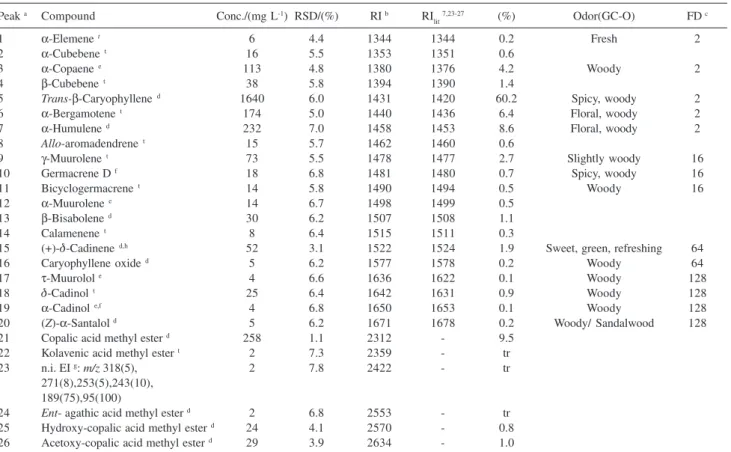
Among the twenty-six compounds pointed out in the studied copaiba oleoresin by GC-MS, ten were identified by co-injection of standards, five by the co-injection with well-known essential oils [marigold (Calendula officinalis) and basil (Ocimum basilicum)] and the others were tentatively identified by mass spectrometry associated with linear retention indices calculations (Table 1; Figures 1A and 1B). Most of them were represented by sesquiterpene skeletons in agreement with
previous reports on C. multijuga.6 Trans-β-caryophyllene
was the major compound, followed by α-humulene and
β-bergamotene. From the acidic diterpenes, present in
lesser amounts and identified by co-injection with
previously isolated standards,28 copalic acid was the most
abundant. The unknown compound 23 showed the same fragmentation pattern as the observed kolavenic acid methyl ester and possibly is a diastereoisomer of it, although no description of this isomer was found in literature. Different from other Copaifera species such
Figure 1. GC-MS of C. multijuga oleoresin. (A) Sesquiterpene region; (B) Diterpene region (*-attenuation changed from 24 to 21 to permit
visualization of minor compounds).
n-heptadecane
1
2
3
4
5 6 7
8
9
10
11
13
14
15
16
17
18
20
12
19
time / min
time / min
Relative
abundance
/
(%)
5 0
50 100
10 15
n-heptadecane Pentanodecanoyl
propanoate
21
24
22
24
25
26
22 23
*
20 25 30 35 40
Relative
abundance
/
(%)
0 50 100 A)
as C. cearensis, C. guianensis and C. duckei, C. multijuga presented a smaller amount of diterpenic acids, as
evidenced by its fluidity.6,11,28 The high content of
hydrocarbon and minor oxygenated sesquiterpenes -almost 90% of the total composition - justifies a deeper study regarding its potential as a raw material in fragrant formulations. This excess of sesquiterpenic substances
was also successfully explored by Lima and coworkers5
in the inhibition of the cellular growth in cancer. In order to better identify the compounds responsible for its aromatic performance, five volunteers were trained on descriptive and comparative olfative analyses with woody compounds and copaiba oils to make easier the recognition of this kind of odor independently of GC-O. After statistical analysis, the judges demonstrated a preliminary tendency to better recognize the copaiba oil among other substances. Since the sampling distribution agrees with the normal distribution, the statistic z is
applicable.25 The test based on the difference D between
the two proportions rejects the hypothesis of equality at the significance level of 95%, enough to characterize a greater sensitivity to copaiba oil odor. This improved
capacity was probably provided by the frequency of exposition and the complexity of the sample, i.e. the richest one.
To perform GC-O C.multijuga oil was methylated with an ethereal solution of diazomethane. In a comparative olfatometric evaluation, natural and methylated oils were considered similar. Three assessors were then selected to carry out AEDA, according to their proven ability in recognizing low thresholds and time availability to perform this second part of the investigation, since this
proceeding is very time-consuming.29 The methylated
sample was diluted 1:1 (v/v) with CH2Cl2 until no odor
was detected (9th dilution or 28) by GC-O. The screening
technique pointed to a small group of significant woody compounds in the most diluted solution where odor was
still perceived (27). The values of the FD-factors of each
odorant are described in Table 1, according to ca. 69% of the judgments. By GC-MS, retention index calculations and co-injection of marigold and basil essential oils these
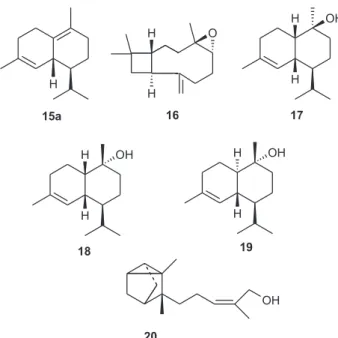
minor substances were suggested to be τ-muurolol (17,
0.1%), δ-cadinol (18, 0.9%), α-cadinol (19, 0.1%) and
(Z)-α-santalol (20, 0.2%), all with FD factors of 128
Table 1. Chemical composition and aroma profile of C. multijuga oleoresin
Peak a Compound Conc./(mg L-1) RSD/(%) RI b RI
lit
7,23-27 (%) Odor(GC-O) FD c
1 α-Elemene t 6 4.4 1344 1344 0.2 Fresh 2
2 α-Cubebene t 16 5.5 1353 1351 0.6
3 α-Copaene e 113 4.8 1380 1376 4.2 Woody 2
4 β-Cubebene t 38 5.8 1394 1390 1.4
5 Trans-β-Caryophyllene d 1640 6.0 1431 1420 60.2 Spicy, woody 2
6 α-Bergamotene t 174 5.0 1440 1436 6.4 Floral, woody 2
7 α-Humulene d 232 7.0 1458 1453 8.6 Floral, woody 2
8 Allo-aromadendrene t 15 5.7 1462 1460 0.6
9 γ-Muurolene t 73 5.5 1478 1477 2.7 Slightly woody 16
10 Germacrene D f 18 6.8 1481 1480 0.7 Spicy, woody 16
11 Bicyclogermacrene t 14 5.8 1490 1494 0.5 Woody 16
12 α-Muurolene e 14 6.7 1498 1499 0.5
13 β-Bisabolene d 30 6.2 1507 1508 1.1
14 Calamenene t 8 6.4 1515 1511 0.3
15 (+)-δ-Cadinene d,h 52 3.1 1522 1524 1.9 Sweet, green, refreshing 64
16 Caryophyllene oxide d 5 6.2 1577 1578 0.2 Woody 64
17 τ-Muurolol e 4 6.6 1636 1622 0.1 Woody 128
18 δ-Cadinol t 25 6.4 1642 1631 0.9 Woody 128
19 α-Cadinol e,f 4 6.8 1650 1653 0.1 Woody 128
20 (Z)-α-Santalol d 5 6.2 1671 1678 0.2 Woody/ Sandalwood 128
21 Copalic acid methyl ester d 258 1.1 2312 - 9.5
22 Kolavenic acid methyl ester t 2 7.3 2359 - tr
23 n.i. EI g: m/z 318(5), 2 7.8 2422 - tr
271(8),253(5),243(10), 189(75),95(100)
24 Ent- agathic acid methyl ester d 2 6.8 2553 - tr
25 Hydroxy-copalic acid methyl ester d 24 4.1 2570 - 0.8
26 Acetoxy-copalic acid methyl ester d 29 3.9 2634 - 1.0
tr = trace (less than 0.1%); lit- literature; a Peak number (see elution order in Figures 1); b Linear retention index on BP5; c Dilution factor (FD) = 2n-1, where
(Table 1; Figure 2). Despite their scarcity, it is important to remark that they play a significant role in the composition of the sample bouquet and confer an intense woody odor to the sample fragrance. In AEDA, they present a “block behavior”. They appear and disappear simultaneously and are the most persistent group of aromatic compounds. The other active compounds were:
δ-cadinene (15, 1.9%, FD 64), caryophyllene oxide (16,
0.2%, FD 64) and other contributors such as γ-muurolene,
germacrene D, bicyclogermacrene, α-elemene,
α-copaene, trans-β-caryophyllene, α-bergamotene and
α-humulene (FD factors and odor descriptions are
presented in Table 1). The presence of δ-cadinene (15),
caryophyllene oxide (16), (Z)-α-santalol (20),
trans-β-caryophyllene (5) and α-humulene (7) were confirmed
by co-injection of the standards. Concerning the sensory profile, the reference standards and the sample substances showed the same behavior when individually compared.
In order to investigate the chiral aspects of δ-cadinene
((+)-δ-cadinene-15a; (-)-δ-cadinene-15b), which has the
most peculiar aroma among the active compounds in the oil, it was trapped directly from C. multijuga oil by adapting a piece of capillary column immersed in a cold trap at the end of the sniffing port. After washing the tube with dichloromethane, this solution (microfraction) was submitted to chiral GC-MS and showed only one peak
compatible with δ-cadinene fragmentation at retention
time of 36.87 min. (-)-δ-Cadinene (15b), obtained by
acid-catalysed isomerization of α-copaene27 showed a retention
time corresponding to 35.56 min (RI 1558) and a similar olfactory description to the one detected in C. multijuga
oil. By the co-injection of copaiba oil micro fraction and
(-)-δ-cadinene (15b) standard, no evidence of this
enantiomer was observed in C. multijuga oil. The difference of 1.3 min in the retention times of two compounds, the identical mass spectra and the similar aroma were considered enough to suggest that
(+)-δ-cadinene (15a) is the only enantiomer present in
C.multijuga oil and has a sweet, green and refreshing aroma.
Acknowledgments
We thank the Natural Products Lab of the Chemistry Institute of the Universidade Federal do Rio de Janeiro, Dr. Margaret Essenberg, (Biochemistry and Molecular Biology Department, Oklahoma State University) and International Flavors and Fragrances – IFF, for providing the standard substances; Dr. Annibal Parracho Sant’Anna (Department of Industrial Engineering, School of Engineering, Universidade Federal Fluminense), for statistic support; CNPq, CAPES, FUJB and FAPERJ for financial support and all the volunteer students for collaborating during this project.
References
1. Ribeiro, J. E. L. S.; Hopkins, M. J. G.; Vicentini, A.; Sothers, C. A.; Costa, M. A. S.; Brito, J. M.; Martins, P. M.; Lohman, L. G.; Assunção, P. A. C. L.; Pereira, E. C.; Silva, C. F.; Mesquita, M.; Procópio, L. C.; Flora da Reserva Ducke: Guia de
Identificação das Plantas Vasculares de uma Floresta
Terra-Firme na Amazônia Central; INPA:Manaus, 1999, p. 395. 2. http://www.abihpec.org.br/english/conteudo/material/
apresenta_%202004_2005 .pdf, accessed in June, 2006. 3. Veiga Jr., V. F.; Pinto, A. C.; Quim. Nova2002, 25, 273. 4. Bruneton, J.; Eléments de Phytochemie et Pharmacognosie;
Lavoisier: Paris, 1987, p. 595.
5. Braga, W. F.; Rezende, C. M.; Antunes, O. A. C.; Pinto, A. C.;
Phytochemistry 1998, 49, 263; Cascon, V.; Gilbert, B.;
Phytochemistry2000, 55, 773; Lima, S. R. M.; Veiga Jr., V. F.; Christo, H. B.; Pinto, A. C.; Fernandes, D. P.; Phytother. Res. 2003,17, 1048.
6. Ferrari, M.; Monteiro, L. C. L.; Netz, D. J. A.; Rocha-Filho, P. A.; Cosmet. Toil.2003, 118, 61.
7. Backer, W.; Chimie et Industrie (Paris) 1922, 7, 542; Osete-Cortina, L.; Domenech-Carbo, M. T.; J. Chromatogr.2005,
1065, 265; Van der Werf, I. D.; Van den Berg, K. J.; Schmitt, S.; Boon, J. J.; Studies Conserv.2000, 45, 1.
8. http://www.ibge.gov.br/home/estatistica/economia/pevs/ tabela1apevs_2001.shtm, accessed in June, 2006.
9. Alencar, J. C.; Acta Amazonica1981, 11, 3. Figure 2. Chemical structures of the sesquiterpenes responsible for the
most relevant odors in C. multijuga oil, according to AEDA, as indicated in Table 1.
H
15a
H H
H
H OH
H OH H OH
H
H
O
OH 16
20
17
10. Turki, S.; Découverte2000, 281, 49.
11. Aschcar, R.; Brasilessência – A Cultura do Perfume; Nova Cultural: São Paulo, 2001, pp. 106,107.
12. Rossiter, K; Chem. Rev. 1996, 96, 3201. 13. Nunzio, M. J.; Aerosol e Cosméticos1985, 41, 9.
14. Ullrich, F.; Grosch, W.; Z. Lebensm. Unters. Forsch. 1987, 184, 277.
15. Kubickova, J.; Grosch, W.; Int. Dairy J. 1997, 7, 65. 16. Fraga, S. R. G.; Rezende, C. M.; J. Essent. Oil. Res. 2001, 13, 252. 17. Grosch, W.; Chem. Senses2001, 26, 533.
18. Miranda E. F. J.; Nogueira, R. I.; Pontes, S. M.; Rezende, C. M.; Flavour Fragr. J. 2001, 16, 281.
19. Ferreira, V.; Pet’ka, J.; Aznar, M.; J. Agric. Food Chem. 2002,
50, 1508.
20. Alves, R. J. V.; Pinto, A. C; Costa, A. V. M.; Rezende, M. C.; J. Braz. Chem. Soc. 2005, 16, 654.
21. Kováts, E.S.Z.; Helv. Chim. Acta1958, 41, 1915.
22. Chalchat, J. C.; Garry, R. P.; Michet, A.; Flavour Fragr. J.1991,
6, 189; Sartoratto, A.; Machado, A. L. M.; Delarmelina, C.; Figueira, G. M.; Duarte, M. C. T.; Rehder, V. L. G.; Braz. J.
Microb. 2004, 35,275.
23. Adams, R.; Identification of Essential Oil Components by Gas Chromatography / Mass Spectroscopy; Allured Publishing Corporation: Carol Stream, 1995.
24. Pino, J. A.; Marbot, R.; Vázquez, C.; J. Agric. Food Chem.
2001, 49, 5883; Salido, S.; Altarejos, J.; Nogueras, M.; Sánchez, A.; Pannecouque, C.; Witvrouw, M.; De Clercq, E.; J. Ethnopharmacol.2002, 81, 129.
25. Veiga, V. F.; Pinto, A. C.; de Lima, H. C.; J. Essent. Oil Res.
2006, 18, 430.
26. McLeave, J. T.; Benson, P. G.; Sincich, T.; Statistics for
Business and Economy; Prentice Hall: New Jersey, 2001, p. 424.
27. Davis, G.; Essenberg, M.; Phytochemistry1995, 39, 553. 28. Pinto, A. C.; Braga, W. F.; Rezende, C. M.; Garrido, F. M. S.;
Veiga Jr, V. F.; Bergter, L.; Patitucci, M. L.; Antunes, A. O. C.;
J. Braz. Chem. Soc. 2000, 11, 355.
29. Van Ruth, S. M.; Biomol. Eng.2001, 17, 121.
Received: August 16, 2006