An Alternative Route for the Synthesis of
(E)-(+)-5(S)-Methylhept-2-en-4-one (Filbertone)
Paulo H.G. Zarbina, Massami Yonashirob,*, and Waldir Perissini Jr.b
a
Departamento de Química, Universidade Federal do Paraná, Centro Politécnico,
Jardim das Américas, 81539-990 Curitiba - PR, Brazil; b
Departamento de Química, Universidade Federal de São Carlos,
Rod. WashingtonLuiz Km 235, C.P. 676, 13565-905 São Carlos - SP, Brazil
Received: August 13, 1997
Foi estudada uma metodologia alternativa para a obtenção da (+)-Filbertone (1), um aromati-zante natural isolado de avelãs. Utilizou-se o álcool comercial (-)-2(S)-metilbutan-1-ol (2) como material de partida, sendo a síntese realizada em quatro etapas com rendimento global de 42%. A rotação óptica e pureza enantiomérica do produto final foram determinados.
We are reporting an alternative methodology to prepare (+)-Filbertone (1), a natural flavor isolated from hazelnut extracts. Commercially available (-)-2(S)-methylbutan-1-ol (2) was used as starting material and the synthesis was carried out in four steps with an overall yield of 42%. The optical rotation and the enantiomeric purity of the final compound were determined.
Keywords:pyridinium chlorocromate, Filbertone, double bond isomerization
Introduction
The (E)-(+)-5(S)-methylhept-2-en-4-one, (+)-Filber-tone (1), was isolated from hazelnut extracts of a Turkish variety in 1989 by Schurig and co-workers1. They also carried out the first chiral synthesis of this compound in 20% overall yield, establishing the relationship between chirality and olfaction. The enantiomeric composition and assignment of the absolute configuration was made1. Ac-cording to Schurig, the natural product (1) exhibits low enantiomeric excess, varying with the origin of hazelnut (54.4-62.6% ee). Compound (1) is included as GRAS (Generally Recognized As Safe) substances and its FAME (Flavor and Extract Manufacturer’s Association) number is 3761 as 5-methyl-2-hepten-4-one2.
In this work, we are describing a new methodology to prepare Filbertone (1) (Scheme 1), using an easy experi-mental procedure with four steps and overall yield of 42%.
Results and Discussion
Commercially available (-)-2(S)-Methylbutan-1-ol (2) (Aldrich) was oxidized with PCC in methylene chloride3 to the known 2(S)-methylbutanal (3)4 in 73% yield. The
freshly purified aldehyde (3) was coupled with allyl bro-mide using Shono’s reaction conditions5 to provide the diastereoisomeric mixture of alcohols (4) in 85% yield. The mixture of (4) was oxidized with PCC in CH2Cl2 at 0 °C3 to afford the β,γ unsaturated ketone (5) in 71% yield.
The α,β-unsaturated ketone (1) was obtained in 95% yield by isomerization of the double bond of ketone (5) using p-TsOH in CH2Cl2. The 1H-NMR analysis of ketone Article
J. Braz. Chem. Soc., Vol. 9, No. 6, 583-585, 1998. © 1998 Soc. Bras. Química
Printed in Brazil. 0103 -- 5053 $6.00 + 0.00
0°C, 3 h, 73%
(4) (3)
(2)
OH
Zn/DMF, 30 min rt, 85%
Br H
O
PCC, CH2Cl2 OH
0 °C, 3 h, 71%
(1) (5)
O
rt, 12 h, 95% pTSA, CH2Cl2 O
PCC, CH2Cl2
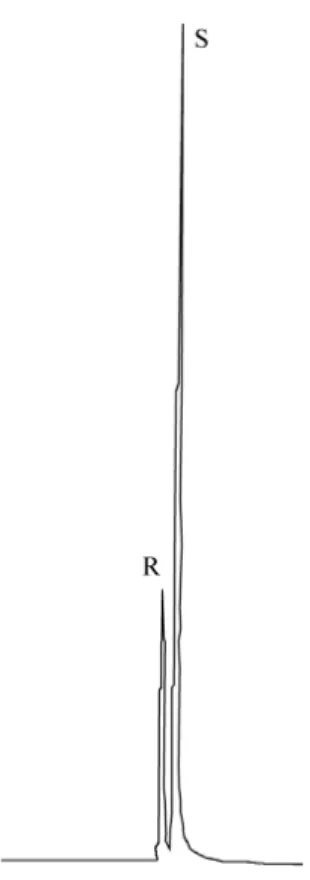
(1), showed a coupling constant (J = 16.2 Hz) for the vinylic protons. The enantiomeric purity of Filbertone (1) was determined by GC chiral column (75% ee of (E)-(+)-5S -methylhept-2-en-4-one) (Fig. 1) and the optical rotation in ethyl acetate solution shows a value of [α]D23 +12.5°. We believe that the partial isomerization of the stereocenter was occurred during the double bond conjugation step.
Experimental
All boiling points are uncorrected. The IR spectra refer to films and were measured on a Bomem M-102 spectrome-ter. The 1H-NMR spectras were recorded with TMS as an internal standard at 60 MHz on a Hitachi Perkin-Elmer R-24A spectrometer and at 80 MHz on a Varian FT-80A spectrometer. The 13C-NMR spectra was recorded with TMS as an internal standard at 20 MHz on a Varian FT-80A spectrometer. Optical rotation was measured on a Perkin-Elmer 241 polarimeter. Chiral separation was obtained by GC on a cyclodextrin-based capillary column, CD-5 (10 m x 0.25 mm x 028 µm; Laboratório de Cromatografia USP/IFQSC/DQFM) using a HP 5890 series II gas chro-matograph (equipped with FID) with H2 as carrier (37.8 cm/s), operating at 40 °C. Column chromatography was carried out on columns packed with Merck Kieselgel 60, Art.-Nr. 7734.
2(S)-methylbutanal (3)
Alcohol (2) (0.82 g, 9.30 mmol) was added to a suspen-sion of PCC (4.0 g, 18.60 mmol) in dry CH2Cl2 (20 mL) at 0 °C. After 3 h, dry ether (10 mL) was added and the mixture of ether and methylene chloride was filtered through Celite, silica gel and charcoal. The solvent was removed by destillation and the residue obtained was quickly purified in a short chromatography column (hexane : ethyl acetate, 9:1) to afford the aldehyde (3) in 73% yield (0.58 g). IR (ϖmax, film cm-1): 2963, 1713, 1461, 1230, 948. 1H-NMR (60 MHz, CDCl
3): δ 0.85 (d, J = 6 Hz, 3H); 1.0 (t, J = 6 Hz, 3H); 1.20-1.80 (m, 2H); 1.80-2.40 (m, 1H); 9.5 (br s, 1H).
5(S)-Methylhept-1-en-4(R/S)-ol (4)
A solution of aldehyde (4) (1.30 g; 15,11 mmol) and allyl bromide (2.15 g, 22.20 mmol) in DMF (15 mL) was stirred at room temperature for 5 min. Zinc powder (1.50 g, 23.10 mmol) was added to the solution and a very strong exothermic reaction started after 10 min and finished in 30 min. A solution of saturated NH4Cl was added (100 mL) and the reaction miture was extracted with ether, dried (Na2SO4) and concentrated. The crude product was chro-matographed over silica gel (hexane:ethyl acetate, 8:2) and the homoallylic alcohol (4) was obtained in 85% yield (1.60 g). IR (νmax, film cm-1): 3409, 3074, 2961, 1642. 1H-NMR (80 MHz, CDCl3): δ 0.70-0.80 (m, 6H); 1.10-1.70 (m, 3H); 1.85 (br s, 1H); 2.10-2.25 (m, 2H); 3.25-3.60 (m, 1H); 5.00 (dd, J1 = 15 Hz, J2 = 5 Hz, 2H); 5.50-6.10 (m, 1H). 13C-NMR (20 MHz, CDCl
3): δ (11.2, 11.4); (13.1, 14.4); (21.5, 25.6); (38.0, 38.9); (39.4, 39.7); (73.5, 74.1); (117.0, 117.2); 135.1.
5(S)-Methylhept-1-en-4-one (5)
The mixture of homoallylic alcohols (4) (2.0 g, 15.60 mmol) was added to a suspension of PCC (6.7 g, 31.0 mmol) in dry CH2Cl2 (100 mL) at 0 °C. After 3 h, dry ether (40 mL) was added and the mixture of ether and CH2Cl2 was filtered thorough Celite, silica gel and charcoal. The solvent was removed by destillation and the residue ob-tained (1.40 g, 71% yield) was used in the next step without further purification. The ketone (5) was found to be highly volatile.
5(S)-Methylhept-2-en-4-one (1)
A solution of compound (5) (1.0 g, 7.9 mmol) and
p-TsOH (0.1 g) in dry methylene chloride (40 mL) was magnetically stirred over night at room temperature. A solution of saturated NaCl (20 mL) was added and the mixture was extract with CH2Cl2. The organic layer was dried (MgSO4) and concentrated in vacuo. The crude prod-uct obtained was purified in a Kugelrohroffen (55 °C, 2.2 mmHg) to afford Filbertone (1) (0.95 g) in 95% yield.
584 Zarbin et al. J. Braz. Chem. Soc.
[α]D23 + 12.5° (c 3.0, EtOAc) IR (νmax, film cm-1): 2950, 1675, 1631, 1450, 1200. 1H-NMR (80 MHz, CDCl
3): δ 0.75 (t, J = 7.5 Hz, 3H); 1.00 (d, J = 7.5 Hz, 3H); 1.25-1.75 (m, 2H); 1.80 (dd, J1 = 7.5 Hz, J2 = 2.5 Hz, 3H); 2.60 (sext, J = 7.25 Hz, 1H); 6.15 (dq, J1 = 16.2 Hz, J2 = 2.5 Hz, 1H); 6.75 (dq, J1 = 16.2 Hz; J2 = 7.5 Hz, 1H). 13C-NMR (20 MHz, CDCl3): δ 11.3; 15.8; 17.8; 26.0; 45.0; 130.4; 141.7; 203.2.
Acknowledgments
The authors are grateful to FAPESP for financial sup-port.
References
1. Jauch, J.; Schmalzing, D.; Schurig, V.; Emberger, R.; Hopp, R.; Kopsel, M.; Silberzahan, W.; Werkhoff, P.
Angew.Chem.Int.Ed.Engl. 1989, 28, 1022.
2. Burdock, G.A.; Wagner, B.M.; Smith, R.L.; Munro, I.C.; Newberne, P.M. In Food Technology 1990, 78. 3. Corey, E.J.; Suggs, J.W. Tetrahedron Lett. 1975,
2647.
4. Seebach, D.; Ehrig, V.; Teschner, M. JustusLiebigs Ann. Chem. 1976, 1357.
5. Shono, T.; Ishifune, M.; Kishimura, S. Chem. Lett. 1990, 449-452.
FAPESP helped in meeting the publication costs of this article