vol. 43, n. 2, abr./jun., 2007
Profile of susceptibility in vitro of Trichosporon asahii and Trichosporon
inkin strains against cyclic imides
Zélia Braz Vieira da Silva Pontes
1*, Edeltrudes de Oliveira Lima
1, Valdir Cechinel Filho
21Laboratório de Micologia, Departamento de Ciências Farmacêuticas, Centro de Ciências da Saúde,
Universidade Federal da Paraíba, 2 Núcleo de Investigação Químico-Farmacêutica, Departamento de Química,
Universidade do Vale do Itajaí
In vitro susceptibility testing of Trichosporon asahii (13 strains) and T. inkin (13 strains) against cyclic imides (succinimides, naphtalimides and maleimides) in concentrations of 200 to 6,25 μg/mL was performed according to the diffusion agar method. By the results obtained, the antifungal activity of the cyclic imides: 3,4-dichloro-N-phenyl-maleimide; 3,4-dichloro-N -phenyl-ethyl-maleimide and 3,4-dichloro-N-phenyl-propyl-maleimide (50 μg/ mL) over T. asahii and T. inkin was important and it may be helpful in showing perspectives in a search for new antimicotic products.
*Correspondence:
Z. B. V. S. Pontes Laboratório de Micologia Departamento de Ciências Farmacêuticas
Centro de Ciências da Saúde Universidade Federal da Paraíba 58059-900 - João Pessoa - PB, Brasil E-mail: [email protected]
Uniterms
• Antifungals • Trichosporon asahii • Trichosporon inkin • Cyclic imides
INTRODUCTION
A taxonomic revision proposed by Guého et al. (1992) showed that the genus Trichosporon consists of six human pathogenic species: T. asahii, T. inkin, T. mucoides, T. cutaneum, T. asteroides and T. ovoides. These species are causative agents of mucous-associated, systemic mycosis, and superficial infection, including white piedra (Guého et al., 1994; Therizol-Ferley et al., 1994; Pontes et al., 2002a, b, c; Jahagirdir et al., 2002).
In therapeutics, the amphotericin B is not consistently active over the Trichosporon species. The fluconazole seems to be more effective and the use of a combined therapy has been recommended due to the variable activity of the amphotericin B and also due to its nefrotoxic effects (Walsh et al., 1990; Anaissie et al., 1992). The great concern is about the synthetic compounds, specially those analogs or those which are originated from secondary metabolites isolated from plants.
Calixto et al. (1984) could isolate an alkaloid of
leaves from Phyllanthus sellowianus (Euphorbiaceae) and Tempesta et al. (1988) discovered the structure and named it phyllanthimide. It has been used as a model to the synthesis of analog compounds just like the cyclic imides. Some these compounds presented are biological active (Andricopulo et al., 1996; Correa et al., 1997; Cruz et al., 1996; Aquino et al. 2003). For the reasons showed above, some new alternatives to diagnose and treat infections caused by the Trichosporon species are necessary. The objective of this study was to evaluate the profile of susceptibility in vitro of T. asahii andT. inkinstrains against cyclic imides.
MATERIAL AND METHODS
Cyclic imides
two naphtalimides, three succinimides and five maleimides (Figure 1) were synthesized in the Núcleo de Investigação Químico-Farmacêutica (NIQFAR) from the Universidade do Vale do Itajaí, Santa Catarina – SC, Brazil (Cechinel Filho et al., 2003).
Each cyclic imide was diluted using dimethylsulfoxide (DMSO) (0,3 mL) and sterile distilled water (q.s.q. 3 mL). The final concentration of the solutions ranged from of 200 to 6,25 µg/mL (Cleeland; Squires, 1991; Dantas et al., 2000; Belém, 2002).
Microorganisms
A total of twenty six human pathogenic Trichosporon strains were used in the study: 13 strains of T. asahii and 13 of T. inkin. Reference isolates were T. asahii CBS 2479 and T. inkin CBS 5585 which were also quality control isolates. All other strains were obtained from clinical material (skin, nails, blood, and hair) from patients suffering from deep and superficial infections and from colonization.
The present protocol was evaluated and approved with no ethical restrictions by the Ethics Committee of the Centro de Ciências da Saúde from the Universidade Fede-ral da Paraíba (UFPB).
The mycological study was carried out at the Labo-ratório de Micologia of the Departamento de Ciências Far-macêuticas and the Trichosporon species were identified according to morphology analysis, followed by physiologic and biochemical profiles (Guého et al., 1992; Guého et al., 1998).
Inoculum
The inoculum was prepared by subculture each
isolate in Sabouraud dextrose agar® (ASD) (DIFCO,
Detroit, U.S.A) at 28-30° C for 48 hours before the experiment. The inoculum suspension was prepared by picking colonies and suspending them in saline sterile solution (0,85 %). The cell density of the suspension was adjusted to 2.5 x 10⁶ UFC/mL.
Microbiological assays
In vitro susceptibility testing of Trichosporon species against cyclic imides was performed according to the diffusion agar method (Bauer et al., 1966; Dantas et al., 2000; Belém, 2002). In sterile Petri plates (90 X 15 mm), as added 20 mL of ASD previously fused and cooled in 45 to 50 °C and to each strain 1 mL of the inoculum previously prepared. After homogenization and solidification, some cavities were made by using sterile glass cannulas (6 mm of diameter). Aliquots of 50 µL of the cyclic imides solutions and of ketoconazole (200 µg/mL) control drug (Jansen Pharmaceutica, Titutsvile, NJ, U.S.A) was dispensed into each cavity, followed by incubation at 28-30 °C for 48 h.
The criteria used for the definition of susceptibility to cyclic imides was the presence of an inhibition zone with a diameter bigger or equal to 10 mm around the cavity.
The strains were considered resistant when this inhibition zone was less than 10 mm of diameter.
Inoculum was removed and subcultured 28-30 °C for 48 h to check viability and purity on SDA plates. Possible interference of DMSO over the growth of the strains were evaluated adding an aliquot (50 µL) of solvent. Absence of interference was considered when there was not any inhibition zone around the cavity. Each experiment was performed in triplicate, independently. The susceptibility was determined by an arithmetic mean from the inhibition zone halos obtained in the experiments.
RESULTS AND DISCUSSION
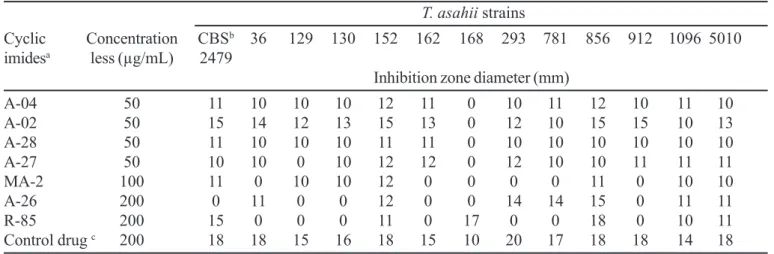
The profile of susceptibility of the T. asahii and T. inkin strains against ten cyclic imides in concentrations of 200 to 6,25 µg/mL were diversified. All the strains were resistant to two succinimides (MA - 01 and MA - 03) and to one naphtalimide (R - 82) in all concentrations tested with an inhibition zone halo inferior to 10 mm diameter. The susceptibility of the twenty six Trichosporon spp. strains against seven cyclic imides (five maleimides, one succinimide and one naphtalimide) was observed in concentrations of 200 at 25 µg/mL (Tables I and II).
Cyclic imides are organic compounds formed by the group CO-N(R)-CO- being R a hydrogen atom from the group alquila or arila. Maleimides, succinimides, naphtalimides, citraconimides and derivatives, are examples of cyclic imides subclasses (Cechinel Filho et al., 1995; Andricopulo et al., 1998; Corrêa et al., 1997). Lately, these compounds have called the attention of the scientific community mainly, due to their therapeutic potentialities as antispasmodics (Cechinel Filho et al., 1995), analgesics (Andricopulo et al., 1998; Corrêa et al., 1997), antibacterial (Cruz et al., 1996) and antifungal (Dantas et al., 2000; Belém, 2002; Aquino et al., 2003). The sensibility of the T. asahii and T. inkin strains against the cyclic imides groups, especially to maleimides, is an important event to notice.
Cechinel Filho et al. (1994) informed that in general, maleimides derivatives show an activity which is approximately 30 times higher than the succinimides against Escherichia coli and Staphylococcus aureus, suggesting that the double bond of the imido ring is a very important fact related to this activity.
dichloro-N-benzyl-maleimide and 3,4-dichloro-N-phenyl-propil-dichloro-N-benzyl-maleimide in a concentration of 100 µg/mL; with the exception of 3,4-dichloro-N-phenyl-ethyl-maleimide which did not inhibited the growth of new strains of C. albicans, two of C. guillermondii, one of C. krusei, three of C. parapsilosis, two of C. stellatoidea and two of C. tropicalis.
According to structure of the maleimides, the distance between the imido ring and the aromatic ring by the introduction of different substitute groups may be an important factor in relation to the activity of these
compounds against the researched species. Lima et al. (1999) suggested that the distance between the imido ring and the aromatic ring of the N-phenyl-alquil-3,4-dichloro-maleimide influenced the antifungal action, that is, it was more effective especially against Rhodotorula rubra and Cryptococcus neoformans in a concentration of 50 µg/mL. They also observed that the introduction of two chlorine atoms in the imido ring did not affect the antifungal activity. Cruz et al. (1996) also suggested that this was an important factor in the antibacterial activity of N-aryl-TABLE I – Profile of susceptibility in vitro T. asahii strains against cyclic imides
T. asahii strains
Cyclic Concentration CBSb 36 129 130 152 162 168 293 781 856 912 1096 5010
imidesa less (µg/mL) 2479
Inhibition zone diameter (mm)
A-04 50 11 10 10 10 12 11 0 10 11 12 10 11 10
A-02 50 15 14 12 13 15 13 0 12 10 15 15 10 13
A-28 50 11 10 10 10 11 11 0 10 10 10 10 10 10
A-27 50 10 10 0 10 12 12 0 12 10 10 11 11 11
MA-2 100 11 0 10 10 12 0 0 0 0 11 0 10 10
A-26 200 0 11 0 0 12 0 0 14 14 15 0 11 11
R-85 200 15 0 0 0 11 0 17 0 0 18 0 10 11
Control drug c 200 18 18 15 16 18 15 10 20 17 18 18 14 18
a A-04: 3,4-dichloro-N-benzyl-maleimide; A-02: 3,4-dichloro-N-phenyl-ethyl-maleimide; A-28: 3,4-dichloro-N-phenyl-maleimide;
A-27: 3,4-dichloro-N-phenyl-propyl-maleimide; MA-2: N-phenyl-2a,6a,-dichlorobicyclo-[2.2.1]-hepta-4-eno-[5,6-C]-succinimide; A-26: 3,4-dichloro-N-phenyl-butyl-maleimide; R-85: N-phenyl-naphtalimide. b CBS: Centraalbureau voor Schimmelcultures,
Baarn,
The Netherlands. c Control drug: Ketoconazole (200 µg/mL).
TABLE II – Profile of susceptibility in vitro T. inkin strains against cyclic imides
T. inkin strains
Cyclic Concentration CBSb 21 39 40 66 148 155 397 618 775 1001 1095 2726
imides a less (µg/mL) 5585
Inhibition zone diameter (mm)
A-4 25 13 14 13 13 11 13 10 12 0 0 0 10 11
A-2 50 12 10 12 11 10 11 12 17 12 11 10 10 10
A-28 50 13 12 12 12 11 12 10 14 10 11 10 10 10
A-27 50 12 12 12 14 12 13 13 14 10 10 10 10 10
MA-2 100 11 12 0 10 0 10 0 12 10 0 10 0 0
A-26 100 11 11 11 11 10 11 0 11 10 0 10 11 0
R-85 200 16 13 12 0 0 11 0 20 12 0 12 14 0
Controlle drug b 200 21 20 21 21 18 19 20 22 18 21 16 21 18
a A-04: 3,4-dichloro-N-benzyl-maleimide; A-02: 3,4-dichloro-N-phenyl-ethyl-maleimide; A-28: 3,4-dichloro-N-phenyl-maleimide;
A-27: 3,4-dichloro-N-phenyl-propyl-maleimide; MA-2: N-phenyl-2a,6a,-dichlorobicyclo-[2.2.1]-hepta-4-eno-[5,6-C]-succinimide; A-26: 3,4-dichloro-N-phenyl-butyl-maleimide; R-85: N-phenyl-naphtalimide. b CBS: Centraalbureau voor Schimmelcultures,
dichloromaleimide and N-aryl-naphtalimide against Salmonella typhimurium, E. coli and S. aureus.
Corrêa et al. (1998), searching about a possible mechanism of action of the cyclic imides, observed that they did not have any effect against Neurospora crassa, suggesting that they did not act by inhibiting a biosynthesis. Therefore, the cyclic imides tested by them were active against Trichophyton rubrum, T. mentagrophytes and Microsporum canis. Further studies about the mechanism of action of these cyclic imides will be very interesting to check if such compounds, for example, act at the level of the ergosterol biosynthesis.
The profile of susceptibility in vitro of the Trichosporon species studied against the succinimides and napthalimides derivatives decreased when compared to the maleimidics. The least concentrations of N-phenyl-2a,6a-dichlorobicyclo-[2.2.1]-hepto-4-eno-[5,6-C]-succinimide (MA -02) and N-phenyl-naphtalmide (R – 85) were of 100 and 200 µg/mL respectively. Belém (2002) observed that these two named compounds were also active but in lower concentrations respectively 50 and 100 µg/mL against 90% of the M. furfur strains. Dantas et al. (2000) observed that species of Candida were resistant to such compounds in concentrations of 6.25 and 200 µg/mL. This behavior may be possibly related to the lack of a double bond present in the imido ring, in the maleimides which produced the inhibition of growth of microorganisms (Cruz et al., 1996; Lima et al., 1999).
It was interesting to observe that the structure of the phyllanthimide, an active naturally occurring alkaloid which follows the recommendations of the folk medicine, was used as model to the synthesis of compounds, particularly to dichloro-N-phenyl-maleimide, phenyl-ethyl-maleimide and 3,4-dichloro-N-phenyl-propyl-maleimide that presented activity in a concentration of 50 µg/mL against the strains of T. asahii and T. inkin. The perspectives in the search for natural and/ or synthetic products which can be used in the production of antimicotics can be broadened.
RESUMO
Perfil de sensibilidade in vitro de cepas de
Trichosporon asahii e Trichosporon inkin frente a imidas cíclicas
O perfil de sensibilidade in vitro de Trichosporon asahii (13 cepas) e T. inkin (13 cepas) frente a imidas cíclicas (naftalimidas, succinimidas e maleimidas) nas concentra-ções de 6,25 a 200 µg/mL foi realizado pelo método de
difusão em agar. Pelos resultados obtidos, a atividade antifúngica das imidas cíclicas: dicloro-N-fenil-maleimida; dicloro-N-fenil-etil-maleimida e 3,4-dicloro-N-fenil-propil-maleimida (50 µg/mL) sobre T. asahii e T. inkin foi importante e pode abrir perspectivas na busca de novos produtos antimicóticos.
UNITERMOS: Antifúngicos. Trichosporon asahii. Trichosporon inkin.Ímidas cíclicas.
REFERENCES
ANAISSIE, E.; LOKS, A.; HACHEN, R.; RUBIN, R.; GRIFFEN, G.; ROBINSON, R.; SOBEL, J.; BODEY, G. Azoles therapy for trichosporonosis: clinical evolution of eight patients, experimental and therapy for murine infection and review. Clin. Infect. Dis., v.15, p.781-787, 1992.
ANDRICOPULO, A. D.; YUNES, R. A.; CECHINEL FILHO, V.; CORRÊA, R.; VILLAIN FILHO, A.; SANTOS, A. R. S.; NUNES, R. J. Synthesis and analgesic properties of cyclic imides: naphthalimide and bis-naphthalimide derivatives. Acta Farm. Bonaerense, v.17, p.219-224, 1998.
AQUINO, P. M. L. P.; LIMA, E. O.; FARIAS, M. P.; FREIRE, K. R. L.; SOUZA, E. L.; CECHNEL FILHO, V.; CORREA, R.; NUNES, R. J.; ANDRICOPULO, A. Atividade antifúngica de maleimidas contra dermatófitos isolados de tinea capitis. RBAC, v.35, n.4, p.91-194, 2003.
BAUER, A. W.; KIRBYWMM SHERRIS, J. C.; TURK, M. Antibiotic susceptibility testing by a standardized single disk method. Am. J. Clin. Pathol., v.36, p.493-496, 1966.
BELÉM, L. F. Estudo epidemiológico da pitiríase versicolor no estado da Paraíba e avaliação química e antifúngica de produtos naturais e sintéticos contra seu agente etiológico. João Pessoa, 2002. 178p. [Tese de Doutorado. Universidade Federal da Paraíba].
CECHINEL FILHO, V.; PINHEIRO, T.; NUNES, R. J.; YUNES, R. A.; CRUZ, A. B.; MORETTO, E. Antibacterial activity of phenylmaleimides, N-phenylsuccinimides and related compounds. Structure-activity relationships. Farmaco, v.49, p.675-677, 1994.
CECHINEL FILHO, V.; NUNES, R. J.; CALIXTO, J. B.; YUNES, R. A. Inhibition of Guinea-pig ileum contraction by phyllanthimide analogues: structure activity relationships. Pharm. Sci., v.1, p.399-401, 1995.
CECHINEL FILHO, V.; CAMPOS, F.; CÔRREA, R. Aspectos químicos e potencial terapêutico de imidas cíclicas: uma revisão da literatura. Quim. Nova, v.26, p.230-241, 2003.
CLEELAND, R.; SQUIRES, E. Evoluation of new antimicrobials “in vitro” and in experimental animal infections. In: LORIAN, V. M. D. (Ed.). Antibiotics in laboratory medicine. 3rd. ed. Baltimore: Williams & Wilkins, 1991. p.739-788.
CORRÊA, R.; CECHINEL FILHO, V.; ROSA, P. W.; SCHLEMPER, I. P. V.; NUNES, R. J. Synthesis of new succinimides and sulphonated derivatives with analgesic actions in mice. Pharm. Sci., v.3, p.67-71, 1997.
CORRÊA, R.; CAMPOS, F.; CECHINEL FILHO, V.; ANDRICOPULO, A. D.; NUNES, R. J.; YUNES, R. A.; RODRÍGUEZ, G.; LÓPEZ, S.; ZACHINO, S. Efeitos antifúngicos de imidas cíclicas - análise do mecanismo de ação. In: SIMPÓSIO PLANTAS MEDICINAIS DO BRASIL, 15, Águas de Lindóia-SP, 1998. Livro de resumos. São Paulo: Gráfica Laramara, 1998. 227p.
CREMLYN, R., NUNES, R. J. Reations of N-(p-chlorosulphonyl-phenyl) maleimida. Phosp. Sulf, v.31, p.245-254, 1987.
CRUZ, A. B.; CRUZ, R. C. B.; CECHINEL FILHO, V.; DEODÓSIO, J. R. A; NUNES, R. J.; YUNES, R. A. Avaliação dos efeitos antibacterianos de N-arildicloromaleimidas e N-arilftalimidas. Relação estrutura atividade. Rev. Latinoamer. Quím., v.25, p.10-13, 1996.
DANTAS, Z. M. R.; LIMA, E. O.; VASCONCELOS FILHO, P. A.; CECHINEL FILHO, V. Susceptibilidade in vitro de espécies de Candida a maleimidas, naftalimidas e succimidas. Rev. Bras. Farm., v.81, p.31-35, 2000.
GUÉHO, E.; SMITH, M. T. H.; DE HOOG, G. S.; BILLON-GRAND, G.; CHRISTEN, R.; BATENBURG-VAN DER VEGTE, W. H. Contributions to a revision of the genus Trichosporon. Ant. van Leeuw., v. 61, p.289-316, 1992.
GUÉHO, E.; IMPROVISI, L.; DE HOOG, G. S.; DUPONT, B. Trichosporon on humans: a pratical account. Mycoses, v.37, n.1/2, p.3-10, 1994.
GUÉHO, E.; SMITH, M. T. H.; DE HOOG, G. S. Trichosporon Behrend. In: KURTZMAN C. P., FELL, J. W. (Eds.). The yeast, a taxonomic study. 1rd ed. Amsterdam: Elsevier Science B. V., 1998. p.854-872
JAHAGIRDAR, B. N., MORRISON, V. A. Emerging fungal pathogens in patients with hematologic malignancies and marrow/stem-all transplant recipients. Semin. Respir. Infect., v.17, p.113-120, 2002.
LIMA, E. O.; QUEIROZ, E. F.; ANDRICOPULO, A.D.; NUNES, R. J.; YUNES, R. A.; CORRÊA, R.; CECHINEL FILHO, V. Evaluation of antifungal activity of N-aryl-maleimides and N-phenylalkyl-3,4-dichloro-maleimides. Bol. Soc. Chile Quim., v. 44, p.185-189, 1999.
PONTES, Z. B. V. S.; RAMOS, A. L.; LIMA, E. O.; GUERRA, M. F. L.; OLIVEIRA, N. M. C.; SANTOS, J. P. Clinical and mycological study of scalp white piedra in the state of Paraíba, Brazil. Mem. Inst. Oswaldo Cruz, v.97, p.747-750, 2002a.
PONTES, Z. B. V. S.; LIMA, E. O.; RAMOS, A. L.; FRADE, J. D. A. M. S.; OLIVEIRA, N. M. C. Espécies de Trichosporon Behrend: colonização anal e piedra branca gênito-púbica em pacientes HIV+. RBAC, v. 34,
p.173-175, 2002b.
PONTES, Z. B. V. S.; LIMA, E. O.; OLIVEIRA, N. M. C.; SANTOS, J. P.; RAMOS, A. L.; CARVALHO, M. F. F. P. Onychomicosis in João Pessoa city, Brazil. Rev. Argentina Microbiol., v.34, p.95-99, 2002c.
THÉRIZOL-FERLY, M.; KOMBILA, M.; GOMEZ DE DIAZ, M.; DOUCHET, C.; SALAUN, Y.; BARRABES, A.; DUONG, T. H.; RICHARD-LENOBLE, D. White piedra and Trichosporon species in equatorial Africa. II. Clinical and mycological associations: an analysis of 449 superficial inguinal specimens.Mycoses, v.37, p.255-260, 1994.
WALSH, T. J.; MELCHER, G. P.; RINALDI, M. G.; LECCIONES, J.; MCGOUGH, D. A.; KELLY, P.; LEE, J.; CALLENDER, D.; RUBIN, M.; PIZZO, P. A. Trichosporon beigelii an emerging pathogen resistant to amphotericin B. J. Clin. Microbiol., v. 28, p.1616-1622, 1990.