vol. 43, n. 2, abr./jun., 2007
Development and
in vitro
evaluation of extended-release
theophylline matrix capsules
Vanessa Alves Pinheiro, Telma Mary Kaneko, Maria Valéria Robles Velasco,
Vladi Olga Consiglieri*
Departamento de Farmácia, Faculdade de Ciências Farmacêuticas, Universidade de São Paulo
Polymers like cellulose (MethocelTM K100MPRCR, K15MPRCR
and E4MCR) at different proportions (15-35%) were used to slow the release of theophylline (100 mg) from capsules. Volumetric method for powder filling capsules was used to prepare the capsules. Drug release from capsules was performed using apparatus 1, at 100 rpm and 900 mL of intestinal medium without enzymes (pH 7.5), at 37 °C, following the USP 28th ed. (Test 8). Dissolution profiles were compared to two batches of commercial extended-release capsules. Capsules compounded with 35% (wt/
wt) of MethocelTM E4MCR showed dissolution profile according
to the official especifications. Similar results were reproduced with other ten compounded batches. Commercial extended-release capsules containing theophylline pellets (100 mg) showed quick drug release when submitted to the same test, indicating that, in these conditions, the capsules did not show prolonged release. Mathematical models like zero-order, first-order and Higuchi were applied in kinetic studies of theophylline release from the compounded capsules. Polymers were efficient to control the release of theophylline in capsules involving diffusion and erosion as mechanisms, and that first-order model was the best fitted one for theophylline matrix capsules. These results support that compounded extended-release capsules can be prepared, since the drug release tests can be done.
*Correspondence: V. O. Consiglieri Departamento de Farmácia Faculdade de Ciências Farmacêuticas Universidade de São Paulo Rua Lineu Prestes, 580, Bloco 13B 05508-900 - São Paulo - SP, Brazil E-mail: [email protected]
Uniterms • Theophylline • Capsules • Extended-release • Dissolution
INTRODUCTION
Compounded capsules have some advantages, like adjusting the dosage to the therapeutic patient needs, considering weight, therapeutic objective and side effects. When patients require specific individualized therapy, pharmacists are called upon by physicians to compound a
wide range of different products, including extended-release and slow-extended-release capsules (Bogner, Szwejkowski, Houston, 2001).
(Shargel, Yu, 1999).Extended-release dosage forms have been extensively carried out several decades ago. Production of tablets and capsules with microgranules has been described applying various materials as cellulose and methacrylic acid derivatives (McGinity, Fukuda, Peppas, 2006; Zheng, Sauer, McGinity, 2005; Lopes, Costa, Lobo, 2005; Fu et al., 2004; McGinity et al., 2004; Young, Koleng, McGinity, 2002; Siepmann et al., 2000; Ishikawa
et al., 2000)
Compounded, slow-release and extended-release capsules has been part of a group called matrix systems and the most common technique to obtain these matrices involves basically the simple mixture of the drug with an inert, hydrophobic or hydrophilic matrix that can be encapsulated (Ojantakanen et al., 1993).
There are few published researches with compounded matrix capsules. Webster, Al-AlChi, Greenwood (1999) studied dissolution profiles of slow-release capsules with morphine sulfate. These authors claimed that these capsules can be an adequate alternative for the administration of morphine sulfate, based on its release, similar to that of the commercial medications.
In another study with morphine sulfate, the authors got six slow-release capsules formulations with 300 mg dose, prolonging the release with HPMC K100M polymer (Bogner, Szwejkowski, Houston, 2001).
Hydrophilic matrix capsules were also studied with micronized hormones, like progesterone, HPMC E4M
Premium and excipients. They were mixed and compacted in gelatin hard capsules. It was concluded that the use of slow-release matrices prolonged the hormone absorption for many hours, allowing the patient to decrease the dose frequency. However, the authors reported the necessity of further pharmacokinetic studies, without which no affirmation could be made about the bioidentical hormones release profiles from slow-release capsules (Timmons, Timmons, 2002).
Theophylline is a good candidate to be encapsulated in slow-release capsules, since the treatment of obstructive chronic pulmonary disease and night crisis depend on keeping seric levels of the drug constant. This explains the existence of a large number of studies about modified release dosage forms with theophylline (Vendruscolo et al., 2005; Zheng, Sauer, McGinity, 2005; McGinity et al., 2005; Ojoe et al., 2005; Chambin et al., 2004; Young, Koleng, McGinity, 2002; Pather et al., 1998).
In spite of these works, there are no studies that prove the compounded extended-release capsules can reduce the drug release in accordance to the official requirements and also present inter-batch uniformity on the drug release profiles.
This research had the purpose of obtaining slow-release compounded capsules with theophylline 100 mg dose, using cellulose derivatives in different rates, studying the “in vitro” drug release. Results were compared to the theophylline release from brand medication (capsules with microgranules). Reproducibility of theophylline release from different batches of capsules was also studied.
MATERIAL AND METHODS
The following materials of pharmaceutical grade were used to compound matrix capsules: anhydrous theophylline 99.80% (supplied by Ariston), hydroxypropylmethylcellulose – MethocelTM
K100MPRCR, E4MCR and K15MPRCR (Dow ChemicalTM), lactose M200 (GalenaTM). Gastric fluid (pH
1.2) and intestinal fluid (pH 7.5) were prepared, according to United States Pharmacopeia, 28th ed. (2005), with Merck analytic grade reagents. Anhydrous theophylline 99.80% was used for analytical determinations. Colourless, number size 1 capsules (Cardinal HealthTM).
Commercial capsules with prolonged-release microgranules (same manufacturer).
Laboratory B1 (Brand Medication): capsules with 100 mg of prolonged-release theophylline microgranules, batch Z95429; fabrication: 06/2003; beyond-use date: 06/ 2006;
Laboratory B2 (Brand Medication): capsules with 100 mg of prolonged-release theophylline microgranules, batch Z100857; fabrication: 01/2004; beyond-use date: 12/ 2006;
Formulations
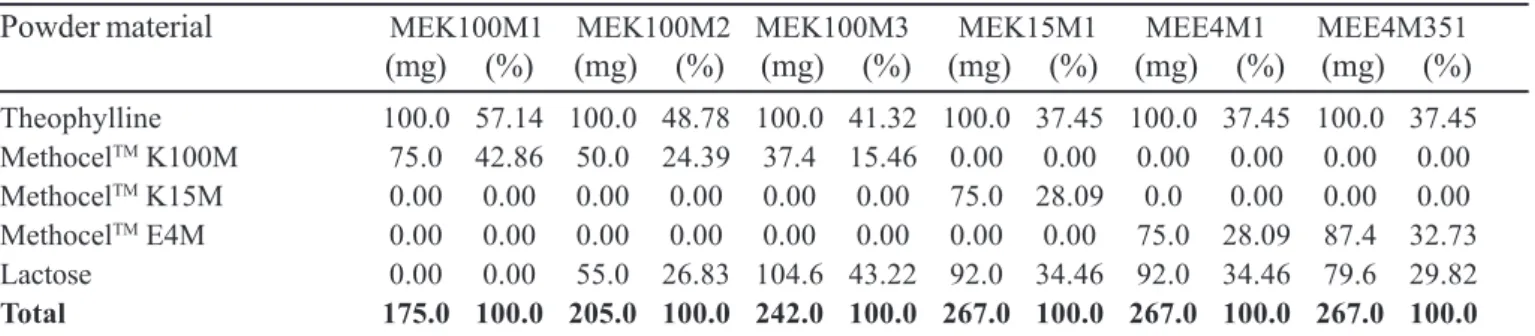
Six different slow-release formulations of capsules with 100 mg of theophylline were prepared, using volumetric method for powder filling capsules in a manu-al encapsulator (MultilaborTM) (Allen, 1999). The
composition of the compounded capsules is presented on the Table I.
The powders were carefully spread on the manual encapsulator until the content was completely inside the capsules, and were settled down by tapping the manual encapsulator 10 times. The caps were put over the capsules bodies and locked. Fifty capsules of each batch were prepared.
Weight variation
Twenty capsules of each formulation were individually weighted and average, standard deviation and variation coefficient were calculated. The results were compared to the specifications of USP 28th ed. (2005).
Assay
An in-house spectrophotometric validated method, in pH 7.5 phosphate buffer solution, at 271 nm, was used to quantify the theophylline in the capsules. Samples of powders, corresponding to 100 mg of theophylline were taken and transferred to a volumetric flask (100.0 mL). About 50 mL of ethylic alcohol were added and the volumetric flask was sonicated for 40 minutes. The volu-me was completed with ethylic alcohol. The solution was centrifugated for 20 minutes and aliquots of 1 mL were taken and diluted into a 100.0 mL volumetric flask with 7.5 pH simulated intestinal fluid.
Sample solutions were recorded in a Beckman Coulter, DU 640, spectrophotometer at 271 nm, in comparison with 10 µg/mL theophylline standard solution, in the same medium. The tests were performed in duplicate.
Drug release
The following test was performed according to American Pharmacopeia 28th ed., for Theophylline Extended-Release Capsules Test 8, using apparatus 1
(basket) with 100 rpm stirring and temperature of 37 °C ± 0.5 °C. A 7.5 pH simulated intestinal fluid (without enzyme) was used as medium (United States Pharmacopeia, 2005).
Aliquots of 10 mL were withdrawn in different times (15, 30, 45, 60, 90, 120, 180, 240, 300, 360, 420 and 480 minutes) from the beginning of the test and the medium was replaced with equal volume at the same temperature. The aliquots were then centrifuged, diluted and quantified by ultraviolet spectrophotometric analysis, using a Standard solution with a known concentration of theophylline in the same medium as reference.
Model dependent parameters
Three mathematics models were applied to interpret dissolution kinetic, in order to determine the process order: first-order model, zero-order model and Higuchi model (Abdou, Hanna, Muhammad, 2000; Ferraz, Consiglieri, Storpirtis, 1998; Shah, Noory, Noory, 1995)
Dissolution Efficiency
Dissolution efficiency (DE) was graphically calculated from dissolved drug percentage versus time curves (Khan, Rhodes, 1975). Variance analysis (ANOVA) was used to check the existence of significant differences between DE data.
Model independent parameters
Data from dissolution profiles of chosen batches and the brand medication (Laboratory B) were submitted to simple independent model employing a difference factor (f1) and a similarity factor (f2) to compare the dissolution profiles (Costa, 2001; Shah et al., 1998).
TABLE I - Composition of compounded extended-release capsules with 100 mg of theophylline and
hydroxypropylmethylcellulose (HPMC, MethocelTM K100MPRCR, K15MPRCR e E4MCR), using volumetric method
for powder filling capsules in batches of 50.
Powder material MEK100M1 MEK100M2 MEK100M3 MEK15M1 MEE4M1 MEE4M351
(mg) (%) (mg) (%) (mg) (%) (mg) (%) (mg) (%) (mg) (%)
Theophylline 100.0 57.14 100.0 48.78 100.0 41.32 100.0 37.45 100.0 37.45 100.0 37.45
MethocelTM K100M 75.0 42.86 50.0 24.39 37.4 15.46 0.00 0.00 0.00 0.00 0.00 0.00
MethocelTM K15M 0.00 0.00 0.00 0.00 0.00 0.00 75.0 28.09 0.0 0.00 0.00 0.00
MethocelTM E4M 0.00 0.00 0.00 0.00 0.00 0.00 0.00 0.00 75.0 28.09 87.4 32.73
Lactose 0.00 0.00 55.0 26.83 104.6 43.22 92.0 34.46 92.0 34.46 79.6 29.82
RESULTS AND DISCUSSION
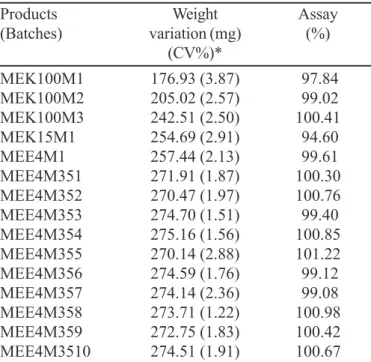
Official specifications establish that, for hard capsules up to 300.0 mg, the weight variation allowed is ± 10.0%, and it is not allowed more than two units out of the specification and none of them can be above or under the double of the indicated percentage. The results of weight variation presented in the Tables II and III showed that all the capsules complied with the Pharmacopeia specifications (United States Pharmacopeia, 2005).
The compounded capsules showed theophylline amount between 94.6% and 101.22%, and those from the commercial batches B1 and B2 showed 104.45%,
respectively, therefore in accordance with the official specifications (United States Pharmacopeia, 2005) (Tables II and III).
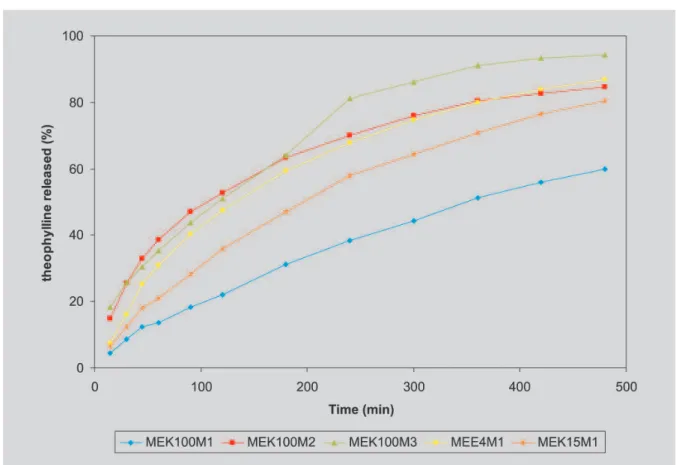
The three types of tested MethocelTM showed
decrease of theophylline release from the capsules (Figures 1 and 2).
According to the dissolution profiles results, the increase of HPMC content, as well as the use of higher viscosity polymers in the formulations, resulted in the decrease of theophylline dissolution rate in compounded capsules. The capsules from the formulation MEE4M351, with 35% (wt/wt) of MethocelTM E4MCR, presented
dissolved amount of theophylline in accordance with the specifications of American Pharmacopeia 28th ed, Test 8. From this formulation, ten batches were compounded to check the reproducibility of the process (Figure 2). All the batches showed dissolved quantities of theophylline in accordance with the specified limits (United States Pharmacopeia, 2005).
When the dissolution profiles of the ten batches of the formulation MEE4M351 and the brand medication (Laboratory B1) were compared through the independent model employing difference factor (f1) and similarity factor (f2), it was possible to verify that f1 values above 15 and f2 values under 50 were obtained. This means that the compounded formulations showed different dissolution profiles when compared to the studied commercial products (Table IV).
To analyze the variance among the average values of Dissolution Efficiency (DE) obtained from chosen developed batches (Figure 3),the Variance Analysis “ANOVA: Unique Factor” was used . This tool performed a simple variance analysis, in order to check if there was significant difference among the values of DE.
TABLE III - Results of weight variation and assay of
commercial capsules with 100 mg of prolonged-release theophylline microgranules
Product Weight Assay
(Laboratories) variation (mg) (%) (CV%)
B1 (brand medication) 161.76 (1.17)* 102.38 B2 (brand medication) 154.56 (1.80)* 104.45 CV = Coefficient of Variation; CV = n = 10 determinations; CV* = n = 5 determinations.
TABLE II -Results of weight variation and assay of
compounded extended-release capsules with 100 mg of theophylline
Products Weight Assay (Batches) variation (mg) (%)
(CV%)*
MEK100M1 176.93 (3.87) 97.84 MEK100M2 205.02 (2.57) 99.02 MEK100M3 242.51 (2.50) 100.41 MEK15M1 254.69 (2.91) 94.60 MEE4M1 257.44 (2.13) 99.61 MEE4M351 271.91 (1.87) 100.30 MEE4M352 270.47 (1.97) 100.76 MEE4M353 274.70 (1.51) 99.40 MEE4M354 275.16 (1.56) 100.85 MEE4M355 270.14 (2.88) 101.22 MEE4M356 274.59 (1.76) 99.12 MEE4M357 274.14 (2.36) 99.08 MEE4M358 273.71 (1.22) 100.98 MEE4M359 272.75 (1.83) 100.42 MEE4M3510 274.51 (1.91) 100.67 *Coefficient of Variation; CV = n = 20 determinations.
TABLE IV -Results of difference factor (f1) and similarity factor (f2) to compare the dissolution profiles
Compounded Difference Similarity batches factor (f1) factor (f2)
MEE4M351 52.69 23.25
MEE4M352 52.73 23.32
MEE4M353 51.85 23.62
MEE4M354 53.92 22.72
MEE4M355 51.86 22.86
MEE4M356 51.73 23.43
MEE4M357 50.23 23.64
MEE4M358 49.05 24.03
MEE4M359 53.76 22.76
FIGURE 1 – Release profiles of theophylline capsules with MethocelTM K100MPRCR, K15MPRCR and E4MCR.
In this case, it was assumed as null hypothesis that the average of two ou more samples are equals (from population with the same average).
According to Table V, the found value of F was 2.07, and the value of F necessary to 5% significance is 2.12. Therefore, there is no significant difference among the compounded batches.
The kinetic models most adequated to the preparations and the obtained values for the correlation coefficient (r) of the compounded formulations are described in Table VI.
According to the correlation coefficients observed, excepted the formulation MEE4M3510, the reproduced batches followed first-order kinetic process, indicating that the dissolution rate of solid particles in a liquid medium depends of the relation between the dissolved amount of
FIGURE 3 – Medium values of DE (%) for compounded batches.
TABLE V – Analysis of variance (ANOVA) of Dissolution Efficiency (DE) results of each studied batch
Source Of Variation Degrees of Freedom Sum of Squares Mean Square F
Between groups 9 268.025 29.781 2.07*
Within groups 40 576.189 14.405
Total 49 844.214
*p = 0.0563
drug and the remaining amount of it in the matrix. This means that, possibly, the process occurs as a result of the drug diffusion through the jelly layer and the erosion of the matrix system, process known as Non-Fickian or anomalous.
Only the formulation MEE4M3510, with a correlation coefficient of 0.9925, followed the Higuchi model, in which the quantity of drug released is directly proportional to the “t. In fact, it was not expected that the release followed the Higuchi model, since this model considers the drug release as a diffusion process based on the first law of Fick, not considering other mechanisms, like drug release by erosion.
case of compounded slow-release capsules, besides this consideration, it must be remembered that due to low compaction, the jelly layer formed by MethocelTM when in
contact with the medium tends to be less rigid than one provided from a formulation with the same polymer in tablets dosage forms, due to a higher porosity of the capsule (Bogner, Szwejkowski, Houston, 2001), meeting the first-order model found.
In the dissolution profiles of the commercial capsules with prolonged release of 100 mg theophylline microgranules, it was showed that the formulations presented quick release of the drug, with dissolved amount of theophylline percentage of 104.28% in 60 minutes and 97.18% in 60 minutes (Figure 4), indicating that in these formulations the drug release is not a limit factor to the absorption. They did not complied with the specifications of the Test 8 (United States Pharmacopeia, 2005).
TABLE VI – Correlation coefficients (r) obtained from mathematical treatment of dissolution kinetics data.
Formulations Zero-order First-order Higuchi Models
MEE4M351 0.9584 0.9975 0.9939 First-order
MEE4M352 0.9254 0.9951 0.9906 First-order
MEE4M353 0.9173 0.9941 0.9888 First-order
MEE4M354 0.9600 0.9987 0.9901 First-order
MEE4M355 0.9659 0.9936 0.9879 First-order
MEE4M356 0.9422 0.9993 0.9935 First-order
MEE4M357 0.9388 0.9973 0.9912 First-order
MEE4M358 0.9411 0.9975 0.9905 First-order
MEE4M359 0.9511 0.9987 0.9899 First-order
MEE4M3510 0.9555 0.9914 0.9925 Higuchi
CONCLUSION
It was possible to obtain compounded modified release matrix capsules with theophylline using different types of hydroxypropylmethylcellulose, like MethocelTM
K100MPRCR, MethocelTM K15MPRCR and MethocelTM
E4MCR, to decrease the drug release rate. The formulation with 35% (wt/wt) of MethocelTM E4MCR was the one
which met the specifications of dissolved drug percentage. Also, it is possible to obtain reproducibility of dissolved drug percentage in extended-release compounded capsules.
RESUMO
Desenvolvimento e avaliação in vitro de cápsulas de
teofilina de liberação prolongada
Cápsulas de liberação modificada contendo 100 mg de teofilina foram preparadas com polímeros derivados da celulose (Methocel® K100MPRCR, K15MPRCR e
E4MCR) em diferentes concentrações, 15-35%, empre-gando-se o método volumétrico. Estudos de liberação do fármaco foram realizados de acordo com a Farmacopéia Americana 28 ed., (Teste 8), empregando aparato 1, rota-ção de 100 rpm e temperatura de 37 oC em 900 mL de
meio fluido intestinal sem enzimas (pH 7,5). Os perfis de dissolução foram comparados ao de duas especialidades farmacêuticas comerciais. A formulação, com 35% de Methocel® E4MCR, evidenciou perfis de liberação de
acordo com as especificações e os resultados foram reprodutíveis para 10 lotes manipulados com a mesma formulação. As cápsulas comerciais de liberação prolon-gada contendo 100 mg de teofilina (microgrânulos), sub-metidas ao mesmo ensaio, apresentaram rápida liberação do fármaco, indicando que a liberação não é fator limitante para a absorção. Avaliou-se a cinética de libe-ração do fármaco empregando os modelos matemáticos de ordem zero, primeira ordem e Higuchi. Conclui-se que as matrizes obtidas foram capazes de modular a libera-ção, envolvendo os mecanismos de difusão e erosão, pre-valecendo o modelo de primeira ordem e que as cápsulas de liberação modificada podem ser manipuladas, desde que testes de liberação sejam realizados.
UNITERMOS: Teofilina. Cápsulas. Liberação prolonga-da. Dissolução.
ACKNOWLEDGMENTS
The authors would like to thank ColorconTM and
BlanverTM, São Paulo, Brazil, for the raw-materials.
REFERENCES
ABDOU, H.M.; HANNA, S.; MUHAMMAD, N. Dissolution. In: GENNARO, A.R. Remington: The science and practice of pharmacy. 20.ed. Baltimore: Lippincott Willians & Wilkins, 2000. cap.35, p.654-666.
ALLEN, L.V. Basics of compounding: compounding powder-filled capsules, The. Int. J. Pharm. Compd., v.3, n.3, p.209-215, 1999.
BOGNER, R.H.; SZWEJKOWSKI, J.; HOUSTON, A. Release of morphine sulfate from compounded slow-release capsules: the effect of formulation on slow-release. Int. J. Pharm. Compd., v.5, n.5, p.401-405, 2001.
CHAMBIN, O.; CHAMPION, D.; DEBRAY, C.; ROCHAT-GONTHIER, M.H.; LÊ MESTE, M.; POUCELOT, Y. Effects on different cellulose derivatives on drug release mechanism studied at a preformulation stage. J. Control. Release, v.95, p.101-108, 2004.
COSTA, P. An alternative method to the evaluation of similarity factor in dissolution testing. Int. J. Pharm., v.220, n.1/2, p.77-83, 2001.
FERRAZ, H.G.; CONSIGLIERI, V.O.; STORPIRTIS, S. Avaliação da cinética de dissolução de ampicilina em comprimidos comercializados no Brasil. Rev. Farm. Bioquim. Univ. São Paulo, v.34, n.2, p.93-99, 1998.
FU, X.C.; WANG, G.P.; LIANG, W.Q.; CHOW, M.S.S. Prediction of drug release from HPMC matrices: effect of physicochemical properties of drug and polymer concentration. J. Control. Release, v.95, p.209-216, 2004.
ISHIKAWA, T.; WATANABLE, Y.; TAKAYAMA, K.; ENDO, H.; MATSUMOTO, M. Effect of HPMC on the release profiles and bioavailability of a poorly water-soluble drug from tablets prepared using macrogol and HPMC. Int. J. Pharm., v.202, p.173-178, 2000.
KHAN, K.A.; RHODES, C.T. The concept of dissolution efficiency. J. Pharm. Pharmacol., v.27, p.48-49, 1975.
MCGINITY, J.W.; CROWLEY, M.M.; SCHROEDER, B.; FREDERSDORF, A.; OBARA, S.; TALARICO, M.; KUCERA, S. Physicochemical properties and mechanism of drug release from ethyl cellulose matrix tablets prepared by direct compression and hot-melt extrusion. Int. J. Pharm., v.269, p.509-522, 2004.
MCGINITY, J.W.; YOUNG, C.R.; DIETZSCH, C.; CEREA, M.; FARRELL, T.; FEGELY, K.A.; RAJABI-SIAHBOOMI, A. Physicochemical characterization and mechanisms of release of theophylline from melt-extruded dosage forms based on a methacrylic acid copolymer. Int. J. Pharm., v.301, p.112-120, 2005.
MCGINITY, J.W.; FUKUDA, M.; PEPPAS, N.A. Properties of sustained-release hot-melt extruded tablets containing chitosan and xanthan gum. Int. J. Pharm., v.310, p.90-100, 2006.
OJANTAKANEN, S.; MARVOLA, M.; HANNULA, A.M.; KLINGE, E.; NAUKKARINNEN, T. Bioavailability of ibuprofen from hard gelatin capsules containing different viscosity grades of hydroxypropylmethylcellulose and sodium carboxymethylcellulose. Eur. J. Pharm. Sci., v.1, p.109-114, 1993.
OJOE, E.; MIYAUCHI, E.M.; VIVIANE, T.C.; CONSIGLIERI, V.O. Formulation and in vitro evaluation of theophylline Eudragit sustained-release tablets. Rev. Bras. Ciênc. Farm., v.41, n.3, p.377-384, 2005.
PATHER, S.I.; RUSSELL, I.; SYCE, A.J.; NEAU, S.H. Sustained release theophylline tablets by direct compression. Part 1. Formulation and in vitro testing.
Inter. J. Pharm., v.164, p.1-10, 1998.
SAKO, K.; SAWADA, T.; NAKASHIMA, H.; YOKOHAMA, S.; SONOBE, T. Influence of water soluble fillers in hydroxypropylmethylcellulose matrices on in vitro and in vivo drug release. J. Control. Release, v.81, p.165-172, 2002.
SHAH, V.P.; NOORY, A.; NOORY, C. In vitro dissolution of sparingly water-soluble drug dosage forms. Int. J. Pharm., v.125, p.99-106, 1995.
SHAH, V.P.; TSONG, Y.; SATHE, P.; LIU, J. In vitro
dissolution profile comparison – statistics and analysis of the similarity factor, f2. Pharm. Res., v.15, p.889-896, 1998.
SHARGEL, L.; YU, A.B.C. Applied biopharmaceutics and pharmacokinetics. 4.ed. New York: McGraw-Hill, 1999. 768p.
SIEPMANN, J.; KRANZ, H.; PEPPAS, N.A.; BODMEIER, R. Calculation of required size and shape of HPMC matrices to achieve desired drug release profiles. Int. J. Pharm., v.201, p.151-154, 2000.
TIMMONS, E.D.; TIMMONS, S.P. Custom-compounded micronized hormones in a slow-release capsule matrix.
Int. J. Pharm. Compd., v.6, n.5, p.378-379, 2002.
UNITED States Pharmacopeia. 28.ed. Rockville: United States Pharmacopeial Convention, 2005. p.1685-1686.
VENDRUSCOLO, C.W.; ANDREAZZA, I.F.; GANTER, J.L.M.S.; FERRERO, C.; BRESOLIN, T.M.B. Xanthan and galactomannan (from M. scabrella) matrix tablets for oral controlled delivery of theophylline. Int. J. Pharm., v.296, p.1-11, 2005.
WEBSTER, K.D.; AL-ALCHI, A.; GREENWOOD, R. In vitro studies on the release of morphine sulfate from compounded slow-release morphine-sulfate capsules. Int. J. Pharm. Compd., v.3, n.5, p.409-411, 1999.
YOUNG, C.R.; KOLENG, J.J.; MCGINITY, J.W., Production of spherical pellets by a hot-melted extrusion and spheronization process. Int. J. Pharm., v.242, p.87-92, 2002.
ZHENG, W.; SAUER, D.; MCGINITY, J.W. Influence of hydroxyethylcellulose on the drug release properties of theophylline pellets coated with Eudragit® RS 30 D. Eur.
J. Pharm. Biopharm., v.59, p.147-154, 2005.