Article
Printed in Brazil - ©2015 Sociedade Brasileira de Química0103 - 5053 $6.00+0.00A
*e-mail: [email protected]
Thiazolidin-4-ones from 3-(Aminomethyl)pyridine, Arenealdehydes and
Mercaptoacetic Acid: Synthesis and Radical Scavenger Activity
Adriana M. Neves,a Auri R. Duval,a Gabriele A. Berwaldt,a Daniela P. Gouvêa,a
Natália P. Flores,b Pâmela G. da Silva,b Francieli M. Stefanellob and Wilson Cunico*,a
aLaboratório de Química Aplicada a Bioativos (LaQuiABio) and bLaboratório de Biomarcadores,
Centro de Ciências Químicas, Farmacêuticas e de Alimentos - CCQFA Universidade Federal de Pelotas, 354, 96010-900 Pelotas-RS, Brazil
The eficient synthesis of ifteen novel thiazolidin-4-ones from reaction of 3-(aminomethyl) pyridine (3-picolylamine), arenealdenhydes and mercaptoacetic acid was described. The desired compounds were obtained in moderated to good yields by two methodologies: conventional heating and ultrasound irradiation. The thiazolidin-4-ones were fully identiied and characterized by nuclear magnetic resonance (NMR), gas chromatography coupled to mass spectrometry (GC-MS) and high resolution mass spectrometry (HRMS) techniques. Four compounds showed radical scavenger activity in the 2,2’-azinobis-3-ethyl-benzothiazoline-6-sulfonic acid (ABTS) assay.
Keywords: thiazolidin-4-ones, picolylamine, sonochemistry, radical
Introduction
Thiazolidinones belongs to a class of heterocyclic compounds that showed important synthetic and biological properties.1 In recent years, several methodologies were
applied to the synthesis of thiazolidinones, for example: microwave irradiation,2 solvent–free synthesis,3 ionic
liquid catalysis,4 trypsin enzyme catalysis5 and biocatalysis
with Saccharomyces cerevisae.6 Our research group also
reported the eficient application of ultrasound irradiation to the synthesis of thiazolidin-4-ones.7,8 There are some data
showing the use of desiccant agents like as DCC (N,N’-Dicyclohexylcarbodiimide),9 ZnCl
2,10 molecular sieve11
and DBSA (p-dodecylbenzenesulfonic acid).12 In addition,
the literature reports a wide broad spectrum of biological activities of thiazolidinones: anti-hepatitis C virus (HCV),13
anti-human immunodeiciency virus (HIV),14 antitumoral,15
antifungal,16,17 antibacterial,18 anti-inflammatory19 and
antioxidant.20
It has been shown that oxidative stress induced by reactive species plays a central role in the onset and development of various diseases like atherosclerosis, carcinogenesis, diabetes mellitus, ageing and neurodegenerative disorders.21-24 In this way, antioxidants therapy can be
viewed as a relevant factor for the treatment and prevention
of wide range of diseases that are believed to be caused or promoted by oxidative stress.22,25 Importantly, the activity of
endogenous antioxidants cannot be advisedly increased, so it would be reasonable to improve cell antioxidant capacity using exogenous compounds in order to minimize the damage caused by reactive species on vital constituents of living organisms as DNA, lipids and proteins.21,23,26
Based in that and in continuation of our research program, here we report the synthesis of 2-(aryl)-3-(pyridin-3-ylmethyl)-1,3-thiazolidin-4-ones. The synthesized heterocycles were also evaluated in α, α-diphenyl-β -picrylhydrazyl (DPPH) free radical scavenging method and 2,2’-azinobis-3-ethyl-benzothiazoline-6-sulfonic acid (ABTS), radical scavenger assays.
Results and Discussion
The desired compounds were synthesized by two methodologies: conventional heating and ultrasound irradiation. First of all, the conventional methodology was studied using two strategies: (i) multicomponent reaction; and (ii) one-pot reaction. The multicomponent reaction of 3-picolylamine 1, corresponding arenealdehyde 2a-o
and mercaptoacetic acid 3 in relux of toluene for 4 h
afforded the thiazolidin-4-ones 4a-o in good yields after
intermediate imine was formed in situ by reaction of 3-picolylamine 1 with arenealdehyde 2 in reluxing toluene
for 1 h, after this time, the mercaptoacetic acid 3 was added
and the mixture was reluxed for 3 h. The progress of all reactions were performed by thin layer chromatography (TLC) using a mixture of hexane:ethyl acetate 3:1 and/or gas chromatography (GC) to observe the complete consummation of arenealdehydes and the formation of thiazolidin-4-ones. It is important to note that these thiazolidin-4-ones 4a-o from 3-picolylamine were obtained
in shorter reaction times than thiazolidin-4-ones from similar 2-picolyamine (16 h).8 Experimental section shows
the yields and selected physical properties of thiazolidin-4-ones 4a-o synthesized by conventional heating.
To gain more scope to this work, the synthesis of six thiazolidin-4-ones were also carried out using the sonochemistry methodology (Scheme 2). Previous works published by us showed that the reaction time and the multicomponent or the one-pot procedure is important to ind the best results.7,8 To the formation of
2-aryl-3-(pyridin-3-ylmethyl)thiazolidin-4-ones 4c, 4f, 4h, 4k, 4l
and 4o, the one-pot reactions were carried out without
intermediate isolation. So, a mixture of 3-picolylamine 1
and corresponding arenealdehyde (2c, 2f, 2h, 2k, 2l and 2o) in toluene was sonicated for 5 min. After this time,
the mercaptoacetic acid 3 was added and the mixture was
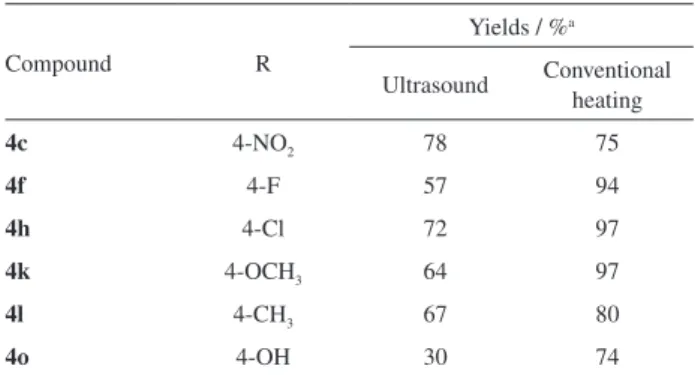
sonicated for more 5 min to the complete consumption of the imine. The products were obtained in moderate to good yields (30-78%) without any further puriication. As we already observed in previous work,8 some reactions carried
out in ultrasound afforded lower yields than reactions in
conventional heating (Table 1). Despite the yields, the short reaction time is the great advantage of the sonochemistry methodology.
The thiazolidin-4-ones 4a-o were fully identified
and characterized by mass spectrometry and 1H and 13C
nuclear magnetic resonance (NMR) spectroscopy. Five thiazolidinones [4c (R = 4-NO2), 4d (R = 2-F), 4g (R = 2-Cl), 4k (R = 4-OCH3) and 4o (R = 4-OH)] were also characterized
by high resolution mass spectrometry (HRMS). The mainly signals of 1H NMR spectra are the H2 and H5 hydrogen’s of
the thiazolidinone ring. The H2 is shown at 5.37-6.02 ppm as a singlet or a doublet signal (coupling with the diastereotopic methylene hydrogen H5a, 4J 1.2-1.7 Hz). The H5a is
assigned as a doublet or a double-doublet at 3.80-3.95 ppm (2J 15.4-16.0 Hz and 4J 0.8-1.9 Hz) and the H5b appear
as a doublet at 3.68-3.81 ppm (2J 15.2-16.0 Hz). The also
diastereotopic methylene hydrogens of pyridin-3-ylmethyl group also appear as two doublets at 4.97-5.16 ppm for CH2a (2J 14.8-15.2 Hz) and at 3.68-3.78 ppm for CH
2b
(2J 14.8-16.0 Hz). In the 13C NMR spectra, the mainly
signals are the carbonyl group (C4, 171.2-172.5 ppm), the C2 (57.8-62.9 ppm), the methylene C5 (31.5-32.9 ppm) and the methylenic carbon of pyrydin-3-ylmethyl goup (43.6-44.7 ppm). Plus, the aromatic signals of the arenealdehyde and pyridil moieties conirm the structure of desired products.
Several synthetic organic compounds have been studied as antioxidant agents by its scavenger free radicals 1
+
2a-o
4a-o a
O H
N S
O
R
R N
N NH2 + HSCH2COOH
3
2a=4a= 2-NO2
2b=4b= 3-NO2
2c=4c= 4-NO2
2d=4d= 2-F
2e=4e= 3-F
R = 2f=4f= 4-F
2g=4g= 2-Cl
2h=4h= 4-Cl
2i=4i= 2-OCH3
2j=4j= 3-OCH3
2k=4k= 4-OCH3
2l=4l= 4-CH3
2m=4m= 2-OH
2n=4n= 3-OH
2o=4o= 4-OH
Scheme 1. Reaction conditions:(a) toluene, relux, 4 h (yields 59-97%).
1
+
2c,f,h,k,l,o
4c,f,h,k,l,o
a
O H
b N S
O
R
R
-H2O -H2O
N
N N R
N NH2
Scheme 2. Reaction conditions: (a) toluene, ultrasound irradiation, 5 min; (b) HSCH2COOH 3, ultrasound irradiation, 5 min (yields 30-78%). Table 1. Comparative yields for the synthesis of thiazolidin-4-ones (4c,f,h,k,l and o)
Compound R
Yields / %a
Ultrasound Conventional heating
4c 4-NO2 78 75
4f 4-F 57 94
4h 4-Cl 72 97
4k 4-OCH3 64 97
4l 4-CH3 67 80
4o 4-OH 30 74
activities. In this context, the antioxidant properties of thiazoles and thiazolidinones were extensively reviewed recently.27 Two important tests used as screening to
antioxidant activities are the 2,2-diphenyl-1-picrylhydrazyl (DPPH) and the 2,2’-azinobis-(3-ethyl-benzthiazoline-6-sulphonate) cation (ABTS+) radical scavenger assays. These
procedures are extensively used and need lower times than other methods.28 DPPH is a stable free radical which has
an unpaired valence electron at one atom of nitrogen with a characteristic absorbance. Compounds reacts with DPPH and convert it to the stable 1,1-diphenyl-pieryl hydrazine causing a decrease in DPPH absorbance. The ABTS radical scavenging test is also a rapid and eficient method, based on the ability of the hydrogen donating antioxidants to scavenge the long-life radical cation ABTS.
In this preliminary study, we applied the DPPH and ABTS radical scavenger assays to investigate the antioxidant properties of thiazolidinones 4. The values of
EC50 (the amount of compound that decreases the initial
DPPH concentration by 50%) and TEAC (trolox equivalent antioxidant capacity) were determined as shown in Table 2. Compounds are considered inactive if the EC50 is higher than 200 µM for DPPH and if the TEAC is lower than 0.5 for ABTS.
Generally, phenolic hydroxyl group is associated to antioxidant activities due to hydrogen donation and stabilization of the free radical by resonance.28,29 However,
the literature reports that compounds with no phenolic
hydroxyl group have also antioxidant properties,30
including thiazolidin-4-ones.31 Saundane et al.32 suggest
that the hydrogen at the 2-position of 2-aryl-thiazolidin-4-ones ring might be a position to form a radical due a possible stabilization by resonance with the aryl group. According to this, we study the potential radical scavenger property of 3-(pyridin-2-ylmethyl)-thiazolidin-4-ones 5,33
3-(pyrimidin-2-il)thiazolidin-4-ones 611 and now of
3-(pyridin-3-ylmethyl)-thiazolidin-4-ones 4 (Figure 1). In
comparison of these three series, the new thiazolidin-4-ones 4 and previous published thiazolidin-4-ones 5 have
similar structure that differs only at position of nitrogen on pyridine ring; and thiazolidinones 6 present a pyrimidine
ring and the absence of a methylene bridge.
The Table 2 shows clearly that the thiazolidin-4-ones
4a-o have different results in the preliminary DPPH and
ABTS tests. In DPPH assay, all thiazolidin-4-ones 4a-o
showed EC50 higher than 200 µM. However, in the ABTS assay, the thiazolidin-4-ones 4j and 4l showed the best
radical scavenger activities, even better than compounds that contain a phenolic hydroxyl group (4m and 4o).
In general, the scavenger activities of thiazolidinones 4
were quite similar to those found for thiazolidinones 5,33
however lower than those found for thiazolidinones 6.11
These results showed that the bioisoster change of pyridin-2-ylmethyl (compounds 5) to pyridin-3-ylmethyl moiety
(compounds 4) did not affect the scavenger ability. It also
suggests that the absence of a methylenic group and/or the presence of a pyrimidine ring attached to the nitrogen of thiazolidinone ring is important to the stabilization of a free radical.
Conclusions
In conclusion, fifteen novel 2-aryl-3-(pyridin-3-ylmethyl)thiazolidin-4-ones were easily synthesized in good yields by conventional methodology. Six of them were also obtained by ultrasound irradiation in good yields and short reaction time. All compounds were fully identiied and characterized by 1H, 13C-NMR and by mass
spectroscopy (see supplementary information). In addition, four thiazolidinones showed moderate radical scavenger
Table 2. Radical scavenger activities of thiazolidin-4-ones 4a-o
Compound R DPPH•EC
50 / µMa ABTS•+ TEACb
4a 2-NO2 none none
4b 3-NO2 none none
4c 4-NO2 none none
4d 2-F none none
4e 3-F none none
4f 4-F none 0.59
4g 2-Cl none 0.95
4h 4-Cl none none
4i 2-OCH3 none none
4j 3-OCH3 none 7.14
4k 4-OCH3 none 0.93
4l 4-CH3 none 7.07
4m 2-OH none 2.92
4n 3-OH none 0.79
4o 4-OH none 1.57
aEC
50 means the amount of antioxidant necessary to decrease the initial
DPPH concentration by 50%; bTEAC means the trolox equivalent
antioxidant capacity; none: ineffective due EC50 higher than 200 µM for
DPPH or TEAC lower than 0.5 for ABTS.
N S
O
R N
N S
O
R
N N S
O
R N
N
ref 11 ref 33
this work
6 5
4
activity in the ABTS assay. These results will guide us for further modiications to ind better scavenger activities.
Experimental
Unless otherwise indicated, all common reagents and solvents were used as obtained from commercial suppliers without further puriication. The sonochemistry reactions were carried out with a microtip probe (3 mm) connected to a 500 Watt Sonics Vibra-cell ultrasonic processor operating at 20 kHz at 24% of the maximum power output. The progress of reactions and the purity of compounds were monitored by thin layer chromatography (TLC) with hexane:ethyl acetate 9:1, using silica gel 60 F253 aluminum sheets; visualization by ultraviolet light 254 nm and by a Shimadzu Gas Chromatograph GC-2010, HP-1 column (cross linked methyl siloxane, 30 m × 0.32 mm × 0.25 µm): Column head pressure, 14 psi, program: T0 = 60 °C; t0 = 2.0 min; rate 10.0 °C min–1; Tf = 280 °C; tf = 13.0 min;
Inj. = 250 °C; Det. = 280 °C. Melting points were determined using open capillaries on a Fisatom model 430 apparatus and are uncorrected. 1H and 13C NMR spectra
were recorded on a Varian Oxford AS-400 spectrometer or on a Bruker Ac-200F spectrometer in CDCl3 containing TMS as in internal standard. Chemical shifts d in ppm with respect to TMS and coupling constants JH-H (1H)
and JC-F (13C) in Hz. The mass spectra were obtained on a Shimadzu GCMS-QP2010SE with a split-splitless injector and equipped with a RDX-SMS capillary column (30 m × 0.25 mm × 0.25 µm); helium was used as the carrier gas (56 Kpa). High resolution mass spectrum were obtained on a LTQ Orbitrap Discovery mass spectrometer (Thermo Fisher Scientiic). This hybrid system meets the LTQ XL linear ion trap mass spectrometer and an Orbitrap mass analyzer. The experiments were performed via direct infusion of sample (low: 10 µL min−1) in the positive-ion
mode using electrospray ionization. Elemental composition calculations for comparison were executed using the specific tool included in the QualBrowser module of Xcalibur (Thermo Fisher Scientiic, release 2.0.7) software.
Conventional heating synthesis of thiazolidin-4-ones 4a-o
A mixture of 3-picolylamine 1 (1 mmol), corresponding
arenaldehyde 2a-o (1 mmol) and mercaptoacetic acid 3
(3 mmol) in toluene (30 mL) was heated at 110 °C with a Dean-Stark apparatus for 4 h. The organic layer was washed with saturated solution of NaHCO3 (3 × 20 mL), dried with MgSO4 and concentrated to give the thiazolidin-4-ones.
When necessary, the crude products were washed with a hot solution of hexane:ethyl acetate (9:1).
Ultrasonics synthesis of thiazolidin-4-ones(4c, 4f, 4h, 4k, 4l and 4o)
In a 25 mL vessel was added a mixture of 3-picolylamine 1
(1 mmol) and the arenaldehyde 2c, 2f, 2h, 2k, 2l or 2o
(1 mmol) in toluene (10 mL). The mixture was sonicated by an ultrasonic probe with a frequency of 20 kHz for 5 min. After this time, the mercaptoacetic acid 3 (3 mmol) was
immediately added and the reaction was sonicated for more 5 min. The solution was washed with saturated solution of NaHCO3 (3 × 10 mL), dried with MgSO4 and concentrated
to give the pure products without any further puriication.
2-(2-nitrophenyl)-3-(pyridin-3-ylmethyl)-1,3-thiazolidin-4-ones(4a)
Yield: 94%; mp 53-56 °C yellow; 1H NMR (400 MHz,
CDCl3) d 3.70 (d, 1H, J 16.0, H-5b), 3.80 (dd, 1H, J 16.0, 1.6, H-5a), 3.82 (d, 1H, J 15.2, CH2b), 5.16 (d, 1H, 2J 15.2,
CH2a), 6.02 (d, 1H, J 1.6, H-2), 7.30-7.24 (m, 1H, Ar-H), 7.35 (dd, 1H, J 7.8, 1.2, Ar-H), 7.58-7.50 (m, 2H, Ar-H), 7.70 (dt, 1H, J 7.4, 0.8, Ar-H), 8.12 (dd, 1H, J 8.2, 1.6, Ar-H), 8.35 (d, 1H, J 1.6, Ar-H), 8.55 (dd, 1H, J 4.7, 1.9, Ar-H); 13C NMR (100 MHz, CDCl
3) d 31.5 (C-5), 44.7
(CH2), 58.0 (C-2), 123.9, 124.5, 125.9, 126.4, 129.6,
130.1, 134.5, 135.6, 136.0, 149.0, 149.3, 172.5 (C-4); GC-MS m/z (%) 285 (M+-30, 49), 209 (10), 92 (100),
65 (40).
2-(3-nitrophenyl)-3-(pyridin-3-ylmethyl)-1,3-thiazolidin-4-ones(4b)
Yield 94%; mp 85-88 °C pale yellow; 1H NMR
(400 MHz, CDCl3) d 3.81 (dd, 1H, J 15.6, 0.8, H-5b), 3.82 (d, 1H, J 15.2, CH2b), 3.96 (ddd, 1H, J 15.6, 1.9, 0.8,
H-5a), 5.01 (d, 1H, J 14.8, CH2a), 5.51 (d, 1H, J 1.6, H-2), 7.28 (2dd, 1H, J 7.8, 0.8, Ar-H), 7.59-7.53 (m, 3H, Ar-H), 8.12-8.11 (m, 1H, Ar-H), 8.26-8.22 (m, 2H, Ar-H), 8.54 (dd, 1H, J 5.1, 1.9, Ar-H); 13C NMR (100 MHz, CDCl
3)
d 32.6 (C-5), 44.2 (CH2), 62.1 (C-2), 122.2, 123.9, 124.3, 130.3, 130.8, 133.1, 136.2, 141.2, 149.1, 149.3, 171.3 (C-4); GC-MS m/z (%) 315 (M+, 18), 148 (60), 119 (28),
92 (100), 65 (36).
2-(4-nitrophenyl)-3-(pyridin-3-ylmethyl)-1,3-thiazolidin-4-ones(4c)
Yield 75%; pale brown oil; 1H NMR (200 MHz, CDCl 3)
d 3.74 (d, 1H, J 15.0, CH2b), 3.79 (d, 1H, J 15.4, H-5b),
7.43 (d, 2H, J 8.7, Ar-H), 7.53 (dt, 1H, J 7.8, 1.8, Ar-H), 8.25 (d, 2H, J 8.7, Ar-H), 8.29 (d, 1H, J 2.1, Ar-H), 8.55 (dd, 1H, J 4.8, 1.6, Ar-H); 13C NMR (50 MHz, CDCl
3)
d 32.5 (C-5), 44.2 (CH2), 61.7 (C-2), 123.8, 124.5 (2 C), 127.9 (2 C), 130.7, 136.2, 146.0, 148.3, 149.2, 149.4, 171.3 (C-4); GC-MS m/z (%) 315 (M+, 11), 148 (71), 119 (29),
92 (100), 65 (38); HRMS (ESI) m/z calcd: C15H13SN3O3 +
H, 316.0750; found: 316.0742 (M + H).
2-(2-fluorophenyl)-3-(pyridin-3-ylmethyl)-1,3-thiazolidin-4-ones(4d)
Yield 87%; mp 61-64 °C pale yellow; 1H NMR
(400 MHz, CDCl3) d 3.74 (d, 1H, J 15.6, H-5b), 3.80 (d, 1H, J 15.2, CH2b), 3.92 (d, 1H, J 15.6, H-5a), 4.99 (d, 1H,
J 14.8, CH2a), 5.70 (s, 1H, H-2), 7.07 (2d, 1H, J 10.0, 8.6, Ar-H), 7.14 (t, 1H, J 7.4, Ar-H), 7.29-7.22 (m, 2H, Ar-H), 7.38-7.33 (m, 1H, Ar-H), 7.53 (d, 1H, J 7.8, Ar-H), 8.30 (d, 1H, J 1.5, Ar-H), 8.50 (d, 1H, J 4.7, Ar-H); 13C NMR
(100 MHz, CDCl3) d 32.5 (C-5), 44.1 (CH2), 56.7 (d,
5J
C-F 3.7, C-2), 116.2 (d, 2JC-F 20.6), 123.7, 124.8, 126.0 (d, 2J
C-F 11.0), 128.2 (d, 4JC-F 3.7), 130.9 (d, 3JC-F 8.8), 131.1,
136.2, 149.1, 149.3, 160.4 (d, 1J
C-F 249.9), 171.4 (C-4);
GC-MS m/z (%) 288 (M+, 40), 213 (34), 148 (56), 92
(100), 65 (37); HRMS (ESI) m/z calcd: C15H13FSN2O + H,
289.0805; found: 289.0798 (M + H).
2-(3-fluorophenyl)-3-(pyridin-3-ylmethyl)-1,3-thiazolidin-4-ones(4e)
Yield 80%; mp 84-87 °C pale yellow; 1H NMR
(400 MHz, CDCl3) d 3.73 (d, 1H, J 14.8, CH2b), 3.76 (d, 1H, J 15.6, H-5b), 3.90 (d, 1H, J 16.0, H-5a), 5.04 (d, 1H, J 14.8, CH2a), 5.38 (s, 1H, H-2), 6.98 (d, 1H, J 8.6, Ar-H), 7.08 (d, 1H, J 8.2, Ar-H), 7.02 (d, 1H, J 8.2, Ar-H), 7.29-7.26 (m, 1H, Ar-H), 7.37 (2d, 1H, J 8.2, 7.8, Ar-H), 7.53 (d, 1H, J 7.8, Ar-H), 8.30 (s, 1H, Ar-H), 8.55 (d, 1H, J 4.7, Ar-H); 13C NMR (100 MHz, CDCl
3) d 32.6 (C-5), 43.9
(CH2), 62.2 (d, 5JC-F 1.4, C-2), 114.0 (d, 2JC-F 22.1), 116.5
(d, 2J
C-F 21.3), 122.7 (d, 4JC-F 3.0), 123.8, 130.8 (d, 3JC-F 8.1),
131.0, 136,3, 141.3, 149.3, 149.4, 163.1 (d, 1J
C-F 248.4),
171.3 (C-4); GC-MS m/z (%) 288 (M+, 24), 213 (32), 148
(65), 92 (100), 65 (35).
2-(4-fluorophenyl)-3-(pyridin-3-ylmethyl)-1,3-thiazolidin-4-ones(4f)
Yield 94%; pale brown oil; 1H NMR (200 MHz, CDCl 3):
d 3.70 (d, 1H, J 15.0, CH2b), 3.76 (d, 1H, J 14.9, H-5b),
3.90 (d, 1H, J 15.6, 1.3, H-5a), 5.00 (d, 1H, J 14.9, CH2a), 5.40 (s, 1H, H-2), 7.11-7.03 (m, 2H, Ar-H), 7.29-7.21 (m,
3H, Ar-H), 7.51 (dt, 1H, J 7.8, 1.7, Ar-H), 8.28 (d, 1H, J 2.0, Ar-H), 8.54 (dd, 1H, J 4.8, 1.7, Ar-H); 13C NMR
(50 MHz, CDCl3): d 32.7 (C-5), 43.8 (CH2), 62.3 (C-2),
116.1 (d, 2J
C-F 21.9), 123.7, 129.2 (d, 3JC-F 8.4), 131.1, 134.1
(d, 4J
C-F 3.2), 136.2, 149.2, 149.4, 160.9 (d, 1JC-F 248.9),
171.2 (C-4); GC-MS m/z (%) 288 (M+, 24), 213 (63), 148
(67), 92 (100), 65 (38).
2-(2-chlorophenyl)-3-(pyridin-3-ylmethyl)-1,3-thiazolidin-4-ones (4g)
Yield 84%; mp 64-67 °C pale yellow; 1H NMR
(200 MHz, CDCl3) d 3.72 (d, 1H, J 15.2, H-5b), 3.75 (d,
1H, J 15.3, CH2b), 3.85 (dd, 1H, J 16.0, 1.3, H-5a), 5.08 (d, 1H, J 14.9, CH2a), 5.88 (d, 1H, J 1.2, H-2), 7.43-7.20
(m, 5H, Ar-H), 7.55 (dt, 1H, J 7.8, 1.8, Ar-H), 8.35 (d, 1H, J 1.8, Ar-H), 8.54 (dd, 1H, J 4.7, 1.4, Ar-H); 13C NMR (50 MHz, CDCl3) d 32.3 (C-5), 44.4 (CH2), 59.3 (C-2), 123.7, 127.5, 127.7, 130.1, 130.5, 130.9, 133.0, 136.1, 136.2, 149.3, 149.5, 171.8 (C-4); GC-MS m/z (%) 304 (M+,
26), 148 (39), 92 (100), 65 (35); HRMS (ESI) m/z calcd: C15H13ClSN2O + H, 305.0510; found: 305.0502 (M + H).
2-(4-chlorophenyl)-3-(pyridin-3-ylmethyl)-1,3-thiazolidin-4-ones (4h)
Yield 97%; yellow oil; 1H NMR (200 MHz, CDCl 3)
d 3.68 (d, 1H, J 15.0, H-5b), 3.75 (d, 1H, J 15.0, CH2b), 3.91 (dd, 1H, J 15.8, 1.2, H-5a), 5.03 (d, 1H, J 14.9, CH2a),
5.37 (d, 1H, J 1.2, H-2), 7.49-7.17 (m, 6H, Ar-H), 8.28 (d, 1H, J 2.0, Ar-H), 8.56 (dd, 1H, J 4.8, 1.7, Ar-H); 13C NMR
(50 MHz, CDCl3) d 32.7 (C-5), 43.8 (CH2), 62.2 (C-2), 123.8, 127.6, 128.6 (2C), 129.4 (2C), 131.0, 136.3, 137.0, 149.3, 149.4, 171.3 (C-4); GC-MS m/z (%) 304 (M+, 18),
229 (41), 148 (66), 92 (100), 65 (39).
2-(2-methoxyphenyl)-3-(pyridin-3-ylmethyl)-1,3-thiazolidin-4-ones (4i)
Yield 94%; yellow oil; 1H NMR (200 MHz, CDCl 3)
d 3.68 (d, 1H, J 15.4, H-5b), 3.78 (d, 1H, J 15.2, CH2b),
3.79 (s, 3H, OCH3), 3.85 (d, 1H, J 15.4, H-5a), 5.01 (d, 1H, J 14.9, CH2a), 5.77 (d, 1H, J 1.6, H-2), 6.89 (d, 1H,
J 8.2, Ar-H), 6.99 (d, 1H, J 6.8, Ar-H), 7.14 (dd, 1H, J 7.6, 1.7, Ar-H), 7.33-7.23 (m, 2H, Ar-H), 7.54 (dt, 1H, J 7.8, 1.8, Ar-H), 8.30 (d, 1H, J 1.9, Ar-H), 8.52 (dd, 1H, J 4.7, 1.5, Ar-H); 13C NMR (100 MHz, CDCl
3) d 32.7 (C-5),
44.0 (CH2), 55.4 (OCH3), 57.8 (C-2), 111.0, 120.8, 123.5, 126.5, 127.1, 130.2, 131.4, 136.1, 149.0, 149.5, 156.9, 171.9 (C-4); GC-MS m/z (%) 300 (M+, 10), 225 (49), 208
2-(3-methoxyphenyl)-3-(pyridin-3-ylmethyl)-1,3-thiazolidin-4-ones (4j)
Yield 88%; yellow oil; 1H NMR (200 MHz, CDCl 3
d 3.79 (s, 3H, OCH3), 3.94-3.70 (m, 4H, H-5 and CH2),
5.02 (d, 1H, J 14.9, CH2a), 5.37 (d, 1H, J 1.2, H-2), 6.84-6,75 (m, 2H, Ar-H), 6.90 (ddd, 1H, J 8.3, 2.5, 0.90, Ar-H), 7.30 (m, 2H, Ar-H), 7.54 (dt, 1H, J 7.8, 1.8, Ar-H), 8.30 (d, 1H, J 2.0, Ar-H), 8.54 (dd, 1H, J 4.7, 1.5, Ar-H); 13C NMR
(50 MHz, CDCl3) d 32.7 (C-5), 43.9 (CH2), 55.3 (OCH3), 62.9 (C-2), 112.5, 114.9, 119.3, 123.7, 130.2, 131.3, 136.4, 140.0, 149.0, 149.4, 160.2, 171.4 (C-4); GC-MS m/z (%) 300 (M+, 28), 225 (49), 92 (100), 65 (36).
2-(4-methoxyphenyl)-3-(pyridin-3-ylmethyl)-1,3-thiazolidin-4-ones (4k)
Yield 97%; mp 67-70 °C pale yellow; 1H NMR
(400 MHz, CDCl3) d 3.68 (d, 1H, J 14.8, CH2b), 3.76 (d,
1H, J 15.6, H-5b), 3.83 (s, 3H, OCH3), 3.87 (dd, 1H, J 15.6, 1.9, H-5a), 4.99 (d, 1H, J 14.8, CH2a), 5.37 (s, H-2), 6.90
(d, 2H, J 8.9, Ar-H), 7.18 (d, 2H, J 8.6, Ar-H), 7.29-7.24 (m, 1H, Ar-H), 7.51 (d, 1H, J 7.8, Ar-H), 8.27 (d, 1H, J 1.9, Ar-H), 8.53 (dd, 1H, J 4.7, 1.6, Ar-H); 13C NMR (100 MHz,
CDCl3) d 32.9 (C-5), 43.6 (CH2), 55.3 (OCH3), 62.6 (C-2),
114.4 (2 C), 123.6, 128.7, 129.9, 131.2, 136.2, 149.2, 149.6 (2 C), 160.3, 171.2 (C-4); GC-MS m/z (%) 300 (M+,
44), 225 (100), 92 (61), 65 (26); HRMS (ESI) m/z calcd: C16H16SN2O2 + H, 301.1005; found: 301.0997 (M + H).
2-(4-methylphenyl)-3-(pyridin-3-ylmethyl)-1,3-thiazolidin-4-ones (4l)
Yield 80%; yellow oil; 1H NMR (200 MHz, CDCl 3)
d 2.37 (s, 3H, CH3), 3.68 (d, 1H, J 14.9, CH2b), 3.74 (dd,
1H, J 15.6, 0.7, H-5b), 3.90 (dd, 1H, J 15.6, 1.3, H-5a), 4.99 (d, 1H, J 14.9, CH2a), 5.37 (d, 1H, J 1.4, H-2), 7.28-7.10
(m, 5H, Ar-H), 7.52 (dt, 1H, J 7.8, 1.9, Ar-H), 8.28 (d, 1H, J 2.0, Ar-H), 8.53 (dd, 1H, J 4.8, 1.6, Ar-H); 13C NMR (50 MHz, CDCl3) d 21.1 (CH3), 32.8 (C-5), 43.7 (CH2), 62.8 (C-2), 123.7, 127.2 (2 C), 129.8 (2 C), 131.3, 135.3, 136.3, 139.5, 149.1, 149.5, 171.3 (C-4); GC-MS m/z (%) 284 (M+, 86), 209 (98), 92 (100), 65 (50).
2-(2-hydroxyphenyl)-3-(pyridin-3-ylmethyl)-1,3-thiazolidin-4-ones (4m)
Yield 59%; mp 168-171 °C pale yellow; 1H NMR
(400 MHz, CDCl3) d 3.73 (d, 1H, J 15.6, H-5b), 3.91 (d,
1H, J 14.8, CH2b), 3.97 (dd, 1H, J 15.6, 1.9, H-5a), 4.93 (d, 1H, J 14.5, CH2a), 6.02 (s, 1H, H-2), 6.83-6.89 (m, 2H,
Ar-H), 7.13-7.17 (m, 1H, Ar-H), 7.26-7.29 (m, 1H, Ar-H), 7.36 (2d, 1H, J 8.2, 7.8, Ar-H), 7.82 (d, 1H, J 7.8, Ar-H), 8.47 (d, 1H, J 1.6, Ar-H), 8.52 (dd, 1H, J 4.7, 1.6, Ar-H);
13C NMR (100 MHz, CDCl
3) d 33.3 (C-5), 43.8 (CH2),
57.1 (C-2), 115.8, 120.0, 124.4, 124.5, 128.7, 130.3, 132.6, 138.3, 147.7, 148.8, 155.7, 171.8 (C-4); GC-MS m/z (%) 286 (M+, 32), 211 (100), 92 (100), 65 (52).
2-(3-hydroxyphenyl)-3-(pyridin-3-ylmethyl)-1,3-thiazolidin-4-ones (4n)
Yield 90%; yellow oil; 1H NMR (400 MHz, CDCl 3)
d 3.73 (d, 1H, J 15.6, H-5b), 3.85 (dd, 1H, J 15.6, 1.9, H-5a), 3.90 (d, 1H, J 14.8, CH2b), 4.89 (d, 1H, J 15.2, CH2a), 5.36 (s, 1H, H-2), 6.76-6.72 (m, 2H, Ar-H), 6.85 (dd,
1H, J 7.8, 1.9, Ar-H), 7.19 (t, 1H, J 7.8, Ar-H), 7.33-7.28 (m, 1H, Ar-H), 7.61 (d, 1H, J 7.8, Ar-H), 8.26 (d, 1H, J 1.5, Ar-H), 8.50 (dd, 1H, J 4.7, 1.2, Ar-H); 13C NMR (100 MHz,
CDCl3) d 32.7 (C-5), 44.0 (CH2), 63.2 (C-2), 114.1, 116.9,
118.3, 124.2, 130.3, 132.0, 137.4, 139.7, 148.1, 148.5, 157.9, 171.7 (C-4); GC-MS m/z (%) 286 (M+, 69), 211
(44), 92 (100), 65 (46).
2-(4-hydroxyphenyl)-3-(pyridin-3-ylmethyl)-1,3-thiazolidin-4-ones (4o)
Yield 74%; mp 139-142 °C cream-coloured; 1H NMR
(400 MHz, CDCl3) d 3.72 (d, 1H, J 14.8, CH2b), 3.74 (d, 1H, J 15.6, H-5b), 3.85 (d, 1H, J 15.6, H-5a), 4.93 (d, 1H, J 15.2, CH2a), 5.37 (s, 1H, H-2), 6.84 (d, 2H, J 8.6, Ar-H), 7.09 (d, 2H, J 8.6, Ar-H), 7.27 and 7.26 (2d, 1H, J 7.8, 7.8, Ar-H), 7.51-7.48 (m, 1H, Ar-H), 8.29 (d, 1H, J 1.6, Ar-H), 8.52 (dd, 1H, J 4.5, 1.4, Ar-H), 9.38 (br, 1H, OH);
13C NMR (100 MHz, CDCl
3) d 32.2 (C-5), 42.9 (CH2), 62.2
(C-2), 115.3 (2 C), 122.9, 127.5, 128.2 (2 C), 130.7, 135.5, 148.3, 148.8, 157.8, 170.4 (C-4); GC-MS m/z (%) 286 (M+,
66), 211 (100), 92 (94), 65 (52); HRMS (ESI) m/z calcd: C15H14SN2O2 + H, 287.0849; found: 287.0843 (M + H).
DPPH assay
The 2,2-diphenyl-1-picryl-hydrazyl (DPPH) free radical-scavenging assay was performed in accordance with the procedure reported by Brand-Williams et al.34
ABTS assay
The ABTS radical-scavenging activity was evaluated as described by Re et al.35 with some modifications.
ABTS radical cation (ABTS•+) was produced by reacting
ABTS stock solution with potassium persulfate. Different concentrations of compounds were mixed with ABTS•+,
and the final mixture was left to stand at 30 °C; the absorbance was measured at 734 nm. Trolox was used as standard reference. The percentage of radical scavenging was calculated as TEAC.
Supplementary Information
Supplementary Information (1H and 13C NMR, mass
and HRMS spectrum) is available free of charge at http://jbcs.sbq.org.br.
Acknowledgements
The authors thank UFPel, CAPES, CNPq (proc. 477916/2010-4) and FAPERGS for the inancial support.
References
1. Tripathi, A. C.; Gupta, S. J.; Fatima, G. N.; Sonar, P. K.; Verma, A.; Saraf, S. K.; Eur. J. Med. Chem.2014, 72, 52.
2. Kanagarajan, V.; Thanusu, J.; Gopalakrishnan, M.; Green Chem. Lett. Rev.2009, 2, 161.
3. Sathishkumar, M.; Nagarajan, S.; Shanmugavelan, P.; Dinesh, M.; Ponnuswamy, A.; Beilstein J. Org. Chem.2013, 9, 689. 4. Lingampalle, D.; Jawale, D.; Waghmare, R.; Mane, R.; Synth.
Commun.2010, 40, 2397.
5. Zheng, H.; Mei, Y. J.; Du, K.; Shi, Q. Y.; Zhang, P. F.; Catal. Lett.2013, 143, 298.
6. Pratap, U. R.; Jawale, D. V.; Bhosle, M. R.; Mane, R. A.; Tetrahedron Lett.2011, 52, 1689.
7. Neuenfeldt, P. D.; Duval, A. R.; Drawanz, B. B.; Rosales, P. F.; Gomes, C. R. B.; Pereira, C. M. P.; Cunico, W.; Ultrason. Sonochem.2011, 18, 65.
8. Gouvêa, D. P.; Bareño, V. D. O.; Bosenbecker, J.; Drawanz, B. B.; Neuenfeldt, P. D.; Siqueira, G. M.; Cunico, W.; Ultrason. Sonochem.2012, 19, 1127.
9. Senthilraja, M.; Alagarsamy, V.; Solomon, V. R.; Lett. Drug Des. Discov.2012, 9, 731.
10. Chavan, S.; Zangade, S.; Vibhute, A.; Vibhute, Y.; Eur. J. Chem.
2013, 4, 98.
11. Campos Jr., J. C.; Gouvea, D. P.; Ribeiro, C. S.; Dutra, F. S. P.; Stefanello, F. M.; Pereira, C. M. P.; Cunico, W.; Siqueira, G. M.; J. Biochem. Mol. Toxicol.2013, 27, 445.
12. Kumar, D.; Sonawane, M.; Pujala, B.; Jain, V. K.; Bhagat, S.;
Chakraborti, A. K.; Green Chem. 2013, 15, 2872.
13. Küçükgüzel, I.; Satilmi , G.; Gurukumar, K. R.; Basu, A.: Tatar, E.; Nichols, D. B.; Talele, T. T.; Basu, K. N.; Eur. J. Med. Chem.
2013, 69, 931.
14. Murugesan, V.; Makwana, N.; Suryawanshi, R.; Saxena, R.; Tripathi, R.; Paranjape, R.; Kulkarni, S.; Katti, S. B.; Bioorg. Med. Chem. 2014, 22, 3159.
15. Wu, J.; Yu, L.; Yang, F.; Li, J.; Wang, P.; Zhou, W.; Qin, L.; Li, Y.; Luo, J.; Yi, Z.; Liu, M.; Chen, Y.; Eur. J.Med. Chem. 2014, 80, 340.
16. Kunzler, A.; Neuenfeldt, P. D.; das Neves, A. M.; Pereira, C. M. P.; Marques, G. H.; Nascente, P. S.; Fernandes, M. H. V.; Hübner, S. O.; Cunico, W.; Eur. J. Med. Chem.2013, 64, 74. 17. Marques, G. H.; Kunzler, A.; Bareño, V. D. O.; Drawanz, B. B.;
Mastelloto, H. G.; Leite, F. R. M.; Nascimento, G. G.; Nascente, P. S.; Siqueira, G. M.; Cunico, W.; Med. Chem.2014, 10, 355. 18. Patel, R. V.; Park, S. W.; Chem. Biol. Drug Des.2014, 84, 123. 19. Maccari, R.; Vitale, R. M.; Ottanà, R.; Rocchiccioli, M.;
Marrazzo, A.; Cardile, V.; Graziano, A. C. E.; Amodeo, P.; Mura, U.; Del Corso, A.; Eur. J. Med. Chem. 2014, 81, 1. 20. Sarkanj, B.; Molnar, M.; Cacic, M.; Gille, L.; Food Chem.2013,
139, 488.
21. Mangge, H.; Becker, K.; Fuchs, D.; Gostner, J. M.; World J. Cardiol. 2014, 6, 462.
22. Halliwell, B.; Nutr. Rev.2012, 70, 257.
23. Valko, M.; Leibfritz, D.; Moncol, J.; Cronin, M. T. D.; Mazur, M.; Tesler, J.; Int. J. Biochem. Cell Biol.2007, 39, 44. 24. Halliwell, B.; Biochem. J.2007, 401, 1.
25. Avery, S. V.; Biochem. J.2011, 434, 201.
26. Bai, H.; Liu, R.; Chen, H. L.; Zhang, W.; Wang, X.; Zhang, X. D.; Li, W. L.; Hai, C. X.; Chem. Biol. Interact.2014, 207, 7. 27. Geronikaki A. A.; Pitta, E. P. Liaras, K. S.; Curr. Med. Chem.
2013, 20, 4460.
28. Hossain, S. K.; Bhattacharya, S.; Bioorg. Med. Chem. Lett.2007,
17, 1149; Apotrosoaei, M.; Vasincu I. M.; Dragan M.; Buron F.; Routier S.; Proire L.; Molecules2014, 19, 13824; Zhang Y.; Fang Y.; Liang H.; Wang H.; Hu K.; Liu X.; Yi X.; Peng Y.; Bioorg. Med. Chem. Lett.2013, 23, 107; Zhao L.; Chen J.; Su J.; Li L.; Hu S.; Li B.; Zhang X.; Xu Z.; Chen T.; J. Agric. Food Chem.2013, 61, 10604.
29. Mastelic, J.; Jerkovic, I; Blaževic, I.; Poljak-Blaži, M.; Borovic, S.; Ivancic-Bace, I.; Smrecki, V.; Žarkovic, N.; Brcic-Kostic, K.; Vikic-Topic, D.; Müller, N.; J. Agric. Food Chem. 2008, 56, 3989.
30. Farias, M A.; Oliveira, P. S.; Dutra, F. S. P.; Fernandes, T. J.; Pereira, C. M. P.; de Oliveira, S. Q.; Stefanello F. M.; Lencina, C. L.; Barschak, A. G.; J. Pharmac. Pharmacol.2013, 66, 733. 31. El Nezhawy, A. O. H.; Ramla, M. M.; Khalifa, N. M.; Abdulla, M. M.; Monatsh. Chem.2009, 140, 531; Bozdag,-Dundar, O.; Coban, T.; Ceylan-Unlosy, M.; Ertan, R.; Med. Chem. Res.
32. Saundane, A. R.; Yarlakatti, M.; Walmik, P.; Katkarf, V.; J. Chem. Sci.2012, 124, 469.
33. Bosenbecker, J.; Bareño, V. D. O.; Difabio, R.; Vasconcellos, F. A.; Dutra, F. S. P.; Oliveira, P. S.; Barschak, A. G.; Stefanello, F. M.; Cunico, W.; J. Biochem. Mol. Toxicol.2014, 28, 425. 34. Brand-Williams W.; Cuvelier, M. E.; Berset, C.; Lebensm. Wiss.
Technol. 1995, 28, 25.
35. Re, R. Pellegrini, N.; Proteggente A.; Pannala, A.; Yang, M.; Rice-Evans, C.; Free Radic. Biol. Med. 1999, 26, 1231.
Submitted: September 17, 2014
Published online: December 12, 2014