Artigo
*e-mail: [email protected]
PREPARATIVE SEPARATION AND PURIFICATION OF BUFADIENOLIDES FROM ChanSu BY HIGH-SPEED COUNTER-CURRENT CHROMATOGRAPHY COMBINED WITH PREPARATIVE HPLC
Jialian Li and Yongqing Zhang
College of Pharmacy, Shandong University of Traditional Chinese Medicine, Jinan, Shandong, 250355, P. R. China Yunliang Lin, Xiao Wang, Lei Fang* and Yanling Geng
Shandong Analysis and Test Center, Shandong Academy of Sciences, 19 Keyuan Street, Jinan, Shandong, 250014, P. R. China Qinde Zhang
Shandong College of Traditional Chinese Medicine, Laiyang, Shandong, 265200, P. R. China Recebido em 13/9/12; aceito em 6/12/12; publicado na web em 4/4/13
Eight bufadienolides were successfully isolated and purified from ChanSu by high-speed counter-current chromatography (HSCCC) combined with preparative HPLC (prep-HPLC). First, a stepwise elution mode of HSCCC with the solvent system composed of petroleum ether–ethyl acetate–methanol–water (4:6:4:6, 4:6:5:5, v/v) was employed and four bufadienolides, two partially purified fractions were obtained from 200 mg of crude extract. The partially purified fractions III and VI were then further separated by prep-HPLC, respectively, and another four bufadienolides were recovered. Their structures were confirmed by ESI-MS and 1H-NMR spectra. Keywords:high-speed counter-current chromatography; bufadienolides; preparative HPLC.
INTRODUCTION
Venenum bufonis, also called ChanSu, is prepared from dried toad secretions derived from either Bufo bufo gargarizans Cantor or Bufo melsanostictus Schneider1 and has been widely used as a cardiotonic, diuretic, anodyne and antineoplastic agent.2 Phytochemical studies have revealed that bufadienolides are contained in the vast majority of fat-soluble compounds in ChanSu which are also the major bioactive constituents. To date, more than 70 bufadienolides have been isolated from ChanSu, including bufalin, cinobufagin, resibufogenin and so on.2 Recent pharmacological studies have indicated that bufadieno-lides can induce apoptosis, inhibit cell proliferation, promote cell differentiation, reverse drug resistance, restrain neovacularization and enhance the immune system.3 Furthermore, bufadienolides have been shown to exhibit significant inhibitory activities against different kinds of human cancer cells, including myeloid leukemia and prostate cells.4,5 Considering these beneficial biological properties and broad applications of bufadienolides, it is necessary to establish an efficient method of obtaining these compounds from ChanSu with high purities and in large quantities for further pharmacological research.
However, the conventional methods using column chromato-graphy employed to separate bufadienolides are often tedious, time consuming, while requiring multiple chromatographic steps and large amounts of reagents.6,7 High-speed counter-current chromatography (HSCCC), as a liquid-liquid partition chromatographic technique, has various advantages, such as no irreversible adsorption, large volumes of sample injection, a simple process and low cost. HSCCC has been successfully applied to prepare various types of natural products.8-11 Ma and co-researchers have isolated several bufadienolides from ChanSu using HSCCC. However, the separation process lasted more than 11 h.12 Hence, it is necessary to explore a more powerful and efficient method of separating bufadienolides at large quantities in a shorter time. Preparative high-performance liquid chromatography (prep-HPLC) is becoming a powerful tool for the isolation of natural products in virtue of its excellent efficiency and high recovery. When prep-HPLC is coupled with HSCCC, its disadvantages including trial
pretreatment of sample and overloaded columns, caused by plentiful raw sample that could be compensated by HSCCC.13 However, few reports have been published on the separation and purification of bufadienolides from ChanSu by HSCCC combined with prep-HPLC.
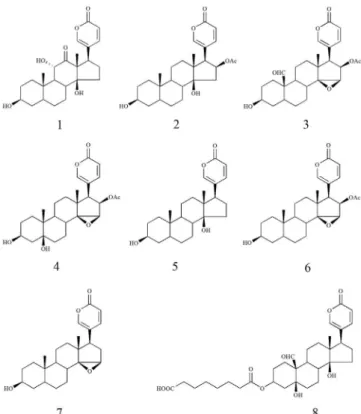
This paper reports a high-efficiency method developed for the separation and purification of bufadienolides from ChanSu by HSCCC combined with prep-HPLC. Eight bufadienolides were successfully obtained and identified as arenobufagin (1), bufotalin (2), 19-oxo--cinobufagin (3), cinobufotalin (4), bufalin (5), cinobufagin (6), resibufogenin (7) and hellebrigenin-3-hemisuberate (8) with purities of 97.7, 97.0, 99.0, 99.8, 99.5, 99.1, 98.5 and 96.1%, respectively. Their chemical structures are shown in Figure 1.
EXPERIMENTAL Apparatus
The HSCCC instrument used in this study was a model GS10A-2 high-speed counter-current chromatograph (Beijing Emilion Science & Technology Co., Beijing, China), equipped with 2 multilayer coil separation columns connected in series (diameter of tube = 1.6 mm, total volume = 330 mL) and a 20 mL sample loop. The b values of the multilayer coil varied from 0.5 at the internal terminal to 0.8 at the external terminal (b = r/R, where r is the rotation radius or the distance from the coil to the holder shaft, and R (R = 8 cm) is the revolution radius or the distance between the holder axis and central axis of the centrifuge). A speed controller can regulate the revolution speed within a range of between 0 and 1000 rpm. A model NS-1007 constant-flow pump (Beijing Emilion Science & Technology Co., Beijing, China) was used to deliver the two-phase solvent system, a model 8823A-UV detector (Beijing Emilion Science & Technology Co., Beijing, China) to monitor the continuous effluent, and a model 3057 portable recorder (Yokogawa, Sichuan Instrument Factory, Chongqing, China) to draw the chromatogram.
pump, a Waters 600 Multisolvent Delivery, a Waters 996 diode-array detector (DAD), a Waters 600 system controller and a Millennium 32 workstation (Waters, Milford, USA).
Materials
Petroleum ether (60-90 oC), methanol, chloroform, ethyl acetate and acetic acid were all of analytical grade (Dame Chemical Factory, Tianjin, China). Acetonitrile used for HPLC analysis was of chro-matographic grade (Siyou Special Reagent Factory, Tianjin, China). Reverse osmosis Milli-Q water (Millipore, USA) was used for all solutions and dilutions.
Venenum bufonis was purchased from a local drug store and identified as the skin secretions of Bufo bufogargarizans Cantor by Dr. Li jia (College of Pharmacy, Shandong University of Traditional Chinese Medicine).
Sample preparation
The dried materials of ChanSu (80 g) were powdered and ex-tracted with methanol 3 times (1 L× 3) (each time 1 h). The extract was then combined and concentrated to yield 24.5 g of residue. The residue was dissolved in 300 mL of distilled water and extracted 3 times with chloroform (500 mL × 3). Finally, around 16.3 g of chloroform residue was obtained and stored in a refrigerator for subsequent HSCCC separation.
Selection of two-phase solvent system
The selection of the two-phase solvent system is a crucial factor for successful separation by HSCCC. The two-phase solvent system was selected according to the partition coefficients (KD) of the
tar-get compound. The KD value is defined as the concentration of the
compound in the stationary phase (CSP) divided by the concentration of the compound in the mobile phase (CMP): KD = CSP / CMP. In this
study, the upper layer was used as the stationary phase throughout the HSCCC separation where the KD value was determined by HPLC
analyses as following:14 1 mL of each phase of the equilibrated two--phase solvent system was added to a test tube and a suitable amount of sample placed into the tube. The tube was then shaken vigorously to mix the solution thoroughly. After the equilibration was established, an equal volume of each phase was analyzed by HPLC to obtain the partition coefficients. The KD value was calculated by the following
equation: KD= AU / AL (AU, the peak area of the target compound in the upper phase; AL, the area in the lower phase).
15
Preparation of two-phase solvent system and sample solution
The HSCCC experiments in the present study were performed with a two-phase solvent system of petroleum ether–ethyl acetate– methanol–water with the volume ratios of 4:6:4:6 (v/v) and 4:6:5:5 (v/v). Solvent mixture was thoroughly equilibrated in a separation funnel by repeated vigorous shaking at room temperature. The two phases were then separated shortly before use. The upper phase was used as the stationary phase, while the lower phase was used as the mobile phase. The sample solution was prepared by dissolving 200 mg of the dried extract in 3 mL mixture solution of lower phase and upper phase (1:1, v/v) of the solvent system (4:6:4:6, v/v).
HSCCC separation
In HSCCC separation, the entire column was first filled with the upper phase. Then the lower phase was pumped into the head end
of the column at a flow rate of 2.0 mL/min, while the apparatus was rotated at 850 rpm. After the establishment of hydrodynamic equili-brium, the sample solution was injected through the sample port. In the stepwise elution, after 220 min of elution using the solvent system (4:6:4:6, v/v), the mobile phase was switched to the second solvent system (4:6:5:5, v/v) from 220-400 min. The effluent of the column was continuously monitored by a UV detector at 296 nm, and each peak fraction was manually collected according to the elution profile. After the separation was complete, the solvents in the column were pushed out with nitrogen gas and the retention of stationary phase was computed.
Preparative HPLC purification procedure
Each partially purified fraction of HSCCC separation was further purified by prep-HPLC. Prep-HPLC purification was performed on a YMC-Pack ODS-A column (250 × 10 mm, i.d., 5 µ) at room tem-perature and the flow rate was set at 2.5 mL/min. The mobile phase was acetonitrile-0.3% aqueous acetic acid (35:65, v/v) for fraction III, while the mobile phase was acetonitrile-0.3% aqueous acetic acid (45:55, v/v) for fraction VI. The effluent was monitored at 296 nm and the peak fractions collected according to the chromatogram. Analysis and identification of HSCCC and prep-HPLC fractions
The crude sample and each fraction from the HSCCC separation and prep-HPLC purification were analyzed by HPLC with a Inertsil ODS-3 C18 column (250 × 4.6 mm, i.d., 5 µ). Flow rate, detection wavelength and column temperature were set at 1.0 mL/min, 296 nm and room temperature, respectively. The mobile phase was composed of acetonitrile and 0.3% (v/v) aqueous acetic acid in gradient elution as follows: 0-8 min, using a constant elution (42% acetonitrile); 8-32 min, linear change from 42 to 50% acetonitrile; 32-35 min, using a constant elution (50% acetonitrile).
Figure 1. Chemical structures of the eight bufadienolides isolated from
The identification of the 8 compounds was carried out by elec-trospray ionization mass spectrometry (ESI-MS) on an Agilent 1100/
MS-G1946 (California, USA) and 1H NMR spectra on a
Varian-600NMR spectrometer (Varian, Palo Alto, CA, USA) with DMSO as solvent and tetramethylsilane (TMS) as internal standard.
RESULTS AND DISCUSSION Selection of HSCCC conditions
The selection of a suitable two-phase solvent system is a critical step for successful HSCCC separation. To achieve successful sepa-ration using HSCCC, the suitable solvent system should provide an ideal partition coefficient range (KD, 0.5–2) for bufadienolides.
16,17
Excessively large KD values (KD >2) tend to produce excessively
broad peaks and lead to extended elution times, while KD values (KD
< 0.5) that are too small often result in loss of peak resolution. In our research, the solvent system of petroleum ether–ethyl acetate–metha-nol–water was chosen and the KD values in different solvent systems
are summarized in Table 1.
As shown in Table 1, compounds 1, 2, and 4 showed the suitable KD values in the solvent system of petroleum ether–ethyl acetate– methanol–water (4:6:4:6, v/v), while compound 5, 6 and 8 had the suitable KD values in the solvent system of petroleum ether–ethyl acetate–methanol–water (4:6:5:5, v/v). Thus, a stepwise elution mode of HSCCC was developed to achieve good separation. However, the preliminary test indicated that bufadienolides 1, 2, 5 and 8 could be excellently separated, while bufadienolides 3 and 4, 6 and 7 were eluted together as one peak, respectively. For this reason, prep--HPLC was utilized to further purify bufadienolides 3 and 4, 6 and
7. Consequently, a combination of both HSCCC and prep-HPLC was
established for the separation and purification of bufadienolides from ChanSu. First, 200 mg of the sample was purified by HSCCC using a stepwise elution mode with the solvent system of petroleum ether– ethyl acetate–methanol–water (4:6:4:6, v/v) and (4:6:5:5, v/v). This separation yielded 4 compounds, including 28.2 mg of arenobufagin (fraction I, 1), 13.6 mg of bufotalin (fraction II, 2), 14.8 mg of bufalin
(fraction IV, 5) and 6.1 mg of hellebrigenin-3-hemisuberate (fraction V, 8) with purities of 97.7, 97.0, 99.5 and 96.1%, respectively, together with the partially purified fraction III (3 and 4) and fraction VI (6 and
7). The HSCCC chromatogram is shown in Figure 2.
Subsequently, 40 mg of partially purified fraction III and 50 mg of partially purified fraction VI were further purified by prep-HPLC, respectively, leading to recovery of 3.5 mg of 19-oxo-cinobufagin (3), 18.6 mg of cinobufotalin (4), 21.4 mg of cinobufagin (6) and 4.6 mg of resibufogenin (7) with purities of 99.0, 99.8, 99.1 and 98.5%, respectively. The details of the eight bufadienolides are summarized in Table 2.
The HPLC chromatograms of the crude extract and fractions of HSCCC are depicted in Figure 3. The HPLC chromatograms of prep--HPLC for partially purified fractions III and VI are shown in Figure 4.
Structural identification
Structural identification of the 8 compounds was performed with
ESI-MS and 1H-NMR.
Compound 1
ESI-MS (positive mode), m/z 439.1 [M+Na]+. 1H-NMR
Table 1. Partition coefficients (KD) of six bufadienolides
Solvent system (petroleum ether -ethylacetate-methanol-water) K1 K2 K4 K5 K6 K8
5:5:5:5 0.36 0.23 0.28 0.55 0.85 0.48
5:5:4:6 0.48 0.75 0.95 2.14 3.94 2.11
4:6:4:6 0.98 1.52 2.05 3.55 6.32 5.99
4:6:5:5 0.58 0.66 0.78 0.89 2.06 1.55
Figure 2. HSCCC chromatogram of crude extract of ChanSu. Conditions: two-phase solvent system, petroleum ether-ethyl acetate-methanol-water (4:6:4:6
and 4:6:5:5, v/v) in stepwise elution; stationary phase, upper phase of 4:6:4:6; mobile phase, lower phase of 4:6:4:6 in 0-220 min, lower phase of 4:6:5:5 in 220-400 min; flow rate, 2.0 mL/min; revolution speed, 850 rpm; detection, 296 nm; separation temperature, 25 oC; sample size, 200 mg crude sample dissolved in 3 mL of solvent (4:6:4:6, v/v) consisting of 1.5 mL of each phase. Retention of stationary phase: 35%
Table 2. Details of the obtained eight bufadienolides
compound mass yield (mg) purity (%)
1: arenobufagin 416.1 28.2 97.7
2: bufotalin 444.1 13.6 97.0
3: 19-oxo-cinobufagin 456.2 3.5 99.0
4: cinobufotalin 458.1 18.6 99.8
5: bufalin 386.2 14.8 99.5
6: cinobufagin 442.2 21.4 99.1
7: resibufogenin 384.2 4.6 98.5
(DMSO-d6, 600 MHz): 7.81 (1 H, dd, J = 9.9, 1.8 Hz, H-22), 7.58
(1 H, d, J = 1.8 Hz, H-21), 6.33 (1 H, d, J = 9.9 Hz, H-23), 4.97 (1 H, s, 14-OH), 4.49 (1 H, d, J = 4.8 Hz, 11-OH), 4.27 (1 H, dd, J = 11.1, 4.8 Hz, H-11), 4.15 (1 H, d, J = 3.0 Hz, 3-OH), 3.97 (1 H, dd,
J = 9.3, 7.5 Hz, H-17), 3.86 (1 H, brs, H-3), 2.29 (1 H, d, J = 11.0 Hz, H-1), 1.74 (1 H, m, H-5), 1.07 (3 H, s, CH3-19), 0.80 (3 H, s, CH3-18). The NMR data was in agreement with those of arenobufagin in the literature.18
Compound 2
ESI-MS (positive mode), m/z 467.1 [M+Na]+. 1H-NMR
(DMSO-d6, 600 MHz): 8.18 (1 H, d, J = 9.6 Hz, H-22), 7.51 (1 H,
s, H-21), 6.20 (1 H, d, J = 9.6 Hz, H-23), 5.38 (1 H, t, J = 8.9 Hz, H-16), 4.38 (1 H, s, 14-OH), 4.19 (1 H, d, J = 3.0 Hz, 3-OH), 3.89 (1 H, s, H-3), 2.87 (1 H, d, J = 9.0 Hz, H-17), 2.61 (1 H, dd, J = 15.0, 9.0 Hz, H-15), 1.78 (3 H, s, -OAc), 0.86 (3 H, s, CH3-19), 0.65
(3 H, s, CH3-18). The NMR data were in agreement with those of
bufotalin in the literature.18
Compound 3
ESI-MS (positive mode), m/z 479.2 [M+Na]+. 1H-NMR (DMSO-d
6,
600 MHz): 9.54 (1 H, s, CHO-19), 7.86 (1 H, dd, J = 9.9, 1.8 Hz, H-22), 7.48 (1 H, d, J = 1.8 Hz, H-21), 6.25 (1 H, d, J = 9.9 Hz, H-23), 5.48 (1 H, d, J = 9.6 Hz, H-16), 4.43 (1 H, d, J = 3.0 Hz, 3-OH), 3.92 (1 H, brs, H-3), 3.76 (1 H, s, H-15), 2.88 (1 H, d, J = 9.6 Hz, H-17), 1.82 (3 H, s, -OAc), 0.76 (3 H, s, CH3-18). The NMR data were in agreement with those of 19-oxo-cinobufagin in the literature.18
Compound 4
ESI-MS (positive mode), m/z 481.1 [M+Na]+. 1H-NMR
(DMSO-d6, 600 MHz): 7.81 (1 H, dd, J = 9.6, 1.5 Hz, H-22), 7.47
(1 H, d, J = 1.5 Hz, H-21), 6.24 (1 H, d, J = 9.6 Hz, H-23), 5.47 (1 H, d, J = 9.6 Hz, H-16), 5.22 (1 H, s, 3-OH), 4.58 (1 H, s, 5-OH), 4.01 (1 H, s, H-3), 3.75 (1 H, s, H-15), 2.87 (1 H, d, J = 9.6 Hz, H-17), 1.82 (3 H, s, -OAc), 0.86 (3 H, s, CH3-19), 0.70 (3 H, s, CH3 -18). The NMR data were in agreement with those of cinobufotalin in the literature.18
Figure 3. (A) HPLC chromatogram of the chloroform extract from ChanSu; (B) HPLC chromatograms and UV spectra of HSCCC fractions (I-VI). Conditions:
column, Inertsil ODS-3 C18 (250 × 4.6 mm, i.d., 5 µ); column temperature, 25
oC; mobile phase, solvent A (acetonitrile) and B (0.3% v/v aqueous acetic acid)
Figure 4. Prep-HPLC chromatograms of fraction III and fraction VI. Con-ditions: column, YMC-Pack ODS-A (250 × 10 mm, i.d., 5 µ); flow rate, 2.5 mL/min; UV wavelength, 296 nm; mobile phase for fraction III, acetoni-trile-0.3% aqueous acetic acid (35:65, v/v); mobile phase for fraction VI, acetonitrile-0.3% aqueous acetic acid (45:55, v/v). 3: 19-oxo-cinobufagin; 4: cinobufotalin; 6: cinobufagin; 7: resibufogenin
Compound 5
ESI-MS (positive mode), m/z 409.2 [M+Na]+. 1H-NMR
(DMSO-d6, 600 MHz): 7.93 (1 H, dd, J = 9.6, 2.0 Hz, H-22), 7.52
(1 H, d, J = 2.0 Hz, H-21), 6.29 (1 H, d, J = 9.6 Hz, H-23), 4.18 (1 H, brs, 3-OH), 4.12 (1 H, brs, 14-OH), 3.84 (1 H, brs, H-3), 2.43 (1 H, m, H-17), 0.86 (3 H, s, CH3-19), 0.59 (3 H, s, CH3-18). The NMR data were in agreement with those of bufalin in the literature.12
Compound 6
ESI-MS (positive mode), m/z 465.2 [M+Na]+. 1H-NMR
(DMSO-d6, 600 MHz): 7.80 (1 H, d, J = 10.0 Hz, H-22), 7.47 (1 H,
s, H-21), 6.24 (1 H, d, J = 10.0 Hz, H-23), 5.48 (1 H, d, J = 9.6 Hz, H-16), 4.21 (1 H, brs, 3-OH), 3.89 (1 H, brs, H-3), 3.75 (1 H, s, H-15), 2.87 (1 H, d, J = 9.6 Hz, H-17), 1.82 (3 H, s, -OAc), 0.90 (3 H, s, CH3-19), 0.71 (3 H, s, CH3-18). The NMR data were in agreement with those of cinobufagin in the literature.19
Compound 7
ESI-MS (positive mode), m/z 407.2 [M+Na]+. 1H-NMR
(DMSO-d6, 600 MHz): 7.77 (1 H, dd, J = 9.6, 2.5 Hz, H-22), 7.53
(1 H, d, J = 2.5 Hz, H-21), 6.26 (1 H, d, J = 9.6 Hz, H-23), 4.21 (1 H, brs, H-3), 3.59 (1 H, s, H-15), 2.52 (2 H, m, H-16), 0.91 (3 H, s, CH3-19), 0.68 (3 H, s, CH3-18). The NMR data were in agreement with those of resibufogenin in the literature.20
Compound 8
ESI-MS (positive mode), m/z 595.3 [M+Na]+. 1H-NMR
(DMSO-d6, 600 MHz): 11.95 (1 H, s, -COOH), 10.46 (1 H, s,
CHO-19), 8.21 (1 H, dd, J = 9.6, 2.5 Hz, H-22), 7.43 (1 H, d, J = 2.5 Hz, H-21), 6.35 (1 H, d, J = 9.6 Hz, H-23), 5.35 (1 H, brs, H-3), 2.50 (1 H, m, H-17), 0.87 (3 H, s, CH3-18). The NMR data were in agree-ment with those of hellebrigenin-3-hemisuberate in the literature.21
CONCLUSION
The present study demonstrated a high-efficiency method for the separation and purification of bufadienolides from ChanSu by HSCCC combined with prep-HPLC. Eight bufadienolides, including arenobufagin (1), bufotalin (2), 19-oxo-cinobufagin (3), cinobufotalin (4), bufalin (5), cinobufagin (6), resibufogenin (7) and hellebrigenin-3-hemisuberate (8) were obtained. Their purities were 97.7, 97.0, 99.0, 99.8, 99.5, 99.1, 98.5 and 96.1%, respectively. The present study proved that the combination of HSCCC and prep-HPLC is a very useful, powerful and rapid technique for the isolation and purification of as many bufadienolides as possible at high purities from ChanSu. Meanwhile, it also demonstrated that the combined methods of HSCCC and prep-HPLC can be employed to prepare as many bioactive components as possible from natural products.
ACKNOWLEDGEMENTS
Financial support from the Natural Science Foundation of China (21202094), the Natural Science Foundation of Shandong Province (ZR2012HQ020, BS2009SW047), the special foundation of Taishan Overseas Distinguished experts and scholars, the Young Science and Technology Star Program of Jinan (20110315) and the Science and Technology Program of ShanDong Academy of Sciences (201107) are gratefully acknowledged.
REFERENCES
1. The State Pharmacopoeia Commission of China; Pharmacopoeia of China, Chemical Industry Press: Beijing, 2010, p. 360.
2. Cheng, G.; Chin. Trad. Herb. Drugs2001, 32, 184.
3. Liu, J.; Zhang, D.; Li, Y.; Ye, W.; J. Int. Pharm. Res.2009, 36, 115. 4. Yeh, J. Y.; Huang, W. J.; Kan, S. F.; Wang, P. S.; The Prostate2003, 54,
112.
5. Zhang, L. S.; Nakaya, K.; Yoshida, T.; Kuroiwa, Y.; Biochem. Biophys. Res. Commun. 1991, 178, 686.
6. Qiao, L.; Duan, W.; Yao, Y.; Chen, H.; Liu, T.; Pei, Y.; J. Shenyang Pharm. Univ.2007, 24, 611.
7. Ma, X.; Zhang, B.; Deng, S.; Wang, C.; Shu, X.; Huang, Sh.; Diao, Y.; Zhang, H.; Zhen, Y.; Prog. Mod. Biomed.2009, 9, 3519.
8. Chen, L. J.; Games, D. E.; Jones, J.; J. Chromatogr., A2003, 988, 95. 9. Rinaldo, D.; Silva, M. A.; Rodrigues, C. M.; Calvo, T. R.; Sannomiya,
M.; dos Santos, L. C.; Kushima, H.; Hiruma-Lima, C. A.; Brito, A. R. M. S.; Vilegas, W.; Quim. Nova2006, 29, 947.
10. Almeida, M. R.; Leitão, G. G.; Silva, B. V.; Barbosa, J. P.; Pinto, A. C.;
J. Braz. Chem. Soc.2010, 21, 764.
11. Wang, D.; Lin, Y.; Lin, X.; Geng, Y.; Wang, X.; Zhang, J.; Qiu, J.; Quim. Nova2012, 35, 337.
12. Li, J.; Ma, X.; Li, F.; Wang, J.; Chen, H.; Wang, G.; Lv, X.; Sun, C.; Jia, J.; J. Sep. Sci.2010, 33, 1325.
13. Zhu, L.; Li, H.; Liang, Y.; Wang, X.; Xie, H.; Zhang, T.; Ito, Y.; Sep. Purif. Technol.2009, 70, 147.
14. Wang, D.; Fang, L.; Wang, X.; Qiu, J.; Huang, L.; Quim. Nova2011, 34, 804.
15. Peng, J.; Fan, G.; Wu, Y.; J. Chromatogr., A2005, 1091, 89. 16. Foucault, A. P.; Chevolot, L.; J. Chromatogr., A1998, 808, 3. 17. Oka, H.; Harada, K.; Suzuki, M.; Ito, Y.; J. Chromatogr., A2000, 903, 93. 18. Ye, M.; Guo, H.; Guo, H.; Han, J.; Guo, D.; J. Chromatogr., B: Anal.
Technol. Biomed. Life Sci.2006, 838, 86.
19. Ma, X.; Xin, X.; Liu, K.; Han, J.; Guo, D.; J. Nat. Prod.2008, 71, 1268. 20. Verpoorte, R.; Phan, Q. K.; Baerheim, S. A.; J. Nat. Prod.1980, 43, 347. 21. Zhang, Y.; Qiu, Y.; Chen, J.; Bo, K.; Jiang, Y.; Pei, Y.; J. Shenyang