RevistaBrasileiradeFarmacognosia27(2017)175–178
w ww . e l s e v i e r . c o m / l o c a t e / b j p
Original
Article
Diterpenes
and
a
new
benzaldehyde
from
the
mangrove
plant
Rhizophora
mangle
Jhessica
N.
Martins,
Fabiana
S.
Figueiredo,
Gabriel
R.
Martins,
Gilda
G.
Leitão,
Fernanda
N.
Costa
∗UniversidadeFederaldoRiodeJaneiro,InstitutodePesquisasdeProdutosNaturais,CentrodeCiênciasdaSaúde,BlocoH,IlhadoFundão,RiodeJaneiro,RJ,Brazil
a
r
t
i
c
l
e
i
n
f
o
Articlehistory:
Received18July2016
Accepted20October2016
Availableonline23November2016
Keywords:
Manool Jhanol Steviol
p-Oxy-2-ethylhexylbenzaldehyde
Rhizophoramangle
Rhizophoraceae
Counter-currentchromatography
a
b
s
t
r
a
c
t
Thisworkdescribestheisolation,byhigh-speedcounter-currentchromatography,ofthediterpenes manool,jhanolandsteviolandthebenzaldehydep-oxy-2-ethylhexylbenzaldehydefromthestiltroots hexaneextractofthemangroveplantRhizophoramangleL.,Rhizophoraceae.Forthis,anon-aqueous biphasicsolventsystemcomposedofhexane–acetonitrile–methanol1:1:0.5(v/v/v)wasapplied.Asfar asweknow,onlysteviolwaspreviouslyisolatedinRhizophoraceaeandthisisthefirsttimethatp -oxy-2-ethylhexylbenzaldehydeisreported.
©2016SociedadeBrasileiradeFarmacognosia.PublishedbyElsevierEditoraLtda.Thisisanopen accessarticleundertheCCBY-NC-NDlicense(http://creativecommons.org/licenses/by-nc-nd/4.0/).
Introduction
Mangroves are ecosystems with unusual variety of plants adaptedtoconditionsofhighsalinity,frequentfloodsandmuddy anaerobic soil. Brazil has thesecond largestmangrove area in theworldbuthasonlythreegeneraofAngiosperms(Wuetal., 2008).Amongthem,Rhizophoraisthemostfrequentandabundant genus.RhizophoramangleL.,Rhizophoraceae,popularlyknownas ‘redmangrove’, is anativeBrazilian widespreadmangrovetree (Tomlinson,1986),occurringalongallthecoast,fromtheStateof ParáuntiltheStateofSantaCatarina(Schaeffer-Novellietal.,2000).
Several secondary metabolites have been
iso-lated/identified/detected in four of the ten existing Rhizophora species (Wu et al., 2008; Nebulaet al.,2013): ditepenoidsand triterpenoidsinR.mucronata(Misraetal.,1984;Ghoshetal.,1985; AnjaneyuluandRao,2001;Anjaneyuluetal.,2000,2002)andinR. apiculata(Kokpoletal.,1990;Gaoetal.,2011);phenylpropanoids and other volatiles, triterpenes, flavonoids and a flavoglycan polymer in R.stylosa (Neilson et al.,1986; Azuma etal., 2002; Lietal.,2007);flavonoids,condensedtanninsandtriterpenesin R.mangle(Williams,1999;Kochetal.,2003;Kandiletal.,2004; Zhangetal.,2010;Costaetal.,2014).
∗ Correspondingauthor.
E-mail:[email protected](F.N.Costa).
In this study, high-speed counter-current chromatography (HSCCC) wasusedto isolatethree diterpenesand a new benz-aldehyde from the hexane extract of R. mangle stilt roots. Counter-currentchromatography,CCC,isaliquid–liquidpartition techniqueinwhichtheliquidstationaryphaseisretainedinthe apparatususingcentrifugalforceonly(Conway,1990).High-speed counter-currentchromatography,HSCCC,usestworotationaxes inaplanetarymotion,generatingavariablecentrifugalforcefield (Conway,1990).Theseparationisbasedonpartitioningof ana-lytesbetweentwoimmiscibleliquids(generallyasolventmixture) formingabiphasicsystem(MarstonandHostettmann,2006).The useofanall-liquidtechniqueleadstomanyadvantagesover con-ventionalchromatography(Berthod,2002),beingtherecoveryof labilecompoundswithoutchemicalmodificationsonitsstructure crucialtothesuccessofthiswork.
Materialsandmethods
Extractpreparation
Rhizophora mangle L., Rhizophoraceae (Supplementary data), wascollectedatReservaBiológicaeAntropológicadeGuaratiba,Rio deJaneiro,BrazilinOctober2010.Plantwasidentifiedoncampus byDrGustavoDuqueEstrada.AsthisplantistheonlyRhizophora speciesoccurringinBrazilianmangroveareasbeingits morphol-ogytotallydifferentfromanyotherexistingmangroveplant,there wasnoneedofavoucherspecimen.Driedandgroundedstiltroots
http://dx.doi.org/10.1016/j.bjp.2016.10.004
0102-695X/©2016SociedadeBrasileiradeFarmacognosia.PublishedbyElsevierEditoraLtda.ThisisanopenaccessarticleundertheCCBY-NC-NDlicense(http://
176 J.N.Martinsetal./RevistaBrasileiradeFarmacognosia27(2017)175–178
weresubmittedtomacerationwithethanol–water(9:1,v/v).55gof thecrudedriedextractwasdissolvedinmethanol–water(50:350, v/v)andpartitionedbetweenhexane,dichloromethaneandethyl acetate,inthisorder,affordingfourdifferentextracts.
Selectionandpreparationofthebiphasicsolventsystemand samplesolution
Solventsystemselectionwasmadebydissolvingasmallamount ofthesampleintesttubecontainingtheequilibratedbiphasic sys-tem.Thetesttubeswereshakenandthecompoundsallowedto partitionbetweenthetwo phases.Equalaliquotsofeachphase werespottedbesideeachotherseparatelyonsilicagelTLCplates (MerckArt.05554,Darmstadt,Germany),developedwiththe sol-ventsystemhexane–ethylacetate9:1.Theresultswerevisualized underUVlight(254nm).Theresultswerevisualizedafterspraying theplatewithH2SO4(10%)andvanillin(5%).
Theselectedsolventsystemwasequilibratedinaseparatory funnelatroomtemperatureandphaseswereseparatedjustbefore use.Theupperlayerwasusedasstationaryphasewhilethelower layerasmobilephase,inheadtotaildirection.Samplesolutionwas preparedbydissolvingthesampleinthesolventsystemusedfor separation(1:1,v/v).
CCCequipmentandseparationprocedure
Semi-preparativeHSCCCwasperformedonaQuattroHT-Prep counter-currentchromatograph(AECS,Bridgend,UnitedKingdom) equippedwithtwobobbinscontainingtwo polytetrafluoroethy-lenemulti-layercoilseach(26ml,1mmi.d.+234ml,3.2mmi.d. and 95ml, 2mm i.d.+98ml, 2mm i.d.). The rotation speed is adjustablefrom0to865rpm.A5mlsampleloopwasusedtoinject thesample.
Intheseparationprocess,the95mlcoilwasfirstentirelyfilled with the upper stationary phase, and then the apparatus was rotatedat865rpm,while thelowermobilephasewaspumped intothecolumn.Theflowrateusedwas2ml/min.Afterthemobile phasefrontemerged andhydrodynamicequilibrium was estab-lishedin thecolumn, thesample solution(300mgin5ml)was injectedintothecolumnthroughtheinjectionvalve.Fractionsof 4mlwerecollected:50duringelutionand30duringextrusion.
Extractandfractionanalysesandcompoundidentification
Crudeextract and eachfraction fromCCC wereanalysed by TLC (Merck Art. 05554, Darmstadt, Germany), developed with
hexane–ethylacetate9:1and/or7:3,accordingtoitspolarity.The resultswerevisualizedaftersprayingtheplatewithH2SO4(10%) andvanillin(5%).
1Hand13CNMRdatameasurementsfortheisolatedcompounds
wererecordedonaVarianVNMRS500(California,USA)at25◦C, operatingat 500MHz for 1Hand 125for 13C, usingdeuterated chloroformandTMSasinternalstandard.
Resultsanddiscussion
R.mangleistheonlyspeciesoccurringalongallBraziliancoastin mangroveareaswithdifferentclimaticandenvironmental condi-tions(Schaeffer-Novellietal.,2000)andverylittleisknownabout itschemicalprofile,especiallytheoneconcerningnon-polar com-pounds.Followingourpreviousworkonphenolic profileofthe EtOAcextractofR.mangleleaves(Costaetal.,2014)whereseveral compoundsweredescribedforthefirsttimeonthespecies,the stiltrootshexaneextractwasinvestigated.
Preliminaryanalysis
Thehexane extractof R. mangle stilt roots wasanalysed by TLCand theplate(not shown)showedacomplexmixture,with compoundsoflowpolarity,possiblyterpenoids,duetothe pur-plecolourdevelopedaftersprayingtheplatewithsulfuricvanillin. Thisfirstinformationoncomplexityandpolaritywasimportantto guidesolventsystemtesting.
Solventsystemselection
Theselectionofthebiphasicsolventsystemisthemost impor-tantstep inCCC, asit meansthechoiceofboth stationaryand mobilephasesatthesametime(Yto,2005)and,withoutconsulting literature,thissearchcanbeverytime-consuming.
More than 150 solvent systems were formerly used to iso-late terpenoids by CCC (Skalicka-Wo ´zniak and Garrard, 2014). From them, non-aqueous solvent systems have been used for the isolation of low-polarity compoundsmainly from essential oils.Themostcommonly usedarehexane:acetonitrile and hex-ane:methanolmodifiedbychlorinatedsolvents(Leitãoetal.,2012). Aftertesting hexane:acetonitrile (1:1,v/v), hexane:methanol (1:1, v/v), solvents were combined and a further system was evaluated: hexane:acetonitrile:methanol (1:1:0.5, v/v/v). When using only acetonitrile as the polar solvent, compounds were slightlymoreconcentratedintheupperlayer(composedmainly byhexane).Ontheotherhand,whenusingonlymethanolasthe
Elution
Hex-EtOAc 7:3 Hex-EtOAc 9:1
5 6
F1 5-10 211.3 mg
F2 11-13 24.5 mg
F3 14-17 21.8 mg
F4 18-20 17.4 mg
F5 21-23 18.8 mg
F6 24-26 53.3 mg
F7 27-30 39.1 mg
F8 31-33 7.6 mg
F9 34-80 73.1 mg 7 8 9 10 11 12 13 14 15 17 19 21 23 25 27 29 31 33 35 37 39 41 43 45 47 49 5153 55 57 59 61 63 65 67 69 71 73 75 77 79
Extrusion
Fig.1.AnalysesofCCCfractionsbyTLCandcombinationbysimilarity.F2,F4,F6andF8arehighlightedandcorrespondtocompounds(1),(2),(3)and(4),respectively.
J.N.Martinsetal./RevistaBrasileiradeFarmacognosia27(2017)175–178 177
polarsolvent,compoundswereheavilyconcentratedinthelower layer(composed mainlyby methanol). Assuming thatthe suit-ablecondition is achievedwhen having distributioncoefficient approximatelyone,addingasmallproportionofmethanolto hex-ane:acetonitrilesystemgavesatisfactoryresults.
CCCseparationandfractionanalyses
Hexane–acetonitrile–methanolatratio1:1:0.5wasemployed forthesemi-preparativefractionationof300mgofR.manglestilt rootshexaneextractaffordingninemainfractionscombinedbyTLC similarity,F1toF9(Fig.1).Elutionprocesstookplaceuntilfraction 50beingsubstitutedbyextrusionuntilfraction80.Compounds1,
2,3and4inF2,F4,F6andF8,respectively,wereisolatedandwere analysedbyNMR.Compoundspurityisnotknown.
Compoundidentification
Compound1wasidentifiedasthelabdanediterpenemanool bycomparisonwithliteraturedata(Ulubelenetal.,1991).Itwas obtainedasayellowamorphoussolidandthemolecularformula wasdeterminedasC20H34OonthebasisofHRESIMS([M−18+H]+
273.2572).1HNMR (500MHz,CDCl
3):ı0.68(s,CH3,H18),0.87 (s,CH3,H19),0.80(s,CH3,H20),1.27(s,CH3,H16),1.00–2.50(m, CH2,H1;CH2,H2;CH2,H3;CH,H5;CH2,H6;CH2,H7;CH,H9; CH2,H11;CH2,H12),4.51(d,1H,C17),4.81(d,1H,C17),5.06(dd, 1H,C15),5.22(dd,1H,C15),5.90and5.94(d,1H,C14).APTNMR (125MHz,CDCl3):ı14.43(CH
3,C18),17.70(CH2,C10),19.38(CH2, C1),21.71(CH3,C20),24.42(CH2,C5),27.63(CH3,C16),33.56(CH3, C19),33.61(C,C3),38.34(CH2,C6),39.06(CH2,C2),39.86(C,C9), 42.19(CH2,C11),55.57(CH, C4),57.31(CH,C8),73.58(C,C12), 106.44(CH2,C17),111.52(CH2,C15),145.26(CH3,C13),148.66(C, C7).
Compound2wasidentifiedasthekaurane diterpenesteviol bycomparisonwithliteraturedata(Subrahmanyametal.,1999;
Geunsetal.,2006).It wasobtainedasa whitepowderandthe
molecularformula wasdeterminedasC20H30O3 onthebasisof HRESIMS([M−18+Na]329.2461).1HNMR(500MHz,CDCl3):ı0.94 (s,CH3,H20),1.22(s,CH3,H18),0.90–2.50(m,CH2,H1;CH2,H2; CH2,H3;CH,H5;CH2,H6;CH2,H7;CH,H9;CH2,H11;CH2,H12; CH2,H14;CH2,H15),4.80and4.74(d,2H,H17).APTNMR(125MHz, CDCl3):ı15.63(CH
3,C18),18.41(CH2,C11),19.08(CH2,C2),21.81 (CH2,C6),28.96(CH3,C20),37.80(CH2,C3),39.53(C,C10),40.69 (CH2,C7),41.26(CH2,C1),42.39(C,C8),43.70(CH2,C12),43.82(C,
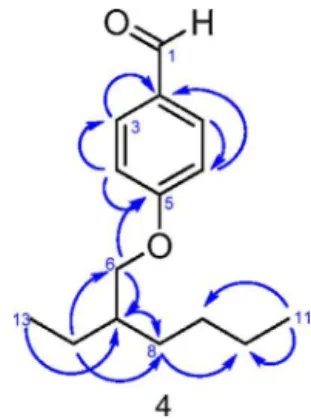
Fig.2.SelectedHMBCcorrelationsof(4)p-oxy-2-ethylhexylbenzaldehyde.
C4),44.20(CH2,C14),48.94(CH2,C15),55.08(CH,C5),57.02(CH, C9),81.54(C,C13),102.97(CH2,C17),155.85(C,C16),183.79(C, C19).
Compound3wasidentifiedasthelabdanediterpenejhanolby comparisonwithliteraturedata(Gonzálezetal.,1977;Stierleetal., 1988;Fragaetal.,1998).Itwasobtainedasayellowoilandthe molecularformulawasdeterminedasC20H34O2 onthebasisof HRESIMS([M−18+H]289.2526).1HNMR(500MHz,CDCl3):ı0.75 (s,CH3,H18),0.83(s,CH3,H20),1.27(s,CH3,H16),1.30(s,CH3, H17),0.85–1.80(m,CH2,H1;CH2,H2;CH2,H3;CH,H5;CH2,H6; CH2,H7;CH,H9;CH2,H11;CH2,H12),3.13and3.40(d,CH2,H19), 5.86and5.89(d,CH,H14),4.93and5.15(dd,CH2,H15).APTNMR (125MHz,CDCl3):ı15.28(CH
2,C11),15.77(CH3,C20),17.15(CH3, C18),17.83(CH2,C2),19.68(CH2,C6),25.47(CH3,C17),28.50(CH3, C16),35.27(CH2,C12),35.63(CH2,C3),36.89(C,C4),37.57(C,C10), 38.49(CH2,C1),42.88(CH2,C7),49.64(CH,C5),55.57(CH,C9), 72.05(CH2,C19),73.27(C,C8),74.96(C,C13),110.32(CH2,C15), 147.81(CH,C14).
Compound 4 (Fig. 2) was identified as p-oxy-2-ethylhexyl benzaldehyde (Table 1). It was obtained as a colourless oil, [˛]d20=−19.15(c=0.2,MeOH),UV(MeOH):203,242and282nm. ThemolecularformulawasdeterminedasC15H22O2onthebasis
Table1
1Hand13CNMRdataofp-oxy-2-ethylhexylbenzaldehyde(4)(500and125MHz;CDCl
3;ıinppm;JinHz).
p-Oxy-2-ethylhexylbenzaldehyde(4)
ıC ıH HMBC
H(2J
C H) H(3JC H)
1 204.38,CH
2 132.61,C 7.54(H3) 7.71(H4)
3/3′ 131.02,CH 7.54(dd;3.3,9.0) 7.71(H4)
4/4′ 128.95,CH 7.71(dd;3.3,9.0) 7.54(H3)
5 167.90,C 7.71(H4) 4.22(H6)
6 68.31,CH2 4.22(ddd;5.7,8.3) 1.68(H7) 1.42/1.41(H12)
7 38.89,CH 1.68(ddd;6.1,12.2,18.4) 4.22(H6) 0.92(H13)
1.42/1.41(12)
8 30.52,CH2 1.35(m) 1.68(H7) 4.22(H6)
1.42(H12)
9 29.08,CH2 1.32(m) 1.35(H8) 1.68(H7)
0.90(H11)
10 23.14,CH2 1.30(m) 0.90(H11) 1.35(H8)
11 14.20,CH3 0.90(d;7.5)
12 23.91,CH2 1.42(m) 1.68(H7) 4.22(H6)
0.92(H13)
178 J.N.Martinsetal./RevistaBrasileiradeFarmacognosia27(2017)175–178
ofHRESIMS([M+H]+234.3355)indicatingfivedegreesof instau-ration. The IR spectrum showedabsorption at 3500–3250 and 1500–1400cm−1typicalforaromaticsignals,at1700cm−1 indi-catingthepresenceofacarbonylgroupandat1260and1100cm−1 characteristicofanetherfunction.Foursimilarcompounds differ-inginthenumberofcarbonsinthechainhavebeenpreviously synthesizedinstudiesonlipidbilayerintercalants(Cohenetal., 2008).
1H,APT,HSQCandHMBC(Supplementarydata)experiments
wereperformedforthestructureelucidationofcompound4.The APTspectrumshowed13carbonsignals,allowingtodistinguish carbontype: twomethyls, five methylenes(including one con-nectedto electronegative atom), four methines (including two aromaticsignalsandonecarbonilic)andtwoquaternaryaromatic carbons.
Thepresence of thecarbonyl aldehyde was confirmedwith thesignalat204.38ppm.Thearomaticringcouldbeseenin1H spectraat 7.71and 7.54chemical displacements. These signals havetheAA′XX′system,astandardtopara-dissubstitutedaromatic ringwith3.3and9.0Hztypicalcouplingconstant.TheC3/C3′and C4/C4′havethesamechemicalshiftduetosymmetry,131.02and 128.95ppm,respectively.Thetypicalchemicalshiftfor CH2O groupappearsat4.22ppmin1Handat68.31ppminAPT experi-ment.StructurewasconfirmedbybidimensionalHSQCandHMBC experiments(Table1andFig.2).
Thenon-aqueoussolventsystemusedinthisworkshowedtobe effectiveontheisolationofthemediumtolowpolarityditerpenes inR.manglestiltrootshexaneextract.Theuseofthissolvent sys-tem,besidesaffordingtheselabilecompoundswithoutchemical modification,additionallyprovidedanewbenzaldehyde deriva-tive,which, as faras weknow, is being described for thefirst timeinnature.Concerningthediterpenes,literaturereportsthe presenceofkauranes,labdanes,pimaranesandbeyeranesbesides severalaromaticcompoundsinRhizophoraceae(Wuetal.,2008; Nebulaetal.,2013)butonlysteviolwaspreviouslyisolatedinthe family.
Authors’contributions
JNM(undergraduatestudent)didthecompoundisolation pro-cedure.FSF(PhDstudent)contributedincompoundidentification byNMRandliteraturesearch.GRM(PhDstudent)didNMR experi-ments.GGLwasFNC’sPhDsupervisor,wherethisworkstarted,and contributedtocriticalreadingthemanuscript.FNCdesignedthe study,supervisedthelaboratoryworkandwrotethemanuscript. Alltheauthorshavereadthefinalmanuscriptandapprovedthe submission.
Conflictsofinterest
Theauthorsdeclarenoconflictsofinterest.
Acknowledgments
JNMartinsisgratefulforPIBIC-UFRJscholarship.FNCostaand GGLeitãoaregratefulforCNPqandFaperjforfinancialsupport.
AppendixA. Supplementarydata
Supplementarydataassociatedwiththisarticlecanbefound,in theonlineversion,atdoi:10.1016/j.bjp.2016.10.004.
References
Anjaneyulu,A.S.R.,Anjaneyulu,V.,Rao,V.L.,2000.RhizophorinB:anovelbeyerane
diterpenoidfromtheIndianmangroveplantRhizophoramucronata.IndianJ. Chem.39B,803–807.
Anjaneyulu,A.S.R.,Anjaneyulu,V.,Rao,V.L.,2002.Newbeyeraneandisopimarane
diterpenoidsfromRhizophoramucronata.J.AsianNat.Prod.Res.4,53–60.
Anjaneyulu,A.S.R.,Rao,V.L.,2001.RhizophorinA,anovelsecolabdanediterpenoid
fromtheIndianmangroveplantRhizophoramucronata.Nat.Prod.Lett.1,13–19.
Azuma,H.,Toyota,M.,Asakawa,Y.,Takaso,T.,Tobe,H.,2002.Floralscentchemistry
ofmangroveplants.J.PlantRes.115,47–53.
Berthod,A.,2002.CountercurrentChromatography,theSupport-FreeLiquid
Sta-tionaryPhase,ComprehensiveAnalyticalChemistry.Elsevier,Amsterdam.
Cohen,Y.,Bodner,E.,Richman,M.,Afri,M.,Frimer,A.A.,2008.NMR-basedmolecular
rulerfordeterminingthedepthofintercalantswithinthelipidbilayer:PartI. Discoveringtheguidelines.Chem.Phys.Lipids155,98–113.
Conway,W.D.,1990.Counter-CurrentChromatography:Apparatus,Theoryand
Applications.VCHPublishersInc.,NewYork.
Costa,F.N.,daSilva,M.D.,Borges,R.M.,Leitão,G.G.,2014.Isolationofphenolics
fromRhizophoramanglebycombinedcounter-currentchromatographyand gel-filtration.Nat.Prod.Commun.9,1729–1731.
Fraga,B.M.,González,P.,Guillermo,R.,Hernández,M.G.,1998.The
biotransforma-tionofmanoyloxidederivativesbyGibberellafujikuroi:thefungalepimerization ofanalcoholgroup.Tetrahedron54,6159–6168.
Gao,M.-Z.,Yuan,X.-Y.,Cheng,M.-C.,Xiao,H.-B.,Bao,S.-X.,2011.Anewditerpenoid
fromRhizophoraapiculate.J.AsianNat.Prod.Res.13,776–779.
Geuns,J.M.,Buyse,J.,Vankeirsbilck,A.,Temme,E.H.,Compernolle,F.,Toppet,S.,
2006.Identificationofsteviolglucuronideinhumanurine.J.Agric.FoodChem.
54,2794–2798.
Ghosh,A.,Misra,S.,Dutta,A.K.,Choudhury,A.,1985.Pentacyclictriterpenoidsand
sterolsfromsevenspeciesofmangrove.Phytochemistry24,1725–1727.
González,A.G.,Arteaga,J.M.,Bretón,J.L.,Fraga,B.M.,1977.Fivenewlabdane
diter-peneoxidesfromEupatoriumjhanii.Phytochemistry16,107–110.
Kandil,F.E.,Grace,M.H.,Seigler,D.S., Cheeseman,J.M.,2004.Polyphenolicsin
RhizophoramangleL.leavesandtheirchangesduringleafdevelopmentand senescence.Trees18,518–528.
Koch,B.P.,Rullkötter,J.,Lara,R.J.,2003.Evaluationoftriterpenolsandsterolsas
organicmatterbiomarkersinamangroveecosysteminnorthernBrazil.Wetl. Ecol.Manag.11,257–263.
Kokpol, U., Chavasiri,W., Chittawong,V., Miles, D.H., 1990. Taraxeryl cis-p
-hydroxycinnamate,anoveltaraxerylfromRhizophoraapiculata.J.Nat.Prod.53, 953–955.
Leitão,G.G.,Costa,F.N.,Figueiredo,F.S.,2012.Strategiesofsolventsystemselection
fortheisolationofnaturalproductsbycountercurrentchromatography.In:Rai,
M.K.,Cordell,G.A.,Martinez,J.L.,Marinoff,M.,Rastrelli,L.(Org.),MedicinalPlants
BiodiversityandDrugs.SciencePublishers,pp.641–668.
Li,D.-L.,Li,X.-M.,Peng,Z.-Y.,Wang,B.-G.,2007.FlavanolderivativesfromRhizophora
stylosaandtheirDPPHradicalscavengingactivity.Molecules12,1163–1169.
Marston,A.,Hostettmann,K.,2006.Developmentsintheapplicationof
counter-currentchromatographytoplantanalysis.J.Chromatogr.A1112,181–194.
Misra,S.,Choudhury,A.,Dutta,A.K.,Ghosh,A.,1984.Sterolsandfattyacidsfrom
threespeciesofmangrove.Phytochemistry23,2823–2827.
Nebula,M.,Harisankar,H.S.,Chandramohanakumar,N.,2013.Metabolitesand
bioactivitiesofRhizophoraceaemangroves.Nat.Prod.Bioprospect.3,207–232.
Neilson,M.J.,Painter,T.J.,Richards,G.N.,1986.Flavologlycan:anovel
glycoconju-gatefromleavesofmangrove(RhizophorastylosaGriff).Carbohydr.Res.147, 315–324.
Schaeffer-Novelli,Y.,Cintrón-Molero,G.,Soares,M.L.G.,De-Rosa,T.,2000.Brazilian
mangroves.Aquat.Ecosyst.Health3,561–570.
Skalicka-Wo ´zniak,K.,Garrard,I.,2014.Counter-currentchromatographyforthe
separationofterpenoids:acomprehensivereviewwithrespecttothesolvent systemsemployed.Phytochem.Rev.13,547–572.
Stierle,D.B.,Stierle,A.A.,Larsen,R.D.,1988.Terpenoidandflavoneconstituentsof
Polemoniumviscosum.Phytochemistry27,517–522.
Subrahmanyam,C.,Rao,C.V.,Ward,R.S.,Hursthouse,M.B.,Hibbs,D.E.,1999.
Diter-penesfromthemarinemangroveBruguieragymnorhiza.Phytochemistry51, 83–90.
Tomlinson,P.B.,1986.TheBotanyofMangroves.CambridgeUniversityPress,UK.
Ulubelen,A.,Topcu,G.,Eris,C.,Sonmez,U.,Kartal,M.,Kurucu,S.,Bozok-Johanss,C.,
1991.TerpenoidsfromSalviaesclarea.Phytochemistry36,971–974.
Williams, L.A.D.,1999.Rhizophoramangle (Rhizophoraceae) triterpenoidswith
insecticidalactivity.Narurwissenschaften86,450–452.
Wu,D.,Xiao,Q.,Xu,J.,Li,M.-Y.,Pan,J.-Y.,Yang,M.-H.,2008.Naturalproductsfrom
truemangroveflora:source,chemistryandbioactivities.Nat.Prod.Rep.25, 955–981.
Yto,I.,2005.Goldenrulesandpitfallsinselectingoptimumconditionsforhigh-speed
counter-currentchromatography.J.Chromatogr.A1065,145–168.
Zhang,L.-L.,Lin,Y.-M.,Zhou,H.-C.,Wei,S.-D.,Chen,J.-H.,2010.Condensed