Series V: Economic Sciences
MARKETING RESEARCH
USING ONLINE SURVEYS
A. LANDOY
1A. REPANOVICI
2Abstract: In this article, quality criteria for electronic survey design and use based on an investigation of recent electronic survey literature are presented. The results show that a hard-to-reach audience can be reached using the quality criteria that are most important for reaching these types of audiences. It is presented one online questionnaire for the academic staff community at Transilvania university of Brasov,Romania. The Limerik one was tested.
Key words: marketing research, academic research, online survey.
1
Bergen University, NORWAY.
2
Dept. of Fine Mechanics and Mechatronics, Transilvania University of Bra ov.
1. Introduction
Some knowledge concerning the design and use of paper-based surveys does translate into electronic formats. However,
electronic surveys have distinctive
technological, demographic, and response rate characteristics that affect their design, distribution, and response rates . In this article, we present the results of a comprehensive investigation into the nature of electronic surveys and current methodological approaches.
Quality criteria across five important methodological components are explored.
These include survey design, participant privacy and confidentiality, sampling and participant selection, distribution and response management, and survey piloting. This is followed with a case study of one survey applied at Transilvania University, using the Limerik type of electronic questionnaire. Text-based e-mail electronic
surveys have existed since 1986 and Web-based surveys since the early 1990s (Kehoe & Pitkow, 1996, [2]; Kiesler & Sproull, 1986, [3]). The differences between the two have been reduced now
that e-mail is multimedia capable.
However, there are several important differences. Web-based surveys allow automatic verification and survey response capture in databases. Copyrighted software
applications such as SurveyWiz,
FactorWiz, QUIS, Survey Pro, Survey
Said, Zoomerang, Survey Monky,
andWebSurveyor eliminate manual
construction and 186 Andrews, Nonnecke,
Preece administrative challenges
2. Survey Design Quality Criteria
• Supports multiple platforms and
browsers/e-mail clients
• Controls for browser settings
• Detects multiple submissions
automatically
• Presents questions in a logical or
adaptive manner, for example, provides control of when and how questions are displayed
• Allows saving responses before
completion
• Collects open-ended or quantified-option
responses
• Provides automatic feedback with
completion
• Uses paper questionnaire design
principles. Provides automatic transfer of responses to a database
• Prevents survey alteration
• Provides response control and
economical displays
• Provides for links to definitions, menus,
button and check box options,
animation, sound, graphics options, and so forth
• Does not require familiarity with survey
presentation software
• Displays appear quickly to participant
• Tracks response source of response
failure
3. Privacy & Confidentiality Quality Criteria
• Participants can designate conditions of
release, use, retention and disposal of personal data
• Sample only from public e-mail lists,
online communities and automated mailing lists
• Send invitations and surveys separately
• Collect data through Web pages
• Provide multiple response options
• Use “re-mailers” to ensure anonymity
• Do not troll through observation
• Do not use “cookies”
• Do not use links from personalized sites
• Provide disclosures
• Provide third party privacy certification
• Use credible domains
• Use encryption for sensitive material
• Use hypertext links for long disclosures
• Disclose sampling procedures
• Obtain community leader consent
• Provide survey results to respondents
• Use self-selected user identifications and
passwords (option)
• Provide “rather not say” response option.
Allow people to “opt-in” (Establish credibility quickly through subject lines and opening statements. Guarantee that no one will see one’s personal data, not anonymity as researchers will know who the participants are, and explain the method for maintaining confidentiality .
4. Survey Design Features Affecting Response Rates
In Transilvania University of Brasov,
Romania we design one online
questionnaire tasted to academic university
staff about Attitudes, Difficulties and
Interest of the Academic Community in Institutional Repository.
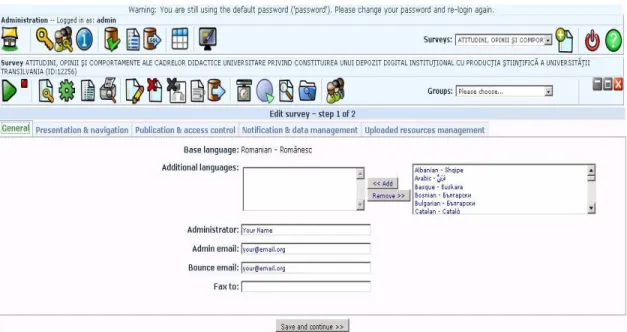
Fig. 1. How to do a survey
We used Limerik.
Fig. 3. Creating one question group
Following the introduction and informed consent pages, the survey questions were divided into three sections, each having a “submit” (save) button. Questions were not numbered. The first section contained demographic questions, the second section contained questions about the online community where the invitation was posted, and the last section contained questions about an online community that the participant had permanently left. This
last section was optional. Coded questions used drop-down menus, radio buttons, and check boxes with nominal scales, Likert scales, semantic differential scales, and single and multiple choice selection options (Figure 4). Open-ended questions were limited to optional opportunities at
the end of a coded question set and were presented via text-input boxes with wrapping and scrolling, not single-line entry.
Fig. 5. Introducing data and visualizing questions
5. The Quality Criteria for Electronic Surveys Provide Choices
We did not implement all the
recommended criteria for quality electronic surveys but did implement those that made sense for the research objectives, context, and content of this study. As discussed previously, the survey succeeded in reaching a significant portion of hard-to-involve academic staff online community
participants. From the case study
experience, the most important criteria contributing to survey success appeared to be the following:
• For design, all the criteria except adaptive question presentation, which was not used.
• For privacy and confidentiality, the criteria of full disclosure of study purpose and sampling procedures, those items that help to establish researcher
credibility, and the promise of
confidentiality and not requiring
identification, although as mentioned earlier, compromises may be needed to protect researchers from unpleasant, unsolicited e-mail.
• For encouraging high response rates, the
multistep invitation and survey
presentation process. Most important,
we responded to all inquiries rapidly and in detail.
6. Conclusion
The electronic survey had good
participation from the community that we wanted to survey.
Dependance on internet connection, and not having the possibility of saving answers, led to having a few abandoned initiatives.
References
1. Birnbaum, M. H. (2000). Surveywiz
and factorwiz: Javascript web pages that make html forms for research on
the internet. Behavior Research
Methods, Instruments and Computers,
32, 339–346.
2. Kehoe, C. M., Pitkow, J. E.,&Morton,
K. (1997). Eighthwwwuser survey.
Retrieved September 17, 2002, from http://www.gvu.gatech.edu/user_surve ys/survey-1997-10
3. Kiesler, S., & Sproull, L. S. (1986).
Response effects in the electronic
survey. Public Opinion Quarterly, 50,