Modern Diatom Distributions in Guanabara Bay Sediment and
Oceanic Areas, Rio de Janeiro (Brazil)
Distribuição das Diatomáceas Modernas nos Sedimentos da
Baía de Guanabara e Áreas Oceânicas, Rio de Janeiro (Brasil)
Lazaro L.M. Laut
1; Vanessa M. Laut
2 3; Frederico S. Silva
3& Alberto G. Figueiredo Jr.
11 Universidade Federal do Estado do Rio de Janeiro, Departamento de Ciências Naturais, Laboratório de Micropaleontologia – LabMicro. Av. Pasteur, 458, IBIO/CCET sala 500 Urca, 22.240-490. Rio de Janeiro, Brasil
2 Universidade do Estado do Rio de Janeiro, Faculdade de Geologia Programa de Pós-Graduação em Análises de Bacias e Faixas Móveis. Av. São Francisco Xavier, 524, sala 400A, Maracanã. 20550-013. Rio de Janeiro – RJ, Brasil
3 Universidade Federal do Rio de Janeiro, Departamento de Geologia, Laboratório de Palinofácies e Fácies Orgânicas. Av. Athos da Silveira Ramos, 274 - Bloco F Ilha do Fundão - Cidade Universitária. 21.949-900. Rio de Janeiro – RJ, Brasil
4 Universidade Federal Fluminense, Departamento de Geologia – LAGEMAR. Av. General Milton Tavares de Souza, 4º andar - Campus da Praia Vermelha – Gragoatá. 24210-346. Niterói – RJ, Brasil
E-mails:[email protected]; [email protected]; [email protected]; [email protected] Recebido em: 26/01/2011 Aceito em: 17/08/2011
Abstract
One hundred and ifty three supericial sediments were collected in Guanabara Bay to physical-chemistry and diatom analyses in the ambit to Monitoring Project (CENPES/PETROBRAS). A total of 146 taxa of diatoms were identiied where the most frequent taxa in Guanabara Bay were Amphora spp., Coscinodiscus spp. and Navicula yarrensis
var. yarrensis. These species are potentially harmful that might harm isheries and mariculture during blooms. The values
of ecological indexes like richness and diversity followed the estuarine gradient were the higher values were found in the mouth and de low in the inner part. The multivariate analyzes permitted recognize seven diatom assemblages in the bay. The DCA analyze shows the most inluence in the distribution of assemblages were the depth and pH. The diatom assemblages analyze proved to be an eficient tool in the environmental diagnosis of Guanabara Bay.
Keywords: Guanabara Bay; benthic diatoms; environmental diagnosis
Resumo
Cento e ciquenta e três amostras de sedimento supericial da Baía de Guanabara foram coletadas durante o Projeto de Monitoramento Ambiental (CENPES/PETROBRAS). Foram identiicados 146 táxons de diatomáceas onde as espécies mais abundantes foram Amphora spp., Coscinodiscus spp. e Navicula yarrensis var. yarrensis. Estas espécies
identiicadas são potencialmente tóxicas e podem prejudicar peixes e a maricultura durante períodos de lorescência. Os índices ecológicos de riqueza e diversidade acompanharam o gradiente estuarino sendo maior na entrada da baía e baixos na região interna. As análises multivariadas permitiram reconhecer sete assembléias de diatomáceas na baía. As análises em DCA mostrou que os parâmetros ambientais mais inluentes na distribuição das assembléias foram a profundidade e o pH. Os resultados obtidos mostraram que as assembléias de diatomáceas são uma importante ferramenta na caracterização
ambiental da Baía de Guanabara.
1 Introduction
The complex nature of estuaries, derived from their hydrodynamics, as well as the presence of strong physicochemical gradients and intricate biological structure, imposes dificulties in forecasting the extension of anthropogenic impacts. Multidisciplinary approaches, speciic sampling strategies, as well as multiple analytical tools and a variety of models, have been used to tackle this problem (Silva et al., 2008).
Monitoring nutrient levels in estuarine systems is problematic because of periodic and diffuse input from non-point sources (Cattaneo & Prairie, 1995).
The micophytobenthos has been recently
reviewed and was referred to as a “secret garden”
(MacIntyre et al., 1996). Diatoms are considered the most important constituent of this benthic
microalgae assemblage in estuarine and shallow
coastal environments (Mc Lusky, 1989). Several studies have revealed a highly diverse and productive
diatom assemblage within coastal and shelf sediments (Admiraal et al., 1982; Riaux, 1983; Riaux-Gobin et al., 1998) – for instance, the chlorophyll a content
per m2 of shelf bottom may exceed that of the entire
overlying water column (Cahoon et al., 1990).
Diatoms are widely used to monitor polluted aquatic environments because they are sensitive to water chemistry, especially ionic content, pH,
dissolved organic matter and nutrients. Wide
geographic distribution and the well-studied ecology of most diatom species are cited as major advantages in using diatoms as indicator organisms (McCormick & Cains, 1994). These assumptions imply that diatom-based water-quality assessment tools should have universal applicability across geographic areas
and environments.
Some studies have been done to understand
the interactions between diatom populations on mudlats and various environmental factors that explaining their spatial and temporal distribution (Admiraal, 1977; Admiraal & Peletier, 1979;
Adimraal et al., 1982). However, the diatom metrics or indexes developed in some geographic area have less successful when reapplied in other areas (Pipp, 2002). This is due not only to loristic differences
among regions, but also to environmental differences
(Kelly et al., 1998) that modify species’ responses to water-quality characteristics.
Ecological studies on estuarine and shallow coastal water diatoms are few in number, compared with freshwater and open ocean habitats (Sylvestre et al., 2004), and very few studies have been done in tropical areas. The concern is mainly focused on temperate estuaries (Admiraal, 1984; Sullivan,
2001).
Considering the studies of coastal environment monitoring in order to evaluate the use of bio-indicators to assess the impact of human activities on urbanized littoral zone, this paper aims to study
the distribution of modern diatoms on the sediment
from Guanabara Bay to determine estuarine gradient and the impact of human activities on the quality of bay water and sediment.
2 Environmental Settings
Guanabara Bay is one of the largest bays on
the Brazilian coastline, located in Rio de Janeiro
State. The bay, including its several islands, has an area of approximately 384 km2 and presents a
coastline 131 km long and a mean water volume of 1.87 x 10⁹ m3 (Amador, 1997; Kjerfve et al., 1997).
The hydrographic basin extends over 4,080 km2 and
includes 45 rivers, 6 of which are responsible for 85% of the runoff (100 ± 59 m3/s). The mean halfwater
volume renewal time is 11.4 days, although in some parts of the bay it is signiicantly higher. Temperature (24.2 ± 2.6°C) and salinity (29.5 ± 4.8 S) proiles show a well-mixed water condition at the bay mouth, extending up to 15–20 km inwards. Thereafter, the system is moderately stratiied. A sandbank located on the ocean side of the bay mouth greatly inluences
the inner water circulation due to current channeling (Kjerfve et al., 1997).
Tides are mixed mainly semidiurnally with a range of 0.7 m and peak spring tidal currents reach 0.5 m/s inside the bay and 1.6 m/s near the bay entrance. The central channel, with depths of 30-40 m and delimited by the 10 m depth isoline, transports the sand into the bay. The bottom topography is inluenced by tidal currents that drain through the central channel, and by a strong sediment input. The
increase in width after the entrance channel results in a decrease of tidal current velocities, leading to
from the active transport of clastic material and from intensive primary production are found in the bay’s northern area (JICA, 1994; Kjerfve et al., 1997).
A strong stratiication of dissolved oxygen is observed in areas where depths are under 10 m. Surface oxygen values reach 300% oversaturation in the photic zone (< 5 m), while bottom (4-5 m) concentrations may stay below 1 ml/l (Rebello et al., 1990). Approximately 11 million inhabitants live in the Greater Rio de Janeiro metropolitan area and, as a result of rapid urbanization and population growth, untreated sewage is discharged directly into the bay.
This area is the second largest industrial region in Brazil and has over 12,000 industries operating along the Guanabara Bay drainage basin, and these account for 25% of the organic pollution released into the bay (FEEMA, 1990). Two oil reineries process 7% of the national oil and approximately 2,000 commercial ships dock in the port of Rio de Janeiro every year, making it the second largest harbor in Brazil. The bay is also homeport to two naval bases, a shipyard, and a large number of ferries, ishing boats and yachts (Kjerfve et al., 1997). Over the past 100 years, catchment areas around Guanabara Bay have been greatly modiied by deforestation and uncontrolled settlement. These activities have increased river low velocities and transport of sediment load, resulting in a sediment deposition of 1 to 2 cm/year (Godoy et al., 1998). Guanabara Bay is considered one of the most polluted environments
on the Brazilian coastline (Rebello et al., 1986; Baptista-Neto et al., 2006).
3 Material and Methods
One hundred and ifty three sediment samples were collected with Ekman grab between October 2005 and May 2007 as part of the PETROBRAS Guanabara Bay Environmental Monitoring Project (Figure 1). Sample sites were chosen to represent the different perimeter characteristics, including natural and human impacts. Surface sediment samples were collected (10 ml) by scraping 5 mm from several points within the grab area, in order to reduce bias due to patchy distribution of diatom cells. The measurements of physical-chemical patterns were taken with portable equipment.
Grain size analyses were performed according to Suguio (1973) method, in which wet sediment samples pass through a 0.062 mm
sieve. The sand is separated from the mud. The silt and clay fractions were analyzed using the pipette method.
Total organic carbon (TOC) and total nitrogen (TN) were determined on precisely weighed (2–5 mg) sediment samples using a Carlo Erba EA 1110 elemental analyzer. Inorganic carbon was removed prior to the analyses with hydrochloric acid, following the method of Hedges & Stern (1984). Quantiication was performed by using calibration curves and cystine as standard. Reference material MESS-2 (National Research Council of Canada) was used to verify accuracy. Analytical precision was G1.7% for TOC and G2.8% for TN while detection limits were G0.06% for TOC and G0.01% for TN.
The sediment (10 ml) was processed with 10% HCl and 30% H2O2 to remove carbonates and
organic matter, respectively. A small quantity of sample (0.4 ml) was evaporated onto cover slips, and subsequently mounted onto a glass slide with Naphrax. A minimum of 300 diatom valves were identiied and counted along parallel transects from each sample using a Zeiss light microscope (1,000 x magniications).
Taxonomic identiications were based on several works, including Hendey (1964), Schoeman (1973), Ehrlich (1975), Germain (1981), Krammer & Lange-Bertalot (1986–1991), Noël (1984), Ehrlich & Dor (1985), Simonsen (1987) and Ehrlich (1995). Data concerning ecology of the taxa were compiled from previous references, in addition to Noël (1982), Poulin et al. (1984, 1986), Gasse (1986), Dor & Ehrlich (1987) and Witkowski (1994).
Ecological index such as abundance, richness (number of species), constancy, diversity and equitability were used in interpreting the data on the identiied species.
Diversity (H’) is an index proposed by Shannon-Wiener (1949) that is appropriate for random samples of species from the community or sub-community of interest and is estimated by H’= ΣpiLnpi, where pi represents the proportion
of the i-th species in the sample and Ln is the
natural (base e) logarithm. For calculation of the
diversity (H’) index the Software MVSP 3.1 was used. Equitatibility (J’) refers to the individual’s distribution among species, being proportional to the diversity and inversely proportional to the dominance. It compares the Shannon-Wiener diversity with the distribution of the observed species, maximizing the diversity. This index is
obtained through J’=H’/Ln (S), where S is the richness of species, H’ is the Shannon diversity
index and Ln is the natural (base e) logarithm. The Software MVSP 3.1 was used.
To multivariate analyses we used stations in
which the number of frustules counted was greater than 100. Diatom abundance data were standardized
to the square root of 0.5. Detrended Correspondence Analysis (DCA or DECORAMA) was used to show
which of the environmental variables measured
inluences community structure. To calculate percentage of variance, Relative Euclidean Distance in PCord 4.0 software was used. Environmental variables used in DCA analysis were temperature, salinity, carbon concentration, pH, Eh, depth, oxygen, nitrogen, phosphorus and C/N relation.
4 Results 4.1 Abiotic
The temperature, salinity and pH values ranged from 23.0 - 25.0 °C, 10.0 - 36.0, and 6.68-7.85, respectively. The means were 23°C, 30 and 7.48, respectively. The highest temperature
values were found at the river mouths and in the
northwestern bay. Salinity and pH were highest in
the central channel (Figure 2).
The Eh and dissolved oxygen values ranged from -700 – 326 and 0.0 - 8.3 mg/l, respectively. Mean values were -123 and 1.9 mg/l, respectively. The highest values were found at the mouth of the bay (Figure 3).
The values of total organic carbon (TOC), nitrogen and phosphorus ranged between 1.09 - 8.14%, 0.23 - 1.27% and 531 - 1032 ug/g, respectively. Mean values were 2.00%, 0.37% and 159.92 ug/g, respectively. The highest values were found in the northwestern part of the bay and at the river mouths (Figures 3 and 4).
The C/N rates ranged between 7 - 15% and the mean was 12%. The highest values were found before the Rio de Janeiro-Niterói Bridge on both sides of the bay mouth (Figure 4).
The grain size distribution relects the tidal current energy near the bottom, which is directly inluenced by bottom morphology and the Guanabara Bay shoreline contour. Bay bottom sediment ranges from clay to coarse sand. Sedimentary textures can comprise from 0% to 100% sand, 0% to 92% silt and 0% to 85% clay. The samples from Guanabara Bay were classiied into three principal groups:
sand, silt and mud, by mean (Figure 5).
4.2 Biotic
A total of 146 diatom taxa were identiied (Tables 1-5) in seventy six samples, while 51 are exclusively benthic and 18 exclusively planktonic.
In 77 stations no diatom frustules were identiied, and at some stations like P38, P40, P42, P45, P46, P48, P52, P134 and P150 the number of frustules was not greater than 100 (Tables 1-5).
Navicula spp., Plagiogramma pulchellum
and Navicula sulcata were the dominant species at sampling stations, with 15-56% total frustules. Amphora spp. and Gramatophora marina displayed highest abundance values at the stations facing the bay mouth. Bidduphia spp. showed most signiicant frequencies behind Governador
Island. Paralia sulcata was found abundantly at São Gonçalo coast and Paquetá and Governador islands (Tables 1-5).
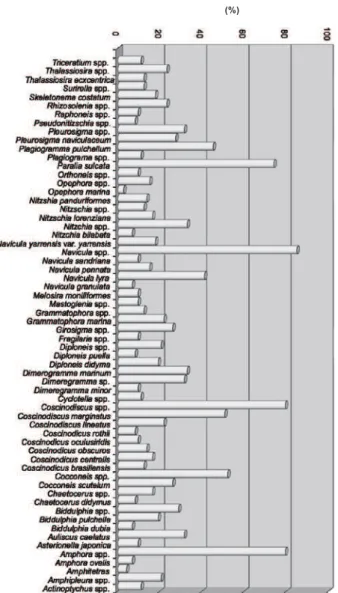
Navicula yarrensis var. yarrensis presented the highest constancy index, being present at 83% of stations sampled. Amphora spp. (78%), Plagiograma spp. (73%), Coscinodiscus spp. (78%), Cocconeis spp. (52%) and Coscinodiscus marginatus (50%) also presented high constancy index in Guanabara Bay (Figure 6).These taxa’s highest frequencies occurred at the stations in the central area of the bay, in small inlets like Botafogo
and Jurujuba and in the area behind Governador
and Paquetá islands.
Chaetocerus spp. presented low constancy index (10%) concentrated in the mouth of bay (stations P04, P05, P15, P20, P87, P89, P94 and P95) and Paquetá Island (P112, P114,P117 and P120) with the abundance between 1-9%.
Coscinodicus centralis showed low
constancy index (15%) and low abundance (1-3%) in the mouth of bay (P01, P03, P04, P15, P19, P20, P27) and São Gonçalo coast (P103, P108, P111).
Gyrosigma spp. presented low values of constancy index (25%) distributed dispersal along the bay showed abundance between 1-20%.
Figure 2 Abiotic parameters (temperature, salinity and pH) from Guanabara Bay. These
dates were collected during the
Figure 3 Abiotic parameters (Eh, Oxigen and Cabon-TOC) from Guanabara Bay. These
dates were collected during the
Figure 4 Abiotic parameters (nitrogen, phosphorus and C/N) from Guanabara Bay. These
dates were collected during the
Richness decreased toward the inner area of
Guanabara Bay. Mean richness at the bay mouth was 17 species/station, while in the inner bay it was 15 species/station. Stations P 50 (2 species), P52, P45, P46 and P48 (3 species), P40 (4 species) and P42 (5 species) presented the lowest richness values in the inner bay. In the middle region, with a mean of 16 species/station, only 3 stations presented very low index: P150 (5 species), P38 and P48 (8 species) P48. At the bay mouth the only anomalies were seen at station P07, which presented 2 species, and at P21, with 8 species (Tables 1-5).
A decreasing gradient was also seen for the
diversity index H’, with values of 2.1, 2.0 and 1.7
for the bay mouth, middle region and inner bay, respectively. The station presenting lowest diversity
Figure 5 Grain size analysis from Guanabara Bay.
(%)
was P 116 (0.3) in the inner bay, and the one presenting the highest was P 15 (2.8), in the middle part. The equitability index values were between 0.2 in the station P116 and 1.0 in the stations P07 and P40 (Tables 1-5).
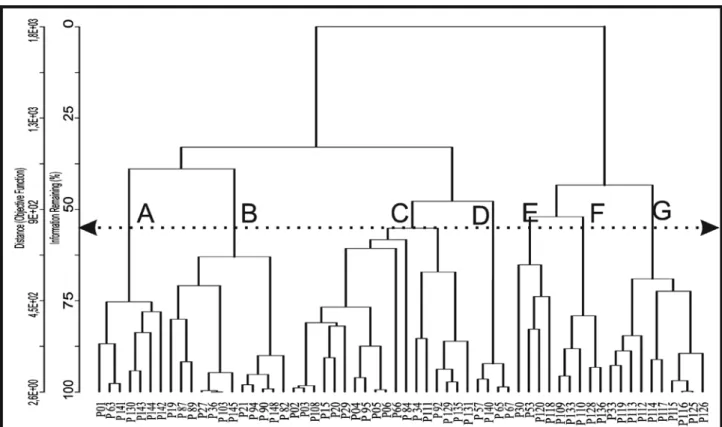
Q-mode cluster analysis generated seven station groups using a cutting at the 60% level (Figure 7): Group A comprised stations in the inner bay except for P01; Groups B and C comprised stations spread all over the bay; Group D comprised stations from the most conined region of Governador Island; and Groups E, F and G were composed of stations in the bay’s middle region, including Paquetá and
Governador islands.
Multivariate DCA analysis presented a correlation coeficient between distances of 47% for axis 1 and of 13% for axis 2, deining six stations groups (Figure 8). Environmental variable pH, followed by depth, was the most inluential variable on axis 1. On axis 2 salinity displayed the largest vector, followed by temperature, carbon and Eh. The C/N ratio presented a 45º vector and therefore showed no signiicant inluence in the analysis. Oxygen, nitrogen and phosphorus had very short vectors and were at the center of the axis.
Figure 7 Cluster analysis in Q-mode of diatoms samples stations in Guanabara Bay.
no signiicant relation to axis 1. On axis 2 this group correlated positively to salinity and negatively to temperature, carbon and Eh (Figure 8).
The same analysis, when performed with
benthic diatoms, showed that D. marinum, Cymbella spp., N. henedy, N. granulata, C. hustedii, C. obscuros, Orthoneis spp., N. sandriana, P. lineatus
and P. agutum were the species most correlated to
basic pH and shallower depths, and P. fasciola was
most correlated to acid pH and greater depths. In relation to axis 2 parameters, Pleurosigma spp. and Navicula spp. correlated to the highest salinities and lowest temperatures, while P. acominatum,
E. alata and N. yarrensis correlated to the lowest
salinity value and the highest temperatures, carbon and Eh (Figure 8).
5 Discussions
The physicochemical patterns (temperature, salinity and dissolved oxygen) identiied in Guanabara Bay agreed with those found by other authors. FEEMA (1990) took measurements near the
surface and near the bottom at 13 stations during the
period 1980-1993, and found a mean salinity of 29.5 ± 4.8%0 with a total range of 9.9 - 36.8%0. Based on
660 measurements by FEEMA at the same depths and stations, the mean water temperature is 24.2 ± 2.6°C with a total range of 17.0 - 31.0°C. As could be expected, net salinity decreases horizontally from
the mouth towards the inner reaches of Guanabara
Bay, at the surface from 31.8 to 21 and near the bottom from 34.59 to 26.1, due to the fresh water
discharge along the inner margins. At the same time,
the temperature increases from the mouth to the inner reaches of the bay, at the surface from 24.6°C to 26.5°C and near the bottom from 21.4°C to 25.5°C,
due to the advection of colder ocean water into the
bay. The entrance of cold water into Guanabara Bay on a regular basis, particularly during the austral summer, is associated with the Cabo Frio Island upwelling system (Kjerfve et al., 1997).
Kjerfve et al. (1997) founded that dissolved oxygen concentrations show large temporal luctuations in both surface and bottom waters. Mean values do not vary signiicantly horizontally, with the exception of the sites near the discharge of pollution-rich runoff, where bottom dissolved oxygen concentrations varied from 3.1 to 4.3 mg.l
-1. On the other hand, the bay shows strong vertical
stratiication, with dissolved oxygen in the bottom layer 2.3-4.8 mg.l-1 (20-45%) lower on the average
than in surface waters. In surface waters, the mean
dissolved oxygen concentration for all stations was
8.4 mg.l-1 (124% saturation), and in the bottom
layer 5.1 mg.l-1 saturation. Dissolved oxygen concentrations at the inner bay sites at times reach anoxic conditions near the bottom. Surface waters, in contrast, are frequently supersaturated with respect to dissolved oxygen, even in highly polluted areas, which relects the high rate of phytoplankton primary production.
The sand sediment occurs in the mouth of bay and follows the main channel, which constitutes the deepest part of the bay. This area is subject to intense hydrodynamic action from waves and tidal currents, indicated by the presence of sand waves (Catanzaro et al., 2004). According to Quaresma et al. (2000) and Kjerfve et al. (1997), these sand
waves occur along the eastern margin of the central
channel between the 10 and 6 m isobaths. These sand waves attain heights of 0.5-2.5 m, lengths of 18-98
m, and decrease in both height and wavelength from
the ocean into the bay in response to decreasing tidal energy. The sand waves have steeper slopes facing the bay, indicating wave progression and bottom sand transport into Guanabara Bay.
The north and center areas of the bay are also characterized by the presence of muddy sediments. In the bay’s innermost region, in the north of Governador Island (NW), predominance of clay-silts is seen, a coarser sedimentation than in the NE side in the same region. This probably occurs because rivers providing input to this area are strongly impacted by human activity, which indicates signiicant population density in the region. On the other hand, in the NE bay muddy sediments clays predominate. Such sedimentation can be explained as a product of the combination of lower hydrodynamics with the presence of mangrove vegetation, which acts as a trap, which allows only the inest sediment to pass into the bay.
TOC results obtained were similar to those from the literature. Baptista-Neto et al. (2000) found
3-5% variation in total organic carbon for Jurujuba Inlet, Guanabara Bay. The authors justiied these values by the restricted entrance of water and the high levels of domestic efluents. The lowest levels were found in higher energy environments, at the Cachoeira River mouth and the southernmost part of the inlet. Carreira et al. (2001), looking for an indicator of recent pollution for domestic sewage in the bay, sampled 8 stations and found TOC values of 2.83–5.54 %. The highest value was found more at
northeast, near the mangrove forests, indicating high
contamination levels. This region is characterized by water input from a great number of contaminated rivers and by the low water renewal rate. Eichler et al. (2003) found similar values when they collected samples in winter and summer in Guanabara Bay, obtaining values ranging from 0.018 to 5.763% in winter and 0.243 to 6.023% in the summer. Vilela et al. (2003) found TOC values of 0.04–4.14 % (bay mouth); 1.9 – 3.89% (central channel); 0.31– 6.13 % (Rio de Janeiro harbor); 3.23–4.2 % (Niterói harbor); 3.7-4 % (Guapimirim APA) and 3.09–4.81 % (REDUC). Vilela et al. (2003) concluded that the high
TOC values in some samples can be accounted for by the proximity to oil reinery pipelines and industrial
and domestic sewage discharges. In the central area,
The distribution of brackish planktonic species along the central channel and at the bay mouth indicates an eficient circulation in the system, although the highest values of brackish species abundance were found in low-energy regions such as behind Governador and Paquetá Islands, and in
Botafogo and Jurujuba Inlets. Pseudo-nitzschia spp. was identiied only in Paquetá Island stations (P111, P113, P114 and P119). These species occur in chains of up to eight cells (Lange et al., 1994) and are abundant in estuarine systems. The low
occurrence of Pseudo-nitzschia spp. frustules in Guanabara Bay was interpreted to indicate that these thin-walled, poorly siliciied planktonic diatoms failed to preserve their frustules in saline (32–34), slightly alkaline (7.6–7.8) and anaerobic sediments. The genus Pseudo-nitzschia has been known as a potential domoic acid producer (Hasle, 2002). High concentrations of this acid in water, caused by Pseudo-nitzschia blooms, can be toxic because
domoic acid accumulates in the food chain (Bates
et al., 1989). Intoxication effects are stomach
disturbance, vertigo and, in serious cases, death of
the organism (Procopiak et al., 2006).
The acidophilic taxon Frustulia is normally found up rivers (Wetzel, 2001). Its occurrence at the mouth of the bay may be the result of water exchange between Itaipu Lagoon and Guanabara Bay. Thus, the occurrence of the marine species Amphora spp., Gramatophora marina and Coscinodiscus centrales (Sylvestre et al., 2004) at the bay mouth signals the transport of marine sediment and of ocean water into the bay.
Navicula yarrennsis was the most constancy species in Guanabara Bay but it was not found in the lecture information about its ecological preferences
Paralia sulcata was the second constant
species in Guanabara Bay. This species is habitually found in coastal plankton, and can also be benthically associated to sand sediment. It is very adaptable to depositional conditions, low depths, salinity variation and mud sediments rich in organic matter (Gutiérrez
& Schillizzi, 2002).
The genera Nitzschia and Gyrosigma are
characterized by high motility rates within the sediment (Admiral, 1984), are particularly adapted to luid sediment conditions and could probably
be considered as biological indicators of degree of
substrate stability. On the other hand, Navicula spp. is the taxon which grows under more stable sediment
conditions (Syvestre et al., 2004). In Guanabara
Bay, Nitzchia spp. and Gyrosigma spp. were most frequently found in organic mud sediment, low oxygen conditions, acid pH and low carbon concentrations (P34, P40, P63, P130).
Some species are considered as potentially harmful but not toxic, because their blooms have been related to mortality of ilter-feeding organisms. The
genus Chaetoceros has been reported in the literature to harm the gills of ilter-feeding organisms, because
of the ornamentation arrows in their frustules. On the Rio de Janeiro State coast, this genus has been
found with more signiicant abundance at the mouth of Guanabara Bay. Coscinodiscus centralis produces polysaccharides which, at high concentrations, can render the environment anoxic. This species is also abundantly found in other bays in southern Brazil (Procapiak et al., 2006). In Guanabara Bay it shows constant but low abundance. We could not ind any information in the literature on the potential toxicity
of other Coscinodiscus species.
Both diversity and richness values were found
as a result of the estuarine character of Guanabara
Bay. At the mouth, the exchange with oceanic water collaborated to the existence of more species. However, in the inner bay, with its low hydrodynamics and a limited renewal of oligoelements, species
numbers fall.
The Shannon diversity index was used in several studies to assess the occurrence of pollution in biologic sampling. Values >3 can be considered as indicators of non-polluted conditions; values between 1 and 3 of moderated polluted conditions; and values <1 of a highly polluted condition (Matta & Flym, 2008). There were no stations with a Shannon index >3 in Guanabara Bay. Diversity index means in Guanabara Bay stayed between 1.7 and 3, indicating a moderately polluted condition. According to the Shannon diversity index, the most polluted regions were Piratininga Beach (P07), Guapimirim and Magé coasts (P45, P50, P52 and P 57), Duque de Caxias coast (P66), Paquetá Island (P115) and Governador Island (P125). In addition, stations P66, P116 and P125 showed a lower equitability index. This is the relex of the diatom population disequilibrium in
these regions.
on ecological factors. Cluster analysis and DCA indicate that diatom distribution in Guanabara Bay was inluenced by environmental factors such as pH, salinity and temperature.
Q-Mode cluster analysis revealed individual compartments in the bay. Groups A and D represented the most parallic environment in the bay. On the other side, Groups B and C represented the central channel, where higher hydrodynamics exist. Groups E, F and G represented channels between the islands.
DCA showed that the Paquetá and Governador Island stations (Groups I and II) were the most acidic sites. These regions receive discharge from rivers and tidal channels in the coastal. Consequently, they have low salinity, low depth, high temperature, high Eh and carbon concentration. The other groups (III, IV, IV and VI) were separated basically by depth and salinity.
Ponader et al. (2007) found through
multivariate analysis that nutrient concentrations (phosphorus and nitrogen total) were important in explaining variations in diatom assemblage composition. In our analysis, these patterns showed secondary importance to diatoms distributions. The oceanic inluence can plays the most important role in the biological features of the bay.
Most nutrient concentrations are caused by
discharge water from drains and channel that runoff
to the bay. High human population density and high levels of atmospheric pollution characterize this area (Amador, 1980; Baptista-Neto et al., 2006). Among
the physical and chemical variables, particularly organic concentration and eutrophication seem to be the most important environmental factors determining the composition and structure of diatoms species composition (Oliveira et al., 2001).
In the DCA we did not test for TOC inluence on assemblages. Nevertheless, we could see that at the stations where high values of TOC were measured, diversity, richness and equitability were low.
We did not consider that in harbor
regions such as Guanabara Bay the increase in turbidity and suspended solids during dredging signiicantly changes light penetration. Fine, living particles in suspension interfere with light penetration and constitute an important
environmental factor in growth distribution of
both attached and planktonic algae (Reynolds,
1996). Benthic diatom density can be decrease immediately after dredging or any events that revolve the sediment (Licursi & Gómes, 2009). In turbid habitats, implicated in sediment loading/resuspension, periphyton can actually bloom, partly because of an enhanced access
to nutrients from close association with the incoming sediments that become an accumulated
in substrate. Licursi & Gómes (2009) found the diversity and number of species increased in sites where dredging works were carried out.
6 Conclusion
The physicochemical parameters identiied along Guanabara Bay do not differ from those already reported in the literature where an estuarine gradient can be clearly deined. The back part of
Governador Island and the river mouths that cross
the mangroves accumulate ine sediment and organic matter, becoming an anoxic, acid environment
with great nutrient concentration. On the other
hand, the central and outer parts of the bay present sandy sediment with organic matter concentrations restricted to the inlets, conditions which relect the high hydrodynamics.
The great diatom species richness could be identiied in the bay with dominance of Navicula spp. and Plagiogramma spp. and the most constant species in the bay was Navicula yarrensis var.
yarrensis.
Potentially harmful species that might harm isheries and mariculture during blooms were identiied. Tourism might also be harmed, since the algae secrete compounds that create bad odors and confer a disagreeable appearance to the water, compromising balneability. However, these species’ populations were small during sampling.
Low diversity and equitability index were identiied, showing polluted conditions especially at Paquetá and Governador islands.
The applied multivariate analyses indicated the existence of seven groups of diatoms in Guanabara Bay, mainly by pH, depth, salinity and temperature.
C. obscuros, Orthoneis spp., N. sandriana, P. lineatus
and P. agutum were the species most correlated to basic pH and shallower depths, and P. fasciola was the species most correlated to acid pH and greater depths, and may be used as environmental
bioindicators for these conditions.
Analysis of diatom assemblages proved an eficient tool in the environmental diagnosis of Guanabara Bay. These results can be used in monitoring and environmental planning studies, as well as in studies of Quaternary paleoenvironmental reconstruction. It is important to point out that harbor regions such as Guanabara Bay, where ships from all over the world dock, may be contaminated with exotic species through ballast water discharge. Thus,
cataloguing and understanding species distribution along the bay becomes needed, as an aid in the elaboration of environmental management plans to minimize possible impacts.
7 Acknowledgements
Table 2 Relative
abundance of diatoms
Table 3 Relative
abundance of
8 References
Admiraal, W. 1977. Experiments with mixed populations of benthic estuarine diatoms in laboratory microecosystems. Botanica Marina, 20: 479–485.
Admiraal, W. 1984. The ecology of
sediment-inhabiting diatoms. Progress in Phycological Research, 3: 269-322.
Admiraal, W. & Peletier, H. 1979. Sulphide
tolerance of benthic diatoms in relation to
their distribution in an estuary. Phycological Journal, 14: 185– 196.
Admiraal W.; Peletier H. & Zomer, H. 1982. Observations and experiments on the population dynamics of epipelic diatoms from an estuarine mudlat. Estuarine Coastal Shelff Science, 14: 471– 487.
Amador, E.S. 1980. Assoreamento da Baía de
Guanabara - Taxas de Sedimentação. Anais da Academia Brasileira de Ciências, 52(4):
723-742.
Amador, E.S. 1997. Baía de Guanabara e Ecossistemas Periféricos: Homem e Natureza.
Reporte Graica e Editora LTDA, Rio de Janeiro, 539 p.
Armengol, J. 1998. Efectos ecológicos del dragado
de embalse de Barasona. Limnética, 14:
17-33.
Bates, S.S.; Bird, C.J.; De Freitas, A.S. W.; Foxall, R.; Gilgan, M.; Hanic, L.A.; Johnson, G.R.; McGulloch, A.W.; Odense, P.; Pocklington, R.; Quilliam, M.A.; Sim, P.G.; Smith, J.C.; Suba Rao, D.V.; Tood, E.C.D.; Walter, J.A. & Wright, J.L.C. 1989. Pennate diatom Nitzschia pungens as the primary source of domoic acid, a toxin in shellish from eastern Prince Edward Island, Canadá. Canadian Journal of Fishing Aquatic Science, 46: 1203-1215. Baptista Neto, J.A.; Gingele, F.X.; Leipe, T. &
Brehme, I. 2006. Spatial distribution ofSpatial distribution of heavy metals in supericial sediments from Guanabara Bay: Rio de Janeiro, Brazil. Environmental Geology, 49: 1051-1063. Baptista Neto, J.A.; Smith, B.J. & Mc Allister,J.J.
2000. Heavy metal concentrations in surface
sediments in a nearshore environment, Jurujuba
Sound, Southeast Brazil. Environmental
Pollution,109(1): 1-9.
Brandini, F.P. 1982. Variação nictemeral de alguns fatores ecológicos na região de Cananéia (SP),
Diel variations of some ecological factors in
Cananéia region (SP). Arquivos de Biologia e Tecnologia, 25(3/4): 313-327.
Brandini, F.P. 1985. Seasonal succession of the phytoplankton in the Bay of Paranaguá (Paraná State – Brazil). Revista Brasileira de Biologia, 45(4): 687-694.
Brandini, F.P. & Thanm, C.A.C. 1994. Variaç�esVariaç�es diárias e sazonais do itoplâncton e parâmetros ambientais na baía de Paranaguá. Neritica,
8(1-2): 55-72.
Byers, S.; Mills, E. & Stewart, P. 1978. Comparison
of methods of determining organic carbon in marine sediments, with suggestions for a standard methods. Hydrobiologia, 58: 43-47. Cahoon, L.B.; Redman, R.S. & Tronzo, C.R. 1990.
Benthic microalgal biomass in sediments
of Onslow Bay North Carolina. Estuarine Coastal Shelf Science, 31: 805– 816.
Carreira, R.S.; Wagner, A.L.R.; Fileman, T. &
Readman, J. W. 2001. Distribuição deDistribuição de
coprostonal em sedimentos supericiais da Baía de Guanabara: indicador de poluição recente por esgotos domésticos. Química Nova,24(1): 37-42.
Catanzaro, L.F.; Baptista Neto, J.A.; Guimarãs, M.S.D.M. & Silva, C.G. 2004. DistinctiveDistinctive
sedimentary processes in Guanabara Bay – SE/Brazil, based on the analysis o echo-character (7.0khz). Revista Brasileira de Geoisíca,22(1): 69-83.
Cattaneo, A. & Prairie, Y.T. 1995. Temporal variability in the chemical characteristics along the Riviere de l’Achigan: How many samples are necessary to describe stream chemistry? Canadian Journal of Fishing in Aquatic Science,52: 828-835.
Cloern, J.E. & Cheg, R.T. 1981. Simulation model of Skeletonema costatum population dynamics in Northern San Francisco bay, California. Estuarine Coastal Shelf Science,12: 83-100. Ehrlich, A. 1975. The diatoms from the surface
sediments of the Bardawil lagoon (Northern Sinaï) – Paleoecological signiicance. Nova Hedwigia, 53: 253–277.
Ehrlich, A. 1995. Atlas of Inland-water Diatom Flora of Israël. The Geological Survey of Israel (eds), 166 p.
Ehrlich, A. & Dor, I. 1985. Photosynthetic microorganisms of the Gavish Sabkha. Ecological Study,53: 295–321.
de Janeiro, Brazil. Anuário do Instituto de Geociências – UFRJ, 26: 36-51.
FEEMA (Fundação Estadual de Engenharia do Meio Ambiente) 1990. Projeto de recuperação gradual da Baía de Guanabara, v. 1.
Ambiente. Rio de Janeiro, 203 p.
Gasse, F. 1986. East African diatoms: taxonomy,
ecological distribution. Bibliotheca
diatomologica, 11, 201 p.
Germain, H. 1981. Flore des diatomées. Soc. Nouv. Ed Boubée, Coll. ‘Faunes et Flores actuelles’, Paris: 444 p.
Godoy, J.M.; Moreira, I.; Bragança, M.J.; Wanderley, C. & Mendes, L.B. 1998. A studyA study of Guanabara Bay sedimentation rates. Jounal of Radioanalytical and Nuclear Chemistry,
227(1-2): 57-160.
Gutiérrez, B.T. & Schllizzi, R. 2002. AsociacionesAsociaciones
de diatomeas en Paleoambientes Cuaternarios de la costa Sur de La Provincia de Buenos
Aires, Argentina. Pesquisas em Geociências,
29(1): 59-70.
Hasle, G.H. 2002. Are most of the domoic acid-producing species of the diatom genus Pseudo-nitzschia cosmopolites? Harmful algae, 1:
137-146.
Hedges, J.I. & Stern, J.H. 1984. Carbon & nitrogen determinationsof carbonate-containing solids. Limnology & Oceanography,29: 657–663. Hendey, N.I. 1964. Bacillariophyceae (Diatoms).
In An Introductory Account of the Smaller Algae of British Coastal Waters. Fishery Investigations, HMSO, London, 4: 317 p. JICA. 1994. The study on recuperation of the
Guanabara Bay ecosystem, Tokyo: Japan International Cooperation Agency, Kokusai Kogyo Co., Ltd., 8 v.
Kelly, M.G.; Cazaubon, A.; Coring, E.; Dell’Uomo, A.; Ector, L.; Goldsmith, B.; Guasch, H.; Hürlimann, J.; Jarlman, A.; Kawecka, B.; Kwadrans, J.; Laugaste, R.; Lindstrøm, E.A.; Leitao, M.; Marvan, P.; Padisa´k, J.; Pipp, E.; Prygiel, J.; Rott, E.; Sabater, S.; van Dam, H. & Vizinet, J. 1998. Recommendations for the routine sampling of diatoms for water quality assessments in Europe. Journal of Applied Phycology,10: 215–224.
Kjerfve, B.; Ribiero, C.; Dias, G.; Filippo, A. & Quaresma, V. 1997. Oceanographic characteristics of an impacted coastal bay: Baía de Guanabara, Rio de Janeiro,
Brazil. Continental Shelf Research,
17(13): 1609-1643.
Knoppers, B.; Carmouze, J.P. & Moreira-Turcq,
P.F. 1999. Nutrient dynamics, metabolism & eutrophication of lagoons along the east luminense coast, state of Rio de Janeiro,
Brazil. In: KNOPPERS, B.A.; BIDONE,
E.D. & ABRÃO, J.J. (Eds.). Environemtal geochemistry of coastal lagoons systems of Rio de Janeiro, Brasil. Niterói: UFF/ Programa de Geoquímica Ambiental, p. 123-154.
Krammer, K. & Lange-Bertalot, H. 1986. Susswasserlora von Mitteleuropa. Bacillariophyceae 1. Teil: Naviculaceae.
Gustav Fischer Verlag, Jena, 876 p.
Krammer, K. & Lange-Bertalot, H. 1991. Susswasserlora von Mitteleuropa. Bacillariophyceae 3. Teil: Centrales, Fragilariaceae, Eunotiaceae. Gustav Fischer
Verlag, Jena: 576 p.
Lange, C.B.; Reid, F.M.H. & Vernet, M. 1994. Temporal distribution of the potential toxic
diatom Pseudo-nitzschia australis at a coastal
site in southern California. Marine Ecology Progress Series,104: 309-312.
Licursi, M. & Gómez, N. 2009. Effects of dredging
on benthic diatom assemblages in low stream.
Jounal of Environmental Management, 90:
973-982.
Matta, M.E.M. & Flynn, M.N. 2008. Estrutura daEstrutura da comunidade itoplanctônica no gradiente de salinidade do estuário de Cananéia – SP. Revista Intertox de Toxicologia, Risco Ambiental eSociedade, 1(1): 59-69.
McCormick, P. & Cairns Junior, J. 1994. Algae asAlgae as indicators of environmental change. Journal of Applied Phycology,6: 509–526.
MacIntyre, H.L.; Geider, R.J. & Miller, D.C. 1996. Microphytobenthos: the ecological role of the ‘secret garden’ of unvegetated, shallow-water
marine habitats: I. Distribution, abundance &
primary production. Estuaries,19: 186–201. McLusky, D.S. 1989. The Estuarine Ecosystem, 2nd
ed. Blackie, Glasgow. 215 p.215 p.
Noël, D. 1982. Les diatomées des saumures des marais salants de Salin-de-Giraud (Sud de la
France). Géologie Méditerranéenne, 9: 413–
446.
Noël, D. 1984. Les diatomées des saumures et des sédiments de surface du Salin de bras del Port (Santa Pola, province Alicante, Espagne). Revista de Investigaciones Geologicas, 38/39: 79–107.
Brazil: Relationship with abiotic variables. Brazilian Journal of Biology, 61(4): 523-540. Pipp, E. 2002. A regional diatom-based trophic state
indication system for running water sites in Upper Austria & its overregional applicability. Verhandlungen des Internationalen Verein Limnologie, 27: 3376–3380.
Ponader, K.C.; Chales, D.F. & Belton, T.J. 2007. Diatom-based TP & TN inference models & index for monitoring nutrient enrichment of New Jersey streams. Ecological Indicators, 7:
79-93.
Poulin, M.; Bérard-Therriault, L. & Cardinal, A. 1984. Les diatomées benthiques de substrats durs des eaux marines et saumâtres du Québec 3.
Fragilarioideae (Fragilariales, Fragilariaceae).
Naturalist Canadien, 111: 349–367.
Poulin, M.; Bérard-Therriault, L. & Cardinal, A. 1986. Les diatomées (Bacillariophyceae) benthiques de substrats durs des eaux marines et saumâtres du Québec 6. Naviculales: Cymbellaceae et Gomphonemaceae. Naturalist CanadienNaturalist Canadien, 113:
405–429.
Procopiak, L.K.; Fernandes, L.F. & Moreira Filho, H. 2006. Diatomáceas (Bacillariophyta) marinhas e estuarinas do Paraná, Sul do Brasil: lista de espécies com ênfase em espécies nocivas. Biota Neotrópica, 6(3): 11 p.
Quaresma, V.S.; Dias, G.T.M. & Baptista Neto, J.A. 2000. Caracterização da ocorrência de padr�es
de sonar de varredura lateral e sísmica de alta
frequência (3,5 e 7,0 kHz) na porção sul da Baía de Guanabara - RJ. Revista Brasileira de Geofísica, 18(2): 201-214
Rebello, A.L.; Haekel, W.; Moreira, I.; Santelli; R. & Schroder, F. 1986. The fate of heavyThe fate of heavy metals in an estuarine tropical system. Marine Chemistry, 18: 215- 225.
Rebello, A.L.; Herms, F.W. & Wagener, K. 1990. The cycling of iodine & iodate in a tropical estuarine system. Marine Chemistry, 29: 77-93.
Redield, A.C.; Ketchum, B.H. & Richards, F.A. 1963. The inluence of organisms on the composition of seawater. In: HILL, M.N.
(ed.). The sea. New York: John Wiley, p. 26-77.
Rezende, K.R.V. & Brini, F.P. 1997. Variação sazonal do itoplâncton na zona de arrembentação da praia do Pontal do Sul (Paranaguá-Paraná). Nerítica,11: 49-62.
Reynolds, C.S. 1996. Algae. In: GEOFFREY, P.; CALOW, P. (Eds.). River Biota: Diversity & Dynamics. Blackwell Science. 257 p.
Riaux, C. 1983. Structure d’un peuplement estuarien de diatomées épipéliques du Nord-Finistère, Oceanologica Acta, 6: 173–183.
Riaux-Gobin, C.; Tréguer, P.; Douvillé, J.L. & Le Roux, C. 1998. Microphytobenthos de deux sédiments subtidaux de Nord-Bretagne: I. Biomasses pigmentaires, luctuations saisonnières et gradients verticaux. Annales De L Institut Oceanographique,74: 29–41. Santos, V.S.; Vilac, M.C.; Tenenbaum, D.R. &
Paranhos, R. 2007. Auto-& heterotrophicAuto-& heterotrophic nanoplankton & ilamentous bacteria of Guanabara Bay (RJ, Brazil): Estimates of cell/ilament numbers versus carbon content.
Brazilian Journal of Oceanography, 55(2):
133-143.
Sevrin-Reyssac, J.; Machado, M.C.; Schutze, M.L.M.; Bibas, S.G.; Lima, I.C.; Lima, C.A. & Esteves, C.P. 1979. Biomass et productionBiomass et production du phytoplankton de la baie de Guanabara (État de Rio de Janeiro, Brésil) et du sector océanique adjacent. Variations de mai � juliletVariations de mai � julilet 1978. Bulletin du Muséum National D’histoire Naturelle,1(B4): 329-354.
Silva, F.S.; Pereira, D.C.; Nuñez, M.L.S.; Krepsk, N.; Fontana, L.F.; Baptista Neto, J.A. & Crapez, M.A.C. 2008. Bacteriological study of theBacteriological study of the supericial sediment of Guanabara Bay, RJ,
Brazil. Brazilian Journal of Oceanography,
56(1): 13-22.
Simonsen, R. 1987. Atlas & Catalogue of the Diatom Types of Friedrich Hustedt. Cramer, J. (ed.),Cramer, J. (ed.),
v.1, 2 and 3, Stuttgart.
Suguio, K. 1973. Introdução a sedimentologia.
Edgard Blucher, São Paulo, 317 p.
Sullivan, M.J. 2001. Applied diatom studies in
estuaries & shallow coastal environments. In: STOERMER, E.F.; SMOL, J.P. (Eds.). The Diatom: Applications for the Environmental & Earth Sciences. Cambridge Univ. Press, Cambridge, p. 334– 351.
Sylvestre, F.; Beck-Eichler, B.; Duleba, W. & Debenay, J.P. 2001. Modern benthic diatom distribution in a hypersaline coastal lagoon:
the Lagoa de Araruama (R.J.), Brazil.
Hydrobiologia,443: 213–231.
Sylvestre, F.; Guiral, D. & Debenay, J.P. 2004.
Modern diatom distribution in mangrove
swamps from the Kaw Estuary (French
Guiana). Marine Geology, 208: 281-293.
Mendonça Filho, J.G.; Baptista Neto, J.A. & Barbosa, C.F. 2003. Search for bioindicatorsSearch for bioindicators
of pollution in the Guanabra Bay: integrations of ecologic patterns. Anuário do Instituto de Geociências-UFRJ,26: 25-35.
Villac, M.C.; Mayr, L.M.; Tenenbaum, D.R. & Paranhos, R. 2001. Sampling strategiesSampling strategies
proposed to monitor Guanabara Bay, RJ,
Brasil. In: MAGOON, O.T.; CONVERSE,
H.V.; TIPPIE, V.; TOBIN, L.T. & CLARK, D.
(eds.). Coastal Zone’91. New York: American Society of Civil Engineers, p. 1168-1182.