EFFICACY OF
JOSHANDA
ZEEQUNNAFAS
AND
HABBE HINDI
ZEEQI
IN
ZEEQUNNAFAS
(BRONCHIAL ASTHMA) - AN
OBSERVATIONAL OPEN CLINICAL
TRIAL
1*Juned Ahmad, 2Md. Anzar Alam, 3Mohd. Khalid, 4Javed A Khan, 5MA Siddiqui
1,2 &3
PG Scholars (MD), Dept. of Moalajat (Medicine), National Institute of Unani Medicine (NIUM) Bangalore-560091
4
Lecturer, Dept. of Moalajat (Medicine), National Institute of Unani Medicine (NIUM) Bangalore-560091 5
Director, National Institute of Unani Medicine (NIUM) Bangalore-560091
(An Autonomous Organization under Dept. of AYUSH, Ministry of Health and Family Welfare, Govt. of India.) E mail: [email protected]
Mob: +91-7204777218
ABSTRACT Background:
Bronchial asthma is a major public health concern, affecting 100-150 million people worldwide and accounts for an estimated 1,80,000 deaths per year. Its incidence is swiftly escalating in India. Unani medicine is augment with many single and compound drugs, which own potential effects to cure the disease, but these formulations are not proof scientifically. Objective: To evaluate the efficacy of Joshanda Zeequnnafas and Habbe Hindi Zeeqi in the treatment of Zeequnnafas to provide safe and effective treatment for asthma. Methods: The clinical trial to assess the efficacy of Joshanda Zeequnnafas and Habbe Hindi Zeeqi in the management of asthma. 50 patients were screened and out of them 30 patients were selected for study. Joshanda Zeequnnafas and Habbe Hindi Zeeqi were administered orally 50 ml (as decoction) twice a day and 125 mg (as tablet form) twice a day for 45 days. Subjective and objective parameters follow up before and after treatment on 0, 15th, 30th, and 45th day of the treatment. In subjective parameter, paroxysmal dyspnoea and wheeze was analysed using paired proportion test. Objective parameter was assessed by the help of Spirometry in terms of ESR, Eosinophilia, FEV1, FEV1/FVC% and PEF and student paired t test was applied to get the results. Safety parameters included complete blood count, SGOT, SGPT, Blood urea, S. Creatinine, RBS, and Urine routine and microscopic; and were assessed on student paired t test. Results: The overall result was highly significant in terms of subjective and objective parameters specially FEV1and PEF (P<0.001) on completion of 45 day treatment course. FEV1/FVC%, ESR, and Eosinophilia were found to be insignificant as the results were P>0.178, 0.785, and 0.220 respectively. Conclusion: The study results suggest that the trials formulations are quite effective in the management of Zeequnnafas. No adverse effects were noted during the complete course of the study trial. Hence it infers that trial drugs are safe, and effective in the treatment of Zeequnnafas (bronchial asthma).
Key Words: Asthma, Balghami Mizaj, Habbe Hindi Zeeqi, Joshanda Zeequnnafas, Unani Medicine, Zeequnnafas,
INTRODUCTION:
In contemporary perspective Zeequnnafs is synonym to Bronchial Asthma [1]. In Unani system of medicine, Zeequnnafs also known as Dama, Intesabe Tanaffus, Zeequnnafas, Zeequnnafas Shoabi, Rabu, Buhar, etc
According to WHO asthma is a chronic disease characterized by recurrent attacks of breathlessness and
wheezing, which vary in severity and frequency from person to person [12]. Bronchial Asthma is an
inflammatory airway disease with episodic occurrences of dyspnoea and wheezing. The Global Initiative for Asthma (GINA) has proposed a descriptive definition of Asthma. “Asthma is a chronic inflammatory disorder of the airways in which many cells and cellular elements play a role.’’ Asthma is one of the most common
chronic diseases globally [13, 14]. The prevalence of asthma has progressively increased both developed and
developing countries [15]. Current estimates suggest that it affects approximately 300 million people worldwide
[16]. An additional 100 million persons will be suffered by 2025. [15]. It has increased in affluent countries over
the last 30 years but now appears to have stabilized, with approximately 10–12% of adults and 15% of children
affected by asthma. [17].The line of management for Bronchial Asthma in conventional medicine is mainly with
Bronchodilator therapies, Anti cholinergic, Corticosteroids, etc [18]. Though these drugs give swift relief of
symptoms but they have systemic side effects including immunosuppression, obesity, osteoporosis, gastric
ulceration, etc [19]. Hence to provide an everlasting effects with less or no side effect, Unani formulations may
play a vital task in controlling this disease. Unani system of medicine recommended a number of drugs that can
be successfully used in the treatment of Bronchial Asthma [20]. Unani physicians have been treating this disease
for thousands of years and they have mentioned various single as well as compound drugs viz; Kakra seenghi
(Pistacia integerrima) Arusa (Adhatoda vasica), Ajmod (Apium graveolens), Aslussoos (Glycyrrhiza glabra),
Bazrul banj (Hyoscyamus niger), Biskhapra (Trianthema portulaca), Doodhi (Euphorbia hirta), Nil(Indigofera:
tinctoria), Qinnab (Cannabis sativam), Sankhahuli (Evolvulus alsinoides), Thohar(Euphorbia tirucalli), Kushta Marjan, Kushta Post Bezae Murgh, Kushta Seemab, Kushta Tila, Laooq Khayarshamber, Kushta Abrak Safed,
for its treatment [21,22]. However, these drugs have not been scientifically explored so far, for their described
effects. So in order to provide safe and more effective drugs for Bronchial Asthma, the present study entitled
“Efficacy of Joshanda Zeequnnafas and Habbe Hindi Zeeqi in Zeequnnafas (Bronchial Asthma)” is designed.
METHODOLOGY:
The present study entitled “Efficacy of Joshanda Zeequnnafas and Habbe Hindi Zeeqi in Zeequnnafas
(Bronchial Asthma) patients - An Observational Open Clinical Trial " was conducted at National Institute of Unani Medicine hospital under department of Moalajat. Before starting upon the project, a comprehensive protocol was chalked out and submitted for ethical clearance from the institutional ethical committee of National
Institute of Unani Medicine, Bangalore. After ethical clearance (IEC No:NIUM/IEC/2011-12/002/Moal/02),
enrolling patients are. Total 50 patients were screened and out of them 30 patients of asthma were selected for the trial for the duration of 45 days. Informed consent was taken in English and also it was rendered in Kannada, Urdu, and Hindi as per need by the translators before start of the study. The GCP (Good Clinical Practice) guide line followed. This study was conducted between May 2012 to December, 2013 and after complete of clinical trial all documents are submitted to Dept. of Moalajat, NIUM, for documentation.
Criteria for Selection of Cases Inclusion Criteria:
Stable patients of bronchial asthma; Patients belonging to 15-70 years of age of either sex or patients willing to participate in the study.
Exclusion Criteria
Patients with terminal medical conditions such as cancer; Unstable cardiac diseases; Pulmonary tuberculosis; Renal insufficiency; Pregnant and lactating women; Cognitive impairment; Patients who failed to give written consent and patients below the age of 15 and above 70 years of age.
Procedure for study
After detailed history and examination, those patients fulfilling the inclusion and exclusion criteria were subjected to haematological, radiological investigations, and Spirometry. A written voluntary informed consent was obtained for the clinical trial, and the drug was allotted to the patients. In acute exacerbations of asthma, patients were advised to take inhaler therapy of conventional medicine. In selection of patients, following parameters were taken into consideration.
Subjective Parameters (before and after the treatment): Grading for-
Paroxysmal dyspnoea: (0=absent;1=mild; 2=moderate; and 3=severe).
Wheeze: (0=absent; 1=mild; 2=moderate and 3=severe).
Objective Parameters (before and after the treatment): Grading for
- Presence of Rhonchi: (0=absent; 1=present).
Over-inflation (assessed by X-ray): (0=absent; 1=present).
Pulmonary Function Test: FEV1, FEV1/FVC ratio, PEF by Spirometry
Clinical Evaluation of the Patients
History taking; Examination: general physical examination and chest examination; Investigations before and
after the treatment: Blood-(Hb%, TLC, DLC, ESR, SGOT, SGPT, Blood Urea, Serum Creatinine, RBS,
AEC);Urine-(routine and microscopic) and Others-( ECG, and X-ray Chest PA view).
PFT was carried out as a diagnostic criterion before and after the treatment. Spirometry can be helpful in
identifying the airflow obstruction, but can’t assess the degree of severity. Normal readings of PFT are FEV1 >
80%, PEF > 80%. Airflow obstruction is established by reduced FEV1/FVC ratio < 70%.The spirometer that
was used in the trial is available with the NIUM hospital. It is a SpiroWin (c) GENESIS brand [23].
Methods of Preparation:
A good quality of drugs was provided by the pharmacy of National Institute of Unani Medicine (NIUM). Before preparing the formula all drugs were properly identified by Chief Pharmacist of NIUM for their originality.
Joshanda Zeequnnafas is selected for trail is taken from Qarabadin-e-Azam[24].
The contents of Joshanda Zeequnnafascomprise of following ingredients.
S.No Unani names Botanical name Wt. of ingredients
1 Badiyaan Neemkofta Feoniculum vulgare 9 gram
2 Pudinaa Khushk Mentha viridis 9 gram
3 Aslussoos Muqashshar Neemkofta
Glycyrrhiza glabra 7 gram
4 Taj Cinnamomum cassia 7 gram
5 Sapistan Chordia dichotoma 11 Nos.
6 Neelofar Nymphaea nauchali 12 gram
The above mentioned ingredients were pulverized to make a powder. 50 ml decoction of 10 gm powder of
Joshanda Zeequnnafas prepared in water was given twice i. e. morning and evening for oral administration before meal.
Habb-e-Hindi Zeeqi is taken as reference from Qarabadin-e-Azam, NFUM Part I, Qarabadin Najmul Ghani, and Al-Qarabadin in the dosage of 125 mg twice daily[ 24,25,26,27].
S.No Unani Names Botanical Name Wt. of ingredients
1 Beesh Mudabbar Aconitum chasmanthum 3 gram
2 Post Beekh-e-Madar Calotropis procera 6 gram
3 Aab-e-Adrak Zingiber officinale 250 ml
Statistical analysis
Descriptive and inferential statistical analysis has been carried out in the present study. Results on continuous
measurements are presented on Mean SD (Min-Max) and results on categorical measurements are presented in
Number (%). Significance is assessed at 5 % level of significance. The following assumptions on data is made,
Assumptions: 1.Dependent variables should be normally distributed, 2.Samples drawn from the population
should be random, Cases of the samples should be independentStudent t test (two tailed, dependent) has been
used to find the significance of study parameters on continuous scale within each group.
Significant figures
+ Suggestive significance (P value: 0.05<P<0.10)
* Moderately significant (P value: 0.01<P 0.05)
** Strongly significant (P value: P0.01)
Statistical software: The Statistical software namely SAS 9.2, SPSS 15.0, Stata 10.1, Med Calc 9.0.1 ,Systat 12.0 and R environment ver.2.11.1 were used for the analysis of the data and Microsoft word and Excel have
been used to generate graphs, tables etc.
Results
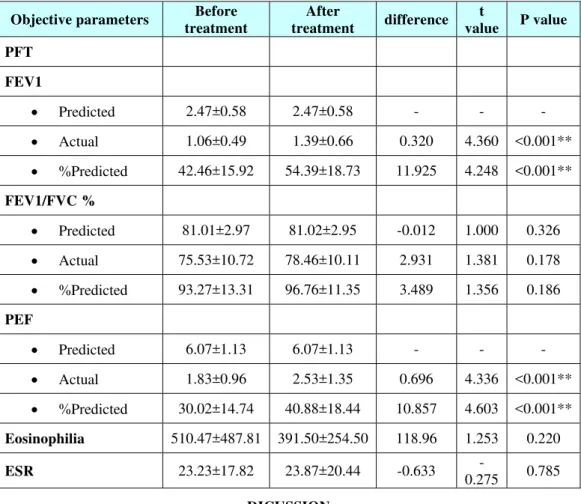
The overall result was highly significant in terms of subjective and objective parameters specially FEV1and PEF
(P<0.001) on completion of 45 day treatment course. FEV1/FVC%, ESR, and Eosinophilia were found to be
insignificant as the results were P>0.178, 0.785, and 0.220 respectively. All results are shown in table number 1,
Table No.1: An Evaluation of Clinical variables before and after treatment (safety parameters)
Before treatment After treatment difference t value P value
Hemoglobin (gm%) 13.94±1.85 13.92±1.99 0.017 0.058 0.954
TLC (cu/mm) 7125.00±1956.10 6996.67±22.09 128.333 0.246 0.807
Neutrophils (%) 60.50±7.51 62.73±8.29 -2.233 -1.135 0.266
Lymphocytes (%) 32.37±6.67 32.03±8.04 0.333 0.178 0.860
Monocytes (%) 1.13±1.07 1.07±1.48 0.067 0.220 0.827
Eosinophils (%) 5.93±5.93 4.13±3.33 1.800 1.655 0.109
Basophils (%) 0.03±0.18 0.00±0.00 0.033 1.000 0.326
ESR (mm/hr) 23.23±17.82 23.87±20.44 -0.633 -0.275 0.785
SGOT (I.U/L) 21.17±6.72 21.00±5.07 0.167 0.162 0.873
SGPT (I.U/L) 20.00±8.64 21.00±5.92 -1.000 -0.791 0.435
Blood Urea (mg/dl) 26.33±5.36 26.60±6.92 -0.267 -0.169 0.867
Serum Creatinine
(mg/dl) 0.90±0.13 0.89±0.13 0.003 0.141 0.889
Random blood
sugar (mg/dl) 95.80±16.85 102.43±27.77 -6.633 -1.225 0.231
Table No.2: Over inflection
Over inflation No. of patients
(n=30) % Before treatment
No 27 90.0
Yes 3 10.0
After treatment
No 30 100.0
Yes 0 0.0
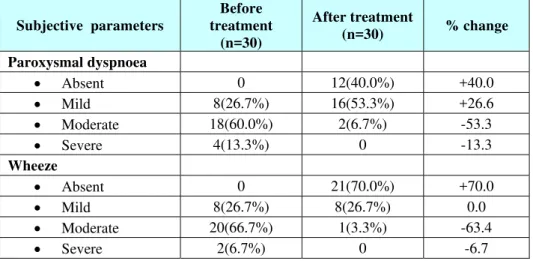
Table No.3: A Comparative evaluation of Subjective parameters before and after treatment
Subjective parameters
Before treatment
(n=30)
After treatment
(n=30) % change Paroxysmal dyspnoea
Absent 0 12(40.0%) +40.0
Mild 8(26.7%) 16(53.3%) +26.6
Moderate 18(60.0%) 2(6.7%) -53.3
Severe 4(13.3%) 0 -13.3
Wheeze
Absent 0 21(70.0%) +70.0
Mild 8(26.7%) 8(26.7%) 0.0
Moderate 20(66.7%) 1(3.3%) -63.4
Severe 2(6.7%) 0 -6.7
Table No.4: A Comparative evaluation of Objective parameters test before and after treatment
Objective parameters Before treatment
After
treatment difference t
value P value PFT
FEV1
Predicted 2.47±0.58 2.47±0.58 - - -
Actual 1.06±0.49 1.39±0.66 0.320 4.360 <0.001**
%Predicted 42.46±15.92 54.39±18.73 11.925 4.248 <0.001**
FEV1/FVC %
Predicted 81.01±2.97 81.02±2.95 -0.012 1.000 0.326
Actual 75.53±10.72 78.46±10.11 2.931 1.381 0.178
%Predicted 93.27±13.31 96.76±11.35 3.489 1.356 0.186
PEF
Predicted 6.07±1.13 6.07±1.13 - - -
Actual 1.83±0.96 2.53±1.35 0.696 4.336 <0.001**
%Predicted 30.02±14.74 40.88±18.44 10.857 4.603 <0.001**
Eosinophilia 510.47±487.81 391.50±254.50 118.96 1.253 0.220
ESR 23.23±17.82 23.87±20.44 -0.633
-0.275 0.785
DICUSSION
Asthma has far reaching connotation both on the children and adult people and if diagnose and treated at an
earlier age could have positive outcome on prognosis of the disease [17]. Incidence of Zeequnnafas is more
common in Mausam-e-Kharif (spring season) and Mausam-e-Sarma (winter season) and less in
Mausam-e-Garma (summer) [11]. Balghami mizaj are more prone to this disease [9]. During the clinical trial, all patients
were assessed for their Mizaj on the basis of Ajnas-e-Ashra. Maximum number of the patients 19 (63.3%) were
having Balghami Mizaj, followed by 7 (23.3%) Damvi, and only 4 (13.3%) were having Safravi temperaments.
The familial association of asthma is due to genetic predisposition [29].The relief in the paroxysmal dyspnoea
was achieved due to effects of trial drugs having actions such as Mukhrij-e-Balgham (expectorant),,
Muhallil-e-Auwram (anti-inflammatory), and Munzij-e-Balgham properties rendered by Poodina, Aslus-soos, Sapistan,Aakh,Badyaan,and Neelofar [30-33]. Wheeze develops due to spasmodic action in the bronchioles.
This effect was achieved by Adrak, BeeshBadyan and Taj, as these possess anti-inflammatory, antitussive and
anti-spasmodic action [34]. During the entire period of study duration, no apparent side effect was reported.
Keeping the above evidence based results into consideration; it infers that the test drugs can be safely used in the management of bronchial asthma. However, long term clinical trials are needed to further explore the other pharmacological actions of the test drugs.
CONCLUSION
On the grounds of above cited results and discussions, it infers that test drugs “Joshanda Zeequnnafas and
Habbe Hindi Zeeqi” are quite effective and safer for the management of asthma. However, other aspects of test drugs need to be explored to provide complete and safe remedy for bronchial asthma in large sample size, maximum dose, standard controlled and multicentre study with blinding.
Acknowledgment:
I would like to express my sincere appreciation towards my guide, Prof. M. A. Siddiqui, HOD, Dept. of
Moalajat and Director National Institute of Unani Medicine Bangalore. His positive attitude, scientific approach, knowledge and fatherly encouragement helped me to complete my dissertation work. I am profoundly indebted to him for inspiring me through his valuable suggestions, abundant affection and erudite guidance
References:
[1] Anonymous. Standard Unani Medical Terminology. New Delhi: C.C.R.U.M; 2012:201-202.
[2] Khan Azam. Romooz Azam (Farsi). 2nd ed. Vol-1, 2. New Delhi: CCRUM, Ministry of Health and Family Welfare;
2006:247,248,249,252.
[3] Khan Azam. Al-Ikseer. Vol.1. New Delhi:Aijaz Publication House;2003:436-452. [4] Khan Hakim Ajmal. Haziq. Ed.1. Karachi: Madina Publishing Company; 1983:302-306. [5] Anonymous. Al-Munjid (Arabic-Urdu dictionary). Delhi: Farid book depot; YNM: 103-4,367,599.
[6] Saunders, M, J.B. Dec. Huang Ti Nei Ching Su Wen, the Yellow Emperor's Classic of Internal Mediciner Calif Med. 1967; 107(1): 125–126.
[7] Jackson, Mark. Asthma: The Biography. UK: Oxford University Press; 2009:10-11. [8] Tabari Ali Ibn Raban. Firdaus ul Hikmat New Delhi: Idara Kitabush Shifa; 2010:195-197.
[9] Razi Abu Bakr Mohammad bin Zakariya. Kitab Al-Hawi (Urdu translation). Vol.4. New Delhi: CCRUM; 1998:9-39. [10] Ibn Sina, Al-Qanoon Fit Tib. Vol.3. Part I. New Delhi: Idara Kitabush Shifa; 707-714.
[11] Jurjani SI. Tarjuma Zakheera Khowarizm Shahi. ed.1. Vol.6. Lucknow: Munshi Nawal Kishore; 1878:257-260. [12] WHO. Chronic respiratory diseases. http:// www.Who.int / respiratory / asthma/en / . Cite on 17 august 2014. [13] Siddhartha N. Shah. API Text book of Medicine. 8thed. Vol-1. Mumbai: The Association of India; 2008: 355.
[14] Global Strategy for Asthma Management and Prevention. Global Initiative for Asthma. Available from: URL:
http://www.ginaasthma.org, 1 - 128 (2012).
[15] Christopher Haslett. Davidson’s Principles and Practice of Medicine. Ed.20. London: Churchill Livingston; 2006:670-677. [16] Anthony SF, Dennis LK, Dan LL, Eugene B, Stephen LH, Larry JJ, et al. Harrison's Principles of Internal Medicine. Ed.18e.
Vol.2. USA: The McGraw-Hill Companies; 2012.
[17] Ganaraja B, Bhattacharyya S, Panchami, R, Ramesh B. A Study of Propensity for Development of Bronchial Asthma in Preadolescents with Family History of Asthma by Spirometry and Body Mass Index. Research Journal of Pharmaceutical, Biological and Chemical Sciences.2012; 3(1):291-297.
[18] Calverley P MA. Modern treatment of chronic obstructive pulmonary disease. European Respiratory Journal. 2001; 18 (34):60– 66.
[19] Dahl R. Systemic side effects of inhaled corticosteroids in patients with asthma. Respiratory Medicine.2006; 100(8): 1307–1317.
[20] Anonymous.Unani System of Medicine.Dabur Research Organisation. Cited on 21 august
2014.http://www.dsir.gov.in/reports/ittp_tedo/ism/ISM_USM_Intro.pdf.
[21] Kabir H.Introduction to Ilmul advia. Shamsher Publisher and Distributors..U.P Aligarh India.2002.Cited on 21 August 2014. http://www. jamiahamdard. ac. In /PDF /ilmul-advia/Introduction%20to%20Ilmul%20Advia.pdf.
[22] Kabir H. Morakkabat (Unani Formulation). Shamsher Publisher and Distributors..U.P Aligarh India. 2003. Cited on 21 August 2014. http://www.e-bookspdf.org / download /unani-formulations.html.
[23] Arja et al. Genetic Determinants of Chronic Obstructive Pulmonary Disease in South Indian Male Smokers. PLOS ONE. 2014; 9(2): e89957. .doi:10.1371 /journal. Pone. 0089957.
[24] Khan Azam. Qarabadeen Azam. New Delhi: Ejaz Publishing House; 1996: 53,538.
[25] Anonymous. National Formulary of Unani medicine. Part.1. New Delhi: Ministry of Health and Family Welfare, Department of AYUSH; 2006: 18.
[26] Ghani N. Qarabadeen Najmul Ghani. New Delhi: CCRUM,Ministry of Health and Family Welfare; 2010: 804. [27] Kabiruddin HM. Alqarabadin ed. 2. New Delhi: CCRUM; 2006:129.
[28] Ganesh Kumar S, Gautam Roy, L. Subitha, Swaroop Kumar Sahu. Prevalence of bronchial asthma and its associated factors among school children in urban Puducherry, India. Journal of Natural Science, Biology and Medicine.2014;5(1):59-62.
[29] Fiocchi A, Terracciano L, Martelli A, Guerriero F, Bernardo L. Allergy Asthma Proc 2006; 27(3): 178-85. [30] Khan MA, Clinical Study of Zeequnnafas Shoabi and evaluation of efficacy of Unani Formulation NIUM:2010. [31] Ghani HN. Khazaenul Advia. ed.3. New Delhi: Idara kitabush shifa;2011:351.
[32] Kabiruddin A. Makhzanul Mufridat. New delhi: Ejaz Publishing House;YNM.