Original Article
Nutritional composition and physicochemical properties of two green seaweeds
(Ulva pertusa and U. intestinalis) from the Pattani Bay in Southern Thailand
Ommee Benjama* and Payap Masniyom
Department of Technology and Industry, Faculty of Science and Technology, Prince of Songkla University, Pattani Campus, Mueang, Pattani, 94000 Thailand.
Received 14 June 2011; Accepted 23 August 2011
Abstract
The chemical composition, amino acid, and element contents, as well as some physicochemical properties of Ulva pertusa and U. intestinalis, collected from the Pattani Bay in Southern Thailand in the rainy and summer seasons of 2007– 2008, were investigated in order to gain more nutritional information. It was found that the two green seaweed species contained high level of protein (14.6–19.5% DW), lipid (2.1–8.7% DW), ash (25.9–28.6% DW), soluble fiber (25.3–39.6% DW), insoluble fiber (21.8–33.5% DW) and total dietary fiber (51.3–62.2% DW). Comparing the element contents of the two species,
U. pertusa was rich in Mg, K and Ca, while U. intestinalis was rich in Mg, K, Cl, Na, and Ca. The essential amino acids of the two species were rich in leucine, valine, and arginine contents. The most limiting essential amino acid of both species was lysine. However, the nutritional composition of the two seaweeds varied depending on seasonal change. As for the physico-chemical properties of both seaweeds, their swelling capacity (SWC), water holding capacity (WHC), and oil holding capacity (OHC) ranged from 4.0 to 6.4 ml/g DW, 7.8 to 15.0 g/g DW and 1.4 to 4.8 g oil/g DW, respectively. WHC and OHC of U. intestinalis was higher than those of U. pertusa (P<0.05). This study suggested that both species could be potentially used as raw materials or ingredients to improve the nutritive value and texture of functional food and healthy products for human beings.
Keywords: nutritional composition, physicochemical properties, Ulva spp., green seaweeds, marine algae
1. Introduction
Marine macroalgae, commonly referred to seaweeds, are categorized by their pigmentation, morphology, anatomy, and nutritional composition as red (Rhodophyta), brown (Phaeophyta) or green seaweeds (Chlorophyta) (Dawczynski
et al., 2007). About 250 macroalgal species have been com-mercially utilized worldwide and about 150 species are favor-ably consumed as human food (Kumari, 2010). In Asian
countries, seaweeds have been utilized since the ancient times as source of human food, animal feed, fertilizer, fungi-cides, as well as herbicides (Fleurence, 1999; Sánchez-Machado et al., 2004). However, in Western countries seaweed polymers are especially used as sources of phyco-colloids, thickening, and gelling agents in food and pharma-ceutical industries (Mabeau and Fleurence, 1993; Rupérez, 2002). At present, the demand of food supplements from seaweeds has increased in Europe, North America, and South America (Manivannan et al., 2009).
Seaweeds are valuable sources of protein, fiber, vita-mins, polyunsaturated fatty acids, macro and trace elements, as well as important bioactive compounds (Ortiz et al., 2006). Thus, they have been recognized as being beneficial for human and animal health (Fleurence, 1999). However, the
* Corresponding author.
Email address: [email protected], [email protected]
nutrient compositions of seaweeds are different depending on species, habitats, maturity and environmental conditions (Ito and Hori, 1989). Generally, green and red seaweeds contain higher protein contents (10–30% DW, dry weight) than brown seaweeds (5–15% DW). Proteins are composed of various amino acids and their nutritional quality can be evaluated against the recommended amino acid pattern (FAO/WHO/UNU, 1985; Wong and Cheung, 2000; Matanjun
et al., 2009).
The lipid content of marine seaweeds accounts for 1–6% DW and provides a low amount of energy. The fatty acids in seaweeds are composed of polyunsaturated fatty acids (PUFAs) (Dawczynski et al., 2007; Kumari et al., 2010). They are good nutritional sources of C18 and C20 PUFAs such as eicosapentanoic acid (EPA) and docosahexaenoic acid (DHA), which cannot be synthesized by human bodies and must be gained from diet only (Kumari et al., 2010).
The element contents in seaweed are interpreted through their ash contents which range between 8–40% DW (Mabeau and Fleurence, 1993). Most seaweeds have more ash contents than terrestrial plants and animal products. Some of the trace elements in seaweeds are rare or absent in terrestrial plants (Ito and Hori, 1989; Rupérez, 2002). Thus, seaweeds are important sources of elements vital for the metabolic reactions in the human and animal health, such as enzymatic regulation of lipid, carbohydrate and protein metabolism (Nisizawa et al., 1987; Insel et al., 2007).
Seaweeds are also good sources of dietary fiber (33– 50% DW), which can be classified as soluble dietary fiber (SDF) and insoluble dietary fiber (IDF) (Lahaye, 1991; Rupérez and Saura-Calixto, 2001). The characteristics of dietary fiber are related to their physicochemical properties such as swelling capacity (SWC), water holding capacity (WHC), and oil holding capacity (OHC), which are important for improvement of functional properties in food (Elleuch et al., 2010).
In the Southern coast of Thailand, especially in the Pattani Bay, twelve seaweed species have been found (Ruangchuay et al., 2007). Red seaweed (Gracilaria spp.) and green seaweed (Ulva spp.) have been abundant in the coastal area. However, the utilzation of seaweeds is restricted to communities living in the coastal area. Gracilaria tenuistipitata and G. fisheri have been served fresh or used in dried products for both human beings and animals, whereas
Ulva species are still under-utilized because in Thailand the knowledge about their nutritional composition is still limited. Therefore the present study aimed to determine the chemical composition, amino acids, and element contents of
Ulva pertusa and U. intestinalis collected from the Pattani Bay in rainy and summer seasons in order to gain extensive information about their nutritional value. Furthermore, this research also investigated some physicochemical properties in order to evaluate their physiological effects in functional and health food.
2. Materials and Methods
2.1 Samples
Samples of the two seaweed species (U. pertusa and
U. intestinalis) were purchased from fishermen who collected them manually from the coastal area of the Pattani Bay during the rainy season in December 2007 and summer in April 2008. The seaweeds were thoroughly cleaned with running water to remove salt, foreign materials such as epiphyte, sand, shells. All cleaned seaweeds were dried at 60°C in a tray dryer for eight hours. Then they were ground into fine powder that could pass through a 0.5 mm sieve. The powder was dried again in an air oven at 60°C for three hours. Then it was stored in sealed aluminum bags at room temperature for further analysis.
2.2 Methods
2.2.1 Proximate analysis
The chemical compositions (protein, ash, and mois-ture contents) of the powder samples were determined according to the standard method (AOAC, 2000). The mois-ture content was determined by oven method at 105°C until their constant weight was obtained. Crude protein content was analyzed by the Kjeldahl method with a conversion factor of 6.25 to convert total nitrogen into crude protein. Ash content was acquired by heating the sample overnight in a furnace at 525°C and the content was determined gravimetri-cally. Crude lipid was extracted from the seaweed powder in a Soxhlet extractor with chloroform:methanol, 2:1, v/v by the method of Bligh and Dryer (1959). The crude lipid content was measured gravimetrically after oven-drying (80°C) the extract overnight. An enzymatic–gravimetric procedure was used to determine the soluble, insoluble and total dietary fiber (AOAC, 2000).
2.2.2 Macro and trace elements
The element contents of samples were analyzed by atomic absorption spectrophotometry (AAS) for Ca, Mg, K, and Na (method 985.35; AOAC, 2000), by inductively coupled plasma optical emission spectrometry (ICP-OES) for Cu and Zn (method 984.27; AOAC, 2000), by gravimetric method for P (Kolthoff et al., 1969) and by Chloride analyzer for Cl.
2.2.3 Amino acid analysis
at 110°C for 22 hours in sealed glass tubes under a N2 atmosphere. The HCl and phenol were then driven off by rotary evaporator. An internal standard was then added into the cooled hydrolysate which was diluted with deionized water and then 10 L of this filtrate was mixed with 70 L of AccQ fluor derivatization buffer and 20 L of AccQ fluor reagent. Samples were then heated at 55°C for 10 min in a heating block, before being cooled and analyzed. The chro-matographic separation was performed by using Waters Allicance 2695 HPLC system with Waters 2475 Multi fluo-rescence detector which was set at an excitation wavelength of 250 nm and an emission wavelength of 395 nm. The separation was achieved in a Hypersil Gold C18 column (3.9x 150 mm, particle size 3m). The mobile phase consisted of two solvents, (A) AccQ·Tag and (B) Acetonitrile in water. The identification of the sample amino acids was carried out by comparing their holding time with the retention times of amino acid standards (Sigma Chemicals).
Essential amino acids was compared with the FAO/ WHO reference amino acid pattern of pre-school children and calculated by the method of FAO/WHO/UNU (1985) as shown below:
100 protein reference of g per acid amino of mg
protein test of g per acid amino of mg (%) score acid
Amino
2.2.4 Physicochemical properties
Swelling capacity (SWC) of seaweed samples was measured by the bed volume technique after being equili-brated in excess solvent (Kuniak and Marchessault, 1972). Water holding capacity (WHC) was measured by the modi-fied centrifugation method described by Suzuki et al. (1996). Oil holding capacity (OHC) of samples was determined by the slight modified method of Caprez et al. (1986). These properties were studied at room temperature (30±2°C). The results of SWC, WHC, and OHC were expressed as ml/g DW, g/g DW and g oil/g DW, respectively.
2.3 Statistical analysis
All determinations were performed at least in four times. Statistical analysis was carried out by using the SPSS 10.0 version software for windows. The analyzed data were expressed as mean with standard deviation (SD). Paired sample t-test was used to identify significant differences at
P<0.05 between the mean values of both species and between the mean value of each species in two different seasons (rainy and summer seasons).
3. Results and Discussion
3.1 Chemical composition
3.1.1 Protein
The chemical composition of U. pertusa and U. intestinalis in the present study is shown in Table 1. The moisture contents of U. pertusa and U. intestinalis collected in rainy and summer seasons were similar, that is within the range 5.4–7.2% of the dry weight (DW). Both seaweed species contained relatively high protein values. The protein content of U. intestinalis (17.9% DW) was significantly higher than that of U. pertusa (15.4% DW). This result was consistent with the report of Fleurence (1999) who described that Ulva spp. had protein content within the range 10–26% (DW). Also, the two species’ protein contents were similar to those of Enteromorpha intestinalis (16.4% DW) and Padina gymnospora (17.1% DW) (Manivannan et al., 2008) but lower than those of some red seaweed species such as
Porphyra tenera (47% DW) and Palmaria palmate (35% DW) (Fleurence, 1999).
Also, this study showed that the protein contents of
Ulva species were compared with those of other green seaweeds such as U. reticulata (21.06% DW) from the Pattani Bay and Caulerpa lentillifera collected from aquaculture ponds in Petchaburi, Thailand (12.5% DW) (Rattana-arporn
Table 1. Chemical composition of dried seaweeds (% dry weight, DW)
Seaweeds Collection time Protein Lipid Ash Moisture TDF
U. pertusa Rainy season 16.1 ± 0.6R 7.4 ± 1.0R 28.6 ± 1.4R 6.0 ± 0.3 52.2 ± 3.8
Summer 14.6 ± 0.3 2.1 ± 0.0 25.9 ± 0.1 5.9 ± 0.3 59.0 ± 0.3S
Mean ± SD 15.4 ± 0.9 4.8 ± 2.9 27.2 ± 1.7 6.0 ± 0.3 55.6 ± 4.4
U. intestinalis Rainy season 16.4 ± 0.1 8.7 ± 0.6R 28.4 ± 0.2R 5.4 ± 0.9 62.2 ± 2.8R Summer 19.5 ± 0.3S 7.3 ± 0.3 26.9 ± 0.6 7.2 ± 0.2S 51.3 ± 0.3 Mean ± SD 17.9 ± 1.7* 8.0 ± 0.9* 27.6 ± 0.9 6.3 ± 1.1 56.7 ± 6.1
and Chirapart, 2006), Enteromorpha intestinalis (11.4% DW), E. compressa (12.3% DW), U. reticulata (13.5% DW) collected from the Southeast coast of India (Manivannan et al., 2009) and U. fasciata (12.3% DW) collected from Hawai’ian islands (McDermid and Stercke, 2003). Obviously, variation in the protein contents depends on the species, seasons, and environmental conditions.
3.1.2 Lipid
According to reported literature, most seaweeds contained lipid less than 4% DW (McDermid and Stuercke, 2003). But some seaweeds had high level of crude lipid, such as Dictyota acutiloba (16.1% DW) and D. sandvicenis (20.2 % DW) (McDermid and Stercke, 2003). From this research it was found that the lipid contents were within the range 2.1– 7.4% and 7.3–8.7% DW for U. pertusa and U. intestinalis, respectively. The results were consistent with previous find-ing for Enteromorpha spp. (7.8% DW), harvested at Rewa from the Gulf of Gdañsk coast on the Southern Baltic Sea (Haroon et al., 2000). However, they showed higher level of lipid than other green seaweeds (range 0.75–1.64% DW) such as Caulerpa lentilifera, U. reticulata and U. lactuca (Wong and Cheung, 2000; Rattana-arporn and Chirapart, 2006). The difference could have been due to the methodology of lipid analysis. In this study, the determination of lipid content was modified by using Soxhlet extraction (AOAC, 2000) with the mixture of chloroform and methanol 2:1 (Bligh and Dryer, 1959). This large quality of extracts might be due to the use of different methods or geographical and seasonal factors (Haroon et al., 2000).
3.1.3 Ash
Earlier literature described that the different seaweeds consisted of different ash contents between 8 to 40% DW (Mabeau and Fleurence, 1993). In this study, the ash contents of sample species were 27.2% DW for U. pertusa and 27.6% DW for U. intestinalis. These were similar to those of E.
flexuosa (23.2% DW), U. fasciata (25.4% DW) (McDermid and Stercke, 2003) and C. lentillifera (24.2% DW) (Rattana-arporn and Chirapart, 2006). The ash values obtained in the present research were compared with those of other green seaweeds such as U. lactuca (21.3% DW) (Wong and Cheung, 2000), U. reticulata (17.58% DW) (Rattana-arporn and Chirapart, 2006). The amounts of ash contents obtained in the present study were also in agreement with those in other previous reports (Rupérez, 2002; Sánchez-Machado et al., 2004). Furthermore, the ash contents in the two seaweeds were higher than those in terrestrial plants, with an average value of 5–10% DW (USDA, 2001). The variation in ash contents also depends on seaweed species, geographical origins, their method of mineralization, as well as effect of food processing by drying and canning (Nisizawa et al., 1987; Sánchez-Machado et al., 2004).
3.2 Soluble, insoluble and total dietary fiber
Seaweeds are known as abundant sources of high polysaccharide content which contain high level of soluble and insoluble dietary fiber (Lahaye, 1991). In this study, the amounts of soluble, insoluble, and total dietary fiber of both species ranged from 25.3–39.6% DW, 21.8–33.5% DW and 51.3–62.2% DW, respectively (Table 2). However, no signifi-cant differences on soluble dietary fiber (SDF), insoluble dietary fiber (IDF) and total dietary fiber (TDF) were found between two species. These analyzed contents agreed with the values previously studied in U. lactuca and Durvilllaea antarctica (Ortiz et al., 2006). The TDF contents of the studied seaweeds were higher than those determined in terrestrial plants such as whole wheat bran (44.5% DW), beans (36.5% DW), onions (16.9% DW) (Prosky et al., 1992; Wong and Cheung, 2001) and Porphyra spp. (Lahaye, 1991). Moreover, the study also found that the ratio of SDF to IDF ranged from 0.8–1.7. From the previous literature reported that the soluble dietary fiber is regarded influential in slower digestion, absorption of nutrients, reduce levels of blood cholesterol and glucose. It also plays an important role
Table 2. Composition of dietary fiber in U. pertusa and U. intestinalis (% DW)
Seaweeds Collection time SDF IDF TDF SDF/IDF
U. pertusa Rainy season 30.4 ± 3.7R 21.8 ± 0.4 52.2 ± 3.8 1.4 ± 0.2R Summer 25.3 ± 0.6 33.5 ± 0.3S 59.0 ± 0.3S 0.8 ± 0.0
Mean ± SD 27.8 ± 3.6 27.6 ± 6.2 55.6 ± 4.4 1.1 ± 0.4
U. intestinalis Rainy season 39.6 ± 0.9R 22.6 ± 2.6 62.2 ± 2.8R 1.7 ± 0.2R Summer 25.3 ± 0.3 26.0 ± 0.3S 51.3 ± 0.3 1.0 ± 0.0
Mean ± SD 32.4 ± 7.7 24.3 ± 2.5 56.7 ± 6.1 1.4 ± 0.4
in preventing constipation, colon cancer, cardiovascular disease and obesity (Ortiz, 2006). In contrast, insoluble dietary fiber is associated with fecal bulk increase and intes-tinal transit time decrease (Potty, 1996). Thus, two Ulva
species appeared to be interesting source of raw material or ingredients for producing functional food or health promo-ting food.
3.3 Element contents
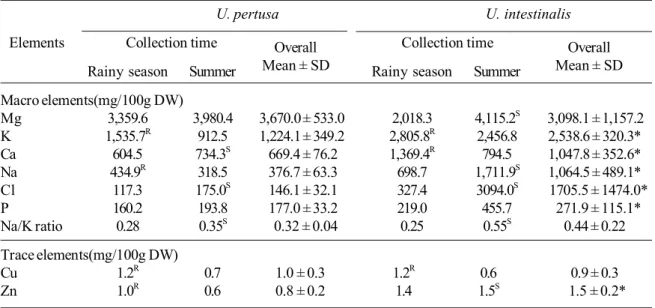
The elements in the two seaweeds are shown in Table 3. The macro elements (Mg, K, Ca, Na, Cl, and P) and trace elements (Cu and Zn) ranged from 117.3–4115.2 mg/100 g DW and 0.6–1.5 mg/100g DW, respectively. Some element contents (K, Ca, Na, Cl, P and Zn) of U. intestinalis were found significantly higher than those of U. pertusa. However, the result indicated that U. pertusa was rich in Mg, K and Ca while U. intestinalis was rich in Mg, K, Na and Cl. The Na, Cl, and K are also responsible for the maintenance of body fluid balance (Insel et al., 2007). The Na/K ratios in the two
Ulva species ranged between 0.25–0.55, which is a favorable value and also agreed with the previous reports (Rupérez, 2002; McDermid and Stercke, 2003; Matanjun et al., 2009). These findings suggested that the intake of both species can help balance Na/K ratio diets. In contrast, the consumption of foods with a high Na level may relate to the risk of hyper-tension (Insel et al., 2007).
For the trace elements, the sum of copper and zinc contents were found within the range 1.3–2.6 mg/100 g DW which are below the maximum level (10 mg/100 g) allow in Japan and France in seaweeds for human consumption (Indergaard and Minsaas, 1991). The levels of the detected
elements fit within the ranges observed in previous reports on seaweeds (Mabeau and Fleurence, 1993; Rupérez, 2002). The results of the present study indicated the possibility of using the two Ulva species as food supplements to improve nutritive values of human diet and regulate the body fluid balance. Further studies should analyze their toxic elements (arsenic, lead, cadmium, tin, and mercury) to assess toxico-logical effects before consumption.
3.4 Amino acid composition
The amino acid contents of the two Ulva species are shown in Table 4. They included essential amino acids (EAAs): methionine, leucine, isoleucine, lysine, phenyl-alanine, tyrosine, arginine, threonine, and valine. For tryptophane and cysteine could not be determined by the methods used. U. pertusa was rich in leucine, arginine and valine whereas U. intestinalis was rich inleucine, threonine, valine, and arginine. The non-EAAs, which are histidine, aspartic acid, glutamic acid, serine, proline, glycine, and ala-nine, were present in relatively high levels. The two species contained a large amount of aspartic and glutamic acids which gave the special flavors and tastes. The contents of total amino acid ranged from 9.5–10.6 mg/100 mg DW (613– 618 mg/g protein) (Table 4) while the protein content were 15.4% DW to U. pertusa and 17.9% DW to U. intestinalis
(Table 1). Leucine made up the highest amount of EAA in the two species. The ratios of EAA to non-EAA of both seaweeds ranged from 0.67–0.72 and their ratios of EAA to total amino acids were almost 0.4. These results agreed with previous reports for C. lentillifera, U. reticulata (Rattana-arporn and Chirapat, 2006) and U. lactuca (Wong and
Table 3. Elements content of U. pertusa and U. intestinalis.
U. pertusa U. intestinalis
Elements Collection time Collection time
Rainy season Summer Rainy season Summer
Macro elements(mg/100g DW)
Mg 3,359.6 3,980.4 3,670.0 ± 533.0 2,018.3 4,115.2S 3,098.1 ± 1,157.2
K 1,535.7R 912.5 1,224.1 ± 349.2 2,805.8R 2,456.8 2,538.6 ± 320.3*
Ca 604.5 734.3S 669.4 ± 76.2 1,369.4R 794.5 1,047.8 ± 352.6*
Na 434.9R 318.5 376.7 ± 63.3 698.7 1,711.9S 1,064.5 ± 489.1*
Cl 117.3 175.0S 146.1 ± 32.1 327.4 3094.0S 1705.5 ± 1474.0*
P 160.2 193.8 177.0 ± 33.2 219.0 455.7 271.9 ± 115.1*
Na/K ratio 0.28 0.35S 0.32 ± 0.04 0.25 0.55S 0.44 ± 0.22
Trace elements(mg/100g DW)
Cu 1.2R 0.7 1.0 ± 0.3 1.2R 0.6 0.9 ± 0.3
Zn 1.0R 0.6 0.8 ± 0.2 1.4 1.5S 1.5 ± 0.2*
Values are expressed as mean ± SD, n=4. R Signifies significantly higher in rainy season (P<0.05). S Signifies significantly higher in summer (P<0.05). *Signifies significantly higher between two species (P<0.05).
Overall
Cheung, 2000).
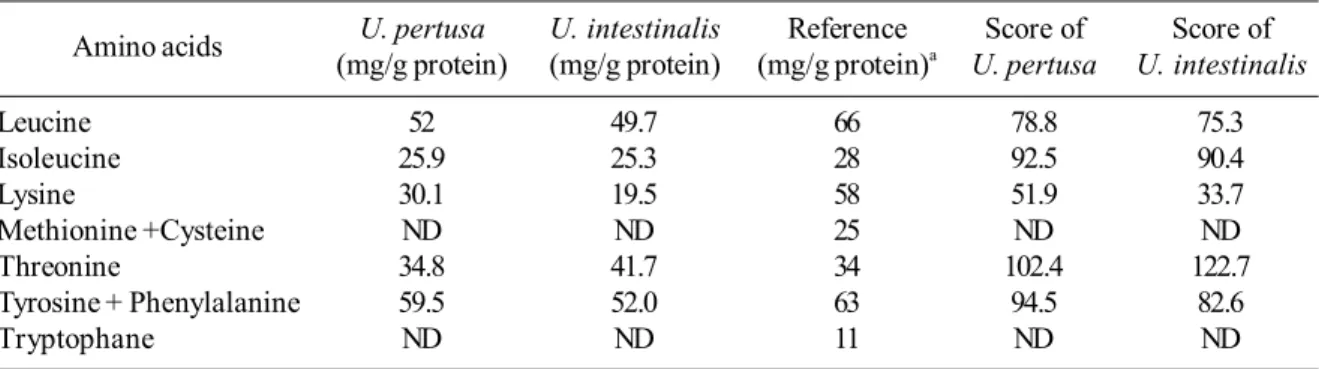
Furthermore, the levels of EAAs in the two seaweeds were compared with the pre-school children’s reference amino acid pattern of FAO/WHO/UNU (1985). The essential amino acid scores of U. pertusa and U. intestinalis ranged between 51.9–102.4% and 33.7–122.7% (Table 5), with threo-nine at the highest score. It was also found that the most limiting amino acid of both species was lysine, followed by leucine. According to previous reports, the limiting amino acid of U. lactuca was leucine(Wong and Cheung, 2000) while that of Eucheuma cottonii and Caulerpa lentiliferra
was lysine (Matanjun et al., 2009). This study shows that the two Ulva species can be used as an alternative source of protein and amino acids for human food and animal feeds.
3.5 Physicochemical properties
Most seaweeds are rich in dietary fiber which deter-mined their hydration properties namely swelling capacity (SWC), water holding capacity (WHC), and oil holding capa-city (OHC). The TDF of the two species ranged 51.3–62.2% (Table 1). Their physicochemical properties are shown in Table 6. The SWC and WHC of both species ranged from 4.00–6.42 ml/g DW and 7.78–14.96 g/g DW, respectively, while the WHC of U. intestinalis was higher than that of U. pertusa (P<0.05). The SWC and WHC values obtained were
similar to those of Fucus vesiculosus, Chondrus crispus,
and Porphyra tenera (Rupérez and Saura-Calixto, 2001), U. lactuca and E. compressa (Lahaye and Jegou, 1993) and some agricultural by-products (dietary fiber concentrates) (Grigelmo-Miguel and Martin-Belloso, 1999; Elleuch et al., 2010). However, some studies reported that it was difficult to compare the values of WHC in one kind of seaweed with those of other seaweeds or food because they depended on sample preparation, size and porosity of samples, as well as temperature, time, and centrifugation in experimental condi-tions (Wong and Cheung, 2000; Elleuch et al., 2011).
The SWC and WHC properties of seaweeds are generally related to their characteristic of polysaccharides as well as protein which links to cell wall of polysaccharide (Fleury and Lahaye, 1991; Fleuence, 1999). This study shows the SWC and WHC values with indicated that both seaweeds may be use as functional ingredient to improve physical and structural properties in food products (Grigelmo-Miguel and Martina-Belloso, 1999; Elleuch et al., 2010).
Besides their hydration properties, fiber has oil hold capacity (OHC). In this study, the OHC of U. intestinalis
(4.62 g oil/g DW), which comparable to that of U. fasciata
meal (4.52 g oil/g DW) (Carvalho et al., 2009), was higher than that of U. pertusa (1.53 g oil/g DW) (P<0.05), which compa-rable to that of U. lactuca (1.46–1.68 g oil/g DW) (Yaich et al., 2011).
Table 4. Amino acid content of U. pertusa and U. intestinalis for two seasons.
U. pertusa U. intestinalis
Amino acid
mg/100 mg DW mg/g protein mg/100 mg DW mg/g protein
Aspartic acidb 1.19 ± 0.06 77.1 ± 1.4 1.46 ± 0.06* 83.1 ± 5.5
Serineb 0.58 ± 0.01 37.7 ± 2.0 0.65 ± 0.03* 36.9 ± 2.2
Glutamic acidb 1.17 ± 0.22 75.6 ± 10.0 1.42 ± 0.02 81.9 ± 7.4
Glycineb 0.66 ± 0.02 43.0 ± 1.5 0.74 ± 0.01* 42.8 ± 3.7
Histidineb 0.13 ± 0.04 8.6 ± 2.8 0.13 ± 0.01 7.4 ± 1.2
Argininea 0.62 ± 0.10 39.9 ± 4.2 0.57 ± 0.03 33.5 ± 4.5
Threoninea 0.54 ± 0.04 34.8 ± 0.5 0.72 ± 0.03* 41.7 ± 5.1
Alanineb 0.92 ± 0.11 59.7 ± 3.7 1.19 ± 0.04* 69.1 ± 8.1
Prolineb 0.54 ± 0.01* 35.2 ± 1.3 0.50 ± 0.02 29.4 ± 3.7
Tyrosinea 0.35 ± 0.02* 22.9 ± 2.4 0.28 ± 0.01 16.2 ± 1.1
Valinea 0.60 ± 0.01 39.1 ± 1.9 0.70 ± 0.02 40.5 ± 3.6
Lysinea 0.46 ± 0.10 30.1 ± 7.8 0.37 ± 0.08 19.6 ± 2.7
Isoleucinea 0.40 ± 0.02 25.9 ± 0.8 0.43 ± 0.02* 25.3 ± 3.4
Leucinea 0.80 ± 0.02 52.0 ± 2.4 0.85 ± 0.05 49.7 ± 7.1
Phenylalaninea 0.56 ± 0.02 36.7 ± 1.4 0.62 ± 0.00* 35.9 ± 3.5
Total AA 9.50 ± 0.45 618.2 ± 9.1 10.61 ± 0.18* 612.9 ± 56.7
EAA 3.97 ± 0.09 258.4 ± 9.3 4.25 ± 0.09* 246.1 ± 24.5
Non-EAA 5.53 ± 0.37 359.8 ± 6.0 6.36 ± 0.11* 366.8 ± 32.2
EAA/Non-EAA 0.72 ± 0.03* 0.72 ± 0.03 0.67 ± 0.01 0.67 ± 0.01
EAA/ Total AA 0.42 ± 0.01* 0.42 ± 0.01 0.40 ± 0.00 0.40 ± 0.00
In other words the range of OHC of two species is quite extensive when compared with other fiber rich food such as peach (1.02–1.11 g oil/g DW) (Grigelmo-Miguel et al., 1999), jack beans (2.3 g oil/g DW) (Betancur-Ancona et al., 2004), as well as orange peel IDF (3.36 g oil/g DW) (Chau and Huang, 2003). The OHC properties of food particles cor-related with their surface properties, overall charge density, lipophilic and hydrophilic constituents (Fleury and Lahaye, 1991; Elleuch et al., 2011). Therefore, the two Ulva species can be a good choice as stabilizers in formulate food products. Moreover, they can reduce blood lipid level, obe-sity and coronary heart disease risk.
3.6 Seasonal effect
Many previous reports listed that the variation in the nutrient contents of seaweeds was related to several environ-mental factors such as water temperature, salinity, light, and nutrients (Marinho-Soriano et al., 2006; Murakami et al., 2011). Most of these environmental parameters can influence the biosynthesis of several nutrients due to seasonal changes in ecological conditions (Lobban et al., 1985).
From this study, U. pertusa collected in the rainy season had significantly higher levels in some nutrients such
as protein, lipid, ash, SDF, elements (K Na, Cu, and Zn), and amino acids (glutamic acid, arginine, threonine and alanine) (P<0.05). In contrast, they showed high levels ofIDF, TDF, elements (Ca and Cl) and amino acids (histidine and lysine) as well as OHC when collected in summer (P<0.05). U. intestinalis collected in the rainy season had significantly higher levels of lipid, ash, TDF, SDF, elements (K, Ca and Cu), and SWC. When U. intestinalis was collected in summer, it had higher levels of IDF, elements (Mg, Na, Cl and Zn), amino acids (serine and lysine), as well as WHC and OHC properties (P<0.05) (Tables 1, 2, 3, 4 and 6). These findings agreed with those described in previous reports for Entero-morpha spp.(Haroon et al., 2000), Gracilaria cervicormis, Sargassum vulgare (Marinho-Soriano et al., 2006), Grate-loupia turuturu (Denis et al., 2010), and Sargassum horneri
(Murakami et al., 2011).
4. Conclusion
It was found that U. pertusa and U. intestinalis con-tained high levels of ash, appreciable protein and dietary fiber contents and relatively high levels of macro elements, essen-tial amino acids and soluble and insoluble dietary fibers. Thus, these two seaweeds can contribute to human and Table 5. Essential amino acid score of U. pertusa and U. intestinalis.
U. pertusa U. intestinalis Reference Score of Score of (mg/g protein) (mg/g protein) (mg/g protein)a U. pertusa U. intestinalis
Leucine 52 49.7 66 78.8 75.3
Isoleucine 25.9 25.3 28 92.5 90.4
Lysine 30.1 19.5 58 51.9 33.7
Methionine +Cysteine ND ND 25 ND ND
Threonine 34.8 41.7 34 102.4 122.7
Tyrosine + Phenylalanine 59.5 52.0 63 94.5 82.6
Tryptophane ND ND 11 ND ND
a Reference amino acid pattern of preschool children (2-5 years) (FAO/WHO/UNU, 1985). ND, not determined Amino acids
Table 6. Physicochemical properties of U. pertusa and U. intestinalis.
Seaweeds Collection time SWC (ml/g DW) WHC (g/g DW) OHC (g oil/g DW)
U. pertusa Rainy season 4.00 ± 0.55 7.78 ± 0.29 1.65 ± 0.10R
Summer 4.58 ± 1.10 8.39 ± 0.54 1.42 ± 0.03
Mean ± SD 4.29 ± 0.86 8.08 ± 0.52 1.53 ± 0.14
U. intestinalis Rainy season 6.42 ± 0.32R 12.84 ± 0.69 4.41 ± 0.06
Summer 4.00± 0.55 14.96 ± 0.66S 4.83 ± 0.09S
Mean ± SD 5.21 ± 1.36 13.90 ± 1.29* 4.62 ± 0.24*
animal nutritional requirements. Their nutritional composi-tions together with their physicochemical properties suggest that Ulva species have a potential food to be functional ingredients in food industry. Moreover, its consumption has a positive effect on health because they can reduce blood lipid level, obesity and risk of coronary heart diseases. Further studies concerned fatty acid, vitamin, non-starch polysaccharide constituents, and toxic elements are neces-sary to provide more information for safer and more versatile utilization of these seaweeds.
Acknowledgements
The authors are grateful to the National Research Council of Thailand (NRCT) for financial support of this research and also to thank the Faculty of Science and Tech-nology, Prince of Songkla University, for research facilities. An appreciation also goes to R. Ruangchuay for seaweed classification.
References
AOAC. 2000. Official methods of analysis, 17th edition, Asso-ciation of Official Analytical Chemists, Arlington VA, U.S.A.
Betancur-Ancona, D., Peraza-Mercado, G., Moguel-Ordoòez, Y. and Fuertes-Blanco, S. 2004. Physicochemical char-acterization of Lima bean (Phaseolus lunatus) and Jack bean (Canavalia ensiformis) fibrous residues. Food Chemistry. 84, 287–295.
Bligh, E.G. and Dyer, W.J. 1959. A rapid method of total lipid extraction and purification. Canadian Journal of Bio-chemistry and Physiology. 37, 911–917.
Caprez, A., Arrigoni, E., Amado, R. and Neukom, H. 1986. Influence of different types of thermal treatment on the chemical composition and physical properties of wheat bran. Journal of Cereal Science. 4, 233–239. Carvalho, A.F.U., Portela, M.C.C., Sousa, M.B., Martins, F.S.,
Rocha, F.C., Farias, D.F. and Feitosa, J.P.A. 2009. Physiological and physico-chemical characterization of dietary fibre from the green seaweed Ulva fasciata
Delile. Brazilian Journal of Biology. 69, 969–977. Chau, C-F. and Huang, Y-L. 2003. Comparison of the
chemi-cal composition and physicochemichemi-cal properties of different fibers prepared from the peel of Citrus sinensis L. cv. Liucheng. Journal of Agricultural and Food Chemistry. 51, 2615–2618.
Dawczynski, C., Schubert, R. and Jahreis, G. 2007. Amino acids, fatty acids, and dietary fibre in edible seaweed products. Food Chemistry. 103, 891–899.
Denis, C., Morançais, M., Li, M., Deniaud, E., Gaudin, P., Wielgosz-Collin, G., Barnathan, G., Jaouen, P. and Fleurence J. 2010. Study of the chemical composition of edible red macroalgae Grateloupia turuturu from Brittany (France). Food Chemistry. 119, 913–917.
Elleuch, M., Bedigian, D., Roiseux, O., Besbes, S., Blecker, C. and Attia, H. 2011. Dietary fibre and fibre-rich by-products of food processing: Characterisation, tech-nological functionality and commercial applications: A review. Food Chemistry. 124, 411–421.
FAO/WHO/UNU. 1985. Energy and protein requirements, Report of a joint FAO/WHO/UNU Expert Consulta-tion, World Health Organization (WHO) Technical Report Series No. 724, WHO, Geneva, Switzerland. Fleurence, J. 1999. Seaweed proteins: biochemical nutritional
aspects and potential uses. Trends in Food Science and Technology. 10, 25–28.
Fleurence, J. and Le Coeur, C. 1993. Influence of mineraliza-tion methods on the determinamineraliza-tion of the mineral content of brown seaweed Undaria pinnatifida by atomic absorption spectrophotometry. Hydrobiologia. 260/261, 531–534.
Fleury, N. and Lahaye, M. 1991. Chemical and physico-chemi-cal characterisation of fibres from Lamiaria digitata
(Kombu Breton): A physiological approach. Journal of the Science of Food and Agriculture. 55, 389–400. Grigelmo-Miguel, N. and Martin-Belloso, O. 1999.
Compari-son of dietary fiber from by-products of processing fruits and greens and from cereals. Lebensmittel-Wissenschaft und Technologie. 32, 503–508.
Grigelmo-Miguel, M., Gorinstein, S. and Martin-Belloso, O. 1999. Characterization of peach dietary fibre concen-trate as a food ingredient. Food Chemistry. 65, 175– 181.
Haroon, A.M., Szaniawska, A., Normant, M. and Janas, U. 2000. The biochemical composition of Enteromorpha
spp. from the gulf of Gdansk coast on the southern Baltic Sea. Oceanologia. 42, 19–28.
Indergaard, M. and Minsaas, J. 1991. Animal and human nutrition. In Seaweed resources in Europe: uses and potential, M.D. Guiry and G. Blunden, editors., John Wiley & Sons Ltd., Chichester, England, U.K., pp. 21– 64.
Insel, P., Ross, D., McMahon, K. and Bernstein, M. 2007. Nutrition, 3rd edition, Jones & Bartlett Publishers, Sudbury, Canada.
Ito, K. and Hori, K. 1989. Seaweed: chemical composition and potential uses. Food Review International. 5, 101–144. Kolthoff, I.M., Sandell, E.B., Meehan, E.J. and Bruckenstein, S. 1969. Quantitative Chemical Analysis, Macmillan Company, New York, U.S.A.
Kumari, P., Kumar, M., Gupta, V., Reddy, C.R.K. and Jha, B. 2010. Tropical marine macroalgae as potential sources of nutritionally important PUFAs. Food Chemistry. 120, 749–757.
Kuniak, L. and Marchessault, R.H. 1972. Study of the cross-linking reaction between epichlohydrin and starch. Die Stärke. 4, 110–116.
in some, sea vegetables. Journal of Science and Food Agriculture. 54, 587–594.
Lahaye, M. and Jegou, D. 1993. Chemical and physico-chemi-cal characteristics of dietary fibers from Ulva lactuca
(L.) Thuret and Enteromorpha compressa (L.) Grev. Journal of Applied Phycology. 5, 195–200.
Liu, H.J., Chang, B.Y., Yan, H.W. Yu., F.H. and Liu, X.X. 1995. Determination of amino acids in food and feed by derivatization with 6-aminoquinolyl-N-hydroxysucci-nimidyl carbamate and reversed-phase liquid chroma-tographic separation. Journal of AOAC International. 78, 736–744.
Lobban, C.S., Harrison, P.J. and Duncan, M.J. 1985. The physiological ecology of Seaweeds, Cambridge Uni-versity Press, New York, U.S.A.
Mabeau, S. and Fleurence, J. 1993. Seaweed in food products: Biochemical and nutritional aspects. Trends in Food Science and Technology. 4, 103–107.
Manivannan, K., Thirumaran, G., Karthikai Devi, G., Anan-tharaman, P. and Balasubramanian, T. 2009. Proximate Composition of Different Group of Seaweeds from Vedalai Coastal Waters (Gulf of Mannar): Southeast Coast of India. Middle-East Journal of Scientific Research. 4, 72–77.
Manivannan, K., Thirumaran, G., Karthikai Devi, G., Hemala-tha, A. and Anantharaman, P. 2008. Biochemical Com-position of Seaweeds from Mandapam Coastal Regions along Southeast Coast of India. American-Eurasian Journal of Botany. 1, 32–37.
Marinho-Soriano, E., Fonseca, P.C., Carneiro, M.A.A. and Moreira, W.S.C. 2006. Seasonal variation in the chemi-cal composition of two tropichemi-cal seaweeds. Bioresource Technology. 97, 2402–2406.
Matanjun, P., Mohamed, S., Mustapha, N.M. and Muham, mad, K. 2009. Nutrient content of tropical edible sea-weeds, Eucheuma cottonii, Caulerpa lentillifera and
Sargassum polycystum. Journal of Applied Phycology. 21, 75–80.
McDermid, K.J. and Stuercke, B. 2003. Nutritional composi-tion of edible Hawaiian seaweeds. Journal of Applied Phycology. 15, 513–524.
Murakami, K., Yamaguchi, Y., Noda, K., Fujii, T., Shinohara, N., Ushirokawa, T., Sugawa-Katayama Y. and Kata-yama, M. 2011. Seasonal variation in the chemical com-position of a marine brown alga, Sargassum horneri
(Turner) C. Agardh. Journal of Food Composition and Analysis. 24, 231–236.
Nisizawa, K., Noda, H., Kikuchi, R. and Watanabe, T. 1987. The main seaweed foods in Japan. Hydrobiologia. 151/152, 5–29.
Ortiz, J., Romero, N., Robert, P., Araya, J., Lopez-Hernández, J., Bozzo, C.E., Navarrete C.E., Osorio A. and Rios A. 2006. Dietary fiber, amino acid, fatty acid and toco-pherol contents of the edible seaweeds Ulva lactuca
and Durvillaea antarctica. Food Chemistry. 99, 98– 104.
Potty, V. H. 1996. Physio-chemical aspects, physiological functions, nutritional importance and technological significance of dietary fibers - a critical appraisal. Jour-nal of Food Science and Technology. 33, 1–18. Prosky, L., Asp, N.G., Schweizer, T.F., DeVries, J.W. and
Furda, I. 1992. Determination of insoluble, soluble dietary fiber in foods and food products: Collabora-tive study. Journal of the Association of Official Ana-lytical Chemists International. 75, 360–367.
Ratana-arporn, P. and Chirapart, A. 2006. Nutritional evalua-tion of tropical green seaweeds Caulerpa lentillifera
and Ulva reticulata. Kasetsart Journal (Natural Sci-ence). 40 (Suppl.), 75–83.
Ruangchuay, R., Lueangthuwapranit, C. and Pianthumdee, N. 2007. Apparent characteristics and taxonomic study of macroalgae in Pattani Bay. Songklanakarin Journal of Science and Technology. 29, 893–905.
Rupérez, P. 2002. Mineral content of edible marine seaweeds. Food Chemistry. 79, 23–26.
Rupérez, P. and Saura-Calixto, F. 2001. Dietary fibre and phy-sicochemical properties of edible Spanish seaweeds. European Food Research Technology. 212, 349–354. Sánchez-Machado, D.I., López-Hernández, J. and
Paseiro-Losada, P. 2004. Fatty acids, total lipid, protein and ash contents of processed edible seaweeds. Food Chemistry. 85, 439–444.
Suzuki, T., Ohsugi, Y., Yoshie, Y., Shirai, T. and Hirano, T. 1996. Dietary fiber content, water holding capacity and binding capacity of seaweeds. Fisheries Science. 62, 454–461.
USDA. 2001. Nutrient Database for Standard Reference, Release 14, Agricultural Research Service, Beltsville Human Nutrition Research Center, Maryland, U.S. Department of Agriculture (USDA), U.S.A.
Wong, K. and Cheung, P.C. 2000. Nutritional evaluation of some subtropical red and green seaweeds. Part 1-proxi-mate composition, amino acid profiles and some physico-chemical properties. Food Chemistry. 7, 475– 482.