A Lead
ANRIL
Polymorphism Is Associated
with Elevated CRP Levels in Periodontitis: A
Pilot Case-Control Study
Wijnand J. Teeuw*, Marja L. Laine, Sergio Bizzarro, Bruno G. Loos
Department of Periodontology, Academic Centre for Dentistry Amsterdam (ACTA), University of Amsterdam and VU University Amsterdam, Amsterdam, the Netherlands
Abstract
Elevated high sensitive C-reactive protein (hsCRP) is a marker for systemic inflammation and a risk marker for atherosclerotic cardiovascular disease (ACVD), and has also been associated with periodontitis. Inter-individual variation for hsCRP in periodontitis has been shown.ANRILis the strongest genetic susceptibility locus for both periodontitis and ACVD, and it is speculated that genetic variation inANRILmay modulate inflammatory processes. Therefore, we explored the possible association between hsCRP plasma levels and a lead-ingANRILsingle nucleotide polymorphism (SNP) in periodontitis patients and controls. 171 healthy subjects with North European descent (115 periodontitis and 56 controls) were included in this case-control study. hsCRP levels were determined and subjects were geno-typed for the leadingANRILSNP rs1333048. In a multivariate analysis, periodontitis, female gender, increasing BMI and homozygosity for the major allele (AA-genotype) of rs1333048 were significantly associated with elevated hsCRP plasma levels (p = 0.012, p = 0.004, p = 0.007 and p = 0.003, respectively). Periodontitis patients with rs1333048 AA-genotype showed higher levels of hsCRP than those carrying the minor C allele (median: 4.5 mg/L vs. 1.6 mg/L, padjusted= 0.007). This study is the first to show that, in addition to gender and
BMI, also a leading SNP inANRILis explanatory for inter-individual variation in hsCRP lev-els in periodontitis patients of North European descent.
Introduction
Periodontitis is a complex, chronic inflammatory disease, resulting in loss of connective tissue and alveolar bone support of the teeth [1]. It is the major cause of tooth loss in adults above 40 years and affects human populations worldwide at prevalence rates up to 10–20% for the most severe forms [2,3]. Periodontitis is associated with moderately increased concentration of high sensitive C-reactive protein (hsCRP) in the blood circulation [4]. These elevated levels of hsCRP in periodontitis are‘dose dependent’with higher levels in severe forms of periodontitis, compared to moderate forms and periodontal health and range between 1–4 mg/L [5]. a11111
OPEN ACCESS
Citation:Teeuw WJ, Laine ML, Bizzarro S, Loos BG (2015) A LeadANRILPolymorphism Is Associated with Elevated CRP Levels in Periodontitis: A Pilot Case-Control Study. PLoS ONE 10(9): e0137335. doi:10.1371/journal.pone.0137335
Editor:Kimon Divaris, UNC School of Dentistry, University of North Carolina-Chapel Hill, UNITED STATES
Received:June 24, 2015
Accepted:August 15, 2015
Published:September 8, 2015
Copyright:© 2015 Teeuw et al. This is an open access article distributed under the terms of the Creative Commons Attribution License, which permits unrestricted use, distribution, and reproduction in any medium, provided the original author and source are credited.
Data Availability Statement:All relevant data are within the paper and its Supporting Information files.
Periodontal therapy reduces periodontal inflammation and recent meta-analyses are highly suggestive that this reduction results in lower plasma levels of hsCRP (overall: -0.5 mg/L) [6].
Although on average periodontitis patients show elevated hsCRP, variations in levels have been shown both between patients and between populations [4,6]. Also the reduction of hsCRP levels after periodontal treatment varies substantially between study groups [6], sug-gesting that additionally several other factors may influence the systemic inflammatory response in patients suffering from periodontitis. Interestingly, hsCRP is also widely accepted as key marker of atherosclerosis and is strongly associated with increased risk for atheroscle-rotic cardiovascular disease (ACVD); levels of 1–3 mg/L and>3 mg/L are considered to give medium and high risk for ACVD, respectively [7,8]. In this context, also increasing BMI and female gender have been suggested as factors associated with chronically elevated hsCRP [9,10].
In general, inflammatory responses are modulated by specific polymorphisms in inflamma-tory genes [11]. We speculate that polymorphisms in theANRILlocus on chromosome 9p21 may be involved.ANRILis a genetic risk factor for several conditions with inflammatory com-ponents in Caucasians, and is the strongest genetic susceptibility locus for periodontitis [12,13] and several types of ACVD, like coronary artery disease (CAD), myocardial infarction, abdom-inal aortic aneurysm and intracranial aneurysm [14–16]. It has been shown that the disease-associated single nucleotide polymorphisms (SNPs) of chromosome 9p21 have been disease-associated with the expression ofANRIL[17]. In particular, the CAD-associated polymorphisms within the core risk haplotype region have been shown to regulateANRILexpressionin vitro[18] and alsoin vivo[19]. But so far, the function ofANRILin relation to periodontitis and ACVD is not fully understood. At least one pathway is known,ANRILis regulated by STAT1 signaling [18], a pathway that mediates response to inflammation upon stimulation of the pro-inflam-matory cytokine interferon-γ. Furthermore,ANRILtranscription was up-regulated in gingival tissues by bacterial infection [13].ANRILmay therefore be an important regulator of inflam-matory and immune reactions, such as in the pathophysiology of periodontitis, ACVD, diabe-tes mellitus and cancer [19]. If so, variation in plasma hsCRP (as endpoint and reporter molecule of a variety of inflammatory pathways) may reflect inter-individual heterogeneity of
ANRILactivity based on genetic variation. Therefore, we hypothesize that the observed varia-tion in hsCRP levels in periodontitis patients might be associated with genetic variavaria-tion in the
ANRILgene in addition to other factors and may explain inter-individual differences in hsCRP levels among periodontitis patients.
The aim of the present explorative pilot case-control study was to investigate the possible association between levels of hsCRP and the leading ACVD- and periodontitis-associated gene polymorphism (ANRILrs1333048, [12,13]) in Caucasian periodontitis patients and controls.
Materials and Methods
Study population
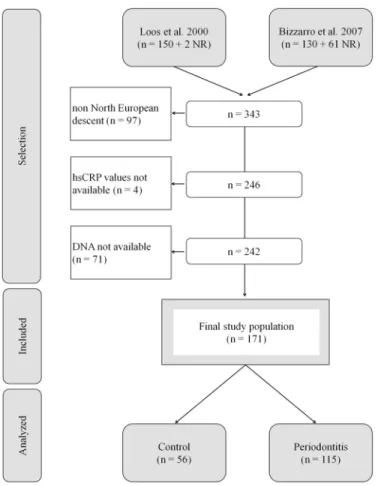
A total of 171 subjects from North European descent, including 115 patients with periodontitis and 56 controls, were suitable to participate in this pilot study. These individuals were retrieved from a total of 343 individuals from two previous studies [20,21] (Fig 1). For all study subjects, age, gender, body mass index (BMI) and current smoking were extracted out of the databases [20,21]. Briefly, referred periodontitis patients were recruited during their first visit at the Department of Periodontology of the Academic Centre Dentistry Amsterdam (ACTA). Clini-cal measurements were performed at six sites per tooth and a full radiographic status was avail-able to analyze interproximal alveolar bone levels. Patients were classified as suffering from periodontitis using the CDC-AAP case definition for moderate to severe periodontitis [22]; Competing Interests:The authors have declared
patients showed at least 2 interproximal sites with attachment loss (AL)4 mm on different teeth in conjunction with alveolar bone loss on the basis of peri-apical radiographs. All patients were untreated and showed generalized bleeding on probing. Controls were selected among subjects registered for restorative dental procedures or who visited ACTA for regular dental check-ups. Control subjects were included if they were not missing more than one tooth per quadrant (3rd molar excluded) and no probing pocket depth (PPD)3 mm. These subjects showed on dental bitewing radiographs1-year-old a distance between the cemento-enamel junction and the alveolar bone crest of3 mm on all teeth.
Exclusion criteria for the current study subjects were: (i) the presence of a systemic disease, (ii) recent history of any acute or chronic infection, periodontitis not included, (iii) systemic antibiotic treatment within the last 3 months, (iv) the use of any medication (including spo-radic NSAID’s), (v) pregnancy or lactation, vi) non North European descent, and vii) no DNA available (Fig 1).
The Medical Ethical Committee of the Academic Medical Center, Amsterdam, approved this study and all participants gave their written informed consent to participate.
Analysis of hsCRP plasma levels
Non-fasting, venous blood was collected from each subject in EDTA containing tubes between 8:30 and 11:30am. Plasma levels of hsCRP were determined using a high sensitivity
Fig 1. Flowchart of patient selection.Of 343 subjects, 171 were suitable for analysis. NR: additional patients obtained during the study period. However, due to missing data, not reported in that particular study.
nephelometric method on the BN ProSpec analyzer (Dade Behring, Marburg, Germany). The detection limit was 0.3 mg/L, linearity was from 0.3 to 230 mg/L, and the coefficient of varia-tion was<3% at a concentration of 2 mg/L. Subjects with hsCRP values<0.3 mg/L were regarded sero-negative [20,21].
Analysis of gene polymorphisms
For all participants, the lead and validated periodontitis- and ACVD-associated intronic SNP rs1333048 in the core risk region of theANRILgene [12,13,23] was investigated. This SNP is also in strong linkage disequilibrium with other representative SNPs that are associated with both periodontitis and ACVD [24]. The polymorphism was assayed at the Institute for Clinical Molecular Biology of the Christian Albrechts University, Kiel, Germany, with TaqMan
(Applied Biosystems [ABI], Foster City, CA, USA) on an automated platform. In brief, genomic DNA was arrayed on 96-well or 384-well plates. Samples were amplified with ABI 9700 PCR machines and fluorescence was measured with ABI 7700 fluorometer. The assay included two locus-specific PCR primers that flank the SNP of interest, and two allele-specific oligonucleotide probes (TTCATGCTATTTTGAGGAGATGTTT[A/C]AATGTCGAATTATTGAAATATTTAT (Context Sequence [VIC/FAM]). For the polymorphism assayed, a PCR-protocol was used as follows: a) activation: 95°C, 10 min, 1 cycle; b) denaturation (95°C, 15s), annealing, elongation, nucleolytic cleavage of hybridized probes (60°C, 1 min), 45 cycles; c) storage: 4°C. For the end-point measurement the ABIPrism 7900 HT Sequence Detection System was used. The assay had a call rate of 100%. The A allele of rs1333048 has been determined as the major allele, while the C allele is the minor allele [13,15]; subjects were genotyped as AA, AC or CC.
Data analyses
Data analyses were performed with the SPSS 18.0 package (SPSS Inc., Chicago, IL, USA). Means, standard deviations, medians, interquartile ranges (IQR) and frequency distributions were calculated. Because of the non-normal distribution, hsCRP plasma levels were log trans-formed for all calculations. The general characteristics of the study population, hsCRP levels, genotype and allelic distribution within the study population were compared with parametric and non-parametric tests (ANOVA and chi-squared test). In addition, boxplots were gener-ated. Where applicable, analyses were corrected for multiple testing (Bonferroni). Deviations from Hardy-Weinberg equilibrium were tested in the control group by using a chi-squared test and a type I error level of 0.05. Odds Ratios (OR) and confidence intervals (CI), adjusted for age, gender, smoking habits and BMI, were calculated. Logistic regression analysis was per-formed. Significance was assessed by a Wald test and by a likelihood-ratio test. Univariate anal-ysis was performed (ANCOVA), using hsCRP levels as the outcome parameter and
periodontitis as a fixed factor. Age, gender, smoking habits, BMI, and carriage of the minor allele (AC or CC) of rs1333048 were included as covariates. For all analyses, the significance level was set to p<0.05.
Results
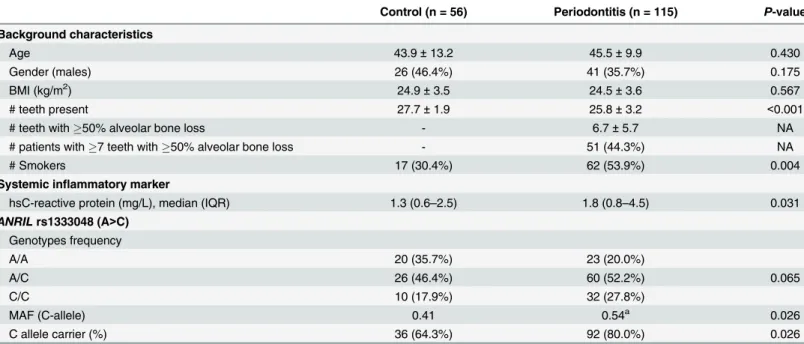
hsCRP was significantly different among the two groups (p= 0.031,Table 1). The median levels of hsCRP levels for controls and periodontitis were 1.3 mg/L and 1.8 mg/L, respectively.
Genotyping results showed no significant deviation from the Hardy-Weinberg equilibrium in the control group. There was no significant difference in the genotype frequencies ofANRIL
rs1333048 between periodontitis and controls (p= 0.065,Table 1). However, minor allele fre-quencies and carriage of the C-allele of rs1333048 (genotypes AC and CC combined) was sig-nificantly associated with periodontitis (adjusted OR = 2.56 [95% CI: 1.20–5.50],p= 0.015).
Univariate analysis of hsCRP levels
Univariate analysis was performed to explore the relation of several covariates with hsCRP lev-els (Table 2). Including the potential confounders, periodontitis was significantly associated Table 1. General characteristics of the study population.
Control (n = 56) Periodontitis (n = 115) P-value
Background characteristics
Age 43.9±13.2 45.5±9.9 0.430
Gender (males) 26 (46.4%) 41 (35.7%) 0.175
BMI (kg/m2) 24.9±3.5 24.5±3.6 0.567
# teeth present 27.7±1.9 25.8±3.2 <0.001
# teeth with50% alveolar bone loss - 6.7±5.7 NA
# patients with7 teeth with50% alveolar bone loss - 51 (44.3%) NA
# Smokers 17 (30.4%) 62 (53.9%) 0.004
Systemic inflammatory marker
hsC-reactive protein (mg/L), median (IQR) 1.3 (0.6–2.5) 1.8 (0.8–4.5) 0.031
ANRILrs1333048 (A>C)
Genotypes frequency
A/A 20 (35.7%) 23 (20.0%)
A/C 26 (46.4%) 60 (52.2%) 0.065
C/C 10 (17.9%) 32 (27.8%)
MAF (C-allele) 0.41 0.54a 0.026
C allele carrier (%) 36 (64.3%) 92 (80.0%) 0.026
aCarriage of the C-allele was signi
ficantly associated with periodontitis: adjusted OR = 2.56 (95%CI: 1.20–5.50),p= 0.015
MAF = Minor Allele Frequency; NA = Not applicable
doi:10.1371/journal.pone.0137335.t001
Table 2. Univariate analysis for hsCRP levels.
F-ratio p-value
Intercept 6.83 0.010
Periodontitisa 6.50 0.012
Age 2.82 0.095
Gender (female) 8.63 0.004
Smoking 3.03 0.084
BMI 7.58 0.007
ANRILrs1333048 (AA-genotype) 9.00 0.003
ahsCRP means and 95% Con
fidence Interval (CI) adjusted for all covariates: Control: 1.19 mg/L, CI: 0.90–
1.57; Periodontitis: 1.86 mg/L, CI: 1.11–2.22)
with elevated hsCRP plasma levels (p= 0.012). After adjustment for the included covariates, the adjusted mean hsCRP levels for the control and periodontitis group were 1.19 mg/L (CI: 0.90–1.57), and 1.86 mg/L (CI: 1.11–2.22),p= 0.012, respectively. In addition, the covariates gender, BMI and genotype were significant: females (p= 0.004), individuals with increased BMI (p= 0.007) and subjects homozygous for the major allele (AA-genotype) of rs1333048 showed increased plasma concentrations of hsCRP (p= 0.003).
The association of theANRILgenotype with hsCRP levels is a new finding. Therefore, we explored the hsCRP levels in relation to periodontitis, subgrouped by carriership of the minor allele.Fig 2shows that subjects with periodontitis and homozygous for the major allele
Fig 2. Boxplots of hsCRP plasma levels in subjects with or without periodontitis according to their genotype ofANRIL(rs1333048).Homozygosity for the major allele (AA-genotype) ofANRIL(rs1333048) is associated with significantly elevated hsCRP plasma levels in patients with periodontitis. Boxes represent interquartile ranges (IQR) and median values are indicated by the horizontal line within the box. Whiskers represent the 10thand 90thpercentiles. P-values are adjusted for age, gender, smoking and BMI. Y-axis is in logarithmic scale.
(AA-genotype) of rs1333048 have significantly elevated hsCRP levels (4.5 mg/L [median]; IQR: 1.2–7.6 mg/L) compared to subjects with periodontitis and carriage of the minor allele (AC and CC genotypes) (1.6 mg/L [median; IQR: 0.7–3.3 mg/L;p= 0.007] and healthy con-trols homozygous for the major allele (1.9 mg/L [median]; IQR: 1.1–3.0 mg/L;p= 0.017). A trend for intragroup differences in hsCRP levels between subjects of the control group homo-zygous for the major allele and subjects carrying the minor allele was also observed
(p= 0.050). Notably, carriage of the minor allele of rs1333048 is associated with relative low hsCRP levels, nevertheless the periodontitis patients with genotypes AC or CC showed higher hsCRP levels than the corresponding individuals in the control group (periodontitis: 1.6 mg/ L [median]; IQR: 0.7–3.2 mg/L; control: 0.9 mg/L [median]; IQR: 0.6–1.7 mg/L;p= 0.022).
Discussion
The present pilot study aimed to investigate the possible association between hsCRP plasma levels and potential confounding factors, including the leading polymorphism inANRIL, in periodontitis patients and controls.ANRILis an important genetic locus as it is associated with several chronic systemic conditions, including ACVD and periodontitis. The main finding of this study is that not only periodontitis, BMI and female gender are related with elevated CRP: also the AA-genotype ofANRIL(rs1333048) is associated with significantly elevated hsCRP plasma levels in patients with periodontitis. While periodontitis, female gender and elevated BMI have been associated with increased hsCRP in the literature [4,9,10], this is the first study that shows that a SNP inANRILis also associated with hsCRP levels in periodontitis patients. Interestingly, a trend was also seen for controls, but this did not reach statistical significance (p= 0.050). The observation suggests that among other and currently unknown factors, the
ANRILlocus may be involved in‘generic’inflammatory processes of immune-mediated dis-eases with hsCRP as final biomarker at one or several pathways. The challenge is to turn the increasing knowledge of pleiotropic pathways to clinical relevance [25].
We recognize that periodontitis is a complex disease with multiple causal factors playing a role simultaneously [26]. These can be grouped in genetic, bacteria and lifestyle related factors, including diet, systemic diseases, notably diabetes, and other factors as of yet unknown. Cur-rently, more genetic loci, in addition toANRIL, shared between ACVD and periodontitis have been identified:PLASMINOGENand a conserved noncoding element withinCAMTA1
upstream ofVAMP3[27,28]. Recent experimental and epidemiological studies suggested that
ANRIL,VAMP3andPLASMINOGENare involved in several regulatory networks that relate to glucose and fatty acid metabolism, host-microbiome interactions and TGF-βsignaling, provid-ing evidence for a mechanistic link between ACVD, periodontitis, obesity and inflammation [27–30]. Any disturbances in these pathways by genetic variants may be a common pathogenic trait of ACVD and periodontitis.
pathway by binding factor H [32–35]. This results in restricted complement activation favoring opsonization and not in the formation of the membrane attack complex, subsequently leading to a less strong inflammatory response and therefore less inflammation derived tissue damage [31]. Nevertheless, we have to realize that for certain cases, even with high levels of CRP, other factors might play a more dominant role in the onset and/or progression of periodontal disease.
For example smoking is known to be a strong etiologic factor for periodontitis. Interestingly, it was in the current study not related to elevated hsCRP plasma levels in periodontitis patients and controls. A possible explanation could be that the effect of smoking depends on the num-ber of cigarettes consumed per day (heavy or light smoking) [36]. Furthermore, the effect of smoking on systemic inflammation is not straight forward and the results of several studies are contradictory [37,38]. It is suggested, that cigarette smoking may affect inflammation via other pathways than elevated hsCRP levels; an association between smoking status and the presence of advanced atherosclerotic lesions but not with hsCRP plasma levels has been shown [39].
In this pilot study we show for the first time that, in addition to gender and BMI, a leading SNP inANRILis associated with variations in hsCRP plasma levels in periodontitis patients from North European descent. Replication studies in other Caucasian and non-Caucasian peri-odontitis patients are needed as well as biochemical studies are necessary to explain the role of
ANRILas pleiotrophic gene affecting inflammatory pathways of different immune-mediated diseases [25], like periodontitis and ACVD.
Supporting Information
S1 Table. STROBE Checklist for Case-Control study. (DOC)
Acknowledgments
The authors thank Dr. A.S. Schaefer from the Institute for Clinical Molecular Biology of the Christian Albrechts University, Kiel, Germany, for the performance of the genotyping.
Author Contributions
Conceived and designed the experiments: WT ML SB BL. Performed the experiments: WT ML SB. Analyzed the data: WT ML. Contributed reagents/materials/analysis tools: WT ML SB. Wrote the paper: WT ML SB BL.
References
1. Pihlstrom BL, Michalowicz BS, Johnson NW. Periodontal diseases. Lancet 2005; 366: 1809–1820.
PMID:16298220
2. Eke PI, Dye BA, Wei L, Thornton-Evans GO, Genco RJ, Cdc Periodontal Disease Surveillance work-group: James Beck GDRP. Prevalence of periodontitis in adults in the United States: 2009 and 2010. J Dent Res 2012; 91: 914–920. PMID:22935673
3. Hugoson A, Sjodin B, Norderyd O. Trends over 30 years, 1973–2003, in the prevalence and severity of
periodontal disease. J Clin Periodontol 2008; 35: 405–414. doi:10.1111/j.1600-051X.2008.01225.x
PMID:18433384
4. Paraskevas S, Huizinga JD, Loos BG. A systematic review and meta-analyses on C-reactive protein in relation to periodontitis. J Clin Periodontol 2008; 35: 277–290. doi:10.1111/j.1600-051X.2007.01173.x
PMID:18294231
5. Loos BG. Systemic markers of inflammation in periodontitis. J Periodontol 2005; 76: 2106–2115. PMID:
6. Teeuw WJ, Slot DE, Susanto H, Gerdes VE, Abbas F, D'Aiuto F, et al. Treatment of periodontitis improves the atherosclerotic profile: a systematic review and meta-analysis. J Clin Periodontol 2014; 41: 70–79. doi:10.1111/jcpe.12171PMID:24111886
7. Geluk CA, Post WJ, Hillege HL, Tio RA, Tijssen JG, van Dijk RB, et al. C-reactive protein and angio-graphic characteristics of stable and unstable coronary artery disease: data from the prospective PRE-VEND cohort. Atherosclerosis 2008; 196: 372–382. PMID:17157301
8. Ridker PM, MacFadyen J, Libby P, Glynn RJ. Relation of baseline high-sensitivity C-reactive protein level to cardiovascular outcomes with rosuvastatin in the Justification for Use of statins in Prevention: an Intervention Trial Evaluating Rosuvastatin (JUPITER). Am J Cardiol 2010; 106: 204–209. doi:10.
1016/j.amjcard.2010.03.018PMID:20599004
9. Pradeep AR, Priyanka N, Prasad MV, Kalra N, Kumari M. Association of progranulin and high sensitiv-ity CRP concentrations in gingival crevicular fluid and serum in chronic periodontitis subjects with and without obesity. Dis Markers 2012; 33: 207–213. doi:10.3233/DMA-2012-0926PMID:22960346 10. Woloshin S, Schwartz LM. Distribution of C-reactive protein values in the United States. N Engl J Med
2005; 352: 1611–1613.
11. Incalcaterra E, Accardi G, Balistreri CR, Caimi G, Candore G, Caruso M, et al. Pro-inflammatory genetic markers of atherosclerosis. Curr Atheroscler Rep 2013; 15: 329. doi:10.1007/s11883-013-0329-5 PMID:23591672
12. Schaefer AS, Bochenek G, Manke T, Nothnagel M, Graetz C, Thien A, et al. Validation of reported genetic risk factors for periodontitis in a large-scale replication study. J Clin Periodontol 2013; 40: 563–
572. doi:10.1111/jcpe.12092PMID:23587006
13. Schaefer AS, Richter GM, Dommisch H, Reinartz M, Nothnagel M, Noack B, et al. CDKN2BAS is asso-ciated with periodontitis in different European populations and is activated by bacterial infection. J Med Genet 2011; 48: 38–47. doi:10.1136/jmg.2010.078998PMID:20978019
14. Deloukas P, Kanoni S, Willenborg C, Farrall M, Assimes TL, Thompson JR, et al. Large-scale associa-tion analysis identifies new risk loci for coronary artery disease. Nat Genet 2013; 45: 25–33. doi:10.
1038/ng.2480PMID:23202125
15. Schunkert H, Gotz A, Braund P, McGinnis R, Tregouet DA, Mangino M, et al. Repeated replication and a prospective meta-analysis of the association between chromosome 9p21.3 and coronary artery dis-ease. Circulation 2008; 117: 1675–1684. doi:10.1161/CIRCULATIONAHA.107.730614PMID:
18362232
16. Helgadottir A, Thorleifsson G, Magnusson KP, Gretarsdottir S, Steinthorsdottir V, Manolescu A, et al. The same sequence variant on 9p21 associates with myocardial infarction, abdominal aortic aneurysm and intracranial aneurysm. Nat Genet 2008; 40: 217–224. doi:10.1038/ng.72PMID:18176561 17. Congrains A, Kamide K, Oguro R, Yasuda O, Miyata K, Yamamoto E, et al. Genetic variants at the
9p21 locus contribute to atherosclerosis through modulation of ANRIL and CDKN2A/B. Atherosclerosis 2012; 220: 449–455. doi:10.1016/j.atherosclerosis.2011.11.017PMID:22178423
18. Harismendy O, Notani D, Song X, Rahim NG, Tanasa B, Heintzman N, et al. 9p21 DNA variants associ-ated with coronary artery disease impair interferon-gamma signalling response. Nature 2011; 470: 264–268. doi:10.1038/nature09753PMID:21307941
19. Cunnington MS, Santibanez Koref M, Mayosi BM, Burn J, Keavney B. Chromosome 9p21 SNPs Asso-ciated with Multiple Disease Phenotypes Correlate with ANRIL Expression. PLoS Genet 2010; 6: e1000899. doi:10.1371/journal.pgen.1000899PMID:20386740
20. Bizzarro S, van der Velden U, ten Heggeler JM, Leivadaros E, Hoek FJ, Gerdes VE, et al. Periodontitis is characterized by elevated PAI-1 activity. J Clin Periodontol 2007; 34: 574–580. PMID:17535288 21. Loos BG, Craandijk J, Hoek FJ, Wertheim-van Dillen PM, van der Velden U. Elevation of systemic
markers related to cardiovascular diseases in the peripheral blood of periodontitis patients. J Periodon-tol 2000; 71: 1528–1534. PMID:11063384
22. Eke PI, Page RC, Wei L, Thornton-Evans G, Genco RJ. Update of the case definitions for population-based surveillance of periodontitis. J Periodontol 2012; 83: 1449–1454. doi:10.1902/jop.2012.110664
PMID:22420873
23. Ernst FD, Uhr K, Teumer A, Fanghanel J, Schulz S, Noack B, et al. Replication of the association of chromosomal region 9p21.3 with generalized aggressive periodontitis (gAgP) using an independent case-control cohort. BMC Med Genet 2010; 11: 119. doi:10.1186/1471-2350-11-119PMID:20696043
25. Parkes M, Cortes A, van Heel DA, Brown MA. Genetic insights into common pathways and complex relationships among immune-mediated diseases. Nat Rev Genet 2013; 14: 661–673. doi:10.1038/
nrg3502PMID:23917628
26. Lopez R, Hujoel P, Belibasakis GN. On putative periodontal pathogens: an epidemiological perspec-tive. Virulence 2015; 6: 249–257. doi:10.1080/21505594.2015.1014266PMID:25874553
27. Bochenek G, Hasler R, El Mokhtari NE, Konig IR, Loos BG, Jepsen S, et al. The large non-coding RNA ANRIL, which is associated with atherosclerosis, periodontitis and several forms of cancer, regulates ADIPOR1, VAMP3 and C11ORF10. Hum Mol Genet 2013; 22: 4516–4527. doi:10.1093/hmg/ddt299
PMID:23813974
28. Schaefer AS, Bochenek G, Jochens A, Ellinghaus D, Dommisch H, Guzeldemir-Akcakanat E, et al. Genetic evidence for PLASMINOGEN as a shared genetic risk factor of coronary artery disease and periodontitis. Circ Cardiovasc Genet 2015; 8: 159–167. doi:10.1161/CIRCGENETICS.114.000554
PMID:25466412
29. Divaris K, Monda KL, North KE, Olshan AF, Lange EM, Moss K, et al. Genome-wide association study of periodontal pathogen colonization. J Dent Res 2012; 91: 21S–28S. PMID:22699663
30. Schwenk RW, Angin Y, Steinbusch LK, Dirkx E, Hoebers N, Coumans WA, et al. Overexpression of vesicle-associated membrane protein (VAMP) 3, but not VAMP2, protects glucose transporter (GLUT) 4 protein translocation in an in vitro model of cardiac insulin resistance. J Biol Chem 2012; 287: 37530–
37539. doi:10.1074/jbc.M112.363630PMID:22936810
31. Du Clos TW. Pentraxins: structure, function, and role in inflammation. ISRN Inflamm 2013; 2013: 379040. doi:10.1155/2013/379040PMID:24167754
32. Holers VM. The spectrum of complement alternative pathway-mediated diseases. Immunol Rev 2008; 223: 300–316. doi:10.1111/j.1600-065X.2008.00641.xPMID:18613844
33. Mihlan M, Blom AM, Kupreishvili K, Lauer N, Stelzner K, Bergstrom F, et al. Monomeric C-reactive pro-tein modulates classic complement activation on necrotic cells. FASEB J 2011; 25: 4198–4210. doi:10.
1096/fj.11-186460PMID:21856781
34. Mold C, Kingzette M, Gewurz H. C-reactive protein inhibits pneumococcal activation of the alternative pathway by increasing the interaction between factor H and C3b. J Immunol 1984; 133: 882–885.
PMID:6234363
35. Suankratay C, Mold C, Zhang Y, Potempa LA, Lint TF, Gewurz H. Complement regulation in innate immunity and the acute-phase response: inhibition of mannan-binding lectin-initiated complement cytolysis by C-reactive protein (CRP). Clin Exp Immunol 1998; 113: 353–359. PMID:9737662 36. van Greevenbroek MM, Jacobs M, van der Kallen CJ, Blaak EE, Jansen EH, Schalkwijk CG, et al.
Human plasma complement C3 is independently associated with coronary heart disease, but only in heavy smokers (the CODAM study). Int J Cardiol 2012; 154: 158–162. doi:10.1016/j.ijcard.2010.09.
017PMID:20926148
37. Helmersson J, Larsson A, Vessby B, Basu S. Active smoking and a history of smoking are associated with enhanced prostaglandin F(2alpha), interleukin-6 and F2-isoprostane formation in elderly men. Ath-erosclerosis 2005; 181: 201–207. PMID:15939073
38. Wannamethee SG, Lowe GD, Shaper AG, Rumley A, Lennon L, Whincup PH. Associations between cigarette smoking, pipe/cigar smoking, and smoking cessation, and haemostatic and inflammatory markers for cardiovascular disease. Eur Heart J 2005; 26: 1765–1773. PMID:15817606