Injecting drug users who are (un)aware
of their HIV serostatus: findings from
the multi-center study AjUDE-Brasil II
Usuários de drogas injetáveis que (des)conhecem
seu
status
sorológico para a infecção pelo HIV:
achados do Projeto AjUDE-Brasil II
1 Faculdade de Medicina, Universidade Federal de Minas Gerais, Belo Horizonte, Brasil. 2 Centro de Informação Científica e Tecnológica, Fundação Oswaldo Cruz, Rio de Janeiro, Brasil. 3 Instituto de Ciências Exatas, Universidade Federal de Minas Gerais, Belo Horizonte, Brasil. 4 Other members listed at the end of the paper.
Correspondence W. T. Caiaffa Faculdade de Medicina, Universidade Federal de Minas Gerais. Av. Alfredo Balena 190, Belo Horizonte, MG 30130-100, Brasil. [email protected]
Aline Dayrell Ferreira 1 Waleska Teixeira Caiaffa 1 Francisco I. Bastos 2 Sueli Aparecida Mingoti 3 Projeto AjUDE-Brasil II 4
Abstract
This study aimed to characterize the profiles of injecting drug users (IDUs) who were unaware of their HIV serostatus, given the importance of this information for prevention strategies, espe-cially in this vulnerable population, key to the HIV/AIDS dynamic. As part of a cross-sectional multi-city survey, IDUs were interviewed and HIV-tested by the ELISA technique. IDUs were categorized according to knowledge of their own HIV status as either aware or unaware. Means, averages, and proportions were compared be-tween the groups using bi- and multivariate analyses. Of 857 IDUs interviewed, 34.2% were unaware of their HIV serostatus. Those who were unaware were more likely: to have been recruit-ed at sites where the HIV prevalence rate was considered medium (> 10 to 50%; odds ratio = 8.0) or high (> 50%; 4.0); to be illiterate (OR = 4.54); to have no prior HIV test (OR = 2.22); to be male (OR = 1.81); and to have been enrolled more recently in syringe-exchange programs (OR = 1.69). HIV prevention programs should target both individuals at risk and HIV-positive individuals. Programs to expand access to HIV testing are pivotal and should be tailored to spe-cific contexts and populations.
AIDS Serodiagnosis; Intravenous Substance Abuse; Acquired Immunodeficiency Syndrome; HIV
Introduction
Public health strategies have been developed to increase awareness of HIV serostatus among individuals and populations for the control of the HIV/AIDS epidemic. Knowledge of one’s serostatus, expressed as early diagnosis of HIV infection, can allow adequate access to treat-ment, ensuring better response to therapy and quality of life among persons with HIV as well as reduction in AIDS mortality 1. In addition, it is believed that such awareness is associated with lower frequency of practices that expose individuals to the risk of being (re)infected and of transmitting the virus 2,3,4,5,6. Testing, coun-seling, and returning the test results thus has an effect on the epidemic’s dynamics by reduc-ing the frequency of risk interactions and HIV transmission 2,3,4.
Statistics indicate 40 million individuals in-fected worldwide 7, with 600 thousand infected
in Brazil 8. Of these, an estimated 67% are un-aware of their HIV serostatus 8.
addi-tion to the availability of these centers, cam-paigns like Fique Sabendo!(Know it!) have also been developed. This campaign was launched in 2003 and aims to raise the Brazilian popula-tion’s awareness concerning the importance of HIV testing, with the goal of a 150% increase in the number of tests performed in the country by 2006 8.
The epidemiological profile of HIV/AIDS infection in Brazil is known to be differentiat-ed, varying according to the period analyzdifferentiat-ed, exposure categories, and regional characteris-tics. Among the exposure categories, the most relevant is “heterosexual”, followed by “inject-ing drug user” (IDUs), account“inject-ing for 19.1% of the AIDS cases diagnosed as of 2004 9.
However, the proportional participation of IDUs varies substantially between regions, cor-responding to some 60% of the AIDS cases re-ported in the South of the country 7,10,11. IDUs play an even more relevant role in the HIV/ AIDS dynamics when considering the risk of transmission from infected IDUs to their sex partners and offspring 11. Thus, injecting drug use behaviors such as initiation of use, sharing of injecting materials, and type of drug used have contributed to the spread of HIV and maintenance of the epidemic in Brazil 12.
The present study aims to characterize the profile of Brazilian IDUs who are unaware (ver-sus aware) of their HIV serostatus, using data from the AjUDE-Brasil II Project. This line of analysis was allowed by the range of informa-tion included in the project and is especially relevant because of the lack of quantitative analyses on the choice to test for HIV infection in specific populations in the country. The re-sulting information can support public policies for testing and counseling, fostering awareness-raising strategies and contributing to greater effectiveness in the interventions to control the HIV/AIDS epidemic in Brazil.
Methods
The AjUDE-Brasil II Project was designed to as-sess the effectiveness of harm reduction strate-gies and establish the baseline situation of IDUs participating in syringe-exchange projects (SEP). This was a cross-sectional, multi-center study obtaining information on aspects related to this population. Participating IDUs were ac-cessed by the SEP in six Brazilian cities (Porto Alegre and Gravataí in the State of Rio Grande do Sul, São José do Rio Preto in São Paulo, Itajaí and Florianópolis in Santa Catarina, and Sal-vador in Bahia) in 2000-2001. Selection of these
SEP was based on level of structuring and time in operation, on the epidemiological profile of the HIV/AIDS epidemic, and the pattern and forms of drug consumption in the different sites. The project included face-a-face interviews conducted by previously trained health agents, using a standardized structured questionnaire, focusing on socio-demographic aspects, living conditions, drug use, risk practices, sexual be-havior, knowledge on blood-borne infections/ diseases and utilization of health services, in-cluding HIV testing 13.
In addition, blood sample was taken on fil-ter paper for diagnosis by ELISA (enzyme-linked immunosorbent assay) of HIV and other blood-borne and/or sexually transmitted infections, according to the methodology described in the document systematizing the AjUDE-Brasil I procedures 13.
In all stages of the study, procedures were performed to guarantee the data quality and reliability 13.
Study sample
IDUs 18 years of age or older and with a history of injecting use in the five years prior to the in-terview were accessed and recruited by out-reach workers in each site. A total of 857 IDUs participated in the study, and no refusals were recorded.
The current study adopted the calculation referring to the detection power for the sample calculation from the source project 13. Based
on testing the hypothesis of comparing pro-portions and an alpha error of 5%, we observed a power of 90% 14.
The premise was that 56.6% of IDUs were unaware of their serostatus based on data ob-tained during the AjUDE-Brasil I Project, defin-ing serostatus unawareness as infected IDUs who had never had an HIV test or had never re-turned for the test results 13.
Variables
the empirical test findings, were defined as those who were actually aware of their HIV status.
Among the covariables was “local HIV back-ground prevalence among IDUs”, a socio-de-mographic variable obtained from classifica-tion of the SEP where the participants were re-cruited, in terms of overall HIV prevalence, based on criteria set by the World Health Orga-nization 15. A “low seroprevalence site” was
de-fined as one where the mean prevalence was less than 10%, which in this case included only one SEP, where the overall HIV prevalence among IDUs was 6.4%. Four SEP, with back-ground HIV prevalence varying from 30.9 to 38.3%, were grouped as “medium prevalence sites”, and finally one SEP where 64.3% of the IDUs were HIV-positive was classified as a “high prevalence site”.
Health services utilization was analyzed ac-cording to the following variables: (1) “lifetime treatment seeking at health services”; (2) “ uti-lization of SEP”, referring to IDUs who reported using or having used the services in such pro-jects; (3) “time using SEP”, related to the time elapsed between the first contact with the SEP and the last recorded contact or the time of the interview (in the case of actively engaged IDUs); (4) “interest in having an HIV test”, as indicated by the question “Have you ever considered hav-ing an HIV test?” and; (5) “prior HIV test”, as re-ported by the IDUs.
Analysis of knowledge about infections was based on the questions: “Do you know of any blood-transmitted disease or infection?”, “Do you know ways of preventing HIV infection?”, among others.
Analysis of drug use considered informa-tion from the six months prior to the interview, and needle/syringe sharing was defined as self-reported lending or borrowing of previously used injecting equipment (active or receptive sharing).
Sexual relations were characterized accord-ing to the nature of the partnership, either oc-casional or regular. Male condom use was de-fined as consistent when the interviewee re-ported using condoms in all sexual relations in the six months prior to the interview.
Analysis
The study analyzed frequency distributions, central tendency and dispersion, comparison of means and proportions using respectively the Student’s t and chi-squared tests.
The association between the outcome and the covariables was explored, allowing the
se-lection of variables (p ≤0.25) to construct the
multivariate model. Odds ratios (OR) were used to measure the associations and respec-tive 95% confidence intervals (95%CI).
The relevance of each variable included in the multivariate model was verified by the Wald statistic, having removed those that did not contribute significantly. Adjustment of the fi-nal model was verified by the Hosmer and Lemeshow test. The final model contained vari-ables with statistical significance (p ≤0.05) and
biological plausibility 16. Based on the estimators obtained by logistic regression, the probability of the event’s occurrence was calculated 16. The
analyses were performed using Microsoft Ex-cel, version 2000, and SPSS, version 11.5.
Ethical issues
The IDUs participating in AjUDE-Brasil II signed a free informed consent form in accordance with Ministry of Health Ruling 196/96. The pro-ject was approved by the Research Ethics Com-mittee of the Universidade Federal de Minas Gerais (case ETIC168/99).
Results
Of the 857 interviewees, 34.2% were unaware of their HIV serostatus (according to the classi-fication adopted by this study), of whom 39.9% were HIV-positive. The overall HIV prevalence was 36.5%, but only 28.9% reported being HIV-positive. The IDUs were predominantly male (82.9%), with a mean age of 28.5±8.2 years. The majority of the IDUs reported having used SEP services some time in life, with a mean utiliza-tion of 11.6±14.5 months (median = 5.9 months). Some three-fourths of the interviewees had considered having an HIV test, but only 47.8% had actually been tested. Among the IDUs who had been tested previously, 20% had not re-turned for the results (Figure 1, Table 1).
Stratifying the IDUs by recruitment site (Table 1) shows that lack of awareness of one’s serostatus varied from 14.9 to 46.1% and was higher in sites with medium background HIV prevalence. In all the sites there was a lower pro-portion of IDUs who reported being HIV-positive as compared to the actual proportion of infected IDUs (as defined by the field testing results).
Figure 1
Classification of IDUs according to knowledge of HIV status. AjUDE-Brasil II Project, 2000-2001.
N = 857 IDUs*
Aware versus unaware of HIV status
Self-reported
HIV status HIV serostatus**
HIV-positive (n = 50; 17.4%)
HIV-negative (n = 62; 21.5%)
Doesn’t know (n = 176; 61.1%)
HIV-negative (n = 50)
HIV-positive (n = 62)
HIV-negative (n = 123)
HIV-positive (n = 53)
HIV-positive (n = 115; 39.9%)
HIV-negative (n = 173; 60.1%)
HIV-positive (n = 194)
HIV-negative (n = 359)
HIV-positive (n = 194; 35.1%)
HIV-negative (n = 359; 64.9%) Unaware
(n = 288; 34.2%)
HIV-positive (n = 194; 35.1%)
HIV-negative (n = 359; 64.9%) Aware
(n = 553; 65.8%)
Total
Total
the IDUs from medium prevalence sites report-ed using these services more frequently (75.8%), however they had used them for less time (mean = 10.4±11.5 months).
As for HIV testing, in contexts with low background prevalence, a significant differ-ence was observed when comparing IDUs who reported having considered an HIV test (67.5%) with IDUs who had actually had the test (28.7%). HIV testing was more frequent in high-preva-lence sites (63.2%), and a higher proportion al-so returned to obtain the results (93.8%).
Comparing IDUs stratified according to awareness of HIV serostatus, Table 2 shows that IDUs recruited by SEP from sites with a back-ground HIV prevalence greater than 10% had two to four times higher likelihood of not know-ing their serostatus as compared to the other IDUs. Lack of awareness of serostatus by IDUs was also significantly higher among male IDUs (OR = 1.7; 95%CI: 1.1-2.6), whites (OR = 1.4; 95%CI: 1.1-1.9), and those who reported some religion (OR = 1.5; 95%CI: 1.0-2.1).
As for work status and schooling, recently unemployed IDUs and those who had never taking technical or occupational training showed increased odds of not knowing their HIV serostatus (OR = 1.5; 95%CI: 1.1-2.2; OR = 1.5; 95%CI: 1.1-2.0, respectively). IDUs with less schooling showed higher odds of not knowing their serostatus, as shown by compar-ing those with no schoolcompar-ing and those who had finished at least the eighth grade (OR = 3.8; 95%CI: 1.6-9.3).
Lack of use of SEP and health services as well as shorter use of SEP services were associ-ated both with unawareness of serostatus and lack of HIV testing. As expected, unawareness of serostatus was more common among IDUs who had never considered being tested (OR = 1.5; 95%CI: 1.1-2.1) or had never actually been tested (OR = 2.3; 95%CI: 1.7-3.1). Identification of aspects related to infection and/or blood-borne diseases, such as knowing ways to pre-vent HIV transmission, proved to be a protec-tive factor against unawareness of serostatus
Table 1
Profile of injecting drug users according to selected characteristics. AjUDE-Brasil II Project, 2000-2001.
Characteristics Total (n = 857) Local HIV prevalence among IDUs p value
Low Medium High (n = 203) (n = 399) (n = 255)
HIV serostatus (n [%])
Unaware of HIV status 288 [34.2] 30 [14.9] 179 [46.1] 79 [31.5] < 0.01 HIV-positive status (self-reported) 244 [28.9] 11 [5.4] 112 [28.9] 121 [48.0] < 0.01 HIV-positive status (ELISA) 311 [36.5] 13 [6.4] 136 [34.1] 162 [64.3] < 0.01
Gender (n [%])
Male 709 [82.9] 176 [86.7] 327 [82.4] 206 [80.8] 0.23
Age (years)
Mean ± SD 28.5±8.2 25.7±6.5 28.0±8.2 31.4±8.6 < 0.01
Median 27.0 24.5 27.0 30.0
Use of SEP
Lifetime use (n [%]) 600 [70.3] 135 [66.8] 300 [75.8] 165 [64.7] 0.005 Time used (months)
Mean ± SD 11.6±14.5 12.7±16.2 10.4±11.5 12.6±17.0 0.084
Median 5.9 5.9 6.7 3.0
Lifetime HIV testing
Considered having test (n [%]) 646 [75.6] 137 [67.5] 286 [71.7] 223 [88.1] < 0.01 Had test (n [%]) 407 [47.8] 58 [28.7] 189 [47.6] 160 [63.2] < 0.01
Times tested
Mean ± SD 1.1+1.9 1.6+0.9 2.6+2.4 2.6+2.2 0.003
Median 0.0 1.0 2.0 2.0
Table 2
Bivariate analysis of aspects associated with unawareness of one’s HIV serostatus. AjUDE-Brasil II Project, 2000-2001.
Variables N Unaware*(%) OR 95%CI
Socio-demographic
Local HIV prevalence among IDUs
Low (< 10%) 202 14.9 1.00
Medium (10-50%) 388 46.1 4.91 3.18-7.60
High (>50%) 251 31.5 2.63 1.65-4.22
Male gender 698 36.0 1.70 1.13-2.57
White skin color 388 38.4 1.41 1.06-1.88
Having a religion 639 36.0 1.47 1.03-2.09
Unemployed** 620 36.5 1.52 1.07-2.16
Having completed a technical course 343 36.9 1.47 1.08-2.00 Schooling
None 29 51.7 3.81 1.55-9.34
≤4thgrade 246 41.1 2.48 1.39-4.43
5thto 8thgrade 441 31.3 1.62 0.93-2.84
> 8thgrade 82 22.0 1.00
Use of SEP and health services
Never used SEP 247 38.5 1.32 0.97-1.79
Time of SEP use*** ≤5.9 months 399 38.8 1.53 1.14-2.05 Never had health treatment 215 50.2 2.54 1.84-3.49 HIV testing
Never considered testing 201 41.3 1.49 1.08-2.07
Never tested 433 43.2 2.29 1.70-3.07
HIV + and doesn’t treat 153 28.8 3.23 1.53-6.80
Knowledge
About blood-borne infections 716 33.1 0.74 0.50-1.10
About HIV/AIDS 777 32.9 0.53 0.31-0.89
Knows some HIV carrier 609 36.3 1.45 1.04-2.04
Drug use
IDU < 3 years 185 38.4 1.29 0.92-1.81
Smoking** 678 36.7 1.87 1.27-2.86
Obtains needles from friend** 161 39.1 1.28 0.90-1.82
Shares needles** 161 42.2 1.52 1.06-2.17
Cleaning of needles/syringes** 296 39.5 1.41 1.05-1.89
Regular sex partners**,#
Not reported 189 38.6 3.78 1.07-13.27
Partners use drugs 103 37.9 1.37 0.88-2.17
100% condom use 134 22.4 0.50 0.32-0.79
Occasional sex partners**,#
Sex for drugs 58 37.9 1.85 0.87-2.78
100% condom use 186 18.3 0.30 0.19-0.48
* IDUs classified in this study as those who were unaware of their HIV serostatus; ** Data refer to the six months prior to the interview;
*** Cutoff based on median time using SEP services;
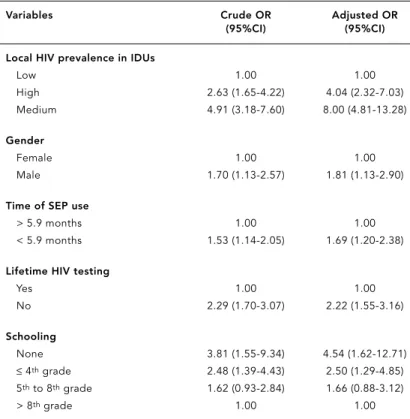
(OR = 0.5; 95%CI: 0.3-0.9). On the other hand, IDUs who were unaware of their serostatus were more likely to have persons with HIV in their social networks (OR = 1.5; 95%CI: 1.1-2.0). The groups were different as to risk behav-iors for infection/disease in relation to sharing needles/syringes (OR = 1.5; 95%CI: 1.1-2.2) and inadequate cleaning of injecting equipment for subsequent use (OR = 1.4; 95%CI: 1.1-1.9). As for sexual behaviors, not having relations with regular partners of the opposite sex was associ-ated with increased odds of not knowing one’s serostatus (OR = 3.8; 95%CI: 1.1-13.3). Inverse-ly, there was an association between consistent condom use in all sexual relations with persons of the opposite sex in the last six months and more accurate knowledge of serostatus, and the association was shown for sexual relations both with regular partners (OR = 0.5; 95%CI: 0.3-0.8) and occasional ones (OR = 0.3; 95%CI: 0.2-0.5). Table 3 presents the results of the multivari-ate analysis. The variables that best explain un-awareness of HIV serostatus were: “site where IDU was recruited”; “gender”; “schooling”; “time using SEP services”, and “lifetime HIV testing”.
Comparing individuals from sites with low background HIV prevalence and those recruit-ed from mrecruit-edium prevalence sites, the latter were more likely not to know their serostatus (OR = 8.0; 95%CI: 4.8-13.3). The odds were also in-creased, but to a lesser degree, among individ-uals from high-prevalence sites as compared to the reference category (OR = 4.0; 95%CI: 2.3-7.0). In addition, unawareness of serostatus showed increased odds in male IDUs (OR = 1.8; 95%CI: 1.1-2.9), those who had been in contact with an SEP for less time (OR = 1.7; 95%CI: 1.2-2.4), and those who had never been tested for HIV (OR = 2.2; 95%CI: 1.6-3.2). As for school-ing, there was a dose-response gradient in the association with unawareness of serostatus: IDUs who had never studied shower higher odds of not knowing (OR = 4.5; 95%CI: 1.6-12.7), with progressively weaker associations for those who had studied up to the fourth grade (OR = 2.5; 95%CI: 1.3-4.9) and those had studied from the fourth to eighth grades (OR = 1.7; 95%CI: 0.9-3.1), as compared to those with more than eight years of schooling.
Calculating the probability of the logistic regression estimators shows that IDUs recruit-ed from mrecruit-edium background HIV prevalence sites, males, those who had never studied, those with less contact with an SEP, and those who reported never having been tested for HIV showed a 0.53 probability of not knowing their HIV status. Meanwhile, IDUs from low back-ground HIV prevalence sites, females, those
who had finished at least the eighth grade, those using a harm reduction program for more than 5.9 months, and those who had been tested for HIV showed only a 0.005 probability of not knowing their serostatus (Figure 2).
Discussion
This study showed that a significant proportion of IDUs are unaware of their HIV status. Among these, during the survey some 40% were diag-nosed as HIV-positive, highlighting the major spread of the virus in the study population as a consequence of different risk attitudes and be-haviors, including lack of care for one’s own health. In addition to lack of HIV testing, un-awareness of serostatus was associated with the characteristics of IDUs recruiting sites, low schooling, less contact with harm reduction programs, and male gender.
Unawareness of serostatus was observed with a quite variable frequency, with a heavy contextual influence in addition to individual variations, which the study also explored. Few studies have approached this issue, thus
hin-Table 3
Multivariate logistic regression using unawareness of HIV serostatus as the response variable.
Variables Crude OR Adjusted OR
(95%CI) (95%CI)
Local HIV prevalence in IDUs
Low 1.00 1.00
High 2.63 (1.65-4.22) 4.04 (2.32-7.03) Medium 4.91 (3.18-7.60) 8.00 (4.81-13.28)
Gender
Female 1.00 1.00
Male 1.70 (1.13-2.57) 1.81 (1.13-2.90)
Time of SEP use
> 5.9 months 1.00 1.00
< 5.9 months 1.53 (1.14-2.05) 1.69 (1.20-2.38)
Lifetime HIV testing
Yes 1.00 1.00
No 2.29 (1.70-3.07) 2.22 (1.55-3.16)
Schooling
None 3.81 (1.55-9.34) 4.54 (1.62-12.71)
≤4thgrade 2.48 (1.39-4.43) 2.50 (1.29-4.85)
5thto 8thgrade 1.62 (0.93-2.84) 1.66 (0.88-3.12)
dering comparisons. However, a recent study in San Francisco, California, from 1997 to 1999 showed similar proportions of unawareness of serostatus (43.7%), although using a different definition for the outcome, namely IDUs who had not HIV-tested or who did not inform the results of their HIV tests during the interview 17.
Some comparisons can be made using esti-mated proportions of individuals who are un-aware of their HIV serostatus, considering dif-ferent contexts. For example, in Brazil an esti-mated 66.7% of HIV-infected individuals are unaware of their condition 8, which is a higher proportion than in the current study. In the United States, unawareness of serostatus (ap-proximately 25%) appears to be much less fre-quent as compared to either the overall Brazil-ian estimate or the findings from the current study 18. The differences in these proportions
between the two countries and the population studied here may be related to the HIV preva-lence in the resident populations and the pecu-liar characteristics of IDUs, among other factors. The milieu to which the individual belongs, expressed here in simplified form by HIV sero-prevalence among one’s peers, can influence attitudes, habits, and beliefs. According to data from the Behavioral Risk Factor Surveillance System (BRFSS), individuals living in neighbor-hoods where HIV is more prevalent tend to be
tested more frequently 19, probably since they are more familiar with issues related to both the infection and the clinical syndrome 20.
The current study highlighted both the dif-ferent proportions of serostatus awareness and differences in aspects related to HIV testing ac-cording to each specific context, with higher proportions of testing in high-prevalence neigh-borhoods.
International studies in different vulnera-ble populations have shown higher testing pro-portions than in the current study, thus high-lighting the importance of expanding testing, counseling, and returning test results in the Brazilian context. In a study in Baltimore with 558 IDUs in 1999-2000, 84% reported previous HIV testing 21. According to the HIV Testing Survey (HITS) in 1995-1996 (HITS-I) and 1998-1999 (HITS-II), more than 75% of the subjects had already been tested 3.
In addition, individual characteristics of the study population can influence HIV testing, with an obvious impact on the serostatus un-awareness rate.
Individuals with little schooling show high-er odds of not being prophigh-erly informed about issues related to HIV infection and AIDS and thus have an insufficient perception of the ob-jective risks to which they are exposed 22,23or express a fatalistic view, i.e., that nothing can
Figure 2
Probability of not knowing HIV status, stratified by low, medium, and high background HIV prevalence among IDUs.
Profile 1: Male IDU, no schooling, has used SEP for ≤5.9 months, and never tested. Profile 2: Male IDU, no schooling, has used SEP for > 5.9 months, and never tested. Profile 3: Male IDU, no schooling, has used SEP for ≤5.9 months, and already tested. Profile 4: Male IDU, studied > 8thgrade, has used SEP for ≤5.9 months, and never tested.
Profile 5: Female IDU, studied > 8thgrade, has used SEP for > 5.9 months, and already tested. 0.00
Pr
obability
0.10 0.20 0.30 0.40 0.50 0.60
High Medium Low
Profile 5 Characteristics Profile 4
Profile 3 Profile 2
be done to avoid HIV infection or AIDS 24. This limited knowledge along with fatalism and de-nial 25can be expressed as less preoccupation
with one’s serostatus 20.
This study showed an association (with a dose-response gradient) between low school-ing and serostatus unawareness. Individuals with less schooling had higher odds of not knowing their HIV serological status. These findings are similar to those of Tobin et al. 21,
who show an association between low school-ing and lack of HIV testschool-ing among North Amer-ican IDUs.
Unawareness of one’s HIV status can be even more relevant in populations with low schooling, since a substantial proportion of this population is not tested, and when they do have the HIV test they fail to return to pick up the result 26. Sullivan et al. 26identified IDUs as
those who return the least frequently to pick up their results (27%), as compared to other groups who are at particular risk for HIV infec-tion. In the current study, approximately 20% of the IDUs who had been tested for HIV failed to return for the result, a figure that is probably underestimated, since it was measured indi-rectly by the questionnaire.
The reasons for “failure to return” for one’s HIV test results have been discussed by various authors. Two important factors are fear of find-ing out that they are infected and discrimina-tion associated with seropositive status 23,27. Thus, the association shown by the current study between high local background HIV prevalence and higher individual probability of having been tested does not allow one to gen-eralize, i.e., sites heavily affected by the epi-demic are not necessarily associated with high-er shigh-erostatus awareness. For example, in Africa, where HIV/AIDS prevalence is the highest in the world, individuals tend not to want to know their serostatus, because they believe that HIV-positive status is associated with social stigma and somber prospects as to the availability of appropriate treatment, thus contributing to the high proportion of individuals who are un-aware of their serostatus in various African communities 28. The recent expansion of anti-retroviral treatment appears to have contributed to a reduction in stigma in some contexts, al-though the findings are still not conclusive 29.
Analyzing the issue from an additional per-spective, IDUs can display differentiated be-haviors within the context of harm reduction programs. An example is the association be-tween less use of SEP services and higher odds of not knowing one’s HIV serostatus. This find-ing could highlight harm reduction activities as
a vehicle for greater dissemination of informa-tion on infecinforma-tion/clinical evoluinforma-tion of HIV in-fection, as well as greater visibility and referral of IDUs to anonymous testing centers. In this sense, SEP utilization could encourage HIV-tested IDUs to return for their test results, thus favoring an increase in the proportion of individ-uals who are actually aware of their HIV status 21. Some variables that are amenable to differ-entiated intervention were also associated with serostatus unawareness, such as gender. Some specificities of the testing, counseling, and re-turn for test results process are known to be frequently associated with socio-demographic and cultural characteristics. For example, stud-ies have shown that individuals with incorrect information on HIV/AIDS, in addition to hav-ing low schoolhav-ing, are mostly young 30,31and
male 22,31. Thus, as observed in this study and
the literature, women are generally more in-formed and are tested more frequently as com-pared to men, and thus have higher odds of knowing their HIV serostatus.
Risk practices for HIV infection 3,22,23,27,32,33
and recognition of increased risk 22can increase the odds of individuals knowing their serologi-cal status. In this sense, another analysis in the AjUDE Project showed a higher frequency of risk behaviors among female IDUs, in relation to initiation in drug injecting and to sexual practices 34, which on the other hand could
fa-vor HIV testing. In addition, women generally have higher odds of knowing their HIV status, due to specific programs for diagnosis during prenatal care and childbirth 1,33.
Some other findings should not be over-looked. In relation to consistent condom use, an apparently inverse association was observed. As discussed above, individuals with more quent risk practices tend to be tested more fre-quently and probably tend more to know their HIV status. However, the interviewees who re-ported consistent condom use, that is, appar-ently at reduced risk for infection, were more likely to know their serostatus. Still, since this was a cross-sectional study, this finding may express behavior changes subsequent to test-ing. An alternative interpretation would be that certain lifestyles and health precautions could be mediating both findings (condom use and testing). However, only an in-depth investiga-tion in this area would be capable of elucidat-ing this possibility 35.
the characterization of HIV serostatus unaware-ness, for example, reasons leading to lack of concern over one’s serostatus, not testing, and not returning for test results.
The study may have committed a bias by using non-random samples, with the possibili-ty of a survival bias, recruiting IDUs in better health and consequently underestimating the true HIV seroprevalance in the study popula-tion. A recall bias may have occurred with a re-sulting underestimation in the data due to over-valuing of exposures, as well as an information bias in view of interviewee’s conditions in the SEP context, which could favor “desirable” re-sponses.
In addition, comparisons were limited by the lack of publications on unawareness of HIV infection status in keeping with this study’s de-sign and the reduced number of quantitative studies on HIV testing in IDUs.
Despite these limitations, the study pro-duced relevant findings on knowledge of HIV serological status in the IDUs population. This question permeates the testing process and is associated with other equally relevant factors, like the context to which the individual be-longs, expressed here by background HIV preva-lence in each local context. IDUs with similar
characteristics displayed distinct probabilities of not knowing their HIV status, according to the areas where they were recruited. Preventive strategies should thus take the contextual di-mension into account, formulating culturally appropriate interventions.
One can thus suppose that preventive cam-paigns will contribute to knowledge of serolog-ical status among IDUs, as long as they focus on information concerning the infection and disease and encourage testing. Such findings could also be used by anonymous testing cen-ters, reinforcing the importance of pre-test counseling to reduce the rate of non-return for test results.
The findings also emphasize the importance of maintaining harm reduction programs and the need to focus in more detail on the issues approached here, such as testing and counsel-ing, as well as referral and counter-referral be-tween harm reduction programs and anony-mous testing centers.
This study allowed developing a differenti-ated approach to the issue of HIV serostatus unawareness, not limited to prior HIV testing. Further research in this area is needed, given the relevance of such issues for controlling the HIV epidemic.
Resumo
Este estudo busca caracterizar o perfil de usuários de drogas injetáveis (UDIs) que desconhecem seu status sorológico para a infecção pelo HIV, em virtude da im-portância desta população na dinâmica da epidemia de HIV/AIDS e do conhecimento da sorologia como es-tratégia preventiva. Foram analisadas informações do Projeto AjUDE-Brasil II, estudo seccional multicêntri-co, obtidas mediante questionário e teste sorológico para diagnóstico do HIV (ELISA). Os UDIs foram agru-pados em: (1) UDIs que desconheciam seu sorostatus para a infecção pelo HIV e (2) UDIs que o conheciam. Foram realizadas comparações de médias, medianas e proporções, análises bivariadas e multivariadas. Dos 857 UDIs, 34,2% desconheciam sua sorologia. Estes apresentaram, significativamente, uma maior chance de terem sido recrutados de locais onde a prevalência do HIV era considerada média (OR = 8,0) e alta (OR = 4,0); de serem do sexo masculino (OR = 1,8); de fre-qüentarem há menos tempo os programas de redução de danos (OR = 1,7), de nunca terem realizado o teste anti-HIV (OR = 2,2) e de nunca terem estudado (OR = 4,5). Estratégias preventivas devem ser elaboradas vi-sando aos diferentes fatores associados ao desconheci-mento do statussorológico, principalmente levando em consideração o contexto em que o UDIs está inserido.
Sorodiagnóstico da AIDS; Uso Indevido de Drogas Paren-terais; Síndrome de Imunodeficiência Adquirida; HIV
Contributors
Other members of the AjUDE-Brasil II Project
J. Andrade, T. Andrade, A. Brás, R. T. Caiaffa, I. Cardo-so, M. CardoCardo-so, M. CardoCardo-so, R. Carmosina, A. B. Car-neiro-Proietti, K. Casseb, M. A. Chagas, R. Coelho, M. Colombo, M. Decândio, S. F. Deslandes, I. L. Dias, D. Dominguez, D. Doneda, R. Eller, E. Ferreira, D. Gan-dolfi, G. Gomes, T. Grever, A. Guimarães, P. Güths, M. Hacker, N. Januário, R. Junkes, R. Knoll, A. Lopes, D. Lisboa, M. Lopes, Â. Maia, M. Malta, R. Marinho, C. Martins, D. Matos, R. Mayer, S. Mello, H. Mendes, E. Mendonça, J. Moreira, A. C. Oliveira, D. Padilha, A. Paixão, I. Picinim, F. Proietti, P. Reis, C. Rinaldi, R. Ro-sa, V. Rodrigues, E. Santos, M. Santos, A. M. Silva, R. Silva, I. Silva, F. Silva, G. Strossi, M. Sudbrack, S. To-maz, T. Telles, M. Urço, W. Vargas Jr.
Acknowledgments
This study was conducted by the Universidade Fede-ral de Minas Gerais with the technical and financial support of the cooperative project between the Pro-grama Nacional de DST e AIDS and the United Na-tions Office on Drugs and Crime (UNODC), project no. AD/BRA/99/EO2).
References
1. Nacher M, El Guedj M, Vaz T, Nasser V, Randrian-johany A, Alvarez F, et al. Risk factors for late HIV diagnosis in French Guiana. AIDS 2005; 19:727-38. 2. Ferreira MP, Silva CM, Gomes MC, Silva SM. Tes-tagem sorológica para o HIV e a importância dos Centros de Testagem e Aconselhamento (CTA) – resultados de uma pesquisa no município do Rio de Janeiro. Ciênc Saúde Coletiva 2001; 6:481-90. 3. Kellerman SE, Lehaman JS, Lansky A, Stevens MR,
Hecht FM, Bindman AB, et al. HIV testing within at-risk populations in the United States and the reasons for seeking or avoiding HIV testing. J Ac-quir Immune Defic Syndr 2002; 31:202-10. 4. Wright RJ, Stringer JSA. Rapid testing strategies
for HIV-1 serodiagnosis in high-prevalence African settings. Am J Prev Med 2004; 27:42-8.
5. Medley A, Garcia-Moreno C, McGill S, Maman S. Rates, barriers and outcomes of HIV serostatus disclosure among women in developing countries: implications for prevention of mother-to-child transmission programmes. Bull World Health Or-gan 2004; 82:299-307.
6. Wilson SR, Brown NL, Chin V, Levin D, Kao Y, Hu P. Condom use by women recently diagnosed with a sexually transmitted infection. Sex Transm Dis 2004; 31:740-7.
7. Joint United Nations Programme on HIV/AIDS/ World Health Organization. AIDS epidemic up-date: December 2004. http://www.unaids.org/ w a d 2 0 0 4 / E P I _ 1 2 0 4 _ p d f _ e n / C h a p t e r 0 - 1 _ intro_en.pdf (accessed on 15/Jan/2005). 8. Ministério da Saúde. Programa Nacional DST/
AIDS: Fique Sabendo, 2003. http://www.aids.gov. br/fiquesabendo/noticias1.asp?not=145 (accessed on 30/Nov/2003).
9. Ministério da Saúde. Boletim Epidemiológico AIDS e DST 2004; ano I, n. 1. http://www.aids. gov.br/final/dados/BOLETIM2.pdf (accessed on 02/Dec/2004).
10. Andrade TM, Dourado MI, Farias AH, Castroeu BG. Redução de danos e redução da prevalência de infecção pelo HIV entre usuários de drogas in-jetáveis em Salvador-Bahia. In: Teixeira PR, orga-nizador. A contribuição dos estudos multicêntri-cos frente à epidemia de HIV/AIDS entre usuá-rios de drogas injetáveis no Brasil: 10 anos de pesquisa e redução de danos. Brasília: Ministério da Saúde; 2001. p. 95-114. (Série Avaliação, 8). 11. Caiaffa WT, Bastos FI, Proietti FA, Reis ACM,
Min-goti SA, Gandolfi D, et al. Practices surrounding syringe acquisition and disposal: effects of Sy-ringe Exchange Programmes from different Brazil-ian regions-the AjUDE-Brasil II Project. Int J Drug Policy 2003; 14:365-71.
12. Hacker MA, Friedman SR, Telles PR, Teixeira SL, Bongertz V, Morgado MG, et al. The role of “long-term” and “new” injectors in a declining HIV/ AIDS epidemic in Rio de Janeiro, Brazil. Subst Use Misuse 2005; 40:99-123.
13. Caiaffa WT. Projeto AjUDE-Brasil. Avaliação epi-demiológica dos usuários de drogas injetáveis dos projetos de redução de danos apoiados pela CN-DST/AIDS. Série Avaliação 6. 2001. http:// www.aids.gov.br (accessed on 20/Sep/2003). 14. Lwanga SK, Lemeshow S. Sample size
determina-tion in health studies: a practical manual. Gene-va: World Health Organization; 1991.
15. World Health Organization/Joint United Nations Programme on HIV/AIDS. Second generation HIV surveillance: the next decade. Geneva: World Health Organization/Joint United Nations Pro-gramme on HIV/AIDS; 2000.
16. Hosmer DW, Lemeshow S. Applied logistic regres-sion. New York: John Wiley & Sons; 1989. 17. Shafer KP, Hahn JA, Lum PJ, Ochoa K, Graves A,
18. Cohen MS, Hosseenipour MC. HIV transmission: epidemiology, biology, and prevention. In: 9th Conference on Retroviruses and Opportunistic Infections; 2002. http://www.medscape.com/ viewarticle/430380 (accessed on 05/Sep/2005). 19. Centers for Disease Control and Prevention. HIV
testing – United States, 2001. MMWR Morb Mor-tal Wkly Rep 2003; 52:540-5.
20. Zafar T, Brahmbhatt H, Imam G, Hassan S, Strathdee SA. HIV knowledge and risk behaviors among Pakistani and Afghani drug users in Quet-ta, Pakistan. J Acquir Immune Defic Syndr 2003; 32:394-8.
21. Tobin KE, Tang AM, Gilbert SH, Laktin CA. Corre-lates of HIV antibody testing among a sample of injection drug users: the role of social and con-textual factors. AIDS Behav 2004; 8:303-10. 22. Riess TH, Kim C, Downing M. Motives for HIV
testing among drug users: an analysis of gender differences. AIDS Educ Prev 2001; 13:509-23. 23. Spielberg F, Branson BM, Goldbaum GM,
Lock-hart D, Kurth A, Celum CL, et al. Overcoming bar-riers to HIV testing: preferences for new strate-gies among clients of Needle Exchange, a Sexual-ly Transmitted Disease Clinic, and Sex Venues for Men Who Have Sex with Men. J Acquir Immune Defic Syndr 2003; 32:318-27.
24. Ramirez JR, Crano WD, Ousit R, Burgoon M, Al-varo EM, Grandpre J. Effects of fatalism and fami-ly communication on HIV/AIDS awareness varia-tions in Native American and Anglo parents and children. AIDS Educ Prev 2002; 14:29-40. 25. Hopkins SG, Gelfand SE, Buskin SE, Kent JB,
Kahle EM, Barkan SE. HIV testing behaviors and attitudes after adoption of name-to-code HIV case surveillance in Washington State. J Public Health Manag Pract 2005; 11:25-8.
26. Sullivan PS, Lansky A, Drake A. Failure to return for HIV test results among persons at high risk for HIV infection. J Acquir Immune Defic Syndr 2004; 35:511-8.
27. Downing M, Knight K, Riess TH, Vernon K, Mulia N, Ferreboeuf M, et al. Drug users talk about HIV testing: motivating and deterring factors. AIDS Care 2001; 13:561-77.
28. Lau C, Muula AS. HIV/AIDS in Sub-Saharan Africa. Croat Med J 2004; 45:402-14.
29. World Health Organization. “3 by 5” progress re-port. December 2004 / WHO and UNAIDS. http:// www.who.int/3by5/en/ProgressReportfinal.pdf (accessed on 20/Aug/2005).
30. Szwarcwald CL, Júnior AB, Pascom AR, Júnior PR. Pesquisa de conhecimento, atitudes e práticas na população brasileira de 15 a 54 anos, 2004. Boletim Epidemiológico AIDS e DST 2004; ano XVIII, n 1. 31. Tapia-Aguirre V, Arillo-Santillán E, Allen B,
Ange-les-Llerenas A, Cruz-Valdéz A, Lazcano-Ponce E. Associations among condom use, sexual behav-ior, and knowledge about HIV/AIDS. A study of 13,293 public school students. Arch Med Res 2004; 35:334-43.
32. Spielberg F, Kurth A, Gorbach PM, Golbaum G. Moving from apprehension to action: HIV coun-seling and testing preferences in three at-risk populations. AIDS Educ Prev 2001; 13:524-40. 33. McGarrigle CA, Mercer CH, Fenton KA, Copas AJ,
Wellings K, Erens B, et al. Investigating the rela-tionship between HIV testing and risk behavior in Britain: National Survay of Sexual Attitudes and Lifestyles 2000. AIDS 2005; 19:77-84. 34. Cintra AMO, Caiaffa WT, Mingoti SA; Projeto
AjUDE-Brasil. Characteristics of male and female injecting drug users of the AjUDE-Brasil II Pro-ject. Cad Saúde Pública 2006; 22:791-802. 35. Des Jarlais DC. Intoxications, intentions, and
dis-ease preventions. Sex Transm Dis 1997; 24:320-1.
Submitted on 24/May/2005